




Abstract
We utilize original survey data to examine factors influencing parental assessment of schools. When asked a series of questions about their evaluation of hypothetical schools in a survey experiment, respondents were given the option to select “don’t know” and explain in their own words what additional information they would want to know about the school in order to make their decision. Respondents were especially likely to answer “don’t know” in response to a question about school safety. We explore patterns of “don’t know” responses through analysis of the open-ended answers that respondents provided. Rather than focusing solely on school characteristics, open-ended responses reveal that parents tend to worry about crime and safety issues in the neighborhoods surrounding schools. We discuss the implications of these findings for education policy, school practice, and education research methods.
Keywords
Introduction
Nearly one-third (31%) of students in the United States are enrolled in schools of choice, a category that includes traditional public schools other than those assigned by a family’s address; charter, magnet, and private schools; and homeschooling (Wang et al., 2019). While the choice movement of the 1990s focused primarily on expanding educational options for families in underperforming urban districts, school choice is now a familiar feature of the national educational landscape. In 2019, more than 42% of families with children in Grades K–12 reported that public school choice was available to them, and all but a few states allow charter schools, the most common form of school choice within the public sector (De Brey et al., 2021). In the wake of battles over COVID-related school closures and policies, as well as a growing emphasis on parental rights in many school districts, educational choice shows no sign of waning (Metz & Hollingsworth, 2023).
Despite its prevalence, however, the process of choosing a school can provoke stress and confusion for families (Cucchiara, 2013; Fong & Faude, 2018; Pattillo, 2015; Roda & Wells, 2013). As parents wade through information on potential schools and consider the benefits and risks associated with various educational opportunities, they may struggle in the face of uncertainty surrounding the process and its implications for their children’s future (Cucchiara, 2013; Kimelberg, 2014b). At a time when school enrollment decision-making increasingly falls to parents, it is critical to understand how parents make sense of and interpret information about individual schooling options (Rhodes et al., 2023; Wang et al., 2019).
In this article, we utilize a unique set of data from a survey experiment conducted in 2014 with 1,259 parents from across the United States designed to determine how they evaluate hypothetical public schools with varying characteristics. Specifically, we focus on a type of survey data that is often discarded or treated as a methodological shortcoming in many analyses—the “don’t know” response—to better understand the types of information that parents would want to know about a potential school for their children. While the survey captured parents’ responses to three key questions about the schools presented to them—how academically suitable they believed the school was; how safe they believed the school was; and how likely they would be to enroll their child in that school—parents were most likely to answer “don’t know” to the question related to school safety, prompting our interest in exploring this uncertainty further. The concept of safety is especially ripe for exploration as it is necessarily subjective and relative, influenced by factors such as individuals’ past experiences, social location, personal beliefs, and media consumption (Callanan, 2012; Simpson, 1996).
Parents who selected the “don’t know” option were invited to explain in their own words what additional information they would require in order to make an informed evaluation. We leverage these qualitative responses to dig deeper on the question of how parents think about safety when assessing schools. Notably, the data reveal that parents’ concerns about the safety of their children extend well beyond the school walls, also encompassing the neighborhoods in which schools are situated, thus complicating our understanding of what parents are thinking about when they make decisions about individual schools. Furthermore, in an age in which conceptions of school safety often conjure fears of on-campus mass shootings, our data highlight the degree to which parents also look to other indicators of safety when evaluating the appropriateness of a school for their children. Understanding the roles that safety, neighborhood-school relations, and parental ambivalence play in the school selection process is critically important as districts respond to an educational marketplace in which choice is increasingly the norm. As we explore below, central to that project is the recognition that schools are not viewed as isolated institutions, but rather embedded in local places.
Background
Schools and School Choice
Scholars have explored a number of interrelated questions concerning schooling decisions, including how parents structure and execute their search for an appropriate school (Bader et al., 2019; Holme, 2002; Saporito & Lareau, 1999), which factors parents prioritize in their decisions (D. N. Harris & Larsen, 2015; Kimelberg, 2014a; Schneider & Buckley, 2002), and which parents ultimately engage in the school choice process (Candipan, 2020; Chen & Moskop, 2020; Wang et al., 2019).
One strain of this research centers on the role of information. Schooling decisions reveal not only the priorities and preferences of different groups of parents, but also differential access to and comprehension of data that parents draw upon to evaluate and choose among options (Hastings & Weinstein, 2008; Hastings et al., 2007; Haxton & Neild, 2012; Jochim et al., 2014; Stein & Nagro, 2015). Given the key principle underlying school choice—that is, when provided the opportunity to choose, families will select schools that lead to better outcomes for their children (Chubb & Moe, 1990)—some of these studies have been motivated by a desire to explain why the mere availability of choice and good intentions do not always result in children ending up in high-quality schools (C. A. Bell, 2009; Fong & Faude, 2018). One potential explanation is that parents—in particular, disadvantaged parents—may lack access to pertinent school information such as test scores or similar data that can inform their decision (Glazerman et al., 2020; Hastings & Weinstein, 2008; Yettick, 2016). At the institutional level, an exclusive reliance on English-only materials or the imposition of time-intensive, opaque bureaucratic systems can limit the equitable transmission of information to all parents (Fong & Faude, 2018; Williams, 2019). At the same time, advantaged parents frequently engage in opportunity hoarding, utilizing a variety of mechanisms to secure desired educational outcomes for their children and ultimately circumscribing access to critical information and resources for other families (Diamond & Lewis, 2022; Lyken-Segosebe & Hinz, 2015; Sattin-Bajaj & Roda, 2020).
While ensuring equitable access to information is an important goal, simply providing data about schools does not mean that all parents will interpret or act on that information in the same way (Glazerman & Dotter, 2017; Kleitz et al., 2000; Saporito & Lareau, 1999; Valant & Newark, 2020). For example, the statement that a school has a diverse student body could signify very different things to parents given the ambiguity of the term “diversity” itself (J. M. Bell & Hartmann, 2007). As Abascal et al. (2021) demonstrated in their study of neighborhood perceptions, diversity may suggest heterogeneity to some, while others interpret the term to mean the representation of specific racial or ethnic groups. Similarly, given the degree to which safety-related judgments and decisions are influenced by sociodemographic (e.g., gender, age) and contextual factors (e.g., level of community cohesion, neighborhood disorder), perceptions of safety in schools, and the weight parents assign to those perceptions when evaluating educational options, are likely to vary considerably (Kanan & Pruitt, 2002; McGrath & Chananie-Hill, 2011). In the next section, we examine this question of how notions of school safety may contribute to parents’ schooling decisions.
School Safety in the Schooling Decision
Evidence suggests that safety concerns play an important, independent role in school choices (Billingham et al., 2020; Hailey, 2020). Not surprisingly, parents’ fears for their children’s well-being at school tend to rise in the wake of high-profile incidents, most notably school shootings (Brenan, 2019). However, beyond the collective horror that these tragic events engender, it is unclear how parents evaluate school safety in a general sense with respect to the schools that their own children attend or could attend. A meta-analysis of studies concluded that school type matters: Overall, private and charter schools are perceived to be safer than traditional public schools (Schwalbach & DeAngelis, 2022). As Hamlin’s (2017) analysis of perceptions of safety in Detroit charter and traditional public schools suggests, though, parent attributes such as the ability to commute longer distances to a charter school and a greater involvement in one’s child’s school appear to be at least partly responsible for the positive association between charter schools and higher levels of perceived safety relative to traditional public schools.
A review of other research reveals little clear consensus on which specific characteristics of schools indicate to parents that a school is safe or unsafe. Several studies suggest that the visible presence of school safety measures (e.g., security cameras, metal detectors), presumably adopted to increase both perceived and actual safety in schools, may in fact lead parents to assume that a school is less, not more, safe (Billingham et al., 2020; Mowen, 2015; Mowen & Freng, 2019). At the same time, asked what would increase their confidence in a school’s preparedness for an active shooter event, parents in another study cited the use of metal detectors most often (Wallace, 2020).
An additional complication is the fact that schools with more Black and Hispanic students—the same spaces that are disproportionately subject to intensive security measures such as metal detectors (Kupchik & Ward, 2014; Nance, 2017)—are often perceived to be less safe, particularly by White parents (Billingham & Hunt, 2016; S. A. Evans, 2024; Ferguson, 2000; Hailey, 2022; Morris, 2021). The finding that the presence of Black and Brown individuals increases the likelihood that a place is viewed as “risky” or “unsafe” is not unique to educational settings (see, e.g., Quillian & Pager, 2001, 2010; Sampson & Raudenbush, 2004). However, when considered within the context of schools, it raises the question of whom school security measures are designed to protect, and from whom (Billingham et al., 2020). Indeed, certain students—notably, low-income Black and Hispanic students—are more prone than their White peers to experience extreme surveillance and hypercriminalization in school (Diamond & Anderson, 2021; Hirschfield & Celinska, 2011; Kupchik & Ward, 2014; Nance, 2017; Welch & Payne, 2010).
While concerns about the racially disparate effects of school surveillance persist, recent years have seen widespread increases in the use of school security measures across U.S. schools of all types, a trend attributed to the spate of shootings on school grounds (Schaeffer, 2022). For example, 91% of K–12 public schools reported the use of security cameras in 2019–2020, compared with only 61% a decade earlier (Wang et al., 2022). How the nearly ubiquitous use of such devices affects students’ and parents’ sense of safety likely depends on a number of factors, including where they are placed and whom or what they are intended to monitor. As S. L. Johnson et al.’s (2018) survey of middle and high school students revealed, the use of “outside cameras and security may be perceived by students as safekeeping, whereas inside cameras may evoke feelings of being viewed as potential perpetrators who need surveillance” (p. 732).
The use of external cameras, in particular, suggests that notions of school safety may be bound up with impressions of the relative danger of the area outside of the school. Notably, perceptions of crime and public safety are often at odds with actual crime rates (Gramlich, 2016). The reasons for this disjuncture are numerous, including the role of the media in stoking fears of crime (Callanan, 2012). As Americans increasingly receive their news from social media, researchers have raised concerns about how these platforms may reinforce racialized narratives about the prevalence of crime and beliefs about criminals. For example, Grunwald et al.’s (2022) study of Facebook pages maintained by police agencies found that Black people were overrepresented in crime posts relative to local arrest rates. Coupled with aggressive policing tactics that target specific neighborhoods and racial or ethnic groups (thus leading to increases in actual arrest rates), the media—both traditional and online—can fuel a heightened sense of danger and concern about crime (Ghandnoosh, 2014).
What is less certain is how parents’ impressions of neighborhood safety—accurate or not—may shape their beliefs about the schools that are located there and, in turn, influence their schooling choices. Overall, research indicates that safety, in general, is important to parents when evaluating schools, but that perceptions of safety are both racialized and differentially responsive to visual cues in the school environment. These findings echo the urban scholarship on individuals’ perceptions of places, pointing to the utility of bridging these literatures in an effort to better understand how parents operationalize and incorporate notions of safety into the schooling decision.
Place-Based Stigma, Neighborhood Perceptions, and Local Institutions
Places can develop powerful reputations that confer a sense of “goodness” or “badness” (M. Evans & Lee, 2020). Urban spaces and places, in particular, are often associated with negative characteristics, including poverty, physical decay, and social disorder (Sharkey, 2013), which, over time, become concretized in stigmas attached not only to those places but also to the people within them (Wacquant, 2007). At the same time, pernicious stereotypes associated with racial and class groups can imbue the spaces these groups occupy, resulting in stigmas that shape how those areas are perceived (Anderson, 2012; Keene & Padilla, 2010; Krysan et al., 2009; Quillian & Pager, 2001, 2010; Sampson & Raudenbush, 2004).
Place-based stigmas are not merely inert opinions; they also influence behavior. For example, Besbris et al. (2015) found that potential buyers of used iPhones in an online marketplace were less likely to express interest if the seller lived in a disadvantaged versus an advantaged neighborhood. Similarly, B. Harris et al. (2021) discovered that the neighborhood stigma associated with sections of a popular Chicago greenway prompted White users to avoid those parts of the trail and modify their recreational pursuits accordingly. Neighborhood stigma may also affect the medical care that individuals receive, as Prener (2022) revealed in his study of emergency medical services (EMS) professionals, whose perceptions of certain urban neighborhoods structured their interactions with patients.
While scholars have emphasized the extent to which spatial stigmas are bound up with race and racial stereotypes (Tuttle, 2022), recent experimental evidence suggests that neighborhood stigmas may also operate independently of racial biases. Besbris et al. (2019) discovered that potential buyers in an online transaction were less likely to receive responses when their inquiry signaled a disadvantaged neighborhood, regardless of their individual race or ethnicity. This research underscores the need to better understand the mechanisms that drive spatial stigmas and, in particular, how individuals’ perceptions of neighborhoods may reflect their beliefs about not only the people, but also the institutions, contained within them.
Indeed, social institutions play an important role in how people describe and make sense of their neighborhoods and communities (M. C. Bell, 2020; Tach, 2009). Billingham and Kimelberg (2018) found that when asked to label their community as either “urban” or “suburban,” individuals relied, in part, on their opinions of two institutions: the local public safety apparatus and the local school system. Controlling for their actual residential location, respondents were more likely to describe their community as urban if, for example, they believed that the local schools were of low quality. Similarly, M. C. Bell (2020) demonstrated how parents’ views of the local police and policing activity helped to shape their neighborhood perceptions and, by extension, their residential preferences.
At the same time, the association between neighborhood perceptions and local institutions may operate in the other direction, such that the reputation of a neighborhood influences how people evaluate the social institutions in it. Posey-Maddox (2016) highlighted the degree to which conceptions of the terms “urban” and “suburban” can prompt monolithic, often inaccurate, perceptions of individual city schools and their suburban counterparts, with “urban” connoting problematic, and “suburban” suggesting universally good, educational environments, irrespective of significant differences that exist within each category. In her study of an urban community, C. A. Bell (2007) observed that “parents projected neighborhood characteristics into schools, particularly around characteristics such as safety, learning environment, students, and school quality” (p. 392). To the extent that neighborhood impressions influence how individuals view the institutions situated there, neighborhood perceptions are an important factor to consider in the broad landscape of schooling decisions. More to the point, how do individuals’ beliefs about neighborhood safety relate to their beliefs about school safety?
Neighborhood Safety and School Safety
While research that directly links perceptions of neighborhood safety and school safety is limited, a few studies prove informative. According to Hong and Eamon (2012), students who reported feeling unsafe walking and playing in their neighborhood were more likely to perceive their schools as unsafe, even after controlling for relevant school conditions. Similarly, Perumean-Chaney and Sutton (2013) found that students who said they felt safe in their residential neighborhood were more likely to say they felt safe in their school. Importantly, students’ feelings of safety, both at school and in the neighborhoods they traverse during the school commute, may differ based on individual characteristics such as race. For example, Bachman et al. (2011) found that living in a central city area (as opposed to a suburban or rural area) increased the fear that White students felt, both at school and on their school commute, but decreased levels of fear among Black students. These findings point to the role that the varying racial composition within urban and nonurban areas may play in students’ perceptions of safety both within and outside of school.
Parents’ perceptions of neighborhood safety and school safety are similarly related. For example, Hamlin (2020) found that in addition to factors such as school building conditions and disciplinary environment, parents’ perceptions of school safety were shaped by their perceptions of the neighborhood. Echoing Sampson and Raudenbush’s (2004) research on the construction of neighborhood stigma, respondents cited concerns about abandoned buildings and the types of individuals their children might encounter on the way to school, as well as fears that neighborhood criminal activity would seep into schools (Hamlin, 2020). Consistent with other findings (Billingham et al., 2020), while some parents associated the presence of security measures (e.g., police officers and video surveillance) with less safe schools, “physical barriers insulating a school from the surrounding neighborhood seemed to raise perceived school safety” (Hamlin, 2020, p. 407).
Much of the extant work has focused on urban communities in which school choice is pervasive or even required. Impressions of both neighborhood and school safety will likely vary depending on whether or not parents have viable educational options, as well as whether or not they are presently engaged in choosing a school. While perceptions of safety can influence parents’ schooling decisions for their children, the availability of choice (or lack thereof)—as well as the act of evaluating schools itself—may, in turn, shape how parents think about safety, both in the abstract and with respect to specific institutions. In either case, it is imperative that researchers develop a richer understanding of how parents conceptualize the issue of school safety, and in particular, what information they seek in order to determine if a given school is safe. As we describe below, this study capitalizes on a commonly dismissed type of survey data—the “don’t know” response—to probe more deeply into this topic.
“Don’t Know” Responses in Survey Data
What we can learn about how parents think about school safety is necessarily influenced by the research method(s) employed. Quantitative and qualitative approaches each come with advantages and disadvantages that shape the scope of inquiry, the nature and range of data generated, and the conclusions that can be drawn. For example, to the extent that opinion surveys are oriented toward the salient issues of the day and reflect popular or politically acceptable positions, they may limit the knowledge generated by preventing respondents from fully expressing their attitudes (Billingham & Kimelberg, 2016). It was this observation that led Bourdieu (1993) to declare that “public opinion does not exist”; the proliferation of surveys in public opinion research serves merely, in Bourdieu’s view, to promote the illusion that “there is such a thing as a unanimous public opinion, and so legitimizes a policy and strengthens the power relations that underlie it or make it possible” (p. 150). Likewise, in the process of crafting survey questions with fixed-choice response options, researchers may unwittingly restrict the array of viewpoints that respondents can endorse, thereby constraining the range of attitudes perceived as normal or permissible.
One common method for addressing this shortcoming, while maintaining the benefits that fixed-choice questions provide for survey research, is to offer respondents alternatives, including the option to refuse to answer, to select “none of the above,” or to say, “don’t know.” These options, particularly the selection of “don’t know,” allow researchers the opportunity to engage in probing follow-up questions (Roe, 2008), though, as T. Johnson (2008) noted, these types of open-ended probes “can be only partially standardized and hence are both employed and worded to some extent at the discretion of the interviewer” (p. 522). As a result, researchers frequently treat “don’t know” and similar responses as missing data in quantitative analyses (Kuha et al., 2018). Despite these challenges, “responses from probing make the data more complete and allow survey researchers to capture the opinions of those who would have otherwise been excluded” (Marken & Klutch, 2017); as such, retaining these qualitative data can make the results of survey research richer, more robust, and more nuanced.
We build on this thinking in the current study, addressing two main research questions. First, we ask, What do patterns of “don’t know” responses reveal about parents’ uncertainty in evaluating hypothetical schools? After establishing that the school safety question elicited the most uncertainty among our respondents, we turn our focus to our second question: What additional information would parents like to know in order to assess a hypothetical school’s safety? To do so, we exploit a unique set of previously unexamined qualitative survey data that allowed parents to explain in their own words the factors that matter to them when evaluating schools. Given the ambiguity that exists in parents’ conceptions of safety, we demonstrate that targeted use of “don’t know” responses can serve as an additional source of information, clarifying and extending what we can learn about parents’ attention to this issue in the context of school choice.
Data, Methods, and Analytic Strategy
The data for this research were collected as part of the Race, Racial Attitudes, and School Segregation Survey (RRASS), created by the authors to assess parents’ evaluations of hypothetical schools. The survey was fielded by the firm SurveyMonkey through their SurveyMonkey Audience (SMA) program. SMA maintains a network of millions of respondents whom it recruits when they visit a SurveyMonkey website. These volunteers participate in surveys in return for noncash rewards, including donations to charities of their choice and entries into sweepstakes to win prizes. SMA tailors the composition of the “audience” to reflect research prerogatives, and to match as closely as possible the age, gender, and geographical composition of the American adult population. The use of online crowdsourced nonprobability samples has become increasingly popular in social science research. Such surveys generally yield results similar to nationally representative samples, though the voluntary nature of such online surveys can produce samples that deviate from the U.S. population in terms of race, ethnicity, and socioeconomic status (for a review, see Thompson & Pickett, 2020).
RRASS, which included participants in urban, suburban, and rural locations from across the United States, was limited to respondents with at least one child, and it yielded 1,259 responses. RRASS used an experimental vignette design to examine parents’ evaluations of schools that varied along several dimensions. The vignette, modeled on one developed by Emerson et al. (2001) and elaborated by V. A. Lewis et al. (2011), described a hypothetical school choice scenario to respondents: Please imagine that you have a five-year-old child who is about to enter elementary school for the first time this fall. You are searching for educational options, and you must choose whether or not to select your local public school. This is the only public school option available to you, and if you choose not to enroll in this school, you will either have to apply to send your child to an expensive private school, home-school your child, or move to another neighborhood or city with other public school options.
Four elements of the school were varied at random: the academic quality of the school (measured in terms of the regional ranking of the school’s students on state standardized tests), the quality of school facilities (measured as the number of years that had passed since the school’s last renovation), the characteristics of the school’s security system (with half of the respondents told that they had to go through a metal detector, have their bags searched, and pass an armed guard to enter the school, and half told simply that they must sign in at the front desk and speak with the school secretary), and the racial composition of the student body (with the relative proportions of Black and White students varying in continuous fashion). After reading about this hypothetical school, respondents were asked three questions: (a) how suitable they believed the school was for their children’s academic needs, (b) how safe they believed the school was, and (c) how likely they would be to enroll their children in the hypothetical school. Each question offered respondents four fixed-choice response options: very suitable/safe/likely, somewhat suitable/safe/likely, somewhat unsuitable/unsafe/unlikely, and very unsuitable/unsafe/unlikely. For each question, respondents had the option to select “don’t know.”
If respondents selected “don’t know” for any of the three questions, they were presented with the following prompt: “What information would you need to know about the school in order to decide whether or not [it is suitable/it is safe/to enroll your child]?” They were then given a text box within which they could manually enter a response, with no restrictions on its length. Previous research employing this dataset (Billingham & Hunt, 2016; Billingham et al., 2020) made use of the quantitative results from respondents who selected one of the four fixed-choice answers to these questions, omitting cases in which respondents selected “don’t know.” While necessary for statistical purposes, these exclusions removed potentially valuable insights into the motivations, concerns, and preferences of parents engaging in school choice.
This article explicitly focuses on the “don’t know” responses and their related open-ended comments, utilizing the insights of those respondents to elaborate on the mechanisms motivating parents as they evaluate hypothetical schools. The analysis proceeded in two stages. First, we examined quantitative patterns among the “don’t know” responses and respondents. Second, we analyzed the actual content of the open-ended comments related to the question to which participants were most likely to answer “don’t know”: school safety.
Analysis of Quantitative Patterns in “Don’t Know” Responses
We established a statistical profile of respondents who selected “don’t know” to any of the questions posed following the presentation of the vignette. We calculated descriptive statistics for these groups and utilized t-tests and χ2 tests to determine if rates of “don’t know” responses and voluntary write-in responses varied significantly across demographic categories or across the randomly varied characteristics of the hypothetical schools presented to respondents. We also evaluated the degree to which “don’t know” responses and write-in answers were correlated with one another—that is, whether those who selected “don’t know” in response to one question were more likely to do so in response to the other questions as well, or whether those nonresponse selections were more selectively tailored to specific questions. Most importantly, we determined which of the three questions posed to the respondents prompted the most uncertainty, as indicated by a “don’t know” response.
Coding of Open-Ended Comments
After determining that the question on school safety elicited the largest number of “don’t know” responses, we compiled all written responses to the school safety question into a separate dataset for the purposes of qualitative coding, following procedures laid out by Strauss (1987), Flick (2009), and Saldaña (2013). This process began with open-ended descriptive coding of each response to identify prevalent themes in the text, including a mixture of constructed codes generated through engagement with prior literature in education research and in vivo codes reflecting the expressions used by respondents themselves. We identified words that appeared frequently in the responses (e.g., “security,” “neighborhood,” and “crime”). While some of these terms occurred with such frequency and distinctiveness that they merited standalone categories (“bullying” was one noteworthy example), many terms were grouped into aggregated coding categories if we deemed that respondents were addressing similar themes using an array of terms. Thus, we aggregated mentions of “neighborhood,” “area,” “location,” and “city” into one category related to the school’s geographic location; and we grouped mentions of “lockdowns,” “drills,” and “procedures” into one aggregated category related to school security protocols. Through this process, we identified 14 distinct themes running through the written responses to the safety question.
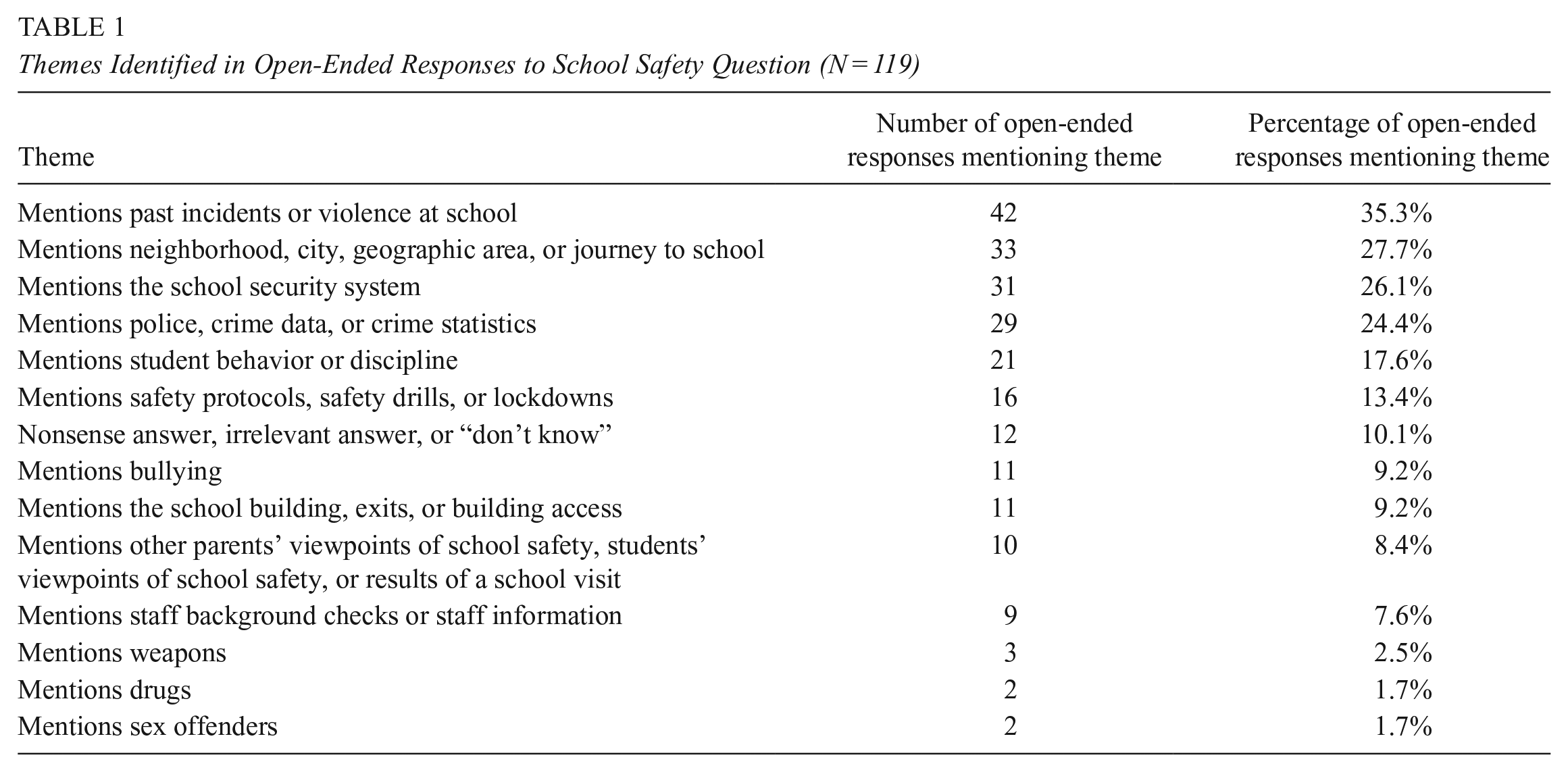
Following this open coding, we returned to each response to identify whether each of the identified themes was present in each of the write-in responses provided by participants. Written responses were coded according to whether they addressed any of the 14 identified themes. Of the 119 written responses that we received, 47 (39.5%) were coded for just one theme, while 45 (37.8%) were coded for two themes. One particularly lengthy response was coded for seven themes. The mean number of themes identified in the responses was 1.9. A complete list of all themes, along with their frequencies in the written responses, is presented in Table 1.
Themes Identified in Open-Ended Responses to School Safety Question (N = 119)
In the section that follows, we turn to the results of our analyses. Our first research question—What do patterns of “don’t know” responses reveal about parents’ uncertainty in evaluating hypothetical schools?—draws on the quantitative RRASS data. We begin by documenting the frequency of “don’t know” responses across our three key survey questions, paying particular attention to the degree of overlap among these responses. We also examine whether those who selected the “don’t know” option differed significantly on salient social, demographic, and economic indicators from those who selected a fixed-choice response. After establishing that school safety prompted the most uncertainty among our respondents, we address our second research question—What additional information would parents like to know in order to assess a hypothetical school’s safety?—using the qualitative comments that respondents provided when given the opportunity to elaborate on their “don’t know” responses. Through this analysis of qualitative responses, we shed further light on the decision-making processes of U.S. parents and provide important insights for researchers seeking to design experimental modules for future research.
Results
The discrete school characteristics that respondents encountered in the vignette influenced their perceptions of school safety, a topic we have previously explored in detail (see Billingham et al., 2020). Most respondents chose one of the four fixed-choice response options to each of the three questions, and those responses yielded clear patterns related to the characteristics varied in the vignette. Respondents were significantly more likely to evaluate the school as safe when they encountered the more relaxed school security scenario, with 82.3% calling such a school “very safe” or “somewhat safe,” compared to only 58.3% of respondents providing similarly positive evaluations of hypothetical schools featuring armed security guards and metal detectors. Perceptions of safety were also affected by the school facilities and academic performance variables, as respondents tended to rate schools as less safe when they had gone longer periods since renovation and featured lower academic test scores. Finally, school racial composition had an impact on overall perceptions of safety, as well. As Figure 1 indicates, participants who chose one of the fixed-choice responses tended to view hypothetical schools as less safe, on average, as the Black proportion of the student body increased.

Proportion of respondents who believe hypothetical school is “very safe” or “somewhat safe,” by Black proportion of student body in hypothetical school.
However, though most participants chose one of the fixed-choice response options to the school evaluation questions, a substantial proportion of the sample answered “don’t know,” and were invited to provide additional information to help explain their choices. Who were these respondents, and what motivated their choices?
Quantitative Findings
“Don’t Know” Responses Across the Three Questions
Of the 1,259 participants in the survey, 64 (5.1%) selected “don’t know” when asked how academically suitable they perceived the hypothetical school to be, and 70 (5.6%) selected “don’t know” when asked how likely they would be to enroll their child in the school. There was partial overlap in the patterns of “don’t know” responses between these two questions, with 35 individuals saying “don’t know” to both. By comparison, “don’t know” responses to the school safety question were nearly twice as common, with 129 respondents (10.2%) choosing this option. Again, there was substantial overlap in “don’t know” responses between this question and the others: 33 respondents selected “don’t know” for both the safety question and the enrollment question, and 37 selected “don’t know” for both the safety question and the academic suitability question. In total, 168 people said “don’t know” to at least one of the three questions, and 26 people said “don’t know” to all three questions. Descriptive statistics on the full sample of respondents, as well as the 129 people who answered “don’t know” to the school safety question, are presented in Table 2. 1
Means and Percentages on Hypothetical School Characteristics and Key Demographic Indicators for the Full Sample of Respondents and for Respondents Who Answered “Don’t Know” on the School Safety Question

Respondents who selected “don’t know” to a question about the hypothetical school were immediately presented with a text box inviting them to explain what additional information they would need in order to make an informed decision. While some participants left this box blank, the overwhelming majority offered comments, providing us with a dataset of unstructured parental reflections on school evaluations. Of the 64 people who said “don’t know” to the academic suitability question, 56 (87.5%) entered a written response; and of the 70 respondents who said “don’t know” to the enrollment question, 58 (82.9%) wrote something in the text box. Here again, the safety question stood out. Among the 129 respondents who said “don’t know” to this question, 119 (92.2%) provided a written response.
Patterns Among “Don’t Know” Respondents
The full sample of survey respondents contained larger proportions of higher-income people, non-Hispanic White people, and people with postsecondary educational attainment than the general population (as indicated by American Community Survey data for the U.S. population during the year the survey was conducted). Specifically, approximately 17% of respondents reported household incomes below $50,000 (compared to 37% of U.S. families), while 38% reported incomes above $100,000 (compared to 30% of U.S. families). Non-Hispanic White people comprised over three-quarters of the full sample (compared to 62% of the U.S. population), while Black and Hispanic respondents comprised approximately 6% and 8%, respectively (compared to 12% and 17% of the U.S. population, respectively). These trends were slightly amplified among the subsample of respondents who said “don’t know” to the questions about the hypothetical school, as Table 2 illustrates, though there were no statistically significant differences in income or educational attainment between the full sample and the subsample of respondents who selected “don’t know.”
It is important to draw attention to the composition of the sample and the ways in which it deviates from the characteristics of the U.S. population. The disproportionately White and affluent nature of the full sample is likely due to the population of potential respondents in the SMA pool. Among the sample in this dataset, we cannot say definitively why people of color were less likely than White respondents to select “don’t know” and offer a written response, but these trends are reflective of pervasive racial and socioeconomic disparities in access to schools of choice in the United States. As Wang et al. (2019, pp. 46–50) reveal, White parents, more highly educated parents, and more affluent parents are far more likely to report that they moved to a neighborhood specifically to give their children access to a specific school, that they shopped around for school options, and that they actively chose the school their children would attend.
Nevertheless, there were no significant differences by respondent race, gender, income, or educational attainment in the patterns of “don’t know” responses to any of the three questions, and most other respondent characteristics—including family composition and the enrollment patterns of their own children—appeared to be only minimally related to selecting “don’t know” for any of the questions. 2 In addition, most characteristics of the hypothetical school had little bearing upon the likelihood that respondents would select “don’t know.” There were two noteworthy exceptions to this trend, both relating to the school safety question. There was a significant association (χ2 (df = 9) = 21.9, p < .01) between the quality of the school facilities (as measured by the number of years since the school’s last renovation) and responses to the school safety question, such that respondents were more likely to say they did not know how safe the school was as the school’s facilities became more dated. This finding makes sense; though the age of a school per se may be an ambiguous indicator, older facilities are more likely to be obsolete, dilapidated, or hazardous, and parents may well have been concerned about potential safety issues emerging from such structures.
Even more pronounced was the impact of the hypothetical school’s security system on respondents’ perceptions of the school’s safety. Respondents were significantly more likely to say “don’t know” to the school safety question when they were told simply that they were greeted at the school entrance by the school secretary and had to sign in at the front desk. Among respondents presented with this information, 15.3% said they did not know how safe the school was. When presented with a scenario involving a metal detector, bag search, and armed security guard, a far smaller proportion (5.3%) said “don’t know” in response to the school safety question (χ2 (df = 1) = 34.2, p < .001).
Clearly, the school safety question stood out as more difficult to answer, especially for those presented with the more relaxed of the two security scenarios in the hypothetical school vignette. What was it about this dimension of the school evaluation process that caused trouble for some respondents? We devote the remainder of the analysis to this question by examining the voluntary text responses provided by respondents when they were asked what additional information they would require in order to make an informed evaluation of the school’s safety.
Qualitative Findings
Probing Open-Ended Comments to Examine Respondents’ Safety Concerns
The themes that we identified most frequently in respondents’ answers to the open-ended prompt related, not surprisingly, to facts about the school that had not been specified in the vignette. In particular, many participants wanted to have more information about the school’s history with safety issues; details about past incidents; and a greater amount of data on rates of misbehavior, crime, and violence. Out of the 119 written responses, 42 (35.3%) made reference to past incidents at the school. As the following examples illustrate, these parents felt that knowing about the school’s handling of past incidents would provide them a fuller context to evaluate the hypothetical school:
“I would need information about whether there has been a problem with violence at the school, how it was resolved, and their general policies surrounding violence, bullying, etc.” (Mother of two from San Mateo, CA)
“What is the atmosphere in the school . . . have their [sic] been any incidents that would put my child in danger?” (Father of one from Gaithersburg, MD)
“Report from this school on incidents by category that resulted in suspension or expulsion. I’d then compare that to other schools in the county.” (Mother of two from Arlington, VA)
The desire for information about the school’s past, including details on previous incidents, was identified in all of these responses, and others. However, it is important to note that there was variation in the specific content across responses; some, like the mothers from San Mateo and Arlington quoted above, drew attention to the policies at the school for dealing with disruptive incidents, while others focused squarely on the perpetrators who they feared might put their own children at risk. What these responses shared in common was an understanding that prior problematic events at the school could serve as red flags warning prospective families about potential future dangers. Such concerns about past incidents and what they might reveal about the school were noted, as well, in another key theme identified in the responses: a request for data on crime, police reports, and violence. Among the 119 responses, 29 (24.4%) made reference to these sorts of statistics. (There was some overlap here, as eight of these cases were also coded as seeking details about past incidents at the school.) For example, a father of one from Saint Paul, MN, requested a “comparison of relevant data such as injury rates, suspensions, incidents of bullying, theft.”
Along with these general statements about data, statistics, and past incidents at the school, respondents mentioned several specific characteristics of the school, its staff, students, facilities, and policies. Of the 119 written responses, 16 (13.4%) said they would require more information about school protocols regarding lockdowns and drills, 11 (9.2%) made specific comments about bullying, 9 (7.6%) wanted to know more about the staff and its level of training, 3 (2.5%) had questions about drugs at the school, and 2 (1.7%) made statements about weapons.
In addition, 31 people (26.1%) asserted that they needed to know more information about security at the school, especially whether there were guards present. The majority of those seeking more information about guards consisted of respondents who had been presented with a vignette that made no mention of a guard. Some, however, who had been given a scenario involving a heightened security apparatus explicitly mentioned that the security system—and, in particular, the guard mentioned in the vignette—gave them pause. “Don’t want a guard at an elementary school,” wrote a father of one from San Francisco, CA. A mother of three from Greenmount, MD went further, stating bluntly, “I don’t feel it’s safer because there is a security guard there. In fact it makes me nervous and I would hate for my child to be greeted by ‘cops’ every morning.”
Prioritizing Safety beyond the School Walls
As a reminder, those who selected “don’t know” in response to the school safety question were given a school-specific follow-up question: “What information would you need to know about the school in order to determine whether or not it is safe for children?” In light of this phrasing, perhaps the most noteworthy finding in our analysis was how frequently respondents’ comments focused not on the school—as prompted—but instead on the neighborhood, the city, or the journey to school. Indeed, requests for information about the school’s neighborhood or location were among the most commonly mentioned responses to the open-ended question about school safety, second only to mentions of past incidents at the school. Out of the 119 typed responses, 33 (27.7%) made reference to the school’s neighborhood, area, city, or the journey from home to school.
Many of these responses were brief and to the point, but they demonstrate how “school safety” may be defined by parents not just in terms of the school itself, but also vis-à-vis the surrounding area, as illustrated by this sampling of entries:
“information regarding the community and crime statistics” (Father of two from Liberty Township, OH)
“neighborhood demographics and stats” (Mother of one from Cleveland, OH)
“crime rates in area” (Father of one from Canoga Park, CA)
“area crime rates” (Mother of one from Augusta, GA)
“crime rate of the surrounding area” (Mother of two from Washington, IL)
“neighborhood, crime rate” (Father of two from Van Nuys, CA)
For all of these respondents, the supplementary information that they sought involved not the school itself but the surrounding community.
For others, concerns about the neighborhood or city were tied in with their desires to know more about the school itself. This manner of thinking about the school and neighborhood in tandem was illustrated by a father of three from Lake Forest, CA, who said that he would like to learn more about school and area crime statistics, visible graffitti [sic] - more about the neighborhood than the school. Assuming that i [sic] live there, i [sic] would think it is safe to assume the school is safe, but still based on a theoretical question there is not enough information to honestly answer.
This father drew a clear distinction between neighborhood and school, largely taking for granted the safety of the latter while problematizing and prioritizing concerns regarding the former. A similar sentiment was expressed by a mother of one from Katy, TX, who wrote that she “would need to know about crime in the general area and on campus.” For this respondent, concerns about crime and safety were linked to the school itself (the “campus”), but clearly extended beyond that limited space, encompassing the broader area. The link between the characteristics of the school and neighborhood was also made explicit by a few parents who commented on the journey to school, implying that threats may face their children as they travel to and from school each day. For example, in order to properly evaluate the hypothetical school for her child, according to a mother of three from Chicago, IL, “I’d need to walk the route with a child in the morning and afternoon.”
Several people inquired about people who inhabited the neighborhood—most notably, sex offenders. One participant, a mother of one from Rossmore, CA, wrote that before she could determine whether the school was safe, she would need to “check sex offenders living near the school; find out about crime in the neighborhood surrounding the school.” Another parent, a father of three from Frederick, MD, included in his list of additional details that he would need in order to assess the school’s safety, “background info of teachers and staff and leadership, physical security at school, number of registered sex offenders and predators in the vicinity, etc.” Speaking a bit more broadly, a mother of one from Duxbury, MA wrote that she “would be concerned with the surrounding neighborhood, is it depressed or have unsavory people hanging out.” As these comments suggest, when evaluating the safety of a potential school for their children, parents may consider not only the school staff with whom their children will necessarily interact, but also outsiders whose only relationship with the school is their physical proximity to it. It is possible, of course, that respondents drew mental associations between the characteristics of the surrounding neighborhood and the characteristics of the school, using the former as a proxy for the latter when making decisions about schools. However, given the frequency with which respondents mentioned discipline and behavioral incidents within the school—and the tendency for some respondents to ask for more information about both the school and the neighborhood—it seems likely that many respondents held sincere concerns about the surrounding environment that were distinct from their concerns about the school.
Limitations
There are some limitations that should be acknowledged when considering the implications of our findings. First, the number of survey respondents providing detailed responses to the open-ended prompts was small; most respondents chose one of the fixed-choice response options to the survey questions. Future research could explore the extent to which the written comments shared by these respondents resonate with a larger sample of parents. The data were also collected before the COVID-19 pandemic affected school enrollment patterns across the United States. While we cannot state unequivocally that these findings apply to the present school choice environment, the fact that conversations concerning both parental choice and school safety have only grown in intensity since we collected our data strongly suggests the continued relevance and importance of this topic.
More highly educated people, higher earners, and non-Hispanic White people were overrepresented in the sample, relative to their proportion of the U.S. population. 3 This has potential implications for the generalizability of the findings. For example, the portion of the vignette prompt informing respondents that opting out of the hypothetical school would require that they “send your child to an expensive private school, home-school your child, or move to another neighborhood or city” may have been deemed more feasible for our survey participants than the general American population.
These patterns reflect longstanding disparities in survey response patterns (Royal, 2019) and in school choice behavior (Wang et al., 2019). Regarding survey response rates, past research has found that Black survey participation rates are often significantly below White participation rates, for reasons that may include logistical issues, distrust of researchers, and skepticism about the degree to which their responses will be taken seriously (Royal, 2019). The representativeness of the sample should be acknowledged when considering the implications of the findings for school choice policy. It is likely that the results reported here most clearly reflect the attitudes of more affluent White parents in the United States, and extrapolation to the attitudes of other groups should be undertaken with caution.
Although the original survey contained questions related to racial attitudes, no one mentioned neighborhood racial characteristics explicitly in their typed answers regarding additional information they would like to have about the school in order to evaluate its safety. In fact, there was only one comment about race among all of the open-ended responses. This may be due in part to the fact that all respondents received information on the racial composition of the hypothetical school, making it unnecessary for them to request additional information on the topic. Nevertheless, the absence of race in the voluntary written answers is noteworthy, given the fact that the racial composition of the student body did have a significant effect on perceptions of school safety among those who chose one of the fixed-choice response options, as illustrated in Figure 1.
Previous research suggests that White Americans may conceptualize school safety in race-evasive terms. Several strains of research indicate that race is invoked in indirect and subtle ways by Americans when talking about social issues. Research on “colorblind racism” (Bonilla-Silva, 2018; Carr, 1997; A. E. Lewis, 2001), for instance, documents how Americans account for race-based inequality with a variety of rhetorical moves attributing the existence and persistence of racial disparities to factors other than racism. We also know that racism is, in part, an unconscious process operating at an implicit level owing to Americans’ socialization into a culture with potent anti-Black stereotypes and biases that shape the perception of nonracial objects in racialized ways (Banaji & Greenwald, 2016; Greenwald et al., 1998). Whether the bias is conscious and/or unconscious, however, many social issues, including crime (Quillian & Pager, 2001, 2010), neighborhood disorder (Sampson & Raudenbush, 2004), politics (Haney-Lopez, 2013), school quality (Goyette et al., 2012), and neighborhood choice (Krysan, 2002) are profoundly racialized. As such, it is important to note that, while “don’t know” participants did not explicitly invoke race in their typed responses, that does not necessarily mean that racial concerns were absent from their thinking about issues related to safety. 4
Finally, although we have analyzed patterns in the “don’t know” responses and their relationships with other survey variables, we cannot state definitively what motivated any given respondent to select “don’t know.” Though many respondents’ uncertainty clearly appeared to reflect a lack of information, it is possible that, for some, the choice of “don’t know” was used as a way to avoid responding (due to social desirability bias or a similar rationale). Nevertheless, offering respondents who selected this option the chance to provide more information in their own words allows for new insights that would not be possible if those responses were simply discarded or coded as “missing data.”
Discussion
By utilizing unique qualitative data from survey respondents whose “don’t know” answers are often discarded as “noise” or methodological problems to be fixed in statistical analyses, this research adds to the understanding of parental school choice. In particular, we have demonstrated that, while safety remains a paramount concern for parents as they consider where to enroll their children, evaluations of and understandings of the concept of “school safety” may be ambiguous. Parents take a number of factors into account when attempting to determine whether or not a school is safe, and, as their open-ended responses to our survey reveal, those factors sometimes relate not to the school itself, but to the neighborhood within which the school is situated, the characteristics of the surrounding vicinity, and the potential for threats along the commute from home to school.
Implications for Education Policy
The results reported here help to advance current debates regarding school choice and education policy in the United States, particularly in the public school sector. (Because the vignette presented to respondents was specifically tailored to public school choice, the implications for private schools and other forms of choice may be more limited.) The intricate connections between schools and neighborhoods are central to academic research on such broad issues as school segregation, the inequitable distribution of resources and academic outcomes, and perceptions of school quality. A growing literature in education studies examines how changing neighborhood demographics affect the demographic composition of neighborhood schools, as well as their academic outcomes. Other studies examine how students’ perceptions of the level of safety in their neighborhoods influence how safe they feel at school.
What the current research adds is a fuller understanding of how these issues are associated with the complex process of school choice for parents. This is not the first study supporting the argument that neighborhood context matters when thinking about school choice. Among other factors, logistical issues such as distance, transportation options, and school attendance zone boundaries all affect which schools parents consider for their children. However, this research reveals that, when parents weigh issues like school safety, they are thinking not just about the safety of their children inside the school walls; they are also considering the safety of the environment that will surround them as they make their way to and from school, and how neighborhood conditions may seep into schools. This finding supports past quantitative research demonstrating that local crime can play a significant role in affecting parents’ attitudes about schools (Burdick-Will, Geebo, & Williams, 2024; Burdick-Will, Stein, & Grigg, 2019; Hailey, 2020).
The composition of the sample used in this research—in particular, the relatively low rate of participation among people of color—also has implications for policy. Limited representativeness and racial and ethnic diversity “both skews overall results and may distort the inferences researchers make about the findings” (Royal, 2019, p. 59). This can include policy recommendations. To the extent that findings and implications stem from analyses of data from disproportionately White samples, conclusions and recommendations may reflect bias, potentially reinforcing a “politics of whiteness,” which, as Castro et al. (2022) showed, can have profound effects on school rezoning and redistricting processes. Such actions may, in turn, perpetuate patterns of segregation, further entrenching racial inequalities in schooling (Owens, 2020).
Implications for School Practice
Despite devastating high-profile incidents of violence, schools are, on average, places where most children experience physical safety (Irwin et al., 2023; Musu et al., 2019). While rates vary across institutions, demographic groups, and geographic areas, most indicators of violence and crime have generally been on the decline over the past several decades, even as institutional responses designed to prevent incidents (especially mass shootings) have increased. These protective measures can make schools appear particularly dangerous, even if, by and large, children are safer in school compared to nonschool contexts (Musu et al., 2019).
As noted in past research, perceptions of some schools as unsafe may lead parents to write off a number of options for their children, exacerbating racial segregation and leading to widening inequalities between schools (Billingham et al., 2020). To the extent that schools can serve as key institutions driving neighborhood inequalities, perceptions (accurate or not) can serve as critical mechanisms reinforcing stratification between neighborhoods, as well. In previous work, we have recommended that, as districts increasingly emphasize parental choice, schools take steps to highlight how safe they are, utilizing the channels established to inform parents about their options (e.g., choice fairs). Our findings here suggest that school and district administrators could arguably expand that effort to highlight neighborhood safety as well, ensuring and promoting the availability of safe transportation, and engaging with neighborhood groups to maintain and advertise the safety of students’ passage to and from school.
Of course, information can be a double-edged sword. As some studies suggest, parents may view schools with a heavy security presence as less, rather than more, safe, perhaps inferring that such measures are warranted to protect against real and present dangers. Thus, it may also be the case that highlighting public safety data about the neighborhood surrounding a school could be counterproductive to the goal of attracting families, serving instead to increase the salience of safety risks and related fears about crime. Future research could address this issue by examining the effect that providing parents with concrete information about neighborhood and school safety during the school choice process has on the likelihood that parents will select a given school.
Our study also provides a reminder that, particularly for schools in distressed urban areas, there may be limits to what schools can do to attract families who have multiple options. If schools are evaluated, in part, on the basis of factors that are beyond the control of school administrators (e.g., the neighborhood conditions where the school is located), even the schools rated most highly in terms of academic quality may face challenges with enrollment or retention. More broadly, it challenges the common narrative among school choice advocates that the embrace of market-based reforms should reduce inequities in education outcomes (see, e.g., Peterson, 2020). A key principle undergirding school choice maintains that if parents are empowered to choose, schools will be forced to compete, thereby improving overall academic quality and weeding out underperformers (Chubb & Moe, 1990). As Barseghyan et al. (2014) noted, “parents’ school preferences depend not only on school productivity but also on factors outside of a school’s control (e.g., the neighborhood surrounding the school)” (p. 1). Thus, if parents prioritize factors beyond the performance of the school itself—for example, their beliefs about the safety of the neighborhood where the school is located—not only might they avoid schools that could produce better academic outcomes, but schools themselves may also have fewer incentives to improve. Finally, these findings could also have implications for our understanding of why public school closures have increased in recent years, particularly in urban neighborhoods with higher percentages of Black residents and higher rates of socioeconomic disadvantage, as well as those undergoing gentrification (Brazil & Candipan, 2022).
We must remain cognizant of the racialized barriers to school choice that continue to disproportionately limit educational opportunities for certain groups in U.S. society. In particular, Black parents are uniquely constrained by race and racism in making school choice decisions. Studying such decision-making practices, Posey-Maddox et al. (2021) found that race and racism directly impact Black parents’ decisions, especially in shaping risk-assessment strategies and myriad other factors involved in the school-choice process. Regarding the findings reported in this article, if Black parents believe that “no choice is the ‘right’ choice,” they may be less inclined to ask the kinds of questions White parents ask, perhaps focusing instead on finding the least-harmful path toward “a high-quality education within highly racialized schooling contexts” (Posey-Maddox et al., 2021, p. 39).
Implications for Future Research
It is critical, both to promote racial equity in social science and to generate more reliable and representative social science datasets, that future research continue to work to improve survey response rates among underrepresented groups, and among Black respondents in particular. Strategies to achieve these goals may include utilizing stratified or quota sampling to ameliorate sampling bias, along with sampling weights to statistically adjust for nonrepresentativeness. Additional efforts—such as engaging in personal visits, augmenting incentives, and improving communication with potential respondents about why participation is important for underrepresented and underserved communities—can serve to enhance trust between survey researchers and respondents (Royal, 2019).
One way for researchers to make the most out of their data and draw attention to the voices of underrepresented communities is to ensure that data that are often discarded, such as “don’t know” responses, are examined in detail, as we have done here. As such, it is important to draw attention to the methodological implications of this study for future research efforts. Fixed-choice response questions in surveys are necessary and informative but, by their very nature, can also be limiting. Even in survey contexts designed to yield quantitative data, our research illustrates the power that giving respondents flexibility can have in enriching social science inquiry. Allowing respondents to answer “don’t know” to complicated survey questions, and then providing them the opportunity to elaborate, can illuminate less obvious patterns in social behavior and can be instrumental to researchers as they work, in an iterative fashion, to refine their methodological approaches and ask better questions. More broadly, this study demonstrates the potential insights to be gained by searching for innovative ways to utilize data that may otherwise be overlooked or discarded in traditional analyses.
Footnotes
Acknowledgements
An earlier version of this article was presented at the Education Reform, Communities, and Social Justice Research Conference, hosted virtually by Rutgers University, June 2, 2021. The authors thank the editors and anonymous reviewers for productive feedback on prior versions of this article.
Declaration of Conflicting Interests
The author(s) declared no potential conflicts of interest with respect to the research, authorship, and/or publication of this article.
Funding
The author(s) disclosed receipt of the following financial support for the research, authorship, and/or publication of this article: This research was supported by Wichita State University via Research/Creative Projects Award #U15009.

Notes
Authors
CHASE M. BILLINGHAM is an associate professor in the Department of Sociology, Wichita State University, Wichita, KS 67260;
SHELLEY M. KIMELBERG is an associate professor in the Department of Sociology, University at Buffalo, SUNY, Buffalo, NY 14260;
MATTHEW O. HUNT is a professor of sociology, Department of Sociology & Anthropology, Northeastern University, Boston, MA 02115;