




Abstract
Research-practice partnerships (RPPs) are gaining international attention as they promise to close the gap between research and practice in education. As RPPs bring together participants with diverse expertise, how people dialogue to collectively learn and address problems of practice is critically important. Analyzing video data from RPP meetings in Switzerland and the United States, this micro-analytic study examines the extent of generative discourse in RPP meetings and the conditions under which it occurs. Since RPPs vary significantly along a number of dimensions, it is useful to compare them to see how these features influence discourse and learning. Across the Swiss and US contexts, almost half of the meeting time was generative—altering meanings and/or creating new knowledge and perspectives. Discourse patterns varied, however, reflecting the different sizes, purposes, and activity structures of the RPPs. Examining meeting discourse across conditions may help promote knowledge generation and continuous improvement in RPPs.
Keywords
The disconnect between research and practice is a global phenomenon. Research-practice partnerships (RPPs) are gaining international attention as they offer a promising strategy for supporting educational change and closing the gap between research and practice (Farrell et al., 2021; Lai et al., 2020). As RPPs bring together a range of participants, how people dialogue to collectively learn and address problems of practice is of critical importance (Farrell et al., 2022). Emerging research provides insight into the discourse of researchers and practitioners (Farrell et al., 2019; Gomoll et al., 2022; Thompson et al., 2019) who have different languages and ways of working (Brown & Allen, 2021). Since RPPs vary significantly in their complexity, composition, and goals (Farrell et al., 2021; Kipnis et al., 2020), it is useful to look across them to see how these features influence discourse and learning in RPPs. As Coburn and Penuel (2016) explain, “We need comparative studies that investigate how RPPs of different designs interact with their contexts to impact various outcomes of interest,” especially studies of RPPs that have “similar aims but different designs” (pp. 51–52). Although RPPs are gaining interest globally, there is a dearth of research that studies RPPs across national contexts, which offer an additional layer of variation.
This study aims to investigate discourse in RPPs in the US and Switzerland. We develop and use an analytical tool to describe and compare dialogue during RPP meetings. We examine the extent to which RPP meetings are characterized by generative discourse (Lefstein et al., 2020) and explicate the conditions under which it occurs. Generative discourse is defined as “engagement between two or more people that transcends the superficial, altering certain meanings or processes and/or generating new knowledge” (Beech et al., 2010, p. 1342). By examining discourse patterns in micro-interactions, this study helps to illuminate whether RPP meetings are sites of joint productive activity, as generative discourse is an important indicator of learning. We assume that practice change occurs through the integration of diverse expertise, and we can examine this possibility through generative discourse.
Background and Literature Review
Research-Practice Partnerships
Research-practice partnerships are deliberate, sustained relationships between researchers and practitioners to address problems of practice. Farrell et al. (2021) define an RPP as: A long-term collaboration aimed at educational improvement or equitable transformation through engagement with research. These partnerships are intentionally organized to connect diverse forms of expertise and shift power relations in the research endeavor to ensure that all partners have a say in the joint work. (p. iv)
A common defining feature is that they involve research organized around educators’ concerns to inform action within the setting and beyond (Denner et al., 2019; Farrell et al., 2019; Henrick et al., 2017). The research within RPPs can involve multiple approaches, including research alliances, design partnerships, and networked improvement communities (Coburn et al., 2013; Farrell et al., 2021; Penuel et al., 2020). Henrick et al. (2017) argue that RPPs should promote the agency of those involved and generate knowledge to inform improvement.
RPPs intentionally attempt to shift relations of power between researchers and practitioners (Farrell et al., 2021). Rather than a typical researcher-practitioner relationship in which the primary flow of information is from researchers to practitioners (Penuel et al., 2015), RPPs emphasize a co-construction of knowledge both in defining the research problem and in shaping the work as it unfolds. Weddle et al. (2021) explain that “Communication within these relationships is bidirectional, with both researchers and practitioners sharing insights about the design, implementation, and study of their joint work” (p. 2). Learning is intended to occur for both researchers and practitioners (Brown & Allen, 2021; Gomoll et al., 2022). As RPPs bring together people with diverse expertise (Farrell et al., 2021; Tabak, 2022), discourse is a critical issue. As Brown and Allen (2021) state, “Practitioners and researchers live in different professional worlds, each with its own institutional language and norms, hierarchies, incentive systems, and approaches to solving problems” (p. 21). As such, the dialogue between them has been described as a form of cultural exchange (Bevan et al., 2018). Partners often need to navigate different timelines, communication tools, and ways of describing their work (Denner et al., 2019; Farrell et al., 2022; Penuel et al., 2015). Attending to the discourse patterns within RPPs is important because, as a participant in Farrell et al. (2021) study noted, “One of the important dynamics in shifts when you start taking on equity deeply in an RPP is to recognize how you make room for real learning within this work” (p. 23).
As the definition by Farrell et al. (2021, p. iv) suggests, RRPs are expected “to connect diverse forms of expertise”—in other words, to create new forms of knowledge and facilitate learning. This topic was addressed by the Collaborative Education Research Collective (2023). Acknowledging the complex nature of learning, these authors developed a framework consisting of five core ideas (systems landscape, interpersonal relationships, intrapersonal relationships, resource mobilization, and educational research). The Collaborative Education Research Collective (2023) also pays attention to power issues. For example, they ask, “How can we collaboratively build routines for meeting, communicating, interacting, and decision-making to promote power sharing and system transformation?” (p. 24). Notably, “supporting productive interactions” is a key component of enabling learning in an RPP (Collaborative Education Research Collective, 2023, p. 24). As Kipnis et al. (2020) explain, examining moves in RPP meetings can illuminate what facilitates communication in different RPPs that vary by age, composition, and other features.
Generative dialogue is an indicator of learning that is expected to occur within RPP spaces. In their framework for understanding RPPs, Farrell et al. (2022) explain that meetings within RPPs constitute a boundary practice where learning could occur at the intersection of research and practice. However, while research has focused on learning in the context of RPPs (e.g., Collaborative Education Research Collective, 2023; Farrell et al., 2022), few studies focus on the microlevel of discourse in RPPs to see how learning may operationalize in RPPs (for exceptions, see Farrell et al., 2019; Gomoll et al., 2022; Tabak, 2022; Thompson et al., 2019). Farrell et al. (2019) coded episodes of sustained conversations in RPP leadership meetings to examine how participants talked about their roles and their partnerships. Gomoll et al. (2022) analyzed the discourse between a teacher and a researcher as they reflected on a previous lesson by watching videos while simultaneously codesigning the next lesson. Their analysis made specific interaction patterns between the partners visible and provided a detailed trajectory of their codesign process. Thompson et al. (2019) analyzed discourse in an RPP using video data to examine how teacher professional learning communities launched instructional improvement work. They noted “stretches of conversation where teams engaged in interconnected Learning Loop discourse” (Thompson et al., 2019, supplementary material, p. 1). which they “considered generative conversations” . Tabak (2022) emphasizes the importance of analyzing utterances in interactions in RPPs “to better understand how to establish and sustain productive tension” based on the different backgrounds of the participants (p. 175). Our study aims to add to this emerging body of literature, focusing on generative discourse in RPP meetings, examining the proportion of generative talk during RPP meetings and how generative talk emerges.
Generative Discourse
Since RPPs are built on the expectation that learning occurs for researchers and practitioners, this study is especially interested in identifying generative discourse sequences. In conceptualizing generative discourse, we draw on examples of literature examining discourse in classrooms (e.g., Clarke et al., 2015; Lodge, 2005; Ryu & Sandoval, 2012), discourse among teachers (e.g., I. S. Horn & Little, 2010; I. S. Horn et al., 2017; Lefstein et al., 2020; Saunders et al., 2023; Sutton & Shouse, 2018; Zoethout et al., 2017), and discourse in other (nonschool) organizations (e.g. Beech et al., 2010; Edmondson, 2016; Paydon & Ensminger, 2021).
Some of these studies are grounded in sociocultural learning theory, 1 understanding learning as a social process (Vygotsky, 1978) and emphasizing a strong interdependence between learning and discourse: “learning is mediated or constituted by discourse” (Lefstein et al., 2020, p. 4). An often-mentioned point is that “[d]ialogue is about engagement with others through talk to arrive at a point one would not get to alone” (Lodge, 2005, p. 134). Studies analyzing discourse in classrooms ask how classroom discourse supports students’ learning and how teachers enable such discourse (Clarke et al., 2015; Lodge, 2005; Ryu & Sandoval, 2012). Studies focusing on teacher teams are often connected to professional learning (I. S. Horn and Little, 2010; I. S. Horn et al., 2017; Sutton & Shouse, 2018). For example, I. S. Horn and Little (2010) described discourse trajectories during teacher meetings differentiating more and less knowledge-generating patterns. They stress the collective character of the learning: “[D]ifferences in the generativity of the group discourse cannot be attributed to the individual teachers’ personal and professional dispositions but should be seen as resulting from each group’s collective orientation and its contextual resources and constraints” (I. S. Horn & Little, 2010, p. 211). Relatedly, Saunders et al. (2023) draw on a conceptual paper by Lefstein et al. (2020) to show how a specific training program influences pedagogically productive talk. In Lefstein et al.’s (2020) conception, several characteristics are common in generative discourse among teachers: revealing problems from teaching practice; providing evidence or reasoning; making connections to general principles; building on others’ ideas so members may have a shared frame of reference; and offering different perspectives to understand a problem in a new way (pp. 8–10). Zoethout et al.’s (2017) study of teacher teams notes the importance of building on others’ ideas as a component of generative dialogue. A dialogic stance means that team members have “shared responsibility for furthering collective understanding” (Lefstein et al., 2020, p. 9).
In examining how researchers and practitioners engage together in organizational settings outside schools, Beech et al. (2010) define discourse as generative when it goes beyond the trivial and creates new knowledge. Similar themes are evident in Edmondson’s (2016) book on teaming in organizations, which explains that “conversing about experiences, insights, and questions builds understanding of new practices and how to perform them.” Overall, research on collaborative discourse could yield important implications for practice. As Zoethout et al. (2017, p. 119) explain: “[. . .] knowing how team learning processes emerge from conversations could enable researchers to better understand team learning and could enable team leaders to better use the team’s full potential as a learning unit.” To understand how and under what conditions learning happens in an RPP, we need to identify the moments of dialogue where there is an opportunity for learning.
At the same time, it is important to acknowledge the presence of nongenerative discourse in meetings. Meetings often lack efficiency and fail to stimulate new perspectives. As noted by Lefstein et al. (2020), many teacher work groups focus on administrative tasks or wander aimlessly through topics. I. Horn et al. (2020) identified low-depth meetings, which involve monologic lecture planning without addressing the “how and why” of teaching. Other similar meeting patterns include discussions of “pacing,” “logistics,” and “tips and tricks” (I. S. Horn et al., 2017). Nongenerative interactions share common characteristics: they lack ties to educational concepts, evidence-based arguments, and meaningful learning objectives of the team (Thompson et al., 2019).
In this study, we describe and compare discourse in RPP meetings in two different contexts. We focus on these research questions:
To what extent are RPP meetings generative? Are there differences in the forms of generative and nongenerative discourse across contexts?
How can RPP meetings be described in terms of their structure and discursive aspects, given their varied purposes, routines, and composition? How do participants contribute to the discourse?
What are the typical instances in which generative discourse sequences occur?
By addressing these questions, we aim to contribute to an emerging body of research on discourse and learning in RPPs.
Methods
Gathering observational data allows for an understanding of a phenomenon in its real-life context (Creswell & Poth, 2016). This study draws on video and audio recordings of RPP meetings. We quantitatively analyzed the video data to describe and compare the duration and types of generative and nongenerative utterances. In this way, we can compare the share of generative and nongenerative utterances within entire meetings in each context and also meetings across contexts. This kind of quantitative analysis allowed us to identify more- and less-generative meetings and differences between researchers’ and practitioners’ share of the discourse. We also qualitatively analyzed transcripts of audio data to explicate the instances in which generative discourse occurred.
Study Contexts
This study examines data gathered across two RPPs, one in Switzerland and one in the United States. In both places, the gap between research and practice is widely recognized. However, RPPs in the US are increasingly common, whereas in Switzerland, they represent an emerging approach, and this could shape how researchers and practitioners relate to one another. We also acknowledge that broader societal discourse patterns could play a role as the meetings involved different languages (i.e., German and English), and the type and length of utterances may reflect customary ways of talking. We are attentive to the ways that these and other national differences may influence RPP meetings. That said, we also operate on the assumption that the varied contextual conditions operate on multiple levels, not just the national level. Notably, we argue that the features of the RPPs themselves create an important set of conditions that shape discourse patterns.
The RPPs were selected for study as they have some commonalities and differences. We use the categories from Farrell et al. (2021)—goals, approaches to research, funding sources, and composition—to describe them. In terms of goals, both RPPs focus on improving instruction. They aim to build the capacity of educators and researchers engaged in improvement and to scale up lessons from the projects more broadly. They have a similar approach to research by building on participant involvement in defining research questions and designing studies to address them. The methods of the studies vary, as explained later. With respect to funding sources, both RPPs were supported with foundation and university resources. In terms of composition, both RPPs include teachers and researchers; however, the US RPP also includes administrators. Besides the overarching similarities, the RPPs differ in size, concrete purpose, and activity structure, which we describe later and refer to in the analysis. These could result in some differences in communication patterns, which we explore.
The Swiss RPP is embedded in a project entitled “Participative School Improvement - Improve Instruction with Students.” The project supports student participation in four secondary schools (grades 7 to 9) by testing new participative settings (for more information, see Häbig et al., 2022). It aims to strengthen student voice (Mitra, 2018) in school improvement processes and support student learning. Data analyzed in this paper come from one type of meeting of one project school located in Canton Zurich, Switzerland. This RPP involves frequent meetings among three researchers and a teacher. The main activities of the meetings were planning and reflecting on different school events strengthening student voice. However, activities within the RPP include other types of meetings with the whole school community and meetings where all four schools are represented. The core activities of the researchers are to collect and analyze data and present research results connected to the initiated changes within each school.
The US RPP is embedded in an education neuroscience project which is aimed at using research about children’s development across school and home to inform pedagogical shifts (for more information, see Datnow et al., 2023). The project involves a partnership between a cross-disciplinary team of university researchers and educators in a racially and linguistically diverse K–12 school district serving approximately 20,000 students. For four years, the project has involved detailed data gathering about young children’s cognitive and socioemotional development—classroom and home observations to better understand their learning environments—and interviews with teachers and administrators. As part of the project, researchers, administrators, and teachers met monthly in Teacher Researcher Collaborative (TRC) meetings to reflect on the research and discuss implications for classroom practice.
There are several reasons why conducting a comparative analysis is important. First, this study provides an opportunity to compare meeting discourse in RPPs with different goals but common elements (Coburn & Penuel, 2016). Next, examining data across contexts allows for validating and utilizing a new analytical tool. Finally, the fact that this study took place across two countries allowed for a unique chance to conduct a study of RPP meetings across international contexts. Since there are no references for cross-national comparisons of RPPs on the microlevel, we see our research as a possible starting point. In addition to the comparative dimension, our aim is to understand the local implementation in the two contexts to better understand the RPPs in and of themselves (Strauss & Corbin, 1994).
Description of RPP Meetings
In the Swiss context, the analyzed meetings took place with high frequency, weekly or biweekly, on Microsoft Teams between May 2021 and May 2022. Meetings typically lasted 60 minutes; however, participants handled time flexibly. A total of 21 meetings took place over one year (see Table 1).
Overview of RPP Meeting Characteristics

Meetings had the same composition: two senior researchers (one of them is an author of this paper); a senior teacher, who was employed 10% time on the project; and a research assistant. Eight meetings were selected for analysis to provide a comparable number of meetings in both contexts. This selection represents the full variety of meetings (e.g., beginning of the RPP work, planning events, and reflecting on events) taking place approximately monthly (aside from school holidays). The agenda was set in advance in a document that could be accessed by all participants. While the analyzed meetings were virtual, it is important to note that the team interacted in person at co-planned school events and thus had an opportunity to build relationships this way as well.
In the US context, the Teacher Researcher Collaborative meetings that were part of the RPP occurred monthly on Zoom, for 90 minutes after school. Teachers were paid for their attendance at the district’s professional development hourly rate. This was the fourth year of the TRC meetings; they were formerly in person but moved to Zoom during the pandemic. Thus, relationship-building between participants took place in these earlier in-person interactions, and researchers also spent time in some teachers’ classrooms. Eight meetings occurred during the 2021–22 school year. Typically, 4–6 members of the research team, 1–2 district administrators, 8–12 elementary teachers, and 3–5 preschool teachers attended each meeting. One author of this paper is a member of the research team and attended the meetings, providing introductory remarks while other researchers led the meetings thereafter. The TRC meetings followed a common format. Researchers led the meetings, beginning with data collection updates from the research project, and then they presented preliminary data gathered in the project and/or shared extant research relevant to early education. Next, participants jointly considered the implications for classroom practice. A specific aim was for teachers to share their insights and experiences in relation to the research and to shape the ongoing work of the RPP. Reflecting the emphases of the project, topics for the meetings reflected two main themes: (1) classroom pedagogy and (2) neuroscience and education. Teachers also raised new topics that were addressed in subsequent meetings.
As the US RPP meetings were designed for feedback and dialogue among teachers, there were often opportunities for discussion and sharing interpretations in small and large group dialogues (using Zoom breakout rooms on some occasions) but also in written form in feedback documents that were cocreated within the meetings. In some meetings, three breakout rooms took place in parallel and were video-recorded and coded. Thus, the duration of the coded material was respectively higher.
Data Analysis
Data analysis involved coding videos of each meeting using MAXQDA qualitative coding software. We chose to analyze videos as they allowed us to capture the situation as it was experienced by the participants in situ. Coding video data in MAXQDA allows for systematic data management without having to rely on extensive transcription in which the spirit of interactions are not as well captured (Hennessy et al., 2016). We conducted a microlevel analysis where the unit of coding was mostly a single utterance by one person. However, longer utterances representing different types of interactions were split up into more coded units. Each segment was coded with only one code since codes were mutually exclusive. A coding system was developed based on existing literature on generative discourse, informed by the work of researchers we cited earlier (e.g., I. S. Horn & Little, 2010; Lefstein et al., 2020; Sutton & Shouse, 2018). The coding scheme included four main categories of discourse patterns, including generative discourse, nongenerative discourse structuring, and outside of a content-related discussion. Each of these parent codes had numerous child subcodes, which are listed in Appendix A and discussed later in the paper. Our main parent codes to answer the research questions were generative discourse and nongenerative discourse. Structuring refers to interactions supporting a conversation, e.g., introductions, calling on someone to speak, etc. The second category, outside of a content-related discussion, includes side conversations unrelated to the meeting topics. These two categories were relevant for the interaction during the meeting but less relevant for our research questions.
We coded several meetings together to establish a common understanding of code definitions. This process was also helpful in mitigating biases and illuminating patterns we may not have seen as participants in the meetings. We then coded single meetings separately, which were overseen by the other researcher. If we were unsure about the assignment of a code for a particular utterance, we discussed it with each other until we came to a consensus. In some cases, we needed additional codes for unpredicted interactions, which we also discussed and defined together. Coding results by each researcher were merged in MAXQDA. In a second round of coding, we coded the sequences according to the person who was speaking, allowing us to examine which groups of participants contributed what share of the discourse. In addition to the quantitative description of meeting characteristics, meaning the duration of generative and nongenerative sequences during the meeting (Lefstein et al., 2020), the context where generative discussions emerged was analyzed qualitatively and compared within and across the two RPPs.
Figure 1 elucidates the conceptual framework guiding our analysis. It centers on the discourse types we attended to in our analysis. Framing the discourse are the RPP meeting features, including the agenda and purpose, the goals of the RPP, the size and composition of the group, and the routines and expectations that shape them. As we note in this article, these aspects vary by RPP and are also important contextual elements discussed in the literature we cited (e.g., Coburn & Penuel, 2016; Farrell et al., 2021; Kipnis et al., 2020).
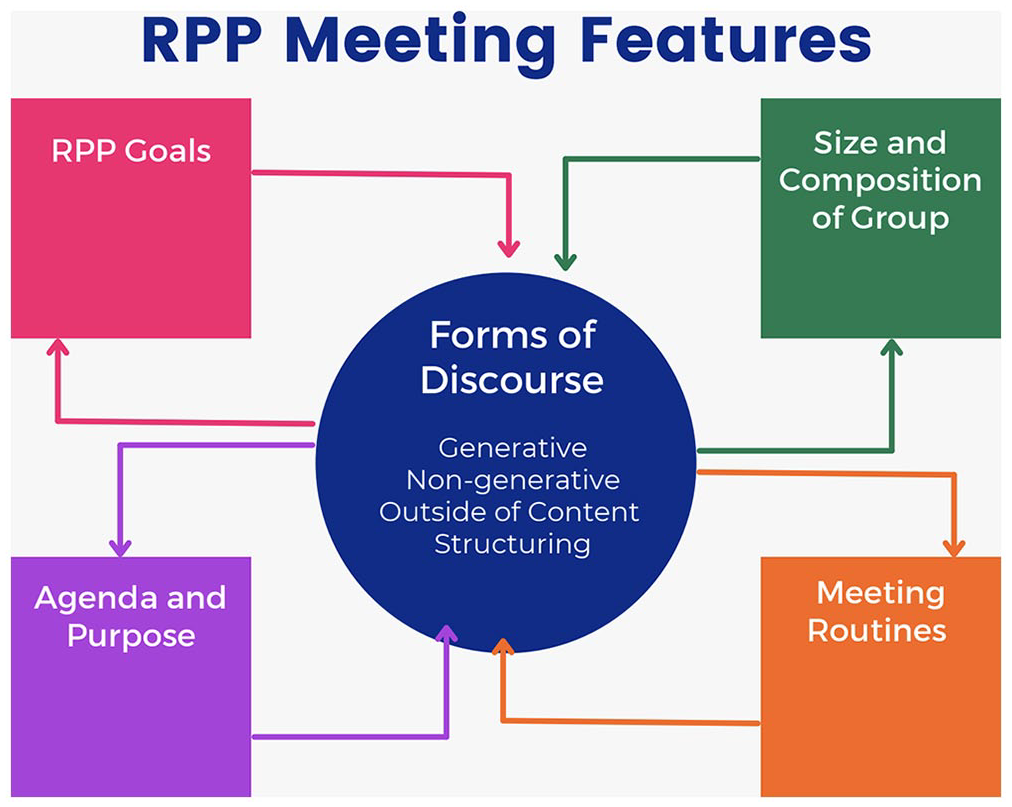
RPP meeting features and discourse types.
Applying this framework to our analysis, we describe the goals of the US and Swiss RPPs. We examined whether the difference in size and activity structures of the RPP meetings across the US and Swiss cases and within the US case (whole group vs. breakout room) impacted speech patterns. We also examined the forms of discourse in relation to the purpose of the RPP meetings as some codes (e.g., planning and logistics, describing extant research) reflect meeting activities. Looking within and across meetings, we were able to see how speech patterns were reflected in meeting routines, as meetings followed a predictable format. As discussed, we explored the impact of group composition by looking at who was speaking during each speech sequence. Finally, we were able to gain additional insight into the impact of these factors (i.e., goals, size, purpose, composition, etc.) as we reviewed transcripts of each meeting, and we drew out excerpts of meeting dialogue to illustrate how these factors came together to shape meetings in the US and Swiss case. We will refer to these comparative dimensions in the results and conclusion.
Results
The findings of our analysis are presented and discussed in three sections. First, we examine the extent of generative and nongenerative discourse in RPP meetings in a quantitative, descriptive way, discussing the types of generative and nongenerative utterances we observed. As we will explain, the two RPPs had similar levels of generative and nongenerative discourse but different types. Second, we provide an overview of the meeting structures in each RPP, presenting visuals to show the four main codes appearing during selected meetings. We explain how meeting structures and patterns vary across the RPPs, reflecting their different purposes, routines, and participants. We note which types of participants spoke at particular points in the meetings. In the third section, we present and analyze vignettes of generative discourse in each of the RPPs.
Extent to Which RPP Meetings Are Generative
In this section, we describe and compare the RPP meetings in the US and Swiss contexts and consider the extent to which meetings could be considered generative. As noted previously, the coding scheme included four main categories of discourse patterns including generative discourse, nongenerative discourse, structuring, and outside of a content-related discussion.
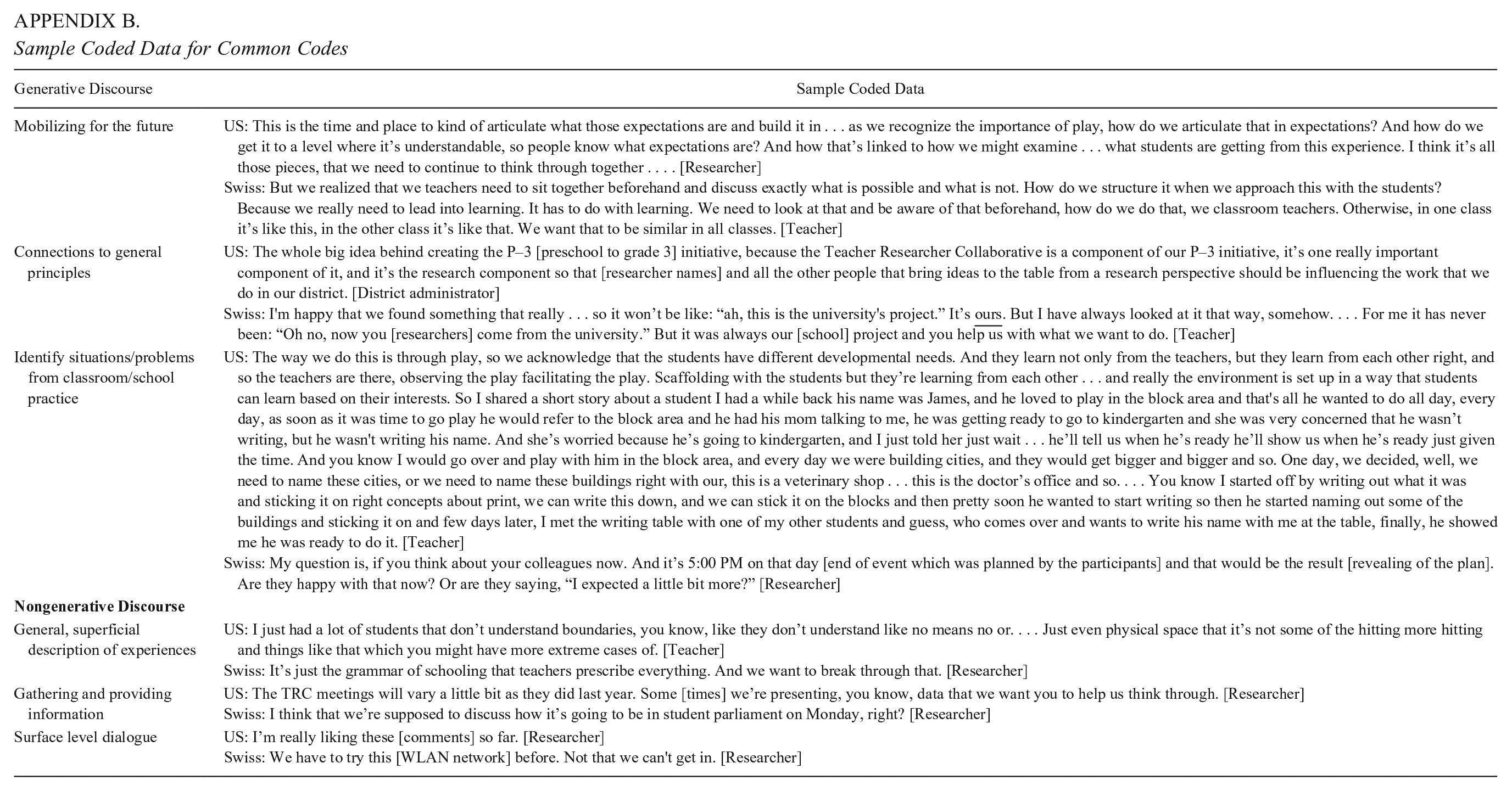
Table 2 shows overall results according to these four main categories. For a description of the codes, subcodes, and for the ratio of codes based on duration of the utterances, see Appendix A. Results in Appendix A are presented for the Swiss and US cases separately and for all data together. Since MAXQDA includes time stamps, it is possible to exclude silent phases and calculate ratios based only on the utterances. In Appendix B, we include samples of coded data for several of the most common generative and nongenerative discourse codes we discuss below.
Percentage of Discourse Types in RPP Meetings

Overall, there was a high degree of generative dialogue in RPP meetings across cases (44.6% in the Swiss case; 47.4% in the US case), reflecting similarly high proportions of generative discourse in both RPPs. We observed some common and divergent generative discourse patterns in the US and Swiss cases. The first generative discourse category is called “mobilizing for the future.” In all, 14.8% of the Swiss and 4.9% of the US utterances were coded under this category, indicating a meaningful difference between the contexts. As noted, in the Swiss case, a main task was to plan and reflect upon school events to promote student participation. This planning activity—on a more elaborated level (co-constructing plans) or more concrete level (identifying next steps for practice)—comprised the core activities of the meetings. This kind of planning was not part of the RPP work in the United States, and these data elucidate a key difference in the purpose of the meetings of the two RPPs. In the Swiss case, the next steps were formulated more for the RPP itself and less for instructional practice.
The second generative category, “providing different perspective,” is low in both the Swiss (1.2%) and the US context (1.9%). Discussing topics from a different point of view seldom happened. Perhaps this is because participants already represented different perspectives, or it was simply not an established meeting routine. The proportion of the generative category “build on ideas of others” varies in the Swiss (1.90%) and US (6.00%) contexts. However, it is important to note that if participants planned something in the Swiss context and built on the ideas of the others, this utterance was coded under the first category (mobilizing for the future/co-constructing plans). The difference could be the result of the coding practice. In the US case, participants were often building on others’ ideas as they shared precise descriptions of classroom experiences (Zoethout et al., 2017).
The category “connections to general principles” was rather high in both contexts: 15.70% in the Swiss and 11.90% in the US context. In the US context, the higher-level goals of the school system were often mentioned, and in the Swiss context, the higher-level goals of the RPP were often discussed, but also many connections were made to the school context, mainly by the teacher. Theory-practice connections were made in both contexts in a similar proportion. We found an interesting difference in comparing the category “argument supported by evidence”: a rather low proportion (3.5%) in the Swiss context and a high proportion (10.7%) in the US context. In the US case, “references to research knowledge” were also common but not apparent in the Swiss case. The differences can be explained in part by the different purposes of the RPP meetings. The US RPP provided a broad platform for discussing topics connected to instruction. Within these discussions, sharing research evidence played a central role during meetings. The RPP meetings in the Swiss context followed very specific aims by designing concrete events, using less evidence-supported arguments.
The category “identify situations/problems from classroom/school practice” also shows differences across the two RPPs: 6.6% in the Swiss and 11.2% in the US context. The most coded sequences involve teachers describing problems and experiences precisely. Such precise descriptions can be considered a door opener to generative discourse (I. S. Horn & Little, 2010). The difference can be explained by the fact that participants in the US context were explicitly invited to connect their own experiences to the topics presented during the meetings. This was a goal of the US RPP—to consider the practical implications of the research findings that were shared—but not of the Swiss RPP. The last generative category, “summarizing dialogue without identifying future steps,” appeared seldom in both contexts (0.9% and 0.8% in the Swiss and US cases, respectively). They were moments of summarizing, however, producing some new ideas (Beech et al., 2010).
Our second main coding family includes all nongenerative utterances. Some of these categories have similar counterparts under the generative codes. We coded an utterance nongenerative if it was not more than trivial, if something was discussed at an operational/organizational level, or if arguments were very general. Observing nongenerative discourse sequences, we see similar amounts across the contexts (46.2% in the Swiss and 40.3% in the United States) but different types.
The first child category is the “general, superficial description of experiences.” The code is used in a comparable amount in both contexts (6.6% in the Swiss and 7.1% in the US). Descriptions are nonprecise, not detailed descriptions of observations. In the Swiss context, this happened regularly when there was some summarizing without adding new thoughts. The most common instances of nongenerative dialogue in both US and Swiss cases involve gathering and providing information (19.3% in the Swiss and 30.9% in the US). Looking further into this parent code, though, we see that the types of discourse vary. In the US case, the most common code is “presenting extant research information not from the RPP” (16.9% of dialogue). In the US case, researchers also commonly shared research data gathered in the RPP (4.8% of dialogue). Such sequences are nongenerative if they are passively received and not further discussed. In terms of “gathering and providing information” in the Swiss case, the most common codes involve “bringing up to date with information” (4.5%), “asking for clarification” (3.1%), and “answering questions” (3.9%).
The next child code in the nongenerative parent code is “surface-level dialogue,” which is quite high in the Swiss case (10.2%) and rather low in the US case (2.1%). Those were longer sequences of negotiations among participants with or without proposed solutions. For example, this occurred when a participant recapped different views on an issue (e.g., when a meeting should be held, how to balance competing demands), without reaching a resolution. In these instances, no new arguments, evidence, or perspectives arose in the dialogue. In the Swiss case, another common code category is “planning and logistics” (9.7% of the utterances), yet this does not occur at all in the US case. In the Swiss context, these are planning activities that do not generate new thoughts but are important for effectively organizing an event, a key goal of the Swiss RPP. In the US case, project updates that were at times logistical were captured as part of the nongenerative code of sharing information.
While we are mainly interested in generative and nongenerative discourse, it is important to also describe the incidence of the other two types. We found that 1.9% of the Swiss sample and 9.5% of all coded sequences in the US sample belonged in the structuring category. The difference can be explained by the size of the group, suggesting that larger groups need more structuring activities than smaller ones. The second category, outside of a content-related discussion, when participants had additional conversations not connected to the topics scheduled (e.g., weekend plans), comprised 7.4% in the Swiss context and 2.7% of discourse in the US context. The meetings in the Swiss context were more informal, including side chats among the participants and consultations about technology issues.
Overall, we see that generative discourse occupied a significant amount of meeting time in both RPPs, including arguments supported by evidence, mobilizing for the future, and making connections to general principles. Nongenerative discourse was also purposeful as it involved gathering or sharing information (including about research) and planning. In the next section, we provide an overview of the meeting structures in the two RPPs.
Overview of Meeting Structures
In this section, we present data on how typical meetings proceeded and the types of utterances that occurred. The differences in the meeting structures reflected the different goals of the RPPs. In the Swiss case, the goal of the project is to strengthen student participation, especially with respect to instruction. The studied school-specific RPP was assigned as a core group for thinking, planning, and implementing activities for the school according to the project aims. Meetings had a clear function in the project and a formal character. Besides the core group meetings, several activities took place in the school, where some or all core-group members participated, often in the role of facilitators. Those activities were planned and reflected upon in the RPP meetings. Members of the research team knew each other before but not the teacher. Meeting routines were developed by the participants. A senior researcher led the meetings.
Using the MAXQDA codeline function, we created a picture of each meeting in terms of the four types of utterances. We use those codelines to show typical meetings from each context. While there were some general patterns across meetings in each context, there was also variation within contexts. The first codeline (see Figure 2) shows a Swiss RPP meeting. The upper part of the figure shows who is speaking: we differentiate between the contributions of the teacher (yellow) and the three researchers (black). The teacher’s share of the coded sequences is 23%, and the researchers’ share is 77%. The teacher is slightly under the 25% proportional share, considering this meeting involved four people. This result provides insight into how group composition influences speech patterns.

Codelines for the Swiss RPP meeting, 7/2021, planning the first project event.
The lower part of the figure reveals that the meeting starts with a non-content-related (dark blue) conversation, mainly some chit-chat. Next, there was some brief structuring (purple) introducing the content-related discourse (light blue and green). This was followed by a longer sequence, where technical issues were discussed, and the teacher was guided to find the document on a platform relevant for the meeting (dark blue). A long content-related discourse follows with brief interruptions—making jokes (dark blue)—and structuring elements to clear overlaps in speaking (purple). The team discussed several topics and planned the first kick-off event for the educators in this school. First, they agreed upon the intended outcomes of the event. Next came a suggestion to hold a similar event for students. This sequence is followed by a negotiation in which the unplanned idea of a mixed event (educators and students) is generated. In the following sequence, the team discussed how to shape the event. Next, the group created a concrete schedule for the event. All participants had access to the planning document, and everyone could initiate and follow changes in the planning. This concrete planning phase explains the rather high proportion of the nongenerative utterances (52% of all coded sequences). The generative discourse comprised a smaller part of the meeting (37%). Here we can see how the meeting routine (who starts and organizes the meeting) and the concrete purpose influenced the discourse.
In contrast, another Swiss RPP meeting depicted in the next codeline (see Figure 3) showed different proportions of generative and nongenerative discourse. In this meeting, the group reflected on feedback after the event. In the discussion, they realized that there were many outcomes of this whole-school community event that they had not yet considered. This led to concrete ideas about how they could continue with the project, incorporating student voices more. In this meeting, 54% of the coded sequences were generative utterances, and 30% of all utterances were nongenerative as compared to the meeting where the percentages were the reverse. The purpose of the first meeting, which involved preparing for an event, had a higher proportion of nongenerative utterances including organizational arrangements. The second meeting, which focused more on reflection about the event, had a higher proportion of generative utterances. The teacher’s share of the coded sequences (22%) was similar to the first meeting (Figure 2), and the researchers’ share was 78%. Again, these numbers are proportional to the participants’ representation in the group and relate to the group’s composition.

Codeline for the Swiss RPP meeting, 11/2021, reflecting on the whole-school community event.
In the US case, the Teacher Researcher Collaborative (TRC) was created as a meeting space to discuss research and jointly consider implications for classroom practice. The goal of the US RPP was to support educators in using general research results and results from the RPP-specific research to inform instruction. As the TRC had been operational for several years, there was a high degree of familiarity between most participants. However, since the size of the group was relatively large, and meetings occurred on Zoom, there was limited informal interaction except at the beginning of the meeting when participants arrived. As the meetings followed a common routine, there was an implicit agreement about how they would unfold, with the researchers taking the lead in setting the agenda. The meetings also followed a general format, but there was also some variation among the meetings. For example, several of the meetings involved an introduction of research-based ideas followed by small group discussions in breakout rooms.
The codeline in Figure 4 shows one hour of the meeting when all participants were together. The upper part of the figure shows who was speaking. During the whole group meeting, the researchers’ share of the coded sequences was 48%, and the practitioners’ share was 52%, showing even participation among both groups but not proportional to their representation (there were 13 practitioners and 7 members of the research team at this meeting). The lower part of the figure shows the types of discourse. In the first few minutes of the meeting, there was an outside the content-related discussion (dark blue) as participants joined the Zoom space. The next several minutes of the meeting involved project updates, and greetings, structuring (purple). Thereafter, researchers begin to introduce the topic of how to create meaningful learning through play in classrooms serving young children, first sharing results from extant research on teachers’ beliefs about learning and the role of play and then sharing interview data gathered from the project. This section is coded as nongenerative discourse (green), as during this period there is no dialogue between participants. One researcher then introduces a brief video, asking teachers to examine the role of the teacher in scaffolding learning through play. This question and the video helped to spur generative discourse (light blue). Teachers provided insights about the video, engaging in a meaningful conversational exchange with each other and the researchers, relating to their own wisdom of practice. The researcher then connected what they shared to existing research. There is some intermittent structuring (purple), as researchers called on teachers to speak.

Codeline for US RPP whole group meeting, 3/2022.
At about minute 20, the whole group session paused as participants were assigned to breakout rooms for 30 minutes. Each breakout room involved 4–5 teachers and at least one researcher. The researchers loosely operated as facilitators, allowing teachers to dialogue among themselves about questions raised in the large group discussion, including: How do your beliefs about play influence your classroom practice, and what opportunities and barriers do you experience in putting your beliefs about learning and teaching into practice? The purpose was for teachers to reflect on their classroom practice. As the codeline in Figure 5 reveals, the breakout room conversation was characterized by a high degree of generative dialogue (84.7% overall). In the breakout room, practitioners represented 76% of the dialogue, and the researcher’s share was 24%, showing that the educators spoke significantly more than in the large group setting. Thus, the smaller group size mattered. Teachers shared precise descriptions of their beliefs and experiences and engaged in a generative dialogue with each other.

Codeline for one US RPP breakout room, 3/2022.
After 30 minutes, the breakout rooms were closed, and participants returned to the main room (see minute 22 in Figure 4). At this point, there is some non-content-related discussion (dark blue) as participants get settled. A rich generative discourse (light blue) ensued as participants built upon each other’s points, sharing insights from their breakout room conversations, and district administrators made comments linking their insights to policy. The meeting concluded with the researcher summarizing how to support learning through play.
Overall, 59.9% of the discourse in the whole group portion of the meeting, including before and after the breakout rooms, was coded as generative. The patterns we observed in this RPP meeting and others that involved breakout rooms differed from a pattern we observed in other meetings when researchers presented a significant amount of research content, with intermittent periods when teachers asked questions or provided insights that resulted in a generative dialogue between participants. In these meetings, the percentage of generative discourse was lower (e.g., 32.4% in one such meeting). Breakout rooms that provided prompts for teachers to relate the research to their own concrete experience were effective in increasing the amount of generative discourse.
In sum, when we examine meeting structures across the two RPPs, we find different patterns in meeting structure, which reflect the goals of the projects, and concrete purposes of the meetings. There are also shorter utterances in the meetings in the Swiss context and longer ones in the US context, reflecting the different interactional patterns described previously. The structure of meetings influences the extent to which meetings involve generative discourse.
Typical Instances in Which Generative Discourse Sequences Occur
It is instructive to examine the instances in which generative discourse sequences occur (or do not) in RPP meetings, as these findings can help inform future practice. To bring the quantitative data to life, we present illustrative vignettes from the most common codes in which we observed generative discourse.
Swiss Case
First, we present a vignette of a generative discourse sequence that occurred in the Swiss RPP meeting profiled in the codeline in Figure 2. In this instance, a researcher suggests a new idea, which was coded as co-constructing plans, a form of generative discourse. A second researcher takes up the issue and constructs the plan further. A third researcher rejects a part of the plan, since she does not want to conduct two disconnected events, risking that ideas diverge from each other. At the same time, she co-constructs the plan further and suggests a solution. The second researcher raises an organizational issue, so the discourse becomes nongenerative.
But I was also wondering. There are the two team events [for teachers]. I was wondering if that would be good to do something similar with the students after all. . . . We didn't plan that originally. But now we were in student parliament, and we could really get them involved.
Yes, that would be of course really a possibility. And then we could also “slightly compress” because then we could conduct both events and put them opposite and say, if you ask the teachers now, then this and that comes out, and if we ask the students, then this and that comes out. Whether that's very similar or not.
Hmm. I wouldn't duplicate. I think it's important for teachers to feel safe. Because that's a process that may not yet be established. I think that's why it's important that we go over it twice. Students, I would follow up as we agreed, again via student parliament. Or what has crossed my mind and if there is that openness, that we take 2–3 students to that, and they also participate in that World-Café 2 setting. That would be a cool option actually.
Yeah, we thought about that too. We'll have to ask Sandy [teacher]. That's where [the discussion] has always just stuck, that it's vacation.
Yes, exactly. Yes.
So now we have to see, Sandy, if there are teenagers who say, despite the vacations, “I'll participate.”
Initially, this seemed to be an organizational question, but with time, it became clear that the teacher was uneasy about how to present the idea of student participation to her colleagues, and the researcher offered an example from another school.
You know, thinking about our team now. There's probably already a couple that are like hmm, “Oh, the students already have a say?!?” Hmm and how many are there, can they outvote us or something? Can you [R2] say what it was like in the other school?
In that school it was so that it was a big team, about 50 people, and there were also a couple of students, around ten. They were clearly less [than educators]. But this atmosphere did not arise at all. It was really. . . . Maybe we have to go in that direction. The mood was: Let's think about it together. It was very open there. . . . There was a great curiosity: “What do you think?” Like this. That is important here.
I think it's great when people say we're thinking about it together and no one makes a decision yet. That's great. Because that's okay. We still have time, and we can clarify things again. Exactly.
In this vignette, we can see how researchers shape the dialogue in different ways. We also see that the teacher had the confidence to express her uneasiness about the suggestion. The past experience of the researcher was helpful in reframing the expected resistance from colleagues.
US Case
The following vignette from the US case includes instances of several generative discourse codes that are prominent in the data, including referring to research knowledge, building on the ideas of others, and precise descriptions of experiences. This vignette derives from the meeting depicted in Figure 4. In one generative exchange, participants discussed the results of the breakout room discussions. As noted previously, the researcher had presented research findings on the role of play in early childhood classrooms. The participants then went into breakout rooms, and teachers reflected on how their beliefs about play impacted their classroom practices. In the first comment, the researcher recaps the discussion and raises a provocative question for the group.
We talked about that a little bit in our group about utilizing careful observation during play as opportunities for formative assessment so that . . . . You know, we talked about play being an extension of what kids are learning from direct instruction first. But also, what if it were reversed where that was a space where children were developing their own ideas and pushing their learning, and it was a space where there was careful observation to support your assessments that you're doing?
It is important to note how this question was raised, as it differs from some other instances we observed where researchers asked simple questions such as “Does anyone have something they wish to share?” This serves a function at times, of course, but it is not as generative as a question that inspires reflection. After hearing this question, a district administrator adds a new perspective and set of questions about how play fits into instruction.
To chime in on that . . . we had a little bit of a similar conversation, where some of the [math] curriculum that we use to use in TK [transitional kindergarten] . . . actually took into recognition that kids need to have time just to when it comes to manipulatives to have that unstructured opportunity, just to explore right? And so, we need to maybe remember some of those things that you know if you're going to do a structured activity, I think you're talking about do you do you front load the play? Or do you add the play at the end? Or do you have it in the middle?
A teacher then also builds upon the administrator’s comment with a specific example from her instruction.
I’d like to piggyback on that because, yeah, . . . the whole idea was you couldn't get them to use the manipulative or maybe the task you were going to teach them until you spent, I think it was I’m trying to it was a week or two weeks, where you just rotated them through all the materials, you were going to use to “get the play out.” Because some of them had never seen anything like that, so it was to give them that moment to play and then later on when you brought . . . also to set the rules for how we use it, you know. They don't fly across the room, they don't go in our mouth, I mean kind of teaching the guidelines for that when you use those manipulatives for math. . . .
A second teacher added her perspective, taking the conversation in a slightly different direction, noting the importance of using play time to make observations of students’ socioemotional development as well as their academics. The conversation continued and then concluded with the researcher summarizing the perspectives that educators provided, emphasizing the examples they shared about the importance of play being integrated into instruction. She notes, “we wanted to end on some practical pedagogical suggestions to take with us and encourage you to continue to try them out and test out new things and see what works and what doesn't and come back and share with us next time we get together.” This example from the US RPP illuminates how educators and researchers co-constructed knowledge in the context of a generative dialogue. Overall, illuminating how the dialogue unfolds in RPP meetings can help participants be more mindful of creating space for knowledge generation.
Conclusion and Implications
In this study, we introduced an analytical tool to analyze RPP meetings, specifically to investigate how learning takes place on a very concrete microlevel. Analyzing video-recorded meeting data gathered in US and Swiss contexts, we examined the extent to which RPP meetings were characterized by generative discourse (I. S. Horn & Little, 2010; I. S. Horn et al., 2017; Lefstein et al., 2020). Using this analytical tool, we presented three sets of results connected to our research questions: (1) we defined the extent of the generative discourse in the two RPPs; (2) we provided an overview of how meetings unfolded; and (3) we identified concrete examples of discourse sequences and examined which elements are supportive of generative discourse and learning. The implications of the results in each area are discussed later.
First, in both RPP meeting contexts, almost half of the meeting time was generative, which is a considerable amount. 3 It could be also explained by the fact that researchers are accustomed to making knowledge visible, implying explicit ways of integrating new knowledge, explaining phenomena, and learning from data. It is possible that the online modality of the meetings could also have contributed to the high degree of generative discourse. Online meetings tend to be more formal and less characterized by spontaneous conversation (Gruber et al., 2022).
There were some differences between the types of generative discourse across contexts. One noticeable difference was in the use of evidence-based arguments; this kind of utterance was rare in the Swiss context. While using research data is a main goal of RPPs (Farrell et al., 2021; Henrick et al., 2017), in the Swiss context there is an intense debate about the use of research in the teaching profession, and this may have influenced the presence of research-based evidence in the Swiss case. Since research often must legitimize itself by producing useful ideas for practice, it could be that research partners adapt to those expectations. However, such an assimilation may work against positive collaboration, where all participants contribute according to their strengths (Tabak, 2022). This finding could be an indication for the Swiss RPP to strengthen the evidence-based inquiry component. Mobilizing for the future as a generative discourse category was relatively low in the US case compared to the Swiss case. This can be explained by the different goals of the RPPs: the Swiss RPP meetings explicitly involve planning school site activities, which involve “mobilizing for the future.” This code has less relevance in the US case, as the RPP meetings do not have this focus. Simultaneously, the US case showed a high share of the code “identifying situations/problems from classroom/school practice,” which is a goal of the US RPP meetings. However, developing future actions based on the identified problems of practice was less common. This could indicate a need for the US RPP team to attend to this issue, as it is also a goal of the RPP.
Defining the extent of generative talk across the two different RPPs provides an opportunity for inquiry and further development. As Wegemer and Renick (2021) explain, “joint work in partnerships is embedded within broader organizational, cultural, relational, and historical systems” (p. 10). Although one might expect differences across contexts since RPPs are a newer concept in Switzerland and the RPP itself was less well established, in fact the amount of generative speech was very similar. The small difference—a higher amount of nongenerative discourse in the Swiss case—can be partly explained with the goals and activity structure of the Swiss RPP. Nongenerative discourse had a planning function, such as the division of tasks. In this way, we emphasize the functionality of this type of discourse, recognizing it not merely as a low-quality feature, as seen in other works (I. S. Horn et al., 2017; I. Horn et al., 2020; Thompson et al., 2019).
The meeting overviews reveal some additional differences in the RPPs according to size, purpose, and activity structure. The Swiss case revealed the role of generative and nongenerative discourse in relation to the purpose of the meetings. As noted previously, a planning meeting involved numerous organizational agreements to clarify the course of action within a school event. The reflection meeting was more generative as it involved group members discussing their insights. The US case showed the effects of size and structure; breakout rooms encouraged more generative talk than larger group settings and showed that building on breakout room conversations in the whole group can also be generative. The US RPP is based on an ongoing project to enhance teaching and learning. The group formulates questions that can be addressed through research, with the aim of yielding information useful for instructional improvement. Thus, sharing research findings is a key aspect of their activity structure. On the other hand, the Swiss RPP primarily concentrates on implementing various prototypes to amplify student engagement within the school. Consequently, a substantial portion of their activities is dedicated to planning and reflection. Although research plays a role in the Swiss RPP, it is not as central as in the US RPP.
An important aspect often mentioned in the RPP literature is the shifting of power relations in a way that allows all participants to have a say (Farrell et al., 2021). As having a voice in meetings is one proxy for this, we coded who was speaking during the meetings. In the Swiss case, the teacher had a slightly lower share of the discourse than what could be theoretically expected in a meeting with four participants. The US case shows different results depending on the setting. In the main meeting sessions, researchers’ voices occupied almost half of the meeting time, despite them being in the minority. However, breakout rooms show a different pattern, with researchers having a share of less than 25% when there are four to five participants, as teacher voices were much more prominent. In both contexts, researchers led the meetings, and these routines were established from the beginning. Indeed, it was an expectation by school partners that researchers would be responsible for planning meeting agendas. This finding leads us to observe how long-standing, uneven power patterns are supported collectively by all participants (Farrell et al., 2021; Wegemer & Renick, 2021). Further analysis of these data aims to explore the extent to which power plays a role in discourse patterns.
We also observed a difference in the average lengths of utterances. Single utterances were longer in the United States than in the Swiss RPP, where much more overlapping speech occurred. This difference could perhaps be explained with different discourse styles in each location but also with varied features of the particular RPP relationships, differences in the formality of the meetings, or the size of the groups. Smaller group meetings (i.e., the Swiss RPP) are likely to be more conversational than larger ones (i.e., the US RPP) in which participants take more formal turns to speak. That said, interrupting someone else’s speech could be seen as ordinary in some cultural contexts and impolite, or a power play, in others (Tannen, 2021). Indeed, cultural influences on discourse could be defined on several levels: RPP, professional, school, local, regional, and national. While we did not find any discourse patterns that seemed unique to a country based on this analysis, further research is needed to distinguish between the various levels of influence.
Finally, the vignettes clarified the course of actions that allowed for generative discourse. The US vignette highlighted the nontrivial nature of asking good questions. The presented vignette showcased the importance of question depth, serving as a valuable model for further interactions. Additionally, the use of artifacts, often referred to as boundary objects (Farrell et al., 2022; Gomoll et al., 2022), such as the short video of a classroom encounter in this case, contributed to making the discourse generative and concrete. This could be a fruitful area for further analysis as prior research suggests that artifacts and tools can contribute in positive ways to knowledge building (Farrell et al., 2022; Popp & Goldman, 2016; Wegemer & Renick, 2021). If participants of RPP meetings are aware of the conversational patterns they can attempt to avoid specific conversational moves or engage tools that deepen engagement.
The Swiss vignette demonstrated that expressing a different view (not accepting a suggestion) led to a completely new solution in the planning process. It is crucial to maintain openness and understand how different views are negotiated to foster productive discourse (Tabak, 2022). Notably, Tabak (2022) explains that different studies “vary in the extent to which they delve into a moment-by-moment, utterance-by utterance analysis of how the negotiation and redistribution of power are accomplished in RPP interactions. As a field, we need more research to this effect to better understand how to establish and sustain productive tension” (Tabak, 2022, p. 175).
The findings from this study also yield implications for practice in RPPs. Beech et al. (2010) suggest that “generative dialogic encounters” are valuable as they can result in new perspectives for the future. They explain, “The criteria of idealized dialogue need not be met continuously. Instead, they need only be met often enough to generate resonances and ongoing ripples within a longitudinal research relationship” (Beech et al., 2010, pp. 1363–1364). We share this view and state that the extent of generative discourse per se is not an exclusive and precisely quantifiable category. We cannot prescribe for RPPs the “right” amount of generative discourse to be “enough” for team learning. However, we believe that the analytical strategy used in this study provided valuable insights to zoom in on specific meeting aspects and to compare entire meetings across contexts. We were able to link goal, size, purpose, activity structure, and composition to different patterns in discourse. Without the comparative analysis between the two RPPs, we would not have been able to recognize and understand the distinguishing features of each approach. This comparison has been instrumental in gaining a deeper comprehension of the unique qualities and dynamics of the Swiss and US RPPs.
If we presume that the conversations within RPP meetings have implications for the RPP more generally, it is imperative that we understand what the use of different types of utterances for the RPP work means. Our goal is to point to the need for inquiry and close analysis of such dialogue as a possible vehicle for continuous improvement and ongoing monitoring of the functioning of the RPP. It is, however, important to center the goals of the RPP and its connection to practice, as this analysis revealed that differences in the types of generative discourse depended on the goals of the RPP. The structure of the meetings (agenda, size, whole group vs. breakout rooms) also shaped the conditions for generative discourse. The findings from this study contribute to existing research by elucidating the meeting conditions that may promote generative dialogue.
Footnotes
Appendix
Sample Coded Data for Common Codes
| Generative Discourse | Sample Coded Data |
|---|---|
| Mobilizing for the future | US: This is the time and place to kind of articulate what those expectations are and build it in . . . as we recognize the importance of play, how do we articulate that in expectations? And how do we get it to a level where it’s understandable, so people know what expectations are? And how that’s linked to how we might examine . . . what students are getting from this experience. I think it’s all those pieces, that we need to continue to think through together . . . . [Researcher] Swiss: But we realized that we teachers need to sit together beforehand and discuss exactly what is possible and what is not. How do we structure it when we approach this with the students? Because we really need to lead into learning. It has to do with learning. We need to look at that and be aware of that beforehand, how do we do that, we classroom teachers. Otherwise, in one class it’s like this, in the other class it’s like that. We want that to be similar in all classes. [Teacher] |
| Connections to general principles | US: The whole big idea behind creating the P–3 [preschool to grade 3] initiative, because the Teacher Researcher Collaborative is a component of our P–3 initiative, it’s one really important component of it, and it’s the research component so that [researcher names] and all the other people that bring ideas to the table from a research perspective should be influencing the work that we do in our district. [District administrator] Swiss: I'm happy that we found something that really . . . so it won’t be like: “ah, this is the university's project.” It’s |
| Identify situations/problems from classroom/school practice | US: The way we do this is through play, so we acknowledge that the students have different developmental needs. And they learn not only from the teachers, but they learn from each other right, and so the teachers are there, observing the play facilitating the play. Scaffolding with the students but they’re learning from each other . . . and really the environment is set up in a way that students can learn based on their interests. So I shared a short story about a student I had a while back his name was James, and he loved to play in the block area and that's all he wanted to do all day, every day, as soon as it was time to go play he would refer to the block area and he had his mom talking to me, he was getting ready to go to kindergarten and she was very concerned that he wasn’t writing, but he wasn't writing his name. And she’s worried because he’s going to kindergarten, and I just told her just wait . . . he’ll tell us when he’s ready he’ll show us when he’s ready just given the time. And you know I would go over and play with him in the block area, and every day we were building cities, and they would get bigger and bigger and so. One day, we decided, well, we need to name these cities, or we need to name these buildings right with our, this is a veterinary shop . . . this is the doctor’s office and so. . . . You know I started off by writing out what it was and sticking it on right concepts about print, we can write this down, and we can stick it on the blocks and then pretty soon he wanted to start writing so then he started naming out some of the buildings and sticking it on and few days later, I met the writing table with one of my other students and guess, who comes over and wants to write his name with me at the table, finally, he showed me he was ready to do it. [Teacher] Swiss: My question is, if you think about your colleagues now. And it’s 5:00 PM on that day [end of event which was planned by the participants] and that would be the result [revealing of the plan]. Are they happy with that now? Or are they saying, “I expected a little bit more?” [Researcher] |
|
|
|
| General, superficial description of experiences | US: I just had a lot of students that don’t understand boundaries, you know, like they don’t understand like no means no or. . . . Just even physical space that it’s not some of the hitting more hitting and things like that which you might have more extreme cases of. [Teacher] Swiss: It’s just the grammar of schooling that teachers prescribe everything. And we want to break through that. [Researcher] |
| Gathering and providing information | US: The TRC meetings will vary a little bit as they did last year. Some [times] we’re presenting, you know, data that we want you to help us think through. [Researcher] Swiss: I think that we’re supposed to discuss how it’s going to be in student parliament on Monday, right? [Researcher] |
| Surface level dialogue | US: I’m really liking these [comments] so far. [Researcher] Swiss: We have to try this [WLAN network] before. Not that we can't get in. [Researcher] |
Acknowledgements
We wish to sincerely thank the participants of this study who gave generously of their time to partner with us, share their experiences, and welcome us in their work settings. We are also greatly indebted to our project team colleagues for their support and collaboration. For the purposes of confidentiality, we do not list individuals members by name. We also wish to thank the AERA Open editors and anonymous reviewers for their feedback on earlier drafts. Correspondence regarding this article should be addressed to Enikö Zala-Mezö at

Declaration of Conflicting Interests
The author(s) declared no potential conflicts of interest with respect to the research, authorship, and/or publication of this article.
Funding
We gratefully acknowledge the Swiss National Foundation (IZSEZO_209163), the Mercator Foundation Switzerland (2020-4090), the Hertzberg Family Foundation, and Sandra Timmons and Richard Sandstrom for their philanthropic funding support of the research-practice partnership projects discussed in this paper. The opinions expressed are those of the authors and do not represent views of the funders.
Notes
Authors
ENIKÖ ZALA-MEZÖ is professor and head of the Center for School Improvement at the Zurich University of Teacher Education. Her research focuses on school improvement school change processes, and the design of collaboration between researchers and school educators.
AMANDA DATNOW is Chancellor’s Associates Endowed Chair and professor in Education Studies and associate dean of social sciences at the University of California San Diego. Her research focuses on educational reform and policy, with a particular interest in equity and the professional lives of educators.