




Abstract
Nationally, many school districts are facing a teacher workforce sustainability crisis, and job retention for novice teachers of color is a key area of focus for educational leaders and policymakers. In this study, we draw on nine years of administrative data from Texas K–12 public schools to better understand how teacher-principal ethnoracial matching is associated with patterns of teacher retention and system-exit. Teacher labor markets are geographically small, so we link data from the National Center for Education Statistics containing geographic locale information to explore how the relationship between ethnoracial matching and novice teacher career outcomes varies across urban, suburban, rural, and town school contexts. We find that matching is associated with an increase in the probability of retention and a decrease in the probability of system-exit, with important variation for novice Black and Latinx teachers working in some nonurban school locales.
Keywords
Introduction
The retention of historically marginalized groups of teachers in K–12 public schools remains a critical area of focus for educational leaders and policymakers. Students of color who learn from teachers of color experience a variety of academic, social-emotional, and postsecondary benefits (Egalite et al., 2015; Gershenson et al., 2018). While most US K–12 public school teachers are White, novice teachers in recent years are more likely to be ethnoracially diverse (Ingersoll et al., 2021; National Center for Education Statistics, 2022)—yet they are also more likely to enter the profession into less-supportive work environments (Redding & Nguyen, 2020). Amid the current context of increased teacher turnover, shortages, and resignations (Carver-Thomas et al., 2021), this pattern has concerning implications for teacher workforce policies in terms of equity and sustainability.
Meanwhile, there is a growing body of evidence demonstrating that working for a principal of color can improve career outcomes for teachers of color (Bailes & Guthery, 2020; Bartanen & Grissom, 2023; Grissom & Keiser, 2011; Viano et al., 2023). Recent literature indicates the potential for teacher-principal ethnoracial matching to improve outcomes such as teacher satisfaction, workplace support, and retention rates (Nguyen et al., 2020). Yet overall, the studies investigating the relationship between principals of color and career trajectories for teachers of color have been unable to disaggregate findings for key understudied groups of educators (e.g., Latinx teachers, novice teachers, rural teachers). And there remains a need for more evidence about whether there is a link between teacher background characteristics (e.g., race/ethnicity, gender identity, preparation program pathway) and the likelihood of working with a principal of the same race/ethnicity. Such evidence could provide state and district educational leaders with information to improve teacher recruitment, job placement, and mentorship program policies.
Importantly, the extant research in this area does not explore whether the relationship between teacher-principal ethnoracial matching and teachers’ career trajectories varies across school geographic locale, despite research indicating that teachers labor markets and novice teacher career decisions are highly local and influenced by geography (Engel & Cannata, 2015; Jabbar et al., 2020). The results of this study contribute to literature about ethnoracial matching and teachers’ career trajectories in three ways. First, we explore which teacher background characteristics are associated with working with an ethnoracially matched principal. Secondly, we examine the relationship between teacher-principal ethnoracial matching and career outcomes for novice Black and Latinx teachers. And finally, we explore how these outcomes vary across school geographic locales. To do so, we draw on employment data for novice teachers in Texas. We define novice teachers as full-time teachers of record in their first year employed at a public or charter K–12 school between 2012 and 2020. Our investigation is guided by the following research questions:
1) Which teacher background characteristics are associated with the occurrence of teacher-principal ethnoracial matching and how do these associations vary across teacher race/ethnic groups and school geographic locales?
2) To what extent does the occurrence of teacher-principal ethnoracial matching predict the probability of retention and system-exit for novice teachers, and how does this relationship vary across teacher race/ethnic groups and school geographic locales?
Literature Review
Novice Teachers’ Career Trajectories
Novice teachers are more likely to turn over compared with their mid- and late-career colleagues (Ingersoll et al., 2021; Kena et al., 2016; Smith & Ingersoll, 2004). Persistently high rates of turnover among this group are especially troubling as novice teachers are more likely to find jobs in the hardest-to-staff schools serving low-income and historically marginalized communities of color (Achinstein et al., 2010). Despite evidence that teacher turnover harms student achievement (Ronfeldt et al., 2013)—especially for students of color—research with the goal of better understanding the drivers of retention and support for novice teachers is scarce.
Prior research suggests that improved teacher-principal matching, and the overall level of job fit between a novice teacher and their principal (Player et al., 2017), could mitigate turnover rates and alleviate the inequitable sorting patterns for this group of educators (Boyd et al., 2005). Despite qualitative studies illustrating the process and mechanisms related to novice teachers’ job preferences and career decisions (Cannata, 2010, 2011), there is a need for more empirical work focusing specifically on novice teacher outcomes within the growing body of research related to teacher-principal ethnoracial matching (Bailes & Guthery, 2020; Bartanen & Grissom, 2023; Viano et al., 2023). And considering high rates of turnover among novice teachers (Ingersoll et al., 2021), school leaders and policymakers would benefit from evidence related to teacher-principal job fit and retention and mobility patterns for novice teachers.
In terms of school characteristics, novice teachers are more likely to enter the profession into schools with lower average teacher experience, a greater proportion of students of color, and more economically disadvantaged students (Ingersoll et al., 2021; Redding & Nguyen, 2020). And each of these school-level measures are associated with teachers’ decisions to leave a school (Redding & Nguyen, 2020). Yet, trends across the literature indicate that beyond student demographics, effective school leadership consistently predicts novice teacher retention outcomes (Youngs, 2007). In studies of teachers at all experience levels, retention and system-exit decisions are linked with other school characteristics, such as the average experience of the principal and principal retention (Béteille et al., 2012; Edwards et al., 2018). Further, there is some evidence that the quality of a schools’ principal is more strongly associated with retention outcomes for teachers of color when compared to their White colleagues (Sun, 2018).
Ethnoracial Matching
Efforts to increase retention rates for novice teachers—especially novice teachers of color—are not new (Kearney, 2008; Villegas & Clewell, 1998). Yet, there is a more recent body of literature suggesting that the interaction between teachers’ demographic characteristics and the demographic composition of a school (e.g., leaders, colleagues, students) could influence career decisions. For example, teachers who are ethnoracially matched to their principal are less likely to turn over (Grissom & Keiser, 2011; Grissom et al., 2012), and this relationship is stronger for Black teachers serving historically disadvantaged communities relative to White teachers in more affluent school contexts (Bartanen & Grissom, 2023).
There is some evidence about the potential mechanisms associated with ethnoracial matching that influence teacher satisfaction and work experiences. For example, Black teachers who work with multiple Black colleagues felt that they had more voice when it came to influencing school-level policy decisions compared to Black teachers who worked in racially isolating contexts (Bristol, 2018). These findings could be related to the characteristics of the interpersonal relationships that leaders build with novice teachers. For example, novice teachers who are ethnoracially matched to their principal could experience increased voice, less discrimination, and more support to pursue culturally responsive teaching practices (Grissom et al, 2015; Tanase, 2022). Relatedly, Brezicha and Fuller (2019) found that teachers working with the same race/ethnicity principal reported higher levels of trust in their principal.
Supportive school leadership is linked with teacher career decisions (Snodgrass Rangel, 2018)—and there is evidence that the teacher-leader relationship is key for teachers of color (Carver-Thomas, 2018). Some qualitative and survey-based findings suggest that teachers of color who lack ethnoracial representation among their school leaders and colleagues often feel isolated and undersupported and face discrimination (e.g., racial, ethnic, linguistic) in the workplace (Bristol, 2018; Griffin & Tackie, 2016). This prior research indicates that principals of color could play a key role in creating a supportive work environment for teachers of color, thus influencing their career decisions.
Teacher-Principal Ethnoracial Matching and Teacher Career Outcomes
Most studies within the teacher-principal ethnoracial matching literature find improved retention and mobility outcomes for teachers who are matched with a principal of their same racial/ethnic identity. A multistate study by Bartanen and Grissom (2023) drew on longitudinal administrative records to investigate how the race/ethnicity of a principal influenced the ethnoracial composition of the teachers in a school. The authors found that a teacher matched with a same race/ethnicity principal was 3–4 percentage points more likely to stay in their current position. Grissom and Keiser (2011) analyzed national cross-sectional survey data and found comparable results—the occurrence of teacher-principal ethnoracial matching in their analysis was associated with a four-percentage-point increase in the likelihood of retention. A few trends emerge from this area of inquiry, as summarized within a recent meta-analysis by Nguyen et al. (2020), where the authors note the link between teacher-principal ethnoracial matching and improved retention outcomes across multiple studies. Importantly, the authors identify this area as critical for future researchers to explore.
While some of the prior quantitative research discussed previously demonstrates that ethnoracial matching between teachers and principals is associated with higher retention rates for Black teachers (Bartanen & Grissom, 2023; Grissom & Keiser, 2011), outcomes for Latinx teachers—one of the fastest growing demographic groups of teachers nationally—remain underexplored. However, one recent study drawing on nationally representative data investigated the intersectional influence of race/ethnicity and gender matching on teachers’ career outcomes and workplace satisfaction, with separate results for multiple teacher racial/ethnic groups (Viano et al., 2023). The authors found that ethnoracial and gender matching was linked to teachers' improved perceptions of their workplace supports, with the strongest positive results for Black teachers in their sample (p. 12). And in terms of exploring variation across school geographic locales, only one study included geographic region as a variable of interest (Viano & Hunter, 2017). The authors found that ethnoracial matching in the southern United States resulted in higher teacher satisfaction compared to other regions, but their analysis did not examine variation across urban, rural, and suburban schools.
Taken together, the literature in this area suggests the need for an examination into how ethnoracial matching can alter novice teachers’ professional trajectories (Redding & Henry, 2019; Simon & Johnson, 2015). And there is a need for research about novice teachers that can address data limitations within existing studies—such as utilizing data restricted to one single teacher labor market (Bruno et al., 2020) or national cross-sectional data that is too broad to inform policymaking at the state and district levels (Redding & Nguyen, 2020). In this study, we analyze observations of novice teachers from nine years for the entire state of Texas, allowing us to leverage the rich geographic diversity of the state to model findings across school locales (urban, suburban, town, rural). These distinctions have important implications for sustainable leadership and policy efforts to strengthen and diversify the K–12 teacher workforce.
Conceptual Framework
We frame our first research question using literature about how teachers’ background characteristics might influence their job search and employment decisions. We hypothesize that teachers prepared in traditional university-based preparation programs might receive training providing them with a more robust and ethnoracially diverse network of mentors and school leaders to potentially work with. For example, there is some evidence that preservice teachers in university-based preparation programs experienced higher quality mentorship and more assistance with the job search process compared to preservice teachers in alternative programs (Matsko et al., 2022; Walsh & Jacobs, 2007). However, some empirical work demonstrates that alternatively prepared teachers are older and more likely to be second-career educators (Cohen-Vogel & Smith, 2007). Such prior workforce experience might provide them with job search skills that lead to a better teacher-principal fit. Other research suggests that teachers of color are more likely to gain their preparation through urban teacher residencies and district-led programs (Carver-Thomas, 2018)—programs that focus on quality mentorship opportunities and providing novice teachers of color with racially/ethnically diverse professional networks at the onset of their careers.
The job search literature demonstrates that teachers seek schools serving communities demographically congruent to the schools they attended—in contexts where they feel represented in terms of their racial/ethnic identity (Achinstein et al., 2010; Cannata, 2010). Yet, research finds that compared to White teachers, Black and Latinx teachers are less likely to work for a same race/ethnicity principal (Brezicha & Fuller, 2019), a representation gap driven by racial/ethnic and gender disparities in promotion opportunities for educators of color and female educators who seek leadership positions (Bailes & Guthery, 2020; Davis et al., 2017). And to date, we found no extant research examining whether the gender identity of novice teachers is predictive of their likelihood of working with a same race/ethnicity school leader.
To frame our second research question, where we ask whether ethnoracial matching is associated with retention and system-exit patterns for novice teachers, we draw on the theory of relational demography, which originated in organizational and sociological literatures. Researchers using this framework seek to better understand how heterogenous levels of fit or congruence between organizational and personal characteristics influence workers’ labor market outcomes (Tsui et al., 1992). We hypothesize that novice teachers who are ethnoracially matched to their principal might feel more supported in the workplace due to shared backgrounds and experiences and thus become more likely to remain in their current positions. More researchers are using conceptual frameworks like relational demography to understand patterns in teacher career trajectories (Nguyen et al., 2020)—yet we found no examples within the extant literature where this theory has been applied to understand outcomes for novice teachers.
Finally, geographic locale is important in framing our results. We hypothesize that ethnoracial matching might be less frequent—especially for teachers of color—in rural/town locales, but that the occurrence of ethnoracial matching could be a key predictor of retention for novice teachers of color in such contexts, where workplace racial isolation could be more common (Kemper Patrick & Arturo Santelli, 2022). Our framework also considers the intersection of preparation program background and geographic school locale to be important in understanding the patterns of ethnoracial matching that we find. University-based teacher preparation programs are mostly concentrated in large urban/suburban metropolitan areas (Reagan et al., 2019). Novice teachers prepared in town/rural geographic locales might have less exposure to ethnoracially diverse mentorship and leadership experiences, which could then influence their job search behaviors.
We also expect novice teachers of color in urban locales to have a greater likelihood of working for an ethnoracially matched principal based on prior analysis in the Texas context (Edwards, 2020). Like rural/town school locales, research finds that urban schools can also experience high relative rates of teacher turnover; as such, ethnoracial matching in urban schools could be differentially important to teachers’ career decisions. Yet, in suburban school locales, more evidence about the importance of ethnoracial matching is needed—especially as the K–12 student and community demographics in suburban areas are becoming more ethnoracially diverse (Lacy, 2016). In the section that follows, we explain our data, measures, and analysis plan.
Method
Data
The data for this study are located in the Texas Educational Research Center (ERC) data clearinghouse. The ERC houses files from the K–12, higher education, and workforce sectors, providing 30 years of information about individuals within these sectors. We utilize data that the Texas Education Agency (TEA) and the State Board for Educator Certification (SBEC) provide to the ERC annually, specifically teacher and principal employment records, certification/preparation program records, and a variety of school-level characteristics. We use information from nine academic years (2012–2020). Our data set begins in 2012 because this is the first year where we can link teachers to classrooms, which we will need in a follow-up paper where we estimate student achievement outcomes. Our data ends in 2020 because this is the most recent year where we have access to geographic locale information. Geographic school locale is a key component of our analysis; therefore, we merged our school-level TEA files to publicly available files from the National Center for Educational Statistics (NCES) Common Core of Data (CCD), providing detailed geographic locale data not reported by TEA.
To create our analytic file with only novice teachers, we first cleaned each year of TEA employment data, keeping only first-year teachers from public or charter K–12 schools. 1 We used Stata for all our data cleaning and analysis. We linked teachers to their SBEC records, allowing us to capture information about what type of preparation program they attended (e.g., university-based program). We then appended all years of data prior to merging in a file with principal information using a unique school identification variable to match novice teachers to their principal. To create the file with principal information, we again started with the TEA employment file and kept only employees coded as full-time principals. We encountered instances with more than one principal assigned to a single school. In these cases, we decided to keep the principal with the most years of experience, most tenure, and highest salary. This decision was based on evidence that more seasoned principals are the most likely to offer substantial mentor support to their teachers, especially novice teachers (Grissom, 2011; Snodgrass Rangel, 2018). Finally, we merged in average school characteristics (e.g., teacher experience, student demographics, etc.).
The resulting file includes 166,787 unique novice teacher observations across all nine years, where each teacher only appears once in the data—in their first year of employment. Table 1 displays average characteristics of novice teachers in our sample, cross-tabulated by teacher race/ethnicity. The racial/ethnic demographics of all novice teachers in our sample are: Asian (0.02), Black (0.11), Latinx (0.28), and White (0.57). Novice teachers who identified as indigenous or with two or more racial/ethnic groups represented less than two percent of all observations.
Characteristics of Novice Teachers

Note. The proportion of teacher racial/ethnic representation across our sample is Asian (0.02), Black (0.11), Latinx (0.28), and White (0.57).
Measures
Dependent Variables
For RQ1, our dependent variable is the occurrence of a teacher-principal ethnoracial match—a binary indicator of whether a teacher worked with a principal of the same race/ethnicity (0 = nonmatch, 1 = match). To create this binary variable, we used a categorical measure of race/ethnicity available in the TEA employment file for both teachers and principals where each employee was identified within one of the six following racial/ethnic groups: Black, Latinx, White, Asian, Native American/indigenous, and two or more race/ethnicity. When a teacher and principal shared the same race/ethnicity, our binary indicator for ethnoracial match was coded as 1. All other teacher-principal ethnoracial pairs resulting in a nonmatch were coded as 0. In our main results, we only discuss outcomes for Black and Latinx teachers because they are the most underrepresented group of teachers in the Texas state context, and results for these groups have the greatest potential to influence teacher workforce policies.
For RQ2, we created two binary outcomes capturing novice teacher career movements in the following year (t + 1). The first outcome (retention) captures whether each novice teacher stayed at their school (0 = leave, 1 = stay), and the second outcome (system-exit) captures whether they exited the public K–12 education system altogether (0 = stay, 1 = exit). We also included three-year (t + 3) and five-year (t + 5) retention outcomes in subsequent models to explore evidence of longer-term associations between ethnoracial matching and novice teachers’ retention. 2 This set of outcomes was created using TEA employment data with multiple observations of teachers over time and then merged into the analytic file at the teacher-year level.
To create the first measure for retention, we looked across years of our data for each teacher to discern when a teacher was employed at a different school compared to the prior year. We were able to do this using a unique school identification (ID) number connected to each novice teacher observation. If the school ID in year t + 1 was not congruent to the school ID from the prior year, our retention variable was coded as 0. If the two school ID numbers were equal, retention was coded as 1. We used the same approach to create our binary measure of system-exit. The key difference for this variable is that a novice teacher was only coded as exiting the system when in the following year there was no record of their employment at any school in any role, state-wide. Table 1 displays summary statistics for our dependent variables (e.g., retention, exit-system, etc.) for all novice teachers and disaggregated by teacher race/ethnicity.
Independent Variables and Covariates
To estimate RQ1, we included several independent variables linked with patterns of workforce entry and career decisions for teachers in prior research. Specifically, we used novice teacher race/ethnicity (Achinstein et al., 2010), and the preparation program they attended (Redding & Smith, 2016), as key covariates alongside a set of school characteristics such as average student demographics and average teacher experience. To estimate RQ2, our key predictor of interest was a binary indicator of teacher-principal ethnoracial match. For each RQ1 and RQ2, we utilized the geographic locale of each teacher’s school as an independent variable, allowing us to estimate subset regression models. The measure for geographic locale originated in the CCD files we merged at the school level and was originally coded as a categorical variable with each school labeled as being in either an urban, suburban, town, or rural geographic locale. To run our subset regression models, we created binary indicators of each school locale for each teacher-year observation (e.g., urban, 0–1; suburban, 0–1). Table 2 provides a full list of the average characteristics of principals, students, and schools linked to each novice teacher observation, representing covariates in our analytic models explained in the following section. 3 To provide more descriptive information about our key outcome measures and to add a summary of how each of our retention and system-exit outcomes vary across school geographic locale, we also provided Table 3.
Average Characteristics of Principals, Students, and Schools
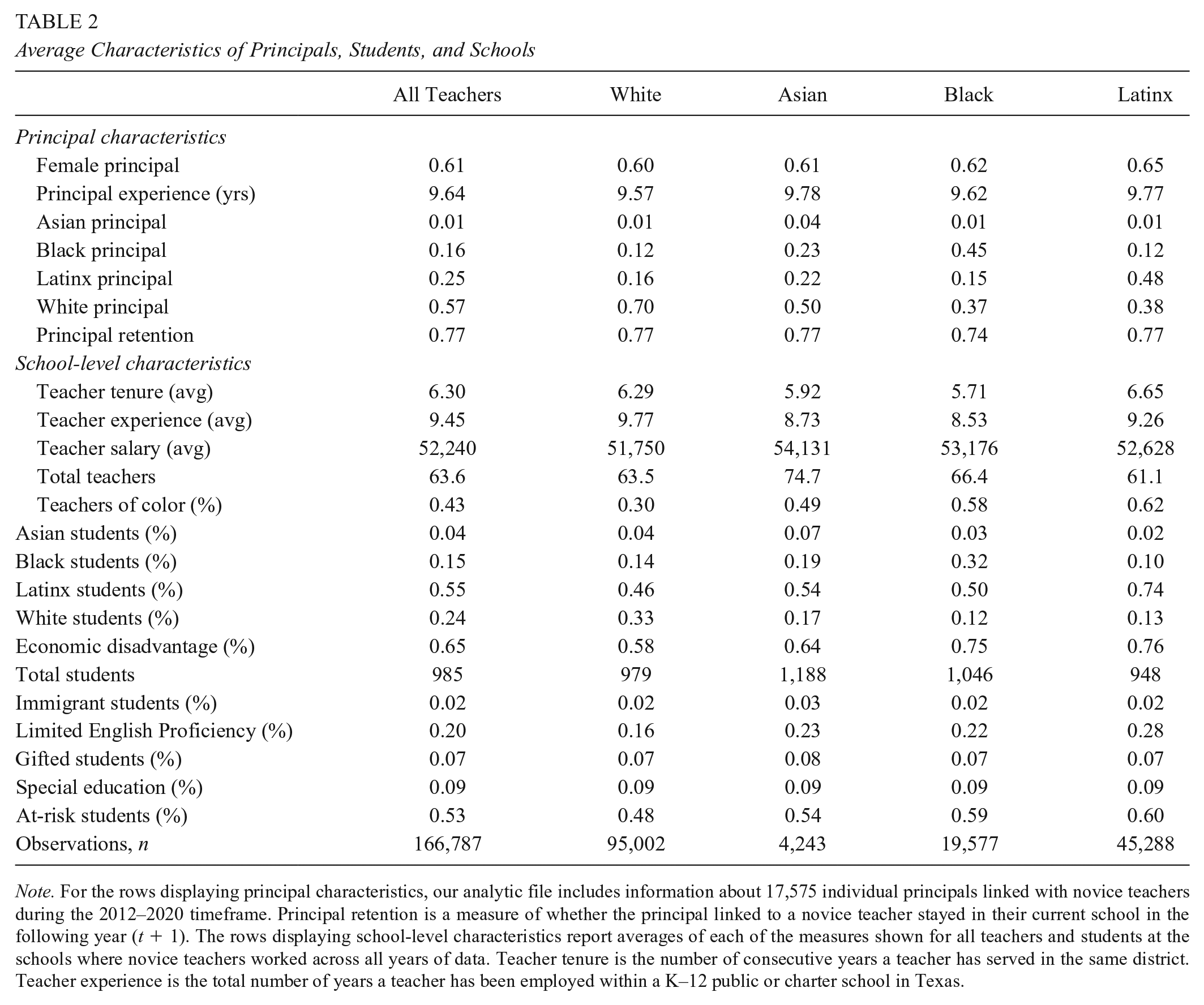
Note. For the rows displaying principal characteristics, our analytic file includes information about 17,575 individual principals linked with novice teachers during the 2012–2020 timeframe. Principal retention is a measure of whether the principal linked to a novice teacher stayed in their current school in the following year (t + 1). The rows displaying school-level characteristics report averages of each of the measures shown for all teachers and students at the schools where novice teachers worked across all years of data. Teacher tenure is the number of consecutive years a teacher has served in the same district. Teacher experience is the total number of years a teacher has been employed within a K–12 public or charter school in Texas.
Average Retention and Exit-System Outcomes by Locale

Note. Mean and standard deviation (in parenthesis) are listed in each cell. Our sample is smaller for the 3-yr/5-yr measures because we can calculate those outcomes for fewer cohorts due to the years of data available.
Analysis
Our analytic approach is designed to be descriptive and correlational, where our key aim is to better understand the relationship between ethnoracial matching and career outcomes for novice teachers. As we explain later, we employed a series of exploratory probability models, but we do not interpret our estimates as causal, and they should not be assumed to be externally valid, yet they might be useful in providing new understandings of prior causal research (Rosinger et al., 2022). In selecting this approach, we are responding to recent calls for “a more general understanding of patterns across a population of interest” within research drawing on rich longitudinal administrative data (Loeb et al., 2017, p. 1). Specifically, we used a combination of descriptive analyses and probability modeling to approach the large-scale nature of our data in a way that was exploratory and intended to generate new hypotheses that future researchers can test and confirm (Gopalan & Nelson, 2019). Our analytic models provided useful estimates describing the relationship between key variables in our data. And because of the rich detail within administrative data used, we were able to pair these estimates with descriptive and summary measures of central tendency (e.g., cross-tabulations, mean statistics) to illustrate the work context and career outcomes that novice teachers in Texas encountered during the time frame of our analysis (see Tables 1–3).
Our modeling approach included three sets of linear probability models (LPMs), with fixed effects at the school level, controlling for time-invariant, school-level factors potentially related to our outcomes of interest: the occurrence of ethnoracial matching, retention, and system-exit patterns (Holt & Gershenson, 2019). Using LPM with school fixed effects allowed for within-school comparisons of each outcome across novice teacher racial/ethnic groups and to control for unobservable variation in school-level resources and attributes, which might otherwise influence matching, retention, and system-exit likelihoods (e.g., school policies, disruptions, principal leadership style). 4 The teacher race/ethnicity variable used across all of our models was categorical with the reference group set to a White novice teacher. While estimates for Asian, Native American/indigenous, and two or more race/ethnicity teachers were produced in our regression outputs, we only report coefficients for Black and Latinx novice teachers due to space limitations and because these two groups represented most of the teachers of color in our sample. Brezicha and Fuller (2019) used a similar fixed-effects approach to estimate the relationship between race/ethnicity match and trust, leveraging within-school variation to compare teachers from different racial/ethnic groups who worked in the same school under the same principal. While their analysis only included one cross-sectional year of data, we drew from a much larger sample of teachers across nine cross-sectional years of data. We also estimate our main retention/exit-system model without fixed effects to explore differences in our outcomes when within-school comparisons are relaxed, and novice teacher observations are pooled at the year level. This change in specification did not shift the pattern of our findings in any of our model estimates. As noted earlier, our data set represents nine cross-sectional years of information, with each novice teacher appearing once in our analytic file. 5
To answer RQ1, we estimated in Equation 1 the probability of ethnoracial match for teacher i in school j in year t as a function of teacher gender (B1), race/ethnicity (B2), and preparation background (B3). 6 Included in Equation 1 were school-level (Sijt) covariates, as well as a school fixed effect (αj). We also included a year fixed effect (yt) and an error term (uijt). Covariates at the school level included student enrollment, student race/ethnicity, student economic disadvantage, and the percentage of teachers of color employed. Refer to Table 2 for the full list of covariates included. Finally, uijt is our error term, and standard errors were clustered at the school level. Because we were also interested in exploring the variation in the probability of ethnoracial matching between urban, suburban, town, and rural school locales, we employed Equation 1 for our full sample and across four subsets of our data separated by school locale type. In each of these subset models, we removed the school-level geographic locale covariates.

In our second set of models related to RQ2, we estimated the association between the occurrence of teacher-principal ethnoracial match and the probability of retention in the following school year (t + 1). We also ran this set of models separately with system-exit set as the dependent variable. As mentioned previously, each of these outcomes were binary (0-1). In Equation 2, an ethnoracial match between the novice teacher and their principal (Match ijt) was the key predictor of interest. We estimated the probability of retention or system-exit as a function of teacher racial/ethnic identity (Race/Eth ijt); ethnoracial match between teacher i and the principal in school j in year t (Match ijt); and teacher (Xijt), principal (Pijt), and school (Sijt) covariates, as well as fixed characteristics of the school (αj), a year fixed effect (yt), and an error term (uijt).

Finally, we extended the previous model in Equation 3 by adding an interaction term to estimate whether there was variation in the probability of retention (or probability of system-exit) when ethnoracial matching occurred specifically for novice Black and Latinx teachers. To do this, we kept the main effects for teacher race/ethnicity and ethnoracial match in our model (β1, β2) and added the interaction between teacher race/ethnicity and teacher-principal ethnoracial match (Match ijt*Race/ethijt). This approach allowed us to estimate how the association between ethnoracial matching and retention/system-exit might be different specifically for Black and Latinx novice teachers. Lastly, to better understand patterns across geographic school locale, we again used a categorical measure of locale (urban, suburban, rural, town) and ran four subset models for school geographic locale as implemented in our first equation.

Results
Ethnoracial Matching and Patterns Across Geographic Locales
Black and Latinx Teacher-Principal Ethnoracial Matching
To answer our first research question, we explored the novice teacher background characteristics associated with teacher-principal ethnoracial matching. We first report the extent to which the race/ethnicity of teachers—specifically Black and Latinx teachers relative to White teachers—was associated with the probability of working for a principal of the same race/ethnicity. 7 Table 4 displays estimates of the probability of teacher-principal ethnoracial matching for Black and Latinx novice teachers relative to novice White teachers. After controlling for teacher and school-level variables that could influence ethnoracial matching, we found that novice Black teachers were around 16 percent less likely than White teachers to work for a same race/ethnicity principal. The magnitude of this association was even larger for novice Latinx teachers, who were 26 percent less likely to experience ethnoracial matching with the principal at their school.
Probability of Teacher-Principal Ethnoracial Match by Teacher Characteristics and Locale
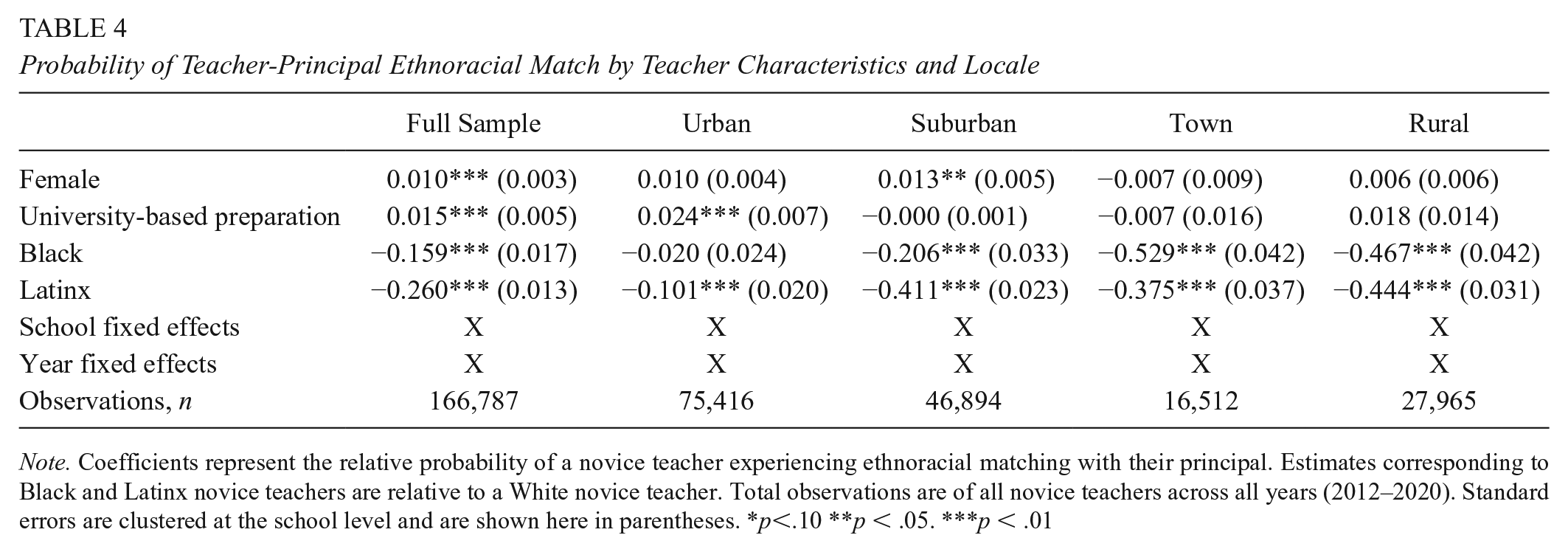
Note. Coefficients represent the relative probability of a novice teacher experiencing ethnoracial matching with their principal. Estimates corresponding to Black and Latinx novice teachers are relative to a White novice teacher. Total observations are of all novice teachers across all years (2012–2020). Standard errors are clustered at the school level and are shown here in parentheses. *p<.10 **p < .05. ***p < .01
We also observed important variation across geographic locales, whereby both Black and Latinx novice teachers appear slightly more likely to experience ethnoracial matching in urban schools but less likely to experience ethnoracial matching in suburban, town, and rural school locales. Thus, the decreased probability of ethnoracial matching for Black and Latinx novice teachers in our full sample was driven in large part by the significantly lower predicted probability that a Black or Latinx teacher in nonurban school locales worked for a principal who matched their race/ethnicity. For example, a Black novice teacher in a rural school was 47 percentage points less likely to work for a Black principal compared to the probability that a novice White teacher would work for a White principal. A novice Latinx teacher in a rural school was 44 percentage points less likely to work for a Latinx principal compared to the probability a White teacher would work for a White principal.
Gender, Preparation Background, and Teacher-Principal Ethnoracial Matching
Our models also included background characteristics of novice teachers, which prior literature indicates can influence early career job placement and job choice patterns (Boyd et al., 2011). As shown in Table 4, we found that novice female teachers were one percentage point more likely to experience a teacher-principal ethnoracial match compared to novice male teachers. This association remained consistent within suburban school locales, while in urban, town, and rural locales, our estimates were neither statistically nor practically insignificant. Novice teachers in university-based preparation programs were one percentage point more likely to work with a principal who shared their race/ethnicity compared to those in all other preparation programs. This association grew within urban school locales, but across suburban, rural, and town schools we observed no statistically significant relationship between novice teachers’ preparation and the likelihood of being ethnoracially matched with their principal.
Overall, our results for associations between ethnoracial matching and gender, as well as preparation background, had coefficients that were small in terms of magnitude and, in many instances, statistically insignificant. Thus, we observed little evidence that, for novice teachers, these two background characteristics were correlated with the likelihood of working for a same race/ethnicity principal. To summarize, across the three teacher background characteristics we explored (race/ethnicity, gender, and preparation program), only race/ethnicity was consistently associated with the likelihood of ethnoracial matching. Black and Latinx teachers in our sample were less likely to work for a same race/ethnicity principal compared to White teachers—except for novice Black teachers in urban schools, where we observed no significant difference in the likelihood of ethnoracial matching compared to novice White teachers.
Ethnoracial Matching and Retention/System-Exit Across Geographic Locales
Table 5 displays estimates from our predictive models describing the relationship between ethnoracial matching and novice teacher retention and system-exit outcomes for the full sample of teachers. The key takeaway from this table is that for all novice teachers, teacher-principal ethnoracial matching was associated with a 2-percentage-point increase in the likelihood of retention and a 1-percentage-point decrease in the probability of system-exit. As the last two columns of Table 5 show, the magnitude of these estimates grew when the outcome was three-year retention but not for the five-year retention outcome. Results here also indicate that net of teacher background and school covariates, Black, Latinx, female, and novice teachers prepared in a university-based program were more likely to stay in their current school in the following year and less likely to leave the K–12 public education system.
Ethnoracial Match and the Probability of Novice Retention/Exit-System

Note. Coefficients represent the relative probability of novice teacher retention and system-exit. All estimates are for the full sample of novice teachers across all years (2012-2020). Standard errors are clustered at the school level and are shown here in parentheses. *p<.10 **p < .05. ***p < .01. Our sample is smaller for the 3-yr/5-yr measures because we can calculate those outcomes for fewer cohorts due to our years of data available.
Predicted Retention
Table 6 displays results that answer the additional components of RQ2, related to our exploration of the heterogenous variation in the relationship between ethnoracial matching and retention patterns across novice teacher racial/ethnic groups and school geographic locales. We first discuss our results for models predicting retention. Overall, we found that the main effect of our teacher-principal ethnoracial match variable shown in row three of the table was associated with a greater likelihood of retention for our full sample and within each locale. However, the differential association for the additional effect of the interaction term (e.g., ethnoracial match x Black teacher) varied across racial/ethnic groups. Figure 1 provides a visual comparison of our main effect coefficients for teacher race/ethnicity as well as the sum of the coefficients for teacher race/ethnicity, ethnoracial match, and the interaction term (Match*Race/eth). This comparison provides a summary of the differential association that ethnoracial match provides for Black and Latinx novice teachers—above and beyond the association between teacher race/ethnicity and retention. This figure also displays how these estimates varied across geographic locales.
Relationship Between Ethnoracial Match and Probability of Retention by Locale

Note. Coefficients represent the relative probability of novice teacher retention. The variable for teacher race/ethnicity is categorical, where a White teacher is coded as the base group. Total observations are of all novice teachers across all years (2012-2020). Standard errors are clustered at the school level and are shown here in parentheses. *p<.10 **p < .05. ***p < .01.

Ethnoracial match and the difference in the probability of retention by locale
Looking at our interaction term in column one and row four of Table 6, it appears that a novice Black teacher matched with a Black principal had an even greater probability of retention compared to a Black teacher experiencing no ethnoracial matching (coefficient = 0.016). In column one, row five, we observed the opposite pattern for novice Latinx teachers, who had a decreased probability of retention compared to a Latinx teacher not ethnoracially matched to their principal (coefficient = −0.022). Our results in Table 6 also indicate some notable variation in retention outcomes across school geographic locales. The interaction for Black teachers matched with a Black principal was only statistically significant in suburban and town locales. Row four and column three of Table 6, a novice Black teacher matched with a Black principal in a suburban school had a greater probability of retention compared to a Black teacher not matched to their principal (coefficient = 0.028). An ethnoracially matched novice Black teacher in a town school also had an increased probability of retention (coefficient = 0.080). Like results for the full sample, as shown in row five and column three, a novice Latinx teacher experiencing ethnoracial matching in a suburban school had a decreased probability of retention compared to a Latinx teacher not ethnoracially matched (coefficient = −0.029). All other estimates corresponding to the interaction for Latinx teachers in our locale subset models were statistically insignificant.
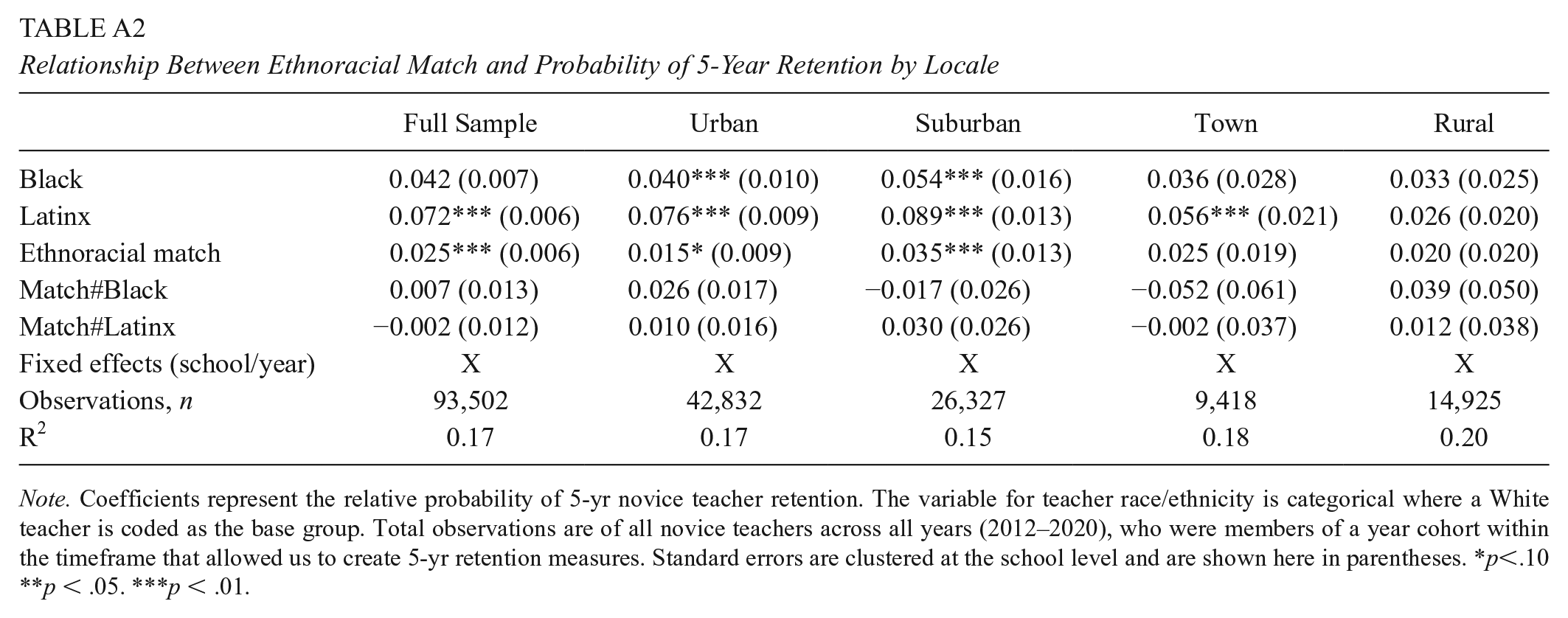
We provided additional estimates where we display results showing heterogenous variation in the relationship between ethnoracial matching and both 3-yr and 5-yr retention outcomes (please see appendix Tables A1 and A2). Estimates in each of these tables are disaggregated by race/ethnicity and geographic locale. The results related to these longer-term retention measures follow a similar pattern to those for one-year retention. However, the magnitude of the associations on the ethnoracial match main effect variable was slightly greater in our 3-year retention models for the full sample and across all locales except for in-town schools, compared to one-year retention.
Predicted System-Exit Patterns
Table 7 displays our results of patterns of system-exit. Overall, our findings for system-exit patterns indicate that ethnoracial matching was significantly associated with lower predicted probability of system-exit. However, the interaction terms in each model in Table 7 were, in most cases, small and statistically insignificant, meaning that we found no additional association between ethnoracial matching and the probability of system-exit for Latinx and Black novice teachers. In column one, rows one and two of this table, our full sample results indicate that Black and Latinx novice teachers were around 3–4 percentage points less likely to exit the system, compared to a White novice teacher. This result was consistent across each geographic locale subset model (columns 2–4) for both Black and Latinx novice teachers, except within rural schools where the magnitude of the relationship was slightly smaller for both groups of teachers, and in town schools where the magnitude was larger for novice Black teachers (see column 4, row 1). In column one, row three, the estimate for the ethnoracial match interaction term for our full sample suggests that a novice teacher matched with a same race/ethnicity principal was 1.5 percentage points less likely to exit the system compared to a novice teacher not matched with their principal. Looking across geographic locales, this association was relatively consistent in urban and suburban schools, whereas the reduced probability of system-exit was slightly larger in town schools, as shown in column four and row five (coefficient = −0.027).
Relationship Between Ethnoracial Match and Probability of System-Exit by Locale
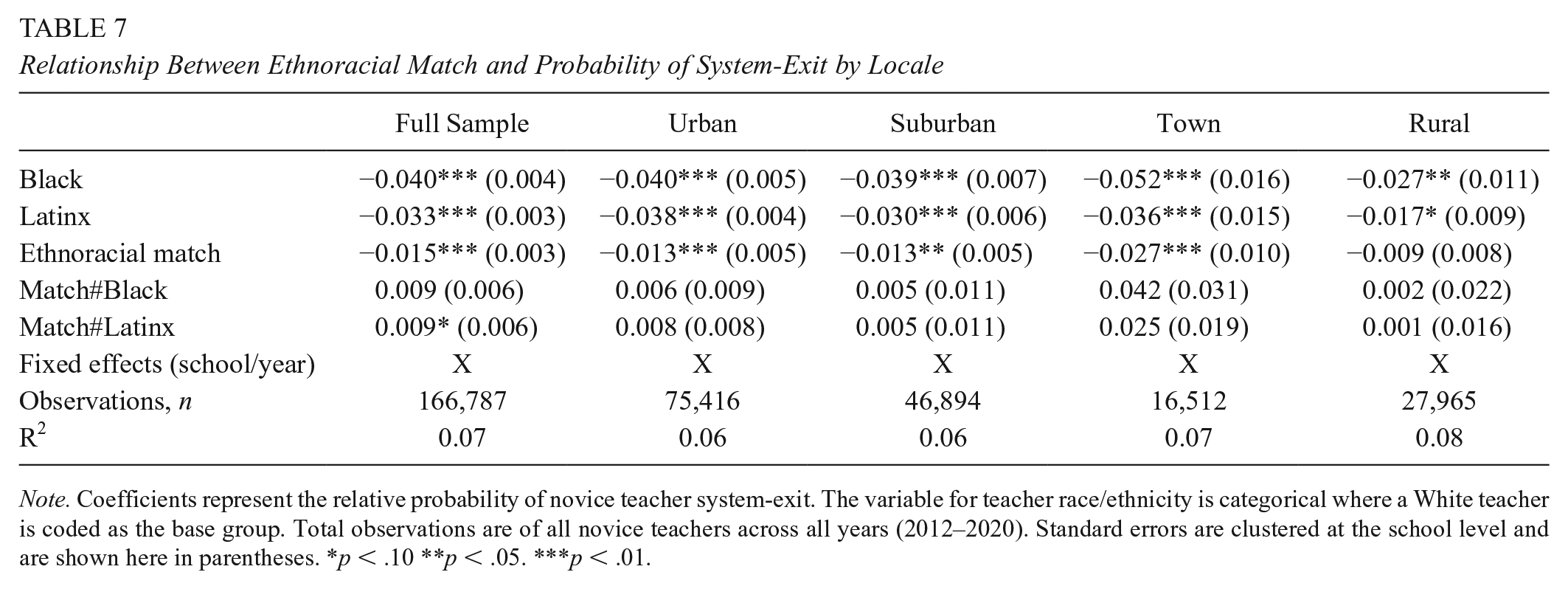
Note. Coefficients represent the relative probability of novice teacher system-exit. The variable for teacher race/ethnicity is categorical where a White teacher is coded as the base group. Total observations are of all novice teachers across all years (2012–2020). Standard errors are clustered at the school level and are shown here in parentheses. *p < .10 **p < .05. ***p < .01.
Discussion & Implications
The purpose of this research was to better understand the ways that teacher-principal racial/ethnic matching is associated with retention and system-exit patterns for novice teachers, specifically those in their first year of teaching. We focused our investigation specifically on outcomes for Black and Latinx novice teachers who continue to be the most racially/ethnically underrepresented educators in Texas—relative to K–12 student demographics. Beyond adding to the emerging group of studies investigating how relational demography can help explain teacher labor market patterns, our findings extend prior literature in two ways. First, our results illuminate how the relationship between ethnoracial matching and retention/exit patterns vary for Latinx teachers, whereas prior quantitative studies of this topic were only able to report results for Black teachers, compared to White teachers. Secondly, we demonstrate how both the probability of teacher-principal ethnoracial matching and the probability of teacher career outcomes associated with ethnoracial matching vary across school geographic locales. As such, in the following paragraphs, we discuss our results in the context of prior literature and explore some strategies that educational leaders and policymakers can leverage to better support younger and more ethnoracially diverse cohorts of educators.
Increasing Opportunities for Ethnoracial Matching
Overall, we found that novice teacher race/ethnicity was consistently linked with the predicted probability of teacher-principal ethnoracial matching. Our results also demonstrated that female teachers and those who attended a university-based preparation program were slightly more likely to be matched with a same race/ethnicity principal. As novice teachers’ racial and ethnic identity had a stronger association with predicted teacher-principal ethnoracial matching, we place more focus on a discussion of those results here. Compared to White teachers, and net of teacher and school characteristics, Black and Latinx novice teachers were less likely to experience ethnoracial matching with the principal at their school. This is consistent with Bartanen and Grissom’s (2023) investigation showing that Black teachers in Tennessee and Missouri were less likely to work with a Black principal compared to White teachers. Compared to this prior investigation, in our study, we were able to analyze a sample with more ethnoracial variation, which allowed us to include trends for Latinx novice teachers. Importantly, our results indicate that this group of novice teachers was the most ethnoracially underrepresented by their principal, whereby Latinx teachers in our sample were 26 percentage points less likely than novice White teachers to work with a principal who shared their same race/ethnicity.
While Latinx teachers are the fastest-growing group of educators in Texas and nationally, prior research suggests that they experience discrimination, stereotyping, and barriers to promotion into leadership positions (Edwards, 2021; Griffin, 2018). In this current study, we found that a Latinx novice teacher was consistently more likely to stay in their current school and less likely to exit the system, compared to a White novice teacher. However, our results suggest no additional association between ethnoracial match and retention/exit system patterns for novice Latinx teachers. In fact, in our full sample and suburban subset results, Latinx novice teachers matched with a Latinx principal were 2–3 percentage points less likely to remain in their current school. Although this result appears to run counter to what we would expect, it could be partly explained by the low predicted probability of teacher-principal ethnoracial match for novice Latinx teachers—especially in suburban locales where one in four novice Latinx teachers in our sample were employed. Overall, our findings indicate a need to reduce career barriers for Latinx educators interested in moving into school leadership positions. Rodela et al. (2019) discussed how Latinx leaders in their study experienced “lukewarm and uneven” forms of mentorship, were rarely encouraged to pursue educational leadership positions, and did not feel as if their cultural strengths were valued by those in power who were mostly White district-level leaders (p. 101). Such discriminatory work environments and exclusive leadership pipelines are harmful to school communities that stand to benefit the most from recruiting, hiring, and retaining more novice Latinx teachers. And as we explore in the following paragraphs, strategies to support pipelines of underrepresented school leaders could be more effective if they were geographically targeted—for example, through the bolstering of university and K–12 district partnerships and district hiring practices (Noonan & Bristol, 2020).
It is interesting that in our models estimating the probability of ethnoracial matching we found considerable variation across school geographic locales. For example, both Black and Latinx novice teachers became much more likely to work for a principal who shared their same race/ethnicity when we restricted our sample to urban schools but much less likely to experience ethnoracial matching in suburban, town, and rural schools. Recent demographic trends indicate that nationally, nonurban—especially suburban—locales are becoming more ethnoracially diverse (Frey, 2022). Considering prior research demonstrating that teachers of color often feel marginalized in nonurban school locales (Weisman & Hansen, 2008), our results strongly imply the need for policies increasing the ethnoracial diversity of school leaders in such contexts—especially in fast-growing suburban districts where 30 percent of the novice teachers of our sample were employed (see Table 2).
Benefits of Ethnoracial Matching
The results of this research provide supporting evidence that Black novice teachers, working for a principal of the same race/ethnicity have a greater likelihood of retention. And where past researchers have found that teacher-principal ethnoracial matching is linked with around a 3–4 percentage point increase in predicted teacher retention (Bartanen & Grissom, 2023; Grissom & Keiser, 2011), the present study has shown that the benefits of matching are potentially stronger for novice Black teachers. In our study, novice Black teachers matched with a same race/ethnicity principal were nearly 8 percentage points more likely to stay in their current school in the following year, compared to a novice White teacher not matched to their principal. Furthermore, our results indicate that this association grew in magnitude (for Black novice teachers) when narrowing the focus to outcomes within specific school geographic locales.
For example, Black novice teachers in suburban and town school locales were around 9 and 12 percentage points more likely to remain at their current school when they worked for a Black principal. 8 Teacher-principal ethnoracial matching could increase levels of workplace support and satisfaction for teachers of color who feel as if they have more voice and representation when working with a leader who shares a similar background, especially in a context where most of their colleagues are White (Bristol, 2018). Prior research has used the theory of relational demography to better understand outcomes driven by the relative racial isolation that Black teachers often experience in nonurban school locales (Kemper Patrick & Arturo Santelli, 2022), as well as the evidence of marginalizing and discriminatory policies/practices in school spaces where teachers of color feel unsupported and devalued by their White colleagues and leaders (Griffin, 2018; Griffin & Tackie, 2016; Grooms et al., 2021; Pizarro & Kohli, 2020). As nonurban school locales become increasingly racially/ethnically diverse (Diamond et al., 2021), future explorations of the experiences and career outcomes of teachers of color are needed.
Finally, we found evidence that novice teachers ethnoracially matched to their principal were around 2 percentage points less likely to exit the K–12 educator workforce. These results are consistent with the claim that teacher-principal ethnoracial matching improves levels of teacher satisfaction with their current work (Viano & Hunter, 2017). This evidence was for our full sample; thus, we did not observe a specific reduction in the likelihood of system-exit specifically for Black and Latinx novice teachers ethnoracially matched to their principal. We did find that compared to White teachers these groups of teachers of color were around 3–4 percentage points less likely to exit the system, indicating that there could be other factors keeping novice Black and Latinx teachers in the education sector. We suggest that future researchers continue to probe qualitative findings suggesting that teachers of color who feel more racially/ethnically represented in their schools also feel more embedded and invested in education as a long-term profession (Achinstein & Ogawa, 2011; Quartz, 2003). Quartz and her colleagues found that teachers of color in their longitudinal sample had higher retention rates compared to White teachers—a pattern that was partly explained by their more diverse within-education career pathways (e.g., instructional coach, curriculum director, dean, assistant principal). Our results did not directly test whether system-exit probabilities were driven by the career movements of Latinx and Black novice teachers into nonteaching educational roles. However, we suggest that future research investigates the longitudinal career pathways of teachers of color, specifically those who are more ethnoracially represented by school and district leadership—as there is evidence of discriminatory barriers for teachers of color who seek promotions into educational leadership positions (Berry & Reardon, 2022; D’amico et al., 2017).
Limitations
This study faces several limitations. First, we drew on administrative information for this analysis, which provided observational details about individual teachers and principals (e.g., experience, race/ethnicity) but is not able to provide insights into the decisions or perceptions of the educators in our sample. Therefore, while we highlight correlational patterns, we are unable to rule out other reasons why novice teachers in our sample switched schools or exited the workforce (e.g., parental leave, family emergency, out-of-state move). Relatedly, we are also unable to understand the mechanisms that drive some of the results we observed related to ethnoracial matching. For example, while a Black novice teacher in our sample was more likely to stay at their current school when they worked with a Black principal, we do not know if that is because of a stronger teacher-principal interpersonal relationship, higher levels of trust, better communication, or a multitude of other factors that our data does not include. Finally, our investigation is noncausal, meaning that our results only show the correlation between variables in the data we accessed, and the conclusions we can draw are also further limited by the fact that our data come from only one state. Thus, the pattern of outcome we observed could not be extrapolated to other states, although they might inform research, policy, and practice in states that are also as geographically and demographically diverse as Texas.
Implications
Despite these limitations, our results suggest that district leaders tasked with school leader recruitment and hiring should consider the benefits of ethnoracial representation, specifically for novice teachers of color. Our findings indicate that Black and Latinx novice teachers were significantly less likely to work for a principal of their same race/ethnicity compared to White teachers. Thus, it is important for policymakers to consider ways to support aspiring educational leaders of color. For example, at the district level, leaders and policymakers could develop partnerships with leadership preparation programs that graduate and certify racially/ethnically diverse cohorts. Similarly, district-level leaders (e.g., superintendents, associate superintendents, human capital directors) should develop systems for identifying teachers of color who are interested in future leadership opportunities and support the financial and increased workload burden required for them to earn additional training and credentials.
The results of this study also offer some important implications related to how state and district leaders support novice Black and Latinx teachers in nonurban school locales. In fact, of the novice Black and Latinx teachers in our sample, almost half worked in a nonurban school, with one-third of all novice Black teachers and one-quarter of all novice Latinx teachers employed in suburban schools. As researchers in population demographics note (Frey, 2022; Lacy, 2016), nationally, suburban areas often contain the most ethnoracially diverse student enrollments. Therefore, policies and strategies for recruiting and hiring more school leaders of color in suburban locales should be considered at the state and district levels. Moreover, the onus for diversifying school leadership in nonurban districts could be distributed to directors of large educational leadership preparation programs, who might consider policies to recruit, train, and mentor more diverse cohorts of future educational leaders who desire to work in suburban school locales. We want to be clear that our results do not suggest segregation by race/ethnicity as a policy solution for the current lack of opportunity for ethnoracial matching indicated by our results. Rather, our findings imply that increased opportunity for ethnoracial matching between teachers and school leaders—especially for historically resilient groups of novice teachers of color—should be considered as a component of hiring processes and strategies to improve teacher-principal fit, with the goal of improving novice teachers’ career outcomes.
Finally, we offer a few implications for research. Future investigations of teacher-leader ethnoracial matching should collect data that allows for longitudinal tracking of teachers’ careers along with measures of perception that can help researchers to better understand some of the mechanisms underlying our retention and system-exit results. We also suggest that qualitative research in this area explore specific reasons that Black and Latinx novice teachers provide for the career decisions they make while probing for connections to their experiences with school leaders. Further, while the principal of a school serves in the most central leadership role, there are other school leaders (e.g., assistant principals, deans, department chairs, mentor teachers) who could influence novice teachers’ career decisions. With this in mind, we suggest that future studies of this topic systematically explore how and in what ways other school leaders alter career pathways for novice teachers of color. We also suggest that future researchers investigate ethnoracial matching at different levels, such as the matching that occurs between teachers and their colleagues (other teachers) and between superintendents and school leaders. For example, it would be useful to know if superintendents of color are more likely to hire and retain more school leaders of color, therefore potentially influencing downstream hiring patterns across various attendance zones or an entire district.
Conclusion
Facing historic workforce shortages and diminishing teacher morale, educational leaders and policymakers are searching for solutions to improve teacher retention outcomes. One approach should be a renewed focus on novice teachers—a group that is more likely to bring racial, ethnic, linguistic, and cultural diversity to the classroom and, therefore, are more likely to better meet the needs of increasingly diverse K–12 student enrollments. From a policy and practice perspective, it is neither equitable nor sustainable that novice teachers of color are currently more likely to matriculate into less-supportive work environments—and thus more likely to turnover. Yet, these patterns persist. The results of this paper are significant because they provide new evidence about how educational leaders and policymakers might mitigate turnover rates and improve overall retention for novice teachers of color. Our findings imply that the strategic recruitment and hiring of principals of color—which we find should extend beyond urban school and district locales—could help in overall retention efforts. These results have implications for district leaders in terms of how they set policy to strategically recruit and position principals of color in the schools where they are most needed and for leaders of educational preparation pipelines where future principals of color are recruited, trained, and supported along their career pathways.
Footnotes
Appendix
Relationship Between Ethnoracial Match and Probability of 5-Year Retention by Locale
| Full Sample | Urban | Suburban | Town | Rural | |
|---|---|---|---|---|---|
| Black | 0.042 (0.007) | 0.040*** (0.010) | 0.054*** (0.016) | 0.036 (0.028) | 0.033 (0.025) |
| Latinx | 0.072*** (0.006) | 0.076*** (0.009) | 0.089*** (0.013) | 0.056*** (0.021) | 0.026 (0.020) |
| Ethnoracial match | 0.025*** (0.006) | 0.015* (0.009) | 0.035*** (0.013) | 0.025 (0.019) | 0.020 (0.020) |
| Match#Black | 0.007 (0.013) | 0.026 (0.017) | −0.017 (0.026) | −0.052 (0.061) | 0.039 (0.050) |
| Match#Latinx | −0.002 (0.012) | 0.010 (0.016) | 0.030 (0.026) | −0.002 (0.037) | 0.012 (0.038) |
| Fixed effects (school/year) | X | X | X | X | X |
| Observations, n | 93,502 | 42,832 | 26,327 | 9,418 | 14,925 |
| R2 | 0.17 | 0.17 | 0.15 | 0.18 | 0.20 |
Note. Coefficients represent the relative probability of 5-yr novice teacher retention. The variable for teacher race/ethnicity is categorical where a White teacher is coded as the base group. Total observations are of all novice teachers across all years (2012–2020), who were members of a year cohort within the timeframe that allowed us to create 5-yr retention measures. Standard errors are clustered at the school level and are shown here in parentheses. *p<.10 **p < .05. ***p < .01.
Acknowledgements
This study used data from The University of Texas at Austin Education Research Center (ERC). The conclusions of this research do not necessarily reflect the opinion or official position of the Texas Education Research Center, the Texas Education Agency, the Texas Higher Education Coordinating Board, the Texas Workforce Commission, or the State of Texas.
Correction (December 2023):
This article has been updated with minor grammatical corrections since its original publication.
Funding
The author(s) disclosed receipt of the following financial support for the research, authorship, and/or publication of this article: This research was supported by a grant from the W.W. Caruth Jr. Fund at Communities Foundation of Texas.
1.
Using the State Board for Educator Certification data, we dropped any out-of-state certified teachers before merging the SBEC information into our novice teacher cohorts created from the Texas Education Agency employment files. We did not have access to private school employment information, so it could be possible that a small group of novice teachers in our analytic file have prior experience in private schools.
2.
Measurement of these outcomes is motivated by research indicating that teachers are at the highest risk of turnover after year one (Newton et al., 2011). In theory, if ethnoracial matching was associated with more support and higher job satisfaction for novice teachers, they would be less likely to turn over in year one and also have a lower turnover risk in subsequent years. There are multiple examples of prior research investigating the association between longer-term retention outcomes and an initial year of teaching intervention or teachers’ preparation/preservice experiences without controlling for the continuation of the independent variable of interest in subsequent years (e.g., Brantlinger et al., 2023; Guthery & Bailes, 2022; Reyes & Alexander, 2017; Zang & Zeller, 2016).
3.
As a sensitivity check, we removed our “Total teachers” covariate from each model, in case it might be collinear with our “Total students” measure, and we observed no difference in the outcome of our estimates.
4.
We found methodological literature to support our fixed effects regression approach, which refers specifically to sample size (VanVoorhis & Morgan, 2007). The authors note the N > 104 + m formula, where m is the number of predictors/covariates and N is the recommended minimum sample size.
5.
We do not use a true longitudinal teacher fixed effects approach where we follow teachers over time to observe how a switch in their principal, resulting in ethnoracial match variation, influences their retention. Rather, we are comparing novice teachers within the same school using cross-sectional data pooled across nine school years. Given a potential concern that schools never experiencing a change in the predictor variable of interest (e.g., ethnoracial matching) do not contribute to the coefficient of interest (Breuer & deHaan, 2023), as mentioned, we ran our models without fixed effects and used effective sample size guidance from  . Relaxing the fixed effects specification did not influence the sensitivity of our estimates in any of our regression results presented.
6.
Although we have certain time-invariant variables (e.g., race/ethnicity, gender) in our models specified with a time subscript (t), this just indicates the race/ethnicity or gender of novice teacher i that is observed only once in the cross-section year t.
7.
To answer our “full sample” question, in we made the decision to focus only on results for Black and Latinx novice teachers for two reasons. First, the proportion of novice Asian teachers (2%) was too small to produce reliable estimates in our analytic models. Secondly, due to manuscript word limits and space limitations, we were only able to discuss results for Black and Latinx novice teachers, and we defend this decision since these two groups represent greater than 90% of the teachers of color in our sample.
8.
We want to reiterate the correlational nature of this exploratory investigation. While we assert that our sample was sufficiently large to observe patterns and trends for novice teachers disaggregated by race/ethnicity and locale, we point to the need for more rigorous investigations in this area. Across geographic locales, in our full sample, around 10%—or 16,512—teachers worked in town schools, with 4% of this group identifying as Black. We also note that close to half of town schools experienced at least one change in principal race over the 9 years of data.