



Abstract
Although children’s literature has been challenged and banned for decades, some U.S. states have recently enacted legislation limiting how teachers can address such topics as race, sex, and gender in classrooms, which may influence teachers’ selection of literature. To understand this phenomenon, this exploratory concurrent mixed-methods study involved a written children’s literature course artifact and survey responses analyzed through critical literacy and self-censorship frameworks. Findings indicate that preservice teachers reported avoiding conversations about gender and gender identity more often than those about sexual orientation or race. Further, despite legislative changes, participants mostly reported self-censoring due to lack of pedagogical knowledge, lack of policy knowledge, and fear of institutional sanctions, which are long-standing reasons for self-censorship rather than new ones. Comparatively, they self-reported little desire to promote the dominant political ideology. This research indicates that topic-restrictive legislation can influence classroom practice even when teachers do not share the ideology behind such legislation.
Keywords
Introduction
Schools carefully select many of the texts used for teaching reading, but teachers still make decisions about which texts to incorporate and how (Conradi-Smith et al., 2022). For decades, teacher educators have emphasized the importance of selecting literature that foregrounds authentic representations of individuals with marginalized identities (Crisp et al., 2016; Flores et al., 2019). Examinations of how successful this emphasis has been in shaping teachers’ practices (e.g., Angleton, 2021; Voelker, 2013) suggest limited incorporation of this literature. As Pace (2019) stated, centering marginalized voices “is both urgent and risky, especially in divided societies” (p. 228). Despite calls for diverse classroom libraries, in practice, teachers continue to privilege stories that center heteronormative, cisgender, and White identities (Crisp et al., 2016).
Although the challenge of using children’s literature to counter dominant narratives is not novel, what has changed is the legislative context. Some U.S. states have recently passed laws that define and constrain the topics teachers can discuss (see Gay, Lesbian, & Straight Education Network, 2023). Elementary teachers in their inductive years, who are typically women ages 22–25 and have not held previous professional jobs (National Center for Education Statistics, 2018), hold relatively little power in school hierarchies and may view themselves as having few alternatives to adhering to this legislation. Thus, it is necessary to explore the way teachers develop critical literacy (Vasquez et al., 2019) and learn to select texts that carry higher risk of producing backlash than others.
This research is especially needed because topic-restrictive legislation is imbued with deficit discourses around children’s ability to engage with complex topics. As Dyson (2015) argued, this deficit discourse further serves to erase students’ cultural assets and academic strengths (Dyson, 2015) and systematically contributes to marginalization. Some teachers claim to resist discussing particular topics with young learners to protect them from discomfort or obscenity (Lammert & Drummond, 2021; Pollock, 2021), while others may use legislation as an excuse for excluding perspectives that they would not have included anyway. However, critical literacy (Vasquez et al., 2019) provides an alternative if teachers are prepared to enact it. As researchers, we share the perspective that young learners are inclined to question their worlds and that critical literacy teaching (Vasquez et al., 2019) is possible if students’ questions are honored rather than minimized (Children’s Community School, 2018; Cowhey, 2006; Dyson, 2015).
In this study, we relied on an exploratory concurrent mixed-methods approach (Bryman, 2006; Merriam, 2014) to explore preservice teachers’ (n = 68) views inside two children’s literature courses in Texas—a U.S. state with legislation restricting how teachers discuss race, gender, and sex in the curriculum (Lopez, 2021). We conducted this research to determine what topics preservice teachers reported avoiding and to see how those topics matched those governed by legislation. In addition, we aimed to understand what factors influenced preservice teachers’ selection of texts. The Research Questions (RQ) were:
RQ 1: When envisioning the use of children’s literature, what topics do preservice teachers in a state with topic-restrictive legislation report self-censoring?
RQ 2: In a state with topic-restrictive legislation, what factors do preservice teachers report as influencing their self-censorship of children’s literature?
Background
First, we explore policy to show how book challenges, bans, and censorship have been recast in recent legislation. Considering this legislation, we define children’s literature and describe how we employ the concept of risk in this study. We conclude with a review of existing research on teacher preparation to use children’s literature.
Current Policy Context: Book Challenges and Bans
Recently, there has been an exponential increase in book challenges. In 2021, the American Library Association (ALA) tracked 729 challenges to library, school, and university materials targeting 1,597 distinct books. This marked a 367% increase in book challenges over 2020 (American Library Association Office for Intellectual Freedom, 2022). Challenged children’s literature most often explores such topics as race, racism, and/or gender, gender expression, and sexual orientation. These same topics are centered in recent legislation focused on controlling the representations of race, racism, and LGBTQIA+ 1 identities in K–12 classrooms.
Teachers who select children’s literature on these topics are undeniably taking actions that risk repercussions. For example, Texas Senate Bill 3 states, “A teacher who chooses to discuss . . . a widely debated and currently controversial issue of public policy or social affairs . . . shall explore that topic objectively and in a manner free from political bias” (Lopez, 2021). Because this law does not define which issues are controversial, it passes the responsibility of interpretation to teachers and, in the case of a complaint, school administrators. Furthermore, teachers may not want to address a controversial dilemma without taking a clear stance on its moral underpinnings, which can lead to self-censorship. Today, unless teachers are comfortable depicting all situations as simple and two-sided, they face sanctions and termination (Hixenbaugh & Hylton, 2021).
These challenges are not a radical break from the past. Instead, they represent the current iteration of White supremacy and cisgender heteronormativity. For example, Graves (2009) documented the purge of gay and lesbian teachers in the 1950s and 1960s from classrooms in some states, including Florida. Nationally, in the 1950s, the rise of McCarthyism spurred laws that censored teachers. In the world of children’s literature, the National Council for Teachers of English (NCTE, 1953) responded: The free people of the United States have built a great nation by the encouragement of free enterprise, itself a product in part of freedom to think. Our inventiveness, our ingenuity, our experimentalism, our creed of “Let’s see how it works” are all directly dependent on the unhampered activities of American minds. (p. 9)
In the view of NCTE, censorship runs contrary to foundational democratic ideals. Similarly, the American Educational Research Association (2014) issued statements on the importance of scholarly and academic freedom, and NCTE (2022) published an updated statement reiterating the importance of literary freedom. To understand how these policies shape teachers’ use of children’s literature, we turn to the relationship between texts and risk.
Defining Risky Children’s Literature
Children’s literature refers to “material written and produced for the information or entertainment of children and young adults” (Library of Congress, 2008). In this research, children’s literature describes reading materials in K–12 classrooms, or what Wadham and Young (2015) defined as literature that does not “have an intended instructional component nor [is it] designed exclusively for classroom use” (p. 39). We use the term literature to refer to informational, narrative, and hybrid text genres inclusive of board books, picture books, chapter books, and novels.
The question of how to describe children’s literature that lends itself to discussions of social issues is contentious. One line of scholarship has termed these risky texts (Angleton, 2021; Damico, 2012; Damico & Apol, 2008; Harste, 2000; Leland & Harste, 2001; Lewison et al., 2015; Simon & Armitage-Simon, 1995; Wessel-Powell & Bentley, 2022).The term risky text reinforces that no text is ever neutral (Vasquez et al., 2019) and, as such, that any text could potentially lead to discomfort or backlash from a community it misrepresents or excludes. Framings of children’s literature as risky acknowledge that those who hold already power in K–12 school spaces (e.g., parents who are White, cisgender, and heterosexual) are likely to have their grievances with diverse representations acknowledged (Goldberg & Smith, 2014). In contrast, when students and their family members with marginalized positionalities voice complaints about curricular invisibility, it is less likely that the absence of representation is viewed as a legitimate concern by school administrators and policymakers (Goldberg, 2021).
Learning to identify and navigate risk rather than denying its existence is key to preservice teachers’ growth as critical literacy educators (Pace, 2019; Ticknor, 2015; Wessel-Powell & Bentley, 2022). As Wessel-Powell and Bentley (2022) argued, to explore risk, preservice teachers can ask, “What makes this text risky for me?” and “What aspects of my own privilege are showing in my discomfort around using this text to teach?” (p. 64). Such questions build preservice teachers’ capacity to confidently share texts despite risk.
Importantly, other scholars described these same texts as critical or diverse by focusing on the possibilities they afford rather than the drawbacks (Flores et al., 2019; Tschida et al., 2014). Specifically, Crawley (2020) challenged that framing texts as risky emphasizes preservice teachers’ discomfort rather than foregrounding the productive conversations they inspire. Because the current study focuses on preservice teachers’ perceptions, we use the term risky text to emphasize the need for teacher educators to equip future teachers with tools to explore and trouble their perceptions of risk. In doing so, we agree with Crawley (2020): When preservice teachers select texts based on which stories may upset dominant groups, it contributes to the harmful exclusion of marginalized characters, voices, and stories. To us, the best way to combat this possibility is not to ignore the tangible impact of risk on teachers’ thinking but to adequately prepare teachers to take a critical literacy stance in contested spaces (Riley & Crawford-Garrett, 2016; Ticknor, 2015). Thus, the framing of risky text helps highlight the tensions inside text selection, while a critical literacy (Vasquez et al., 2019) lens helps frame instructional practices. With this distinction in mind, we review studies of how teacher educators prepare teachers to select texts.
Teacher Preparation to Select Risky Children’s Literature
Although risky texts could feature any number of topics, this study focuses on how legislation specifically governing discussions of gender, sex, and race affected preservice teachers. As such, it is imperative to consider the decades of scholarship on how preservice teachers develop critical literacy and engage with these topics.
First, research on teachers’ perceptions of texts featuring LGBTQIA+ identities has shown that individuals’ views can shift when they read and discuss this literature in supportive environments (Airton & Koecher, 2019; Buchanan et al., 2020; Hermann-Wilmarth, 2007). For example, Beck et al. (2017) found that through reading gender and sexually diverse texts, followed by dialogue and reflection, graduate students reported increased likelihood to use these texts. When teacher educators model a critical literacy stance toward these texts (Ticknor, 2015) and when individuals have a chance to observe how young readers react to these texts (Clark & Blackburn, 2009), teachers’ growth can accelerate. However, research has suggested that these experiences have limited transfer to classroom practice (Crawley, 2020; Thein, 2013; Young, 2019). For instance, preservice teachers in Angleton’s (2021) study reported concerns about how their students’ parents would feel about LGBTQ+ inclusive narratives and suggested that elementary students were too “innocent” (p. 4) for these topics, echoing deficit and paternalistic discourses (Dyson, 2015).
Engagement with children’s literature that authentically represents racial diversity and challenges dominant narratives around racism and racial inequality can also positively influence individuals’ development of racial literacy (İşler & Dedeoğlu, 2019; Lammert, 2022; Riley & Crawford-Garrett, 2016; Tschida et al., 2014). When teachers attempt to incorporate texts about race and racism in their classrooms, they face similar challenges to those they report related to LGBTQIA+ literature: Many feel ill-equipped to guide discussion and question whether their students are mature enough to discuss such topics (Davilá, 2011; Mosley & Rogers, 2011; Solic & Riley, 2019). Notably, when preservice teachers in Buchanan’s (2015) study were asked to consider discussing race in elementary classrooms, “they suggested that doing so was either controversial or risky” because “race is too complicated for elementary students” (p. 14). Across this literature, students’ developmental stages are commonly referenced as a justification for avoiding discussions of race, even though lived experiences of race begin at birth (Children’s Community School, 2018). In another study of preservice teachers’ use of texts on racism in field work, Beneke and Cheatham (2020) observed that mentor teachers actively silenced discussion about race and “emphasized children’s naïveté” (p. 262). This literature suggests that teacher education has a role to play in disrupting norms and encouraging new teachers’ engagement with students’ questions about race-related topics (Cowhey, 2006).
Research on the role of children’s literature in preservice teacher education has provided insights into the factors that stifle the transfer of preservice learning to practice. In their content analysis of children’s literature course syllabi, Sharp et al. (2018) identified 306 distinct learning outcomes. However, not one outcome addressed censorship, book challenges, or book bans (Sharp et al., 2018). Relatedly, Flores et al. (2019) reviewed the uses of children’s literature in literacy methods courses and found that teacher educators commonly emphasized the importance of diversity and representation. Combined, these studies suggest a perfect storm for recent graduates of teacher education programs who may have been taught to value risky texts but have been given little preparation for the contentious political climate that they are entering (Davilá, 2011). We now turn to relevant theory to offer explanations for why these challenges using risky children’s literature persist.
Theoretical Frameworks
To understand the topics teachers self-censor and their reasons for self-censorship, we employed two complementary frameworks: the psychosocial basis of self-censorship (Bar-Tal, 2017) and critical literacy (Janks, 2012; Vasquez et al., 2019).
Self-Censorship
Bar-Tal (2017) defined self-censorship as “an act of intentionally and voluntarily withholding information from others in the absence of formal obstacles” (p. 37). Self-censorship has been documented as a macrolevel mechanism to maintain a preferred national story (Pace, 2019). For example, the torture of Algerian civilians by French forces was not spoken of in French media well into the 1990s as a collective act of self-censorship and denial (Branche & House, 2010). Self-censorship can also function on a smaller, more individual level, such as a teacher omitting aspects of a historical event (e.g., not accurately describing the conditions slaves endured) despite standards directing their teaching.
Self-censorship is distinguished from censorship by the presence of formal obstacles (e.g., legislation, policies, sanctions; Gibson & Sutherland, 2021; Hartsfield & Kimmel, 2021). This distinction enables researchers to more accurately understand the way individuals weigh costs and benefits (Bar-Tal, 2017). Notably, individuals may not take up every possible freedom, despite a lack of obstacles. Again, this phenomenon is far from novel; Sullivan and Tuana (2007) chronicled this “knowing ignorance” in relation to the racial history of the United States, while Blackburn et al. (2018) demonstrated how it functions in relation to LGBTQIA+ identities. In our review of literature, we have shown that many prior studies have demonstrated that preservice teachers are hesitant to use risky texts for various reasons (Flores et al., 2019). Yet, many circumstances have been documented showing individuals having true information and not communicating it, even though others do not have the information and could benefit from it (Gibson & Sutherland, 2021).
In education contexts, theories of self-censorship offer possible explanations for why teachers might not share their knowledge. Vered et al. (2017) proposed the following reasons: (a) promotion of the dominant ideology and desire for national unity, (b) concern regarding bringing political content into classrooms, (c) concern regarding confronting young students with unpleasant or difficult topics, (d) insecurity in selecting materials and guiding student discussion, and (e) fear of inconsistency with institutional policies leading to sanctions and pushback. This theory suggests that a teacher’s fears (e.g., worry over parental pushback), goals (e.g., a desire for unity), and knowledge (e.g., understanding what is developmentally appropriate) intersect around their decision to self-censor (Buchanan et al., 2020). Self-censorship may occur, specifically in the selection of children’s literature, as preservice teachers encounter topics that challenge their individual beliefs (Hartsfield & Kimmel, 2021). We situate these factors within social contexts through framings of critical literacy.
Critical Literacy
Critical literacy refers to the ability to analyze, question, and understand information sources from multiple perspectives as a reader (Janks, 2012; Leland & Harste, 2001). It involves developing an understanding of power, justice, and awareness of gender and racial differences within the literacy education (Vasquez et al., 2019; Wolfe, 2010). Taking a critical literacy perspective involves intentionally reaching for risky children’s literature (Wessel-Powell & Bentley, 2022) and using it to help students develop the skills and knowledge needed to become informed, engaged, and active social participants. This approach involves various teaching strategies, such as analyzing current events, using literature to challenge dominant perspectives, and encouraging students to engage in critical dialogue and reflection (Flores et al., 2019). In this research, critical literacy supported the work of teacher educators by framing the approaches and practices to teaching with risky children’s literature. It also afforded a way to critically examine the reasons preservice teachers gave for their unwillingness to include perspectives through children’s literature, particularly in relation to concerns that young children might not be developmentally ready to engage with content (Children’s Community School, 2018; Cowhey, 2006; Dyson, 2015).
Methods
This study relied on a mixed-methods approach informed by critical perspectives on quantitative research (Sablan, 2019). As such, we examine our positionality first.
Researcher Positionality
Jacobson and Mustafa (2019) provided a three-tier reflexivity tool for researchers to articulate and examine their positionalities. At the first tier, we identified our social positions. We are two White cisgender women and U.S. citizens. We are licensed, experienced elementary teachers and lifelong readers of children’s literature.
At the second tier of critical reflexivity, we explored how these positions influence our lives (Jacobson & Mustafa, 2019). At the time of the study, we resided in a culturally conservative state in the U.S. Southwest, with policies that marginalize and criminalize people of color and LGBTQIA+ individuals (Gay, Lesbian, & Straight Education Network, 2023). Enacting critical reflexivity, we used dialogue, humility, and critical friends as resources (Lammert, 2022) as we continually reflected on our culpability in the harmful effects of these policies and our obligation to resist them.
Finally, we examined how our positions influenced our research design. As former elementary teachers, we observed school procedures that privileged White, cisgender, and heteronormative ways of being. This experience sharpened our position as methodological quantitative criticalists who acknowledge that “numbers are not neutral, and statistics are not color-blind” (Sablan, 2019, p. 185). This stance informed our design of the quantitative elements of the current study. We carefully designed categories for selected response items with the knowledge that the categorization we employed had the potential to further marginalize particular groups. We attempted to mitigate this risk by including items where respondents wrote in topics of their choosing and analyzing the data comparatively. Our positionalities influenced the decisions we made, including those prior to study conceptualization and after data analysis had concluded. In the remaining description of methods, we address researcher positionality at each step.
Participants and Research Setting
In the state where this study occurred, Senate Bill 3 was passed in September 2021, which matched the time frame in which the participants in this study enrolled in children’s literature courses. Senate Bill 3 governs how K–12 teachers can discuss race and sex in public school classrooms (Lopez, 2021). This study was conducted in the spring semester of 2022. In both universities, children’s literature was offered as an elective course inside teacher preparation programs.
Each author taught one of the university children’s literature classes separately, but we relied on each other for reflexive support. There were 40 students at University A and 28 students at University B who consented to participation in the study (n = 68). Research at both sites had Institutional Review Board approval. All participants provided active, informed consent. Demographic information was obtained through a survey that 59 of the 68 participants completed. Participants’ responses to an open-ended item asking their gender indicated that they were 58 women and 1 man. Their racial and ethnic self-identification is presented in Table 1.
Self-Reported Race and Ethnicity of Participants

These respondents identified as “White/Native American/Latino” (1), “Multiracial” (1), and “Mexican, Spanish, Native American” (1).
University Teaching Context
As practice-based researchers, we engage in ongoing cycles of reflection on our practice to improve our teaching. The courses were similarly designed but were not perfectly uniform. Table 2 shows a comparative analysis of course topics.
Comparative Analysis of Course Topics

As experienced children’s literature instructors, our stance toward texts representing diverse and marginalized communities influenced preservice teachers’ perspectives. Accordingly, we were cautious not to frame texts or the identities represented in texts as controversial or nonnormative. However, preservice teachers described texts as “controversial” or “risky” nearly every class period; in these instances, we engaged with questions around their perceptions of risk, such as “You said this text might be risky—risky for whom?” or “Is it ever controversial not to include a text?” These questions were intended to support preservice teachers’ use of risky text and development of critical literacy (Vasquez et al., 2019).
Data Sources
Participants have a strong tendency toward self-reporting socially desirable beliefs when topics are controversial (Mertens, 2015). This trait means that preservice teachers may be inclined to report that their views on children’s literature are more similar to their instructors’ than they actually are. However, relational validity (Tuck & McKenzie, 2015) can be achieved through building trust and can lead to more valid findings. This dilemma means that to understand preservice teachers’ views of children’s literature, anonymously collected and identifiable data sources must be analyzed based on how they were collected (Bryman, 2006).
Given these challenges, we used a written course assignment and an anonymous survey artifact. Due to the power dynamics of creating categories for the identities and/or topics preservice teachers consider risky (Sablan, 2019), the survey included selected response and open-ended questions. Although we suspected that some preservice teachers viewed texts promoting dominant ideologies as not risky and text promoting nondominant ideologies as risky, we could only test this assumption by including items on various topics. These data enabled us to compare how preservice teachers represented their views differently, depending on whether they were responding to instructors through a named assignment or an anonymous course survey.
Survey Instrument Design
Our simple descriptive survey (Mertens, 2015) was originally based on an instrument designed by Voelker (2013) to assess teachers’ views and uses of texts. Voelker’s instrument was based on four factors: book selection efficacy, prudent decision-making, censorship issues, and teacher-parent relationships. Informed by social contexts, we had previously expanded these factors to include a broader range of influences and stakeholders on teachers’ beliefs and practices. For example, we added Factor 10: Teacher’s Views of Children, which focused on what types of topics respondents believed that children were developmentally prepared for by age. We also expanded the topics that may be considered risky to include in children’s literature. For example, Voelker’s (2013) survey had just one item that asked about “books that present homosexuality as another lifestyle choice” (p. 32). Informed by more contemporary and nuanced views of the identities of individuals who identify as LGBTQIA+, and the importance of their representation in teacher education settings (Hermann-Wilmarth, 2007; Young, 2019), we created items that asked separately about sexuality/sexual orientation and gender/gender identity. We also included open-ended write-in options.
We piloted this survey with 55 students enrolled in a children’s literature course in the spring of 2018. Following Fowler (2014), we employed multiple complementary pilot testing strategies. We discussed the survey results with the students, and we encouraged them to provide feedback on problematic items. We also used exploratory factor analysis to analyze the strength and relationship between each factor (Welkowitz et al., 2006). Pilot testing showed that the survey had acceptable internal construct validity (Hoffman et al., 2018). Given the shifts in policy between 2018 and 2022, for this study, we added Factor 2: Teacher’s Consideration of State Policy Contexts to include items on participants’ views of how legislation influences their selection of children’s literature. Table 3 shows the factors and topics that informed survey design.
Survey Factors and Risky Topics Used in Likert-Scale Items

The survey began with demographic questions followed by 50 items on a 5-point Likert scale, with five questions for each factor. Each of the 10 topics was distributed across the factors, but some items did not specify a single topic. For example, one item in Factor 8 stated, “Schools should stay neutral on issues of social justice,” which could apply to any topic the respondent considered to be an issue of social justice. Importantly, we did not reference any specific children’s books inside the survey items. Given preservice teachers’ known tendency to downplay their willingness to self-censor topics, such as race (e.g., Beneke & Cheatham, 2020), the survey was designed to reveal these biases in an anonymous response format separate from references to particular texts.
The survey included additional items designed to reveal what topics participants assumed to be risky beyond those we suggested. The first was a table of the topics in Table 2. Participants were instructed to slide a bar to indicate the earliest grade level they thought the topic would be acceptable to discuss through children’s literature. Participants could click a separate box if they thought that the topic was never acceptable. The second, an open-ended item, said, “List all the topics that you consider censorable in Preschool through 6th Grade Children’s Literature. If you do not consider any topics censorable, write ‘NA.’”
The survey was administered through a reusable Qualtrics link, which enabled it to be conducted anonymously. This method was chosen to reduce social desirability bias (Mertens, 2015). Respondents were given time in class to complete the survey. Ultimately, 59 students completed the survey in the last 3 weeks of the semester.
Written Course Assignment
Our second data source was a course assignment used by instructors at both universities. First, participants read Bishop’s (1990) iconic statement on children’s literature as windows, mirrors, and sliding glass doors. The stated goal of the lesson was to cultivate an understanding of how children use literature to see and understand themselves and develop understandings of the lives of others. The participants discussed the article with two to three peers and then wrote an open-ended reflection. Responses were submitted as a course assignment, with participant names attached. Responses ranged in length from 86 words to 356 words. All 68 students completed the written reflection.
Data Analysis
Consistent with an exploratory concurrent mixed-methods analysis (Bryman, 2006), both data sources were analyzed simultaneously and recursively to ensure that neither assumed priority in the results.
RQ 1
To begin our analysis, descriptive statistics were generated based on participants’ responses to the survey. We originally focused on RQ 1 by examining the response patterns to the item, which asked participants at which grade level they thought that certain risky topics were acceptable to discuss with children’s literature. We made a histogram showing the distribution of responses to each topic. We noted that responses to this item were standardized in that we provided the topics (e.g., Race/Ethnicity, Religion; see Table 3), but we also had two open-ended sources of data on what topics participants were comfortable with: their written response from coursework and the survey item asking them to list all topics that they believed were censorable.
Specifically, we noticed that when writing about windows, mirrors, and sliding glass doors (Bishop, 1990), participants brought up topics as examples in their answers. We then categorized the risky topics participants mentioned into groups. For example, the written statement “As a White woman, I have never paid attention to or noticed the lack of diversity in books until recent years” was coded as (a) race and (b) gender because the respondent mentioned being a White woman as relevant to how she understood diversity. A graduate student assistant independently categorized the survey responses by using our category headings, with 93.6% inter-rater agreement.
Finally, we underwent a similar process of categorizing the topics participants listed as censorable on the survey. During our first attempt to categorize responses, we had one category for all sex-related content, but we realized that this category included a range of ideas, from graphic/obscene sexual content, to sexual abuse, to content related to sexual orientation. We then recategorized, splitting this category into three. A graduate student assistant independently categorized the survey responses by using our category headings, with 96.2% inter-rater agreement.
RQ 2
To answer RQ 2, which focused on the factors that influence preservice teachers’ self-censorship, we maintained the same approach toward concurrently analyzing both data sources. First, both researchers examined the means and distributions of participants’ responses to the Likert-scale survey items organized by the factors around which the survey was designed (e.g., Teacher’s Beliefs and Identity, Teacher’s Consideration of State Policy Contexts; see Table 3). After discussing general trends in the survey, both researchers separately conducted open thematic coding (Merriam, 2014) of the participants’ written work. Because the class assignment was typically written as a paragraph, we unitized their writing based on participants’ mention of (a) windows, (b) mirrors, or (c) sliding glass doors. Each time a participant shifted from discussing one element of the framework to another, we marked that as a separate unit, yielding 176 units of text from the 68 students’ responses. Our initial coding focus was on any response mentioning a challenge, objection, or obstacle to using risky texts. However, to our surprise, responses that named specific challenges were so rare as to not provide enough data to generate themes. Thus, to maintain the trustworthiness (Mertens, 2015) of findings, we shifted to open inductive coding for the lenses participants took to the topic of risky texts. We identified three analytic categories of lenses, which are described in our results.
Finally, to completely address RQ 2, we also used theories of self-censorship to group the Likert-scale items by Vered et al.’s (2017) five reasons for self-censorship in education settings. We identified items that exemplified the five reasons and compared the respondents’ mean scores to each reason code. Author 1 conducted member checking interviews with three participants to determine their level of agreement or disagreement with our conclusions (Mertens, 2015). Our purpose was to seek confirming and disconfirming evidence of the topics and factors for self-censorship provided through this analysis.
Results
The results are organized consistent with the research questions. First, we outline which risky topics preservice teachers reported self-censoring. Then, we describe the factors that influenced preservice teachers’ self-censorship of children’s literature.
RQ 1: When Envisioning the Use of Children’s Literature, What Topics Do Preservice Teachers in a State With Topic-Restrictive Legislation Report Self-Censoring?
Results varied across data sources. Within the survey, they also varied according to whether the question was open response or selected response. Table 4 shows at which grade level participants stated that various topics were acceptable to discuss with children’s literature. The topics are organized from those deemed most acceptable for earlier grades (i.e., Depictions of Bullying were deemed acceptable, on average, around the beginning of Grade 2) to least acceptable for earlier grades (i.e., Sexuality/Sexual Orientation was deemed acceptable, on average, late in Grade 4).
Mean Grade Level When Topics Are First Acceptable to Discuss With Children’s Literature, According to Participants (n = 59)

These data are reported as a numerical value corresponding to the grade level. For example, 2.5 would indicate the middle of Grade 2.
These topics are governed by Senate Bill 3.
In addition to this item, which asked participants to respond to topics provided by the researchers, participants also responded to an open-ended item that asked them to list what topics they believed were censorable. Table 5 shows what topics participants wrote in as censorable.
Topics Participants (n = 59) Wrote In as Censorable on the Survey

These topics are governed by Senate Bill 3.
Thirty-eight participants (64.4%) selected “NA,” indicating that they believed that no topics should be censored, while 21 respondents (35.6%) wrote in topics. Most respondents who thought that some topics were censorable wrote in multiple topics.
Finally, in analyzing preservice teachers’ written course artifacts, we found that most participants mentioned topics that they believed should be discussed using children’s literature. That is, the topics listed in Table 6 are those that participants said may be risky but must be included in classrooms anyway, demonstrating their emergent critical literacy (Wessel-Powell & Bentley, 2022).
Topics Participants (n = 68) Wrote About in Response to Bishop (1990)

These topics are governed by Senate Bill 3.
Again, many respondents wrote about multiple topics. In these written assignments, some participants also wrote about reasons for not wanting to engage with risky texts, which addressed RQ 2.
RQ 2: In a State With Topic-Restrictive Legislation, What Factors Do Preservice Teachers Report as Influencing Their Self-Censorship of Children’s Literature?
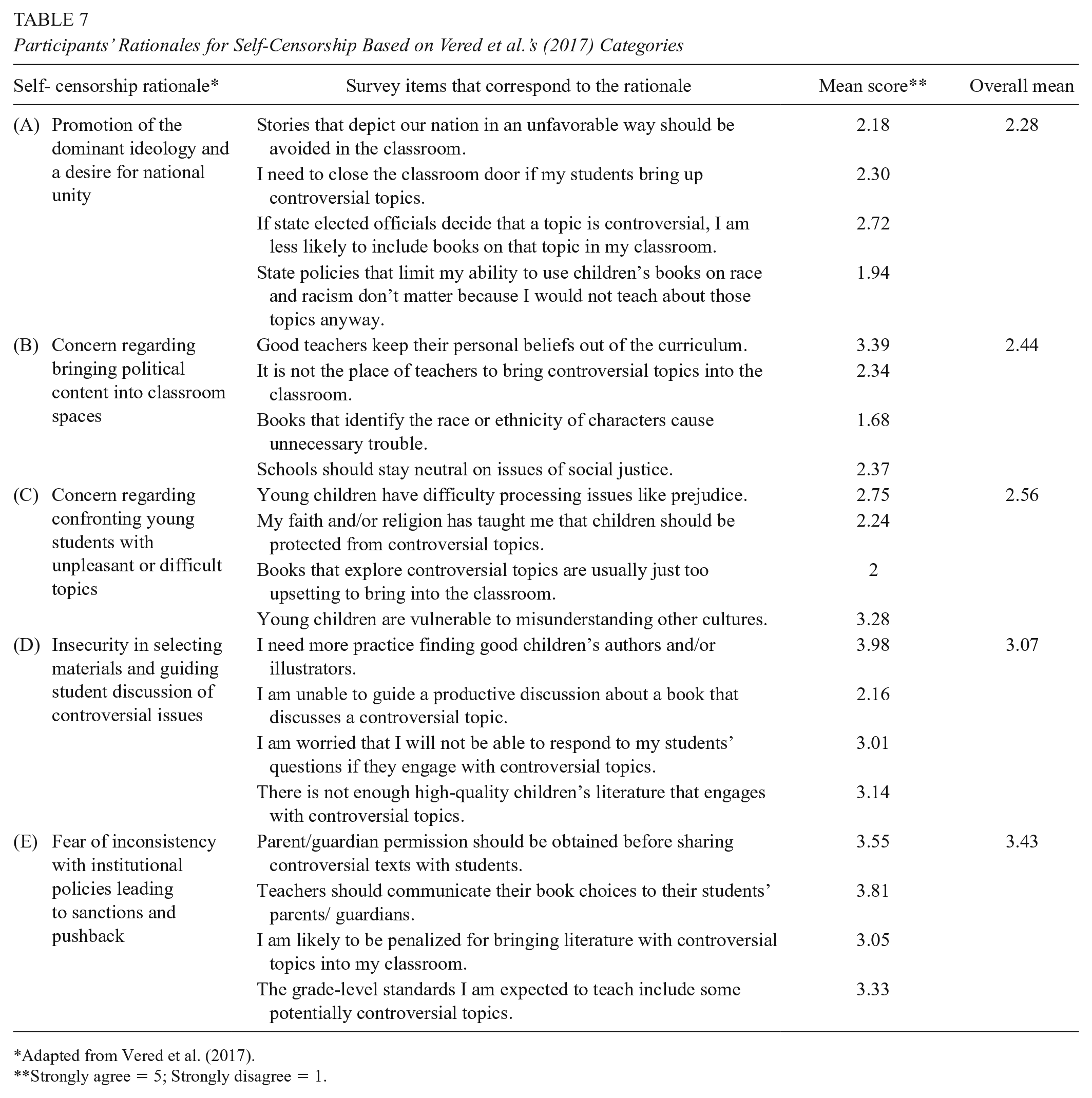
First, we answered this question by comparing participants’ responses to items that corresponded to typical reasons for self-censorship in education settings, as noted by Vered et al. (2017). Table 7 is organized in order from the rationale category participants reported as being least relevant to their decision-making (i.e., A; overall mean 2.28) to the most relevant (i.e., E; overall mean 3.43).
Participants’ Rationales for Self-Censorship Based on Vered et al.’s (2017) Categories
Adapted from Vered et al. (2017).
Strongly agree = 5; Strongly disagree = 1.
Means were lowest on the items that asked about participants’ desire to promote the dominant ideology and national unity (mean of 2.28) and concern regarding bringing political content into classrooms (mean of 2.44). Means were highest for items related to misunderstanding school policies (mean of 3.43) and insecurity in pedagogical knowledge (mean of 3.07).
Finally, our thematic analysis of participants’ written responses to the topic of windows, mirrors, and sliding glass doors (Bishop, 1990) identified three different lenses toward risky texts held by our participants, which are presented in Table 8, followed by extended description.
Lenses Toward Risky Texts: Analytic Coding

Fearful Toward Risky Texts: “Backlash, Politics, and Parents”
Responses were coded as “Fearful” when they included references to avoiding particular topics. None of the participants actively resisted the idea that students deserve windows, mirrors, and sliding glass doors. However, six statements (2.9%) named concerns over pushback and/or censorship. Four of these responses described the problems caused by censorship rather than expressing alignment with it. For example, one participant wrote, “If one book is banned, then certain topics and values may not be talked about, and this could negatively affect the way kids view what is in those books.” Just two statements described a willingness to self-censor without challenging its damaging impact. They wrote, “I think teachers skirt around the issue of representations because of politics and parents” and “I have seen lots on social media about backlash teachers receive because of incorporating diverse texts.” These two responses were the only written responses that discussed censorship and did not state resistance to this practice. None of the responses that expressed fear named particular texts.
Experiential Toward Risky Texts: “I Remember Trying to Be Like Her”
The 74 comments (43.1%) in the “Experiential” category emphasized participants’ experiences as readers as an origin point for using Bishop’s (1990) framework. Within this category, participants pointed out that the framework helped them reflect on past experiences. When describing the books that were windows, participants recalled older, canonical books, such as To Kill a Mockingbird (Lee, 1960), as well as contemporary titles, such as I Am Not Your Perfect Mexican Daughter (Sánchez, 2017). Six responses in the Experiential category recalled experiences as White readers learning about race and racism through texts. For example, one participant recalled the text Warriors Don’t Cry, a memoir by Melba Pattillo Beals (2007) chronicling her experience integrating Little Rock’s Central High School. She wrote: Before reading that book, the only things I knew about this country’s racist history was that Rosa Parks sat at the front of the bus, Martin Luther King Jr. had a dream, and Harriet Tubman helped Black slaves escape slavery. Of course, I knew that Black people were (and still are) mistreated because of their race, but I never really knew what they went through until I read Warriors Don’t Cry.
Responses such as this one were consistent with using books as windows (Bishop, 1990) that permitted learning about events that they did not personally experience. However, although participants attempted critical literacy (Vasquez et al., 2019), these responses did not transcend into sliding glass door responses (Bishop, 1990) that would have reflexively analyzed the limits of their own racialized perspective on their capacity to emphasize with characters of color.
When describing books as mirrors (Bishop, 1990), participants mentioned contemporary texts, such as To All the Boys I’ve Loved Before (Han, 2017), which typically had cisgender young women protagonists. One participant explained that reading Dumplin’ (Murphy, 2017) was the first time they saw themselves represented in literature. They elaborated, “I grew up inside of the pageant world, and extremely uncomfortable in my own body. . . . [Dumplin’] was the first time that I learned that was not normal, and that self-love is the basis for all love.” Similarly, the books that participants described as sliding glass doors often focused on heterosexual cisgender women. One explained that she loved The Selection (Cass, 2013) because she “wanted to be as confident as women in romance novels, and be proud, and these books allowed me to step through this sliding glass door.” In sum, responses that were experiential tended to include texts that participants believed were connected to key moments of personal growth.
Goal-Driven Toward Risky Texts: “I Will Help Students Feel Proud and Confident”
The largest category of responses (97; 55.1%) was coded as “Goal Driven” because they focused on using Bishop’s (1990) framework to improve future text selection. Although prior research suggested that teachers of younger students might avoid certain topics due to developmental concerns (Voelker, 2013), this reasoning was not the case here. In fact, the only mentions of age/development suggested that young students in particular needed to feel representation. One participant wrote, “To be a student of elementary age, when so much growth and development is still taking place, and not see yourself represented in material you’re constantly exposed to truly [I] think needs to change.” Similarly, another response said, “Children’s literature is so important because it’s one of the first ideas of life that kids see.” Echoing such scholars as Cowhey (2006), these responses reflected the view that young children deserve affirmation through representation rather than the view that young children should be protected from risky topics.
Regarding the local policy context, comments similarly suggested that representation was especially important in Texas rather than less important due to the setting. One participant wrote, “Especially in [a state] that is so rooted in segregation and racism, literature can be an extremely helpful teaching tool.” Most responses, overall, reflected this view, although none of the goal-driven responses mentioned particular children’s texts.
Discussion
This research focused on the complicated terrain that exists between the topics preservice teachers report self-censoring in children’s literature and their reasons for doing so. Although prior studies have explored how preservice teachers engage with diverse representations in literature (Flores et al., 2019; Voelker, 2013; Wessel-Powell & Bentley, 2022), these questions have been recast in classrooms governed by topic-restrictive legislation. However, the findings from this study indicate that preservice teachers named many of the same challenges they had before when it comes to teaching through risky texts, suggesting that self-censorship (Vered et al., 2017) may be a likelier explanation than organizational or institutional censorship.
Topics of Children’s Literature
One goal of this research was to determine what topics preservice teachers envisioned self-censoring. On the written course assignment, only two respondents expressed concerns about using risky texts without qualifying that they would use these texts despite backlash. However, on the anonymously conducted survey, 21 participants wrote in topics that they believed should be censored in schools, including violence, suicide, drug abuse, and swearing, as well as sexual orientation and gender identity. Following self-censorship theory (Vered et al., 2017), one way to explain this discrepancy is that respondents were much more forthcoming on the anonymous measure than on the written course assignment that identified their names. Additionally, it is understandable that respondents believed that some topics, such as depictions of abuse, could lack developmental appropriateness for young learners, even though, statistically speaking, it is likely some students would have experiential knowledge of such topics (Angleton, 2021; Dyson, 2015; Voelker, 2013). Teachers can and should express care for their students’ well-being. However, as proponents of critical literacy, we find it deeply troubling that sexual orientation, sexual identity, and gender identity were so regularly reported to be censorable alongside such topics as abuse. This finding indicates that some respondents consider LGBTQIA+ identities as atypical and possibly dangerous, a stance that could demean their students and their students’ families (Airton & Koecher, 2019). More positively, 55.1% of respondents took a goal-driven stance toward risky text in their written assignments, and many of these responses suggested that humanizing experiences were valuable for all learners, regardless of age (Cowhey, 2006; Vasquez et al., 2019).
Overall, responses were more consistent across data sources on the topic of race than they were in relation to LGBTQIA+ identities. On average, participants reported a comfort with talking about race at a relatively early grade level: middle of Grade 2. Only three participants wrote in race as a censorable topic in elementary classrooms. It was also the second most commonly mentioned topic in the written class assignment, where White participants enthusiastically explained how much they gained from experiencing windows (Bishop, 1990) into racial injustice. Overall, this finding paints a relatively positive picture of preservice teachers’ willingness to engage with race, although the extent to which they will take this up in practice is questionable (Beneke & Cheatham, 2020).
Participants’ views related to sex, gender, and sexual orientation were more complicated. In part, this result was because participants may have responded differently to various topics that fall under the LGBTQIA+ umbrella, including gender, gender identity, and sexual orientation. In analyzing the data, we realized that some participants may not have even considered whether they felt more comfortable talking about gender as compared to sexual orientation before completing the survey. We also recognized that when responding to items about such constructs as gender, participants (especially cisgender participants) may have been interpreting gender to mean representations of nonbinary, transgender, and/or gender-fluid individuals rather than recognizing that it is impossible to avoid any depictions of boys or girls or the use of any pronouns when reading texts. Interestingly, when responding to Bishop (1990), 16 participants wrote about how they connected best to characters who shared their gender identity, suggesting that participants realized that children benefit from diverse representations of gender, although, disappointingly, they may not always be willing to take the risk as teachers. Based on these findings, it is possible that preservice teachers believed that talking about gender and gender identity would take on more risk than talking about sexual orientation in the cultural and legislative (Lopez, 2021) context in which the study took place. Thus, we recommend that teacher educators support preservice teachers’ development of expanded knowledge and language for discussing gender and gender identity. Furthermore, as teacher educators, there were times when we lacked knowledge of high-quality texts including gender-diverse characters, and we recommend that course instructors build their knowledge in this area.
Factors Contributing to Self-Censorship of Children’s Literature
A second goal of this research was to determine what reasons preservice teachers had for self-censoring. We found that participants reported that they were minimally driven by a desire to promote the dominant ideology and national unity (mean of 2.28), despite recent legislation. They also reported low concern for bringing political content into classrooms (mean of 2.44), despite fiery rhetoric from policymakers. Instead, the more influential rationales for self-censorship were their concern that they might misinterpret school policies (mean of 3.43) and their insecurity in their pedagogical knowledge (mean of 3.07). This result suggests that the same issues that preservice teachers perennially name as reasons for avoiding particular topics remain central, despite legislative changes (Beck et al., 2017; Clark & Blackburn, 2009). Clearly, and on a positive note, teacher educators have the tools to deepen new teachers’ understanding of curricular policies and the resources they have at hand to meet those obligations. Regardless of legislation, such courses as children’s literature are essential in helping teachers develop the knowledge and practices necessary to use risky texts in their classrooms.
Limitations
Our identities undoubtedly influenced study conceptualization, design, and interpretation. As teacher educators who also study our practices, our need to enact critical reflexivity is compounded because our ability to teach about the use of risky children’s literature is shaped by our own knowledge and experiences (Jacobson & Mustafa, 2019; Lammert, 2022). Our ontological perspective and emphasis on understanding how relationships influence self-reporting is informed by the challenges we have had as teacher educators who promote critical literacy. Researchers with other professional backgrounds and ontological leanings would likely come to different conclusions than our own. Our commitment to culturally sustaining practices (Paris, 2012) does not replace the limits of our positionalities as White cisgender women. We call for increased attention to the work of scholars who are representative of the communities that are marginalized by current legislation.
Directions for Future Research
We are certainly not the first researchers to wonder how to encourage participants to provide honest answers to hard questions (Mertens, 2015). In the case of preservice teachers’ views of risky children’s literature, one difficulty was creating categories to represent identities when these categories may not be recognizable to the individuals whom they are intended to represent (Sablan, 2019). Here, we note that participants’ responses often suggested that they did not realize that teaching about gender was already occurring when identities were unmarked (e.g., a character described with she/her pronouns) but had heightened awareness when certain marked identities were mentioned (e.g., transgender, nonbinary). We found that it was necessary for us to mark specific identities in survey items to accurately assess our participants’ views of them because their assumptions about gender categories varied from one another and from our own.
Another challenge is the trade-off between the relative anonymity of a survey versus the relational validity (Tuck & McKenzie, 2015) that comes with knowing a course instructor personally. In this study, we addressed this issue by leveraging a mixed-methods analysis approach (Bryman, 2006) combined with a critical quantitative stance (Sablan, 2019). Future research that sources additional data is needed. In particular, we wondered how these respondents would have engaged with written vignettes conveying scenarios in which risky text might be used. Gathering preservice teachers’ responses to these types of scenarios would undoubtedly yield new insights that could inform teacher educators’ work.
Another methodological challenge is the liminal position preservice teachers occupy. In this study, we asked participants about their views, knowing that they had not yet stepped into in-service teaching and that their current decisions about texts were influenced by their mentor teachers and university coursework (Flores et al., 2019). This reason is mainly why we did not conduct classroom observations, which could easily have become performative demonstrations of compliance rather than true reflections of critical literacy. Further research that tracks changes in teachers’ views of risky texts over time and across contexts could provide additional insights, especially as scholars have pointed out that the lessons learned in preservice settings do not always transfer into in-service practice (Crawley, 2020; Thein, 2013; Young, 2019).
Conclusion
Censorship is a long-standing issue in democratic societies. However, people in the United States are more likely to stay silent on risky topics than they were in the 1950s and any time since (Gibson & Sutherland, 2021). The tendency toward self-censorship is a broad cultural and societal problem that has entered the education field, and children’s literature is a critical wedge. In terms of the topics preservice teachers are willing to engage with through children’s literature, this study found that preservice teachers self-reported more confusion and avoidance about gender and gender identity than the topics of sexual orientation or race. Our analysis of written course artifacts revealed that most preservice teachers envisioned including diverse identities in the texts they would use in their teaching. However, in terms of their reasons for self-censorship, respondents stated that they mostly self-censored due to lack of knowledge of pedagogy and text options, and confusion about institutional policies, rather than a true desire to promote a particular political ideology. Combined, these findings indicate that teacher educators have a crucial role in teaching preservice teachers to self-assess risk levels and select texts that authentically represent the diversity of the United States. Rather than allowing legislation to make schools into places that are unwelcome to marginalized children, teacher educators must take up the mission of providing new teachers with practical tools and resources to create inclusive classrooms rooted in critical literacy.
Footnotes
Declaration of Conflicting Interests
The author(s) declared no potential conflicts of interest with respect to the research, authorship, and/or publication of this article.
Funding
The author(s) received no financial support for the research, authorship, and/or publication of this article.

1.
We use this initialism to refer to Lesbian, Gay, Bisexual, Transgender, Queer, Intersex, and Asexual inclusive identities (except when referencing work using different terminology). We recognize that self-identification varies between individuals and that terms can change.
Authors
CATHERINE LAMMERT is an assistant professor at Texas Tech University, 3002 18th St., #351, Lubbock, TX 79409;
VICKIE C. GODFREY is an assistant professor at Eastern Kentucky University, 521 Lancaster Ave., Richmond, KY 40475;