




Abstract
The gender disparity in leadership positions is substantial and critical yet persists despite decades of focused study. Critical developmental periods, such as emerging adulthood, may be particularly relevant to attend to if we hope to find effective interventions to tackle this problem. The present study draws on longitudinal data covering four years of college among a socio-demographically and nationally diverse sample of college students with adverse backgrounds (N = 404) who enrolled at one of 182 four-year colleges or universities across the United States. Results indicate that female students enter college with significantly lower levels of leadership aspirations than their male counterparts. Once in college, despite greater likelihoods of participating in activities conceptualized as “leadership learning experiences,” female disadvantages persist. Overall, development experiences over four years of college had no discernable effect on gender disparities in leadership aspirations. Implications for research and practice are discussed.
Keywords
Introduction
The gender disparity in leadership positions is substantial and critical. Prominent leadership roles remain disproportionately held by men (Hill et al., 2016). A recent Pew Research Center report indicates that only 27% of the 117th Congress identified as female, the largest proportion to date (Blazina & Desilver, 2021), and similar disparities appear in higher education, where, as of 2016, only 30% of college presidents were women (American Council on Education, n.d.). The problem is even more acute in the business world where record numbers of women running Global 500 businesses in 2021 amounted to only 23 women representing less than 5% of Fortune Global 500 CEOs (Hinchliffe, 2021).
These disparities persist despite decades of focused study on leadership in general and an abundance of college- and university-based programing focused on undergraduate students’ leadership opportunities. Among myriad social and economic factors that influence gender imbalances in leadership positions (e.g., Eagly et al., 2007) is the possibility that our higher education system is not sufficiently cultivating female students’ leadership aspirations during the college years. Further challenging our ability to address gender disparities is a lack of empirical work investigating leadership emergence in adolescence (Tackett et al., 2022) and in college-aged populations (Correia-Harker & Dugan, 2020).
Leadership aspirations and motivations are critical predictors of later leadership outcomes and further predict later income, educational attainment, life satisfaction, and even longevity (Ashby & Schoon, 2010; Judge & Kammeyer-Mueller, 2012; Offermann et al., 2020). And while there is clear interest in developing leadership skills and motivations in emerging adults (Brungardt et al., 2006; Tackett et al., 2022), little is known about how gender identity affects leadership aspirations in undergraduate college students, or the extent to which educational experiences and institutional environments may influence differential development of leadership aspirations across genders. This has led researchers to call for more longitudinal research on leadership development in the college years, including direct attention to the impact of collegiate experiences on this development (Correia-Harker & Dugan, 2020). We echo those calls and suggest a need for evidence on leadership outcomes among students from a diverse range of sociodemographic backgrounds, as the samples examined in prior studies have largely reflected the demographic makeup of high-level leadership positions themselves (e.g., Rudman and Phelan, 2010).
In the present study, we explored gender differences in leadership aspirations over four years of college among a sample of resilient students attending a wide range of colleges and universities throughout the United States. The sample is comprised of college students from a range of backgrounds, including low socioeconomic status, exposure to a variety of adverse childhood experiences (as defined by the CDC, 2019; see also Wolniak & Rekoutis, 2016; Wolniak et al., 2021), and considerable demographic diversity. Such data offer new evidence on the extent to which precollege traits and undergraduate experiences and environments are associated with the development of leadership aspirations in students for whom such development might make a significant change in the trajectory of their careers and lives and in ways that could meaningfully inform gender diversification of consequential leadership roles.
Theoretical and Empirical Grounding
Numerous theoretical and conceptual frameworks have been utilized in studies of leadership development in general (Eva et al., 2021) and among college students in particular (Komives & Dugan, 2010). For example, these include Kegan’s (1994) models of intrapersonal development, the social change model of leadership development (Astin, 1996; HERI, 1996; see also the related models of socially responsible leadership: Dugan et al., 2008; Komives et al., 2006), and those derived from empirical evidence indicating that gender stereotypes undergird leadership differences among men and women (Eagly & Johannesen-Schmidt, 2001; Eagly & Karau, 2002). Although these and other related models offer useful information on factors influencing leadership in college students and associated gender differences, the present study is most directly and centrally informed by conceptual models related to career development, particularly social cognitive career theory (SCCT) (Lent et al., 1994, 2002).
The basis for centering our attention on SCCT is, first, it situates leadership aspirations as potential antecedents to future career behaviors. Second, SCCT offers a particularly valuable perspective on the development of leadership aspirations in the college environment because it simultaneously offers a granular explanation of the development of career interests, like leadership aspirations, while highlighting the importance of self-efficacy, which has been identified as influential across prior studies of women’s leadership development (Eva et al., 2021; Haber-Curran and Sulpizio, 2017). And third, SCCT acknowledges the role of input and environment factors—like gender and college experiences, respectively—that hold relevance when examining development among college students (Mayhew et al., 2016; Salisbury et al., 2012). Avolio (2007) echoed this assertion in identifying the need to investigate such identity-based and environment factors as they pertain to leadership development.
While SCCT incorporates a series of models that together describe career development, our study focuses primarily on the interest model, which explains how individuals form aspirations for certain careers and roles within those careers. The core of the interest model suggests that leadership aspirations are driven by a combination of one’s self-efficacy and judgments of their likelihood to succeed in a career path, which result when individuals have relevant experiences (Lent et al., 1994, 2002). Applied to the undergraduate college context, these experiences might include activities like part-time employment, internships, or mentoring others that influence the development of career interests and leadership aspirations.
Personal characteristics—including gender identity—also play a role in the SCCT interest model. Personal characteristics influence one’s engagement in learning opportunities, which lead to ongoing personal assessments of one’s likelihood to succeed (Lent et al., 2002). Within the college environment this may, for example, result in characteristics like socioeconomic status influencing a student’s likelihood to seek out, view as attainable, or assign value to having an internship. Activities like internships might provide the student with a “learning opportunity” to take on a leadership role, where success or failure in such endeavors then shape the student’s perceptions of their capacity to succeed as a leader, ultimately influencing their career interests and aspirations toward leadership positions.
However, critics contend that general models of career development, such as SCCT, do not sufficiently address considerations like familial obligation and underrepresentation of women in work environments that specifically affect women’s career development (O’Neil & Bilimoria, 2005). Additionally, such models do not explicitly account for the discrimination and prejudice with which female leaders are met (Eagly, 2007).
Although SCCT was not created to specifically model women’s career development, gender and other identity-based factors are nevertheless central to the SCCT model, conceivably allowing for such factors as familial obligation, gender representation in the workplace, and discrimination to be accounted for indirectly. Specifically, SCCT suggests that gender, along with other identity-based factors, influence one’s propensity toward acquiring the kinds of learning experiences that shape beliefs and estimations of future success and ultimately drive interests such as leadership aspirations (Lent et al., 2002). SCCT frames gender as playing an important, if perhaps subtle, role through its associations with accessing critical experiences that ultimately shape career aspirations such as leadership, indicating its appropriateness as a theoretical framework to examine gender differences in leadership aspirations.
Defining Leadership Aspirations
In the present study, we define leadership aspirations as the desire for positional leadership within a chosen career domain (Gregor & O’Brien, 2016). Leadership aspirations share some conceptual similarity with motivations to lead (Chan & Drasgow, 2001) and leader identity (Day & Harrison, 2007) but have an explicit focus on the desire for leadership positions and positional authority. Additionally, because of their focus on the individual leader, leadership aspirations are distinct from definitions of leadership development as a social phenomenon involving multiple individuals (Day, 2000; Day et al., 2014).
Situating leadership aspirations within the broad literature on leadership outcomes is challenged by the overall fragmentation and lack of integration of the literature. Therefore, we drew from and were informed by Eva et al.’s (2021) comprehensive review of academic publications from 2000–2019 that focused on adolescent girls. This work connected individual capabilities to leader emergence, motivations, and identity, and ultimately to leadership behavior, offering helpful insight into gender differences in leadership development. Stemming from their review is the suggestion that the connection between perception of the self as a female leader and overall perception of female leaders plays a foundational role in leadership development of adolescent females (Eva et al., 2021). The importance of self-perception is further reinforced by a recent interdisciplinary synthesis of literature related to leadership and adolescent development (Tackett et al., 2022).
Gender Differences
The literature explicitly addressing gender differences in leadership aspirations and related concepts largely underscores existing disparities but does not clearly point to advantages or disadvantages for a particular gender. For example, evidence indicates that male students report higher levels of leadership aspirations than female students (Sheppard, 2018; Singer, 1989), have higher affective motivation to lead (Elprana et al., 2015), express more interest in securing more demanding jobs (Ashby & Schoon, 2010), and demonstrate higher motivation to manage (Eagly et al., 1994). Alternatively, research has also suggested that gender differences do not always favor male students. For example, female college students have been shown to desire more prestigious occupations than male college students (Watts et al., 2015), adolescent girls who are not positional leaders in their schools may hold greater motivations to lead than their male counterparts (Lizzio et al., 2011), and women have been found to score higher on most of the subscales designed to measure the social change model of leadership development (Dugan, 2006; Dugan et al., 2008). Still other findings have revealed no significant gender differences in motivation to lead (Rosch et al., 2015).
Studies that have observed gender differences in leadership outcomes suggest a mix of situational and psychological factors that may be important to female leadership aspirations and development. Situational factors include prioritization of other relationships (Killeen et al., 2006), family (Gregor & O’Brien, 2016), and other time commitments (Sanchez & Lehnert, 2019) over the pursuit of leadership roles, as well as fewer opportunities to develop leadership abilities in the workplace (Hoobler et al., 2014). Psychological factors also appear to play a significant role in female leadership aspirations and leadership development, including self-esteem, perceived self-competency, and leadership self-efficacy—factors that together suggest the importance of general and leadership-specific confidence to the development of leadership aspirations (Boatwright & Egidio, 2003; Eva et al., 2021; Haber-Curran & Sulpizio, 2017; Lechner et al., 2018; Sanchez & Lehnert, 2019). In particular, Haber-Curran and Sulpizio’s (2017) review of literature found evidence to suggest that differences in both self-efficacy and confidence in their leadership abilities account for some of the observed disadvantages among girls and young women, relative to boys and young men.
The Influence of College
Prior research suggests that what happens during college may influence the development of leadership aspirations, leader development, and related concepts. Research has shown that the variation in one’s institutional environment, including learning and different experiences during college, is associated with leadership. Kezar and Moriarty (2000) and others (Correia-Harker & Dugan, 2020; Dugan & Komives, 2010; Posner et al., 2015) illustrate the importance of one’s learning environment—such as college major and institutional characteristics—for understanding leadership outcomes and developmental processes. Even more resoundingly, researchers have pointed to the value of gaining leadership experience; this can take the form of participating in formal leadership development programs (Fischer et al., 2015; Harris & Leberman, 2012; Posner, 2009) or other opportunities to gain leadership experience (Eva et al., 2021; Kezar & Moriarty, 2000; Lent et al., 2002).
In their discussion of SCCT, Lent et al. (2002) noted, "having positive experiences in career related activities and the aptitude to do well in specific careers makes it more likely that people will develop robust efficacy expectations and positive outcomes for these career pursuits" (p. 272). Although subject to interpretation, this suggests particular value of leadership learning experiences directly connected to the work environment. Leadership learning experiences such as work experience and internships have been assessed in the leadership development literature, leading to mixed findings on the value of work experience during college. Drawing on the social change model of leadership, Salisbury et al. (2012) found work experience during college to be positively related to leadership development during the first year of college. Also using the social change model, Lewis (2020) addressed the leadership development potential of working while in college, but found it to be linked to “lower self-reported capacity for socially responsible leadership” (p. 554). Garcia et al. (2017) found a positive relationship between leadership development and internships among Latino males. Together, these findings point to the potential promise of such leadership learning experiences, while highlighting opportunity for further research to fully understand their role in leadership development.
Such experiences and environmental factors may not influence male and female students the same way. For example, Kezar and Moriarty’s (2000) longitudinal study spanning four years of college indicated that women self-reported lower leadership ability at the start of college, as well as four years later, and that men self-reported greater growth in leadership ability over this period, suggesting the possibility that the college environment has a differential effect on students based on their gender.
Relatedly, two studies on women’s leadership aspirations point to the important influence of the social dynamics of the college environment. Davies et al. (2005) found stereotype threat to have a negative influence on women’s leadership aspirations. Additionally, Boatwright and Egidio (2003) found a significant positive correlation between college women’s need to connect with others and their leadership aspirations, postulating that this link may be due to a naïve expectation of non-hierarchical collaborative leadership in the working world, in which connection with others supports leadership efforts. Interpreted together, these two studies suggest that a feeling of fit, connectedness, or sense of belonging to the campus community may contribute to the development of leadership aspirations. This suggestion is particularly concerning in light of research that indicates sense of belonging (Strayhorn, 2019) is depressed in students from lower socioeconomic status backgrounds, as indicated by first-generation status (Duran et al., 2020; Stebleton et al., 2014), and emerging evidence specifically among a sample of low-income college students indicating substantial disadvantage among female and first-generation students’ developing a sense of campus belonging over four years of college (Wolniak et al., 2023). These prior works suggests a complex relationship among college student identities, their sense of belonging, and, potentially, the development of leadership aspirations.
Altogether, evidence points to a complex interplay of factors related to gender differences in leadership aspirations, in which self-efficacy emerges as a particularly important factor (Eva et al., 2021; Haber-Curran & Sulpizio, 2017) and raises concerns about the relatively low levels of self-efficacy found among girls and young women (Haber-Curran & Sulpizio, 2017). Meanwhile, studies suggest experiences related to leadership opportunities (Eva et al., 2021; Fischer et al., 2015; Kezar & Moriarty, 2000; Lent et al., 2002; Posner, 2009) and social aspects of the college environment (Boatwright & Egidio, 2003; Davies et al., 2005) influence female leadership aspirations. However, the empirical evidence to date is quite limited, particularly in terms of college student development, and demonstrates the need for more research to explore, and better understand, gendered pathways to leadership aspirations.
The Present Study
The purpose of the study is to explore gender differences in leadership aspirations development over four years of college and the extent to which aspects of the college experience have an influence on development. We base our analysis on the previously mentioned evidence and theory, from which we suggest a conceptual model that frames how leadership aspirations may develop in college, the factors that influence its development, and the role of gender. We offer that leadership aspirations develop during college as a result of three processes. First, leadership aspirations at college entry are influenced by prior formation that occurs during adolescence (Tackett et al., 2022) and are shaped by gender identity (Sheppard, 2018; Singer, 1989) and other sociodemographic characteristics (Ashby & Schoon, 2010; Massey et al., 2008; Schoon & Parsons, 2002), as well as dimensions of self-concept (Boatwright & Egidio, 2003; Eva et al., 2021; Haber-Curran & Sulpizio, 2017). Second, differences in leadership aspirations at the start of college, along with continued influence of gender and other sociodemographic and self-concept traits, affect a student’s tendency to access leadership “learning opportunities” (Lent et al., 2002), which in turn mediate the relationship between gender and development of leadership aspirations across subsequent years of college. Lent et al. (2002) explicitly described a relationship in which learning opportunities, like the leadership learning experiences included in this study, mediate the relationship between individual background characteristics and self-efficacy and the development of career interests, like leadership aspirations. Third, the development of leadership aspirations during college is influenced by the institutional environment that forms the context in which development may occur, including such factors as major field of study (Posner et al., 2015) and the overall academic and social climate (Boatwright & Egidio, 2003; Davies et al., 2005), where the influence of institutional environment characteristics may differ by (or be conditional on) one’s gender identity.
Within this conceptual framework our analyses were designed to address the following four questions:
Methods
Context and Participants
The present study is part of an ongoing research effort designed to identify factors that influence the academic and career trajectories of students who had a combination of risk factors upon entering college. We draw on longitudinal data collected between September 2017 and May 2021 based on student surveys administered at multiple points in time among a population of 839 first-time college students. All participants received a one-time scholarship from the Horatio Alger Association (HAA), a not-for-profit organization focused on supporting college students from predominately low-income backgrounds who had been exposed to severe adversity during their childhoods. The HAA Scholarship Program annually grants roughly 700–800 scholarships of $10,000, along with a select handful of about 100 awards of $25,000. Both types of awards are dispersed evenly over one’s time in college to recipients who maintain good academic standing (i.e., a grade point average of at least 2.0). Recipients may apply the funds to cover their costs of attendance at the institution of their choosing. The present study examined the 2017 entering college cohort of scholarship recipients over four years of college.
Data
Data were collected through an entering first year (Y1) student survey administered within the first few weeks of college to 514 students who provided consent to participate, yielding 455 completed surveys. Subsequently, data were collected through follow-up surveys among all Y1 respondents at the start of the second year of college (Y2), in the spring of the third year of college (Y3), and toward the end of the fourth year of college (Y4). The Y1-to-Y4 response rate among consenting participants exceeded 75%. After imputing item-level missing data and applying nonresponse weights, the data analyzed represented 404 students across 182 four-year institutions.
Table 1 contains descriptive statistics for all variables analyzed in total and separately for female- and male-identified students. Tests for mean differences by gender were conducted based on t- and Chi-sq statistics for continuous variables and categorical variables, respectively. Variable definitions are provided below and correlations among all variables appear in the appendix (Table A1).
Descriptive Statistics

Source: Horatio Alger Association Longitudinal and Tracking Study of 2017 Scholars.
Notes: All statistics are based on weighted data, adjusted for nonresponse. Not shown in the table are categorical variables for unknown/missing: internship (M = 0.484, SD = 0.500), mentored (M = 0.114, SD = 0.318); major (M = 0.118, SD = 0.323); undergraduate enrollment (M = 0.487, SD = 0.500); SAT/ACT 75th percentile (M = 0.545, SD = 0.499). Statistically significant differences between genders were based on t-tests for continuous variables and Chi-sq tests for categorical variables. *p < 0.10, **p < 0.05, ***p < 0.01.
In examining sample means (M) and standard deviations (SD) by gender, we see that females reported significantly lower levels of leadership aspirations (p < 0.01) and lower levels of self-efficacy (p < 0.05) upon entering college. Females were also more likely than males to have held an internship during college (p < 0.01) and were employed more often over four years of college (p < 0.05). In addition, as one should expect based on historic and national trends, female students were less likely to have majored in business (p < 0.01) or STEM (p < 0.05) fields.
Data Adjustments
Several adjustments were made to enhance the study’s validity and to facilitate interpretation of the analytic results. First, data from each survey were weighted to address systematic nonresponse by adjusting each round of data to reflect the proportional distribution of the full population of scholarship recipients invited to participate in the study. Given prior research indicating that college students’ likelihood to participate in surveys varies by demographics, where female, White, and Asian-identified students are more likely to respond to surveys (Blaney et al., 2019), our proportional adjustments were based on race (White, Asian, other), gender (female, male), and level of scholarship received. Second, missing data of all continuous variables were imputed using the expectation–maximization (EM) algorithm, in addition to listwise deletion among the sociodemographic categorical variables and the inclusion of “missing or unknown” categorical dummy variables for missing college experience and environmental measures. Finally, all analyses were estimated using robust standard errors. All regression estimates we report are based on imputed, weighted data with robust standard errors.
Measures
Leadership Aspirations
Our primary dependent variable is a scaled measure of career aspirations for leadership based on Y4 survey responses, with a parallel pretest collected at the start of college (Y1). The measure is a nine-item scale adapted from the Career Aspiration Scale-Revised (CAS-R): Leadership subscale (Gregor & O’Brien, 2016), with inter-item (alpha) reliabilities ranging from .88 to .90 across the time periods (see Table 2 for constituent items).
Inter-item (alpha) Reliability of Scaled Measures

Source: Horatio Alger Association Longitudinal and Tracking Study of 2017 Scholars.
Notes: aAdapted from Gregor and O’Brien’s (2016) CAS-R: Leadership subscale; bsurvey questions were phrased as “Please indicate the extent to which you agree or disagree with the following statements,” with response options 1 (“Strongly disagree”) to 5 (“Strongly agree”); c items were adapted from Mayhew et al. (2018), asked at Y2, Y3, and Y4 and summed.
Characteristics at College Entry
Our primary independent variable was a categorical indicator of students’ self-identified gender (female = 1, male = 0). In addition, several other variables were included to capture differences in students’ ascribed sociodemographic characteristics, including racial/ethnic identity (Asian = 1, Black = 1, Hispanic, any race = 1, multiracial = 1, other [American Indian or Alaska Native, Middle Eastern, other] = 1, White=0), first-generation status (first-generation = 1, continuing generation = 0), and self-reported parents’/guardians’ gross annual income (in $1,000 units). Additional precollege measures were included to account for variation in academic achievement prior to college (based on composite SAT/converted ACT score) and self-efficacy, which we measured through a three-item scale (alpha = 0.71, see Table 2) as suggested by prior studies of leadership outcomes (Eva et al., 2021; Haber-Curran & Sulpizio, 2017) and the SCCT framework (Lent et al., 2002). Each of these variables were measured through the entering college (Y1) survey.
Leadership Learning Experiences
To capture variation in students’ college experiences in alignment with what prior research has identified as potentially influential to leadership aspirations and its development (Eva et al., 2021; Garcia et al., 2017; Lent et al., 2002; Salisbury et al., 2012), we included three measures of leadership learning experiences that connect to the positional, work-placed nature of the leadership aspirations measure. These include a dichotomous indicator for having ever held an internship (1 = yes, 0 = no) and a count measure capturing the number of years students were employed during their undergraduate education (0–4; note that 97 percent of the sample indicated having been employed at some point during college, rendering a count variable preferable to a dichotomous measure). Additionally, we include a dichotomous indicator for having ever served as a mentor to others (1 = yes, 0 = no) across four years of college because of the conceptual alignment between mentoring others and leadership development. All experiential measures were collected via the Y2 − Y4 surveys.
Academic and Social Environments
Four measures were included to capture differences in students’ academic and social environments (Boatwright & Egidio, 2003; Davies et al., 2005). One was based on a five-item scale of campus belonging (Duran et al., 2020), measured at Y2 – Y4 and combined into a single composite (alpha = .92, see Table 2). We also included dichotomous indicators of majoring in business, STEM, or an other field of study, which align with prior studies suggesting significant connections between leadership orientations and business and STEM majors (Posner, 2009; Posner et al., 2015). In addition, we included two Integrated Postsecondary Education Data System (IPEDS)–based measures of each institution’s number of enrolled undergraduates (transformed into quartile groups) and the overall academic quality of enrolled undergraduates (75th percentile of SAT or converted ACT score, also transformed into quartiles) as a proxy for peer effects based on the overall academic environment (Wolniak & Ballerini, 2019).
Analysis
Our primary analysis involved estimating a generalized structural equation model (GSEM) to obtain different path coefficients associated with the study’s conceptual framework Specifically, we tested for statistically significant gender differences in: (a) leadership aspirations at the start of the first year of college (Y1), net of other college entry characteristics (Question 1); (b) leadership aspirations toward the end of the fourth year of college (Y4), net of leadership aspirations at Y1, all other college entry characteristics, leadership learning experiences, and academic and social environments (Question 2); and (c) the likelihood of participating in leadership learning experiences (internships, mentoring others, and employment) across four years of college, net of all other college entry characteristics and Y1 leadership aspirations (Question 3). Additionally, we tested for moderation by estimating the full model, with the addition of separate blocks of cross-product variables based on gender × any statistically significant effects uncovered among the academic and social environment variables (Question 4). Given the aims of the study, GSEM offered the advantage of fitting linear, logistic, and Poisson paths simultaneously, thereby avoiding problems associated with simple structural equation modeling (SEM) and ordinary least squares (OLS) estimates (e.g., Finney & DiStefano, 2006; Long, 1997).
A general representation of the estimated models is shown in Equations 1–3, where



The leadership aspirations measures (at Y1 and Y4) were standardized (M = 0, SD = 1) prior to analysis, such that the estimated effects should be interpreted as change in SD units resulting from a one-unit change in the independent variable, net of all other variables in the model. In addition, examining leadership aspirations at Y4 net of the parallel measure at Y1 afforded optimal statistical control over student differences prior to exposure to college and allows the effects of the models’ independent variables to account for variation in pretest–posttest gains, above and beyond the influence of the pretest. In other words, by including the pretest in the model, the estimated effects of the independent variables on posttest scores indicate those variables’ influence on pretest-to-posttest gains (i.e., development) in college during the timeframe studied ( Pascarella et al., 2003). We interpreted the results accordingly.
Results
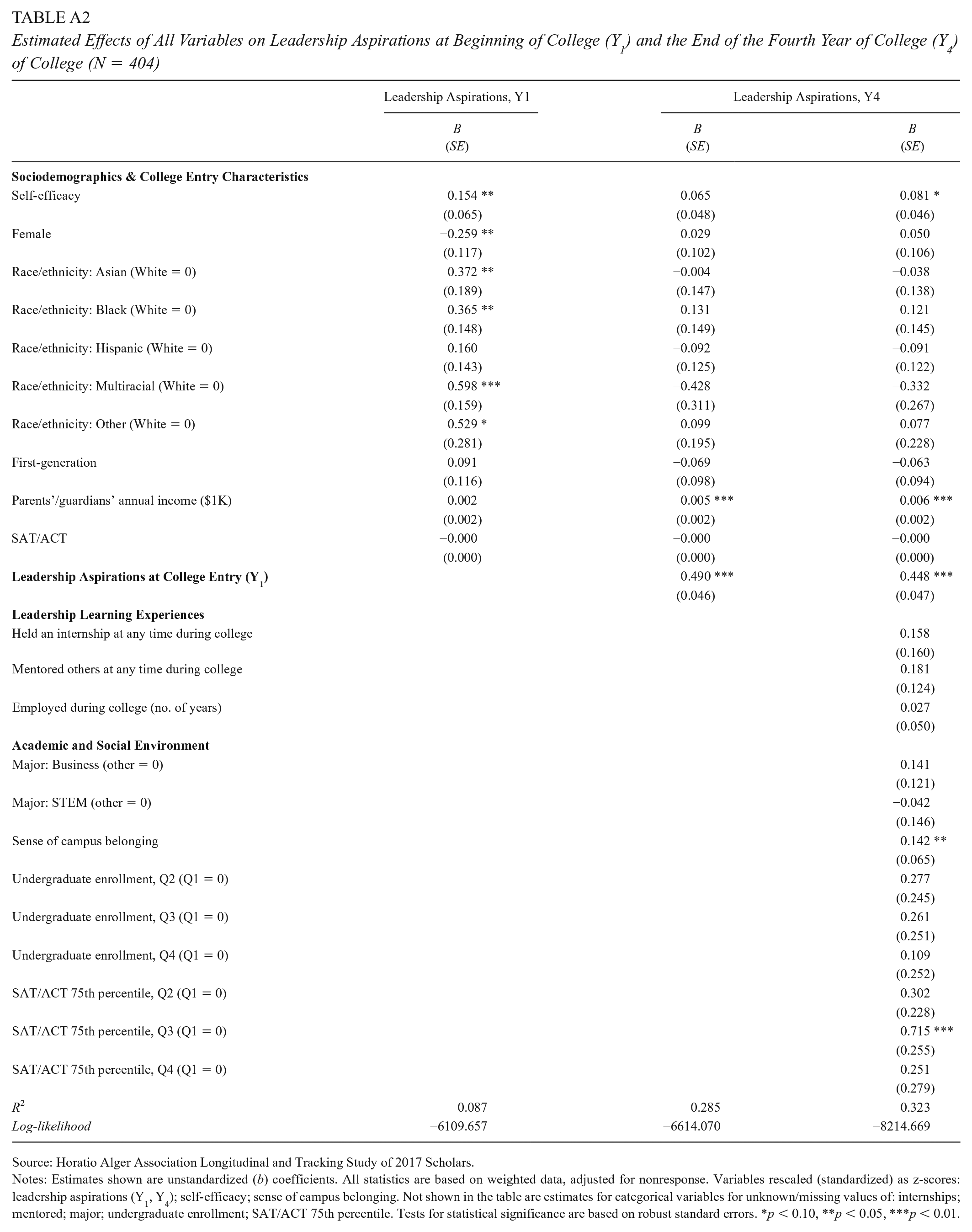
The results of the GSEM estimates are shown in Table 3, which includes statistically significant (p < 0.10) coefficients and standard errors. Given the exploratory nature of this study, we also report in the appendix (Table A2) results from a supplemental analysis showing the full set of coefficients predicting leadership aspirations at the beginning of college (Y1) and toward the end of the fourth year of college (Y4). The supplemental analysis, based on traditional SEM, followed a hierarchical order to estimate leadership aspirations at Y4, in which we first entered all variables capturing college-entry characteristics and the parallel measure of leadership aspirations at Y1, and second, introduced all leadership learning experiences and academic and social environment measures. Because GSEM is more limited than SEM in terms of diagnostic tests for evaluating model fit, to assess model fit, we included in Table A2 the R2 and log-likelihood statistics. Note also that the Akaike Information Criteria (AIC) for the fully specified SEM model and GSEM model were 16,513.340 and 4,979.808, respectively, indicating improved goodness-of-fit of the full GSEM model (lower AIC values indicate better model fit; Burnham & Anderson, 2004), providing some general evidence that GSEM provides a more appropriate statistical estimation of these data (Lin et al., 2017).
Statistically Significant Estimates

Source: Horatio Alger Association Longitudinal and Tracking Study of 2017 Scholars.
Notes: All statistics are based on weighted data, adjusted for nonresponse. Variables rescaled (standardized) as z-scores: leadership aspirations (Y1, Y4); self-efficacy; sense of campus belonging. Not shown in the table are estimates for categorical variables for unknown/missing values of: internships; mentored; major; undergraduate enrollment; SAT/ACT 75th percentile. Tests for statistical significance are based on robust standard errors.
p < 0.10, **p < 0.05, ***p < 0.01.
Leadership Aspirations at the Beginning of College
The results highlight the extent to which female-identified students entered college trailing their male counterparts in terms of leadership aspirations, above and beyond the influence that racial/ethnic identity, measures of socioeconomic status, and academic achievement exerted on leadership aspirations at the start of college. The estimates indicate, all else equal, a statistically significant difference in which female students entered college roughly .26 SDs below their male counterparts (B = −0.259, p < 0.05). Also notable is evidence of a positive association between levels of self-efficacy and leadership aspirations at the beginning of college (B = 0.154, p < 0.05).
Leadership Aspirations Development Over Four Years of College
In terms of development over four years of college, controlling for individual differences in leadership aspirations at the start of college and holding constant all-college experience and environment variables, there were no discernable gender differences in leadership aspirations at the end of the fourth year of college. In other words, female- and male-identified students experienced comparable first- to fourth-year change in leadership aspirations, and the gender differences found at college entry do not dissipate after taking into account a host of experiential and environmental differences that accompany students’ four undergraduate years. This finding was corroborated by the supplemental analysis that incrementally introduced the set of college experience and environment variables (see Table A2, middle column).
Leadership Learning Experiences
Turning attention to gender differences in leadership learning experiences during college, we report odds ratios given the categorical and count nature of the measures. The results show a moderately significant gender difference in the amount of employment students had across four years of college, where female-identified students reported a greater likelihood of involvement (exp(B) = 1.120, p < 0.10). No gender differences were found in students’ likelihoods of holding internships or mentoring during college. What’s more, none of the three leadership learning experiences yielded a statistically significant influence on leadership aspirations development over four years of college.
Academic and Social Environments
In terms of the associations between leadership aspirations development and students’ academic and social environments in college, having a stronger sense of belonging (e.g., feeling comfortable on campus and a sense of commitment to, support from, and acceptance by one’s campus community) positively and significantly influenced leadership aspirations development (B = 0.142, p < 0.05). There was also partial evidence of positive peer effects, suggesting an influence of attending an institution with higher entering SAT/ACT scores among enrolled students (in terms of the third vs. first—or lowest—quartile among the institutions represented in our sample, B = 0.715, p < 0.01), though the effect did not follow a consistent pattern and thus awaits further examination before any strong conclusions should be drawn. Among these statistically significant environment-based measures, we found no evidence that gender had a moderating effect. In other words, though a stronger sense of campus belonging exerted a positive developmental influence, net of all other variables in the model, the effect did not differ by gender.
Discussion
Although considerable research in recent decades has focused on leader development in general and, to a lesser extent, on college student leadership development (e.g., Fischer et al., 2015; Harris & Leberman, 2012; Kezar & Moriarty, 2000; Posner, 2009), there is much still to learn about the nature and development of leadership aspirations during the college years. In particular, we lack empirical evidence on the aspects of college that might facilitate or hinder development, or change, in leadership aspirations over four years of college, or the mechanisms that may account for gender differences. These questions are all the more pressing to address among students whose backgrounds are marked by low socioeconomic status and/or histories of childhood adversity, for whom leadership aspirations might make a significant change in the trajectory of their careers and lives, and to whom sense of belonging might prove more elusive.
Overall, the results offer new empirical insight into the gender gap in leadership aspirations, particularly in terms of precollege (i.e., preexisting) differences. Specifically, our findings suggest leadership aspirations differ by gender: female students enter college with significantly lower leadership aspirations than their male counterparts. This leadership aspiration disadvantage for female students emerges before they begin experiencing college. Once in college, their experiences and institutional environments appear not to compensate for, nor amplify, female students’ entering disadvantages. Although we did find mean differences in female and male students’ participation in leadership learning experiences that consistently favored female students, including internships and work experience, the gender influence in participation was largely confounded by other entering college characteristics, and these leadership learning experiences do not appear to have a direct influence on the development of leadership aspirations, as suggested by prior research and SCCT (Lent et al., 2002). Furthermore, across all measures of institutions’ academic and social environments that we examined, sense of campus belonging provided the clearest evidence of having a developmental effect on leadership aspirations, though the influence was found to be the same for female and male students. Overall, the study presented the following main findings.
Gender Differences in Leadership Aspirations at the Beginning of College
Female students enter college with significantly lower levels of leadership aspirations than their male counterparts. This disadvantage at college entry is the main source by which gender influences leadership aspirations over the course of four years in college. Prior research suggesting gender differences in leadership aspirations (e.g., Sheppard, 2018; Singer, 1989) aligns with our findings. Importantly, this finding provides evidence that gender gaps form early on, prior to one’s freshmen year of college, highlighting the importance of the emerging literature on leadership and adolescent development (Eva et al., 2021; Tackett et al., 2022). And while we also found female students’ self-efficacy at college entry to be lower than that of their male peers, which is consistent with prior research (Eva et al., 2021; Haber-Curran & Sulpizio, 2017), our results suggest only a weak positive influence of self-efficacy on subsequent leadership aspirations development.
College Has Little Influence on Gender Differences in Leadership Aspirations Development
Our results also suggest college does little to mitigate the early gender gap in leadership aspirations; as students progressed through college, there were no discernable gender differences in leadership aspirations development. Given prior literature pointing to the environmental and experiential factors that influence leadership aspirations of female students (Boatwright & Egidio, 2003; Davies et al., 2005; Eva et al., 2021; Fischer et al., 2015; Kezar & Moriarty, 2000; Lent et al., 2002; Posner, 2009), we were surprised by this finding. What’s more, these findings suggest that interventions designed to improve the gender gap in leadership aspirations need to be timed before students get to college. According to Forbes, leadership training is a multi-billion-dollar industry (Westfall, 2019); resources dedicated to closing the gender gap in leadership may be better spent on programming before college begins.
Leadership Learning Experiences Vary by Gender but Do Not Influence Leadership Aspirations
We found gender differences between students’ participation in potential leadership learning experiences. From a descriptive standpoint, a higher proportion of female-identified students participated in internships during college, and the average length of work experience during college was higher for female-identified students. Once controlling for entering college characteristics, including leadership aspirations, we still found evidence indicating greater likelihood of employment among female students. But while prior research led us to postulate that such experiences would spur leadership development, none of the leadership learning experiences we examined had a direct influence on the development of leadership aspirations.
These findings are contrary to the expectations we derived from the SCCT interest model (Lent et al., 1994, 2002). Specifically, one would anticipate increased leadership aspirations among those who participated more, or more actively, in leadership learning experiences. This was not evident from our analyses. Although it is possible that leadership aspirations are indeed driven by leadership learning experiences, those experiences may be most impactful when they occur prior to college. Prior research pointing to high school as a time when many students first encounter formal employment and identity formation, including the crystallization of vocational interests, is highly salient (Tackett et al., 2022). Ultimately, more focused examination of where and when interventions are most impactful is clearly needed.
Sense of Campus Belonging Is Important for Leadership Aspirations Development
Finally, we found that students’ sense of campus belonging was positively related to the development of leadership aspirations, suggesting it had a developmental influence on leadership aspirations. This influence was general among all students rather than moderated by gender. Thus, while having a stronger sense of campus belonging appears to be important for leadership aspirations development, it exerts the same positive influence for females and males. This finding deviates from prior research, suggesting a connection between forces like sense of belonging and the development of leadership aspirations among female students (Boatwright & Egidio, 2003; Davies et al., 2005). Nevertheless, our findings clearly point to the important role that social environments in college play in the overall development of leadership aspirations and appear to be a primary means by which college influences the development of leadership aspirations. That this influence occurs similarly across female- and male-identified students does not take away from evidence that leadership aspirations are stimulated through social aspects of the college environment.
Given the lower average sense of belonging among first-generation college students (Duran et al., 2020; Stebleton et al., 2014; Wolniak et al., 2023), a significant proportion of the sample on which this study is based, the link between sense of belonging and the development of leadership aspirations is troubling from an equity standpoint. It suggests that the disadvantage with respect to sense of belonging that is experienced by first-generation college students may not only be a disadvantage in and of itself, but may also contribute to diminishing ambition as expressed through leadership aspirations.
Limitations and Future Directions
Although there are many advantages of multi-institutional, longitudinal data with repeated measures for studying college student development (Mayhew et al., 2016; Pascarella et al., 2013; Shadish et al., 2008), the present study is not without limitations. We have identified at least four key limitations that should be taken into consideration when interpreting the results and in guiding future research.
First, while studying populations of college students from predominately low-income and adverse backgrounds is a worthwhile endeavor given leadership pipeline concerns, it is important to note that the particular cohort of students in our study does not represent a generalizable population of US college students. For example, compared to national averages, the HAA scholarship program’s selection process favors students from considerably lower socioeconomic households and with higher prior academic achievement while in high school (Wolniak et al., 2011). Despite this limitation, studying leadership aspirations over four years of college offers a lens into the mechanisms through which the college experience may, or may not, facilitate development, and the complex relationships that exist for students with one (e.g., low-income) or more (e.g., low-income, female, racially minoritized) marginalized identities.
Second, though we examined pretest-posttest measures of leadership aspirations previously validated in college student samples (Gregor & O’Brien, 2016) and confirmed the inter-item reliability within our sample, more work is needed to substantiate leadership aspirations within a nomological network of related constructs. Additional research is warranted to validate leadership aspirations relative to, for example, personality traits, self-efficacy, and other leadership and career outcomes (e.g., Zhu et al., 2013).
Third, we selected variables that had theoretical or empirical rationale for their inclusion in the analytic models but note the limited prior empirical evidence specifically aimed at investigating leadership in emerging adults and the role of gender, particularly from a longitudinal or developmental perspective during the college years (Brungardt et al., 2006; Correia-Harker & Dugan, 2020; Tackett et al., 2022). As a result, omitted variables capturing important sources of variation prior to or during college (e.g., participation in specific leadership development programs, student-run clubs, student governance, and/or participation in athletics), either because they were unavailable in our data or not evident in the literature, may have biased our results. We encourage future studies testing alternative models and conceptually drawing from interdisciplinary frameworks to further advance the longitudinal study of gender and leadership development in college.
Finally, we note a general need for further examination of existing literature on college leadership development interventions for robustness and replicability. Our review of literature uncovered a general lack of detail and/or insufficient research design for replication or the robust evaluation of program effects (e.g., Harris & Leberman, 2012; Jennings, 2009; Murray & Schultz, 2013; Rosch & Caza, 2012). Replication studies are needed to alleviate concerns about potential false positives and biases toward publishing studies only about successful interventions.
Conclusions
For higher education practitioners and researchers, persistent gender imbalances in high-level leadership roles (American Council on Education, n.d.; Blazina & Desilver, 2021; Hinchliffe, 2021) raise worrying concerns about whether leadership development occurs in the same way for female- and male-identified students during college. Although our study suggests that the period prior to entering college may be most critical to the differential formation of leadership aspirations across genders, it is not yet clear why. Our findings suggest that leadership learning experiences are not playing a role in the development of leadership aspirations in college students, yet there remains value in further understanding the nature of these experiences and how they might be contributing to or detracting from one’s sense of oneself as a leader (Lent et al., 2002).
Our findings also have practical implications regarding the timing of both targeted and global interventions focused on the development of leadership aspirations. Our findings suggest that targeted interventions—those that focus on increasing female leadership aspirations—may be best timed before college. Indeed, they indicate a need to invest in leadership development programming targeting female adolescents prior to college. If entering levels of leadership aspirations are the most powerful force acting on the formation of leadership aspirations across four years of college, there is a compelling case for investing in interventions targeting females in the years leading up to college.
However, the development of female leadership aspirations does not stop at college entrance, even if the gap between female and male leadership aspirations does not fully close during college: global interventions designed to increase leadership aspirations for all genders may be effective during college. Specifically, those that leverage sense of belonging may be particularly effective; among the institutional factors we examined, higher sense of campus belonging was strongly associated with higher leadership aspiration development across the college years. Although this finding was not particular to the development of female leaders, it nevertheless has practical implications for individual students as well as institutions. Particular attention should be paid to interventions that increase sense of belonging, particularly among first-generation college students who are often disadvantaged in this regard. In sum, there is opportunity to narrow the gender-based gap of leadership aspirations prior to college and then to lift the leadership aspirations of all students during college.
Ultimately, our findings suggest that more research is needed to understand what combinations of factors account for the pipeline of female leaders. Although higher education environments are ripe for research and targeted interventions, the fact that female students enter college already disadvantaged with respect to leadership aspirations points to a need to cultivate females’ leadership aspirations earlier in adolescence, suggesting a specific need for research designed to uncover the factors and interventions that might have an influence on developing leadership aspirations during this crucial developmental period. Research and interventions that solely target the college years may be missing critical pieces of the puzzle for reducing gender imbalances in high-level leadership positions, where college-based leadership interventions may be better serving male-identified students (Zimmerman, 2019) and therefore exacerbate, rather than mitigate, gender inequities. Within the college years, our findings offer a call to action to examine the mechanisms for change among existing college-based leadership interventions separately for females and males, to identify potentially divergent pathways toward leadership development.
Footnotes
Appendix
Estimated Effects of All Variables on Leadership Aspirations at Beginning of College (Y1) and the End of the Fourth Year of College (Y4) of College (N = 404)
| Leadership Aspirations, Y1 | Leadership Aspirations, Y4 | ||
|---|---|---|---|
| B
|
B
|
B
|
|
|
|
|||
| Self-efficacy | 0.154 ** | 0.065 | 0.081 * |
| (0.065) | (0.048) | (0.046) | |
| Female | −0.259 ** | 0.029 | 0.050 |
| (0.117) | (0.102) | (0.106) | |
| Race/ethnicity: Asian (White = 0) | 0.372 ** | −0.004 | −0.038 |
| (0.189) | (0.147) | (0.138) | |
| Race/ethnicity: Black (White = 0) | 0.365 ** | 0.131 | 0.121 |
| (0.148) | (0.149) | (0.145) | |
| Race/ethnicity: Hispanic (White = 0) | 0.160 | −0.092 | −0.091 |
| (0.143) | (0.125) | (0.122) | |
| Race/ethnicity: Multiracial (White = 0) | 0.598 *** | −0.428 | −0.332 |
| (0.159) | (0.311) | (0.267) | |
| Race/ethnicity: Other (White = 0) | 0.529 * | 0.099 | 0.077 |
| (0.281) | (0.195) | (0.228) | |
| First-generation | 0.091 | −0.069 | −0.063 |
| (0.116) | (0.098) | (0.094) | |
| Parents’/guardians’ annual income ($1K) | 0.002 | 0.005 *** | 0.006 *** |
| (0.002) | (0.002) | (0.002) | |
| SAT/ACT | −0.000 | −0.000 | −0.000 |
| (0.000) | (0.000) | (0.000) | |
|
|
0.490 *** | 0.448 *** | |
| (0.046) | (0.047) | ||
|
|
|||
| Held an internship at any time during college | 0.158 | ||
| (0.160) | |||
| Mentored others at any time during college | 0.181 | ||
| (0.124) | |||
| Employed during college (no. of years) | 0.027 | ||
| (0.050) | |||
|
|
|||
| Major: Business (other = 0) | 0.141 | ||
| (0.121) | |||
| Major: STEM (other = 0) | −0.042 | ||
| (0.146) | |||
| Sense of campus belonging | 0.142 ** | ||
| (0.065) | |||
| Undergraduate enrollment, Q2 (Q1 = 0) | 0.277 | ||
| (0.245) | |||
| Undergraduate enrollment, Q3 (Q1 = 0) | 0.261 | ||
| (0.251) | |||
| Undergraduate enrollment, Q4 (Q1 = 0) | 0.109 | ||
| (0.252) | |||
| SAT/ACT 75th percentile, Q2 (Q1 = 0) | 0.302 | ||
| (0.228) | |||
| SAT/ACT 75th percentile, Q3 (Q1 = 0) | 0.715 *** | ||
| (0.255) | |||
| SAT/ACT 75th percentile, Q4 (Q1 = 0) | 0.251 | ||
| (0.279) | |||
| R 2 | 0.087 | 0.285 | 0.323 |
| Log-likelihood | −6109.657 | −6614.070 | −8214.669 |
Source: Horatio Alger Association Longitudinal and Tracking Study of 2017 Scholars.
Notes: Estimates shown are unstandardized (b) coefficients. All statistics are based on weighted data, adjusted for nonresponse. Variables rescaled (standardized) as z-scores: leadership aspirations (Y1, Y4); self-efficacy; sense of campus belonging. Not shown in the table are estimates for categorical variables for unknown/missing values of: internships; mentored; major; undergraduate enrollment; SAT/ACT 75th percentile. Tests for statistical significance are based on robust standard errors. *p < 0.10, **p < 0.05, ***p < 0.01.
