



Abstract
In this article, we analyze student survey data related to sense of belonging and relationships with teachers and adults within and across the fastest growing subgroup of K–12 public school students: students classified as English learners (ELs). Students classified as ELs in our study, overall, felt a similar sense of belonging, or slightly higher sense of belonging than their never and formerly EL-classified peers; however, within the sense of belonging constructs, students classified as ELs varied in their perceptions of school climate. Additionally, current EL-classified students who took the survey in English were more positive than those who took the survey in another language; however, once student demographics and school contexts were held constant, survey language was weakly related to our outcome measures. We conclude by discussing how our findings can guide K–12 education policies, practices, and research to foster inclusive educational environments.
Introduction
For more than a decade, federal policy inducements focused on measuring and communicating the quality of America’s K–12 public schools have been based primarily on students’ performance on state standardized assessments (e.g., No Child Left Behind Act, 2002). However, policy changes under the Every Student Succeeds Act (2015) prompted districts as well as state and federal government to develop, invest in, and implement policies and programs that emphasize a more holistic view of measuring and communicating school quality. As a result, a number of districts and states added data on school climate to their public-facing web pages that report out on school and district performance. For example, in 2018, Rhode Island rolled out new school and district report cards that include data from the state’s annual school climate and culture survey. Beginning in 2019, the Illinois Report Cards included data on all components of a school climate survey for every school in the state. Researchers, practitioners, and policymakers alike have begun to explore, develop, implement, and evaluate various aspects of non-test-based measures of school quality. And although much research has focused on measuring student achievement and closing achievement gaps among student groups (e.g., Decker & Bolt, 2008; Polikoff, 2016; Porter & Gamoran, 2002), very little research focuses on the nuances of measuring school climate, a relatively new measure of school performance.
Beyond an environment for academic learning, school is indeed a place where children learn to engage in and form positive social relationships (Cohen et al., 2009). The climate of a school substantially influences if and how these relationships are fostered and grown, while also impacting student achievement (Hoy et al., 2006; MacNeil et al., 2009). While there is no universal definition of school climate, most definitions include a component related to interactions between students and between students and adults (Brookover et al., 1978; Esposito, 1999). As such, two important components of school climate are (a) the sense of belonging students feel among their peers and (b) students’ relationships with teachers and other adults in their school.
Sense of belonging and student-teacher relationships are important contributing factors to students’ academic, behavioral, and psychological outcomes, including, but not limited to, improved self-concept, social skills, self-esteem, motivation, engagement, and academic achievement; as well as reduced depression, social-emotional distress, and social rejection (Anderman, 2002; Battisitch et al., 1997; Goodenow, 1993; Hagborg, 1998; Klem & Connell, 2004; Roeser et al., 1996). If we know that these elements of school climate contribute to important student outcomes, then policymakers and practitioners should be interested in ensuring equal access to environments that are conducive to learning. While some quantitative research has focused on how student groups vary in their perceptions of school climate (e.g., Booth et al., 2022; Gage et al., 2016; Rohatgi & Scherer, 2020; Romero & O’Malley, 2020), this study explicitly focuses on understanding any differences in perceptions of student climate among the fastest growing group of students in U.S. public schools: Students classified as English learners (ELs) (National Center for Education Statistics [NCES], 2021).
EL is the term used in the federal Elementary and Secondary Education Act (reauthorized by ESSA, 2015) to specify an individual whose difficulties in speaking, reading, writing, or understanding the English language that may be sufficient to deny the individual the ability to meet challenging state academic standards; the ability to successfully achieve in classrooms where the language of instruction is English; or the opportunity to participate fully in society. (Title IV, §4002)
We know that the disparities in educational outcomes and experiences between EL-classified students and those not classified as ELs are among the largest of all subgroup gaps, and that they have remained relatively unchanged for more than a decade (National center for Education Statistics, 2019). This is an especially concerning trend given that school districts are legally obligated to ensure that students classified as ELs have equal access to instructional programs in K–12 public schools (Casteñada v. Pickard, 1981; Lau v. Nichols, 1974). Yet surprisingly few studies have examined the very basic questions of how EL-classified students perceive their school’s climate 1 and whether their perceptions differ from those who were formerly classified as ELs but recently moved out of this status through a formal reclassification process 2 and from those who were never classified as ELs. Given that school climate plays a significant role in student achievement and engagement (Sherblom et al., 2006; Thapa et al., 2013), and knowing that EL-classified students often face issues of marginalization and othering by both peers and educators (e.g., Dabach, 2011, 2014; Dabach et al., 2017; Kanno & Kangas, 2014), resulting in them receiving “limited educational opportunities because of their linguistic ‘deficits’” (Dabach, 2010, as cited by Kanno & Kangas, 2014, p. 852), understanding school climate from the perspective of students classified as EL has important implications for both policy and practice.
Through the analysis of survey data collected from students in three school districts located in the State of Massachusetts, this study is designed to lay preliminary groundwork to better understand variations in never, current, and former EL-classified students’ schooling experiences by investigating sense of belonging and relationships within the school community. In particular, we ask the following research questions:
How do students’ perceptions of school climate vary among EL-classified students, their peers who were formerly EL-classified, and never EL-classified students?
Among current EL-classified students, how do perceptions of school climate vary across those who chose to complete the survey in a language other than English and those who chose to complete the survey in English?
Are student-, teacher-, and school-level characteristics related to EL-classified students’ perceptions of school climate? If so, how?
School Climate and English Learner–Classified Students
An extensive line of research has examined the effects of programs aimed at improving school climate (e.g., Bierman et al., 2010; Durlak et al., 2011; Greenberg et al., 1995; Kam et al., 2003; Taylor et al., 2017). Similarly, many studies have examined school climate and its relationship to academic outcomes, safety, absenteeism, retention, suspension, and expulsion (Thapa et al., 2013). School climate research has also focused on issues related to ways of measuring schoolwide climate (Bradshaw et al., 2014; Durham et al., 2014; Faster & Lopez, 2013; Haggerty et al., 2011; Hough et al., 2017) and exploring the extent to which teachers and administrators can and do influence school climate (Deal & Peterson, 1990; Peterson & Deal, 1998; Rhodes et al., 2009). Some survey research has shown that student characteristics (e.g., gender, racial/ethnic identity) have no statistically significant effect on students’ reported relationships with teachers and peers in high-socioeconomic-status (SES) schools; however, student characteristics have a statistically significant, negative effect on student relationships with teachers and peers in low-SES schools (Arhar & Kromrey, 1995). Moreover, individual teacher support of students was found to be a significant predictor of students’ social acceptance by both their teachers and student peers; however, teacher support was not a significant predictor for students’ sense of belonging (Hughes et al., 2006).
The aforementioned research can help inform and shape local and state approaches to measuring, communicating, and improving school climate, including students’ sense of belonging and relationships with others. Insofar as that is the case, quantitative analyses have largely focused on school climate from the perspective of all students. Though some quantitative studies have broken down perceptions of school climate by race/ethnicity or socioeconomic status (e.g., Berkowitz et al., 2017; Voight et al., 2015), very little attention has been given to EL-classified students’ perceptions of school climate.
EL-classified students in public schools typically have a distinct educational experience as a result of schools’ legal obligations to guarantee that they receive necessary supports to equally access instructional programming (Casteñada v. Pickard, 1981; Lhamon & Gupta, 2015; Lau v. Nichols, 1974). For example, nearly all EL-classified students (97%) participate in language instruction education programs (U.S. Department of Education, 2015). Given their unique educational experiences, understanding how EL-classified students perceive elements of their school’s climate is important, particularly as this student population continues to grow.
As school climate becomes a more common component of measurement and accountability systems for schools, it will be important to consider the heterogeneity of school climate between and within the population of students classified as ELs, to ensure that they have access to a safe environment that is conducive to academic growth—particularly during a time when anti-immigrant sentiments and discrimination have proliferated (Gover et al., 2020; Lopez et al., 2018; Vachuska, 2020). Researchers and policymakers have traditionally focused on variations in academic outcomes across students currently classified as ELs and their peers who are not classified as ELs (Kieffer & Thompson, 2018; Mavrogordato & White, 2017; Saunders & Marcelletti, 2013; Saxe & Sussman, 2019). However, emerging evidence suggests that this binary comparison is not sufficient; rather, there are pronounced differences in how students never classified as ELs, students formerly classified as ELs, and students currently classified ELs engage in K–12 schools, as well as the outcomes they achieve while enrolled in K–12 schools (Hopkins et al., 2013; Mavrogordato & White, 2020; Saunders & Marcelletti, 2013; Thompson et al., 2022). For example, students classified as ELs might be relegated to programs or coursework that segregate these students from the general student population, while students formerly classified as ELs may have access to honors and advanced academic coursework their EL-classified peers are discouraged from taking (Callahan, 2005; Callahan et al., 2009, 2010; Callahan & Shifrer, 2016; Kanno & Kangas, 2014). Examining variations in students’ perceptions of school climate within and across current, former, and never EL-classified students can provide an understanding of the heterogeneity of students’ perceptions of school climate and inform a framework for how we may measure and address gaps in students’ schooling experiences.
Finally, districts and states continue to be held accountable for narrowing gaps in educational outcomes between subgroups of students. Unlike standardized test score gaps, gaps in how students experience schools are generally not included in measurement and accountability systems today. However, diverse public schools have not always fared well under accountability systems, which some have argued is related to the use of measures that are highly correlated with student demographics (Schneider, 2017). In particular, over the past two decades, schools and districts serving economically disadvantaged students and students of color have frequently been among the lowest performers within state accountability systems (Alliance for Education, 2020; Gordon, 2019; Neese & Bush, 2019; O’Keefe, 2021; Swaby, 2018). In response, they have often made the case that traditional accountability metrics do not illustrate a complete picture of all that schools do. For instance, unlike schools with very few EL-classified students, schools serving large populations of students classified as ELs have responsibilities to help students learn academic content and acquire English proficiency, while also working with students and families to navigate the complexities of the educational system. How, then, are such schools performing on non-test-based, school climate–related measures? In the absence of data, it is hard to tell. Are such schools merely rationalizing their low marks on current accountability systems? Or are they leveling a valid critique—that only their weaknesses, and not their strengths, are being measured?
In this study, we investigate whether there are meaningful differences in students’ perceptions of two components of school climate—their sense of belonging and their perceptions of teachers’ interest in them—across never, current, and former EL-classified students, as well as between current EL-classified students with various levels of self-perceived English language proficiency. We approach this study from diverging literatures about how current, former, and never EL-classified students may or may not differ from one another in terms of their perceptions of a school’s climate.
Competing Theories of How Students Classified as English Learners Experience School Climate
How EL-classified students experience school climate is an increasingly important considerations for education leaders and policymakers, particularly in light of rising xenophobia and anti-immigrant sentiment across the United States. One body of research suggests that EL-classified students would have more negative perceptions about their school climate than their former and never EL-classified peers. There are concerns that students classified as ELs spending parts of their school day in separate programs and segregated classrooms, where social contact with peers not classified as ELs is limited, may trigger feelings of isolation, exclusion, and “othering” (Gándara, 2020; Hopkins & Lowenhaupt, 2016; Lowenhaupt, 2016). Research qualitatively examining the relationships between EL-classified students and the expectations of teachers and other adults within schools suggests that a student’s EL label can cause educators to stigmatize EL-classified students and lower expectations for academic achievement and trajectories (Dabach, 2014; Dabach et al., 2017; Kanno & Kangas, 2014; Suárez-Orozco & Suárez-Orozco, 2000). Similarly, Kanno and Kangas (2014) find that many teachers steer EL-classified students away from high-track courses in the name of “protecting” them. Beyond expectations, Dabach (2011) identified how educators’ perceived sense of connection with EL-classified students even shaped their preferences toward serving this subgroup of students. Penn (2021) expanded upon this work, finding that educators’ sense of connection with EL-classified students was influenced by how they perceived their role—as a moral imperative, a professional responsibility, or a legal obligation—in educating newcomer students classified as ELs.
However, another body of literature suggests that schools can create inclusive and welcoming classroom environments for EL-classified students, which can result in expanded social interactions both inside and outside of classrooms, as well as strong relationships between teachers and students (Hopkins et al., 2015; Jaffe-Walter, 2008; Jaffe-Walter & Patton Miranda, 2020; Lowenhaupt, 2014). For example, in a study of specialized schools for newcomer students, Jaffe-Walter and Patton Miranda (2020) assert that such programs “offer unique culturally affirming environments, educational opportunities, and safe spaces to develop linguistic skills and to transition to life in the United States” (p. 104). Teachers of students classified as ELs also offer teachers who have chosen to work specifically with EL-classified students and possess specialized training to do so, a stark contrast to the teachers EL-classified students may encounter outside of EL programs, who do not always feel as if students classified as ELs are their responsibility to educate (Lowenhaupt et al., 2020). This research suggest that providing specialized learning contexts for EL-classified students, particularly those who are new to U.S. schools and possess early levels of English proficiency, may in fact cultivate a deeper sense of belonging and provide an opportunity for such students to forge stronger relationships with teachers.
Taken together, these literatures provide competing hypotheses about the potential relationship between EL status and the perceptions of school climate this article explores. On the one hand, we might posit that never and former EL-classified students would experience a greater sense of belonging and perceive their teachers are more interested in them than their current EL-classified peers because they are no longer isolated in segregated programs and classes for EL-classified students, allowing them greater access to peers not classified as ELs. Moreover, they no longer possess the EL label that can prompt educators to stigmatize and lower expectations for EL-classified students. Conversely, it could be the case that current EL-classified students possess a deeper sense of belonging and perceive their teachers are more interested in them than their peers formerly classified as ELs since they are part of a program designed specifically to serve students with similar needs and backgrounds and have access to educators who are trained to support, and interested in supporting, EL-classified students. Moreover, when EL-classified students are integrated with peers not classified as ELs in classrooms, some EL-classified students have reported that “students make fun of us because we don’t speak English,” leading them to feel they needed to “stay silent” (Jaffe-Walter & Patton Miranda, 2020, p. 114). This suggests that EL-classified students, particularly those with early levels of English proficiency like those in our study who chose to take the survey in a language other than English, may experience a deeper sense of belonging at school than their peers who have exited EL status and no longer have access to the safe space provided by EL programming.
Data
This study draws from survey responses of 5,840 students across three school districts in Massachusetts, administrative data related to these students’ EL status (provided to the research team by the districts), and school-level student and teacher demographic data available on the Massachusetts Department of Elementary and Secondary Education (MA DESE) web page. The Commonwealth of Massachusetts is a prime state for a study of perceptions of school climate from students classified as ELs. Like many other states, Massachusetts’s population of EL-classified students is rapidly growing and diversifying (U.S. Department of Education, 2018). Focusing on such a state is valuable, since much EL research to date has focused on traditional immigrant-destination states (e.g., California, Florida, Texas) with long-standing populations of students classified as ELs. EL-classified students and the ways in which they experience school in these states may look and feel fundamentally different due to the enduring and renewing population of EL-classified students. Additionally, students classified as ELs in “new destination” states like Massachusetts are more likely than immigrants in traditional immigrant-destination states to reside in a household with an annual income below the federal poverty line (Terrazas, 2011).
While Massachusetts’s population of EL-classified students is rapidly growing and diversifying, the three districts included in this study are more diverse than the state as a whole. To protect the identities of the districts, we do not report individual district statistics; however, across all three districts, approximately 50% of students are economically disadvantaged, compared to 33% at the state level. Additionally, 23% of students in our three districts are students classified as ELs, compared to 10% at the state level (MA DESE, n.d.). The three districts that are part of our study have varying levels of growth of EL-classified student populations: Over the past 5 years, one district’s EL-classified student population has declined by approximately 3%, whereas the other two have increased by approximately 3% and 6.5% (MA DESE, n.d.). As a point of comparison, the EL-classified student population in Massachusetts has grown approximately 2% over the past 5 years. Studying perceptions of school climate from the perspective of EL-classified students in these relatively more diverse districts provides a valuable perspective for districts with EL-classified student populations that are growing and diversifying.
Online surveys were administered to all students in Grades 4 through 12 across the three school districts during the 2016–2017 school year. Because the survey did not include a question about EL status, we requested and obtained student-level administrative data from the districts and matched student identification numbers in the administrative and survey datasets. Fifteen survey scales were developed to correspond with particular dimensions of school quality identified by researchers and community stakeholders as important (Gagnon & Schneider, 2017). The scales were field tested and analyzed for validity and reliability. For this study, we identified two scales that measure students’ perceptions of their school climate: the “student sense of belonging scale” and the “teacher’s interest in student scale.”
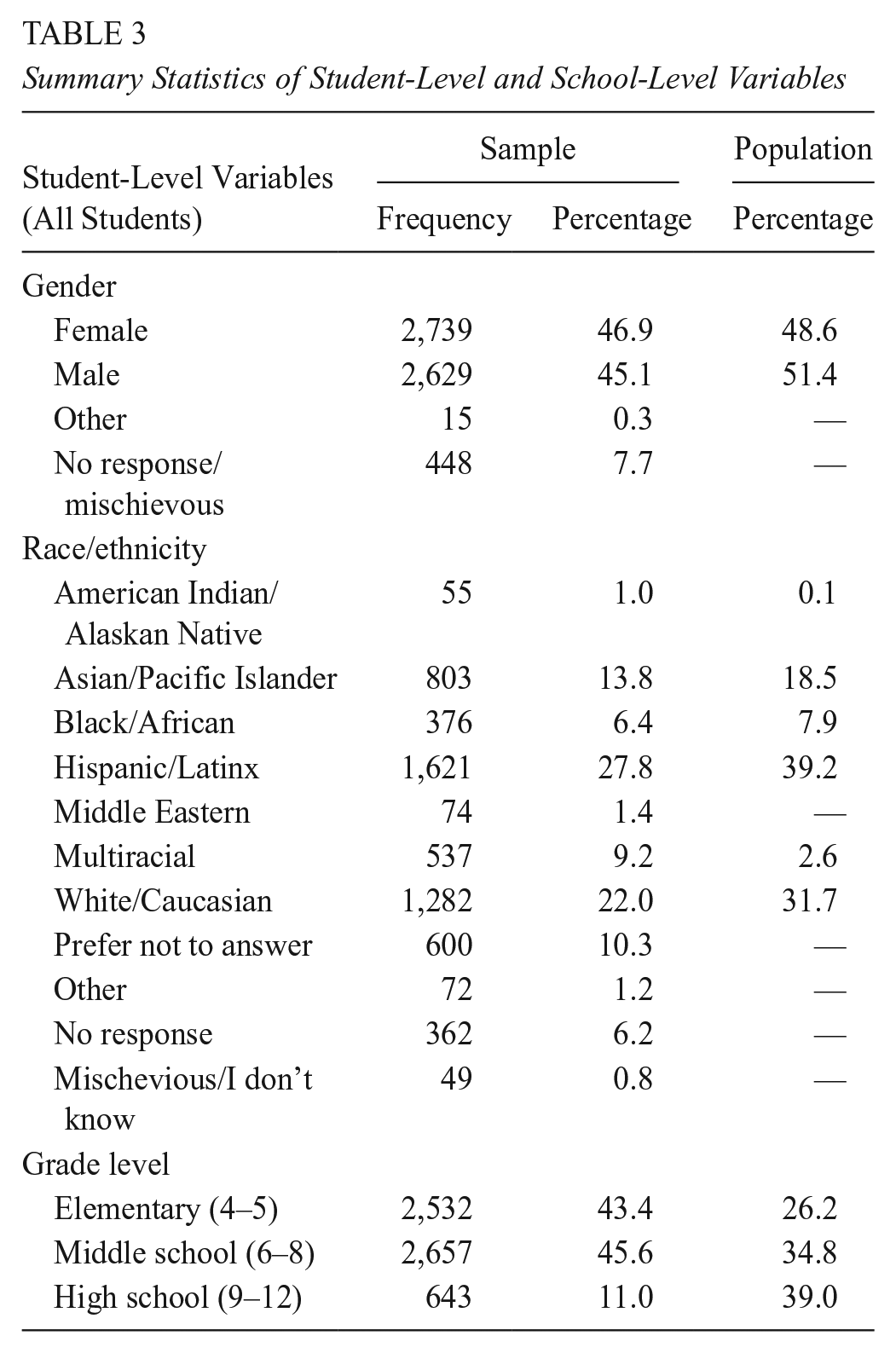
As described below, students’ responses to questions related to these two scales are our primary outcomes of interest. To maximize the number of survey questions asked per student, preserve a large sample size, and minimize burden on student respondents, not every student answered every survey question. Instead, students were randomly assigned two-thirds of the survey; therefore, each question was answered by 66% of the total number of survey respondents. On average, approximately 3,700 students responded to each survey question. As shown in Table 3, below, considering nonresponders and respondents who selected “prefer not to answer,” the surveyed population is demographically representative of the total Grade 4 through 12 student population across the three districts. While students in Grades 4 and 5 are slightly overrepresented in our sample, the majority of EL-classified students are identified and reclassified by or before fifth grade (Bialik et al., 2018). Thus, this overrepresentation of elementary-aged students allowed us to capture a larger set of EL-classified students. The total number of students to which the survey was administered in each district is not reported to protect district anonymity. In the subsequent section, we describe the different types of survey data we use, as well as district administrative and MA DESE data.
Outcomes of Interest: Sense of Belonging and Teacher Interest in Students
Our primary school climate outcomes are students’ sense of belonging and perceptions of their teachers’ interest in them. Listed in the first column of Table 1, the sense of belonging scale is comprised of six questions, and the teacher interest in students scale is comprised of five questions. Internal reliability analyses indicated an acceptable level of reliability for both scales, with a Cronbach’s α of .83 for the sense of belonging scale, .77 for the fourth- to fifth-grade student-teacher relationship scale, and .87 for the 6th- to 12th-grade student-teacher relationship scale. Responses to questions were on a 5-point Likert scale. While we descriptively analyzed responses at the individual question level, we also conducted principal component analyses to inform the creation of weighted sense of belonging and teacher interest variables for use in regression analyses. Correlations between the sense of belonging variables ranged from .3 to .6; and from .3 to .5 for the student-teacher relationship variables. For both the sense of belonging and teacher interest scales, all questions loaded on to a single component. As such, we created a weighted sense of belonging variable and a weighted teacher interest variable by multiplying students’ responses to individual questions by their component weight, and then summing the weighted responses. Table 1 provides summary statistics for the individual questions that make up the sense of belonging and teacher interest scales, as well as the weighted sense of belonging and weighted teacher interest variables.
Descriptive Statistics of Outcome Variables

Key Explanatory Variables: EL Status and Survey Language
We are interested in the relationship between students’ sense of belonging and perceptions of their teachers’ interest in them and two explanatory variables: EL status and survey language. Using district administrative data, we matched student survey respondents to one of three EL status categories: (a) never ELs are students who have never been identified as an EL while enrolled in the district; (b) current ELs are students who are currently identified as an EL and are receiving EL programming and supports; and (c) former ELs are students who were once classified as an EL but, within the past 2 years, were reclassified as English proficient and, thus, no longer eligible to receive EL programming and supports. Students currently and formerly classified as ELs made up 13% and 22% of the survey population, respectively; students never classified as ELs comprised the remaining 65% of the survey population.
Students were given the option to take the survey in one of nine languages: Armenian, Brazilian Portuguese, Cape Verdean-Creole, Chinese, English, Haitian Creole, Khmer, Somali, and Spanish. The overwhelming majority of students (96%) completed the survey in English. Approximately 3%, or 150 students, completed the survey in Spanish; and 1% completed the survey in Brazilian-Portuguese. Approximately one-fourth of 1% of students completed the survey in one of the other languages. Using this data, we created a binary non-English survey variable that takes on a value of 0 for those who completed the survey in English and a value of 1 for those who completed the survey in a language other than English. Table 2 provides a cross-tabulation of our two explanatory variables.
EL Status by Survey Language
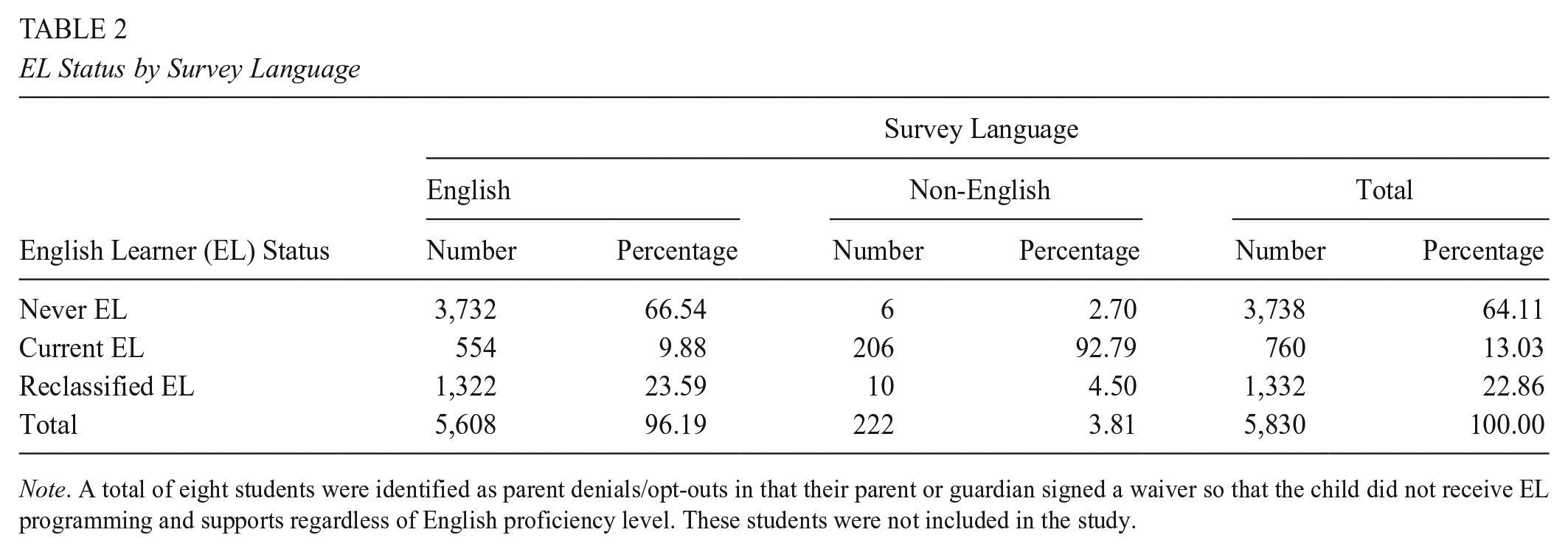
Note. A total of eight students were identified as parent denials/opt-outs in that their parent or guardian signed a waiver so that the child did not receive EL programming and supports regardless of English proficiency level. These students were not included in the study.
Covariates: Student and school demographics
Student-Reported Demographics
Recognizing that a wide array of student and school characteristics may be related to students’ sense of belonging and perceptions of their teachers’ interest in them, we incorporate student demographic data collected via the survey as covariates in our analyses. These data include student-reported gender, race/ethnic identity, and grade level.
Table 3 displays summary statistics for student demographic data. To protect the identities of the schools and districts that took part in the survey, we only report summary statistics of all student survey participants. In some cases, we adjusted student responses to demographic questions. In particular, when a student selected the “other” category for either gender or race/ethnicity, the student was provided the opportunity to specify an “other” identity in an open-ended text box. We reviewed all “other” responses and identified responses that could be classified as “mischievous,” meaning that students may have given a response that they considered “funny” (Robinson-Cimpian, 2014, p. 172). For example, students identifying as “shark,” “demon,” or “unicorn” were considered to be mischievous responders. As such, we adjusted students’ gender and race/ethnicity responses by leaving their identity as “other” for individuals that included a nonmischievous response and recoding the mischievous responders to a mischievous category. Additional details related to this adjustment process are available in online supplementary material (see Appendix A in the online version of the journal).
Summary Statistics of Student-Level and School-Level Variables
School Demographics
Drawing on data from the MA DESE, we incorporate the following school-level demographics: percentage of students in the school that met or exceeded expectations on the state English language arts (ELA) and math assessments, as well as percentage of students that are economically disadvantaged, 3 classified as ELs, high needs, 4 White, and have an individualized education program (IEP). We include assessment performance in response to research suggesting that “high academic achievement leads to greater social acceptance and sense of belonging” (OECD, 2017, p. 122). We include the aforementioned student demographics across the school in acknowledgement of prior research suggesting that students who attend schools where there is a higher concentration of students from low-SES families are more likely to have lower sense of belonging (Willms, 2003). Moreover, race has been found to be a significant factor in explaining variation in perceptions of school climate (Koth et al., 2008). Finally, based on work that suggests that female teachers tend to have higher social engagement with students (Topchyan & Woehler, 2020) and that all students experience positive outcomes from studying with teachers of color (Bristol, 2020; Goldhaber et al., 2019), we draw on school-level teacher demographic data from MA DESE that include the percentage of teachers who are White, percentage female. Additionally, given research suggests that teacher turnover can have a negative impact on students’ educational experiences (Ronfeldt et al., 2013), we also included a variable that captures the percent of teachers who were retained between the 2015–2016 and 2016–2017 school years.
Methods
Our first research question asks, How do students’ perceptions of school climate vary among EL-classified students, their peers who were formerly EL-classified, and never EL-classified students? We begin by examining these differences using descriptive statistics and analysis of variance (ANOVA). To examine our second research question—how perceptions of school climate among students classified as ELs vary across those who chose to complete a survey in a language other than English and those who chose to complete a survey in English—we conduct chi-square tests and multiple analysis of variance (MANOVA).
Next, to explore if and how student demographics are related to EL-classified students’ perceptions of school climate, we employ linear regression. We begin with the basic model

where our primary outcome of interest,
Next, given that research points to the importance of school-level contexts on immigrant youth belongingness (e.g., Gonzales et al., 2013; Suárez-Orozco et al., 2009), we incorporate school-level student demographics as well as school-level test scores on the state achievement assessments into our model:


where, as previously described,
Results
Variation Across Students Currently, Formerly, and Never Classified as ELs
As shown in Table 4, across the six sense of belonging questions, students classified as ELs had, on average, the most positive responses (average of 3.62 across all six questions, compared to 3.58 for formerly EL-classified students and 3.54 for never EL-classified students). Across the five teacher interest in student questions, EL-classified students had, on average, more positive responses than never EL-classified students, but less positive responses than former EL-classified students (EL-classified students’ average of 3.74 across all five questions, compared to 3.80 for former EL-classified students and 3.71 for never EL-classified students). However, we find no statistically significant differences among the three groups for either the weighted sense of belonging or teacher interest in students variables.
Sense of Belonging and Teacher’s Interest in Student, by EL Status, With Analysis of Variance to Examine Differences in Survey Responses Across EL Status Groups

Note. Bolded p-values indicates statistical significance at p <.05
At the individual question level, EL-classified students were more positive than both their peers who were formerly and never EL-classified on four of the questions, less positive than both formerly and never EL-classified students on four questions, and more positive than never EL-classified students but less positive than formerly EL-classified students on three question. Differences across these three groups were statistically significant at the p < .05 level for two of the six sense of belonging and two of the five teacher interest in student questions, with two of the four statistically significant differences indicating that EL-classified students were more positive than former and never EL-classified peers.
Heterogeneity Among Students Classified as ELs Based on Facility With English Language
Our second research question asks: Among EL-classified students, how do perceptions of school climate vary across those who chose to complete the survey in a language other than English and those who chose to complete the survey in English? As shown in Table 4, among those who completed the survey in English and those who completed the survey in a language other than English, we find no significant differences in the weighted sense of belonging and teacher interest in student variables. At the individual question level, EL-classified students who took the survey in English were significantly more positive than those who elected to take the survey in another language for four of the six sense of belonging questions, and significantly more negative for two of the six questions (p < .01). With regard to EL-classified students’ perceptions of teachers’ interest in them, differences in responses between EL-classified students who took the survey in English and those who elected to take the survey in another language were not significant.
Given that many questions that make up the weighted sense of belonging and teacher interest in student measures are correlated, we also conducted a MANOVA for students classified as ELs who took the survey in English and those who took the survey in another language. Among students classified as ELs, sense of belonging was significantly higher for those who took the survey in English than among those who took the survey in another language (p < .01). By contrast, student perception of their teachers’ interest in them was not significantly different across students classified as ELs who took the survey in English and those who took the survey in another language (p = .118).
Exploring EL Status and Survey Language in Conjunction With Larger School Context
Many factors impact a student’s schooling experience and perceptions of school climate. In this section, we examine if and how EL status and facility with the English language are contributing factors to students’ perceptions of school climate while taking into account the context of the school as a whole. While we focus on the weighted overall sense of belonging and teacher interest variables as our outcomes of interest, analyses for the individual questions that make up each scale are available upon request.
We begin by examining results from our basic regression model that includes only student demographic characteristics and district dummy variables as covariates. We ran one model with the explanatory variable of interest being a binary variable of whether a student is currently classified as an EL (column 1s in Table 5), which is how current accountability systems view the EL subgroup; we also ran a second model with two binary variables indicating whether a student is a current EL or former EL (column 2s in Table 5). When we look at the traditionally used measure of EL versus non-EL, where formerly EL-classified students are included in the non-EL-classified student group, we find that EL status does not play a significant role in students’ sense of belonging or perceptions of teacher interest in them. However, when we include indicators for current EL-classified students and formerly EL-classified students, we find a positive and statistically significant relationship (p < .05) between being a formerly EL-classified student and sense of belonging and students’ perceptions of their teacher’s interest in them. Student-level characteristics that had the strongest relationship with sense of belonging were gender and grade level. Regarding gender, if part of a students’ sense of belonging is their relationships with teachers (not necessarily their teachers’ perceived interest in them), this finding aligns with prior research showing that teachers’ perceptions of students’ academic and behavioral performance vary by gender (e.g., Dee, 2005; Koepke & Harkins, 2008; Split et al., 2012). The significant relationship between sense of belonging and grade level also aligns with research showing that students’ sense of acceptance and belonging declines in adolescence, as they traverse through middle and high school (e.g., Anderman, 2003; Barber & Olsen, 2004; Eccles et al., 1993; Walton & Brady, 2017). Moreover, being enrolled in District 2 or 3, as compared to District 1, had a strong positive relationship with students’ perceptions of teachers’ interest in them. Being enrolled in District 3 also had a strong positive relationship with students’ sense of belonging. These results suggest that, beyond the individuals within the schools, organizational school-level factors can have an impact on students’ perceptions of their school climate; however, this research was not able to identify what organizational factors may contribute to this result.
Coefficients for Regression Models for Overall Sense of Belonging and Ordinal Probit Models for Individual Sense of Belonging.
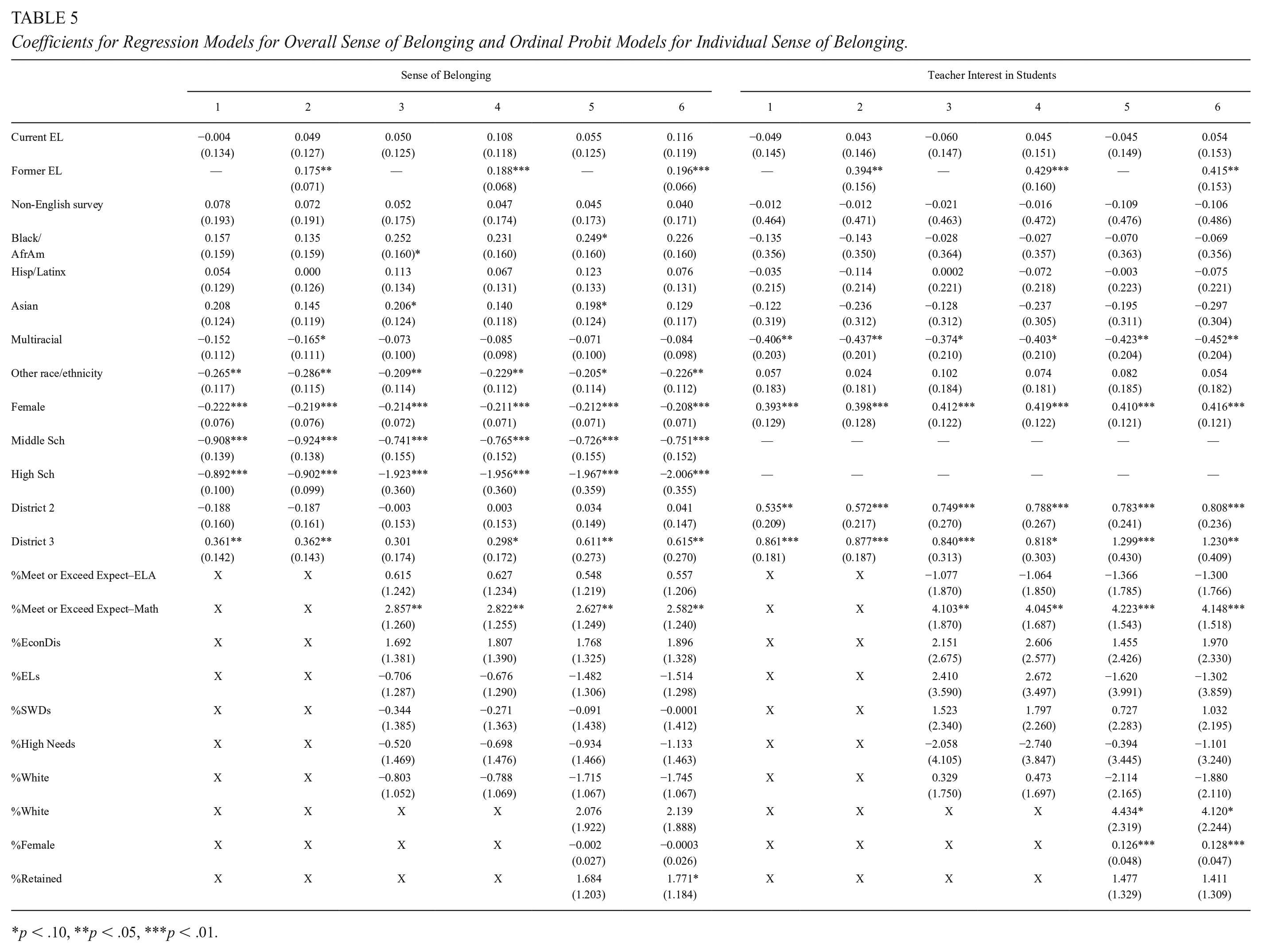
p < .10, **p < .05, ***p < .01.
Incorporating school-level student characteristics (columns 3 and 4) and teacher characteristics (columns 5 and 6) does not substantially change the direction or size of the coefficients of our variables of interest. However, it is worth noting the large, positive, and statistically significant relationship between the percentage of students meeting or exceeding expectations on the state mathematics assessment and the sense of belonging variables—effect sizes of approximately 1.5 standard deviations on the weighted variables. This pattern follows other work that has shown a generally positive circular relationship between sense of belonging at school and academic achievement: “A sense of belonging leads to higher academic achievement, and high academic achievement leads to greater social acceptance and sense of belonging” (OECD, 2017, p. 122). Moreover, districts with a greater percentage of female teachers were associated with more positive student-teacher relationship responses, a finding that aligns with prior work indicating that female teachers tend to have higher social engagement with students (Topchyan & Woehler, 2020).
Finally, while chi-square test results revealed differences in sense of belonging between EL-classified students who took the survey in English and those who took the survey in a language other than English, once we control for other student demographics and school contexts, the survey language that a student chose has a weak and non–statistically significant relationship to their sense of belonging and perceptions of student-teacher relationships. However, these findings must be cautiously interpreted because the sample size for this population is relatively small, limiting the reliability of the results.
Discussion
Do ELs Feel They Belong and That Teachers Are Interested in Them?
Our findings suggest that EL-classified students, overall, feel approximately a similar sense of belonging, or slightly higher sense of belonging than their never and formerly EL-classified peers. Particularly because “well-known equity gaps due to language, income, and immigration status” (Lazarín, 2020, para. 1) make students classified as ELs particularly vulnerable to inequities within public institutions, it is important to understand that many often do feel a sense of belonging within their schools. Related to our competing hypotheses from our conceptual framework and prior literature, our findings suggest that the literatures informing the potential relationship between EL status and the perceptions of school climate may not be competing; they may depend on what subcategory of school climate is the focus of study. While EL-classified students had the highest average sense of belonging (weighted and unweighted), deeper exploration into the individual questions provides important insight into what may be driving these feelings of belonging. The difference between the subgroup averages where EL-classified students’ ratings were lower than never and former EL-classified students was smaller than the differences for the questions where EL-classified students’ ratings were higher. For example, for the question, “How connected do you feel to the adults in your school?” the average rating for EL-classified students was 0.21 and 0.25 units higher than never and formerly EL-classified students, respectively. For the question, “How well do people at your school understand you?” the average rating for EL-classified students was 0.15 and 0.19 units higher than never and formerly EL-classified students, respectively. In contrast, when EL-classified students scored lower than never and former EL-classified students, the difference was 0.10 and 0.13 for the question, “How much do you feel you belong to your school?” and 0.02 and 0.08 for “How accepted do you feel by other students?”
The larger magnitude of difference in EL-classified students’ perceptions of the former two questions is also driving the higher overall sense of belonging averages. Because the differences in scores for those questions where EL-classified students scored lowest were relatively smaller than for those questions where EL-classified students scored highest, this may suggest that EL-classified students’ experiences in these areas may more closely align with those of all students. Given this, and the fact that there are not significant differences between the three subgroups’ responses for these questions, it may be that increasing belonging at school writ large could have a positive impact on all students, including students classified as ELs. Below, we discuss what could be important school factors for EL-classified students’ higher ratings about how well people at school understand them and how connected they feel to adults in their school.
With regard to teachers’ interest in students, EL-classified students’ responses were quite similar to other students’ for the questions about how concerned the teacher would be if they were upset, and how carefully the teacher would listen to them if they had something on their mind. There were quite large differences—in the negative direction—between EL-classified students’ ratings and never and formerly EL-classified students’ ratings on how often teachers appear to be really interested in what they have to say (former EL-classified students 0.24 and never EL-classified students 0.19 units higher than EL-classified students); and between EL-classified students’ and former EL-classified students’ ratings on how excited their teacher would be to see them return in later years (former EL-classified students 0.20 units higher than EL-classified students). In contrast, the difference between EL-classified students’ responses and never and formerly EL-classified students’ responses to how interested their teacher is in what they do outside of class are 0.23 (former) and 0.30 (never) units. These findings may suggest that students have similar perceptions of teachers’ approaches to supporting students socially emotionally (e.g., being upset, having something on their mind they need to talk about); where differences may lie are in EL-classified students feeling a lower sense of their teachers’ being genuinely interested and invested in their academic pursuits—which is also emphasized by EL-classified students’ higher ratings of teachers being interested in what they are doing outside of class. We discuss this further in the next section.
The Potential Role of Programming for EL-Classified Students
Differences across EL-classified students’ perceptions of school climate may be connected to the support services they receive. For example, EL-classified students are often exposed to numerous adults in their day-to-day schooling experiences. In addition to their primary grade-level teachers, students classified as ELs typically interact with instructional specialists (e.g., English as a second language [ESL] teachers), paraprofessionals, or other staff who support them as they acquire proficiency in the English language. Our results indicating ELs have relatively positive perceptions of their relationships with adults supports the idea that exposure to a variety of educators and school staff may have a positive impact on EL-classified students’ sense of belonging and relationships within schools, highlighting the important role that all school staff play in EL-classified students’ perceptions of school climate. For example, the other adults that students classified as ELs come in contact with beyond their primary classroom teachers may provide positive experiences and foster a sense of belonging among students classified as ELs. Additionally, many of the other adults that EL-classified students encounter through their EL programming may be likely to communicate with them in their native language, which may also facilitate more positive perceptions in belonging. This finding builds on Jaffe-Walter and Patton Miranda’s (2020) recent work suggesting that “counterpublics”—defined as communities that offer the potential for individuals from marginalized groups to develop identities and critiques that are not easily forged in the wider public sphere (Fraser, 1990)—offer “spaces that honor and cultivate the epistemologies and skills of the marginalized in ways that strengthen society as a whole” (pp. 104–105). In their study, “counterpublics” fostered a sense of solidarity related to learning English and negotiating migration experiences. While Jaffe-Walter and Patton Miranda’s (2020) work focused on schools exclusively serving immigrant students classified as ELs, our findings suggest that counterpublics—where “all teaching and learning [are] designed with their needs in mind and could be accessed by all students” (p. 111)—may be possible within traditional schools.
Moreover, finding that EL-classified students were significantly more likely to say that their teachers are interested in what they do outside of class may suggest that teachers find it easier to communicate with students classified as ELs in social language, perhaps about out-of-school and/or non-academic matters. If so, this may also lend support to research that shows that students classified as ELs often achieve proficiency in social language before academic language (Haynes, 2007).
While EL-classified students reported relatively positive responses to questions related to feeling understood and respected by their peers, teachers, and adults, they reported relatively negative responses to questions related to feeling like they belong and are accepted in their school. Though not significantly different than never and formerly EL-classified peers, these lower responses may be associated with the ways EL-classified students experience school. For example, Chapter 71A, Section 4, of the Massachusetts General Laws states that districts enrolling students classified as ELs must educate them in a sheltered English immersion program, unless the district obtains a waiver for another program model. Sheltered English programs are programs that are taught in English but make the academic content more comprehensible to EL-classified students using strategies such as visual aids, simplified English, or the use of ESL instructional specialists. For example, students classified as ELs may receive supports in which they are in the regular classroom but working alongside a smaller group of students classified as ELs and an ESL instructional specialist. This may make EL-classified students feel understood and respected by their classroom peers and the adults they are working with in that classroom. However, EL-classified students still may not feel as though they belong and are accepted within the larger school community.
In contrast to students classified as ELs, formerly EL-classified students felt supported by and connected to their peers but were less positive about their relationships with adults and teachers. This finding may suggest a negative “reclassification effect” on students’ perceptions about their teachers’ interest in them once reclassified as English proficient, which aligns with recent findings that reclassified students report more short-term negative discriminatory interactions with teachers (Chin, 2021).
Facility With Language
While considering student demographics essentially eliminated the effect that survey language had on students’ sense of belonging, we found that EL-classified students who took the survey in English responded more positively to nearly all of the sense of belonging questions. EL-classified students who felt comfortable enough to take the survey in English may have felt more connected to the school and understood by people in the school simply because of their higher perceived proficiency and/or comfort with the English language. Additionally, greater proficiency with the English language may reduce language barriers between EL-classified students and their never EL-classified peers and adults, which may play an important role in EL-classified students’ feelings of connectedness to adults. However, we find no statistically significant differences in responses to teacher interest in student questions among EL-classified students who completed the survey in English and those who completed it in another language.
Feelings of being understood and connected are not necessarily congruous with feelings of acceptance among their peers. Students classified as ELs who took our survey in English had significantly more negative responses to questions related to acceptance and respect shown to them by their peers than those who took the survey in another language. It is possible that this result may be related to EL-classified students relying on their native language having a tight-knit, potentially more insular, peer group—a peer group in which they feel respected and accepted. However, additional research, particularly qualitative research, would help us better understand the complex nature of these relationships.
Conclusions and Future Research
Much of the policy focus related to students classified as ELs over the past two decades, understandably, has been on the specific work of building English language proficiency while continuing to support academic growth in other subject areas. Yet EL-classified students are no different from other students in that their learning experiences are shaped by a wide range of factors that extend beyond the design of classroom instruction. Factors like sense of belonging can play an important role in ensuring that students remain engaged in school and continue to see value in the educational experience. As this study suggests, some of the programming typical for EL-classified students appears to facilitate positive experiences in school. Other elements, however, appear to have the opposite effect; our study, for instance, suggests that reclassification, while a positive academic outcome, can also lead to EL-classified students feeling less connected to their teachers. Thus, although additional research is necessary, schools might do more to consider the ways that strong relationships and a feeling of inclusion can be fostered for those students most likely to feel marginal.
It is important to note that the results of this study may be nongeneralizable to EL-classified students in other districts or states, though replication of the study in other districts and states or using nationally representative datasets would be valuable for the field to gain a better understanding of the role that schools, districts, communities, and states may play in EL-classified students’ sense of belonging and relationships within schools. If done in other contexts, we recommend surveys be offered in multiple languages, as ours was, to allow for students to engage with the questions in a language they are most familiar with. We also recognize that our survey was conducted at a time when executive branch political rhetoric and dialogue at the national level focused on deportation of undocumented immigrants and the building of walls along the U.S.-Mexico border. These larger national political contexts could have implications for students’ sense of belonging and relationships with others.
Finally, while students classified as ELs in this study, on the aggregate, felt belongingness, it is important to continue to study this topic, particularly qualitatively in ways that bring in student voice, to better understand the factors that may contribute to or hinder sense of belonging among students classified as ELs. Given the conclusions of this research and its limitations, we believe future research should incorporate both qualitative and mixed methods approaches and build upon this work to further examine variation in sense of belonging of students classified as ELs across classrooms, schools, districts, states, as well as in different national political contexts.
Supplemental Material
sj-docx-1-ero-10.1177_23328584231179171 – Supplemental material for bELonging: Do Students Classified as English Learners Feel Included?
Supplemental material, sj-docx-1-ero-10.1177_23328584231179171 for bELonging: Do Students Classified as English Learners Feel Included? by Rachel S. White, Jack Schneider and Madeline Mavrogordato in AERA Open
Footnotes
Acknowledgements
The Massachusetts Consortium for Innovation Education Assessment (MCIEA) is supported by the Massachusetts State Legislature.
Declaration of Conflicting Interests
The author(s) declared no potential conflicts of interest with respect to the research, authorship, and/or publication of this article.
Funding
The author(s) received no financial support for the research, authorship, and/or publication of this article.

Supplemental Material
Supplemental material for this article is available online.
1.
2.
In the state of study (Massachusetts), EL reclassification processes must first consider the results of ACCESS (Assessing Comprehension and Communication in English State-to-State) for English language learners (ELLs)—the state’s language proficiency assessment—to identify students as candidates for reclassification (minimum of 4.2 overall ACCESS score and 3.9 ACCESS literacy score). Then, school-based teams must consider “other relevant data to determine whether students can perform ordinary classroom work in English, and whether they should exit the English language education program” (MA DESE, 2022, p. 33).
3.
4.
Calculated by MA DESE based on the number of high needs students, divided by the adjusted enrollment. A student is high needs if he or she is designated as either low income (prior to school year 2015), economically disadvantaged (starting in school year 2015), or ELL, or former ELL, or a student with disabilities. A former ELL student is a student not currently an ELL but had been at some point in the 2 previous academic years.
Authors
RACHEL S. WHITE is an assistant professor in the Department of Educational Leadership & Policy Studies at the University of Tennessee, 1122 Volunteer Blvd, Knoxville, TN 37996;
JACK SCHNEIDER is the Dwight W. Allen Distinguished Professor at the University of Massachusetts Amherst, 813 N. Pleasant St., Amherst, MA 01003;
MADELINE MAVROGORDATO is an associate professor of K–12 educational administration at Michigan State University, 407 Erickson Hall, College of Education, Michigan State University, East Lansing, MI 48824;
References
Supplementary Material
Please find the following supplemental material available below.
For Open Access articles published under a Creative Commons License, all supplemental material carries the same license as the article it is associated with.
For non-Open Access articles published, all supplemental material carries a non-exclusive license, and permission requests for re-use of supplemental material or any part of supplemental material shall be sent directly to the copyright owner as specified in the copyright notice associated with the article.
