




Abstract
Recruiting racially minoritized principals is one suggested strategy to increase the racial diversity of teachers, who would then better match their increasingly racially diverse students. However, focusing solely on race ignores the salience of race-gender intersectionality in principal-teacher relations. Using three waves of nationally representative, cross-sectional data with school and year fixed effects, we compared similar teachers in the same school who are and are not race-gender congruent with their principal. We found that better discretionary workplace benefits were concentrated among Black teachers with Black principals, especially Black male teachers with Black male principals, who reported workplace supports almost half a standard deviation higher than did similar non-Black female teachers in their school. Male teachers earned up to $2,890 more supplemental income with male, racially congruent principals; female teachers earned up to $1,050 less with female, racially congruent principals. However, teacher turnover was not consistently responsive to race-gender congruence.
Keywords
Teachers and school leaders having identities that reflect the student body is associated with a host of benefits (Fitchett et al., 2017; Martinez, 2020; Nicholson-Crotty et al., 2016; Renzulli et al., 2011; Roch & Edwards, 2017). Research has tended to focus on examining the benefits of students having racially congruent teachers, with several studies documenting that increased descriptive representation among teachers is associated with higher test scores, increased placement in gifted education, and greater academic aspirations (Fox, 2015; Grissom & Redding, 2015; Joshi et al., 2018; Redding, 2019). However, schools have traditionally struggled to recruit and retain a workforce approximating students’ demographic makeup, particularly students’ racial and gender composition. As of 2017–2018, around 80% of teachers and principals were White, 77% of teachers were female, and 54% of principals were female (Taie & Goldring, 2019, 2020). Considering that schools became “majority minority” in 2014–2015, when the proportion of racially minoritized 1 students exceeded the proportion of White students (Digest of Education Statistics, 2013), understanding how to increase diversity in the teacher workforce has become a critical concern for education policy-makers, with targeted efforts at recruitment having mixed results (Partelow et al., 2017; Sawchuk, 2014).
Although evidence on the consequences of underrepresentation of male-identifying 2 teachers within the profession on student outcomes is less conclusive than it is regarding racial representation (see Antecol et al., 2015; Dee, 2007), the extant research on representation effects is even more underdeveloped in its consideration of how such effects may differ by teacher-student race and gender congruence. The nascent literature on race-gender intersectionality of teachers has tended to focus on qualitative or theoretical insights on teachers with specific race-gender intersections, such as Black male teachers (e.g., Milner, 2016), instead of the effects of race-gender congruence on students or teachers.
Previous scholars studying the effects of racial or gender representation among principals on teacher outcomes have used a representative bureaucracy (RB) framework (Bartanen & Grissom, 2021; Grissom et al., 2012; Grissom et al., 2015; Grissom & Keiser, 2011). Through the RB lens, demographic congruence, or passive representation, may serve as a key retention mechanism in which shared values and understanding translate into employee benefits through active or symbolic representation (Hindera, 1993; Theobald & Haider-Markel, 2009). Although much research confirms similar relationships, where representation is associated with positive outcomes for demographically matching subordinates (Bartanen & Grissom, 2021; Grissom et al., 2012; Grissom & Keiser, 2011), prior work has arguably evaded a direct consideration of the complexities of power in supervisor-employee relations vis-à-vis race, gender, and intersecting identities (Applebaum, 2010). Indeed, studies of bureaucratic representation have embraced this notion. Scholars have become increasingly attentive to how representation might operate most strongly when bureaucrats and clients share multiple identities (Meier, 2019) and have begun to empirically test for representation effects by using an intersectional lens (Fay et al., 2020).
This study investigates the extent to which teacher retention, perceived workplace supports, and discretionary benefits differ based on the intersection of teacher race and gender relative to their principal’s race and gender. We focused on the racial identities 3 of Black, White, Hispanic 4 , Asian American/Pacific Islander (AAPI), and American Indian coupled with the gender identities of male or female. We used nationally representative cross-sectional data sets spanning the 2007–2008 through 2015–2016 school years on individual teachers and their principals to assess the utility of RB, going beyond a simplistic conceptualization of passive representation in three broad ways. First, we examined differences by race-gender, whereas prior work has focused on race or gender. Second, our analysis centered congruence by specific racial and gender identities instead of focusing on overall congruence, an analytical choice that has led prior work to relegate differences by race or gender identity to secondary analyses. Third, we integrated intersectionality to explore complexity in specific race-gender intersections, away from a singular focus on congruence to a more expansive view of how principals’ specific race and gender identities could actively benefit teachers who identified similarly, especially for those from minoritized backgrounds.
An Intersectional Lens for RB
A chief tenet underlying RB is that a bureaucracy more effectively promotes the public’s interest when it is demographically similar to the public it serves (Kingsley, 1944). The notion of RB originated in the observance that “[government] administrators are drawn overwhelmingly from the upper and middle classes of the population” (Kingsley, 1944, p. 151) to advance and protect the interest of a White “ruling class.” Since its inception, the theoretical application of RB to the study of organizations has manifested in myriad ways but has been commonly applied through either a racial or gender lens (e.g., Mansbridge, 1999). More specifically, scholars have drawn on RB to understand how racial or gender congruence with principals affects teacher outcomes (e.g., Grissom et al., 2012; Grissom & Keiser, 2011). However, applications of RB have rarely considered the intersection of race and gender in the context of supervisor-employee demographic representation (Meier, 2019). As the current study is concerned with the relationship between principal-teacher race-gender similarity and teacher-perceived workplace supports, benefits, and turnover, we present our remaining discussion of RB and our hypotheses through an intersectional racial and gender lens in terms of supervisor-employee relationships.
Theoretical Assumptions of RB
RB distinguishes between passive representation (the degree to which bureaucrats are demographically similar to those they serve) and active representation (the extent to which bureaucrats are responsive to the needs of those they serve due to demographic similarity; Mosher, 1968). A central notion regarding RB is that passive representation tends to lead to active representation, a hypothesis tested in a variety of settings (see Riccucci & Van Ryzin, 2017). Additional scholarship contends that although passive representation does not guarantee active representation, it nevertheless holds some symbolic value by enhancing organizational legitimacy and promoting a cooperative public more inclined to partake in co-production (Headley et al., 2021; Theobald & Haider-Markel, 2009; Van Ryzin et al., 2017). This concept is operationalized as symbolic representation (Riccucci et al., 2014; Riccucci et al., 2016).
RB provides a suitable lens to understand principal-teacher relations and how they influence organizational or teacher outcomes (Bartanen & Grissom, 2021; Grissom et al., 2012; Grissom et al., 2015; Grissom & Keiser, 2011). Predicated on the assumption that demographic characteristics of bureaucrats influence their attitudes and behavior (Dolan & Rosenbloom, 2016), RB suggests that when principals are more passively representative, they are more likely to engage in active representation by espousing workplace policies and decisions that are more beneficial for their teachers. For instance, principals may be more likely to assume an advocacy or “mentor” role for those of a similar racial or gender identity due to shared values and enhanced understanding, bolstering a sense of trust, autonomy, cooperation, and, ultimately, improved principal-teacher relationships (Grissom et al., 2015). Principals sharing a similar racial or gender identity as their teachers may exhibit enhanced support and communication in ways that, for example, signal more encouragement and recognition of teacher efforts, more effectively provide necessary materials and supplies for teachers to carry out their work (e.g., textbooks, classroom equipment), or more willingness to arrange for teachers to secure extracurricular activities or roles (e.g., coaching athletics), thus offering additional compensation to teachers beyond base salaries.
Research in human resources has found that frontline workers value autonomy in the workplace as well as enhanced support from and cooperation with supervisors (Meier, 1993). Subordinates experiencing these benefits from their supervisors may then have more positive employee attitudes and behaviors, which may translate to greater willingness to remain engaged with the organization, greater satisfaction, and a lower likelihood of turnover (Grissom et al., 2012; Grissom & Keiser, 2011). Even in the absence of supervisor active representation, increased passive representation may similarly improve employee attitudes and behavior by imbuing legitimacy to the organization among underrepresented employees (i.e., symbolic representation; Theobald & Haider-Markel, 2009). It is also possible that subordinates behave differently in response to passive representation or lack thereof. One study on teacher job satisfaction based on teacher-principal race congruence finds what naïvely appeared to be positive returns to race congruence; however, this result was driven by lower satisfaction among White teachers working for Black principals, while Black teachers’ satisfaction did not differ based on the race of their principal (Viano & Hunter, 2017).
Intersectionality theory serves as a useful theoretical extension to consider how supervisor and employee demographic backgrounds interact to affect supervisor and employee relations and, ultimately, employee outcomes. Although most RB literature considers bureaucratic representation primarily through a racial lens, these interactions rarely operate unidimensionally through discrete or binary racial identities. Instead, these interactions are often based on several individual identities. First coined by Kimberlé Crenshaw, the notion of “intersectionality” acknowledges that individuals who are both women and people of color are marginalized by patterns of oppression that are salient to both identities and, by extension, suggests a failure to recognize the intersectional aspect of how power and privilege equates to the rejection of reality (Crenshaw, 1989, 1990).
Applying an intersectional lens to the tenets of RB suggests that heterogeneous members of specific groups (such as women of color) might experience the workplace differently depending on their race and gender, partly due to the degree to which their identities are shared with their supervisor. Multiple shared identities between an employee and their supervisor may yield individual or combined (additive or multiplicative) effects for the employee in a given workplace context (Atewologun, 2018). For example, representation effects may be larger for employees who are represented across many dimensions of their identity among leadership in their workplace, thus resulting in higher levels of job satisfaction and a stronger inclination to remain at the organization.
Hypotheses
The application of RB to the study of principal-teacher relationships leads to the hypothesis that passive representation among principals will lead to active representation in the form of greater perceived workplace supports and benefits for teachers and will operate through shared race-gender intersectional identities between principals and their teachers. Although RB studies of bureaucratic representation are traditionally concerned with the representation of the disadvantaged (racially minoritized) group, they do not deny that representation among the advantaged (i.e., White teachers) also occurs—in fact, under the status quo, organizations and bureaucrats are primed to represent the interests of the advantaged (Meier, 2019). RB contends that all bureaucrats represent, with more attention to the interests of individuals with shared identities (Meier, 2019). Thus, for the purpose of this study, we take the stance that, in theory, all teachers stand to experience representation effects based on the intersection of the racial and gender identities shared with their principals:
H1: Teachers with race-gender congruent principals will report more robust perceived workplace supports, more positive job satisfaction, and higher discretionary benefits and be less likely to turn over than their race- and gender-incongruent colleagues.
Even so, representation may be less salient for White individuals than racially minoritized individuals or even lose salience altogether (Meier, 2019). Furthermore, based on the premise that racially minoritized teachers may be more likely to experience tokenization, microaggressions, and other instances of racial marginalization with principals of a different racial background, we hypothesize that racially minoritized teachers will be especially sensitive to passive representation:
H2: Such benefits will be greater for racially minoritized teachers with race-gender congruent principals than for White teachers with White-gender congruent principals.
We similarly derive the hypothesis that female and male teachers will experience representation effects differently. Although the literature on gender representation among teachers and principals is underdeveloped, theoretical arguments and empirical evidence suggest that representation may be most salient for male teachers in a female-dominated teaching profession (Grissom et al., 2012; Husain et al., 2021; Meier, 2019):
H3: Such benefits will be higher for male teachers with race-congruent male principals than for female teachers with race-congruent female principals.
It may also be the case that female principals may be more attentive to supporting and addressing the workplace needs of female teachers. For example, female principals may secure extracurricular positions and additional monetary benefits for female teachers that female teachers may have historically been excluded from as an identity group within the school, such as arranging for a female teacher to serve as a coach of a school sports team. Thus, we posit that the alternative hypothesis wherein representation effects may be stronger for female teachers can also be true.
Contribution
This study builds on a wealth of literature exploring how principals affect teachers, particularly studies assessing whether teacher and principal demographics are associated with teacher outcomes. Previous authors have largely found that teachers who share the same race as their principals leave their jobs less often than teachers who do not share the same race as their principal (Grissom & Keiser, 2011; Grissom et al., 2009; Renzulli et al., 2011); a similar relationship exists when teachers share the same gender as their principals (Grissom et al., 2012; Husain et al., 2021). Research from Tennessee and Missouri has found that principals tend to increase the proportion of same-race teachers in the schools they lead over time (Bartanen & Grissom, 2021). We add to this literature in four substantial ways. First, we integrate intersectionality theory to focus on teacher and principal race-gender intersections. Second, we prioritize the analysis of specific racial and gender identities, moving away from the tendency of prior research to focus on congruence instead of the complexity inherent in specific identities. Third, we extend much of the prior literature into a new time period, a key contribution because relationships between teacher-principal race and outcomes have been found to be time-varying (Viano & Hunter, 2017). Fourth, we include a variety of outcomes to understand how passive representation translates not only into outcomes through turnover but also into outcomes associated with workplace conditions and teacher compensation. Ultimately, this study intends to make a theoretical contribution to the understanding of RB intersectionality applications as well as contribute to the understanding of how to increase the racial diversity of teachers so the teaching workforce can better approximate rising racial diversity among students.
Methods
Data
Our data came from the Schools and Staffing Survey (SASS), Teacher Follow-Up Survey (TFS), and National Teacher and Principal Survey (NTPS), all administered by the National Center for Education Statistics (NCES). SASS/TFS were administered to a stratified random sample of teachers and schools every few years between 1987 and 2011. NTPS replaced SASS in 2015, using a different sampling technique. NTPS retained most of the survey instruments from SASS, with no changes to the items we analyzed in this study. SASS and NTPS distributed questionnaires to teachers, principals, and school representatives (National Teacher and Principal Survey—Overview, n.d.; Tourkin et al., 2010). The samples were constructed through a multistage probability sampling design, wherein schools were selected first, followed by the selection of an average of 10 teachers per school. 5 One year after SASS, NCES conducted TFS to gather further information from principals about the current employment of teachers who had taken the survey the previous school year. TFS was not conducted after the 2015 NTPS.
For the purposes of this study, we drew upon teacher, principal, and school surveys from the 2008 and 2011 SASS and the 2015 NTPS for public schools only. We included information from multiple waves to increase sample size and add power to statistical calculations. Each wave of data included a small number of schools with non-White principals, a subgroup of schools important for assessing race-gender congruence for racially minoritized teachers. We included more recent waves from SASS to increase relevance and analyze data not included as part of relevant prior research (e.g., Grissom et al., 2012; Grissom & Keiser, 2011). Our sample included 62,950 teachers in 12,460 schools for the turnover analysis and 88,950 teachers in 16,580 schools for the other analyses. All estimates in the analysis used teacher-level survey weights to account for complex sampling design, correct for unit nonresponse, and increase precision. 6 Including teacher-level survey weights allowed the results to represent the target survey population—all teachers working in public schools during the school years included in the data set.
Measures
Dependent Variables
Turnover
One year after each SASS wave, principals were asked to identify whether the teachers from the immediately preceding SASS were still teaching in that school, had moved to a different school, or had left the profession, among other alternatives. Responses were compiled into two dichotomous variables indicating whether the teacher had moved schools or left teaching. Results indicated that 6% of teachers had moved schools and 7% had left teaching, with wide variation by teacher race-gender (see Table 1 and Appendix Table A1 for differences by principal race-gender).
Descriptive Statistics on Outcomes, by Teachers’ Racial and Gender Identity

Note. Standard errors are in parentheses. Results are estimated by using survey weights. Observations are rounded to nearest 10, per NCES requirements. AAPI = Asian American or Pacific Islander; NCES = National Center for Education Statistics.
Source. Schools and Staffing Survey and the National Teacher and Principal Survey from the National Center for Education Statistics.
Perceived Workplace Supports
Our measures of perceived workplace supports are guided by prior research on teacher preferences (e.g., Viano et al., 2021). Prior research on teacher-principal race congruence (Grissom & Keiser, 2011; Viano & Hunter, 2017) has included SASS Likert-scaled items with the prompt “To what extent do you agree or disagree with the following statements?” The options ranged from strongly agree (4) to strongly disagree (1), with four response options. We treated these measures as continuous, with a range of 1 to 4. The items we analyzed indicated whether the administration was supportive of teachers (“The school administration’s behavior toward the staff is supportive and encouraging.”), the provision of materials needed for teaching (“Necessary materials such as textbooks, supplies, and copy machines are available as needed by the staff.”), the support the principal provided to teachers for student behavior (“My principal enforces school rules for student conduct and backs me up when I need it.”), the principal’s communication with teachers (“The principal knows what kind of school he or she wants and has communicated it to the staff.”), and recognition for teachers’ efforts (“In this school, staff members are recognized for a job well done.”). More information on the average values of these outcomes can be found in Table 1 and Appendix Table A1.
Job Satisfaction
Prior research on teacher-principal gender or race matching (Grissom et al., 2012; Grissom & Keiser, 2011; Viano & Hunter, 2017) has assessed teacher satisfaction through the following item: “I am generally satisfied with being a teacher at this school.” More information on this outcome can be found in Table 1 and Appendix Table A1.
Discretionary Benefits
Teachers typically receive additional compensation for various responsibilities beyond traditional instructional duties. Teachers reported the additional monetary compensation they received in the school year of survey administration. They were asked to report “any additional compensation from this school system for extracurricular or additional activities such as coaching, student activity sponsorship, mentoring teachers, or teaching evening classes” as a dollar amount, with 43% of respondents reporting additional salaries of an average of about $2,600 (for those who received any supplemental salary). They were also asked whether they coached sports (binary yes/no). More information on these variables can be found in Table 1 and Appendix Table A1. We included both measures as dependent variables to assess monetary benefits and whether these benefits could be connected to differential access to coaching.
Independent Variables
The independent variables were based on teacher and principal responses to race and gender identity items. All surveys asked respondents to report their gender as male or female. Respondents were asked whether they were of Hispanic or Latino origin (binary yes/no) followed by an item asking respondents to mark as many as applied: White, Black or African American, Asian, Native Hawaiian or Other Pacific Islander, American Indian or Alaskan Native. We combined the Asian ethnic identity with the Native Hawaiian or Other Pacific Islander option into an AAPI identity. When we refer to teachers/principals as race-gender congruent, this indicates that they identified as the same gender and race.
Covariates
Prior research has indicated that school environments, teacher characteristics, and principal effectiveness influence teacher turnover. Therefore, we included school demographics, enrollment, urbanicity, school type, and school level to control for school-level environments. Principal degrees and experience were included as proxies of principal effectiveness. At the teacher level, we included years of experience, years of experience squared, certification status, average grade level taught, and degrees to account for teacher characteristics. For more information and a full list of covariates, see Table 2.
Descriptive Statistics on Independent Variables and Covariates
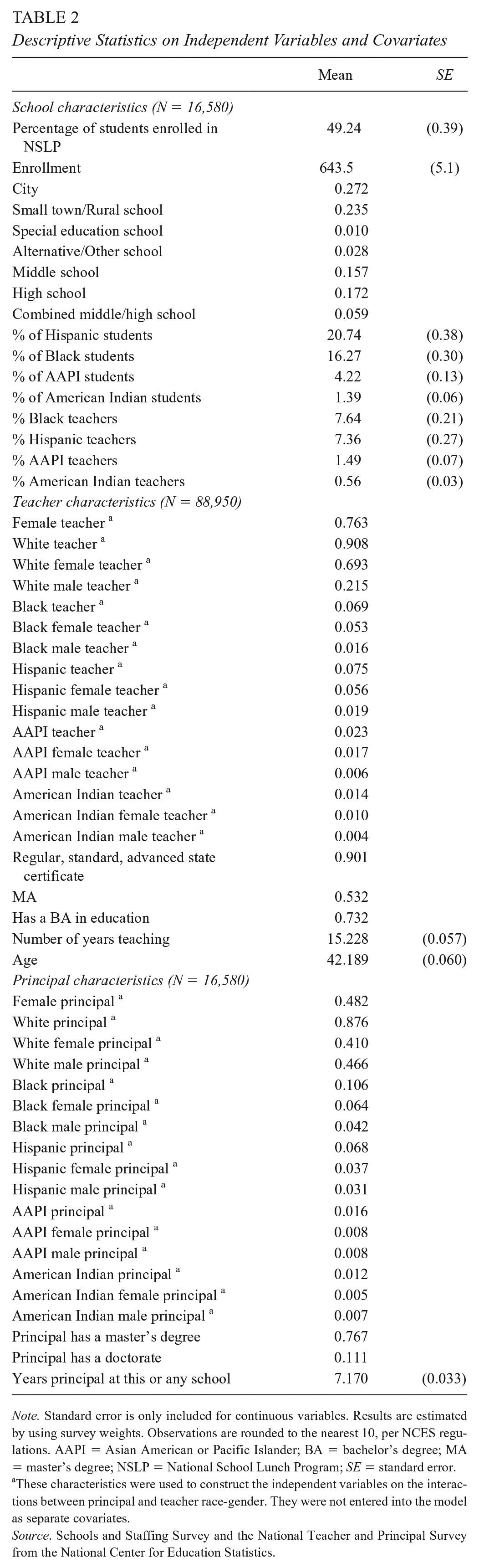
Note. Standard error is only included for continuous variables. Results are estimated by using survey weights. Observations are rounded to the nearest 10, per NCES regulations. AAPI = Asian American or Pacific Islander; BA = bachelor’s degree; MA = master’s degree; NSLP = National School Lunch Program; SE = standard error.
These characteristics were used to construct the independent variables on the interactions between principal and teacher race-gender. They were not entered into the model as separate covariates.
Source. Schools and Staffing Survey and the National Teacher and Principal Survey from the National Center for Education Statistics.
Empirical Framework
We employed ordinary least squares (OLS) regression (linear probability models for binary outcomes 7 ) and school and year fixed effects (FE) to examine relationships among teacher and principal race-gender pairings within school and the outcomes. School FE controlled for the influence of unmeasured, school-level variables, while year FE controlled for between-year differences affecting all outcomes within a cross section. We applied school FE because unobserved between-school influences, such as testing performance, may have adversely affected teachers’ reported working conditions or mobility, potentially exacerbating bias in the estimates of interest. In school and year FE models, teacher-level variables represented the association of specific teacher attributes on the outcome relative to teachers within the same school who were otherwise similar to each other (i.e., in ways controlled for by the covariates). 8 The school and year FE attempted to isolate the effect of the teacher-principal race-gender intersection on teacher-perceived workplace supports, satisfaction, benefits, and turnover probability. The general form of the FE model in this study was:
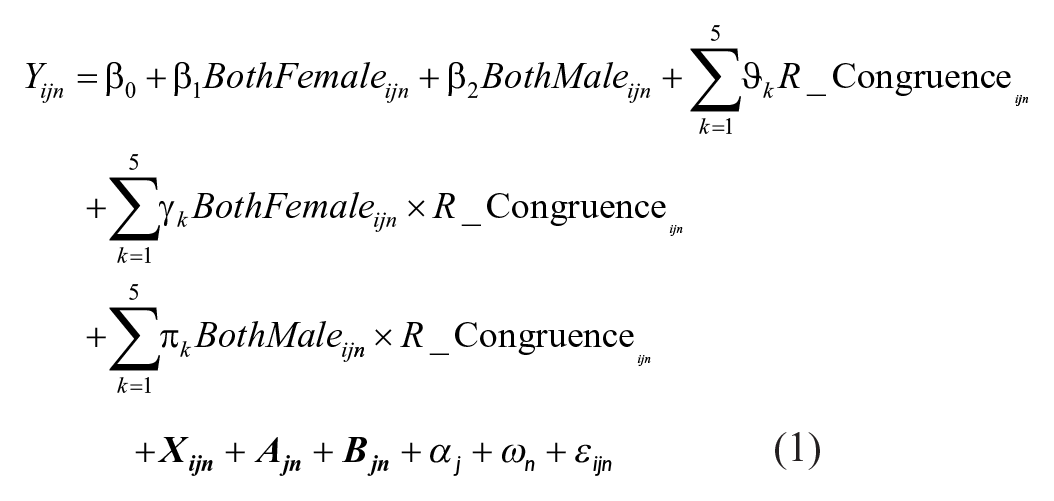
where
We included a variety of indicators for gender congruence, racial congruence, and race-gender congruence. The variables
To calculate the associated change in the outcome for a given shared race-gender compared to similar teachers in their school who did not share gender or race with the principal, we combined the coefficients indicating shared gender, shared race, and shared race-gender. For instance,
We tested our hypotheses by using t-tests for the combined coefficients and Wald tests comparing combined coefficients. We evaluated Hypothesis 1 through the statistical significance of the combinations of coefficients representing the cumulative association of race-gender congruence for each race-gender intersection. Hypothesis 2 was evaluated by comparing the combined race-gender coefficients for racially minoritized teachers with the combined race-gender coefficients for White teachers. Similarly, Hypothesis 3 was tested by comparing coefficients for those of the same racial identity with different gender identities (e.g., comparing Black female teachers with Black female principals to Black male teachers with Black male principals). We note that our model did not have overt measures of racism, discrimination, or power, but we deferred to the recommendation of quantitative critical theorists: Differences between racial groups are indicative of racism. Race, in and of itself, cannot cause disparities, so disparities were interpreted as being caused by racism (Gillborn, 2008; Gillborn et al., 2018).
Results
Teacher Turnover
Using our specified linear probability model predicting turnover status with school and year FE, we compared the traditional coefficient of interest to our 10-category specification separated by specific race-gender intersections in Table 3 (see Appendix Table A3 for coefficients before linear combination). Contrary to findings from prior studies using earlier data, we did not detect a relationship between race-gender congruence and moving schools (–.010, p = .310, column (1)) or leaving the teaching profession (.008, p = .425, column (3)).
Linear Combinations of Interaction Terms From Linear Probability Models Predicting Turnover Status, Including Full Teacher, School, and Principal Covariates With School and Year Fixed Effects

Note. Standard errors are in parentheses, clustered by school. Results are estimated by using survey weights. Observations are rounded to the nearest 10, per NCES regulations. Covariates are omitted for brevity. Linear combinations combine the relevant race, gender, and race-gender coefficients from the full results, which are available in Online Appendix Table A3. AAPI = Asian American or Pacific Islander; NCES = National Center for Education Statistics.
p < 0.10. *p < 0.05. **p < 0.01. ***p < 0.001.
Source. Schools and Staffing Survey and the National Teacher and Principal Survey from the National Center for Education Statistics.
When we examined differences for specific race-gender intersections, the simple overall congruence variable masked race-gender intersectional differences. AAPI male teachers working for AAPI male principals were 8.3 percentage points (p = .010, column (4)) less likely to leave teaching than similar teachers in their school who were non-AAPI and female. When we examined differences in these associations of teacher mobility and race-gender congruence between minoritized and White teachers, we found that AAPI male teachers with AAPI male principals had significantly lower predicted rates of leaving the profession than did White male teachers with White male principals (p = .035). At the same time, Hispanic female teachers with Hispanic female principals had a higher probability of leaving the profession than did White male (–.012, p = .042) and White female (–.025, p = .018) teachers with White-gender congruent principals. We found no evidence that, conditional on race, female-identifying teachers with female principals had different outcomes than did male-identifying teachers with male principals.
Perceived Workplace Supports and Job Satisfaction
Our next set of results are presented in Table 4, with the outcomes representing some of the ways passive representation could translate into active representation. As opposed to turnover, the results in Table 4 suggest that race-gender congruence was salient to the distribution of better-perceived workplace supports. When compared to other teachers in the same school who were neither race nor gender congruent with their principal, race-gender congruent teachers reported stronger support for discipline enforcement (.045, p = .043), more communication from the principal (.059, p = .004), and more principal recognition (.053, p = .018), as shown in columns (5), (7), and (9), respectively.
Linear Combinations of Interaction Terms From the Regression Models Predicting Perceived Workplace Supports and Job Satisfaction, Including Full Teacher, School, and Principal Covariates With School and Year Fixed Effects
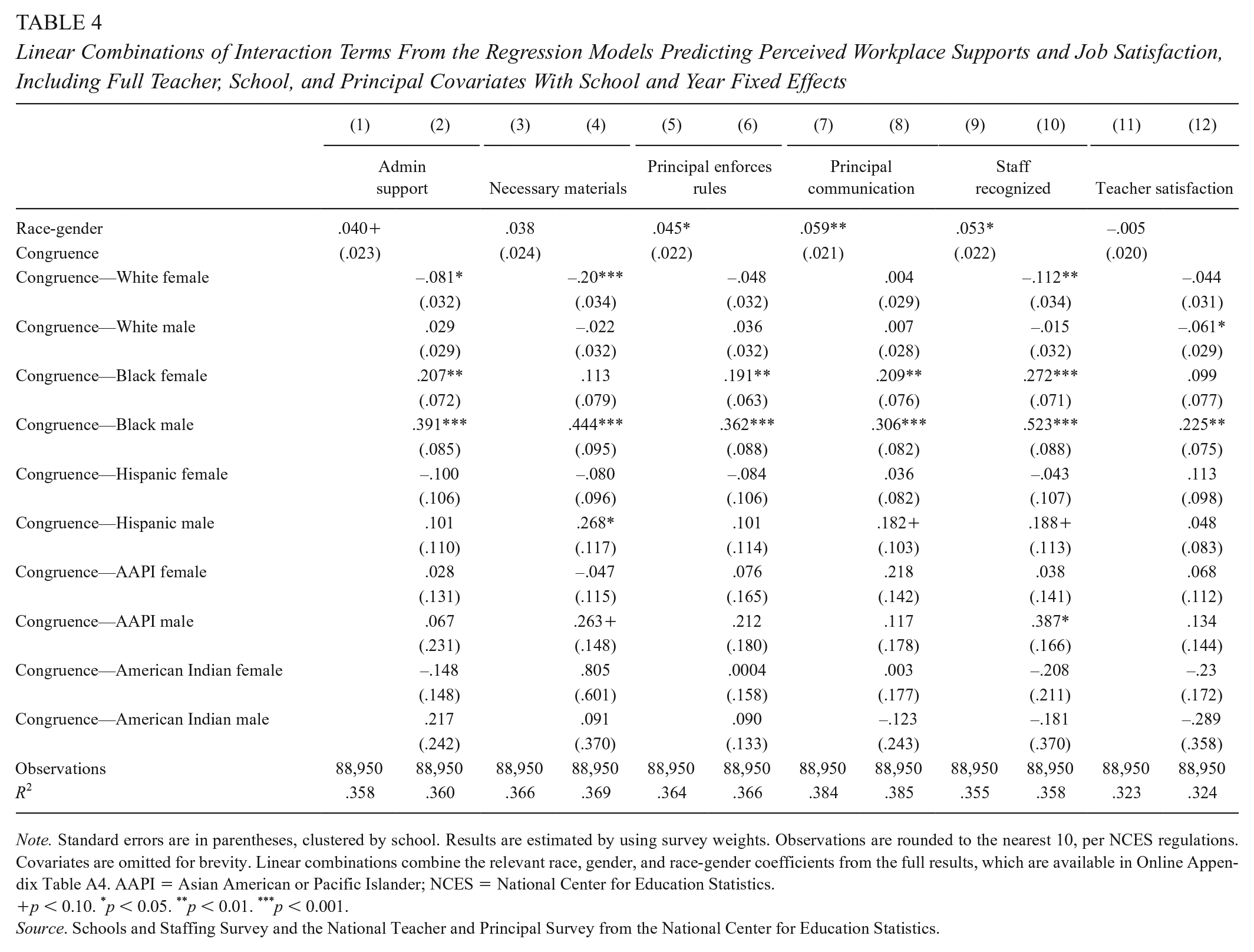
Note. Standard errors are in parentheses, clustered by school. Results are estimated by using survey weights. Observations are rounded to the nearest 10, per NCES regulations. Covariates are omitted for brevity. Linear combinations combine the relevant race, gender, and race-gender coefficients from the full results, which are available in Online Appendix Table A4. AAPI = Asian American or Pacific Islander; NCES = National Center for Education Statistics.
p < 0.10. *p < 0.05. **p < 0.01. ***p < 0.001.
Source. Schools and Staffing Survey and the National Teacher and Principal Survey from the National Center for Education Statistics.
In support of our first hypothesis, we found significant heterogeneity in the direction and magnitude of the associations by specific race-gender intersections (even-numbered columns, Table 4). Being a White female teacher with a White female principal was mostly associated with worse perceived workplace supports compared to those of non-White males in their school, specifically for administrative support (–.081, p = .011), the distribution of necessary materials (–.020, p < .001), and principal recognition (–.112, p = .001). We did not find evidence that White male teachers with White male principals received more workplace support, with the only significant finding indicating that these teachers were less satisfied than other similar teachers in their school who were non-White females (–.061, p = .038). In support of our third hypothesis, perceived support was significantly higher for White males with White male principals than for White females with White female principals for the outcomes of receiving necessary materials (p < .001), rule enforcement (p < .001), and recognition (p < .001).
Regardless of gender, Black teachers reported better-perceived workplace supports when they had Black-gender congruent principals compared to those of teachers in their schools who were non-Black, non-gender congruent. The results were positive and statistically significant in all but two cases (necessary material support, .113, p = .151; and teacher satisfaction, .099, p = .196, for Black female teachers with Black female principals). These coefficients on Black male and Black female race-gender congruence were clearly practically significant. For instance, the standard deviation on staff recognition was 0.88. Therefore, Black male teachers with Black male principals were predicted to be almost two-thirds of a standard deviation in higher agreement that their principal recognizes their efforts than were non-Black female teachers in their school. To show how these differences are projected to look on the original Likert scale, we show predicted values for each race-gender dyad compared to those sharing neither race nor gender from the models in Table 4 in Online Appendix Table A6. The coefficients from Table 4 are equivalent to the difference between the relevant dyad and the Not Congruent predicted value in Table A6. As is shown in Table A6, Black female and Black male teachers with Black-gender congruent principals consistently had predicted values closer to strongly agree (4) than Not Congruent and White teachers with White gender-congruent principals (H2), differences that were all statistically significant according to Wald tests. Across all six of the outcomes on Table 4, Black male teachers with Black male principals were predicted to have almost half a standard deviation higher values (.45), on average, than were similar non-Black female teachers at their school.
When examining whether Black male teachers accrued more workplace support with Black male principals than did Black female teachers with Black female principals, we found support for H3 regarding material support (p = .005), recognition (p = .020), and satisfaction (p = .047).
In all but one case, the coefficients for race-gender congruence for Hispanic teachers were not statistically significant. The exception was Hispanic male teachers with Hispanic male principals, who were significantly more likely to report that they received necessary materials (.268, p = .022). These results might be underpowered compared to the results for White and Black teachers due to lower observation sizes; as we can observe, the magnitude of the coefficients were often as large as results that were significant for White and Black teachers (e.g., Hispanic male staff recognition). We can observe a similar pattern of mostly negative associations for Hispanic female teachers with female race-congruent principals, while the associations were mostly positive for Hispanic male teachers with Hispanic male principals.
We found more significant differences when assessing H2 and H3 for Hispanic teachers. Hispanic male teachers with Hispanic male principals were significantly more likely to agree that they received necessary materials (p = .015) and were more satisfied (p = .047) than did White male teachers with White male principals. In support of H3, Hispanic male teachers reported significantly higher material support than did Hispanic female teachers with Hispanic gender-congruent principals (p = .017).
The sample size was even lower for AAPI and American Indian teachers with race-gender congruent principals, but we observed similar patterns. AAPI male teachers with AAPI male principals consistently had positive coefficients that, in one case, were approaching significance at the 5% level (necessary materials with .263, p = .076) and, in the other, were statistically significant (staff recognition with .387, p = .020). AAPI and American Indian female teachers and American Indian male teachers had no significant coefficients, although the coefficients could, at times, be quite large. For instance, the coefficient for American Indian female teachers for necessary materials was .805 (p = .181). This coefficient was much larger than the corresponding coefficient for White female (p = .096) and White male teachers (p = .077), but these differences were only significant at the 10% level.
We found some support for our second and third hypotheses comparing AAPI teachers with White teachers and by gender identity, although these differences tended to be significant at the 10% level. AAPI male teachers with AAPI male principals had significantly higher agreement that they were recognized (p = .017) and had higher agreement that they had necessary materials (p = .058) compared to White male teachers with White male principals. AAPI female teachers with AAPI female principals had higher agreement on materials (p = .076), principal communication (p = .054), and recognition (p = .075) than did White males with White male principals. AAPI male teachers with AAPI male principals had significantly stronger agreement than did AAPI female teachers with AAPI female principals on materials (p = .090) and recognition (p = .088).
Discretionary Benefits
Our last set of outcomes examined discretionary benefits with monetary value: additional compensation and coaching. Odd-column results in Table 5 indicate that having a race-gender congruent principal was associated with earning an additional $573 (p < 0.001) in compensation and 7.4 percentage point higher probability of becoming a coach (p < 0.001) compared to teachers who were neither race nor gender congruent with their principal.
Linear Combinations of Interaction Terms From the Regression Models Predicting Discretionary Workplace Benefits, Including Full Teacher, School, and Principal Covariates With School and Year Fixed Effects

Note. Standard errors are in parentheses, clustered by school. Results are estimated by using survey weights. Observations are rounded to the nearest 10, per NCES regulations. Covariates are omitted for brevity. Linear combinations combine the relevant race, gender, and race-gender coefficients from the full results, which are available in Online Appendix Table A5. AAPI = Asian American or Pacific Islander; NCES = National Center for Education Statistics.
p < 0.10. *p < 0.05. **p < 0.01. ***p < 0.001.
Source. Schools and Staffing Survey and the National Teacher and Principal Survey from the National Center for Education Statistics.
However, the even-column teacher race-gender results intimate that these findings were an artifact of higher compensation and more coaching opportunities for male-identifying teachers with male race-congruent principals. Female-identifying teachers with female race-congruent principals earned lower additional compensation and were less likely to coach a sport than were male-identifying teachers working for male race-congruent principals. These financial benefits were large for male-identifying teachers, especially White male teachers with White male principals, who were predicted to earn $1,707 more per year (p < .001) than were non-White female teachers at their school, and for American Indian male teachers with American Indian male principals, who were predicted to make $2,886 more per year (p = .020) than were non-American Indian female teachers at their school. Hispanic female teachers with Hispanic female principals had the largest negative coefficient on additional compensation (–1,045.7, p < 0.001). White male teachers with White male principals were 28 percentage points (p < .001) more likely to report being a coach than were non-White female teachers in their school. The only exceptions to this pattern were Hispanic male and AAPI teachers with race-gender congruent principals, with coefficients that were attenuated and not statistically significant.
We found inconsistent support for our second hypothesis. American Indian male teachers were predicted to earn more than were White male teachers (p < .001), but White male teachers were predicted to earn more (p = .020) and coach more often (p = .016) than were Hispanic male teachers with Hispanic male principals. AAPI female teachers were predicted to earn more than were White female teachers with race-gender congruent principals (p = .044).
We found the most significant support for our third hypothesis, in comparing male- and female-identifying teachers’ discretionary benefits. Male-identifying teachers with male-identifying race-congruent principals had significantly higher additional compensation and were more likely to coach than were female-identifying teachers with female-identifying race-congruent principals. These differences were practically significant, with the female-identifying teachers who had female race-congruent principals earning $800 to $3,700 less than did male-identifying teachers with the same racial identity who were also supervised by male race-congruent principals.
Discussion
This analysis makes theoretical contributions to RB theory and advances understanding of the mechanisms through which the increased racial diversity of school principals might diversify the teaching workforce. We are contributing to RB theory in three ways. First, we have extended prior work focused on passive representation by examining whether race-gender intersectional identities translate into active representation through perceived workplace supports and discretionary benefits. We have found that these intersections have significant implications for how we conceptualize the extent to which passive representation translates into active representation and positive workplace outcomes. Second, we have specifically focused on race-gender intersectionality as our primary analysis. Unlike prior work, we have shifted the focus to examine how passive representation translates differentially into active representation for particular race-gender intersections. We have confirmed the salience of specific race-gender identities over general congruence indicators that hide significant heterogeneity among racial and gender identities. Third, both findings coalesced to show the theoretical purchase gained by integrating intersectionality theory into RB studies.
Our findings can inform conversations about racial diversity among principals and teachers in several ways. Although we found little support for the hypothesis that race-gender congruence influenced teacher turnover, we found more significant results on perceived workplace supports and benefits. We found that race-gender congruence was often associated with more positive outcomes for teachers, especially for Black teachers with Black principals and male teachers with male race-congruent principals. Such benefits were often greater for racially minoritized teachers with race-gender congruent principals than for White teachers with White gender-congruent principals; this finding was consistently true for Black teachers with Black gender-congruent principals. Some evidence suggested that AAPI and American Indian teachers with race-gender congruent principals, especially those who identified as male, also experienced more positive benefits than did White teachers with White gender-congruent principals. This finding likely mirrors prior literature on the importance of reducing race-based stress and microaggressions for improving the working conditions of teachers of color (Frank et al., 2021; Grooms et al., 2021; Mahatmya et al., 2022).
Regarding our third hypothesis, White male teachers were the only male teachers managed by male principals to have consistently higher benefits, conditional on race, than were White female teachers with White female principals; however, some evidence showed that this positive male intra-gender effect also extended to non-White male teachers. Although Black female teachers experienced several significant benefits from having Black female principals, those benefits were consistently smaller than those of Black male teachers working for Black male principals. We suspect that representation for the Black identity may have had stronger salience than racial identity did for White or Hispanic teachers. It could also be the case that recent efforts to increase the presence of Black males in education have resulted in more Black male teachers and principals entering and remaining in the profession for reasons intimately tied to their intersectional identity in ways supported by organizations dedicated to male teachers of color (Bristol, 2020).
The exception to the findings on the benefits of having a race-gender congruent principal, especially for Black teachers, was monetary compensation, where female teachers with female race-congruent principals had lower predicted earnings than did their male race-incongruent colleagues and male teachers with male race-congruent principals. Our findings on supplemental pay partially reflect a broader literature on the wage gap between male- and female-identifying employees. This literature has found that male employees are more likely than females to work additional hours, earning more supplemental pay (Bertrand et al., 2010; Goldin, 2014). We can clearly observe this pattern descriptively (see Table 1); male employees of all racial identities had higher average supplemental salary. Our findings might indicate that female principals could be more sensitive to the preferences of their female race-congruent employees, leading to fewer additional tasks that would have come with supplemental salary. This finding could partially reflect these female principals being responsive to the preferences of their female race-congruent employees, who might have been expected, based on explorations of the gender wage gap, to prefer job flexibility over maximizing compensation (Goldin, 2014; Goldin & Katz, 2011). Conversely, female teachers could have been more likely to be asked to do supplemental work but not be paid for it. Administrators might have relegated female racially minoritized teachers to tasks perceived as nurturing or supportive (i.e., motherly, feminine) that did not come with supplemental pay, unlike more official coaching roles (Haase, 2008; Ispa-Landa & Thomas, 2019; Mahatmya et al., 2022).
Overall, the evidence supports our suggestion that RB theory should move beyond simple congruence relationships to examine differences across intersecting identities. We also found support for taking an intersectional lens to examine differences in the benefits of passive and active representation. We found evidence for the salience of sharing a Black racial identity, especially for Black males. At the same time, female-identifying teachers did not necessarily benefit from gender congruence as much as male-identifying teachers did. Although we did not find evidence that improved perceived workplace supports and higher discretionary benefits systematically translated to lower turnover, this result might indicate that teachers had differing patterns of mobility in a post-Recession labor market compared to findings from pre-Recession time periods (Grissom et al., 2012; Grissom & Keiser, 2011).
Limitations
Although the school FE methods were essential, given the study’s purpose, they precluded examining between-school moderators and may still function imperfectly. For example, the student body composition, teaching faculty, and principal race could have affected teacher turnover decisions, intimating that school composition might have moderated the relationships examined herein (Patrick & Santelli, 2022; Renzulli et al., 2011; Rodriguez et al., 2022; Strunk & Robinson, 2006). Composition and other school-level moderators are worth examining in future studies but were beyond this study’s scope and methodologically impossible, given our application of school FE to cross-sectional data. Despite the methodological affordances of school FE for our study, they may not have removed all within-school confounders. Our analysis did not isolate whether race-gender congruence, in and of itself, caused differences in outcomes or whether the cause originated through other related mechanisms. The association between principal and teacher race-gender intersections and the outcomes may have been driven by teacher perceptions, principal behavior, student body behavior, faculty behavior, and/ or implicit biases. This is particularly the case when teacher turnover is involuntary, especially when teachers’ contracts are not renewed due to poor performance or discrimination. Estimates from a subsample of teachers from SASS samples indicated that only about 8% of attrition was due to contract nonrenewal for performance or unknown reasons, such that involuntary attrition was a minor concern in this sample.
A second potential limitation concerned some of our measures. We would like to have used validated measures from these surveys to quantify sources of discrimination. However, the lack of these measures did not necessarily detract from the overall findings, as differences across racial identity could be considered evidence of racism because race, in and of itself, does not cause disparities (Gillborn, 2008; Gillborn et al., 2018). Additionally, analyses of perceived workplace support used single-item measures instead of composite or latent variable measures, potentially resulting in less reliable outcomes. Although composites may have reduced measurement error, they would mask the novel findings detected across individual survey items.
We also were limited in our ability to make inferences across the various outcomes because we only had data on teacher mobility from SASS. When we compared the SASS and NTPS samples (see Online Appendix Table A7), they differed in several ways, and these differences might have led to our conflicting findings between turnover and workplace benefits, particularly because prior work has found that the salience of teacher and principal race congruence has changed over time (Viano & Hunter, 2017).
Finally, race and gender identity are socially constructed, context-specific, and often contested. When comparing the self-identified race and gender from a survey, we are left with little knowledge of the extent to which others observe similarities or differences in their identities and the salience of these identities across individuals. Although we recognize that race and gender can be construed differently at different time points (Bussey, 2011; Viano & Baker, 2020), self-identified race and gender (i.e., how race and gender were measured in this analysis) are preferable to other methods of assignment (Roth, 2010).
Implications for Policy and Practice
Given the importance of increasing retention of Black teachers in the workforce because of representational benefits for Black students (e.g., Joshi et al., 2018), this study shows the importance of recruiting more Black administrators. Prior research has found several successful strategies for increasing the recruitment of school administrators, including mentorship programs and leadership academies that can be purposefully leveraged to recruit Black principals (Sanchez et al., 2009). Alternate strategies involving the enhancement of principals’ relations with Black teachers through diversity and anti-bias training, although promising in theory, have shown mixed or fleeting effects and durable implementation challenges in practice (Sparks, 2020). Future research should aim to identify empirically supported practices that would encourage the development of diverse workplace settings, particularly for Black teachers and principals.
Moreover, policy solutions might be considered to address lower discretionary benefits for female-identifying teachers, particularly those with female-identifying principals, especially as it relates to financial compensation. Increasing training and support for school leadership to create more inclusive workplace cultures and to create more pay equity for teachers could help lessen the gender penalty for female-identifying teachers.
Implications for Future Research
As RB remains a popular theory, future RB research should continue to integrate theories on race, gender, and intersectionality. To focus solely on race or gender congruence ignores the intersectional nature of how race, gender, and power interplay in supervisor-employee relationships. At the same time, these findings did not engage with questions about whether certain identity categories (i.e., race or gender) are more important than others and whether sharing multiple identities is more important than sharing one identity. New lines of inquiry could also explore intra-gender principal-teacher relationships, where the principal holds a different racial identity than the teacher, particularly when the principal is White. We can observe some patterns in our full models (see Appendix Tables A3–A5) indicating the relative salience of sharing a racial identity, gender, or race-gender intersection, although space constraints did not allow us to fully explore the differences within racial-gender dyads. Future research could address these questions while also attending to broader structural considerations on how race, gender, class, and other identities are understood and valued in society.
This study also suggests the need for future examination of various measures of active representation and their relationship with each other. Perceived workplace supports and discretionary benefits clearly represent principal-initiated active representation, as these outcomes are directly under principal control. But the extent to which passive representation and supports/benefits are linked to teacher turnover is unclear, calling into question whether mobility is an active representation-related outcome. Stated differently, findings on the benefits of passive representation in perceived workplace supports but not in turnover showed that active representation correlated with principal-initiated behaviors, casting doubt on the idea that active representation was largely driven by teacher-initiated behaviors, such as turnover. The active representation findings also raise questions regarding how else school administrators apply discretion. Therefore, researchers might incorporate additional measures of active representation into nationally representative surveys (e.g., instructional coach placement or conference travel).
Our data set allowed for nationally representative estimates with a broad set of outcomes, but future research using state administrative data could address subsequent questions of import to policy/practice. For instance, longitudinal panel data tracking teachers over time could assess whether the same teacher had different outcomes (most likely mobility, but potentially supplemental pay and other outcomes) in response to changes in their race-gender congruence with their principal, either because the teacher switched schools or their school changed principals.
Our finding that racial congruence was more salient for Black teachers shows that the benefits of representation are not equally distributed. Subsequent studies could disaggregate by grade level because female principals are concentrated in elementary schools, and by region because prior research has found higher salience of racial congruence in the South (Viano & Hunter, 2017). Although we integrated intersectionality theory, future work might explore the utility of other critical theories to explore this complexity and integrate more identities that could influence principal-teacher relationships, such as sexual orientation, country of origin/nationality, ableism, and age. As we recognize that racism, inequality, and power have not been systematically integrated into public administration studies, it is incumbent on future studies guided by RB theory to recognize complex identities and dynamics among those of similar and different identities.
Supplemental Material
sj-docx-1-ero-10.1177_23328584221148156 – Supplemental material for Principal and Teacher Shared Race and Gender Intersections: Teacher Turnover, Workplace Conditions, and Monetary Benefits
Supplemental material, sj-docx-1-ero-10.1177_23328584221148156 for Principal and Teacher Shared Race and Gender Intersections: Teacher Turnover, Workplace Conditions, and Monetary Benefits by Samantha Viano, Luis A. Rodriguez and Seth B. Hunter in AERA Open
Footnotes
Acknowledgements
The authors would like to thank attendees of the Association for Education Finance and Policy 47th Annual Conference, the anonymous reviewers, and AERA Open editors for helpful comments on this study. This paper would not have been possible without the support of Martin Ford at George Mason University, who graciously arranged for a conveniently located restricted data room to access these data. The authors acknowledge the support and guidance of Jason Grissom on an earlier version of this study.

Supplemental Material
Supplemental material for this article is available online.
Notes
Authors
SAMANTHA VIANO is an assistant professor at George Mason University. Her research focuses on evaluating policies and assessing school contexts that predominantly affect minoritized student populations and their teachers, including policies on school safety and security, online credit recovery, teacher retention, and methods for studying racial equity.
LUIS A. RODRIGUEZ is an assistant professor of education leadership and policy studies at New York University. His research focuses on the K–12 teacher labor market and policies intended to improve quality, retention, and diversity within the teaching workforce.
SETH B. HUNTER is an assistant professor of education leadership at George Mason University. His research concerns educator and organizational effectiveness, focusing on teacher leadership and the policies and practices of educator evaluation.
References
Supplementary Material
Please find the following supplemental material available below.
For Open Access articles published under a Creative Commons License, all supplemental material carries the same license as the article it is associated with.
For non-Open Access articles published, all supplemental material carries a non-exclusive license, and permission requests for re-use of supplemental material or any part of supplemental material shall be sent directly to the copyright owner as specified in the copyright notice associated with the article.
