




Abstract
Mentorship is vital to increasing graduate school access in computing; however, mentorship must be structured in power-conscious, developmental ways to ensure equitable access to and support within computing graduate pathways. I engage a critical quantitative lens to examine mentoring support among undergraduates with reported graduate aspirations, taking a nuanced look at departmental mentorship to investigate how organizational power in computing may maintain inequitable mentoring outcomes. Descriptive and regression analyses draw from a longitudinal sample of 442 graduate aspirants in computing who completed an introductory course survey (between 2015–2017) and a follow-up survey (fall 2019). Results document significant variation in forms of mentoring support and disciplinary psychosocial beliefs (i.e., computing identity and self-efficacy), with key patterns across graduate aspirants’ social identities and mentors’ organizational power (via their departmental roles). I conclude by discussing structural and social inequities in mentorship, which may underscore disparities in students’ realization of their computing graduate aspirations.
Keywords
Graduate education in the United States holds a pivotal place in guiding key innovations and training future faculty. Despite the rapidly changing nature of knowledge in computing and technology, diversity within pathways to graduate school programs has not kept pace. Across computing and other scientific disciplines, “the pool of potential STEM graduate students is increasingly diverse, and research disciplines and institutions are striving—though many continue to struggle—to be more inclusive and equitable, in terms of both representation and institutional climate” (National Academies of Sciences, Engineering, and Medicine [NASEM], 2018, p. 29). Indeed, the preceding quote signals a sizable opportunity to foster interest in scientific graduate education—including programs in computing—and especially among students who have been systemically minoritized (i.e., students excluded from opportunities due to their racial/ethnic, gender, social class, and other identities by the creation and preservation of dominant power structures such as white supremacy). Yet, efforts to diversify and craft equity-minded structures in computing pathways must be examined with a critical lens (Metcalf, 2014), as departmental leaders need to facilitate transformative, affirming environments where systemically minoritized students can thrive in pursuing computing graduate degrees.
Computing 1 represents a unique case within science, technology, engineering, mathematics, and medicine (STEMM) disciplines. Although professional opportunities have soared (Bureau of Labor Statistics, 2019), computing remains one of the least diverse STEMM disciplines (National Center for Science and Engineering Statistics, 2019). Collegiate computing departments face many challenges in fostering equitable environments and outcomes for systemically minoritized students, especially in the face of growing enrollments (Computing Research Association [CRA], 2017). These challenges are exacerbated by a faculty shortage, a lack of faculty diversity, and difficulties filling faculty positions due to the workforce marketability of computing skills (CRA, 2017). One way to build inclusive computing pathways, particularly toward the professoriate, is to focus on students’ early experiences in graduate school trajectories—such as the time between undergraduates’ reported interest in graduate degrees and the time at which they make concrete plans. For institutional actors to understand decision-making in students’ post-baccalaureate plans, and thus understand opportunities to confront structural injustices in computing graduate school access, I posit the need to employ a critical paradigm (Baez, 2007) that examines (in)equitable organizational power structures in computing departments.
Recently, researchers have argued that mentoring relationships may help foster equity-driven changes to institutional culture, individual support, and students’ graduate school plans in STEMM (NASEM, 2019; Packard, 2016); yet, limited scholarship has taken an explicitly critical perspective to mentorship in STEMM graduate pathways—a necessary shift if we are to prioritize transformation of the policies and practices that maintain structures of minoritization in STEMM (Griffin, 2020a). In computing, short-term mentoring interventions have been documented to foster undergraduate students’ disciplinary growth (Boyer et al., 2010; Pon-Barry et al., 2017), but few scholars have interrogated how structures of power govern the provision of (in)equitable mentoring support within computing graduate pathways. Using a critical lens to explore how mentoring shapes the disciplinary development of computing students with graduate aspirations is a crucial focus, as students with stronger computing identity and self-efficacy may be more likely to act upon their aspirations through graduate school enrollment. Using a sample of undergraduates who had a mentor in their computing department and held graduate school aspirations, this study examines departmental mentorship in computing, how mentorship relates to graduate aspirants’ psychosocial beliefs, and conditional effects of mentoring support within a layered conceptual framework that attends to power dynamics. Following Rios-Aguilar’s (2014) framework for critical quantitative inquiry, the following questions guide this study:
Among graduate school aspirants, whom do undergraduate students identify as their primary mentors in computing departments?
Among graduate school aspirants, how does mentoring support that students receive in computing departments vary by the mentor’s role as well as students’ identities?
Among graduate school aspirants, what aspects of mentoring relationships in computing departments predict students’ computing identity and computing self-efficacy? How does the salience of mentoring support vary by the mentor’s role and students’ identities?
Literature Review
In keeping with Rios-Aguilar’s (2014) suggestions for critical quantitative inquiry and critical theorists’ notions of historically, socially, and politically situating educational contexts (e.g., Baez, 2007; Ellsworth, 1989), I first discuss inequities within mentorship across disciplines and the structural conditions that plague collegiate computing departments—context that underscores later implications. Then, I review existing literature about mentoring in computing departments and how mentoring shapes computing graduate pathways. Finally, I introduce how this study contributes a distinct empirical and epistemological lens to current scholarship.
Context on Mentorship and Power Across Disciplines
Mentoring relationships significantly influence undergraduate students’ development and longer-term trajectories, such as graduate school plans (Luna & Prieto, 2009; Trolian & Parker, 2017). Further, mentors provide crucial support to systemically minoritized students (e.g., Dugan et al., 2012; McCoy et al., 2020), perhaps by helping them navigate challenging campus environments and using their institutional power to change oppressive practices (Benishek et al., 2004; Ragins, 1995). Although organizational context significantly shapes mentoring relationships, few studies have situated mentorship in a systemic lens. One recent exception illustrated how the racialized and gendered histories of academic disciplines—or how the academy and its social systems are structured by race and gender—present a more salient social force than identity concordance in mentoring (Davis et al., 2015). Thus, it is imperative to learn more about the layers of power in mentoring, as such information may catalyze departments to redress inequitable student outcomes through structural transformation of mentoring opportunities.
Power has become a key focus of mentorship in higher education, often to discuss the nuances of cross-cultural mentoring (Barker, 2007; Johnson-Bailey & Cervero, 2004; McCoy et al., 2015). At the undergraduate level, scholars have drawn from critical theory to understand how systemic minoritization shapes mentorship in disciplinary and university programs (Beck et al., 2022; Wallace et al., 2000). Similarly, graduate education researchers have found that dysfunctional power structures in STEMM mentorship generate inequities in academic labor (Gaughan & Bozeman, 2016), harm in graduate students’ developmental trajectories (Tuma et al., 2021), and the maintenance of discriminatory academic environments (Wofford & Blaney, 2021), all of which point to the need for power-conscious mentorship. Less is known, however, about how power functions in mentoring between these levels of postsecondary education. Additionally, although it remains necessary to address power across disciplines, the disproportionately exclusionary nature of specific scientific disciplines—like computing—creates an even greater impetus for action.
Mentorship in Computing Departments
Computing departments face a vortex of inequity, as growing enrollments have prompted academic leaders’ use of policies that hinder access and inclusion. Recently, Nguyen and Lewis (2020) found that competitive enrollment policies negatively predict first-year computer science students’ sense of belonging, self-efficacy, and perception of departments as welcoming—results that the authors problematize in the context of departmental efforts to retain racially/ethically and gender minoritized students. Further, a dire faculty shortage in computing has reduced the time and resources faculty have for mentoring (CRA, 2017). This reality may prompt computing faculty (many of whom are white men; Zweben & Bizot, 2021) to reproduce disciplinary inequity by choosing to mentor students with similar identities, speaking to the phenomenon of homophily in mentorship (Cole & Griffin, 2013).
To varying extents, computing departments have incorporated faculty and peer mentorship into the curriculum (Charleston et al., 2014; Cohoon et al., 2004; Ogan & Robinson, 2008; Pon-Barry et al., 2017). For one, some targeted mentoring efforts lie within introductory courses. Introductory computing courses are vital access points, and early mentoring relationships may impact students’ intro course success and long-term commitment to computing (Pon-Barry et al., 2017; Tashakkori et al., 2005). If intro course students engage in positive mentoring relationships and gain confidence in their computing skills (Fryling et al., 2018; Pon-Barry et al., 2017), they may also pursue future departmental mentorship opportunities like undergraduate research experiences (UREs) or pre-professional organizations (Hug & Jurow, 2013; Rorrer et al., 2018). Because UREs involve faculty-led projects, they provide a natural setting for mentoring (Rorrer et al., 2018). Pre-professional organizations may also offer environments for mentors to provide guidance aligned with mentees’ identities (Boyer et al., 2010; Hug & Jurow, 2013). Yet, offering access to mentorship is not enough to ensure that mentorship has a positive effect.
It is also essential to acknowledge scholars’ recent focus on gender and racial/ethnic identity concordance in STEMM mentorship (Blake-Beard et al., 2011; Hodari et al., 2014; Newman, 2015). Yet, findings about identity concordance in STEMM mentorship remain inconclusive. Whereas some studies support the community-building activism possible when Women of Color with shared identities engage in student-faculty mentorship (Hodari et al., 2014), others document how mentoring relationships with deep-level similarities (e.g., shared beliefs) are more effective than relationships with identity-based similarities alone (NASEM, 2019; Newman, 2015). To foster effective mentorship, it is necessary to learn more about mentors’ values and beliefs—many of which may be evident in the mentoring support provided.
Mentorship and Computing Graduate School Pathways
Although researchers have shown that mentorship bolsters students’ graduate school plans across disciplines (e.g., Trolian & Parker, 2017), few have illuminated how mentorship relates to computing graduate pathways or complicated it with a critical lens. In computing, faculty support plays a role in sustaining students’ early graduate aspirations (Wofford et al., 2022), and faculty and peer mentors promote graduate-level matriculation (Charleston, 2012; Cohoon et al., 2004). Yet, less is known about the space between graduate aspiration and matriculation, and mentors may provide crucial assistance as computing students navigate graduate school enrollment decisions. Further, in propelling the conversation forward to interrogate the qualities of mentoring support that shape students’ computing graduate pathways, it is vital to problematize how power structures in computing may shape the inequitable provision of mentoring support. Computing culture remains competitive, masculine, and white, and we must consider how mentoring support may be constructed within cultural and structural power dynamics that perpetuate messages of isolation and inadequacy to those with nondominant identities (e.g., Black women; Thomas et al., 2018).
Psychosocial Outcomes of Mentorship in Computing
In exploring how mentoring may either perpetuate minoritization or serve as a tool of transformation, I turn to literature on psychosocial beliefs in STEMM and computing to understand how cultural messages rooted in power structures may inform equity across student development. Science identity and self-efficacy are two crucial psychosocial outcomes of STEMM mentorship (Byars-Winston et al., 2015). Although conceptually different, as science identity depicts individuals’ self-perceptions as a “science person,” and science self-efficacy concerns individuals’ confidence in mastering specific tasks, students frequently develop both beliefs concurrently (Williams & George-Jackson, 2014). Mentors are often crucial in shaping these psychosocial beliefs; yet, depending on mentorship quality, students’ development may not be uniformly positive (NASEM, 2019). Given the scope of this study, I draw from emerging research on computing identity and self-efficacy—both of which underscore STEMM graduate school and career trajectories (Byars-Winston & Rogers, 2019; Chemers et al., 2011).
Scholars have only recently investigated the unique traits of computing identity (Taheri et al., 2018, 2019). Computing identity, or how one feels like a “computing person,” is strongly associated with fostering persistence in undergraduate computing (Taheri et al., 2019) and computing career choice (Mahadeo et al., 2020). Yet, less is known about how mentors contribute to computing identity development, especially compared to research on mentorship and science identity (e.g., Chemers et al., 2011; Robnett et al., 2018). Further, to advance equitable mentoring outcomes, computing identities must be considered in the context of students’ social identities (Fernandez & Wilder, 2020). Otherwise, mentors may perpetuate oppressive norms that produce tensions between systemically minoritized students’ social identities and their identity as a computing person.
Researchers have also made new strides in operationalizing computing self-efficacy (Kolar et al., 2013). Computing self-efficacy measures individuals’ confidence in mastering technical skills and has been found to predict computing career interests and workforce experiences (George et al., 2022; Lyon & Green, 2021) as well as graduate aspirations (Dahlberg et al., 2008; Wofford et al., 2022). Studies also detail how mentoring support positively relates to computing self-efficacy (Blaney & Stout, 2017; Wofford, 2021). Despite knowing that mentors can augment computing self-efficacy, much remains to be learned about the type(s) of mentoring support related to computing self-efficacy, which students receive mentoring support, and who provides such mentorship—all questions that benefit from a critical lens centering on departmental power structures.
Addressing the Empirical and Epistemological Gap
While mentorship, broadly construed, may foster computing identity and self-efficacy, scholars have not detailed specific forms of mentoring support in computing (Goh et al., 2007; Hodari et al., 2014). Coupled with the urgent need to dismantle inequitable power structures in computing departments, this opaque understanding of mentoring motivates my power-conscious exploration of mentoring support. Further, given that computing identity and self-efficacy positively predict students’ computing graduate aspirations (Wofford et al., 2022), knowing how psychosocial beliefs develop among graduate aspirants may reveal new insights about how departments can transform structures of support in computing graduate pathways.
Of note, I extend prior research by taking a critical quantitative approach in research motivation, design, and interpretation (Rios-Aguilar, 2014; Stage, 2007; Stage & Wells, 2014). Underscored by the goals of critical theory to offer social and cultural critiques (e.g., Habermas, 1971; Macey, 2000), I am guided by the foundations of critical theory in seeking to illuminate “hidden power arrangements, oppressive practices, and ways of thinking” (Baez, 2007, p. 19). Critical quantitative work is similarly motivated by social transformation, often emphasizing ways to dismantle minoritizing policies or practices (Baez, 2007; Stage, 2007). I embrace these epistemological foundations by investigating how mentorship may be a key lever toward equitable outcomes in collegiate computing, while interpreting mentorship in the context of power structures. In adopting a critical quantitative lens, I devised questions that focus on social inequities. I also grappled with my positionalities throughout analyses, and my methodological decisions were guided by the imperatives of critical quantitative work. Further, by conceptually applying a power perspective, I interpret results with an eye toward structural inequities in computing and how policy or advocacy efforts may resolve some of these disparities.
Conceptual Framework
To model mentorship in computing departments and complicate mentoring in power-conscious ways, this study is guided by two conceptual underpinnings. First, I employ Crisp and colleagues’ (2017) framework of mentoring undergraduate students. This framework connects students’ identities and backgrounds, educational contexts, mentoring relationship features, forms of mentoring support, and student outcomes. Given my focus, I adapted this framework to situate mentorship in a computing-specific context (discussed further in the methods).
Foundationally, Crisp and colleagues (2017) posited that students’ identities inform how they participate in college and that the university context shapes students’ identities—a bidirectional relationship that shapes the breadth (i.e., intent, purpose, intensity) and depth (i.e., length) of mentoring relationships. Further, Crisp and colleagues outlined how such background traits and educational characteristics influence forms of mentoring support (i.e., mentoring practices), which are of central importance to the present study. Crisp and colleagues articulated four categories of mentoring support: psychological and emotional (e.g., encouraging behaviors), degree completion (e.g., advising students through policies and requirements), academic subject knowledge (e.g., doing research with students, sharing disciplinary resources), and career development (e.g., role modeling). These dimensions are posited to impact both intermediate (e.g., psychosocial development) and longer-term outcomes.
Although Crisp and colleagues’ (2017) framework grounds my analyses, I extend this framework by incorporating a theoretical perspective of power in mentorship (Ragins, 1995, 1997). Using this perspective extends scholarship that addresses how mentoring is reflective of and shaped by power structures (as discussed in the literature review) and heeds the call for power-conscious social transformation in critical theory (Baez, 2007) and critical quantitative research (Stage & Wells, 2014). Specifically, I apply Ragins’s (1995) theoretical framework of organizational change, which draws from literature on diversity, power, and mentorship at cultural, structural, and behavioral levels. In this framework, Ragins discussed how the cultural level speaks to the foundational beliefs that an organization holds of itself, the structural level considers the organizational grouping of positions, and the behavioral level focuses on individual perceptions. Although the present data source allows me to address the behavioral level of mentorship most closely (via forms of mentoring support), I leverage the structural and cultural levels to discuss and constructively critique structures of positional power and disciplinary culture in computing departments.
Collectively, I take a disciplinary approach to examine mentorship in computing due to the ways that disciplinary knowledge underscores graduate school preparation (Flaster et al., 2020). Without exploring how psychosocial beliefs are shaped by disciplinary-specific mentorship, inequities in computing may persist under the guise of imprecise recommendations for equity in STEMM, which often assume similarities across distinct disciplines (see Figure 1).
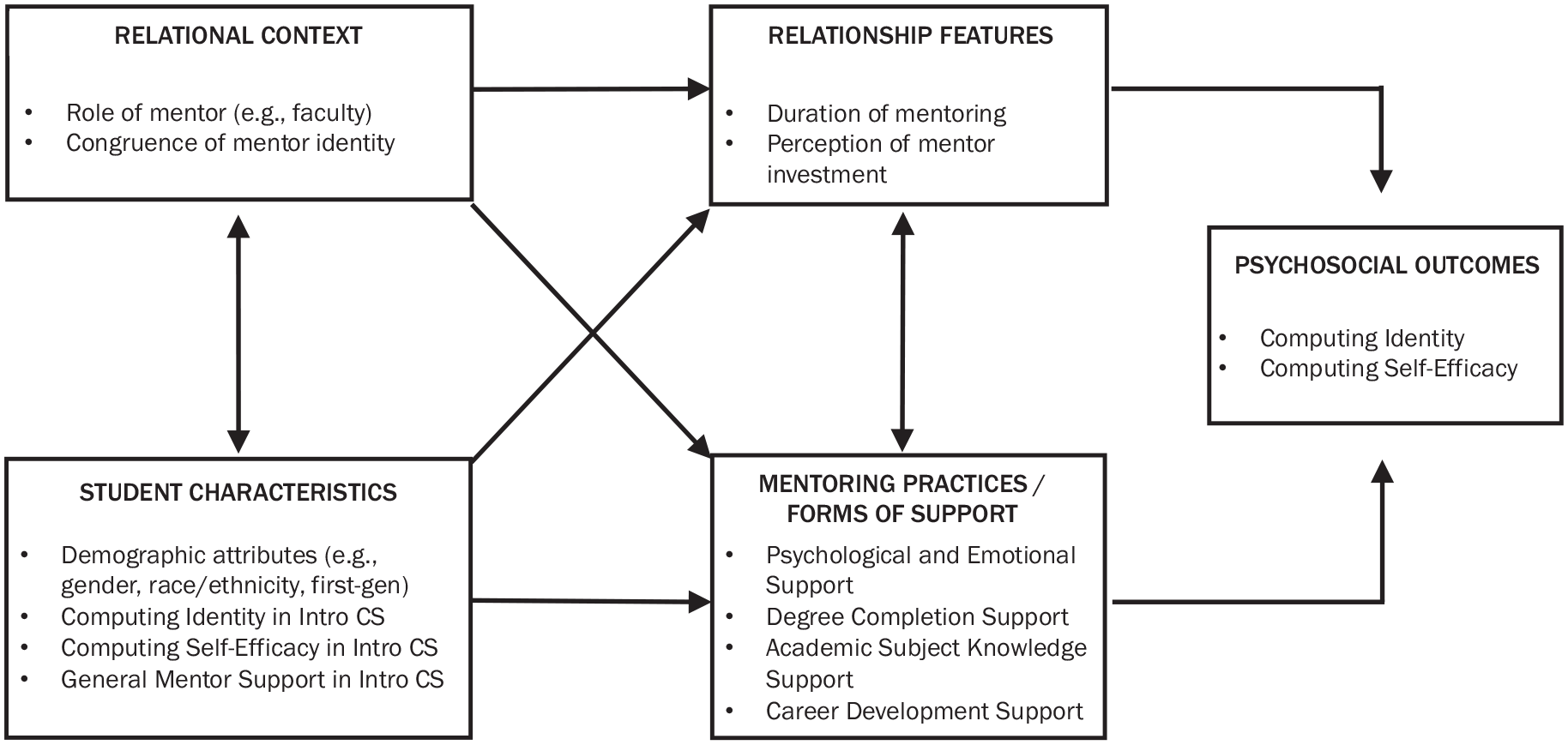
Framework for power and mentorship in computing departments, adapted from Crisp et al. (2017) and Ragins (1995).
Methods
Data Source
This study used data from the BRAID Research project, a longitudinal, nationwide study of equity in computing. Computing departments at each BRAID institution (13 public and two private doctoral-granting universities) made specific commitments to support systemically minoritized students in computing. To learn more about outcomes of this initiative, the BRAID Research team surveyed two cohorts of undergraduate students, all of whom took an introductory computing course in 2015–2016 or 2016–2017. Data collection spanned 5 years and ended in fall 2020. The first 400 respondents that completed an introductory course survey (across all institutions) received a $15 Amazon gift card, and all respondents were entered into a raffle for one of two larger gift cards. Introductory course survey respondents were invited to complete annual follow-up surveys that examined students’ views of undergraduate computing and postcollege plans. Follow-up survey respondents were guaranteed a $10 or $20 Amazon gift card. 2
Study Sample
Data were drawn from a longitudinal sample of undergraduates who completed an end-of-introductory-course survey in 2015–2016 or 2016–2017 and a follow-up survey in fall 2019 (N = 1,884). These specific time points are important, as survey items about mentoring were newly added in fall 2019.
Given the focus on mentorship in computing departments, I restricted the sample accordingly. First, the sample was filtered to include students who identified having a mentor in their department (n = 1,268). To match the departmental focus, I also restricted the sample to students who reported computing majors on the follow-up survey (n = 644). Finally, to explore departmental mentorship among students with graduate aspirations, I limited the sample to those who reported master’s or doctoral degree aspirations on either survey (n = 442). See Table A1 in the online supplemental materials for a profile of included respondents.
Measures
Dependent Variables
Two dependent variables served as outcomes for this study. First, I created a latent construct of computing identity, representing the extent to which individuals see themselves as “computing people.” Second, I created a latent construct of computing self-efficacy, representing students’ domain-specific confidence in mastering computing skills. Both factors were drawn from existing literature (Wofford, 2021) and tested using confirmatory factor analysis with Promax rotation in SPSS (online supplemental materials, Table A2).
Independent Variables
This study examined mentorship in computing departments and how features of mentoring relationships relate to graduate aspirants’ computing psychosocial beliefs. I outline how independent variables were organized in accordance with Crisp and colleagues’ (2017) framework.
Student Characteristics
The first block included direct pretests for each dependent variable to account for students’ psychosocial beliefs during introductory computing courses. I then created a factor illuminating students’ perceptions of general mentoring support during intro courses. Notably, the early general mentoring support factor reflects broad mentorship and could include support from faculty, peers, employers, family or community members, or others.
Second, I included variables measuring students’ identities. Given that identity formation is ongoing, I used follow-up survey items to address the most current ways students described their gender, race/ethnicity, and sexuality (other identities were only observed on the first survey). In coding identity groups and other categorical variables, I used weighted effect coding to place results of subgroups relative to the weighted average of the group means (Daly et al., 2016), rather than using dummy coding, which often (un)intentionally privileges dominant students’ narratives (e.g., white students, men). With weighted effect coding, “the midpoint or reference shifts away from the unweighted grand mean to the weighted sample mean” (te Grotenhuis et al., 2017, p. 165). Thus, categorical subgroup results are interpreted relative to the weighted sample mean—a mythical student average that avoids comparing students to each other while statistically accounting for subgroup sizes.
Relational Context
In the third block, I focused on the relational context of mentorship. Although departmental context is reflected in the sample (i.e., filtering to computing majors), it is vital to consider the structural and interpersonal nature of students’ relationships with their primary mentor. Thus, I controlled for the mentor’s role as well as racial/ethnic and gender identity congruence between mentors/mentees. Students could select their primary mentor from seven roles, such as undergraduate faculty advisor, advising staff, or advanced undergraduate peer.
Relationship Features
The fourth block included two single-item variables measuring the breadth and depth of graduate aspirants’ relationships with their primary departmental mentor. These two variables assessed the duration of mentoring relationships and extent to which students perceived their mentor to be invested in a developmental relationship.
Forms of Mentoring Support
Finally, I accounted for the behaviors in which students reported their mentor to be engaged. I first tested four factors (i.e., psychological and emotional support, degree completion support, academic subject knowledge support, career development support) using items adapted from the College Student Mentoring Scale (Crisp, 2009). Across these items, students identified the extent to which their primary mentor in the computing department regularly enacted certain behaviors (see online supplemental materials, Table A3) on a scale from 1 (strongly disagree) to 5 (strongly agree). Although all factors were statistically reliable, academic subject knowledge and career development constructs were highly correlated (> .70). This correlation may be partially due to the applied nature of computing, as the support needed to learn academic computing skills may mirror support that fosters computing career preparation. Given these concerns, I tested and used three revised mentoring support factors: (1) psychological and emotional support, (2) degree completion support, and (3) computing field and career development support.
Analyses
Descriptive Analyses
The first research question concerns whom graduate aspirants in computing departments identified as their primary mentors; frequencies revealed the distribution of mentorship across seven departmental roles. The second research question examines mentoring support in computing departments and how support varies by the mentor’s role as well as students’ social identities. To address this question, I used one-way ANOVAs with Tukey post-hoc tests. Of methodological importance, ANOVAs relied on mean differences in factor scores, which are sensitive to the ways latent constructs are extracted and rotated in factor analysis (DiStefano et al., 2009); thus, these results are exploratory.
Inferential Analyses
The final research question explores aspects of departmental mentorship that shape graduate aspirants’ computing identity and self-efficacy, and I employed two ordinary least squares (OLS) regression models to address this question. Before running analyses, I examined frequencies and missing data (see online supplemental materials, Table A2) and, given the low amount of missing data, decided to preserve students’ responses and not impute for missing data. I then ran each regression model separately, controlling for identical main effects. By accounting for the same control variables, I explored how predictive power diverged across models. Finally, I tested each regression model with interaction terms (i.e., mentoring support*mentor’s role; mentoring support*gender; mentoring support*race/ethnicity).
Positionality
In critical quantitative work, as with all research, positionality is of central importance (Rios-Aguilar, 2014). I came to this work having many positive mentoring experiences; yet, I have also experienced gendered assumptions in mentoring support as a cisgender woman in education. My motivation also draws from my experiences fostering mentoring opportunities for prospective STEMM graduate students while working in graduate admissions. Throughout this work, I practiced reflexivity by contemplating how my social positions influenced my methodological choices and interpretations, particularly as a white woman and regarding a discipline where I remain an outsider. For example, in analyses, I considered using each disaggregated subgroup of students’ identities as one way to center the perspectives of systemically minoritized students. I deliberated many aggregation options and implications, depending on the data source and statistical tests, and reflected upon how my perceptions of limitations and opportunities in coding may be influenced by my positionalities. These and other research decisions were shaped by my positionality in known and unknown ways.
Limitations
This study has a few key limitations. First, while BRAID Research data are multi-institutional, data were collected at doctoral-granting research universities, leaving much to be learned about computing mentorship in other institutional contexts. For example, mentoring, institutional resources, and departmental power structures look quite different at regional comprehensive universities, and such institutions may play an important role in promoting access to computing graduate education. Second, survey data collected limited details about students’ identities. These limited details constrained my ability to contextualize the experiences of racially and ethnically minoritized students (e.g., survey did not capture whether Black students identified as Black Caribbean, as having a family history of enslavement in the United States, etc.) or students with dis/abilities, as two examples. 3 Additionally, specific social identities of mentors were not captured. Such data source limitations lead to exploratory results that do not capture individuals’ full identity-based realities, as the histories of exclusionary power in the United States and higher education are more complex than survey data can unveil. Finally, it is essential to acknowledge that quantitative analyses—even when interpreted with structures of power in mind—do not paint the whole picture of mentorship, and studies using qualitative or mixed methods may robustly expand the knowledge base about mentorship and computing graduate pathways.
Results
RQ1: Roles of Mentors in Computing Departments
Addressing the first research question, Table 1 illustrates the distribution of mentors’ roles among graduate aspirants with a primary mentor in their computing department. Half (50.2%) of graduate aspirants indicated their primary mentors to be faculty members. Advanced undergraduate peers represented the next most common mentor, with 17.0% of students chiefly receiving mentorship from senior-level computing peers. About one-third of graduate aspirants selected another option as their primary mentor (i.e., supervisors or professional colleagues, advising staff, graduate students, someone else). Among these options, 12.9% of graduate aspirants indicated their departmental mentor to be a supervisor or professional colleague, perhaps speaking to the applied nature of computing.
Distribution of Primary Mentors’ Roles in Computing Departments (n = 442)

RQ2: Inequities in Mentoring Support
The second research question concerns inequities within mentoring support. Exploratory one-way ANOVA results revealed how mentoring support diverged by mentors’ departmental roles. Table 2 shows significant differences in mean factor scores across all mentoring constructs. These results suggest that the most salient differences lie within psychological and emotional support (F(6, 428) = 7.939; p < .001). Graduate aspirants mentored by advanced undergraduate peers, graduate students, or someone else reported higher mean factor scores on psychological and emotional support than those mentored by faculty advisors or other computing faculty. To explore whether this result was due to the self-selective nature of the current sample (i.e., graduate school–aspiring computing majors with departmental mentors), I repeated this one-way ANOVA test among computing majors with departmental mentors who did not hold graduate aspirations and results confirmed these significant disparities within psychological and emotional mentoring support.
Mean Factor Score Differences on Mentoring Support Constructs, by Role of Primary Departmental Mentor
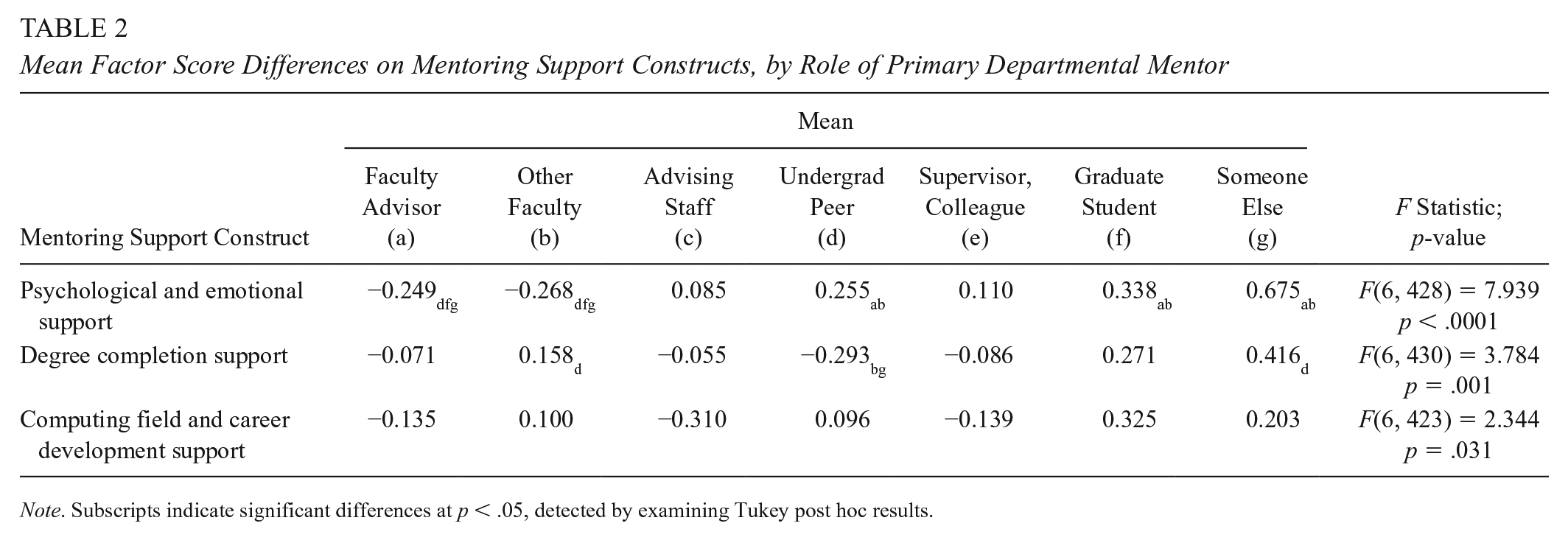
Note. Subscripts indicate significant differences at p < .05, detected by examining Tukey post hoc results.
Key differences also emerged in degree completion support (F(6, 430) = 3.784; p = .001), as shown in Table 2. Post-hoc tests illustrated that graduate aspirants whose departmental mentor was someone else reported significantly higher mean factor scores on degree completion support than students mentored by an advanced undergraduate peer. Further, graduate aspirants with another faculty mentor (not their advisor) reported significantly greater degree completion support than those with an advanced undergraduate peer mentor. Although no significant differences emerged across computing field and career development support, the highest levels of field-specific support appeared among those mentored by graduate students, suggesting that undergraduates with graduate aspirations may look to current graduate students for advice.
The second research question also prompted an examination of inequities across students’ social identities. I first used one-way ANOVAs to test differences across all mentoring support constructs by discrete identities (i.e., gender, race/ethnicity, transgender identity, first-generation status, social class, sexuality, and dis/ability), and significant differences only emerged with regard to gender. One-way ANOVA results (F(2, 432) = 3.944; p = .020) revealed gender differences in psychological and emotional mentoring support, with Tukey post-hoc tests illustrating that women received more psychological and emotional support than men (p = .040). I then examined individual items contributing to gender differences in psychological and emotional support (Table 3).
Mean Differences on Psychological and Emotional Support Mentoring Practices, by Gender Identity
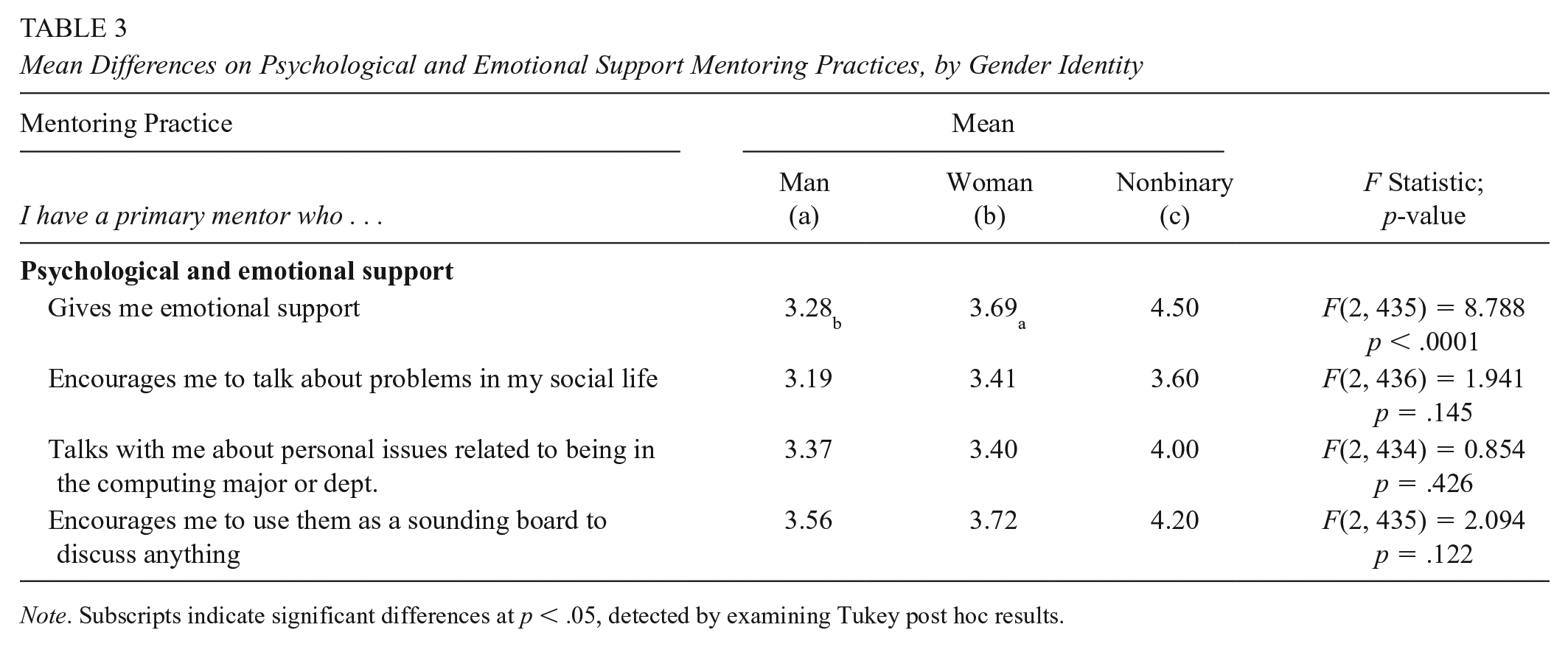
Note. Subscripts indicate significant differences at p < .05, detected by examining Tukey post hoc results.
Table 3 shows significant gender differences regarding the extent to which graduate aspirants felt their primary mentor provided emotional support, with women receiving more emotional support than men (F(2, 435) = 8.788; p < .0001). Notably, nonbinary graduate aspirants may also receive greater emotional support, given the higher means, but this was likely nonsignificant due to the sample size of nonbinary students (n = 5). No gender differences emerged on other items in the psychological and emotional support construct; yet, it is striking that women and nonbinary students reported higher means on all items.
Given these gender disparities, I examined potential inequities in psychological and emotional support across intersecting gender and racial/ethnic identities. Although many other social identities intertwine with gender, I focused on race/ethnicity because prior research has often examined gender and racial/ethnic identity concordance in mentorship. I first tried using one-way ANOVA with 14 disaggregated categories of intersecting identities. Although significant results emerged on two items (i.e., emotional support, encouragement to talk about social life), post-hoc tests could not attribute group differences, likely due to small sample sizes and the number of groups. I then used a revised approach 4 to explore inequities across six broader intersecting groups.
As illustrated in Table 4, one-way ANOVA results revealed significant differences (F(5, 423) = 4.004; p = .001) across intersecting gender and racial/ethnic groups for only one psychological and emotional mentoring behavior: providing emotional support. Using Tukey post-hoc tests, it became evident that graduate aspirants who were underrepresented Women of Color in computing (i.e., Black, Latina/x, Native, Arab, Persian, Middle Eastern, and multiracially minoritized women) reported higher mean scores on emotional support than graduate aspirants who were white men or underrepresented Men of Color in computing.
Mean Differences on Psychological and Emotional Support Mentoring Practices, by Intersecting Gender and Racial/Ethnic Identities

Note. Subscripts indicate significant differences at p < .05, detected by examining Tukey post hoc results. USOCC = underrepresented Students of Color in computing.
Homogeneity of variances test was not met for item; thus, differences are not interpretable.
RQ3: How Departmental Mentorship Predicts Psychosocial Beliefs
To analyze the extent to which features of departmental mentorship predict disciplinary psychosocial development among graduate aspirants in computing, I ran two OLS regression models predicting computing identity and self-efficacy that were identical sans the pretest (e.g., intro course computing identity was the pretest for the computing identity regression).
Main Effects
Results from final regression models (i.e., controlling for main effects) are presented as Model 1 in Tables 5 and 6. I discuss these models collectively to compare mentoring features associated with students’ computing identity and self-efficacy. Overall, independent variables were better predictors of computing identity (R2 = 30.2%) than computing self-efficacy (R2 = 24.0%). Much of this predictive power can be attributed to students’ intro course psychosocial beliefs (Block 1), as indicated by the salience of computing identity (β = 0.44; p < .001) and computing self-efficacy (β = 0.38; p < .001) as pretests on their respective outcomes. After controlling for Block 5, which included forms of mentoring support, results also showed that early general mentoring support negatively predicted computing self-efficacy (β = −0.12; p = .02), whereas this was not the case for computing identity.
Next, Block 2 revealed several differences in how graduate aspirants’ identities relate to disciplinary psychosocial development, after accounting for control variables. First, multiracial graduate aspirants who identified as Asian, Asian American, and/or white had higher levels of computing self-efficacy (β = 0.10; p = .04), relative to the weighted sample mean of students’ racial/ethnic identities. No racial/ethnic differences emerged for computing identity; however, results indicated differences in computing identity for men and women. 5 Relative to the weighted sample mean of students’ gender identities, men reported higher levels of computing identity (β = 0.18; p < .001), whereas women reported lower levels of computing identity (β = −0.19; p < .001). No other significant differences were detected.
Block 3 (mentoring relational context) in Table 5 shows that mentors who were other professors (not students’ advisors) and faculty advisors shaped computing self-efficacy, though in opposite ways. Compared to the weighted sample mean of mentors’ departmental roles, graduate aspirants with other faculty mentors had higher levels of computing self-efficacy (β = 0.15; p = .01), whereas mentorship from a faculty advisor was negatively associated with computing self-efficacy (β = −0.11; p = .05). Notably, block-by-block changes in the computing identity model (Table 6) revealed that the role of other faculty mentors (not students’ advisors) was significant until mentoring support variables entered. This suggests that mentoring behaviors may be more strongly associated with computing identity than what role mentors occupy.
Predictors of Computing Self-Efficacy Among Graduate Aspirants with Departmental Mentors in Computing (n = 378)
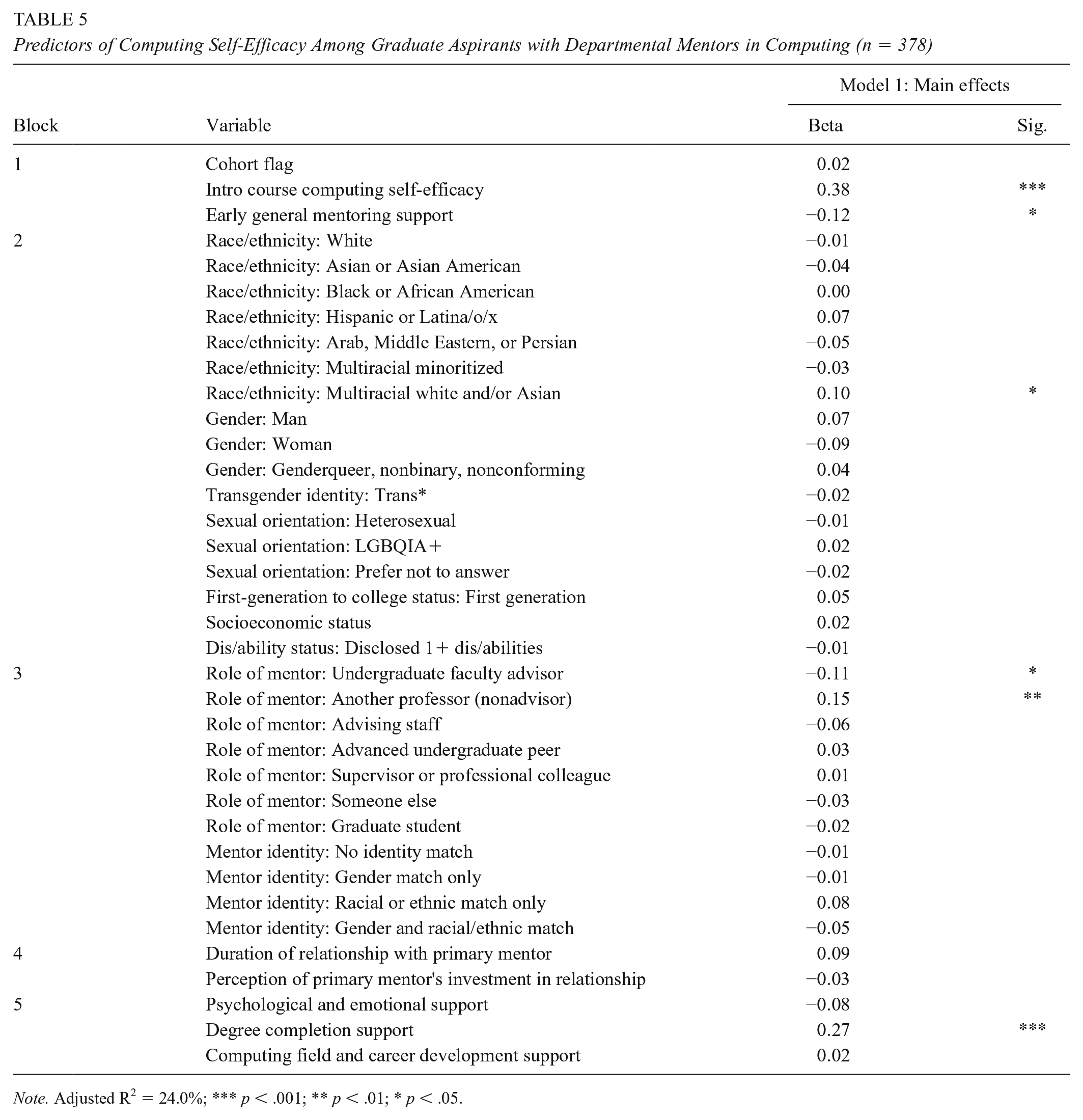
Note. Adjusted R2 = 24.0%; *** p < .001; ** p < .01; * p < .05.
Predictors of Computing Identity Among Graduate Aspirants with Departmental Mentors in Computing (n = 373)

Note. Adjusted R2 for Model 1 = 30.2%; Model 2 = 31.0%; *** p < .001; ** p < .01; * p < .05.
Regarding the breadth and depth of departmental mentorship (Block 4), Table 5 shows no significant differences in computing self-efficacy. However, Table 6 illustrates that graduate aspirants who felt their primary mentor was invested in their relationship also reported significantly higher levels of computing identity (β = 0.13; p = .02). In some ways, graduate aspirants’ perceptions of investment may naturally relate to their disciplinary identity development, given the deeply intrinsic nature of these perceptions.
Finally, Block 5 included forms of mentoring support. Among three factors, both regressions solely showed degree completion support as significant. Degree completion support was the second most salient variable associated with computing self-efficacy (β = 0.27; p < .001) and held a significant, positive relationship with computing identity, but to a lesser strength (β = 0.13; p = .04). Despite the descriptive inequities among other forms of mentoring support, regression results illuminated that such variance was explained by other covariates. Given that this sample reflects graduate aspirants and that degree completion support included items about current and future educational options, the importance of this support is not entirely surprising.
Interaction Effects
In a second level of inferential analysis, I explored whether the predictive power of mentoring support was moderated by graduate aspirants’ gender, race/ethnicity, or the mentor’s role. One significant two-way interaction emerged (Table 6) revealing that, although computing field and career development mentoring support did not significantly relate to graduate aspirants’ computing identity with most departmental mentors, such support significantly predicted computing identity for graduate aspirants mentored by “someone else” (Figure 2). Yet, the gap between these two lines is not large, and the slope of the reference group line (i.e., all other departmental mentors) is nonsignificant. Although there may be differences in the benefits gained from being mentored by someone else, the distance between the points in Figure 2 is not sizeable, which may help explain why neither variable was significant as a main effect. To further investigate who graduate aspirants classified as “someone else,” I explored associated text entries; this revealed that half of graduate aspirants mentored by someone else reported friends and program alumni that now worked in computing as their primary mentors—a logical connection to providing beneficial field-specific mentorship.
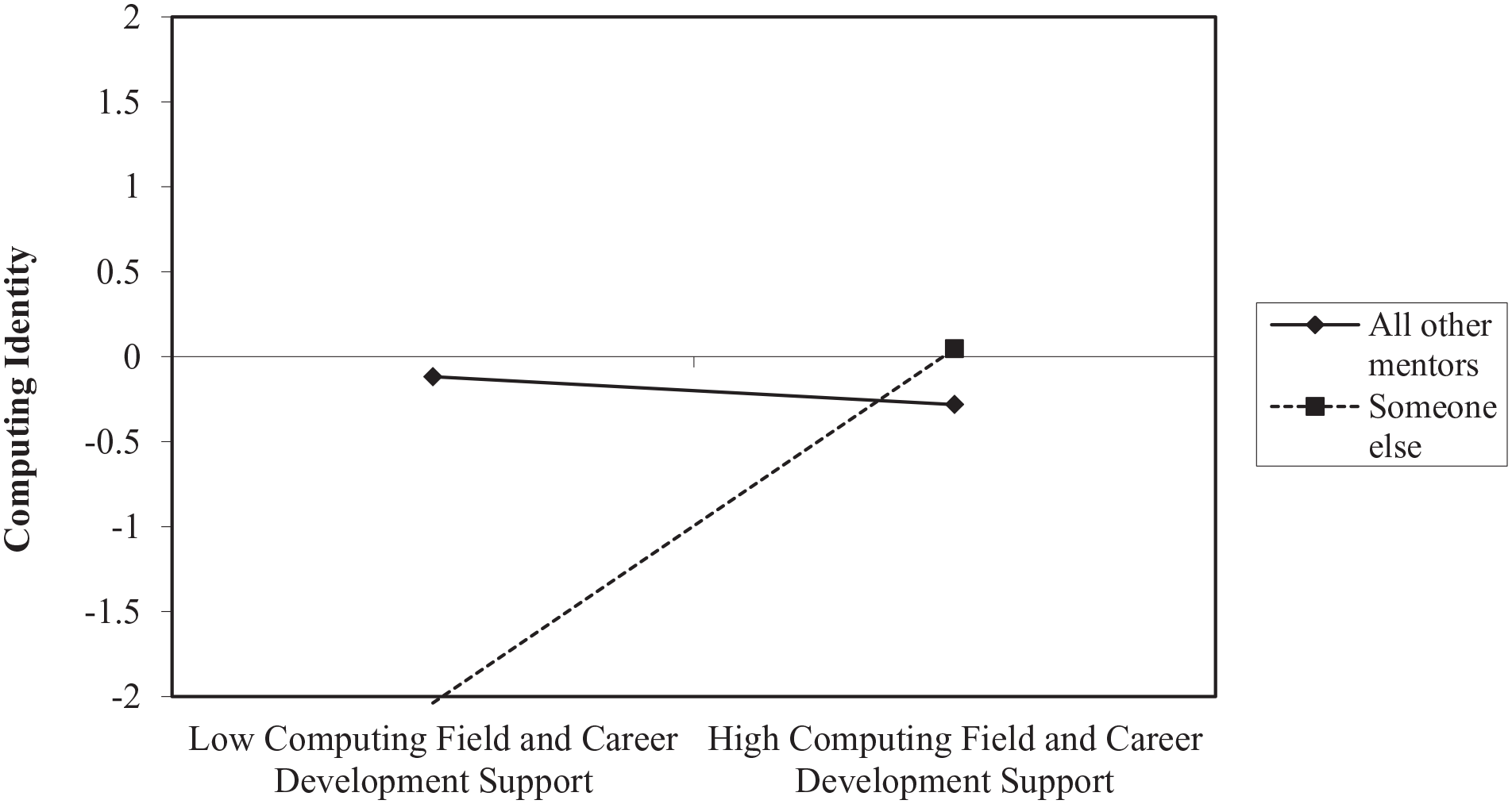
Computing identity by level of computing field and career development mentoring support due to departmental role of mentor
Discussion and Implications
Synthesizing Key Results
Informed by literature on equity in computing, mentorship, and graduate pathways, this study leveraged a critical quantitative lens to explore how departmental mentorship in computing relates to the disciplinary psychosocial beliefs of graduate school aspirants. The present results collectively suggest that mentors in computing departments (1) provide differential forms of support, with noteworthy differences across graduate aspirants’ racial/ethnic and gender identities, and (2) provide wholly divergent forms of mentoring support that vary based on the mentor’s departmental role. Although mentoring relationships are initiated for many reasons (Baker & Griffin, 2010), and thus promote different outcomes, these results illustrate the utility of examining specific mentoring behaviors and how power dynamics may shape interactions. Additionally, revealing students’ initial levels of computing identity and self-efficacy as the strongest positive predictors of each outcome confirms the importance of introductory courses (Blaney & Stout, 2017; Pon-Barry et al., 2017). However, each of these key patterns warrants the use of a critical lens if we are to embed equity-mindedness in the structures that impact graduate aspirants’ developmental beliefs and relationships.
Contextualizing Takeaways with Structural and Cultural Power
By documenting how mentors’ positional power and students’ identities—two products of institutional and societal power structures—relate to forms of mentoring support and disciplinary psychosocial beliefs among computing graduate aspirants, this study makes a novel contribution to literature about mentorship and graduate school pathways in computing. Although scholars have associated mentoring support with computing identity and self-efficacy (Goh et al., 2007; Hodari et al., 2014) and explored how mentoring fosters computing graduate school plans (Charleston et al., 2014; Cohoon et al., 2004; Wofford, 2021; Wofford et al., 2022), few have discussed how mentoring experiences may be an artifact of structural and cultural power in computing departments. Using a conceptual framework underscored by critical theory (Baez, 2007) that specifically explores organizational power (Ragins, 1995) and undergraduate mentorship (Crisp et al., 2017), the current study illustrates how mentors’ positional power and departmental cultural values complicate mentorship that computing graduate aspirants receive.
The position (and power) of departmental mentors matters greatly in guiding what support is provided. Although some existing research explores how faculty and peers provide mentoring support in computing (Tashakkori et al., 2005), the present study offers new insight by comparing a wider array of mentors’ positions. Indeed, attending to departmental mentors’ positions (and differential affordances of departmental power) captures greater complexity than prior studies and propels conversations about mentorship to include systemic considerations. Recent evidence suggests that peer mentors bolster introductory computing students’ confidence (Pon-Barry et al., 2017), which speaks to the disproportionate level of psychological and emotional support that graduate aspirants mentored by students (advanced undergraduate or graduate-level) or someone else reported, relative to respondents mentored by faculty. Computing faculty mentors may also employ hierarchical power dynamics that obstruct the provision of emotional support, given that imbalanced student-faculty power dynamics are amplified in STEMM (Baber, 2015; Newman, 2015). Further, computing faculty may feel unequipped to offer emotional support, as faculty are rarely socialized to view personal support as part of mentorship (O’Meara et al., 2013).
Mentors’ positional roles also shape computing psychosocial development in this study. Interestingly, having a faculty advisor as one’s mentor negatively predicted graduate aspirants’ computing self-efficacy, whereas having another faculty mentor (not students’ advisor) was a positive predictor. It is plausible that other faculty mentors may be PIs of research labs or involved in community-mentoring models (Kobulnicky & Dale, 2016), which may be especially helpful if systemically minoritized students seek faculty who share their identities (Charleston et al., 2014). Although these data do not allow me to confirm precise roles or identities of other faculty, I explored the extent to which graduate aspirants perceived mentors to provide research opportunities, depending on mentors’ roles. Post-hoc crosstabs showed significant differences, with 35.2% of graduate aspirants mentored by another professor reporting frequent opportunities to work on a research project relative to 16.4% of graduate aspirants mentored by faculty advisors. Given the association between undergraduate research and computing graduate school enrollment (Wright, 2020), this is important context to understand how other faculty mentors support disciplinary development.
In alignment with the conceptual framework, it is also crucial to discuss how cultural power in computing departments influences mentorship. According to Ragins (1995), “the values and norms inherent in an organization’s culture can support or deter mentoring relationships” (p. 110). A cultural power lens is useful to interpret how psychological and emotional support may be racialized and gendered. For underrepresented Women of Color in computing, caring attitudes are a healthy aspect of mentoring (Hodari et al., 2014). Yet, the fact that underrepresented Women of Color in computing reported more emotional support also raises concerns about the persistence of racism and sexism in computing (Charleston et al., 2014; Thomas et al., 2018) and whether emotional support was simply crucial for existing in oppressive environments.
While exploratory, regression analyses also suggest that gendered cultural norms pervade computing departments and computing identity development (e.g., Cheryan et al., 2013). To further explore these gender differences, I ran independent samples t-tests for mean differences between men and women on computing identity at each time point. Post-hoc results reveal significant mean differences (p < .001) and identify a larger gender difference in computing identity on the follow-up survey (.495) than the intro course survey (.353). Although these data do not directly address how gendered cultural values permeate computing, mean differences reveal an increasing gap between men and women graduate aspirants’ beliefs about being a “computing person.” Despite receiving mentorship, women graduate aspirants report lower scores on computing identity than that which they started with, suggesting that sexism remains prominent in computing departments.
Implications for Policy and Practice
Policy- and practice-oriented interventions are imperative to resolve inequities in higher education, as articulated through Rios-Aguilar’s (2014) framework for critical quantitative inquiry, and computing departments’ provision of mentoring support is no exception. First, considering current departmental tensions (CRA, 2017), computing departments should consider either hiring a new staff member or reclassifying an existing staff member’s role to include responsibilities as a mentoring advocate. Prior research in STEMM higher education has shown how departmental staff can be important advocates in mentoring programs (e.g., Meyerhoff Scholars Program; Maton et al., 2016) and help students navigate dysfunctional faculty power dynamics in mentoring (e.g., NASEM, 2019; Wofford & Blaney, 2021), which is likely to also be true as computing students navigate graduate pathways. However, establishing this staff position does not relieve computing faculty from learning equity-minded mentoring approaches that honor students’ identities and address organizational contexts (Griffin, 2020b), necessitating further steps to redress minoritizing power structures in computing.
Given how mentors’ positional roles underscore mentorship experiences in computing, institutions must prioritize structural changes that can uplift efforts toward equitable mentoring support across departmental roles. Akin to suggestions from Park and colleagues’ (2022) critical quantitative study, department heads may consider adding ethics of care “checkpoints” by facilitating dialogues among all mentors—faculty, students, staff, and others. Such dialogues could discuss Gilligan’s (1977) perspectives about ethics of care and use self-evaluations for mentors as a reflexive tool—a suggestion also reminiscent of Posselt and colleagues’ (2020) call for equity checks in faculty decision-making. Employing ethics of care in mentoring could take several forms including, but not limited to, recognition of mentees’ efforts and validation of mentees in humanizing ways. To implement this type of thinking, computing departments may develop discussion guides for mentors and mentees to consider how personal subjectivities and systems of power shape mentoring expectations, academic engagement, and goal setting. Notably, although I argue ethics of care to be an institutional responsibility in constructing systems of mentorship, care is most likely to be seen in individual relationships. Yet, women faculty spend more time on service than men (O’Meara et al., 2017), and Black women provide disproportionately high psychological support as faculty mentors (Griffin & Reddick, 2011). As such, institutional leaders devising checkpoints for ethics of care should be wary of relying on women—especially Black women and other Women of Color—to provide disproportionate care in mentorship, as this extra weight may negatively affect their academic careers.
All too often, mentoring is seen as an extra-role responsibility; institutions should work to systematically integrate mentoring opportunities to promote the value of mentorship (NASEM, 2019). For example, institutions should reward the care labor often associated with providing psychological and emotional mentoring support. Developing rubrics for annual faculty reviews that include care labor, for one, may also uplift the provision of care as a rewarded part of faculty roles. Computing departments could also incentivize faculty to partner with graduate students or advanced undergraduates as “co-mentors” through supplemental funding (for faculty and student mentors), and departments could then match co-mentors with prospective mentees—perhaps students who indicate curiosity about graduate school. Mentees would then gain access to multiple mentors and benefit from their differential support. This may also serve as an opportunity to train graduate students and advanced undergraduates—who may be future faculty—as mentors. If implemented, these efforts should also attend to power structures, using policy to catalyze mentors’ and mentees’ discussion of reciprocity, expectations, and social positions to cultivate mutually beneficial relationships (Goerisch et al., 2019; NASEM, 2019). Although such efforts may require initial time and labor, the resultant model of community mentoring would have copious advantages for growing a departmental culture of mentorship and reducing overreliance on individual mentors.
Finally, specific to graduate school trajectories, this study suggests that some graduate aspirants rely on “someone else” in the department (e.g., friends, alumni) or on graduate students for computing field-specific or psychological and emotional mentoring support. To ensure equitable access to these mentors, computing departments could hire alumni as industry or graduate school liaisons to convey specialized knowledge broadly within the department. At the national level, the Computing Accreditation Commission (ABET, n.d.) may also formalize industry- or graduate-level mentoring partnerships in the curriculum as a seminar course. At the same time, companies or graduate programs sponsoring such mentors should incentivize participation (e.g., through stipends, steps toward promotion). Formalizing graduate aspirants’ access to these types of mentors may be one way to reorient information access about future trajectories with an equity-focused lens.
Implications for Future Research
This exploratory critical quantitative study lends itself to many directions for future research, some of which may be best addressed using qualitative designs. For one, future research should consider how disciplinary cultures influence mentorship. This direction may provide robust information about structural changes necessary in computing and offer insights that can be replicated across other STEMM disciplines with unique disciplinary norms. Second, different quantitative strategies (e.g., structural equation modeling) may be well-suited to address relationships among independent variables—relationships that may also be disentangled via qualitative research. Third, it is crucial to explore the perspectives of departmental mentors, as perspectives from those holding power in mentoring relationships may reveal new ways to create equity-minded mentoring structures and incentives. Finally, although exploring affective outcomes among graduate aspirants helps propel research on graduate trajectories into the space between aspiration and matriculation, researchers would do well to extend the longitudinal nature of this investigation to tangible outcomes, such as application patterns, matriculation behaviors, and career decisions.
Conclusion
Attending to graduate aspirants’ experiences with mentorship in computing departments, this study reveals new insights about inequitable mentoring interactions. Results show that graduate aspirants’ departmental mentoring support varies based on the mentor’s role (e.g., faculty, peer) and students’ social identities—disparities rooted in structural and cultural power, and disparities that may be associated with computing students’ realization of their goals to attend graduate school. Although mentoring is often thought of as an individual activity, ensuring equitable quality and outcomes of mentoring relationships is also an institutional responsibility in higher education (NASEM, 2019). Mentoring support may be leveraged as a powerful tool to shape students’ beliefs about their skills and place in computing, and developing equity-focused institutional structures of mentorship may be one way to address existing inequities in computing students’ development and graduate school trajectories. However, without addressing the complex social structures and dynamics that guide mentoring practices, the promise of mentorship in computing and other STEMM departments may not be fully realized.
Supplemental Material
sj-docx-1-ero-10.1177_23328584221143097 – Supplemental material for Inequitable Interactions: A Critical Quantitative Analysis of Mentorship and Psychosocial Development Within Computing Graduate School Pathways
Supplemental material, sj-docx-1-ero-10.1177_23328584221143097 for Inequitable Interactions: A Critical Quantitative Analysis of Mentorship and Psychosocial Development Within Computing Graduate School Pathways by Annie M. Wofford in AERA Open
Footnotes
Acknowledgements
This article was part of my dissertation research, and I am grateful to Drs. Linda J. Sax, Sylvia Hurtado, Kimberly A. Griffin, and Kimberley Gomez for their guidance on this work as my dissertation committee. Additionally, I gratefully thank Drs. Jennifer M. Blaney and Rachel A. Smith for their helpful feedback on an earlier version of this manuscript, which was presented at the 2021 American Educational Research Association meeting. I would also like to acknowledge the anonymous reviewers and editors of AERA Open, all of whom provided thoughtful feedback throughout my manuscript development.
Funding
The author(s) disclosed receipt of the following financial support for the research, authorship, and/or publication of this article: The data used in this study was provided by the UCLA BRAID Research project, whose collection of these data was supported by AnitaB.org and NSF (#1525737).

Supplemental Material
Supplemental material for this article is available online.
Notes
Authors
ANNIE M. WOFFORD is an assistant professor of Higher Education in the Department of Educational Leadership & Policy Studies at Florida State University. Her research examines structural inequities that characterize trajectories to and through graduate education, with a particular focus on disparities in STEMM disciplines and within mentoring relationships.
References
Supplementary Material
Please find the following supplemental material available below.
For Open Access articles published under a Creative Commons License, all supplemental material carries the same license as the article it is associated with.
For non-Open Access articles published, all supplemental material carries a non-exclusive license, and permission requests for re-use of supplemental material or any part of supplemental material shall be sent directly to the copyright owner as specified in the copyright notice associated with the article.
