




Abstract
At the onset of the COVID-19 pandemic, our teacher preparation program shifted to an online setting, disrupting a key feature of practice-based teacher preparation: preservice science teachers’ (PSTs) approximation of rigorous and responsive instruction during extended pedagogical rehearsals, called macroteaching. Given this unplanned shock to their preparation, we examined how PSTs viewed macroteaching and their evolving participation in the teaching rehearsal. Using a situative perspective, we collected multiple forms of data. We found that although PSTs wanted to enact rigorous and responsive instruction, their participation was deeply affected by the sudden shift to an online setting. Our analysis of video-recorded lessons confirmed PSTs’ observations that their instruction became less rigorous and responsive over time. We conclude with questions about teacher preparation during the pandemic.
T
Appearing halfway through our methods course, COVID immediately disrupted a key feature of our practice-based course: PSTs’ approximation of rigorous and responsive instruction during extended pedagogical rehearsals (Grossman et al., 2009). In these rehearsals, called “macroteaching” (Stroupe & Gotwals, 2018), PSTs approximate providing students with opportunities to examine puzzling phenomena and construct evidence-based explanations (rigor) while noticing and attending to student thinking as they build an equitable classroom community (responsiveness) (Thompson et al., 2016).
At the start of the 2020 spring semester, PSTs were divided into four content groups: biology, earth science, physics, and chemistry. The biology and earth science groups each completed one round of in-person macroteaching to peers in the methods course. The physics group completed one in-person hour of instruction in March 2020 before COVID-19 forced courses online. As a class, PSTs decided to continue macroteaching with the remining physics unit and the entire chemistry unit through the Zoom™ video teleconferencing platform.
Given this unplanned interruption to practice-based teacher education, we became curious about how PSTs viewed macroteaching and their attempts at rigorous and responsive instruction. We asked:
How did PSTs frame the purpose of macroteaching when COVID disrupted the practice-based methods course?
How were PSTs’ participation in macroteaching, and their attempts at rigorous and responsive instruction, shaped by the sudden disruption of the practice-based methods course?
Background and Framing
As Kang (2022) argues, the field of teacher education struggles to design opportunities for in-service teachers to learn about rigorous and responsive instruction. We extend this concern to teacher preparation and argue that PSTs need more opportunities to learn about, rehearse, and receive feedback about their attempts to enact rigorous and responsive instruction. Although we had hoped that macroteaching might provide such a learning opportunity for PSTs, the shock of COVID-19 and moving the methods course online fundamentally changed the class.
In this section, we define rigorous and responsive instruction, describe the macroteaching learning opportunity in the practice-based science teacher preparation course, and conclude with the theoretical framework.
Rigor
Although rigor is sometimes described as extensive content coverage and the completion of complex tasks, we argue that rigor is an emergent property of discursive classroom interactions (Thompson et al., 2016). We frame rigor as a collaborative effort to construct and revise scientific explanations, which is a central practice across scientific disciplines. The work of explaining in science involves observing, constructing hypotheses, determining criteria for and using evidence, and co-developing knowledge claims in and across communities (Duschl, 2008).
In our methods course, PSTs learn to create and facilitate opportunities for students to move away from reciting vocabulary terms and toward engaging in complex reasoning about scientific phenomena. Importantly, the term rigor does not mean that students must use “correct” science terminology to explain phenomena. Rigor, especially when viewed through a lens of collaborative talk, means that students use their suite of personal and community resources (including language) to take ownership of ideas, to shape the science practices of the classroom, and to frame science as a social and humanized activity (see Table 1 for levels of rigor; Lemke, 1990; Thompson et al., 2016).
Forms of Explanatory Rigorous Talk

Note. This table is adapted from Thompson et al. (2016).
Responsiveness
Defining responsiveness is also difficult. Broadly, responsiveness involves noticing, attending to, interpreting, and using students’ ideas and needs to shape pedagogical actions (Kang, 2022; van Es et al., 2017). For this study, we focused on two dimensions of responsiveness: (a) building on students’ scientific ideas and (b) encouraging participation and building classroom community (see Tables 2 and 3; Thompson et al., 2016).
Dimension of Responsiveness: Responding to and Building on Students’ Scientific Ideas

Note. This table is adapted from Thompson et al. (2016).
Dimension of Responsiveness: Participation Structures and the Building of a Community

Note. This table is adapted from Thompson et al. (2016).
From the perspective of building on students’ scientific ideas, teachers enacting responsive instruction help students share ideas and build on each other’s thinking over time. Teachers support students as they elaborate on ideas, build norms for classroom talk, and routinely engage in complex forms of social reasoning (Leinhardt & Steele, 2005; Mercer, 2008; Michaels & O’Connor, 2012). As a community, teachers and students work together to ensure that they hold each other and the emerging learning community accountable for creating and growing knowledge practices in which students’ language and experiences form a foundation for science work (Michaels & O’Connor, 2012).
From the perspective of encouraging participation and building classroom community, teachers and students jointly make meaning as they link ideas (Mortimer & Scott, 2003). Such collective intellectual effort is supported by co-developed participation structures to help teachers and students listen and respond to one another’s ideas. Over time, norms for participation shape in-the-moment interactions and provide the foundation for teachers and students to examine how the structures for participation should be altered or expanded (Herrenkohl & Guerra, 1998).
To support rigor and responsiveness, teachers must take purposeful actions to open opportunities for students that may not otherwise exist, such as negotiating structures for participation with students and creating spaces to learn together about each other’s emerging and changing participatory needs (Gay, 2000; Kang, 2022).
Practice-Based Science Teacher Preparation
Enacting rigorous and responsive instruction is important, but preparing PSTs for such teaching is complex and underexamined. Science educators and teacher educators know very little about the pedagogy or content of learning opportunities that focus on the practices of teaching. For example, a national consensus report on preparing teachers could not find answers to basic questions about how methods courses are structured, the roles they play within the preparation curriculum, or the effects of these courses on novice teachers’ work in schools (National Research Council, 2010).
Given this need for a better understanding of preparing teachers for rigorous and responsive instruction, we argue that practice-based teacher preparation can provide PSTs with powerful learning opportunities. By practice-based teacher preparation, we mean a framing of teacher education that focuses on disrupting preservice teachers’ images of disciplinary work and teaching, reimagining teaching through a lens of equity and justice, and rehearsing core teaching practices while building relationships with students and their communities (Stroupe et al., 2020; Windschitl & Calabrese Barton, 2016).
Moving toward practice-based teacher preparation helps address the problem of enactment, which can be characterized as a mismatch between knowing what to teach and being unsure of how to teach (Kennedy, 1999). For example, Grossman and McDonald (2008) attend to the problem of enactment by suggesting that teacher educators employ wide repertoires for engaging PSTs in investigating teaching and learning, situated in such artifacts of practice as case-based learning, examining lesson plans and student work, and using video of classroom instruction. We propose that practice-based teacher preparation organizes the work of teaching and teacher education around core practices and employs an ensemble of teacher educator pedagogies, such as representing practices, engaging preservice teachers in rehearsals of practices, and coaching in clinical settings, to support the approximation of complex forms of teaching over time by PSTs.
A key element of learning to teach through approximations of instruction is a community of colleagues to discuss, test, critique, and challenge pedagogical decisions. Teaching is relational and reciprocal work—teachers need to know how to notice, predict, and be open to and interact with students’ ideas; to read and understand social interactions; to support and build upon productive talk; and to understand how individual and collective cultures can enhance learning (Philip et al., 2019). To enact the equitable visions and foundational ideas PSTs learn about in teacher education, they must rehearse the complex, relational work of teaching in the moment through approximating, receiving feedback, and having coaching conversations with experienced teachers and teacher educators. Through scaffolded work on interactive practices that encourage principled improvisation, PSTs can learn to make relational judgments required by the realities of classroom life.
Macroteaching
Although a practice-based approach to teacher preparation provides a framework for supporting PSTs, teacher educators must design learning opportunities for PSTs to approximate rigorous and responsive instruction. We use macroteaching as a learning opportunity for PSTs to approximate rigorous and responsive instruction as they work in groups to plan, teach, and reflect on 11–12 consecutive hours of instruction to their peers (approximating one unit of instruction). Macroteaching occurs in our methods course, which meets 4 hours per week and concludes a 4-year teacher preparation program in which PSTs major (and minor) in a science discipline while fulfilling requirements for a teaching certificate.
Macroteaching was co-designed in 2015 after PSTs’ leveled three critiques about shorter pedagogical rehearsals (microteaching): (a) The approximation episodes were too short (i.e., 20 minutes); (b) too much time elapsed between approximation opportunities (e.g., about 2 weeks); and (c) PSTs taught three to four peers acting as students, limiting the number of student ideas they could elicit and use to inform their teaching. Given these critiques raised by PSTs, David Stroupe and Amelia Gotwals decided to represent responsive instruction based on students’ expressed and emerging needs. Subsequently, Stroupe and Gotwals (2018) co-developed macroteaching during the spring semester to allow for an elongated peer-teaching opportunity to better reflect the daily work of secondary science teaching.
Through analysis of video and PSTs’ plans, reflections, and interviews, Stroupe and Gotwals found that PSTs’ understanding of professional work changed in two fundamental ways during macroteaching. First, PSTs became more comfortable navigating uncertainty when they actively sought and valued students’ ideas. For example, PSTs shifted to seeing students’ “curve ball” ideas as potentially informative and productive instructional resources rather than “misconceptions” to fix. Second, PSTs noted that by having to serve as instructors and students during macroteaching, they experienced the discursive and pedagogical moves found in rigorous and responsive teaching from multiple perspectives. Such experiences helped PSTs begin to see how students could work as knowledge builders in the classroom as they leverage tools to organize and use knowledge to identify and solve complex problems (Stroupe & Gotwals, 2018).
Learning to Teach in Virtual Settings
Macroteaching usually occurs in person, but the COVID-19 pandemic forced PSTs to enter a virtual setting (Zoom™). When investigating how to engage in teacher preparation online, we encountered a dearth of research about learning rigorous and responsive teaching practices in virtual settings. However, several recent studies have investigated teacher learning in online settings. For example, Watkins et al. (2020) examine instructors’ responsiveness in an asynchronous online discussion as part of a hybrid online science professional development program for in-service elementary and middle school teachers. In another example, Cohen et al. (2020) evaluate whether providing coaching between practice sessions in teacher education courses leads to more rapid development of skills and changes in teachers’ beliefs about student behavior, using mixed-reality simulations as a practice space and standardized assessment platform. Both examples illustrate how in-service and preservice teachers might learn in virtual settings during short-term professional development and a simulated environment, yet neither study examines PSTs’ participation during extended pedagogical rehearsals and attempts at rigorous and responsive instruction in virtual settings. This study, then, adds to the literature by examining how PSTs’ participation shifted when attempting to teach in a virtual setting.
Theoretical Framing
We used situative theory to address the complexity of examining how and why PSTs’ participation might be shaped by the sudden shift in practice-based teacher preparation due to COVID. Situative theory is a hybrid analytical lens framing individuals’ learning through their participation in activities that occur through interactions with actors, tools, and discourses of a context (Greeno, 2006; Kang & van Es, 2019; Peressini et al., 2004; Putnam & Borko, 2000; Sykes et al., 2010). A situative perspective on PSTs’ participation helps focus researchers’ analytical lens to, as Peressini et al. (2004) propose, “guide our decisions about data to collect and to offer a way of disentangling—without isolating—the complex contributions of these various contexts to novice teachers’ development” (p. 71). In other words, a situative perspective helps us make sense of why PSTs’ reasoning and participation might be shaped by a sudden shift in context, given the new norms and expectations for participation that they encounter and create (see Cobb, 2000; Fairbanks et al., 2010; Peressini et al., 2004; Putnam & Borko, 2000).
Methods
“Forced” Design Experiment
Given the theoretical framework and our dual roles as instructors and researchers, we viewed this study as a “forced” design experiment. By forced design experiment, we mean that external circumstances (the COVID-19 pandemic) required fundamental changes to the original design of the methods course. In turn, we rapidly and simultaneously engineered particular forms of participation for our PSTs while engaging in a systematic study of their participation (e.g., Penuel et al., 2011). Throughout the methods class, we reflexively revised our instruction, the macroteaching experience, and the data collection and analysis techniques (Horn & Campbell, 2015; Singer-Gabella, 2012), which included input from our PSTs. By enacting a forced design experiment, we aim to contribute to theories about learning and the role of teacher educators in teaching while examining their instruction.
Participants and Methods Class Setting
The 15 participants, all undergraduate PSTs majoring in a science field, were peers in a secondary science methods course we co-taught in the previous semester that was framed around rigorous and responsive instruction. The participants self-identified as:
9 women (1 East Asian, 1 Iraqi American, 7 White Americans)
6 men (White Americans)
The methods course in this study was the second in a two-course sequence. We met for 4 hours per week, 2 hours per class. This class schedule remained the same after the shift online. We established a shared Zoom setting to conduct class and, together, learned to navigate the online setting before restarting macroteaching. All PSTs agreed to participate in the study, and we received Institutional Review Board permission to collect and analyze PST data.
Macroteaching
As noted, macroteaching was the primary practice-based pedagogical experience in the second semester of the methods course sequence. As a classroom community, we co-designed an action plan for macroteaching with PSTs, given the impending closure of in-person classes.
We created the teaching teams based on disciplinary major and teaching interests. In addition, we assigned each team a disciplinary topic that would likely be included in a curriculum or textbook during their teaching career:
Biology (human impact on ecosystems): Beth, John, Billy, Lori. Taught in person, January 21–February 4, 2020.
Earth Science (tides): Victoria, Andy, Ben, Jennifer. Taught in person, February 11–25, 2020.
Physics (sound and waves): Zhang, Don, Jessica. Taught one lesson in person and the remainder online, March 10–26, 2020.
Chemistry (acids and bases): Michael, Amy, Sanaa, Phoebe. Taught online, April 2–16, 2020.
Data Collection
We collected and analyzed multiple forms of data from four different types of interactive episodes aimed at capturing PSTs’ sensemaking and participation from a situative perspective: (a) planning communication and activity (i.e., video-recorded online meetings and emails), (b) observations/video recordings of macroteaching, (c) participant-generated artifacts, and (d) two types of interviews. We selected these data sources for three reasons. First, we wanted to collect an array of data to better understand how and why PSTs’ reasoning and participation shifted over time. Second, we needed to examine how PSTs’ pedagogical reasoning evolved during important moments of professional work—planning, instructing, and reflecting. Third, given our theoretical framework, we thought that the data sources could better capture episodes of participation as PSTs engaged in instructional practices, such as planning, teaching, and reflecting, rather than relying on measures that are further removed from teachers’ daily activities (Table 4 describes the data collection and the features of each interactive episode).
Data Collection

Note. This table is adapted from Thompson et al. (2016).
Data Analysis
We engaged in three interacting phases of data analysis: (a) developing and applying codes to the initial round of interview coding, (b) using a priori codes about rigorous and responsive instruction to analyze macroteaching instruction in the online setting, and (c) finding patterns and triangulating data. The first phase of data analysis focused on refining a coding scheme. The coding scheme was initially informed by the literature on rigorous and responsive teaching, approximations of practice, and later by emergent themes from the data. For interviews, the coding scheme was debated and iteratively revised in weekly research meetings until we reached a consensus (see Table 5). We each coded a sample of data using the final coding scheme, identified areas of disagreement, and refined the coding process over time. For coding instructional episodes (see below), we used observation instruments validated in a prior study (Thompson et al., 2016).
Three Categories of Codes

The second phase of analysis involved using the codes to examine teaching episodes, or “small, socially shared scripted pieces of behavior” recognizable across most classrooms (Leinhardt & Steele, 2005, p. 91). In total, we coded 77 episodes within the 18 lessons. Table 6 describes how we distinguished episodes by the actors involved, participant roles, temporal attributes, and goals/purposes of the episode (see Thompson et al., 2016).
Episodes of Classroom Activity

Note. This table is adapted from Thompson et al. (2016).
The third stage of analysis involved examining the codes for each of the data sources to look for patterns in our data. For example, each lesson held on Zoom was video- and audio-recorded, and both authors watched or listened to it. When we encountered a moment that fit our coding scheme (see the Data Analysis section), we transcribed the episode. After coding each data source, we triangulated our data by looking across data sources to find supporting or disconfirming evidence across data sources to enhance the credibility of the codes and subsequent claims (Merriam, 2009; Patton, 2003).
Findings
In this section, we organize the findings around three assertions. First, although PSTs wanted to participate in rigorous and responsive instruction during online microteaching, how they framed the purpose of microteaching reflected the sudden shift in the medium of interaction and the timing of the rehearsals. Second, all participants observed that their participation was shaped by the rapid shift to a new classroom setting. The PSTs serving as instructors noticed that they altered their enactment of instruction, and the PSTs serving as students engaged with their instructors and peers differently than they had hoped during macroteaching. Third, our analysis of video-recorded macroteaching observations aligned with PSTs’ stated observations during interviews: Their words and actions became less rigorous and responsive as online macroteaching progressed. All quotes are taken from whole-class debriefing conversations, planning communications, class activities, or interviews. Note that our analysis and claims focus on macroteaching that occurred in the online setting after COVID forced a drastic shift in the practice-based teacher preparation program. We do not compare the rigor and responsiveness of in-person macroteaching to online macroteaching. However, PSTs used their experiences during in-person macroteaching to make sense of the dramatic shift in context, and this study aims to share their stories based on their words and actions and to examine their attempts at rigorous and responsive instruction as they navigated a terrible situation.
The Purpose and Planning of Macroteaching
All PSTs hoped to leverage macroteaching as a helpful opportunity to rehearse rigorous and responsive instruction. However, both PST teaching teams shifted their framing and planning around instruction because of COVID’s interruption.
After participating as students during the biology and earth science groups’ instruction, the physics group planned for, and assumed, that they would engage in macroteaching during in-person classes. This planning was initially useful because the physics group was able to conduct one lesson in person. However, between the first and second lessons, the entire university (including the practice-based teacher preparation program) moved all courses online. The physics group, then, shifted their framing of macroteaching from engaging in similar rehearsals to those designed by the biology and earth science groups to surviving the experience of macroteaching.
The most immediate concern for the physics group was rapidly adapting activities for an online setting. Because the physics group had planned to facilitate activities in person, Don, for example, felt instant pressure to “scramble and find online simulations because we [had] only planned activities that we needed to help students work on in person.” Such scrambling affected the physics group’s planning sessions. For example, Zhang noted that when planning for in-person macroteaching, the physics group saw the opportunity through the lens of rigorous and responsive instruction and planned learning opportunities accordingly. Yet when forced online because of COVID, “We were panicked. . . . We didn’t talk much about [the activities] in planning. We focused on time—do we have time for discussion? We didn’t think about how to do discussion. Just trying to make it through the next lessons.” As the rapid shift in the instructional medium led the physics group to frame macroteaching in terms of survival, planning sessions served as triage opportunities to merely endure the COVID-induced experience.
Although the physics group framed their macroteaching experience as survival, given the timing of their instruction, the chemistry group—the last team to engage in microteaching—had 2 weeks before their unit to watch and learn from the physics group. Therefore, the chemistry group’s framing of macroteaching became coping and acceptance of teaching online. In addition, the chemistry team viewed online macroteaching as an opportunity to rehearse as much rigorous and responsive instruction as they felt was possible, given the circumstances.
The physics group’s planning sessions prioritized impending and necessary adaptations, but the chemistry group seemed nostalgic for an alternative reality in which the COVID-19 pandemic never forced macroteaching online. In their planning meetings, chemistry group members would often describe an imagined macroteaching experience in which they could teach in person, only for someone in the group (often Phoebe) to redirect the other members back into the online reality. For example, prior to their unit, when planning an activity about acids and bases, the chemistry group began discussing an activity that “would have been so perfect to do in person” (Michael). After the discussion continued for 3 minutes, Phoebe interrupted by saying, “Okay, this has been fun, but we definitely cannot do this activity online.” This exchange is illustrative of many instances in which the group members wished that macroteaching could continue to serve as an important rehearsal opportunity, only to have to shift their framing to plan for the best possible unit, given the COVID-induced online setting.
In their effort to rehearse as much rigorous and responsive instruction as possible, the chemistry group used the experience of participating as students during the physics group’s online instruction to inform their pedagogical decisions. For example, the chemistry team often focused on improving class discussions, noting that the physics group—in their necessary haste to adapt instructional activities—did not always consider how to facilitate conversations between students. Specifically, the chemistry group noticed that students tended to remain silent during whole-class discussions in the main “room” of the Zoom platform, yet they often spoke during small-group conversations in “breakout rooms” (breakout rooms in Zoom are a subspace within an online session that aims to host small groups of participants). Therefore, the chemistry group planned to use ideas heard during small-group conversations to “force ideas into the whole-class discussion” (Michael). For the chemistry team, this instructional adaptation seemed necessary to help students talk to each other, but it also felt “forced and teacher-heavy” (Phoebe). Such adaptations became frequent among the chemistry team as they navigated macroteaching online.
PSTs’ Participation During Macroteaching
In addition to reframing the purpose and planning of macroteaching, all PSTs’ participation was affected by the COVID-induced change in interactive medium.
PSTs Serving as Instructors
The PSTs in the physics and chemistry teaching groups claimed that their participation as instructors was affected in two ways. First, PSTs reported that the “logistics of instruction” (Don)—the enactment of learning opportunities and the facilitation of student participation—were difficult to navigate, given COVID. For example, as Phoebe from the chemistry group noted, “It is hard enough to teach in person. Now, there are too many things that I can’t do in real time on Zoom. It is too hard to do so many things at once.” Don, from the chemistry group, agreed, noting, “Everything takes longer online, way longer than I imagine teaching in person would take.” These quotes exemplify the sentiment expressed by all PSTs who were forced online because of COVID—enacting practice-based teaching on Zoom was difficult.
PSTs reported that the most difficult learning opportunity to facilitate was student talk, during whole-class discussions and in small-group conversations. As Phoebe noted, “Most of the time was spent fixing technology issues rather than on pedagogy or helping with conversations.” For example, students were “kicked out of Zoom” (Michael) or they “turned their screens off, so it was hard to know who was following along” (Sanaa). The instructors often had to “repeat instructions because people’s audio feeds paused or turned off” (Phoebe), which disrupted the “flow of an already limited conversation” (Don). In breakout rooms with small groups, “No one wanted to talk at first until one person decided to take charge of the conversation, and everyone else would just sit there and say, ‘Yeah, okay, sounds good’” (Phoebe). Even PSTs serving as students noticed the difficulty of participating in Zoom. Victoria, an instructor for the in-person earth science group, expressed sympathy for her peers by noting:
I think online teaching teams had some success in small-group talk, but it was hard to bring those ideas together as a whole class. In person, we could stop class and say, “Hey, here’s a great idea for us to think about” if it came from a small group. In Zoom, we couldn’t do that. They couldn’t stop breakout rooms, bring up the idea, then send everyone back to breakout rooms. It probably would have taken 5 minutes to do all of that, and that’s a long time in a short class.
Note that Victoria highlighted a pedagogical dilemma named by the instructors as challenging—how Zoom potentially slows down interactive possibilities—and linked such a dilemma to the design of learning opportunities for participants during macroteaching.
The second way PSTs claimed their participation as instructors was affected centers on the “substance of instruction” (Amy)—the enactment of key features of rigorous and responsive instruction: Noticing, attending, and using students’ ideas and providing opportunities for reasoning about science. All participants serving as instructors during COVID believed that their substance of instruction was diminished.
From the perspective of PSTs’ macroteaching groups, noticing, attending, and using students’ ideas to shape instruction proved difficult for two reasons. First, PSTs noted that students (their peers) did not engage in verbal or written talk during lessons. Don noted, “It was hard to gauge what students were thinking when they d[id] not share their thinking.” Several PSTs attempted to name this lack of talk, with Phoebe noticing the “Zoom void,” Zhang declaring the lack of talk as “mute mode” (in which student PSTs placed their audio feed on “mute” to stay silent), and Amy describing her frustration at the “nothingness of Zoom space.” Each of these labels points to the same phenomenon that stifled PSTs’ attempts to notice, attend, and use students’ ideas to shape instruction.
When students chose to participate, PSTs noted the difficulty of promoting continued talk. For example, Phoebe noted, “When a student asks a question or says a comment, I feel like I have to keep the conversation going rather than the ideas getting used by other students.” Zhang also provided an example, noting, “I asked a question, and Beth [a student] responded. But then there was silence, and no one responded, so I had to ask a new question.” Rather than facilitating student talk, PSTs believed that online teaching halted conversations. Such circumstances made PSTs’ work of promoting student-to-student talk difficult to achieve.
From the perspective of providing opportunities for students to reason about science, PSTs felt constrained by the lack of student participation. Subsequently, PSTs increasingly felt the need to deliver information to students to inject content. For example, Jessica (physics) lamented:
We had such great activities planned for in-person macroteaching, but they would take too much time online. So, we decided to use simulations instead so that the students could at least encounter the content. Ideal? No. But we needed them to get the physics ideas to finish the unit.
Zhang echoed her teaching partner, noting that they had to “drop all in-person activities to quickly change to online versions that could introduce content.” PSTs, then, felt pressure to cover content rather than provide opportunities for promoting student talk.
Even the chemistry group, which had time to plan ahead for online macroteaching, reverted to content delivery because they noticed a lack of student participation during the physics unit. For example, Amy worried that the chemistry group was merely “going over the basics, but that’s because we didn’t know how to get people talking online.” Michael, another chemistry group member, echoed Amy, noting, “I felt more prone to telling students things rather than helping them talk about things.” Such decisions reflected the frustrations expressed by other PSTs as they rapidly shifted planning and teaching.
Interestingly, a feature of Zoom that was designed to facilitate talk—the chat box—provided a layer of complexity for both macroteaching teaching groups to navigate. For example, Amy (chemistry) noted that she had difficulty “pay[ing] attention to all the answers coming into the chat box.” Amy also noted that the “chat function allowed comments to be written, but that’s not a discussion.” Thus, even when PST instructional teams used the features of Zoom designed to enable discussion, PSTs did not rehearse facilitating talk as they hoped. Students agreed about the complexity of the chat box. For example, Andy, a student, asked a question of his peers during a whole-class conversation but realized, “When I was typing, they [my classmates] already moved on. I couldn’t keep up with what everyone said in the chat.” Thus, the pace of the chat box made conversations difficult.
Taken together, the lack of opportunities to notice, attend to, and use students’ ideas to shape instruction and to provide opportunities for reasoning through talk created a continually constraining cycle of participation. As student thinking became more difficult to elicit and publicize, PSTs began to deliver information to students rather than endure silent voids in conversation. As Phoebe (chemistry) summarized:
Because of COVID, teaching online felt like “muscle memory” of pedagogy. We could work on models and share ideas because we established those practices and culture in person, but we did not really focus on diving into pedagogical reasoning. We were going through the motions without critical reflection or conversation because of the slowness and clunkiness of the technology.
As Phoebe noted, this pedagogical spiral frustrated the PSTs serving as instructors because they wanted to use macroteaching as a learning opportunity for rigorous and responsive instruction, but they believed that the COVID-induced shift to an online setting hindered how they might rehearse teaching.
PSTs Serving as Students
Given how PST instructors noticed that COVID affected their participation, we wondered whether PSTs serving as students also believed that their participation was shaped by COVID. PSTs serving as students reported participating differently with regards to talk, in written and verbal forms, which aligned with the challenges encountered by instructional groups in two ways.
First, PSTs serving as students chose to participate less in an online setting. Beth (biology) was a student for both online macroteaching experiences and noted, “Discussions were not fluid. I can remember Phoebe [chemistry] saying, ‘Okay, I’m going to call on someone. No one is participating.’” Phoebe agreed with Beth, observing that the “normal banter [of classroom talk] got muted or dulled because of [the] new online space we were in.” Michael (chemistry) noted, “If you [a student] were already quiet, then you were even less likely to share. If you shared a lot typically, such as John [biology] and Beth [biology], you still shared less.” Such reduced student participation aligned with the challenges PSTs faced attempting to facilitate talk—there was simply less talk to facilitate.
When PSTs were asked why they talked less, two main answers emerged. First, PSTs serving as students felt more hesitant to talk online. For example, Victoria (earth science) said that she felt “less confident to ask questions online.” Beth (biology) agreed, saying, “It was easier to not ask questions. I didn’t want to put the teaching team behind, so I just chose not to talk.” While talk between teachers and students was reduced, talk between students diminished as well. Beth (biology) noted:
There were times where someone would ask about what I said, and I’d think, “That’s not really what I think, but it’s close, and I don’t really want to deal with fighting with someone over Zoom to get my point across.”
Note that PSTs wished they were able to talk to each other, but they felt limited in how they could converse.
Second, PSTs reported that there were too many distractions. When participating as a student, Amy (chemistry) said, “It was just hard to pay attention with my computer in front of me and COVID news all around.” In addition to COVID news, named distractions included email (Phoebe), texts (Victoria), social media (Andy), and snacks (Beth). In addition, Beth noted that when she tried to participate, she would get distracted: “I would go look something up about our class topic and then miss out on the class talk, and then I’d be confused.” Thus, the COVID-induced online setting shaped how students chose to participate.
Over time, the lack of student participation reflected how COVID shaped the classroom community. For example, Michael (chemistry) noted that as a teacher and as a student, he did not have the “same accountability to participate in the activities,” so his participation waned. Beth (biology) agreed: “You could just see everyone’s attention go down as the semester kept going. I think everyone was sick of COVID and online stuff.” agreed, noting, “No one wanted to talk first in a discussion” Phoebe, and “No student wants to talk. Zoom made the class social norms different”. As noted, such a lack of participation directly influenced the teaching experiences of PST instructional teams.
Confirmation of PSTs’ Observations
Because interview data provided PSTs’ perspective on how their enactment of rigorous and responsive instruction and students’ participation was shaped by the COVID-induced move to on online medium, we decided to examine the video-recorded macroteaching lessons, using codes created to describe rigor and responsiveness in classrooms. Our analysis of video-recorded online macroteaching lessons aligned with PSTs’ stated observations during interviews: Their words and actions became less rigorous and responsive across teaching episodes, and episodes that might have promoted student talk became less frequent as macroteaching progressed after COVID forced the class onto Zoom.
Rigor and Responsiveness Declined
As PSTs described in the interviews and whole-class conversations, our analysis confirms that the rigor and responsiveness of instruction and classroom interactions decreased over the course of the physics and the chemistry macroteaching experiences that occurred online (see Table 7).
Online Macroteaching Instructional Episodes With Rigor and Responsiveness Ratings
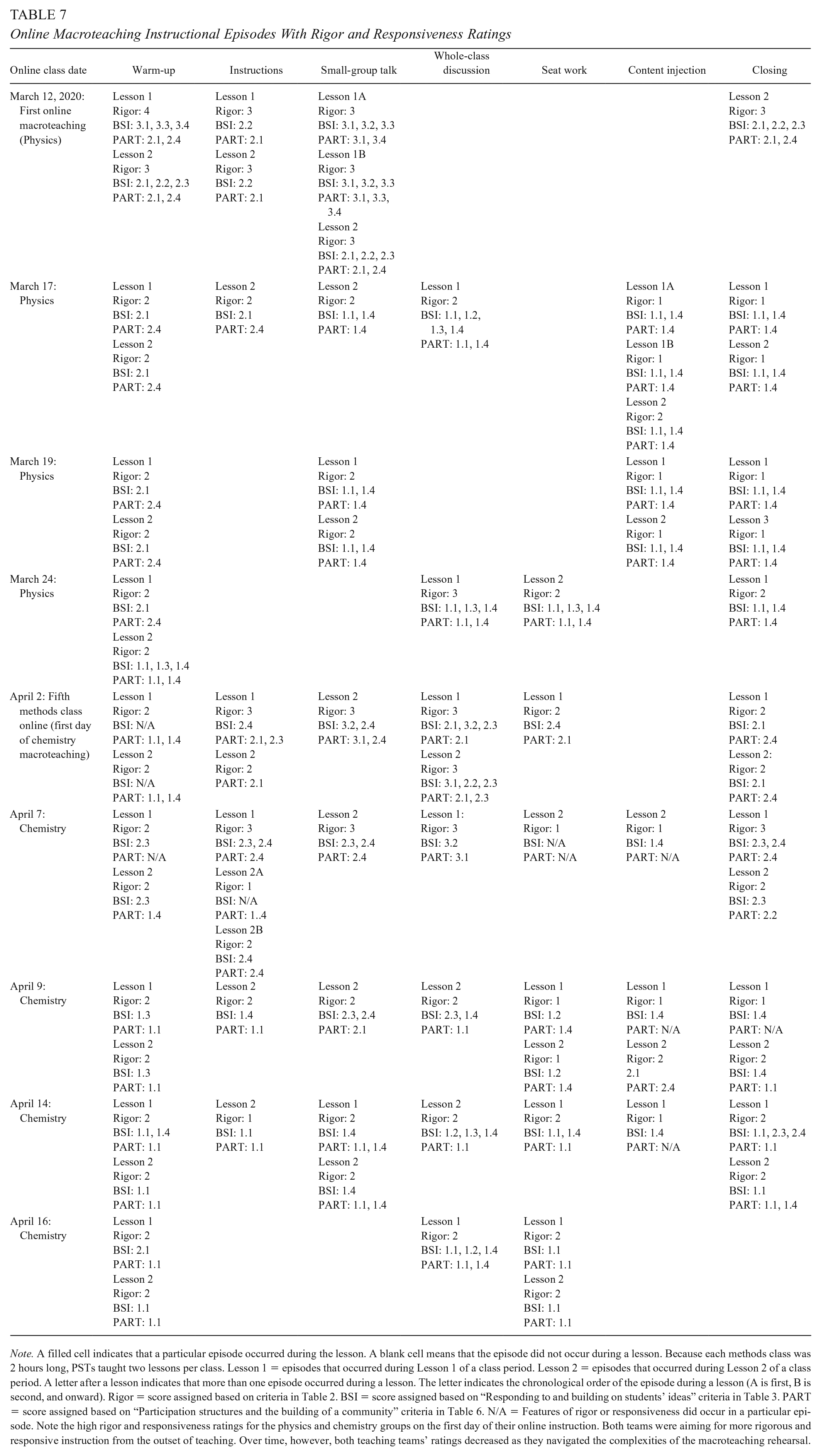
Note. A filled cell indicates that a particular episode occurred during the lesson. A blank cell means that the episode did not occur during a lesson. Because each methods class was 2 hours long, PSTs taught two lessons per class. Lesson 1 = episodes that occurred during Lesson 1 of a class period. Lesson 2 = episodes that occurred during Lesson 2 of a class period. A letter after a lesson indicates that more than one episode occurred during a lesson. The letter indicates the chronological order of the episode during a lesson (A is first, B is second, and onward). Rigor = score assigned based on criteria in Table 2. BSI = score assigned based on “Responding to and building on students’ ideas” criteria in Table 3. PART = score assigned based on “Participation structures and the building of a community” criteria in Table 6. N/A = Features of rigor or responsiveness did occur in a particular episode. Note the high rigor and responsiveness ratings for the physics and chemistry groups on the first day of their online instruction. Both teams were aiming for more rigorous and responsive instruction from the outset of teaching. Over time, however, both teaching teams’ ratings decreased as they navigated the complexities of the macroteaching rehearsal.
In terms of rigor, the physics and the chemistry instruction decreased from focusing on how and why a phenomenon occurred at the launch of each unit to asking students to describe what happened during a phenomenon. By the end of both units, the instructors became focused on students citing facts and definitions about a phenomenon, the lowest rating on our coding scheme for rigor. For example, the physics group initially pressed students to determine why radio telescopes on Earth received fast radio bursts at regular intervals from space (see March 12 in Table 7 for codes). During the first lessons, the physics group provided students with opportunities to consider how observable features of the phenomenon related to unobservable features and to justify their thinking with initial evidence and life experiences. However, as the unit progressed, the physics group became more concerned with covering content and ensuring that students stated correct information. By the end of the unit, the physics group shifted from a focus on ‘why” to a “what” focus in terms of rigor (see March 24 in Table 7 for codes). The chemistry group followed the same pattern: They began the unit with high rigor by asking students to explain why chemicals might make people sick (see April 2 in Table 7 for codes), but over time, they decreased the rigor and hoped that students might be able to recall information about chemical reactions (see April 16 in Table 7 for codes).
Similarly, responsiveness (in terms of “Responding to and building on students’ scientific ideas” [BSI] and “Participation structures and the building of a community” [PART]) decreased after initial attempts to create online classroom communities in which students felt safe and valued to share and build on each other’s science ideas. In both units, students’ initial science ideas that could have become valuable resources for the classroom community were elicited and publicized but never again used by the teaching team. For example, in the chemistry unit, the instructors asked students about a phenomenon of people becoming poisoned by mixing household cleaning products. One student, Jennifer, shared her story of a similar experience in the university chemistry laboratory in which she mixed chemicals, caused a potentially toxic gas to be created, and had to be decontaminated by the university fire patrol. This story triggered memories from other students who were in the chemistry building that day, recalled the evacuation, and wondered how a chemical reaction could clear out an entire campus building (see April 2 in Table 7 for codes). Jennifer’s story had the potential to shape the instructional team’s unit, and during the first lessons, PSTs engaged in features of responsiveness that rated highly on the coding scheme. By the end of the unit, however, the chemistry team “forgot about Jennifer’s story” (Michael) and instead focused on content coverage (see April 16 in Table 7 for codes). Thus, our analysis of classroom videos aligned with PSTs’ observations that their attempts at online macroteaching decreased in rigor and responsiveness over time.
Opportunities for Student Talk Decreased
Given the decline in rigor and responsiveness during online macroteaching, PSTs also noticed that student talk decreased in the Zoom setting. Our analysis shows that instructional teams may have contributed to the decline by enacting instructional episodes that provided fewer opportunities for student talk. Specifically, we found that episodes aimed at promoting talk, such as whole-class conversations, became less frequent over time. In addition, episode types that might limit possibilities for talk, such as content injection and seat work, increased in frequency during macroteaching. Some episodes that might promote talk, such as small-group conversations, were enacted across macroteaching lessons. Although such episodes remained consistent in terms of frequency of enactment, the decrease in rigor and responsiveness of the episodes limited opportunities for talk, thus shaping students’ participation. Importantly, PSTs’ observations and instruction aligned: A decrease in rigor and responsiveness (especially in terms of BSI and PART) indicated that students had fewer opportunities to talk about science ideas, which was the phenomenon reported by PSTs in interviews.
Discussion
This study occurred in the midst of a global pandemic that forced PSTs into an online setting, requiring them to make pedagogical decisions that they never anticipated or, as they noted, ever wanted to make. As the course instructors, we wondered how PSTs’ participation in an extended pedagogical rehearsal—macroteaching—might be shaped by the shock event of COVID. In this section, we make sense of the findings by noting that although COVID constrained PSTs’ participation, in another way, the pandemic helped strengthen their desire to enact rigorous and responsive instruction because they experienced teaching episodes that limited their opportunities to learn.
Rigor and Responsiveness Decreased
As noted, the rigor and responsiveness of instructional episodes decreased over the two macroteaching units taught during the COVID pandemic. Student talk became less frequent, teacher talk increasingly resembled Initiate-Response-Evaluate discourse aimed at moving a conversation in the teacher’s direction, and the overall science talk became more focused on facts than on explanatory conversations about phenomena in the units. Thus, the cognitive demand of the class decreased (Michaels & O’Conner, 2012). Although PSTs attempted to support conversations in which students might engage in rigorous and responsive activity, the reduction in participation constrained opportunities to hear and use students’ ideas as resources to shape instruction (see Manz & Suárez, 2018). Subsequently, instruction resembled “delivery pedagogy” (Stroupe, 2016), in which the teachers are the sole knowledge authority and their focus remains on controlling the classroom and covering curriculum (Duschl, 2008; Ford, 2012; Kennedy, 1999).
From a situative perspective, we offer a three-pronged explanation that emerged from the data for the reduction in rigorous and responsive instruction over the course of macroteaching online. First, PSTs engaged in pedagogical reasoning while simultaneously making sense of a new and rapidly changing instructional setting. Although the PSTs expressed disappointment that their participation dwindled and that their instruction drifted away from rigorous and responsive goals, they understandably made participatory decisions that focused on surviving and accepting the unusual and unexpected circumstances. PSTs could simultaneously envision how they wanted to participate in macroteaching but still chose to think and act in ways that decreased rigor and responsiveness over time, citing COVID—and, subsequently, the online setting—as the cause of their dual thinking.
Second, PSTs explicitly described how moving to an online setting constrained opportunities for using students’ ideas and experiences as resources to shape instruction, which is a hallmark of rigorous and responsive instruction. PSTs lamented that the online setting limited how much time they could provide students to talk, engage in activities, and make sense of puzzling phenomena. Without students’ ideas available, PSTs resorted to information delivery in the hopes of covering content deemed important during planning sessions. Even when students shared experiences that were immediately relevant to the unit (such as Jennifer’s story about the chemistry lab evacuation), such ideas were rarely elevated to the public plane of talk at the whole-class level or were lost in the chaos of online instruction. Although Zoom provided spaces for students’ ideas to exist, PSTs often used such spaces as storage sites rather than inscriptions to be leveraged for later lessons.
Third, as Philip et al. (2019) note, teaching practices are inherently relational. As PSTs described, the relational work of online instruction was different than the possibilities for building and growing relationships in person. In the online setting, the PSTs serving as instructors believed that they could not engage in hallmarks of rigorous and responsive instruction, which emphasize relational work, such as providing daily opportunities for students to reason through productive talk and making student thinking public and subject to consideration by the classroom community (Engle & Conant, 2002; Lehrer & Schauble, 2006). In the chaos of COVID, the PSTs attempting online macroteaching did not prioritize relational work, which ultimately limited opportunities for students’ participation.
Given the decrease in rigorous and responsive instruction and the reduction in PSTs’ participatory opportunities, we worried that PSTs might begin to express an interest in delivery pedagogies or would become disenchanted with teaching. However, all PSTs reported that participating in an online setting helped strengthen their desire to enact rigorous and responsive instruction because they experienced teaching episodes that limited their opportunities to learn; they recognized the tension between the instruction they desired to enact, and how COVID bounded their instructional opportunities during macroteaching. Further, PSTs expressed frustration that they could not enact teaching that aligned with their developing vision of rigorous and responsive instruction.
From a situative perspective, the tension expressed by PSTs between the instruction they wanted to enact and the instruction that occurred during COVID is not unique to this study. Teachers, regardless of setting, make pedagogical decisions during planning and in-the-moment interactions with students that reflect a constant conversation between a personal vision of instruction and learning and a setting’s implicit and explicit messages about what counts as success (Thompson et al., 2013). PSTs in this study made the decisions they believed were necessary to “survive” and “cope,” given the rapidly changing participatory circumstances. They balanced immediate needs of engaging in a pedagogical rehearsal in a drastically different setting with long-term goals of learning to teach. Importantly, their vision of teaching that they wanted to enact remained unchanged, even as rigor and responsiveness of the instruction declined. PSTs recognized that they could enact better instruction, and given a different setting that allowed for in-person interactions, they felt confident that they would make different pedagogical decisions that would result in rigorous and responsive learning opportunities for their students.
Conclusion
As teacher educators, we are deeply invested in supporting PSTs’ enactment of rigorous and responsive instruction through participation in extended pedagogical rehearsals in a practice-based preparation program. We worried that the COVID pandemic would stifle PSTs’ participation in macroteaching and disrupt the pedagogical learning opportunity. We conclude by noting that our worry was justified in one way—PSTs’ participation in macroteaching became less rigorous and responsive over time in the online setting. However, we were pleasantly surprised to learn that PSTs recognized the gradual decline in participation and voiced important ideas about how and why they wished that the online learning opportunities better aligned with goals of rigorous and responsive instruction.
As teacher educators, we know that COVID and other sociopolitical factors will continue to shift the landscape of teacher preparation. Thus, online teacher preparation may become more common and accepted as a medium for interaction and as a site of PSTs’ learning. Given the ever-shifting landscape of teacher preparation and the shock COVID provided all of us as teacher educators, we offer two “lessons learned” from our experiences. First, as teacher educators, we must represent the adaptation of learning opportunities to PSTs, who notice our words and actions. Although COVID forced us into “survival mode” alongside PSTs, we talked about our pedagogical decisions on the public place of interaction so that PSTs could listen to our reasoning. These public displays of pedagogical reasoning may help PSTs as they begin to consider their upcoming planning, teaching, and reflecting. Second, PSTs in our class supported each other’s attempts at rigorous and responsive instruction because they cared about each other’s learning. Therefore, as teacher educators, we must purposefully design opportunities for PSTs to build a collaborative community so that they are invested in each other’s success, regardless of the setting in which they interact.
We are left with two lingering questions for the field to consider about practice-based teacher preparation and supporting PSTs as they learn about rigorous and responsive instruction. First, PSTs attempting rigorous and responsive instruction during extended pedagogical rehearsals may face substantive hurdles when teaching online. Given the relational work inherent in rigorous and responsive instruction, and given how online settings change how humans interact from in-person settings, can (and should) practice-based teacher preparation occur entirely online? Second, we, like many teacher educators, wonder about PSTs’ next steps as teachers, given the COVID-induced shock to their preparation program. Because PSTs were forced into a setting that did not support their emerging ideas about teaching and their participation in rigorous and responsive instruction, will they be more likely to push themselves to enact rigorous and responsive instruction during their first years of teaching? Will they be more attentive to student participation because they noticed how instruction and participatory structures are linked and can decline rigor and responsiveness in tandem?
We conclude by reminding ourselves, and readers, about PSTs’ extraordinary effort to enact rigorous and responsive instruction despite the dire circumstances. The COVID-19 pandemic shaped their participation, physical and mental health, and learning opportunities in ways we may never fully comprehend. We extend our immense gratitude to the PSTs in this study who did their best to learn, to grow as a community of colleagues, and to support each other through a terrible time.
Footnotes

Authors
DAVID STROUPE is an associate professor at Michigan State University. He is interested in how to better prepare science teachers to disrupt epistemic injustice and provide students with opportunities for epistemic agency.
JULIE CHRISTENSEN is a doctoral candidate in the Department of Teacher Education at Michigan State University. She is interested in supporting teachers’ enactment of equitable and ambitious pedagogy.