




Abstract
The notion of belonging is an often-referenced but under-theorized concept in studies of school organization. The purpose of this study is to examine the politics of belonging in schools and accompanying implications for how schools are organized and led. This research employs an autophotographic methodology. Student participants took photographs across 2 years of data collection of spaces where they did and did not “fit in” and participated in interviews to explain their photographs. Students identified four themes in their photographs regarding their sense of membership at school: (a) the importance of spaces where belonging is noncontingent; (b) the distinction between calm spaces and surveilled spaces; (c) anxiety in public, “wild” spaces where no help was available; and (d) generally positive but mixed impressions of teachers. An increased understanding of organization leadership for belonging is linked to numerous other timely concerns in educational administration, including equity and inclusion.
Beginning in the 1990s, researchers began to pay close attention to students’ sense of belonging and its impact on students’ learning (Battistich et al., 1995; Goodenow, 1993). In the last decade, however, this attention has waned, and a recent review notes “a paucity of interventions that intentionally aimed to develop adolescent school belonging” (Allen et al., 2022, p. 229). This study attempts to reenergize this focus by including attention to the politics of belonging in school and pointing to the leadership implications for how school organizations establish conditions and boundaries of belonging. Our study examines this question: How do students “visualize” and reflect on their emotional experiences of belonging and not belonging in school? Using photographic and interview data obtained from students, we situate their observations in the ecology of the school environments, pointing to the ways in which adult policies and decisions affect students’ relationships with teachers and peers.
Belonging in School
Although a complete accounting of the literature on school belonging is beyond the scope of this paper, understanding the core of what has been said about school belonging is important to developing an understanding of leadership for belonging. Slaten and colleagues (2016) have undertaken a comprehensive review of the literature on school belonging. They trace the original concept back to Maslow’s (1943) hierarchy of needs and to Baumeister and Leary’s belongingness hypothesis, which states that “human beings have a pervasive drive to form and maintain at least a minimum quality of lasting, positive, and significant interpersonal relationships” (2017, p. 497). These conceptualizations of belonging in general are linked to multiple ways of defining and conceptualizing school belonging. Such school-based explorations of belonging have been grounded in sense of school community (Osterman, 2000), student engagement (Finn, 1993), and social identity (Hamm & Faircloth, 2005). Although the precise definition of school belonging remains contested, the most widely used definition, according to Slaten and colleagues (2016), is “the extent to which students feel personally accepted, respected, included, and supported by others in the school social environment” (Goodenow & Grady, 1993, p. 80).
The five factors consistently associated with increased levels of school belonging are a positive school climate, students’ sense of safety, caring teachers, parental support, and positive peer relationships (Allen et al., 2022; Slaten et al., 2016). Although each of these factors contributes to school belonging, research has found that the particulars are more complex (Slaten et al., 2016). For example, in schools with a more widely shared sense of belonging, the negative mental health effects experienced by students who do not share this sense of belonging are more profound than in schools in which the overall sense of belonging is more moderate (Anderman, 2002). Furthermore, although peer relationships, teacher relationships, and school climate are all associated with a stronger sense of belonging and accompanying academic and behavioral benefits, when controlling for teacher relationships and school climate, stronger peer relationships are associated with greater misconduct (Demanet & Van Houtte, 2012; McNeely & Falci, 2004). In short, schools with stronger bonds of belonging are better for those who feel that they belong but worse for those who feel excluded, and ceteris paribus, stronger peer relationships may be a less desirable substitute for a sense of membership in school as a whole or closer relationships with teachers.
Recent scholarship has found that one important factor is the difference between the extent that one expects to belong and the sense of belonging experienced and that people have greater expectations of belonging in places where people who share their social identities are assumed to be (Murphy & Zirkel, 2015; Thau et al., 2007). Evidence suggests that a sense of belonging is more strongly linked with educational outcomes in students from marginalized backgrounds because of stereotype threats and other social stigmas faced by these students (Murphy & Zirkel, 2015). Finally, research suggests that students’ sense of belonging has persistence even when organizational settings change: Students who did not experience belonging in high school are similarly less likely to experience belonging in postsecondary institutions, even after controlling for other demographic and relationship factors (Pittman & Richmond, 2007). Belonging is complex and multifaceted—it has different levels of importance to different groups of students.
Educational Leadership and Belonging
Although many studies of educational leadership take belonging as a worthwhile aim for school leaders, fewer have focused on leadership for belonging as such. Understanding the leadership role in how belonging in school organizations is generated and sustained bears on questions of equity and quality. For example, scholars have found that for students from marginalized groups, belonging is often a touchstone for social and academic relationships in school, and lack of belonging leads to broader deleterious effects on social development and academic performance (Curry, 2016; Valenzuela, 1999). Several conceptualizations of educational leadership, including ethical educational leadership and educational leadership for social justice, have adopted increasing belonging as a core tenet of their normative descriptions of leadership, but few have grappled with theories of belonging as such. Riley (2013, 2017, 2022) is an exception: She has taken leadership approaches to promoting belonging as central to her inquiry. Riley (2013, 2017) argues that for students, schools are a locus within their social lives that are situated within their broader life experiences and within the community. Students with different experiences understand what it means to “belong” in different ways that are shaped by those experiences, and a central role of administrators is to act as “place leaders and place-makers who can help make belonging work for many different people” (Riley, 2017, p. 7). For Riley, school leadership that produces belonging involves an intense focus on the particularities of students’ experiences (2013). Riley suggests that leaders ought to aspire to “leadership of place,” which draws on the voices and experiences of students to generate school as a place where students can find their place in the world (2013, 2017). We believe that this study elaborates Riley’s (2017) normative account of the importance of belonging-focused leadership with insight into the process and politics of how school organizations generate belonging.
Theories of ethical educational leadership have incorporated questions of belonging as well, particularly theories of caring school leadership (Louis et al., 2016; Walls, 2020) and theorizing regarding the ethic of community (Furman, 2003, 2004). Scholars of caring leadership have recognized that leaders play an important role in establishing conditions for care that enable and constrain belonging (Louis et al., 2016). Among school adults, leaders also play an important caring role by buffering staff members from external expectations in ways that help them feel a sense of membership and agency in the school (Walls, 2020). Furman’s (2003, 2004) ethic of community also foregrounds questions of belonging by exhorting scholars to consider school community as a more-or-less inclusive process rather than as a social configuration. Such a processual community ethic involves processes for full participation, deliberation, dialogue, and the common good, with the views and needs of multiple stakeholders considered (Furman, 2004).
Scholars of social justice leadership have identified school belonging as a goal and an outcome of social justice leadership practices. For instance, Theoharis and O’Toole (2011) posit that leadership that emphasizes inclusion for English language learners can be generative of a pathway to belonging for those students. Evidence suggests that students who believe that administrators are acting as social justice leaders feel a stronger sense of belonging in school (Canli, 2020). Wang (2018) cites Noddings in arguing that social justice leaders foster “a strong sense of belonging, of collective concern for each individual, of individual responsibility for the collective good, and of appreciation for the rituals and celebrations of the group” (1996, pp. 266–267). However, focusing on belonging can also cause leaders aspiring to social justice to become too insular and inward-looking rather than aspiring to more participative forms of leadership and advocacy (Woods & Roberts, 2016). In an ethnographic study, Shirazi (2018) details how investments that schools make in equity policies designed to promote belonging are often counteracted by other organizational actions (e.g., limits on student groups) that complicate and undermine students’ sense of how inclusive or welcoming the school is to people like them. His study finds that the way that one urban high school established several universally accessible forms of belonging also made other avenues of belonging inaccessible, rendering the school’s program incoherent to students due to these inconsistencies. Shirazi (2018) comes closest to grappling with the organizational politics that leading for belonging generates, but there is still much room for further inquiry. An emphasis on school belonging is a part of the scholarship on social justice leadership, but it is not the central focus.
Theoretical Framework: The Politics of Belonging
We frame our analysis by adapting Yuval-Davis’s (2006, 2011) politics of belonging. It is useful to think of schools as polities where democratic community is an aspiration (Crow & Slater, 1996; Slater & Boyd, 1999) that affects students (Hope, 2012). It is therefore also useful to distinguish between belonging and the politics of belonging. Yuval-Davis (2011) suggests that belonging is akin to “feeling-at-home,” whereas the politics of belonging are “the dirty work of boundary maintenance” (Crowley, 1999, p. 15, quoted in Yuval-Davis, 2006, p. 204). Yuval-Davis’s theorizing about the politics of belonging is rooted in political science and draws on Anderson’s (1983) concept of “imagined communities,” which suggests that community is often an abstraction because many members of the community will never meet or interact with one another. In schools, students and teachers are likely to interact with a higher proportion of other people in the school, but the research on belonging nonetheless suggests that most students form their feelings of belonging based on a limited number of peer and teacher relationships as well as a more abstract sense of membership in the school (Slaten et al., 2016).
Yuval-Davis (2006) argues that to understand the politics of belonging, we must understand that membership also implies an associated bundle of rights and responsibilities. At different times, different actors may shape access to these rights and responsibilities in broader and more limited ways. For example, such social identities as race, ethnicity, or place of residence are inflexible ways to limit membership, whereas language or culture are more flexible. Most flexible of all are commitments to a common set of values. We posit that the organizational politics of belonging in schools can be understood via the levels of flexibility and inflexibility identified by Yuval-Davis. Figure 1 displays some basic ways one might think about the flexibility of belonging in schools.
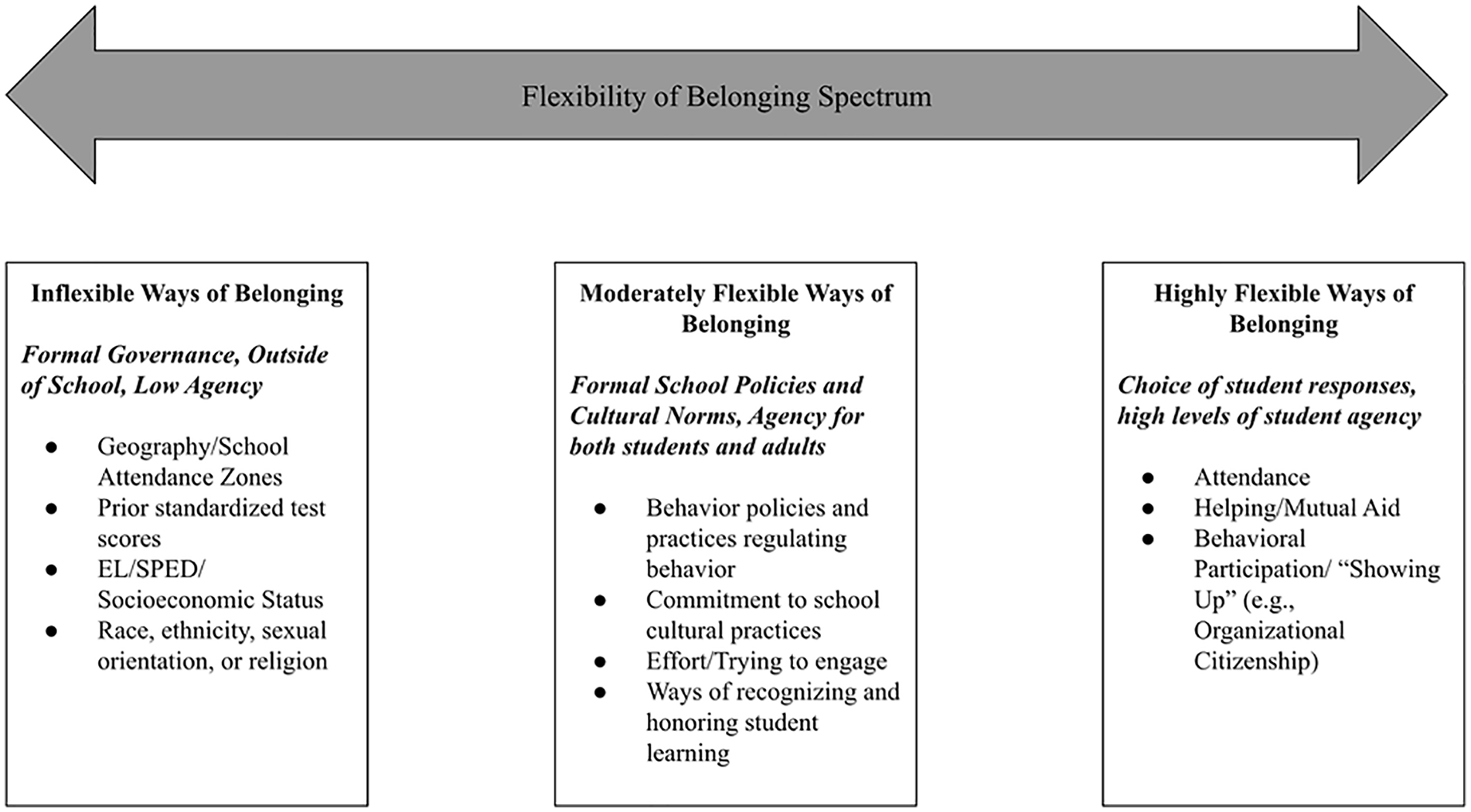
Flexibility of Belonging Spectrum.
Figure 1 represents a provisional and theoretical adaptation of Yuval-Davis’s politics of belonging to educational settings, but we wish to suggest several additional propositions to this adaptation. First, we reason that the most inflexible ways of belonging are those that involve formal governance or policies set outside the school. Often, neither students nor school adults have much formal influence over these policies. Second, the moderately flexible and highly flexible are areas where students and adults in the school have some level of agency and therefore implicate the micropolitics of the school (Achinstein, 2002; Ball, 2012). As Waller (1932) observes, schools are in a state of “perilous equilibrium,” with authority ultimately resting “upon the consent, mostly silent, of the governed” (p. 12)—that is, students. As a group, students have considerable agency over how belonging, inclusion, and exclusion play out in schools. Indeed, significant research attention has been paid to how schools have sought to manage the inclusion of student perspectives (Mitra, 2008, 2014).
Thus, in addition to formal governance over which school actors have little control, the moderately flexible politics of belonging also includes school-level policies of inclusion and exclusion, such as discipline (Jones et al., 2018), dress code (Knipp & Stevenson, 2021) and ability grouping (Worthy, 2010), over which there may be contests and disagreements. Furthermore, the cultural norms of the school around race, gender, and other social distinctions are important to students’ sense of belonging and subject to political contests (Cookson, 2015; Huyge et al., 2015; Ulichny, 1996). Finally, more subtle practices regulate boundaries and spaces—questions of who gets to be where, when, and with whom (Mauldin & Pressberry, 2020; Riley, 2017; Walls, 2021). The aspects of belonging with the highest degree of flexibility primarily comprise student responses and commitments in the ways that students (individually and collectively) can exercise agency.
Methodology and Research Design
This study uses an autophotography approach (Noland, 2006). Autophotography involves asking participants to take photographs based on a prompt and using the photos as data for analysis. Autophotography differs subtly from photo-elicitation (Harper, 1986; Walls & Holquist, 2019) because although photo-elicitation interviews use the photographs as a jumping-off point for the subject of interest, in autophotography, the interviews are more limited in scope to discussions of the photographs and their meanings. Autophotography is useful in capturing the perspectives of young people because “it offers . . . a way to let participants speak for themselves” and choose the images that “participants themselves believe best represent them” (Noland, 2006, p. 1).
Autophotography is also a useful approach when one is trying to capture the social meaning of spaces and places (Lombard, 2013). In the past, autophotography has been used to study such topics as homelessness (Johnsen et al., 2008; Lombard, 2013), mental health (Glaw, Kable et al., 2017), the lifeways of the elderly (Kohon & Carder, 2014; Phoenix, 2010), and how youth interpret social class (Ziller & de Santoya, 1988). Autophotography allows participants to affectively represent the important spaces in their lives through their images. In short, autophotography grants additional agency to research participants by emphasizing their “showing” in the balance of showing and telling that characterizes presentation of research data (Phoenix, 2010).
School Site and Context
The participants in this study came from a single suburban middle school. This middle school is in a historically middle-class area and is a 15-minute drive from the downtown core of a large city. Although historically comprising mainly White students and with low incidence of poverty in the community, over the past 15 years, the proportion of racially and ethnically diverse students in the community as well as the number of students who qualify for free or reduced-price lunch have grown. At the time of data collection, slightly more than 30% of the student body were students of color, and just under 30% qualified for free or reduced-price lunch. The teaching staff are experienced: Teachers at the school have a mean of 16 years of total experience and a mean of 12 years of experience at the school itself.
Study Participants and Data Collection
The data collection for this study took place during the 2016–2017 and 2017–2018 school years. The prompt given to students to direct their photography across both years was the same: Students were instructed to “take pictures of places in the school where you feel like you belong or ‘fit in’ and places in the school where you do not belong or ‘fit in.’” Students used the cameras on the researchers’ tablets to take their pictures, and teachers in the school were made aware that students might be walking around the school to take pictures on days when data collection occurred, although students were told not to disturb classes in session. During the first year of data collection, five students (two eighth graders and three seventh graders) took photographs. During the second year of data collection, we made the decision to limit data collection to only seventh graders so that we could be confident that participants were taking classes from the same teachers and interacting frequently with the same group of peers. Furthermore, seventh-grade students were in the “middle” of middle school—they had already learned something of the politics of belonging at the school and how they would use personal agency to navigate those politics. We gathered perspectives from six students during the second year of data collection. In total, these 11 participants took 54 photographs, for an average of just under five photographs per student. No student took fewer than three photographs or more than seven.
During both years, we worked with the seventh-grade teaching team (and, during Year 1, the eighth-grade teaching team) to identify a cross section of students spanning not only demographic factors (i.e., race/ethnicity, gender, qualification for free or reduced-price lunch) but also the ways in which students “show up” in class: students who are outspoken and shy, students who do well in classes and less well, students whose behavior teachers find challenging and students whom teachers find to be well behaved. We recognize that one limitation is that teachers may have had mistaken or biased ways of recommending students for the study, but we tried to speak individually with teachers to gather multiple perspectives. In all, our sample comprised three boys and eight girls, two students of Asian descent who were the children of immigrants to the United States, two Black students, and seven White students. Three of the 11 students in the sample qualified for free or reduced-price lunch.
We interviewed students about the photographs they took by using open-ended interview prompts (e.g., “Tell me about this picture?” or “Why did you take this picture?”) immediately after they took the pictures. We treated the discussion of each picture as a self-contained story that was interpreted intersubjectively within the context of the interview (Kvale & Brinkman, 2009). One strategy for doing this was to keep our follow-up questions as short as possible to avoid suggesting our own interpretations of stories (e.g., “How did you feel about that?” or “What happened next?”). In all, interviews lasted between 28 and 49 minutes.
Data Analysis
As Phoenix (2010) notes, analysis of autophotography data, like all data analysis, “addresses the identification of essential features and patterned regularities in the data, and the systematic description of interrelationships among them” (p. 169). All autophotographic studies begin with a process of categorization and content analysis of the photos themselves. For example, Ziller and de Santoya (1988) categorize the content of photos by their environmental (place/setting), social, and self-concept (affect, beliefs about self) dimensions. This initial examination of categories and themes is understood as participants’ collectively “speaking” their experiences through photographs (Glaw, Inder, et al., 2017; Johnsen et al., 2008).
From this initial categorization and content analysis, analytic techniques diverge. Those scholars writing from the traditions of social psychology often undertake formal statistical analysis of how different subgroups of photographers represent the topic in question (Ziller & de Santoya, 1988). Other scholars, typically writing from a more anthropological or sociological disciplinary lens, apply a more inductive approach to analyzing photographic content (Noland, 2006). In addition, researchers may choose (as we did in this study) to speak to participants to develop a better qualitative understanding of what participants photographed and why and then code this interview formally as qualitative data (Noland, 2006). The purpose of these interviews is to add texture to the meanings conveyed by the photographs themselves (Glaw, Inder, et al., 2017).
We followed a modified version of Glaw, Inder, et al.’s (2017) analytic steps for autophotography studies. First, we applied descriptors of content to each photo, such as whether it was taken in a classroom or a different school space, or whether it contained teachers, other students, or no people at all. We tabulated how frequently photos showed each of these attributes. Second, we noted the evident emotional valance and brief meaning of each photograph. In some cases, these meanings were evident from the photographs themselves (e.g., a picture of a classroom celebration). In other cases, we looked to participants’ verbatim description of why they took a photograph. For example, one student photographed an empty stairwell and described it as a place where “we don’t always get along on that stairwell, and sometimes high schoolers say mean stuff to the middle schoolers.”
Third, we more fully analyzed participants’ descriptions of their photographs by using inductive open coding (Saldaňa, 2013). Although participants used their photographs as a basis for their description, they often subsequently branched into more general categorizations and explanations of their sense of belonging in schools. We coded these explanations with the intention of combining photographs and more elaborate descriptions of participants’ thinking and feeling into themes. Fourth, we examined the codes that emerged from our analysis of interviews and the meanings of photographs to identify themes that were well represented among multiple participants and across photographs and spoken descriptions. We gave these themes “in vivo” names to describe the ideas behind them. For example, in describing how common it was for peers to reciprocally help each other in small ways, one student spoke of letting peers in from the cold through a locked door: “If somebody’s out there, they’ll go let them in.” Finally, we examined relationships among themes. In most cases, this evaluation involved a combination of analyzing the frequency of photographic content (i.e., how often peers appeared in pictures vs. the students themselves) and analyzing the way that research participants described each group/category.
We followed Shenton’s (2004) guidance with respect to trustworthiness based on credibility, transferability, dependability, and confirmability. To demonstrate credibility, we took several steps. The first author spent approximately 130 hours in the school, doing background observations and observing the culture of the school to be visible to students and “to gain an adequate understanding of an organization and to establish a relationship of trust between the parties” (Shenton, 2004, p. 65). We also chose autophotography as a method to help students feel comfortable being more honest and forthright in their descriptions and facilitate representing their experiences in their own terms. The authors engaged in interpretive discussions with one another during data analysis and checked our meanings and interpretations with participants. We gave a fulsome description above of the school and the student participants to help readers understand the circumstances to which this analysis is (and is not) transferable. Finally, we gave an accounting of our data collection and analysis procedures in a way that we hope demonstrates dependability and confirmability to the reader.
Limitations
The primary limitation of this study is that it is not generalizable; the results must be interpreted in the context where they occurred. We have sought to describe the setting and culture of the school in the findings so that other researchers may understand the extent to which these findings apply to their own research contexts, but it is altogether possible that conducting an autophotographic project with students at a different middle school would yield a quite different set of concerns. Furthermore, the data collection for this study occurred prior to the COVID-19 pandemic, and we expect that how students think about belonging may have changed during their experiences with virtual schooling. Additionally, in the years following data collection in this study, the influence of photo- and video-based social media has only grown, which may lead to changed ways that youth represent belonging via these mediums (Smith et al., 2021). Finally, we relied on teachers to help us select the students for this study, and although we sought to collect insight from multiple teachers, it is possible that they nonetheless pointed us to students who had systematically different views of belonging than did the student body as a whole.
Themes in Students’ Autophotographic Representations of Belonging
Here, we present four themes that emerged from our analysis of photographs and their accompanying descriptions. The results represent the penultimate step of our data analysis, although we also refer to earlier stages of our analysis (e.g., tabulating how often different areas are shown in photos, describing the emotional valence of photos) in our descriptions of these themes. We present some initial findings about the relationships among themes and implications for leadership for belonging in our discussion section. Throughout the presentation of these findings, we have sought to include a substantial selection of the photographs taken by students, as these photographs were the primary meaning-making tool through which our understandings in this study were constructed. Consequently, 12 of the 54 photographs (22%) are displayed in the section that follows.
One overlying note we wish to make deals with the language that students used to describe belonging or lack thereof. Although we consistently prompted photographs by asking students to take photographs of places where they “fit in” or belonged and places where they did not “fit in” or belong, students almost never described belonging with these words in their interviews. The most common descriptor by far of places where students felt that they fit in was “safe” or “unsafe”—26 of the 54 total photographs were described with these terms. A second common descriptor applied to spaces designated to particular people (e.g., a classroom, the main office) was whether the people in those spaces were “understanding”—this descriptor was used for 18 photographs. Another common adjective, used in relation to 12 photographs, was whether people (whether particular people or people in general) were “nice.” Another seven photographs referred to whether a space was “calm,” while five referred to whether a spot in the school was “comfortable.” These were the primary axes along which students evaluated belonging in the school.
Theme 1: Students’ Expectations of “Universal” Rather Than “Contingent” Recognition
It was clear that in some realms of school life, most students expected effort or simple participation to be recognized rather than quality. For example, two different students took pictures of the gymnasium as places where they felt like they “fit in” because allowances were made for different skill levels and students tried to help one another improve. As shown in Figure 2, one student, Niall, said, “And that’s our gym, and it’s very nice, and even though people are at different skill levels with all the sports we do in gym class, it’s still people accept[ing] each other and try[ing] and help[ing] each other get better at whatever we’re doing in gym class.”

Belonging in the Gym.
Another aspect of the school where students felt that judgment or “making fun” should be proscribed was in making art. Four students, all girls, took pictures having to do with either art class or art that was on display. Notably, three of these four photographs dealt with breaches of belonging and a sense that students or adults were unfairly or inappropriately judging the work of others. Sandra (describing Figure 3) felt that her teacher was unfair in judging the quality of her work:
There’s another picture of a room I took, and in there I feel like the teacher judges me a lot based on my art style and because of a mistake I made in sixth grade, and she hasn’t taken a liking [to] me that much, and she favorites a lot of other students and really skims over my work. I worked really hard [on] this project, and she graded me very poorly on how hard I worked. And then she hasn’t really—even now, she doesn’t like me very much. Yes, and I really want to like her class because I really like art, but I just feel like she judges me a lot based on the style I draw sometimes and just because of one thing I said last year.
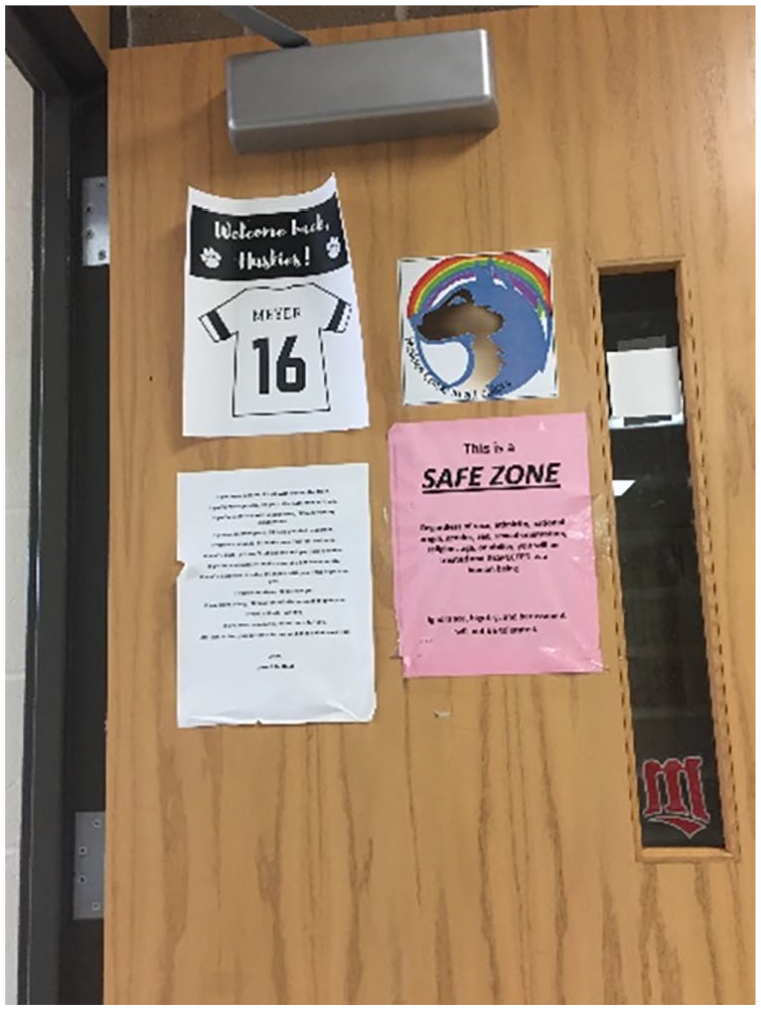
Apprehension in the Art Class.
Another student (describing the photograph in Figure 4) took issue with students being mean regarding other students’ artwork that was on display:
Those are the, I don’t know, I think that’s seventh-grade art. I [took] a picture of that because sometimes in the hallways, people say mean things about other people’s artwork. I get here early in the mornings so that sometimes there’ll be like five or six of us, and we’ll look at the art, and sometimes people say mean stuff. I wish they wouldn’t, but I don’t know what to say.

Seventh-Grade Artwork.
For these students, in at least certain areas of school life, one important element of belonging appears to be that attempts to make art or learn new physical skills are recognized more than the quality of the outcome. One inherent sense of safety for these students is their freedom to try things out without the judgment of either teachers or peers, which seemed particularly important to the girls in this study. Another student took a photograph of an empty display case and remarked, “It’s kind of sad and gloomy—they should just put something in it because we are making stuff all the time. But they just don’t have anything there, and I think it’s just kind of weird. It’s just empty.” This student wanted her peers to be recognized simply because of the day-to-day work that they all do.
Theme 2: Distinctions Between Calm Spaces and Controlled/Surveilled Spaces
One occurrence during the second year of the study that five of the six students took pictures of and commented on was the implementation of a gender-split assigned seating system in the lunchroom. None of the students preferred the new assigned seating system, but only one of the six students complained that the problem with the system was that he did not get to sit with his friends. For the other five students, the primary problem that they saw was that the change did not solve the underlying problem that it was supposed to solve. As one student explained:
Recently, we have been split up into tables of six girls or six boys. I guess some of the people who [are] there can sometimes be really rude to you and sometimes can be nice. Well, the person there who watches over us and all said that we were too noisy and too loud. I don’t really think that that was the case. Really, it’d be one table that would be extremely loud. I would understand why she would want to do that, but the rest of the tables, I guess, were fine with their group. Recently everyone got split up so we would keep our indoor voices and all that. But it was just one table, but it wasn’t the whole cafeteria. I don’t think everyone deserves to get split up if there’s one table, one group of people who keep causing it.
Another student (describing the photograph in Figure 5) closely echoed these comments when she said:
The lunchroom is not my favorite. It’s not my favorite place. Because there are kids that are yelling, and they will fight. They started separating us so there [are] going to be only six people [at a table]. All the boys were towards the front. All the girls were towards the back on our side. I didn’t really like that because most of the kids weren’t really doing anything. And they could have dealt with it when it was a certain group of people instead of everyone. And kids are still fighting. They will start pushing each other around or throwing food. I’m far away, but I can still see it happening. Most kids are pretty nice, but there are certain groups of kids that’ll fight and not behave.

A Quiet Cafeteria.
For these students, the approach of school adults to trying to make the lunchroom quieter represented an increase in control and surveillance without any accompanying reduction in noise or increase in sense of safety. Put differently, it substituted solving the problem with a system intended to solve the problem.
Students did value places that were calm, where they could relax by themselves and with peers. In total, eight of the 54 pictures taken by students were of places that were particularly calm. One such place was the library, which was represented in two pictures. As Niall noted (regarding Figure 6):
This is the library, so it’s another calm spot. The staff help you a lot in there, trying to find books that you might want if you’re stuck trying to find a good book. They help you if you need somewhere to study—it’s a good place to go. It’s quiet in there. There’s tables set up. It’s just a good all-around kind of relaxing space.

The Calm of the Library.
Both Black students in this study took pictures of a hallway just outside the cafeteria. They described the cafeteria as feeling quite chaotic but liked this space because it represented a place where they could relax. As one eighth-grade student explained (regarding the photograph in Figure 7):
It’s sort of like a link between the elevator and the vending machines and the foosball, and there’s a corner right there, and there’s a wall, and after lunch my friends normally go to that corner, and there’s a wall so, like, no one will know we’re there, so it’s sort of our, like, secret hideaway. We’re normally there, like, playing music, talking, or, like, snapchatting. . . . [M]e and my friends normally go to the vending machines and get, like, stuff from the vending machines and just eat there and talk and just be friends.

A “Secret” Hideaway.
Having spent time in the school, we can attest that this area is not really “secret,” but for these students, the ability to have a space that was calm, social, and not subject to continuous surveillance helped them feel a stronger sense of belonging. In contrast, both students had terribly negative experiences in the cafeteria and pointedly described disagreeing with adult supervisors about how to solve problems of noise and student conflicts during lunch. Other students also described feeling like they belonged and “fit in” in spaces where they could “hide in plain sight.” For example, two students took pictures of slightly occluded places in the hallway where they could be with their friends before and after school. Furthermore, in the first and second years of the study, students took photographs of the main entrance of the school and described it as a calm place to relax with friends.
Theme 3: Unsupervised Encounters and Lack of Help in the “Wild”
Although students enjoyed finding calm spaces where they were minimally supervised and could relax with their friends, busy public spaces, such as hallways, were uncomfortable and not places where students felt a sense of belonging. Students described these spaces as being hectic, rushed, and where not many people would stop to help. In all, eight of the 54 photos (15%) were of hallway spaces, and all but one was described negatively. One student described the hallway (depicted in Figure 8) this way:
I took [a] picture of the hallway—it’s basically, if you don’t know how to do something, there’s not many people who can help you, and it’s just time to just grab your stuff and go to your next class. It’s a little bit less comfortable because not many people will stop to help you if your locker is stuck or anything.

No Help in the Hallways.
The middle school where this study was conducted shared a building with a high school. Although students were largely kept separate, there were a few “borderlands” in the hallway where students from both schools regularly crossed paths, and these were sites of tension for the middle school students. As one seventh-grade student said (of Figure 9):
I was trying to get a picture without the high schoolers really seeing that I was taking pictures of them, but the high school hallways, I don’t really feel safe there, because a lot of them swear or they’re shoving people. It’s just really crowded in the hallways there. Some of them are making fun of the middle schoolers. Some of them are not always nice. To go to lunch and then gym and then choir band, you have to go through the high school hallways. The middle school hallways are better. They’re less crowded, and some kids swear, but not all of them. There’s just more room, and kids aren’t shoving each other.

The High School Hallway.
Two students also took pictures of bathrooms as uncomfortable spaces, either because they were unsafe or because they were unpredictable. As one student noted (regarding Figure 10):
I took a picture of the bathroom because every time I go into the bathroom, it’s somehow weird going to the bathroom—you feel unsafe because anything could happen at that moment. Someone could shut the lights off. Or someone could be in there making a mess or waiting to do something bad to you. At school, there’s a bunch of people in here, and I don’t know half of those people. You never know what could happen. But if one of my friends were there and just like, "Yes, it’s okay." When my friends are there, it feels safe.

The Unpredictability of the Bathroom.
The antithesis of the unpredictability of the hallways and the bathroom was the main office. Five students took pictures of the main office, and four of the five described the main office as a positive space. Most students felt similarly to the seventh-grade student who said:
Well, you’re looking at the office, which is right next to you. The reason I took the picture is it’s the one place to be to feel safe because there’s teachers. If you’re ever in trouble, there’s nothing to be scared about because teachers are there. They’re going to calm you down. They’re going to talk to you. They’re going to help you out.
This overall sentiment of the main office being populated by helping adults who could calm students down and help get them out of trouble seemed steadying when contrasted with the uncertainty of public spaces with little adult help or supervision.
Theme 4: Generally Positive but Mixed Impressions of Teachers
Of the 54 photographs that students took, students spoke about teachers in explaining 35 of them. This is more than the number of photos that prompted students to talk about friends (23 photos). And, of the 54 total photographs, 32 of them were of classroom spaces (the interior or exterior of classrooms). Further breaking down these 32 photographs, the description offered by students for 24 photographs had a positive emotional valence, six photographs had a negative emotional valence, and the final two photographs had a mixed-emotion valence (e.g., one student said, “In the art room, I feel safe [but] I don’t, it’s in between.”).
In general, students who described teachers or classes in positive terms said that teachers made them feel “safe” or “comfortable.” For example, one student noted (about Figure 11), “I had this teacher for Technology Class first semester, and [he] would make me feel safe. He came to one of my dance shows. If we told him about performances we had, he would try and come, and he came.”

The Door to Technology Class.
Another student shared a picture of his language arts classroom and said, “I feel safe there, because Mr. M, he’s just really nice, and I feel safe around him. Just the environment feels safe. You don’t feel scared when you’re in there. You feel you can just learn easily.” In other cases, the teacher was described (as a student said about Figure 12) as “nice,” and this in combination with friends and a positive classroom environment produced a sense of safety:
It’s the social studies room in seventh grade. It’s Ms. O’s room. It’s pretty safe. If I go into it there, I feel really happy because there’s friends, [and] the teacher’s really nice. It’s really a happy place to be. I feel that way because of my friends and how there’s—I love to be outside in nature. There’s big windows, and every time I look outside, it makes me feel happy, and everything like that.

Ms. O’s Room.
However, for each of the three preceding teachers and classrooms highlighted by students, at least one other student felt a diminished sense of comfort or safety about the same teacher or classroom. Most students felt positively about most of the classroom pictures that they took, but four of the 11 had negative feelings about at least one classroom, and different students experienced the same classroom in different ways. More than half of the students echoed the sentiments of one student (describing Figure 13), who said that they felt a general sense of comfort in classroom because teachers were in the classroom interacting with students and enacting a plan for their time together: “This is a classroom. I feel more comfortable in there because the teacher’s in the classroom and talking to all the students, and there’s a plan for what you’re supposed to do. It could be any classroom, but I just took a picture of an empty classroom.”

“Any Classroom”.
One of the reasons most of the students in this study described most classrooms as places of safety and comfort seemed to be because they were fronted by adults who were trying to give purpose and meaning to students’ time together.
Organizing for Belonging: Discussion and Implications
We provisionally adapted Yuval-Davis’s framework (2006, 2011), focused on the politics of national belonging, to focus on the politics of belonging in schools for the purposes of this study. We found that viewing students’ photographs and interpretations through the lens of more and less flexible and accessible notions of belonging was a fruitful way to understand their perceptions of safety and membership. The tensions they surfaced suggest two ways that a more elaborated politics of belonging approach may be useful in theorizing about educational leadership.
Invisible Boundaries
First, exploring the “boundaries” of belonging compels us to examine the implicit social contract that governs membership in school. Up to a certain age, of course, students are compelled to go to school, but they may also give up some implicit freedoms in exchange for belonging—even when the terms of belonging are flexible and accessible. And the work contracts signed by adults make no mention of the ethical obligations between adults in schools or the implicit expectations that extend beyond the contracts. Examining these trade-offs directly and the organizational commitments they engender will augment our understanding of leadership for belonging.
Second, applying a politics of belonging lens to educational leadership draws our attention to the ways in which leaders intentionally (or inadvertently) design school expectations about the flexibility and accessibility of belonging for students. Careful attention to how policies and practices are aligned along dimensions of belonging and inclusion is important, as is understanding students’ perspectives about how inclusion or exclusion helps them view organizational policies as coherent, predictable, and safe. Examining leadership practices through the politics of belonging allows us to ask ethical questions about the circumstances when it is appropriate to enact less accessible boundaries to membership. The “boundary work” of the politics of belonging thus has substantial implications for analysis of equity, exclusionary policies, and social and academic support more generally.
Contingent Membership as a Boundary
Several theoretical and practical implications for leadership and how leaders can best navigate the politics of belonging emerge from our analysis of how students envisioned “fitting in” in school. Students clearly identified that spaces where belonging was noncontingent, or not based on any proficiency or acuity in a task, were important resources for them. This desire for universal recognition has been identified by political theorists as an important underpinning of liberal states (Bohman, 2007)—democracy recognizes the basic worth of all people. Spaces of noncontingent belonging thus serve an important purpose in Yuval-Davis’s (2006) flexibility of belonging framework by offering a baseline place where anyone in the school can be a member, and they highlight the tremendous power school adults wield for exclusion simply by not recognizing students’ work as worthwhile. For leaders, students’ craving for this type of noncontingent space underscores a need for balance and intentionality in the academic and social support functions of the school. Students’ emphases on spaces that were “safe” and “nice” underscore the basic power for students of being known and recognized. Recent scholarship has highlighted the importance of humanizing school leadership (Marshall & Khalifa, 2018); for students, one important aspect of humanization are places in the school where nothing is expected of them in exchange for membership, but they nonetheless experience the benefits of being members of the school community. Such spaces also give students ways to belong in school that are not based on performative or evaluative measures of worth and thereby help schools fulfill their function as communities connected to the broader community (Riley, 2022).
Adult Supervision and Boundaries
Students also felt that one gap in their experience of belonging was when adults set out to solve problems but fell short or asked students to give up too much. During the second year of the study, six of the seven students expressed varying degrees of disappointment in how efforts to make the cafeteria calmer during lunch succeeded only in shifting the chaos and disruption to a more confined part of the cafeteria. Three other students echoed the comments of one student who remarked, “What [the supervising teacher and administrator] did ma[de] it easier for them to see what was happening, but it didn’t fix it.” This finding presents two implications for existing theories of ethical leadership, particularly the ethic of community (Furman, 2003, 2004). Students clearly felt as though the process of community was disrupted in these cases—there was insufficient deliberation or consultation alongside students for how this problem would be solved. More importantly, though, students felt that community in this case was neither a social configuration nor a process but an outcome of intervention—in this case, the way adults intended to regenerate community during lunchtime failed to produce the intended outcome. One lesson for studying leadership with the politics of belonging in mind is that although process was important for students, the consequence of the process was also important (particularly when it fell short). Adults acting in this case ineffectually exerted raw power over a space where students expected to exercise a good deal of agency, and students felt that a more democratic approach would have been more useful and less harmful (Woods & Roberts, 2016). The two Black students in this study leveled the most pointed criticism regarding this failure of community, suggesting that heavy-handed efforts to regulate belonging may have outsized effects on minoritized students (Marshall & Khalifa, 2018; Murphy & Zirkel, 2015).
For their part, students often reported that calm spaces where they could be with peers (e.g., the library, the alcove outside the cafeteria, the hallway before school began) were spaces where they felt a good deal of belonging—and, again, the two Black students in this study contrasted this with their experience in the cafeteria. Students particularly tended to prize spaces where there was soft supervision—where they were not being actively surveilled by adults but also were not completely out of adults’ sight or hearing. These “hidden” safe spaces were predictable because of the potential for adult intervention rather than “wild” spaces where students’ own flexible norms prevailed. This aligns well with the existing literature about belonging, which finds that peer relationships and safety are important aspects of belonging—softly supervised spaces to be with friends balance these criteria (Slaten et al., 2016). In contrast, spaces where students perceived a lack of adult support—and often a lack of peer support as well—were viewed as less safe and more threatening. Of the six students who took photographs of the hallway, five reported negative feelings of not being safe or experiencing a lack of belonging. These feelings were most pronounced among the two students who were the children of immigrants, who reported feeling quite anxious in hallway and, in the case of one student, the bathroom. This aligns with previous findings in the belonging literature: Students with marginalized social identities are particularly prone to experiencing lack of belonging, which is concerning because such students are also most likely to experience harmful effects when they do not feel that they belong (Murphy & Zirkel, 2015; Riley, 2022). For these students, the politics of belonging in spaces where students’ own norms prevail was so flexible that it was no longer predictable. The sole student who expressed positive feelings about the hallway indicated that the presence of long-time friends whom he got to see between classes was the reason, and other students who expressed negative feelings also indicated that being with their friends ameliorated their sense of anxiety in “wilder,” less supervised spaces.
The Community of Adults and the Community of Students
Middle school students’ nuanced thinking about rules, supervision, and peer and adult support are suggestive of two practical organizational commitments that leaders and school adults more broadly may find useful in reducing barriers to belonging (Ancess, 2003).
The first is inculcating an attitude of helpfulness as an aspect of the culture and climate of the school. We were struck in the student interviews by the prevalence of the word safety to describe spaces, by which students invariably meant psychological safety. Students experienced the greatest insecurity in their sense of belonging at times when they felt that help was either not available or not effective. When students sensed that peers or adults were either not nearby or were ineffectual in their efforts to help, their feelings of safety were diminished. On the other hand, help did not need to be active or engaged: Passive or potential help seemed to satisfy students’ need for support. In fact, several students noted the value of generic adult support (“There are teachers in the office, and they will help you”; “It could be any classroom, but in classrooms, there’s a teacher and a plan”). In contrast to studies of educational caring and caring leadership (Noddings, 2012; Walls, 2020), which focus on dyadic relationships, there also appears to be value for students in a more general, role-based type of support offered by adults. Students valued their relationships with individual teachers, but in certain instances, they simply valued teachers’ support role in general. Cultivating a general attitude among adults toward helpfulness is likely to improve students’ feelings of psychological safety and belonging in the school and generate a value commitment that is a low barrier to membership.
Second, leaders concerned with the politics of belonging may do well to reframe supervision of students by adults during non-instructional time as serving as guarantors of belonging. Adult supervision often focuses narrowly on maintaining students’ physical safety (from jostling or bullying) and a sense of order (Gage et al., 2020). Repositioning this role as more focused on belonging as such may cue adults’ attention away from, for example, a group of students talking more loudly than one would wish to a student who is quietly struggling in a different way. We suggest that slight shifts in adult supervision could be effective in increasing students’ sense of agency as well as belonging.
This exploratory study of students at a single school represents a beginning point of applying the politics of belonging to educational leadership. The findings here are not generalizable, and different students at a different school may have surfaced an entirely different set of concerns and tensions. Nonetheless, the beliefs about safety and membership “envisioned” by these students do yield insights into organizing schools in ways that make belonging accessible and flexible. We believe that there is much to be learned by investigating the theoretical avenues explained above.
Footnotes

Authors
JEFF WALLS is an assistant professor of educational leadership at Washington State University. His research explores the intersection of ethics and organization in education.
KAREN SEASHORE LOUIS is Regents Professor Emerita at the University of Minnesota. Her research centers on school improvement and reform, school effectiveness, leadership in school settings, and the politics of knowledge use in education.