




Abstract
Feeling unsafe at school undermines student well-being and educational outcomes. Black, Indigenous, People of Color (BIPOC) might feel less safe at school due to attending systemically inequitable schools and discriminatory treatment. This QuantCrit study examines two facets of this inequality of opportunity: factors explaining differing rates of feeling unsafe and ecological assets of BIPOC students. Methods include decomposition to understand differences in feelings of safety and structural equation modeling to examine relationships between safety, ecological assets, and subsequent outcomes, using data from two nationally represented, longitudinal data sets. We find that BIPOC students felt less safe at school than did White students, and these differences are more attributable to variation between schools for Black students and within-school differences for Hispanic and American Indian students. The association between feeling unsafe and early adulthood socioeconomic status was fully mediated by ecological assets for Black and Hispanic students, but only partially mediated for White students.
Feeling unsafe at school undermines student well-being and negatively affects educational attainment (Davis & Warner, 2018; Henrich et al., 2004; Lacoe, 2020). Many indicators of school safety predict diminished short-term outcomes, such as lower test scores, higher likelihood of dropping out of school, and less student engagement (Lacoe, 2020; Nakamoto & Schwartz, 2010; Peguero et al., 2021). Bullying and victimization in schools are declining (Wang et al., 2020), but high-profile incidents of violence could be leading students to feel a heightened sense of fear in school (Fox & Fridel, 2018). Although nationwide trends indicate that schools are becoming increasingly safer, many students continue to feel unsafe in school (Ames, 2019).
Considering the potential negative effects of feeling unsafe at school, it is all the more troubling that prior research has found that Black and Latine students feel less safe at school than do White students, with no available evidence on American Indian students (Bachman, Randolph, & Brown, 2011; Lacoe, 2015). Black, Indigenous, People of Color (BIPOC) might feel less safe at school than do White students as a result of the differences in contextual factors across schools BIPOC students attend and/or differential treatment within schools. A robust literature explores how BIPOC youth tend to be segregated in systemically inequitable schools (Johnson, 2011; Orfield, 2001; Reardon & Owens, 2014) and are more likely to attend schools in unsafe neighborhoods or with hazardous conditions (Burdick-Will et al., 2021; Hopson et al., 2014; Stretesky & Lynch, 2002), circumstances associated with feeling unsafe at school.
At the same time, BIPOC students at racially integrated schools are often subject to discriminatory treatment, including segregation into separate tracks as well as racist macro- and microaggressions that could lead them to feel less safe at school (Francis & Darity, 2021; Leath et al., 2019). Racially integrated schools often place BIPOC and White students into separate academic tracks, which could lead some BIPOC students to fear racial isolation and failure if they are placed in courses with White students (Francis & Darity, 2021; Tyson, 2011). BIPOC students tend to be placed in less challenging courses even if their prior performance is equivalent to that of White students, and less challenging tracks are associated with lower educational attainment (Irizarry, 2021; Werblow et al., 2013). In prior literature on schools with majority White students, Black students often reported harmful experiences that could lead to lowered feelings of safety, including teacher discrimination and peer exclusion (Carter Andrews, 2012; Ispa-Landa, 2013; Leath et al., 2019; McGee, 2013). In a study of New York City (NYC) middle school students, Lacoe (2015) confirms that Black students’ feelings of safety were correlated with racial tensions within schools. In summary, either the differences in contextual factors across schools BIPOC students attend or the conditions within school could lead BIPOC students to feel less safe at school. However, prior literature has neither established the extent to which BIPOC students feel less safe at school than do White students across a variety of contexts nor the extent to which differing levels of feelings of safety are attributable to differences across or within schools. In this study, we use two nationally representative, longitudinal surveys to conduct a systematic exploration of BIPOC students’ feelings of safety in high school. In both data sets, BIPOC students reported feeling less safe than did White students in school, 1 a difference we decompose to understand whether BIPOC students feel unsafe because of differences in contextual factors across schools or experiences within schools.
Because BIPOC students were more likely to feel unsafe at school, safety could be one of the systematic ways that racism suppresses individuals’ potential (Cornell & Mayer, 2010). We take a Quantitative Critical Race Theory (QuantCrit) approach to this research, such that we seek to describe not only why BIPOC students feel unsafe but also how the ecological assets of BIPOC students mediate these challenges (Eichas et al., 2010; Lerner et al., 2012; Sesma et al., 2013). In the aforementioned analysis, we recognize structural barriers and inequalities that lead to differing feelings of safety and that much of what we are measuring is akin to structural racism (Gillborn et al., 2018). We then transition to an assets-driven analysis of indicators of ecological assets of BIPOC students who feel unsafe in high school (Lerner et al., 2012; Sablan, 2019). We explore how BIPOC students leverage their ecological assets to succeed educationally and occupationally in early adulthood.
Literature Review
Causes of Students Feeling Unsafe in School
Although extreme violence in schools is rare, students may feel unsafe based on more subtle experiences of violence, including bullying, harassment, and disrespect, especially for BIPOC students who are subject to racially discriminatory treatment (Bachman, Gunter, & Bakken, 2011; Dotterer et al., 2009; Howard, 2008; Vossekuil et al., 2002). However, students’ feelings of safety are distinct outcomes from violence, victimization, and bullying (Boxer et al., 2003; LaGrange et al., 1992). Although victimization often precedes students feeling unsafe at school (Bachman, Gunter, & Bakken, 2011; Vidourek et al., 2017), they may avoid victimization but nonetheless feel unsafe or, conversely, feel safe but encounter acts of violence (Fisher et al., 2018). Based on this prior literature, we define feelings of safety as one component of school climate (that is intimately intertwined with other components) that indicates students’ individual assessment on whether the school is an emotionally and/or physically secure environment, a calculation likely informed by such conditions as the severity of crime, level of concern about risks, and emotional state.
Although a wealth of literature can help theoretically explain why BIPOC students are more likely to feel unsafe than are White students, few studies have explored this question empirically. The study mentioned previously on NYC middle schools finds that negative views of school safety officers were associated with Black students’ feelings of safety and beliefs that school discipline was unfair were associated with Latine students’ feelings of safety (Lacoe, 2015). A study using nationally representative data from the National Crime and Victimization Survey School Crime Supplement finds that White and Black students often had the same predictors of feeling fearful at school, including metal detectors, victimization, bullying, and going to school in a central city (Bachman, Randolph, & Brown, 2011). A third study combines safety with connectedness to examine Black-White and Black-Latine gaps in this construct, using school climate surveys from seventh graders in California. These racialized gaps in safety/connectedness were negatively correlated with enrollment of low-income students and student-teacher ratios (Voight et al., 2015). This prior work supports the assertion that BIPOC students might feel less safe at school as a consequence of the schools they attend and experiences within their schools.
Consequences of Feeling Unsafe in School
Few studies have focused specifically on feelings of safety and later outcomes. Studies from NYC find that students who switched from feeling safe to unsafe subsequently had lower test scores (Lacoe, 2020) and that being in a school where students felt the least safe was associated with lower test scores than those in schools where students felt the most safe (Laurito et al., 2019). In the latter study, this significant, negative association between attending unsafe schools and test scores was particularly acute for Latine and Black students who had recently been exposed to crime in their neighborhood, as compared to Black and Latine students in safer schools with similar exposure to neighborhood crime (Laurito et al., 2019). A previous study using nationally representative data finds that students who felt unsafe at school, particularly male students, were more likely to drop out (Peguero et al., 2021).
In this study, we focus on whether students feel safe at school because this construct combines various aspects of school safety into one metric that captures how the different internalized interpretations of school safety affect students’ feelings about school. Using student-reported measures of feelings of safety or fear is common in the school safety literature (see Benbenishty et al., 2002; Lacoe, 2020). However, the association between feeling safe and later outcomes has rarely been assessed, and rarer still is a focus on differences in feelings of safety and subsequent outcomes by student race (with the exception of Lacoe [2020] and Laurito et al. [2019]). At the same time, we draw inspiration from Sablan (2019), who writes, “A critical approach to [quantitative methods is] one that emphasizes the assets of students of color rather than deficits and/or speaks to the overarching structure of racism and racial inequity (vs. individualistic determination) in framing, interpretation, and approach” (p. 184). Consequently, we seek to understand the relationship between BIPOC students’ feelings of safety and longitudinal outcomes through centering how students’ ecological assets help them succeed later in life after feeling unsafe in high school.
Ecological Assets
We draw from the positive youth development (PYD) literature to conceptualize the assets that assist BIPOC youth in overcoming adversity, which in this study is defined as feeling unsafe at school. However, PYD is not solely a framework for understanding how youth overcome challenges, conceiving of adolescents as developing strengths as a natural part of human development in which, “all youth have strengths and all contexts have assets” (Agans et al., 2014, p. 920). Instead of pathologizing youth as problems that need to be fixed, PYD recognizes youth as, “resources to be developed” (Lerner et al., 2006; Roth et al., 1998). The PYD model posits that youth have developmental assets—a combination of ecological and internal assets—that help them develop the Five Cs of PYD: competence, confidence, connection, caring, and character (Bowers et al., 2010; Lerner et al., 2005). The Five Cs have a positive relationship with the sixth C—contribution—and a negative relationship with risk and problem behaviors (Eichas et al., 2010; Lerner et al., 2003; Lerner et al., 2005; Lerner et al., 2006).
A wealth of literature assesses the validity of this framework by developing measures for each construct (Benson et al., 2011; Bowers et al., 2010; Bowers et al., 2011; Eichas et al., 2010; Lerner et al., 2005; Taylor et al., 2005; Theokas et al., 2005; Theokas & Lerner, 2006). We focus specifically on ecological assets for three reasons. First, ecological assets are meant to represent objective or verifiable strengths, increasing the potential policy significance of the findings (Lerner et al., 2012). Second, our data (described below) are well suited to measure objective/verifiable strengths because they include multiple reporters of similar activities and focus on specific accomplishments (Benson et al., 2011; Orejudo et al., 2021; Theokas & Lerner, 2006). Third, our data are better able to approximate the validated measures of ecological assets than are internal assets or the Five Cs. Several prior studies have analyzed either the same or similar data to measure ecological assets (Gardner et al., 2008; Guzmán-Rocha et al., 2017; Lawson & Masyn, 2015; Minor et al., 2021). We draw from the wealth of PYD research to assess whether our approximation of ecological assets mediates the relationship between feeling unsafe and longitudinal outcomes.
Ecological assets, also referred to as external assets, relate to the ways in which youth are empowered, their opportunities for prosocial involvement, and participation in activities indicative of healthy behavior (Agans et al., 2014; Lerner et al., 2006; Lerner et al., 2012; Scales et al., 2006; Taylor et al., 2005; Theokas et al., 2005; Theokas & Lerner, 2006). We draw primarily from the operational definition of external assets that includes four constructs: support, empowerment, boundaries and expectations, and constructive use of time (Benson, 2003; Benson et al., 2011). Support is conceptualized as care received from families, parents, neighborhoods, and schools. Empowerment conceives of youth being in service to the community and the community valuing this service. Boundaries and expectations includes families, schools, and neighborhoods that provide structure, rules, consequences, role models, and high expectations for behavior in addition to positive peer influence. Constructive use of time refers to spending significant time on a regular basis in structured activities (creative, sports, organizations, religious) and minimizing idle time with friends. Ecological assets are additive, such that as assets increase, so do better outcomes (Benson et al., 2011; Gardner et al., 2008; Scales et al., 2006; Theokas & Lerner, 2006). This framework has been validated with youth of various racial/ethnic identifications as well as across difference settings, genders, and socioeconomic backgrounds (Guzmán-Rocha et al., 2017; Minor et al., 2021; Taylor et al., 2005). At the same time, ecological assets is not an explicitly critical theory. Although its assets-driven orientation draws some similarities to critical understandings of youth capital, such as community cultural wealth (Yosso, 2005), what theory defines as ecological assets are based on perspectives from dominant ideologies with no specific equity lens (Fields, 2020; Kochanek & Erickson, 2020). Because of this, we integrate a critical approach to our research through a QuantCrit conceptual framework.
Conceptual Framework: A QuantCrit Approach to Safety and Ecological Assets
This study is guided by a QuantCrit framework that informs the methodology and interpretation of findings. Over the last few decades, Critical Race Theory (CRT) has become an increasingly popular framework for legal analyses and qualitative studies, and QuantCrit is intended to extend CRT to quantitative analysis. It has been argued that CRT is incompatible with quantitative studies because of the historic development of quantitative methods as a tool of eugenicists, the ways numbers have been weaponized against BIPOC, and the common deficit-orientation of quantitative analysis (Covarrubias & Vélez, 2013; Gillborn et al., 2018; Zuberi & Bonilla-Silva, 2008). QuantCrit seeks to resolve this tension by suggesting five guiding principles for a CRT approach to quantitative research (Garcia et al., 2018; Gillborn et al., 2018): (a) racism is central: recognize that racism is deeply rooted in society and not easily quantified; (b) numbers are not neutral: findings should be critically examined for ways they can promote deficit-oriented language; (c) categories are not natural: race is socially constructed and should be approached critically; (d) data cannot speak for themselves: integrate experiential knowledge instead of focusing solely on findings from quantitative data; and (e) social justice/equity orientation: quantitative analyses in and of themselves have no inherent value without advancing social justice goals. With these five QuantCrit principles guiding analysis and interpretation, it is possible to use quantitative methods with a CRT lens (Crawford et al., 2019; Garcia et al., 2018; Sablan, 2019).
QuantCrit informed the conceptualization of this study in ways we will map out through the five core QuantCrit principles as well as the overlap with the core tenets of CRT: (1) We center racism as the mechanism behind the inequalities we observe in the quantitative data. This recognizes the first principles of QuantCrit as well as the first tenet of CRT on the intercentricity of race and racism (Solórzano, 1998). As expressed previously, differences in feelings of safety by racial/ethnic identification are hypothesized to be by-products of racial inequality in school assignment and school experiences. (2) We use quantitative methodologies that do not seek to disguise or control away racial differences, avoiding, “removing racism from the discussion by using tools, models, and techniques that fail to take account of racism as a central factor in daily life” (Crawford et al., 2019, p. 127). In doing so, we recognize that statistical modeling is neither a neutral nor objective exercise, challenging the dominant ideology in the parlance of the second core tenet of CRT (Solórzano, 1998). As described below, the analyses seek to expose differences by student racial/ethnic identification instead of attempting to eliminate disparities through modeling choices. (3) Although we use the term BIPOC to describe our sample, generally, we perform all analyses on the more specific BIPOC identifications Black, Latine, and American Indian. We recognize that broad categorizations, such as BIPOC, often have little salience to individuals, that they are not based upon any sort of natural sorting within students’ lived experiences, and that even identifying with one of these racial/ethnic groups is socially constructed with no biological basis (Viano & Baker, 2020). (4) This study is informed by and findings interpreted through prior qualitative accounts of why BIPOC students might feel less safe at school (Carter Andrews, 2012; Gándara & Contreras, 2010; Ispa-Landa, 2013; McGee, 2013; Rosenbloom & Way, 2004), and we recognize the positionality of the authors when describing the study methodology. Our results are informed by the collective experiences of the authors and the biases built into the data collection and analysis. Our goal is not to conduct a neutral exploration of these topics because neutrality does not exist. (5) We take a social justice/equity orientation through an assets-driven perspective on BIPOC students by integrating measurement of their ecological assets (Lerner & Overton, 2008; Sablan, 2019). We justify our use of quantitative methods by working, “with/against numbers” (Gillborn et al., 2018, p. 174), understanding that quantitative methods have no inherent value unless they are used responsibly to increase educational equity. We focus on the ecological assets of BIPOC students, adolescents with support systems and enriching experiences that can allow them to succeed even though they face such challenges as feeling unsafe. In doing so, we seek to bridge a problem-posing orientation—understanding why BIPOC students feel less safe at school—into a problem-solving orientation (Lynn, 2019). This is meant to be indicative of a commitment to social justice, the third core tenet of CRT. QuantCrit informs the development of this study and, in doing so, seeks to lift the experiences of BIPOC students to build an understanding of the challenges they face in school and their assets.
Contribution
Our first contribution complements prior literature on school safety by integrating a QuantCrit lens to advance the use of this framing in the research literature as well as the aligned social justice goals of conducting research for BIPOC students. Being QuantCritical allows us to then make several other substantive contributions. Although prior literature has tended to either solely explore why students felt unsafe or the consequences of feeling unsafe, we combine these outcomes in one study to increase the relevance of our findings and focus on students’ assets. We also use advanced statistical techniques and two nationally representative surveys to tease apart relative sources of feeling unsafe as well as the mechanisms through which ecological assets can suppress the potentially negative effects of feeling unsafe. The purpose of this research is to learn more about augmenting BIPOC success through understanding how to increase feelings of safety and to add another example to a growingly impressive roster of QuantCrit-framed studies. Correspondingly, we focus on the following research questions:
1) To what extent are the lower feelings of safety of BIPOC students compared to those of White students attributable to systematic inequality across schools, their experiences within schools/demographics, or other intrapersonal factors?
2) In what ways can ecological assets reduce the potential negative influence of feeling unsafe in high school on outcomes in early adulthood for BIPOC students, as compared to these same processes for White students?
Methods
Data and Sample
This study includes data from two nationally representative, longitudinal data sets administered by the U.S. Department of Education: the Education Longitudinal Study of 2002 (ELS) and the High School Longitudinal Study of 2009 (HSLS). Samples were generated by a two-stage sampling design, with schools selected first, followed by students within those schools from the target population, 10th graders in the 2001–02 school year (ELS) and ninth graders in the 2009–10 school year (HSLS). We analyze the restricted-use version of both data sets to allow for detailed information on student racial/ethnic identification and school assignment.
Both data sets include surveys administered to students, parents, and teachers in the spring of 2002 (ELS) and the fall of 2009 (HSLS). The base year sample of students took follow-up surveys in 2004, 2006, and 2012 for ELS (Ingels et al., 2014) and 2012 and 2016 for HSLS (Duprey et al., 2018). Our sample includes students who responded in the base year and most recent year. We include follow-up surveys in high school (2004 for ELS and 2012 for HSLS) for our ecological assets measures, when possible, and post–high school (2012 for ELS and 2016 for HSLS) to measure longitudinal outcomes. The final ELS survey occurred approximately 8 years post–high school, compared to 3 years for HSLS, so including ELS allows us to have a more complete picture of longitudinal outcomes after students would have traditionally engaged in higher education and joined the workforce.
Although ELS and HSLS were designed to maximize generalizability, using measures that met standards set for statistical reliability and validity, we recognize that these measures and the standards they met were selected purposefully to maximize the interests of the survey developers and federal agencies administering the survey. In other words, these data sets were not neutral in their design or intent. We do not use these data sets for their supposed objectivity. Instead, as articulated in our framework, we analyze these surveys to help us further our social justice aims.
Measures
We describe below how we measure racial/ethnic identification and feelings of safety. For more information on covariates used to answer the first research question, see Online Appendix A. Our discussion of how we approximate ecological assets and outcomes of interest related to the second research question is in Online Appendix B. As noted there, we are not using validated measures of ecological assets, so our results should be interpreted as measuring similar constructs that are potentially a lower bound on students’ ecological assets. These measures had substantial patterns of missingness. In Online Appendix C, we discuss the multiple imputation procedure and compare variable means pre- and post-imputation.
Identifying as BIPOC
We measure whether students identify as BIPOC through the students’ self-reported racial/ethnic identification on base year surveys. As reflected in our QuantCrit framing, we recognize that these categories are socially constructed and note that the most valid way to measure racial/ethnic identification for the purposes of a QuantCrit study, while recognizing that these categories are not natural, is through self-reporting (Viano & Baker, 2020). Both ELS and HSLS asked a separate item on Hispanic 2 ethnicity, followed by an item on racial identification. On ELS, students were asked, “Are you Hispanic or Latino/Latina?” (response options Yes/No), followed by an item asking about racial identification, “Please select one or more of the following choices to best describe your race,” with the options White, Black/African American, Asian, Native Hawaiian or Other Pacific Islander, and American Indian or Alaskan Native. Participants were instructed to, “MARK ALL THAT APPLY.” The items and response options were almost identical on HSLS, with only a few minor changes (e.g., “Black or African American” instead of, “Black/African American”).
We create four indicators of racial/ethnic identification, allowing students to identify with multiple categories. Those who identify as White, Black, and/or American Indian (even if they identify with multiple racial/ethnic categories) are coded as having that racial identification. Hispanic includes all those who indicated that they were Hispanic on the ethnicity item, regardless of their response on the second item. Referring to Table 1, 72% of the ELS sample and 74% of the HSLS sample identified as White, 16% of the ELS sample and 20% of the HSLS sample identified as Black, 15% of the ELS sample and 21% of the HSLS sample identified as Hispanic, and 5% of the ELS sample and 10% of the HSLS sample identified as American Indian.
Descriptive Statistics on Sample by Self-Identified Race/Ethnicity and Feelings of Safety, Including Longitudinal Outcomes

Note. Estimated using survey weights, taking into account the survey’s complex sampling design. None of the variables in this table were imputed. ELS outcomes were measured in 2012. HSLS outcomes were measured in 2016. SES (socioeconomic status) is standardized. BA = bachelor’s degree; ELS = Education Longitudinal Study of 2002; HS = high school; HSLS = High School Longitudinal Study of 2009.
Feelings of Safety
The key independent variable for this study comes from the base year surveys. On ELS, students were asked to respond to a variety of statements on their school experience on a Likert scale of strongly agree, agree, disagree, or strongly disagree. The item of interest stated, “I don’t feel safe at this school,” which was then dichotomized to indicate that students felt unsafe at school (i.e., agree or strongly agree with the prior statement) or felt safe at school (i.e., disagree or strongly disagree with the prior statement). This full list of items on the school experience was not included on HSLS, but one item on the HSLS base year survey asked for students’ agreement with the statement, “I feel safe at this school” (on the same Likert scale as ELS). For the HSLS version, we similarly created an indicator that students disagreed or strongly disagreed that they felt safe. This measure was constructed in this fashion because the substantive response to the question came from either choosing to agree or disagree about feeling unsafe/safe at school. Although the extent to which the student agreed or disagreed could provide heterogeneity in outcomes, the focus of this study is on whether students felt safe in high school, not the extent of their agreement on feeling safe in high school. About 11% of the sample of 10th graders in ELS and 10% of the sample of ninth graders in HSLS reported feeling unsafe at school, although these responses differed by racial/ethnic identification (see Table 1).
Empirical Framework
Decomposition
To address the first research question, we use a decomposition method often referred to as the Kitagawa or Blinder-Oaxaca decomposition (Kitagawa, 1955; Oaxaca & Ransom, 1998) to partial out whether differences in feelings of safety are due to differences across schools (measured through school IDs), within schools (measured by covariates), or other interpersonal differences within schools/intrapersonal differences (unmeasured). The decomposition model begins by estimating the predicted probability of feeling unsafe for BIPOC students and White students, taking the difference in these predictions and calculating the portion of this difference that is due to the covariates we have specified in the model (explained portion) or is unexplained by the covariates. We perform the decomposition separately for HSLS and ELS as well as by student race/ethnicity (White compared with Black, Hispanic, or American Indian) for a total of six decompositions. This decomposition is performed using the oaxaca command in Stata, which also calculates standard errors for the explained and unexplained portions (Fortin et al., 2011; Jann, 2008). All models are fit using survey weights and sampling units that account for the complex sampling design and school cluster effects (through inclusion of the sampling units). The weights were created to adjust for nonresponse and are the recommended weights from the survey developer for analyses combining the specific waves of data collection we analyze: F3BYPNLWT for ELS and W4W1W2W3STU for HSLS (Duprey et al., 2018; Ingels et al., 2014). The survey weights allow inferences to generalize to the full population (i.e., anyone who was enrolled in public education in 10th grade in the spring of 2002 or in ninth grade in the fall of 2009). The model is fit to each of the imputed data sets, followed by the results being pooled using Rubin’s combination rule (Rubin, 1996). The decomposition is estimated first with only covariates from the surveys (Model A), followed by only school IDs (equivalent to a school fixed effect, Model B), then with school IDs and covariates (Model C) to understand the contributions of between-school variation and covariates, although noting that decomposition is incapable of completely differentiating between-group variation and covariates such that there will be overlap between the variance explained by school IDs and the variance explained by covariates (Gibbons et al., 2012).
Structural Equation Modeling
To answer our second research question, we fit structural equation models (SEMs) assessing the temporal relationships between feeling unsafe in school, ecological assets, and longitudinal outcomes, where ecological assets act as a mediator between safety and the outcomes (see Figure 1). Feeling unsafe and longitudinal outcomes are observed, while ecological assets is a latent variable. The measurement model for ecological assets is conceptually grounded with items that approximate validated measures of these constructs (Agans et al., 2014; Benson et al., 2011; Gardner et al., 2008; Lawson & Masyn, 2015; Minor et al., 2021; Scales et al., 2000; Scales et al., 2006). Although not shown in Figure 1, variables with shared method variance (i.e., measured on the same survey or the same items in different surveys) are fit with error terms that are allowed to correlate. We use a maximum likelihood with missing values estimator with weighting/sampling units to account for the complex survey design and school cluster effects. We assess model fit using the Comparative Fit Index (CFI), Tucker Lewis Index (TLI), Normed Fit Index (NFI), Root Mean Square Error of Approximation (RMSEA), and Standardized Root Mean-Squared Residual (SRMR). Because of limitations in using fit indices with survey weighted data, we assess the CFI, TLI, NFI, and RMSEA on models without survey weights (Williams, 2021). We determine adequate model fit with CFI, TLI, and NFI above .90, RMSEA below .050 (ideally with the 90% confidence interval not spanning .050 and p of Close Fit [PCLOSE] above .950), and SRMR below .050. We fit separate models for the two data sets, for each outcome, and by student race/ethnicity, for a total of 16 models. For information on the confirmatory factor analysis of the measurement models for ELS and HSLS, see Online Appendix B.

SEM With Student Safety, Approximate Ecological Assets, and Longitudinal Outcomes. Estimated Separately for White, Black, Hispanic, and American Indian Students and by Survey
Positionality
A defining feature of critical research is stating author positionality, regardless of the mode of analysis, because numbers are not neutral, and neither are quantitative methods (Gillborn et al., 2018; Zuberi & Bonilla-Silva, 2008). The lead author is a White woman who brings her experiences attending racially diverse schools and teaching in schools where almost all students identified as racially minoritized. These schools were often safe havens for many of the students, with periodic acts of violence that could be heavily disruptive, but with their impacts unequally distributed among students based on race, class, parent support, and other factors, many of which we explore in this study. The second author is a Person of Color who taught in similar schools as the first author. Despite structural inequities, her students were eager learners who prioritized school, community, and friendships. These experiences influenced the framing of this work because we learned from our experiences that students have inequitable access to safe learning environments for structural and individual reasons and that students often did not feel safe but could succeed based on their assets.
Both authors are engaged scholars in the fields of educational leadership and policy. Researching and teaching in this subfield directly inform the framing of the study and methodological decisions. Being part of an interdisciplinary research field encourages the use of a variety of empirical tools, which has informed our use of methods typically associated with economics (decomposition) and psychology (structural equation modeling) as well as how we selected our measures. We interpret our findings through the lens of critically engaged scholars who focus on structural racial inequality in our research and teaching.
Results
We first discuss the decomposition results, which help us understand the extent to which the sources of feeling unsafe differ by BIPOC identification. We then examine the SEM results, assessing the linkages between feeling unsafe, ecological assets, and longitudinal outcomes.
Sources of Feelings of Safety
Each column of Table 2 includes results from three decomposition models. Model A only includes covariates, Model B includes school IDs, and Model C has both. The predicted probability students felt unsafe is identical across the three models. We do not report the unexplained variance for Models A and B for brevity. Column (1) in Table 2 reports the results for decomposition models of the ELS data, comparing students who identify as White to those who identify as Black. White students have a predicted probability of feeling unsafe of .095, and Black students have a predicted probability of feeling unsafe of .180, a difference of .085. In Model A, 59% of this difference (−.050/−.085) is explained by covariates, while in Model B, 65% of this difference (−.055/−.085) is explained by school IDs. In other words, just over half of the difference in feelings of safety between White and Black students can be explained by measured differences in such covariates as gender, test scores, school climate, or victimization (Model A). Almost two-thirds of the difference in feelings of safety between White and Black students can be explained by the schools they attend (Model B). Once in the same model, 91% of the difference (−.077/−.085) can be explained by covariates or school IDs, such that the unexplained portion (−.008) is not statistically significant.
Decomposition Results by Racial/Ethnic Identification and Survey

Note. Observations are rounded to the nearest 10 to comply with NCES regulations. All models are restricted to students identifying as White and one other racial/ethnic identification (as indicated by the presence of predicted probability of safety for that identification). Robust standard errors are in parentheses. Figures are estimated using survey weights. Missing covariate observations are imputed using multiple imputation, with each model fit separately for each of the 30 (ELS) or 40 (HSLS) imputed data sets, with the results combined using Rubin’s combination rule. Each column represents three separate models. Model A includes only student covariates from the base year student survey. Model B includes only school IDs, equivalent to a school fixed-effect model. Model C includes student covariates and school IDs from Models A and B. “% Diff” columns represent the percentage of the difference explained by each of the variance components. ELS = Education Longitudinal Study of 2002; HSLS = High School Longitudinal Study of 2009; NCES = National Center for Education Statistics.
p < 0.05. ** p < 0.01. *** p < 0.001.
Decompositions comparing White students with Hispanic students (column (2)) and White students with American Indian students (column (3)) similarly have insignificant unexplained variance in Model C. When Hispanic and White students are compared, 73% of the difference in feelings of safety is explained by the covariates (−.056/−.077), with 57% explained by the schools they attend (−.044/−.077). The covariates explain 68% of the difference in feelings of safety between White and American Indian students (−.052/−.077), and the school accounts for 34% of the difference (−.026/−.077). Although covariates and school IDs together could explain most of the variation in feelings of safety in columns (1)–(3), the proportion of variation explained by schools was larger for Black students, and covariates explained more variation for Hispanic and American Indian students.
As is shown in columns (4)–(6) in Table 2, the results are similar for HSLS, although the portion unexplained after including covariates and school IDs is significant in comparisons of White students to Hispanic students (column (5)) and American Indian students (column (6)). The decomposition comparing White students and Black students finds that 43% of the difference in feelings of safety is attributable to covariates (−.022/−.051) and that 98% of the difference could be attributable to the schools that White and Black students attend (−.050/−.051). In HSLS, White and Hispanic students’ feelings of safety, as relayed in HSLS, have the smallest difference among all comparisons in both surveys (−.028), although the difference is still statistically significant. The decompositions indicate that the variation explained by the covariates (−.034) and the school IDs (−.039) is larger than the actual differences (−.028), such that the unexplained variation is positive (.029). For American Indian students, their increased probability of feeling unsafe in comparison to that of White students is explained more by their school (35%, or −.028/−.081) than by the covariates (14%, or −.011/−.081), with a significant portion of variation unexplained (64%, or −.052/−.081). Partially, the lower proportion of variation in differences in safety accounted for by the covariates for HSLS in columns (4) and (6), compared to ELS in columns (1) and (3), could be attributable to the smaller set of HSLS covariates (see Online Appendix A). However, this would not explain the consistent finding (columns (1) and (4)) that the majority of the variation in the differences in feelings of safety of Black students compared to those of White students is attributable to differences between schools.
Feeling Unsafe and Ecological Assets
Outcomes 8 Years Post–Expected High School Completion From ELS
Referring to Panel A of Table 1, the proportion of the ELS sample who attained at least a bachelor’s degree (BA) varies by racial/ethnic identification and by feelings of safety in the base year. For instance, 20% of those identifying as American Indian who felt safe in 10th grade earned a BA, while 7% of those who didn’t feel safe earned a BA. There is similar variation in early adulthood socioeconomic status (SES; using a standardized SES measure), with students who felt unsafe consistently having lower SES than students who felt safe. Black respondents who felt safe in 10th grade had a mean early adulthood SES of −.201, compared to −.348 for those who felt unsafe in high school.
We describe the SEM results for the ELS data by outcome and student racial/ethnic identification. We focus on the relationships indicated with β coefficients in Figure 1 instead of the full measurement model. Results are shown in Table 3, with the outcome of earning a BA in columns (1)–(4) and the outcome of SES in 2012 in columns (5)–(8). Each model is fit separately for each racial/ethnic identification. All models show adequate model fit according to at least three fit statistics (Kenny, 2020).
Results From the SEM, Fitted to ELS Data

Note. Observations are rounded to the nearest 10 to comply with NCES regulations. Robust standard errors are in parentheses. Figures are estimated using survey weights, taking into account the survey’s complex sampling design. Missing covariate observations are imputed using multiple imputation, with each model fit separately for each of the 30 imputed data sets, with the results combined using Rubin’s combination rule. Ecological asset latent variable is approximated using similar items from validated surveys of these constructs. BA = bachelor’s degree; CFI = Comparative Fit Index; ELS = Education Longitudinal Study of 2002; NCES = National Center for Education Statistics; NFI = Normed Fit Index; PCLOSE = p of Close Fit; RMSEA = Root Mean Square Error of Approximation; SEM = structural equation model; SES = socioeconomic status; SRMR = Standardized Root Mean-Squared Residual; TLI = Tucker Lewis Index.
Estimated on models without survey weights.
Estimated on models with survey weights.
p < 0.05. ** p < 0.01. *** p < 0.001
Feeling unsafe does not have a significant association with the outcome of earning a BA across models. For White students (column (1)), feeling unsafe is associated with lower ecological assets (−.151, p < .001), and more ecological assets are associated with a higher likelihood of earning a BA (.996, p < .001). The relationship between feeling unsafe and ecological assets is not significant for Black (−.096, p = .362) and Hispanic (−.156, p = .091) students and is significant for American Indian students (−.154, p = .023). The relationship between ecological assets and earning a BA is statistically significant for Black (.562, p < .001) and Hispanic (.546, p < .001) students. Although β3 for the model restricted to American Indian students is large in magnitude (.858, p = .081), it is not statistically significant at the 5% level (potentially due to the observation size).
We have similar findings for SES in 2012. Although feeling unsafe has a significant negative association with ecological assets for White respondents (−.077, p = .020), this coefficient is smaller for Black (−.050, p = .284) and Hispanic (−.069, p = .197) respondents and larger for American Indian students, but not statistically significant (−.126, p = .371). For all subgroups, feeling unsafe predicts significantly lower ecological assets, and ecological assets has a significant, positive association with higher future SES.
To determine whether there are other differences in these relationships by racial identification, we use the Baron and Kenny approach to testing mediation, adjusted for SEM (Baron & Kenny, 1986; Iacobucci et al., 2007; Mehmetoglu, 2018). We find that ecological assets partially mediates the relationship between feeling unsafe and subsequent SES for White students. For Black and Hispanic respondents, the association between feeling unsafe and subsequent SES is completely mediated by ecological assets. For American Indian students, the Baron and Kenny test finds no mediation. The descriptive statistics would imply that feeling unsafe in school has a negative association with subsequent SES, but the positive influence of ecological assets for Black and Hispanic students (as measured) supersedes this potentially negative relationship.
Outcomes 3 Years Post–Expected High School Completion From HSLS
As shown in Table 1, Panel B, unlike in the ELS outcomes, feeling unsafe at school was not uniformly negative for educational attainment. Although high school graduation rates were lower for White, Hispanic, and American Indian students who felt unsafe compared to those who felt safe, the converse was the case for students identifying as Black, with a 90% graduation rate for those who felt safe and a 91% graduation rate for those who did not. Just like the outcome of graduating high school, feeling unsafe in high school was associated with lowered likelihood of enrolling full-time in postsecondary or working full-time in 2016 for all racial/ethnic groups except for Black respondents.
The results from the structural equation models for the HSLS data are shown in Table 4. All models show adequate model fit according to at least three fit statistics (Kenny, 2020). Across models, the associations between feeling unsafe and the outcomes are not statistically significant. For earning a HS diploma, results are fairly similar across models, with a negative association between feeling unsafe and ecological assets and a positive relationship between ecological assets and the outcomes, although these coefficients are only statistically significant for White respondents (−.247, p < .001 and .291, p < .001, respectively). These patterns are similar for the outcome of working or studying 3 years post–high school, although the coefficients are statistically significant not only for White respondents (−.225, p < .001 and .503, p < .001) but also for Hispanic (−.200, p = .057 and .434, p = .005) and American Indian (−.133, p = .024 and .206, p < .001) students.
Results From the SEM, Fitted to HSLS Data
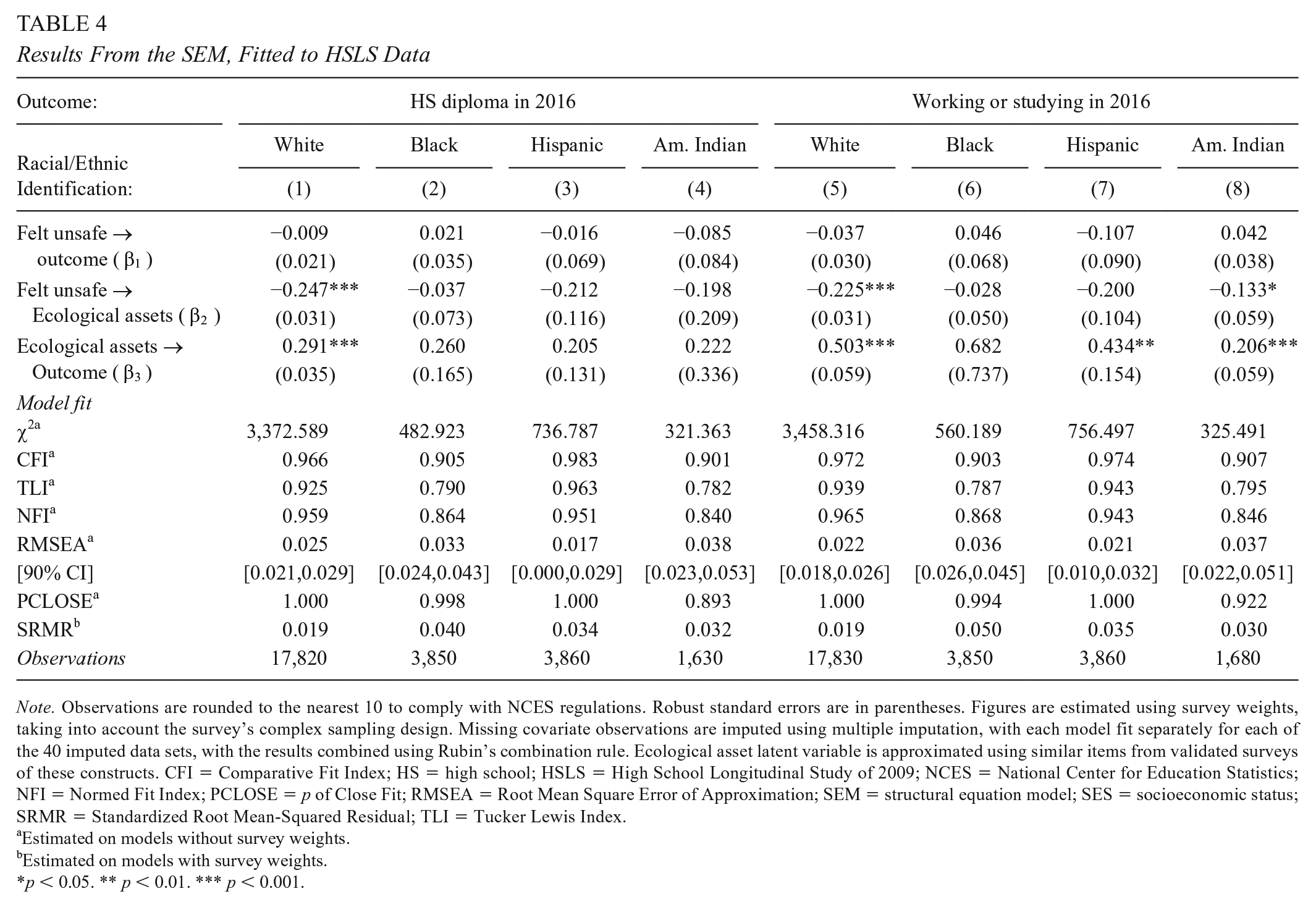
Note. Observations are rounded to the nearest 10 to comply with NCES regulations. Robust standard errors are in parentheses. Figures are estimated using survey weights, taking into account the survey’s complex sampling design. Missing covariate observations are imputed using multiple imputation, with each model fit separately for each of the 40 imputed data sets, with the results combined using Rubin’s combination rule. Ecological asset latent variable is approximated using similar items from validated surveys of these constructs. CFI = Comparative Fit Index; HS = high school; HSLS = High School Longitudinal Study of 2009; NCES = National Center for Education Statistics; NFI = Normed Fit Index; PCLOSE = p of Close Fit; RMSEA = Root Mean Square Error of Approximation; SEM = structural equation model; SES = socioeconomic status; SRMR = Standardized Root Mean-Squared Residual; TLI = Tucker Lewis Index.
Estimated on models without survey weights.
Estimated on models with survey weights.
p < 0.05. ** p < 0.01. *** p < 0.001.
Discussion
In this study, we examine potential reasons why BIPOC students feel less safe in high school than White students do and the ways in which ecological assets help counter these challenges. We find evidence supporting our hypotheses that BIPOC students feel less safe at school because of systematic inequality across schools as well as individual differences within schools. For Black students in particular, school assignment is an important explanatory factor in their lower feelings of safety, compared to those of White students. These findings echo qualitative accounts like that of McGee (2013), who writes about Brian, a high-achieving Black high school student who has a perilous commute to/from school that extends into his experience in school: “When I walk into school, the danger does not end at the school door. I always have to stay on guard, even when I don’t want to” (p. 461). For Latine and American Indian students, student-level covariates tend to explain a higher proportion of the difference in feeling unsafe compared to the feelings of White students. Qualitative work has discussed how BIPOC students often feel singled out by school staff, including teachers, librarians, school police, and cafeteria workers, in ways that could lead to feeling less safe (Carter Andrews, 2012; Rosenbloom & Way, 2004). Threats to safety can also stem from students’ racial/ethnic identification; Rosenbloom and Way (2004) share the experiences of Tanya, a Chilean American, who attends a school where conflict often arises along ethnic lines: “This girl was proud of being Dominican . . . so then, this Puerto Rican girl said not to get too happy because they were immigrants. That’s how the fight started” (p. 439). As we established in our QuantCrit framing, these accounts show the intercentricity of racism as a driver of racialized school assignment and of experiences in schools that lead to differences in feelings of safety.
Our different findings for Black as compared to Latine and American Indian students expose racial differences, but this is not a neutral exercise, with the available measures that we use to explore differences in feeling unsafe being specifically constructed to fit with a dominant ideology. We only account for differences that others deemed important to measure on these surveys, with other indicators absent, such as more fine-tuned measures of racial tension and hostility. How students respond to survey items could also be racialized. For instance, Asian American students (who do not consistently feel less safe at school than White students do and so are not a focus of this study) might be influenced by the model minority myth when responding to these types of items (Lee et al., 2009; Ng et al., 2007). The model minority myth characterizes Asian American students as high-achieving, hardworking, and agreeable, while stereotype boosts/threats can affect the possibility that students conform to their racialized stereotypes in environments like schools (Armenta, 2010; Ng et al., 2007).
We take a social justice orientation to this research through our exploration of ecological assets. We find that our approximate measures for ecological assets have powerful explanatory power over future outcomes. Even though feeling unsafe in school often predicts lower ecological assets, the positive influence of our available measures of ecological assets eliminates the negative influence of feeling unsafe on early adulthood SES in the ELS sample for Black and Latine students (i.e., ecological assets fully mediate the influence of feeling unsafe on SES), but not for White students. These findings confirm prior research on the positive relationship between ecological assets and longitudinal outcomes (Agans et al., 2014; Bowers et al., 2011; Gardner et al., 2008; Guzmán-Rocha et al., 2017; Scales et al., 2006; Theokas & Lerner, 2006). These findings are mirrored in qualitative research, like those of Gándara and Contreras (2010) in their research on the experiences of Latine students enrolled in a college-access program called Puente, noting how successful students often had ecological assets like relationships with adults in school and positive peer influence.
Implications for Practice
These results confirm a wealth of evidence on systematic inequality in the differences in contextual factors across schools BIPOC students attend, particularly Black students, and the conditions they face within schools. Education policymakers have a responsibility to ensure the safety of students, prioritizing racially minoritized students, who are often neglected in policymaking decisions and feel less safe in school. These results suggest the salience of collecting data on students’ feelings of safety as a potential accountability mechanism, particularly when this measure is disaggregated by students’ racial/ethnic identification. These data can also inform resource distribution and targeted program delivery to schools with pervasive safety challenges. At the same time, school leaders and practitioners might feel powerless to attend to these structural issues within their responsibilities. For these communities, these results show the importance of building students’ ecological assets. For guidance, recent research suggests strategies that teachers, parents, and mentors can use to grow students’ ecological assets, such as building student-teacher relationships through teachers expressing care, providing support, and sharing power with students (e.g., Sethi & Scales, 2020).
Implications for Research
This study shows how QuantCrit can be used to powerfully design explorations of school safety for racially minoritized students. We rely on the QuantCrit framing to reinforce that BIPOC students feel less safe at school and that these differences are due to various sources of structural racism. At the same time, our research does not disaggregate beyond broad racial/ethnic categories. Further disaggregation is an important area of future research, particularly differences by country/region of origin for Latine and Asian American/Pacific Islander students (Castillo & Gillborn, 2022). These surveys and other similar surveys are capable of this kind of disaggregation by country as well as intersectional analyses by gender identity, sexual orientation, dis/ability status, and other layers of identity.
Although prior research has found that BIPOC students felt less safe at school than did White students (Bachman, Randolph, & Brown, 2011; Lacoe, 2015; Voight et al., 2015), we extend this work by exploring reasons behind this inequality. Future work on school safety should prioritize the experiential knowledge of minoritized students while attending to the role of systematic inequality and ecological assets or similar asset-driven concepts. Previous research on the negative consequences of feeling unsafe motivates more attention to this construct (Lacoe, 2020; Laurito et al., 2019; Peguero et al., 2021), and we complement this prior research through understanding how assets can mediate this relationship. More generally, this study seeks to integrate all five of the core principles of QuantCrit and encourages future researchers to continue to think critically about how to best do so. In particular, we address the QuantCrit core principle that data cannot speak for itself through referencing qualitative work and our stated positionality, and future researchers can seek to clarify sophisticated approaches to make quantitative research more responsive to experiential knowledge of those who are racially minoritized. This is, arguably, a core challenge in QuantCrit research using secondary data.
Future research can continue to explore why students feel unsafe at school and the connections between school safety, ecological assets, and outcomes. First, although we examine whether school assignment, generally, explains why students feel unsafe at school, future research could continue to explore specific school-level indicators that could illuminate why school assignment predicts a high percentage of variation in feeling unsafe, particularly for Black students. These studies could build off recent research finding that violent crimes committed in close proximity to schools are associated with student mobility (Burdick-Will et al., 2021). Second, as exploring the mediatory role of ecological assets in the relationship between school safety and longitudinal outcomes is a secondary analysis in this study, we only scratch the surface of potential ways to examine these relationships. For instance, future studies could develop more fine-grained measures of various aspects of ecological assets instead of one ecological assets latent factor. A more sophisticated model could also examine relationships between the variables explaining feeling unsafe from the decomposition analysis with ecological assets and the outcomes.
Although we often refer in this study to differences across schools and within schools as indicative of systematic inequality, we recognize that the measures from ELS and HSLS only capture these concepts by proxy. Although a couple of items on ELS specifically asked about racial tensions, neither survey attempted to measure racism, discrimination, or bias in a nuanced way. Future large-scale surveys would greatly benefit from integrating these types of measures on surveys of students, teachers, and school administrators. Correspondingly, researchers should continue to develop valid, reliable measures of these constructs that can assess racism and discrimination from the perspectives of young people and adults.
Inequality is manifested in many insidious ways. We explore one specific way and encourage others to continue to develop more nuanced ways to expose inequality while showing the strength of those who suffer from it. Although we might assume based on descriptive statistics that BIPOC students who feel unsafe in school are passive victims, we show that ecological assets are powerful sources students draw upon to succeed in early adulthood. This study suggests that future research should examine not only the negative impact of racism and institutionalized oppression but also ways in which BIPOC students succeed because of the assets they have from their families, teachers, and themselves.
Supplemental Material
sj-docx-1-ero-10.1177_23328584221138484 – Supplemental material for Black, Indigenous, People of Color and Feelings of Safety in School: Decomposing Variation and Ecological Assets
Supplemental material, sj-docx-1-ero-10.1177_23328584221138484 for Black, Indigenous, People of Color and Feelings of Safety in School: Decomposing Variation and Ecological Assets by Samantha Viano and Natalie Truong in AERA Open
Supplemental Material
sj-docx-2-ero-10.1177_23328584221138484 – Supplemental material for Black, Indigenous, People of Color and Feelings of Safety in School: Decomposing Variation and Ecological Assets
Supplemental material, sj-docx-2-ero-10.1177_23328584221138484 for Black, Indigenous, People of Color and Feelings of Safety in School: Decomposing Variation and Ecological Assets by Samantha Viano and Natalie Truong in AERA Open
Supplemental Material
sj-docx-3-ero-10.1177_23328584221138484 – Supplemental material for Black, Indigenous, People of Color and Feelings of Safety in School: Decomposing Variation and Ecological Assets
Supplemental material, sj-docx-3-ero-10.1177_23328584221138484 for Black, Indigenous, People of Color and Feelings of Safety in School: Decomposing Variation and Ecological Assets by Samantha Viano and Natalie Truong in AERA Open
Footnotes
Acknowledgements
The authors would like to thank attendees of the American Educational Research Association (AERA) annual meeting, the anonymous reviewers, and AERA Open editors for helpful comments on this study. This paper would not be possible without the support of Martin Ford at George Mason University, who graciously arranged for a conveniently located restricted data room to access these data. The ideas seeding this project took root in Dr. Will Doyle’s practicum course at Vanderbilt University, and we thank Dr. Doyle for his encouragement to ask interesting questions aligned with nationally representative secondary data sets like the ones in this study.

Notes
Authors
SAMANTHA VIANO is an assistant professor of education at George Mason University. Her research evaluates solutions schools select to address systemic challenges in K–12 education, particularly their effects on minoritized students and their teachers, focusing on school safety and security, online credit recovery, teacher retention, and methods for studying racial equity.
NATALIE TRUONG is a doctoral student in education policy and research methodology at George Mason University. Her research interests are in the areas of assessments and accountability policy and data disaggregation by race and ethnicity.
References
Supplementary Material
Please find the following supplemental material available below.
For Open Access articles published under a Creative Commons License, all supplemental material carries the same license as the article it is associated with.
For non-Open Access articles published, all supplemental material carries a non-exclusive license, and permission requests for re-use of supplemental material or any part of supplemental material shall be sent directly to the copyright owner as specified in the copyright notice associated with the article.
