




Abstract
Culturally relevant pedagogy (CRP; e.g., Ladson-Billings, 1995) is a set of beliefs and practices that aim to serve culturally and linguistically diverse student learners. Although a large body of work describes its tenets and permutations, and its implications for students, less work has been done to outline the myriad barriers that teachers face when trying to implement CRP. This paper addresses this gap by proposing a race-conscious, multilevel, ecological framework to illuminate the societal, institutional, and individual obstacles that teachers must navigate in the pursuit of CRP. Implications for teacher training and development are discussed.
Keywords
Introduction
Teachers are the most proximal force shaping students’ experiences in school. Extant research suggests that teachers are hugely influential in students’ academic, identity, and psychosocial development (Creemers & Kyriakides, 2007; Darling-Hammond, 2010; Duncan-Andrade, 2009). However, despite most teachers’ positive intentions, racial disparities in classrooms are enacted principally, although often unconsciously (Ahram et al., 2011; P. Gregory et al., 2014; Vavrus & Cole, 2002), through teachers’ behaviors (Lewis & Diamond, 2015). Teachers have lower academic and behavioral expectations for Students of Color than for White students, provide more negative feedback, and employ more punitive disciplinary actions (e.g., Scott et al., 2019; Tenenbaum & Ruck, 2007; U.S. Department of Education Office for Civil Rights [OCR], 2014). These expectations and behaviors contribute to persistent racial disparities in student outcomes, including academic achievement, graduation rates, placement in gifted and talented and special education programs, and disciplinary experiences (Amemiya et al., 2019; Bal et al., 2019; de Brey et al., 2019; A. Gregory et al., 2010; Milner & Ford, 2007; Skiba et al., 2002; Stanford Center for Education Policy Analysis, 2019).
One pathway by which scholars and practitioners have proposed to combat these disparities is the use of culturally relevant pedagogy (CRP; Ladson-Billings, 1995). This approach directly concerns itself with the promotion of positive, racially conscious attitudes and practices in the classroom (Banks, 1995; Gay, 2010; Ladson-Billings, 1995, 2014; Nieto, 2000; Steele & Cohn-Vargas, 2013). CRP requires that teachers hold high academic and behavioral expectations for their students, create meaningful connections between school and home, and cultivate critical reflection within themselves and their students (Gay, 2010; Ladson-Billings, 1995). CRP has been linked to several positive academic and psychosocial outcomes for students, including increased engagement and connectedness to the content (Byrd, 2016; Hill, 2012; Hubert, 2013), more feelings of belonging, improved relationships with teachers (Coughran, 2012), higher test scores (Bui & Fagen, 2013; Rodriguez et al., 2004), and heightened sociopolitical awareness and critical analysis (Gutstein, 2003; Martell, 2013).
Although a large body of work describes the tenets and permutations of CRP, and its implications for students, less work has been done to outline the myriad barriers that teachers face when trying to implement it. For example, a key requisite for enacting CRP is a teacher’s awareness of (a) their own racial identity and (b) the societal inequities that historically race-ethnically minoritized learners face; without this awareness, teachers’ own biases can subvert their capacity to execute CRP practices (Dover, 2013; Dyce & Owusu-Anasah, 2016; Young, 2010). Teachers’ practices are also constrained by school- and district-level mandates for curricula, disciplinary procedures, and the distribution of resources (Creemers & Kyriakides, 2007; Tseng & Seidman, 2007). In fact, uptake of new teaching strategies can be either supported or inhibited by the culture and characteristics of the school’s leadership and colleagues (Creemers & Kyriakides, 2010; Liebowitz & Porter, 2019). Although extant work has examined these challenges separately, the literature lacks a cohesive and comprehensive theoretical view of multiple layers of racial contextual conditions and how these shape the individual processes by which teachers’ racialized beliefs, attitudes, and behaviors develop—which are the foundations of effective delivery of CRP (Ladson-Billings, 2006). To address this gap, I present a theoretical framework that illuminates the previously unexplored nexus of contextual influences on teachers’ effective implementation of CRP. These barriers have the potential to influence the practices of teachers from a variety of racial backgrounds and teaching in a variety of school settings. Attending to barriers and influences from multiple sources at various levels of the human ecology has the potential to help scholars better understand the conditions under which CRP implementation is most likely to be effective and aid practitioners in addressing these challenges at multiple places in the system.
The following sections examine how the competencies, behaviors, and policies required to enact CRP are promoted and inhibited by societal ideologies, institutional contexts, and individual characteristics and socialization. First, I briefly describe CRP’s components and documented effectiveness with Students of Color. Second, I draw on existing ecological theories to propose an integrated framework that specifies how influences at each ecological level inform (a) how teachers come to develop and practice the core tenets of CRP and (b) an examination of various barriers to implementation and development. To do so, I describe relevant literature that has demonstrated how barriers at each ecological level can constrain or enhance CRP implementation. Finally, I conclude with considerations for practitioners who are looking to support teachers’ development and enactment of CRP.
Culturally Relevant Pedagogy
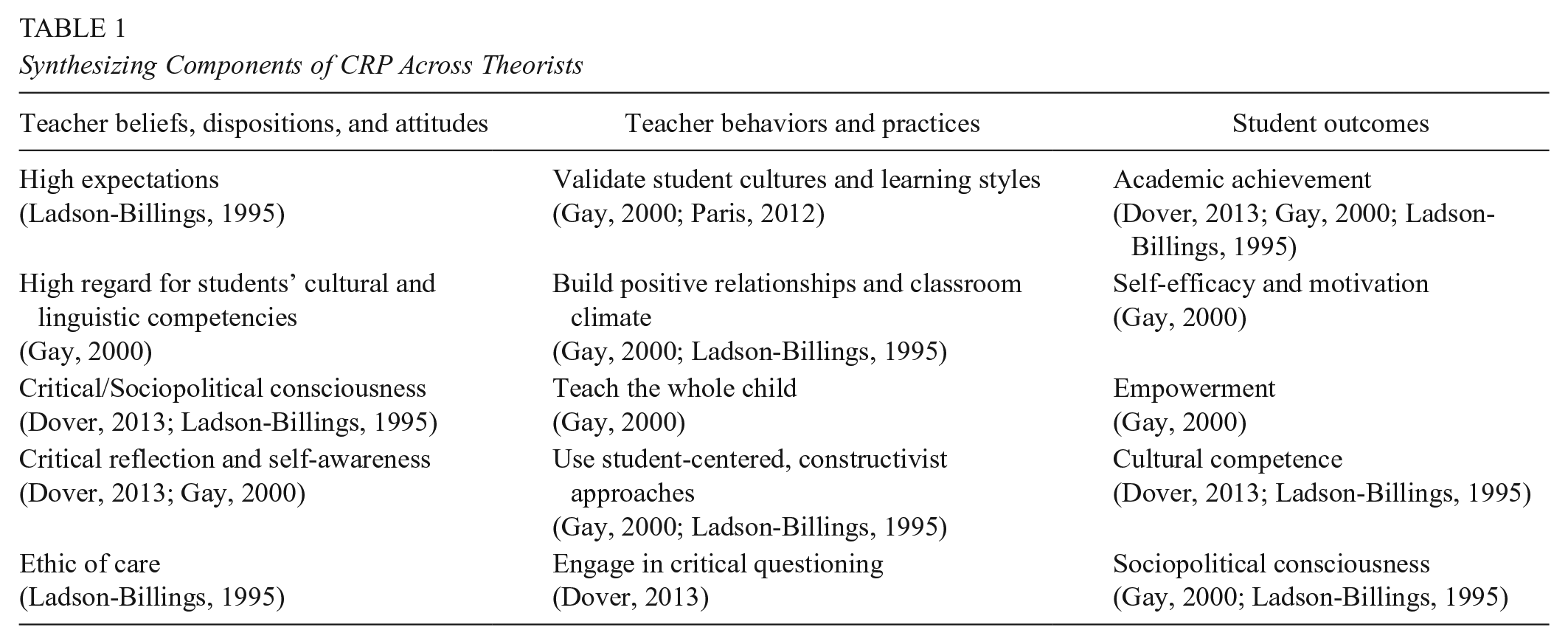
CRP is a teaching approach that encompasses attitudes and practices aimed at supporting racially, culturally, and linguistically diverse learners. Over the past 4 decades, a wide range of labels has been applied to this set of attitudes and practices, such as culturally responsive teaching (Gay, 2000, 2014), culturally relevant education (Dover, 2013), multicultural education (Banks, 1995), culturally sustaining pedagogy (Paris, 2012), and the term I use throughout this paper, culturally relevant pedagogy (Ladson-Billings, 1995; Sleeter, 2012). Although such scholars as Ladson-Billings (2014) have embraced newer terms, such as culturally sustaining pedagogy, I use the term CRP in this paper because of its long-standing name recognition. Despite distinctions among each of these labels, they share major components in the areas of beliefs, dispositions, and attitudes that teachers require and behaviors that teachers must enact, all in service of achieving student outcomes. Below, I elaborate on these components as they are described by key theorists (see Table 1).
Synthesizing Components of CRP Across Theorists
Teacher Beliefs, Dispositions, and Attitudes
In service of CRP, teachers must develop particular dispositions and attitudes about themselves and their students. Teachers must hold high expectations about the academic potential of all students (Ladson-Billings, 1995) and high regard for the cultural and linguistic competencies that students bring to school (Gay, 2000). To develop these attitudes, teachers must have a sociopolitical consciousness, which entails the ability to engage in critical reflection on or analysis of their own identities and societal positions and of the sociopolitical contexts of their students (Dover, 2013; Villegas & Lucas, 2002). Teachers should be able to recognize their own cultural beliefs and practices while simultaneously learning to access other cultures (Ladson-Billings, 2006). They must believe in the idea of the classroom as a site for social change and view themselves as agents in effecting social change (Dover, 2013; Irvine & Armento, 2001). Finally, they must deeply care about their students as learners and as people (Ladson-Billings, 1995).
Teacher Behaviors and Practices
Decades of research have illuminated many practices that constitute CRP. Explicit acknowledgment and validation of students’ cultural heritages build bridges between students’ home and school lives and cultivate students’ sense of self-worth (Gay, 2010; Paris, 2012). Building meaningful relationships with students and their families and communities is crucial to successfully enacting CRP; it is through these relationships that a “learning partnership” can develop, through which students’ motivation and engagement emerge (Hammond, 2015). Teachers should be equipped to teach the “whole child,” attending to social-emotional needs and skills as well as developing students’ own sociopolitical consciousness. Various instructional strategies have been identified throughout the literature and across content areas, such as creating and modifying curriculum to represent and reflect diverse cultural identities, connecting content to students’ lived experiences, using collaborative talk structures to engage all students in academic dialogue, and differentiating for multiple ability levels and learning styles (Ensign, 2003; Fulton, 2009). Instruction should be student-centered, building on (rather than ignoring) students’ “funds of knowledge,” or cultural and linguistic knowledge that comes from life experiences (Gonzalez et al., 1995). Teachers should employ constructivist teaching approaches, whereby knowledge is cocreated in the classroom and the authority over what constitutes knowledge is shared between teachers and students (Morrison et al., 2008). Teachers who are culturally responsive also make connections between content and the larger context of societal inequality and empower students to use their skills to critique society by questioning texts and other learning materials (Dimick, 2012; Dover, 2013; Laughter & Adams, 2012).
Student Outcomes
Well-implemented CRP should enhance students’ achievements and, more specifically, students’ learning (Ladson-Billings, 2006). Just as important for CRP practitioners is the cultivation of self-efficacy, motivation, and empowerment in their students (Gay, 2000). Teachers’ validation of and high regard for students’ cultural backgrounds should be in service of students’ developing cultural competence, which includes feelings of integrity about one’s own cultural background and the knowledge and ability to navigate others’ cultures. Finally, CRP aims to instill sociopolitical consciousness in students, allowing students to “recognize, understand, and critique current and social inequalities” (Ladson-Billings, 1995, p. 476).
Opportunities for Teachers Learning and Implementing CRP
Learning about and engaging in CRP have positive consequences for teaching practices. In a case study of math teachers, Fulton (2009) finds that teachers who used CRP were successful in building a community of learners, challenging students, and differentiating appropriately. In a 2-year qualitative study, Milner (2011) similarly finds that a teacher who sought to develop cultural competence, or the understanding of one’s own and other cultures’ ways and systems of knowing, was able to be an active listener and recognize and affirm the identities of the students in their classes. Teachers engaged in a long-term, intensive professional development program focused on cultural relevance in science teaching developed more critical awareness of themselves and the social context of their students and enhanced their instructional techniques, leading to higher student achievement (Johnson, 2011; Johnson & Fargo, 2010). Another long-term professional development intervention that focused on supporting English language learners saw significant improvements in teachers’ contextualization of instruction through increasing their knowledge of individual students’ lives and skills (Diaz et al., 2018).
Social-Ecological Theories and Race
Ecological theories broadly emphasize the influences of multiple contexts on individual development. According to Bronfenbrenner and Morris (2006) bioecological systems theory, development is affected not only by an individual’s immediate environment but also by the broader environments in which they grow as well as the interactions among these various environments. The immediate setting is known as the microsystem, which includes those settings that have direct contact with an individual teacher, such as the home and family and the classroom or work setting. The mesosystem refers to the linkages between one or more of those microsystems, such as the interaction between racial narratives that a teacher experiences in the home environment and how those align or conflict with racial messages at their school. Theoretically, there may be mesosystem linkages that are relevant; however, for the purposes of the current paper, I deal only with the microsystems of the classroom and the school and their influences on and from the exo- and macrosystems. The exosystem describes broader social structures that have indirect influence on individuals. For example, district-level employees may never have direct contact with a teacher, but the decisions that they make have consequences for how a teacher functions in the classroom. It is at this level that institutions have influence over individual development. Finally, the macrosystem is the most distal environment that nonetheless influences development, through the creation and perpetuation of ideologies and cultural values that drive societal norms, rules, and laws.
Racial dynamics and racism at each level of human ecology have implications for individual development. Two theories that exemplify the pathways by which racism affects individuals’ experiences and development are described here. First, García Coll et al.’s integrative model (1996) builds on ecological systems theory to specifically consider the development of minority youth in context, detailing how structural racism influences the development of ethnic/racial minority children. The integrative model explores constructs at macro-, exo-, microsystem, and individual levels that contribute to the development of competencies in minority children. Second, McKinney de Royston and Nasir’s (2017) theory of racialized learning demonstrates how racial dynamics at multiple levels of the human ecology shape students’ experiences in school and, ultimately, their academic and identity development. These two models provide examples of how racism and racial dynamics at multiple levels of the social ecology shape students’ development; below, I argue that this framework can also be applied to the development of teachers, in that teachers’ own dispositions and behaviors related to teaching are also influenced by the racial dynamics that occur at each social-ecological level.
Scholars in community psychology assert that individual development is influenced by the complex and simultaneous interplay among individual, interpersonal, community, and societal factors (e.g., Bronfenbrenner & Morris, 2006; Schwartz et al., 2019). Although the theory of CRP espouses this concept for students, CRP theorists and interventionists have given less attention to the idea of teachers as learners and thus tend to overlook the multiple levels of context that influence their development and implementation of requisite dispositions and skills. Research on teachers’ development more generally does recognize teachers as growing, learning, and developing individuals (e.g., Beavers, 2009; Clandinin & Husu, 2017). Thus, consistent with an ecological approach, this paper argues for situating teachers as learners-in-context when considering the opportunities and barriers that they face when implementing CRP.
A Race-Conscious Multilevel Framework for Teachers’ Implementation of CRP
In the sections that follow, I outline a race-conscious multilevel framework for understanding how teachers’ dispositions and behaviors related to CRP enactment are shaped and constrained by racial dynamics at multiple levels of human social ecology (see Figure 1). I draw on theories of CRP and ecological models to consider their relevance for teachers’ development of racialized biases, beliefs, and behaviors and the consequences therein. I begin by examining the societal context in which institutions are embedded and in which individual teacher-level inputs and barriers contribute to culturally relevant dispositions and practices. I then describe the relevant literature that demonstrates these barriers at each level.
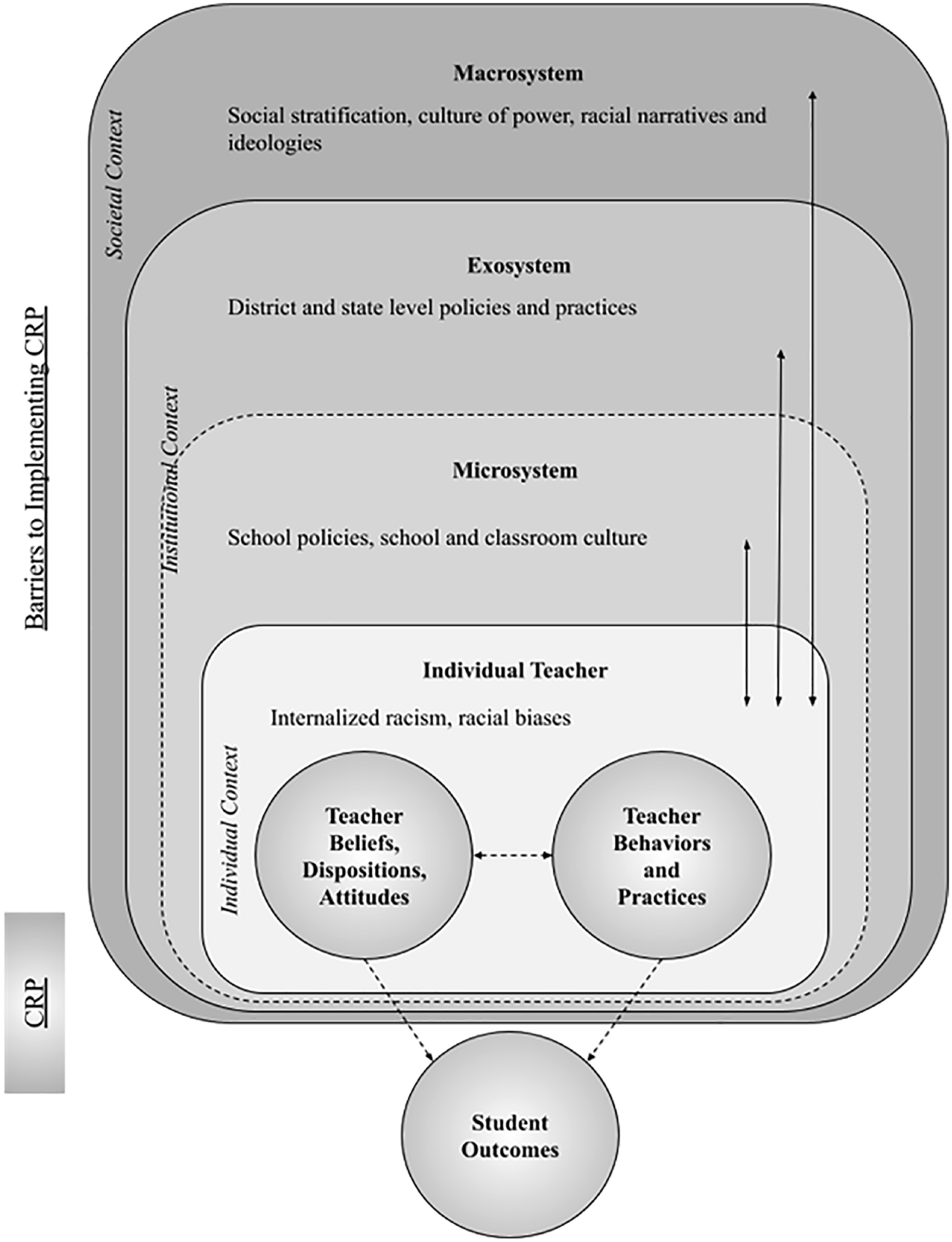
A Multilevel Framework of Racism-Related Barriers to CRP Implementation
The Societal Context: The Macrosystem
The societal level of ecology, or the macrosystem, is where socio-historical ideologies stratify our society, physically and socially (McKinney de Royston & Nasir, 2017). Social stratification theory posits that individuals in a society are sorted into a hierarchy of groups based on their designated or assumed value (Tumin, 1967). One’s social position in a stratified society informs one’s access to power and resources; it also has consequences that manifest in the forms of segregation (physical and/or psychological), access (or not) to social mobility, and attributions that are formed about one’s own group and those who occupy other strata (i.e., stereotypes). Early theorists postulated how broad cultural and societal norms, generated by those in power, infiltrate the everyday behaviors and dispositions of the individuals in that society, including how institutions function to reproduce the dominant culture (Althusser, 1977; J. Anyon, 1981; Bourdieu, 1977; Lareau, 2011). Schools are governed by the rules of those in the dominant culture, or the “culture of power” (Delpit, 1988, p. 282). They teach rules of behavior that align with the norms of the culture in power, encourage “submission to the rules of the established order,” and “ensure subjection to the ruling ideology” (Althusser, 1977, pp. 4–5). White people as a group maintain their privileged status by simply reproducing the current structures of power, acting under the influence of the ruling class ideology that says that they belong at the top of the hierarchy. As the majority of the teacher workforce in the United States is White, Whiteness and White privilege are intertwined with the position of authority that teachers hold over students, whereby success in the institution of school relies on enacting the values and cultural tropes of the dominant culture (Khan, 2010; Picower, 2009). The culture of power is upheld through explicit messaging as well as inclusionary and exclusionary practices that privilege conformity to one’s given place in society to preserve the existing hierarchies. Individuals within schools do not always know that they are reproducing this hierarchy: teachers often aim to “open up for them [students] the path to freedom,” as the “the majority do not even begin to suspect the ‘work’ the system forces them to do” (Althusser, 1977, p. 19). In racial terms, the perpetuation of the status quo is justified (or challenged) by adherence to (or resistance of) racial narratives or storylines (Bonilla-Silva, 2014).
The dominant socio-historical ideologies of White superiority and Black inferiority have stratified—and continue to stratify—our society physically through the legal mechanisms of segregation (e.g., redlining) and socially through racialized discourse. An example of discourse that stratifies is a racial storyline or narrative, which is akin to a stereotype. A racial narrative, such as “multiplication is for White people,” has important and damaging implications for how Black and other Students of Color view themselves and, in turn, perform academically (Delpit, 2013). As another example, stereotypes that link rap music to delinquency are harmful. Society stereotypes rap music as anti-authoritarian because of its associations with Blackness; however, (a) White students also like rap and (b) other forms of music are just as rebellious (e.g., gothic, punk), but their associations with Whiteness render them exempt from critique (Warikoo & Carter, 2009). Stereotypes and their pernicious effects on students are not limited to Black and White; the “lazy Chicano/a,” the “savage or slow Native American,” and the “quiet Asian” are examples of stereotypes that permeate the educational landscape and have negative consequences for students from a wide variety of backgrounds (Ochoa, 2013; Peterson et al., 2016; Solorzano & Yosso, 2001). All of these racial narratives are alive in the school environment, where educators who aim to practice CRP must actively reject them to hold their Students of Color and their cultural backgrounds in high regard.
Teachers who practice CRP are faced with combating harmful narratives and discourses at the societal level (i.e., the macrosystem) to disrupt the reproduction of the established racial hierarchy. While working to promote the realization of all students’ full potential, teachers practicing CRP must confront and challenge the macrolevel ideologies of White supremacy and inferiority of People of Color that get produced and reproduced through (a) policies and practices in and between institutions, (b) micro-interactions between persons, and (c) individual psychological processes (Carter & Merry, 2019).
Institutional Context: The Exo- and Microsystems
The institutional context in which racial dynamics act upon teachers includes the exosystem and the microsystem. Policies and practices that states and districts implement compose the exosystem: although teachers rarely have direct contact with decision-makers at this level, their guidelines and regulations materially influence how teachers engage in the practices of teaching. Schools and classrooms (those that serve as learning environments for teachers, such as graduate-level courses, and the classrooms that teachers lead for students) are microsystems in which teachers develop and implement CRP.
Institutional racism occurs through “particular and general instances of racial discrimination, inequality, exploitation, and domination in organizational or institutional contexts” (Carmichael & Hamilton, 1967, cited in Clair & Denis, 2016). Policies and practices can themselves enact institutional racism, impeding teachers’ effective implementation of CRP. Institutional racism in the form of exclusionary discipline policies, for example, can prevent teachers from building positive relationships with their students and fostering a supportive classroom climate. Exclusionary discipline policies tend to give rise to disproportionately punitive outcomes for Students of Color. The processes by which Black and Brown students receive more exclusionary discipline than their White counterparts can be explained by policies that target ways of being / cultural norms (e.g., calling out) and by practices that rely on teachers’ discretion (e.g., giving a referral as opposed to a warning). Disciplining Black and Brown students for their dress styles, hairstyles, and linguistic habits and choices is in direct conflict with validating their cultural and linguistic styles, a key behavior of CRP; policies that necessitate this type of targeting provide a barrier to teachers who want to implement CRP but feel beholden to school rules and/or district regulations.
Furthermore, teachers are more likely to exercise exclusionary discipline with their Students of Color than with White students. Over the course of a 5-year ethnographic study in a racially integrated high school, Lewis and Diamond (2015) document the many instances of teachers’ exercising discretion over how and with whom to enforce disciplinary policies, such as the dress code or suspension length, often to the detriment of Black students in the school. This work provides a micro-interactional view that supports the oft-replicated findings of disproportionate use of punitive and exclusionary discipline practices with Students of Color (e.g., Bal et al., 2019; Nicholson-Crotty et al., 2009; Skiba et al., 2011). Nationwide, Black students are three times more likely to be suspended or expelled than White students (OCR, 2014). The use of exclusionary discipline conflicts with the CRP practice of teaching the whole child because students who are excluded from the classroom are not given the opportunity to learn the social-emotional skills required for classroom functioning. Exclusionary discipline also fails to recognize the assets that students bring to the classroom. In schools and districts where exclusionary discipline policies are in place, it is difficult for teachers to develop and implement behavior management tools that are culturally relevant, for they lack the administrative and institutional supports necessary to do so.
Another constraining practice or policy is academic tracking. Schools often distribute more rigorous curricula and higher expectations to White students than to Black and other Students of Color through the process of academic tracking (Lewis & Diamond, 2015). Although this unequal distribution may not be an official policy of the school or district, its systematic enactment results in fewer opportunities for Black students and Students of Color to engage with upper-level classes and in lower expectations from their teachers (e.g., Kelly & Carbonaro, 2012). This comes in direct conflict with the CRP tenet of high expectations.
The Context of the Individual: Race-Related Beliefs and Behaviors
In additional to societal and institutional barriers that teachers face, individual race-related beliefs and their manifestations as behaviors can also impede implementation of CRP. Individual teachers’ internalized racism, unconscious and explicit biases, and experiences with diverse populations present potential challenges to the acquisition and development of the attitudes and dispositions necessary for CRP.
Internalized Racism
As individuals come to internalize the societal, institutional, and interpersonal messages and actions suggesting that People of Color are inferior to White individuals, they position their own roles and identities either in a place of subordination or of domination. For this reason, scholars refer to racism that occurs at this level as internalized racism: “Internalized racism refers to the acceptance, by marginalized racial populations, of the negative societal beliefs and stereotypes about themselves” (Williams & Williams-Morris, 2000, p. 255). Racism at this level is enacted within and upon one’s self and can have consequences for behavior. Teachers who have internalized the racial hierarchy of the macrosystem, regardless of their own racial background, might find it natural to believe and act upon existing societal stereotypes; in other words, internalizing the status quo hinders individuals from questioning problematic stereotypes. For teachers, this can mean accepting so-called cultural explanations for racial achievement gaps and discipline disparities.
Although not typically measured, manifestations of internalized racism occur when teachers who come from marginalized backgrounds behave in ways that perpetuate marginalization for their Students of Color. This is evidenced in inconsistent findings from race-match studies. Specifically, teacher-student racial match does not consistently predict decreases in discipline disparities: Ferguson (2001) finds that teachers of various backgrounds were just as likely to criminalize Black boys’ misbehaviors and target them for discipline; Bradshaw et al. (2010) find that race-match did not reduce Black students’ risk of exclusionary discipline. This evidence stands in contrast to other studies that have found benefits for Black and Brown students who are taught by a same-race teacher (see Redding 2019 for a review). As it stands, additional research is needed to uncover how internalized racism may be contributing to teacher bias in the classroom.
Racial Biases
Like most other adults in the United States, teachers hold unfavorable biases toward People of Color (Starck et al., 2020). Unconscious racial biases are “the attitudes or stereotypes that affect our understanding, actions, and decisions in an unconscious manner” (Staats, 2016, p. 29). Research has shown that unconscious biases are more likely to influence behavior when individuals are in situations of stress and fatigue and face time constraints (Bertrand et al., 2005; Chugh, 2004)—all of which are commonplace for teachers. Indeed, teachers’ biases can function as barriers to effective teaching (Gallavan, 2000). In particular, White teachers in high-minority school contexts may experience higher levels of racial stress, which may exacerbate manifestations of biased beliefs and behaviors (DiAngelo, 2011; Kang et al., 2014), acting as a barrier to equitable and caring treatment of all students.
Although the unconscious biases of teachers are seldom tested, there have been a few notable exceptions. In a study of elementary school teachers, Van den Bergh et al. (2010) find that although teachers’ explicitly stated prejudices had no relationship to their expectations for students, teachers’ implicit racial prejudices (as measured by the Implicit Association Test [IAT]) against an ethnic minority group predicted the size of the ethnic achievement gap in their classrooms. In a study involving elementary students in New Zealand, teachers’ explicitly stated high expectations had a positive relationship with reading achievement for all students, regardless of race/ethnicity, but their implicit racial bias (as measured by the IAT) predicted students’ math achievement, benefitting the students whose racial-ethnic group the teachers unconsciously favored (Peterson et al., 2016). An experimental study in the United States shows that White instructors who had higher anti-Black / pro-White implicit biases had higher anxiety when instructing a class of Black students, which led them to deliver lower-quality lessons (Jacoby-Senghor et al., 2016). In each of these studies, the instructors’ implicit and explicit biases were at most mildly correlated, supporting the idea that they were unaware of their biased attitudes.
Racial biases manifest in various ways in the classroom. One way is through differential academic expectations for students based on racial background. Tenenbaum and Ruck’s (2007) meta-analysis finds a consistent overall teacher bias by student race: teachers hold more negative perceptions of Black and Latine students’ performances, abilities, and psychosocial adjustment compared to those of White students. Studies published since then have continued to document differences in teachers’ expectations for Black and Latine versus White and Asian students across academic domains and grade levels. For instance, Cherng (2017) finds that high school teachers’ appraisals of their Black students’ academic abilities were lower than those of their White students. Garcia et al. (2019) find that elementary school teachers’ assessments of students’ executive functioning were systematically biased according to students’ ethnicity and English learning status, even after adjusting for direct assessments. Using an experimental design, Copur-Gencturk et al. (2020) find that despite students’ similar performances on a math task, teachers rated White students as having higher mathematical ability than Students of Color. Taken together, these studies provide evidence that teachers’ estimations of their students’ academic abilities tend to differ systematically by race. These differential expectations act as a barrier to teachers’ holding high expectations for their Students of Color, a key disposition of CRP.
Teachers’ appraisals of, and reactions to, student behaviors also tend to be more negative for Students of Color than for their White counterparts. Although the literature is inconsistent, many studies have found that teachers rate Students of Color in their classrooms more poorly in problem behaviors compared to their White students. In an observational study of elementary classrooms, Hosterman et al. (2008) find that teachers underrated the problem behaviors of their White students but did not underrate the problem behaviors of their Latine and Black students. Other work demonstrates that teachers react more negatively to misbehaviors of Black children than of White children. Ferguson’s (2000) in-depth ethnographic study of an elementary school illuminates how teachers, regardless of their own race, interpreted Black boys’ misbehavior as evidence of their “criminal proclivities” and thus subjected them to more frequent and harsher forms of disciplinary action (p. 89). Similarly, Yates and Marcelo (2014) find that Black preschoolers’ engagement in imaginative play practices was associated with teachers’ rating those children as less prepared for school and higher in teacher-child conflict, while those same behaviors were associated with positive ratings on those measures for non-Black children. The researchers suggest that these findings provide evidence that teachers attribute differential meaning to children exhibiting the same behaviors based on the students’ race. In a more recent study, controlling for student off-task and disruptive behaviors, Black students received more negative feedback from teachers than did White students, regardless of teacher race (Scott et al., 2019). These negative appraisals of, and feedback to, Black and Latine students impede the extent to which teachers can build positive and caring relationships with these students, a key practice of CRP.
A lab-based experimental study examines whether a student’s race influenced teachers’ hypothetically reported responses to a series of minor infractions, such as disrupting the class (Okonofua & Eberhardt, 2015). The researchers find that teachers’ emotional responses (“feeling troubled”) were similar for students of both racial backgrounds for the first infraction; however, teachers were significantly troubled by the second infraction only when it was committed by a Black student. Likewise, teachers were more likely to recommend more severe disciplinary action for a second infraction for Black students than for White students. Furthermore, the association between students’ race and severity of discipline was mediated by teachers labeling students as troublemakers—that is, teachers were more likely to view a second infraction as evidence of a behavioral pattern, which led to harsher discipline. Because this was a vignette study, the only marker of race provided was suggestive names, but, importantly, these names were enough (verified through manipulation checks) to elicit differential responses to these parallel behaviors based on each student’s assumed race. Indeed, these negative interpretations align with societal pathologizing of Black behavior (Carter et al., 2017). Teachers who aim to create trust and positive relationships with their Students of Color need to carefully attend to the quantity, quality, and valence of feedback they provide and examine the assumptions that may arise in reaction to students’ behaviors.
More broadly, Black students often experience negative race-related treatment and discrimination from teachers, such as disrespect and discouragement (Brittian & Gray, 2014). In an online survey, a quarter of African-American and Caribbean-Black youth reported feeling as though teachers treated them with “less respect than other students” at least once within a prior year (Seaton et al., 2008). Sixty percent of African-American adolescents interviewed by Dotterer et al. (2009) reported experiencing discrimination in school from peers and teachers. Kohli and Solórzano (2012) detail how teachers’ frequent mispronunciations of students’ names were harmful to those students’ sense of belonging and sense of self.
The aforementioned biases and their implications for teaching practices and student experiences are barriers to teachers’ development of care, high expectations, and high regard for students of all racial-ethnic / cultural backgrounds. Thus, addressing these biases is a crucial step in the development of a culturally relevant pedagogue (Pang, 2010).
Recommendations for Practice
I have outlined above the barriers that exist in multiple socio-ecological contexts that constrain teachers’ effective implementation of culturally responsive teaching attitudes and practices. Still, many teachers are succeeding at implementing CRP across grade levels and subject areas (see Bottiani et al. 2018 for a systematic review). In this section, I present some strategies, policies, and professional development opportunities that can support teachers in overcoming barriers at each ecological level. Importantly, just as racial dynamics in the micro-, exo-, and macrosystems seep down to influence individual teachers, the actions that teachers take individually and collectively can have positive impacts on the racial dynamics at multiple layers of contexts that they inhabit. Therefore, individual- and institutional-level interventions have the added potential to “trickle up” and ultimately change the societal context in which students live and learn.
Recommendations to Address Race-Related Barriers at the Individual Level
When internalized and unconscious racial biases remain unchecked, they can result in racially discriminatory dispositions and behaviors, such as lower expectations for Students of Color (e.g., Tenenbaum & Ruck, 2007), microaggressions (Sue et al., 2009), disparities in punitive discipline (A. Gregory et al., 2010), and disproportionately negative feedback toward Students of Color (Scott et al., 2019). A goal of CRP implementation is to promote equity, excellence, and holistic wellness for Students of Color, so it is vital to address these race-related biases and beliefs in the pursuit of CRP.
Individuals cannot fully confront their biases without an understanding of their own position in racial and socio-economic hierarchies, which calls for the development of a critical or sociopolitical consciousness. Because social stratification in the macrosystem and the racialized narratives that have resulted continue to shape teachers’ and students’ experiences in schools, Ladson-Billings (2014) and others (Dover, 2013; Gay, 2000; McKinney de Royston & Nasir, 2017) have suggested that the development of a critical or sociopolitical consciousness is a necessary prerequisite for teachers implementing CRP. Broadly, sociopolitical consciousness requires understanding and critiquing the social, political, and economic status quo and one’s individual location within it (also referred to as sociopolitical development [SPD]; Watts et al., 2003). McKinney de Royston and Nasir (2017) present the importance of teacher SPD in the context of a district-wide equity initiative, where they find that the success of a top-down approach was “largely dependent upon the sociopolitical awareness of an individual teacher or administrator” (p. 272). In other words, district policy agendas are not simply realized by themselves; instead, they require the individual and coordinated actions of the many actors in the system—specifically, the actors who wield power over students. With regard to racial equity, one district administrator explained that “teachers who employ a colorblind pedagogy could be reinscribing inside their classrooms the racialized harm that students experience outside school. Colorblindness, therefore, is a form of racialized harm” (p. 277). In contrast, schools that were successful had staff members who possessed “a racialized clarity about how their students were perceived and positioned in and out of schools” (p. 278). These individual teachers’ racial awareness mediated the extent to which this district-wide equity policy was transmitted to students, illuminating the power of SPD in mediating between policies/ideologies and implementation.
Importantly, SPD tends to be the most difficult component of CRP to put into action, perhaps because of the historical lack of importance placed on SPD in teacher education, which has led to inadequacies in this area (Dallavis, 2013; Ladson-Billings, 2014). Part of what makes SPD so difficult to advance is its reliance on personal understanding of one’s status in society (Watts et al., 2003). This status, and the accompanying understandings, often differ based on an individual’s membership in either the dominant racial group (White) or a marginalized racial group (e.g., Black, Indigenous, Latine, or Asian).
Examples of how this process can differ by a teacher’s race are presented here. White teachers often begin without a basic understanding of themselves as having a race and must uncover their privilege to move forward. Then, they must learn about the social and economic systems that place marginalized students at a disadvantage (and have placed themselves at a relative advantage) and, importantly, how schools contribute to and reproduce these disadvantages and advantages. Finally, these reflections will prepare them for addressing inequities in their classrooms (Zion et al., 2015). Teachers of Color, on the other hand, bring a lifetime of lived experiences of marginalization to their work with students; however, this knowledge is rarely incorporated into their training (Mensah & Jackson, 2018). In their study of a career-readiness initiative for Black and Latino male youth led by Teachers of Color, Jackson and Knight-Manuel (2019) identify “cognitive strategies evaluating sociocultural inequities” and “content knowledge connected to sociopolitical contexts impacting Black and Latino males” as key components necessary for preparing educators to enact culturally relevant practices (p. 68). Their study highlights how educators’ deepening reflections and awareness of the challenges that these students face alongside their own identities and lived experiences were crucial when examining and improving their own pedagogical practices as related to Black and Latino males.
Sociopolitical consciousness can be developed by giving pre-service and in-service teachers opportunities to engage in individual reflection and group discussions that promote social analysis (Durden et al., 2016). Also, Jackson (2011) finds that teaching history and making sense of history in the context of the students they will teach were integral in developing teachers’ sociopolitical consciousness.
Alongside building a sociopolitical consciousness, teachers can address and manage their unconscious biases in several ways. In addition to building awareness, interventions in the broader psychological literature that have demonstrated success at reducing unconscious biases include building a sense of partnership to reduce outgroup status (Dovidio et al., 2004) and increasing empathy through taking perspective (Okonofua et al., 2016; Whitford & Emerson, 2019).
Once individuals’ personal biases and societal inequities are unearthed, teachers will be better equipped to challenge them within themselves, their colleagues, and school policies (Whipp, 2013). Engaging in critical reflection that bolsters self-awareness as well as awareness of societal inequities can have a ripple effect for teaching practices. First, it supports teachers in transforming their individual practices; later, it has the potential to lead teachers to see themselves as agents of change in their schools and districts (Dyce & Owusu-Anasah, 2016).
Recommendations to Address Race-Related Barriers at the Institutional Level
At the institutional level, a host of district- and school-level policies can address the contextual barriers that teachers face when trying to implement CRP. First, districts and schools should consider policies aimed at creating a supportive environment for teachers to cultivate positive and warm relationships and classroom climate, demonstrate high regard for the cultural and linguistic assets that students bring to the table, and nurture the development of the whole child academically, socially, and emotionally. A large body of research has demonstrated that social-emotional learning (SEL) programs promote students’ prosocial behaviors and positive attitudes about the self and others (Durlak et al., 2011). More recently, scholars have called for the explicit incorporation of equity into SEL through the development of transformative SEL, which includes racial-ethnic / cultural identity in the pursuit of positive and empowering learning environments for all students (Jagers et al., 2019). Similarly, restorative practices (RPs) have been emerging as a powerful strategy for promoting a positive and just environment for students as well as addressing institutional harms that befall Students of Color in schools. Several multi-school, longitudinal studies have demonstrated that RPs reduce racial discipline disparities (A. Gregory et al., 2016), decrease exclusionary discipline (Anyon et al., 2014), and improve school relationships (e.g., Kaveney & Drewery, 2011).
Finally, strong leadership at the school level has the potential to promote teachers’ efficacy and well-being, which also has positive consequences for teachers’ implementation of CRP. Several studies suggest that a school’s organizational structure and the competencies of its leader create the conditions under which teachers cultivate the dispositions (i.e., high expectations of students) and behaviors (i.e., constructivist approaches and positive relationships and classroom climate) inherent to CRP. For example, schools that are organized to promote teacher collaboration are higher in levels of collective efficacy beliefs, which in turn are associated with higher levels of student achievement (Goddard et al., 2015). A recent meta-analysis finds that principals’ leadership behaviors were consistently associated with teachers’ well-being and instructional practices and, in turn, students’ achievements (Liebowitz & Porter, 2019). The highest-leverage practices identified in this meta-analysis were instructional management; such activities as supporting teachers through observations, feedback, and professional development and curricular programming; and promotion of positive staff, student, and community relationships. Using a narrative case-study methodology, Rivera-McCutchen (2021) finds that a school’s internal capacity for delivering exemplary education to Students of Color was supported by the leader’s embodiment of an antiracist stance, development of authentic relationships with staff and students, belief in staff’s and students’ capacity for growth, strategic navigation of the political climate, and cultivation of radical hope. Thus, having a strong leader at the helm of a school or a district is vital to spearheading and reinforcing teachers’ CRP beliefs and practices.
Conclusion
This article synthesizes existing evidence that teachers’ implementation of CRP is influenced by racial dynamics and racism at multiple levels of the social ecology; societal, institutional, and individual contexts all play a role in shaping teachers’ beliefs about and interactions with their Students of Color. Most proximally, teachers’ individual experiences and dispositions influence their development of high expectations for students, constructivist teaching methods, and responsive discipline practices. Teachers who are unaware of their personal biases are at greater risk of manifesting differential behavior toward historically marginalized students. Teachers’ practices and interactions with students happen in the context of the institutions of schools and districts, which can either foster or inhibit a teacher’s ability to enact CRP. For example, a teacher who tries to practice restorative discipline in a school with a zero-tolerance discipline policy will be minimally successful at best and alienated at worst. Even a teacher who tries to hold high expectations for all students may be hamstrung by academic tracking policies that place the lowest-performing students in classes with undemanding curricular programming. Finally, individual development and the institutional contexts in which it occurs are embedded in the larger societal context, where social stratification and racial narratives have perpetuated the systemic racism that pervades each of our experiences and interactions.
Using this race-conscious multilevel framework illuminates how and why teachers face barriers at multiple levels of the social ecology when implementing CRP. Thus, interventions, trainings, and other professional development experiences should be constructed to consider the race-related influences at multiple levels of the social ecology in concert, including (a) teachers’ race-related personal experiences and beliefs and (b) institutional support and policies at the school and district levels, such as punitive discipline policies, poor school racial climate, and leadership behaviors. Through changes at the individual and institutional levels, schools and teachers can support students in combating societal-level negative racial narratives about Black people, Indigenous people, and other People of Color. Ultimately, these actions can serve to realize the goals of CRP, the achievement and empowerment of Students of Color within our education system.
Footnotes
Funding
The author(s) disclosed receipt of the following financial support for the research, authorship, and/or publication of this article: The research reported here was supported, in whole or in part, by the Institute of Education Sciences, U.S. Department of Education, through grant R305B140037 to New York University. The opinions expressed are those of the authors and do not represent the views of the Institute or the U.S. Department of Education.

Author
OLGA PAGÁN is a doctoral candidate at New York University’s Steinhardt School of Culture, Education, and Human Development. Her research focuses on teachers’ well-being and practices and their impacts on outcomes for Students of Color.