




Abstract
Internships are widely viewed as “door openers” to opportunity, yet students without ample financial, social, and institutional supports are often excluded from these experiences. This exclusion is especially problematic for Latinx students attending Hispanic-Serving Institutions, for whom an internship could be transformative. In this article, we elaborate upon Núñez’s (2014) multilevel model of intersectionality to highlight how agents’ perceptions, social categories, embodied practices, and broader contextual forces interrelate to shape Latinx students’ access to internship opportunities at a university in the border region of Texas. Using inductive thematic, correlational, and social-network analysis techniques to analyze survey (n = 192) and focus group (n = 12) data, we find that gender, academic major, socioeconomic status, and race intersect with organizational (e.g., insufficient information) and contextual (e.g., labor markets) factors to shape students’ access and perceptions. We provide recommendations for disrupting systemic inequalities in internship access and culturally appropriate programming and ideas for future research.
Keywords
As part of their college experience, students are increasingly encouraged to pursue an internship so that they can explore their career interests, develop new professional networks, and gain experience in the modern workplace. This advocacy for internships is supported by a growing body of interdisciplinary research demonstrating their positive impacts on academic achievement (Parker et al., 2016), development of new professional identities (Dailey, 2016), and postgraduate employment outcomes, such as 14% more interview callbacks for interns versus students without an internship (Nunley et al., 2016). Consequently, internships are considered a “high-impact practice (HIP)” that students should pursue while in college (Kuh, 2008), with some observers even calling for colleges and universities to make them a core requirement for graduation (Busteed & Auter, 2017). Coupled with growing pressure on higher education to cultivate students’ “employability,” or their job prospects (Tomlinson & Holmes, 2016), the status of internships as an HIP is making them a central feature of institutional strategies for enhancing college students’ success in the early 21st century.
But the advocacy behind internships and other forms of work-based learning (WBL) is not without its problems, particularly for historically marginalized institutions and students. The heightened attention on students’ employability and WBL is especially pronounced at Hispanic-Serving Institutions (HSIs), where social mobility is often one of the central goals for institutional leadership and the Latinx 1 students who predominantly attend them (Martinez & Santiago, 2020). However, although many Latinx college students certainly appreciate the value of a college degree as a tool for mobility and financial stability for themselves and their families (Gándara,1995), some remain unaware of the (in)formal processes and resources needed to pursue career opportunities, such as internships (Huerta et al., 2022). Further complicating the widespread involvement of Latinx students in the internship labor market is evidence that students without ample financial means, valued social capital and networks, and institutional resources—constraints that hamper many Latinx undergraduates, who are likely to be first-generation, working, and enrolled part-time while in college (Excelencia in Education, 2019)—can experience difficulties in finding and then successfully completing internships, especially those that are unpaid and located in expensive cities (Hora, Wolfgram, & Chen, 2021; Jacobson & Shade, 2018).
In fact, internships are anything but a neutral HIP or cocurricular activity; instead, they are co- or extracurricular programs that can act as potent vehicles for perpetuating systems of inequality, privilege, and the domination of marginalized groups (Curiale, 2009; Hope & Figiel, 2015; Wolfgram et al., 2021). This unfortunate state of affairs is due to the potential for internships, with their high financial and sociocultural barriers to entry, to act as a race-, class-, and gender-based gatekeeping mechanism into the professions while also providing inexpensive (or free) labor to employers in a late-capitalist economy (Chan et al., 2015; Perlin, 2012). Further complicating matters for students attending HSIs is the historic underfunding of these institutions (De Los Santos & De Los Santos, 2003), which may influence the size and scope of career services units and the ways that an institution can pay attention (or not) to the exclusionary gatekeeping systems that their students will inevitably face. As a result, a critical question facing the field of higher education is whether Latinx students attending HSIs are experiencing barriers in their pursuit of a college internship?
In this article, we report findings from a mixed-methods study on this topic conducted at a 4-year university in the border region of Texas. Our approach to the study of internships is grounded in the contention that these programs—much like postsecondary institutions themselves—are not race-neutral or a de-contextualized phenomenon (Ray, 2019) that can be studied and improved without any attention paid to the unique institutional contexts of HSIs and Latinx students’ racial identities. Instead, analyses of internship access and student experiences need to avoid “one-size-fits-all” approaches that ignore microlevel individual student identities, the mesolevel of institutional programs and support services, and macrolevel forces, such as the historic and structural political and socioeconomic inequalities facing Latinx students in the labor market (Garcia et al., 2019; Nuñez & Sansone, 2016).
To account for these multilevel and multifaceted forces, a theoretical framework is required that allows for the dynamic interactions among these disparate factors and the ways that power, systemic racism, and historic inequalities have constrained opportunities for students of color (Ladson-Billings, 2006; Núñez, 2014). Intersectionality, first conceptualized by Black feminist theorists in legal studies, argues against “single-axis” explanations of inequality and oppression, instead offering a heuristic for “open-ended investigations of the over-lapping and conflicting dynamics of race, gender, class, sexuality, nation, and other inequalities” (Cho et al., 2013, p. 788). In this article, we use Núñez’s (2014) multilevel model of intersectionality, which draws upon insights from legal studies (Crenshaw, 1991) and Latino Critical Theory (Villalpando, 2004) and which posits three interrelated levels of influence that create and perpetuate inequalities in education: social categories (Level 1, or L1), embodied practices and arenas of influence (L2), and historicity or broader historical, political, and economic contexts (L3).
In this article, we elaborate and extend Núñez’s (2014) framework by emphasizing the microlevel of individual students, but not solely their social identities, which is a common focus that has been critiqued in higher-education studies of intersectionality as oversimplifying processes of structural inequality (Harris & Patton, 2019), and their perceptions about the opportunity structures available to them. In adopting this approach, we draw upon situated cognition theory (Greeno, 1998) that emphasizes how internalized perceptions of real and imagined constraints and affordances within our built, social, and political environments can shape behavior and decision making. We have used this agent-centered framework to study faculty curricular design (Hora, 2016), employer and educator conceptions of workplace skills (Hora et al., 2019), and disciplinary cultures (Ferrare & Hora, 2014), and in this article, we apply this approach to the study of how multilevel forces interact to shape students’ access to internships.
Specifically, our aim is to integrate Núñez’s (2014) multilevel model of intersectionality with our agentic approach to examine how a group of Latinx students attending an HSI in Texas perceive and experience internship-related constraints and affordances in their lives. Through the concurrent analysis of data from an online survey (n = 233) and focus groups and interviews (n = 12) held with undergraduate students at Texas College (TC), we answer the following questions: (a) What are the most salient multilevel factors (L1 social categories, L2 embodied practices or arenas of influence, or L3 historicity) functioning as obstacles to and/or challenges with students’ internship experiences? and (b) How do these multilevel factors intersect in the lives of students? In answering these questions, we focus on Latinx students attending TC. Our analytic approach includes chi-square, t-test or Fisher’s exact tests to conduct significance tests among key variables from survey data, inductive thematic analysis of qualitative data, and social-network analysis (SNA) of these qualitative themes to visualize the nested nature of Núñez’s (2014) framework and the interactions among agents’ perceptions and whether/how their identities and structural features affect students’ access to internship opportunities.
Background
Although a robust body of literature exists on the unique cultural features of HSIs and Latinx student outcomes in HSIs (Garcia et al., 2019; Núñez, 2014), the experiences of Latinx students within the world of work (Nuñez & Sansone, 2016), and career development more generally (Leal-Muniz & Constantine, 2005; Risco & Duffy, 2011), research on internships for Latinx students and/or within HSIs is more limited.
Insights on Internship Programs in HSIs
In one of the few empirical studies on Latinx student internships at an HSI, Fedynich et al. (2012) find that student participation rates were low due to external work demands, but that once the institution created a program to better support students to learn about internship opportunities, there were higher rates of student persistence, graduation, and immediate employment within desired fields. In another study on geoscience students enrolled in a regional state HSI, Sansone et al. (2019) similarly find that Hispanic students who participated in on- and off-campus geoscience internships increased their confidence and understanding of geoscience as a field, built skills related to career readiness, and gained professional networks in geoscience.
But enhancing internship opportunities for Latinx students at HSIs is not a simple matter of encouraging students to pursue a position or listing openings on a career center website. Well-designed initiatives are essential to help Latinx students avoid the tendency to “opt out” of internships and related career opportunities due to financial and familial considerations, and especially preconceived concerns about ethnic and racial discrimination and the suitability of employer culture for Latinx populations (Berríos-Allison, 2005; Sansone et al., 2019; Sweeney & Villarejo, 2013). Consequently, how well an HSI actively creates support systems that are responsive to the discrimination, racism, and perceived or real limitations in opportunities for Latinx students in the labor market may be crucial in boosting internship participation.
How can such a commitment to supporting students’ postgraduate success in a potentially hostile labor market be enacted in practice? Researchers of HSIs have long argued that one of the most important supports offered by these institutions is a welcoming and nurturing institutional culture for Latinx students, in contrast to primarily White institutions that can represent a hostile environment, replete with limited opportunities and even outright racist behavior toward students of color (Huerta & Fishman, 2014). Such a commitment can be seen in the idea of “Latinx-serving,” which is a core aspect of some HSIs’ missions and identities that can be evident in how well an institution supports students’ academic self-concept, leadership identity, racial identity, critical consciousness, graduate-school aspirations, and civic engagement (Garcia, 2019; Garcia et al., 2019). It is important to note, however, that not all HSIs have a deep commitment to serving Latinx students or the resources to create and sustain robust student support services; in some instances, the climate at a HSI can even perpetuate and reproduce racially hostile environments for Latinx students (Cuellar & Johnson-Ahorlu, 2020).
As a result, in our current focus on internships, the idea of how an internship program could (or should) be culturally relevant is a critical question, as are the ways that a campus could institute what Garcia et al. (2019) call “structures for serving” (p. 28) that reflect the institutional capacity and intentionality to serve the unique social and cultural needs of Latinx students. To best understand how HSIs could design internship programs that reflect a commitment to being Latinx-serving, it is also important to consider the specific attributes of Latinx students that institutions should consider when designing these programs.
Attributes of Latinx Student Identities and Experiences That Influence Their College Experience
Although global assertions about how Latinx students’ identities and cultural backgrounds shape their college and career experiences cannot fully capture all the nuances of diversity within the Latinx community—because they are not a monolithic group—the literature does highlight how some patterned identities and experiences matter. For instance, research indicates that some Latinx students do not consider certain careers to be available to them based on fear (or experience) of discrimination within the professions (Berríos-Allison, 2005); in other instances, Latinx students have limited peer, familial, and personal networks that include individuals who can broker professional opportunities (Huerta et al., 2022). In addition, studies on “familism” have explored the role that Hispanic families play in college students’ pursuits and ambitions (e.g., Desmond & Turley, 2009; Rudolph et al., 2005), which can motivate and help students to persist and graduate (Sáenz et al., 2018). However, some Latinx students have regional family bonds that can keep them from considering non-local career options, such as internships, due to familial expectations and obligations (Fedynich et al., 2012). On the other hand, research on working Latinx students reveals a family-oriented focus that can lead to positive outcomes, such as a strong desire to obtain prestigious jobs and positive views on the nature and value of work itself (Nuñez & Sansone, 2016; Sólorzano et al., 2005).
Further complicating matters is that different and overlapping social categories and identities, such as race, ethnicity, gender, language, and generational status, also can shape and constrain individual Latinx students’ opportunities (Contreras, 2011). For instance, gender and parental education are strongly associated with persistence decisions and college grades (Crisp et al., 2015), and a combination of first-generation status and gender affect how Latina students cope with the challenges of attending college (Gloria & Castellanos, 2012). These findings underscore the importance, value, and even necessity of an intersectional lens for investigating issues related to the experiences of Latinx students in postsecondary education.
Intersectionality in HSIs and the Role of Perceived Affordances
An intersectional perspective is especially useful when it comes to the problem of internship accessibility, given that internships involve three actors who reflect and inhabit distinct yet overlapping spheres of activity: employers, postsecondary institutions, and students themselves. The multilevel intersectional framework of Núñez (2014) is especially appropriate for our study, as it was designed to investigate Latinx student experiences while also avoiding the tendency to focus exclusively on the social identities of students without accounting for the underlying structures that shape and constrain opportunity (Harris & Patton, 2019). In accordance with the original focus of intersectional analyses to embed the situated experiences of multiply-minoritized subjects within larger systems of oppression (Crenshaw, 1991), Núñez’s (2014) multilevel model of intersectionality examines how social identities and categories unfold and operate within different “arenas of practice as situated within particular times and places” (p. 85). The three levels in this multilevel model of intersectionality and examples of elements within them include the following:
Level 1: Social categories and relations are socially constructed and overlapping identities that influence social hierarchies and positions, such as gender, race, and ethnicity, generational college student status, and so on. In our study, we maintain the focus of Level 1 on individual-level social categories.
Level 2: Multiple arenas of influence or embodied practices represent spheres or venues of social activity that overlap and include interpersonal relations, organizational spaces, and how individuals create narratives about their opportunities (i.e., their experiences with and perceptions of events and situations). In this article, we conceptualize Level 2 as including organizational elements of TC, experiential factors (e.g., perceived affordances of the environment), and cultural factors. Although culture can famously be located at micro-, meso-, or macrolevels, in our approach, we view it as a group-level factor.
Level 3: Historicity refers to the broader contexts in which social categories and embodied practices take place, such as regional labor markets, national and international politics, historical events, and even geographic characteristics. In our study, some of the salient Level 3 forces that influenced students’ experiences with the internship market included the location of TC along the U.S.-Mexico border, which raises issues of immigration law and international relations; a 2019 median regional household income of $46,871, compared to $62,843 in the United States (U.S. Census Bureau, n.d.); and a regional economy dominated by the military, government, and the retail and hospitality sectors, which typically offer low-wage jobs.
These Level 3 macrolevel contexts dictate the types of jobs, educational opportunities, and pathways to social mobility available to Latinx students and their families, and how microlevel identities, such as race and gender, overlap and function within these oppressive structures is a central issue in intersectionality research. However, people are neither passive agents subject entirely to the structural forces in which they live and work nor entirely rational actors who make decisions based on careful cost-benefit analyses (Martin, 2003; Simon, 1982). Consequently, it is neither structure nor agency that dictates social life, and human cognition and decision making is best viewed not as an “in the head” mental activity but as a process that is deeply influenced by our political, sociocultural, and institutional environments (Greeno, 1998).
A critical part of this process is how people internalize simplified mental models of the world to minimize cognitive load in complex, real-world situations (Goldstein & Gigerenzer, 2002). A particularly influential type of mental model is called a “perceived affordance,” which encodes the types of actions or behaviors that a person perceives as being possible, desirable, and tenable in a given situation. For instance, a low-income, first-generation, nonbinary Latinx student growing up in a border town may perceive a 4-year university or a prestigious internship in Chicago to be financially and socially inaccessible to them. We use this lens of situated cognition, where the analytic focus is placed on the microlevel perceptions of students interacting with the multilevel forces of their worlds, in this study in the “experiential” category of Level 2 elements.
In addition, we draw upon SNA techniques to visualize intersectionality from the perspective of Latinx college students attempting to enter the internship labor market.
Although analyzing qualitative data by using network analytic techniques is increasingly common in the social sciences (e.g., Pokorny et al., 2018), it has not frequently been used to study intersectionality theory. Some scholars have used network analysis to examine citation patterns in intersectionality research (Moradi et al., 2020), and in this article, we build upon prior work in this area (Ferrare & Hora, 2014; Hora, Wolfgram, & Chen, 2021) and use this approach to graphically depict and analyze qualitative data about Latinx students’ perceptions and experiences of the ways that identity, embodied practices, and structural and systemic forces affect their opportunities.
Methods
This study employs a concurrent mixed-methods design, in which qualitative and quantitative data are collected and analyzed simultaneously to answer the research questions (Creswell, 2014). The data reported in this article are drawn from a larger study of college internships at 14 postsecondary institutions across the United States. Institutions were recruited via professional networks with the intent to capture a diversity of institution types and student characteristics, and leadership at each campus self-selected into the study. TC was selected for this analysis because it was the first of three HSIs to enroll in the larger project.
Background of the Study Site: TC
TC is a public, regional, comprehensive 4-year university that was initially founded as a land-grant technical college that served primarily White college students, but due to recent (im)migration and demographic shifts in the region, TC became a Hispanic-Majority Institution in the 1980s. Since then, TC acquired HSI status when the designation was created by the federal government in 1992. TC is located near the Mexico-U.S. border, within a mid-sized city with a Latinx population that is above 80%. TC engages its status as an HSI through the promotion and celebration of its history of “serving” Latinx students and the community of which it is a part and of providing resources and supports to its students. At the time of data collection, more than 80% of students self-reported being Latina/o/x American, 4% of which were Mexican international students. TC can also be considered a “Big Systems Four Years,” according to the typology of HSIs advanced by Nuñez et al. (2016) intended to highlight institutional diversity within the sector. Major employers in the area include a large insurance carrier, a military base, several large retailers, and government, educational services, and public utilities; our analysis of online internship postings indicated that the major skill areas in demand for local internships include information technology, maintenance and repair, and business, sales, and marketing (Hora, Dueñas, et al., 2021).
Sampling
The sampling frame for the study included students in the second half of their degree programs to increase the prospects that a student had completed an internship and were not in programs with mandatory and highly regulated practicums (e.g., nursing, teacher education). The size of the study sample was capped at 1,250 students due to budgetary constraints with survey incentive payments. Analysis of possible non-response bias showed that our study sample was not systematically different from the student population at TC based on race and gender, but given the self-selected nature of the sample, we do not claim that the sample was representative of all students at TC. All non-Latinx students were removed from the study sample for the purposes of this article.
After completing the survey, students were asked whether they were willing to participate in a focus group, and 160 students indicated that they were interested. Approximately 30 students who equally represented the intern and non-intern groups were randomly selected from this pool, and 13 responded to these inquiries and made appointments to meet with the study team. Students who had taken an internship (n = 6) and those who had not (n = 7) were included in the focus groups, given the focus on understanding barriers to internship participation; one non-Latinx student was removed from this pool for the analysis reported in this article.
Measures
For the larger study, our team developed an online survey that included items drawn from existing, validated scales or created for this study. The survey instrument was pilot-tested, and cognitive interviews were conducted with students prior to being administered at TC. All survey respondents were asked whether they had participated in an internship in the previous 12 months, and students who had not taken an internship were asked whether they had been interested in pursuing one. For those who answered “yes,” a follow-up item posed six potential obstacles with yes/no response options. The survey instrument also elicited information about students’ employment status, parental income, personal annual income, and demographic information about age, gender, race, and first-generation status.
Focus groups were used in this study to maximize the number of participants included in the project, but they also fostered interactions among students that could yield richer insights and provide a source of triangulation among data sources (Wilson, 1997). Two different focus-group protocols were created for the study: one for interns and one for non-interns. Students who had taken an internship were questioned about their experiences and potential obstacles to internship success. Students without internship experience were asked about general perceptions about internships and answered a question focused on obstacles to securing an off-campus internships.
Data Collection Procedures
Survey
We administered the online survey to TC students in the fall of 2019, and a total of 233 students completed it, a response rate of 18.6%. Of these 233 students, 84.6% (n = 192) identified as Latinx and were included in the study. The survey instrument for this study is included in online supplementary materials.
Focus-Group and Interview Protocol
We conducted eight focus-group sessions with 13 students at TC in September 2019, with one to three students in each session. In one case, only one student showed up for a focus group, which made this session an individual interview. The sessions each lasted approximately 1 hour and were moderated by trained members of the study team. Table 1 shows selected characteristics of students included in the study.
Attributes of Student Respondents by Level 1 and Level 2 Factors
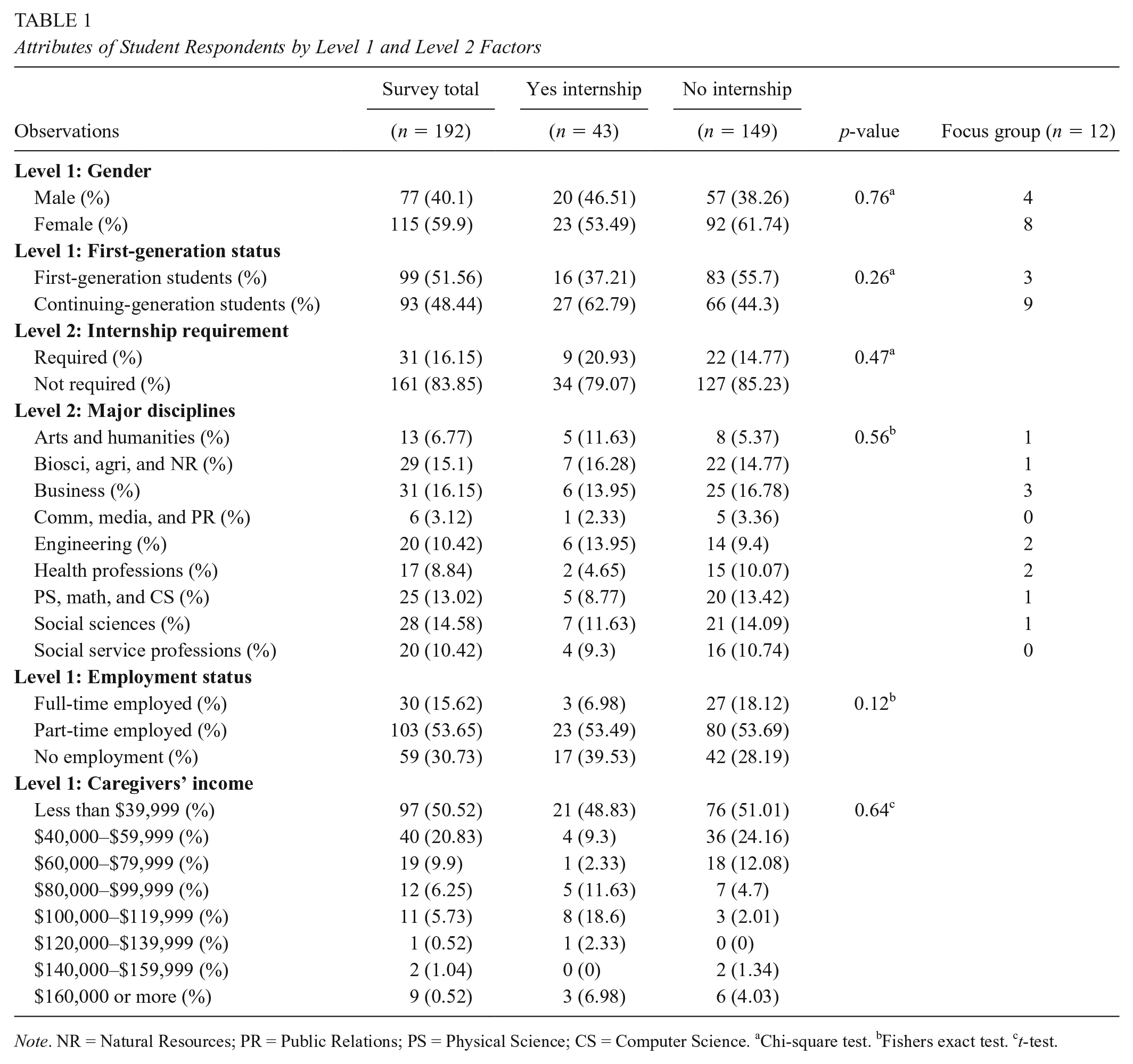
Note. NR = Natural Resources; PR = Public Relations; PS = Physical Science; CS = Computer Science. aChi-square test. bFishers exact test. ct-test.
Data Analysis Procedures
Quantitative Analysis
The proportion of cases with missing data across measures was less than 5%, and without evidence that missing data were not random, we used the pair-wise deletion approach to handling missing data. Simple descriptive statistics were used to report the types of obstacles that non-interns faced when seeking an internship, followed by chi-square, t-tests, or Fisher’s exact tests to examine the significance between different variables (e.g., gender, first-generation status) and two dependent variables: internship participation and each of the six reported obstacles to internships.
Qualitative Analysis
For the qualitative analysis of text-based data, we first segmented transcripts into more manageable units in which internship access and multilevel issues were discussed. Two analysts reviewed the same transcripts independently and selected salient text, compared and discussed results, and then segmented the transcripts (Creswell & Miller, 2000). Then, with the multilevel framework of Núñez (2014) in mind, the first author engaged in an open coding process, working through data segments for three students while creating codes based on explicit references to a category in the framework (e.g., gender, career services units) (Charmaz, 2014; Ryan & Bernard, 2003). This phase resulted in a list of 44 discrete factors grouped into the three levels; Table 2 shows how these codes mapped onto the multilevel model of Núñez (2014). During this coding process, we only coded explicit references to specific influences on or experiences with internships, added a category to Level 2 to capture cultural forces, and restricted Level 1 codes to aspects of identity and not individual experiences with multilevel forces (which were Level 2 codes). Then, we documented code-code associations and/or causal relations and organized these code “chains” thematically (Miles et al., 2013).
Analyses of Associations Between Level 1 and Level 2 Factors and Obstacles to Internships

Note. NR = Natural Resources; PR = Public Relations; PS = Physical Science; CS = Computer Science.*p-value < 0.05. ***p-value < 0.001. aChi-square test. bFishers exact test. ct-test.

Note. *p-value < 0.05. aChi-square test. bFishers exact test. ct-test.
Then, we used techniques from SNA to graphically depict the inter-relationships between and among individual codes through first developing a participant-by-code matrix in which each cell indicated whether participant i spoke about a particular element j (1) or not (0). We then used UCINET software to transform the two-mode data matrix into a one-mode (code-by-code) matrix (Borgatti et al., 2002) and then to graph the co-occurrences of pairs of codes. The size of each node in the graphs was also adjusted to represent one of the measures of node centrality—that of degree centrality—which refers to the number of times a code was most connected to other codes, given our interest in capturing especially salient factors influencing how students perceive their environmental constraints and affordances.
The trustworthiness of our qualitative analyses was enhanced by comparing student-based results with interview data from interviews conducted independently with some faculty and staff (which are not reported in this article), triangulating findings from student data with interviews with faculty and staff at TC, having multiple analysts review raw data and independently derive codes, and engaging in peer debriefings at each stage of data coding and analysis to confirm that findings and our understanding were in alignment (Creswell & Miller, 2000). Additionally, although our qualitative sample was small (n = 12), robust insights into human experience (and saturation or repetition of findings across cases) can be reliably achieved with relatively small samples (e.g., Hennink & Kaiser, 2021).
Researcher Positionality
Finally, we articulate the positionality of our team in relation to the community who is the focus of the analysis—HSIs and the predominantly Latinx students that they serve. We approach this research from the lived experiences and identities of scholars who identify as a Japanese American male, a White male, a Chicano male, a Korean female, and an Asian female, with the first author also positioned as a learning scientist and cultural anthropologist committed to documenting the cultural forces shaping opportunity in higher education. Consequently, our approach to the present study is shaped by our identities, access to class-based knowledge and resources, and our collective backgrounds, which are different from those of the students who are the focus of the analysis in this article. That said, we are all strongly allied with the goals of HSIs to serve Latinx students and communities.
Results
RQ1: Multilevel Factors That Functioned as Obstacles to Students’ Internship Experiences
In this section, we report findings from analyses of qualitative and quantitative data that provide insights into the factors across the three levels of Núñez’s (2014) multilevel model of intersectionality that are most salient to the problem of internship participation for students attending TC.
Analyses of Survey Data
First, we examine whether there were statistically significant differences in how particular Level 1 social categories (e.g., gender, first-generation status) or Level 2 embodied practices at the organizational level (e.g., internship requirements) were associated with internship participation itself. As shown in Table 1, there were no significant differences in internship participation among groups in each category, although one interesting result is that 22 of 149 non-interns (14.7%) were in programs that required an internship, which raises questions about how well TC was supporting these students in securing a position.
Then, to provide a snapshot of the obstacles that students at TC face when seeking an internship at a larger scale, we briefly report results from the survey data on this critical question. Among the 192 students who completed the survey, 149 (77.6% of all students) reported not having had an internship. Of these 149 non-interns, 117 (78.5% of non-interns) students had wanted to pursue an internship. For this group, 67% (n = 79) reported a heavy course load as an obstacle, 67% (n = 79) reported a lack of opportunities, 63.2% (n = 74) reported the need to work a paid job, 34.1% (n = 40) reported insufficient pay, and 31.6% (n = 37) reported a lack of transportation. These students rarely reported just a single obstacle, instead reporting multiple barriers, such that they overlapped with one another. For instance, students most frequently reported the need to work and a heavy course load, demonstrating how these two obstacles in practice intersected and even amplified one another (see Figure 1).

Combinations of obstacles perceived by non-interns as constraining their ability to pursue an internship.
Additional analyses of the ways that social categories and institutional factors were associated with each of the six obstacles in the survey reveal few statistically significant differences (see Table 2).
For instance, gender was only significantly associated with the obstacle of heavy course loads (p < 0.05) and lack of transportation (p < 0.05), first-generation status was not associated with any of the barriers, employment status was associated with the need to work (p < 0.001), and academic major was associated with lack of transportation (p < 0.05).
Analyses of Focus Group / Interview Data
In Table 3, we outline each of the themes that students explicitly identified as being salient to their consideration of college internships.
Multilevel Elements of Núñez’s (2014) Intersectionality Framework Identified in the Qualitative Data

We also analyzed how students made connections between and among the factors at Levels 1, 2, and 3 with respect to their internship opportunities and experiences. Statements that explicitly linked various factors addressed five main topics that are described in this section.
Factors Leading to Students’ Sense of Not Being Competitive / Limited Opportunities
Four students spoke about how various factors (e.g., academic major, being from a low-SES background, gender, and institutional prestige) interacted to ultimately give them the sense that they were not competitive in the internship market and/or simply had few opportunities available to them. For instance, one male student, who did not participate in an internship, stated:
[My department, computer science] brings in [former interns] from big companies like Microsoft and Google who say, “I got an internship,” but it’s one guy out of a million people that apply, so it feels kind of like a lie. It feels unobtainable. It would be nice if they brought in more obtainable internships. Because, I mean, we’re not a very high-achieving city. It’s nice to shoot for the stars, I guess, but when it is kind of like a dream, it’s hard to visualize.
This particular utterance was coded as L1 (Major) + L2 (Organizational: outreach) + L3 (Employer status) + L3 (Low city prestige) = L2 (Experiential: sense of limited opportunities) + L2 (Experiential: uncompetitive in the internship market). To illustrate the interconnected nature of students’ observations and perceptions of their opportunities, we used SNA techniques to create an affiliation graph from these qualitative data, where individual themes are depicted with different icons for each of the three levels, and lines connecting pairs of codes represent explicit linkages for this student (see Figure 2).

Affiliation graph of individual students’ perceived affordances related to internship access.
In this example, the only salient social category associated with the problem of internship opportunities was that of the students’ academic major, with organizational, economic, and reputational factors also coming into play. In some cases, certain majors (e.g., business or engineering) were described as having ample internship positions available—locally and regionally—while students in other programs (e.g., art or forensic science) had fewer structured internship opportunities.
Of the students who discussed the issue of not being competitive or having limited opportunities for internships, some did mention that the perception of their city as “not high achieving,” along with their race and gender (i.e., being a Latina), led to their feeling uncompetitive while seeking a position and then being an outlier at their actual internship site. In this case, the Latina student who participated in an internship described “imposter syndrome,” feelings of not belonging at the firm and not being taken as seriously as the mostly White male cohort of interns.
In other cases, the primary factor limiting students’ opportunities was financial; some students had to work part- or full-time jobs to pay for tuition and cost-of-living expenses for themselves and/or their families. This situation had a variety of impacts, from one student stating that they couldn’t participate in “regular” college life, such as lunch at the student union, to others observing that due to their work schedule, they simply had no time for an internship. One female student who had not taken an internship noted, “I wish I could just come to school and not go to work and do all the internships I want to do, but I mean—I can’t.” Another succinctly stated, “Leaving my [regular] job is simply not an option.” Each of these results highlights how a variety of intersecting factors led these students to feeling uncompetitive or bereft of career-boosting opportunities.
Influence of Pay and Housing on Students’ Ability to Participate
Four students discussed how the expenses associated with an internship—specifically, the low pay and/or related housing costs—were prohibitive. One female art major shared that the costs of an out-of-state internship, which would be required because few art opportunities existed in the TC community, plus the fact that many art-related internships were unpaid and her immigration status as a non-U.S. citizen made an internship unrealistic. In another student’s case, however, two scholarships from TC enabled her to cover the costs of housing in another city during the internship. In addition to the scholarships facilitating her ability to take an internship, this female student had recently switched majors from molecular biochemistry to finance, which led to “a lot of doors opening for me because I switched my major.” In this way, the microlevel factors of financial need and academic major intersected with organizational supports (i.e., subsidies and scholarships) and structural forces (e.g., housing costs, internship pay by sector) to shape students’ opportunities and access.
Role of TC as a Vehicle for Social Capital / Information Resource
Another theme identified in the data pertains to the role of TC as a conduit of information about internship opportunities and students’ subsequent sense of what (if any) opportunities existed and how competitive (or not) they were in the internship marketplace. The dissemination of information about job openings and related opportunities is one of the principal ways that social capital operates with respect to social mobility, as networks (whether academic, personal, or professional) act as vehicles for the sharing of scarce opportunities (Granovetter, 1974).
The data also indicate that TC students generally believed that their departments did not provide sufficient or accessible information about internships. In one case, a working student who did not have time to review the large number of emails from TC—some of which were about internships—simply deleted these messages, raising questions about the best medium for reaching working students (e.g., text messages or social media). For this student and others, the result was a lack of knowledge about whether internships even existed in their fields, let alone how to go about pursuing a position.
Role of Gender, Race, Employer Diversity, and Sense of Exclusion at Internship
Three female students spoke of the ways that gender, race, and the racial composition of employers affected their connection, or lack thereof, during the internship. One Latina interning at a finance firm with a cohort of interns who were all White men was told by a supervisor after a group presentation:
You know what, [student], you’re going to need to try harder because you’re in a group that is dominated [by men], so a lot of people aren’t going to take you seriously because you’re pretty and you’re a woman.
This student also noted that although “she was never mocked for being Hispanic,” she did feel out of place as the only non-White intern in the firm, and subsequently she never felt included in conversations or a sense of belonging at the company. Another female student who interned in a laboratory in Northern California discussed how being away from home and the only Latina was “pretty intimidating because there’s a whole room of guys.”
Finally, one of these students discussed gendered family care obligations, which her brothers and male peers did not have, as one of the constraints in her life that affected her ability to seek an internship:
Being a female, we have different expectations, you know, and being Mexican, like having to cook and clean and all that stuff, to where, like, nowadays people, you know, I want to be more educated and then not really my priority to do cooking and cleaning. But, you know, it’s still expected of me [by my family] to be like that perfect woman, I guess you could say.
This student’s situation illustrates how the multiple-minoritization of identities (Level 1) can be amplified by characteristics of the local internship market (Level 3), and how gendered social relations and family care obligations (Level 2) can additionally act as barriers to internships. These data highlight how social categories intersect with broader structural forces to affect students’ embodied experiences with internships.
Role of Prestige of City and University in Students’ Sense of Belonging/Mobility
Two students discussed how the low prestige of their city affected their internship and/or their sense of future opportunities. One female student suggested that the fact that they were not in a “gigantic city” but instead one that could be considered “mediocre” led many young people to leave: “Everyone successful leaves [NAME of CITY].” Another female student who had interned at a prestigious organization in New York City said that being from [NAME of CITY] made it “more difficult for [her] to have conversations with people” because of a perceived lack of cultural fit. These data illustrate how geography, place of origin, and cultural snobbery each constitute part of the landscape in which individual Latinx students’ internships unfold.
RQ2: Multilevel Factors That Intersected in the Lives of Students
For this final set of data from our study, we used SNA to delve into the ways that factors at the three levels of Núñez’s (2014) framework operated across multiple students’ lives. For this analysis, the codes were organized according to the three levels of the multilevel framework.
SNA of Intersections Among Levels 1, 2, and 3 by Gender Groups
According to intersectionality theory, it is likely that Level 1 social categories, such as race and gender, do play a role in how people perceive their opportunities within broader social, political, and economic structures. Thus, we disaggregated the data by one of the more influential Level 1 social categories identified in our study—gender—and created two affiliation graphs that depict the intersecting factors reported by male and female students as salient to their internship opportunities or lack thereof. The thickness of the lines connecting codes depicts the frequency with which they were explicitly linked (i.e., the thicker the line, the more frequently they were linked by students). The three symbols next to each code represent one of the three levels in Núñez’s (2014) framework (i.e., Level 1 as social categories, Level 2 as embodied practices, and Level 3 as historicity), with their size adjusted to represent the number of times a code was connected to other codes (e.g., degree centrality). (See Figures 3 and 4).

Affiliation graph of male students’ perceived affordances related to internship access.

Affiliation graph of female students’ perceived affordances related to internship access.
These graphs provide a visual snapshot of the multilevel, intersectional forces that affect Latinx students attending an HSI as they engage in the world of internships; they also highlight differences between male (n = 4) and female (n = 8) Latinx students in our study sample. If we consider differences between the two graphs, the most striking is the tightly interconnected set of four codes (i.e., gender, race/ethnicity, racial dynamics of employers, and belonging) evident in the female graph but absent in the male graph. Although such differences should be interpreted with caution, as this technique is sensitive to small variations in sample size and interviewee volubility, the fact that the male students were less focused on L1 dynamics other than current employment and major and more focused on limited internship opportunities and the paucity of information available to them is notable. Additionally, we highlight the stronger perceptions of L3 forces by the female group and the critical role that academic majors play in both groups of students.
Discussion
Our aim in this article was to examine how a sample of Latinx students attending an HSI perceived the constraints and affordances facing them in the internship labor market, using Núñez’s (2014) multilevel model of intersectionality as a theoretical lens to interrogate the ways that overlapping social identities and underlying structural forces may be excluding these students from internship opportunities. The contributions of the article to the literature are threefold: (a) new empirical insights on a critical yet understudied topic—the experiences of Latinx students attending HSIs with internships, (b) an elaboration of Núñez’s (2014) framework that adds a situative perspective that emphasizes individual perceptions of students’ opportunity structures, and (c) the introduction of SNA techniques to visualize qualitative data as part of an analysis of intersectional phenomenon.
In conducting and reporting our study, we also sought to avoid depoliticizing the concept of intersectionality and/or adopting a deficit frame whereby Latinx students or HSIs were seen as the source of the problem. With these contributions and considerations in mind, we next turn to specific insights from the data, followed by a brief discussion of ways that the data can inform “doing” intersectionality in practice (Harris & Patton, 2019; Núñez, 2014).
Insights Into the Experiences of Latinx College Students and Work-Based Learning
As noted, previous scholarship (Leal-Muniz & Constantine, 2005) has found that Latinx students sometimes opt out of career fields and internships due to preconceived worries about race and ethnic discrimination. Unfortunately, we also found that students in our study did experience racialized and gendered discrimination during their internships. Consequently, internships—much like postsecondary institutions themselves—should be viewed not as race-neutral spaces (Ray, 2019) but as politicized and potentially exclusionary spaces into which entry is problematic for students who are not White, male, and well resourced. Such a focus in the interdisciplinary literature on internships would represent a departure from the majority of scholarship on the topic, which tends to view internships as unproblematic HIPs that simply need to be pursued or “taken” by enterprising students.
Additionally, the data reveal that for Latinx college students in this study, internships were not a common experience, with survey results indicating that just 25.8% (n = 60) of the students at TC had had an internship. This is a much lower figure than some national estimates of 50% of college seniors having taken an internship (National Survey of Student Engagement, 2021); the fact that just one in five TC students participated in this potentially “door-opening” (Saniter & Siedler, 2014) experience is concerning. Further, the fact that 76.9% (n = 133) of the non-interns had actually wanted to take one but could not due to their work schedules, academic course load, lack of opportunities, and so on indicates that higher education in general and HSIs in particular have an internship accessibility problem on their hands (see also Hora, Wolfgram, & Chen, 2021).
As highlighted by an intersectional perspective, this problem of access is not solely a structural issue related to student employment or academic work; the role that certain social categories and identities play in inhibiting access must also be considered. For instance, this study highlights the importance of a student’s academic major as a microlevel factor that affects whether they have access to not just a variety of internship openings but paid positions in particular, with business and engineering students holding a distinct advantage over students in other fields. Female students in the qualitative portion of the study also highlighted the dynamics among race, gender, and employer discrimination, indicating that such issues and constraints may be more acutely experienced among Latina students. Similarly, as noted by other scholars (e.g., Medina & Posadas, 2012), family is often a source of support and motivation but also of tension for Latinx men and women, due to potent gendered familial expectations and obligations about work, careers, and commitment to the family (Gándara, 1995; Risco & Duffy, 2011). At the same time, gender did not play a significant role in our statistical analyses while appearing to be a salient and influential factor in our qualitative results, suggesting that how gender may be affecting internship participation should be explored in greater depth in future research.
Implications for Future Research and Practice
In the spirit of using the data reported in this article to dismantle racist, classist, and sexist systems of oppression inherent in the internship marketplace, we conclude with a brief discussion of the implications of our findings for educational practice and how to make internship opportunities more accessible for Latinx students attending HSIs. Additionally, building on Garcia’s (2019) and other scholars’ work on HSIs and the idea of “servingness” (Sansone et al., 2019), we draw attention to ways that TC has succeeded and failed to provide these structures for students in our study, which may also illuminate similar issues and patterns affecting Latinx students attending other HSIs.
First, we argue that HSIs need to acknowledge and address how various social categories and identities—especially gender—may affect their students’ experiences with internships. Specifically, based on evidence that minoritized students feel a low sense of belonging in White-dominated workplaces and that women experience gendered norms for work within their families and workplace discrimination, it is time to adopt an approach to “culturally responsive” internships that dispenses with the fiction of meritocracy and puts in place adequate and appropriate support systems for non-majority students. This approach means that the private sector would need to refine and work in conjunction with colleges and universities to co-develop culturally responsive internships that would work to dismantle practices that reinforce feelings of marginalization while also ensuring that all students were financially supported throughout the experience.
Second, several students reported gaps in how the institution provided information about internships in their courses or via career services units, thereby causing fractures in their professional opportunities and growth, particularly for working students too busy to check their email regularly. We contend that the vehicles for sharing social capital in the form of information (Lin, 2001) should be viewed as an important element of servingness within HSIs. Therefore, we encourage HSIs to center information provision about WBL opportunities and to build multimodal systems for sharing accessible, high-quality, and jargon-free information for Latinx students through text messages, social media, departmental webpages, and other formats.
Third, an intersectional lens highlights the fact that internships are subject to a variety of Level 3 contextual forces that are beyond the direct control of an individual HSI, but their potentially negative effects can be ameliorated by intentional and targeted programming and student supports. One example of these broader field effects is the discipline- and occupation-specific nature of the internship labor market, with internships for business and STEM majors—especially those that are paid and/or potential “conveyer-belt” positions leading to full-time employment (Moss-Pech, 2021)—being more prevalent and accessible. In addition, the geographic isolation of the city where TC is located makes travel and relocation expenses essential for students seeking positions in such firms as Microsoft, Google, and other Fortune 500 corporations. The relatively depressed local economy results in a scarcity of internship positions for all the students at TC, with an analysis of online listings revealing roughly 324 potential interns for each job posting (Hora, Dueñas, et al., 2021). Each of these findings indicates that to best meet the needs of their students, TC career advisors and leadership should pay close attention to helping them—especially those students outside the business and STEM fields—find and successfully pursue internships beyond the competitive and limited local labor market.
Ultimately, with an intersectional lens, is it clear that the landscape of internships is too often one of exclusion and gatekeeping that disadvantages many college students. Scholars interested in exploring these issues in the future should consider drawing on intersectionality or other frameworks that are critical and multidimensional (e.g., field theory; see Hora, Wolfgram, & Chen, 2021), examining the ways that cultural factors within organizations (e.g., employers and postsecondary institutions) and students’ own lives influence how internships are structured and experienced, and especially the roles that race, gender, and academic major play in students’ opportunities in the internship labor market. If the field of higher education is sincere about advancing diversity, equity, and inclusion along with the benefits of HIPs such as internships it will need to deal with the fact that at present, these two goals are not compatible and will require a not inconsiderable investment of time, money, and energy to rectify these long-standing inequalities.
Supplemental Material
sj-docx-1-ero-10.1177_23328584221102162 – Supplemental material for A Multilevel, Agent-Centered Analysis of Intersectionality in a Hispanic-Serving Institution: The Case of College Internship Access for Latinx Students
Supplemental material, sj-docx-1-ero-10.1177_23328584221102162 for A Multilevel, Agent-Centered Analysis of Intersectionality in a Hispanic-Serving Institution: The Case of College Internship Access for Latinx Students by Matthew T. Hora, Matthew Wolfgram, Adrian H. Huerta, Changhee Lee and Anita Gopal in AERA Open
Footnotes
Acknowledgements
The author(s) disclosed receipt of the following financial support for the research, authorship, and/or publication of this article: The authors would like to thank the Bill & Melinda Gates Foundation for their generous support of this research project, and the faculty, staff, and students at Texas College who shared their time and experiences with our research team.

Notes
Authors
MATTHEW T. HORA is an associate professor of adult and higher education and director of the Center for Research on College-Workforce Transitions (CCWT) at the University of Wisconsin-Madison. His research focuses on the cultural, cognitive, and systemic factors that shape educational practices, including teaching, skills development, and internship programming.
MATTHEW WOLFGRAM is a researcher at the Wisconsin Center for Education Research and CCWT at the University of Wisconsin-Madison. His research interests include anthropology and ethnography of education, participatory action research, and the use of qualitative research methods to study the education and career experiences of minoritized college students.
ADRIAN H. HUERTA is an assistant professor of education in the Rossier School of Education at the University of Southern California and a CCWT research affiliate. His research focuses on boys and young men of color, college access and equity, and gang-associated youth.
CHANGHEE LEE is a doctoral student in the Department of Educational Leadership and Policy Analysis and a CCWT project assistant at the University of Wisconsin-Madison. She is interested in educational innovations for marginalized students and their impacts.
ANITA GOPAL was a researcher at CCWT at the University of Wisconsin-Madison. Her research focuses on student access and success, racial equity, workforce development, and immigration policies for underserved populations in higher education.
References
Supplementary Material
Please find the following supplemental material available below.
For Open Access articles published under a Creative Commons License, all supplemental material carries the same license as the article it is associated with.
For non-Open Access articles published, all supplemental material carries a non-exclusive license, and permission requests for re-use of supplemental material or any part of supplemental material shall be sent directly to the copyright owner as specified in the copyright notice associated with the article.
