




Abstract
The authors investigate coronavirus disease 2019 (COVID-19) risk factors, suitability of online instruction, politics, and institutions’ finances as rationales guiding instructional delivery decisions for fall 2020, after COVID-19’s emergence. Contributions include estimating multinomial logit regressions with mode of delivery as a categorical variable, integrating resource dependence and crisis response as theoretical frames, and introducing new predictor variables, including a measure of local residential access to broadband Internet. Findings suggest that county populations, local political preferences, and the percentage of revenue derived from auxiliary enterprises were consistent predictors of delivery mode. Political parties of an institution’s governor and congressional representative were predictive of delivery mode for institutions in the lowest tercile of endowment per student but not for institutions in the highest tercile. Bottom-tercile institutions substituted from online to in-person reopening as reliance on revenue from auxiliary enterprises increased, but top-tercile institutions appeared only to substitute from hybrid to in-person or from online to hybrid delivery as revenue from auxiliary enterprises or tuition and fees increased.
During the spring 2020 semester, the coronavirus disease 2019 (COVID-19) pandemic emerged and created a range of negative consequences for students, staff members, and institutions in higher education. Many students were sent home from their campuses and residence halls and completed their spring courses in virtual formats, leading to reductions in course completion as well as delayed graduation and lost internships, jobs, or job offers (Aucejo et al., 2020; Bird et al., 2020). Institutions faced lost revenue from room and board refunds offered to students sent home, as well as uncertainty over fall 2020 enrollment prospects (Kim et al., 2020; Seltzer, 2020a). Institutions that participated in National Collegiate Athletic Association postseason basketball tournaments lost revenue-sharing proceeds after those events were canceled (Witz, 2020). At the same time, institutions faced increased expenses for implementing safety protocols and scaling up delivery of online courses (Seltzer, 2021; Whitford, 2020b). Institutions received direct payments from the federal government through multiple rounds of economic stimulus, but half of the direct payments were earmarked for student financial aid, and institutions still resorted to furloughs and reductions in compensation for employees (ESPN Staff, 2020; Seltzer, 2021; Whitford, 2020a). Public institutions that relied on state funding faced uncertainty with respect to state and local revenues, especially for state governments that depended on revenue from income taxes and charges from activities like driving on toll roads (Sheiner & Campbell, 2020).
Institutions concerned about revenue and cash flow looked ahead to incoming students’ admissions preferences for fall 2020. Early evidence suggested that students preferred in-person instruction to virtual delivery, suggesting that institutions should prioritize in-person delivery if they wanted to attract new students and retain existing students (Kim et al., 2020). On the other hand, bringing students back to campus in the fall introduced a risk of spreading COVID-19 in the campus community, and later evidence suggested this was a plausible concern; even among campuses that brought students back to campus, in-person and hybrid delivery modes were associated with larger increases in local COVID-19 case rates relative to fully online delivery (Andersen et al., 2022; Leidner et al., 2021; Lu et al., 2021). Hispanic or Latino individuals and non-Hispanic American Indian, Alaska Native, Black, or African American individuals faced a higher risk for contracting COVID-19 and a higher risk for hospitalization or death after contracting it, relative to non-Hispanic Asian and White individuals, as results of unequal access to health care and housing and a higher likelihood of employment as essential workers (Centers for Disease Control and Prevention, 2022). Institutions with higher shares of individuals at higher risk from COVID-19 among their students, staff members, or communities might have been especially concerned about limiting the spread of the virus (Centers for Disease Control and Prevention, 2021). Facing a potential tension between conducting business as usual and protecting public health, colleges and universities pursued a wide range of approaches to reopening in the fall, with at least one in four institutions opening primarily or fully in person, at least two in five institutions opening primarily or fully online, and at least one in five institutions using a hybrid approach (“Here’s Our List,” 2020). Institutions also differed in the timing of their decisions, with the California State University system announcing in May that fall instruction would be online, while the University of Southern California initially announced that fall courses would be offered in person but shared in July that instruction would be mostly online (Burke, 2020; Zukoski & Wright, 2020). Some institutions even welcomed students back to campus for in-person instruction in August before changing course and sending them home for online delivery, including the University of North Carolina at Chapel Hill, Michigan State University, and the University of Notre Dame (Flaherty, 2020; Seltzer, 2020b).
In light of these dynamics, we investigate institution and community characteristics that might offer some explanation into administrators’ preferred plans for reopening. The present study joins an emerging strand of literature in investigating why institutions chose the approaches they did (Acton et al., 2022; Collier et al., 2020, 2021; Felson & Adamczyk, 2021; Tobin et al., 2021; Whatley & Castiello-Gutierrez, 2021). Other studies on this topic suggest that relevant factors include state- and county-level political variables (Collier et al., 2020, 2021; Felson & Adamczyk, 2021), student demographics (Collier et al., 2020), COVID-19 incidence (Collier et al., 2021), county-level population density, share of institution revenue from tuition, institution graduation rates, institution residence hall capacity (Felson & Adamczyk, 2021), and enrollment of international students (Whatley & Castiello-Gutierrez, 2021).
This study offers a number of contributions to the emerging literature on this topic (Acton et al., 2022; Collier et al., 2020, 2021; Felson & Adamczyk, 2021; Whatley & Castiello-Gutierrez, 2021). First, we conceive of the dependent variable of institutions’ choice of mode of instructional delivery as a categorical rather than a binary variable and accordingly use multinomial logit regression to illustrate relationships between predictive factors and in-person, hybrid, and online reopening separately. Second, we propose a theoretical foundation that links resource dependence with organizations’ responses to crisis and we examine differences in results for institutions with the highest and lowest values of endowment per student (Coombs, 2007; Pfeffer & Salancik, 1978; Tobin et al., 2021). Finally, we introduce new predictor variables into the emerging literature on institutions’ reopening decisions, including staff characteristics, revenue from auxiliary enterprises, and residential access to broadband Internet. Findings suggest that county populations, local political preferences, and the percentage of revenue derived from auxiliary enterprises were consistent predictors of delivery mode. Political parties of an institution’s governor and congressional representative were predictive of delivery mode for institutions in the lowest tercile of endowment per student but not for institutions in the highest tercile. Bottom-tercile institutions substituted from online to in-person reopening as reliance on revenue from auxiliary enterprises increased, but top-tercile institutions appeared only to substitute from hybrid to in-person or from online to hybrid delivery as revenue from auxiliary enterprises or tuition and fees increased. In the next section, we review relevant literature and identify five hypotheses, followed by an outline of the research method, review of results, and discussion of the results through the lens of the hypotheses.
Literature Review
Several emerging studies have examined institutions’ plans to deliver instruction for the fall 2020 semester (Acton et al., 2022; Collier et al., 2020, 2021; Felson & Adamczyk, 2021; Tobin et al., 2021; Whatley & Castiello-Gutierrez, 2021). Collier et al. (2021) used a structural equation modeling approach with state sociopolitical characteristics, county sociopolitical characteristics, pandemic severity, and state revenue declines as factors predictive of the fall 2020 mode of instructional delivery. State sociopolitical characteristics included joint Republican control of a state’s governor’s office and legislature and the percentage of individuals 25 years and older without at least a bachelor’s degree, county sociopolitical characteristics included the percentage of county residents who were Trump voters in the 2016 presidential election and the county-level share of individuals without at least a bachelor’s degree, measures of pandemic severity included state- and county-level 14-day average case counts per 100,000 residents as of the dates institutions made their decisions, and state revenue declines were measured by comparing state tax revenue from March to May 2019 compared with the same period in 2020 for each state and expressed as a percentage change (Collier et al., 2021).
In general, state and county sociopolitical characteristics and pandemic severity had statistically significant relationships with institutions’ reopening decisions. Only state features appeared to matter for public 4-year institutions (with institutions in states with joint Republican control and a lower percentage of residents with bachelor’s degrees or higher more likely to open in person), and both state and county features were associated with public 2-year institutions’ decisions. Both state and county features also mattered for private 4-year institutions, as did pandemic severity (with greater severity associated with lower likelihood of reopening in person) and state revenue declines (with private institutions in states with greater declines in tax revenue more likely to open in person). In earlier work, Collier et al. (2020) found that institutions in states with Republican governors and institutions in states with Republican-controlled legislatures were more likely to plan to open in person as of August 5. Institutions with higher percentages of enrolled students who were White were less likely to plan to open in person (Collier et al., 2020). The authors did not find a clear relationship between local COVID-19 case rates and reopening plans, although they found that institutions in the highest quintile of local cases were less likely to plan to open in person (Collier et al., 2020).
Felson and Adamczyk (2021) estimated a multilevel logit regression model in which institutions were nested within states and some institutions were nested within systems. Categories of predictor variables included state and county political characteristics, state and county COVID-19 incidence measures, basic characteristics of colleges and universities, colleges’ and universities’ financial characteristics, faculty characteristics, and the percentage of students within colleges and universities who previously took some or all of their courses online (Felson & Adamczyk, 2021). Findings suggested that institutions that derived a higher percentage of their revenue from tuition, institutions with greater residence hall space, institutions with higher graduation rates, and institutions in states and counties with higher percentages of 2016 Trump voters had a higher likelihood of reopening in person (Felson & Adamczyk, 2021). On the other hand, institutions with higher enrollment and institutions in counties with higher population density had a higher likelihood of reopening online (Felson & Adamczyk, 2021).
Tobin et al. (2021) focused on the decisions of a group of 123 private liberal arts colleges and introduced institutional financial health indicators including endowment per student, Zemsky’s financial stress score, and the Forbes College Health Financial Grade. They examined two versions of the dependent variable for choice of delivery mode, one binary (in person or not) and one categorical variable that treated hybrid delivery as separate from in-person and online delivery. Findings suggested that liberal arts colleges in the bottom quartile of endowment per student and institutions at risk according to the Zemsky or Forbes scores were more likely to open in person. Institutions with lower county-level COVID-19 case rates in the week leading up to their decisions were more likely to open in person, and county-level vote shares for Trump in the 2016 presidential election appeared to matter less in the sample of private liberal arts colleges relative to findings for other institutions in Collier et al.’s (2021) and Felson and Adamczyk’s (2021) samples. In their analysis of the categorical dependent variable, they did not find any statistically significant predictors of hybrid reopening for private liberal arts colleges. Whatley and Castiello-Gutierrez (2021) focused specifically on institutions that changed their plans during July 2020, in the midst of changing guidance from the U.S. federal government around visa status for international students who would take their course loads fully online at U.S. institutions. Whatley and Castiello-Gutierrez used a Cox proportional-hazards event-history model with observations for each day in July 2020 and found that private 4-year institutions with higher percentages of enrolled international students were more likely to change their reopening plans in July to include more in-person instruction.
Although these studies shed light on numerous aspects of institutions’ decisions, there are some remaining inconsistencies and missing pieces. First, different authors took different approaches to handling hybrid delivery in the dependent variable. Collier et al. (2021) included hybrid delivery with fully or primarily online delivery in their binary dependent variable, and Felson and Adamczyk (2021) included hybrid delivery with fully or primarily in-person delivery in a binary outcome. Tobin et al. (2021) used two different dependent variables, one that matched Collier et al.’s grouping hybrid approaches with fully or primarily online and one that separated hybrid approaches in a categorical dependent variable with three categories. Allen and Seaman (2013) defined hybrid courses as courses with 30% to 79% of content delivered online and in which online content may replace some face-to-face meetings. These courses may resemble in-person courses to the extent that students must be present on campus for face-to-face components and students may benefit from campus resources including broadband Internet access or technical support (Felson & Adamczyk, 2021; Skinner, 2019). On the other hand, hybrid courses may take even more planning, communication, and time to implement than online courses require and represent a deviation from the business as usual of in-person instruction (Andersen et al., 2022; Ocak, 2011).
Grouping modes of delivery that institution leaders may regard differently may introduce statistical bias into estimates of relationships between predictive factors and instructional decisions. For example, if institutions with revenue concerns want to have students back on campus, either in fully in-person or hybrid delivery environments, estimates of the relationship between revenue measures and in-person reopening may be biased downward if the reference category includes hybrid delivery. On the other hand, estimates of the relationship between COVID-19 incidence measures and in-person reopening may be biased upward if the in-person outcome includes hybrid decisions that institution leaders may view as mitigation measures. Despite Tobin et al.’s (2021) null findings related to hybrid reopening for private liberal arts colleges, there still appears to be justification for modeling hybrid delivery separately from in-person and online approaches for other institutions in case institution leaders approached hybrid reopening differently from both in-person and online reopening.
Second, existing research illustrates relationships between financial factors and reopening decisions but does not illustrate how finances might influence institutions’ interpretation of other factors like political sentiment or the suitability of online instruction for students’ learning. Existing studies have shown that institutions in states experiencing revenue declines, institutions that derived a higher percentage of revenue from tuition and fees, institutions with lower endowment per student, and institutions with low ratings of financial health were more likely to open in person for fall 2020 (Collier et al., 2021; Felson & Adamczyk, 2021; Tobin et al., 2021).
However, researchers have not yet investigated the extent to which financial security might influence institutions’ responses to other predictive factors, for example, if institutions at financial risk were more likely to go along with the preferences of local elected officials or the preferences of the local electorate (Pfeffer & Salancik, 1978). If institutions at different levels of financial security respond differently to pressures such as student enrollment demand or elected officials’ political preferences, statistical models that do not condition on finances may yield an incomplete picture of institutions’ decision making. Investigating relationships between predictive factors and the decision to reopen with hybrid delivery, especially for public institutions and private doctoral universities, and investigating a moderating role for financial health in the relationships between reopening decisions and other predictor variables remain open lines of research.
Hypotheses
The COVID-19 pandemic meets Coombs’s (2007) definition of a crisis as “a sudden and unexpected event that threatens to disrupt an organization’s operations and poses both a financial and a reputational threat” (p. 164). COVID-19 can pose a reputational threat if stakeholders are unsatisfied with institutions’ responses to the pandemic (Coombs, 2007). Crisis situations may exhibit ambiguity in at least two dimensions, moral ambiguity and attributional ambiguity (Roulet & Pichler, 2020). Crises are subject to moral ambiguity when precipitating actions are not clearly right or wrong (Green, 2004; Roulet & Pichler, 2020). Institutions might have differed in their perceptions of the moral character of their reopening decisions if they thought prioritizing distance might protect public health but prioritizing a return to campus might promote student learning, connect students with campus resources, or preserve employees’ livelihoods. Crises exhibit attributional ambiguity when an involved party’s responsibility for precipitating a crisis is unclear (Roulet & Pichler, 2020). After the onset of COVID-19, institutions might have perceived themselves, or at least tried to present themselves, as victims of the pandemic rather than responsible for its transmission (Coombs, 2007). Most research on organizational crisis response focuses on organizations’ responses to precipitating crisis events that have already occurred, so the context of COVID-19 during the summer of 2020 is unusual because institutions were deciding how to respond in the fall as the pandemic was ongoing, crisis outcomes had not yet been fully realized, and data after the March onset of the pandemic were only a few months old (Coombs, 2007; Roulet & Pichler, 2020). This timing only added to moral and attributional ambiguity, as institutions might also have questioned the extent of the connection between public health outcomes and their own reopening decisions in the earliest stages of the availability of evidence on COVID-19 transmission (Andersen et al., 2022).
An organization can take a variety of responses to crises, including denying the existence of a crisis, diminishing the importance of a crisis, or rebuilding its reputation after accepting responsibility (Coombs, 2007). Coombs (2007) hypothesized that organization representatives would be most likely to attempt to diminish the importance of a crisis if they could portray the organization as a victim of the crisis with minimal responsibility or if the organization had no track record of similar crisis incidents. Organization representatives would be most likely to attempt to accept responsibility and rebuild the organization’s reputation after a crisis with an appearance that the organization could have prevented it or if the organization experienced similar crisis events in the past (Coombs, 2007). In the context of institutions’ response to COVID-19, business-as-usual responses emphasizing in-person instruction would downplay or diminish the importance of the risk for COVID-19 transmission on campus or in classrooms, and adjustments in favor of hybrid or online instruction would reflect institutions’ willingness to take responsibility to attempt to limit the spread of COVID-19.
Researchers have found that maintaining social distance is an effective way to mitigate spread of COVID-19, and colleges and universities facing higher local incidence of COVID-19 may have felt higher pressure to implement preventive measures such as keeping students out of classrooms (Siedner et al., 2020). Institutions with larger enrollments also may have had more opportunities for person-to-person transmission of the virus. Individuals from certain populations faced higher risk for contracting COVID-19 as well as higher risk for hospitalization or death upon contracting it, including Hispanic or Latino individuals and non-Hispanic American Indian, Alaska Native, Black, or African American individuals (Centers for Disease Control and Prevention, 2021). Greater numbers of local cases from the emergence of the pandemic to the beginning of the fall semester may constitute a local crisis history, and institutions with larger enrollments and a higher proportion of staff members at greater risk for COVID-19 cases or complications may have a harder time avoiding responsibility for any realized negative consequences. Consistent with Coombs (2007), such institutions with crisis histories or limited ability to avoid perceived responsibility may be more likely to pursue strategies that reflect some willingness to accept responsibility for protecting institution stakeholders.
Hypothesis 1: Colleges and universities with higher local and institutional COVID-19 risk factors (including county case rates, total institutional enrollment, and the percentage of staff members who are American Indian, Alaska Native, Black, African American, Hispanic, or Latino) had a higher likelihood of reopening with a hybrid or online delivery mode.
With respect to the academic suitability of online instruction, factors including students’ willingness to take online courses and access to broadband Internet may influence the likelihood that students would succeed in an online environment. Ortagus (2017) found that married students, working students, and students with dependents were more likely to take some or all of their courses online. The percentage of students at an institution taking some or all of their courses online might be reflective of students’ interest in or willingness to take courses online, and this might also reflect institutional infrastructure to design or facilitate online courses or faculty members’ willingness to teach them (Ortagus, 2017). Skinner (2019) found that local access to broadband Internet predicted enrollment in online courses at open-access public colleges and universities and that increases in minimum available speeds were positively associated with the share of students taking some courses online. If reopening online to facilitate social distancing represented a way for institutions to take responsibility for mitigating the spread of COVID-19, then institutional and local capacity to offer courses online successfully would limit institutions’ ability to avoid taking responsibility in this way or downplay their response to the pandemic. These factors also would apply specifically to online delivery and not hybrid delivery with students on campus; regional broadband Internet access limitations would constrain students’ ability to take courses online from home but not to complete online course content while living on campus or in close proximity to campus resources.
Hypothesis 2: Institutions with greater capacity to offer instruction online (those with higher percentages of students who already took some or all of their courses online and higher percentages of local community residents with access to broadband Internet) had a higher likelihood of reopening with online delivery.
Throughout the unfolding of the COVID-19 pandemic in the United States, Republicans or individuals with Republican political leanings viewed COVID-19 as less of a threat than did individuals whose views aligned more closely with the Democratic Party (Tyson, 2020). Democratic governors were more likely than Republican governors were to order lockdowns and more likely to implement mask mandates (Adolph et al., 2021; Tellis et al., 2020). This difference in viewpoint also aligned with differences in individual compliance with measures such as social distancing and mask wearing (Gollwitzer et al., 2020; Kramer, 2020). In crisis situations subject to ambiguity, competing actors may engage in discourse to promote their preferred framing of a crisis (Coombs, 2007; Roulet & Pichler, 2020). If elected officials diminish the importance of COVID-19 mitigation efforts or if local residents do not view those efforts as morally right, then institutions would have an easier time diminishing the importance of their own COVID-19 response and pursuing an approach closer to business as usual. Furthermore, elected officials may control important resources, including funding and support for policy initiatives, and institution leaders (especially at public institutions) may be reluctant to contradict elected officials’ framing of the pandemic (Coombs, 2007; Pfeffer & Salancik, 1978; Roulet & Pichler, 2020). If a governor diminished the importance of social distancing and did not pursue restrictive measures, a decision by a public institution to keep students away from campus would create a competing message about the importance of the pandemic and the appropriate response (Coombs, 2007; Roulet & Pichler, 2020).
Hypothesis 3: Institutions in states and local communities with greater Republican influence (measured by the political party of a state’s governor and the political party of a district’s congressional representative) had lower likelihood of reopening with a hybrid or online mode of delivery.
Institutions may rely on resources beyond public funding and may need to cultivate relationships with actors in their external environment in order to secure these resources (Pfeffer & Salancik, 1978). If colleges and universities depend on tuition revenue as a financial resource and believe that tuition-paying students will prefer in-person instruction, then they will be more likely to offer in-person instruction upon reopening, other things equal (Kim et al., 2020). Similarly, if colleges and universities depend on revenue from room and board charges, then they will be more likely to offer in-person instruction to bring students back into residence halls (Seltzer, 2020a). Institutions that rely on other auxiliary activities such as intercollegiate athletics may prioritize returning students to campus to facilitate practices and travel to competitions and follow the leads of athletics governing bodies (Collier et al., 2020). Institutions dependent on students for revenue may also prefer hybrid delivery to online delivery if hybrid delivery would bring students back to campus, residence halls, and dining facilities for some portion of face-to-face instruction.
Hypothesis 4: Colleges and universities that depend on student enrollment and auxiliary activities for financial resources (measured by the percentage of revenue from tuition and fees and the percentage of revenue from auxiliary enterprises) had a lower likelihood of reopening with online delivery.
Colleges and universities may attempt to organize their activities in order to appeal to prospective students and elected officials or to facilitate auxiliary enterprises, but resource dependence might also influence institutions’ responses to crisis situations. If reopening with hybrid or online delivery in response to high local case rates or risk factors make institution leaders appear to accept responsibility for addressing COVID-19 or to acknowledge some ethical importance of responding to the pandemic, the institution may receive criticism from observers who do not hold these views (Coombs, 2007; Green, 2004; Roulet & Pichler, 2020). Institutions may also have a higher propensity to defer to the preferences of elected officials if they have a higher reliance on external resources, including public funding and goodwill. Resource dependence may interact with crisis response in the determination of institution leaders’ interpretation of and reaction to crisis characteristics, including crisis severity, appropriateness of potential responses, the discourses and crisis framing of external agents who control importance resources, and organizations’ ability to generate revenue (Pfeffer & Salancik, 1978; Roulet & Pichler, 2020).
Hypothesis 5A: Hypotheses 1 and 2 will be most strongly evident for institutions with the lowest dependence on external resources.
Hypothesis 5B: Hypotheses 3 and 4 will be most strongly evident for institutions that depend the most on external resources.
Data
Data for this study came from seven disparate sources. Most study variables came from the Integrated Postsecondary Education Data System (IPEDS) maintained by the National Center for Education Statistics (2021). IPEDS variables included a unique UNITID to identify each institution; institution name; Carnegie classification; highest degree level awarded; public or private control; fall 2019 full-time equivalent (FTE) total undergraduate and graduate student enrollment; fall 2019 online student enrollment; 2019–2020 total revenue, revenue from tuition and fees, revenue from auxiliary enterprises, and year-end endowment value; staff counts by race/ethnicity and full- or part-time status; county; state; congressional district; and latitude and longitude. We accessed the key outcome variable of institutions’ reopening plans for fall 2020 via the Chronicle of Higher Education with permission from the College Crisis Initiative at Davidson College (College Crisis Initiative at Davidson College, n.d.; “Here’s Our List,” 2020). Reopening data classified institutions as fully in person, primarily in person, fully online, primarily online, or in a hybrid and/or hyflex model; institutions primarily in person or primarily online allowed certain exceptions, such as lab sections, to deviate from the rest of campus, and hybrid or hyflex models let faculty members have discretion over delivery modes for their courses, and hybrid or hyflex delivery of a course could rotate between in person and online day by day or week by week (College Crisis Initiative at Davidson College, n.d.). Reopening information was merged onto IPEDS data using institution name, state, and county.
County characteristics were collected from USAFacts (COVID-19 daily case rates by county, aggregated as total case numbers as of July 31, 2020) and the Centers for Disease Control and Prevention (bridged-race county population estimates for 2019) (Centers for Disease Control and Prevention, 2020; USAFacts, 2021). In contrast to Collier et al.’s (2021) use of COVID-19 cases as of the date institutions made their decisions, we assumed that institutions monitored case numbers and could have changed their decisions up to the start of the fall semester, so final decisions (even a decision to maintain a course of action announced earlier) reflected local COVID-19 incidence as of July 31. These variables were merged onto IPEDS data by state and county Federal Information Processing Standard codes to link each institution’s county with the relevant characteristics. Each governor’s political party was collected from Ballotpedia (2020) and merged by state, and congressional representatives’ political parties were collected from the U.S. House of Representatives (n.d.) Web site and merged onto IPEDS by state and congressional district. We used the political party of the congressional representative as a measure of within-state variation in political opinion current as of 2018 midterm elections, whereas members of the House of Representatives themselves may have little oversight of institutions’ decision-making processes in their districts.
Finally, a measure of local broadband Internet access was introduced from the U.S. Census Bureau’s (n.d.) American Community Survey. The American Community Survey reports annual individual-level survey responses for public-use microdata areas (PUMAs) with at least 100,000 residents. To associate IPEDS institutions with PUMAs, IPEDS institutions’ latitudes and longitudes were overlaid onto a shapefile of PUMAs using QGIS software (Hillman, 2017; IPUMS-USA, n.d.; QGIS, 2021). We then joined each IPEDS institution with the PUMA that contained it using QGIS, exported a file from QGIS with UNITIDs and PUMA identifiers, and merged back the PUMA identifiers back onto the IPEDS data using the UNITID. We used a single variable to represent local broadband Internet access: for public 2-year institutions, this variable took the value of the weighted percentage of survey respondents in each institution’s PUMA with access to broadband Internet in their households, and for public and private 4-year institutions, this variable took the value of the weighted percentage of respondents in each institution’s state with household access to broadband Internet.
Analysis samples include institutions with nonmissing values for reopening plans and nonmissing values for model covariates. For-profit institutions are not captured in the fall 2020 reopening data and are excluded from the analysis. Four-year institutions with a Special Focus designation in the Carnegie Classification (those awarding a majority of credentials in a single field) had 34.9% of institutions missing reopening information, and Special Focus 2-year institutions had 29.7% missing reopening information, and these are also excluded. The full sample of institutions includes associate’s-, bachelor’s-, master’s-, and doctorate-granting institutions with nonmissing values for institution characteristics, county characteristics, and rates of local broadband access. Table 1 illustrates characteristics of the regression samples featured in Tables 2 and 3. Within the full sample, 28.8% of institutions opened fully or primarily in person, 22.7% of institutions opened with hybrid delivery, and 48.5% of institutions opened fully or primarily online. Across institution types, public 2-year institutions were the least likely to open fully or primarily in person (17.6%) and the most likely to open fully or primarily online (65.1%). Relative to public 4-year institutions, private 4-year institutions had smaller fall 2019 FTE enrollment (3,400 vs. 11,600), had smaller percentages of students take some but not all courses online in fall 2019 (12.5% vs. 26.4%), generated higher percentages of revenue from tuition (56.4% vs. 28.0%), and generated higher percentages of revenue from auxiliary activities (14.8% vs. 8.9%), on average. Private 4-year institutions were more likely to open fully or primarily in person (41.2% vs. 26.6%) and less likely to open fully or primarily online (33.1% vs. 47.0%), on average, relative to public 4-year institutions.
Means (Standard Deviations) of Model Variables

Note. COVID-19 = coronavirus disease 2019; FTE = full-time equivalent.
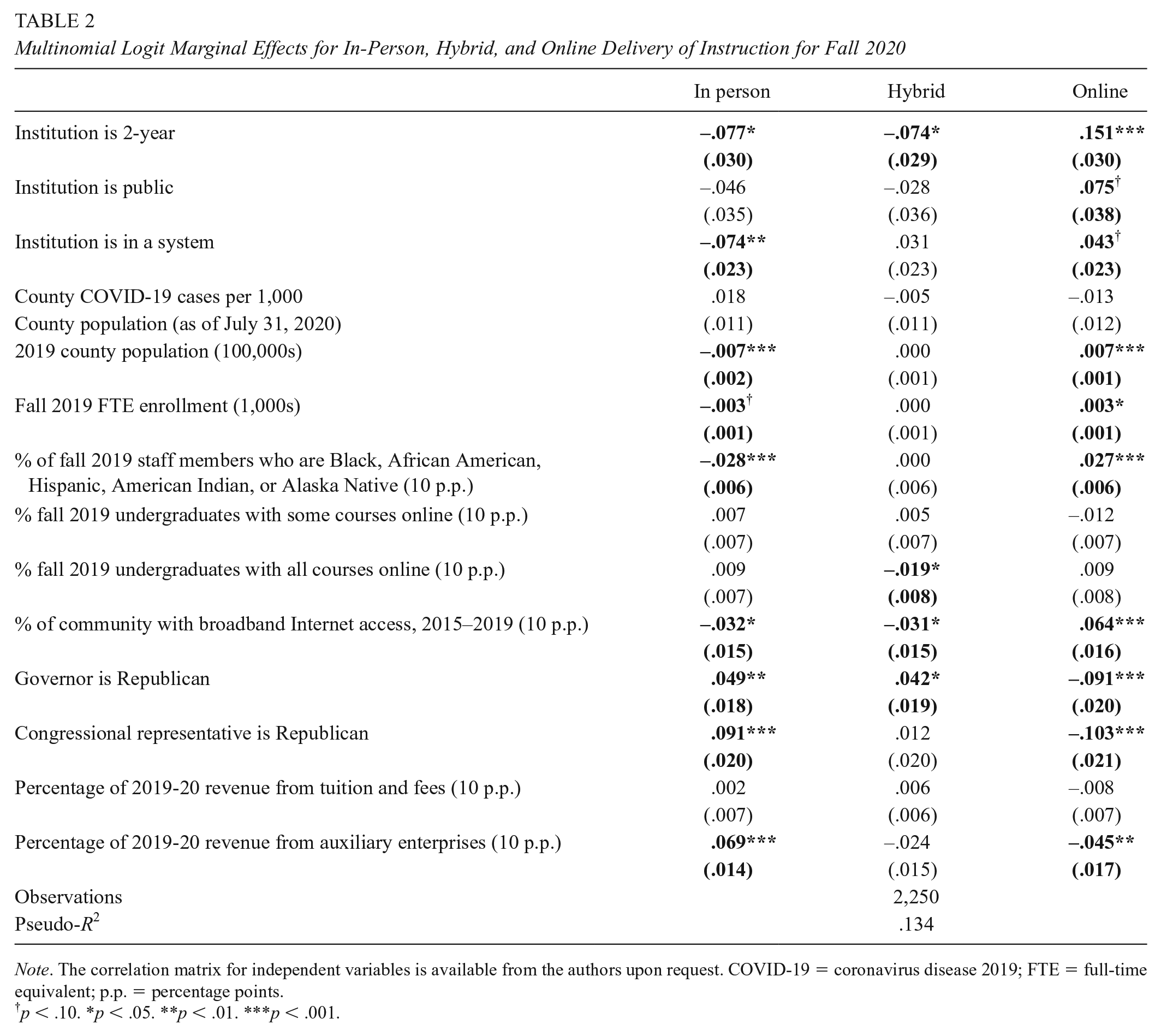
Multinomial Logit Marginal Effects for In-Person, Hybrid, and Online Delivery of Instruction for Fall 2020
Note. The correlation matrix for independent variables is available from the authors upon request. COVID-19 = coronavirus disease 2019; FTE = full-time equivalent; p.p. = percentage points.
p < .10. *p < .05. **p < .01. ***p < .001.
Multinomial Logit Marginal Effects for Fall 2020 Mode of Instructional Delivery, by Institution Degree Level and Control

Note. The correlation matrix for independent variables is available from the authors upon request. COVID-19 = coronavirus disease 2019; FTE = full-time equivalent; p.p. = percentage points.
p < .10. *p < .05. **p < .01. ***p < .001.
Method
We investigate the hypotheses above using multinomial logistic regression. Multinomial logit models are appropriate in cases in which dependent variables have multiple categories that cannot be put in order. In this case, we think of in person (fully in person or primarily in person), hybrid, and online (fully online or primarily online) as three categories of approaches to reopening. Hybrid modes of delivery may have greater expectations for faculty familiarity with virtual conferencing software, expectations for information technology support staff members, and expectations for students to have access to reliable Internet and appropriate hardware, relative to in-person delivery, with even greater demands for these in online delivery modes, so some stakeholders may see hybrid approaches as a middle ground between in-person and online delivery (Bowen, 2012; Ortagus et al., 2018). On the other hand, other stakeholders may prioritize having students back on campus and would be indifferent between hybrid and in-person approaches (Felson & Adamczyk, 2021). Others may want to avoid health risks from in-person delivery but defer to faculty autonomy to use in-person learning as needed and would be indifferent between hybrid and online approaches (Collier et al., 2021). Given these possibilities, and to illustrate relationships between predictor variables and each of the three modes of reopening separately, we conceive of the three modes of reopening as unordered and appropriate for a multinomial regression approach. (See online Appendix A for results from an ordered logit regression specification with an ordered dependent variable as a robustness check.)
The probability pij that an institution i chose a reopening option j is given by

for a vector of institution characteristics
For ease of interpretation of results, we will report marginal effects

where
This analysis is subject to some important limitations. First, this is an analysis of secondary data with a threat of unobserved characteristics that may be correlated with observed characteristics included in the model and with institutions’ reopening decisions, so causal interpretations of relationships between model covariates and reopening decisions are not possible. Second, with a relatively limited sample of institutions, especially in subgroup analyses, sample size and statistical power may not be high enough to allow statistical significance even when meaningful relationships might exist. Finally, reopening decisions were measured on September 20, 2020. Some institutions made adjustments to their plans at the beginning of the fall semester, so plans measured 3 weeks into September might reflect some of that contingency planning and not institutions’ actual preferences from the summer looking ahead to the fall. (See online Appendix A for a test of the sensitivity of the results to the use of a dependent variable capturing institutions’ decisions as of August 1.) Emerging research suggests that institutions’ decisions might be related to time-specific factors, including the prevalence of COVID-19 at the time institutions made decisions or the announcement of decisions of peer institutions, and our data do not capture this time-specific dimension (Acton et al., 2022; Tobin et al., 2021).
Results
Table 2 presents marginal effects from a multinomial logit regression for all institutions in the sample over the options of in-person, hybrid, or online delivery of instruction for fall 2020. Marginal effects across a single row add up to zero, so if, for example, having a characteristic is associated with a higher likelihood of in-person reopening, that characteristic would also predict an equally lower likelihood of pursuing the hybrid or online options. Results in Table 2 suggest that 2-year institutions were 15.1 percentage points more likely to open online, 7.4 percentage points less likely to open with hybrid delivery, and 7.7 percentage points less likely to open in person, relative to 4-year institutions, and all these differences were statistically significant. Public institutions and institutions in systems were marginally statistically significantly more likely to open online relative to private institutions and institutions not included in systems, respectively, and institutions in systems had a statistically significant 7.4 percentage point lower likelihood of opening online.
With respect to COVID-19 risk factors, the county-level COVID-19 case rate was not statistically significantly related to the choice of instructional delivery mode. Institutions that had higher county population and a higher percentage of Black, African American, Hispanic, American Indian, or Alaska Native staff members had statistically significantly higher likelihood of opening online; every additional 10 percentage points of staff members in these groups was associated with 2.7 percentage point higher likelihood of opening online, and every additional 100,000 county population was associated with an additional 0.7 percentage point higher likelihood of opening online. These were associated with statistically significant and commensurate reductions in the likelihood of opening in person and were not significantly related to the likelihood of hybrid delivery. Each additional 1,000 FTE students was associated with a 0.3 percentage points statistically significantly higher likelihood of opening online and a marginally significant reduction in the likelihood of opening in person.
Findings related to the suitability of online instruction included the percentage of fall 2019 undergraduate students who took some classes online, the percentage of fall 2019 undergraduates who took all of their classes online, and the percentage of local (for 2-year institutions) or state (for 4-year institutions) residents with access to broadband Internet. The percentage of students taking some courses online during fall 2019 did not have any significant relationships with the mode of reopening for fall 2020, but every additional 10 percentage points of students taking all courses online during fall 2019 was associated with a statistically significant 1.9 percentage point lower likelihood of reopening with hybrid delivery in fall 2020. For each 10 percentage point increase in the percentage of community residents with access to broadband Internet, institutions had a statistically significant 6.4 percentage point higher likelihood of opening online for fall 2020, and this was associated with statistically significant declines in likelihood of 3.2 and 3.1 percentage points for opening in-person or with hybrid delivery, respectively. Interpreting this result in the other direction, model results suggest that institutions in local areas or states with less broadband access were more likely to open in person or with hybrid delivery and less likely to open primarily or fully online.
Political variables in the model included indicators for having a Republican governor and having a Republican representative in Congress. Having a Republican governor was associated with a statistically significant reduction of 9.1 percentage points in the likelihood of opening online and associated with significant increases of 4.9 percentage points in the likelihood of reopening in person and 4.2 percentage points in the likelihood of reopening with hybrid delivery. Having a Republican congressional representative was associated with a statistically significant reduction of 10.3 percentage points in the likelihood of opening online and associated with a significant 9.1 percentage point increase in the likelihood of opening in person but did not have a statistically significant relationship with the likelihood of opening with hybrid delivery.
Finally, variables capturing resource dependence included the percentage of 2019–2020 revenue that came from tuition and fees and the percentage of 2019–2020 revenue from auxiliary enterprises such as residence life, campus dining, campus bookstores, and intercollegiate athletics. The percentage of 2019–2020 revenue from tuition and fees was not significantly related to any option for fall 2020 reopening. Each additional 10 percentage points of 2019–2020 revenue from auxiliary enterprises was associated with a statistically significant 4.5 percentage point reduction in the likelihood of opening online and a statistically significant increase of 6.9 percentage points in the likelihood of opening in person for fall 2020.
Relationships Among Modes of Reopening and Covariates Across Institution Types
Table 3 presents results from similar multinomial logit regression specifications for subsamples of public 2-year, public 4-year, and private 4-year institutions. The only differences in model specification from Table 2 are that indicators for 2-year degree level and public control were removed from the model, because these are completely captured by the subsamples. Belonging to a system was associated with a statistically significant 5.4 percentage point lower likelihood of opening in person for public 2-year institutions. Public 4-year institutions within systems had a significant 10 percentage point lower likelihood of opening in person and 10.2 percentage points higher likelihood of opening with hybrid delivery. Membership in a system was not significantly related to the mode of reopening for private not-for-profit 4-year institutions. Similar to Table 1, county-level COVID-19 case rates, the percentage of fall 2019 undergraduates taking some but not all of their courses online, and the percentage of 2019–2020 revenue from tuition and fees were not statistically significantly related to reopening decisions for any of the institution subsamples.
Across institution subsamples, county population was positively and statistically significantly associated with the likelihood of opening online for each group of institutions and negatively and significantly associated with reopening in person for each group; marginal effects were smallest for private 4-year institutions and largest for public 4-year institutions. Within private 4-year institutions, each 10 percentage point increase in staff members who were Black, African American, Hispanic, American Indian, or Alaska Native was associated with a significant 7.1 percentage point reduction in the likelihood of opening in person and a significant 5.3 percentage point increase in the likelihood of opening online. The same change in staff composition at public 4-year institutions was associated with a significant 2.8 percentage point reduction in the likelihood of opening online and marginally significant increases in the likelihood of opening with hybrid delivery at both public and private 4-year institutions; staff composition was not significantly related to the mode of reopening at public 2-year institutions. Enrollment of FTE students was not significantly related to the mode of reopening for any institution subsample.
With respect to factors reflecting the suitability of online instruction, only private 4-year institutions exhibited statistically significant relationships. Each 10 percentage point increase in state residents with access to broadband Internet was associated with a significant 9.2 percentage point reduction in the likelihood of private 4-year institutions opening in person, and each 10 percentage point increase in students who took all their courses online during 2019 was associated with a 3.3 percentage point reduction in private 4-year institutions opening with hybrid delivery. Higher broadband access was associated with marginally significantly lower likelihood of hybrid reopening and marginally significantly higher likelihood of online reopening at public 2-year institutions, and private 4-year institutions with higher percentages of students who took all courses online during fall 2019 had a marginally significantly higher likelihood of opening in person during fall 2020.
The three institution subsamples exhibited relatively more difference with respect to political predictor variables and relatively more similarity with respect to predictor variables associated with resource dependence. Public 4-year institutions in states with Republican governors were 20.8 percentage points less likely to reopen online, 10 percentage points more likely to reopen in person, and 10.8 percentage points more likely to reopen with hybrid delivery, and all relationships were statistically significant. Public 2-year institutions in states with Republican governors had a significant 9 percentage point lower likelihood of reopening online and significant 6.5 percentage point higher likelihood of reopening with hybrid delivery, and the relationship between governor’s political party and opening in person was not statistically significant. Governor’s political party was not statistically significantly related to any of the modes of reopening for private 4-year institutions. All three institution types were statistically significantly more likely to reopen in person in congressional districts with Republican representatives, ranging from a 6.9 percentage point higher likelihood at public 2-year institutions to 10.2 percentage points at private 4-year institutions. Public and private 4-year institutions were statistically significantly less likely, and public 2-year institutions were marginally significantly less likely, to reopen online in districts with Republican representatives. Public 4-year institutions were 11.4 percentage points more likely to open with hybrid delivery in districts with Republican representatives. Finally, the percentage of 2019–2020 revenue from auxiliary enterprises was positively associated with the likelihood of reopening in person for each institution subsample, ranging from a 7.1 percentage point higher likelihood of reopening in person at public 4-year institutions to a 10.9 percentage point higher likelihood at public 2-year institutions.
Relationships Among Modes of Reopening and Covariates Across Levels of Endowment per Student
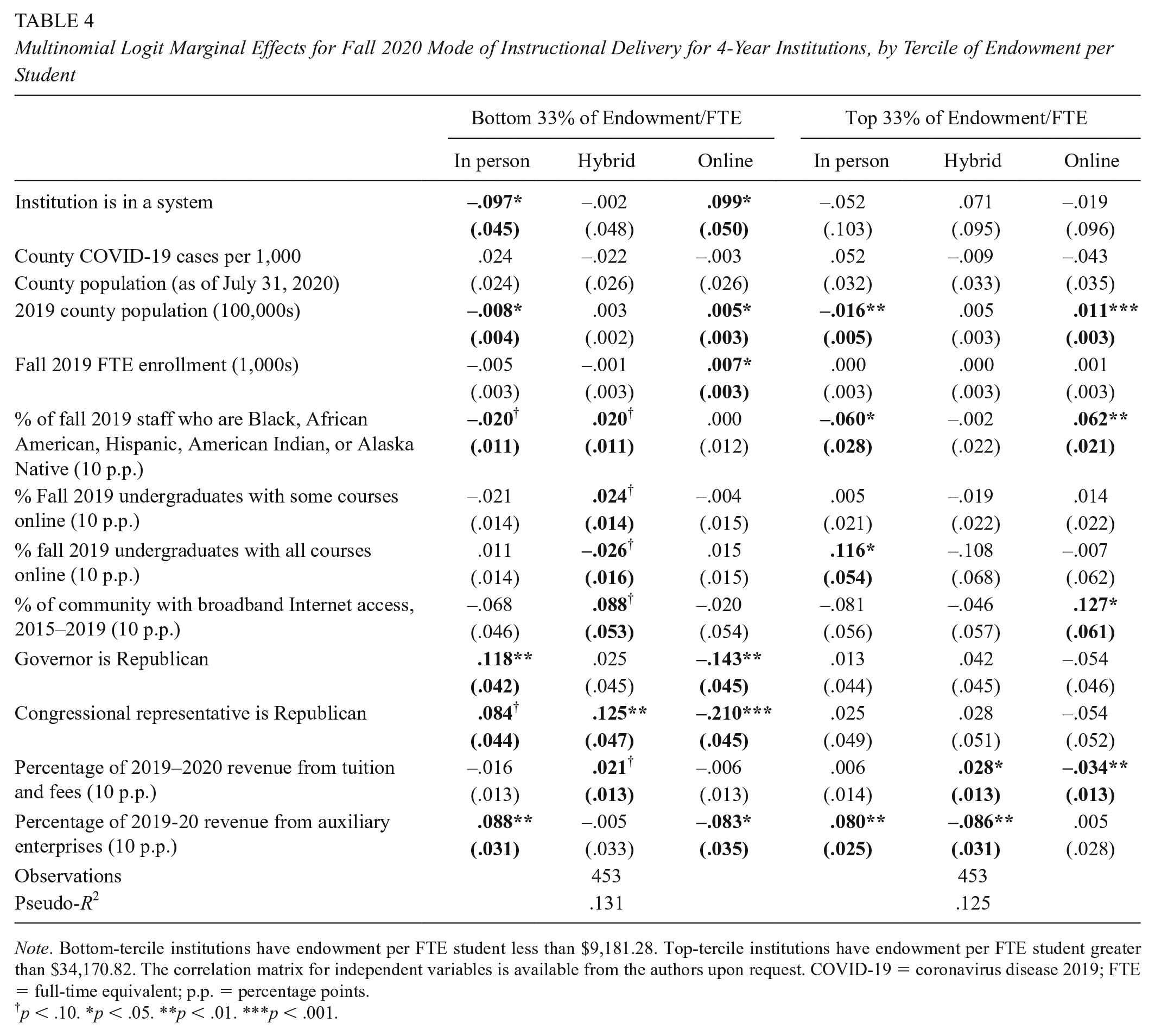
Table 4 illustrates results from multinomial logit regressions for institutions in the lowest and highest terciles for endowment per FTE student as a measure of resource security. With respect to measures of pandemic severity, both groups of institutions were statistically significantly more likely to reopen online and less likely to reopen in person with larger county populations, but magnitudes of these relationships were larger for institutions with higher endowment per student. Staff demographics were significantly related to modes of reopening only for institutions with the highest endowment per student, with each 10 percentage point increase in staff members who were Black, African American, Hispanic, American Indian, or Alaska Native associated with a 6.2 percentage point higher likelihood of reopening online and a 6 percentage point lower likelihood of reopening in person. Staff demographics and measures of online suitability were only marginally significantly related to the likelihood of reopening with hybrid delivery at institutions with the lowest endowment per student, and each 10 percentage point increase in local broadband Internet access was associated with a 12.7 percentage point increase in the likelihood of reopening online at institutions with the highest endowment per student.
Multinomial Logit Marginal Effects for Fall 2020 Mode of Instructional Delivery for 4-Year Institutions, by Tercile of Endowment per Student
Note. Bottom-tercile institutions have endowment per FTE student less than $9,181.28. Top-tercile institutions have endowment per FTE student greater than $34,170.82. The correlation matrix for independent variables is available from the authors upon request. COVID-19 = coronavirus disease 2019; FTE = full-time equivalent; p.p. = percentage points.
p < .10. *p < .05. **p < .01. ***p < .001.
Political variables were not statistically significantly related to any modes of reopening at institutions with the highest endowment per student, but both the governor’s and congressional representative’s political parties were significantly related to the likelihood of reopening online at institutions with the lowest endowment per student. Bottom-tercile institutions in states with Republican governors were 14.3 percentage points less likely to reopen online and 11.8 percentage points more likely to open in person, and bottom-tercile institutions with Republican congressional representatives were 21 percentage points less likely to reopen online and 12.5 percentage points more likely to reopen with hybrid delivery. Institutions with the lowest endowment per student showed evidence of substituting between online reopening and in-person reopening as the proportion of revenue from auxiliary enterprises rose; each 10 percentage point increase in revenue from auxiliaries was associated with an 8.3 percentage point reduction in the likelihood of opening online and an 8.8 percentage point increase in the likelihood of opening in-person. Institutions with the highest endowment per student showed evidence of substituting between online and hybrid or between hybrid and in person, but not between online and in person. At top-tercile institutions, each 10 percentage point increase in revenue from auxiliary enterprises was associated with an 8.6 percentage point reduction in the likelihood of reopening with hybrid delivery and an 8 percentage point increase in the likelihood of in-person reopening, and each 10 percentage point increase in revenue from tuition and fees was associated with a 3.4 percentage point reduction in the likelihood of opening online and a 2.8 percentage point increase in the likelihood of opening with hybrid delivery.
Discussion
The present results provide the first evidence of statistically significant predictors of hybrid reopening that are distinct from predictors of online or in-person reopening. Institutions with higher shares of community residents with access to broadband Internet had a higher likelihood of reopening online and a lower likelihood of opening in person or with hybrid delivery, with a 3.1 percentage point lower likelihood of reopening with hybrid delivery for every 10 percentage point increase in community residents’ access to broadband Internet. This suggests that institutions in areas with lower broadband access were more likely to use hybrid delivery with students on campus and able to use campus resources, providing support for Hypothesis 2, and this was driven primarily by public 2-year institutions (Table 2). Institutions in states with Republican governors were less likely to open online (9.1 percentage points) but roughly equally more likely to open in person (4.9 percentage points) or with hybrid delivery (4.2 percentage points), providing partial support for Hypothesis 3. On the other hand, institutions with Republican congressional representatives were less likely to open online (10.3 percentage points) and offset that almost entirely with a higher likelihood of opening in person (9.1 percentage points), and Table 2 illustrates that public 2- and 4-year institutions had a higher likelihood of using hybrid reopening strategies with Republican governors and representatives relative to private 4-year institutions. For every additional 10 percentage points of students who took all courses online, institutions were 1.9 percentage points less likely to reopen with hybrid delivery (Table 1), and this was driven primarily by private 4-year institutions (Table 2).
Hypotheses 5A and 5B, that pandemic severity and suitability of online instruction would be more salient for resource-secure institutions and political preferences of outside stakeholders would be more salient for resource-insecure institutions, also represented contributions to the emerging literature. Using endowment per FTE student as a measure of resource security, we found that institutions in the top tercile of endowment per student were more sensitive to county population, staff demographics, the share of residents with access to broadband Internet, and the share of fall 2019 undergraduate students who took all their courses online, compared with institutions in the bottom tercile of endowment per student (Table 4), providing support for Hypothesis 5A. Institutions in the top tercile of endowment per student did not have any statistically significant relationships between modes of reopening and the political party of the governor or congressional representative, but institutions in the bottom tercile were less likely to open online and more likely to open in person with a Republican governor, and they were less likely to open online and more likely to open with hybrid delivery in congressional districts with Republican representatives (Table 4), providing support for Hypothesis 5B. Results in online Appendix B (specifically online Appendix Table B2A) suggest that this relationship also holds for top- and bottom-tercile public 4-year institutions, with public 4-year institutions in the bottom tercile of endowment per student 14.9 percentage points more likely to open in person in states with Republican governors relative to Democratic governors and 15 percentage points less likely to open online in congressional districts with Republican representatives.
In Table 4, institutions in the lowest tercile of endowment per student were less likely to open online (8.3 percentage points) for every additional 10 percentage points of 2019–2020 revenue from auxiliary enterprises and more likely to open in person (8.8 percentage points), suggesting a substitution from online to in-person delivery to attract students back to campus. Institutions in the top tercile of endowment per student were less likely to open with hybrid delivery (8.6 percentage points) and more likely to open in person (8 percentage points) for every additional 10 percentage points of 2019–2020 revenue from auxiliary enterprises, and these institutions were less likely to open online (3.4 percentage points) and more likely to open with hybrid delivery (2.8 percentage points) with every additional 10 percentage points of 2019–2020 revenue from tuition and fees. This suggests that less resource secure institutions substituted from online to in-person delivery, but more resource secure institutions either substituted from online to hybrid approaches (if they derived more revenue from tuition and fees) or from hybrid to in-person approaches (if they derived more revenue from auxiliary enterprises), but not from online to in-person delivery, consistent with Hypothesis 5B. In total, results suggest that institutions at different levels of endowment per student exhibited different relationships between their reopening strategies and pandemic characteristics, and hybrid reopening appeared to have similar associations to in-person reopening for some pandemic characteristics (especially local access to broadband Internet in Table 2) and similar associations to online reopening for other pandemic characteristics (especially staff demographics for private 4-year institutions in Table 3).
Results provide additional support for the four central hypotheses. In Hypothesis 1, we proposed that institutions would be more likely to adopt online or hybrid reopening strategies in areas with greater pandemic severity or risk. Results suggest that institutions with higher percentages of staff members who are Black, African American, Hispanic, American Indian, or Alaska Native and institutions in counties with higher populations (with more opportunities for person-to-person virus spread) had a greater likelihood of reopening online and lower likelihood of reopening in person (Centers for Disease Control and Prevention, 2021; Ives & Bozzuto, 2021; Johnson et al., 2022). The association between county population and mode of reopening was evident for public 2-year institutions and public and private 4-year institutions, and the relationship between staff demographics and mode of reopening was most strongly evident at private 4-year institutions. Institutions may have been exercising caution to protect staff members at higher risk for adverse outcomes from COVID-19, or institution leaders from these groups may have been more likely to prioritize safety in reopening, and we consider this point further below (Centers for Disease Control and Prevention, 2021). County-level COVID-19 case rates were not consistently related to institutions’ reopening decisions in our results (Felson & Adamczyk, 2021).
In Hypothesis 2, we hypothesized that institutions for whom online or hybrid approaches were more suitable would be more likely to adopt these approaches. Results suggest that institutions that had higher percentages of local (for 2-year institutions) or state (for 4-year institutions) residents with access to broadband Internet were more likely to reopen online and less likely to reopen with hybrid or in-person delivery. Institutions that had higher percentages of students taking all their courses online during fall 2019 were less likely to reopen using hybrid delivery, and both of these results were most strongly evident for private 4-year institutions. Our findings agree with Felson and Adamczyk’s (2021) finding that the percentage of students taking some but not all courses online was unrelated to institutions’ reopening decisions, They also found that the percentage taking all courses online was unrelated to reopening decisions, but they grouped hybrid and in-person reopening approaches in a single binary outcome variable, and we found a significant relationship with hybrid reopening only (Felson & Adamczyk, 2021).
In Hypothesis 3, we proposed that institutions facing political opposition to online or hybrid reopening strategies would be less likely to adopt these approaches. Results illustrate that institutions in states with Republican governors were 9.1 percentage points less likely to open online, 4.9 percentage points more likely to open in person, and 4.2 percentage points more likely to reopen with hybrid delivery. Institutions in congressional districts with Republican representatives were 10.3 percentage points less likely to open online and 9.1 percentage points more likely to open in person. Relationships between the governor’s political party and the mode of reopening held most strongly for public 4-year institutions and were not statistically significant for private 4-year institutions. Public 2- and 4-year institutions and private 4-year institutions all were more likely to open in person if they were located in congressional districts with Republican representatives; public and private 4-year institutions were less likely to open online, and public 4-year institutions also were more likely to open with hybrid delivery with Republican representatives. Findings echo Felson and Adamczyk’s finding that state- and county-level sociopolitical factors matter for institutions’ reopening decisions, but our sector-specific findings differ from Collier et al.’s (2021) findings that state-level sociopolitical factors were associated with private 4-year institutions’ decisions and county-level sociopolitical factors were not associated with public 4-year institutions’ decisions. Differences might arise from Collier et al.’s (2021) inclusion of educational attainment as a sociopolitical variable, state legislative control and county-level vote shares in the 2016 presidential election as political measures, differences in modeling approach, or differences in specification of the dependent variable.
In Hypothesis 4, we predicted that institutions that depended on tuition and fees or auxiliary enterprises for higher shares of revenue would be less likely to reopen online. Results suggest that institutions that derived a higher percentage of 2019–2020 revenue from auxiliary enterprises were less likely to open online and more likely to open in person. Public 2- and 4-year institutions and private 4-year institutions were more likely to open in person if they had a higher percentage of revenue from auxiliary enterprises, and public 2-year institutions with higher shares of revenue from auxiliary enterprises were also less likely to open online. Felson and Adamczyk (2021) did not include institutions’ percentage of revenue from auxiliary enterprises but found that institutions’ residence hall capacity and percentage of revenue from tuition were significant predictors of hybrid or in-person reopening.
Conclusion
The results of the present study suggest that colleges and universities were motivated by a variety of academic, financial, political, and health-related factors in choosing how to reopen their campuses and deliver instruction for the fall 2020 semester (Acton et al., 2022; Collier et al., 2020, 2021; Felson & Adamczyk, 2021; Tobin et al., 2021; Whatley & Castiello-Gutierrez, 2021). These results have several implications for researchers and practitioners interested in this and similar dynamics. Similar methodological approaches might be appropriate for research on related decisions including mask mandates, vaccine mandates, and holding in-person events including athletic events or commencement (Gollwitzer et al., 2020; Kramer, 2020; Redden, 2021). With respect to the decision-making process behind the choice of delivery mode, qualitative research methods including interviews and comparative case studies may identify additional considerations that were relevant to institution leaders and illustrate the extent to which stakeholders agreed with the eventual decisions (Liu et al., 2021).
In particular, our finding that institutions with higher percentages of staff members in racial and ethnic groups at higher risk for COVID-19 complications were more likely to open online might reflect that institutions made decisions to promote staff health or that staff members from those groups were more likely to prioritize community health in general, and this is an important direction for additional research (Johnson et al., 2022). Our findings also have relevance for organizational decision making in crisis situations beyond COVID-19, and our finding that resource-insecure institutions might be less willing to contradict other actors’ crisis framing merits both quantitative and qualitative investigation. In crises without a clear responsible party, institution leaders may be less likely to make statements or take actions that assign responsibility to an outside actor as they depend more strongly on that actor for resources or support (Pfeffer & Salancik, 1978; Roulet & Pichler, 2020).
Just as spring 2020 instructional delivery had an impact on students’ academic performance, the choice of mode of delivery for fall 2020 likely influenced students’ academic outcomes both across institutions and across students within institutions, especially if academic factors (such as students’ likelihood of succeeding in hybrid or online environments or local access to broadband Internet) were not the only relevant considerations in the choice of delivery mode (Bird et al., 2020). The choice of mode of delivery also might have had an impact on other outcomes including spring 2020–to–fall 2020 retention rates and enrollment of new students beginning fall 2020 (Kim et al., 2020). Reopening decisions might also have had an influence on institutions’ 2020–2021 expenditures, especially if institutions needed to provide personal protective equipment for students on campus or provide technology or technical support for students studying online. Impacts of instructional delivery approaches during COVID-19 on student learning outcomes and other institutional outcomes are an important area for future research.
With respect to practice, other recent evidence suggests the spring 2020 shift to online learning may have reduced students’ course completion, so administrators should pay attention to students’ course performance and resource needs if they are in hybrid or online environments, especially if institutions chose their mode of instruction because of financial, political, or public-health-related considerations (Bird et al., 2020). If institutions opened in person, they may need to attend to town-gown relationships or faculty and staff satisfaction, especially if reopening led to an increase in local COVID-19 cases (Andersen et al., 2022; Kellermann, 2020; Leidner et al. 2021; Lu et al., 2021). Findings from the emerging body of research on institutions’ reopening decisions might inform exercises such as governing board orientations in order to illustrate the range of factors that might influence institutions’ planning.
Supplemental Material
sj-docx-1-ero-10.1177_23328584221099605 – Supplemental material for Varied Institutional Responses to COVID-19: An Investigation of U.S. Colleges’ and Universities’ Reopening Plans for Fall 2020
Supplemental material, sj-docx-1-ero-10.1177_23328584221099605 for Varied Institutional Responses to COVID-19: An Investigation of U.S. Colleges’ and Universities’ Reopening Plans for Fall 2020 by Tyler D. Blanco, Brian Floyd, Bruce E. Mitchell II and Rodney P. Hughes in AERA Open
Footnotes
Acknowledgements
We thank Ann Bernhardt, Christopher Marsicano, and researchers at the College Crisis Initiative at Davidson College for creating and facilitating access to mode-of-reopening data. We also thank anonymous reviewers for helpful feedback. All errors are our own.

Authors
TYLER D. BLANCO is a master’s student in economics at the University of Missouri. His interests include K-12 and postsecondary administration and education law.
BRIAN FLOYD is a doctoral student in higher education administration at West Virginia University. His interests include community college leadership and presidential turnover.
BRUCE E. MITCHELL II is a graduate of the doctoral program in higher education administration at West Virginia University. His research interests include diversity, equity, and inclusion in higher education and student affairs.
RODNEY P. HUGHES is an assistant professor of higher education administration and director of the Center for the Future of Land-Grant Education at West Virginia University. His research interests include higher education governance, institutional research, P–20 to workforce transitions, and education policy.
References
Supplementary Material
Please find the following supplemental material available below.
For Open Access articles published under a Creative Commons License, all supplemental material carries the same license as the article it is associated with.
For non-Open Access articles published, all supplemental material carries a non-exclusive license, and permission requests for re-use of supplemental material or any part of supplemental material shall be sent directly to the copyright owner as specified in the copyright notice associated with the article.
