




Abstract
This evaluation of faculty hiring examines how eight faculty search chairs at a border Hispanic-serving institution (HSI) discuss how they enact an HSI consciousness when making hiring decisions. Using a combined phenomenological case study approach, the author examines hiring through a conceptual framework that brings together organizational culture and Borderlands theory to understand how committee decisions on hiring are informed by their campus’s HSI designation and cultural identity. Through analysis of faculty search chair interviews, faculty search chairs at a borderland HSI are committed to hiring with their student population in mind by enacting a Latinx-serving consciousness. Overall, the findings of this study contribute to a broader conversation on servingness as well as scholarship on how educators and administrators can embrace the cultural values that their Latinx students possess to make decisions in hiring.
Hispanic-serving institutions (HSIs) exist at borders of time, language, geography, and ideology. Often, their histories as predominantly White institutions are in tension with their futures as Latinx serving. This organizational identity dissonance complicates the evaluation of HSI practices and policies, as most HSIs are structured to serve a predominantly White student demographic (Garcia, 2017; Vargas, 2018). This is not to say that HSIs are at fault; deep embedded assumptions and values about how higher education institutions should operate are ingrained into an organization’s culture (Schein, 2010). These assumptions and values are routinized, normalized, and become taken for granted (Sergiovanni & Corbally, 1986) and are enmeshed within an interconnected web of structures, natural laws, and interpretations (Tierney, 1988).
One of the most potent, yet subtle, ways of learning about organizational culture is through hiring (Schein, 2010). In hiring, implicit assumptions are enforced through hiring criteria and reinforced through criteria for promotion (Schein, 2010). Faculty hiring as a mechanism for understanding organizational culture has been underexplored. Beyond an understanding of culture, faculty hiring also provides a window into what leaders believe makes a good, tenurable professor. At HSIs, where leaders aim to serve Latinx students, whom they hire to teach Latinx students is critically important. This notion of what it means to serve Latinx students at HSIs, or “servingness,” has been taken up recently by Garcia, Núñez, and Sansone (2019). Their multidimensional conceptual framework for understanding servingness illustrates the impact of external factors on structures of servingness and how these structures then affect student outcomes and experiences. Among their structures of serving are aspects of organizational culture including decision-making practices and faculty diversity. According to their framework, these structures affect students’ racialized experiences, validating experiences, academic outcomes, and nonacademic outcomes. And yet scholarship has not yet investigated the ways faculty members and culture inform hiring decisions that directly affect Latinx students.
To further examine this matter, I decided to investigate the process of decision making within faculty hiring. This study answers the following research questions:
How do faculty search committee chairs at an HSI make hiring decisions conscious of their campus’s HSI designation and cultural identity?
What aspects do they consider when deciding whom to hire?
Faculty Hiring and Organizational Culture
To date, few studies have identified the specific attitudes or beliefs faculty members have of their role as Latinx-serving educators (Ching, 2022; Garcia et al., 2020; Hubbard & Stage, 2005). Scholars recommend a transition to pedagogical approaches that are culturally sensitive (Cortez, 2015) or asset based (Rendón et al., 2015). Among these studies of instruction, the level of analysis is on individual action, removed from the larger cultural challenges of the institution. Separating the two levels of analyses is insufficient to advance a conversation toward equity for Latinx students at HSIs; both are needed. Although these studies may provide individual faculty members or leaders with models for how to be liberatory in their own teaching or work, the transformative shifts being called for among HSIs will not happen without examining how the current organizational structures affect individual efforts to adopt practices that explicitly aim to serve Latinx students’ needs and interests. Understanding and transforming attitudes and behaviors of organizational actors is an urgent matter. When deficit perspectives of Latinx students go unchallenged, they become normalized across the institution (Rendón et al., 2015). When faculty members hold these deficit-minded beliefs of students, it influences their actions (Ching, 2022). So until HSIs deeply contend with the issue of individual action and broader organizational culture being mutually reinforcing, they will be taking up only half of the work. A cultural shift at multiple levels is needed.
One practice that is often overlooked for its potential to reshape culture is faculty hiring. A small number of researchers have focused on the role of organizational and personal values in faculty hiring (Liera, 2019; Smith & Mamiseishvili, 2016; Twombly, 2005). Whereas synergy between individual and organizational values is expected, at HSIs that exist along borders of White-serving and Latinx-serving practices, contradictions in values between these two levels can be expected. Candidate characteristics that faculty hiring committees value are often informed by White sociocultural norms, creating a tendency for search committees to positively evaluate candidates with similar identities to their own (Lamont, 2009; Liera & Hernandez, 2021; Rivera, 2017; White-Lewis, 2020). Even if university leaders publicly support and promote racial diversity among their faculty, the organization’s sociocultural processes which are rooted in an organization’s culture could prevent faculty hiring search committees from minimizing their biases in their decision making. One example of this can be seen in a case study of faculty hiring at a campus focused on enacting equity in hiring new faculty (Liera, 2020). In this study, faculty members outwardly expressed equity-mindedness as a cultural value, which led to an intentional embedding of equity throughout the process; however, this also created tensions for those who were tasked with enforcing equity. Contradictions between the organization’s espoused and enacted values led to power disputes and resistance despite calls for equity. These tensions illustrate a fragmentation, or a border, between national calls for faculty diversity and the mechanisms deployed to enact such diversity.
Among the increased push for faculty diversity, it is important to note that a diverse faculty body both indicates and creates an institution’s climate (Contreras & Contreras, 2015). Latinx students perceive the presence of Latinx faculty and mentors to be most important in their success as college students (Medina & Posadas, 2012), yet well documented in the literature are the harmful and invalidating experiences of Latinx and other racially minoritized faculty (Antonio, 2002; Delgado Bernal & Villalpando, 2002; Finkelstein et al., 2016; Gonzales et al., 2013; Harris, 2020; Pittman, 2010; Smith, 2015; Stanley, 2006; Stanley et al., 2003; Turner, 2002; Villarreal et al. 2019). The composition of the faculty shapes the norms of the community; therefore, to advance a Latinx-serving mission is to disrupt and transform the status quo that reflects institutionalized values. Moreover, leaders who use faculty recruiting and hiring strategies that were not designed to address their campus history with race could fall short in meeting their goals. Recent scholarship has recommended beyond so-called best practices for hiring toward more cultural interventions such as addressing conditions of faculty retention and success, questioning “objective” criteria, and ensuring that values are deeply embedded in decision making (Griffin et al., 2020). Yet when researchers examine culture as a means to change, they often look at public artifacts that do not fully capture the values and assumptions embedded in the fabric of an organizational culture.
Conceptual Framework
To make decisions with broad impact, higher education leaders require a “full, nuanced understanding of the organization’s culture” (Tierney, 1988, p. 5). Because organizational culture includes both individual- and group-level phenomena, this study was conducted across two levels of analysis: the micro and the meso. In presenting and combining organizational culture (meso) and Borderlands theory (micro) to evaluate both units of analysis, I assert that HSIs and the faculty members within them often exist within a liminal space between mainstream, White-serving and emergent, minority-serving institutions.
Organizational Culture
Organizational culture is defined as the patterns of basic underlying assumptions that an organization has created as a response to organizational problems; these assumptions have developed over time, are deeply embedded in the values and behaviors of its members, and are held as truth (Schein, 1990). In hiring, for example, an understanding of organizational culture can illuminate which values an organization prioritizes when vetting candidates for admission to their organization. Hiring committees use certain boundaries and measures to allow or deny entrance to the organization. Additionally, hiring is one of the six primary mechanisms of how leaders embed and transmit an organizational culture, making it one of the most subtle yet potent ways through which cultural assumptions are embedded in an organization (Schein, 2010). The subtleties exist because often the values and assumptions through which hiring decisions are made are hidden and taken for granted.
Borderlands Theory
To redress the absence of a critical, intersectional perspective within organizational culture theory, I turn to Chicana feminist theory. Most well known among Chicana feminist theorizing is the theory of Borderlands. 1 Borderlands as a theoretical frame is appropriate for examining the phenomena of hiring because hiring itself is a border, a boundary that designates inclusion and exclusion for members. Anzaldúa (1987) also used Borderlands theory to explain the structural boundaries marginalized and minoritized individuals must traverse to occupy the dominant culture. So, although it is applied here to name the boundary of exclusion inherent in hiring, it is also used to identify the multiple systems of oppression between worlds or cultures that minoritized faculty must navigate including the boundary of organizational membership. To that end, a borderland can be structural, psychological, and symbolic. One of the most cited concepts from Borderlands is the notion of nepantla, which considers an in-between space where borderland dwellers reside. The people who inhabit the borderlands are los atravesados, the crossed over, and inhabit a space that is neither here nor there, residing instead in the contradictions. This state of occupying with intention a space that is neither here nor there is in itself an act of rebellion and resistance; a refusal to accept Western dualities ever present in education.
I also apply the concept of a path toward conocimiento, an awakened consciousness, that “challenges official and conventional ways of looking at the world” (Anzaldúa, 2015, p. 120). I believe we can use an understanding of the path to conocimiento to implement cultural shifts at HSIs. The path to conocimiento typically refers to an awakening of an individual; however, this awakened consciousness in multiple individuals can contribute to a shift in overall organizational consciousness, thus altering the organizational culture. The path consists of seven stages: first, el arreabato, meaning a rupture or wounding of prior beliefs; second, nepantla, being torn between identities; third, the Coatlicue state, which refers to a state of emotional turmoil; fourth, el compromiso, a crossing or conversion; fifth, putting Coyolxauhqui together, meaning destruction and re-construction; sixth, the blow-up where realities clash; and finally, a shift toward spiritual activism.
Research Design
The goal of this research was to understand how faculty search chairs enacted a consciousness of the HSI designation and cultural identity when hiring. To examine these two levels (organizational culture and individual consciousness within the culture), I used a combined phenomenological case study approach. Among the many approaches to phenomenology, I sought one that respected subjectivity and considered a way to make meaning of phenomena given its understanding of the connectedness between an individual and the world. As such, a Heideggerian ontological phenomenology approach was most useful. Heidegger (1995) argued that human existence (Daesin) resides in a context referred to as a world of meanings. Within this world, humans are submerged in shared cultures, practices, and history (van Manen, 2014). van Manen and Adams (2010) stated that phenomenology “thrives on irrevocable tension between what is unique and what is shared, between particular and transcendent spheres of the lifeworld” (p. 450). To that end, Heideggerian phenomenology allows a Borderland stance aware of contexts and borders of stratification.
In pairing phenomenology with case study, it was my intent to design a study that was concerned with consciousness, essence, and being but that made mindful considerations of the organization in which the individual is situated. Yin (1981) asserted that case study serves as a way to examine a phenomenon in its real-life context. With the goal of understanding the phenomenon of hiring at HSIs, the heuristic quality inherent in both case study and phenomenology enables a nuanced understanding of HSI consciousness and how it may vary across HSIs by context (Merriam, 1998). Acting upon the heuristic nature, this study intends to provoke reflection and learning about the self through this approach.
Study Site
Border Hispanic-Serving Institution (BHSI) is located in the city of Girasol (a pseudonym), which borders the Mexican city of Rodriguez (a pseudonym). Girasol is a city of approximately 600,000 residents, with a transnational community that puts the borderplex population closer to 2.5 million. At the time of data collection, nearly 85% of Girasol residents identified as Hispanic/Latino. BHSI is a largely commuter campus with students who live and traverse across this border region. It is a veteran HSI that has served a primarily Latinx demographic for decades. I deemed BHSI a site worth examining because of its unique location on the border and high Latinx student enrollment (83%). The border context is important because of its binational, bicultural, and bilingual existence, all factors that play a role in the overall HSI consciousness.
Personal assumptions based on my early phenomenological attitude (van Manen & Adams, 2010) and lived experiences as a student of multiple HSIs 2 led me to question the link between the critical mass of Latinx faculty members and HSI consciousness. Research on networks and diffusion of information suggests that thresholds and critical mass within networks are important for the diffusion of ideas (Granovetter & Soong, 1983; Valente, 1995). Given this information, I hypothesized that because of the large Latinx presence at BHSI, HSI consciousness was more present and embedded in the overall culture including in the hiring process and criteria.
According to Vargas et al. (2020), HSIs that receive Title V funding on average have a ratio of Latinx students to Latinx tenured and tenure-track faculty members ratio of 146:1. Despite BHSI’s high percentage of tenured and tenure-track Latinx faculty members (27%), given the large Latinx student demographic, the ratio of Latinx students to Latinx tenured and tenure-track faculty members is close to the average at 141:1. It is worth mentioning that Latinx contingent faculty members make up nearly half the total BHSI adjunct population (44%). Although contingent faculty members are often not involved in decision-making, such as in hiring, the combined presence of tenured and tenure-track and adjunct Latinx faculty members at BHSI amounts to 37% overall, bringing the ratio of Latinx students to Latinx faculty members to 40:1. In this instance, a critical mass of Latinx faculty members and Latinx students at BHSI have power in numbers to influence the culture and consciousness at large.
Data Collection
The primary source of data for this study was semistructured interviews (Hays & Singh, 2012). I used documents such as hiring handbooks, job advertisements, and campus observations to gather information about the search process and the institutional context; I followed this review of organizational artifacts with interviews to uncover organizational culture and explore the idea of HSI consciousness. According to Moustakas (1994), phenomenological interviews should be informal and interactive processes that use in-the-moment questioning depending on the course of the interview. I reviewed document information prior to each interview to illuminate possible areas of discussion and adjusted my questioning wherever appropriate.
I conducted interviews with eight faculty search chairs between November 2019 and January 2020 across multiple disciplines and identities (Table 1). I contacted BHSI’s records office to receive a copy of each of the faculty job advertisements from 2017 and 2018 and sent recruitment e-mails in October 2019 to each of the addresses provided on the job ads. In total, I e-mailed 28 faculty search chairs with requests to interview, received responses from 12, and conducted interviews with 8. 3
Border Hispanic-Serving Institution Faculty Participant Characteristics
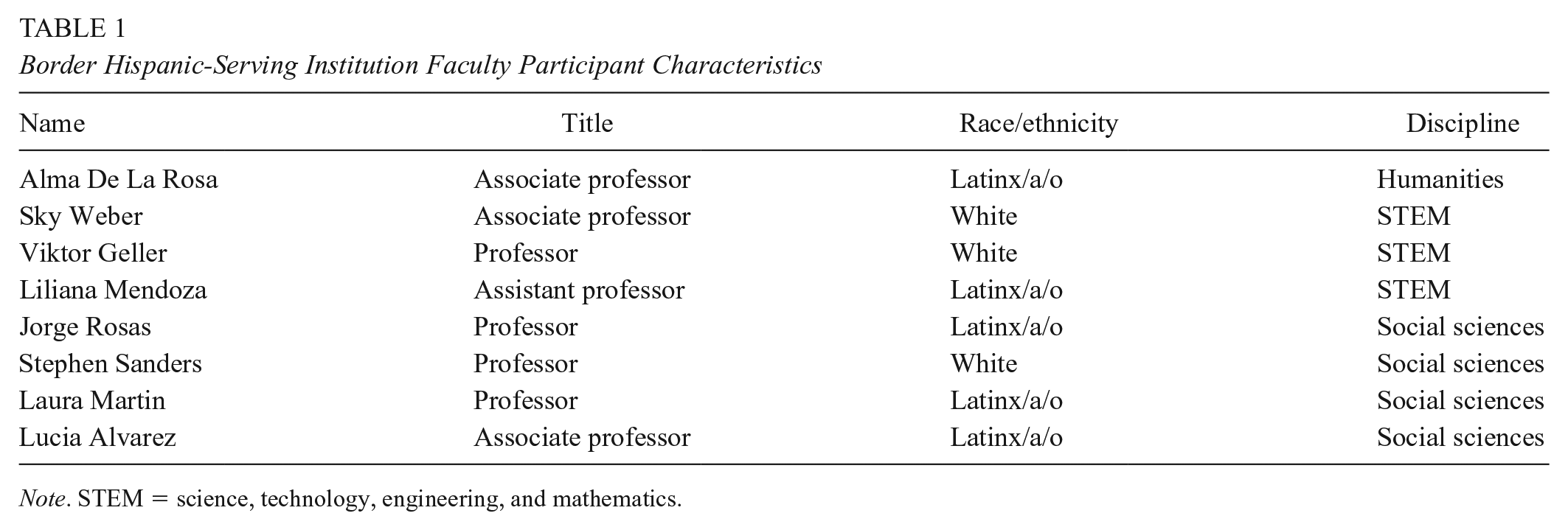
Note. STEM = science, technology, engineering, and mathematics.
I interviewed faculty participants for 60 to 90 minutes each and audio-recorded each interview. I asked questions regarding their perceptions of the organizational culture, how candidates were evaluated, and considerations of equity, HSI designation, and identity. In total, I conducted 10 hours of interviews with BHSI faculty search chairs and had each interview professionally transcribed using a third-party transcription service. In a few of the interviews I conduced with Latinx faculty members, both English and Spanish were spoken through the act of translanguaging. 4 I personally transcribed the parts of the interview that were in Spanish because of the high cost of translation services. The bilingual flexibility in these interviews came as a result of me sharing my identity and background while building rapport with the participants. I never asked participants questions in Spanish, but if they began responding in Spanish, I responded in ways that were natural to me. Following interviews and transcription, I uploaded the transcripts into a project I created in NVivo 12.
Data Analysis
I engaged in analysis informed by two primary approaches: first, phenomenological analysis (Giorgi, 2009), and second, Saldaña’s (2016) approach to coding qualitative data. Phenomenological analysis occurs in four steps: (a) reading for a sense of the whole, (b) differentiating the description into meaning units, (c) reflecting on the psychological significance of each meaning unit, and (d) clarifying the psychological structure(s) of the phenomenon (Giorgi, 2009). Heeding this phenomenological analytic procedure, I first embarked on the step of reading every individual transcript for a sense of the whole while engaged in precoding, preliminary jottings, and analytic memoing (Saldaña, 2016). Through this memoing, I split the data into smaller codable moments (Bernard, 2011). I engaged in a first cycle of descriptive coding to identify and link comparable contents of each individual interview (Saldaña, 2016), which allowed me to uncover nuances among faculty interviews immediately. Then, I created a codebook informed by organizational culture and Borderlands theory with codes such as “cultural values,” “organizational priorities,” “borderland consciousness,” “ambiguity,” and “contradictions,” to name a few. I then grouped them through the process of code mapping, which illuminated patterns and themes (Saldaña, 2016). During and after this process, I wrote analytic memos to make sense of early patterns and meaning units. Finally, I engaged in theoretical coding to further develop themes from the codes (Saldaña, 2016).
Positionality
In Husserlian phenomenological analysis, the researcher engages in a process known as the epoché, or phenomenological reduction. To make claims of neutrality through the epoché and to bracket my self “promotes not only blindness to our complexity as multiplicitous selves but also a dangerous fragmentation of our selves” (Ortega, 2016, p. 77). In recognition of my multiplicitous identity—a second-generation Mexican American, product of HSIs, and Chicana feminist from the border—and in alignment with ontological Heideggerian phenomenology, I positioned myself in self-awareness of my role as a researcher informed by my own lived experience and subjectivity. I drew awareness to my state of inhabiting borderlands (symbolic, ideological, and physical) as well as a differential consciousness (Sandoval, 1995). Within this recognition, I situated this study and myself within specific histories and relations of power. I enacted a fidelity of the analytic process to suspend judgment as much as possible. Additionally, the inherent objective of phenomenological analysis which states to refrain from making generalizations about a phenomenon or a population were helpful reminders to bracket out my assumptions about what I anticipated from the data.
Trustworthiness
I triangulated the interview data with an analysis of the artifacts I gathered for describing the institutional context. This step of triangulation served as a tool for recalibration to the study context. I consulted demographic information, university policies, and historical artifacts found online to craft the larger narrative of this study. Additionally, my ongoing reflections on positionality and bias have also been an important contribution to the trustworthiness of this study. In bracketing my identity, not to claim objectivity, but to demonstrate how my own lived experience informed my interpretations of the data, I continually revisited Merleau-Ponty’s (1945) claim that phenomenology is understood only through the act of doing it. Finally, I used peer debriefs with members of an interdisciplinary women-of-color dissertation writing group (whose members were from sociology, American studies, communication studies, and higher education) to discuss my analysis. Using peer debriefing with memoing and reflection allowed me to develop co-constructed interpretations informed by a critical interdisciplinary lens.
Limitations
Although I set out to conduct purposive sampling to garner participants with shared cultural identities as the students at BHSI, I did not consider their own positionalities or stances on equity prior to conducting the interviews. It was my aim to uncover how their own lived experiences with organizational culture informed hiring decisions, but I had not fully considered the ways in which differences in aspects such as rank would affect the overall chairing experiences.
Findings
At BHSI, the aspects of HSI designation and cultural identity that I identified from the interviews with faculty members about hiring are illustrated by three key components of the broader organizational culture: faculty search chairs described looking for candidates who (a) shared a commitment to serving the region, (b) were experienced in mentoring Latinx students, and (c) were valuing and understanding of intersectional Latinx experiences. These components showed up in conversations both about their own experiences as faculty members at BHSI and when discussing what they looked for in hiring new faculty members. Additionally, these three components emerge from and contribute to what I refer to as a Latinx-serving consciousness: imagining the future of servingness.
Observable Commitment to Serving the Region
When prompted to discuss the mission and values of the university, all eight faculty search chairs described the campus’s commitment to the surrounding community. They described looking for new faculty members who also live these values and understand the region’s uniqueness as a border town. Laura explained that the reason why BHSI was committed to serving the region was because of a lack of access to higher education in nearby cities. She shared, About 60% or maybe 65% of our students receive Pell grants, and that’s a marker of low-income status. And about 30% of our population in the city of Girasol live below the poverty line. So, that access and the HSI status is important. But . . . let’s say you grew up in [Southern] California, you could live at home and go to like probably 50 different universities. . . . Whereas in Girasol, your choices are [a university in a neighboring state] or BHSI. And maybe if you live [across the border in Mexico], like Universidad de Rodriguez [a pseudonym] or whatever, there’s not a lot of choices for people.
These limited options for students mean that BHSI is serving an entire region of people, a region that is primarily Mexican American and Mexican. The HSI identity provides a sense of legitimacy to the university and a sense of ownership that the university belongs to the people of the community. BHSI’s location in a higher education desert 5 support this embedded cultural commitment to serving. Faculty members in this study took this responsibility to heart when they described the type of students who attended BHSI and the importance of having faculty members who understood the community context.
Faculty search chairs discussed the need for job candidates to understand the border location, including its political, cultural, and historical context. Despite the complexities of living on the border, all faculty members in this study described the respect and care that they had for students; they looked for candidates that would have those same commitments to the community. Stephen, professor in the social sciences, told me that search committees will “often look for people who have ties [to the community].” As search chair, Stephen said they looked for signals that a candidate wants to be in or near the city of Girasol. Looking for ties is important to Stephen because that way, the candidate already understands the community and the students who attend BHSI: I think compared to most cities in the country, it has a lower level of education or a low level of income. I mean you have some who lived here hundreds of years and came, but for the most part quite a few of people that are immigrants. I guess you would maybe say DACA [Deferred Action for Childhood Arrivals] students or children of immigrants. A lot of those students need opportunities.
Part of understanding the community context is knowing that the community is composed of immigrants or DACA recipients. When hiring new faculty members, they need individuals who will be understanding of the community context as well as the experience of those within the community such as immigrant or DACA status.
Outsiders with no initial ties to the region, like Viktor, explained that the border context placed BHSI in a unique position geographically as well as culturally. Viktor said, The unique location is the border location and a bi-cultural situation. We are in a geographic situation being right on the border and having a large percentage of our population Hispanic or Hispanic American both in the community and in our student population [and that is] reflected also in our faculty population. So [its uniqueness is] due to the unique location, geographical location of our institution but also our cultural heritage of our institution. So [BHSI] is a research-focused institution with a unique Hispanic focus inherited from the geographic and cultural aspects of the institution.
For Viktor, the bicultural border context gave BHSI a “unique Hispanic focus.” These distinctive aspects of BHSI set it apart from other research institutions. Beyond just the nature of the primarily Latinx demographic, the cultural aspects of the community of Girasol inform the BHSI student experience. According to Viktor, it is important that faculty candidates understand the border culture outside of the university.
Sky touched on these cultural aspects when discussing the importance of hiring faculty members who understand the student population. Sky told me, Well, there’s no litmus test, but certainly we wanted faculty that had an understanding of our student population because we have a very unique student population. Your typical university experience is that you go to your university, [and] you’re staying in the dorms, right? You’re working full time on everything. Here, that’s not what happens. They’re commuters and 80% of the students have a full-time job outside of this. At graduation, they always do a show of hands, raise your hands if you have kids, raise your hands if you have a full-time job. A huge proportion of the [graduates in the] audience is raising their hand. That’s very unique. And so, what happens is professors will come here remembering their other university and then they always go “the students here are just lazy. They don’t want to work.” Then, I usually have a talk with them and say, “We have a different student population. That student that you’re frustrated at probably has kids and a full-time job and they’re still going to school, and if anything, they’re more committed than the other person, but at the end of the day, their priorities are feeding their kids and paying their bills. They can’t quite devote the attention to this that a full-time student would, but that doesn’t mean they’re not dedicated. It’s really impressive, in fact.” We look for faculty that aren’t necessarily from here, but that have done some research and have an understanding of what they’re coming into.
Sky, another Girasol transplant, described the importance of incoming faculty members’ knowing the types of students who attend BHSI. His experience with colleagues who refer to BHSI students from a deficit lens influences his approach to hiring new faculty. To Sky, this understanding of the BHSI student experience confirms his belief that the students are committed to their education, and faculty members hired should, in turn, demonstrate a commitment to serving the region by serving the students of the region.
Criteria Prioritized Latinx Mentoring
BHSI faculty members used implicit and explicit criteria that emphasized a priority on Latinx student mentoring. Regarding candidates most qualified to work at BHSI, Jorge emphasized the importance of mentoring. He said, At the end of the day research is important, it’s pivotal, but because of the nature of who we serve, we still have to take a step back and say [what’s important] is mentoring and advising with the students.
Jorge shared this prioritization of mentoring students despite stating moments earlier that research and number of publications was an important qualification in hiring. This belief was common among all other interviews as well. Even when discussing the topic of hiring, search chairs communicated that they looked for the most qualified candidates and researchers who could mentor students. They held research and teaching in equally high regard and what linked them both was this emphasis on mentoring. Specifically, Stephen expressed the importance of having the most qualified people to educate their primarily first-generation student population. Stephen said, We want the most qualified people because if we’re trying to get the best education to these first-generation students, right? We don’t want to compromise too much . . . our students is [sic] all equal. We need to give them the best quality education to the diverse population we have right now.
To Stephen and other faculty search chairs at BHSI, hiring the most qualified faculty members was directly connected to the notion of serving the region and a primarily first-generation Latinx community.
Sky emphasized that he looks for signals during the interview stage that convey a passion for working with students. To him, this informal evaluation of mentoring is evidenced by passion that comes through in body language and tone. Sky said, Ideally, we want faculty that want to work with students and do cool things with students. From there, it’s more just my philosophy and looking at people, so when I have them in my office, I’ll talk about a few projects. I don’t even care if they care about my project, what I’m looking for is their eyes, and when they’re talking about the things they do . . . when they talk about involving students, do their eyes light up a little bit? Like “that was a good fun, positive experience.” [Do they share] things that they did for that student or you kind of get that the student was holding them back and they were just doing it because they had to? I look for kind of that overall attitude and the kind of candidates we hired were ones that were really excited to work with students. I look forward to that.
Sky, as well as other faculty search chairs, expressed that hiring faculty members with a passion for mentoring Latinx students was important. Mentoring was a word used frequently in interviews when describing what search chairs looked for in candidates. They defined mentoring in various ways: for example, it occurred in classroom interactions, in meeting students halfway, and in providing them with research opportunities. The aspect of mentoring described by the faculty members I interviewed was deeply embedded within the culture. It was also a priority that was enveloped in the internalized commitment to serving the region. Together, the prioritization of mentoring and the commitment to serving meant that BHSI faculty search chairs were on the same page when looking for whom to hire to teach their students. It was important to them that new faculty members be good researchers but more important that they mentored students, keeping in mind their unique experiences and identities (i.e., first generation, commuter, working classes, etc.).
Valuing and Understanding Intersectional Experiences of Students
Last, faculty search chairs at BHSI indicated that understanding and empathizing with intersectional student experiences was of utmost importance when determining whom to hire. Whether they were describing specifically what they wanted in potential hires or reflecting on their own practice and the organizational culture, there was this collective understanding that their students’ experiences mattered and contributed to a cultural richness unique to BHSI. This aspect came through particularly as faculty search chairs expressed a need for faculty hires to be understanding of their students and the border experience. This understanding was rooted in empathy and awareness which came through in every interview with faculty members. For example, in the context of discussing BHSI students, Lucia spoke about the Latinx student experience as a binational and bilingual experience that has value. Using an asset-based perspective, Lucia said, First, it’s [necessary] to know the community, the value our students bring, right? So, for me for example, bilingualism, their knowledge that they bring from their families and their cultural practices, should be present in each one of our courses. If [students] find a place where those are valued then it’s easier for them to flourish and to develop.
As a bilingual Latina, Lucia can speak to her students in both English and Spanish. For her, the act of translanguaging or having a bilingual flexibility shows that she values the knowledge and skill involved in speaking in two languages. Additionally, her understanding and empathizing with the external realities and responsibilities her students hold is also something she values. Later, Lucia expressed that this notion of translanguaging is something done to show value in bilingualism but is also embedded within “the culture of the institution.” The act of translanguaging on campus is a cultural practice and was evident even in my interviews with bilingual faculty members who translanguaged with me. And even though she would not discriminate against a faculty candidate who was monolingual, she expressed that faculty members at BHSI should value the bilingual, bicultural identities of the students.
Similarly, when Alma also brought up the concept of translanguaging, she specified that students did not have to be fully bilingual, recognizing that Latinx identities fall on a spectrum of linguistic abilities. She said that regardless of Latinidad, students who grew up in the border context understood her jokes and references for the most part. Additionally, she shared that when she translanguaged, it held a special meaning to both her students and herself. Alma shared, I code switch all the time, I translanguage. I move my languages back and forth, and [my students] get it. They laugh. . . . You switch back and forth in the classroom, and they get you. Yes, they’re 80% Latinos and Latinas, and everybody else was raised here so they get me. They’ll switch gears too. [Even if] they’re White or they’re Black, but if they’re from Girasol, they get me too. And if not, then I’ll throw in the translation, but I know they get it.
Because of this mutual understanding of language, which is demonstrative of culture, she develops a bond with her students. In hiring, she also looks for faculty members that can connect with students in a similar fashion.
In addition to translanguaging, several faculty members shared the importance of valuing the experience and identity of BHSI students as transfronterizx, or border crossers. Lucia said: So, we have a good number of students at BHSI here that are transfronterizos, and they cross [the bridge] every day to come to school so there is this need to acknowledge, you know, their unique situation and what they bring. Anyway, if you have class, from the ten PhD students, four are transfronterizos, two are totally bilingual, maybe one doesn’t understand any Spanish, but we are able to create those spaces. I think that makes our program even stronger because they do have these opportunities of living in their own, everyday practice and their everyday learning situations. They live what they are studying so that’s very cool.
This statement about understanding the experience of the transfronterizx reality is important in hiring new faculty members because of the understanding and empathy required when working with BHSI students. Faculty members indicated this consciousness of intersectional Latinx experiences straddles borders of nationality and citizenship. Liliana also conveyed the importance of linguistic and cultural consciousness when she shared a strategy she had to recruit a faculty member who was a Mexican national to be able to relate to and speak with the students in her program who were also from Mexico. Liliana shared, I recruited someone who was a Mexican national intentionally because a lot of the students that we were serving [for a two-year degree] were Mexican nationals. We usually have one or two [in the graduate level] where English is their second language and the language barrier is a huge obstacle.
Later in this conversation, Liliana shared that her decision as search chair was made because of her own experience in undergraduate education where she felt tokenized and misrepresented as the only Latina.
Although not related to students specifically, Laura shared an example that captures the transfronterizx experience. She told me, Our administrative assistant . . . lives [across the border] in Rodriguez, and she comes across the border every day. So, what does that mean when there’s all these border wall politics, and remain-in-Mexico policies? And you know, that doesn’t necessarily directly affect [the university president or the department], but it can on any given day depending on what’s happening on the bridge.
The precarity that BHSI students and staff members may face given their border-crossing status has direct implications when considering attendance in classes, late policies, mental health, family separations, and more. Alma, Lucia, and Laura talked about hiring strategically so that new faculty members at BHSI would carry an awareness of how border issues could affect students.
Latinx-Serving Consciousness: Imagining the Future of Servingness
The themes in this study demonstrate aspects considered when deciding who to hire and are reflective of broader cultural identity and characteristics. The themes that capture commitments, priorities, and values collectively speak to organizational elements of culture and consciousness. When I set out to examine the phenomenon of hiring, I presumed that HSI consciousness would manifest as a mere awareness of HSI identity but instead found that HSI consciousness is one additional piece of the servingness puzzle. Beyond organizational structures such as policies and programs at HSIs, those who do the work of implementing these programs and securing grants require a deep, nuanced, and intersectional understanding of Latinx student experiences. This initial conception of HSI consciousness developed into a greater Latinx-serving consciousness. As part of their Latinx-serving consciousness, a couple of faculty members described the importance of their roles as beyond borders of time and space. When describing their experiences at BHSI, Sky and Alma spoke specifically about the roles they played in educating and imagining the future of higher education. Sky said, The Hispanic population in the U.S. is growing, and so we see ourselves as having what we think the demographic will look like in the future. BHSI is . . . a glimpse to the future, so if we do awesome, then we can say, our future’s going to look a little bit different.
In believing that BHSI is a glimpse into what future demographics of college students will look like, Sky saw his role as bigger than himself. The responsibility he and his colleagues have to educate current BHSI students directly affects the sustainability of a future where Latinx students lead higher education enrollment trends. Similarly, Alma expressed that her classroom represents a vision that her Chicano elder scholars had for Latinx students. Alma told me, I had two senior scholars visit my class once. They said “We wrote about this. We wrote about one day this would be possible, and now you’re doing it. You switch back and forth [between English and Spanish] in the classroom and they get you.”
These two imaginaries presented by BHSI faculty members begin to form a narrative of how we can reimagine servingness and envision how to alter policies, structures, and cultural identity to make it a reality.
Discussion
Studies of HSIs as organizations have been presented in numerous ways, including a focus on identity, mission, values, and practices (Contreras et al., 2008; Garcia, 2016, 2017). Beneath the surface of these organizational structures, individual actors who have biases, assumptions, and contradictions make decisions with far-reaching implications. I approached this study with a superficial understanding that HSIs inhabited a borderland where they were caught in between contradicting organizational identities. Initially, I anticipated that the borderlands of HSIs resided in the space caught between their status as historically White-serving institutions and their commitment to serve Latinx students. Faculty search chairs faced and embraced a variety of contradictions beyond the HSI designation and described contradictions they held in tension in their everyday experiences and interactions. In Borderlands, this concept of both/and exists in nepantla, the in-between space that is neither here nor there but is both (Anzaldúa, 1987). The concept of both/and leadership illustrates that although choosing one idea or identity over a contradictory other minimizes cognitive dissonance, when leaders appreciate multiple, conflicting truths, they move the organization toward trusting cultures that result in respect, collaboration, and learning (Smith et al., 2016). When search chairs recognized and valued the bicultural, binational, and bilingual aspects of their community, they contributed to a culture of respect and community.
The third theme, understanding and valuing the intersectional experiences of students, was most salient for participants. Recognizing the complexities of the region and of their students allowed them to prioritize hiring faculty members who also understood those complexities. At HSIs, region-specific or context-specific considerations are of high importance when determining ways of serving (Garcia, 2016; Garcia et al., 2019; Núñez, 2017). At BHSI, part of understanding the regional context entailed embracing realities that were often perceived to be in conflict. Often misconstrued as mutually exclusive, the BHSI campus embraced both: broad access for people from the region while also being committed to excellence in mentorship and opportunities for research. The deeply embedded value on these two elements together demonstrates the both/and aspect of its border-conscious organizational identity and culture. Another contradiction exists on a literal border for students that live in one country but attend school in another. The transfronterizx experience embraces the both/and liminal space of nepantla in a literal borderland. As a result of constant and collective border crossing, the inclusion of both English and Spanish, as opposed to the hegemonic use of English on a university campus, embraces the space of linguistic nepantla. Here, translanguaging is not only a form of resistance (de los Ríos & Seltzer, 2017) but is an ordinary facet of daily life. Embracing the contradictions and accepting the both/and quality of their culture freed BHSI from choices that would otherwise limit the education of their students. When HSIs allow themselves to exist among these contradictions, or to exist in a borderland, students and faculty members are allowed to be a more authentic version of themselves.
Path to Conocimiento of Servingness
In my quest to examine faculty hiring while contending with consciousness and the role it plays in culture, I anticipated that HSI consciousness was a state of being, a destination to reach at the end of some transformative experience. It was my hope that all faculty participants already held an HSI consciousness and that I would likely find consciousness at varying degrees. What faculty members at BHSI illuminated for me, however, was that Latinx-serving consciousness was instead more akin to a journey and a path to conocimiento (Anzaldúa, 2015). Although this path to conocimiento results in an awakened consciousness, it is an ongoing and reflexive journey within the self to develop an enlightened or heightened sense of spiritual activism. Spiritual activism, as described by Anzaldúa (2015), is a practice, not a destination, that brings together inner work and public acts of activism. I see this path to conocimiento, to Latinx-serving consciousness and to servingness, as the same. And I provide an example of the path to conocimiento through each of the seven stages by an experience as told by Sky.
First, when Sky stated that he often must tell new faculty members to let go of expectations of how college students should be, he was creating a rupture for new faculty. This rupture, or arrebato, led to a state of nepantla, or the second stage, in which new faculty members were caught between old ideas and new. Third, Sky encouraged new faculty members to resist what they thought they knew to be real during the Coatlicue state. Fourth, he led them to a turning point or a conversion through el compromiso. Fifth, he told them to deconstruct and then reconstruct a new narrative around college student expectations and motivations through the process of putting Coyolxauhqui back together. Sixth, he allowed them to experience a clash of realities that they knew to be mutually exclusive, such as the idea that students are not lazy and unmotivated but rather are dedicated because they show up despite personal circumstances. And seventh, he aided in the shifting toward a new reality, one that humanized the border college student experience and created an awakened consciousness of their lived realities on the border. In the seventh stage, the shift that occurs evokes a spiritual activism. In sharing this experience, Sky could lead new faculty members to an awakened consciousness that is predicated on acts of serving the Latinx students at BHSI and is rooted in compassion and empathy. Although Sky’s story illustrates but one person’s shift to awakened consciousness, multiple member shifts can result in an altering of organizational culture, including values, beliefs, and deeply embedded assumptions. These subtle shifts in culture can have major implications for altering the process of hiring. Therefore, after hiring, building this consciousness among faculty members matters and continues.
Additionally, the findings revealed that students were at the core of every conversation about organizational culture. Faculty members at BHSI shared care and love for their students. They were aware of their role in advancing social mobility, and they viewed their work as a social responsibility. This ethos, or appeal to credibility, was rooted in a commitment to serving the needs of their students. The student body was bicultural, binational, bilingual, and, most important, valued for the strengths of these cultural characteristics. And these were characteristics and beliefs that shaped their organizational cultures via mission, policies, values, beliefs, and assumptions.
Implications
This study has broad implications for the improvement of faculty hiring practices, for the realization of policy that designates HSIs as intended sites of servingness, and for future research on HSIs and servingness. In practice, colleges and universities regardless of HSI status can evaluate their own hiring practices through a lens of organizational culture using this case study as an example. They might consider interviewing or surveying their own search chairs from the most recent hires to ask how committees evaluated candidates to understand the deep, embedded cultural values and priorities. After reflecting on what their interviews revealed about their embedded values and priorities, HSIs should then prioritize training search chairs and committee members on how to evaluate candidates on the basis of a Latinx-serving consciousness that is attuned to their regional needs and the intersectional experiences of students.
This study serves as a call for a faculty members at HSIs to embrace a new awakened consciousness that is rooted in a borderland subjectivity and servingness. In recognizing Latinx cultural ways of knowing by embracing a liminal space of both/and, HSI leaders and policy makers can create a new vision for HSIs. They can do this by altering hiring criteria to recognize a spectrum of qualifications. As research confirms that hiring committees screen first for candidates’ minimum qualifications (White-Lewis, 2020) they often then consider diversity and teaching statements as secondary. By relocating the boundary of minimum qualifications to include elements of Latinx-serving consciousness, search committees will hire faculty members who already embody servingness. What if, among the minimum qualifications, hiring committees included metrics for interpersonal, sociocultural, and socioemotional awareness such as cultural sensitivity, empathy, and awareness of the Latinx student experience unique to their region? What would it look like to evaluate faculty candidates on how they value and add value to student experiences from the region? Adopting this borderland subjectivity in hiring—one where they evaluate both curriculum vitae and Latinx-serving consciousness—could transform the ways HSIs embed and embody servingness. According to Schein (2010), “being systematic in paying attention to certain things becomes a powerful way of communicating a message, especially if leaders are totally consistent in their own behavior” (p. 237). Therefore, altering the criteria for membership and role modeling authentic Latinx-serving consciousness will contribute to overall shifts in organizational culture.
This study’s findings also highlight ignored intersections of Latinidad that need to be considered in practice and policy development. One key aspect of BHSI’s case study illuminates the importance of regional geographic contexts in shaping culture, beliefs, and values. At BHSI, transfronterizx students experience unique challenges and daily obstacles. Search chairs who were aware of these challenges looked for candidates who were sensitive to these experiences. It is also critical to consider that transborder experiences in the United States are not all the same; across the states that border Mexico (California, Arizona, New Mexico, and Texas), border regions may have different regional cultures, values, and legislative priorities. Implementing necessary trainings for all new faculty members around culturally relevant and region-specific policies, mentoring, and pedagogy would improve student experiences and overall culture.
Additionally, this study will contribute to the developing literature on faculty hiring, which in recent years has begun to center questions of racial equity (Liera, 2019; Liera & Hernandez, 2021; White-Lewis, 2020). Expanding this research to other HSIs can illuminate additional mechanisms of servingness and aspects of Latinx-serving consciousness. Scholarship can shift the conversation and policy makers can relocate boundaries of accountability by reimagining the borderlands of servingness.
Footnotes

1.
In this paper, I capitalize Borderlands when referring to the theory coined by Gloria Anzaldúa. It is lowercase when describing a border(land).
2.
My time as a student at three HSIs might be considered an autophenomenological pilot study in which I developed this hypothesis on the basis of my lived experience.
3.
Four of the chairs contacted declined participation in this study.
4.
5.
Author
CYNTHIA D. VILLARREAL is a scholar examining the borderlands of higher education. She holds a PhD in urban education policy and is a visiting assistant professor at the University of California, Riverside.