



Abstract
School rezoning, or redistricting, is the process by which school boards draw and redraw school attendance boundaries. These boundaries are key drivers of racial and economic school segregation but can also work to ameliorate it. Using a critical orientation to narrative policy analysis, this study examined the cultural politics of race and whiteness in an urban school district undergoing school rezoning. Drawing on semistructured interviews with 15 school leaders and community stakeholders, findings provide a lens for school leaders and policymakers to better understand how and to what extent race is imposed in school attendance boundary decisions. Our findings expand current literature on school rezoning by shedding new light on racial narratives embedded within the political process. We conclude with policy and practice implications.
School segregation by race/ethnicity and socioeconomic status is linked to deep-seated educational inequality and the uneven distribution of resources across schools (Billings et al., 2014; Reardon et al., 2019). A key driver of school segregation are the boundaries, or school attendance zones, dividing students into schools within districts (Owens, 2017). These boundaries form the catchment or residential areas from which schools draw students, with approximately 85% of public school children attending their neighborhood public school (National Center for Education Statistics, 2020). Given the coupling between residential and school segregation (Frankenberg, 2013; Owens, 2017; Welsh, 2019), redrawing attendance boundaries can work to exacerbate or ameliorate racial and economic segregation in schools.
School rezoning, also referred to as redistricting, is the process by which school boards draw and redraw attendance boundaries within districts (Bartels & Donato, 2009; Siegel-Hawley et al., 2017). Importantly, under the present legal context, rezoning is one race-conscious policy mechanism that can reduce racial and economic segregation and bring together disparate neighborhoods and associated resources (Frankenberg et al., 2017; Saporito & Van Riper, 2016). Consequently, school systems around the country, including those in Washington, D.C., New York City, and Howard County, Maryland, have engaged in major rezoning efforts that seek to balance the racial and/or socioeconomic composition of schools.
School rezoning research is anchored in several bodies of literature on school diversity and integration, 1 school and neighborhood inequality, school (de)segregation, educational inequality, and contemporary issues in the politics of education (e.g., Dumas, 2011; Gándara & Orfield, 2012; Holme et al., 2013; López & Burciaga, 2014; Reardon et al., 2019; Venzant Chambers, 2019), but studies on rezoning are thin. The handful of rezoning studies view schools and neighborhoods as tightly linked by race and class and have largely focused on outcomes. Specifically, studies explore the segregative outcomes associated with school rezoning by examining spatial and quantitative student enrollment and/or census data within districts (Richards, 2014; Saporito & Van Riper, 2016; Siegel-Hawley, 2013). Existing research emphasizes the centrality of irregularly shaped attendance boundaries and considers the impact of race-conscious versus race-neutral policies in shaping segregative outcomes. However, these studies lack specific analysis of race/racism and whiteness as an important subtext to the rezoning political process—a critical oversight because race is permanent and endemic (Bell, 2004; Fields & Fields, 2014). Rather than assume that White parents value racially and ethnically diverse schools and support policy mechanisms to achieve educational equity (Evans, 2021), this study confronts race/racism and whiteness in narratives on school rezoning.
Additionally, rezoning studies have largely overlooked school stakeholders (e.g., superintendents and school board members) or community members as central figures mediating and facilitating the rezoning process. These omissions are significant because school boards, as governance bodies, have authority over policy processes and outcomes. Board members with children attending public schools may have a particular interest in leveraging this authority to affect resource allocation in their “home” schools (Bartanen et al., 2018). Additionally, board members with dense social networks in the enrollment zone may experience potential pressures from parents and community members (Bartanen et al., 2018). Studies also show that White and affluent families are dominant actors in school boundary and rezoning efforts, often seeking to influence the process to their advantage (Bartels & Donato, 2009; Holme et al., 2013; Siegel-Hawley et al., 2017). Given historical and contemporary evidence showing that White middle- and upper-class parents generally avoid schools and neighborhoods with greater racial and ethnic diversity (Card et al., 2008; Evans, 2021; Posey-Maddox, 2014), interrogating race, and specifically whiteness and White racial interests, offers critical insight in understanding school rezoning processes and outcomes. Additionally, by featuring multiple stakeholders—school board members, district leaders, rezoning committee members, and community voices—this study provides a more nuanced perspective of the racial dynamics underpinning rezoning.
Richmond’s complicated history as a Southern city with a large Black population experiencing demographic change, population growth, and gentrification provides a useful context. Our qualitative case study incorporated interviews with school leaders and community stakeholders and field-based observations of public rezoning meetings in Richmond City Public Schools (RPS). To examine racial narratives in the rezoning process, we asked: (a) What racial narratives emerged in Richmond’s school rezoning effort? and (b) How did these racial narratives unfold in the political process?
Our focus on racial narratives in school rezoning builds on prior work examining race in policy narratives (e.g., Welsh et al., 2019). More specifically, we take a critical orientation to narrative policy analysis (NPA; McBeth et al., 2007), which is a useful conceptual and methodological tool to analyze policy but offers little explanatory power to interrogate whiteness as a discourse and whiteness as colorblind or color-evasive language 2 (Annamma et al., 2017; Bonilla-Silva, 2006). Our study also provides a lens for school leaders and policymakers to better understand how and the extent to which race is imposed in school assignment decisions. Findings expand current literature on school rezoning by shedding new light on ways racial narratives are embedded within the political and policymaking process. Overall, we argue that how race is conceptualized in rezoning initiatives deeply informs the ensuing political and public engagement processes.
School Rezoning and the Cultural Politics of Race and Whiteness
School rezoning is a familiar political process. The politics of rezoning stems from a complicated history of post-Brown remedies to desegregate schools (Delmont, 2016; López & Burciaga, 2014; Venzant Chambers, 2019). This history provides the groundwork to understand the practical and symbolic “common sense” notions about race and racism conceptualized in education policies like school rezoning (Dumas et al., 2016). By “common sense,” Dumas et al. (2016) contended there are cultural-ideological meanings informing how race gets taken up “not as a variable, but rather, as part of an explanatory framework” (p. 7) in educational policy and politics.
Race, according to Fields and Fields (2014), is an “invisible ontology” operating across various structures, policies, processes, and practices, even when presumed to be absent or not readily “visible.” Young et al. (2019) highlighted the invisibility of race in their analysis of Virginia’s state board of education meeting minutes. The strategic avoidance of race and racism was especially problematic given the study’s context and timing, which overlapped with White supremacist rallies and racial violence in Charlottesville, Virginia. An extension of this avoidance can also be seen in the racialization processes of Latinx people in the “New Latino South” (Kochhar et al., 2005) 3 —Southern states with rapid growth in Latinx populations since the 1990s. Yet despite this growth, historical legacies of Jim Crow segregation and its impact on contemporary policies, practices, and race relations in the South have “often render[ed] a racial binary that obscures the Latinx population” (Rodriguez, 2021, p. 568). The problem with race as an invisible ontology, then, is that it legitimizes when and to what extent racial/ethnic groups are deemed visible or invisible. It also narrates groups’ hypervisibility. To explain the (un)intentional avoidance of race and racism, Critical Whiteness scholars posit three components of the discourse of whiteness: (a) unwillingness to name the contours of systemic racism, (b) avoidance of identifying with a racial experience or minority group, and (c) minimization of racism in U.S. history (Cabrera et al., 2017, p. 18).
Researchers have explored the discourse of whiteness to interrogate ways whiteness manifests in educational policy (Aggarwal, 2016), whiteness as forms of opportunity hoarding (Diamond, 2018), or White entitlement to both physical and metaphorical space (Castro et al., 2022; Posey-Maddox, 2014; Warren & Coles, 2020). This research collectively articulates how whiteness—a social concept—is sustained materially, psychologically, and emotionally within the “invisible ontology” of race (Leonardo, 2009). In one study exploring rezoning in a suburban Colorado district, Bartels and Donato (2009) illustrated White parents’ use of discursive tactics to resist rezoning by foregrounding issues like class size, academics, or fears about school safety. Such tactics reveal the strategic use of language as a site of racialized meaning (Fairclough & Wodak, 1997). Rather than confront underlying “thorny issues of race [whiteness], ethnicity, and class differences,” White parents asserted that “they have the right to live in a neighborhood of their choice and send their children to homogenous schools” (Bartels & Donato, 2009, p. 241). In this particular articulation of rights, Harris’s (1993) seminal theorizing of whiteness as property illuminates how whiteness is reified through exclusionary mechanisms (Cabrera et al., 2017). Furthermore, consistent with other scholars who draw on colorblindness to explain the failures of desegregation in schools (e.g., Dumas, 2011; Revilla et al., 2004), Bartels and Donato (2009) demonstrated the influence and strategic employment of colorblind racism—another core component of the discourse of whiteness (Cabrera et al., 2017)—to safeguard White parents’ interests.
This complex interaction of competing values and interests is further complicated by race-neutral policy framings since the Supreme Court disallowed racial classifications of individual students in districts’ desegregation efforts (Scott & Quinn, 2014). Consequently, race neutrality in rezoning initiatives promotes the use of racial proxies such as socioeconomic status or academic performance, allowing whiteness and implicit racist attitudes to go unchecked (Horsford, 2019).
Conceptual Framework: Racial Narratives
Narratives consist of collective and individual stories of past and current events. Policy researchers use narratives to understand different perspectives of a policy process (Stone, 2002; Welsh et al., 2019). McBeth and colleagues (2007) posited “narratives are the lifeblood of politics” and can be used strategically to guide policy action. Methodologically, NPA focuses on “the centrality of narratives in understanding policy issues, problems, definitions, and outcomes” (McBeth et al., 2007, p. 88). It is a useful approach to elucidate uncertain and complex policy processes by illuminating dominant and counter-dominant narratives, allowing researchers to generate a metanarrative, or fully nuanced story, of the policy process (Stone, 2002). However, NPA, like other methodological approaches in policy analysis, maintains a traditional “techno-rational orientation” (Dumas et al., 2016) that assumes policy is race neutral.
Foregrounding race and whiteness in school rezoning narratives is both necessary and in line with scholarship illustrating the complex and contested history of school desegregation and the costs and benefits of integration (Bell, 2004; Venzant Chambers, 2019). Scott and Quinn (2014) highlighted these tensions by noting that Black and Latinx children bear the “burden of desegregating schools” through busing plans, disparate assignment to lower tracked classes, and exposure to discriminatory and punitive school discipline policies (p. 751). Furthermore, these realities illustrate what Horsford (2019) referred to as the “paradox of race” within school desegregation scholarship, which necessitates stronger theorizing of race and Black determination as well as a critical interrogation of whiteness and Whites’ racial attitudes. In line with Horsford’s assessment, we apply a critical lens to NPA to study rezoning in the following ways. We situate RPS’s rezoning process in Richmond’s deeply racialized context, interrogate the visible and invisible “racial storylines” (Bonilla-Silva, 2006), and consider core theoretical components of whiteness (e.g., whiteness as colorblindness, White entitlement, and whiteness as assumed racial comfort; Cabrera et al., 2017) to unpack racial narratives.
Methodology
Our study of school rezoning draws from a larger comparative rezoning project across two Virginia school districts between 2019 and 2021 (see Castro et al., 2022; Siegel-Hawley et al., 2021). For this article, semistructured interviews conducted with 15 key stakeholders in RPS’s rezoning process were primary data sources, but we also incorporated field-based observations 4 of public meetings to offer contextual details.
Context
The City of Richmond is undergoing rapid demographic shifts; recent census data indicate a population increase of 14%, or 15,400 residents, since 2010 (Suarez & Nocera, 2021). Black residents comprise approximately 47% of the population, White residents about 46%, and Latinx residents total about 7% (United States Census Bureau, 2019). However, public school enrollment differs sharply, with Black students accounting for about 62% of total enrollment, 19% Latinx students, 14% White students, 3% multiracial, and about 2% Asian/Asian-American (Virginia Department of Education [VDOE], 2021).
The initial school rezoning proposal sought to address overcrowding on the city’s south side, where Latinx residents were concentrated and 10-year growth projections indicated 5,500 additional students (Mattingly, 2019). To accommodate this growth, the district constructed three new schools, which necessitated redrawing attendance boundaries. One of six major rezoning goals, 5 addressing “diversity of all kinds within schools” (RPS, 2019), was pertinent because of extreme school segregation in three RPS elementary schools (Figure 1). In 2018, these schools—Holton, Fox, and Munford—enrolled 895 of 1,252, or about 70%, of all White RPS elementary students, whereas the average RPS elementary school enrolled 52 White students (VDOE, 2018). Significant clustering of White students in the city’s north side and west end was central to the district’s plan to increase student diversity within schools, ultimately overshadowing rezoning priorities to reduce south side overcrowding.
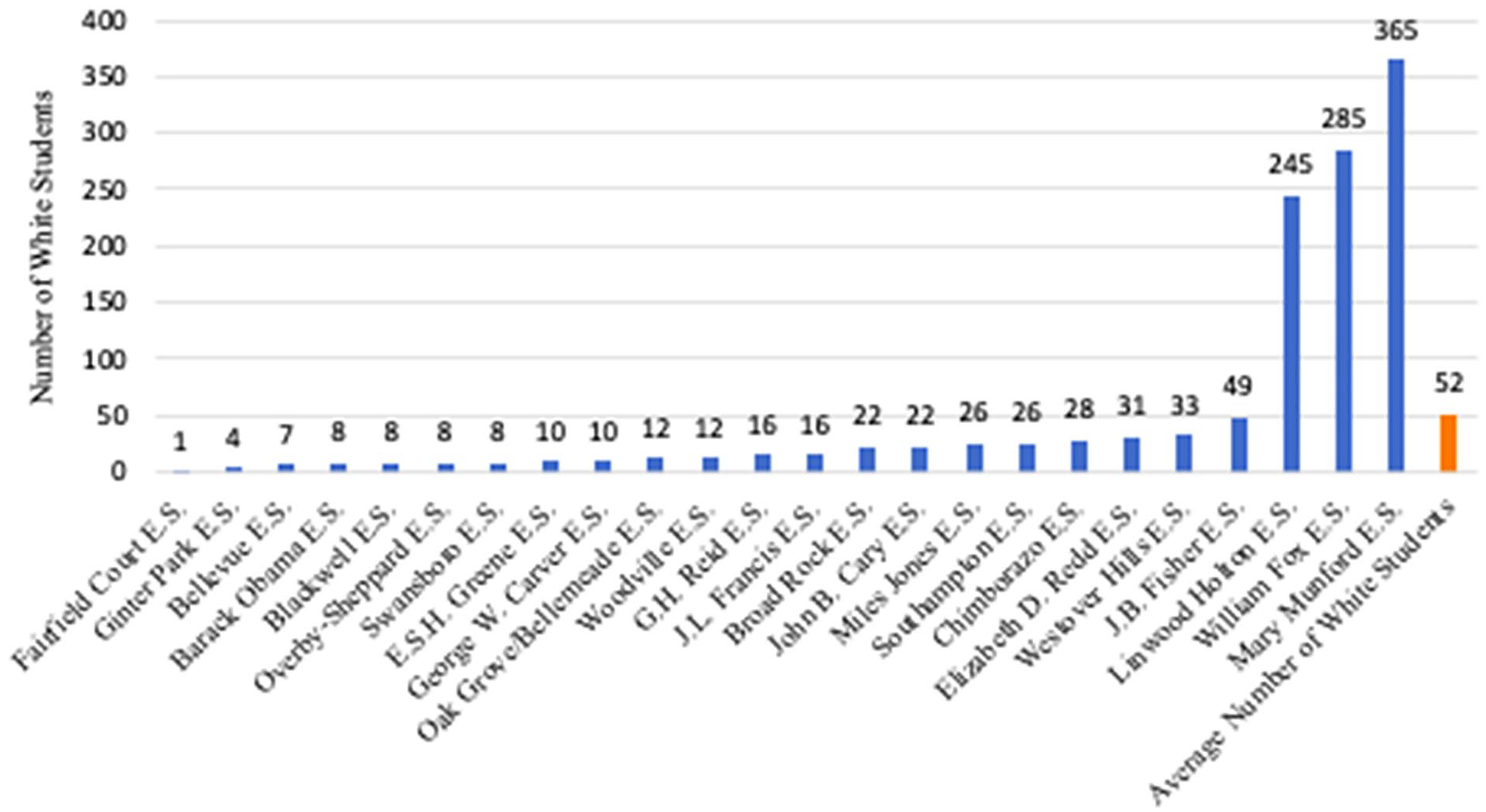
Number of White elementary students enrolled in Richmond Public Schools, 2018 (n = 1,252).
RPS’s rezoning process lasted 9 months, with multiple engagement and feedback channels, including 59 school board meetings, online comments, community events, and surveys. A board-appointed Rezoning Advisory Committee (RAC), composed of two members from each school board district, was also central to the process. The RAC and the superintendent presented four final proposals developed by external consultants for the board’s consideration, with each proposal outlining potential system-wide zone configurations.
Two of the four options included pairing schools close in proximity. Pairing is a rezoning strategy that encompasses multiple neighborhoods previously associated with at least two schools to yield a single, more diverse attendance zone. A pairing option might assign students to two schools using various grade-level configurations by pairing students in Grades K through 2 in one site and Grades 3 through 5 in the other site. Pairing options in Richmond integrated up to seven elementary schools by adjusting grade configurations so students from previously separate and racially identifiable schools would be together. On a five to four vote, the board approved with amendments an option that did not include pairing, although they did approve a choice-based option encouraging transfers between two racially identifiable schools. These new elementary school zones attempted to modestly redress a segregative 2013 rezoning process (Mattingly, 2019), which Siegel-Hawley and colleagues (2017) documented “as a swift, chaotic and nontransparent political process” (p. 129) involving the closure of a majority Black, high-performing elementary school. The politically contentious and secretive nature of the rezoning, along with the racialized and segregative impact of school closure, became the basis for litigation against the 2013 school board. Consequently, the 2013 rezoning process remained in public consciousness, shaping the new school board’s rezoning efforts.
Data
Data for this study come from a purposive sample of stakeholders contacted via email or phone because of their involvement in RPS’s rezoning process. The final sample of participants included six rezoning committee members (i.e., RAC), three RPS school board members, two district or central office officials, and four community advocates and parents (Table 1). We sought to capture a geographically and racially/ethnically diverse group of adult participants across the city; however, our sample did not reflect overall city demographics (see online Supplemental Data for additional study limitations). White participants were overrepresented (60% of sample, 46% of residents), whereas Black (33% of sample, 47% of residents) and Latinx (6% of sample, 7% of residents) were underrepresented. Given the nature of our data and to protect participants’ requests for anonymity, some comments may not include racial/ethnic or geographic identifiers.
Interview Participants
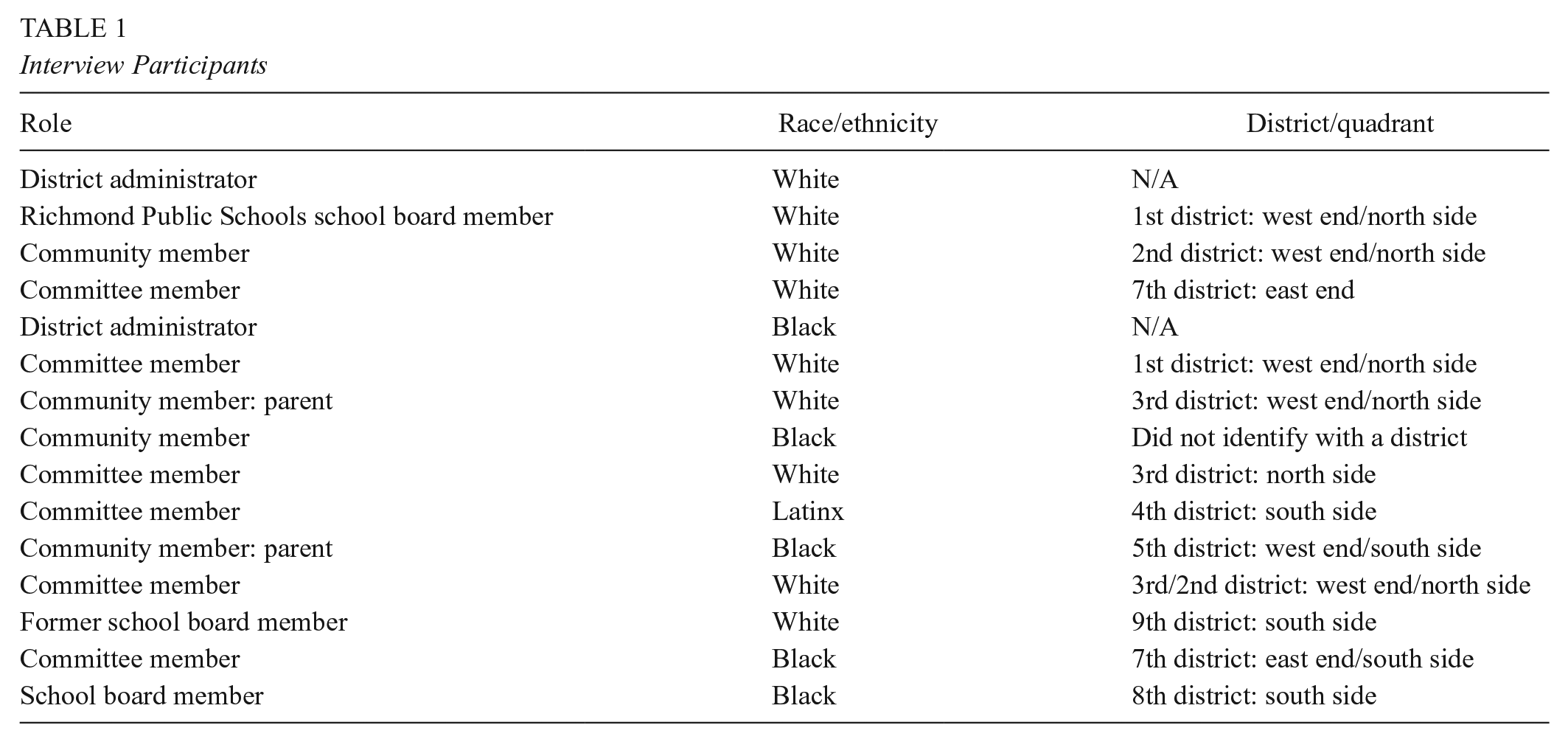
Data collection included 15 semistructured interviews lasting between 45 and 90 minutes. Interviews were conducted in person or by phone or online video and were audio recorded for transcription. We used protocols to ensure consistency and included measures for snowball sampling (see Appendix) to ensure broad representation, particularly with community advocates who did not act in an official capacity during rezoning. Participants were asked about their role in the rezoning process, forms of public engagement they observed or participated in, perceptions of how race and socioeconomic status figured into the process—including how stakeholders talked about race—and perceptions of rezoning outcomes on local politics.
Analysis
Drawing from NPA and related concepts like power, conflict, and policy (McBeth et al., 2007; Young & Diem, 2017), data were initially coded using a theory-driven approach. These relatively low-inference codes helped us identify details about the setting, characters, and policy problem and solution (McBeth et al., 2007). Inductive codes focused on the cultural politics of race and whiteness (i.e., colorblindness, White racial comfort, discursive language, etc.), the rezoning process (i.e., public engagement and participation), and codes indicating participant sentiment. This dual coding scheme enabled us to capture salient themes pertaining to the study’s guiding perspectives and frames.
To ensure coding consistency, the research team conducted two rounds of test coding for interrater reliability, refining the coding scheme as new data were captured (Miles et al., 2014). Each member then coded select interviews and noted the essence of the interview in a data matrix (Miles et al., 2014). Additional measures taken to ensure trustworthiness include triangulating interview data with observational field notes, ongoing mutual reflection, debriefing, and incorporating descriptive field notes following interviews. Participants were also given opportunities to conduct a member check of transcripts upon request. Using thematic analysis (Patton, 1990), we then identified emerging themes and patterns from participant interviews. The most salient themes undergirding racial narratives in the rezoning process are discussed as key findings.
Findings
This study explored the racial narratives that emerged in Richmond’s school rezoning effort and its political process. To address these aims, we first discuss school rezoning as a process historically embedded within racial narratives of school desegregation and “Massive Resistance” and more contemporaneously, within a prior school rezoning effort. By grounding participants’ understanding of rezoning through a historical lens, we show the permanence of race conceptualized in school segregation policy and outcomes. We also elaborate on ways narratives avoided or confronted race/racism and highlight aspects of whiteness as colorblindness and racial comfort. The last section focuses on the hypervisibility of White parents and the invisibility of Black and Latinx community members.
School Rezoning as Historically Embedded
For many participants and community members, Richmond’s rezoning process invoked a complex racial history. Participants recalled histories of Massive Resistance (Epps-Robertson, 2016), naming and renaming schools associated with the Confederacy (Carrington, 2019), school closures in African American communities, and a 2013 rezoning process vigorously opposed by civil rights and pro-integration groups. In fact, the 2013 school rezoning effort was a constant shadow, a reminder of a contentious, opaque policy process that led to the closure of a majority Black school and more segregative attendance boundaries across the city. However, relatively new district administrators were unaware of the details of the 2013 rezoning and its impact on Black residents. Having later learned of these events, one commented, “I wish I would have taken a little bit more time to understand the history of rezoning prior to this.” Presumably, this knowledge would have enabled the participant “to ground people,” further contextualizing why people of color distrusted the process, even in its early stages.
With the 2013 rezoning still a part of the city’s collective memory, the past remained firmly entangled with the present because some participants viewed the current rezoning effort as part of a continuum of racial inequality. A Black community member explained that what happened at Richmond Public Schools with African Americans [in 2013] was done very purposefully. We are still trying to bring ourselves up from the ashes of the lack of vision that segregationist policy makers laid down in the mid-20th century.
Further recognition of rezoning’s historical context emerged in references to Massive Resistance—the collection of Southern state laws intended to prevent integration of Southern schools following Brown (Golub, 2013). Several narratives mentioned Massive Resistance as participants drew parallels between rezoning and school desegregation. Even the superintendent of RPS described contemporary opposition to rezoning as “Massive Resistance 2.0.”
Richmond’s longer history of racial segregation also figured prominently in participants’ narratives. And amid a national reckoning around race, some participants’ sentiments centered this history. One White community member involved with the advocacy group Integrate RPS stated, “We live in the former capital of the Confederacy, we have a legacy of segregation” and recalled the fraught history of regional opposition to integration. Another White member of the RAC, who advocated for pairing after the committee concluded its work, said, My driving factor in it was . . . what is an explicit, antiracist policy that’s going to push back against generations of racist policies . . . [pairing] was going to be a start, you know, getting folks in a shared space that’s just like where the work begins, but you get them there.
Yet some narratives ignored this history by viewing rezoning through an a-racial lens, illustrating what Cabrera and colleagues (2017) posited as whiteness as epistemologies of ignorance. They argued this type of racial ignorance “allows White people to remain racially blissful (or at least not complicit in racial oppression) . . . allow[ing] the contours of contemporary systemic racism to remain uninterrogated” (p. 21) while also insisting that one does know. Demonstrating this duality of ignorance, a White parent and community member opposed to pairing suggested that by recalling histories of segregation and Massive Resistance, the superintendent framed the discussion in a way that community members opposed to pairing would potentially be identified as racist. She believed that: that’s just not gonna lead to a fruitful conversation or you can have a critical take on pairing and it doesn’t have to be predicated on racism, but the way that he [the superintendent] framed the conversation just made people unable to talk about it. And there are plenty of nonracist ways to critique this policy.
In her view, rezoning was a contemporaneous policy problem and not part of a longer historical continuum of racialized school policy. However, this was an uncommon sentiment among interviewees given that most intentionally drew historical connections, viewing school rezoning as an opportunity to address “systematic divestment of the building blocks of upward mobility” by enacting system-wide change.
A Critical Juncture
Narratives also revealed complex negotiations about the legacies of racism and its influence on community members’ rezoning positions. With few local educational policy solutions specifically aimed at antiracism and mitigating racialized outcomes, one Black community member saw the rezoning moment as a critical juncture. He explained that Richmond was in a “transitional phase [whereby] if we don’t capitalize on this very fleeting moment of interracialism, this is going to turn into a White city with the same types of character flaws that it’s always had.” For this participant, bold policy action that put race “front and center” was critical to moving beyond a rhetoric of integration that continued to uphold whiteness and the racial status quo. However, leveraging this policy window required political buy-in, especially from many longtime Black residents in Richmond who, according to the participant, held a fleeting sense of hope for rezoning.
Indeed, several narratives echoed similar sentiments about Black residents’ distrust and reluctance about rezoning. As previously noted, much distrust was attributed to the 2013 rezoning, but narratives revealed widespread distrust toward city and school leaders as part of Richmond’s deeply racialized history. Reflecting on the challenges of engagement, a Black participant expressed that other Black residents “didn’t feel like things were going to change” because of past failures around desegregation, rezoning, and previous policies that diminished historically Black communities. Although a White committee member suggested that Black people had “rightful reasons” to be distrustful of rezoning, White residents’ distrust and their related opposition to rezoning were perceived differently. Commenting on many constituents’ opposition to pairing in her district, another White committee member noted that this stemmed from RPS’s policy and program implementation track record, which caused many to “not trust that this system will do this process well.” Unlike Black residents, White residents’ distrust was rationalized through a political lens, not from a racial or anti-integration stance.
This notion of trust was an important subtext to participants’ narratives about the policy process because, as one Black participant stated, “If you’re distrustful of the administration, then that all gets carried over to the rezoning process.” Opportunities to build trust within and across racial lines, to some extent, were limited by the brief tenures of Richmond’s first White superintendent in decades and many other central office newcomers. Overall, the lack of trust in RPS’s ability to implement pairing from multiple constituent groups coupled with Richmond’s racialized history and context shaped the racial narratives used to frame the rezoning process and the extent to which race was discussed.
Confronting or Avoiding Race Talk
Discursive strategies
To elaborate on how racial narratives unfolded in the political process, we highlight ways narratives confronted or avoided race and whiteness in rezoning discussions. Here, the use of discursive strategies revealed multiple conceptualizations of race consistent with antiblackness, colorblind ideology, and the minimization of whiteness. One concern emerging in participants’ narratives was unease with being rezoned to schools they perceived were lower quality based on standardized test scores. Describing residents’ sentiments, one committee member recalled: “What I heard, the way it was phrased was they [schools] are not academically as strong. . . . So, those kids are not prepared to be in school with my kid. We heard some of that, but there wasn’t really anything to support that.” Other committee members also acknowledged that comments from majority White speakers about a loss of intimacy, higher student-teacher ratios, and lower school quality were largely unsubstantiated by data presented in public forums and on the district’s website.
Therefore, given the Black and White racial/ethnic demographic majority within the city’s rezoning hot spots, we found these narratives reflective of antiblackness. Drawing on BlackCrit theory and scholarship, Dumas (2016) regards antiblackness as the “cultural disregard for and disgust with blackness” (p. 12), which serves to deny Black people’s humanity through constant surveillance and suffering. Describing how he observed antiblack racism at community meetings, one Black participant said: I do see that usually when we start talking about African Americans, the questions [come up] of quality or questions about educational experience, or questions about classroom sizes, or questions about intimacy, student to teacher ratio. So, when you hear all these catchphrases start coming in, it begs the question . . . we never have these types of conversations when we start talking pairing well-performing schools with other well-performing schools. . . . These matters always become an issue when we start talking about pairing with Black schools or schools that service predominantly poor communities, then we get into these questions.
Although most committee members did not identify or draw on antiblackness to explain residents’ opposition to rezoning, BlackCrit scholars argue that antiblackness is institutional and endemic (Dumas, 2016; Warren & Coles, 2020). This point was highlighted by one participant who linked these racialized discourses to “the same type of language that people used during the Massive Resistance movements of the 1960s and the 1970s.”
Racial discursive strategies that avoided race were especially salient because, as previously mentioned, “people don’t want to be called a racist.” One White committee member observed how residents delicately crafted their critiques of the rezoning process to avoid being labeled as racist. The participant recalled that White community members against pairing often prefaced their opposition by saying, “I am for integrated schools . . . but I’m not for integration in this way.” Rather than rezone, some residents leaned on the rallying cry to “save neighborhood schools” as the preferred strategy—ignoring ways the phrase was similarly deployed in opposition to desegregation (Delmont, 2016). Racial meaning making was therefore supplanted by some residents’ preoccupation with being called racist or, as one White participant said, “knee-jerk reactions” that minimized explicit discussions of race. However, avoiding race talk also meant that some community members only used explicit racial language when arguing that rezoning “is not about race.” In one instance, a White committee member described how an antipairing advocacy group called Revitalize RPS strategically aligned with Black leaders who advocated for equal access to school resources as a way to oppose rezoning by co-opting a “resources-first” narrative.
The politics of whiteness in rezoning narratives
We also identified racial narratives interrogating whiteness, White interests, and White racial comfort, which often emerged alongside discussions of the “White savior” archetype. Cammarota (2011) described White saviorism as “the tendency to render people of color incapable of helping themselves” except when assisted by White individuals (p. 244). In this regard, several participants expressed concern that some community members might perceive rezoning as a policy tool to “save” Black students and schools, further explaining some of their opposition. As one White community member explained, “White saviorism can lead you to be condescending, to feel like you’re being a savior instead of being a community member.” Although these participants rejected White saviorism and the damage-centered imagery often associated with Black schools and students (Tuck, 2009), their narratives also neglected dimensions of Black self-determination, self-actualization, and self-efficacy—assets that Black communities have historically and contemporaneously sought in Black education spaces (Warren & Coles, 2020).
In the absence of affirming narratives that highlighted cultural wealth within majority Black schools, some community narratives weaponized this critique of whiteness. This was evident in the rhetoric and actions of one active White parent, who said she believed in integration but opposed pairing and the idea that pairing was beneficial for the greater public good. Ironically, she rejected White saviorism saying, “It’s so White savior, White colonialism-esque that we need to send ourselves over there to save that school.” However, her public record of opposition to pairing in community meetings and forums was inconsistent with her espoused critique of whiteness and White privilege. Rather, her comments could be perceived as another example of White residents co-opting a legitimate counterargument from many Black residents to maintain and protect White interests.
White parents’ insistence on avoiding race talk simultaneously amplified ways they sought to preserve White racial comfort. To illustrate, a committee member explained that White parents in the north side viewed schools through a quantifiable racial lens whereby White racial comfort depended on the presence of other White children: Holton has the kind of diversity that White progressives are comfortable with. The school is 50% Black, 40% White, and 10% other. And so it makes White progressives feel good about themselves because their kids are going to a school that’s not majority White. . . . So they’re like, my kids are going to school with kids who don’t look like them, but Holton, it’s 2.2 miles away from two other elementary schools that are hyper-segregated—97% Black.
In essence, this committee member described some White parents’ acceptance of racial diversity, wherein being one of 40% was deemed acceptable but not one of 20%. These comments are consistent with prior work on school and neighborhood racial composition, which suggests a threshold, or tipping point,
6
of the non-White population that dictates White students’ school entry or exit (Card et al., 2008; Green et al., 2020). In sharing her attempts to shift the discourse at public meetings from White racial enrollment to systemic racism, she concluded that such narratives were systemically racist because that is putting out the expectation that White families are always in the majority, that White families are always having the advantage. That’s the problematic piece. And that’s the part that people really had a hard time wrapping their minds around.
Although the participant suggested that centering systemic racism is necessary to fully understand the mechanisms of school segregation, this broader structural critique of racial segregation as a systemic problem was largely absent from many participants’ narratives.
Unequal Public Engagement
When asked about whose voices were and were not heard in rezoning discussions, multiple participants agreed that a small percentage of White middle- and upper-class families, primarily located in the west end and north side of the city, dominated. Conversely, one Black committee member regretfully noted that “we didn’t get the same responses from communities of color whether it’s Brown or Black or some of our Korean Americans.” Unpacking this dynamic illustrates the cultural politics of race and whiteness in narratives.
Overrepresentation, silencing, and invisibility
One district leader recalled that race was always on display since “White families on the north and some on the west made up the majority of people who are coming to these meetings,” not only in their regions but also across the city. One White rezoning committee member described ways White parents dominated public meetings and claimed space: So, there was this one father, and I forget if he was Fox or Munford, who went to every single one. Even when we had one at Southwood in this tiny little space with mostly Spanish speakers, he had to come to that so he could say again “You can’t do anything that will affect me and mine” even though nobody needed to hear him at that meeting . . . but certainly every single time he would come and make his speeches.
This White middle-class takeover of public school spaces is not new (Posey-Maddox, 2014) and emphasizes whiteness as ontological expansiveness, which Cabrera et al. (2017) defined as “the privilege of access to both physical and metaphorical space” (p. 23). The participant described the impact of this takeover on marginalized communities as “patronizing [and] really rude to the people who lived in those areas.” A Black committee member, observing a similar occurrence of White affluent parents controlling the narratives in her district, stated, “We had parents from Fox and Munford [majority White schools] come over here to our meetings. And it was interesting how they would use their positions about pairing and injected in our conversations over here.”
White families’ overrepresentation ultimately undermined attempts to gather responses from underrepresented groups, especially among Latinx community members who encounter deeply entrenched Black-White racial boundaries in the U.S. South (Rodriguez, 2021; Sohoni & Mendez, 2014). This dilemma heightened participants’ concerns that some White community members would reinforce deficit narratives about Black and Brown parents as underengaged and apathetic about education. However, a White RAC member insisted that “those folks [people of color] were there and, in those spaces, and really care about what’s going on at their kid’s school and for the community at large, [but] White people didn’t make space for that.” One Latinx committee member concluded that White community members and parents did what they always do—“speak for communities of color and make decisions on their behalf without actively including their voices.”
A Black participant also explained that broader systemic challenges influenced why some people of color chose not to participate or were constrained from participating. For example, many of the families in one Black committee member’s district did not have the same availability for meeting attendance “because they are burnt out at the end of the day.” This burnout was attributed to parents working long hours or multiple jobs. In addition, several participants pointed out that the process was not designed for full inclusion. As one noted, “The whole system is designed to benefit people who have the time and the energy to commit themselves as citizens to these policies.” Furthermore, the absence of Spanish-language translation and greater Latinx representation on committees were key barriers to public engagement from Richmond’s Latinx community. A comment from the sole Latinx representative on RAC illustrated this exclusion: “All I heard the whole conversation was about Black and White, Black and White, Black and White, and that’s . . . since I’ve been here since 2011. . . . When somebody disagrees, it turns into a Black and White issue and nothing happens.” Scholars have written about racialization processes of Latinx people and other immigrant groups of color, particularly in regions long characterized by stark Black-White racial divisions that complicate how these groups construct and navigate spaces of belonging (Rodriguez, 2021; Sohoni & Mendez, 2014). The participant’s comment highlighted the invisibility and erasure of Latinx community members from the policy process despite its goal to address overcrowding in the city’s south side, where Latinx community members were concentrated.
Racialized belonging in public and private spaces
Race also shaped narratives of belonging in public engagement. Affirming his commitment to ensuring that multiple perspectives were heard, the superintendent stated: “Look, this is a public school system that serves the public. [It] revolves around public engagement and opinion and is governed by a publicly elected and democratically engaged school board. Public engagement is vital.” District leaders recalled hosting or attending multiple informal meetings and small gatherings (the superintendent mentioned participating in 30–40 meetings), even pursuing additional meetings with Black constituencies to attempt to balance representation. Community meetings in a variety of settings (i.e., coffee houses, living rooms, church basements) aimed to provide accurate information, explain the process, answer questions, and clarify positions. The superintendent felt these meetings “create[d] space for people to disagree, to have hard conversations.”
These efforts were regarded by some participants as “a step in the right direction,” but a White committee member also felt they unintentionally contributed to uneven public engagement due to White co-optation and White residents leveraging their power and influence with leaders. Racialized belonging was perhaps most visible in the small, informal living room chats hosted by White families. The exclusionary nature of these meetings symbolized sites of belonging and, according to one participant, “had a lot of loud opposition to rezoning.” These meetings further enabled White parents to activate social networks and capital to share information through PTA groups, other private gatherings, flyers, and Facebook. Additionally, several participants agreed that White parents, with more time, resources, training, and experience in local politics, used their influence to meet with key stakeholders and form advocacy groups that deracialized narratives about rezoning.
The role of leadership
While authority for school rezoning lies with the school board, the superintendent and other district leaders facilitate design and/or implementation of the rezoning process. Thus, we highlight the role of leadership in this section because participants raised concerns about leaders’ ability to address race and racism authentically.
Interviewees noted diverse representation in the rezoning process as one unmet leadership responsibility. For example, a White committee member attributed the hypervisibility of White voices and the concurrent silencing of communities of color to “a lack of input from our underrepresented districts.” This was a common critique of the RAC, whose school board-appointed members were not racially or ethnically representative of the districts they served. Indeed, one committee member of color described a hostile RAC nomination process in which she was initially overlooked. She noted: If it had not been for myself asking to be nominated, and the president of the council asking [for me] to be nominated . . . then, I probably would not have been in that role. And I could tell you that the other person would have probably been another White person.
A Black participant also described the political consequence of underrepresentation whereby “the same dynamics and issues that are happening within the school board . . . got translated into power dynamics on the rezoning committee.” This resulted in racial alliances that informed whose voices were heard and which constituent viewpoints were prioritized. Ultimately, denying communities of color equitable representation in the rezoning process further institutionalized patterns of racism and cemented the racial politics of rezoning.
Participants’ narratives also revealed an overall lack of clarity about the school rezoning process and the extent to which the policy problem was clearly defined. The absence of clear goals and policy priorities focused explicitly on race and racism produced conflicting views about the problems rezoning should address. According to the superintendent, race and racial integration, then, became an ancillary concern to “all kinds of technical issues.” He recalled: I heard lots of things around why pairing wouldn’t work—not because of race, but because of things like, we’d have to do more busing and that would be an imposition on certain families. We’d have to spend more money, take away funding from other important efforts. Pairing leads to obesity because kids aren’t walking to schools, concerns about climate change because of increased transportation. These narratives went from the technical and legitimate to the absurd.
Although the district’s leadership team, including the superintendent, acknowledged that having “difficult conversations about race” was critical to the process of trying to create more racially inclusive school zones, other participants felt that naming race and racism was an important but missing first step in deciding how attendance boundaries should be determined. According to one Black participant, that meant [deciding] what we [were] going to do with predominantly White enclaves and predominantly schools of color [who] got the most attention because it [rezoning] really did threaten privilege and power in a way that other things did not, even as it relates to economic status.
Indeed, White resistance to pairing was so entrenched that some White families expressed threats to file lawsuits against RPS, exit the public system in favor of private schools, or move to neighboring districts if pairing went forward at public hearings—all of which echo sentiments of White flight within broader desegregation narratives (Delmont, 2016; Pratt, 1993). Thus, in the absence of critically interrogating White racial identity and interests, whiteness remained unnamed and unchecked.
Key stakeholders agreed that rezoning aims were initially centered on better utilization of school buildings; however, rezoning unfolded in a deeply racialized context where ignoring racial power dynamics was impossible. These dynamics were palpable, resulting in unexpected emotional burdens for some participants, especially participants of color who observed or experienced racism and racial microaggressions. These findings suggest that school and district leaders play a central role in clarifying goals and priorities and in confronting history, whiteness, and the silencing of voices of color.
Discussion
This study confirms that school rezoning is a “socially messy” and “politically painful” process (Bartels & Donato, 2009, p. 245) while highlighting the racial politics of rezoning narratives in Richmond’s highly segregated, Southern context. We find that how stakeholders understand race and whiteness—with regard to rezoning-related history, resistance to school desegregation, and past and present racial dialogue—thoroughly shapes and is shaped by the political and public engagement dimensions of school rezoning.
Dominant racial narratives emphasized the community’s collective memory of a heavily contested, segregative 2013 rezoning and the history of desegregation and Massive Resistance (Epps-Robertson, 2016; Golub, 2013). White and Black stakeholders alike acknowledged these historical linkages, using them to illustrate the centrality of race and racism in the present-day rezoning process, the contours of antiracism, and/or the similarities between White resistance to integration then and now. White resistance to pairing—the most integrative policy option under consideration—was likened to resistance to desegregation orders in earlier eras, further demonstrating the pervasiveness of whiteness in education policy (Dumas et al., 2016; Horsford, 2019).
Tenets of critical whiteness studies offered generative terms throughout our analysis, like whiteness as property (Harris, 1993), to explain why White antipairing stakeholders framed their opposition around their right to choose schools based on residential choices. Seemingly, these narratives upheld whiteness as colorblindness, and particularly Bonilla-Silva’s (2006) notion of naturalization, because they viewed racial inequality as a natural consequence of residential choices and individual preferences rather than a by-product of structural or institutional racism. White resistance to pairing also involved technical concerns and personal inconveniences—for instance, transporting children to two or more schools or concerns about walkability within neighborhoods. Yet elevating these inconveniences as rationales against pairing preserves White innocence from the “moral obligation . . . to acknowledge and challenge the underlying logic of the inhumanity and inequity that fuels racism and racist practices” (Gutiérrez & Jaramillo, 2006, p. 183).
White and—to some extent Black—resistance to pairing unfolded as advocating for equalizing resources first, before integration. Black and Latinx communities have long rejected problematic notions that through mere proximity to White children and whiteness, their schools would improve (Horsford, 2019; Nieto, 2004). Black communities’ demand for equitable resources holds the promise of Brown accountable while emphasizing social and cultural capital within predominantly Black and Latinx schools. However, our analysis suggests that some White residents and advocacy groups co-opted Black communities’ resource-first argument as a discursive tactic to resist racial integration. 7
We also found that racial narratives often relied on vague, race-neutral language rather than explicitly racist rhetoric. Although coded language regarding class size or poor student achievement was used as racial proxies, a framework of antiblackness helps explain how even a thriving Black school with strong standardized test scores can be disregarded and dismissed as problematic and unworthy (Dumas, 2016). Additionally, colorblind sentiments and hostility, veiled or otherwise, from White antipairing advocates and those who failed to challenge White resistance engendered racialized belonging that excluded Black and Latinx residents. Cultivating a sense of belonging is especially salient in contexts where rapid demographic shifts potentially disrupt Black-White racial paradigms. Rezoning narratives positioning race as a binary further contributed to the exclusion of Latinx community members despite historical legacies of Latinx people in the struggle for equitable school resources and desegregation (Gándara & Orfield, 2012; Nieto, 2004). Ultimately, we found this binary minimized rezoning concerns from Latinx residents.
Finally, racial hypervisibility and invisibility also unfolded in the public engagement process. Outsized White representation and perceptions of disengagement from communities of color emerged as another racial narrative. White voices and concerns were elevated through informal channels like living room chats and school-based meetings hosted by White rezoning committee members or by formal channels like committee board appointments. Although unequal public engagement stemmed partly from Black residents’ distrust lingering from the 2013 rezoning and school closure as well as a history of White resistance to desegregation, findings suggest that White narratives of distrust around leaders’ (in)capacity to implement pairing effectively must be interrogated as a racial discursive strategy. 8
Future research might explore how trust (or the lack of it) in educational leadership and policy is shaped through a racialized lens. Furthermore, narratives suggest district administrators or key rezoning stakeholders (i.e., committee or school board members) failed to articulate clear policy goals focused on race, segregation, and aims for racial integration (Siegel-Hawley et al., 2021); this potentially legitimated colorblind language and weakened the ability to address racial and economic segregation. As such, we borrow from Ladson-Billings (2004) to suggest that rezoning in Richmond landed on “the wrong note.”
Policy and Practice Implications
Our findings offer several implications for policy and practice. First, policymakers should facilitate shared understanding of local political history, including past policies with contemporary effects (i.e., redlining or Massive Resistance) and more recent rezoning experiences. Partnerships with local universities, media outlets, and historical organizations can help lay bare the full scope of historical and contemporary forces driving school segregation. Community-based organizations may be especially valuable to the public engagement process by serving as conduits to these histories. Key leaders should also confront race talk early and regularly when rezoning. Addressing and redirecting implicit and explicit racism or deficit-oriented discourses about students of color may help dislodge aversive racism and colorblind narratives used to resist rezoning through rationalizations “on the basis of some factor other than race” (Dovidio & Gaertner, 2000, p. 315). Leaders should challenge conceptions of belonging and exclusion embedded in residential choice by addressing barriers to fair housing for families of color and common assumptions about race and school quality undergirding these narratives.
Findings also challenge conventional public engagement pathways (e.g., public meetings or surveys) that amplify dominant voices while diminishing those of marginalized community members. School board and district leaders should disrupt traditional norms of engagement by, for example, prioritizing input from underrepresented communities and youth, attending to the hypervisibility of White community members, or correcting racialized discourses in real time. Smaller community-based meetings could facilitate cross-racial dialogues and reduce opportunities for exclusion. Finally, leaders and policymakers should develop clear rezoning policies that seek to reduce racial and economic segregation and use clear metrics to achieve desired integrative outcomes.
Supplemental Material
sj-docx-1-ero-10.1177_23328584221091274 – Supplemental material for Narratives of Race in School Rezoning: How the Politics of Whiteness Shape Belonging, Leadership Decisions, and School Attendance Boundaries
Supplemental material, sj-docx-1-ero-10.1177_23328584221091274 for Narratives of Race in School Rezoning: How the Politics of Whiteness Shape Belonging, Leadership Decisions, and School Attendance Boundaries by Andrene J. Castro, Genevieve Siegel-Hawley, Kimberly Bridges and Shenita Williams in AERA Open
Footnotes
Appendix
Acknowledgements
This research was supported by the William T. Grant Foundation (OR-201192).

Notes
Authors
ANDRENE J. CASTRO is an assistant professor in the Department of Educational Leadership and research faculty at the Institute for Inclusion, Inquiry, and Innovation at Virginia Commonwealth University. Castro’s research explores the cultural politics of race in education with an emphasis on teacher recruitment and retention policy and the impact of educational policies on school-community dynamics.
GENEVIEVE SIEGEL-HAWLEY is an associate professor of educational leadership at Virginia Commonwealth University. Her research examines school segregation and resegregation in U.S. metropolitan areas, along with strategies for promoting inclusive school communities and policy options for a truly integrated society.
KIMBERLY BRIDGES is assistant professor of education leadership and co-coordinator of the Virginia Commonwealth University EdD program in K–12 leadership. Her areas of focus include effective school board governance, collaboration, and state and local policy for equitable K–12 schools, systems, and student success.
SHENITA E. WILLIAMS is a licensed clinical social worker and school social worker with over 25 years of experience in the field of education and social work. Ms. Williams is an adjunct faculty member of the Virginia Commonwealth University School of Social Work and a PhD student in the Virginia Commonwealth University School of Education.
References
Supplementary Material
Please find the following supplemental material available below.
For Open Access articles published under a Creative Commons License, all supplemental material carries the same license as the article it is associated with.
For non-Open Access articles published, all supplemental material carries a non-exclusive license, and permission requests for re-use of supplemental material or any part of supplemental material shall be sent directly to the copyright owner as specified in the copyright notice associated with the article.
