




Abstract
Research in sociology demonstrates the way social connections shape access to information about job opportunities. In education, we understand less about how social networks impact the job process for marginalized teachers and teachers in nontraditional labor markets. This study examines how teachers in New Orleans and Detroit, cities with high concentrations of charter schools, use their networks to search for jobs, and how their experiences vary by race and gender. We find that in choice-rich environments, there was an extensive reliance on social networks in the hiring process, and teachers had different access to key social networks that can help to land jobs. Hiring decisions and unequal access to job opportunities among teacher candidates, in part due to the reliance on networks, created conditions where teachers who cultivated stronger networks, or with access to the “right” networks, had greater opportunity, with implications for racial and gender equity and diversity.
Policymakers, researchers, and advocates have called for increasing the numbers of teachers of color, particularly Black and Latinx teachers, in the classroom (Figlio, 2017; Partelo et al., 2017; U.S. Department of Education, 2016). The problem has been identified, but there are multiple explanations for why there are so few teachers of color in schools. Structural inequities, such as unequal opportunities to access higher education, shape the supply of teachers of color (Dupre, 1986; Lee, 2019; Madkins, 2011; Miller & Garcia, 2004), yet research also suggests that racial discrimination in school district hiring practices eliminates qualified Black teachers (D’Amico et al., 2017). Both of these dynamics, supply and demand, contribute to the underrepresentation of teachers of color. Our work explores the mechanisms through which racism, discrimination, and structural inequities limit job opportunities for teachers of color, particularly in educational contexts that are changing, with large numbers of charter schools.
The expansion of charter schools is increasing alternative pathways to teaching, and deregulation is rapidly changing teacher labor markets (Jabbar et al., 2019; Kretchmar et al., 2016; Trujillo & Scott, 2014). These policy contexts and institutional arrangements shape how social networks—teachers’ personal and professional connections—influence employment decisions (McDonald et al., 2012). Research in sociology has consistently shown that social networks influence access to information about employment opportunities, job search behavior, and employers’ hiring decisions (Lin, 2001; McDonald, 2010). Social networks can foster job opportunities; however, they can also reproduce structural inequities that marginalize minority populations (Braddock & McPartland, 1987). Networks tend to be racially homogenous (Castilla et al., 2013; Fernandez & Sosa, 2005) and often reproduce existing social structures. As McDonald et al. (2016) note, job opportunities are often “guided by white preference and privilege, regulated through network mechanisms, and linked to distinctive historical circumstances and ethnoracial power dynamics” (p. 16).
In this study, we draw on qualitative data from 79 interviews to examine how teachers in two cities with expanding school-choice policies, New Orleans and Detroit, activate their social networks in the job search, who they are connected to, how their experiences vary by race and gender, and ultimately, the implications for access to employment opportunities.
Overall, we find that teachers relied extensively on social networks in the hiring process. However, teachers had differential access to key social networks that can help to land jobs, particularly since the leadership of many charter schools is often disproportionately white and male, and charter schools in large urban areas have displaced teachers of color (Dixson et al., 2015; Scott, 2008; White, 2016). Our qualitative data, supplemented with social network surveys, illuminates patterns in the number and type of ties for white teachers and teachers of color, and by gender, in ways that could limit the job opportunities for these marginalized groups in the job search. We also find that racism and sexism in job-search processes is inherently tied to teachers’ experiences with discrimination in the workplace, as networks convey both information about job opportunities as well as what it is like to work in a particular school or organization. Teachers were warned away from some charter organizations, where the culture was perceived as hostile to women or people of color, which made teachers less likely to apply and more likely to exit. These dynamics create challenges for increasing diversity in charter schools, suggesting a need for institutional change and new recruitment practices to recruit and retain teachers of color.
Background
Three strands of research frame our study and provide context for understanding teacher networks as they relate to job opportunities. First, we review research on how social networks impact the job search process for job seekers and employers. Next, we summarize the literature on how job opportunities vary by race and gender. Finally, we review research on teachers’ experiences in charter schools.
Social Networks and the Job Search
Social networks, an individual’s social interactions and the connections that indicate relationships, play a critical role in the employment search. Social networks generate and influence social capital, which are the resources or expertise that come from social ties and are embedded within a network (Adler & Kwon, 2000; McDonald, 2010). Investing in social connections can lead to benefits (Lin, 2001), such as information about job opportunities (Stigler, 1962). Leveraging connections to people in hiring positions can lead to better job opportunities (Lin, 2001). There is a need, however, to understand how social capital functions for job seekers and employers within different networks and how they mobilize network resources (McDonald, 2010), especially because identity differences, and where one is positioned within a network, can impact access to job opportunities (Lin, 2001). Individuals seeking a job typically find employment through formal means, informal means, or applying directly to a position (Granovetter, 1995). Formal means include impersonal intermediaries, such as university-sponsored job fairs or advertisements on online job boards (Wanberg et al., 2020). In contrast, informal sources include personal contacts, such as friends or family (Wanberg et al., 2020). Finally, some individuals apply for employment by contacting employers directly. Research has shown that informal personal contacts produce better quality and better paid job opportunities for job seekers than formal means (Granovetter, 1995; Holzer, 1988), and individuals who use work-related contacts are more likely to be hired (Fernandez, 2000). Personal connections can also garner access to information about job opportunities that are unavailable publicly (Holzer, 1988; Marsden & Gorman, 2001). In fact, through networks, job opportunities can arise even when an individual is not actively searching for a job (McDonald, 2010).
Like job seekers, employers rely on both formal and informal systems to make employment decisions. Employers determine if a candidate is a good fit by looking at their credentials and skills, as well as personal characteristics, including mannerisms, appearance, and those who are culturally similar to themselves (Rivera, 2012). Network ties can help employers make inferences about an applicant’s capabilities (Podolny, 2001); thus, many employers use employee referrals (Fernandez et al., 2000). The use of networks for informal job placements, like personal referrals, varies depending on the institutional structure of a labor market (McDonald et al., 2012). In regulated and rigid markets, informal job matches are less likely. Conversely, in markets with more flexibility and less regulation, informal job matches are more common (McDonald et al., 2012). Teacher labor markets have typically been more rigid and regulated. However, with the expansion of alternative teacher certification pathways and the growth of charter school networks, teacher labor markets are shifting, raising questions about how networks interact with access to job opportunities.
Networks and Job Opportunities Shaped by Gender and Race
Though networks can provide opportunity, networks can also reproduce structural inequities by gender and race. First, the forms of social capital resources that are privileged in the economy are not equally distributed across social groups (Lin, 2000). For example, relying on established and certified candidate pools when hiring can have negative consequences in contexts where women and racial minorities hold fewer positions of power and hiring authority than white males (McDonald et al., 2016). Second, networks tend to be homogenous (Castilla et al., 2013; Fernandez & Sosa, 2005). Network homogeneity can marginalize minority groups, since social ties tend to form between people of the same race and gender identities (Braddock & McPartland, 1987; Marsden, 1988).
Some networks are segregated by gender (Marsden, 1988), and this pattern is reinforced by gender homophily, the pattern of people associating with same-sex individuals (McPherson et al., 2001). Gendered social networks can affect job opportunities because historically women have less social capital than men, particularly the forms that are privileged in the labor market (Eagly & Carli, 2007). Research has shown that women tend to have more unstable work careers than men (Williams & Han, 2003), due to their disproportionate care for children and other family members, particularly in contexts with weak social welfare and workplace policies. Instability or breaks in employment can impact the number and depth of social resources women can access when searching for jobs (Campbell, 1988). Moreover, in work organizations, women’s social networks tend to be less central, less influential, and provide less work-related support even when people have the same position (Brass, 1985; Ibarra, 1992; McGuire, 2002). For example, McDonald (2011) revealed that male networks yielded more job leads and higher status connections than female networks.
Social networks play a role in providing access to jobs, but this can vary by race. Unemployment rates are higher for racial minorities (U.S. Bureau of Labor Statistics, 2018), due to structural inequalities in access to education and jobs and racial discrimination in the hiring process (Bertrand & Mullainathan, 2004). This, in turn, affects the power of networks in accessing positions. For example, McDonald et al. (2016) find that the odds of receiving unsolicited job leads increase significantly in occupations with more white workers. Furthermore, there are more instances of opportunity hoarding in competitive labor markets, and access to job information becomes less accessible (McDonald et al., 2016). Labor market discrimination also shapes workers’ search strategies. Pager and Pedulla (2015) found that Black job seekers adapted to labor market discrimination by increasing the breadth of their searches. Additionally, Black workers, and other historically marginalized racial and ethnic groups, are more likely to offer help to others seeking jobs, compared to White workers (Hamm & McDonald, 2015).
In contexts where referrals are used for hiring, Black workers may have a particular disadvantage. Due to historic patterns of inequitable access to opportunities, Black job seekers are less likely than other racial groups to have ties to people who are employed and they may be more isolated (Tigges et al., 1998). Residential segregation influences job search patterns for Black job seekers because their search tends to be limited to the job opportunities in the urban core (Stoll & Raphael, 2000). Moreover, Black workers in decentralized labor markets and dispersed from city centers tend to have higher unemployment rates (Mouw, 2002). Mouw (2002) found that the use of employee referrals reduced the probability of hiring a Black worker by 75% in firms that are less than 10% Black and that in all firms employee referrals maintained employment segregation.
Charter School Labor Markets and Access to Opportunity
In education, there is limited research on the role of social networks in the job search. However, we know that teachers believe social connections to an employer is a hiring advantage and this belief influences their job-seeking behavior (Cannata, 2011). Teachers not only tap into their social networks when looking for job opportunities, but they try to expand their social networks by substitute teaching and interacting with educational leaders (Cannata, 2011). Further, membership through teacher-preparation programs expands teachers’ networks and access to job opportunities (Maier & Youngs, 2009).
However, charter schools function differently than traditional public schools. Charter schools, which are publicly funded but privately operated schools, are granted more flexibility in hiring policies (Gross & DeArmond, 2010). Research analyzing charter schools’ hiring practices demonstrates that charter school principals report high levels of autonomy when hiring and recruiting teachers and they use more varied approaches (Jabbar, 2017). Unfortunately, few schools use data-driven hiring practices (Cannata et al., 2017); instead, they emphasize personal characteristics and referrals (Cannata et al., 2017; Jabbar, 2017). In decentralized labor markets with large numbers of charter schools, the use of networks appears to be more prevalent (Jabbar et al., 2020). There is little literature, however, that examines the varying structure of networks for teachers who are differently positioned in society.
Women and Teachers of Color in Charter Schools
Although changes in the teacher labor market were intended to create innovation in the market, they may foster inequitable hiring policies that negatively impact teachers of color and female teachers. Teacher labor markets already have low representation of teachers of color (U.S. Department of Education, 2016), and without sufficient representation in the workforce, access to job opportunities for racial minorities through social networks may be limited. Research has shown that many charter schools managed by Charter Management Organizations (CMOs) and Education Management Organizations (EMOs) are structured similarly with boards of directors and advisory boards composed mostly of White men from the corporate sector (Scott, 2008). Even though nationally charter school teachers are more diverse than public school teachers (Institute of Education Statistics, 2019), in many large urban cities, like Boston, Chicago, and Philadelphia, charter school teachers tend to be less representative of their student populations than traditional public schools (Casey et al., 2015). In some cases, the representation gap between students of color and teachers of color in charter schools is twice as large as the gap in traditional public schools (Casey et al., 2015). Charter schools are also less likely to retain teachers of color, in part due to their hiring practices (White, 2018), and their school culture and organization (Golann, 2018; Torres, 2014).
Methods
We use data from 79 interviews to understand how teachers in Detroit (where 53% of students attend charter schools) and New Orleans (92% charter) tap into their social networks as they search for jobs. (See Online Appendices A and B for more details on the demographics in each site as well as sample recruitment and survey information; for more on the historical context of reform in Detroit and New Orleans, see Dixson et al., 2015; Jabbar, 2015; Khalifa et al., 2016; Wilson, 2015.) To ensure a diverse pool of teachers at different stages of their careers, who may have different job search processes and preferences, we sampled teachers who were currently in teacher preparation programs seeking their first jobs as well as those who were currently working in schools (to understand later career moves). In 2016–2017, we interviewed 79 teachers (42 teachers in New Orleans and 37 in Detroit) actively searching for a job across these sites, asking them about their job search strategies and the role of their social networks in the process (see Table 1).
Social Network Contacts for New Orleans Teachers

Note: TOC stands for teachers of color and includes all teachers identifying as non-White, including Black, Latinx, Asian/Pacific Islander, and multiracial respondents.
Interviews were semistructured, lasting 60 minutes each, and were recorded and transcribed. As part of each interview, teachers completed a short social-network survey, asking teachers from whom they seek information about jobs. We examined the percentage of an individual’s ties that were same-race, different-race, same-gender, different-gender, and to principals or network/district leaders. We coded the qualitative data in Dedoose, developing deductive codes from the literature on job search and teacher labor markets (Miles et al., 2014). We coded for how teachers perceived that race, gender, and age influenced their job search or career advancement (see Online Appendix C).
Limitations
Our work is limited in several ways. First, our sampling strategy does not lend itself to a representative sample of job seekers in each site. Therefore, our results, particularly the descriptive results from the network surveys, simply describe trends within our data, which may not be representative. We hope that these trends and our qualitative data yield new questions that can be taken up in future work. Second, although a key focus of our work was race- or gender-based discrimination in the job search, it emerged from our data that there were also issues with discrimination and lack of opportunity within schools once teachers were hired, and sometimes those issues were most salient for teachers’ job choices (e.g., to stay or leave their current position). However, given that this emerged from the data, we were unable to systematically ask about participants’ experiences with bias within organizations, aside from their interactions during the job search process.
Race, Gender, and the Job Search
Our findings indicate that there was an extensive reliance on social networks in the hiring process, particularly in New Orleans and Detroit. However, teachers had differential access to key social networks that can help to land jobs. First, we report the descriptive results from our social network survey data, where we asked teachers to report the people they consulted for advice or information about the job search. Although our sample is small and not representative, we found some notable patterns in the number and type of ties for women and men and, for White teachers and teachers of color, in ways that could disadvantage these marginalized groups in the job search. Our qualitative findings then help to illuminate how networks structured access to opportunities as well.
Our findings provide insight into some of the potential mechanisms of inequity in the labor market. Coupled with the qualitative data, we see that there are multiple mechanisms that drive inequity in the labor market: First, there is the role of social networks and, in particular, which networks offer access to people in hiring authority, and which networks are privileged in a particular reform climate; second, there are challenges with discrimination in the hiring process as well as evidence of some emerging backlash among White teachers, due to the focus on diversity in many of our sites; and finally, there are limited opportunities at some campuses for teachers of color, with institutional practices that reinforce racist structures and do not allow for change even with a more diverse staff. Information and knowledge about these organizations is passed to other teachers through networks, closing off some schools from consideration and reducing opportunities for teacher diversity.
Variation in Network Composition and Size by Race and Gender
We begin by describing patterns we noticed in the ego networks of teachers in our study. In our sample from New Orleans, White teachers had bigger networks, or more contacts, in schools, on average, compared with teachers of color. For example, on average, White teachers had 4.26 contacts per person compared to teachers of color who had 3.50 contacts per person. White teachers’ networks were especially homophilous and included a greater percentage of White contacts than the networks of teachers of color. On average, 77% of each White teachers’ contacts were White, while 51% of contacts were White among teachers of color. However, White teachers and teachers of color reported similar rates of knowing a principal or someone with hiring authority in their network. For example, a quarter of our participants had a direct tie to a principal. Notably, our sample only included one male teacher of color, and we report those results for transparency (see Tables 1 and 2).
Social Network Contacts for Detroit Teachers
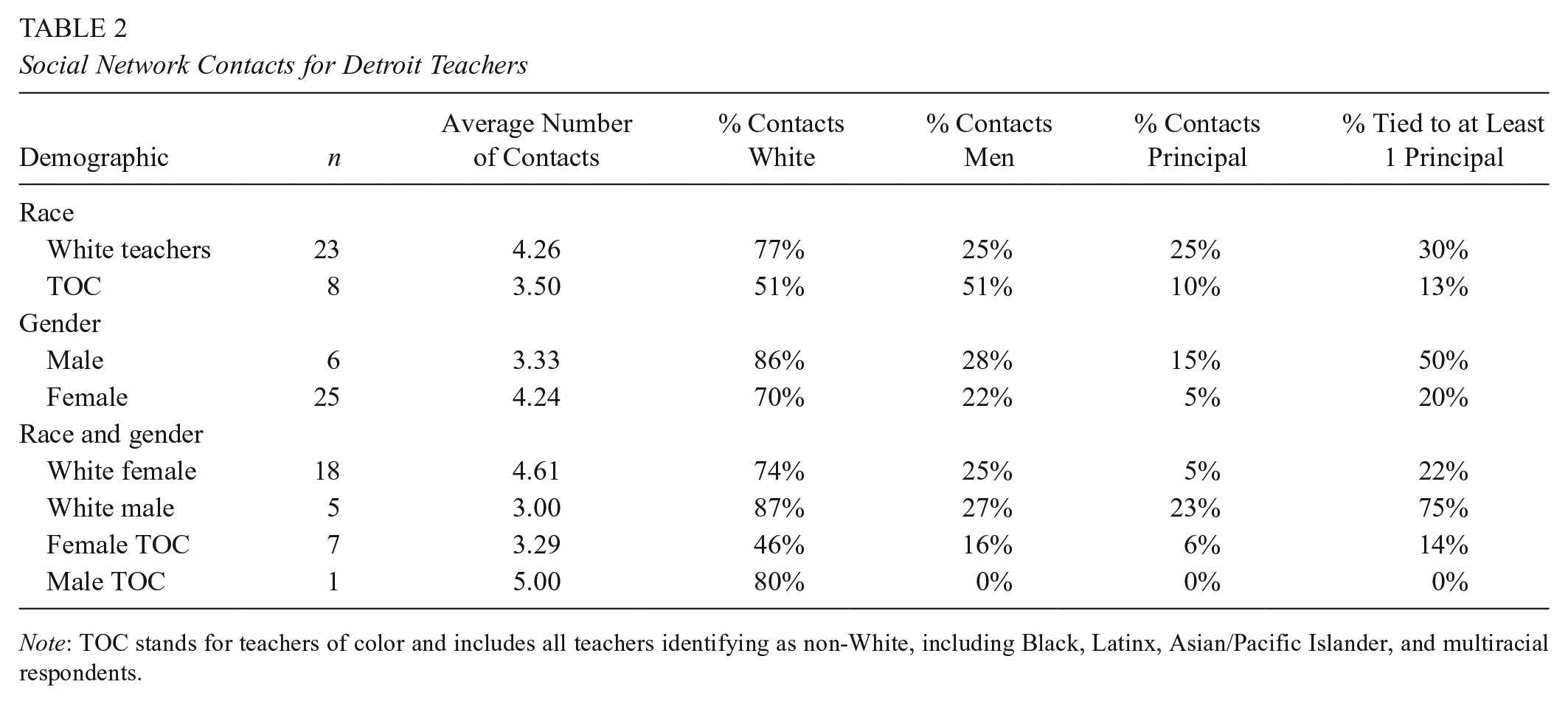
Note: TOC stands for teachers of color and includes all teachers identifying as non-White, including Black, Latinx, Asian/Pacific Islander, and multiracial respondents.
In Detroit, we found similar patterns. White teachers had more contacts in their networks than teachers of color. On average, White teachers had 4.26 contacts per person compared to teachers of color who had 3.50 contacts per person. Additionally, we found evidence of racial homophily. White teachers’ networks included a greater percentage of White contacts than the networks of teachers of color. On average, 77% of White teachers’ contacts were White. In contrast, 51% of contacts for teachers of color were White. White teachers also mentioned principals as contacts more often than teachers of color. In our sample, 30% of White teachers mentioned having a principal as a contact in their network, while just 13% of teachers of color included a principal as a contact in their network. We also found that male teachers were more often connected to principals. For example, 50% of male teachers had a contact that was a principal, compared to 20% of female teachers who mentioned a principal as a contact. This pattern persisted for White teachers, as 75% of White male teachers mentioned principals as contacts compared to 22% of White female teachers who mentioned principals as a contact in their network.
Hiring for Diversity? Skepticism and Backlash
At the time of our study, there was national and local attention to the shortage of teachers of color in public schools, particularly in areas that served large numbers of students of color. Several teachers of color in both sites believed they had an advantage in the job search due to a growing emphasis on diversifying the teaching force. In New Orleans, a Latina teacher described how the city’s changing context, with a growing number of immigrant students and English language learners, made her more competitive on the job market and helped her secure her job: I actually met an HR person or a recruiter, at one of our . . . events, and we just started chatting and she told me how [the] Parish needed teachers that spoke Spanish because there’s such an influx of ELL and ESL. . . . We got to talking and then she put me in contact with the school that I’m at now, so she was instrumental in me getting this job.
Similarly, a Black male teacher in New Orleans described how he was highly sought after and could easily find a position given his area of teaching: “I’m the rarest of unicorns in the teaching world.” He had six close ties, which included people in leadership positions in charter schools and in powerful local education reform organizations, with whom he had ongoing casual conversations about his career plans and was recruited by these contacts. His goal, however, was to find a position where he could stay long term and make a greater impact: “Where do I think my impact is going to be most directly and broadly felt, and useful. And I don’t know the answer to that yet.” Unfortunately, this was not something he found easily, as he believed that not all institutions were open to change.
However, not all teachers believed their racial backgrounds were an asset in the job search. One Black female teacher in New Orleans noted her options were limited to inner-city schools because of her race and background teaching in those schools. She said that urban schools “were the schools that gravitated towards me more than, say, a school in the suburbs,” due to her experience working in urban schools and because of her “race as well, because I seem like I could probably relate to those students more.” During the job search, she was courted by inner-city schools but ignored by others, constraining her job search. Another Black female teacher in New Orleans said that for one job prospect, she was asked to jump through a number of hoops, whereas her White colleague was offered the job without having to take additional steps: I mean all I can do when I interview is put my best foot forward. I do know that I applied for one position at a charter school and another fellow applied for it and she didn’t have to go through half of the steps—and it was a process that I had to go through—they just kind of offered her the job without her even doing a demo teach or anything like that. They just gave it to her and on the other hand I think I had to go through like six different steps to even get into the school or even do a demo teach.
In this case, she did receive a callback or interview, but the process was much more intensive than for her White colleague, perhaps in part because she had no ties to leaders there. In fact, this teacher had four ties that aided her with the job search, but most of her connections were friends providing general advice, or other working teachers, who had little power in decision making regarding hiring. These encounters with discrimination in the labor market limited the opportunities for teachers of color, particularly Black teachers, who were seen as serious candidates only for particular types of jobs and sometimes required to go through a more arduous and inequitable interview process to get those jobs.
While many White teachers believed diversity was important, some went further to identify their own White privilege in the labor market. One White teacher in New Orleans noted that she believed that her school prefers to hire Black teachers and that she, too, would seek to diversify the school if she were in a hiring position. She noted racial and gender-driven tensions among staff and students “every day,” and over who was promoted, as the executive staff is mostly White. A White teacher in Detroit noted that schools were trying to diversify. As a White female in her mid-20s, she said she “fits rights in” when she goes into charter schools but adds, “I don’t think that’s best for the kids here,” referencing research indicating that Black students do better if they have a Black teacher or multiple Black teachers. She says that “knowing that and being really aware of that, not wanting to be part of that, was just hard to navigate.” Similarly, a White female teacher noted that her school had a diverse faculty, which is important, so that students can “see people of all different ethnicities in leadership roles in whatever they do.”
A few White teachers, typically younger ones, went further to identify their own privilege or recognized a culture of White supremacy. Three White male teachers noted their advantages in the job search. One described how much of the leadership of charter schools in New Orleans consisted of White men from “out of town,” and he could relate to them, recognizing how their shared experiences helped him in the hiring process. In Detroit, one White man in his 20s said of the job search, “I obviously had benefit from my racial identity,” and another said he was given more opportunities and more “implicit trust” as a White male, even though he only had two connections in his job-seeking network, none of which were to school leaders. Another said that the “cards are stacked in my favor,” and as a White man, he had never felt at a disadvantage in the job search. Two White female teachers similarly noted that they benefited from being the norm, “the stereotypical teacher, a White female” in the charter-school job search and therefore did not face any discrimination. One of these teachers, who had a large network of 10 contacts from whom she sought job advice, added, “I know that’s probably not true for other people.”
However, the importance of diversity in these hiring contexts was also tied up with the view that White teachers were not prioritized in the job search. Six White teachers in New Orleans said they had experienced discrimination in the hiring process. One White male teacher in New Orleans said that while he recognized that “it’s preferable to have people that reflect the racial identity of the communities that people are working in,” he believed that being White was not an asset. Other White teachers in New Orleans said that they felt overlooked because of their race. One teacher believed that many schools weren’t interested in her because she was White. Another White teacher wanted to work on a team that addressed student behavior but noted that they were all Black teachers whom she perceived to be underqualified, selected because they interacted with the families the most. She believed that she wasn’t given the opportunity to work with that team because of her race. A White male teacher felt discriminated against because of his race when he was in athletics but noted, “But at the same time, that I have privilege elsewhere.” Another teacher noted: I had [a co-teacher] at the beginning of the year who was very, I wouldn’t say anti-White, but she has a chip on her shoulder I think, for good reason, for sure. That always made me feel uncomfortable . . . at one point I felt like I wanted to leave because I just didn’t want to be another White face, oppressing the kids. I don’t know, I’m in a different spot right now with that . . . I don’t know where I’m at.
In these instances, White teachers’ discomfort was centered as opposed to the experiences of Black teachers. Furthermore, race also intersected with age, place, and geography. One White female teacher in her mid-20s felt that some hiring managers were thinking, “How is this little White girl going to run one of the classrooms?” But she was hired, anyway, and she believed that being from New Orleans also gave her an advantage over some of the other young White teachers who came through Teach For America or TeachNOLA.
In New Orleans, White teachers generally acknowledged some conflicting views around teacher diversity and their own privilege, but in Detroit, there was a more explicit concern about discrimination among some White teachers. Four White teachers believed their chances to get a job or receive a promotion were hindered by their race. One White female in her mid-20s explained that Black administrators in the traditional public school system were “openly disrespectful” to her and that she and other White teachers were “targets of some less-than-savory types of comments and advice.” She feels she was hired “so late” because of her race. Another White female in her 40s described how a Black principal seemed eager to hire her on the phone but that when they met in person, “his whole demeanor changed.” She hesitated a bit and then said that she heard about “some . . . racism. Against the White,” which she thinks was the cause of the demeanor change. In a part of Detroit where the majority of the population was Asian, a White teacher in her 30s believed that her race “comes against her” because schools are trying to diversify and that if she saw an Asian man at a job interview, she would assume he would get the position. A White male in his 40s said that he would have to leave his school if he wanted a leadership position because the school is mostly Black, and “that’s the leadership they want.” These types of arguments reflect a misunderstanding of racism and power structures—that is, the idea that White people can be discriminated against in the same ways as Black people and may indicate the beginning of a backlash to the increased focus on diversity (i.e., hiring more teachers of color) in teacher recruitment, perhaps paralleling the backlash to affirmative action in higher education and other industries.
Related to a call for racial diversity in schools was a widespread belief that more men were needed in the classroom. One female teacher in Detroit said there was a movement to see more men in the classroom and in administration; there was a desire, she said, for “that male presence in the building.” Some female teachers noted that this put them at a disadvantage. One White female teacher in New Orleans said that she hadn’t experienced any discrimination per se but felt if she were a male candidate in elementary school, she would have an easier time. A White female charter teacher in Detroit recounted how her administration talked to faculty about trying to get more male teachers and more teachers of color on the campus. Her administration commented that “male teachers and especially the Black male teachers were walking around the job fair with some swagger because everyone wanted them, everyone was trying to get those teachers at their school. So it seemed like they had the pick of the place.” Others similarly described male teachers as “hot commodities,” and two female Detroit teachers described the importance of having “males in the room as role models for the young boys” or “more male role models” in schools. One man said that “if there’s any prejudicial discrimination going on,” that he is probably on the benefitting end because “there’s going to be a lot of woman at these career fairs and I happen to be a man.” Generally, respondents felt that in a female-dominated field, a male candidate had more options in terms of where to work. There was also an assumption that students lacked male role models outside of school and some women argued that men contributed positively to school culture.
Information About Discrimination Within Organizations Passes Through Networks
Teachers also reported that they felt discrimination existed within the workplace, particularly in some charter organizations, where the culture or structure was perceived as hostile to women or people of color and made teachers more likely to exit or less likely to apply. In other words, teachers of color felt they could “get in the door” but were ultimately not retained, pushed out, or deemed not a good “fit.” In New Orleans, few teachers described gender or race discrimination in the hiring process but did sense discrimination within some charter organizations in terms of how they were structured, the culture, who was promoted to leadership positions, or whose voices were elevated.
Race and Organizations
Teachers of color recognized they were in high demand during the job search but experienced discrimination within school contexts. Black teachers especially noted that while they did not feel discriminated against in the job search, once they had a job, they felt that race could play a role. In New Orleans, one Black female noted that colleagues at her prior school, a predominately Black school, would drive to campus with confederate flags on their trucks. She noted that these experiences made her unhappy at that job and drove her to switch to a new workplace where she is happier: “I can wear my Black Lives Matter t-shirt to work now. It’s awesome. But that’s a big factor for me. I actually want to have a drink with the folks I work with.” She learned about the opportunity and the culture of the school through her networks. Her boyfriend worked there and recommended her for the job. Other teachers also described a culture in charter schools where there were communication barriers between Black and White staff members. One biracial teacher attributed this in part to “just a lack of knowledge.” She added, “There are people on both sides of the spectrum who have not had a whole lot of dealings with the other, outside of a work environment. There are some teachers who, they really just don’t know what’s okay to say and what’s not okay to say. It’s not out of any malice. Nobody takes offense. It’s just a lack of a cultural understanding of adults.” She noted, however, that the school’s management was not aware of the problem, as evidenced by the lack of courses and experiences that center around African American history.
Another teacher in New Orleans similarly described issues with race due to leadership and culture in charter schools, which she felt were driving out Black teachers: “I don’t know if it’s people being driven out because their leaders are like ‘I don’t want Black teachers in my school.’ I don’t think that’s it, but I do think there’s . . . teachers who are coming to the consciousness that their race is going to bear on their work. I think that school leaders need the same kind of work.” When Black staff took on leadership experiences, they were sometimes “pigeon-holed into being the culture person” or “pigeon-holed into being a discipline person” rather than making curricular decisions. She added, “When you look at the types of roles that they have across the city, when you see a Black man in leadership you can assume that he is maybe the dean. He’s going to be there to deal with the people in trouble.” A White New Orleans teacher similarly noted that even schools that sought to address White privilege did not align their ideas to their practice: “Sure you all can hold these professional development sessions, but the way that you treat people negates everything that you would say. You would make lip service just caring about racial equity, but that’s not what you practice.” She described the system as designed to stifle radicalization and organizing by teachers, via “constant recruiting” of people who “will be easy to insert into the culture of that environment, which is a very white, upper-middle class environment.” In the job search, information through these networks shaped opportunities, as the teacher noted: Just the fact that that’s still racialized, just the fact that even [organization], which is like right now a primarily White people organization, that’s a place where I share information and people can get me jobs. People are like “I’m going to get you a job here” and they will. That’s is just so influenced by race and by social network and by education level by who you know. What a huge effect that has.
In these ways, the culture of charter schools, in particular, stifled diversity efforts, particularly with regard to the retention of teachers of color.
Gender and Organizations
We also found similar patterns for women in the job search and in charter organizations. Female teachers were less likely to report gender discrimination in the job search, even though several did indicate that they believed there was a preference for males. However, they did note that it was difficult to advance in the careers within some organizations. In New Orleans, one female charter school teacher shared that organizational issues at her school made it difficult to balance the demands of her career and family. Another charter school teacher noted that school leadership received opinions from men and women differently: I guess there were a lot of times at [school] where the same complaint . . . would be more heard from the voice of man teacher than a woman teacher . . . I was also in a relationship with one of the teachers at [school] who was a man, so I would have intimate insight of how he and I were treated by the same people in similar circumstances and really different ways. That was where I really think I noticed, whoa, there’s like serious red flag issues here around gender.
Issues of gender discrimination were particularly salient for one Latina teacher, who felt her school was targeting “noisy women of color,” those who were actively trying to unionize the school. Women were not the only teachers to note differential experiences based on gender. A male teacher described what he perceived as “benefits of being a male,” including opportunities to take on additional coaching positions and serving as a dean.
In Detroit, women said they were less likely than men to be offered a leadership role. Several female teachers in both traditional public and charter schools also noted that women were forced to cycle through jobs, often changing grades, classrooms, and leadership roles, but men seemed to be much more stable in their positions. One teacher shared that males were given leadership opportunities “far more frequently” than females did: For example, when they created the [leadership team] at my school, there were some other female candidates that I think would have been good to consider . . . but the only candidate that was really considered . . . was a White male. There’s only one female leader, and she’s an African American woman, but all the other leaders are White men. So I do feel like in the [district], gender has a lot to do with leadership. . . . We’ve had several principals come through my building. They’ve all been male.
Women thus reported not being offered the same leadership positions. Rather than barriers to entry into organizations, through hiring, they lacked the networks to advance within organizations to reach leadership positions. These messages then spread through networks, as female teachers believed they would not be serious candidates for leadership positions.
Discussion
As teacher labor markets continue to change under market-driven policies that deregulate teacher entry and expand charter school market shares, it is important to understand how these institutional and contextual changes influence teacher hiring. In particular, as the proportion of Black teachers in large cities declines with public school closures and charter-school openings (Buras, 2016; Henry, 2016; White, 2018), and charter-management organizations simultaneously increase their focus on recruiting teachers of color, it is important to examine the dynamics that may shape access to future teaching employment. Our study is an exploration of how teachers’ social networks may play a role in these processes. We organize our discussion section around four themes that emerged from our findings that highlight how social networks play a role in the processes of recruitment, job search, and retention of teachers.
Teacher Networks and Organizational Conditions
Networks are critical for retention and support efforts (Borman & Dowling, 2008). However, we argue that “who you know” provides access to jobs only for teachers that are structurally positioned to take advantage of those ties. Our work builds on research that has examined race-based discrimination in teacher hiring (D’Amico et al., 2017), suggesting some of the mechanisms through which teachers of color are not hired, via the structural nature of teachers’ networks (fewer ties to leaders, for example), but also through the information that flows through networks about which organizations are “good” places for teachers of color to work and advance. While discrimination also plays a role, through intentional or unintentional bias, and was harder to capture via interviews with teachers, our work also shows that there can be structural, network-based reasons for the lower rates of hiring teachers of color. In other words, our work suggests that it is the interaction of structural inequalities and interpersonal racism that drives lower numbers of teachers of color entering and staying in charter schools in these sites. Indeed, all teachers sought to use their networks in the job search, given the importance of connections, but the “payoff” varied, by race and gender, when teachers were confronted with discrimination in the hiring process.
Although it was not the initial focus of our research, we found that many teachers of color felt they could get in the door but were either not retained, pushed out, or deemed not a good “fit.” This creates challenges for addressing the lack of teacher diversity in charter schools, as organizational actors who would like to see improvements in their teacher workforce are often met with resistance. Furthermore, information about hostile working environments for women or teachers of color gets passed through networks, creating reputations that could impede future hiring of teachers. Our work suggests that, beyond recruitment of diverse teaching staff, institutions actually need to change culturally and organizationally to successfully recruit and retain teachers of color. These changes could influence the network ties between teachers and leaders who are looking to diversify their educator workforce. Organizational change, however, could be challenging as recent research has shown how many organizations operate as race-neutral bureaucratic structures (Ray, 2019), and calls for addressing systemic racism in organizational practices can be overlooked. Colorblind ideology can affect the racialization of schools and impact the recruitment and retention strategies used by leadership. Research should explore the ways that racial and gender-based hierarchies within schools influence organizational practices and reproduce inequality over time (Acker, 2006).
Organizational Challenges
In this way, our work connects to White (2016), who examines how “culturally subtractive” school conditions in charter schools lead to turnover of teachers of color, as well as Bristol’s (2020) work on how being the only member of a racial minority (e.g., the only Black male teacher) on campus can foster social isolation and limited support. Turnover is also driven by teachers with limited network connections within a campus, who are thus more likely to leave due to being unable to leverage a broader network. We assert that schools that are run authoritatively with little to no teacher input, where obedience instead of collaboration is the norm, struggle to retain teachers of color. Multiple New Orleans and Detroit charter school teachers observed that school administrators seek not mere coachability in their new-hires but compliance. Teachers observed that employers preferred candidates who could be “molded” and who did not give “lip,” “backtalk,” or “push back.” In Detroit, schools seem to seek out young, easily molded teachers, which reveals some of the features that White (2018) categorizes as “organizational conditions conducive to turnover”—that is, school leaders have rigid ideas about instruction and are unwilling to negotiate with teachers over such matters, and these hierarchical relationships lead teachers to feel subordinate. Indeed, as research on teacher candidates of color in preparation programs has shown, the contradiction between teachers’ personal values and organizational practices can create challenges for teachers of color (Gist, 2017).
Gender Influences
We also find a slow advancement of women and people of color within organizations in terms of leadership positions. Our work connects to Scott’s (2008) argument that educational privatization is a way for White men to preserve an elite and privileged space in educational leadership and policy. These kinds of hostile environments can create racial and gendered burdens for teachers of color, where they now must use personal time and resources to make their school environments safe and workable for themselves and other minoritized co-workers. Scott explains that as people of color and women slowly increase their presence in the field, they often assume leadership positions as a last resort—only to end up receiving harsh criticism when they cannot produce impossible results. Indeed, teachers in Detroit, in particular, observed that women cycle through leadership jobs more quickly than men and that men were offered administrative roles more frequently. Daily microaggressions, relying on outside formal professional structures to develop justice-oriented leadership practices, and navigating the intersections of family and professional responsibilities are just a few of the reasons why women quickly cycle through leadership positions (Gorski & Chen, 2015; Kholi et al., 2019).
Political Instability
Changes in the policy environment also altered the power of teachers’ networks for teachers in our study, similar to patterns found elsewhere (White, 2018). Veteran teachers had more robust networks given their years of experience, but with labor-market segmentation, or shifts in the political landscape, those networks no longer yielded the same opportunities. When teachers were fired post-Katrina, the majority of whom were Black veteran educators, their networks were disrupted, forcing many of them to change school districts or leave the teaching profession. Emerging teacher networks in Detroit, influenced by sweeping educational reform strategies, competed with older networks of teachers comprised predominantly with teachers of color, more likely to be from the community in which they taught. While these older networks were likely strong and robust, that does not translate directly into power within certain policy environments. Without institutional support or resources, teacher networks may lack the diverse knowledge or access to expertise that is necessary for problem solving or navigating shifts within the teacher labor market (Farrell & Coburn, 2017). Further research could explore why and how those shifts occur and how teacher networks respond to uncertainties within the labor market. Research shows that Black teachers are more often affected by firings due to school closures and the instability of district restructuring that often precipitates those closures (Cook & Dixson, 2013; Lee & Sartain, 2020; Lincove et al., 2018; White, 2018). Hiring decisions, and unequal access to job opportunities among teacher candidates, in part due to the reliance on networks, created conditions where teachers who can cultivate a stronger network, or with access to the “right” networks, had greater opportunities for employment. Teachers of color and their networks must overcome structural, administrative, and accessibility barriers to secure initial interviews and permanent employment (Bristol & Shirrell, 2019). Future research should explore how policy and budgetary decisions related to the hiring process have implications for teacher diversity and the racial composition of a district’s teacher workforce.
Conclusion
Our results suggest that a superficial focus on diversity is not sufficient and can even generate a backlash, as White teachers end up believing that they are being “harmed” by a focus on diversity, with an implied tradeoff between quality and diversity. Instead, more genuine efforts to diversify staff and allow for diverse perspectives within organizations are needed. This includes exploring how teachers of color operate within schools, either as loners or groupers (Bristol, 2018). Indeed, most teachers talked not about discrimination in the job search but discrimination once they were employed with their school. Charter schools wanted to hire teachers of color but were ill-equipped at retaining them. Limited support, lack of communication, and weak labor protections are just a few examples from research on how charter schools have failed at retaining their teachers of color (Fusco, 2017; White, 2018). Teachers of color can become tokens or, as one teacher in our study noted, be viewed as “noisy women of color” when they seek to make internal changes. Our work thus aligns with the research on charter school teachers and teaching, which suggests that teachers who initially sought to work in charters can become disillusioned with practices in those schools when they do not align with their pedagogical beliefs, which increases turnover within these organizations (Golann, 2018; Torres, 2014).
The current policy environment, including the call for schools and other social sector institutions to address racial injustice, is seeing a greater emphasis placed on the hiring of teachers of color. School districts with a majority minoritized student population, and a historical legacy of segregation and discrimination, are seeking Black teachers to provide critical instruction for children. However, our research, along with other scholarship that has examined teachers of color in charter schools, suggests that without changes to organizational practices, charter schools may simply have a revolving door of Black teachers. This could lead to an exodus of Black students and families from the charter school sector for other educational options or choices, as these school conditions can be culturally subtractive. During a time when many organizations are reflecting on and considering their role in upholding structures of racism, our findings highlight how charter schools in these and other urban areas need to consider not only their hiring practices but also how organizational practices, including disciplinary and instructional practices, may or may not align with their stated goals of addressing racial equity. This shift in approach could not only help recruit but also retain teachers of color and provide innovative pathways for future teachers to consider employment in charter schools.
Supplemental Material
sj-docx-1-ero-10.1177_23328584221084719 – Supplemental material for Race, Gender, and Networks: How Teachers’ Social Connections Structure Access to Job Opportunities in Districts With School Choice
Supplemental material, sj-docx-1-ero-10.1177_23328584221084719 for Race, Gender, and Networks: How Teachers’ Social Connections Structure Access to Job Opportunities in Districts With School Choice by Huriya Jabbar, Rachel Boggs and Joshua Childs in AERA Open
Footnotes
Author Note
Thanks to Andrene Castro, Emily Germain, and Rachel Tabak for their research assistance. Thanks to Rebecca Callahan, Marisa Cannata, and David DeMatthews for feedback on earlier drafts, instruments, and presentations. This research was supported by the National Academy of Education/Spencer Foundation Postdoctoral Fellowship, the University of Texas College of Education Small Grants Program, and Grant P2CHD042849, Population Research Center, awarded to the Population Research Center at The University of Texas at Austin by the Eunice Kennedy Shriver National Institute of Child Health and Human Development. The content is solely the responsibility of the authors and does not necessarily represent the official views of the National Institutes of Health. This research has also received support from the Grant T32HD007081, Training Program in Population Studies, awarded to the Population Research Center at The University of Texas at Austin by the Eunice Kennedy Shriver National Institute of Child Health and Human Development. The content is solely the responsibility of the authors and does not necessarily represent the official views of the National Institutes of Health.

Authors
HURIYA JABBAR is an associate professor in the Department of Educational Leadership and Policy at the University of Texas at Austin. Her research uses sociological and critical theories to examine how market-based ideas in PK–12 and higher education shape inequality, opportunity, and democracy in the U.S.
RACHEL BOGGS is a doctoral student in the Department of Educational Leadership and Policy at the University of Texas at Austin. Her research examines how social contexts influence education and how policy can be used to improve the lives of children and families.
JOSHUA CHILDS is an assistant professor in the Department of Educational Leadership and Policy at the University of Texas at Austin. His research examines the role of interorganizational networks and cross-sector collaborations to address complex educational issues.
References
Supplementary Material
Please find the following supplemental material available below.
For Open Access articles published under a Creative Commons License, all supplemental material carries the same license as the article it is associated with.
For non-Open Access articles published, all supplemental material carries a non-exclusive license, and permission requests for re-use of supplemental material or any part of supplemental material shall be sent directly to the copyright owner as specified in the copyright notice associated with the article.
