




Abstract
This study utilizes life history methodology to understand how White teachers develop racial awareness while also exploring how the education profession acts as an inflection point for racialized understandings of the world. Furthermore, as the educators in this study grew in their racial awareness, there was a rise in conflicting and ambivalent feelings as they attempted to teach in ways that aligned with their newly developed awareness. These feelings surfaced as the educators grappled with issues of race, Whiteness, and systemic inequality in both their profession and in their personal lives. Using a framework of Critical Whiteness Studies, this study provides a nuanced and contextual discussion of White identity development. Ultimately, findings show that educators begin to understand race through proximity, exposure, and repeated interaction with students of Color. This holds major implications not only for educators and teacher education programs but also for students of Color.
Introduction
In the United States, it is possible for White people to live a life of racial isolation. A White person in this country could grow up, attend school, find work, build a family, and live out their days in almost entirely White spaces. Take marriage, for example; studies find that 92% of White people marry other White people (Pew Research Center, 2015). The children of these marriages could conceivably attend all-White schools, as school segregation is higher today than it was in the 1970s (Bonilla-Silva, 2014). Neighborhoods are also segregated by race, and this is continuously reinforced by federal and local laws (Rothstein, 2017). When looking at friendships, 81% of White people say that the majority of their friend group is White (Pew Research Center, 2015). These examples of racial segregation demonstrate how Whiteness becomes “normalized,” and therefore, seemingly invisible (Bonilla-Silva, 2014).
However, it is too simplistic to think that White people can live in ways that are completely removed from people of Color. In addition to the ongoing historical contexts of slavery, colonization, and multiple forms of oppression that continue to shape this country, people of Color influence how White people think about and understand race, whether they are physically present or not (Lensmire, 2010, 2017; McManimon et al., 2018). Consider the number of ways that White people encounter ideas about people of Color, and about themselves in relation—the myriad of stereotypes and jokes about people of Color, media portrayals and historical accounts, the narratives (or lack of narratives) that are told in schools and in society regarding people of Color. While White people can seemingly live in an enclave, “people of color loom large in the creation of white selves” (Lensmire, 2017, p. 45).
This segregation becomes especially problematic in education, as over 80% of the teaching force identifies as White (U.S. Department of Education, 2016), whereas 47% of students in public schools identify as White (National Center for Educational Statistics, 2015). If White educators have spent their lives in majority-White spaces, their “life experiences and positionality . . . often make it challenging for them to understand the relevance of teaching from the culturally relevant perspective” (Picower, 2009, p. 199). In other words, we need educators who are able to teach to all students. Picower (2021) further elaborates, the sheer number of White people in the field of teaching, coupled with their frequent lack of experience thinking about and addressing race, makes it essential to understand the ways in which White racial identity influences how they enact—and how they can reframe—their understandings of race. (p. 5)
It is critical that White educators understand how their identity frames their teaching. This study seeks to understand White racial identity, its development, and how the teaching profession acts as an inflection point to prior ideological considerations. This knowledge is important for teacher training programs, as we continue to aim for a disruption in preconceived notions of race before teachers head into the classroom (Picower, 2021). By understanding racial awareness, White educators can work toward more equitable and inclusive teaching.
To that end, this study draws on in-depth interviews with seven White-identifying educators in the Midwest, and utilizes life history methodology to understand the following questions: How do White, United States American teachers in the K–12 education system develop racial awareness? How does the profession of teaching influence racial awareness? While other scholars have explored the topic of White racial awareness (see Jupp et al., 2019, for a comprehensive overview), this study is unique for three main reasons. First, this study’s research questions indicate that racial awareness is a process that occurs in and across events over time. White racial awareness is not static, nor is it unchanging (Jupp & Slattery, 2010). Therefore, life history methodology is well suited to a critical analysis of White racial development, as it provides insight into how racial identities are formed through childhood experiences, friendships, socioeconomics, religion, and other factors. This methodology also brings to light the ways that these identities can change over time. Second, as I will further explain in the Method section, this study holds historical importance, as it was conducted during the 2020–2021 school year. Finally, this study sheds light on the ways that racial awareness is fraught with conflicting and ambivalent feelings. This has been underexamined in the literature (with the exception of Lensmire, 2010), and it is an important topic to understand, as it pushes back against monolithic portrayals of Whiteness.
Literature Review
During the early 1990s, various models of White identity development were theorized, with much of this research being applied in counseling and with undergraduate students in higher education settings (Doane & Bonilla-Silva, 2003; Rowe et al., 1994). One well-cited model comes from Helms (1990). This model consists of a multistaged continuum through which White people “progress” until they reach “autonomy.” Each stage is defined by racial attitudes and emotions, and Helms (1990) argues that it is possible to “move forward along the developmental continuum, but not backwards” (p. 41). While this model was a starting place for the theorization of racial identity development, it has also been much criticized.
Rowe et al. (1994) point out multiple problems with Helm’s model. First, they argue that Helms’ model was built around how White people develop their identity in relation to people of Color, but it does not consider White peoples’ thoughts and ideas on Whiteness. This is a significant oversight, as White people often neglect to understand themselves as racialized beings (Bonilla-Silva et al., 2006; Lensmire, 2010). Second, Rowe et al. (1994) critique the model for being linear and argue that there is no proof that identities develop in such a way. The final critique of this model is that it is useful only for examining Black/White identities and does not consider other racial identities (Rowe et al., 1994). Despite these critiques, Helms (1990) remains influential, and we see the use of this model in recent publications (see Utt & Tochluk, 2020).
White identity development research in the field of education also began in the 1990s, with King (1991) and Sleeter’s (1992, 1993) work making seminal contributions to understanding how White educators think about race and Whiteness (Jupp et al., 2019). These studies focused on conversations with White preservice and in-service educators, and documented their tendencies to diminish the importance of race. In 2019, scholars Jupp, Leckie, Cabrera, and Utt published an extensive literature review on White teacher identity. This review examined 25 years of literature, published between 1990 and 2015. Out of the 47 articles that were published during this time, five major themes arose: “(a) racialized silence and invisibility, (b) resistance and active reconstruction of White privilege, (c) whiteness in institutional and social contexts, (d) fertile paradoxes in new research, and (e) reflexive whiteness pedagogies” (Jupp et al., 2019, p. 16). These themes push White identities studies into new directions, and provide empirical evidence for the importance of understanding White identities in ways that move past “simply documenting White teachers’ race-evasion” (p. 6).
The most relevant of those themes with regard to this study is “fertile paradoxes in new research,” which the authors define as “race-visibility within White race-evasive identities and contexts . . . race-cognizant or race-visible identities whose overall trajectories recognized race yet did so in ways that limited or diminished its importance” (Jupp et al., 2019, p. 27). Studies that examined fertile paradoxes highlighted educators who espouse social justice and antiracist teachings, yet often understood racism and Whiteness in limited and simplistic ways. For example, in Yoon (2012), a group of White educators attempt to enact equity work, thus demonstrating their understanding that racial work is critical to schooling. However, while attempting this work the participants continued to reify notions of Whiteness. These studies are helpful in their ability to demonstrate the complex nature of Whiteness; however, what these studies are lacking in is a complex examination of the feelings that surface when White educators are enmeshed in these fertile paradoxes.
Since Jupp et al. (2019), there has been continued work on White teacher identity; notably, Moon (2016), Berchini (2016), Jupp et al. (2016), Lensmire (2017), McManimon et al. (2018), Utt and Tochluk (2020). These studies take up the call for nuanced examinations of White identity. My study contributes to this critical empirical body of knowledge, while also bringing further attention to the complex ambivalent feelings that occur during White identity development.
Theoretical Framework
In order to understand White racial awareness, this study utilizes critical Whiteness studies (CWS) as a theoretical frame. CWS is built on “African American and critical White studies traditions” (Jupp et al., 2016, p. 1156) and has gone through two major iterations, the first wave and the second wave. The first wave of CWS was known for documenting the race-evasive and reactionary tendencies of White people when discussing race. Additionally, first wave CWS also documented the racist practices of White educators, with much attention on the role of White privilege. Eventually this wave of CWS was critiqued for monolithic portrayals of Whiteness that did not take into account complex identities (Jupp et al., 2016). Therefore, second wave CWS seeks to address these critiques and has moved toward the idea that Whiteness must be examined in the context of culture, society, and history, and that varying identity markers, such as gender, religion and class must be taken into account. These considerations create a more intersectional and nuanced analysis, and push back against the idea that Whiteness is static and unchanging (Jupp et al., 2016; Ulysse et al., 2016).
One of the most important contributions that CWS makes to the framing of this study is the theorization of Whiteness: Whiteness, as definition, refers to hegemonic racial structurings of social and material realities operating in the present moment that perpetuate racialized inequalities and injustices. White identity, as definition, refers to the multiple, intersecting, and (often) privileged race-evasive ways of conjugating White identities in the present moment . . . our understanding of White identity recognizes White privilege and race-evasive identities, but it does not totalize, reduce, or essentialize White identities to these important, however partial, understandings. (Jupp et al., 2016, p. 1154)
This definition makes an important distinction between Whiteness and White identity. As Picower (2021) further explains, Whiteness is the “ideology and way of being in the world” (p. 8) that maintains White supremacy. This is how I understand Whiteness in terms of my research. Additionally, this study considers the multiple factors that contribute to one’s identity, such as gender, ability, religion, and class. Yoon (2012) furthers this idea of the importance of intersectional identities, stating “Whiteness is elastic because it is contextually nuanced” (p. 590). Thus, it is important to keep in mind that both Whiteness and White identity can shift and change with varying contexts and social influences.
Methods and Contexts
Sociopolitical Context
The 2020–2021 academic year was marked by both a global pandemic and political unrest. This was a time when numerous men and women of Color were killed by White police officers, with many of those killings occurring in Minnesota, the location of this study. It was a year of political upheaval and divide, with a contentious presidential election and a capitol insurrection. Needless to say, my participants and I had a lot to discuss. To put these events into chronological perspective, Table 1 compares the major sociopolitical events with my research timeline:
Sociopolitical Events Compared With Research Timeline

While this table does not document every major event of the 2020–2021 academic year, it provides an overview of the volatile and difficult time in which this research occurred.
“Physical” Location
As I consider the location of my study, there is the actual physical location of the two schools and there is the online Zoom platform through which I conducted all my interviews. The teachers who participated in this study did spend some physical time in their school buildings over the course of the 2020–2021 school year, but at no point during the school year was I allowed into the school buildings.
The context of the two schools is important to consider. Even if the teachers were not physically in these spaces, they were still influenced by the students and other staff members with whom they work. Both schools are located in first-ring suburbs outside of the Twin Cities, Minnesota. These suburbs are characterized by growing racial and economic diversity. Due to discriminatory practices in mortgages loans, the economic crash of 2008, housing vouchers, and the school choice/charter school movement, these suburbs are home to some of the most segregated schools and neighborhoods in the country (University of Minnesota Law School & Institute on Metropolitan Opportunity, 2015).This has led to the current situation, where the first-ring suburbs are diversifying and White people are moving to second and third ring suburbs (University of Minnesota Law School & Institute on Metropolitan Opportunity, 2015). This is the context in which these educators work and live.
One school in this study is a preK–5 elementary school, the other is a middle school. As of 2019, 100% of the staff at the elementary school were White (Minnesota Report Card, 2019). At the middle school, 83% of staff members identify as White (Minnesota Report Card, 2019). As such, these schools were chosen for their reflection of national demographics—a majority White teaching force and a diverse study body.
Teacher Participants
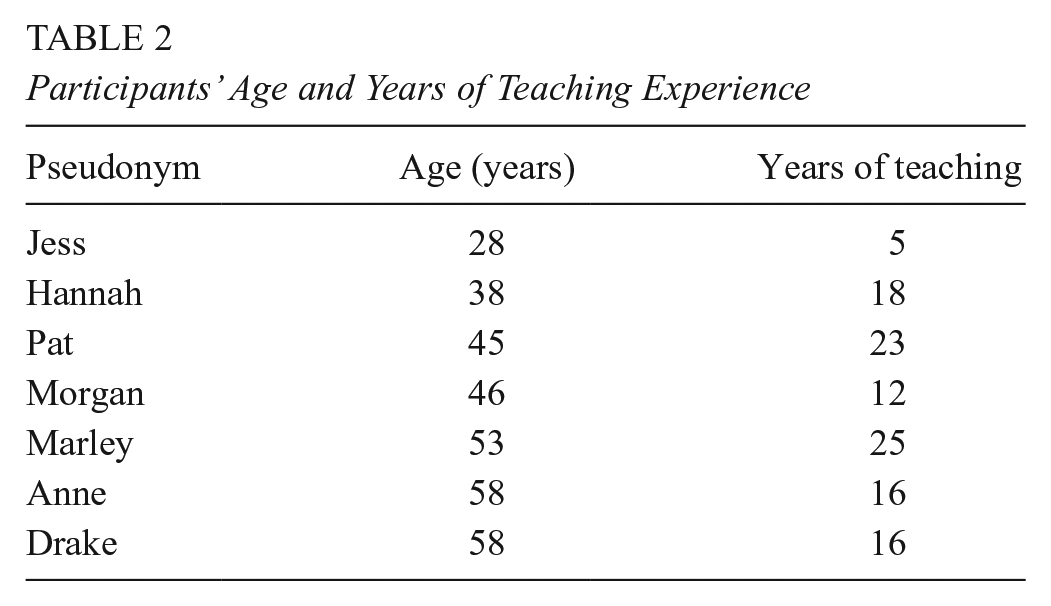
Six of the seven teacher participants were born and raised in small, rural towns in the Midwest. Even into adulthood, all but one of these educators live within a few hours of their hometowns. Table 2 provides further participant information.
Participants’ Age and Years of Teaching Experience
The teachers in this study were recruited from their schools during prepandemic staff development sessions. To recruit teachers, I introduced myself and gave a brief presentation of my research. I then asked for interested participants. The criteria for participation was as follows: self-identify as White, 3 or more years of teaching experience, and hold an active teaching license. There was no prerequisite regarding an interest in social justice or race. Any teacher was welcome to join the study so long as they fit the aforementioned criteria. Teachers were not monetarily compensated for participation.
Researcher Autobiography
In line with my commitment to CWS, I acknowledge that my identity has shaped this research every step of the way. I bring to this study all of the experiences of being a White, educated, female-identifying, middle-class woman. While all these identities are important, I will elaborate on one critical part of my identity that I share with the teacher participants—a White, Midwestern culture.
Both the teachers and I have similar backgrounds and upbringings. We have common stories of childhood, schooling, relationships, family, and teaching. Their stories were familiar to me, as so many were grounded in Minnesotan-ness. The “Midwest is commonly associated with a ‘nice’ and ‘friendly’ demeanor” (Smolarek & Negrette, 2019, p. 219). We are a people who have a really hard time speaking blunt honesty about anything; we are taught to be nice, we are taught to think of others. These are great things. At the same time . . . there is a sort of hidden language that emerges making it so we can’t speak to each other in ways how we honestly feel. (Smolarek & Negrette, 2019, p. 220)
This is important because much of what was said in the interviews was the unsaid, or it was coded in the language of Minnesota-nice. This is a culture in which there are many unspoken rules about that which is unspeakable—namely, politics, religion, money, sex, and race. This commonality of place and culture gave me the ability to deeply understand the stories that the participants shared with me, and the context that surrounds these stories.
Methodology
This research is built around life history methodology. Atkinson (1998) defines this methodology as The story a person chooses to tell about the life he or she has lived, told as completely and honestly as possible, what is remembered of it . . . the essence of what has happened to a person. . . . It includes the important events, experiences, and feelings of a lifetime. (p. 8)
This methodology was a strong compliment to the context of this study, as I wanted to understand how moments within a lifetime influence the way we think about the world. Life history interviews help explain how society shapes us; by talking about life events it becomes clear how and why ideas are changed over time (Atkinson, 2012; Freeman, 1993) Additionally, the pandemic condition shaped these interviews into emotional and social outlets during a time of isolation. Often the participants described the interviews as “therapeutic,” echoing Atkinson’s (1998) claim that life history “. . . can often help the person clarify or understand something that might not have been understood . . . before the telling” (p. 12). There was much to consider in the 2020–2021 year.
Data Collection
The teacher participants took part in a series of four, 1-hour, in-depth interviews over the course of the 2020–2021 school year. Atkinson (1998) argues that to understand a participant’s way of thinking, the researcher must ask interview questions that revolve around family origin, cultural settings, relationships, social factors, and education. Interviews that are structured in this manner allow for an understanding of the “essence of one person’s entire life” (Atkinson, 1998, p. 3). As such, each interview was themed and scaffolded on the preceding interview. For example, the second interview was about racial identity, but I noticed that many of the participants told stories about being White and female. Considering the overlap, I decided the theme of the third interview should be gender identity. This allowed me to follow up on racialized gender moments from the second interview and learn more about how race and gender overlapped to affect the participants’ lives. This method of interview building was also helpful in addressing the changing conditions of the pandemic and the numerous political events that influenced the course of our conversations. I wanted the flexibility to discuss these events, particularly since so many were about racism in U.S. society.
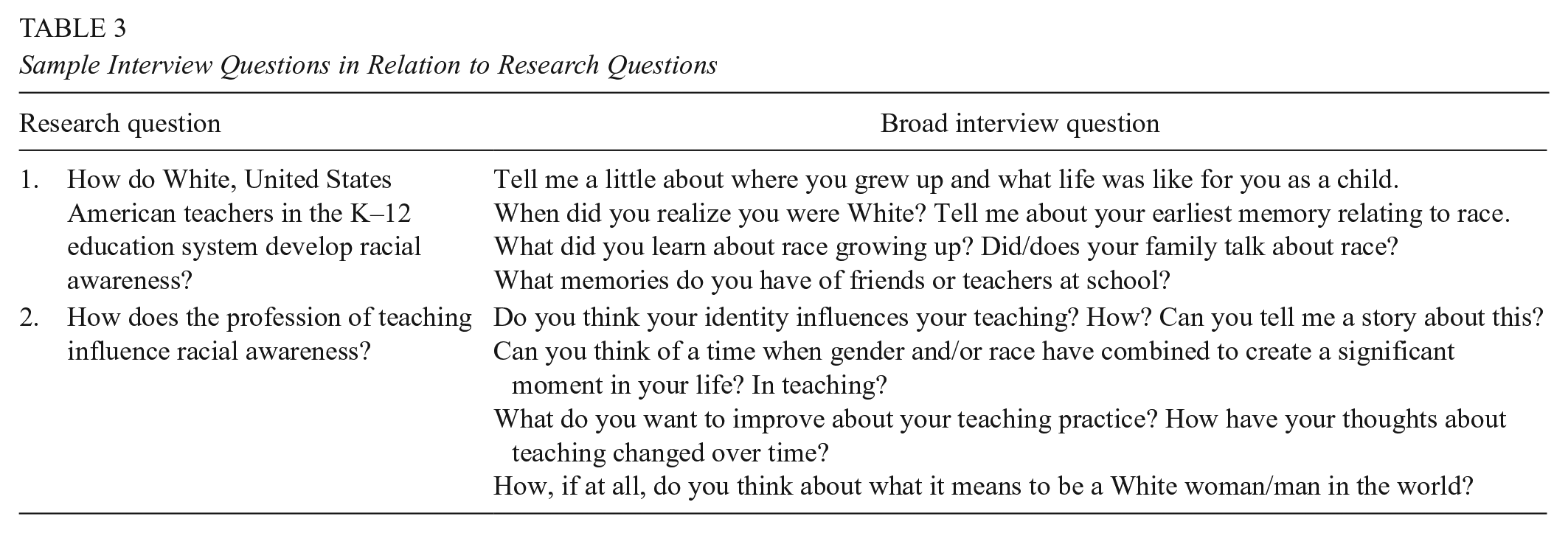
Table 3 provides an example of the broad, planned interview questions, as well as the interview questions’ alignment with the research questions that guide this study. These questions were not shared with the participants prior to the interview, as they were my conversation guide, leaving the interview open if an interesting avenue presented itself.
Sample Interview Questions in Relation to Research Questions
After each interview, I transcribed the interview and then edited for clarity. I also took detailed, analytical notes that recorded “emotional reactions to events, analytic insights, questions about meaning” (Rossman & Rallis, 2016, p. 172). These notes were especially important when it came time to design the next round of interviews, and during coding.
Analytic Approach
The analysis of this data was informed by a grounded theory approach. Grounded theory is the process by which the researcher first turns to the data for ideas that inform the phenomenon at hand (Charmaz, 2014). Furthermore, grounded theory consist[s] of systematic, yet flexible guidelines for collecting and analyzing qualitative data. . . . Grounded theory begins with inductive data, invokes iterative strategies of going back and forth between data and analysis, uses comparative methods, and keeps you interacting and involved with your data and emerging analysis. (Charmaz, 2014, p. 1)
To that end, I began my analysis with a close reading of each transcript and all analytical notes. After reading, I did two rounds of coding. First, I coded descriptively, looking to “define what is happening in the data” (Charmaz, 2014, p. 113). After I completed this process, I did a second round of coding that was focused on sorting and synthesizing the initial codes (Charmaz, 2014).
From these codes, I created categories utilizing an inductive and deductive process (Saldaña, 2014). Categories that arose from inductive analysis were based on emic language, or the words and phrases of the participants themselves (Rossman & Rallis, 2016). For example, many of the participants described their childhood homes as “color blind,” as their parents never discussed race. Categories that arose from deductive analysis were based on etic views, which came from the supporting literature, my interpretations of the data, and my analytical notes (Rossman & Rallis, 2016).
Throughout the analytical process, I utilized the “back and forth” process of grounded theory, continuously checking codes, categories, and themes against close reads of the interviews and my analytical notes. This iterative process allowed for constant theorization around the data which led to the findings and overall themes of this work (Charmaz, 2014). I also used a back-and-forth approach to check my data, reaching out to the participants for clarifications and follow-up questions.
Findings and Discussion
Three major themes emerged when discussing racial awareness with the teacher participants. First, it became clear that when the teachers in this study were children, they received direct and indirect messages about people of Color from White adults in their lives. These led to early ideological formations about race. Second, the educators overwhelmingly discussed how teaching acted as an inflection point in their racialized understandings. Teaching was a context in which these educators spent time with students of Color. Finally, as the educators in this study deepened their understandings of race, they attempted to teach in ways that aligned with this understanding. This resulted in a tidal wave of ambiguous feelings.
Constructing a White Childhood
In order to understand early ideas on race, I asked the participants about the first time that race was important to them or the first time they realized they were White (Thandeka, 2001). To understand the following story, it is important to know that Morgan is the one participant who did not grow up in the Midwest. Her family moved often during her childhood and most of Morgan’s schooling took place on a Cherokee reservation. When considering early memories of race Morgan says, “I have this memory of being at a parade and sitting down next to a Black boy and thinking . . . oh, you know, just noticing it. I don’t remember what I really thought about it.” Despite spending her childhood years in a school where she was the racial and cultural minority, Morgan’s first memory of race is about a comparison between herself and a Black boy. This demonstrates the “hypervisibility [of] African Americans and a relative invisibility [of] Asian Americans and Native Americans” (Frankenberg, 1993, p. 12) in Morgan’s mind.
In a similar story, Pat discusses her first experiences encountering people of Color in college. She says, I feel like it [race] never was brought up growing up. It was because everyone was White. It didn’t really matter. Like, race wasn’t a thing. And even in college, it wasn’t that I realized I was White, but I realized that other people weren’t.
Both of these narratives demonstrate how White people often neglect to understand themselves as racialized beings (Bonilla-Silva et al., 2006; Johnson, 2002). Morgan and Pat recount stories where they did not notice their own Whiteness, they noticed that “other people weren’t” White. This supports Johnson’s (2002) finding that “early memories of race focused on identifying a racial ‘other,’ not on their Whiteness or awareness of themselves as racial beings” (p. 162). It is also noticeable that Morgan does not name race, and Pat only does halfway through her memory. This is further evidence that they are not considering their own bodies in a racialized way.
The next set of narratives also recount moments that lack considerations of Whiteness; however, in these stories adults are present. Adults play an important role in shaping how children understand race and their position in racialized social hierarchies (Hagerman, 2014). As we will see, the adults in these stories taught the participants boundaries and expectations around relationships with Black people.
Marley recounts a story that her mother often told her, followed by a childhood memory:
It was probably late 1950s. [Mom] had two friends, Molly and Lucía. Molly was African American, and I think Lucía was Latina. They weren’t allowed to live in the dorms together. And my mom was so mad that they [the college] wouldn’t let her, so she left. She moved into an apartment with these two women. She thought [segregation] was dumb. Mom told us that story . . . they lived in an apartment and had a ball. Of course, that was hard. Back then they had to pay for the apartment. They had to cook for themselves. They had to do all the things. My mom did tell me that she had a boyfriend that she was serious about. And he broke up with her because she lived with these women who were not white. And she was mad about that, too. She told him to go on his way then, if that’s what he thought.
That’s an unusual experience for her generation.
Exactly. So . . . we’ve met Molly and her family. They came to visit us one summer, I was probably in middle school. And I remember going to the pool with them and people staring because we didn’t have any people of Color in our community. I remember that. So, I did see someone of color, but it was briefly, like just for a few days.
Do you remember talking about race as a family, when they came to visit?
No, I think that we were young enough that my mom, of course, was so excited to see her that it felt very comfortable. She was like, “This is someone that I really care about. Therefore, this is fine.” I remember thinking about it like, “Hmm, I wonder what people think . . . these guys are different.” But there was never any trouble. Nobody ever said anything.
This was a very poignant memory for Marley, but one that was also full of conflict for her adolescent self. Marley remembers her mother’s story as one where a White woman broke social norms to live with two women who were “not White.” Growing up in a town where there were no people of Color physically present, this story occupied Marley’s childhood imagination in a romanticized way, as this friendship was presented as a time where her mother “had a ball” and seemingly stood up against blatant racism. The conflicts surrounding this living arrangement do not seem to have been discussed in detail with Marley; the argument with the college and Marley’s mother’s terminated romantic relationship must have been complicated and difficult, yet the story is presented in a way that makes light of the racialized realities of such a situation.
Marley also displayed uncertainty toward meeting Molly, as she was concerned about what people in her small town would think. Marley’s mother gave her permission to accept Molly, under the condition that this was a person for whom she cared. While Marley’s mother may be encouraging of Molly’s acceptance, Marley’s hesitancy to embrace Molly is inhibited by the perceived shame or guilt that will be placed on her by other White people in the town. This reflects Thandeka’s (2001) work on the ways that White adults police young White children’s interactions with people of Color. Thandeka (2001) describes the making of White identity through shame, repression, and fear. In Marley’s story, we see her mother making provisions—friendships with Black people that you care about is “fine.”
Drake tells yet another story where the spoken and unspoken racial norms of the White adults in his life shape his understandings of race:
I would categorize it now as we grew up in a racist . . . society, or a racist family? community? For sure.
What makes you say that?
Well, for example . . . [the rhyme] “Eenie, meenie, miney, moe” . . . to find out who’s going to be “it” . . . “catch a” . . . we used the N word . . . “by the toe.” You know, that kind of thing. My parents never said, “What are you doing?” They heard us say it 100 times. I remember one instance, I’m probably in grade school at this time . . . we were at my grandma’s house for Thanksgiving and my uncle parked his Mercedes on the street. And then two guys came and broke off the medallion, the Mercedes thing from the hood, right? So they happen to be black people. That left an imprint based on my uncle’s reaction to it and what was said about that.
Like in Marley’s story, Drake’s narrative shows us that the adults in his life modeled “appropriate” racialized behavior. It was acceptable to sing racist songs that included verbalizing the N-word, as no adult ever told him otherwise. The Thanksgiving story also shows how Drake’s uncle, and any other adults present, imparted on Drake the stereotype that Black people are criminals. It is noticeable that in this story, there are no adults challenging Drake’s uncle, and so we again see silence as a stand-in for approval. As a child, Drake sings racist songs and hears his uncle discuss racist stereotypes; no adults in these memories pose a challenge to the narratives. When I asked Drake if his family ever discussed racism, he emphatically told me, “No, no. Not whatsoever.” This demonstrates the “invisibility of most mechanisms to reproduce racial inequality” (Bonilla-Silva, 2014, p. 26), as Drake can vividly recall these formative memories, but does not directly connect this to having racialized conversations as a child, even though these conversations are clearly racialized.
Anne tells a story that is quite similar to Drake’s, reflecting on her first memory of race form childhood: We never ever talked about it [race]. And it was funny, because I remember some of the songs we learned in grade school, talking about Redskins and runaway slaves. They would never have that type of song nowadays. When I think about race, you didn’t talk about it much. Thinking about these songs, that is so unacceptable now and I never knew that back then. I remember growing up and singing songs, in elementary school you sang them as it was written. I remember . . . [singing] “When the land was young and the Redskins walked in, he went to bed with the shotgun cocked . . .” It was really racist. We just thought it was the music we sang.
In Anne’s memory, she does not detail a specific interaction with an adult, but adults were clearly present in this memory. Through silence, the adults in Anne’s life teach her that racist sentiments are acceptable.
These reflections on racialized childhood memories show us how young White children are socialized to think about race. These are foundational moments in the making of White identity; however, this is not to say that children are empty vessels that adults fill with racist ideas. There is “variation in white children’s racial common sense . . . kids participate in their own socialization through interactions within a racial context. [This is] a view on the social reproduction of ideology that includes children’s agency” (Hagerman, 2014, p. 2612). What these early memories do demonstrate, however, are the ways that White adults make distinctions for children in terms of identity development and contributing to racial ideology. Thandeka (2001) explains this process between children and adults: This social construction of a “white” requires us to make a distinction between a person’s core sense of self before and after its identity is defined as white. Before the white identity is established, this core sense of self is not white. Its personal racial identity is, in effect, nonexistent because the socialization process has not yet been undertaken by its white community of caretakers, legislators, and police force. (p. 85)
In a society where White people can physically exist in almost entirely White spaces, it is critical to consider how these notions from childhood are, if ever, challenged. For some, these childhood ideological foundations are likely never challenged, thus reifying White supremacy in the next generation. For others, like the teachers in this study, there are life events that trouble these initial understandings of race. As the next section will detail, for the teacher participants in this study, that disruption comes through their chosen profession.
Teaching as an Inflection Point for Racialized Understandings
All seven participants discussed how teaching was the most ongoing, life-changing, and formative force in shaping their understanding of race. This came up repeatedly in the interviews, and while all the participants talked about the formative nature of teaching in different ways, they all reflected on how important teaching has been to them. Marley states this succinctly: When I started teaching is when I started understanding. Being in differences, because I was involved with so many different types of kids and families. I just learned so much. You see all of the differences, the learning that I’ve done over time with the different kinds of kids that I’ve worked with.
Anne also highlights how working in a diverse setting has changed her way of thinking: I guess I never realized all the blind spots . . . you don’t realize all the prejudice. You see all this stuff happening now, it’s not like it’s new. The more I teach . . . it’s exposure to kids, right? When you have experience with these great kids, you’re a lot less racist. I think you realize these parents . . . it’s not that these parents don’t care. That’s not true. You have to have the experience with those kids to know that makes us better teachers . . . to see these great kids and meet these wonderful parents . . . that will help us overcome our prejudice that we all have. . . . So I guess exposure has really helped me become better, I hope I’m a better teacher because of that.
Anne and Marley all discuss the benefits of “exposure” to people of Color, although none of them acknowledge the burden that this places on their students. This echoes Frankenberg’s (1993) research that finds “primary relationships with people of color are a context in which white women become much more conscious of the racial ordering of society” (p. 135). Anne provides a specific example of how teaching challenged her prior beliefs. She alludes to “these parents [who] don’t care,” which is a reference to the stereotype that “Black famil[y] values are inferior to those of Whites” (Bonilla-Silva & Forman, 2000, p. 71). Through interactions with “great kids” and “wonderful parents,” Anne realizes that this is a stereotype that she believed and then, through her relationships, she challenged this belief in herself.
Pat also discusses teaching as an opportunity, as she recalls when she started teaching, she “didn’t know anything.” She continues, “I didn’t even know where Somalia was. And I was like, “Eid? What’s that? What’s this henna on your hands? . . . And then I just started to kind of learn from the kids.” In our final interview, Pat described how grateful she is to be an educator: I take being a teacher as a big gift that I get to have. I get to have relationships with all of these kids. I would have never known about Ramadan, I would have never known about Tibetan New Year, all of these things that I have learned by working with these kids.
Pat often told me that growing up on a farm in a small Midwestern town meant that she never met people who had a life that was different from her own. She is repeatedly candid about her lack of knowledge of other cultures, religions, and ethnicities. Though she expresses appreciation for her profession, there are multiple times throughout our interviews where Pat wonders if she should move home to be closer to her family. This tension is important, as it demonstrates that “. . . racial awareness for whites continues to be voluntary. White privilege allows respondents to engage people of colour when they desire” (McKinney, 2006, p. 184). Pat is thankful to have learned from her students, but often longs to be back home in her small town where life is “simple.” The unspoken here is that everyone in her small town is White.
Childhood and adolescence represent a time in these educators’ lives when they were living in mostly White spaces and were going through a process of White socialization. Teaching is the context in which these educators first spent prolonged amounts of time with people of Color and thus began to challenge their early ideas of race. This echoes McKinney’s (2006) findings that “personal relationships with people of colour are rare for most whites, if they occur they can impact dramatically the white person’s racial consciousness” (pp. 168–169). The next section, however, demonstrates the tensions and contradictions that arise once racial awareness has been recognized and deemed as important.
Attempting to Teach With Awareness: The Rise of Ambivalent Feelings
Lensmire (2010) theorizes that White racial identity is “profoundly ambivalent” (p. 160). He further elaborates on this ambivalence in the following passage: White fear has usually been understood in terms of white people’s response to a threatening, stereotyped Other; I argue that, in addition, white fear results from acts of violence by white authority against its own white community. That is, white desire for love and solidarity with people of color is policed and suppressed, resulting in fear and a divided, ambivalent white self. (p. 160)
White ambivalence has already presented itself in this data. The stories from childhood reflect “White authority against its own White community,” and ambivalent feelings are present in Marley’s story about meeting Molly, Drake’s questioning of his parents’ choice to let him sing racist songs, and Pat’s conflicting feelings over where to live. Lensmire (2010) discusses much of White ambivalence in terms of the fearful and conflict that White people feel when they seek out “love and solidarity with people of color.” I seek to build on this idea of ambivalence by highlighting not only love and fear, but also detailing the myriad of other mixed emotions that surface when educators try to build relationships with students of Color and attempt to utilize their racial awareness in their teaching practice.
Jess is the youngest participant in this study, and she strives to teach in a way that is equitable and culturally relevant. She reads voraciously on topics of racism and gender oppression, and is one of the few educators in this study who discusses her own Whiteness. Jess expresses her desire to have strong, positive relationships with both her friends and students of Color. This background information is useful when considering the ambivalence that Jess displays in the following story. In this narrative, Jess explains an interaction between herself and two of the students in her class:
One time I had to pull two students out of my class, one was Somali and one was Latino. They were using racial slurs against each other, as a joke. I said, “I know, I’m the white lady saying this but . . .” I was like, “You guys know that you don’t mean it, and you guys do have that pass of being able to joke about it. Maybe that helps you feel better, to be able to joke about that.” I was like, “How would you feel if White students said that?” And they were like, “Absolutely not.” I said, “I agree, but you have to think of how you’re modeling and making things seem okay [for students who] may not understand that you have different passes of what’s appropriate, depending on your identity.” It was . . . I don’t know, I felt so uncomfortable. And so weird.
What did they say?
It seemed like they were agreeing with me. And they didn’t do it again. Which . . . I didn’t mean like, don’t do it again. Just think about it . . . I don’t know. I asked them for their thoughts. One wouldn’t say anything. The other was like, “No, I have to think about if people try to copy me . . . that type of thing.” I remember he used the word copy.
Do you think about that moment differently now than you did at the time?
I wish I wouldn’t have been so scared. I don’t know . . . I feel . . . I do think I felt more comfortable, even though I was scared, because it was two boys. I have a hard time confronting girls sometimes, regardless of race.
There is much to unpack in this story. First, it is significant that Jess is naming her Whiteness, as Whiteness is often normalized to the point of invisibility (Bonilla-Silva et al., 2006; Lensmire, 2010); however, the way she deploys this racial noticing is important. Jess prefaces her conversation about the use of racial slurs with, “I know, I’m the white lady saying this . . .” thus positioning the comments that follow as perhaps untrue. She believes she might be incorrect in her assumptions that people of Color cannot direct racial slurs at one another, and since she is unsure, she uses her Whiteness to mitigate that uncertainty. She then states that students of Color have a “pass” based on their “identity,” but she then contradicts this by asking the boys to think about the example that they are setting for younger students.
Jess explains that this conversation was “so uncomfortable” and “so weird.” I believe this discomfort partially stems from her aforementioned uncertainty. Jess’s discomfort also stems from her fear. Much has been written about White fear, specifically the fear that surfaces in White women in relation to Black men (Irby, 2014; Lensmire, 2010; Picower, 2009; Thandeka, 2001). Jess, says that while she felt afraid, at least this conversation was with boys. Disciplining girls of any race causes her the most fear. In later interviews, when I asked Jess to elaborate on this imbalance in disciplinary comfort, she said that teaching middle school is like working with “little boys and young women.” She explains that boys are easier to redirect since they are more immature than girls. While Jess did not specify race in her elaboration between disciplining boys versus girls, I draw on Irby (2014) to understand the ambivalent feelings that Jess is displaying. Irby (2014) discusses how Black boys and White girls create a “fear/desire” (p. 785) binary in desegregated schools. He theorizes that “disciplining heterosexual Black boys represents a new campaign of institutionalized violence and intimidation that reflects a subtle, but nonetheless pernicious, White male segregationist agenda” (p. 785). Thus, Jess might be more comfortable disciplining boys because this is an expression of White femininity. Black boys are easier to see as “punishable,” and this act helps Jess to maintain her status as a “good” White person, Moon (1999) continues, In order to achieve and maintain “good (white) girl” status white women must be willing to be, if not actively engaged with, at least complicitous with the reproduction of white supremacy. (p. 182)
Jess provides a strong example of the ambivalent feelings, especially the fear, that arises when White female teachers attempt to have racialized conversations with students of Color.
Marley also shares a story about the conflicting feelings that arise during her attempts at solidarity with students of Color. To set the context for this narrative, Marley and I were talking about her dedication to making her classroom a space where students of Color feel welcome and supported. Marley stated that she feels this means that students need to be able to trust her and express to her when she is “acting racist.” She continues,
When kids say you’re acting racist, what do you say to them?
It’s been a super long time since anybody has said that to me, but the first couple times I heard that I was like, “Whoa, I have biracial kids. I’ve been married to a black man.” I have all of these things come up and I’m like, “How can that be?” And then usually . . . because that’s an emotional reaction, any human being is going to have an emotional reaction. My first move is always to say, “Okay, we’re gonna separate for a little bit because I can’t talk about this right now because I’m reacting to you and you are upset. So let’s separate for a little bit.” And usually I would do that with a third party. I wouldn’t have that conversation with a kid by myself. It’s too hard to do that without having someone that you can sound off to. I needed another adult to check me, to be that impartial person that can say, “Wait a second . . .” So that’s the restorative circle stuff that we do.
In this brief story, Marley shares a myriad of feelings. She displays vulnerability by asking her students to name her racist moments, and she shares feelings of security with her students, as both the students and Marley are willing to have difficult conversations about racism. Marley also displays defensiveness and disbelief at being labeled a racist, calling on her romantic relationships with Black men and her biracial children as proof of her antiracist identity. She then displays guilt at her defensive reaction, and then acceptance at the work that must be done in the restorative justice circle that her school utilizes.
Understanding that White educators experience a range of emotions while attempting to teach in ways that utilize their racial awareness is vitally important, as it helps deconstruct the racist/antiracist binary that social justice work falls into. This story shows that as Marley is trying to build strong relationships with students of Color through restorative justice practices, she experiences a breadth of emotions that simultaneously push her toward solidarity and also confine her.
Implications and Conclusion
The stories that I share in this work illustrate the complexity and tensions that arise in White educators as they come to racialized understandings through their teaching. Furthermore, we see that this racialized awareness is fraught with ambivalent emotions. This holds a myriad of implications for students, educators, administrators, and society at large, but I will outline two main implications that are most pertinent to the field of education.
These stories show us that White educators are developing their racial awareness over time and context, with particular importance on the teaching profession. For some educators, this is their first encounter with diverse spaces. While this context is beneficial for developing the educators’ racialized understandings of the world, this inevitably means that this development occurs in direct relation to their students of Color. One can extrapolate that this is not a situation that is beneficial to students of Color (Love, 2019). For example, in Marley’s story about the restorative justice circle, we see students of Color carrying the emotional weight of their White adult educators’ learnings. While the students’ stories are not told here, one can only imagine the distress a child feels at naming a teacher’s racist habits. More research must be done on the impact that White educator identity development has on students of all races, particularly the emotional labor that it asks of students of Color.
Second, these stories show the importance of “. . . remain[ing] attentive to the pedagogical possibilities of complexity and conflict” (Lensmire, 2010, p. 170). We see conflict arise in these teachers as they begin to understand racialized realities. These tensions are important, as they show us the emotional barriers that White teachers grapple with as they attempt to teach in ways that are culturally and racially relevant. Furthermore, by deeply examining narratives that speak to White identity development, and in particular how these identities develop in the context of schooling, we can learn how to disrupt prior notions of race before educators enter classrooms (Picower, 2021). This calls for teacher education programs to utilize what is already known about White identity development, and to employ that in teacher training in ways that do not essentialize White identities or reinforce the racist/antiracist binary. It is important to note that while teacher training programs uphold White supremacy through their very structure (Berchini, 2016), these programs are called to be places of resistance (Love, 2019; Picower, 2021).
As we expand understandings of White identities more possibilities, questions and tensions arise. In this study, we see that it is possible for educators to reconsider their racial ideologies. Our identities, our thoughts and beliefs, are not static. This knowledge is an important piece of the complicated problem that is systemic racism and White supremacy in education.
Footnotes

Research Standards
All research pertaining to human subjects protection and data sharing was approved by the University’s Institutional Review Board, study #00010434.
Author
MEGAN C. DEUTSCHMAN is a PhD candidate at the University of Minnesota–Twin Cities. Her research focuses on the Whiteness of the teaching force. Specifically, she examines the ways that White educators conceptualize and enact their White identities.