




Abstract
Using a randomized control trial design, this study examines the extent to which a comprehensive college transition program (CCTP) shapes students’ time-use during their first 3 years in college. The CCTP provides comprehensive student-centered support as well as a generous scholarship. We compare students who had access to the CCTP with those who only received the scholarship. Findings indicate that both student groups spent similar amounts of time working for pay, studying, and on social media, and time-use had no differential bearing on college GPA by treatment status. In an exploratory analysis of program components, we find correlational evidence that academic-related interactions with faculty are positively associated with hours spent studying. We consistently find that the strongest predictor of time-use in college is how students spend their time in high school, suggesting that interventions aimed at shaping students’ time-use may be most effective if they are targeted at students’ precollege years.
The manner in which students structure their time in college has shifted over the past 60 years (Arum & Roska, 2010; Babcock & Marks, 2011). Specifically, several studies show that college students tend to spend fewer hours studying today than in the past. This aligns with literature that also suggests that students enter college with little understanding of college academic expectations (Serra & DeMarree, 2016; Stinebrickner & Stinebrickner, 2012) and that time management is a struggle for most first-year college students (Armstrong & Hamilton, 2013). These findings are especially concerning when focusing on low-income, first-generation college students given that they have fewer access to opportunities acclimating them to college expectations (e.g., college counseling) (McDonough, 2005). As such, colleges across the nation are experimenting with college transition programs that include academic and social support only (Xu et al., 2018) or academic and social support coupled with financial aid (Clotfelter et al., 2018; Page et al., 2019; Scrivener et al., 2015). These programs are rooted in a philosophy that campuses need to create supportive, responsive environments in order to facilitate success among traditionally underserved student populations.
One of the intermediate goals of these transition programs is to restructure students’ time-use by exposing students to program-specific events, professors, and peers, with the ultimate aim of improving students’ academic outcomes. Such intensive, structured support may be necessary given the growing evidence that light touch nudges may not be enough to alter student behavior (Oreopoulos, 2020; Oreopoulos & Petronijevic, 2019). 1 The comprehensive college transition program (CCTP) examined in this study includes integrated support services like shared courses; mentorship; housing or shared space on campus; access to program-specific faculty, staff, and peers; and scheduled activities outside class. We theorize that being in such a close community with accessible and relatable role models (whether peers or CCTP staff) will lead CCTP students to structure their time for academic success to a greater extent than students who do not have access to such an environment. We expect to see this behaviorally, with CCTP students spending more time on academic, career, or community-focused activities rather than on purely social pursuits. The restructuring of students’ time-use, coupled with the content of the programming, may lead to a stronger relationship between time-use and grade point average (GPA) for CCTP students than their non-CCTP peers.
We first document college students’ reported time-use in their first through third years in college. We define time-use as a student’s reported average number of hours spent on a given activity during a typical 7-day week. Then, we examine whether participation in the CCTP influences students’ time-use and whether the relationship between students’ first- and third-year college GPA is moderated by students’ time-use. Our data consist of survey responses from low-income, primarily first-generation college students (all students have an expected family contribution of less than $10,000, and 69% report that neither parent has a bachelor’s degree) who participated in a CCTP (Hallett et al., 2020) at the three 4-year universities in the University of Nebraska (NU) system. Specifically, we leverage an experimental design in which students were randomly assigned to (a) participate in the CCTP or (b) receive a scholarship (College Opportunity Scholars [COS]) without the comprehensive support of the program. While we have a third randomized condition that did not receive a scholarship or support, we foreground all comparisons between CCTP and COS because we observe nonrandom survey attrition and sorting between the CCTP and COS groups on the one hand and the control group on the other. Therefore, we examine differences in time allocation by CCTP and COS conditions and whether different time allocations by treatment arm affect college GPA, focusing specifically on the likelihood that a student will (a) spend more than 6 hours per week preparing for class, (b) spend more than 6 hours per week on online social networks (e.g., Facebook, Twitter, Instagram), or (c) spend 21 or more hours a week working for pay. We contrast the time spent on social media to time spent studying for two reasons: (1) statistics indicate that more than 90% of adults aged 18 to 29 years use social networking sites (Brenner & Smith, 2013) and (2) some studies indicate that excessive use of social media may reduce self-regulation and contribute to suboptimal academic performance (Whelan et al., 2020). Additionally, we focus on students’ likelihood of working for pay because close to 70% of all students work while attending college (Carnevale & Smith, 2018). We examine both academic and nonacademic activities to gain a holistic understanding of how students allocate their time as a function of being involved in a college transition program.
Next, we examine potential explanations of our findings by examining whether engagement in a first-year seminar, course-related interactions with faculty, academic interactions with peers, perceptions of staff care and support, and participation in CCTP events influence CCTP students’ time-use. For these analyses, we focus on students’ engagement with the program elements and time-use in their first 2 years, when the CCTP provides the most support for students. By examining specific programmatic elements within the broader CCTP, we are able to examine factors that are potentially scalable at other institutions. Our study can be summarized by the following research questions:
We first examine the relationship between program participation and time-use and find that students in the CCTP report spending similar amounts of time studying, on social media, and working for pay as COS students, after accounting for their time-use in high school and other background characteristics. This pattern remains consistent throughout students’ first to third year in college. Then, we examine the correlation between reported time-use and college GPA from students’ first to third year in college. As expected, college GPA from first to third year was, on average, consistently higher among students who spent at least 6 hours per week studying and lower among students who spent more hours on social media than students who spent fewer hours doing those activities. While students’ time-use is positively correlated with college GPA, the magnitude of the association is small. We find no differential effects of time-use on cumulative GPA across treatment groups.
Finally, we examine possible factors that may help program participants restructure their time-use in college, specifically focusing on CCTP students. We find that CCTP students who reported having more course-related interactions with program faculty were more likely to spend at least 6 hours per week preparing for class in both their first and second years on campus. In addition, CCTP students who participated in more CCTP-sponsored social activities were less likely to spend time on leisure activities like social media. In all of our analyses, however, the strongest predictor of student’s time-use in college was their time-use in high school.
This study contributes to the existing body of evidence on the efficacy of college transition programs. First, we leverage an experimental design to compare students in a CCTP with scholarship-only recipients. Therefore, our analysis separates out the impact of programmatic support from the impact of grant aid. Second, this study examines time-use measures that are associated with academic success in college. Research from the past 50 years concludes that a sense of membership or belonging on college campus, resulting from increased effort and time spent on activities, is associated with greater persistence and academic success (e.g., Brint & Cantwell, 2010; Hurtado & Carter, 1997; Newcomb, 1962; Pascarella et al., 1986). We extend these studies by studying the impact of program participation on time-use in college and its relationship to academic outcomes. Finally, we capitalize on three waves of survey data to examine students’ 2 years in the CCTP and a year transitioning out of CCTP (i.e., third year in college). Thus, we assess whether students in different treatment arms shift their time-use in college compared with their respective comparison groups across multiple years.
Conceptual Framework
College transition programs are rooted in a philosophy that proactively engaging students in the learning process can lead to greater retention and academic success (Price, 2005). Each program defines and implements proactive engagement differently depending on the duration of the program, the targeted student population, and the program elements administered to address student needs (Hallett et al., 2019). However, at the core of its definition is that the responsibility of student engagement and academic success is shared between the institution and the student. Empirical evidence suggests that CCTPs are generally successful at boosting students’ psychosocial and academic outcomes (Clotfelter et al., 2018; Kitchen et al., 2018; Kuh, 2003; Melguizo et al., 2019; Page et al., 2017; Scrivener et al., 2015; Xu et al., 2018).
Following how Brint and Cantwell (2010) categorized time-use, we define time-use in college as (1) time spent toward scholarly pursuit, (2) time spent in active engagement (in contrast to passive use of time), and (3) time spent connecting with various facets of campus life. We do so in view of the fact that students’ time-use in college is complex and multifaceted, particularly when considering those from different socioeconomic backgrounds. There are divergent opinions as to whether being more engaged with on-campus activities versus passively spending time on online social networks is beneficial to the college experience (Anand, 2007; Brint & Cantwell, 2010; Cheung et al., 2011). For instance, studies highlight benefits to being engaged in online social networks such as building college students’ interpersonal connectivity and providing entertainment value (Cheung et al., 2011). By leveraging social networking sites, students are better able to connect with one another and find each other to study, work, or develop a relationship (Cheung et al., 2011). In contrast, other studies find that passive use of time such as using social networking sites, watching television, or playing video games is associated with decreased academic performance (Brint & Cantwell, 2010; Whelan et al., 2020).
In addition to passive use of time, college students have various opportunities to become involved through clubs and organizations. Student engagement theory indicates that when students devote more psychological and physical time and energy to the academic experience, they develop and learn in proportion to their investment (Astin, 1984). On the one hand, evidence indicates that being involved in social organizations, collegiate sports, and honors programs are all associated with positive academic outcomes (Pascarella & Terenzini 2005). On the other hand, students’ involvement does not uniformly equate to academic success. In cases where students prioritize organizational commitments over scholarly pursuits—particularly in sororities and fraternities—the relationship between involvement and academic success is either mixed or negative (Armstrong & Hamilton, 2013; Arum & Roska, 2010). Similarly, Brint and Cantwell (2010) found that, except for time spent on scholarly pursuit (time spent studying), most other time-use measures (e.g., connecting with campus life, time spent online) were weakly related to GPA.
Highlighting the different ways in which students exert time and effort into activities on campus, Fosnacht et al. (2018) determined four different profiles of first-year college students based on their time-use: balanced, involved, partier, and student-parents. While some students tend to spend the majority of their time per week relaxing and socializing (termed partiers), other students were able to find a balance in spending even amounts of time on academic and social pursuits (termed balanced). In some cases, students reported spending more time working and caring for dependents (termed student-parents) or volunteering (termed involved). Their study unveiled the wide range of time allocation among college students and the many ways in which different types of students might be involved with campus activities.
Balancing time in college may look different for low-income, first-generation college students than for their more represented peers. For instance, low-income students are more likely to work full-time in college and the challenge of balancing work and learning may lead to a decline in grades (Carnevale & Smith, 2018). Furthermore, students enter college with uneven information on how to successfully navigate college, with low-income students, first-generation college students, and students of color often barred from adequate opportunity to access college-related information (Armstrong & Hamilton, 2013).
CCTPs may encourage students from low-income backgrounds to effectively invest time and energy into the college experience through various academic and social programs (i.e., residential life or shared academic courses). These transition programs may structure students’ time-use such that students develop stronger relationships with peers, faculty, and administrators while feeling an increased sense of belonging and mattering to those on campus. Below, we elaborate on the program under study and its theorized relationship to students’ time-use in college.
CCTP Participation and Time-Use
CCTPs improve student outcomes via the collaborative learning achieved from increased engagement and involvement from both the institution and the students (Bloom & Sommo, 2005; Lardner & Malnarich, 2008; Price, 2005). While there are demonstrated positive impacts of CCTPs on academic achievement, persistence, and graduation, results are not always consistent across programs (Bloom & Sommo, 2005; Clotfelter et al., 2018; Page et al., 2017; Scrivener et al., 2015; Visher et al., 2012; Xu et al., 2018). As CCTPs by definition include a wide array of support services, it is important to understand not just whether a CCTP as a program improves student outcomes but also the extent to which specific aspects of a CCTP shape intermediate behaviors that may contribute to the ultimate outcomes of interest, such as persistence and graduation. We focus on four aspects of the CCTP best positioned to reshape students’ time-use: (1) the first-year seminar, (2) interactions with CCTP faculty, (3) staff care and support, and (4) academically focused interactions with peers.
The first-year seminar is a one-semester course designed to increase students’ college knowledge, build study skills, and establish community among CCTP students. The first-year seminar’s explicit focus on strategies and skills for academic success could lead to changes in students’ time-use. First-year seminars have been found to increase second-year retention (Clark & Cundiff, 2011; Schnell & Doetkott, 2003), particularly when they provide students opportunities to engage in high-impact practices (Keup & Young, 2017).
The program is intentional about community building, and peer connections are a significant part of students’ experience in the CCTP. We examined CCTP students’ academic interactions with their CCTP peers because students may learn time management by interacting with similarly high-achieving peers who have access to the same programmatic opportunities and experiences. While socializing with peers is often seen as inversely related to the amount of time spent on academic pursuits (e.g., Thibodeaux et al., 2016), spending time with peers specifically for academic purposes could help students feel connected socially while also improving their academic outcomes (Zimmerman, 2003).
CCTP staff and instructors serve as academic role models and institutional champions for CCTP students (Hallett et al., 2019; Kitchen et al., 2020). A qualitative evaluation of the program under study noted that CCTP staff and instructors frequently meet with students one-on-one to check on their academic process, discuss educational goals, and identify areas of improvement (Hallett et al., 2019). As a function of being surrounded by academic role models and champions, students in the CCTP may spend more time investing in their educational pursuits than students who are not in the program.
Faculty may provide specific advice about studying or how to succeed in the class. CCTP students take a set of shared academic courses during their first year, and CCTP-specific faculty lead these courses. While there is variation by campus, these faculty members are generally recruited by the program and are encouraged to use active learning techniques, to employ engaging pedagogies, and to build relationships with students. Indeed, interactions with faculty are related to students’ academic effort and grades (Anaya & Cole, 2001; Kuh & Hu, 2001).
Similar to faculty, program staff may influence students’ behavior and time-use. Staff regularly work one-on-one with students, providing support and advice that could shape students’ time-use. CCTP staff work full-time with the program and review students’ midterm grades with them, facilitate workshops, meet regularly with students, and generally have an open-door policy that allows students to come to them with any concerns they may have. Staff members’ validation of students has been identified in qualitative research as an important lever for student success within the CCTP (Hallett et al., 2019).
Research Design
The CCTP is a college transition program funded by a private philanthropic foundation. This college transition program is designed to support students from low-income backgrounds attending one of the three 4-year campuses in the NUs. The average family-adjusted gross income for students randomized to either the CCTP or the COS in our sample was $44,568. In contrast, the average family income in the state was $85,571 (American Community Survey, n.d.). First-time college students who graduated from a Nebraskan high school are eligible to apply if they meet the GPA cutoff of 2.5 and provide evidence that their expected family contribution is below $10,000 (Angrist et al., 2016). 2 Applications are scored by the funding foundation based on students’ achievement, personal essay, and recommendations.
Starting in 2012, the program was evaluated using an experimental design (Angrist et al., 2014, 2016). Students whose applications received the highest scores were awarded a scholarship and a spot in the CCTP (“must-funds”). Students with the lowest application scores did not receive support from the foundation (“no-funds”). Students whose scores put them in the middle of the distribution were randomly assigned to one of three treatment arms: 3 CCTP, COS (scholarship only), and control. Furthermore, students were randomized within the college they targeted on their application. For example, students who targeted an NU campus were randomly assigned to one of the three treatment arms within that strata. Our study focuses on the students who targeted one of the three NUs and were randomly assigned to one of three treatment arms in 2015 and 2016, when the foundation added a survey component to the evaluation to measure the impact of the program on psychosocial and other nonacademic outcomes (Melguizo et al., 2019).
During the first 2 years of college, CCTP students receive additional advising, work with peer mentors, typically live together, take classes reserved for CCTP students, and participate in a variety of required events on campus. In addition, CCTP students are awarded up to $60,000 in scholarship funds for up to 5 years. After the end of their second year, students continue to receive a scholarship, but they no longer participate in the intensive, comprehensive programming required during the first 2 years. COS students receive the scholarship but do not have access to the program, and students in the control group do not receive access to the financial support or the CCTP.
The data for this study come from three sources: students’ FAFSA (Free Application for Federal Student Aid) records, students’ GPA information obtained through the NU system, and multiwave surveys administered as part of a mixed-methods evaluation of the CCTP (see Cole et al., 2018, for review). Surveys were administered to students who enrolled in one of the three NUs in 2015 or 2016. The broader evaluation of the CCTP is following both cohorts for 4 years, including their time in the CCTP and transition out of the formal programming. In this study, we focus our analysis on students’ first 2 years, when students participated in the full program, as well as on their third year to see whether the program had lasting effects on students’ time-use after required program activities ceased.
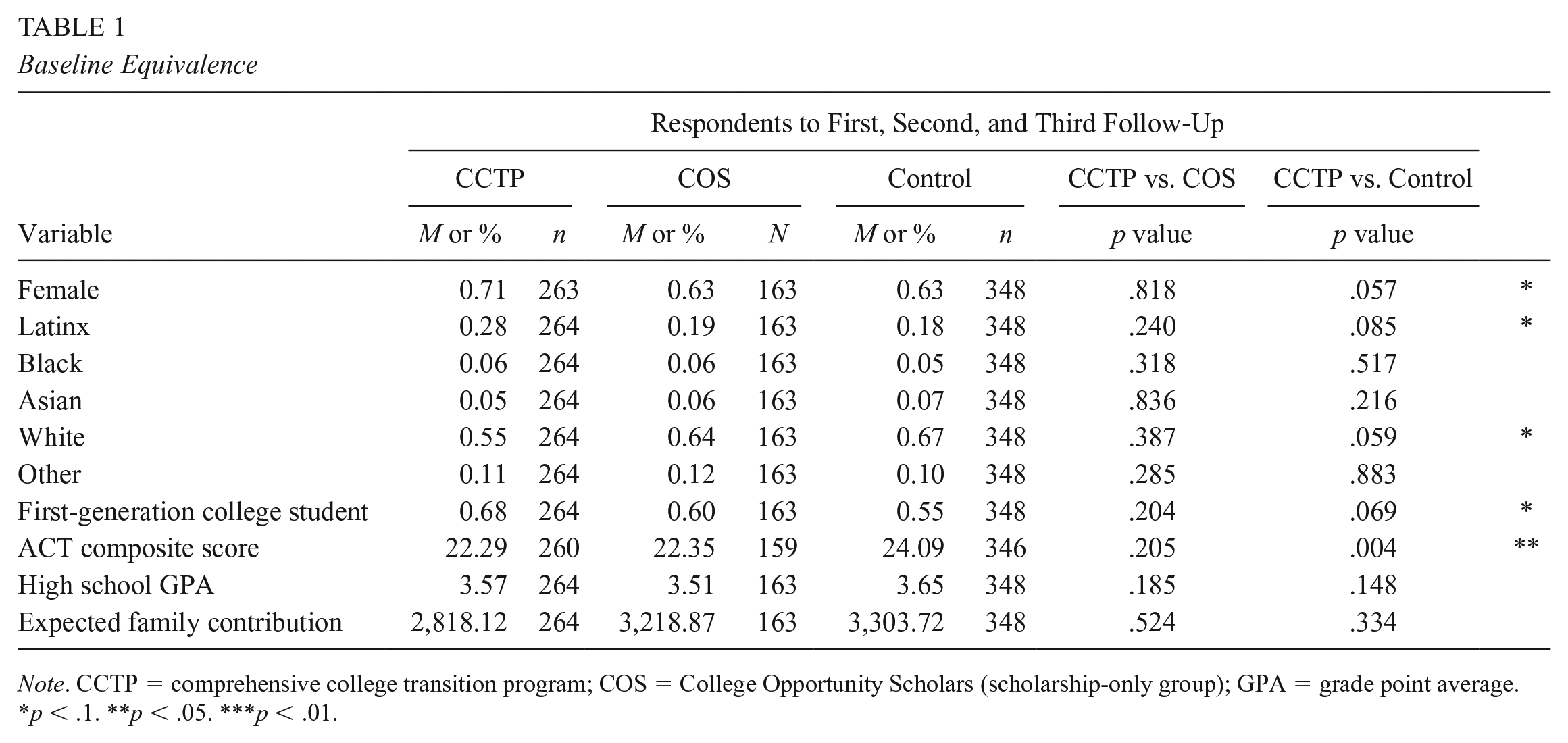
Table 1 examines whether students in the three program assignments are statistically comparable across various background characteristics like race, gender, parental education, and socioeconomic status. Over two thirds of our sample are women, and slightly over half of the students in the sample are White. The average expected family contribution across the three groups ranges from $2,800 to $3,300, with control students, on average, having higher expected family contribution compared with students in the CCTP or COS groups.
Baseline Equivalence
Note. CCTP = comprehensive college transition program; COS = College Opportunity Scholars (scholarship-only group); GPA = grade point average.
p < .1. **p < .05. ***p < .01.
While CCTP and COS students are statistically indistinguishable from one another, there are differences between CCTP and control students. This is likely due to the initial impact of the scholarship offer on students’ college enrollment decisions (Angrist et al., 2016; Angrist et al., 2020) and differences in response rates to our survey across time (Melguizo et al., 2019). Specifically, the share of female students is higher in the CCTP group than in the control group (p < .10), and there are more Latinx students in the CCTP group than in the control group (p < .10). Also, Table 1 shows that students in the control group have a higher average ACT score than students in the CCTP group (p < .01). For these reasons, we present results comparing CCTP students with COS students and make available the results comparing CCTP students with control students in the online Supplemental Appendix. The comparison between CCTP and COS identifies the impact of comprehensive support above and beyond receiving the scholarship.
To get a better sense of how generalizable our sample is to the average student attending one of the three Nebraska universities, we referenced publicly available institutional reports (see online Supplemental Table A.1 in Appendix A). Students in our analytical sample are substantially more diverse in terms of race and gender and are generally higher achieving, as evidenced by their ACT scores, than the typical student attending Nebraska universities. Our results, therefore, are generalizable to high-achieving, underrepresented students attending one of the three Nebraska universities and, by extension, to similar students attending public 4-year institutions.
Key Variables
Time-Use
Guided by our conceptual framework of time-use in college, we focus on time spent on scholarly pursuit, passive time-use via online social networks or playing video games, and time spent working for pay. Students responded to the survey in the spring of each academic year and were asked about their behavior in a typical week. Specifically, we asked students the number of hours they spent doing various activities in a typical week (hours spent preparing for class, playing video games, on social media, and working for pay) and provided the respondents with the following choices: 0, 1–5, 6–10, 11–15, 16–20, 21–25, 26–30, and more than 30 hours/week. Our survey items are based on the time-use items in the National Survey of Student Engagement and Cooperative Institutional Research Program (n.d.) Freshman surveys (Center for Postsecondary Research, n.d.; Cooperative Institutional Research Program, n.d.). We show the distribution of responses in the online Supplemental Figures A.1–A.3 in Appendix A.
We create binary indicators of time-use based on prior research and the context of our sample. Recent numbers indicate that close to 90% of adults between the ages of 18 and 29 years use some form of social networking sites (Brenner & Smith, 2013) and about 70% of college students report playing video games at least once in a while (Jones, 2003). Additionally, about 70% of college students work in college with more low-income students working full-time relative to higher-income students (Carnevale & Smith, 2018). Finally, the average number of hours spent studying/on educational pursuits is about 5 hours among students in our sample. We created a binary variable with 1 indicating that students spent 6 or more hours per week on social media, gaming, or studying. This distinction aligns with how previous scholars have partitioned time-use using similar ordinal scale survey items (Babcock & Mark, 2011). 4 We also examine whether students spent more than 21 hours per week working for pay. We split the measure at the 20 hours a week mark given that working part-time consists of 20 hours/week. These dichotomous variables of whether students reported high time-use in each of these activities are our outcomes of interest. Students also completed an initial survey at the beginning of their first year in college in which we asked them to report their time-use during a typical week in high school related to studying, working for pay, on social media, and playing video games. We use these high school measures as controls in all of our estimations related to college time-use. Given that social media use is more prevalent than playing video games, we present results on social media in the main text and refer the reader to the online Supplemental Appendix A for results on playing video games.
Programmatic Elements
Next, we investigate the relationship between CCTP students’ engagement with key programmatic elements and their time-use during their first 2 years on campus. We focus on academic experiences for which there is a clear connection to students’ time-use: the first-year seminar, which aims to build time management and academic success skills; interactions with peers about academic issues, which could shape student behavior through peer pressure or role modeling; and course-related interactions with CCTP faculty, during which faculty could provide advice and guidance on how to structure students’ time to succeed in their class. 5
In Table 2, we summarize the specific measures included in the survey and representative items within each construct. For all four constructs, items were combined using a Rasch scoring process, a type of item response theory that allows us to account for slight changes in the survey instrument over time. Rasch reliability coefficients for the constructs are between 0.79 and 0.84, indicating good to acceptable fit (see online Supplemental Appendix B for detail on scale fit). We standardized logit scores with respect to all CCTP and COS students in the randomization sample and use standardized measures of all four scales in our analysis.
Program Component Constructs

Note. The first-year seminar is required for all students in their first year, but there is between-student variation in the extent to which students engaged in the seminar. While students can continue to interact with CCTP (comprehensive college transition program) -affiliated faculty and students after their second year, there are no longer formal program requirements that facilitate such interactions, as there are in the first 2 years.
Empirical Strategy
We estimate the effect of CCTP participation on students’ time-use using a probit model as specified below:

The outcome (
Then, we look at whether students in the CCTP who spent more time on these three key activities have higher college GPAs than COS students. In other words, we examine the moderating effect of time-use on the relationship between treatment type and college GPA. We estimate a linear regression with an interaction term as specified below:

where
Finally, we conduct exploratory analyses, limiting our sample to students in the CCTP, and examine the relationship between CCTP students’ levels of engagement with key program elements and students’ time-use during their first 2 years in college. We estimate a series of probit models predicting whether students spent 6 or more hours per week studying or on social media, or working more than 21 hours per week, respectively, as a function of students’ engagement with each element, their time-use in high school, background characteristics, and randomization strata. These models can be generalized as

The outcome,
Results
Program Participation and Time-Use in College
First, we present results from our main analysis looking at the effect of CCTP participation on the likelihood that students spent 6 or more hours per week preparing for class relative to being assigned to the COS group (see Table 3). Irrespective of program assignment, students who reported spending 6 or more hours per week studying, 6 or more hours per week on social media, or 21 plus hours working for pay in high school were significantly more likely to state that they spent more time doing those activities in college (marginal effects ranging from 10 to 28 percentage points; p < .01).
Effect of Program Condition on Time-Use From First to Third Year in College

Note. Average marginal probabilities presented. CCTP = comprehensive college transition program; COS = College Opportunity Scholars (scholarship-only group). All models include controls for race/ethnicity, gender, ACT score, high school GPA (grade point average), expected family contribution obtained from their FAFSA (Free Application for Federal Student Aid) record, first-generation status, and randomization strata-by-cohort fixed effects. Sample restricted to students in the randomized CCTP, COS, and control groups who targeted one of the three campuses and who responded to each wave of the survey. In the analysis of each survey wave, we restricted the sample to those who responded to survey waves up to that point. The sample size among those who responded to the baseline and first wave is 1,325; from baseline to second is 984; from baseline to third is 774.The reference categories are COS students, female, White, cohort 2015. Standard errors are in parentheses.
p < .1. **p < .05. ***p < .01.
Students in the CCTP were similarly likely to spend 6 or more hours studying, on social media, and working for pay as COS students during their first year through their third year in college. The coefficients across the models are essentially zero, although the estimates are somewhat noisy. Specifically, we find that the average marginal effect of CCTP participation on the likelihood that students spent 6 or more hours per week studying during students’ first year is −0.7 percentage points with a 95% confidence interval (CI) of −6.2 to 4.8 percentage points. Examining the marginal effects of different representative values such as students with higher-than-average high school GPA or first-generation college students, we find very similar effects. When examining time spent studying for students with a standard deviation higher than high school GPA, we find an average marginal effect of −0.6 percentage points (95% CI of −5.5 to 4.3 percentage points) and an effect of −0.7 percentage points (95% CI of −6.2 to 4.8 percentage points) for first-generation college students (see online Supplemental Table A.2 in Appendix A for details). Similarly, the average marginal effect comparing the likelihood that CCTP and COS students will spend 6 or more hours per week on social media during their first year in college is essentially zero, with a 95% confidence of −7.1 to 7.1 percentage points. In addition, CCTP students were 4 percentage points (95% CI of −8.9 to 1.2 percentage points) less likely to spend 21 or more hours per week working for pay during their first year, but this result is also statistically indistinguishable from zero. Our backend calculations of the minimum detectable effect size indicate that the magnitude of the effect must be closer to 5 to 8 percentage points depending on the outcome for us to be able to reject the null hypothesis given our sample size, research design, and 80% power (Djimeu & Houndolo, 2016). If the program changes students’ time-use in more subtle ways, we will not be able to estimate those changes precisely with our data. Similarly, the wide confidence intervals for these estimated effects indicate a fair amount of uncertainty regarding the relationship between CCTP participation and time-use.
CCTP students spent similar amounts of time on leisure and academic activities as COS students while involved in the program (first 2 years in college) and while no longer formally involved in the program (third year in college). This could be related to the fact that all students were relatively high achieving in high school, having to earn at least a 2.5 GPA to qualify for a scholarship from the Foundation, and to maintain at least a 2.0 GPA in college to retain their scholarship. Additionally, students in both groups receive the scholarship, which may reduce their need to work.
CCTP Participation on College GPA by Levels of Time-Use
Before we examine the effect of program participation on time-use and GPA, we first examine the correlation between time-use and GPA. Table 4 shows that students’ first-year GPA is strongly correlated with their second-year GPA; similarly, second-year GPA is strongly correlated with third-year GPA. Students’ time spent studying is positively, but somewhat weakly, correlated with students’ GPA (r ranging from .16 to .21). Looking across the years, we see that study time is progressively more strongly correlated to college GPA. In contrast to the positive correlation between study time and GPA, time spent on social media and working for pay are weakly and negatively correlated with GPA (r ranging from −.13 to −.03). The magnitude of these correlations corresponds to the magnitude of the effects found in previous findings. For example, Brint and Cantwell (2010) found that attending class and studying is positively correlated with GPA (effect size of .10, p < .001) and working for pay was associated with lower GPA (effect size of −.13, p < .001).
Correlation Between Time-Use and GPA

Note. First-year through third-year GPAs refer to students’ cumulative GPA. T1 = survey wave 1; T2 = survey wave 2; T3 = survey wave 3; GPA = grade point average. Pearson’s correlation coefficients are presented using continuous measures of time-use and GPA.
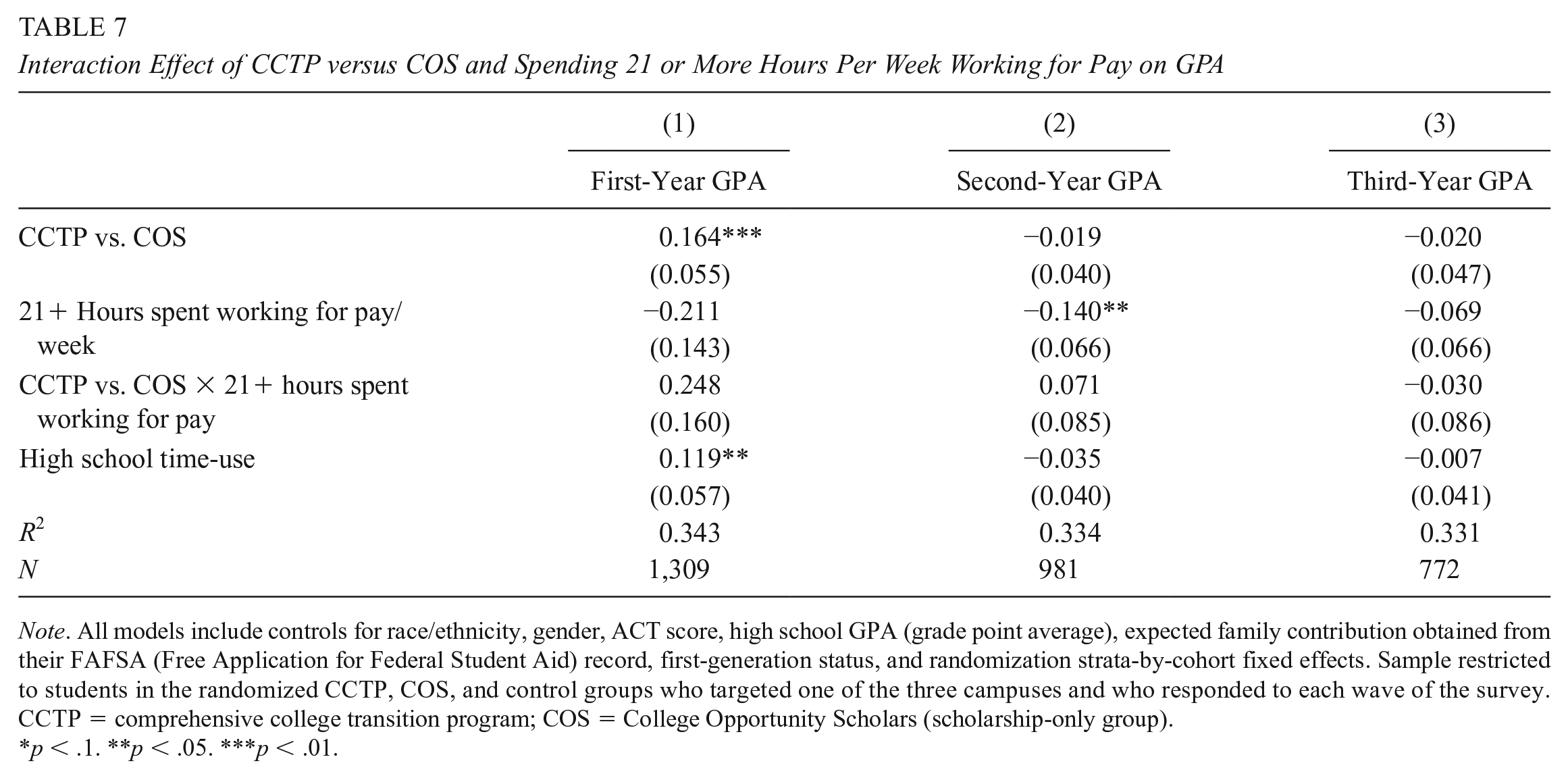
Next, we assess whether time-use moderates the relationship between treatment status and GPA. Tables 5 through 7 show that students’ reported time-use does not have differential bearing on their college GPA. However, we see some interesting main effects. In Tables 6 and 7, we see that CCTP participation results in higher cumulative GPAs relative to the COS group but only among students who spent less than 6 hours on social media and less than 21 hours working for pay. Specifically, as shown in the top row of Column (1) in Table 6, CCTP students who spend less than 6 hours per week on social media earn a 0.13 point higher cumulative first-year GPA than students in the COS condition, which is equivalent to getting a B+ instead of a B in one of their courses (p < .05). The interaction term in Table 6, however, indicates that there is no difference in GPA between CCTP and COS students who spend more than 6 hours per week on social media (e.g., studying is not differentially helpful for CCTP or COS students). In addition, CCTP students on average earn a 0.16 point higher first-year cumulative GPA than COS students if they spend less than 21 hours working for pay (p < .01), as shown in the first row of Column (1) in Table 7.
Interaction Effect of CCTP versus COS and Studying 6 or More Hours per Week on GPA

Note. All models include controls for race/ethnicity, gender, ACT score, high school GPA (grade point average), expected family contribution obtained from their FAFSA (Free Application for Federal Student Aid) record, first-generation status, and randomization strata-by-cohort fixed effects. Sample restricted to students in the randomized CCTP, COS, and control groups who targeted one of the three campuses and who responded to each wave of the survey. Standard errors are in parentheses. CCTP = comprehensive college transition program; COS = College Opportunity Scholars (scholarship-only group).
p < .1. **p < .05. ***p < .01.
Interaction Effect of CCTP versus COS and Spending 6 or More Hours per Week on Social Media

Note. All models include controls for race/ethnicity, gender, ACT score, high school GPA (grade point average), expected family contribution obtained from their FAFSA (Free Application for Federal Student Aid) record, first-generation status, and randomization strata-by-cohort fixed effects. Sample restricted to students in the randomized CCTP, COS, and control groups who targeted one of the three campuses and who responded to each wave of the survey. Standard errors are in parentheses. CCTP = comprehensive college transition program; COS = College Opportunity Scholars (scholarship-only group).
p < .1. **p < .05. ***p < .01.
Interaction Effect of CCTP versus COS and Spending 21 or More Hours Per Week Working for Pay on GPA
Note. All models include controls for race/ethnicity, gender, ACT score, high school GPA (grade point average), expected family contribution obtained from their FAFSA (Free Application for Federal Student Aid) record, first-generation status, and randomization strata-by-cohort fixed effects. Sample restricted to students in the randomized CCTP, COS, and control groups who targeted one of the three campuses and who responded to each wave of the survey. CCTP = comprehensive college transition program; COS = College Opportunity Scholars (scholarship-only group).
p < .1. **p < .05. ***p < .01.
Time spent working does not have differential bearing on students’ GPA across treatment conditions. We do not observe a significant interaction effect between program participation and time spent on social media or working for pay on first- through third-year college GPA. The relationship between time-use and GPA does not differ if students participated in the transition program or received only the scholarship.
We additionally investigate whether there is a difference in GPA between CCTP and COS students depending on the amount of time spent gaming. We find patterns similar to the results pertaining to social media. Specifically, students who spent less than 6 hours per week playing video games were more likely to earn a higher first-year GPA. However, CCTP and COS students earned similar GPAs in their first through third years in college irrespective of their reported levels of gaming (see online Supplemental Table A.3 in Appendix A).
When compared with control students, CCTP students were more likely to spend 6 or more hours per week studying by their third year. Moreover, CCTP students were less likely to spend 21 or more hours per week working for pay than the control students throughout their first three years in college (see online Supplemental Table A.4 in Appendix A). However, we caution against causal interpretations of these results given evidence that CCTP students were more likely to remain in our sample over time and differ from control students on certain demographic variables.
Programmatic Elements of the CCTP
We turn now to our exploration of specific program elements that might positively shape students’ time-use patterns. Tables 8 and 9 present estimates from the models examining the relationship between program engagement and time-use during students’ first and second years.
Programmatic Elements of the CCTP on Time Spent Studying, Working for Pay, and Online Social Networks, Year 1 (Probit, Controls, Preferred Thresholds)

Note. Faculty interactions are course-related only. Peer interactions are academic-related interactions only. Academic activities are an indicator of whether the student participated in CCTP academic activities; social activities are an indicator of whether the student participates in CCTP social activities; studying is an indicator of whether the student spends 6+ hours per week preparing for class; working is an indicator of whether the student spends 21+ hours per week working for pay; social media use is an indicator of whether the student spends 6+ hours per week on social media. Models control for high school GPA (grade point average), ACT score, EFC (expected family contribution), race/ethnicity, gender, first-generation status, total number of CCTP activities, and randomization strata. Probit, marginal effects presented. Standard errors are in parentheses. CCTP = comprehensive college transition program; COS = College Opportunity Scholars (scholarship-only group).
*p < .1. **p < .05. ***p < .01.
Programmatic Elements of the CCTP on Time Spent Studying, Working for Pay, and on Online Social Networks, Year 2 (Probit, Controls, Main Thresholds)

Note. Faculty interactions are course-related only. Peer interactions are academic-related interactions only. Academic activities are an indicator of whether the student participated in CCTP academic activities; social activities are an indicator of whether the student participates in CCTP social activities; studying is an indicator of whether the student spends 6+ hours per week preparing for class; working is an indicator of whether the student spends 21+ hours per week working for pay; social media use is an indicator of whether the student spends 6+ hours per week on social media. Models control for high school GPA (grade point average), ACT score, EFC (expected family contribution), race/ethnicity, gender, first-generation status, total number of CCTP activities, and randomization strata. Probit, marginal effects presented. Standard errors are in parentheses. CCTP = comprehensive college transition program; COS = College Opportunity Scholars (scholarship-only group).
p < .1. **p < .05. ***p < .01.
We find some evidence to suggest that CCTP students’ course-related interactions with faculty shape how they allocate their time during their first 2 years. Specifically, a one standard deviation increase in students’ perceived quality of course-related interactions with CCTP-affiliated faculty is associated with a 4.2 percentage points increase in the likelihood that they will spend 6 or more hours per week preparing for class in their first year (p < .05) and a 6.7 percentage points increase in the likelihood that they will spend 6 or more hours per week preparing for class in their second year (p < .01). To put these results in context, about 31% of CCTP students reported spending 6 or more hours studying in high school. Increases of 4.2 and 6.7 percentage points in their first and second years, respectively, represent increases of 13.5% and 21.6%, respectively. On average, CCTP students rate the quality of their interactions with CCTP-affiliated faculty as 2.98 on a 5-point scale in their first year, and 2.76 on a 5-point scale in their second year. A one standard deviation increase in each year would represent an increase of 0.73 and 0.76 points, respectively, in some way distributed across students’ responses to the five items in the scale. This could represent a student going from discussing personal problems or concerns with a faculty member “rarely” to “occasionally,” for example. Taken together, these results indicate that potentially small changes in faculty practice can lead to relatively large shifts in students’ time-use.
Engagement in the first-year seminar is not significantly associated with students’ time-use in their first year. Similarly, academic peer interactions are not significantly related to students’ likelihood of studying or spending more than 6 hours per week on social media, or to their likelihood of working more than 21 hours per week. We do, however, find evidence suggesting that students who participate in CCTP-organized in-person social events are less likely to spend more than 6 hours per week on social media.
We do not find consistent associations between students’ perceptions of staff care and support and time-use. At the end of their first year, students who reported higher levels of staff care and support were slightly more likely to spend 6 or more hours on social media, while at the end of their second year, students reporting higher levels of staff care and support were about 6 percentage points more likely to spend at least 6 hours per week studying. This could reflect the fact that staff interact with students under a number of circumstances, including when students already believe themselves to be struggling; for example, a student could believe that they are spending too much time on social media and then reach out for additional engagement with staff members.
In general, the strongest predictor of students’ time-use patterns in college is their time-use in high school. Even after controlling for a number of covariates including the level of students’ engagement with CCTP, measures of students’ time allocations in high school are the strongest predictors of students’ studying and leisure habits as well as their work schedules in their first and second years in college.
Sensitivity Analyses
We conduct multiple checks to assess the sensitivity of our results to the analytic decisions we made for our preferred estimates. First, we rerun our main model without covariates. Given that the study leveraged random assignment, our results should remain robust to the exclusion of covariates. In the online Supplemental Tables A.5 to A.8 in Appendix A, we remove the covariates race/ethnicity, gender, ACT score, high school GPA, expected family contribution, and first-generation status and redo the main analysis comparing CCTP students with COS students. Results remain consistent when excluding student covariates. Additionally, we use a linear probability model to compare the extent to which our results remain consistent using a different estimator (online Supplemental Tables A.9 to A.11 in Appendix A). Results from the linear probability and probit models are consistent.
Second, we respecify the time-use threshold one level up or one level below from our preferred definition. Specifically, we respecify the threshold of 6 or more hours studying or on social media to 11 or more hours studying or on social media. Additionally, we respecify our threshold for working for pay from 21 or more hours to 16 or more hours. In the online Supplemental Table A.12 in Appendix A, we examine the effect of program participation on time-use using these new thresholds. In the online Supplemental Tables A.13 to A.17 in Appendix A, we examine differential relationships with first- to third-year college GPA using the new threshold and study the association between key program components and time-use. We see that our results pertaining to studying and working for pay remain consistent, but our findings related to social media are more volatile. We find suggestive evidence that CCTP students are 7 percentage points less likely to spend 11 or more hours on social media relative to COS students during their second year in college (p < .05). Additionally, the results suggest that CCTP may mitigate the negative relationship between spending 11 or more hours on social media and third-year cumulative GPA. We caution against extrapolating implications from these findings given that (a) we are looking at 5 additional hours on social media, which is a significant increase from our preferred specification and (b) fewer students are contributing to this analysis during Year 3. These findings indicate that more research probing the relationship between social media use and academic performance is warranted.
Discussion
Balancing time in college is a challenge faced by all students, and programs working to promote student success are often called on to provide support for developing time management skills. We hypothesized that students in a CCTP may structure their time in different ways than students without access to comprehensive support. The students in the CCTP, in addition to a financial scholarship that pays for tuition, fees, and books, are given access to various academic role models, tutoring and mentoring services, shared academic courses, and, in some cases, on-campus housing with other CCTP peers, all of which could influence students’ time-use. Contrary to our hypothesis, our results suggest that CCTP and COS students spent, on average, similar amounts of time on these activities, indicating that program participation did not affect their time-use. However, the wide confidence intervals suggest that our estimates are quite noisy, and it is possible that the CCTP shaped students’ time-use in ways we are not able to precisely measure with our data.
Additionally, we hypothesized that CCTP students would earn higher GPAs than their COS peers, because of the additional support provided to CCTP students aimed at addressing students’ academic, social, and personal needs. We did not find evidence to support this hypothesis; that is, CCTP and COS students, on average, had similar GPAs regardless of their reported time spent studying, on social media, or working. The channel through which the program helped students’ academic outcomes does not appear to be by restructuring students’ time, although our estimates are again somewhat noisy. Nevertheless, among the subgroup of students who spent more time studying and less time on social media, CCTP students earned higher first-year GPAs than the scholarship-only COS students.
The students in our sample, regardless of treatment condition, are high-achieving students who entered college already highly engaged in various activities, which may explain why the program had minimal impact on their time allocation. Across all our models, we consistently found that the strongest predictor of time-use in college was how students spent their time in high school. After accounting for high school time-use, program participation did not independently explain how students structured their time in college. Our work therefore highlights the importance of early time-use habits, established during high school, in predicting time allocations in college. Interventions aimed at shaping students’ time management may be most effective if they are targeted at students’ precollege years. In addition, systematic outreach to feeder high schools through an early mentoring process may be a way to foster positive time management skills.
While our results indicate that habits formed during high school may be hard to change, we caution against a view that college students’ behavior is not malleable. Previous studies found that skills and behavior are context specific (e.g., Lundberg, 2013; Oyserman et al., 2006), meaning that different contextual cues can influence one’s decisions. If a student is in a context in which she is surrounded by academic role models and is constantly reminded to persist through academic difficulties, she is likely to interpret academically challenging tasks as important rather than “not for me.” Experimenting with various early outreach programs and probing how students spend their time in high school may be a way to empower students in their ongoing process of time management in college.
We found a positive correlation between faculty course-related interactions and time spent studying among program participants. Studies also support this finding as frequent, and quality interactions with faculty can promote student learning and engagement on campus (Cole & Griffin, 2013). While exploratory, our finding suggests that a promising practice may be for faculty to proactively engage students in the learning process. College students receive limited feedback on their academic progress in college (Price et al., 2010) and are not systematically provided with an explanation of academic and nonacademic expectations. While faculty expect students to put in enough time toward studying while maintaining a healthy balance with social activities, faculty usually do not explicitly convey their expectations to students. Therefore, faculty may want to intentionally facilitate a discussion about time expectations in the course as a way to shape college students’ time-use.
Our measures of passive use of time indicates a slight negative association with college GPA. This is in line with prior research that has similarly found small, negative correlations between self-reported social media usage and GPA (Barton et al., 2018; Leyrer-Jackson & Wilson, 2018). Our results suggest that popular narratives of the rise of social media as having a substantial negative effect on students’ academic performance may be exaggerated, at least within the range of social media usage reported by our sample.
Future Research
While our study sheds light on an important facet of college life—time spent on various academic and nonacademic activities—we are unable to capture the process by which time-use may influence college GPA. For example, social-psychological theories suggest that time-use may be a proxy for broader characteristics like self-regulation or self-efficacy (Bandura, 1986; Britton & Tesser, 1991; Zimmerman, 2008). We do not capture when students exercise self-control or when students feel efficacious deciding their time-use, or why certain self-regulatory strategies were used. Self-regulated learning, the broader notion behind time management, influences academic behavior by affecting decisions like how many hours to study or how many hours to spend on various social pursuits (e.g., playing video games or checking social media). An extension of this study would be an examination of time management skills as a result of participating in a CCTP. Specifically, future studies may investigate goal-setting and attitudes about spending time on various activities to better gauge short- and long-term planning and their relationship to immediate decisions to spend time on various activities (Britton & Tesser, 1991).
Relatedly, we only have a rough measure of how much time students spent on these activities, not the quality of their efforts. For example, a student could spend 10 hours preparing for class but those hours may not have been productive. Conversely, a student may spend 7 hours a week on social media or gaming but does so in a context that allows her to build friendships, de-stress, and more productively engage with the academic demands of their classes. Future work could use time-use diaries to understand the competing directions in which students are pulled. In addition to coursework, social activities, and work, students may have familial obligations, volunteer in the community, participate in clubs or other student organizations, intern, and dedicate time to other pursuits.
Prior studies found a positive association between student engagement in college and academic outcomes (Astin, 1984; Pascarella & Terenzini, 2005) and that the benefits are more pronounced for academically underprepared students (Carini et al., 2006). Our study focused on high-achieving students who applied to the program, which may explain why we did not find notable shifts in time allocation. Future studies should explore differential time-use patterns of certain college subpopulations, such as academically underprepared students, and the role of similar transition programs in bolstering their success.
Finally, all students in our sample received a generous financial scholarship that may have reduced their need to work (Carruthers & Özek, 2016) and their financial stress. Studies that tease out the combined effect of the program and scholarship on time-use may show different results and will complement the findings of this research.
Conclusion
Students experience different challenges throughout college that influence how they structure their time. There is likely no common ideal pattern of time-use for all students, and students with varying levels of support in college must develop unique time management strategies based on the specific demands they face, their goals, and their priorities. By providing individualized support to students that addresses their specific challenges and goals, CCTPs may engender student success while working within their existing habits and time-use patterns. Understanding how students spend their time and the trade-offs involved in pursuing each activity (grades, post-graduation opportunities, networks, etc.) could allow practitioners to better support students and help them structure their time in ways that align with their long-term goals.
Supplemental Material
sj-docx-1-ero-10.1177_2332858421995215 – Supplemental material for Balancing Time in College: Examining Time-Use and Academic Outcomes of Students in a Comprehensive College Transition Program
Supplemental material, sj-docx-1-ero-10.1177_2332858421995215 for Balancing Time in College: Examining Time-Use and Academic Outcomes of Students in a Comprehensive College Transition Program by Elizabeth S. Park and Elise Swanson in AERA Open
Footnotes
Acknowledgements
We would like to thank Adrianna Kezar for providing feedback on previous versions of this manuscript. We would also like to acknowledge the members of the mixed-methods evaluation team: Tatiana Melguizo, Darnell Cole, Ronald Hallett, Matt Soldner, Mark Masterton, Evan Nielsen, Cameron McPhee, Samantha Nieman, Edward Chi, Joseph Kitchen, and Gwendelyn Rivera for designing and implementing the Longitudinal Survey of Thompson Scholars. This study received financial support from the Susan Thompson Buffett Foundation.
Authors’ Note
This randomized control trial was registered with the American Economic Association under trial number AEARCTR-0000125. Opinions are those of the authors alone and do not necessarily reflect those of the granting agency or of the authors’ home institutions.

Notes
Authors
ELIZABETH S. PARK is a postdoctoral scholar at the University of California, Irvine. Her research areas include the high school to college transition, STEM (science, technology, engineering, mathematics) education, and community colleges.
ELISE SWANSON is a postdoctoral research associate at the University of Southern California. Her research focuses on issues of equity in postsecondary access and success.
References
Supplementary Material
Please find the following supplemental material available below.
For Open Access articles published under a Creative Commons License, all supplemental material carries the same license as the article it is associated with.
For non-Open Access articles published, all supplemental material carries a non-exclusive license, and permission requests for re-use of supplemental material or any part of supplemental material shall be sent directly to the copyright owner as specified in the copyright notice associated with the article.
