



Abstract
In spring 2020, many U.S. colleges and universities rapidly shifted to online instruction and implemented social distancing policies to respond to the COVID-19 pandemic. Students experienced unprecedented disruption of their interpersonal academic and social networks due to the loss of physical proximity. We used egocentric network analysis and latent profile analysis with survey data from April 2020 and conducted follow-up interviews in September 2020 to examine some of the pandemic’s immediate effects on student interpersonal network change. We found the disappearance of interpersonal network patterns featuring coworkers and academic ties, as well as reductions in students’ overall number of connections and the role diversity of their networks. Results suggest potential ongoing reduction of peer academic relationships, implying that institutional personnel may need to pay particular attention to academic connections in online spaces and to regenerating students’ academic networks when on-campus physical spaces may again be used to support learning.
Keywords
U.S. postsecondary institutions experienced unprecedented disruption during March 2020 as many enacted social distancing policies to slow the spread of COVID-19. Institutions that had spent decades investing in campus infrastructure designed to support in-person interpersonal networks through shared educational space, time, and programming shifted students, faculty, and staff into online spaces. Colleges and universities needed to support students’ physical distancing while mitigating the loss of socioacademic community and learning. There has never been a sudden conversion of in-person campus learning environments on this scale while maintaining continuity of education through emergency remote instruction, and the long-term effects on students are unclear. Existing literature about social network disruption due to natural disasters, migration, and relocation indicates that such disruption is related to increased distress (Morris & Deterding, 2016; Oyama et al., 2011; Sluzki, 1992). Physical proximity is a key mechanism that predicts interpersonal interaction (Small, 2017), and social distancing policies disrupted this mechanism; therefore, the resulting effects on students’ frequent interaction networks are unknown. This work underlines the importance of exploring how abrupt shifts in physical colocation can influence both the structure of college students’ socioacademic networks and the sense that students make of their educational experiences, both immediately and longer term.
Learning more about the pandemic’s effects on student interpersonal relationships requires a relational approach that situates students within their shifting network structures, which are embedded in large and complex postsecondary institutional structures (Weeden & Cornwall, 2020). Better understanding immediate student network change in response to external shock can facilitate more effective institutional support going forward, related to both the current pandemic and potential future physical disruptions. We conducted a mixed methods social network study to identify existing patterns of college student interaction networks immediately before and after the implementation of social distancing policies and how students made sense of their experiences of network change. We collected egocentric data at a U.S. institution in April 2020, which consisted of students’ reports of their frequent contacts, and conducted follow-up individual interviews in late September 2020. In general, we found that in the immediate aftermath of social distancing policy implementation, students identified fewer numbers of ties overall and particularly declines in the academic component of relationship networks. Students altered their networks in heterogeneous ways in response to campus disruption, reconfiguring networks based on relational, support, and financial sense-making. Initial evidence indicates some longer-lasting contraction in networks, suggesting that with a return to campus-based or physically proximal activities, institutions may need to support students in reconstructing relationships, especially those that are academically focused.
Background
Higher education institutions play a role in structuring students’ academic and social networks, along with students’ own identities, behaviors, and preferences, in ways that can interrupt or perpetuate inequality. Researchers found that U.S. student course networks are structured by curriculum and class years (Israel et al., 2020; Weeden & Cornwall, 2020). Furthermore, the structural racial/ethnic and socioeconomic class diversity of the student body shapes students’ friendships and peer interactions within and between groups (Bowman & Park, 2014; Park & Denson, 2013; Park et al., 2013). Institutions facilitate student networks through academic, spatial, and affinity groupings, creating and maintaining “pathways” (Armstrong & Hamilton, 2013) or “geographies” (Benson & Lee, 2020) that can yield disparate outcomes for students structurally marginalized by race, class, and gender. For example, some activities or pathways that institutions structured required levels of wealth, specific cultural capital, or time that excluded low-income student participation. Students experienced social class effects as intersecting with marginalizing experiences based on race/ethnicity and gender (Benson & Lee, 2020).
Literature on U.S. postsecondary institutions demonstrates that they spend time and resources to create physical learning environments (Strange & Banning, 2015) or ecologies (Renn & Arnold, 2016) intended to be educationally enriching settings where students form relationships. These physical spaces include places such as residence halls, unions, libraries, and classrooms, which facilitate interpersonal engagement through proximity and shared interests. College students’ lives are embedded within the academic, social, and socioacademic (Deil-Amen, 2011) interpersonal networks that are generated by these physical interactions. Students use physical spaces to generate networks of interpersonal relationships that fulfill important functions such as social support, academic achievement, and professional advancement. In the United States in March 2020, many institutions abruptly removed physical spaces as sites for interpersonal interaction and, in some circumstances, replaced them with online spaces. The subsequent disruption of interpersonal interactions within the physical space of the college or university campus meant that students’ networks of academic, social, and professional support were potentially disrupted as well, especially for students whose networks were dependent on the physical infrastructure of the college campus.
Purpose and Importance of Student Interaction Networks
In the past decade, the U.S. higher education literature has increasingly focused on the importance of interpersonal networks on a students’ sense of community, learning outcomes, and persistence. Much of the network-based higher education literature examined peer relationships and to some degree instructional relationships, but students are also embedded in relationships with family members, coworkers, and others outside postsecondary institutions that affect their experiences (Mayhew et al., 2016; Small, 2017). Furthermore, student relationships with others have an instrumental purpose in classroom learning (Tinto, 1997) and many cognitive and psychosocial theories related to college student development (Abes et al., 2019). Under the umbrella of student development theories, students socially construct their identities, interpersonal dissonance can prompt cognitive growth, and relationships can be a vehicle for challenge and support (Sanford, 1967).
Students’ interpersonal relationships are multifaceted, meaning that any given relational tie can be characterized by its existence as well as aspects of quality such as tie strength, content, directionality, and alter characteristics. Research on the quality of relationships among college students suggests that influences such as tie strength are situational and context dependent, complicating what more broadly scoped theories of network formation suggest about social interactions. For example, Small (2017) demonstrated that students do not always turn to long-standing core discussion group members (often close friends and family) when they have a personal problem to discuss, which called into question the common notion that trust and social support are typically found together. There may be a set of influences that shape the quality and nature of college students’ peer networks that are distinct from significant influences in other contexts (Smith & Vonhoff, 2019).
Students’ purposes in forming the relationships, the environments in which students are embedded, and the routines they form all influence the structures of students’ interpersonal interactions (Small et al., 2015). The types of relationships carry different resources or value, such as social support or academic assistance (Deil-Amen, 2011; Tinto, 2015). Academically, students often form relationships at the start of a semester in order to construct study groups (Brown, 2019; McCabe, 2016), and these relationships change over time. Mechanisms that foster relationships include physical proximity, course enrollment, cocurricular engagement, and the social identities that students possess (Biancani & McFarland, 2013; Marin & Hampton, 2019; Smith & Vonhoff, 2019). In postsecondary contexts, homophily often shapes the ways that students construct and maintain relationships (Kandel, 1978; McPherson et al., 2001). Homophily in higher education settings includes shared interests, fields of study, identities, and proximity via residence halls or classrooms (Biancani & McFarland, 2013; Brown, 2019; Hu & McCormick, 2012; Smith, 2018; Tinto, 2015).
Proximity and space play an integral role in collegiate relationship construction and maintenance. Proximity influences the ways that individuals interact across various types of relationships, including relationships with faculty, staff, and friends (McAlister, 2016; Pokorny et al., 2017; Sailer & McCulloh, 2012; Small & Adler, 2019). For example, when commuter students are farther away from campus, they may feel less connected to their friendship networks and campus community as a whole (Anderson, 2020; Pokorny et al., 2017). Moreover, proximity helps organize how students engage academically with instructors and peers (Dyer et al., 2018). These concerns about proximity and the ways that students navigate higher education took on new meaning during the COVID-19 pandemic. Pandemic-related institutional responses forced college students who had engaged in face-to-face contexts away from their classrooms and often from their physical campus spaces, and into online learning modalities (Aucejo et al., 2020; Cohen et al., 2020; Tasso et al., 2021).
Network Disruption
Interpersonal networks are dynamic. Relationships shift with life-course events such as moving, marriage, having children, and changing jobs (Bidart et al., 2020; Wrzus et al., 2013). Networks can also be suddenly disrupted by unusual events (Wrzus et al., 2013). A breadth of literature has examined contexts of network disruption due to environmental and sociopolitical events (Cox et al., 2016; Lowe et al., 2012; Morris & Deterding, 2016; Oyama et al., 2011; Sluzki, 1992). Networks of support such as friendships, romantic relationships, study partnerships, and coworker bonds can be disrupted as a result of crisis-based life changes such as a natural disaster or global pandemic (Chirikov et al., 2020; Cohen et al., 2020; Lowe et al., 2012; Morris & Deterding, 2016). Early literature on the COVID-19 pandemic suggested that pandemic-related stressors played a role in altering and disrupting interpersonal relationships (Cohen et al., 2020; Elmer et al., 2020; Hyne & Thompson, 2020; Tasso et al., 2021). Furthermore, it is clear that the COVID-19 pandemic is among those events that can negatively influence some student’s experiences, mental health, enrollment, and persistence (Aucejo et al., 2020; Chirikov et al., 2020; Cohen et al., 2020; Hunt et al., 2021; Tasso et al., 2021) and is disproportionately affecting already marginalized students, such as racially and ethnically minoritized students and low-income students (Goldrick-Rab et al., 2020; Hunt et al., 2021; National Student Clearinghouse, 2020; Rudenstine et al., 2021).
Because of its global scale, evolving conditions, social distancing policy recommendations, and protracted uncertain duration, the COVID-19 pandemic is a singular context among studies of network disruption. We aimed to describe the patterns in students’ interpersonal network changes that occurred as a result of the rapid transition from place-based campus life to emergency remote instruction in Spring 2020 in order to understand more about students’ experiences of network disruption. Accordingly, following are our research questions:
Conceptual Framework
The rapid implementation of social distancing policies in March 2020 can be conceptualized as network shock, with the potential to cause changes in students’ networks as they employ various coping strategies. We draw on Pescosolido’s (1992) social organizing strategy (SOS) framework to guide our investigation of network shock. The SOS framework is based on the ways that individuals are embedded in interpersonal and systemic social networks and uses an event-centered approach to trace network dynamics and associated behaviors. In the SOS framework, the event was the onset of a health condition, and Pescosolido used the framework to apply relational and multilevel sociological theory to what had been formerly individualistic rational-choice approaches to studying medical system navigation. In our case, the event precipitating potential network shifts is the pandemic, as college students made sense of events via relationships with others in their networks and drew on the resources in those networks to navigate their lives and continued studies amid disruption and uncertainty.
Perry and Pescosolido (2012) explained the major tenets of the SOS framework, the first of which is that “coping with disruptive episodes is a social process that involves contact with networks in the community” (p. 138) as well as various levels of organizational systems. These disruptions influence network pattern change over time, yielding different network patterns as individuals draw on interactions with specific people and resources or support. Our study focuses on the relationships of people in the networks, rather than possible resources or modes of interaction. Further, early responses to an event and associated network configurations may be different from those required for the long-term, making longitudinal study necessary. While our current study focuses on the initial response to disruption, we recognize the importance of revisiting student networks as they moved through the summer and subsequent semesters. In sum, the SOS framework highlights the essential role of understanding the location of the individual embedded in specified social network structures as a key element shaping human behavior in response to major events.
Centering fundamental social processes and highlighting the role of physical context shifts precipitated by the pandemic disruption, we focused on college student network interaction patterns immediately before and after social distancing. Given previous literature and our conceptual framework, we hypothesized that prepandemic egocentric networks would exhibit a wider variety of patterns compared with those after social distancing. We expected to see declines in overall number of ties reported and especially declines in ties related to physical space interaction, such as coworkers and classmates. We also expected potential emerging network patterns related to students’ social identities such as race/ethnicity and socioeconomic status. Finally, we explored student narratives to identify a variety of logics and influences on students’ changes in interpersonal interaction networks after institutions enacted social distancing policies.
Method
We used an egocentric network design (Perry et al., 2018) as part of a sequential explanatory mixed methods study (Hollstein, 2014). Egocentric networks consist of a set of people (“alters”) described by a respondent (an “ego”) in response to a prompt, as well as the qualities of alters and relationships. We chose an egocentric design because it focuses on how individuals constructed their peer networks, is congruent with random sampling so that a broad range of students could be included, and allows for alter anonymity. A sequential explanatory design best fit our research questions, which involved first discovering network patterns and then exploring how students made sense of their constructions. We collected network data and described patterns of egocentric network change quantitatively, and then we collected and analyzed follow-up qualitative narrative interview data to explain, expand, and deepen the analysis of the initial patterns of egocentric network change. Quantitative data collection took place within a few weeks of the transition online, while the qualitative data are more retrospective. The discussion below includes explanations of how we used data and analysis triangulation (Wald, 2014) to enhance project validity.
Data Collection
The research site is a large, research-intensive public university in the U.S. Midwest. The institution hosts more than 600 student organizations as well as Division 1 athletic events. The undergraduate student population is largely enrolled full-time, less than 25 years old, about 70% White, over half are from the same state, and many students major in STEM fields. In March 2020, the institution announced an initial several-week and then semester-long movement to online instruction. Institutional personnel encouraged students to depart campus where possible, provided housing and meal plan refunds, brought students who were abroad back to the United States, and cancelled in-person events or transitioned to virtual formats. The quantitative data were collected during April 2020 via electronic questionnaire, following several weeks of online instruction. We drew a random sample of 3,000 undergraduates, stratified by school or college and first-generation status, and oversampled international students, both done to help account for potentially disproportionate impacts of COVID-19. The response rate was 9%. The questionnaire asked students about their typical interactions with others before the institution implemented social distancing policies and their current interaction patterns. The prompt we used to construct the prepandemic egocentric networks was Think of a person you regularly sought out or interacted with during a typical week prior to social distancing. Who was that person? Choose all that apply: friend, family, romantic partner, spouse, roommate, classmate, coworker, university faculty or staff, other.
A second series of questions asked about students’ current interactions, with the same list of possible responses. Students could list up to five alters before social distancing and up to five alters after social distancing, a limit chosen based on previous literature (Manfreda et al., 2004). Students were also asked a series of demographic questions.
Our final sample was composed of 263 respondents (see Table 1). Among our participants, students identified as genderqueer or nonbinary (<10), cisgender women (165), and cisgender men (86). There were 17 international students, 13 students who reported being the first in their families to attend college, and 66 students reported being Pell grant recipients. For students who responded to our question about racial identity by selecting all that applied, participants described themselves as American Indian (<10), Black (<10), Hispanic/Latinx (<10), South Asian (<10), White (139), and Asian/Asian American (15). The average age in the sample was 20.72 years (SD = 2.78). For students who identified a year in school, respondents said they were first-year (40), second-year (44), third-year (41), or fourth-year or higher (48). Before the pandemic, 185 students lived in university-owned housing and 85 lived off campus. Students reported changing their residence (111) and their employment statuses (77) because of the pandemic.
Description of Student Survey Participants, April 2020
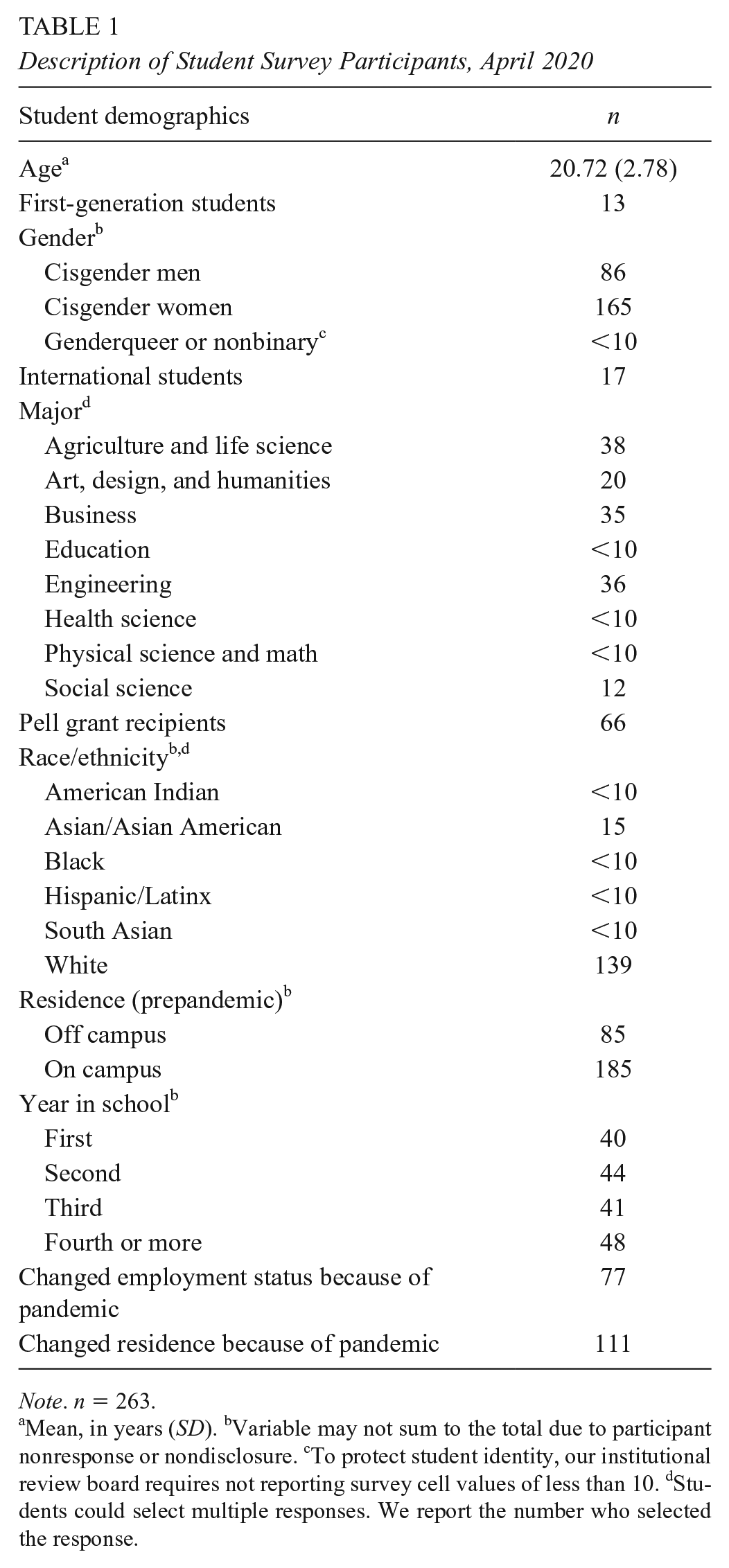
Note. n = 263.
Mean, in years (SD). bVariable may not sum to the total due to participant nonresponse or nondisclosure. cTo protect student identity, our institutional review board requires not reporting survey cell values of less than 10. dStudents could select multiple responses. We report the number who selected the response.
We invited all 68 students who indicated interest via the questionnaire to participate in compensated individual follow-up interviews. We conducted individual virtual interviews in September 2020 with all the students who responded to the interview invitation (21 students). We used students’ network-based responses from their questionnaires as prompts to elicit further details and sense-making about the changes in their personal networks and their experiences of being college students during the pandemic from March 2020 onward. Therefore, students were reporting retrospectively on their survey data and explaining their social network dynamics. Interviews lasted between 30 and 90 minutes and were audio recorded and transcribed verbatim. The interview participants are described in Table 2. As a group, the participants were relatively evenly distributed among class years, and 14 students were majoring in STEM fields. There were 13 women and 8 men, and 15 White students and 6 Students of Color. Six of the students lived in on-campus residence halls before the pandemic, and 13 students changed residences during the shift to online learning.
Interview Participants

Analytic Strategies
Egocentric Networks
We used the quantitative data collected in April 2020 to construct individual egocentric networks for each respondent at Time 1 (in the weeks just before social distancing began in March 2020) and Time 2 (April 2020, several weeks after institutional implementation of social distancing). These networks allow us to identify how many alters a student reported at each time period (called “degree”) and the relationship nature of those ties (e.g., whether a relationship with an alter was multifaceted, such as being a friend and coworker, or whether egocentric networks spanned social and academic contexts). The average degree at Time 1 was 2.49, and the average degree at Time 2 was 1.07.
Network Heterogeneity
In addition to degree, for each individual we calculated a score for Blau’s index of heterogeneity (Blau, 1977). Blau’s index calculates how much diversity exists within a sample. In this study, the Blau’s index indicates how diverse or homogenous an individual’s types of ties are at each time period. Blau’s index is calculated by the following formula:

where, p is the proportion of a category (in this case ties) and i is the number of categories. The closer to zero, the more homogenous an individual’s alters are, and the closer to one, the more heterogeneous they are. If all of a student’s ties are of different relationship types, the Blau’s index for relationship types is 1. If they are all the same, then a student’s Blau’s index would be 0.
Latent Profile Analysis
To identify shared traits among students by their relationship types, we employed latent profile analysis (LPA) to observe the probability that any individual student would belong to a shared group of similar peers based on the frequency of different relationship types among their alters. Profiles are created so that the differences within profiles on a set of measures, in this case, relationship types, are minimized and the differences between profiles are maximized. LPA is a nonparametric method for identifying unobserved shared group membership among individuals, meaning that the distribution of latent variables is estimated rather than assuming the data have some parametric form. We calculated the probability that any individual would fall into K number of profiles for each time period. Because LPA calculates probabilities of every student belonging to each profile, individuals may belong to every profile to some degree. Therefore, LPA accounts for the uncertainty of classifying students within different profiles. We could not estimate a latent transition analysis, which would identify classes based on the type of transition students experienced (e.g., many diverse contacts to few contacts) rather than their membership in a shared group at different time points, because of sample size limitations. The results reported here reflect two independent samples of classes. Within the profile, a tie can belong to multiple categories, with each category conceptualized as a binary (either present or not).
We fit LPA models to the seven relationship categories to extract one to six profiles, estimating variances as (1) equal or (2) varying, and estimating covariances as (1) zero or (2) varying across profiles in all the LPA models. We “assigned” a student to a profile for which they had the highest probability. Students’ probabilities were uniformly high for their selected profile and uniformly low for the other profiles. The different arguments for variances and covariances allowed for three models to be specified: (1) equal variances and covariances fixed to 0, (2) varying variances and covariances fixed to 0, and (3) varying variances and varying covariances. To aid in model selection, we used the Aikake information criterion and Bayesian information criterion. All LPAs were conducted in R using maximum likelihood estimation via the tidyLPA package (Rosenberg et al., 2019).
Qualitative Case Profiles
As part of our overall data analysis process, members of the research team collaborated to deductively (to construct egocentric networks) and inductively (to explore students’ constructions of their experiences) code the interview transcripts using descriptive coding, created a codebook, and kept analytic memos during coding (Saldaña, 2016). At least two team members coded each transcript and resolved discrepancies. We focused on students’ discussions of their transitions during March and April 2020 and specifically students’ constructions of factors related to interpersonal network dynamics. Because our quantitative results suggested residential change as a potential factor in network dynamics, we examined students’ narratives for evidence of this. We created a metamatrix (Saldaña, 2016) to compare the prevalence of inductive themes within each latent profile to identify individuals who could illustrate common themes within each profile group.
After completing analysis, both our quantitative and qualitative findings resisted clear thematic categorizations by student identity and experience, and we wanted to avoid reductiveness and preserve the complexity of students’ experiences as conjointly shaped by a variety of social forces, following Benson and Lee’s (2020) analysis of first-generation students’ experiences. To illustrate the complexity of the various latent profiles and examine students’ senses of their shifting egocentric network dynamics before and after social distancing within space constraints, two team members chose four students and developed synopses of their experiences that highlighted these interrelated social forces. We selected these four students from among our qualitative participants because they fit the most common three profiles at Time 1 and covered all three profiles at Time 2. We also selected these four students to include maximum variation in terms of gender, race and ethnicity, initial residence on or off campus, major, and residence change in response to the pandemic. In the profiles, we summarized themes in their experiences, connected them where relevant to experiences described by other participants, and constructed visual representations of their Time 1 and Time 2 egocentric network characteristics (see Figures 6–9).
Results
Patterns of Student Interaction Networks Before and After Social Distancing
The LPA identified five distinct groups at Time 1 and three distinct groups at Time 2. Tables 3 and 4 describe each of the eight profiles students belonged to in terms of their average number of tie types present in the profile. We gave each of the profiles descriptive names based on the predominant ties in the group. Among groups at Time 1, students varied in both the size of their networks and in the types of relationships they reported frequent interaction. (Although network size was not used as a primary determining factor in the analysis, it is visible in the latent distribution of students across groups.) For example, we identified that 102 students belonged to a group we called “Just Friends.” These students had fewer ties on average at Time 1, and the majority of their ties were with social contacts. A similar group of 84 students (“Friends + Lovers”) differentiated themselves by possessing romantic partnership ties. These two large groups constituted more than half of the sample. The third-largest group (“Friends + Coworkers”) also was composed of students with, on average, 1.68 friends and few other ties. This group was more likely to possess coworker ties, however. Among the vast majority of students, latent profiles differentiated on one of three key dimensions: friends, lovers, and coworkers.
Latent Profiles at Time 1, Mean (SD) Degree per Tie Type per Class

Latent Profiles at Time 2, Mean (SD) Degree per Tie Type per Class

The remaining students belonged to two groups with higher numbers of ties overall. Only eight students belonged to the highly social group with an average of 4.63 friends and higher than average roommate and classmate ties (“Socializers”). Although some of these values are potentially a byproduct of the small group size, students in this group were generally above average on socioacademic ties. In contrast, the other small group we called “Socioacademic + Family,” with 13 students, had above average family ties (1.23) in addition to their above average number of friendship ties (2.23). In both cases, higher levels of friendship ties were also related to above average socioacademic ties with classmates.
We identified three interpersonal network profile patterns after the transition to social distancing. Students’ networks uniformly contracted in size (see Table 4) and decreased in diversity of tie types (see Figures 1 and 2). The largest group of students, “Few Ties” (n = 139), reported few alters and very little diversity among their ties. The second largest group, “Family Ties” (n = 194), possessed more ties, on average, with family playing a prominent role. The third group possessed above average friend ties and classmate ties, suggesting that these students worked to maintain the socioacademic relationships that had largely disappeared from the prepandemic period.

Blau’s index of heterogeneity by participant at Time 1.

Blau’s index of heterogeneity by participant at Time 2.
We observed similar trends in overall measure of diversity from the Blau’s index and in the diversity index between latent profile groups (see Figures 1 and 2). As the number of overall relationships decreased (and the potential for variation within those relationships decreased as a consequence), we observed increasingly homogenous relationships among many students. This suggests that multiplex relationships might be decreasing, as there is less potential for overlap among relationships. Friends, classmates, roommates, and romantic partners fell away, leaving students fewer opportunities to capitalize on socioacademic connections and relying increasingly on family and strong tie friendships as part of their day-to-day social interactions.
This trend was most apparent when we viewed the range of Blau’s index scores by latent profile. At Time 1, relationships were relatively diverse and relatively consistent across the five groups (see Figure 3). This changed substantially when we examined the range of Blau’s index scores from a few weeks after the onset of social distancing policies (see Figure 4). Students with few ties also had, on average, much less diverse networks, while students in the other two groups had relatively similar median Blau’s index values, albeit with a greater range of value and higher levels of diversity among their relationships overall. This provides further evidence that multiplexity in students’ relationships potentially declined as a result of social distancing policies.
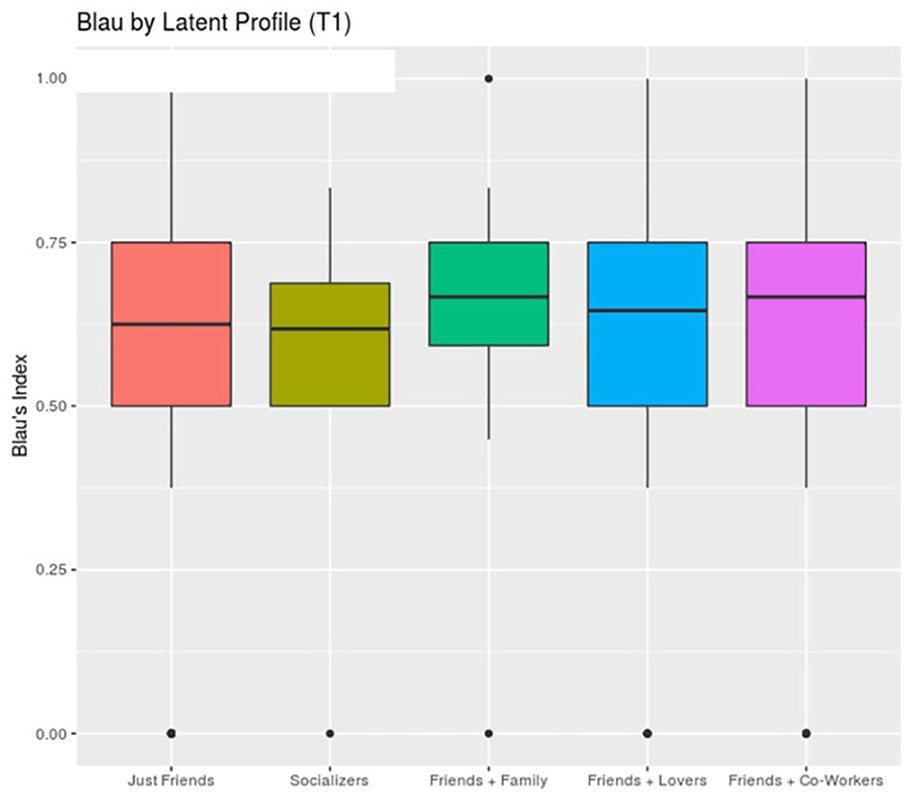
Blau’s index of heterogeneity by latent profile at Time 1.

Blau’s index of heterogeneity by latent profile at Time 2.
When we examined students’ latent profile groups during the two time periods by demographic factors and by changes in context (all the variables included in Table 1), we found little evidence of patterns within or among groups that mapped onto profiles. For example, students were relatively evenly split by gender, race, first generation status, and international student status among the profile groups before and after social distancing. The one exception to this observation occurred when we looked at social distancing profiles by whether they had to change residence or experienced a change in employment. In that case, students who had changed residence or employment were disproportionately represented in the “Few Ties” profile. Within that group, more students who lived on campus reported changing their residence compared with those who lived off campus. This finding is consistent with proximity as a key variable in network formation (Small, 2017), as students whose networks were shaped by residential environment and proximity served to lose the most when they experienced a shift in context. Rather than experiencing context collapse, these students seemed to have less diverse network ties after social distancing.
We also did not observe consistent patterns in the flow of students from one latent profile to another over the two time periods, with the potential exception of “Socializers” who managed to maintain socioacademic tie diversity (see Figure 5). Instead, a variety of factors seem to drive changes in students’ networks in the period before and after the implementation of social distancing. Because we observed few discernable patterns in who belonged to each relationship profile before and after social distancing, we turned to the qualitative interviews to unpack some of the complexity of the diverse influences that shaped students’ social networks in each period.
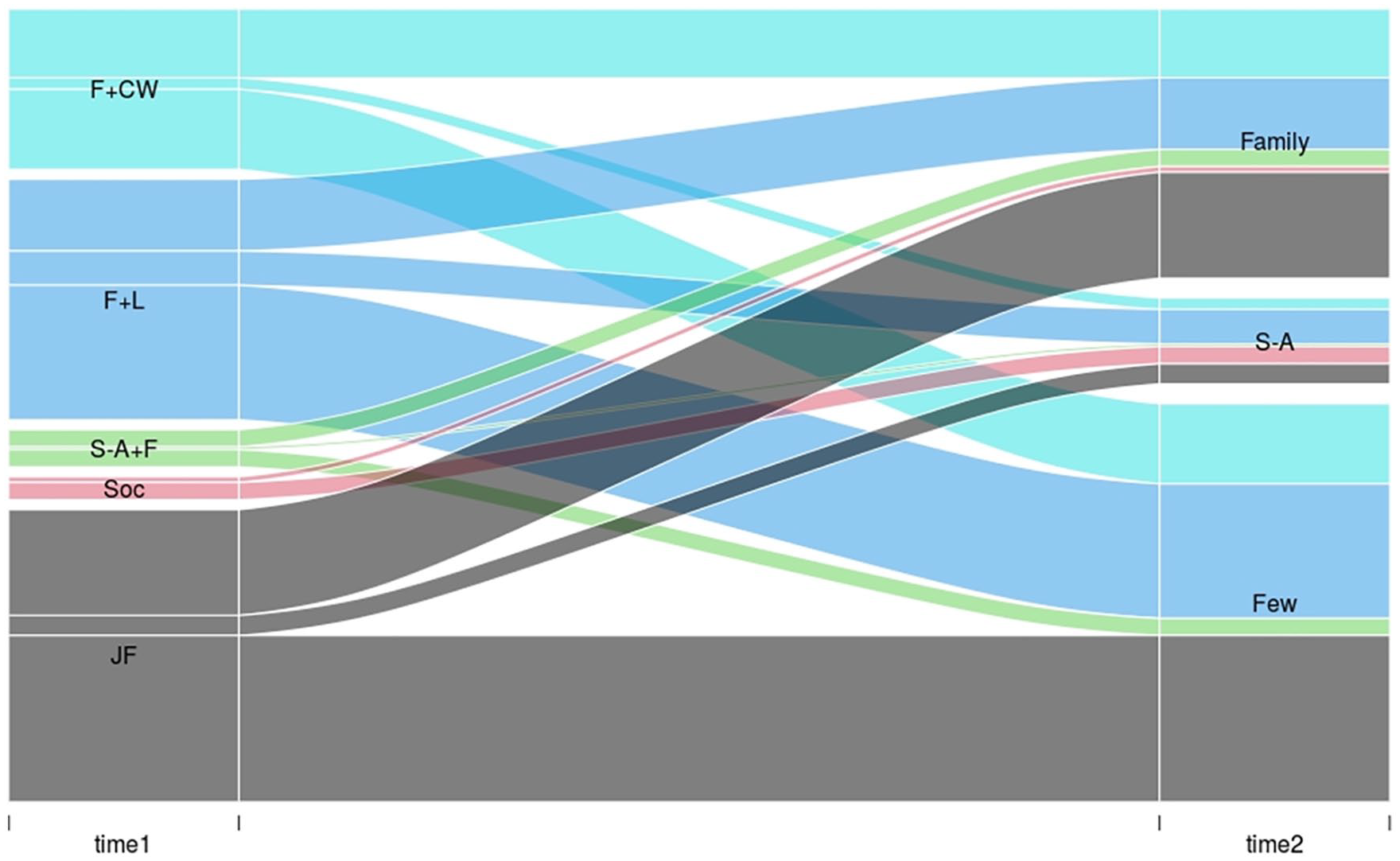
Change among latent profiles over time.
Change in Networks: Four Student Profiles
Given the variation in the five types of student network profiles identified from before the pandemic, the reduction to three profiles after social distancing, and heterogeneity in the ways that students’ patterns changed, we investigated students’ qualitative accounts of their experiences to understand more about the dynamics of network change. Aligning with the quantitative findings, our qualitative findings did not fit the identification of simple thematic patterns. Some of the factors related to network change included residence change, as indicated in the quantitative findings, or financial calculations that led to divergent decisions. Most students talked about losses of academic relationships, or of needing to work specifically to maintain them via technology. The family-inclusive pattern became visible in the quantitative data after the onset of the pandemic. Students typically included family members in their narratives, although family members did not always rise to the level of being included in “interaction” network questions. Students’ narratives about the time after social distancing were clearly shaped by their own attitudes about COVID-19 and those of other people present in their daily interactions. When reflecting back on April 2020, students described working hard to create new socioacademic routines and to cope with anxiety and the unknown health, educational, and career effects of the virus. Furthermore, as we talked with students in September 2020, despite a return to some sort of proximity to campus, students had not reestablished their early patterns, and especially reported continued loss of the peer academic connections they would have typically made in courses.
Because we want to highlight the ways that students’ multiple identities, social positionality, and experiences and preferences combined to shape changes in their networks, we decided to present four student profiles below as illustrative of some of the sense-making that shaped student decisions. For each student, we report their latent profiles from before and after social distancing and include their egocentric network visualizations. The interpretation of the visualizations is described in the key for Figures 6 to 9. As we discuss each student’s profile, we also offer some commentary on commonalities within the particular profile.
KEY FOR FIGURES 6–9.
Note. Each visualization contains 10 wedges, representing the maximum possible number of alters reported. The visualization is divided vertically in half, with the left half representing ties reported at Time 1 (prior to social distancing) and the right half representing ties reported at Time 2 (after social distancing). Each wedge is coded by color to demonstrate the types of ties contained by the alter. Unreported ties are shaded gray.

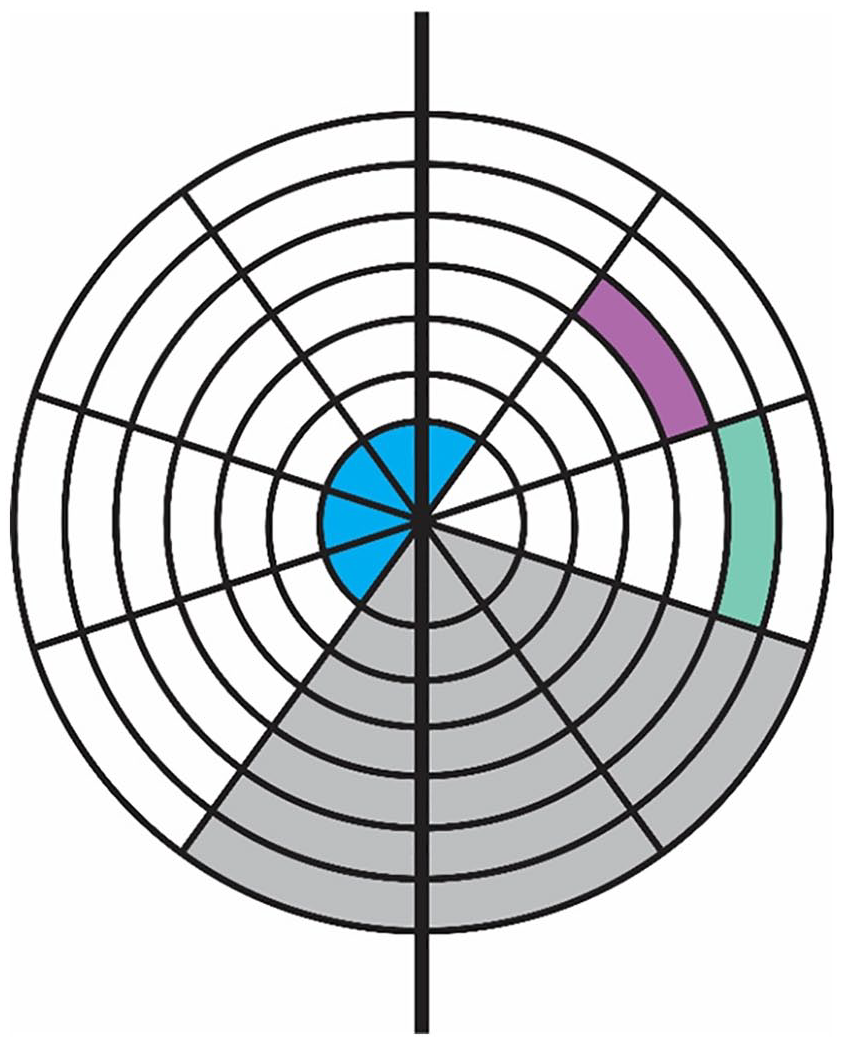
Andrew (Just Friends–Family Ties).Note. See “Key for Figures 6–9 above.
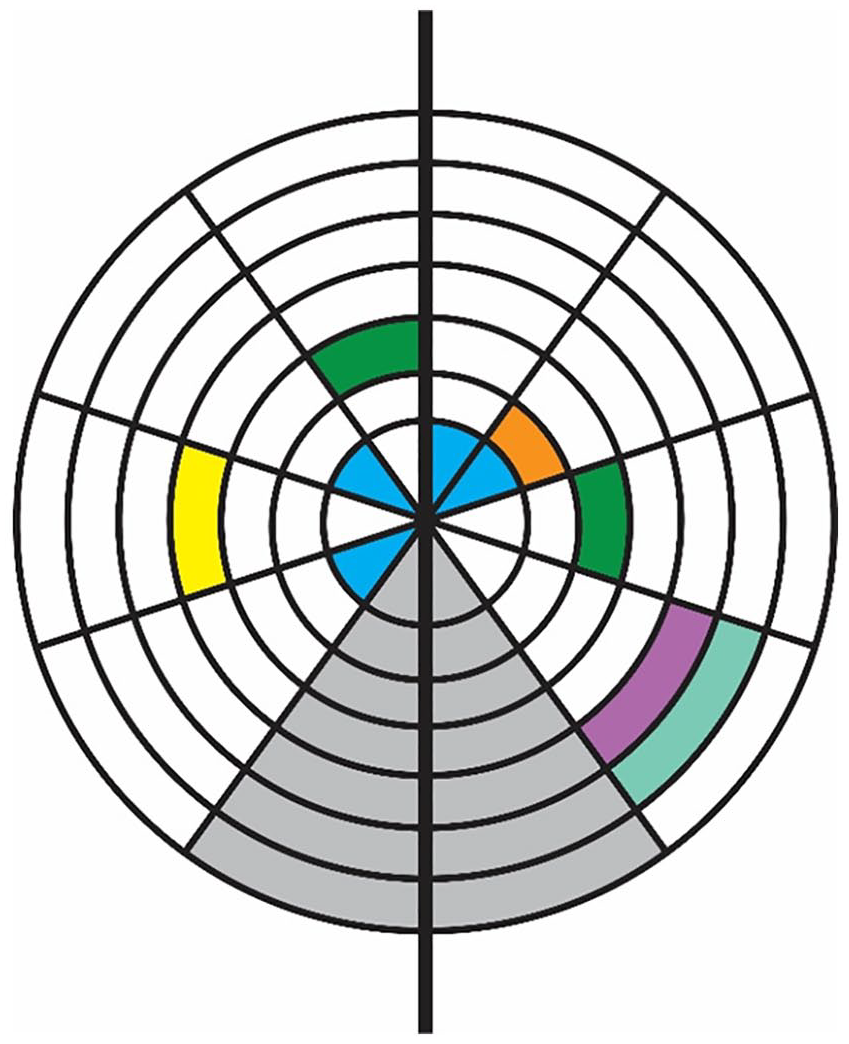
Abby (Friends + Lovers–Family Ties). Note. See “Key for Figures 6–9 above.

Gabriela (Friends + Lovers–Socioacademic Ties).Note. See “Key for Figures 6–9 above.

Ethan (Friends + Coworkers–Few Ties).
Andrew
Latent Profiles: Just Friends–Family Ties (See Figure 6)
In early spring 2020, many students were embedded within campus-based networks of peers that they socialized and sometimes studied with. Following residence hall closures and the shift to online courses, some students moved from their rooms and off-campus apartments back to family homes. As a result, family interactions became more prevalent as students negotiated relationships with parents, maintaining college friendships, and interacting with local friends from before college. Andrew was an Asian American fourth-year engineering student who described his social interactions with two friend groups as one of the most valuable parts of his college experience. He had been living in an apartment off campus and moved back to his parents’ house in a nearby state when the pandemic struck. Andrew got along well with his family, took daily walks with a neighbor friend, and maintained regular interactions over Zoom with his college friends. Despite these interactions, because of his family’s social distancing protocols during this period, Andrew summarized his feelings as “just very depressing to not be able to see any one.” He further explained, My family took it, COVID, pretty seriously . . . I was only to ever leave the house for groceries. Otherwise, especially for that first month and a half to two months, we were only really allowed to go for walks outside. Besides that I had never seen anyone. So, there’s that, and then, in terms of coming back to campus [prior to fall], our parents just kind of assumed if we did, it was to go see friends, so they said no to that right away.
Andrew spent the summer working at a remote internship, and he moved back to his campus apartment in Fall 2020 to finish his final semester, cautiously socializing with his small friend group to “make memories” and demonstrate how much he appreciated them.
Abby
Latent Profiles: Friends + Lovers–Family Ties (See Figure 7)
While some students, like Andrew, moved in with family for relational reasons, financial considerations also shaped students’ decision making about where to live and how to organize their time after classes shifted online, which in turn affected the composition of their interpersonal interaction networks. Abby, a White woman, who was a second-year education major, was living in her sorority house at the beginning of 2020. She had a boyfriend, a group of friends and classmates, and was dealing with the stress of working jobs that could not cover her expenses. When the university shifted courses online, she moved to another state to live with her mother, and her siblings helped her obtain a nearly full-time job there. With fewer expenses and able to organize her coursework during the spring, summer, and subsequent fall around her work schedule, she felt more financially secure and in control of her time. She said, I mean, I really just think the craziest thing to me was going from having no money and struggling to like, a week later, just totally fine, like, no issues. I don’t have to pay for rent. It was just such a turnaround in my life, which is so weird.
Abby described occasionally meeting over Zoom with friends who were classmates during the summer and getting assistance from an academic advisor, but most of her personal interactions were with family members and her boyfriend. Abby’s employment dealt with logistics related to COVID-19, so she felt “not super connected” with campus-based friends who were “partying all the time.” She said, “I don’t want to tell them, like, they’re doing something wrong, and then be mad at me. So I’d rather just not talk to them.” She hoped to continue her current work and online academic schedule until her planned return to campus in Fall 2021.
Gabriela
Latent Profiles: Friends + Lovers–Socioacademic Ties (See Figure 8)
Some students living in off-campus apartments remained there after social distancing policy implementation. As a result, their networks tended to remain composed of peers rather than becoming more family centric. Gabriela was a third-year Puerto Rican student who was majoring in life sciences. She worked for university dining until it ceased operation mid-spring. Although she stayed physically proximal to the university during the spring semester, her interactions with coworkers, peers, and classmates declined. Gabriela described the stress of both the anticipated and the actual changes to her work, academic, and social life and relationships. Describing the alterations in her daily life, she said, So it’s [the pandemic] also changed my routine. And the same goes for relationships, because just like the fact that I wasn’t going in to work, or the fact that I wasn’t going in to class, and that the library was closed, or like me thinking that those things were going to happen were like, the big concerns. . . . I just kind of figured it out. My roommate ended up staying for a little bit and then I still saw some of my friends, and I just like, we made it kind of work through it all. So, maybe not like on-campus, like, resources [helped], but just like, friendships and relationships just kind of helped a little bit.
She continued to carefully see a small group of friends and her boyfriend during the spring and visited family over the summer, before returning to campus in Fall 2020 because she thought her courses would be delivered in hybrid format. Although her courses ended up being mostly virtual, she appreciated socializing with friends and returning to her on-campus dining job.
Ethan
Latent Profiles: Friends + Coworkers–Few Ties (See Figure 9)
Students with high socioacademic participation and an array of types of people they interacted with found those interaction ties contracting and becoming more one-dimensional as typical patterns of academic and social life were disrupted. For some students, though they did not physically relocate, observing social distancing required relationship renegotiation, limiting in-person interaction with physically proximal peers, or experiencing those peers relocating. Ethan was a White fifth-year student who lived in a nearby city with his parents and commuted to campus. A business and health sciences major, Ethan was active in clubs, worked out to stay healthy, had a part-time on-campus job in an academic department, and maintained relationships with an array of friends and classmates. Prior to social distancing, he spent most of his day in various spaces on campus. Ethan described how the lack of campus spaces disrupted his usual routines, which affected his academic work and his mental and physical health.
All of my classes went online and I know that productivity for me just went downhill dramatically, just because it’s a lot harder for me to do stuff online. And the fact that we were just told to stay at home was a big thing, like all the gyms were closed, so, like, I was just even more anxious. So I’m having to try to figure out a new daily routine because everything that I was doing before I could no longer do.
Ethan no longer interacted with classmates, but he was able to work his on-campus job remotely. In Fall 2020, he commuted to campus from his parents’ house because he preferred in-person learning where possible. He found a distinctly different campus atmosphere. He commented, “Now it’s like, the only time you should be on campus is when you have class. So, like, the general feel is that if you don’t have to be here, don’t be here.” Despite the fact that the university was holding some face-to-face classes and had opened residence halls, social distancing policies created a physical environment that accommodated only necessary activities, rather than the kinds of interactions that had made up the fabric of many students’ lives before the pandemic. When we talked with students in Fall 2020, most had not added relationships with any new individuals, and they were unsure of how long their contracted interaction patterns would have to last.
Discussion
As colleges and universities in the United State took unprecedented action in March 2020 in response to the COVID-19 pandemic, undergraduate students experienced shocks to the interpersonal interaction networks they had constructed and their daily routines. We compared a sample of undergraduate student interaction networks before and after social distancing to understand the kinds of relationship patterns students had been embedded in and how those network patterns changed in response to proximity and course modality shifts. Prior to social distancing, we found five latent profiles of student relationship patterns, varying by number of friends and the inclusion of romantic partners and coworkers. Some ties were multiplex, indicating that an individual may have served overlapping roles or purposes, particularly those that were both academic and social. After social distancing, we found three latent profiles of student relationship patterns, indicating fewer ties overall as well as profiles more inclusive of family members. Overall, student networks contracted in size and became more one-dimensional.
As we compared which profiles students fit into before and after social distancing, few clear patterns emerged, indicating multiple and complex influences on student network changes. The movement between profiles demonstrated that students responded to uncertainty in a variety of ways, underlining Pescosolido’s (1992) assertion that people who share an experience may not have the same sets of social ties, which can yield different sense-making and outcomes. Students who had moved residences or altered employment statuses appeared in each of the post–social distancing profiles. Interview participants described their relationships with family, their financial and employment situations, their altered daily routines, and the ways that social distancing and pandemic-related stressors cost them a variety of alters in their egocentric networks. Even if students’ physical proximity to campus did not change, social distancing policies often meant that academic and campus coworker ties decreased. The decrease in academic ties was consistent with other research on student networks during the pandemic (Elmer et al., 2020).
Students’ networks altered in terms of characteristics and the resources embedded in the relationships. Prior to social distancing, we found some patterns of relationships that contained friends who also served as academic connections, representing potential broad trends in prepandemic undergraduate student life regarding with whom students reported regular interaction. These findings are consistent with prior research that suggests students draw on multiplex relationships as part of their undergraduate experience (Brown, 2019; McCabe, 2016; Small, 2017), and that fewer students have larger diverse networks (McCabe, 2016). Although some students maintained or developed socioacademic relationships following social distancing, many neither gained nor maintained the academic components of their relationships. In their narratives, students described trying to recreate a semblance of their previous daily schedule or struggling with maintaining some kind of structure to support learning given high levels of anxiety and uncertainty. Family emerged in more networks following social distancing, which echoes literature on a central role of kin in coping with disasters (Hurlbert et al., 2000).
Examining student networks in response to the pandemic shows that student response to disruption was not uniform. Broadly, students may have maintained friendship ties, but for some students, those were reactivations of old friendships or intentional maintenance of current friendships. The pandemic drew attention to the level of effort required to maintain interaction across distance. Other ties, especially those with family, rose to being noticed and commented upon after social distancing. Even students who lived with family and commuted to campus before the pandemic named those interactions post social distancing as they took on new meaning. Congruent with Pescosolido’s (1992) SOS framework and its application to people coping with the onset of illness, students reconfigured their networks within constraints, navigated organizational systems, and drew on constellations of resources as needs shifted.
Though our study contains unique network data collected during a singular historical event, it is not without limitations that lead us to suggest directions for further research. Our sample is small and limited to one 4-year institution, so it cannot speak to the breadth of college student experiences. Even at this institution, it is likely that respondents were among those less severely affected by the pandemic. Our analytic sample size limited our ability to conduct subgroup analyses of interest. Future studies should examine network change with a larger and more diverse sample in other institutional settings. Special attention should be paid to the evidence that suggests disproportionate impact on racially minoritized students and the role that gender plays in socioacademic relationship formation (Benson & Lee, 2020), especially in the context of exogenous shocks to relationship continuity.
While we report network change, students reported the Time 1 networks retrospectively. It had only been a few weeks, so accurate recall was likely higher than if it had been longer. Interview data were also retrospective over the past 6 months, though our inclusion of respondents’ prior survey data as part of the interview protocol likely helped participants with recall. Our study draws out some potential implications from the immediate shock of the pandemic’s onset on students’ daily lives and the patterns of their relationships. Longitudinal study will be important to understand more about the dynamics of how students move through different phases of the pandemic and navigate continued educational experiences and career plans. While the COVID-19 pandemic prompted this particular study, in general we advocate for more regular longitudinal studies of college student networks that examine change over time. Longitudinal panel designs would allow for comparisons of routine types of network change with those produced by disruptive events, which may have differing implications for policies and practices that support students.
Given survey length constraints and because we did not collect names of specific alters, we do not have survey data on alter–alter relationships and cannot identify whether the individual alters are identical across time. Network-based research could more broadly consider students’ relationships beyond peers and instructors, as well as more robustly measure tie content and strength. Future research could and should consider the modalities students used to communicate with their peers and how modality influences socioacademic relationship maintenance. Furthermore, the potential long-term influences of social distancing on network ties are unclear, as is the impact of these ties on observed and perceived student outcomes. In general, descriptive patterns of interpersonal relationships could be connected to research on student development, creating space in the latter for relational research and models. Incorporating social network formation and disruption mechanisms, as well as dyadic and network relational measures, could contribute to more robust future theorizing and research about cognitive and psychosocial development.
As leaders of postsecondary institutions grapple with what increasing face-to-face interactions in physical proximity looks like in the future, our results suggest that administrators may need to provide reorientation for returning students who have established pandemic-related interpersonal routines that included fewer people in general, and specifically fewer classmates. Student affairs offices and those designing cocurricular programming may need to reconsider or expand outreach and introductory activities beyond first-year students to reengage returning on-campus students, especially for services and opportunities that require in-person student engagement and thus could not maintain availability during remote education. Student affairs educators will also have to grapple with advising student organizations that may have formed different cultures during the online period because of the change in peer interaction frequency and modality, resulting in different kinds of student peer networks or forms of engagement than they would typically see.
Smaller frequent interaction networks and the array of diverse ways students reconfigured their networks suggest learning environment designers and educators may need to interrupt the routines they helped create for social distancing purposes in order to promote interaction again. This may be especially salient for academic relationships that seem particularly context dependent, as the lack of physical proximity sometimes lessened academic interactions. Those working in student support may need to pay attention to students’ use of classroom and study spaces and habits, while maintaining the accessibility features that have been gained (Keegan, 2020). In student narratives, on-campus employment, either virtual or when safely in person, helped students to maintain both financial stability and connections to campus, as has been found generally true in previous literature (McClellan et al., 2018). Finally, it is possible that students’ families may play a somewhat altered role in their experiences as students going forward, given the uptick in reported family interactions in the post–social distancing networks. Some families got glimpses into their student’s construction of a scholarly identity and the daily routines of college life. Particularly for public institutions, this phenomenon may provide reinvigorated opportunities to develop relationships with families and more broadly shape public impressions of higher education institutions. Our results suggest that institutions may need to help students diversify their interpersonal networks once social distancing restrictions are lifted, and especially to help students reconstruct the academic networks that the pandemic dissolved or hindered.
Footnotes

Authors
RACHEL A. SMITH is an assistant professor of student affairs and higher education in the School of Education in the College of Human Sciences at Iowa State University. Her research agenda is focused on the ways postsecondary institutions shape environments for student relational network development and associated educational outcomes.
MICHAEL G. BROWN is an assistant professor of student affairs and higher education in the School of Education in the College of Human Sciences at Iowa State University. His research agenda is focused on the development of curriculum, instruction, and instructional technology in undergraduate education.
KEVIN A. GRADY completed his MEd in student affairs in the School of Education in the College of Human Sciences at Iowa State University and is currently the Coordinator of Registered Student Organizations at Drake University. His research agenda is focused on crisis communication in higher education and program assessment of residential curricula in higher education.
STEPHANIE SOWL is a PhD candidate and research assistant in the School of Education at Iowa State University. Her research interests include examining college trajectories of underrepresented students and the role of geography in reproducing educational inequality.
JESSICA M. SCHULZ completed their PhD in higher education at Iowa State University and is Confidential Advocate in the Office of Equity and Inclusive Excellence at Winona State University. Their research agenda is focused on interpersonal violence in higher education, critical consciousness, and Whiteness in student affairs.