



Abstract
Guided by the following questions: (1) What are the experiences of immigrant children attending schools in communities experiencing police brutality and anti-immigrant sentiments? (2) How do middle school children of immigrants visually represent their experiences with legal violence? and (3) What are children’s visions of freedom and community safety in this context?, this article highlights the understudied preadolescent children of immigrants through a 2-year study of a multidisciplinary theater class at a local elementary school in South Central Los Angeles. Data includes child interviews, class observations, artwork, and performance videos, from recently arrived Mexican and Central American children aged 10 to 13 years. Findings reveal how children come to understand policing, reinforcing concepts like “good cop/bad cop,” conflating local police and ICE (Immigration and Customs Enforcement) agents, but also imagining alternatives for community safety outside of police systems. This work contributes to the fields of immigration, abolitionist education, and ethnic studies, among others, offering new ways of supporting immigrant children through the use of arts-based tools.
My name is Maria, and I am 11 years old. My portrait is about me being a nice police officer. What I mean by that is me stopping DONALD TRUMP FROM SEPARATING FAMILY! [sic] Another reason why I want to be a police officer is because it has always been my dream job. I want to help the community.
Maria 1 is just one of many children in this study that were enthralled with police officers, military personnel, and enforcement figures as a way of combating the anti-immigrant policies that threatened their family cohesion and safety. Other children like Naomi Wadler, age 11; Sophi Cruz, age 5; Zianna Oliphant, age 9; Katherine Figueroa, age 9; Wynta-Amor Rogers, age 7: similar to Maria, represent a spokesperson, an activist, a messenger for their community. At these young ages, children of color must grow up early and acknowledge the ways their communities are disenfranchised, discriminated, and desperate for an end to deportations and police killings. Scholars have called attention to the dangerous ways society adultifies Black girls, in particular (Burton, 2007; Epstein et al., 2017). Despite the adverse outcomes of early childhood adultification, we continue to see Black and Brown children exchange their innocence for the possibility of rights (Rodríguez, 2018; Rodriguez Vega, 2015; Woodhouse, 2009). Albeit potent voices in the fight for social justice, putting children in this position also has unfair consequences for academic and personal development. Moreover, we know that growing up in underresourced inner-city schools already poses a threat to the well-being of children (Candel, 2019; Ewing, 2018; Morris, 2007; Williams et al., 2002). Yet, children having to stand up for themselves, their families, and communities is not new. Over 66 years ago the Supreme Court ruled in the historic 1954 Brown v. Board of Education case that segregating schoolchildren was unconstitutional. 2 The story of 6-year-old Ruby Bridges was instrumental in achieving desegregation. She and her family received the brunt of violence and White rage because a Black child was allowed to attend the all-White school (Kurland, 1979). Ten years earlier, the life of another child, 8-year-old Sylvia Mendez became similarly instrumental in desegregating Mexican schools in California through the landmark Mendez v. Westminster 1947 ruling (Valencia, 2005). Yet Black and Brown children continue to face adverse childhood experiences when compared with their White counterparts (Condron, 2009; Liu et al., 2020). To address the systematic ways children are harmed, the United Nations outlined the Declaration of the Rights of the Child which states that children have the right to education and to be protected from any racial, religious, or any other type of discrimination (United Nations, 1959).
This article centers the experiences of recently arrived Latinx immigrant children. However, their experiences do not exist in isolation. In places like South Central Los Angeles the lives of Brown 3 immigrant children are deeply intertwined with the experiences of Black children and the community in general. To understand how policing affects immigrant children, this article will look at the interactions, aspirations, and lived experiences that immigrant children in Los Angeles had with police officers and immigration enforcement. Through an analysis of children’s drawings, interviews, journal entries, and theater performances, this work is guided by the following research questions:
Over a period of 2 years, I taught the theater curriculum for a class of sixth grade students aged 10 to 13 years old. This curriculum design is a methodological tool built on the legacies of El Teatro Campesino and Theater of the Oppressed and demonstrating possibilities for engaging children in difficult conversations in ways that are trauma-sensitive, culturally sustaining, and that center hope (Duncan-Andrade, 2009; Ladson-Billings, 1995, 2014). In the following section, I present the relevant literature. Then, I provide an overview of the methodology used to create this research, followed by the findings which are divided into three sections: (1) Personal Encounters with Pol(ICE); (2) Good vs Bad Cops Tropes; and (3) Dreams of Community Safety. The last section discusses the findings and concluding thoughts.
Review of Literature on Immigrant Children
The national impasse of resolving the undocumented status of 11 million people, has placed 4.5 million children of immigrants at risk of family separation (Suárez-Orozco et al., 2015). We know that the combined stressors of migratory status and poverty can have long-term detrimental consequences for youth (Yoshikawa, 2011). Already, children living in urban areas exhibit signs of posttraumatic stress disorder at twice the rate than soldiers returning from war (Tucker, 2007). This stress affects their lives as they transition into adults. In fact, studies on older undocumented 1.5-generation youth have described coming into adulthood like waking up to a nightmare (Abrego, 2006; Abrego & Gonzales, 2010; Gonzales, 2011). Yet there is still much we do not know about children of immigrants, who are the fastest growing segment of the population in the United States (Passel, 2011).
Most recently, the Trump presidency was disastrous for mixed-status families and immigrant children. In just 4 years, Trump upended the asylum process and continued to transform the immigration system by making legal entry into the United States nearly impossible (Montoya-Galvez, 2020). Trump’s efforts to curb undocumented immigration were constantly contested by the Supreme Court and federal judges across the United States (Montoya-Galvez, 2020; Verea, 2018). During Trump’s tenure, ICE apprehensions increased by 17% from 2017 to 2018 (Gramlich, 2020). Today, not only are children growing up with the consequences of an anti-immigrant presidency but also during the Black Lives Matter Uprising, where the impact of police brutality is palpable by the overrepresentation of police violence toward the Black community (Dreyer et al., 2020; Nix & Lozada, 2021). Although the Black population represents 12.3% of the population, they account for 25% of killings by police from 2013 to 2017 (Gaynor et al., 2021). Given the myriad of challenges and barriers that immigrant children are confronted with, supportive and humanizing spaces in schools and communities are essential. However, not all schooling experiences are positive.
Schooling
Teachers report that children exposed to immigration raids often missed school and were seldom able to concentrate when they attended, resulting in the slipping of grades (Chaudry et al., 2010; Kirksey et al., 2020; Santillano et al., 2020). The consequences of detention and deportation can affect children’s abilities to transition into a healthy adolescence (Santos et al., 2017; Soto, 2020). For instance, as children, undocumented immigrants experience inclusive access to public education, but as adults they are denied participation in jobs, higher education, and other privileges like driving, traveling, and voting (Abrego, 2006; Ellis et al., 2019; Gonzales, 2011). As such, legal status affects every aspect of the ecological development of young people from health, cognitive, educational, socioemotional, engagement, labor-market, and more (Rendón García, 2019; Suárez-Orozco et al., 2011). Children in immigrant families come of age as they receive a series of societal messages about their cultural, ethnic, and racial group. These messages can be seemingly positive yet, still detrimental to students. For example, Asian students are often perceived as “smart” and “hard-working,” perpetuating the “model minority myth” (Lachica Buenavista, 2018; Lee, 1994). While they can be interpreted as neutral or benign, ultimately these messages advance ideologies of White supremacy. For others, they can be overtly negative such as the racist perceptions of all Latina/o/x being “illegal.” Through societal treatment, media representations, and political sentiments, social mirroring can influence children’s identities in detrimental ways (Suárez-Orozco & Suárez-Orozco, 2000). Due to these negative messages, “adolescents may find it difficult to develop a flexible and adaptive sense of self” (Suárez-Orozco et al., 2009; Suárez-Orozco & Quin, 2006). Hence, being undocumented can cause serious risks to any person’s well-being, particularly during a time of high anti-immigrant sentiment and police violence. Moreover, legal violence, described as the normalized, but cumulatively injurious effects of the law (Menjívar & Abrego, 2012) is a useful framework for this work in helping understand how laws are socially accepted despite being harmful. In an effort to mitigate legal violence, the city of Los Angeles officially became a sanctuary city in 2019, although policies like Special Order 40 already existed, which barred police officers from initiating contact with someone only because they believe the person might be undocumented (Smith & Ormseth, 2019). However, although there are symbolic sanctuary city ordinances and polices like Special Order 40, undocumented immigrants still fear calling the police when they are victimized in a crime (Muchow & Amuedo-Dorantes, 2020). In their study, Muchow and Amuedo-Dorantes (2020) found that domestic violence calls per capita dropped by 3% in Los Angeles Police Department (LAPD) reporting districts with a higher concentration of Latino noncitizens as awareness about immigration enforcement increased, proving empirical evidence of the “chilling effect” of immigration enforcement on Latino immigrant engagement with police (p. 1).
Policing
Shifting focus from policing and immigration, to policing in communities of color, it is no secret that there is a history of police brutality in Los Angeles. However, what is not widely known are the programmatic ways policing in places like South Central Los Angeles were continuously expanded to surveil, punish, and marginalize Black and Brown youth. For example, in 1977 the security force of the Los Angeles Unified School District (LAUSD) was the fourth largest enforcement agency in the county (Felker-Kantor, 2018). One of the most egregious ways youth became intertwined with the legal system through their schooling experience was through the Alpha File—an LAUSD and LAPD partnership launched an initiative to surveil youth in South Central whom they predicted to become criminals (Felker-Kantor, 2018). This racist program operated on “racialized assumptions of criminality” and was especially destructive to Black children and teens (103). After a lawsuit by the American Civil Liberties Union (ACLU), the Alpha File was abandoned for another program. The new LAPD program, Total Resources Against South Bureau Hoodlums (TRASH) took 38 officers to target Black areas of the city. The program was soon after renamed to Community Resources Against Street Hoodlums (CRASH) and was expanded to become LAPD’s elite paramilitary antigang unit, setting a trend for the rest of the country (104). Among its reputation for aggressive crime suppression operations, this program borrowed from the Alpha File model in that it created a systematic way of keeping track of “suspected gang members, who had not participated in any gang-related activity” (105). However, things like living in an active gang neighborhood, wearing things like round or V-neck shirts, tennis/French-toed shoes, or Black T-shirts were the ways Black and Latino youth’s names were added to the list. Unable to ever remove their names from the file cards and any protest of this would be documented. Although Asian and White youth also live communities with gangs and participated in gangs, this program focused on descriptors for identifying Black and Brown possible gang members. Under this practice, youth did not receive due process. Eventually the expansion of the Juvenile Justice System demarcated a shift in treating Black and Brown children as adults (110). Legally adultifying and criminalizing Black and Brown children.
Later in 1999, Anderson, in Code of The Street, argued that life circumstances in disenfranchised communities like lack of jobs that pay living wages, limited basic public services (prompt help during emergencies, building maintenance, trash pickup, lighting, and other services that middle class neighborhoods take for granted), the stigma of race, the fallout from rampant drug use and drug trafficking result in alienation and absence of hope for the future (p. 32). Unfortunately, youth in places like Watts are still dealing with this reality (Kelley, 2007; Rodríguez, 2018). Living in this environment places young people at special risk for despair (Wilson, 2009). However, there are some mitigating elements like a stable home life or mentorship that can offset those effects. Unfortunately, not all children have these protective factors. Thus, young people are confronted with learning a set of “street codes” composed of informal rules governing interpersonal public behavior. Anderson argues that at the heart of this street code is the quest for respect. In what he calls street culture, respect is viewed as an external entity, one that is hard won, but easily lost. Overall, this code is a cultural adaptation to a profound lack of faith in the police, judicial system, and authority (Anderson, 1999). Rather, youth viewed police as part of the dominant White society, not meant to protect, as demonstrated by the lack of response when called or by harassment of youth of color.
Critical scholars have demonstrated some of the dangers of color-blind thinking when it comes to interactions between communities of color and police (Crenshaw & Peller, 1992; Patton, 1992). In many communities, enforcement officers represent a threat rather than a source of safety (Bornstein et al., 2012). Children of immigrants often conflate immigration agents with local law enforcement, resulting in a fear of any public official (Dreby, 2012, 2015). Children also have a tendency to assume all immigrants are undocumented, even seeing themselves as undocumented despite having U.S. citizenship (Dreby & Adkins, 2012). They also report fear in not knowing what can happened to their own parents if stopped by the police for a traffic infraction (Chaudry et al., 2010). Consequently, the every-day experiences for children are met with questions such as, what do I do if I see a police officer, and will my parents be home when I return from school. Consequently, this anxiety can persist and create toxic stress (Hornor, 2015). This is compounded by the fear, distrust, depression, anxiety, and financial instability of deportation (Cervantes et al., 2018; Ee & Gándara, 2020). In fact, legal violence has also been used to exemplify how the broken window’s theory—where school policies relying on surveillance and policing of students created detrimental effects on student achievement (Bellows, 2019). Giroux (2018) would agree with Anderson’s remarks that today’s authorities do not offer hope to this generation (p. 102). The recent reports on gun violence concur that cops in schools have not made schools safe (Na & Gottfredson, 2013). Rather, it has transformed disciplinary problems into criminal violations that result in negative outcomes for youth. Police presence has cemented what scholars call “the school-to-prison pipeline” or the school to prison nexus, where children get entangled with the law for otherwise acceptable child-like behaviors (Welch, 2017). Thus, schools function as “institutions of containment and control that produce pedagogies of conformity and oppression that kill the imagination by teaching to tests.” When hope is not found in school, youth must look elsewhere. For instance, anthropologists (Coe et al., 1993; Covey, 2010; Flores, 2016) have long documented the mirroring behavior between gangs and military groups, where youth replicate the behavior, dress, and ideas of a group as a way to gain acceptance. For them, imitating power is an attempt to survive. Although undocumented status poses a risk for young people’s development, it is also a site of resistance and resilience where youth form alternative ways of living, learning, and overcoming obstacles (Pérez Huber, 2017; Muñoz, 2018). Even if overcoming means aspiring to become part of the system of control by wanting the be police and enforcement officers.
Culturally Sustaining Art Pedagogies
Doing research with children can be challenging. Due to children’s age, language development, and vulnerability, traditional methods of research may be biased toward adults. These complexities make artistic tools useful, prompting an interest in using art to communicate with preadolescents (Bhattacharya & Payne, 2016; Crivello et al., 2009; Driessnack, 2005; Tumanyan & Huuki, 2020). For example, visual art methods like Photovoice, drawing, and performance have been especially useful for children who have experienced traumatic events in their lives such as illnesses, war, and abandonment (Johnson et al., 2012). Art education is crucial, especially for its positive effects on the development and education of marginalized children (Hudson, 2020; Sandoval & Latorre, 2008). However, it is troubling that massive cuts to arts funding most often happen to schools in communities of color (Shaw, 2018). Even under financial restrictions critical educators have found ways of making teaching and learning a culturally relevant and sustaining pedagogical practice (Ladson-Billings, 2014). As in the case of Ladson-Billings, Paris, Alim, and many others, the art form of spoken word and hip-hop have functioned as sites rich with pedagogical possibilities (Hudson, 2020; Paris & Alim, 2017). In the 1970s, Freire (2018) reminded us of the impossibility to teach without a forged, invented, and well-thought-out capacity to love. Since then, critical scholars have built on this call to love with new trauma-informed pedagogical possibilities meant to meet the needs of today’s students (Duncan-Andrade, 2009; Hannegan-Martinez, 2019). In the spirit of love for our students, Bettina Love (2019) reminds us that abolitionist teaching is “as much about tearing down old structures and ways of thinking as it is about forming new ideas, new forms of social interactions . . . the ultimate goal of abolitionist teaching is freedom” (pp. 88–89). As such, this begs the question, how can our teaching help children feel freer? Bettina Love goes on describe how things like writing, drawing, acting, painting, composting, spittin’ rhymes, and dancing are love, joy, and resistance personified (p. 99).
Art education in schools is so important because for many dark children, art is more than classes or a mode of expression; it is how dark children make sense of this unjust world and a way to sustain who they are, as they recall and (re)member in the mist of chaos what is means to thrive (p. 100).
Similarly, with the goal of joy and freedom this work attempts to contribute to this legacy and underscore the importance of culturally sustaining pedagogies by using Chicanx/Latinx traditions of teatro for social change.
Methodology
Employing techniques from El Teatro Campesino (a theater group from the 1970s Chicano Movement who work with the United Farm Workers Union), Theater of the Oppressed by Augusto Boal, and Problem-Posing Pedagogy by Brazilian educator Paulo Freire I designed and taught a sixth-grade theater curriculum for newly arrived immigrant students. After carefully creating a curriculum that was culturally sustaining and in accordance with the state’s requirements for a sixth-grade theater class, I taught this class for 2 years from 2015 to 2017 at an after-school program in South Central Los Angeles. During this time, the country was going through the 2016 U.S. presidential election and the second year of the study was Trump’s first year in office. Thus, the data I have provides insights into children’s perceptions of legal violence pre- and post-Trump through the following prompts: What is the problem in the community? How do you feel about this problem? What can be done to change it? What is the most important news story you have seen on TV? The study began with 13 students. In the second year, the class grew to 30, for a more demographic information see Table 1. The students in my class were all English Language Learners working to pass the state’s sixth grade-level standardized English exam.
Student Demographics

The school is located in the City of Watts, which is part of South Central Los Angeles. Historically, Watts has been predominantly an African American community. In the 1980s, the city experienced a demographic shift (Behrens, 2011). Currently, Watts is a Mexican and Central American immigrant-receiving community with a long history of poverty, police brutality, job scarcity, and inadequate food and housing (Diver-Stamnes, 1995). Contemporary scholars call this lack of fresh foods a “food desert” (Lewis et al., 2011). Children growing up in Watts today confront the same issues their predecessors faced in the 1960s and 1990s. 4 . Given these realities, children in the area experience housing, food, and educational insecurities in their daily lives, coupled with overpolicing, violence, and immigration issues.
Data Collection and Analysis
This multimethod qualitative project drew on 62 hours of interviews 5 with parents, children, and teachers, 50 hours of class and home observations, 40 hours of recorded theater performances and practices, visual analysis of 136 drawings, in addition to student journal entries, and 80 pre-/postsurveys from 2015 to 2017. However, this article will only focus on drawings and in class interactions. Since my work includes both interviews and artwork, I used separate analytical strategies for each data set. First, I professionally transcribed interviews and coded them through Dedoose—an online software. Then, building on previous methods of visual coding (Chavez, 2001; Rodriguez Vega, 2018; Santa Ana, 2002), I employed a protocol of visual content narrative analysis by creating codes—such as Content, Actors, Emotions, Nations, and Aesthetics—that are quantified to capture the narratives in children’s art. A research assistant and I carefully read through each image, taking note of the themes outlined above. Together, this creative data captured the verbal and visual testimonies of immigrant children. The images you will see in this article are some of the most keenly representative drawings of the most prevalent themes found, namely representations of legal violence and police presence.
Over the course of this project, I visited the students during their regular class time and conducted observations prior to teaching and working with them. Once the curriculum was created, I invited students and talked to parents about the class an ensure consent. Sending home informational pamphlets in English and Spanish, I made myself available to speak with parents after school about the class and gain their permission for participation. A total of 13 students joined the first year: eight boys and five girls. All of them had immigrant parents and five of them had migrated to the United Staes themselves. We began each class talking about the issues they saw in the school and community, such as gangs, littering, environment, and bullying. However, almost every conversation turned to the topic of immigration.
The second year of my theater class, the entire sixth grade class came to theater once a week for an hour. Over the course of the year, we added after school rehearsals for the final performance. The large class of 31 students was represented with families from places like Mexico, Guatemala, El Salvador, and Honduras. One of the most important reasons for including the entire class in the theater program was to ensure that more girls participated, resulting in a total of 18 girls and 13 boys. As the weeks progressed, shy students started to come out of their shells and began to work on projecting their voice and presence. Although the children born in the United States. were citizens, there were constant conversations about Trump’s unexpected presidential victory. Every week, children shared stories that involved deportation fears, the U.S.–Mexico wall, and foreign policy concerns like U.S. relations with North Korea and Russia.
Once we had common concerns to discuss, I introduced Image Theater 6 (Boal, 2000). Each student used their body as a canvas and collectively created images that gave life to their stories, concerns, and ideas. Once we had the images created, we activated the images through actos. 7 For both years, the final performance was inspired by children’s stories and anxieties about immigration issues. We collaboratively created a story and once our storyboard was complete, children volunteered to play certain roles, came up with lines, including jokes and punchlines. The next section is divided into three sections, first, themes of personal encounters with Pol(ICE), then narratives of good vs bad cop tropes; and finally, children’s dreams of community safety.
Findings
Pol(ICE) Encounters
One of the students’ favorite theater games consisted of students walking around the room and as I count down from five to one, by the time I got to one, they had to assemble themselves into an impromptu frozen image. The rules were that if they could not create a unified image with the other people, they would be out. One of the first times we played this game, students created the image in Figure 1. Here, the group of boys is split into two people with their hands up in the air (one ironically wearing a sweater with the words “trouble finds me”) and three others apprehending them. Two of the students pretended to point guns with their hands. When I asked the group to relax and explain the image, one of the boys said, “we are catching criminals, Miss.” I continued to ask questions like, “who are you three?” one responded, “we are the po-po [police].” While it is easy to hypothesize that this is just boy’s playing century old games, the ease with which they improvised this scenario is indicative of the normalization of police apprehensions seen on television or in person. Places like Watts are known to be over policed and fraught with excessive force toward Black and Brown youth, it is not surprising to see children reenact this (Bass, 2001).

Five boys in frozen image.
The second example comes from one of the journaling activities. I asked Brandon, age 13, why he did not come to school the day before and he drew the image in Figure 2. In the image he writes, “My dad went to jail. He had his turn to call, when we went to pick him up. I was sad.” The image portrays Brandon’s family on a bus approaching the jail. Although he has access to many crayon colors, Brandon uses very little color aside from the big brown door, the blue P in the parking lot, and the bright yellow sun. Inside the jail, Brandon draws everyone frowning. The only figure smiling is the person in the corner who is able to see everyone, a literal panopticon of surveillance in the way all imprisoned people are watched by the figure on the corner (Foucault, 2007). While analyzing drawings, frowns always stand out to me, as it is almost automatic to draw a smile instead of the alternate. Therefore, when I see frowns, I know it is a deliberate choice by the child artist to demarcate a negative emotion or association. Presumably, one of the stick figures in the jail cells is Brandon’s dad. When he was telling me about the drawing he said, “How could I say this? Ok, my dad, he was just walking to get some food to eat, but the police stopped him and they said he was on drugs, and they took him. But I’m excited because he’s coming out in 2 weeks.” Brandon’s statement is indicative of a positive coping mechanism in the making and his drawing reveals the ways people are heavily surveilled in poor communities leading to criminalization for doing mundane activities like walking. Coinciding with Das Gupta (2013), who found that children’s testimonies about their deported fathers emphasize the emotional rather than the material toll, Brandon also highlights the emotional loss he feels by not having his father with him.

Brandon’s image.
Max is usually quiet. His parents migrated from Mexico and his aunt (Tia Divina) lived with them and took care of Max when his parents worked late. When it was time to assign characters to our skit, Max volunteered to play Trump. The class got a kick out of seeing Max’s dark brown complexion paired with the bright yellow wig. When students began a conversation about the border, Max said, My aunt got deported to Mexico. She used to live here in the USA, and one day she was going to work in a taxi, and the taxi driver was, like, on drugs and then the police stopped him, and since my aunt was in the taxi, they arrested her. She don’t really know that the taxi driver was on drugs, they didn’t do a drug test on her so they just took her to the jail and deported her.
This is another example of a young person faced with the separation of a caretaker. On her way to work, Max’s aunt got into a taxi that was pulled over while speeding and driving erratically. Unknown to her, the taxi driver was under the influence and was arrested on site. As the police questioned Max’s aunt, they learned she was undocumented when she did not have proper identification. This prompted officers to call ICE on her although she was only the passenger. As she came into contact with law enforcement, she was questioned about her legal status and eventually this traffic stop resulted in her deportation. This close coordination between local law enforcement and federal ICE officials is how many undocumented immigrants become easily intertwined with the criminalizing system due to their legal status (Armenta, 2012, 2017; Vitello, 2006; Yoshikawa et al., 2019). This work demonstrates the intersecting impacts of these various legal and penal discrimination system by highlighting the emotional, educational, and developmental impact on children.
In Max’s drawing (Figure 3), we can see the representation of the United States, where he is, and Mexico, where his Tia Divina is now living. He singles himself out in the drawing. Geographically he draws where he is located, California, and his aunt in the northeastern part of Mexico. The longing for his aunt is characterized by the puzzle like figures of his and his aunt’s bodies, emphasized by the distance and border between them. Max’s drawing and story resembles many of the children who shared about a family member who has been deported, jailed, and imprisoned. It is clear that not only are the legal lines between ICE and local police blurred, but that children are perceptive to the dangerous relationship between the two.
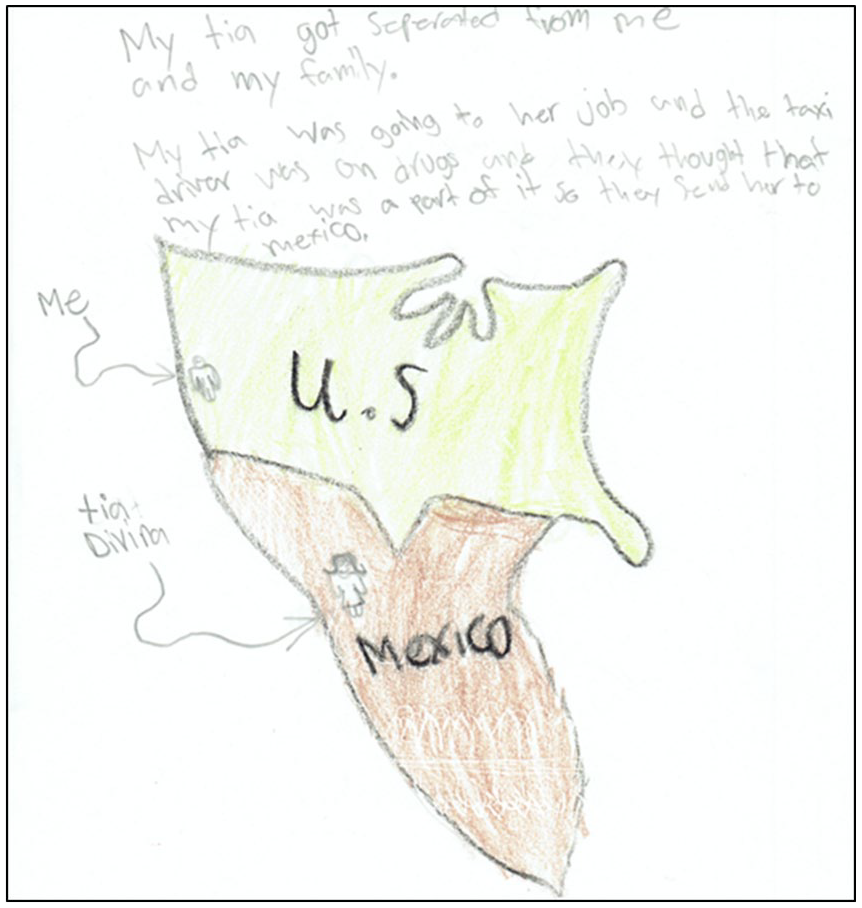
Max’s image.
Good Cop Versus Bad Cop
Popular tropes like “good guy vs. bad guy,” “cops vs. robbers,” or the settler colonialist favorite, “cowboys vs. Indians” have been around for so long. Popular culture promotes these clichés through movies, books, and games. In fact, many of the students that I worked with wanted to become police officers or join the military. One of the students that was most passionate about this is Maria, mentioned above. However, Maria does not want to become just a “regular” cop. As she states, she wants to be “one of the good ones.” The following portrait (Figure 4) is of Maria embodying who she wants to be in the future, an LAPD officer. Included in her vision of being a “nice police officer,” she specifically wants to stop Donald Trump. The artist statement next to the portrait signals that to her, being a nice police officer means “stopping Trump from separating families.” This is another example of how police and immigration matters collide. To Maria, police have enough power to stop a President from wrongdoing. She wants to help the community by becoming a cop and stopping Trump is her first goal.

Maria’s image.
Many of the students in this class were constantly talking about the military. Some of them were obsessed with soldiers and talking about war, snipers, and other authority figures like police officers, FBI, and CIA. Children and families of color encounter military commercials, movies, video games and it is important to note that scholars have long understood the purposeful targeting of military recruitment in brown neighborhoods (Abajian, 2013). As a disproportionate number of Chicanos/Latinos have died in World War II, Vietnam, and Afghanistan (Mariscal, 2010). Similarly, it seems that to these middle school boys, the military is one of the only ways of achieving upward mobility (A. H. Huerta, 2015). These data also suggest that children see themselves as police officers, military, or even gang members in an attempt of claiming power that they currently do not hold (Cook et al., 1996). The question might come up if the desire to not see immigrants as “criminal” is a gendered phenomenon and this is not the case in my work, both girls and boys felt a deep sense of over responsibility to help people, immigrants in particular.
Children as young as 5 years could already articulate their desires to want to be police officers. During one of the home visits I conducted with the family of one of my students, I met all three brothers whose parents were Mexican immigrants. Two out of the three boys expressed that they wanted to be police officers. The first one to say so was 5-year-old Lucas. When I asked him why he said “to catch the bad guys!”
What do you want to be when you grow up?
Police?
Yes.
Police? Why?
To get the bad guys. Criminals.
Later I sat down to interview the parents while the boys played in their room. Their mother told me she did not like the neighborhood and that they would move out as soon as possible. The dad told me that one morning when he was walking the kids to school, they saw a dead person in the alley. They called the police but did not wait for them nor give their own information because they did not want to get involved, affirming the findings on trust in police in Latino noncitizen neighborhoods. This feeling of vulnerability in the face of the law is theorized as “illegality”—a feeling of helplessness in the face of the law (De Genova, 2004). The mom affirmed they were afraid of the police as they could be questioned and taken in for not having “papers.”
Dream of Community Safety
During the final performance of the year, students recreated a migration story about a child migrating from El Salvador to Los Angeles. In the play, they ensured that he arrived safely to the United States—something that did not happen in real life as told through the experience of two cousins in the class who had a 17-year-old cousin (Alex) pass away on the border. However, in the play, one of the main obstacles for helping the child reunite with his parents was the police officer and police dogs that are guarding the border. Although the border is not jurisdiction of police, to children, this enforcement official is used interchangeably with CBP. In the play, the parents wait on the U.S. side as the mother cuts a hole through the fence so the kids can cross. The dad must come up with a clever way of removing the police officer. The transcript below demonstrates one of the conversations about what to do about the police officer/border patrol.
Our mom can be on the other side of the border, saying, “the police, is there, so hurry and cross before they see you.”
The ending is like in suspension.
Yeah, we could leave people in suspense. What would happen if the mom and dad tell the police, “Help us” What would the police do?
They’re going to say, “We can’t because we deported them for a reason” and the reason must be really bad.
I know, remove them! When the police are gone, they can cross.
In order to help the migrant children cross, students presented three options—first to bypass the police and try to cross without them noticing. The second is an unknown result, which may represent the actual lived experience of many interactions with local law enforcement (Cervantes et al., 2018). Carla, age 12, suggests that the audience should be left in suspense. Third, when asked “what would the police do if they asked for help, the response is that they would not be helped. Samuel, age 12, states that the police would not help the family, because of “a really bad” reason ostensibly a crime. So finally, Sergio steps in and suggests the ending that was ultimately used in the play which is that someone should distract the police officer and that when the police are removed, they kids can run through. To these students, there is a danger in asking the police for help. A study by Rendón García (2019) showed that Latinx undocumented parents varied in their strategies of protection and communication about undocumented status and detention/deportation risk, depending on the age of the child. Some parents reported using protective strategies like never answering the door; others who were parents of older children reported discussing openly the risk of detention by ICE in public spaces and why it was important not to “draw attention” to oneself. As a result, youth can exhibit being overly cautious when doing mundane activities like being in public, working, or driving with someone, having to constantly look over their shoulder for police (Ellis et al., 2019).
The other way students see a possibility of survival is to fight back. When asked during the brainstorming of what the parents can do to help the kids migrate safely when the border is being patrolled by police, Edgar responded, “The dad can hit the police over the head with a pan!” This was very comical to the rest of the class who responded with “yes,” and “ what if the pan breaks?” A student even pretended being hit by a pan in a satirical way, almost like watching a cartoon falling flat to the floor with the sound effect of “booyooyooing.” Although some children demonstrate an investment in policing and a desire to become police officers, they also communicated that police presence did not necesarily equal safety for the immigrant community. In fact, here students express that safety means an absence of police presence. This is not only a theme present with immigrant children—as a cross state study revealed, in areas of heightened anti-immigrant sentiment, U.S. born Latinxs (U.S. citizens) are also less inclined to report a crime to the police (Menjívar et al., 2018).
The final way students expressed policing alternatives was to decriminalize immigrants. During clean up time after class, two students stayed behind to help. I decided to ask them what they wanted to be in the future and this is what Alex, age 12, said, “I want to be a lawyer.” I responded, “A lawyer? Why do you want to be a lawyer?” “Because I want to see why criminals always have to be like us. I want to help them.” “How do you know if you helped them?” I ask, and he responds, “because there will be no more police and no more criminals.” Although brief the conversation was also profound. In expressing his dreams for the future, Alex without overt awareness, presented the idea that criminality is constructed, and all people deserve help. His astute observation is aligned with the way immigrants have been systematically criminalized during the last three presidential administrations (Hing, 2018). Ultimately, through art making, children question police violence and surveillance. Their ideas ranged from becoming “good” police, fighting back against police, or abolishing police and criminalization.
Conclusion
Some believe that we have come a long way since school segregation, yet, violence, lack of resources, policing, and the loss of innocence for children of color is unfortunately still all too common. Black families must have “the talk” with their children about what to do if pulled over by police. Relatedly, immigrant families must also have a “talk” about what to do if questioned by an immigration or enforcement officer. Children of color must prepare for violence or family separation, and if this burden must be carried by the most vulnerable in society, then it is urgent that educators become aware of their students’ everyday needs not only at school, but in their communities and homes. We must respond to the calls of abolitionist educators and thinkers who urge us to radically care for students if we are to ensure that students thrive and not merely survive as they transition into adulthood (Bettina Love, 2019). It is important for me to underscore the complexity of conversations about abolitionist educational practices that illuminate the nuanced ways children interact with the greater carceral state. The intentions of this work are not to de-center Blackness, rather to make visible how carceral logics and school-to-prison-pipeline ideologies are maintained and reproduced. In an effort to naturalize Black and Brown coalitions, this article highlights Pol(ICE) presence in the lives of immigrant children. It is for this and many other reasons that the arts are desperately needed in inner-city schools where Black and Brown children attend. If budget cuts for art education continue to increase then it is crucial to support the integration of art curriculum in mainstream subjects like science, math, history, and other, including expanding after school arts programming (Hudson, 2020; Persaud, 2019; Shaw, 2018).
This study is one of the first to examine the confluence of local law enforcement and policing with federal immigration enforcement from the standpoint of students. Moreover, demonstrating that arts-based methods provided a powerful medium of communication for students to imagine alternative realities regarding their and their families’ relationship with the criminalizing state. The children in this project reimagined structural and systematic violence from the nation state and made clear their own sense of responsibility to make things better. Children in South Central Los Angeles deserve real safety and protection, not surveillance. However, the new Biden administration has not changed the very close nationwide collaboration between local police and federal immigration enforcement. Since Trump, migrant criminalization this has not become weaker and remains the norm. The primary limitation of this study is that it may not be representative of the experiences of all immigrant children. Moreover, preservicing teachers to be proactively prepared with mental health resources and assistance for children and families in distress is vital as not all educators have access to arts organizations and curriculum that can help children cope with the stressors of an anti-immigrant political climate. We know the future of this country deepens greatly on this population. As such, arts-based research in schools on the topic of immigration and Pol(ICE) presence merit special attention and support to continue this work if we are to ensure children thrive into adulthood.
Footnotes
Acknowledgements
This work is dedicated to all children of immigrants who shared their stories and art with me. A special thank you to Hirokazu Yoshikawa and the AERA Open reviewers and editors that provided thoughtful feedback. This research received support from the Ford Foundation, UCLA’s Chicano Studies Research Center, UC MEXUS, and the Social and Public Art Resource Center (SPARC).

Notes
Author
SILVIA RODRIGUEZ VEGA is a UC Chancellor’s Postdoctoral Fellow at University of California, Santa Barbara, in the Department of Chicana and Chicano Studies. She is a community engaged artist and scholar, and her research explores the ways anti-immigration policy affects the lives of immigrant children through new methodological tools centering art and creative expression.