




Abstract
Colleges and universities have increasingly worried in recent decades about college students’ well-being, with the COVID-19 pandemic aggravating these concerns. Our study examines changes to undergraduate emotional sentiments and psychological well-being from before to after the onset of the pandemic. In addition, we explore whether certain risk factors (i.e., prior mental health impairments, trait emotional stability) and protective factors (i.e., subjective socioeconomic status, parental education, household resources) predicted students’ emotions and their intraindividual changes due to the pandemic onset. We compared experience sampling method data from 120 students from before and after the pandemic onset, examining intraindividual trajectories. There was only little change in students’ emotions. Prior mental health impairment and trait emotional stability predicted students’ emotions, averaged across time points, but not emotion changes. Few associations with emotions were found for subjective socioeconomic status and parental education, but study-related household resources predicted levels and changes in emotions.
Keywords
Introduction
Concerns about college and university students’ psychological well-being and mental health have increased in recent decades in the United States (Eisenberg et al., 2009; Lipson et al., 2019; Liu et al., 2019; Walters et al., 2018). This concern became heightened in the face of the COVID-19 pandemic, which affected the lives of the entire population, including the academic and social experiences of college students (Browning et al., 2021; Huckins et al., 2020). In addition to more general worries concerning health, personal income, and the economy, college students were affected by the closures and the rapid shift to online teaching. Furthermore, many students were forced to move back in with their parents during a time of many restrictions and constraints, such as restricted contact to nonhousehold members, reduced social activities and home-schooled siblings.
With the increase in stressors came a decrease in psychological well-being and an increase in mental health issues. While already elevated in previous years (American College Health Association, 2018; LeViness et al., 2018; Lipson et al., 2019; National Institute of Mental Health, 2016; Pérez-Rojas et al., 2017; Substance Abuse and Mental Health Services Administration, 2017), negative emotions and mental health impairments have spiked among the overall U.S. population and college students in particular during the COVID-19 pandemic (Centers for Disease Control and Prevention, 2020a, 2020b; Pfefferbaum & North, 2020). Researchers relying on survey data found that college students were more sedentary, anxious, and depressed during the first COVID-19-affected term, compared with previous academic years, with their impaired mental health being related to maladaptive behavior, such as increased phone usage and decreased physical activity (Charles et al., 2021; Huckins et al., 2020).
Individual coping with the COVID-19 pandemic is influenced by risk and protective factors (Browning et al., 2021; Sánchez-Teruel et al., 2021; Sun et al., 2021; Tang et al., 2020). This article focuses on risk and protective factors concerning university students’ emotional coping with the COVID-19 pandemic, including prior mental health impairments, and the personality facet of low emotional stability (an aspect of neuroticism) as risk factors, as well as study-related household resources and the subjective socioeconomic status (SES) as protective factors. We also tested whether the SES predicted levels of and changes in emotions. In contrast to most previous studies on risk and protective factors that relied solely on cross-sectional survey methodology (Browning et al., 2021), we assessed emotional sentiments with pre- and postsurveys, in real-life situations and contexts. The latter allowed us to examine the intraindividual trajectories in emotions and may make these assessments more ecologically valid and less confounded with memory errors or other response biases (e.g., Goetz et al., 2013; Takarangi et al., 2006).
We used a unique study design that utilized both an experience sampling method (ESM) and pre- and postsurveys between February and April 2020 to examine how the perceivable onset of the COVID-19 pandemic in the United States affected college students’ campus and study activities, their emotions, and their psychological well-being. We expected that the impact of the pandemic-related stressors on students’ emotions and well-being might be moderated by students’ risk factors (low emotional stability; prior mental health impairment) and protective factors (access to study-related household resources and subjective SES).
The COVID-19 Pandemic and Its Repercussions on Student Life, Students’ Psychological Well-Being, and Emotions
The COVID-19 pandemic affected many aspects of student life and well-being, which is of particular importance as students are typically regarded as a vulnerable population for mental health issues (Rubley, 2017). The core change to student life for many college students was the requirement to leave campus housing and the shift to emergency remote instruction. These repercussions of the pandemic may pose additional burdens on students’ mental health (Liu et al., 2020). Students who left campus housing might no longer have access to key resources for student success and well-being, such as a quiet place to study or in-person access to social support from classmates, staff, or faculty. Initial studies of the pandemic’s consequences indeed documented increases in college students’ perceived stress, anxiety, and depressive symptoms after the onset of the COVID-19 pandemic (Charles et al., 2021; Husky et al., 2020; von Keyserlingk et al., 2021). With regard to stressors related to academic success, students were often concerned about their ability to continue with their studies to avoid degree completion delays (Hasan & Bao, 2020).
It should be noted that psychological well-being and mental health are larger, multifaceted constructs (Gross & Muñoz, 1995; Ryff & Singer, 2008; World Health Organization, 2001), of which only the emotional facets are examined in this article. Psychological well-being includes facets such as self-acceptance, positive relationships with others, autonomy, environmental mastery, personal growth, and purpose in life (Ryff & Keyes, 1995). In this study, we captured only the emotional aspects of psychological well-being. Although emotions were captured with situational assessments, these state measures were aggregated for each person to the person-specific average across all situations, separately for the time period before and after the pandemic onset. Thus, the emotion measures, although situational, are used as indicators for habitual, rather stable levels of emotions. This approach is based on the expectation that a person with high psychological well-being will habitually experience high and frequent positive emotions and low and rare negative emotions (Carmeli et al., 2009; De Leersnyder et al., 2015; Diener et al., 2009; Diener et al., 2010; Nyklíček et al., 2011; Winefield et al., 2012). Mental health primarily refers to the absence of psychological disorders and symptoms thereof but also includes many aspects similar to well-being, including working creatively and productively, maintaining positive relations to others, feeling comfortable when being alone, and feeling fulfillment (Gross & Muñoz, 1995; Pfefferbaum & North, 2020). Similar to well-being, the indicators of mental health employed in this study mainly refer to the experience of high positive and low negative emotions. Thus, future studies may want to expand the scope of this research by examining further elements of psychological well-being and mental health.
The Impact of the Pandemic on Students Is Mitigated by Risk and Protective Factors
Since the pandemic brought myriad different stressors into the lives of most people, including college students, this was a time requiring extraordinary coping mechanisms. How individuals cope with stressors, such as the COVID-19 pandemic, differs between individuals and is influenced by individual and social risk and protective factors.
Among the empirically identified factors protecting students from harmful mental health impairments due to the COVID-19 pandemic were various coping strategies known to reduce stress levels, such as mindfulness, self-efficacy, and humor (Bendau et al., 2021; Savitsky et al., 2020a; Sun et al., 2021), exercise (Chen et al., 2020), happiness (Zainal Badri & Wan Mohd Yunus, 2021), social support, family income stability, living in urban areas (Cao et al., 2020), adaptability and positive emotions (Zhang et al., 2021), and being currently employed (Juchnowicz et al., 2021).
Among the risk factors aggravating the pandemic’s effect on the participants’ mental health were COVID-19-related financial stress, stigma, perceived COVID-threat, and COVID-related worries, which predicted anxiety and depression, as well as female gender and COVID-19 prosocial behavior predicting anxiety (Elmer et al., 2020; Sun et al., 2021), harmful emotion regulation strategies, such as emotion suppression or rumination (Bendau et al., 2021; Savitsky et al., 2020a). Female gender was also identified as a risk factor by Juchnowicz et al. (2021), Browning et al. (2021), Elmer et al. (2020), and Li et al. (2021). The latter mentioned several other risk factors, including family suspected with COVID-19, having lost a loved one to COVID-19, decreased family income, and online course characteristics (little interaction, disturbed learning, difficulty in adaption), excessively collecting personal information, family relatives’ intentional estrangement, and suffering harassment, abuse or insult. The risk of contagion and having infected family members were found to be risk factors by Zainal Badri and Wan Mohd Yunus (2021) and well as Cao et al. (2020). Elmer et al. (2020) further identified isolation in social networks, lack of interaction and emotional support, and physical isolation to be risk factors.
While the identification of risk and protective factors merely describes empirical associations, further theoretical models attempt to explain the underlying mechanisms driving these empirical relations. One such explanatory model is the demands–resources model, which suggests that demands are responsible for the negative mental health outcomes, including burnout symptoms and depression, while the resources needed to cope with demands drive positive and adaptive behavior (work or study engagement) and predict aspects of psychological well-being (Demerouti et al., 2001). In this sense, demands resemble either stressors or risk factors, while resources resemble protective factors.
Possible interactions between stressors and risk factors are described in further theoretical frameworks, the vulnerability–stress models, or diathesis–stress model (Chang et al., 2016; Colodro-Conde et al., 2018; Solberg et al., 1994). These models explain how mental health can be both a predictor and an outcome of the individual pathways that people take when coping with stressors such as a pandemic. The diathesis–stress model posits that individuals differ in their likelihood and severity to be affected by the same stressors, and this individual difference component is called vulnerability. Differences in vulnerability can for instance be due to personality-related, genetic, or social factors (Romanowicz et al., 2012; Solberg et al., 1994; Van der Aa et al., 2009). More vulnerable individuals will tend to have a harder time coping with stressors than less vulnerable individuals. Several studies have applied diathesis–stress models to describe how interactions between vulnerability and the COVID-19-pandemic-related stressors predicted mental health outcomes (Cox et al., 2020; Hong et al., 2020; Lynch et al., 2020; Raj et al., 2020). In line with this earlier research, we expected that prior mental health impairment may represent a vulnerability or risk factor affecting the ability to cope with an ongoing stressor, such as a pandemic. In the following sections, we introduce the risk and protective factors considered, and our hypotheses pertaining to them, in more detail.
Trait Emotional Stability as a Risk Factor
The effects of stressors on mental health are likely to vary depending on individuals’ personality, especially their emotional stability. Low emotional stability (also called neuroticism) can be described as a personality trait characterized by the tendency of experiencing more depression, anxiety, and hostility (McCrae & Costa, 1986). Emotional stability may affect a person’s emotions during stressful times, such as a pandemic, in two main ways: Low emotional stability is generally associated with increased levels of negative emotions, and low emotional stability may aggravate the effects of stressors on emotional and mental health outcomes.
Regarding the direct effects of emotional stability on emotions, low levels of emotional stability are correlated with a wide range of negative life outcomes, such as mental and physical health problems, low well-being (Kotov et al., 2010; Lucas, 2018; Malouff et al., 2005), and also with level and variability of negative affect (Geukes et al., 2017; Kalokerinos et al., 2020; Kotov et al., 2010; Lucas, 2018; Malouff et al., 2005; Wendt et al., 2020).
Furthermore, emotional stability is associated with the frequency and level of affective reactivity to stress (Bolger & Schilling, 1991; Hisler et al., 2020; Howland et al., 2017). In the university context, students with low emotional stability were found to react in more maladaptive ways to daily stressors, with more negative emotions and more pronounced mental health impairments (Felsten, 2004).
These studies suggest that students with low levels of emotional stability may be particularly vulnerable during stressful times such as the COVID-19 pandemic. On the one hand, their base level of negative emotions may be generally increased, and on the other hand they may react more sensitively to stressors.
Psychological Well-Being and Mental Health as a Mitigating Factor
Mental health is considered both an outcome of the ability to cope with stressors, and a predictor of it. For instance, both the demands–resources models of coping with stressors (Demerouti et al., 2001; McVicar, 2016) and the diathesis–stress model or vulnerability–stress model (Ingram & Luxton, 2005) consider prior mental health as a resource and protective factor (or as the absence of a demand or risk factor) in encounters of stressors that may buffer against the negative consequences of the encountered stressors. According to these models, prior mental health impairment may exacerbate the impact of a stressor on people’s emotions and well-being by additional stress and demands and by decreasing the resources available for coping strategies. However, mental health impairments are also considered outcomes of demands and stressors that balance individual coping mechanisms.
Research on the relation between mental health and college students’ coping during the COVID-19 pandemic examined mental health mostly as an outcome (Hong et al., 2020; Savitsky et al., 2020a; Sun et al., 2021), but occasionally also as a predictor (von Keyserlingk et al., 2021).
Socioeconomic Background as a Mitigating Factor
Financial insecurity is a well-known risk factor for psychological morbidity (Kopasker et al., 2018; Lund et al., 2018) and for health risks during the COVID-19 pandemic (Lassale et al., 2020). Scholars have expressed concerns that students and families with low-income backgrounds experience even more psychological distress and stronger decreases in well-being during the COVID-19 pandemic (Lederer et al., 2021; Purtle, 2020). People with lower educational attainment experienced significantly more job and income losses during the COVID-19 pandemic (Daly et al., 2020), which can further exacerbate financial insecurity. The Student Experience in the Research University Consortium administered a COVID-19 survey with more than 30,000 undergraduate students from nine research universities in the United States, finding that students from low-income or working-class backgrounds experienced more financial hardships, food and housing insecurity, and had less access to appropriate study spaces and necessary technical tools for online learning compared with students from upper middle class or wealthy backgrounds (Soria & Horgos, 2020). These stressors likely affect students’ academic progress and performance, as well as their well-being. Data from the Student Experience in the Research University survey further showed higher rates of generalized anxiety disorders and major depressive disorders among students of low-income and working-class backgrounds compared with students from higher social classes (Soria & Horgos, 2020).
The Present Study
Our theoretical framework integrates the aforedescribed research on various risk and protective factors in a joint model of college students’ emotional coping with stressors related to the COVID-19 pandemic. In this study, we use the distinction between protective and risk factors for the sake of organizing our hypotheses and predictors (Figure 1). As assumed risk factors, we examine prior mental health impairments and low trait emotional stability. As assumed protective factors, we examine subjective SES and study-related household resources. We distinguish between different indicators of socioeconomic resources, focusing on socioeconomic indicators with relevance to academic engagement of college students, such as access to computers or study materials.
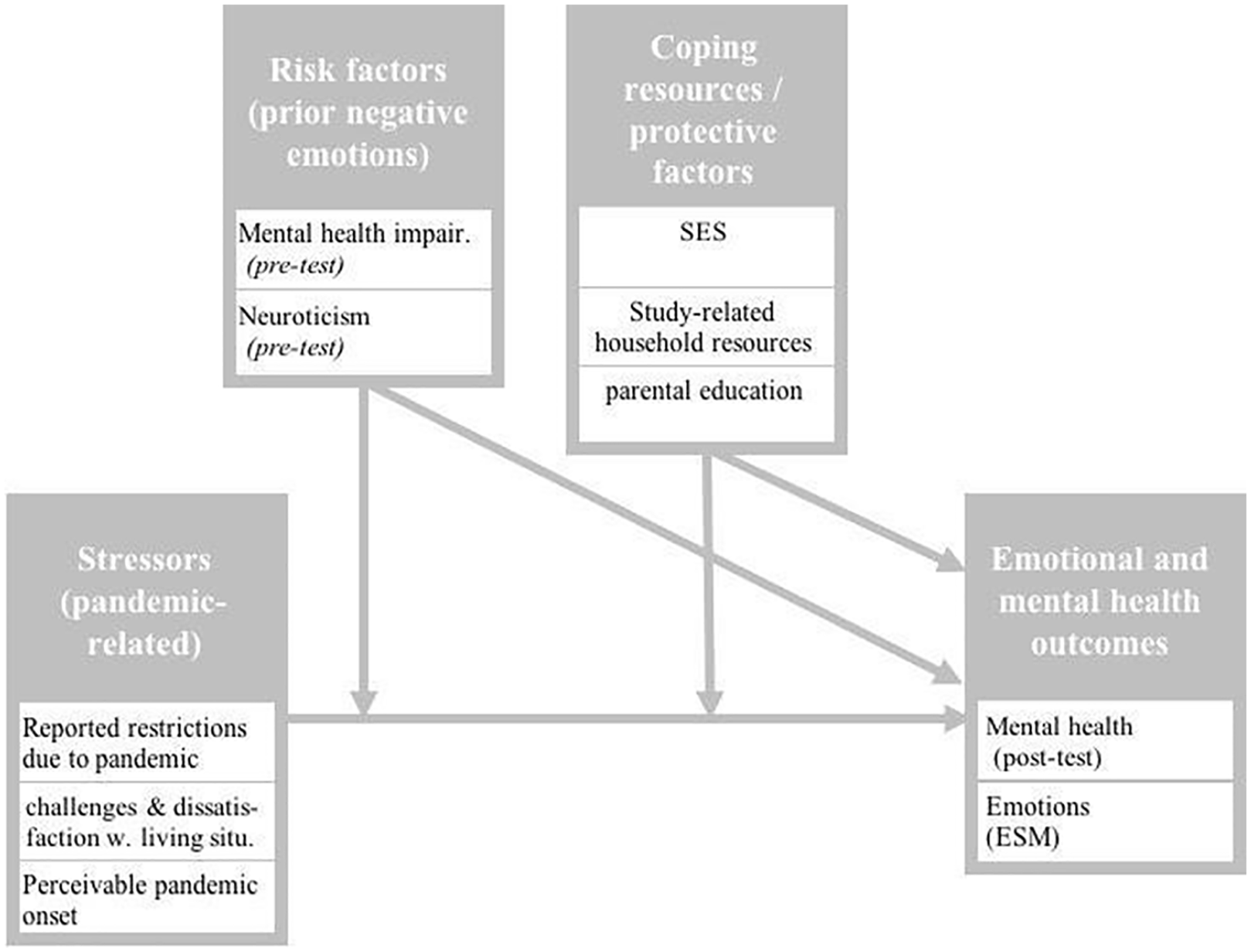
Our theoretical working model explaining how the COVID-19 pandemic may have affected college students’ mental health.
We assume that both risk and predictive factors can not only have direct effects on the levels of emotions and mental health, but can also moderate the effects of the stressor (here: the pandemic) itself on these outcomes. This is in line with both the literature on general risk and protective factors (Magson et al., 2021), and the research on the specific risk and protective factors examined in this study.
Together these models help clarify why we consider mental health impairment both as a predictor and as an outcome of emotional stress reactivity. It should be noted that classification into risk and protective factors is arbitrary insofar as that all the constructs examined here are continuous variables with a pole representing risk (e.g., poverty, low emotional stability) and an opposite pole representing protection (e.g., affluence, high emotional stability).
This study extends the previous research by focusing on the longitudinal within-person changes of the in situ assessed emotions. Most previous studies on risk and protective factors of mental health and psychological well-being among college students during the COVID-19 pandemic were cross-sectional (Sun et al., 2021). The few available longitudinal either used between-person analyses (Huckins et al., 2020), which do not reliably tell how emotions change within persons (Kievit et al., 2013; Moeller, 2022), or they used very few measurement time points (Savitsky et al., 2020b), whereas we used intensive longitudinal data of emotions being measured in the moments and contexts in which they occurred.
Research Questions
This study examined four major research questions related to positive emotions (engagement, joy, interest, and contentment) and negative emotions and affective states (anxiety, depressive feelings, hopelessness, boredom, feeling tired, feeling confused, and frustration). All hypotheses related to these research questions were preregistered with the Open Science Framework (see Moeller, von Keyserlingk, et al., 2020):
Methods
Sample and Data Collection
The data were collected from February to April 2020 at a large public research university in Southern California. Students were recruited by several classroom announcements made in large lectures, fliers posted around campus, and online advertisements on social media. A convenience sample of 141 undergraduates consented to participate in the study. Among those, 41% majored in health and biological sciences, 15% in STEM (science, technology engineering, and mathematics) majors, 33% in social and applied social sciences, 4% in arts and humanities, and 7% had not yet declared their major at the time of data collection. 73% of study participants self-identified as women. Study participants had diverse racial and ethnic backgrounds with 53% Asian/Asian American, 27% Hispanic or Latino/Latin American, 14% White/European American, and 6% other.
Data collection consisted of a presurvey, a series of repeated ESM surveys, and a postsurvey. Participants were informed that they would receive a $50 gift card at the end of the study. Participants did not receive reminders to complete notifications.
Directly after consenting to participate in this study, students completed the 20-question online presurvey. In the last part of this survey, they were instructed to download the assessment app (ExpiWell) to participate in the experience sampling. Data collection with experience sampling continued over the course of 7 weeks.
It should be noted that this study was a secondary data analysis. The data collection had been planned with other research questions in mind, and the onset of the pandemic surprised us during the ongoing study. Because one original goal of this study was to compare whether different surveying schedules (different lengths and intensities of the data collection) made a difference for the predictive value of ESM responses and the response rates, students were randomly assigned to one of three groups (Group A with N = 48, Group B with N = 52, and Group C with N = 41) with distinct study durations (see Supplemental Material S-2 available in the online version of this article).
ESM surveys were sent to students in 2020 during observation Window 1 (February 24 to March 6) and observation Window 2 (March 30 to April 10). In between the two observation windows, the campus moved instruction online and urged students to leave campus housing on March 10, the World Health Organization declared a pandemic on March 11; The U.S. government declared a national emergency on March 17, California issued a statewide stay-at-home order on March 19, and the campus announced its first confirmed COVID case on March 23.
We used a signal-contingent sampling scheme with random time points for the ESM surveys. Each student was prompted to answer 50 ESM surveys (for the dates of these surveys, see online Supplemental Figure S-1). ESM questionnaires timed out and became unavailable if participants did not complete the full questionnaire within 30 minutes. Surveys were sent to students only on weekdays. The total number of completed ESM surveys (= sample size on the intraindividual level) was 2,661. The average number of valid ESM responses per person was 21 (Table 1). The repeated ESM surveys included 15 questions (see online Supplemental Material S-4). Last, students were asked to take a 19-question online posttest survey in April 2020 after completing all ESM surveys.
Slopes of Emotions Regressed on the Binary Measurement Time Point Variable (Model 1)

Note. p Value is two-tailed here. Coefficients marked bold are statistically significant at p ≤ .05. ICC = intraclass correlation coefficient; ESM = experience sampling method.
Mean score across all ESM surveys at prepandemic onset. bChange from pre- to postpandemic onset.
Measures
Emotions
Emotions were assessed in the experience sampling surveys. In every survey, students were asked to what extent they felt the following 11 emotions when they were beeped: engaged, interested, frustrated, confused, bored, anxious, depressed, tired, joyful, content, and hopeless. Students responded to these questions on a 5-point Likert-type scale (1 = not at all, 2 = a little, 3 = somewhat, 4 = more than some, 5 = extremely). In every survey, the questions about students’ emotions were displayed in a random order.
Personality Trait Emotional Stability
Emotional stability was assessed in the presurvey with the following two items from the 10-item short scale NEO from Gosling et al. (2003): I see myself as someone who (a) “is relaxed, handles stress well” and (b) “gets nervous easily.” Students responded to these items on a 5-point Likert-type scale (1 = strongly disagree, 2 = disagree, 3 = neither agree nor disagree, 4 = agree, 5 = strongly agree). Please note: We measured instability (neuroticism), but use the reversed term emotional stability throughout the manuscript, because it is better known in the literature.
Mental Health Impairment
Mental health impairment was assessed with 10 items based on the K10 screening instrument for nonspecific psychological distress by Kessler et al. (2002). Students were asked how often in the past seven days they felt (a) “tired out for no good reason?” (b) “nervous?” (c) “so nervous that nothing could calm you down?” (d) “hopeless?” (e) “restless or fidgety” (f) “so restless you could not sit still?” (g) “depressed?” (h) “that everything was an effort?” (i) “so sad that nothing could cheer you up?” (j) “worthless?” Students responded to these items on a 5-point Likert-type scale (1 = none of the time, 2 = a little of the time, 3 = some of the time, 4 = most of the time, 5 = all of the time).
Access to Study-related Household Resources During the Pandemic
Four questions in the postsurvey asked students if they had access to (a) a quiet study place without distractions, (b) a computer or other devices for course related tasks, (c) a stable internet connection, and (d) needed course material for online courses. Students responded to these items on a 7-point Likert-type scale (1 = never, 7 = all the time).
Self-Reported SES
Subjective SES was measured using one item of the MacArthur scale on subjective social status (Adler et al., 2000). Students were asked to indicate their position on a 10 rung ladder that represents society. The top of the ladder represents people in society with a very high SES, earn a lot of money and have a high education level, whereas the bottom of the ladder represents a very low SES (Adler et al., 2000).
Analytical Methods
The analyses for this study were preregistered after data collection but prior to any analyses (Moeller, von Keyserlingk, et al., 2020), using the templates for preregistrations of ESM studies proposed by Kirtley et al. (2020).
To examine Research Question 1, the effect of the pandemic onset on students’ emotion levels and their intraindividual changes (Research Question 1) were analyzed with multilevel random coefficient regression analyses (see Equation 1) in Mplus (version 7.4; Muthén & Muthén, 1998–2015), with time points nested in individuals. The advantage of such models is that they allow both intercepts and slopes to vary across individuals. We used full information maximum likelihood estimations for missing data handling.
The Mplus input files can be found as open code in the online Supplemental Material S-1. To examine whether positive and negative emotions changed as a function of the COVID-19 pandemic arriving in the United States, we first created a binary variable indicating whether ESM data were collected in the week(s) before the official declaration of COVID-19 as a pandemic by the WHO (that occurred on March 11, 2020) and the subsequent campus closures (which were announced on March 12, 2020 at this university). The binary time variable was coded 0 for before and 1 for after the official pandemic onset. We then estimated the intraindividual slope in the emotions by regressing the emotion on this binary time variable at the intraindividual level (Equation 1). Because of the relatively small sample size on the person level (141 individuals), it was not possible to include all emotion outcomes in the same statistical model. Therefore, a separate model was estimated for each emotion.


On Level 1 (= intraindividual), a random intercept (
To examine Research Questions 2 and 3, all models examining the effects of the between-level predictors on emotion levels and emotion changes were analyzed with multilevel intercepts-and-slopes-as-outcomes models. For that purpose, we added the respective risk factors in separate models as person-level (Level 2) predictors and a cross-level moderator/interaction to the aforedescribed model in multilevel intercepts-and-slopes-as-outcomes models (Equation 2). In addition to the parameters described in Equation 1 above, this model includes the Level 2 predictor


Since no standardized coefficients are estimated for the intended analyses (type = two-level random) in the program Mplus, we transformed all variables to a scale from 1 to 10 by using a variant of the Percent of Maximum Possible (POMP) transformation (see Little, 2013). We chose this solution over the option to standardize all variables manually because of the various problems that can result from standardizing (intensive) longitudinal and nested data (Hamaker & Grasman, 2015; Moeller, 2015). Figures of the models (Figure 2 and online Supplemental Figure S-2) were created with Python.

Distributions of the intraindividual trajectories for each person (blue lines) and on average (red line), with the red dots representing the average at each time point and the vertical red lines representing the standard deviations for each time point.
As psychological processes of change take place within individuals, intraindividual models are needed to understand these intraindividual processes (Molenaar, 2008; Reitzle & Dietrich, 2019). For that purpose, we analyzed and plotted the trajectory from the first week(s) (prepandemic onset) of ESM data collection to the second (postpandemic onset) week of ESM data collection for each individual.
Results
Linking the Pandemic to Changes in Emotions (Research Question 1)
To examine whether positive and negative emotions changed due to the arrival of the COVID-19 pandemic in the United States, we regressed the emotions on the dichotomous pandemic-onset-variable at the intraindividual level. The results of these models are summarized in Table 1. The slopes indicate whether an emotion increased or decreased from the first week of data collection (before the official pandemic onset) to the second week of data collection (after the pandemic onset). Only two emotions showed a significant change, and none of them was in the expected directions (Table 2). There was a significant increase in engagement (Β = .362) and a decrease in tiredness (Β = −.528). Thus, we can reject our hypotheses that the declaration of COVID-19 as a pandemic in the United States and the subsequent campus closures led to an observable increase in students’ momentary negative emotions and decrease in momentary positive emotions.
Emotions on Prior Mental Health Impairment (MHI)

Note. All estimates are unstandardized. p Value is one-tailed. Coefficients marked bold are statistically significant at p ≤ .05.
The variance of the slope indicates interindividual differences in regard to the intraindividual trajectories in emotions from before to after the pandemic onset. Figure 2 illustrates this interindividual heterogeneity in regard to intraindividual changes in emotions, which shows increases for some individuals and decreases for others in each of the eleven examined emotions. For this figure, we first calculated each person’s average for Time 1 (before the pandemic onset) and Time 2 (after pandemic onset) and then plotted the intraindividual trajectories as blue lines, and the change from the interindividual average (red dot) from Time 1 to Time 2 as red horizontal line.
Linking Changes in Emotions to Risk Factors (Research Question 2)
Next, we examined whether the risk factors of prior mental health impairment and trait emotional stability predicted changes in emotions from before to after the pandemic onset.
As expected, prior mental health impairments (Table 2) were a significant negative predictor of all positive emotion mean scores (−.237 ≤ Β ≤ −.129). Likewise in line with our hypotheses, prior mental health impairments significantly positively predicted all negative emotion mean scores (.146 ≤ Β ≤ .350). In contrast, prior mental health impairments predicted the pre-to-post pandemic onset change in only one emotion: feeling content (Β = −.119).
As expected, low emotional stability (Table 3) was a negative significant predictor of various positive emotion mean scores, namely feeling interested (Β = −.088), feeling engaged (Β = −.102), feeling joyful (Β = −.185), and feeling content (Β = −.198). Likewise in line with our hypotheses, low emotional stability was a positive significant predictor of various negative emotion mean scores, namely feeling anxious (Β = .158), feeling frustrated (Β = .094), feeling depressed (Β = .087), feeling hopeless (Β = .115), and feeling tired (Β = .169). In addition, low emotional stability predicted the pre-to-post pandemic onset change in feeling anxious negatively (Β = −.092) and the change in confusion positively (Β = .087).
Emotions on Trait Emotional Instability

Note. All estimates are unstandardized. p Value is one-tailed here. Coefficients marked bold are statistically significant at p ≤ .05. Please note: We measured instability (neuroticism), but use the reversed term emotional stability throughout the article, because it is better known in the literature.
Linking Changes in Emotions to Protective Factors (Research Question 3)
Socioeconomic Status
The subjectively perceived SES predicted the mean score of only one emotion, contentment (Β = .227) and the intraindividual change in only one, other, emotion: feeling joyful (Β = .151; Table 4). In our preregistered hypotheses, we had expected the SES to be positively associated with the changes and intercepts of positive emotions and to be negatively associated with the changes and intercepts of negative emotions.
Emotions on Socioeconomic Status (Ladder Question)

Note. All estimates are unstandardized. p Value is one-tailed here. Coefficients marked bold are statistically significant at p ≤ .05. SES = socioeconomic status.
Parental Education
Parental education predicted the mean score of feeling anxious (Β = .176), frustrated (Β = .125), depressed (Β = .134), hopeless (Β = .143), and feeling tired (Β = .142), as well as the intraindividual change in two other emotions: feeling bored (Β = .087) and feeling interested (Β = .089; Table 5).
Emotions on Parents’ Education

Note. All estimates are unstandardized. p Value is one-tailed here. Coefficients marked bold are statistically significant at p ≤ .05.
Study-Related Household Resources
The access to study materials predicted the mean scores of feeling frustrated (B = −.094), feeling hopeless (B = −.097), feeling tired (B = −.136), and feeling confused (B = −.097; Table 6). Six emotions showed a change from before to after the pandemic onset that depended significantly on the access to a study place: feeling anxious (B = −.211), feeling frustrated (B = −.152), feeling depressed (B = −.133), feeling hopeless (B = −.147), feeling joyful (B = .083), and feeling content (B = .104).
Resource 1: Do You Have the Study Materials (Textbooks) You Need for Your Courses in This Quarter?

Note. All estimates are unstandardized. p Value is one-tailed here. Coefficients marked bold are statistically significant at p ≤ .05.
The access to a stable internet connection predicted the mean scores of feeling frustrated (B = −.097), feeling hopeless (B = −.092), feeling tired (B = −.231), and feeling confused (B = −.102; Table 7). Three emotions showed a change from before to after the pandemic onset that depended significantly on the access to a study place: feeling bored (B = −.124), feeling interested (B = .116), and feeling joyful (B = .154).
Resource 2: Do You Have a Stable Internet Connection?

Note. All estimates are unstandardized. p Value is one-tailed here. Coefficients marked bold are statistically significant at p ≤ .05.
The access to a computer or other working device predicted the mean scores of feeling frustrated (B = −.177), feeling hopeless (B = −.122), feeling tired (B = −.228), feeling bored (B = −.174), and feeling confused (B = −.182; Table 8). Two emotions showed a change from before to after the pandemic onset that depended on the access to a computer or other working device: feeling anxious (B = .144) and feeling tired (B = .117).
Resource 3: Do You Have Computer(s) or Other Devices to Work on Your Course-related Tasks?

Note. All estimates are unstandardized. p Value is one-tailed here. Coefficients marked bold are statistically significant at p ≤ .05.
The access to a study place allowing the student to focus on their coursework predicted the mean scores of feeling frustrated (B = −.093), feeling hopeless (B = −.057), feeling tired (B = −.091), feeling joyful (B = .122), and feeling content (B = .130; Table 9). Three emotions showed a change from before to after the pandemic onset that depended on the access to a study place: feeling frustrated (B = −.079), depressed (B = −.106), and hopeless (B = −.093).
Resource 4: Do You Have a Study Place That Allows You to Focus on Your Coursework This Quarter?

Note. All estimates are unstandardized. p Value is one-tailed here. Coefficients marked bold are statistically significant at p ≤ .05.
Linking Changes in Emotions to Changes in Mental Health Impairment (Research Question 4)
As expected, changes in emotions from the first to the second week of ESM data collections were associated with changes in mental health in the pretest versus posttest (see Table 10). The intraindividual slopes of all negative feelings, except for feeling tired, were positively predicted by the change in mental health impairment (difference score post- minus pretest). This means that an increase in mental health impairment was positively associated with increases in the negative emotions (feeling anxious, frustrated, hopeless, confused, and bored). Changes in three positive emotions were unrelated to changes in mental health impairment. At first sight, it may appear as if changes in interest were positively associated with changes in mental health, however, this finding is only significant if the one-sided, not if the two-sided p value is considered, and since it is an unexpected finding, the correct p value to consider would be the two-tailed score. Thus, in sum, changes in the positive emotions can be considered all unrelated to changes in mental health impairment. Similarly, the mean scores (intercepts) of all emotions, positive as negative, were unrelated to the change score of mental health impairment.
How Changes in Emotions Relate to Changes in Mental Health Impairment (ΔMHI; Model 4)

Note. All estimates are unstandardized. p Value is one-tailed. Coefficients marked bold are statistically significant at p ≤ .05.
Discussion
This study examined the impact of the COVID-19 pandemic on college students’ positive and negative emotions by comparing ESM data before and after the onset. In addition to average effects, we examined whether the interindividual variance in the intraindividual trajectories were explained by a comprehensive set of risk factors and protective factors, including trait emotional stability, prior mental health impairments, SES, and study-related household resources. Overall, the three main findings of this study are as follows.
First, there were surprisingly few changes in student emotions from before and after the onset of the pandemic. Notably, we unexpectedly found that students’ tiredness decreased while their engagement increased from before to after the pandemic onset.
Second, the risk factors of prior mental health impairments and low trait emotional stability predicted the mean scores in emotions (i.e., a student’s average anxiety across all measurement time points) in the expected directions (positive relations with negative emotions and negative relations to positive emotions). However, the intraindividual change in emotions (stress reactivity) was not affected by these predictors.
Third, SES only positively predicted the mean score of a single emotion, feeling content, and the intraindividual change in feeling joyful. The protective factors with the most striking relations to students’ emotions were study-related household resources, particularly access to study materials. Access to study materials predicted the intraindividual change in emotions more than their mean scores, in all the expected directions (positive effect on positive emotions’ slopes and negative effects on negative emotions’ slopes). Hence, immediate change in emotions in the first weeks after the onset of the pandemic was related to access to specific study-related resources, rather than to broader measures of students’ socioeconomic background.
Theoretical Implications
Most of the previous studies on risk and protective factors with regard to emotional coping with the COVID-19 pandemic rely on cross-sectional self-reports, although a few (Huckins et al., 2020) examined emotional coping with similar intensive longitudinal data as this study does. Since we examined intraindividual trajectories with intensive longitudinal data, our results cannot directly be compared with the many previous cross-sectional studies or the longitudinal studies employing between-person methods that examined risk and protective factors with regard to students’ well-being and mental health during the COVID-19 pandemic. Our longitudinal design in combination with our within-person analyses enabled us to examine within-person change in emotions, as well as the predictors of such within-person change, which is a rather new focus, compared with previous research. Our study suggests that the onset of the pandemic did not directly translate into an immediate decrease in emotional well-being for students. This contrasts a study by Huckins et al. (2020), which found that anxiety and depression increased for college students both in comparison with earlier weeks in the study term and a previous term. These differences between our findings and Huckins et al. (2020) may reflect differences between the geographical locations and student populations. Huckins et al. (2020) was situated at Dartmouth, a highly selective private Ivy-League University which is located in the U.S. East Coast. In contrast, this study is situated in the U.S. West Coast at a large public university that is federally designated as an Asian American and Native American Pacific Islander–serving institution and as a Hispanic-serving institution. Another plausible reason for these differences between both studies is methodological: The sample size of momentary measures was much larger in the Huckins et al. (2020) study, with 113,864 observations for anxiety and 20,323 observations for depression, compared with our 2,995 ESM observations. With such large sample sizes, even the smallest differences may become statistically significant, and Huckins et al. (2020) reported relatively small mean score differences in both anxiety and depression. Also, Huckins et al. (2020) compared the anxiety and depression values from a previous term with those from the first COVID-19 term, contrasting our comparison from weeks before to after the pandemic onset within the first COVID-19 term. This difference is potentially larger than the difference that we examined, because in the prior comparison term reported by Huckins et al. (2020), anxiety and depression decreased in March and April, compared with earlier weeks, while they increased in March and April during the COVID-19 term. Thus, the difference between the decreased values in the comparison term with the increased values in the COVID-19 term is larger than the difference between the earlier weeks in the term and the last weeks in the term that we examined in our study.
Overall, our results support research that suggests emotional granularity (Lange et al., 2020) as the effects of the predictors on emotions mean scores and trajectories differ with respect to specific emotions. Predictors affected different emotions in unique ways. This is consistent with prior research. For instance, our finding that students reported tiredness as their strongest emotion corresponds with other studies examining affective experience in educational settings, such as Moeller, Brackett, et al. (2020), who also reported this pattern for high school settings. It has often been discussed that sleep deprivation is a serious risk to the psychological and emotional well-being of college students and young adults (National Sleep Foundation, 2006; Owens & Adolescent Sleep Working Group, 2014; Owens et al., 2010). The decrease from before to after the pandemic onset in tiredness may have protected some students from some of their usual stress, which may have buffered expected negative effects of the pandemic onset on college students’ emotions.
The finding that trait emotional stability was only predictive for mean scores but not intraindividual changes in emotions does not support theories assuming that trait emotional stability (or neuroticism) affect both emotional sentiments and stress reactivity (Bolger & Schilling, 1991). This may be due to students not having experienced sufficient stress for such individual differences in the stress response to become observable.
From a methodological perspective, our finding that mental health and trait emotional stability measures predicted the mean scores of students’ positive and negative emotions in expected directions may be considered as an indicator of the measures’ validity. The items capturing mental health impairment and trait emotional stability strongly refer to experienced emotions, so that these relations between predictors and ESM emotion measures are not surprising and may even be judged as tautological. Nevertheless, finding covariances between the state and trait measures referring to negative emotional experiences yields valuable insights, because it is theoretically possible and empirically found sometimes that state and trait measures do not capture the same phenomena and therefore fail to function in similar ways (Goetz et al., 2013).
This study has several implications for educational administrators and public health professionals in the sector. Recently, many scholars expressed concerns that students with low-income backgrounds would experience even more psychological distress and stronger decreases in well-being during the COVID-19 pandemic (Lederer et al., 2021; Purtle, 2020). Our results showed that students from lower income backgrounds did not suffer from larger increases of negative emotions overall. Instead, we found more narrowly evidence that specific study-related household resources (access to a quiet study place and study materials) were relevant predictors of college students’ emotional well-being and ill-being after the onset of the pandemic and the related shift to emergency remote learning. These findings provide actionable insights on how to support students coping with stressors: in addition to traditional tools, such as counseling, or mental health interventions (see Seppälä et al., 2020), interventions for college students could focus on mitigating the most acute access limitations to study-related resources, in the hope not only to improve the study behavior itself, but also improve college students’ psychological well-being.
Limitations
This study relied on a quasi-experimental design, with all the limitations to causal interpretations that this entails. Moreover, when planning the study, we did not anticipate such a quasi-experiment (or pandemic) to happen. In this sense, this was a secondary analysis of data that were collected originally with other research questions in mind. Therefore, we did not include predictors that in retrospect would be potentially useful for the understanding of coping in the face of a pandemic, such as health-related demands and resources. Because of these reasons, we were only able to preregister this study after the data collection, but before the data analysis.
In order to examine the long-term-effects of the pandemic, it would have been desirable to have data from a longer period of ESM data collection, such as the week-to-week reports across an entire term as reported by Huckins et al. (2020). As stated above, additional comparison data from spring terms in the years before (or after) the pandemic would have been needed to disentangle the usual emotional changes over the course of a typical term from those due to the pandemic.
For all analyses concerning the interindividual level, the sample size for this study was relatively small (141 individuals). This is due to the fact that this was originally planned to serve as a pilot study on the impact of different surveying schedules. This small number of individuals may affect the replicability of the findings in the following ways: We know that correlation coefficients only stabilize in samples of about 250 or more individuals (Schönbrodt & Perugini, 2013). In particular, our sample may have been too small to discover any systematic interindividual differences in emotions as a function of subjective SES. As the violin plots (see online Supplemental Figure S-2) indicate, there were very few individuals on either pole of the response scale of the subjective SES question, and a larger sample with enough individuals in each subjective SES group would be needed to examine this relationship.
The assignment of mental health impairment and trait emotional stability to risk factors and socioeconomic indicators as protective factors is arbitrary insofar as all these variables are continuous, with a negative and a positive pole. The presence of mental health can be considered a protective factor while its absence is considered a risk factor. Vice versa, poverty could be considered a risk factor, but the opposite, affluence, a protective factor. Thus, future studies could aim to find out which exact study-related resources can be affected with which measures during such states of emergency to make sure students have what they need to study and feel well. Another research question for future studies is whether study-related demands affect students’ psychological well-being in similar ways as study-related resources, and whether the demands–resources models of engagement and burnout (Demerouti et al., 2001; McVicar, 2016) may contribute to the understanding of best support for students during a pandemic.
The time window during which we were able to examine the changes in students’ emotions was very early into the pandemic, and rather short. At that point of time, the potential stressors were still less pronounced than during later phases of the pandemic. For example, local prevalence rates were rather low, younger people were thought to be relatively safe, and the economic impacts were muted. This may have affected both the extent to which changes in emotions were observable, and the potentially disproportionate impacts of pandemic related by personal risk and protective factors.
Conclusion
Using ESM data about college students’ emotions in the weeks before and after the onset of the COVID-19 pandemic, we did not observe the expected decrease in positive emotions nor the expected increase in negative emotions on average. Among a comprehensive set of potential risk and protective factors, including prior mental health impairment, trait emotional stability as well as subjective SES and familial resources, study-related household resources emerged as the most consistent predictor of changes in students’ emotions. These study-related resources have been most proximally related to students’ well-being during the shift to remote instruction. These findings provide actionable insights on how to support students coping with online learning in times of a pandemic: providing practical support with respect to study-related resources and being mindful of students’ limitations in access to these resources.
Supplemental Material
sj-docx-1-ero-10.1177_23328584211065725 – Supplemental material for Risk and Protective Factors of College Students’ Psychological Well-Being During the COVID-19 Pandemic: Emotional Stability, Mental Health, and Household Resources
Supplemental material, sj-docx-1-ero-10.1177_23328584211065725 for Risk and Protective Factors of College Students’ Psychological Well-Being During the COVID-19 Pandemic: Emotional Stability, Mental Health, and Household Resources by Julia Moeller, Luise von Keyserlingk, Marion Spengler, Hanna Gaspard, Hye Rin Lee, Katsumi Yamaguchi-Pedroza, Renzhe Yu, Christian Fischer and Richard Arum in AERA Open
Footnotes
Acknowledgements
We acknowledge the financial support for this research that was associated with a larger research project funded by the Andrew W. Mellon Foundation, #1806-05902, and a Jacobs Foundation Early Career Research Fellowship to Julia Moeller. We thank the Open Access Fund of the Leipzig University Library for covering the publication fees.
ORCID iDs

Authors
JULIA MOELLER is an assistant professor of educational psychology and interim professor of early child development at the University of Leipzig, Germany, Marschnerstr. 31, 04109 Leipzig, Germany,
LUISE VON KEYSERLINGK is a postdoctoral scholar at Technical University Dortmund and was previously a postdoc at the University of California, Irvine. Her research is focused on motivation, educational choices, composition effects, and students’ well-being in higher education.
MARION SPENGLER is a professor of individual differences at Medical School Berlin, Germany. Her research is focused on personality development in educational contexts as well as the role of personality for educational trajectories and across the life span.
HANNA GASPARD is a deputy professor at the Center for Research on Education and School Development at Technical University Dortmund and affiliated with the Hector Research Institute of Education Sciences and Psychology at University of Tübingen. Her research interests include students’ motivational and educational trajectories and interventions to foster student motivation and achievement.
HYE RIN LEE is a PhD candidate in the School of Education at the University of California, Irvine. Her research is focused on academic motivation, psychological interventions, student engagement, STEM (science, technology engineering, and mathematics) education, and higher education.
KATSUMI YAMAGUCHI-PEDROZA is a social psychology PhD student at the Pennsylvania State University. Her research interests are broadly related to gender, intersectionality, stereotyping, and prejudice.
RENZHE YU is a PhD candidate at the University of California, Irvine. His primary research interest is using data science to understand and support student success and equity in higher education.
CHRISTIAN FISCHER is an assistant professor of educational effectiveness at the Hector Research Institute of Education Sciences and psychology at the University of Tübingen, Germany. His research examines pathways to improve STEM (science, technology engineering, and mathematics) teaching and learning, in particular through the use of digital technologies.
RICHARD ARUM is a professor of sociology and education at the University of California, Irvine. His research is focused on the legal and institutional environments of schools, social stratification, and digital education.
References
Supplementary Material
Please find the following supplemental material available below.
For Open Access articles published under a Creative Commons License, all supplemental material carries the same license as the article it is associated with.
For non-Open Access articles published, all supplemental material carries a non-exclusive license, and permission requests for re-use of supplemental material or any part of supplemental material shall be sent directly to the copyright owner as specified in the copyright notice associated with the article.
