




Abstract
In spring 2020, COVID-19 seismically shifted the education landscape as schooling moved online. We report a small-scale mixed-methods study of how that upheaval affected three-dimensional science learning in elementary school classrooms, and how the situation changed when school resumed, in modified form, in fall 2020. Teachers with experience in 3-D science instruction completed two surveys, in summer and winter 2020, and a subgroup of the summer respondents participated in semistructured interviews. After a near-total collapse of science instruction in the spring, the fall brought a partial return to normalcy, but the prevalence of practices such as hands-on investigations, small-group discussions, and all-class meaning-making was still only about half what it had been before the crisis. Based on the survey data and teachers’ comments, we offer suggestions for a future in which aspects of online learning may be a permanent part of the educational environment.
Keywords
Background
The Next Generation Science Standards (NGSS) and the Framework for K–12 Science Education called for a shift in science pedagogy for elementary teachers—for many a dramatic shift (National Academies of Sciences, Engineering, and Medicine, 2019, 2020; National Research Council, 2012; NGSS Lead States, 2013). Teachers are asked to support “three-dimensional” (3-D) learning—to integrate a challenging progression of core disciplinary ideas, crosscutting concepts, and science and engineering practices. This vision includes understanding science as practice and as a way of knowing rather than just as a body of facts and requires viewing students as epistemic agents “who take, or are granted, responsibility for shaping the knowledge and practice of a community” (Stroupe, 2014, p. 488). Teachers no longer “tell,” but rather help their students figure out. NGSS-aligned lessons are typically framed around a real-world phenomenon and a related question for students to explore and investigate.
While there is no single instructional approach that is optimal across all topics, grades, and contexts, attributes of successful approaches include giving students opportunities to engage in investigation themselves; providing opportunities for them to interact socially, exchanging and debating ideas; and building a community of learners that works together to build understanding (National Academies of Sciences, Engineering, and Medicine, 2019; National Research Council, 2007). Learning to orchestrate and facilitate such 3-D learning has required considerable work on the part of teachers, but some have embraced it. In our various identities as educators, curriculum developers, education researchers, and scientists, we are firmly convinced of the critical importance of science education with these characteristics and are committed to supporting its implementation. We have found three components of 3-D science instruction to be particularly important and have made them central to the curricula we have developed: hands-on activities, small group work, and all-class meaning-making discussions, in which students present and discuss their small-group work (Michaels & O’Connor, 2012; Windschitl et al., 2018). While these specific practices may not be either necessary or sufficient for effective 3-D science instruction, they are concrete components that can signal, particularly in elementary school, that students are engaging in the authentic investigation of phenomena and in collective sense-making, practices that are crucial to an instructional approach focused on doing rather than one centered on telling (Michaels et al., 2009; National Academies of Sciences, Engineering, and Medicine, 2019, 2020; Windschitl et al., 2018).
In spring 2020, the novel coronavirus seismically shifted the education landscape, in ways that seemed to threaten the progress that had been made toward 3-D science learning. Nearly 2 years later, the upheaval is still with us, and some aspects could continue well into the future or recur in response to a new disaster. Even after the current crisis has passed, some aspects of remote teaching and learning may become permanent parts of the education system, at least for some student populations. The science education community needs to understand how these new models for remote teaching and learning have affected elementary science instruction, in order to shape their future development in ways that support, rather than undermine, the NGSS vision of 3-D teaching and learning.
There is an extensive literature on the use of technology in education, and a large body concerned specifically with K–12 science education (Barbour, 2019; Linn & Eylon, 2011; Major et al., 2018). Substantial subliteratures deal with fully online instruction, often, but not always, asynchronous (e.g., Bryans-Bongey, 2016; DiPietro et al., 2008; Hoadley & Linn, 2000; Kim et al., 2007; Lipponen et al., 2003) and with the use of technological tools such as interactive whiteboards and online instructional units within a conventional classroom setting (e.g., Ibourk & Kendrick, 2021; Kerawall et al., 2013; Kershner et al., 2010; Linn & Eylon, 2011; Sandoval & Reiser, 2004). Another line of research concerns the comparative advantages of hands-on and virtual investigations and laboratories (de Jong et al., 2013). While none of this work anticipated online educational environments like the ones that emerged during the COVID-19 pandemic, in general, “the principles of high-quality science and engineering education remain the same,” regardless of the mode of instruction (National Academies of Sciences, Engineering, and Medicine, 2020, p. 7). Quality face-to-face and web-based learning environments generally share similar characteristics, which include active engagement, collaborative interaction, and the development of communities of interest, and meaning-making discourse (American Distance Education Consortium, 2003; Bryans-Bongey, 2016; DiPietro et al., 2008; Kosloski & Carver, 2016).
The pandemic created conditions for a massive, unplanned, uncontrolled experiment in the implementation of online instruction. No researcher would have designed such an intervention, and no internal review board would have approved it, but it nevertheless provides an opportunity to explore what happened when districts, teachers, students, and parents confronted the challenge of teaching and learning in this new environment.
Research Questions
The authors have been involved in curriculum development and teacher professional development for elementary school science for many years and have built relationships with several local school districts and many teachers who are deeply committed to the principles of 3-D science education and are familiar with pedagogical approaches to support it (Lacy et al., 2021; TERC, 2011, 2015). This group of teachers seemed ideally equipped both to make the best of this challenging situation, and to be able to reflect insightfully on their experience. Through a combination of survey responses and in-depth interviews, we sought to address these research questions:
Building on our findings, we suggest possible steps to support teachers and students in 3-D learning experiences in the post-COVID environment. We think it is important to highlight the experience of the teachers. Our education system can be healthy only if teachers not only have the tools and structures to be effective educators but also experience a rewarding work environment.
Methodology
Data Sources and Instruments
The study takes a mixed-methods approach (Creswell & Plano Clark, 2017), incorporating three components: An online survey administered in summer 2020, shortly after the end of the school year; in-depth, semistructured interviews during summer 2020 with a selected group of survey respondents; and a second online survey administered in December 2020–January 2021, after completion of the fall 2020 instructional period. This approach, combining quantitative analysis of fixed-response items with qualitative analysis of open-ended questions, reflects both our interest in how specific aspects of science instruction were affected, and our awareness that in such an unprecedented situation we needed to be open to hearing experiences and reactions that we could not anticipate.
Forced-response survey items provided rough quantitative information about a few key aspects of science instruction, notably the average time spent on science instruction, and the frequency of our three focal aspects of 3-D science instruction: hands-on activities, small-group work, and all-class meaning-making. These data provide a narrow window into what happened to science instruction both in the abrupt shutdown of schools in spring 2020 and the partial return in fall 2020.
Open-ended survey items and interviews allowed us to probe more deeply into teachers’ experiences, clarifying the constraints they were under, challenges they faced, resources available to them, approaches they tried—and what they observed about their own and their students’ experiences. The full surveys and interview protocol are provided in the Supplemental Materials 1, 2, and 3 available in the online version of this article.
Participants
Participants were Grades 4 to 5 teachers in four public school districts in eastern Massachusetts. (Three participants in the summer survey also taught in Grade 6.) All of these districts had adopted NGSS-aligned science curricula, and we had provided a large majority of the teachers with professional development in which they both learned about the shift to 3-D science teaching and learning and experienced it as science learners themselves. For the summer 2020 study, we reached out to the district science coordinators and asked them to forward our request to teachers in their districts. Thirty-two teachers completed the survey (out of approximately 100 contacted), and 28 volunteered to be interviewed. The teaching experience of the summer survey participants ranged from 3 to 32 years. From that group, 17 (13 teachers and four science coordinators) were selected for in-depth interviews, based on their responses to open-ended survey questions, and aiming for a diversity of grades, districts, and reported experiences. Interview participants received $50 gift cards in compensation. For the winter survey, we again reached out to teachers through the science coordinators from the same districts, and received 23 responses, of which 13 came from teachers who had previously completed the summer survey. Table 1 summarizes the composition of the sample; more information about the individual teachers is provided in the online Supplemental Table S1.
Summary Information About Survey Participants
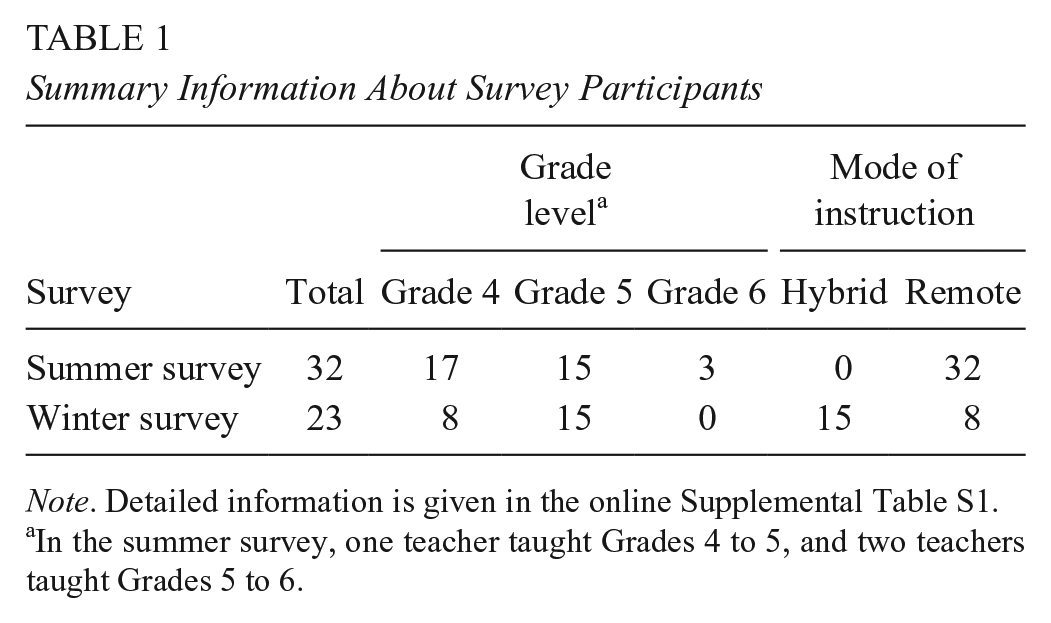
Note. Detailed information is given in the online Supplemental Table S1.
In the summer survey, one teacher taught Grades 4 to 5, and two teachers taught Grades 5 to 6.
Clearly this was not a random sample, or broadly representative. We view it rather as representing something like a best-case scenario. Our solicitation method intentionally focused on districts where teachers had familiarity and experience with 3-D science instruction, and where we knew the science coordinators to be deeply committed to excellence in science teaching and learning. We had preexisting relationships of mutual trust and respect with many of the teacher participants, based on their involvement in professional development activities and/or curriculum development projects. We therefore had reason to respect their accounts and opinions, and to anticipate that they would share those accounts with us thoughtfully and openly. Participation in the study was voluntary, so presumably those who volunteered were self-motivated to assist in such an investigation. A large majority of participants (91% in both surveys, 82% of summer interviews) taught in relatively affluent and well-resourced suburban school districts. Those districts had full-time science coordinators who typically provided guidance and material for the move to online instruction, and many students likely had home environments, technological resources and family supports that facilitated their educational engagement. Additional information about the districts is given in the online Supplemental Table S2. These teachers’ experience, motivation, and the resources available to them and their pupils, positioned them relatively well to incorporate aspects of 3-D learning as they adapted to a new learning environment. In short, if there were to be public school classes in which such learning would be sustained even under pandemic conditions, our sample would be a likely place to find them. In addition, we expected that their prior experience with 3-D science teaching would give them perspective and insight into what worked, what did not, what might be possible, and what could be helpful in the future.
Analytical Approach
For the forced-response survey items, we counted response rates for the various answers, and we reviewed teachers’ responses to open-ended questions for recurrent themes (Coffey & Atkinson, 1996). Where significant numbers of respondents raised similar issues, we coded for frequency. Because of the small size and nonrepresentative nature of the sample, however, we did not attempt to use more advanced statistical or coding techniques. Our goal here is not to present generalizable data, but rather to give a snapshot of the changes in science education practices and teachers’ experiences as they emerged within our sample.
Findings
When we reviewed the surveys and interviewed teachers in summer 2020, what we learned was sobering, though hardly surprising: The crisis virtually wiped out science instruction, especially instruction that strives toward the NGSS vision, even for these highly skilled and motivated instructors in well-resourced school districts (Research Question 1, Research Question 2). The results of the winter survey, however, were more encouraging. Given the summer to regroup, teachers sought out resources and guidance; district science coordinators developed curricula, materials, and guidelines; and children and parents did their best to adapt. Time spent on science returned to pre-COVID levels, and the practices of hands-on activities, small-group discussions, and all-class meaning-making rebounded. Challenges remained: In all four districts, at least half of instructional time was remote and asynchronous. Largely as a result of this reduction of contact time, the prevalence of those key activities remained far below what the teachers reported from pre-COVID classes, and many teachers continued to voice concerns about the limitations of the online or hybrid modalities (Research Question 3). In the following sections we explore this general picture in more detail and look for factors that may have contributed to better or worse outcomes (Research Question 4).
Spring 2020: Collapse
In most cases, teachers reported that some science instruction continued after the shift to online instruction in spring 2020, but with substantially less time than before. Only five of the 32 survey respondents reported spending no time at all on science online (and their students may have received science instruction from another teacher). The majority, however, reported substantially less time per week spent on science; the median reported drop, compared with pre-COVID, was 50%. These results are in broad agreement with a national survey, across K–12 grades, in which 88% of teachers reported less time on science through remote learning than in the classroom (National Academies of Sciences, Engineering, and Medicine, 2020).
Figure 1 shows the responses to the summer survey regarding the frequency with which the teachers used the three crucial aspects of 3-D science instruction that we asked about: hands-on activities, small group work, and all-class meaning-making discussions. The results were stark. When meeting in-person, all the teachers reported using these practices either regularly (83% to 97%) or sometimes. After the move to online instruction, the practices disappeared or became rare in most of the classes. These reports, too, are broadly consistent with those of the national survey, in which only 38% of teachers reported students engaging in experiments or investigations in the remote environment (National Academies of Sciences, Engineering, and Medicine, 2020).

Reported frequency of use of key instructional practices. (a) Hands-on activities. (b) Small-group work. (c) All-class meaning-making.
Many teachers’ open responses confirmed that this shift reflected a dramatic change in the nature of science instruction. One teacher summarized the change this way: “Learning face-to-face was hands on, inquiry-based, and completed with peers. Online learning was watching and listening and done in isolation.”
Both on the survey and in interviews, they described multiple reasons for this dramatic change. Some districts dictated that there would be no synchronous instruction at all, or that it be reserved for other subjects, or focused on social–emotional support. As one teacher wrote, “There was a lot to balance with social and emotional needs as the number one priority.” One district ordered that no new curricular material be presented, in any subject, after the move to online instruction. Some teachers reported that they had been instructed to prioritize English language arts and mathematics. One wrote, “I think science fell by the wayside for most students. It was difficult for students to do everything every week, and they focused on math and language arts activities.” Several clarified that although students were still provided with science materials and activities, direct, teacher-led science instruction did not happen. Often the materials were offered as optional enrichment activities, with no accountability. Moreover, nearly a third of teachers (9/31) reported that many of their students were unable to participate fully in online instruction.
Most teachers reported, as one put it, that “Science ‘teaching’ involved putting together lessons for students to be able to follow independently.” Another wrote, “The learning was mostly based on watching videos, trying to make meaning from readings and videos, and then producing some kind of diagram or science notebook page to demonstrate understanding.” While several teachers felt that at least some students learned well from these resources, many students did not, or it was impossible to tell. One teacher wrote, “I did a lot of work on activities, but I don’t know if they even did them!”
Two consistent themes in the open-ended responses were the importance of small-group student-to-student interaction, and discovery through hands-on activities. In response to an open-ended survey question about the difference between face-to-face and online science instruction, 13 of 32 teachers highlighted the lack of small-group discussions, and 12 mentioned the need for hands-on investigations. No other themes came close to those numbers. Following are some representative comments: I wasn’t able to engage in discussions and help guide students through their investigations and discovery. Without experiments and/or time in the day to have discussions, students are less able to grasp the science concepts that are discovered through hands-on activities and discussions. At home, students were not able to use the range of materials that were available in the classroom. They were also unable to discuss their science thinking in real-time with their classmates. We could not share or collaborate on hands on experiences that [are] an essential part to science learning. We did not provide opportunities for students to learn from one another. Most important, is the lack of student interaction. Their shared discovery and making meaning dialogue. We need to have students working hands on in groups. I missed the interactive aspect of modeling, inviting student comments and questions along the way. I also missed engaging with students WHILE they are doing hands-on learning. I felt the curriculum we were delivering was good and contained all the necessary information, but it was still really hard for the kids to process on their own.
Even amid the chaos, some teachers saw glimmers of promise. One summarized the experience this way: It was a disorganized shit show with constantly changing requirements! I worked insane hours to create curriculum (we have none) and make it useful remotely, and give kids feedback on their work. Kids who tried to participate did a fantastic job and exceeded my expectations! I just wish I could have reached the 25% who did not participate at all. I was surprised that some kids actually did better work and participated more remotely than they usually did in class—having a quiet space was very helpful for them. I was also excited to learn about some tools that helped remote learning, like making videos, that really engaged students and will be useful even after we return to school.
Some teachers reported students taking the materials up enthusiastically, particularly when they involved hands-on tasks or investigations. One wrote, Although content and group meaning making suffered during this time of emergency remote teaching, what flourished was students’ enthusiasm for creative, open STEM activities like “using two materials [to] build a boat that floats” or “make something useful out of a cardboard box.”
Another remarked that “small groups in break out rooms were very, very successful at allowing students to talk more deeply, and engage in tasks together.”
Fall 2020: Partial and Uneven Recovery
All the 23 teachers who responded to our winter survey reported that regular science instruction had resumed: The spring was a huge learning curve, less internet access for students, and we were flying [by] the seat of our pants. In the fall, we are more organized, more resources and attendance is excellent. We are back on track this Fall/Winter educating students about science content and practices. My students are excited about science again. Discussions are lively and students are actively creating meaning together.
The median time spent on science had returned to its pre-COVID value (3 hours/week), and most districts had largely resumed teaching their normal science curriculum—though, of course, with many modifications to instructional practice.
In three of the four districts studied, most classes used a hybrid model, with the class split into two cohorts that alternated between in-person meetings and remote, asynchronous instruction. In these classes, each student was receiving roughly half the pre-COVID direct instructional time, perhaps partially compensated by an effectively smaller class size. One of our study districts remained fully remote throughout the fall, and all districts retained some fully remote cohorts. Nearly two thirds of our respondents (15, 65%) reported using the hybrid, cohort-based approach. The remainder (8, 35%) were teaching fully remotely, two because their district was fully remote, the other six teaching remote classes within districts that also supported hybrid instruction. None of our respondents were teaching in a hybrid mode with both in-person and remote students participating simultaneously.
District-by-district descriptions are given in the online Supplemental Table S3. Some teachers reported using curricular materials developed specifically for the online environment. In almost all cases, the amount of time and content were dictated by the district, although a few teachers had substantial autonomy.
As Figure 2 illustrates, access to instruction was much improved from the spring. Only one teacher reported that many students were unable to participate fully in instruction.

Teachers’ reports of students’ ability to participate fully.
As Figures 1 and 3 show, this partial return to normalcy was accompanied by a partial recovery of the instructional practices of hands-on activities, small-group work, and all-class meaning-making discussions, from their near-disappearance in the crisis of spring 2020. Open-ended comments also revealed a much greater use of carefully selected, coherent curricular materials in the fall, while in the spring what science activities remained were often isolated activities selected, understandably, more for their engagement value than as part of a systematic effort to build skills and understanding (e.g., “make something useful out of a cardboard box”).

Percentage reporting using each practice regularly.
Figure 4 compares the frequency of the three practices in hybrid and fully remote classes. Because of the small numbers—only eight fully remote classes—none of the differences are statistically significant. Moreover, based on their responses and our personal knowledge of the individuals, several of the remote-only teachers are truly exceptional in their energy and dedication to high-quality science education. Nevertheless, and perhaps not surprisingly, there are indications that hands-on activities and all-class discussions were more common in the hybrid than in the fully remote setting. Less expected is the indication that small group work was at least as common in the remote-only classes, and possibly even slightly more frequent. Teachers’ comments provide some possible explanations: one (hybrid) mentioned the difficulty of in-person small-group work while maintaining social distancing, and seven commented that with the class already divided into cohorts, with half in the classroom at a time, each cohort was small enough (8–10 students) to act effectively as a small group without further division. On the other hand, teachers working in the remote environment commented on the time required for managing online breakout rooms as an obstacle, and the difficulty of managing small groups in a virtual setting.

Frequency of use of practices in hybrid and fully remote classes (fall 2020). (a) Hands-on activities. (b) Small-group work. (c) All-class meaning-making.
Figure 5 summarizes the responses from teachers of hybrid classes about whether the different practices occurred face-to-face, online, or in both settings. Overwhelmingly, these activities were carried out either face-to-face, or in both settings—and many of the teachers who chose “both,” explained that when the activities occurred online it was due to unavoidable constraints—in one case, for example, the class began meeting face-to-face only a month into the school year; in another, holidays forced one cohort to meet solely online for a time. The one teacher who selected “online” for all-class discussions and hands-on investigations wrote I only taught one science lesson in person. It was the same lesson so I presented it twice, for Cohort A and Cohort B. The kids loved it and so did I. They applauded when it was over because they miss hands-on science so much.

Hybrid classroom instructional modalities.
When asked specifically whether they saw any positive outcomes from the shift from pre-COVID classroom lessons to hybrid or remote learning, five teachers volunteered that more students were able to share their ideas, either because the cohorts were smaller than the whole class, or because of the technology: “When we discuss over zoom, kids that are reluctant to share out loud or struggle with oral language can type into the chat instead, so are more likely to participate.” Many (10/23) identified their own increased familiarity with online resources and technology as a benefit. Two highlighted that students could work at their own pace, including rewatching experiments and investigations. Four mentioned smaller class sizes, with one, teaching fully online, writing, Smaller group discussions mean each student participates more frequently. The Cohort model has led to two groups making meaning and then coming together to share their understanding and refine their thinking—more robust whole class discussions. I have also partnered one student from each cohort in breakout rooms to share. I have enjoyed doing science “with” students in their homes. In many instances, they are being more independent about reading through directions and figuring out what to do—they are also intrigued more by the work and results of others whom they did not see completing the investigation. They love to wonder about each other’s results together.
Most of the teachers, however, seemed to find it easier to identify challenges, rather than positive outcomes, from the shift to online or hybrid modes of instruction. Consistent with the trends shown in Figures 1 and 2, the most prevalent were the reduction and difficulty of hands-on activities (9/23) and of group/partner work (9/23), followed by the lack of time (6/23) and the difficulty of providing materials (4/23). Here are some typical comments: In a good year I struggle to fit in all the curriculum, and now with such limited time there is a lot I will not be able to cover in the depth I would like. I miss the hands on. . . . The tactile/kinesthetic learning is lacking. Experiences still feel like secondary sources rather than primary sources. Group/partner work is really difficult, sharing materials is frowned upon yet the only way to do science is to explore hands on. [A challenge is] getting the supplies for activities into the hands of remote learners. I need to package them to pass out while the kids are in-person in anticipation of their remote science lessons later in the week or only do science lessons remotely that require common items found in most households.
While recognizing these significant challenges, many teachers expressed some combination of relief, pride and even joy that they were actually teaching science again. Following are some representative comments: Students have a much more robust learning experience now than they did in the spring. I am now able to teach science “live” and with the actual materials. Also, I can facilitate the making meaning discussions. We are getting it done, and quite successfully, considering the limitations and circumstances we find ourselves [in]. Last year the emphasis was on providing SOMETHING for children to do and having contact with them to make sure they were ok. This year the focus is on teaching. Social emotional concerns are still paramount as well, but the tone, and purpose of our days is different than last spring. It was really thrilling to once again share in the big “aha” moments during the hands-on activities. I don’t think online science lends itself to those shared moments the way in-person learning does.
At the same time, however, a few teachers expressed a gloomier picture: I do not enjoy it and feel it takes longer to teach curriculum. Teaching science online is quite dull. Unfortunately, many students do not have the materials or the executive functioning skills to make [t]eaching science online effective.
When asked to select resources that were helpful in teaching science online (Research Question 4), respondents in the winter survey chose online resources (17/23, 74%), colleagues (15/23, 65%), and supervisors (12/23, 52%). The latter two were strongly reflected in their open response comments, such as: Coaches created documents that either combined or omitted lessons now that time is a major obstacle. The 4th grade science committee put together worked over the summer and into the fall to put together Google slide decks that we used for synchronous and asynchronous times. The district created a hub with websites that offered resources.
One teacher, who reported receiving little guidance or support from the district, also highlighted “tremendous support from parents,” as well as from her grade-level teaching partner. Although almost three quarters (17/23, 74%) of the winter survey respondents reported receiving professional development training, none mentioned it as an important resource or support, possibly because it was rarely directly related to science teaching (only two, who participated in workshops on scientific sense-making in the online environment) and in no cases specific to the curriculum they were teaching. The supports that they appeared to need and value most were those that directly supported their instructional tasks.
To summarize, then, we found, within a small sample of teachers and districts chosen specifically for their commitment to, and experience with 3-D science education:
Reflections and Suggestions
In common with others (National Academies of Sciences, Engineering, and Medicine, 2020), some of our respondents saw this moment not just as a temporary crisis, but as foreshadowing a world in which aspects of online education become a permanent part of the instructional landscape. One remarked, “We have all learned to teach/learn differently. Education has changed forever.” Our respondents also identified significant affordances to some aspects of the hybrid instructional environment, including the ability to work with fewer students at a time, opportunities for students to review materials and work at their own pace, and greater participation and engagement by some students in the online environment.
If remote schooling becomes a permanent aspect of elementary science education, however, the burden of addressing the associated challenges cannot fall—as so much of it did in 2020–2021—on the shoulders of individual teachers, or even local curriculum coordinators. As a report from the National Academies of Sciences, Engineering, and Medicine (2020) remarks, A shift to teaching and learning that mirrors the vision of the Framework was still new to many teachers even in an in-person classroom environment, and they will need additional effort to determine how best to continue this transition in new learning and teaching environments. (p. 47)
States, districts, and developers of curricula and professional development resources need to rise to the challenge. Building on the comments of these thoughtful and committed teachers, along with insights from research and our own experience in curriculum design and professional development, we suggest some steps that could be helpful for sustaining key features of 3-D science learning in online contexts in elementary school. Because these instructional formats are so new, and because we have little detail about exactly what our teacher respondents did, let alone about their students’ experiences or learning, our suggestions are necessarily broadly drawn. As one of our respondents said, “We are still in the beginning stages of learning to do this WELL.”
Hands-on Activities and Virtual Investigations
It is widely recognized that science instruction should include having students conduct authentic investigations of phenomena (de Jong et al., 2013; Haury & Rillero, 1994; National Research Council, 2007, 2012; NGSS Lead States, 2013), and the teachers in our study keenly felt the difficulty of providing those experiences in the remote environment. When possible, teachers generally reserved those activities for their face-to-face classes, though even there the need for social distancing, and for students not to share materials, raised obstacles. When face-to-face activities were not possible, some teachers used activities that could be carried out with readily available materials, while others distributed kits for students to use at home, but the responsibility sometimes fell to the individual teacher. One, teaching fully remotely, wrote, “I chose to teach hands-on science. Since I am needing to make most of the student facing materials and am very much on my own with students everyday, I decided to do the best thing possible for my kids.” She added, however, “This is not a good equity decision. The district has not made this choice for all of our students.” Others, meanwhile, simply gave up on hands-on investigations.
For remote instruction, curricula need to be designed or adapted to incorporate activities, including project-based options, that can be done at home with readily available materials, or by observations of the world around them, including options accessible to all students (National Academies of Sciences, Engineering, and Medicine, 2020). In some cases, materials may need to be physically distributed, by the school district, to students who do not have them.
None of the teachers in our sample reported using online interactive simulations to replicate the experience of authentic investigation, but this is another area ripe for development (National Academies of Sciences, Engineering, and Medicine, 2020). Both physical and virtual investigations have significant affordances, and both have been shown to be effective (de Jong et al., 2013; Triona & Klahr, 2003), although, in elementary school, virtual investigations appear to work best when combined with hands-on experiences, particularly if the students do not have prior knowledge about the phenomenon under investigation (de Jong et al., 2013; Jaakkola & Nurmi, 2008; Zacharia et al., 2012).
Small-Group Activities
In our sample, small-group activity was the aspect of 3-D instruction that collapsed most completely in spring 2020 and recovered least in fall 2020 and, along with hands-on investigations, was the aspect most missed by the teachers. As one teacher put it, It’s much harder [to teach science online] because how do you recreate that spontaneous talk, when there are discoveries, and then they start to theorize and one student is saying, “Oh, no, no, I don’t think so. I think this,”—like that natural banter, and generally [it] results in either a consensus within the small group or they agree to disagree.
A large body of research supports the view that student-to-student dialogue is a critical component of successful learning (Bryans-Bongey, 2016; Howe & Abedin, 2013; Kosloski & Carver, 2016; Major et al., 2018; Michaels et al., 2009). Although there has been a great deal of research on using technology to foster classroom dialogue (Major et al., 2018), the experience of our respondents suggests that better software, and better support for teachers in effectively using existing tools, are needed for structuring and managing student exchange of ideas, both in synchronous online class meetings and asynchronously. This observation echoes recommendations also made in the National Academies report (National Academies of Sciences, Engineering, and Medicine, 2020). While a teacher quoted above found breakout rooms to be “very, very successful,” another wrote “It’s difficult to regulate and manage small groups on virtual platforms.” Some districts’ online platforms did not support breakout groups, and even when the technology supported such groups, for safety reasons their use was not allowed unless an adult could supervise each group at all times. In synchronous online classes, the teachers were handicapped by the difficulty of monitoring all the groups for potential problems, and of supporting their engagement with each other and with the phenomena, easily and quickly, while also being able to interact closely with one group at a time—as the teacher would in a physical classroom. The clunkiness of the breakout room structure was also an obstacle to the use of quick, informal small-group interactions: “Turn & Talk is less of an option even though I use this constantly in the traditional classroom.” This is an area ripe for technological improvement, and we suggest that teachers be engaged in that process.
All-Class Discussions
Our survey results suggest that all-class meaning-making may translate relatively seamlessly to an online setting. Of the three practices we tracked, it is the one that recovered the most in fall 2020 (Figures 1 and 3). Several teachers observed improved student participation in the discussions in the hybrid instructional format; one commented that she was “able to have students share more of their own ideas, rather than some students never sharing ideas during in-person discussions,” and another agreed that it was “easier for students to share their observations and discuss.” Part of this improvement was apparently due to the splitting of the class into two smaller cohorts; as one teacher wrote, “more students were able to share during class discussions since groups were smaller.” The opportunity to take advantage of a reduced class size for discussions may be a reason to retain some use of cohort-based hybrid instruction even after the end of pandemic restrictions.
Professional Development
Even in the pre-COVID instructional environment, there was a clear need to support teachers in adapting to 3-D science instruction, and if their teaching is going to shift in part to online or hybrid environments, professional development programs will also need to adapt (National Academies of Sciences, Engineering, and Medicine, 2020). While almost three quarters of our winter survey respondents reported receiving some professional development prior to classes resuming in the fall, the majority centered—understandably—on technical training with various tools and online platforms, or focused on other subjects, such as writing and mathematics. Only two teachers reported participating in workshops specifically on fostering scientific sense-making in the online environment, and they apparently sought those experiences out on their own initiative. While the teachers’ improved comfort with online tools in the fall suggests a positive effect of the training, the only respondent to volunteer an opinion felt it was not appropriate for her grade level. Because of the paucity of data from our respondents, this section draws more on the literature, and our experience, regarding effective professional development.
One of our summer survey respondents, however, did have this to say: [The] number one thing I would like to see would be teachers taking a really effective online workshop in their content area. To see what is possible. Because they’re going to give workshops about how to teach online. And then they’re going to say, you can do this with this thing; you can do this with that thing; you can structure like this. But if you’ve actually experienced it being done, it’s so amazing because you’re seeing how much you learned from it and you’re seeing how much fun. [You’re] not just thinking about a list of things you can do.
She is echoing characteristics of effective professional development programs in any context (Borko, 2004, 2016; Community for Advancing Discovery Research in Education, 2017; Darling-Hammond et al., 2017; Garet et al., 2001; Gilbert & Justi, 2016; Reiser, 2013). Her view also coincides with our experience in designing and carrying out teacher professional development: The teachers should experience, as learners, both the science activities they will be teaching, and the pedagogical tools and approaches they will be using. This approach has the added benefit for curriculum designers that the experience of the teachers as learners is often a good proxy for the experience of their students. We have found that observations and feedback from teacher professional development can help guide the development of curricular materials and technological tools for their students. If the teachers find a breakout room structure awkward or confusing, or have trouble gathering materials or following instructions for an at-home investigation, it’s a strong signal that students will struggle, too.
To be sure, none of what we suggest will be easy. Changes in the widely used technology platforms for remote classes, Google Classroom and Zoom, would need to be made by their corporate owners, and will need to consider a wide range of issues, such as privacy, safety, and accessibility. It will be a major undertaking to redesign science curricula to use universally available materials, to create programs to distribute materials to all students, or to develop and adopt appropriate simulations in lieu of, or in combination with, hands-on experiments and observations. Creating and disseminating high-quality professional development—and finding the time for teachers to experience it—has never been easy, and doing it an online setting, while it has some affordances, will not make it significantly easier. While prior research provides some guidance, the fully online instructional environment in elementary school is very new, and a great deal of experimentation and research will be needed.
Conclusion
As we write this, in fall 2021, vaccinations are spreading, schools are reopening widely for in-person instruction, and there is growing hope of a sustainable return to “normal” schooling. At the same time, however, limited vaccine uptake and the emergence of new and more virulent viral variants render that hope tenuous. It is likely, and possibly desirable, that some aspects of the online and hybrid instructional modalities will persist, albeit in more limited contexts than in the initial emergency of spring 2020. The experiences of the teachers surveyed in this work suggest that maintaining the principles and practices of 3-D science learning in an online setting is possible, but highly challenging. For some teachers and students and some topics, the online environment may even offer advantages over conventional in-person instruction.
To repeat the comment of one teacher, though, “We are still in the beginning stages of learning to do this WELL.” There is much to be learned about how to facilitate authentic hands-on investigations and small- and large-group sense-making, how to make sure all students are able to participate fully, and how to support teachers in adapting an already demanding pedagogical approach to an unfamiliar and daunting environment. We do not have the answers, but as new technological, curricula and professional development resources for science learning in the online environment are developed, it will be important to listen to the experiences of the teachers. They are the ones on the front lines, who observe what is working and what isn’t, and why. The voices reflected in this work represent a beginning of that effort.
Supplemental Material
sj-docx-3-ero-10.1177_23328584211065714 – Supplemental material for Some Lessons From Elementary School Teachers’ Experiences of 3-D Science in the Time of COVID
Supplemental material, sj-docx-3-ero-10.1177_23328584211065714 for Some Lessons From Elementary School Teachers’ Experiences of 3-D Science in the Time of COVID by Roger G. Tobin, Sara J. Lacy and Sally Crissman in AERA Open
Supplemental Material
sj-docx-4-ero-10.1177_23328584211065714 – Supplemental material for Some Lessons From Elementary School Teachers’ Experiences of 3-D Science in the Time of COVID
Supplemental material, sj-docx-4-ero-10.1177_23328584211065714 for Some Lessons From Elementary School Teachers’ Experiences of 3-D Science in the Time of COVID by Roger G. Tobin, Sara J. Lacy and Sally Crissman in AERA Open
Supplemental Material
sj-docx-5-ero-10.1177_23328584211065714 – Supplemental material for Some Lessons From Elementary School Teachers’ Experiences of 3-D Science in the Time of COVID
Supplemental material, sj-docx-5-ero-10.1177_23328584211065714 for Some Lessons From Elementary School Teachers’ Experiences of 3-D Science in the Time of COVID by Roger G. Tobin, Sara J. Lacy and Sally Crissman in AERA Open
Supplemental Material
sj-docx-6-ero-10.1177_23328584211065714 – Supplemental material for Some Lessons From Elementary School Teachers’ Experiences of 3-D Science in the Time of COVID
Supplemental material, sj-docx-6-ero-10.1177_23328584211065714 for Some Lessons From Elementary School Teachers’ Experiences of 3-D Science in the Time of COVID by Roger G. Tobin, Sara J. Lacy and Sally Crissman in AERA Open
Supplemental Material
sj-pdf-1-ero-10.1177_23328584211065714 – Supplemental material for Some Lessons From Elementary School Teachers’ Experiences of 3-D Science in the Time of COVID
Supplemental material, sj-pdf-1-ero-10.1177_23328584211065714 for Some Lessons From Elementary School Teachers’ Experiences of 3-D Science in the Time of COVID by Roger G. Tobin, Sara J. Lacy and Sally Crissman in AERA Open
Supplemental Material
sj-pdf-2-ero-10.1177_23328584211065714 – Supplemental material for Some Lessons From Elementary School Teachers’ Experiences of 3-D Science in the Time of COVID
Supplemental material, sj-pdf-2-ero-10.1177_23328584211065714 for Some Lessons From Elementary School Teachers’ Experiences of 3-D Science in the Time of COVID by Roger G. Tobin, Sara J. Lacy and Sally Crissman in AERA Open
Footnotes
Authors
ROGER G. TOBIN is a professor of physics at Tufts University with a background in experimental surface science. His educational research interests include innovative and inclusive instruction at the college level and the development of curricula and professional development programs for K–12.
SARA J. LACY is a senior scientist at TERC with extensive experience developing materials for teaching and learning science in both face-to-face and online contexts. Her research interests are in how students and teachers develop understanding of key science concepts.
SALLY CRISSMAN is a senior science educator at TERC with extensive experience developing science curriculum and related teacher professional development materials. For over 30 years, she taught science in elementary, middle, and high schools and was a science education workshop leader and conference speaker throughout the country.
References
Supplementary Material
Please find the following supplemental material available below.
For Open Access articles published under a Creative Commons License, all supplemental material carries the same license as the article it is associated with.
For non-Open Access articles published, all supplemental material carries a non-exclusive license, and permission requests for re-use of supplemental material or any part of supplemental material shall be sent directly to the copyright owner as specified in the copyright notice associated with the article.
