



Abstract
This article illustrates how designing schools with Indigenous systems of relationality can be life giving for a healthier post-COVID world. Indigenous systems of relationality—the worldviews, beliefs and practices, and moral precepts of being in relation with the rest of the living world—are the cornerstone of Indigenous knowledges, and the cornerstone of Indigenous families and communities. We consider the ways in which Indigenous systems of relationality can offer strategies for educators, families, and communities to redesign approaches to learning in schools in ways that sustain and promote life. Drawing on three case studies of schools in Thailand, México, and Colombia, we show how educators might respond to the specific needs within their communities, repair the fracturing of humans from nature, and orient us to life-giving forms of activity that are beneficial beyond our current crises and into the future.
Keywords
This article illustrates how redesigning schools with Indigenous systems of relationality can be life giving for a healthier post-COVID world.
From Thailand, México, and Colombia, we present portraits of Indigenous systems of relationality as antidotes to the current dominant purposes of public schooling. At this time in human history, we recognize the deep continued devastation that COVID-19 has caused in many of our lives, our children, and the ones we love (UNICEF, 2021). However, while COVID-19 has created a global schooling crisis, we suggest the real crisis of our times repeatedly points to the fracture of our relations with lands, waters, and each other. In this article, we consider the ways in which Indigenous systems of relationality offer strategies for educators, families, and communities to redesign approaches to learning in schools in ways that are life giving. A relational orientation in learning enhances a community’s resiliency and well-being as each member learns to live in consensual and reciprocal relationships with each other and the living world (Whyte, 2017). Here, we illustrate how schools can strengthen a community’s relational processes. That is, that rather than involving families in the work of schools, we focus on how schools can be involved in the life of families and the regeneration of their relations.
We organize this article by presenting three cases of Indigenous and/or rural schools that contain elements of how schools could be medicine for their communities, if they were to support humans’ survival and perhaps even thriving through these current crises and into the future. Together, the cases highlight the centrality of human relationships with Land. Specifically, we explore three interrelated principles of Indigenous systems of relationality: (1) centering personality of land and place, (2) process-based orientations to learning, and (3) participating in family and community endeavors (see Figure 1) and how they work in tandem with each other within the context of Indigenous schools in the Global South. Finally, we offer a set of design principles and practices for educators who are interested in shifting their school practices through Indigenous systems of relationality.

Indigenous systems of relationality that grow in nature–culture relations.
In the following sections, we highlight how each of the case studies exist in their own political and historical contexts while drawing from relevant broader Indigenous and educational movements. Contexts of Indigeneity are distinct across the cases and differ from histories of settler colonialism in the United States and Canada. 1 For example, scholars have applied the framework of neoliberal coloniality applied in Abya Yala (South America) rather than settler colonialism in the United States and Canada, with growing conversation on how both frameworks have relevance to Indigenous struggles throughout the continents (Castellanos et al., 2012). Thailand is a territory that was never formally colonized by European powers, but yet engages in autocolonization where schools are purposed to create a homogeneous ethnic, religious, and linguistic identity based on “Thai-ness” (Harrison & Jackson, 2010; Keyes, 2008). We provide more context of each of these within each case.
To imagine the world anew at this time in human history, we suggest looking to Indigenous teaching and learning ethics, drawing from robust scholarship by Indigenous educators (Bang et al., 2015; Kawagley & Barnhardt, 1998; McCoy et al., 2020; Simpson, 2017) and the practices of learning by observing and pitching in (Rogoff, 2014).
Why Indigenous Systems of Relationality?
Indigenous systems of relationality—the ethics, worldviews, beliefs and practices, and moral precepts of being in relation with the rest of the living world—are the cornerstone of Indigenous knowledges as well as Indigenous families and communities (Cajete, 2015). Through these systems of relationality, young people learn what it means to be a responsible family member and person in the world (Alcalá et al., 2021), the nature of relational responsibility, and how to participate in communal life through everyday social and cultural experiences (Cajete, 2015). Passed down from one generation to the next, relational frameworks are deeply embedded within Indigenous knowledge systems and support the health and well-being of Indigenous peoples (Elliott-Groves et al., 2020). These systems of relationality are designed to shape social and communal activity, alleviate stress, and enhance individual and collective livelihoods. Indigenous relationality is co-constructed in relationship to the natural world, whereby a sense of Indigenous personhood is characterized by dynamic reciprocal responsibility and reverence for a vast web of relations across people, plants and animals, ancestral, and natural world relations (Cajete, 2015). In fact, the foundation of Indigenous education is premised on Indigenous systems of relationality through which one develops a sense of identity and purpose.
Using the metaphor of a corn seed, we highlight three interrelated principles of Indigenous systems of relationality: (1) centering personality of land and place, (2) process-based orientations to learning, and (3) participating in family and community endeavors. These three elements are intimately linked with one another so that other life may grow and flourish. Centering personality of Land refers to a community’s land-based ethical codes. We see personality of place to be similar to the germ of the corn seed that contains their unique genetic code passed from one generation to the next. Process-based orientations to learning are akin to the pericarp and seed coat that are the protective layers of the seed, fluidly responding to the outer conditions of the soil. Finally, participation in family and community endeavors is like the endosperm or starchy part of the corn seed that supports growth of the seed until it can produce its own food and support the feeding of others. We explain each component in more detail below.
Centering Personality of Land
“Land is, therefore we are.” (Bang et al., 2014)
In 2001, Deloria wrote that “power and place produce personality . . . simply meaning that the universe is alive but also contains within it the very important suggestion that the universe is personal and, therefore must be approached in a personal manner” (p. 23). Centering personalities of Land is deeply related to the physical, intellectual, mental, and spiritual health of human people (Elliott-Groves et al., 2020; Tuck et al., 2014). In many Indigenous communities around the world, relationships to their homelands guide a community’s associated languages, practices, philosophies, systems of governance, and understandings of the universe (Simpson, 2014; Styres, 2019). For current purposes, centering personality of Land in learning supports every individual person to seek and sustain a particular moral relationship to other beings through embodied, reciprocal engagements, and observations with the natural world (Deloria, 2001). The act of interrelating oneself with Land and the stories embedded within them affirm that “entire lives represent and embody versions of Indigenous knowledge” (McKinley et al., 2009, p. 3). Centering and engaging with Land creates the conditions for Indigenous thought, advancing living Indigenous knowledges, rather than simply reproducing them (Bang et al., 2014; Deloria, 2001; Simpson, 2017). Learning in Indigenous contexts supports individuals to more complexly respond to the personalities—the unique relationships and responsibilities one has to Land and their larger community.
Process-based Orientations That Cultivate Heterogeneity
Related to the first principle above, learning with the personalities of Land is process based. Learning how to live with others in a good way is a process of continuous observation, guided by one’s network of relational responsibilities across time and space (Elliott-Groves & Meixi, in press; Simpson, 2017). A process-based orientation implies attuning to ongoing community endeavors, being open to new unfolding possibilities of learning, and allowing Land and others to guide activity. Learning is communally experienced as humans interact with the powers that move through the living world (Cajete, 1994; Wildcat, 2009); it is based in an awareness of being part of the greater movement of life.
Instead of dictating singular pathways for learning, Indigenous forms of knowing emerge in collaboration with other living beings. Rivers, plants, animals, stars, and other humans are teachers and participants that create new possibilities of knowing “when diverse knowledge systems collide with one another” to renew personal and communal relationships to place (Barnhardt & Kawagley, 2005, p. 20; Million, 2015). A heterogeneity of people, practices, and epistemologies expands collective human potentials for knowing and meaning making (Rosebery et al., 2010). Being attuned and open to emergent possibilities of learning contrasts to settled forms of knowing that impose one way of knowing and its final destination (Bang et al., 2012). In a school setting, a process-based orientation in learning is ultimately also a step toward “desettling” historically racialized notions of science, mathematics, and other forms of knowing by cultivating a kind of openness to others and allowing oneself to be moved by them (Bang et al., 2012; Bang & Medin, 2010. Through a process-based orientation, schools could support generative navigations across family-based, village-based, and curriculum-based knowledges. It offers pathways toward educational self-determination and sovereignty through allowing learning to be collective, democratized, and emergent from Land and community.
Participating in Family and Community Endeavors
Finally, learning is centered on the goal of knowing how to be a person in the world through reciprocal participation in community endeavors. Community participation fosters one’s sense of purpose and connectedness to the greater whole and ultimately the collective well-being of the living world. Robust scholarship in the Indigenous Americas has made visible how the Learning by Observing and Pitching-in (LOPI) paradigm guides the learning process by fully integrating the learner into the activities of an intergenerational community, with collective support and effort (Rogoff, 2014). In fact, participating in work is what makes learning and life possible and dignifies the person (Cardoso Jiménez, 2015). In many Indigenous communities, learning is organized horizontally, allowing all members to participate. For example, within the family context, learning is guided in multiple ways including verbal instruction, correction, and modeling to help learners improve their performance (Alcalá et al., 2021). As children learn and develop new expertise, their role changes and they begin to grow into a range of responsibilities in the family and community. Adults respect and trust children to know what they need and are interested in figuring out; they respond to these relationally to encourage children to learn and contribute on their own initiative (Alcalá & Cervera, 2021).
In these Indigenous communities, learning and teaching are relational and responsive rather than imposed. Children learn by observing and helping through responsible coordination and collaborative integration, as learners and experts work together to achieve a shared goal using verbal and nonverbal communication (Alcalá et al., 2014; Correa-Chávez et al., 2015). Building on the principle of process orientation, this involves (1) knowing when to help and coordinate efforts with the group by observing, anticipating, and considering others’ physical, social, and emotional needs in addition to their own to accomplish a shared goal (López et al., 2015); and (2) slowly earning trust from adults, and developing ownership of their work and capabilities to complete household activities without supervision (Alcalá & Cervera, 2021). Children might listen in on adult conversations, observe while adults use medicinal plants, explore their environment, take a family walk, help with parents’ work, contribute to the household economy, and participate during ceremonies. Learning is viewed as a transformation of participation rather than a simple transfer of information or skills, where individuals co-develop their identities alongside the practice itself (Lave & Wenger, 1991; Rogoff, 2003). Learning encompasses a variety of ways of knowing in a nonlinear trajectory that is flexible to trial and error (Urrieta, 2015). Participation expands nature–culture relations and co-develops one’s identities, roles, and responsibilities to the whole across time and space.
Based on these principles, this article highlights the kinds of relationality that grounds learning within Indigenous communities that could be openings to shifting teaching and learning in schools in more life-giving ways. Next, we outline the process of how this article came to be and provide an overview of the three cases/school initiatives that three of the authors have been a part of. Last, we provide a summary of these practices in relation to each principle of Indigenous systems of relationality in Table 1 below.
Designing Schools With Indigenous Systems of Relationality Across Cases

Key Practices for Educators With Indigenous Systems of Relationality
As shown on the table, Centering the personality of Land at school was related to making visible the land-based practices, philosophies, and stories of families. Developing process-based orientations to learning was enacted across the cases through embodied learning by planting and growing food with each other on Land. Finally, such processes across the cases were critical for deepening participation in family and community endeavors. The three cases uplifted parents’ expertise and the role of children in intergenerational endeavors.
We now present each case study in their context and describe concrete ways educators, policy makers, and families/communities enacted these in practice. The cases highlight school–family engagements in three Indigenous and Indigenous-heritage communities across Thailand (Hmong), México (P’urhépecha), and Colombia (Indigenous heritage). Across rural and urban school settings, the cases offer examples of how educators have engaged Indigenous systems of relationality to inform contemporary schooling practices in their unique contexts. With these goals in mind, we seek to illustrate key design principles of community–school collaborations and practices that focus on learning and well-being, and in doing so push back against deficit-based narratives that locate formal schools as the main reference point for what is valued as progress and development (Bang et al., 2018; Ishimaru et al., 2019).
Methodologies
To frame our methodologies, we provide a trajectory of our partnership and discuss our own relationality through self-location statements that reflect our own epistemologies and collective intent (Kovach, 2009; Snelgrove et al., 2014; Wilson, 2008). We came together as a collective through an interdisciplinary network of scholars with a common interest and desire in child development and learning, as well as experiences working as educators in formal learning environments in Indigenous communities globally.
We are Indigenous, Indigenous-heritage, and non-Indigenous scholars who have been working extensively with various Indigenous communities in Colombia, México, Thailand, Canada, and the United States. Meixi is a Hokchiu scholar who grew up in Singapore and with the Lahu tribe in northern Thailand focused on land and family-based educational designs; Fernando is a Colombian psychologist interested in child development and culture; Lucia is an immigrant from an Indigenous-town in Mexico focused on how learning is organized among Indigenous (Yucatec Maya and P’urhépecha) communities in Mexico and the United States. Ulrike is a German anthropologist working on Indigenous teacher education and intercultural collaboration in a P’urhépecha community in Michoacán, México. Emma is Cowichan First Nations. Her research engages youth, families, and communities in the development of integrated social and educational interventions at the intersection of culture, learning, and human development and trauma, prevention, and recovery. The development of this article also prompted constant reflection of our positionality and resulted in a continuous interlearning process (Gasché, 2008).
As scholars from distinct backgrounds and sociocultural contexts, we embrace a range of methodologies in the cases presented here, while constantly looking for ways to decolonize Eurocentric research practices, and constantly questioning the methods and interpretation of the results. Our documentation of teaching and learning processes ranged from walking and storying lands with mobile cameras in Chiang Rai, Thailand (Marin & Bang, 2018), Photovoice (Castleden et al., 2008; Higgins, 2014; Mark & Boulton, 2017) as method in Cherán, Michoacán, México, and self-directed videos curated by families in Pichindé, Colombia. Since the start of our formal collaboration in October 2020, we conducted three rounds of collaborative data analysis. In each round, the researcher involved in each case and context presented their initial analysis to the group. Other group members would then extend these interpretations, drawing from our distinct histories in various documentation practices and methodological training in interaction analysis, community-based research, developmental psychology, and Indigenous methodologies and pedagogies that were often an outgrowth of our complementary engagements in each of our unique contexts and communities.
Overview of Cases
Each case below illustrates how the three principles of Indigenous systems of relationality are deeply interrelated and cannot be separated. We give a brief overview of the context of each case and related practices that enact these relational systems across schools and communities. It is important to note that histories and enactments of Indigeneity are distinct across place.
Case 1: Chiang Rai, Thailand
Context: Logics of Nationhood and Modernity in Indigenous Education in Thailand
The first case presented here illustrate the ways that Land holds and sustains their families’ mathematics knowledges, practices, and ethics that make a family know who they are as a people (Bang et al., 2014; Simpson, 2017), and who they are in relation with—including plant, animal, family and community relations, ancestors, and the spirit world. We present two episodes from a teacher-walk with families on their homelands in northern Thailand, a key point in the evolution in a participatory design research project (Bang & Vossoughi, 2016) a large urban Indigenous school called Sahasatsuksa.
Deficit framing of Indigenous families and young people run deep in Thailand (Kwanchewan & Prasit, 2009; Prasit & Meixi, 2018). National narratives of development have been complicit in removing highland Indigenous children from their families, lands, languages, and knowledge systems to participate in a “superior present” (Kwanchewan & Prasit, 2009). Western schooling, in contrast, is deemed desirable and necessary for children to “progress” toward narrowing Eurocentric definitions of modernity, technology, and capitalistic production (Esteva, 2011; Mignolo, 2007).
As a result, 60% of 2600 Sahasatsuka’s students leave their homes to study in the city for 9 months out of the year (Meixi, 2019). After 2 years working together, the design team including researchers and teachers began to try to repair the fragmentations across home and school. The team then worked with six families and their children to design village walks to more robustly understand the complex lives of children going to school at Sahasatsuksa. We focus on one family, the Paj family (Hmong), and use interaction analysis of video data of this family on a walk around their village (Jordan & Henderson, 1995).
Portraits of Indigenous Systems of Relationality
In these two episodes, the Paj family is leading a walk and recounting stories of growing mangoes together. The mango farm was passed down through the generations. In this village, mango growing and harvesting is a common source of pride and family income. For the Paj family, the mango garden was also a final resting place for one of their loved ones.
Episode 1: “Before it used to be my husband”—Growing into roles and relations with Land-based mathematics

As Ti hears his mother calling his father into the role of being the person who measures the distances between mangoes to plant, he offers his own experience of measuring the fields to plant the mango trees. Ti describes a practice where at least three people work together to use a long piece of rope, with knots tied at 4-meter intervals. At each knot, the third person then uses a stick to mark the land for places to plant the new mango trees. This measurement strategy when planting mangoes happens in the context of family responsibilities. 2
His mother then chimes in to say Ti was the one who went to plant the garden last year (Timestamp 21:18). While she previously saw her husband as the person who measures the mangoes, she now reaffirms Ti growing into this role and tells the story of how he planted 500 trees in the past year in their new garden. Thus for Ti, planting mangoes and the combination of quantities (4-meter) measurements and spatial patterning in the land, is part of larger family roles and responsibilities. In this episode, mathematics is less a site of colonialism but rather it expands possibilities for community (re)generation and for young people to learn their roles and responsibilities within family life.
Episode 2: Grandfather’s burial

As we continue walking, Pan, Ti’s mother points in the distance, turning our attention to a tuft of tall grasses in the distance. Following his mother’s prompting to tell the teachers about the tuff, Ti says, “This here.” Pan explains that this is the burial site of his grandfather in the mango garden. Ti, in fluid collaboration, follows up by explaining his family’s beliefs that “if we bring him and bury him here, he will help look after the garden.” This case highlights the enduring commitments that Ti and his family were holding to their ancestors through the embodied practices of growing, planting, and harvesting mangoes. Learning in this sense is a living expression and collaboration with ancestral relationships past, present, and future.
As teachers and visitors to the Paj family’s homelands, these walks grew our responsibilities to Ti and his spheres of relations. Even after the project officially ended, Meixi and team returned to the Paj family’s home to celebrate Hmong New Years with them. Furthermore, walking with families deepened our ethical commitments to Land and family in our own lives and made vividly present the vast systems of relationality that the many other Indigenous young people at school exist within.
For the Paj family and the educators that grew in relation with them, this case foregrounds centering the personality of Land in Indigenous systems of relationality. Similar to the germ where the roots of the corn seed emerge in relationship with the Land and soil, Ti both inherits and grows his own unique ethical codes and reciprocal relationships to his homelands and ancestors. Surfacing particular moral relationships and personalities of place (Deloria & Wildcat, 2001) was intimately intertwined with and supported by continuous participation in family endeavors, the endosperm that supports the growth of those relationships. In this case, Ti’s expanding role in relation to tasks his father and grandfather used to take on was part of enacting important ethical codes. Furthermore, growing mangoes for Ti involved continuous observation of seasons, the growing conditions of the mango and the spirit world. It was a process-based way of learning and knowing that expands Ti’s understanding of place, and human meaning making as part of broader life cycles and processes.
Case 2: Cherán, Michoacán
Context: Intercultural and Inductive Method and Milpas Educativas
In various states in Mexico such as Chiapas, Michoacán, Oaxaca, and Puebla, educators working in Indigenous public schools have initiated independent education programs that rely on an Intercultural and Inductive Method (Método Inductivo Intercultural [MII]; Gasché, 2008; Nigh & Bertely, 2018). Since 2017, a new approach also integrated “educational corn fields” or Milpas Educativas. This pedagogical–political method aims to make explicit Indigenous knowledge through land-based activities, social endeavors, rituals, and recreational activities in which both children and adults commonly participate.
In the Indigenous P’urhépecha community of Cherán, México, as a result of approximately 70 years of formal schooling that aimed to “castellanizar” or eliminate the use of Indigenous languages, only a minority of community members speak P’urhépecha. Still, 90% of the population identify as Indigenous, maintaining their traditional cultural practices, rituals, and social organization (Instituto Nacional de Estadística, Geografía e Informática, 2010). P’urhépecha systems of knowing are reflected in the educational practices that take place at home and in the larger community and during the training of teachers with the MII at the levels of initial education (1–2 years old) and preschool (3–5 years old).
Portraits of Indigenous Systems of Relationality
Below, we present three Photovoice examples to illustrate the process of planting and growing corn with children, mothers, and teachers working together. The entire team, consisting of four educators, 60 children, 40 parents, and two elders/community members, participated in this activity. The Photovoice artifacts were a part of Ulrike’s archive, of how families were working together in the Milpas Educativas in Cherán. Ulrike was part of the teacher training team MII and continues to accompany the pedagogical processes in the Milpas Educativas project.
In the furrow already created, they begin to sow corn seed. In this moment of joint activity, we can see the mother giving corn seeds to her daughter and guiding her with her hand so that the seed is placed in the hole created for planting.
It is common practice to plant corn seeds together in the same hole, as corn is a social being and needs other corn plants to cross-pollinate and grow. At the same time, the three featured in the picture—mother, daughter, and son—are making sure there is balance in the uneven soil between the furrow and the higher soil banks, so that the seeds do not fall out of the hole. It is an embodied tactile experience with mother and child feeling the weight and size of each seed in their hands. The little boy observes what the little girl and her mother are doing, with a stick ready to support the process or move soil if needed.
In the activity pictured above, four people participate: the teacher distributes the seeds, the youngest girl places the seeds in the hole by the furrow, and the older girl covers the seeds with earth by using her left foot. Each person has their unique role while observing others simultaneously.
The little boy on the right observes the actions of the three other participants. The girl planting the seeds (on the left) has to balance on this uneven terrain. An older child on the right is standing beside her on one foot, ready to use her other foot to push the dirt to cover the seeds to protect them from the sun and provide humidity for them.
In between the growing corn plants, a little boy (age 3 years) is squatting with a bucket of cow dung fertilizer on his side. He has lowered his body to the same height of the corn, and is looking out into the field. With one hand he holds the bucket, with the other he puts some fertilizer at the base of the plant, at the same time attentively observing another activity happening nearby.
These three Photovoice portraits highlight the importance of process-based orientations within Indigenous knowledge systems. Like the pericarp and seed coat of the corn, the cultural process of planting corn is responsive to and part of larger movements and powers of the living world. This is seen in how the children and teachers fluidly participate with each other (Photovoices 1 and 2), and how the young child (Photovoice 3) simultaneously places the fertilizer and keenly observes others in the distance. The cycles of growth of the corn plant structure school activities, rather than the other way around. Learning through land-based practices and observing cycles of land-based time as part of school, can also be enhanced with a wide range of curricular content. In this way, the school can build on what is known and done in the family and community to enrich and maintain these family and land-based knowledges. Learning with Land cultivates heterogeneity to the many forms of knowing present in the landscape, where schools can be a site of navigation across knowledge systems.
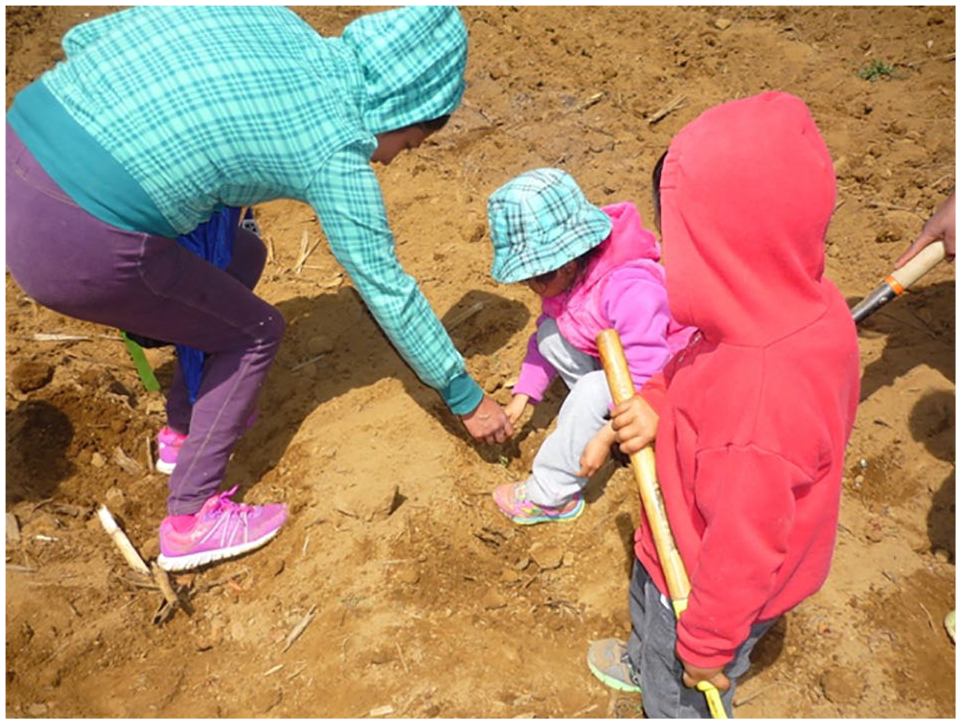
Holding and planting seeds together.
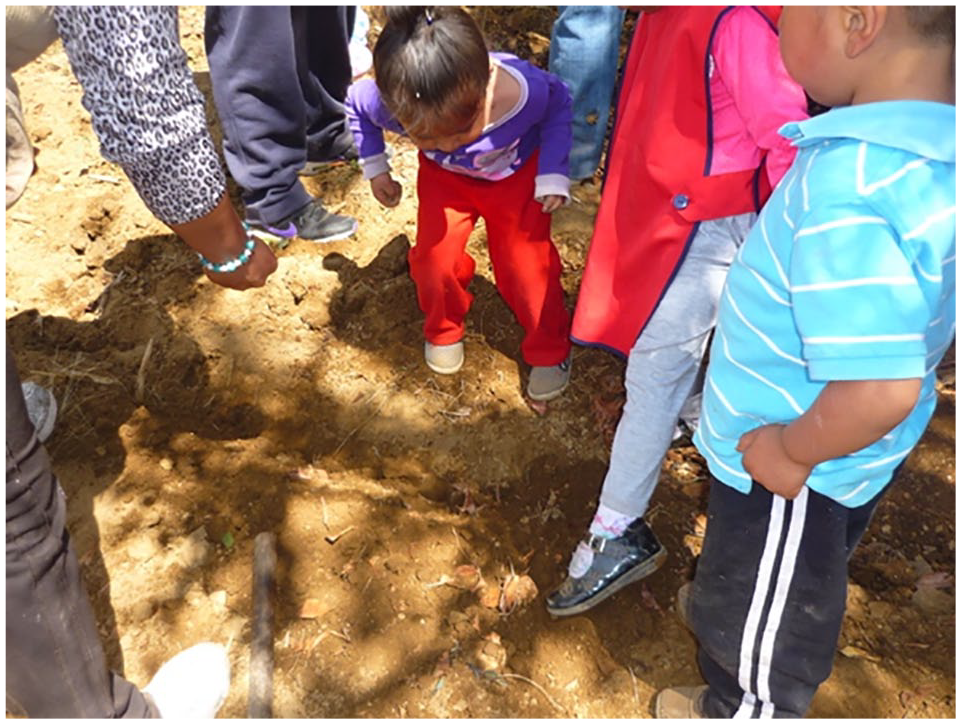
Each person has a role in contributing.

Simultaneous attention—Watching the corn.
In relation to the other two principles, rooting school activities in community lands reinforces one’s own ethnic identity. It supports the ongoing transmission of a community’s genetic code from one generation to another, through the cultural process of sowing corn as part of the school curriculum. Children of all ages participate in these activities, with each one observing and participating according to their interests and capacities toward a common goal (Rogoff, 2014), just like how the endosperm of the corn supports their growth and flourishing.
Children learn about their reciprocal relations of human societies within the natural world by engaging in intergenerational cultural practices across school and home. They learn to value Land and their natural laws as the primary sustainers of human life and this place as part of their own collective and personal identities. Those families that participated expressed to the teachers their appreciation for being allowed to practice their traditional techniques in corn planting in the milpa, along with their children and older community members with more expertise.
Case 3: Pichindé, Colombia
This case illustrates how a teacher intentionally redesigned her school located in Pichindé during the COVID-19 pandemic in partnership with her students and their families. Pichindé was home to a pre-Hispanic Indigenous group and today is a low-medium income and rural community, near Cali, Colombia. During Spanish’s colonization the mestizaje process contributed to the large-scale assimilation of Indigenous people in Colombia. Despite this, many communities living in rural mountainous areas continue to self-identify and enact some traditions of past Indigenous groups (Gutiérrez de Pineda, 1968/1994). Currently, 39.3% of the population in Pichindé is self-identified as a mestizo and 14.3% as Indigenous (Alcaldía de Santiago de Cali, 2014). Many families usually work in agricultural activities and hold sophisticated knowledge about the land. Unfortunately, Colombia does not have a full characterization of the practices and knowledge of their rural communities, and the rural educational plans have largely ignored those practices and knowledge (Arias, 2017). Western schooling, as a colonial practice, has historically contributed to this systemic loss of cultural and community knowledges by ignoring the needs, interests and knowledge systems that already exist in those communities.
Context: Pedagogical Transformation During the Pandemic
On March 16, 2020, schools in Colombia shut down, and the preschool teacher transformed her pedagogical strategies by designing activities that were based on children’s ways of life—their home contexts, knowledges, and practices of their families. These included everyday activities around the house and working with a garden, to name a few.
One of the activities we focus on here is the teacher’s creation of intergenerational collaborative gardening activities with the intention to promote interactions across parents, children, and their homelands. Learning in schools thus would not be imposed onto families but rather emerge from them. Since children in rural Colombia are usually involved in planting, school activities became integrated into these everyday home contexts; based on children’s participation in community endeavors with Land.
Over April, May, and June 2020, the teacher asked the families to record themselves with mobile phones as they worked in the garden to document the children’s progress and learning. Families then sent the videos to the teacher who offered feedback to the children’s learning process. Although families were involved in everyday activities, it was hard for them to abandon the idea of these videos as the school homework.
In July 2020, the teacher was invited to present this experience in a series of online events organized by the Cali’s Government and two universities who were interested in highlighting the invaluable teachers’ work during the beginning of the pandemic. Fernando was the moderator of one of those events and he collaborated with the teacher planning her presentation. Because of the potential learnings derived from this case, Fernando asked the teacher for permission to include her pedagogical innovation in the paper. Two episodes from two different videos were selected by Fernando for analysis 3 and are presented below.
Portraits of Indigenous Systems of Relationality
We present episodes of two family-collaborations as recorded by the families of Pichindé. The first family shares about their process of preparing the land for corn. The second family focuses their dialogue on the process of compost making for their home garden.
Episode 1

In this episode, a father and his son prepare the land for planting. This episode reveals, on one hand, the shared knowledge and intergenerational collaboration between them, and, on the other hand, how the teacher redesigns her pedagogical approach taking advantage of the community’s knowledge. At the start of the clip, the father asks his son about the necessary steps for sowing, and when the son responds the father corrects him. As the conversation continues, the son begins to complete his father’s sentences, indicated by the overlapped square brackets in Frames 1 and 2. Although the adult is guiding the process, overlapping talk reveals the son’s knowledge of the planting process, and his active participation in the interaction. He is paying keen attention to his father’s posture, he is following his father’s talk, and completing his father’s sentences.
Collaboration is embodied, too. In the first frame, we can see father and son’s bodies moving in synchrony, almost mirroring each other’s body position and postures. Both have a digging stick angled toward the ground, with eyes focused on the same spot on the land. They wear the same boots and broad-rimmed hats for shade. He seems to view and observe himself within these mature everyday family practices. In sum, the child participates in the activity verbally, using artifacts and involving his body in the process of preparing the soil to plant the corn seeds. From different positions, father and son collaborate in the verbal explanations and embodied planting process, with the son growing in consciousness of his role as a contributor to family life.
Episode 2

In Episode 2, another child explains the components used to prepare the soil for planting. In Frame 1, the mother, who recorded the situation, asks him about the names of the components of compost, and he begins to list a few. In Frame 2, his mother contributes to his list by adding that those components such as eggshells and fruit peels “come out from the kitchen.” In the second frame, as the child explains the various ingredients that make up the fertilizer, he and his mother are explicitly making the link between human activities (the peels and eggshells that come from the kitchen) that return and replenish the ground.
In Frame 3, she invites him to extend his explanation by asking prompting questions like “and this?” and “what else?” The mother’s questions seem to guide her son through the explanation of the different components of the soil, and she also helps him recall specific details of each. Together, in Frames 3, 4, and 5, they seem to cocreate knowledge through detailed explanations about the uses and ways of preparing each compost component, what is required to build healthy soil for planting; the relation of the plants to water for drainage, and the relationship between animals and plants. Through relational epistemologies where one understands the relatedness of each component to the other, and our dynamic role within them (Bang & Marin, 2015), the child is learning about their personal role in relation to the many other complex roles of each soil component in the cultivation and growing of plants.
This case foregrounds the participation in family and community endeavors principle of Indigenous systems of relationality, the endosperm of the corn seed that supports growth. Participation in family and community endeavors as part of school was an opening for parents to share their knowledge about planting with their children, and parents also could also recognize their children’s growing knowledge, learnings, and gifts. Also, school activities became integrated into these everyday home contexts where families’ knowledge formed the basis of learning at school. Deeply integrated with the two other principles—centering the personality of Land and process-based orientation, these two families also learn to cultivate particular relationships to Land through understanding their unique role in growing food for their family and community. Participating collaboratively in their home garden is also based in an awareness of the roles of others (including animals) to support other forms of life.
We now synthesize these cases based on the three design principles of Indigenous Systems of Relationality presented in Table 1.
Designing Learning With Indigenous Systems of Relationality
Design Principle 1: Center Personality of Land With Everyday Practices
Invite family-driven documentation of everyday practices and relational epistemologies. In the case of Pichindé, the teacher created spaces for families to reengage land-based practices that were representative of their everyday life in times of pandemic. Families physically worked with each other to shovel and mix the soil in embodied, material engagements with the natural world in an activity that is common where they feel a sense of belonging. Furthermore, families’ talk reveals relational epistemologies that connect human life to the natural world. Children made verbal the relationships of food scraps from the kitchen, water, worms, and ash as all playing their individual necessary roles to sustain plant growth and their beauty.
Design activities based on Land-time and Land-relations. In Cherán, school activities followed and were guided by and grounded in seasonal corn-growing patterns and relationships across time. Learning and participation was based in a “lifeway appropriate to place” (Kawagley & Barnhardt, 1998). The milpas (corn fields) where families were working were also based in relational conceptions and processes. Children through their school’s activities at the milpa, are apprenticed at an early age into the idea that respecting the natural world is a process of reciprocity based on a collective responsibility and hard work to maintain the good of all.
Engage with stories together. Teachers are often outsiders to their children’s lives. In the case of Chiang Rai, teachers explicitly took the position of storylisteners, those responsible for finding out the answers and the teaching of the family’s stories for their own lives (Archibald, 2008). In this case, teachers were interested in better understanding the personalities of place—the “knowledge in its practical particulars is known best to the peoples of that place” through family stories of Land (Wildcat, 2009, p. 57, italics in original). This required a level of teacher vulnerability, where the act of storylistening is an opening for reciprocal meaning making and subsequently strengthened interrelation and responsibility for both the teller and the listener (Archibald, 2008). As family members or as visitors–researchers, storytelling and storylistening grew and guided their own ethical sensibilities even after the walk together. Back at school in the city, this shared experience of storywork across teachers and the Paj family had resulted in Indigenous making festivals and teaching and learning that is better understood and places in service of these now expanded responsibilities to lands and families.
Design Principle 2: Develop Process-based Orientations for Embodied Learning Grounded in Community Ethics
Embody learning processes with land. The practices related to the care of plants requires the mind and body being in tune with the characteristics of the land and plants. Being on Land requires knowing how to move and adapt one’s body to the present activity, paying attention and responding appropriately to movements and the activity of others. Engaging all senses such as touch and smell is key for learning. The “social purpose” of any practice guides the work and gives meaning to life. The practices featured across the cases are associated with subjects such as health and nutrition.
Cultivate heterogeneity by grounding learning first in community knowledge systems and ethics and then connect school disciplines. Working with Land is dynamic and recognizing it as part of community life offers multiple ways to link school subjects and other academic topics. While walking in the field and passing by the mango orchard one also learns about the historical changes in the use of land and human settlements. At the same time, it is associated with rituals, practices, and the principle of reciprocity, in other words, it relates to the philosophical, ethical, and social teachings as well as from a historical and linguistic perspective. Oral and literacy practices are basic, and the development of the arts in all its dimensions is strengthened by holistic, mature land-based practices. The organizing axes of the Intercultural and Inductive Method opens geography to its components, geology, climate, cartography, as well as its biology—flora and fauna—instead of considering these as resources in the first place. Content related to the natural environment (food scraps), sustainability, and mathematics, including geometry and counting, are reinforced when children count the seeds, and follow the space necessary between the holes in the furrow, their size as well as the grade of ripeness of the mangos.
Walk and story lands with families. A process-orientation does not presume a fixed or settled curriculum. Walking and storying lands here was an important practice to create spaces for navigation across family-based knowledges and school-centric ones. In Chiang Rai, Land—this mango garden on the mountain, is pedagogy for the Paj family (Simpson, 2014). Educators walking with families on their homelands revealed, encoded and nurtured these important guiding practices and place-specific relationships across human, plant, and ancestral relations. Schools that center Land-based processes would help cultivate generations of Indigenous peoples who have “the skills, knowledge, and values to rebuild our nations” based on the world views and values of their own societies (Simpson, 2014, p. 1).
Design Principle 3: Deepen Participation in Family and Communities Endeavors to Nurture One’s Gifts
Design learning that begins from and integrates family-based activities as important sources of learning and knowledge (Moll et al., 1992). Schools should be places where children learn their role and belonging in a dynamic system of relationships. Families in Pichindé for example, co-participated in the design of the home garden learning experience during the quarantine. Although the teacher proposed the activity, it was implemented based on the knowledge, practices, and rhythms of each family. Also, the parents did not limit themselves to filming the children, they guided them through questions and complemented their answers. As part of “school” children were directly involved with planting corn and its related processes such as preparing the land, the soil, and sowing the seeds.
Work side-by-side with families. Teachers in Cherán worked side-by-side with families in these important intergenerational community practices such as planting corn In Cherán and Chiang Rai, school educators, families, and young people collaborated in the same physical space. In Chiang Rai, as Ti narrates his growing role to plant mango trees, a role that used to be his father’s, he is learning to honor his responsibilities to his grandfather who is also an active participant in the fields beyond his passing. At the same time, being in the physical space as the families, educators are also learning their relation to families. Learning in the Paj family was foundationally based in contributing to family life, past, present, and future, with the goal of young people learning and nurturing their unique gifts to the collective.
Respond fluidly, observe children and help them find their gifts. Just as the child was naming parts of the soil in the case of Pichindé, we too have unique roles in the larger ecosystem of life. Learning how to live with others in the world is a process of continuous observation and participation that strengthens one’s commitment to those relationships and cultivates heterogeneity, of which teachers are a part. In these cases, these activities, were contexts by which children, families, and educators could practice observing each other and other processes in the natural world. Teachers must learn to observe children, to notice and nurture their gifts, and respond in fluid ways to collaborate with families as well.
In sum, families and communities across generations play an important role in designing learning experiences based on their knowledge, practices and rhythms. In other words, the three cases illustrated how schools can respectfully articulate the epistemologies, ontologies and values of the communities in which they are located.
Conclusion: How Should We Live? (Re)placing Schools Within the Heartbeat of Community and Indigenous Sovereignty
Human learning is relational. We posit that all students—Indigenous and non-Indigenous benefit from learning how to be a person in the world, what their day-to-day responsibilities are within a greater universe, and how to receive and contribute their unique gifts to the lands where they live (Cajete, 2000; Corntassel, 2018; Kawagley & Barnhardt, 1998; Starblanket, 2018). At this critical juncture in human history where our systems of living and governance reveal gross, racialized inequities in health and well-being, designing for more just education requires what Michelle Alexander calls a “revolution in values.” We as parents, educators, and researchers have an opportunity to fundamentally rethink education processes as “systems of life-enhancement” for the holistic well-being of our children and communities (Wildcat, 2009, 2020), rather than ones that uphold capitalistic systems that justify violence. Learning grounded in Indigenous systems of relationality, we suggest, will need to be an important way forward.
Despite long-standing assimilative paradigms that forced Indigenous children to abandon their cultural practices and identity in order to engage in learning (Chávez & Longerbeam, 2016; Prasit & Meixi, 2018; Rogoff, 2014), Indigenous communities have always recrafted and designed learning toward their own ends (McCoy & Villeneuve, 2020). This article highlights three schools that build with existing community movements to reorient learning toward life. The cases show possibilities of how teachers can hold the heartbeat of their communities by grounding learning first within their Land-based knowledges, practices, and ethics. Instead of trying to replicate school at home, relational understandings of learning resist epistemic violence (Marker, 2006) and instead, create space for diverse knowledge systems to coexist and potentially complement one another across home and school. While we recognize that these goals might often be diverse and contested, what we illustrate here are ways to begin working with families to understand and surface the range of these goals within a given community as an important starting point.
While state-driven schooling could provide some important tools for Indigenous people and their communities, this education must be contextualized in its greater whole (Cajete, 2010). In a recent study, Yucatec Maya children reported on the importance of what the learn at home in contrast to what they learn at school, stating that at home you learn to be a person “aprender a ser persona”—a responsible and contributing member of your family and community (Alcalá et al., 2021). What is clear, however, is that the continued assertion of simplistic pedagogies common in assembly-line schooling that ask children to focus on worksheets and meaningless tasks will be ineffective for the multidimensional realities, crises, and opportunities of our times.
While these cases feature homelands that are in more rural areas, we posit that urban schools also exist on Indigenous Lands (ceded or unceded; Bang et al., 2014). For urban-based educators, we hope that some of these practices might be useful to you in your journey to elevate, uncover, and make present the multiple and interrelated histories—Indigenous histories, migration histories, more-than-human histories, environmental and ecological histories—of the Lands where you live and work.4 Public schools, whether rural or urban, could be powerful converging spaces of collaboration for all of us to learn this. Amid changing socioecological systems, we all continually need to learn how to be a person and how to walk in a good way in human and natural world societies. The three principles presented here provide the foundation to reorganize learning in the classroom and beyond, by centering land, integrating process-based orientations to learning guided by community ethics in relation to school curriculum and by viewing families and communities from strengths-based perspective to identify family and community strengths and gifts. It is to engage with a revolution in ethics with unique place-based Indigenous systems of relationality as a guide.
Our current dominant systems of learning and the Land-lessness of school based on relationships of dominance and extractivism seem to perpetuate the growing rise of ethnic nationalism, human supremacy, and socioecological collapse. To support the transition to a new world at this critical juncture, our work ahead as educators will require a deep reorientation to our children and their full systems of relationships—Indigenous and non-Indigenous. It will require persistent creativity, gentleness, wisdom, deep attention and listening to our students and their families and what thriving means to them. We suggest that learning to relate to other beings in life-enhancing ways is the core challenge, possibility, and responsibility of our lifetimes.
Supplemental Material
sj-docx-1-ero-10.1177_23328584211062587 – Supplemental material for When Learning Is Life Giving: Redesigning Schools With Indigenous Systems of Relationality
Supplemental material, sj-docx-1-ero-10.1177_23328584211062587 for When Learning Is Life Giving: Redesigning Schools With Indigenous Systems of Relationality by Meixi, Fernando Moreno-Dulcey, Lucia Alcalá, Ulrike Keyser and Emma Elliott-Groves in AERA Open
Supplemental Material
sj-docx-2-ero-10.1177_23328584211062587 – Supplemental material for When Learning Is Life Giving: Redesigning Schools With Indigenous Systems of Relationality
Supplemental material, sj-docx-2-ero-10.1177_23328584211062587 for When Learning Is Life Giving: Redesigning Schools With Indigenous Systems of Relationality by Meixi, Fernando Moreno-Dulcey, Lucia Alcalá, Ulrike Keyser and Emma Elliott-Groves in AERA Open
Footnotes
Acknowledgements
The authors thank the participating families across the lands and communities where they live and work. They also express their gratitude to Barbara Rogoff, Carrie Lane, and the anonymous reviewers for their insightful comments on earlier versions of this article.

Notes
Authors
MEIXI is a Hokchiu scholar who grew up in Singapore and with the Lahu tribe in northern Thailand focused on land and family-based educational designs.
FERNANDO MORENO-DULCEY is an assistant professor in Colombia interested in child development and culture.
LUCIA ALCALÁ is a Mexican immigrant focused on prosocial behavior among Indigenous (Yucatec Maya and P’urhepecha) communities in Mexico and the United States.
ULRIKE KEYSER is a German anthropologist and assistant professor in México working on Indigenous teacher education and intercultural collaboration.
EMMA ELLIOTT-GROVES (Cowichan Tribes) is an assistant professor with interests at the intersection of Indigenous education and social work.
References
Supplementary Material
Please find the following supplemental material available below.
For Open Access articles published under a Creative Commons License, all supplemental material carries the same license as the article it is associated with.
For non-Open Access articles published, all supplemental material carries a non-exclusive license, and permission requests for re-use of supplemental material or any part of supplemental material shall be sent directly to the copyright owner as specified in the copyright notice associated with the article.
