




Abstract
In this thought experiment, we explore how to make access to individualized instruction and academic mentoring more equitable by taking tutoring to scale as a permanent feature of the U.S. public education system. We first synthesize the tutoring and mentoring literature and characterize the landscape of existing tutoring programs. We then outline a blueprint for integrating federally funded and locally delivered tutoring into the school day. High school students would serve as tutors/mentors in elementary schools via an elective class, college students in middle schools via federal work-study, and 2- and 4-year college graduates in high schools via AmeriCorps. We envision an incremental, demand-driven expansion process with priority given to high-needs schools. Our blueprint highlights a range of design tradeoffs, implementation challenges, and program costs. We estimate that targeted approaches to scaling school-wide tutoring nationally, such as focusing on K–8 Title I schools, would cost between $5 and $16 billion annually.
Program Vision
This article is about an idea. Our premise is that the U.S. public education system substantially underinvests in individualized instruction and academic mentoring. Individualized instruction is among the most effective education interventions ever subjected to rigorous evaluation (Dietrichson et al., 2017; Fryer, 2017; Nickow et al., 2020). Decades of research on child development demonstrate the central role that positive relationships play in fostering students’ motivation, self-regulation, self-identity, and psychological well-being (National Scientific Council on the Developing Child, 2015; Osher et al., 2020). We seek to understand what structures, systems, and supports are necessary to provide students with access to personalized instruction and positive school-based relationships by integrating tutoring into the school day.
Access to tutoring is inherently unequal. Private tutoring is a $124 billion dollar industry globally (Global Industry Analysts, 2020). The number of private tutoring centers in the United States alone has grown from 3,000 in 1997 to over 9,000 in 2016, with the majority of this growth in high-income communities (Kim et al., 2021). The enormous demand for tutoring further attests to its efficacy and also highlights the inequity of an educational system where individualized instruction is largely available to only those students whose families can afford it in the private market (Saadvera et al., 2020). Compounding this inequity, research finds that students who are Black, Hispanic, and from lower socioeconomic backgrounds are less likely to report forming meaningful informal mentoring relationships with their K–12 teachers, counselors, and coaches (Kraft et al., 2021).
Our aim is to equalize access to individualized instruction and academic mentoring by redefining norms about what tutoring programs look like and do. Tutoring is commonly viewed as afterschool homework help or short-term remediation for struggling students. Instead of an ancillary, compartmentalized, and temporary intervention, we see tutoring becoming a core feature of public schools over time. This is a long-term vision for systemic change similar to the expansion of public kindergarten over a 30-year period (Cascio, 2009). We aim to leverage tutoring as a structure for fostering sustained relationships between students and older peers or adults who serve as tutors/mentors, complementing the classroom instruction students receive with individualized support and academic mentoring.
We outline one possible blueprint for taking our vision of tutoring to scale nationally. This includes a range of tradeoffs and implementation challenges that are inherent to such a foundational change to public schooling. Our blueprint centers on 10 core design principles to guide federally funded, locally operated programs. We draw heavily on models of high-dosage tutoring where students work with the same tutor as part of a regular class during the school day (de Ree et al., 2021; Guryan et al., 2021; Kraft, 2015) and augment this approach with elements of modern school-based mentoring programs (Lyons et al., 2019; Wheeler et al., 2010). 1
We propose a tiered model for staffing tutoring at scale where high school students serve as tutors/mentors in elementary schools via an elective class, college students in middle schools via Federal Work-Study (FWS), and 2- and 4-year college graduates in high schools via AmeriCorps. We develop this program structure—rather than an exhaustive menu of design choices—to provide districts with an initial framework that can be adapted instead of expecting them to build a model from scratch. Proposing a specific structure also allows us to construct credible estimates for the total cost of scaling tutoring nationally. Such evidence is critical for informing whether, as a society, we believe that tutoring at a national scale is a goal we can and should pursue.
We envision an incremental expansion process driven by district interest that prioritizes schools serving students most in need of individualized instruction and deeper personal connections at school. Our estimates of school-wide tutoring program costs include a range of equity-based approaches that are on par with existing federal investments in programs such as Title I, the National School Lunch Program, and Head Start. For example, a program targeting all K–12 schools in the lowest quartile of academic proficiency rates would cost approximately $10 billion annually. Expanding tutoring across K–8 Title I schools would cost approximately $16 billion annually. These estimates reflect total costs of the program structure we describe below, which we envision being primarily funded by the federal government but could also include contributions from state, district, philanthropic, and private-sector partnerships.
Even an exercise in envisioning tutoring at a national scale is prime for critique. The history of education reform is littered with failed attempts to take promising ideas and evidence-based programs to scale. An initiative of this expense and magnitude would face enormous pressure to show immediate results. Lofty promises and outsized expectations that can aid in the coalition-forming process could jeopardize perceived success. Efforts to scale tutoring will be highly variable in their success and are unlikely to achieve the large effects on academic achievement found in efficacy trials of smaller to mid-sized programs often implemented under best-case circumstances. Tutoring is not a silver bullet, and time with a tutor does not guarantee a personal connection. We should be clear-eyed about these realities and the need for a sustained commitment to program improvement. We should also expand our focus beyond test scores alone to consider whether and how tutoring supports students’ well-being, sense of belonging, and wholistic success in school.
Taking tutoring to scale has the potential to provide benefits well beyond supporting the students who receive tutoring. Tutors/mentors, particularly younger peer tutors, may also benefit directly by strengthening their own academic content knowledge and enhancing their social connectedness and sense of competence (Eskreis-Winkler et al., 2019; Fuligni, 2019). Scaling tutoring would expand community service and employment opportunities for young adults, provide valuable leadership experience for tutors/mentors who work as peer leaders supporting teams of novices, and create jobs across the country. It also might expand and diversify the pipeline of potential educators within local communities by exposing more youth to careers in education and building their professional networks in schools, which can facilitate future job placement (Dobbie & Fryer, 2015; Krieg et al., 2016). Furthermore, to the extent that tutoring increases educational achievement and attainment, it would have economic benefits for both individual students as well as the nation’s economy as a whole (Hanushek & Woessmann, 2020). None of these benefits are guaranteed, but we can think of few educational interventions with such a range of potential returns.
We make several contributions with this thought experiment. We provide the first systematic analysis of the costs associated with scaling tutoring nationally across a range of grade-level and school-type combinations. We also identify a variety of tradeoffs and implementation challenges relevant for scaling tutoring that have remained largely unaddressed in the literature such as how to add tutoring without displacing enrichment classes and whether to prioritize in-person versus online models. A growing number of scholars, policy makers, and pundits have made compelling cases for a rapid deployment of tutoring services to support those students most adversely affected by the COVID-19 pandemic. Our vision for an incremental, sustained expansion of tutoring across the public school system has more in common with the decades-long integration of kindergarten into the public education system than with many of the current proposals for leveraging tutoring to address unfinished learning. While our blueprint focuses on long-term growth at a far larger scale, we believe it offers insights that can further support the success of these more immediate efforts. Finally, we shine a light on key areas in the research literature, such as peer and virtual tutoring, where there is a clear need for further research.
Ultimately, we hope to catalyze a national dialogue around making tutoring a permanent feature of public schooling. Imagine the ideal. What if tutoring were a regular class where students developed sustained, caring relationships with tutors/mentors who supported them across several grades? What if tutors/mentors became someone students could turn to for advice about navigating the challenges of adolescence and the path to higher education? What if this model became self-sustaining where students who benefitted from tutoring were then motivated to serve as tutors/mentors themselves, improving their skills throughout high school, college, and beyond? What if more new teachers were former tutors/mentors with years of experience working with students and seeing how they learn? Nothing has ever been accomplished that was not first imagined.
The Great Potential of Tutors/Mentors
Effects on Academic Achievement
Several recent meta-analyses conclude that tutoring has the largest impact, on average, among a wide range of education policies and programs aimed at raising student achievement (Dietrichson et al., 2017; Fryer, 2017; Inns et al., 2019; Pelligrini et al., 2021). In Figure 1, we display average effect sizes on standardized student achievement across interventions included in four recent meta-analyses. The average effect of tutoring programs on student achievement is larger than the effects found in approximately 85% of causal studies evaluating education interventions (Kraft, 2020). This effect on student achievement (~0.36σ) is also meaningfully larger than popular alternatives districts are considering in response to the COVID-19 pandemic such as class size reduction (~0.13–0.20σ; Angrist & Lavy, 1999; Krueger, 1999), extending the school day/year (~0.05σ; Figlio et al., 2018), vacation academies (~0.06–0.16σ; Schueler, 2020; Schueler et al., 2017) and summer school (~0.08σ−0.09σ; Augustine et al., 2016; Lynch et al., 2021). Tutoring is also unique among other interventions studied in its sustained effectiveness for both reading and math through high school (Fryer, 2017; Inns et al., 2019; Nickow et al., 2020).

Comparative effects of tutoring and other interventions on standardized student achievement.
Studies suggest that tutoring can be effective for students across the full distribution of achievement, with mixed findings about which students benefit most. Several reviews find that tutoring benefits students at all levels of prior performance (Black et al., 2008; Leung, 2015; Pelligrini et al., 2021; de Ree et al., 2021) with some evidence of larger effects among lower performing students (Kraft, 2015), Black students (Fryer & Howard-Noveck, 2020) and children from low-income families (Carlana & La Ferrara, 2021). A recent evaluation of high-dosage tutoring suggests that standardized tests may not even capture the full extent of the learning gains experienced by low-achieving students due to test floor effects (Guryan et al., 2021).
Effects on Social–Emotional Development and Success in School
Research also suggests that tutors have the potential to provide a range of benefits beyond accelerating learning when they are able to develop strong relationships with students and serve as academic mentors. Positive, caring relationships with adults or older near-peers can support students’ social–emotional development, enhance their attachment to school, and expose students to mentors who can help them successfully navigate the education system (Balfanz & Byrnes, 2018; Bowman-Perrott et al., 2014; Christensen et al., 2020; DuBois et al., 2011). Several recent randomized controlled trials (RCTs) show that connecting students with an older role model fosters prosociality and benefits students’ educational attainment and long-term outcomes, particularly for students from low-income backgrounds (Falk et al., 2020; Kosse et al., 2020; Resnjanskij et al., 2021), a finding that is echoed in anecdotal evidence from tutors (Frimpong, 2021).
Over the past two decades, many mentoring programs have shifted from community-based models focused on social relationships toward school-based models focused on the intersection of academic support and socioemotional development (Herrera et al., 2007; Rhodes, 2020). This pivot points to the growing overlap between academic mentoring and high-dosage tutoring. However, experimental evaluations of stand-alone school-based mentoring programs find relatively modest effects on outcomes such as self-efficacy, positive relationships, and attendance but null effects on academic achievement (Wheeler et al., 2010; Wood & Mayo-Wilson, 2012). Evidence from more recent school-based mentoring programs such as Building Assets and Reducing Risks (BARR) program and the Check & Connect program find some positive effects on grade point average (GPA), attendance, and course failure rates but few if any effects on students’ performance on standardizes tests (Bos et al., 2019; Guryan et al., 2020; McQuillin et al., 2015). Explorations of these mixed findings point to the quality of student–mentor relationships as a central moderator of program effectiveness (Lyons & McQuillin, 2019), as well as the importance of setting specific goals with students and provide targeted feedback (Lyons et al., 2019). We interpret this evidence to suggest that students might experience the broadest benefits when elements of school-based mentoring programs are integrated within tutoring programs that allow for sustained relationships and focus on clear academic and social/emotional development goals with frequent feedback.
Benefits for Tutors/Mentors
Tutoring likely also has reciprocal benefits for tutors/mentors. A recent meta-analysis of 16 experimental and quasi-experimental evaluations of peer tutoring programs finds evidence of substantial academic gains for tutors (Leung, 2019). A large-scale RCT finds that even being paired with younger students to provide advice can improve older students’ academic performance (Eskreis-Winkler et al., 2019). Tutoring taps into an adolescent’s innate need to contribute and feel respected (Allen et al., 1994; Allen et al., 1997; Fuligni, 2019; Yeager et al., 2018). These benefits also appear to translate to tutoring in an online setting. Carlana and La Ferrara (2021) find that college students who volunteered and were randomly accepted into an online tutoring program reported higher levels of empathy after serving as tutors.
Financial and Opportunity Costs of Tutoring
While the large effects of tutoring are impressive, any assessment of their policy relevance must also consider the financial and opportunity costs (Levin & Belfield, 2015). Tutoring program designs and cost structures vary widely based on key inputs such as tutor compensation, student–tutor ratios, dosage, duration, and the intensity of training and supervision. Estimates of the cost of high-dosage tutoring models with a 2:1 student-to-teacher ratio vary between $2,500 and $3,800 per pupil (Ander et al., 2016; Fryer, 2014; Fryer & Howard-Noveck, 2020; Guryan et al., 2021). Despite higher costs, tutoring compares favorably in most cost–benefit analyses because of its large effects (Guryan et al., 2021; Harris, 2009; Levin et al., 1987; Washington State Institute for Public Policy, 2020). Guryan et al. (2021) find that the benefit–cost ratio of high-dosage tutoring for high school students is at least equal to exemplar preschool programs and reduced class sizes.
An equally important but less salient cost of tutoring is the opportunity costs of students’ time. The benefits of tutoring depend not only on the efficacy of the program but also on what activities tutoring displaces. It is easiest for educators to know and shape what tutoring takes the place of when it is delivered during the school day. However, pulling students out of class or reducing time spent in enrichment classes, physical education, or free-play is not costless. Two recent studies illustrate how tutoring can even have negative impacts when it takes away from more productive uses of students’ time. A study of a French tutoring and college access program for low-income students finds that it benefitted high-achieving students but decreased the academic performance of students with lower achievement levels, possibly by shifting their time from core academic classes to the supplemental material taught in tutoring (Ly et al., 2020). A large-scale study of distance tutoring in Kenya delivered via phone calls finds the program lowered student achievement by crowding out more productive time students spent at home studying (Schueler & Rodriguez-Segura, 2021).
Effective Tutoring Practices
Research on tutoring has largely focused on evaluating entire program models instead of specific features of tutoring programs. Despite this limitation, a number of common practices emerge across the most effective programs. Session length, frequency, and setting are fundamental aspects of program structure that largely determine effectiveness (Heinrich et al., 2014; Strayhorn & Bickel, 2003; Wasik, 1998). Two recent meta-analyses of causal research and a large, quasi-experimental study find that tutoring programs providing a high dosage of instruction, with at least three sessions a week for 30 to 60 minutes, are consistently more effective than those with less tutor–student contact (Fryer, 2017; Nickow et al., 2020). Scheduling is also linked to program efficacy. Programs incorporating tutoring into the school day have larger effects on achievement than those scheduled outside of school (Nickow et al., 2020). Scheduling tutoring within the school day promotes regular attendance, better coordination with teachers, and a stronger academic culture (Fryer, 2014; Guryan et al., 2021).
Best practices such as monitoring progress, tying tutoring content to classroom learning and grade-level standards, and providing a stable tutor relationship also emerge from the literature. Highly effective programs often center ongoing, informal measurement of student progress and formative assessments in their curriculum (Jacob et al., 2016; Markovitz et al., 2014). Students are more likely to fall behind academically when they lack access to rigorous instruction and grade-level assignments (TNTP, 2018). Additionally, working with the same tutor/mentor throughout a program could foster familiarity that is beneficial for achievement (Hill & Jones, 2018) and is integral to the relationship-driven benefits of youth mentoring highlighted in a nationwide RCT (Grossman et al., 2012).
Research also suggests that several key features of tutoring programs can vary without sacrificing effectiveness. While one-to-one tutoring is likely most effective, clustering students into groups of up to four per tutor reduces program costs with only a small reduction in effectiveness as measured by student achievement gains (Nickow et al., 2020; Schwartz et al., 2012). However, it is possible that tutoring in small groups does not provide the same mentoring benefits that one-on-one models can provide. Remote and in-person delivery may also be similarly effective, but the existing research is quite limited. Two recent RCTs find encouraging effects (Carlana & La Ferrara, 2021; Roschelle et al., 2020), while a third finds no impacts (Torgerson et al., 2016). Descriptive studies of online programs suggest that relationships are a particularly critical feature for maintaining engagement and that lack of internet and internet-enabled devices can lead to unequal access (Burch et al., 2016; Marshall et al., 2021).
Tutor qualifications can also vary while maintaining effectiveness, particularly when tutors are supported by adequate training and ongoing coaching (Hänze et al., 2018; Jacob et al., 2016; Kraft, 2015). Evidence suggests that licensed teachers are the most effective tutors in terms of raising student achievement but that they may not present the most scalable or cost-effective approach to staffing tutoring (Nickow et al., 2020). We focus on AmeriCorps members, college students, and cross-age peer tutors due to their relatively low cost, large potential supply, and close proximity in age to K–12 students. Rigorous evaluations of programs leveraging AmeriCorps members and other full-time tutors find moderate to large effects when tutors work with a strong program structure that provides high-quality instructional materials and ongoing training (Fryer, 2014; Guryan et al., 2021; Jacob et al., 2016; Kraft, 2015; Markovitz et al., 2014; Markovitz, Hernandez, Hedberg, & Neishi, 2018; Markovitz, Hernandez, Hedberg, et al., 2018; Markovitz et al., 2019; Parker et al., 2019). There is also ample causal evidence that college students can tutor effectively, particularly when following highly structured curricula (Allor & McCathren, 2004; Astin & Sax, 1998; Carlana & La Ferrara, 2021; Courtney et al., 2008; Denton et al., 2004; Fitzgerald, 2001; Juel, 1996; Lachney, 2002; Lindo et al., 2018; Moore-Hart & Karabenick, 2009; Spear-Swerling, 2009; Young et al., 2018). Two meta-analyses also identify that volunteer tutors produce smaller but still significant effects on achievement (Nickow et al., 2020; Ritter et al., 2009).
While peer and cross-age tutoring has a long history in the public school system, the evidence base for this model is far more limited. Programs such as Reading Buddies and Peer Assisted Learning Strategies that incorporate elements of peer tutoring have been used in schools for decades and have been found to be effective (Fuchs et al., 2002; McMaster et al., 2005; Stein et al., 2008; What Works Clearinghouse, 2012, 2013). Evidence from larger meta-analyses reporting results specifically for peer tutoring programs show meaningful effects on student achievement (Dietrichson et al., 2017; Slavin et al., 2009). Another meta-analysis finds that students learn more through peer interaction than through completing the same tasks alone (Tenenbaum et al., 2020). However, much of the existing literature is limited by small samples, weak research designs, and use of self-reported, proximal outcomes (Alegre-Ansuátegui et al., 2018; Greene et al., 2018; Leung, 2015; Shenderovich et al., 2015; Topping et al., 2003, 2011, 2012). There are also several examples of rigorous program evaluations that find no effects of peer tutoring (Lloyd, Edovald, Kiss, et al., 2015; Lloyd, Edovald, Morris, et al., 2015; Romero et al., 2021). Despite the mixed evidence on peer tutoring, its potential and cost-effectiveness make it an attractive option for taking tutoring to scale (Education Endowment Foundation, 2018).
Attempts to Take Tutoring to Scale
Two prior efforts to scale tutoring nationally provide important lessons for future efforts. President Clinton’s America Reads initiative aimed to marshal one million volunteers and college work-study students as tutors to support early literacy. The accompanying legislation, however, was never funded, and the idea dissipated into a loose network of programs with highly variable structures and goals (Fitzgerald et al., 2002; Worthy et al., 2003). America Reads tutors in some programs became de facto teachers’ aides rather than serving as tutors (Worthy et al., 2003). While individual programs may have been effective thanks to local resources or strong program leadership (Fitzgerald, 2001; Moore-Hart & Karabenick, 2009), lack of central funding, data collection, guidance, and structure were key inhibitors of sustaining efficacy at scale (Fitzgerald et al., 2002; Worthy et al., 2003).
The No Child Left Behind Act, in contrast, provided over $2 billion annually for Title I schools to fund afterschool tutoring for students via Supplemental Education Services (SES). Despite this investment, meta-analytic and quasi-experimental evaluations find that SES programs generally had little to no effect on student achievement (Chappell et al., 2011; Deke et al., 2012; Heinrich et al., 2010; Heinrich et al., 2014). Tutoring via SES suffered from high costs, low take-up, varied attendance, and low dosage delivered to students according to multisite and nationally representative studies (Good et al., 2014; Vernez et al., 2009). Districts were required to contract with proven providers, but states had little funding or capacity to vet providers (Burch et al., 2007). The per-student funding structure also incentivized for-profit providers to use small-group tutoring with student–tutor ratios that were commonly 6:1 or higher (Farkas & Durham, 2007). Mixed-methods studies across multiple districts find that providers engaged in limited coordination with schools and struggled to establish rigorous academic cultures (Good et al., 2014; Heinrich et al., 2010).
Ultimately, both programs delivered a relatively low dosage of tutoring to far fewer students than intended and fell well short of their lofty goals (Deke et al., 2012; Heinrich et al., 2014; Vernez et al., 2009; Worthy et al., 2003; Zimmer et al., 2010). These initiatives placed high demands on schools and families to coordinate tutoring while providing limited support. America Reads lacked the federal funding necessary to scale and the coordination required for disparate local initiatives to learn from each other and share best practices. SES provided substantial funding, but challenges such as lack of coordination between tutoring organizations and schools, the afterschool setting, large student-to-tutor ratios, and limited information provided to parents undercut program effectiveness.
While federal initiatives have struggled to deliver a cohesive program to students, several large studies of tutoring programs suggest maintaining efficacy at scale is possible (Gersten et al., 2015; Jacob et al., 2016; Markovitz et al., 2014; Sirinides et al., 2018). A case study examining the expansion of the Minnesota Reads program in Florida highlights the importance of an established set of program design features and instructional resources for scaling with fidelity (Markovitz et al., 2019). School-based coordinators, in particular, may play a key role in maintaining program fidelity and trouble-shooting challenges that arise (Heinrich et al., 2014).
The Current Tutoring Landscape
Today, the individualized instruction landscape is comprised of a diverse portfolio of programs that vary widely in their structure, goals, costs, and offerings. Common private sector models include regular or on-demand virtual tutoring and in-person tutoring at centers or families’ homes. In 2020, one in four parents in the United States reported acquiring one-to-one or small-group tutoring for their child outside of school when many school buildings were closed due to the COVID-19 pandemic (Saadvera et al., 2020). Some public schools directly provide or partner with nonprofit organizations to offer tutoring as part of an extended-day or afterschool programs. The typical school-based program is delivered by a licensed teacher to small groups of two to 10 students as a pull-out session or after school (Office of Planning, Evaluation and Policy Development, 2017). Other approaches include full-time service members or community volunteers providing tutoring-like support during class as teacher aides; service-members running afterschool programs at schools; and students working with peers or older students in peer and cross-age tutoring models. One third of high schools surveyed in 2014–2015 required at least some students to participate in academic tutoring (Office of Planning, Evaluation and Policy Development 2017).
National nonprofit tutoring and youth development programs comprise a sizable fraction of the tutor opportunities that are free to students and their families. These include organizations that operate independently from the school system and provide free tutoring and enrichment activities to low-income communities such as Breakthrough Collaborative, Jumpstart, and Upward Bound. They also include programs such as CityYear, the (Minnesota) Reading and Math Corps, Reading Recovery, and Reading Partners, which operate in partnership with schools to provide tutoring and other support services during and after school. At the community level, 10,000 federally funded 21st Century Learning Centers in the United States provide afterschool programing—often including tutoring—to roughly 770,000 students (Lyles, 2017). Relatively speaking, however, these programs all serve a very small fraction of the 50 million students who attend public schools. 2
The Potential and Perils of the Present Moment
The COVID-19 pandemic has upended the public education system and created unprecedented challenges for students and schools. In response, there has been a groundswell of interest in tutoring as an approach to accelerate student learning. Scholars, educators, philanthropists, journalists, and policymakers have called for major expansions to tutoring and national service programs (Brooks, 2020; Burgess, 2020; Campbell et al., 2020; CORPS Act, 2020; DiPerna, 2020; Dynarski, 2020; Frimpong, 2021; Goldrick-Rab & Yoshikawa, 2020; Learning Recovery Act, 2021; Munyan-Penney & Barone, 2020; Oreopoulos, 2020; Robinson & Loeb, 2021; Slavin, 2020, 2021; Wong, 2020). Maryland State and the Los Angeles and Fresno Unified School Districts have allocated funds and coordinated tutors to support students via online platforms and through agreements with the teachers’ union (Blume, 2020; Office of Communications, 2020; Salmon, 2020). Some states have also endorsed the nonprofit Schoolhouse.world as a catch-up resource, connecting students to volunteer tutors remotely (Toppo, 2021). Several philanthropists are funding expansions of tutoring programs in New York, Chicago, Broward Country (FL), and across Tennessee (Citadel, 2020; Gates, 2020; Tamburin, 2020). The Annenberg Institute at Brown University has established the National Student Support Accelerator as a research, innovation, and resource hub for scaling high-impact tutoring. Large international tutoring initiatives are also underway in the United Kingdom, the Netherlands, and Australia (“A Class Apart,” 2020; Smith, 2020; U.K. Department for Education, 2020; “Victoria to employ thousands,” 2020).
The pandemic has also forced us to reconsider long-held norms and practices in public education, creating a rare opening for fundamental, structural change. The sprawling, decentralized nature of the U.S. public education system has traditionally made it difficult to scale and sustain changes to core educational practices (Tyack & Cuban, 1995). During the pandemic, schools have had to redesign systems, roles, and schedules at an unprecedented speed and scale. If ever there were an opportunity to fundamentally change the way we deliver public education, the time is now.
Evidence of declining academic performance combined with growing enthusiasm for a rapid expansion of tutoring could also imperil its potential longer term success. We risk repeating the mistakes of the past by implementing tutoring in hasty and uneven ways due to a lack of coordination and system-wide capacity. Rapid scale-up of a diffuse set of tutoring models with philanthropic backing might benefit pockets of students but could also erode support for tutoring if it is viewed as only a short-term, add-on solution and perceived as ineffectual. A myopic focus on test scores might also cause tutoring to look more like test prep than an opportunity to deepen students’ understanding of core academic concepts, ignite their curiosity, and support their well-being. Attempts to scale tutoring would likely be more successful and sustainable if they are part of a larger effort to incrementally integrate tutoring within the structures of the public school system instead of an immediate response to address perceived learning loss.
Goals and Design Principles
We envision the primary goals of national-scale tutoring would be to (1) complement classroom instruction in core academic subjects with individualized support to reinforce and deepen learning, and (2) provide students with sustained relationships with a caring adult or older peer who would serve as an academic mentor to support students’ persistence and engagement in school. The central idea is to build a coordinated, team approach to support students’ success in school where all students have someone who knows them and can be their academic advocate and role model. This will require a systematic approach to improvement by experimenting with different implementation models, testing the efficacy of promising program features, and building a network for sharing best practices (Bryk et al., 2015).
Successfully taking education reforms to scale is a balancing act between maintaining fidelity to the core components of a program and providing flexibility for local actors to shape implementation within their contexts. Here we propose a set of 10 design principles, which constitute the foundation of our proposed tutoring program. These design principles are informed by research on practices of highly effective tutoring programs and the implementation science literature (Coburn, 2003; Elmore, 1996; McLaughlin & Mitra, 2001). Below we describe the many ways in which local district partnerships might tailor programming to their own context.
Design Principles
Tutoring Is a School-Wide Program
Every student can benefit from tutoring and mentorship. We fully recognize a school-wide approach creates difficult tradeoffs when funding is limited, as it would serve fewer struggling students overall than would be possible with more targeted approaches. The benefits are that tutoring all students can foster a collective commitment because it is seen as a core practice rather than an ancillary offering. School-wide programs also avoid the perception and potential stigma that tutoring is remediation. A practical middle ground might be to target tutoring to all students in specific grades.
Tutoring Is With the Same Tutors/Mentors
Sustained relationships between tutors/mentors and students are key. Ensuring continuity in tutor-student pairings will be central to any tutoring program’s ability to successfully integrate academic mentoring. In some cases, tutor–student pairings may need to be limited to a semester rather than a full-academic year to accommodate scheduling limitations given that long-term commitments may constrain tutor/mentor supply.
Tutoring Is a Part of the School Day
We envision tutoring as a supplemental class integrated into the regular or an extended school day rather than as part of a pull-out, in-class, or afterschool approach. Scheduling tutoring into the school day promotes regular attendance and ensures students have the necessary internet access and devices for online programs.
Tutoring Is Individualized
Effective tutoring programs maintain low student-to-tutor ratios—no higher than 4:1, preferably 2:1—to preserve tutors/mentors’ ability to personalize instruction and provide individual attention. The specific ratio poses a tradeoff between personalization and cost-effectiveness that will be important to study.
Tutoring Is a High-Dosage Intervention
Tutoring programs that meet more frequently are more effective. Administrators should aim for three to five sessions a week of at least 30 minutes each.
Tutors/Mentors Receive Intensive, Ongoing Training
Prioritizing tutor training through a combination of initial professional development, peer learning communities, and on-the-job coaching is key to supporting continual improvement. Investments in training will be increasingly important as programs work to scale their supply of tutors/mentors.
Tutors/Mentors Provide Instruction Based on High-Quality Instructional Materials
Instead of homework help, tutoring should incorporate direct instruction by tutors/mentors using high-quality instructional resources and formative assessments aligned with grade-level content.
Implementation Principles
District Adoption Is Voluntary
Scaling tutoring should be a ground-up process of voluntary local adoption rather than a top-down, federally mandated or incentivized expansion. There is little reason to expect that schools lacking parent and teacher support would be committed to integrating tutoring into their core structures and implement it in a way that benefits students.
Districts Shape Program Implementation
Districts should not only be supported to implement the program design principles with fidelity but also have the flexibility to determine specific program characteristics. Local school administrators will have the best expertise in how programming can suit their schools’ needs. The tension here is that districts might adapt tutoring in ways that undercut its efficacy rather than taking on the implementation challenges that high-dosage tutoring can create.
District Experiences Should Inform Ongoing Revisions to the Blueprint
The blueprint we provide is an initial framework that should be revised and amended based on lessons learned from pilot programs and ongoing evaluations.
The Blueprint
We propose integrating 30 minutes of tutoring into the school day across K–12 public schools. 3 To scale this program to the U.S. student population at a feasible per-pupil cost, we envision a tiered portfolio of high school students, college students, and recent college graduates would serve as tutors/mentors. Although licensed teachers are, on average, more effective at raising student achievement via tutoring, these groups of less-experienced tutors provide a cost-effective alternative and offer a larger potential supply. Our portfolio model could also be expanded or modified to include additional potential sources of tutor/mentor supply such as paraprofessionals, teachers in training, and retired teachers. New blended learning models, where tutoring programs incorporate the use of computer-based learning platforms, present another potential cost-saving approach although such models may not deliver the mentoring relationship component that is a primary goal of the program we outline here. In our vision, tutors/mentors at each level would voluntarily participate and be compensated with elective course credit, hourly wages, or living stipends. This tiered system of tutors/mentors across grade levels creates a modular framework that would also allow districts to expand tutoring in stages.
Our program is predicated on federal funding for locally designed and locally operated tutoring programs. School districts decide how to adapt their schedule to incorporate tutoring, what the primary academic focus of tutoring will be, and whether tutoring takes place in person or online. Local tutoring organizations could take primary responsibility for recruiting, screening, and training tutors/mentors in partnership with schools, even among peer models that leverage high school students as tutors/mentors. Although a range of scheduling solutions exist, we see extending the school day as optimal to creating collective buy-in and ensuring students will be able to attend tutoring. Tutoring classes should supplement—not supplant—core classroom instruction, the arts, and physical education. Tutoring would focus on supporting students’ learning in core courses and building strong academic mentoring relationships.
To support districts to implement these structural changes and new programming, we imagine an important role for a new office in the Department of Education (ED), which we refer to as the National Tutoring Institute (NTI). The NTI could serve three main purposes: administering federal funding, maintaining a set of design and implementation resources, and facilitating partnerships and network learning opportunities. A new national office within the ED could provide clarity of mission and a more focused center of coordination, but these functions could also be performed by existing federal organizations such as ED’s Office of State Support and the Corporation for National and Community Service.
We see federal funding as essential given the high costs of tutoring and inequitable distribution of education funding across districts and states (Corcoran & Evans, 2015; Knight, 2017). Participation would be completely voluntary for districts. We propose additional, fully funded positions to administer the program, support tutors/mentors, and oversee operations including peer leadership, school site managers, and district coordinators. Districts would apply for funding via a streamlined application that outlines their proposed partnership and program design. We suggest rolling out the program in equity-based phases, first targeting Title I schools or schools in the bottom quartile of academic proficiency rates. Providing targeted assistance to support applications from the most in-need districts—a strategy that successfully doubled the access to Head Start in low-income communities—would further ensure that resources go first to where they are needed most (Ludwig & Miller, 2007).
A Tiered Portfolio of Tutors/Mentors
Tutoring at a national scale is a human resource challenge that involves inherent tradeoffs. The more restrictive the parameters for who can serve as tutors/mentors, the smaller the tutor/mentor supply and the fewer students a program can reach. Our vision is to draw on a tiered portfolio of tutors/mentors, prioritizing a semester or year-long commitment on the part of tutors. Evidence suggests that tutors without formal training as educators can be effective with strong program designs, on-the-job training, and structured curricula (Allor & McCathren, 2004; Hänze et al., 2018; Juel, 1996; Leung, 2015; Lindo et al., 2018; Markovitz et al., 2019; Moore-Hart & Karabenick, 2009). We expect that even with this portfolio approach tutor/mentor supply will constrain program scale initially but allow for broader expansion over time.
Our blueprint matches tutors/mentors from a range of school-age populations according to the increasing difficulty of grade-level content but could be adapted to different combinations of tutor/mentor types and grade levels. In Table 1, we provide estimates of the total tutors/mentors needed and students reached for each module across all public schools as well as more targeted approaches focusing on Title I and low-proficiency schools. 4
Paired Grade Ranges and Tutors/Mentors Needed for Schools

Note. Percentage of population estimates are the share of a potential tutor/mentor population who would be needed to serve the respective number of students. The college population is based on the total number of full-time students. The AmeriCorps population is based on the reported total applications to AmeriCorps in 2012. Low-proficiency schools are in the bottom quartile by school-level student proficiency rates on state assessments, indexed across math and English language arts achievement reported by the U.S. Department of Education (2020a).
Elementary School Students and High School Tutors/Mentors (2:1)
We propose high school students tutor/mentor local kindergarten through fifth-grade students in pairs as part of an optional high school elective.
Middle School Students and College Work-Study Tutors/Mentors (3:1)
We propose that college students tutor/mentor middle school students in groups of three as part of FWS programs. This pairing has the additional benefit of improving college affordability for tutors/mentors.
High School Students and Full-Time Tutors/Mentors (4:1)
We propose expanding AmeriCorps to fund grants for 2- and 4-year college graduates to tutor/mentor high school students in groups of four through local, state, and national nonprofit partners. Many programs that employ AmeriCorps members to serve in schools, such as City Year, engage Corps members as teachers’ aides, student success coaches, or staff for afterschool programs. We envision organizations employing tutors/mentors via AmeriCorps to exclusively serve as tutors/mentors in standalone tutoring classes during the school day.
Students With Disabilities and Paraprofessionals
A greater level of skill and individualization is necessary to work with students with learning differences. Roughly one in six students receiving special education services spends less than 40% of their time in regular classroom instruction. We budget for paraprofessionals to work one-on-one with this high-need population but expect school-based Individual Education Plan (IEP) teams would decide whether a student should instead be in the cross-age tutoring program. Paraprofessionals play an integral role in classrooms, often supporting the implementation of IEPs for special education students. However, districts will have to navigate potential limitations on paraprofessionals’ roles given federal requirements that they work under direct teacher supervision.
The Organizational Structure
Next, we envision the personnel and organizational infrastructure necessary to support K–12 schools’ implementation strategies and to estimate total program costs. In this template, the newly created NTI within the ED would administer funding and help coordinate the efforts of districts, colleges, and tutoring organizations. Local tutoring organizations would assume primary responsibility for staffing, training, supporting, and overseeing tutors/mentors. Full-time tutors/mentors and administrators would be employees of the district or local tutoring partner, funded by federal dollars. Deciding on the scope of managerial infrastructure presents a clear tension between providing adequate operational support for districts and creating expensive bureaucratic positions that can become coopted for other administrative tasks.
We outline five community-level leadership roles charged with shaping program scope, implementation, and operation. These positions consist of district coordinators, work-study directors, school site managers, tutor homeroom teachers, and tutor peer leadership. Each respective role could assume responsibility for managing program operations at the district, college, school, classroom, and tutor-group levels. K–12 teachers would be recruited, but not required, to serve as Tutoring Homeroom Teachers for additional pay, overseeing students during tutoring and coordinating efforts between teachers and tutors/mentors. A potential tradeoff for teachers is that tutoring could save them time by substituting for some of the additional individualized support they provide to students but could also demand additional time to coordinate and communicate with tutors/mentors. We include a visual of this organizational structure and more detailed description of local leadership positions in the Supplemental Appendix A (available in the online version of this article).
National Tutoring Institute
We envision an institute within the ED that could serve as a central hub for administering federal funding and coordinating support and resources for districts implementing tutoring programs. The NTI might oversee the following operations: (1) processing district applications for funding; (2) facilitating local partnerships between districts, colleges, tutoring and mentoring organizations, and AmeriCorps affiliates; (3) hosting convenings and networking opportunities to build communities of practice around tutoring/mentoring; (4) developing tutor/mentor training materials and guidance for districts about evidence-based practices, program designs, and operations; (5) compiling a library of instructional materials and formative assessments for tutors to use; (6) offering technical assistance and implementation support for districts, colleges, and AmeriCorps tutor/mentor programs; (7) providing targeted support for high-needs districts to establish program partnerships and submit funding applications; and (8) collecting implementation data about program operations and expansion. The day-to-day management and delivery of these services might best be implemented using existing federal infrastructure (e.g., Regional Education Laboratories) and other nongovernmental organizations (e.g., the National Student Support Accelerator at Brown University).
We also expect that the NTI would work closely with the Institute of Education Sciences to commission program evaluations that would inform ongoing improvement efforts. These commissioned evaluations might seek to evaluate larger district programs as well as to compare the efficacy of different program design approaches across sites. Evaluations should examine and value a range of student academic and socioemotional outcomes to prevent programming from taking on a singular, test-prep focus. The Institute of Education Sciences might also support research-practitioner partnerships focusing on rapid-cycle, formative assessments of local programs intended to drive growth and improvement. We could also imagine more summative mixed-methods evaluations occurring on a rolling 5-year basis to inform district funding decisions.
Applying, Adapting, and Implementing
We envision a process where districts apply to the NTI for federal funds to support a tutoring program. In some contexts, this may involve adapting existing programming or partnerships rather than establishing new ones. A streamlined application might ask districts to identify: (1) what school level(s) or grades they will target for tutoring, (2) the high school, college and/or service organization(s) they will partner with, (3) the schedule they will use to offer tutoring as part of the school day, (4) the instructional materials they intend to use, and (5) evidence of sufficient interest among teachers or other school personnel to serve as tutoring homeroom teachers. The NTI would review district applications to assess their broad alignment with core design principals and fund programs based on capacity, target school priorities, and tutor/mentor supply.
Below we highlight several design decisions for districts and partner organizations to weigh when implementing a tutoring program. Often, local-level administrators will face complex tradeoffs: increasing student-to-tutor ratios makes individualization more difficult but is likely more cost-efficient; scheduling tutoring during school will improve take-up but can introduce major logistical barriers; being selective about tutor/mentor qualifications may raise baseline quality but will reduce supply and the number of students served; outsourcing tutor/mentor management to a partner organization relinquishes some control but reduces operational burden. Here we point out some relevant pros and cons associated with these fundamental program design choices.
Scheduling
We expect that scheduling tutoring during the regular school day will be one of the most challenging aspects of our blueprint to implement. Districts will have two key decisions to make: whether or not to extend the school day and whether to offer tutoring during a single period or to integrate sessions throughout the school day. As shown in Table 2, these choices determine three key features of local programs: (1) whether tutoring supplements or supplants existing classes, (2) whether schools will need to extend teachers’ workday, and (3) how many tutors/mentors are required and how much they can work.
Tutoring Scheduling Decisions and Implications
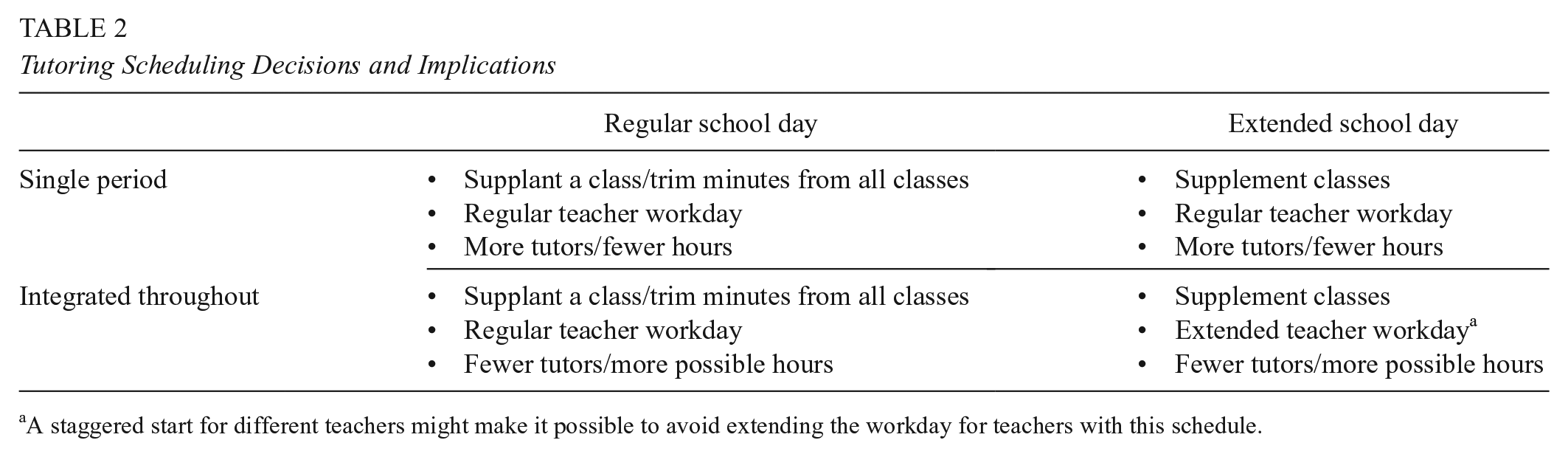
A staggered start for different teachers might make it possible to avoid extending the workday for teachers with this schedule.
Schools and districts will know best whether and how to adjust their current schedule. In some instances, schools may be able to aggregate pockets of underutilized time during the existing school day to create an extra period for tutoring. A second alternative is to shorten periods throughout the day by a few minutes to carve out a tutoring period. A third approach would be to integrate tutoring into existing personalized learning time blocks or Response to Intervention (RTI) models. We recommend extending the school day by 30 minutes across all K–12 schools to make time for tutoring Monday through Thursday and an early release on Fridays for K–8 students. Extending the day for high school students would be particularly advantageous given that our blueprint aims to recruit many of them to serve as tutors/mentors for 30 minutes in addition to being tutored.
A critical but underappreciated challenge with extending the school day is the need for union approval through collective bargaining and fair compensation for teachers’ additional time. Our proposed model of extending the school day would not rely on extending teachers’ workdays. For maintaining the teacher workday to be feasible, tutoring at the elementary and middle school levels has to happen at the same time for all students either during the first or last period, so that some teachers can start their days after first-period tutoring classes or end before last-period tutoring class. The tradeoff with simultaneous tutoring sessions is the need for many more tutors/mentors than if districts integrated tutoring across the full school day. The alternative, extending the teacher workday, would be more costly but allows tutoring to be integrated throughout the school day and for fewer overall tutors/mentors to work across multiple class periods.
The large supply of high school students who could serve as tutors/mentors makes offering tutoring during a single period in elementary schools somewhat more feasible. Limiting tutoring to a single period in middle school is a greater challenge given the more limited supply of college students. A single period would also limit FWS students to tutoring only 2 hours a week, which may be optimal for some tutors/mentors but not for others. Full-time AmeriCorps members would need to work with high school students in classes integrated throughout the school day. For high schools, we can imagine an extended day schedule with tutoring and core classes during the traditional school day and electives, including tutoring elementary school students, during the additional period. This might allow schools to stagger the workdays of core-subject teachers and elective teachers to avoid extending the teacher workday.
Tutoring Content
A second central decision for districts will be to identify the core goals and associated curriculum for tutoring. The political battles over the Common Core State Standards highlight how contentious an issue this can be (Polikoff, 2021; Tampio, 2018). The NTI would make a range of content and formative assessments for core academic subjects available that districts could choose to use or adapt. Regardless of the focus, district coordinators should ensure that tutoring content complements rather than supplements their traditional classroom instruction. Tutoring sessions should also include dedicated time for relationship-building and academic mentoring through informal conversations. One approach would be to start tutoring sessions with rotating 5-minute, one-on-one conversations as students work on independent warm-up activities. This would provide opportunities for private check-ins between students and their tutors/mentors.
Online Versus in Person
Districts will need to decide if tutoring will take place in person, remotely through a video call, or in some hybrid form. There are clear tradeoffs here. Virtual sessions have the benefits of expanding the pool of tutors/mentors beyond the local supply and reducing time costs and logistical obstacles associated with commuting to schools. However, online programs impose the additional costs of providing and maintaining the necessary technological infrastructure and web-connected devices. We also know less about the ability of tutors/mentors and students to form strong bonds and caring relationships if they never meet in person.
Student Grouping and Tutor–Student Matching/Ratios
Districts would determine the process for grouping students and matching tutors/mentors as well as exact student-to-tutor ratios with a ceiling of 4-to-1. We can envision a variety of matching priorities related to a tutor/mentor’s experience level, fluency in students’ home language, individual background, and subject-specific interests.
Tutor/Mentor Selection
Tutor/mentor selection would be managed by tutoring organizations that partner with local districts or local-level program administrators. The NTI would provide resources for tutor/mentor selection and make suggestions for considering different qualifications such as ability to connect with students, content knowledge, and a minimum GPA, but ultimately the selection criteria would be left to local discretion. Approaches to tutor/mentor selection present a clear tradeoff between maintaining a committed and qualified corps of tutors/mentors and constraining tutor/mentor supply. High selection barriers may not be feasible in some contexts, making high-quality training and support essential for program success.
Tutor/Mentor Training
Tutor/mentor training could also be implemented by tutoring and mentoring organizations in coordination with school site administrators. Training is an integral aspect of effective tutoring and mentoring and should include ongoing observation and coaching via peer and school leadership. The NTI would provide training guides that districts could opt to use and adapt. Training would likely include topics such as relationship-building strategies, cultural competence training, questioning techniques, student learning differences, local curriculum and content standards, setting appropriate boundaries, and responsible community engagement (especially for tutors/mentors not from the local community). Peer leaders would need additional training on how to provide ongoing feedback and coaching to their fellow tutors/mentors. These feedback sessions could occur on Fridays when K–8 students do not have tutoring.
Costs and Funding
We estimate the total costs of the program at a national scale without specifying a cost-sharing model across federal and local funding sources. How the federal, state, and local governments share program costs presents a number of tradeoffs. Requiring districts to cover some fraction, perhaps 10%, of program expenses would lower costs from the federal perspective and possibly enhance local commitment to program success. A design with a higher financial commitment from states or districts might only exacerbate existing inequities in access to tutoring given longstanding racial and socioeconomic gaps in per-pupil funding across states and within states across districts (Corcoran & Evans, 2015; Knight, 2017). In the online Supplemental Appendix B, we discuss existing federal programs that legislators might leverage as potential funding mechanisms for the program.
Most prior attempts to estimate tutoring costs at scale involve a back-of-the envelope calculation that multiplies a fixed per-pupil cost by the number of students served. Our approach is a more dynamic model of total tutoring system implementation costs, inclusive of both variable and fixed costs. With our modular blueprint, per-pupil costs vary considerably across grade-level designs. One weakness of our cost estimation is that we cannot accommodate local-level variation in design choices. We view these cost estimates as baseline figures that illustrate the magnitude of federal funding such an effort would require. We aggregate school- and district-level costs of tutor-student pairings described above and the administrative structure detailed in the online Supplemental Appendix B. We price the primary inputs of each tutoring program module and provide the details of input costs, model assumptions, and data sources in the online Supplemental Appendix A.
Program Cost Projections
In Table 3, we estimate total and per-pupil costs across three different target populations and within each grade range. This breakdown helps contextualize the aggregate costs of a targeted tutoring model relative to current federal education initiatives such as Title I ($16 billion), the National School Lunch Program ($14 billion), and Head Start ($9 billion). We estimate that a national program to tutor the 6.4 million elementary and middle school students in schools in the bottom quartile of student proficiency rates would cost $4.8 billion annually. Alternatively, targeting all 22.3 million public elementary school students would cost $14.8 billion. Tutoring the 28 million K–12 students attending Title I schools would cost $26.1 billion. At the highest end, tutoring every public-school student in the United States would cost $50.1 billion.
Estimated Total and per Pupil Funds by School Level

Note. Low-proficiency schools are in the bottom quartile by school-level student proficiency rates on state assessments, indexed across math and English language arts achievement reported by the Department of Education (2020a). Program total includes costs that are not attributable to specific grade ranges such as district and federal expenses.
There are two main drivers of cost differences within our model: tutor/mentor type and student-to-tutor ratios. These factors shape per-pupil costs across grade ranges ($662 elementary; $927 middle; $1,486 high) because of the distinct tutors/mentors and student-to-tutor ratios we propose in our blueprint. Costs for tutoring high school students are also higher because we estimate the all-in costs of service members, which are shared across federal and community stakeholders in the current AmeriCorps model. We budget an average annual stipend of $30,000 plus benefits and a $6,000 Segal Education Award, which is just above the current maximum stipend allowed by AmeriCorps. Our aim is to attract a larger and more diverse supply of potential tutors/mentors and to make participation more practical for recent college graduates from low-income backgrounds. 5 Our per pupil cost estimates also vary by the schools we target because of differences in average school and district size across samples and the relative representation of elementary, middle, and high schools in each sample.
We make several assumptions when calculating our total cost estimates that suggest they capture the high end of the program’s potential cost range. We assume a model fully funded by new federal dollars, rather than through a reallocation of existing funds. We also assume every district in a given target population would opt into the program and that two thirds of districts would need additional technical resources to support virtual tutoring. Personnel expenses comprise 83% of our estimated costs, which is consistent with prior literature on intervention costs (Hollands et al., 2016; Levin & Belfield, 2015) as well as evidence from IRS filings of nonprofit tutoring organizations. 6
The relative cost-effectiveness of this program is roughly in line with other, similar tutoring programs according to our comparison of cost-effectiveness ratios (CERs) for a $1,000 investment in a single year of the program (Harris, 2009). Our average per pupil cost to serve all students in the United States is $1,022, which is lower than first-generation high-dosage tutoring models because of our higher student–teacher ratios and use of high-school and college students as tutors. If our program had an effect of 0.10σ, less than a third of the average effect size found in the literature (Nickow et al., 2020), the CER would be 0.10, making it competitive with other tutoring programs and cost-effective education interventions. For example, Heinrich et al.’s (2014) study of SES across four metro areas found effects between 0.04σ and 0.12σ in some samples, with per-pupil costs ranging from $1,100 to $1,400. The corresponding CERs for these effects range from 0.03 to 0.11. Saga Innovations’ original high-dosage tutoring program cost between $3,500 and $4,300 per pupil, yielding a CER between 0.09 and 0.11 (Guryan et al., 2021). 7 Vacation academy tutoring, administered by teachers over a short period, have a CER of 0.12 for the average effect of 0.07σ (Schueler, 2020). To exceed the CERs of these similar programs, our proposed national tutoring program would need to have a positive effect of at least 0.13σ.
The Challenges of Scale
The success of any effort to take tutoring to scale will depend critically on a clear-eyed understanding of the implementation challenges that can scuttle even the most promising education reforms. Successfully scaling education initiatives requires navigating a complex and decentralized organizational environment where shifting political priorities, competing demands, and high rates of administrative turnover serve to reinforce the status quo. Districts are often risk-averse organizations that are wary of partnering with outside programs. We have intentionally designed the blueprint so that the actors and organizations required to implement tutoring at scale all stand to benefit from either direct compensation, new administrative positions, increased funding, instructional support, mentoring relationships, or job experience.
Too often, education reformers focus on scale as a narrow, numerical expansion of a program. Scaling successfully requires attending to the depth as well as the breadth of consequential change, the spread of practices across actors within organizations, and the sustainable transfer of ownership to local districts (Coburn, 2003). Expansion efforts commonly fail due to excessive focus on superficial features of program adherence (Spillane et al., 2002). Scaling successfully requires a balance between empowering implementers to shape programs to their local contexts and ensuring knowledge transfer of core design principles to avoid “lethal mutations” (McLaughlin & Mitra, 2001).
The blueprint we propose is predicated on a fundamental shift in our collective understanding and norms about what schools do. We see individual instruction complementing group instruction as an integrated strategy to support the learning and development of all students. For this to happen, administrators, teachers, tutors/mentors, students, and parents would need to view tutoring and mentorship as core parts of students’ schooling. An effective tutoring structure would also mean a departure from the siloed and individual nature of teachers’ work toward a more collective effort where teachers and tutors/mentors coordinate to support students.
Our proposed blueprint would require substantial, structural changes to education systems and ongoing skill development for young adults. Schools will need to make major, coordinated changes to their schedules across grade levels and in partnership with local colleges to align the timing of tutoring with the schedules of high-school and college students. Scaling tutoring is highly dependent on the will of young adults to serve as tutors/mentors and the skill required of them to succeed. In some cases where programs employ tutors/mentors from outside of a community, it will be critical to support tutors/mentors’ development of cultural competencies to help them avoid adopting deficit-lenses and savior-like mentalities (Zhu, 2019). Ongoing on-the-job training and critical reflection are essential for program success.
We have attempted with this blueprint to create a structure that recognizes these challenges. Our aim is to provide an architecture for supporting schools’ efforts to make tutoring widely accessible, while providing for local ownership over key implementation features. The modular nature of the blueprint is intended to provide flexibility in program design, while still maintaining a “family resemblance” across programs (Elmore, 1996). Scaling tutoring successfully will likely require a scaffolded sequence of implementation support and capacity building (Durlak & DuPre, 2008; Quinn & Kim, 2017).
Conclusion
There are often large gaps between what we know about effective education interventions and what we can successfully implement at scale. This article attempts to bridge this gap for tutoring. We view tutoring as a promising intervention not only for supporting students to access and deepen their grade-level content knowledge but also as an opportunity to facilitate meaningful school-based mentoring relationships. Accomplishing this goal will take a substantial federal commitment and a shift in the norms and structures of schooling. It will also require patience and persistence in the face of implementation challenges. We hope our blueprint will help to pave the way forward.
Supplemental Material
sj-docx-1-ero-10.1177_23328584211042858 – Supplemental material for A Blueprint for Scaling Tutoring and Mentoring Across Public Schools
Supplemental material, sj-docx-1-ero-10.1177_23328584211042858 for A Blueprint for Scaling Tutoring and Mentoring Across Public Schools by Matthew A. Kraft and Grace T. Falken in AERA Open
Footnotes
Acknowledgements
We are grateful to the many people who shared their expertise with us and provided invaluable feedback including Jessi Brunken, Simon Burgess, Megan Carey, Pamela Civins, Betty Clinton, Robbie Coleman, Lindsay Dolce, Angela Duckworth, Melissa Emidy, Chris Fairbank, Julia Freeland Fisher, Mike Garringer, Sakshi Gawde, Bradley Gellman, Allison Gilmour, Sara Goldrick-Rab, Michael Goldstein, Rick Hess, Nathan Jones, Robert Kelchen, John King, Seth Kolker, Susanna Loeb, Samantha Margolis, Soljane Martinez, Scarlet Nunez, Rachel Palumbo, David Parker, Michael Petrilli, Justin Reich, Carly Robinson, Joshua Rodriguez, Todd Rogers, Alan Safran, Judith Scott-Clayton, Robert Slavin, Andy Sokatch, Tracy Steffes, Nicholas Tampio, Vivian Tseng, Paul von Hipple, Douglas Webber, and David Yeager. Joshua Bleiberg, Alexander Bolves, Marlene Almanzar Garcia, Jessalynn James, Samuel Lynch, Melissa Lyon, Luyan Nguyan, Hannah Sexton, and Sara White provided excellent research assistance. All errors and omissions are our own.

Notes
Authors
MATTHEW A. KRAFT is an associate professor of education and economics at Brown University, PO Box 1938 Providence RI, 02912; email:
GRACE T. FALKEN is a program associate at the Annenberg Institute at Brown University; email:
References
Supplementary Material
Please find the following supplemental material available below.
For Open Access articles published under a Creative Commons License, all supplemental material carries the same license as the article it is associated with.
For non-Open Access articles published, all supplemental material carries a non-exclusive license, and permission requests for re-use of supplemental material or any part of supplemental material shall be sent directly to the copyright owner as specified in the copyright notice associated with the article.
