



Abstract
Despite considerable growth in rates of participation in recent years, concerns remain about disparities in access to dual enrollment programs. On one hand, there are questions regarding who has access, which students are most disadvantaged, and which schools fail to offer the opportunity at all? On the other hand, there has been little clarity about what helps to improve access—in particular, what is the role of state policies in this effort? Using nationally representative data sources, this study uses a multilevel approach to understand how dual enrollment participation varies at the level of states, schools, and students. The findings reveal that policy mandates are among the strongest predictors of dual enrollment participation. Furthermore, schools serving greater proportions of racially minoritized students are the least likely to offer dual enrollment, but within schools, students from lower socioeconomic backgrounds have a lower probability of participating relative to their more affluent peers.
As a growing proportion of high school graduates enroll in colleges and universities, there has been considerable attention paid to the college readiness of these students. Indeed, while nearly 70% of graduates now enroll in higher education, only 60% of those who enroll are found to finish within 6 years (Bureau of Labor Statistics, U.S. Department of Labor, 2018; McFarland et al., 2017; Shapiro et al., 2013). Though a number of challenges may affect degree completion, research shows that a growing proportion of students are unprepared for the academic rigor of higher education (Arum & Roksa, 2011; Bettinger & Long, 2005; Bound et al., 2010) and struggle to accumulate the requisite number of credits needed to graduate on time (Attewell & Monaghan, 2016). Especially troubling is that these challenges are often most pronounced among students of color (i.e., Black and Hispanic/Latino) and those from low-income backgrounds (Attewell & Domina, 2008; Taylor et al., 2020).
Programs offering accelerated learning in high school have been commonly promoted to address concerns regarding academic preparedness and timely degree completion in recent decades. Since the 1990s—and increasingly since the 2001 No Child Left Behind Act—both state- and federal-level policymakers have sought to expand access to advanced coursework by introducing policies that upgrade curricular opportunities (Conger et al., 2009; Kolluri, 2018). Widely known programs, including the International Baccalaureate Diploma Programme (IB) and Advanced Placement (AP), provide pathways for students to take advanced, college-level coursework while still enrolled in high school (American Institutes for Research, 2013).
Dual enrollment (DE) programs have also emerged as an increasingly popular option for accelerated learning in recent decades. 1 These programs allow students enrolled in high school to take college credit-bearing courses through a partnership between high schools and postsecondary institutions. Research from the National Center for Education Statistics (NCES) shows that the number of high school students participating in DE grew from an estimated 1.2 million in 2002 to approximately 2 million in 2010 (Thomas et al., 2013; Waits et al., 2005).
The surge in DE participation may be attributed in part to the attractiveness of this program among policy makers (Taylor et al., 2015). Formal legislative statutes governing DE grew from 33 states in 2001 to 47 states in 2012 (Borden et al., 2013; Education Commission of the States, 2001). While there is heterogeneity in the scope of these policies, many are intended to expand access by requiring schools to offer DE and by subsidizing the costs to students and their families. Because DE requires coordination between the secondary and postsecondary sectors, institutional participation may be affected by whether or not state legislation regulates the extent of these arrangements. As such, state-level policies may be especially important to ensure that students have access to these curricular opportunities.
Despite the growing popularity of DE, many questions remain regarding equal access to these programs for students from marginalized backgrounds and the contextual factors associated with whether or not the program is offered. While there has been considerable research on longstanding programs such as AP (Kolluri, 2018), we know far less about DE by comparison, and few studies have offered a national examination of program access. Recently, Xu et al. (2021) investigated the role of state policies and other contextual-level factors on the extent of race-based gaps in DE participation rates within school districts. But because this study only employs data aggregated at the district level, it is still unclear how these factors may directly affect students after accounting for individual factors associated with course-taking behavior. It also remains unclear whether and, if so, how disparities by race/ethnicity and socioeconomic status manifest in DE participation relative to other opportunities (e.g., AP/IB). Because DE is only one of multiple options for accelerated learning, it is important for investigations of disparities in program access to consider student behavior within the context of a full choice set of alternative considerations.
Using multiple nationally representative data sources, we employ a multilevel framework to examine variation in DE participation at the level of schools and students, focusing particularly on the role of state policies in facilitating access to the programs. We argue that a more nuanced understanding of DE participation, and the role of state policies in this effort, is needed to understand the extent of demographic disparities in program availability across school contexts and gaps in student participation between historically advantaged and disadvantaged groups. We seek to inform policy efforts to expand DE by identifying which student populations are most at risk of lacking access and which state policies may serve to improve participation. Specifically, our investigation considers the following questions:
Background and Literature Review
Variation in Dual Enrollment Access
Several studies have provided a descriptive illustration of the contextual differences between schools offering DE compared with those who do not. One nationally representative study from NCES found that a higher proportion of schools offering DE are located in towns and rural locales serving a greater number of White students (Thomas et al., 2013). Using institution-level data from Illinois, Taylor and Lichtenberger (2013) also show that DE participation at 644 high schools in the state is associated with geographic locale in addition to the student body’s racial and socioeconomic composition. Research from other states, including Pennsylvania, Florida, New York, Texas, and Virginia, find similar trends of stratified access such that female students from White, middle- and upper-income backgrounds are most likely to participate compared with students from other backgrounds (Giani et al., 2014; Karp et al., 2007; Miller et al., 2017; Museus et al., 2007; Pretlow & Wathington, 2013).
Two recent studies further examined the extent of disparities in access to DE using nationally representative data from the Civil Rights Data Collection (CRDC). The U.S. Government Accountability Office (2018) employed generalized linear regression to estimate the relationship between school poverty level with advanced course offerings. They found that high-poverty schools are less likely to offer DE relative to schools with lower concentrations of low-income students. Another study used fractional regression models to examine the relationship between contextual influences with the extent of race-based gaps in participation for AP and DE programs within districts (Xu et al., 2021). The authors found that a number of district-level characteristics—including the racial composition of high school students and racial disparities in pre-high school achievement, among other factors—are positively associated with White–Black and White–Hispanic gaps in DE participation.
In comparison, fewer studies have examined the extent of DE access using student-level data. Another report by NCES (2019) demonstrated that among students who began high school in 2009, the rate of DE participation was between 8 and 11 percentage points higher for White students relative to Black and Hispanic/Latino students. This descriptive report also found that the gap between students whose parents are college educated versus those who did not graduate from high school was 16 percentage points (NCES, 2019). Rivera et al. (2019) employed logistic regression with the High School Longitudinal Study of 2009 (HSLS:09) to investigate the association of several factors with DE participation. Using the full sample of both public and private students, the authors found that racial disparities dissipate after controlling for grade point average (GPA). They also found that female students and those from higher socioeconomic backgrounds have greater odds of participating in DE relative to other students, and contextual characteristics (e.g., public schools, rural/town locales) are also highly associated with program participation.
However, some limitations of these student-level analyses preclude a clear understanding of DE access. Regarding the sample, these studies did not limit their investigation to students enrolled in schools that offer DE. So while the results help provide a broad synopsis of participation, the estimates conflate the probability of taking DE coursework among students who have access to the program with those who don’t. Furthermore, by employing a dichotomous categorization of the dependent variable, prior studies neglect to distinguish between students who do not participate in DE specifically from those who may not participate in any accelerated learning program at all. The distinction is important because lacking access to DE does not necessarily imply that a student is impeded from taking advantage of any advanced coursework. For these reasons, it remains unclear how disparities in DE participation manifest among students who have access to the program and must consider this program among other choices.
The Role of State Policies in Dual Enrollment Access
There are considerable differences in how DE programs are governed and regulated across states that may also affect heterogeneity in program access. Legislation pertaining to DE will often contain multiple regulatory components that vary widely across states. 2 But among the multiple dimensions of these policies, there are two components that specifically regulate DE access—mandates that determine the prescriptiveness of institutional participation in addition to funding-related mandates.
First, state policies often determine the stakeholders responsible for paying tuition costs, which may include students and their families, the school district, the state government, the postsecondary institution, or some combination thereof. Second, state-level policies may also prescribe participation between institutions at the secondary and postsecondary levels as a required mandate or simply a voluntary partnership, if at all. Because DE is a collaborative program between institutions across educational sectors, these arrangements are often managed through local agreements (Western Interstate Commission for Higher Education, 2006). 3
The aforementioned work of Xu et al. (2021) is one of the first studies to empirically examine the role of different state policies governing DE—specifically emphasizing legislation facilitating program access, student outcomes, and financing. They found that districts located in states with strong accountability mandates for program access have higher rates of DE participation overall, but these policies are also associated with an increase in the White–Black and White–Hispanic gaps in participation. They also found that moderate or strong financial support policies are associated with lower participation rates, on average. But because this study only employed data aggregated at the district level, it is still unclear how state and institutional context may affect individual students, particularly after accounting for other factors associated with course-taking behavior (e.g., prior academic achievement, etc.).
Conceptual Framework
We draw on multiple theoretical perspectives to investigate the multilayered factors affecting DE access among schools and individual students. We posit that DE participation is a function of opportunity broadly structured by school participation and the facilitation of their arrangements with postsecondary institutions by state-level policies. On one hand, given the evidence of disparities by race/ethnicity or socioeconomic status that manifest in access to other accelerated coursework opportunities, DE may similarly function as a mechanism that further stratifies preparation for higher education. On the other hand, state policies may help to facilitate access to DE above and beyond the potential disparities across schools. In what follows, we explain how DE access may be shaped by broader contextual influences.
The Secondary School Context and Curricular Stratification
A sociological lens is helpful to understand how DE opportunities may vary by student background and across school context. Indeed, students’ decision making is a product of their habitus—defined as internalized dispositions, beliefs, and perceptions deriving from past experiences and shaped by their environment (Bourdieu, 1986). For this reason, students may be more likely to participate in DE programs when encouraged by institutional agents in the broader school context; yet, advanced course-taking opportunities are often unequally distributed by race/ethnicity and socioeconomic status within schools (Lewis et al., 2015; Oakes & Guiton, 1995). For instance, while advanced course taking is attributable in part to prior academic achievement, research shows that it is also determined by other student-related factors including parental education and income status (Attewell & Domina, 2008; Zietz & Joshi, 2005). As such, some students may be precluded from opportunities for advanced course-taking for reasons above and beyond academic achievement.
Students from marginalized backgrounds may also lack awareness of the requirements needed to participate in DE. In other words, these students may lack dominant cultural capital—or rather the norms, behaviors, and knowledge of one’s social class (Bourdieu, 1986; Bourdieu & Passeron, 1990)—that inform their ability to navigate the complexities associated with early postsecondary opportunities. Such capital may be particularly relevant for DE, which is unique to other accelerated learning programs because students must meet the requirements for admission to a postsecondary institution in order to participate. NCES reports that nearly half of colleges that offer a DE program have academic eligibility requirements that equal those for regular admission (Marken et al., 2013), which may include a minimum GPA, standardized test scores, and written recommendations (Education Commission of the States, 2019). Considering these requirements, participation in DE can mirror the traditional college enrollment process, which often disadvantages students of color and those from low-income backgrounds (Holzman et al., 2020).
Demographic gaps in DE may also occur between-schools since access to advanced coursework is often unequally accessible. For instance, Iatarola et al. (2011) found that schools with a higher percentage of students from low-income backgrounds are less likely to provide these courses, controlling for other factors. Although many high schools have increasingly offered advanced curricular opportunities such as AP and IB in recent years, disparities persist across the sociodemographic characteristics of schools. Research shows that schools serving high proportions of low-income students and those from racially minoritized backgrounds are the least likely to offer these opportunities (Conger et al., 2009; Klopfenstein, 2004; Rodriguez, 2018; U.S. Department of Education Office for Civil Rights, 2014). Given these trends, inequities in access may occur at two levels: schools serving marginalized populations may be less likely to offer DE, and students from these backgrounds may also have a lower probability of participating within schools that offer the program.
However, disparities in DE participation could be interpreted differently when considered as merely one of multiple opportunities for curricular upgrading. For instance, descriptive evidence from Florida and Arkansas show that more students may participate exclusively in AP rather than DE, but there are also a considerable number of students who engage in coursework for both programs (Speroni, 2011; Taylor & Yan, 2018). While some scholars have explored whether DE may lead to a substitution with AP (Dutkowsky et al., 2009), one recent study of course-taking behavior in Colorado shows that there is little evidence of substitution (Clayton, 2021). For this reason, students who do not participate in DE may not necessarily lack access to other accelerated learning opportunities—rather, they may use DE as an option merely to supplement other offerings.
Institutional Supply, Student Demand, and the State Policy Context
State-level policies may also affect DE access by eliciting a response of institutional supply and student demand. Because DE requires cooperation from different educational sectors, state policymakers may intervene to establish intersector arrangements in the effort to increase program access. This type of intervention commonly exists between higher education sectors through statewide articulation agreements: comprehensive arrangements requiring collaboration between public colleges within a state that permit students to transfer seamlessly between them (Roksa, 2009). Unlike articulation policies for college transfer, state policies regulating DE do not always provide blanket requirements for institutional partnerships, but some policies do facilitate the establishment of cooperative agreements between secondary and postsecondary institutions.
Nonetheless, the strength of DE policies can differ considerably since states offer varying degrees of flexibility to regulate these arrangements. In a report for the U.S. Department of Education, Karp et al. (2005) distinguished state-level policies according to how they prescribe participation for secondary schools—if at all—as either mandatory or voluntary. Policies offering tuition subsidies may also affect DE access by mandating who is responsible for paying tuition costs, which can be covered by state funds, district-level funds, or students and their families (Zinth, 2015).
Mandates may be a particularly advantageous form of governmental accountability that compel schools to offer DE programs and allow more students to participate if provided the opportunity. McDonnell and Elmore (1987) advance that mandates are one mechanism of policy implementation that regulates the actions of state agents such as public schools. The authors argue that, “the expected effect of mandates is compliance, or behavior consistent with what the rules prescribe” (McDonnell & Elmore, 1987, p. 138).
Still, it is unclear if all policy mechanisms regarding DE manifest the desired response regarding access to the programs. Considering the importance of accountability in this regard, these policies may affect a response from both institutions and students. On the supply side, participation between high schools and colleges may depend on the level of prescriptiveness from legislative statutes. High schools may be more willing to offer DE when there is a clear mandate to do so or if they are not responsible for the costs.
On the demand side, students may make a rational choice regarding whether or not to participate after weighing the costs against the perceived benefits of participating in DE (Becker, 1993). Regarding the financial costs, of particular importance may be the determination of who pays for the tuition and fees. Although most DE programs keep tuition and fees relatively low for participants (An & Taylor, 2019), students and their families could be less likely to participate if state policies do not provide provisions to subsidize tuition costs. Because families do not pay tuition for public secondary schooling, they may not value investing in higher education prematurely, though the opportunity to take college-level coursework and accumulate college credits early may still be particularly attractive to high-achieving students with college expectations. But among other potential challenges, the ease of access to DE programs (or rather, the lack thereof) is a fundamental nonmonetary cost to participation. If schools partner with a local college, this may reduce challenges to the application process and thus facilitate easier access to coursework. As such, mandates may provide students with clear pathways that increase the probability of participating.
Research Design
Data and Samples
We gathered data from multiple sources to comprehensively represent the relationship between state policies with DE participation at the level of both schools and students. To capture these different aspects of DE participation, we generate two data sets derived from nationally representative surveys in addition to original data collected from the documentation of policies covering all 50 states.
Institution-Level Data
To facilitate an investigation of DE program availability, we employed institution-level data derived from the U.S. Department of Education’s Office of CRDC. The CRDC is a biennial survey collecting information about school characteristics and outcomes from the universe of public schools nationwide. The 2015–2016 data collection features comprehensive information on 96,360 schools including expenditures and staff characteristics, student body characteristics, and curricular offerings. In order to add supplemental information regarding these institutions, we merge the CRDC with data from the Common Core of Data (CCD) and from the U.S. Department of Education’s EdFacts initiative, which collects information pertaining to school-level academic achievement.
Several restrictions are employed to generate the final analytic sample of public schools from CRDC. First, the sample is reduced to include only schools serving students through at least the 12th grade in all 50 states, excluding U.S. territories and DC, given our study’s emphasis on state policies. We also restrict the sample to “traditional” public high schools, which includes those defined by CRDC or CCD as regular, magnet, and charter schools. 4 The final analytic sample includes a total of 18,848 public schools.
Student-Level Data
To examine student-level outcomes, we employ the restricted version of the HSLS:09. This data source captures a nationally representative sample of more than 25,000 ninth-grade students enrolled at 944 public and private high schools in the fall of 2009. More specifically, HSLS:09 is a longitudinal study that surveyed high school students at multiple points during their educational trajectory and contains information from transcripts as well as student and administrator surveys.
The analytic sample for the HSLS:09 data is also restricted to facilitate our investigation of DE participation. First, we restrict the sample to only include students enrolled at traditional public schools—following the same definition employed for the CRDC sample. This restriction is in keeping with our interest in understanding the role of state policies, which principally affect public institutions. Second, we also restrict the sample to students who were surveyed in each of the first three waves of data collection because DE participation is only captured in the years after the baseline period. Last, since DE participation is identified in HSLS from survey data, students who indicated that they were uncertain of whether or not they enrolled in such courses are also excluded. 5 Taken together, these restrictions produce a final unweighted, analytic sample of 10,980. The sample sizes for HSLS are rounded to the nearest 10 in compliance with regulations from NCES.
State Policy Data
We also compiled a database of legislation pertaining to DE in order to generate independent variables regarding state policies that facilitate program access. As previously discussed, our study is motivated, in part, to ascertain how high schools and students respond to policy mandates. Following a careful review and analysis of policies across states (see Supplemental Appendix B available in the online version of this article), our analysis produced a categorization of policy components that determine who is responsible for paying tuition costs and mandate school-level participation. Online Supplemental Appendix Table B1 presents the states with policy features that we define by these funding and participation mandate categories. In this classification of policy typologies, we hypothesize that each approach may have a different relationship with examined outcomes given the different implementation goals.
First, we define our funding-related policy components according to which party is responsible for paying for tuition. The inclusion of a funding variable is based on the premise that financial incentives (or disincentives) affect the willingness of institutions and students to participate in DE. For this reason, we placed emphasis on coding for two types of policies regarding funding for our analysis. The first captures states where the school district is required to pay for the tuition and fees. The second captures states in which the state government pays some extent of the tuition and fees, even if it is only for certain populations and not necessarily all students. The third category, which constitutes our reference category for the analysis, represents states where the tuition responsibility is either left to families or made on a local basis.
Second, we also define participation mandates according to the strength of the policy in four categories: strong articulation mandate, strong participation mandate, moderate participation mandate, or voluntary participation. The strong articulation mandate refers to regulation for high schools or school districts to enter into an agreement with a postsecondary institution. Policies with a strong participation mandate refers to states where the policy language indicates that the high school shall either offer or make DE available to students. In states with a moderate participation mandate, schools are required to offer students the opportunity for early college credit accumulation, but DE may be offered as only one option among others (e.g., AP, IB, etc.). Our reference category for the analysis includes states with participation policies that we define as voluntary. In such instances, schools may be encouraged to provide these opportunities, but ultimately have discretion on whether or not to do so.
Analytic Approach
As previously noted, the facilitation of DE opportunities occurs at multiple levels: requiring coordination from state governments, the participation of schools, and the ensuing participation of students themselves. Of particular interest is how the factors at each level are related to the extent of access to these programs. For this reason, we use two approaches to answer the research questions. To answer the first research question, we employ multilevel modeling, which is appropriate to estimate the relationships between variables at multiple levels with our outcomes. 6 For the second research question, we use multinomial logistic regression to further account for the complexity of the curricular choice set often presented to individual students. While both approaches are ideally suited to answer the research questions, it is important to note that they do not facilitate the ability to make causal inferences.
Multilevel Regression Models
Our primary analysis begins with multilevel techniques using both of the aforementioned data sources. This approach ideally accounts for the complexity of the hierarchical structure of variation in DE participation by estimating both fixed and random effects that capture the relationships between variables. In other words, because students are nested within high schools—and high schools within states—there is likely to be considerable variability in DE participation. Multilevel models adequately account for the nesting of individual units within different contexts and facilitates the decomposition of within- and between-group variation; thereby allowing us to estimate how the factors at each level contribute to the outcomes of interest and to estimate the degree of error related to unobserved effects at each level. Without accounting for this clustering, the estimates will suffer from aggregation bias and the standard errors may be underestimated (Raudenbush & Bryk, 2002).
Grounded by the conceptual framework, our models assume that the estimated associations of our explanatory variables with the outcomes are the same and would not differ across contexts. For this reason, we employ random-intercept logistic regression models to estimate the unique contribution of predictors at the level of students, schools, and states, and only the intercepts, or rather, the overall level of response between groups, are allowed to vary in these models (Rabe-Hesketh & Skrondal, 2012). As such, the variability of random intercepts capture the extent that clusters vary in degree of DE participation while the coefficients for specific variables present the estimated associations of characteristics and policies with our outcomes.
School-level analysis
We answer the first research question in two parts, beginning with an analysis of schools employing the CRDC data set to estimate two-level models in which the institution-level covariates are represented as Level 1 and state-level covariates are represented at Level 2. Equation 1 can be expressed as follows:

where
Variable Descriptions and Summary Statistics

Source. Office for Civil Rights Data Collection (CRDC), 2015–2016; Common Core of Data (CCD), 2015; EDFacts 2015–2016 Achievement Data (EDFT); High School Longitudinal Study of 2009 (HSLS:09); AP = Advanced Placement; GEN = self-generated variable; IB = International Baccalaureate Diploma Programme.
Indicates the reference category.
Student-level analysis
We use three-level models with the HSLS:09 data set to further our examination of the first research question in which students (Level 1) are nested within schools (Level 2) that are also nested within states (Level 3). In this instance, we specifically investigate the probability that students will participate in DE. Equation 2 can be expressed as follows:

where i, j, and k, respectively, index the level of students, schools, and states. The random intercept
The three-level model is employed to adequately account for the nesting of students within schools and states and to produce parameter estimates for the factors at each level. But of primary interest for this analysis is the relationship between student characteristics and state policies with DE participation. Thus, while we control for observed factors across schools, our coefficients of interests are at Levels 1 and 3 specifically.
Given the complex sampling design of the HSLS:09, these models employ analytic weights for students (W3W1W2STU) in order to calculate the correct standard errors and to help make statistically valid inferences of the population. Following Rabe-Hesketh and Skrondal (2006), we also rescaled the regression coefficients according to the random-intercept variance, which will be “less affected by the scaling of level 1 weights than the original parameters” (p. 806). Because the statistical software employed to fit our models is unable to adequately accommodate both the HSLS survey design elements with multiply imputed data, 8 we employ a multiple random imputation procedure to generate our parameter and standard error estimates. As described by Allison (2002), we combine the estimates produced from 10 complete, yet separately imputed data sets using the Stata ice package. 9
Multinomial Logistic Regression Models
Although the aforementioned analyses allow us to investigate the influence of factors at multiple levels on DE participation, they may obscure important differences in course-taking behavior. Because students may consider DE as only one accelerated learning opportunity among others, a student who does not participate in DE may actually participate in another program instead. For this reason, we employ multinomial logistic regression (MLR) with the HSLS data set to answer the second research question. MLR improves on the use of a dichotomous outcome, which may inadvertently conceal important differences in DE participation by grouping students who may only take AP or IB coursework with those who never participate in any program at all.
For this analysis, we generate a multicategorical dependent variable capturing the choice set of various accelerated learning opportunities offered in high schools. The dependent variable distinguishes four categories: students who only participated in DE, those who participated in both DE along with at least one other accelerated learning program (e.g., AP or IB), and students who only participated in a program other than DE; each of these options is compared with the base category of never participating in any accelerated learning program. The MLR models are also weighted (W3W1W2STU) and employ a sample further reduced to include only students enrolled at schools that offer a DE program (n = 8,710). Therefore, this analysis allows us to infer which student populations nationwide are most likely to lack access to DE when the program is actually available to them.
Results
School Participation in Dual Enrollment
Table 2 presents the results of the multilevel model analyses estimating the relationship between institutional- and state policy-level predictors with the probability that a school would offer DE. The estimates from three models are presented successively in which Model 1 includes only state policy predictors, Model 2 includes only institutional predictors, and Model 3 presents the full model containing both. Estimates are presented as both log odds in addition to average marginal effects for ease of interpretation.
Multilevel Logistic Regression Estimates of Dual Enrollment Availability Among Public Schools

Source. Office for Civil Rights Data Collection (CRDC), 2015–2016; Common Core of Data (CCD), 2015.
Note. The analytic sample includes 18,848 “traditional” public schools—defined as regular, magnet, and charter schools—that enrolled 12th graders in all 50 states, excluding U.S. territories and DC. Continuous variables are grand mean centered. Missing data are multiply imputed. Reported are coefficients presented as log odds, with standard errors in parentheses. AME = average marginal effects; AP = Advanced Placement; IB = International Baccalaureate Diploma Programme.
Reference categories: Participation voluntary and no tuition mandate. bReference category: Regular public school status, % Free/reduced-price lunch: Low, and % Racial minorities: Low.
p < .05. **p < .01. ***p < .001.
The table shows that the state policy context has a strong relationship with DE availability. 10 Model 1 shows that schools in states with a strong articulation mandate or a strong participation mandate were more likely to offer DE programs relative to schools in states where participation is merely voluntary. Models 3 estimates show that the significance of the relationships is robust net of other variables. We find that, on average, the probability of a school offering DE is 12 percentage points higher in states with some strong mandate relative to those in which there is no mandate or participation is only voluntary. In contrast, we do not find a statistically significant association with funding-related policies.
Several school characteristics are also related to whether or not DE is offered. Because there is little difference between the models, we focus on estimates from Model 3. The geographic locale factors are among the most important predictors of DE availability. Relative to suburban schools, those in rural and town locations are, respectively, 5 to 10 percentage points more likely to offer the program, but those in urban locales are 2 percentage points less likely to do so. Controlling for other factors, there is also a negative relationship among charter schools which are less likely to offer DE relative to those defined as regular high schools. Yet several factors have a positive and statistically significant relationship with DE availability: offering AP, a larger student enrollment, higher per pupil school expenditures, and a higher proportion of students with proficient-level math scores. Taken together, these findings suggests that schools offering DE may serve a larger number of students who would meet the criteria to participate in advanced curricular opportunities.
Student body characteristics were of particular interest for our investigation, and we find that the results vary for indicators of school poverty compared with racial/ethnic composition. On one hand, Title I status has a positive relationship with the outcome while schools with a considerable percentage of students receiving free or reduced-priced lunch are also more likely to offer DE compared with those serving the fewest students from this background. Nevertheless, this observed relative advantage is lowest among schools serving the most low-income students—at a difference of only 3 percentage points compared with 4 to 5 percentage points for the schools with a more mixed-income student composition. But on the other hand, holding constant other factors—including indicators for school poverty—the measures capturing schools with greater percentages of racially minoritized students are all negative and statistically significant. Specifically, schools in which students of color make up 75% or more of the student body are 14 percentage points less likely to offer DE relative to a school serving predominately White students.
Student Participation in Dual Enrollment
Table 3 presents the results of our three-level multilevel models regarding student participation in DE. Model 1 controls only for state policy indicators, Model 2 controls for student sociodemographic characteristics only, and Model 3 combines Models 1 and 2 but also adds indicators of academic achievement, degree expectations, and school-level factors. For parsimony, we have suppressed the estimates for institution-level factors given our primary interest in the student- and state policy indicators. 11 The results suggest that among state-level policies, only strong articulation mandates have a statistically significant association with the outcome. Controlling for other factors, Model 3 shows that the probability of participating in DE is 10 percentage points higher among students in states where schools are mandated to establish articulation agreements compared with those in states where school participation is voluntary.
Multilevel Logistic Regression Estimates of Dual Enrollment Participation Among High School Students

Source. High School Longitudinal Study of 2009 (HSLS:09).
Note. The analytic sample includes 10,980 students enrolled at “traditional” public schools offering dual enrollment. The sample size is rounded to the nearest 10 per requirements from NCES. Models are weighted using the W3W1W2STU longitudinal weight. Multiple random imputation procedures are employed for missing data. School level controls include school type, locale, enrollment characteristics, instructional resources, and an indicator for dual enrollment availability. Reported are coefficients presented as log odds, with standard errors in parentheses, and average marginal effects (AME). DE = dual enrollment; AP = Advanced Placement; IB = International Baccalaureate Diploma Programme; AAPI = Asian or Native Hawaiian/Pacific Islander; NCES = National Center for Education Statistics.
Reference categories: Participation voluntary and no tuition mandate. bReference categories: White, Parental education: College degree, “D” Average grade point average, high school or less expectations.
p < .05. **p < .01. ***p < .001.
The full model shows that DE program participation has the strongest relationship with measures of academic achievement and college expectations. Specifically, the probability of participation is 28 percentage points higher for students with the highest GPA compared with those with the weakest credentials, on average, and 20 percentage points higher among typical “B” average students. Students with expectations to graduate from college are similarly more likely to participate in DE compared with students with lower degree aspirations.
While some sociodemographic characteristics are also related to DE access, these findings are not robust across models. First, we find that female students are more likely to participate relative to males. In contrast, those from lower socioeconomic backgrounds—as defined by parental education and income status—are less likely to engage with DE by 2 percentage points relative to more affluent students. We also find a negative relationship of participation among Hispanic/Latino students in Model 2, but after controlling for other factors in Model 3, this relationship is also no longer statistically different from zero.
Examining Heterogeneity in Student Participation
We now turn to our results from the MLR analysis in Table 4 to further complicate our understanding of potential disparities in DE access. Specifically, the MLR analysis narrows our focus to students enrolled in traditional high schools offering DE programs, and we also account for other accelerated learning programs that students may consider. In this effort, we are able to provide a more nuanced description of student-level disparities in access. Given the focus of our investigation, we only emphasize the results here for the outcomes regarding DE despite the fact that our multicategory dependent variable estimates probabilities for multiple coursework pathways. 12
Multinomial Model Estimates of Dual Enrollment Participation Among Students in Schools Offering the Program
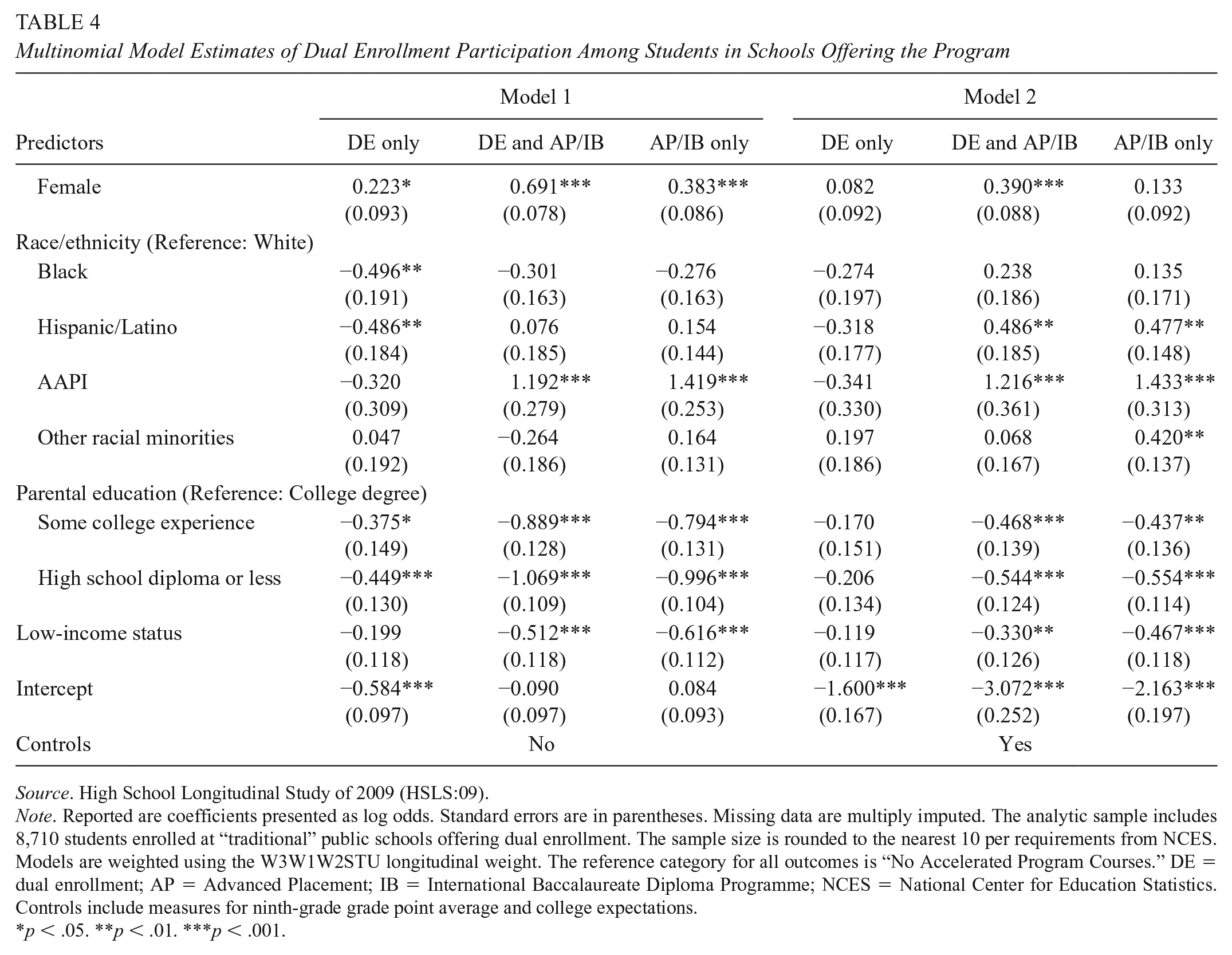
Source. High School Longitudinal Study of 2009 (HSLS:09).
Note. Reported are coefficients presented as log odds. Standard errors are in parentheses. Missing data are multiply imputed. The analytic sample includes 8,710 students enrolled at “traditional” public schools offering dual enrollment. The sample size is rounded to the nearest 10 per requirements from NCES. Models are weighted using the W3W1W2STU longitudinal weight. The reference category for all outcomes is “No Accelerated Program Courses.” DE = dual enrollment; AP = Advanced Placement; IB = International Baccalaureate Diploma Programme; NCES = National Center for Education Statistics. Controls include measures for ninth-grade grade point average and college expectations.
p < .05. **p < .01. ***p < .001.
The results in Model 1 suggest that—compared to White students and those from college-educated families—Black and Hispanic/Latino students, and those with less-educated parents, have a lower probability of participating in DE relative to not participating in any accelerated learning program. Those from lower socioeconomic backgrounds are also less likely to enroll in DE along with coursework in another program. But after accounting for academic achievement and degree expectations, Model 2 shows that differences by race/ethnicity and socioeconomic status regarding participation in DE alone are no longer statistically different from zero holding other factors constant. However, the negative relationship of enrolling in DE along with another program among students from lower-socioeconomic backgrounds is robust across the models. We also find a positive relationship of enrolling in multiple programs among students identifying as Asian American or Pacific Islander and Hispanic/Latino, controlling for other factors.
Discussion
Drawing on multiple nationally representative data sources, our study examined the extent of DE participation—specifically variation across contexts and the factors that may facilitate (or impede) access to these programs. The findings from this study revealed important differences in DE participation between schools and among students. Using a multilevel framework to inform our analysis, the results demonstrate that access to DE is a function of state policy levers, institutional structures, and the academic and sociodemographic differences of students.
We found that state policy mandates are among the strongest predictors of DE participation. This finding is consistent with Xu et al. (2021) who also found that state policies are an important determinant of access; but in contrast, we did not find statistically significant relationships for the funding-related policies. Nonetheless, our study offers some new insight concerning the relevance of specific policy components mandating participation.
First, we found that there was a positive relationship between strong participation mandates with DE participation in the school-level analysis. Relative to policies in which participation is only voluntary, schools appear to be more likely to offer DE when the directive to do so is clearly prescribed. In other words, this type of regulation is likely to compel schools into providing DE for students to ensure that they remain in compliance with the state policy (McDonnell & Elmore, 1987). Given the null results from our student-level analysis, the mere offering of DE may not be sufficient to ensure that students actually participate.
Second, we also find that states with strong articulation mandates have a significant relationship with participation among both schools and students. Unlike the other policy categories, mandating clear cooperative agreements may ensure that secondary schools (or districts) and postsecondary institutions are all invested in these arrangements. The amount of effort required to establish DE opportunities may, indeed, incentivize schools to actively engage in encouraging students to participate. Articulation mandates may also help to establish clearer pathways for students to participate. The provisions for DE that are developed by decree of these mandates likely provide advantages similar to articulation agreements that facilitate the ability for students to transfer between public colleges and universities (Roksa, 2009). In the literature regarding transfer-based articulation, scholars have found that students affected by these comprehensive arrangements are more likely to move between institutions seamlessly and experience improved post-transfer outcomes (Boatman & Soliz, 2018; Gross & Goldhaber, 2009; LaSota & Zumeta, 2016). Perhaps the structural clarity that they provide also helps to reduce important barriers for students (Baker, 2016).
Notably, the greatest impediment to participation occurs when schools do not offer access to the program at all, so it is important to consider how DE access varies across contexts in ways that point to potential disadvantages for some student populations over others. Although nearly 70% of all schools in the CRDC sample offer DE (see Table 1), our results show that some disparities in program availability remain. In particular, schools are less likely to offer DE when there is a greater proportion of students from minoritized racial/ethnic groups and when they are situated in urban locales. These findings are largely consistent with many prior studies of DE participation in individual states (Giani et al., 2014; Karp et al., 2007; Miller et al., 2017; Museus et al., 2007; Pretlow & Wathington, 2013; Taylor & Lichtenberger, 2013) in addition to studies of access to AP (Kolluri, 2018). In summary, these findings suggest that students of color may be the most at-risk of lacking access to DE due to between-school differences in DE offerings.
Controlling for other factors, our findings suggest that schools serving a greater proportion of students who qualify for free and reduced-price lunch are more likely to offer DE relative to those with low proportions of these students. Nonetheless, within schools that offer DE, students from lower socioeconomic backgrounds are less likely to participate compared with more affluent students. Although we found no differences between groups for participating only in DE, there were only statistically significant differences by socioeconomic status and race/ethnicity regarding the choice to participate in multiple programs (i.e., DE and another) relative to no program. In general, fewer students in our sample only take DE courses: Table 1 shows that 14% of students in the full sample participated only in DE while 20% did so while also taking coursework for another accelerated learning program. For this reason, the majority of DE participants appear to be more likely to use this opportunity as a supplement to other programs, not as a substitute (Clayton, 2021). This is further supported by the findings from our institution-level analysis showing that schools with AP coursework have a higher probability of also offering DE. But irrespective of the ways that students may choose to use DE for the purposes of curricular upgrading—as either a supplement or a substitute—it is evident that those from lower socioeconomic backgrounds are the least likely to engage with the opportunity to participate in DE.
Conclusion and Implications
Our study provides new insight concerning the extent of access to DE nationwide and contributes to a more comprehensive understanding that should inform considerations for policy and practice. Notably, 33% of students in our sample participated in DE (see Table 1). Put in context, this is a similar percentage to the number of high school students nationwide who graduated with AP credits in 2013 (Kolluri, 2018). Given the growing popularity of these programs, more attention must be paid to consider the mechanisms driving disparities and to understand the role of state policies intended to ensure that there is equal access.
DE programs should consider ways to provide more services to support students. At the school level, administrators may need to improve outreach to parents—particularly for students from lower socioeconomic backgrounds. Schools could also ensure that their DE partnerships with local colleges feature orientation programs and campus visits for students and their families, which are suggested to improve the process of early college-going (Edwards et al., 2011; Piontek et al., 2016). Given the need to adequately coordinate with postsecondary institutions, families, and students, schools and districts should also invest appropriately in staff and administration to facilitate pathways that adequately reduce barriers to DE access (Piontek et al., 2016).
Since participation disparities also appear to stem largely from differences between schools, legislators should consider how state policies could serve to facilitate secondary and postsecondary partnerships. Certainly, the policy landscape is quickly evolving as states recognize the need to regulate the multiple components of DE. According to the Education Commission of the States, there were over 200 bills related to DE in 2019 alone (Pompelia, 2020). In light of the findings from this study, state legislators should consider the utility of strong mandates for participation and articulation among their other considerations. Through such mandates, schools and districts could be more engaged in their partnerships with local colleges, which may potentially help to reduce challenges to the application and enrollment process. In other words, mandates may provide students with clear pathways that increase the probability of participating.
Our study also points to new directions for further research regarding DE. More scholarship should consider the policies of individual states in order to better understand how the intricacies of their policy components relate to DE access and conceivable benefits for student participants. Increased attention must also be paid to potential disparities in DE experiences. Indeed, students may engage in DE across different locations (on-campus vs. at a high school), modality (online vs. in-person), and also for coursework that may apply toward academic or vocational degree programs. In this, disparities in access may exceed the notion of merely whether or not a student had access to DE coursework, but also, what are the potential qualitative differences in the experiences of those who participate. Understanding the extent of these distinctions and their implications will be important to ensure that DE does not evolve to further stratify opportunities for students to become adequately prepared for higher education.
Supplemental Material
sj-docx-1-ero-10.1177_23328584211041628 – Supplemental material for Determinants of Dual Enrollment Access: A National Examination of Institutional Context and State Policies
Supplemental material, sj-docx-1-ero-10.1177_23328584211041628 for Determinants of Dual Enrollment Access: A National Examination of Institutional Context and State Policies by George Spencer and Mónica Maldonado in AERA Open
Footnotes
Funding
This research was supported by a grant from the American Educational Research Association (AERA), which receives funds for its “AERA Grants Program” from the National Science Foundation (NSF) under NSF award NSF-DRL No. 749275. Opinions reflect those of the author and do not necessarily reflect those of AERA or NSF.
Notes
Authors
GEORGE SPENCER is an assistant professor at the Institute of Higher Education at the University of Georgia. He conducts research on two related areas of inquiry: understanding students’ educational pathways from high school through college, and evaluating the effectiveness of policy levers intended to improve college readiness, access, and completion.
MÓNICA MALDONADO is a graduate research assistant at the Institute of Higher Education at the University of Georgia.
References
Supplementary Material
Please find the following supplemental material available below.
For Open Access articles published under a Creative Commons License, all supplemental material carries the same license as the article it is associated with.
For non-Open Access articles published, all supplemental material carries a non-exclusive license, and permission requests for re-use of supplemental material or any part of supplemental material shall be sent directly to the copyright owner as specified in the copyright notice associated with the article.
