



Abstract
Using a dis/ability critical race theory (DisCrit) and critical quantitative (QuantCrit) lens, we examine disproportionate application of exclusionary discipline on multiply marginalized youth, foregrounding systemic injustice and institutionalized racism. In doing so, we examined temporal-, student-, and school-level factors that may result in exclusion and othering (i.e., placing into special education and punishing with out-of-school suspensions) within one school district. We frame this study in DisCrit and QuantCrit frameworks to connect data-based decision making to sociocultural understandings of the ways in which schools use both special education and discipline to simultaneously provide and limit opportunities for different student groups. Results showed a complex interconnectedness between student sociodemographic labels (e.g., gender, race, and socioeconomic status) and factors associated with both special education identification and exclusionary discipline. Our findings suggest that quantitative studies lacking in-depth theoretical justification may perpetuate deficit understandings of the racialization of disability and intersections with exclusionary discipline.
Keywords
Disproportionality is the extent to which group membership (e.g., gender, race/ethnicity, socioeconomic strata) differentially affects the probability of an outcome, such as exclusion from classroom learning opportunities. Disparities in academic achievement have dominated educational equity discourse in recent years (e.g., Reardon et al., 2019), and these have been explored in critical discussions related to opportunity gaps and educational debt (Carter & Welner, 2013; Ladson-Billings, 2006; Tate et al., 2008). However, examinations of additional metrics of inequity, including disproportionate representation of multiply marginalized youth (e.g., Black, Indigenous, and People of Color [BIPOC] placed in special education) in exclusionary discipline, are needed (Annamma et al., 2018) to gain a full understanding of the ways in which educational systems perpetuate inequities through exclusion.
Although federal and state agencies have identified racial disproportionality in both special education placement and exclusionary discipline enactment as a significant problem, research has presented inconsistent findings regarding causes of disproportionality in special education (see Morgan & Farkas, 2016; Skiba et al., 2016), and studies related to reduction of discipline disparities remain scant (see Cruz et al., 2021). Furthermore, Cruz et al. found that studies of school-based programs meant to reduce discipline disparities have rarely focused on the intersecting forms of oppression, exclusion, and erasure (see Annamma et al., 2018; Blake et al., 2017) that cause multiply marginalized students (i.e., those who experience multiple and intersecting oppressions in schools) to experience these exclusionary outcomes at higher rates. Understanding these phenomena as embedded in deficit discourses and interventions that center White, “neurotypical” students may be the first step in mitigating these inequities. Deficit approaches focus on finding and remediating rather than acknowledging and sustaining individual differences as valuable parts of the human experience; alternative approaches consider the disabling aspects of society and the inaccessibility of the built environment (see Artiles et al., 2016; Lambert, 2018). Thus, there is a need for equity-centered studies that interrogate whiteness, smartness, and goodness as ideological properties that are leveraged in school systems (see Leonardo & Broderick, 2011).
Qualitative work on disproportionality has highlighted the manner in which deficit ideologies are embedded in school systems (Bal et al., 2014; Harry et al., 2005; Lambert, 2019; Leonardo & Broderick, 2011; Lewis-McCoy, 2016) and the ways in which disparate discipline and labeling practices affect students’ and families’ lived experiences (Annamma et al., 2019; Banks, 2017; Connor et al., 2019). However, quantitative and qualitative works often speak past one another in attempts to uncover complexities that are subject to agency–structure dualism; individual actors within schools can enact agency, but outcomes remain subject to embedded structural inequities (Ahram et al., 2021; Mehan, 1992). Both discipline and special education identification represent processes that are subject to the agency–structure divide, and there are multiple points in each process at which bias may be introduced (see Smolkowski et al., 2016, for discipline, and Artiles, 2019, for special education). Therefore, schools that attempt to address these disparities without an explicit rejection of deficit ideologies (i.e., racism and ableism) in educational systems may exacerbate entrenched inequities.
Deficit ideologies are reified as schools exclude multiply marginalized students from general education through both special education assignment (e.g., Waitoller et al., 2010) and exclusionary discipline enactment (e.g., Welsh & Little, 2018). Exclusionary decisions are a result of ideology–ontology circuits that fortify one another (Artiles & Jacks, n.d.), in which subjective assessments reinforce structural inequities and deficit ideologies and affect stakeholders’ perceptions of students. “There are clear connections between the ways students are perceived to be abnormal emotionally, cognitively, or behaviorally, and life outcomes” (Annamma et al., 2014, p. 60), and what schools have historically considered “normal” remains tightly connected to dominant ideology (Leonardo & Broderick, 2011; Tyack, 1974). Thus, we must examine both institutional and individual factors that affect the ways in which students experience particular outcomes.
Purpose of the Study
Our positionalities draw from our experiences working across special education, disability, and disproportionality as both practitioners and researchers. All three of the authors have worked as practitioners serving multiply marginalized, disabled youth of color and advocating for inclusive education in school systems. Our experiences as researchers also encompass a wide range of quantitative, qualitative, and mixed methodologies meant to bridge crucial divides in research and practice. This leads us to an interpretation of data from a critical lens and leads us to an understanding of disability that acknowledges the political, social, and historical legacies of marginalization.
From this collective positionality, we used data on one school district to investigate the following research questions: (a) What is the representation of BIPOC in school disciplinary and special education outcomes? (b) What is the longitudinal relationship between students’ identities, such as race, and their involvement in exclusionary discipline practices and special education labeling? (c) Are there school-context components that contribute to disproportionality in exclusionary discipline for multiply marginalized students?
In the sections that follow, we describe the epistemological and theoretical locations that frame our study, and we then describe how this framework enabled us to challenge dominant discourses of discipline and special education in this research. We use a critical quantitative (QuantCrit) methodology (Baez, 2007; Garcia et al., 2018; Gillborn et al., 2018) to examine relationships between students, schools, and disproportionate suspension rates within this particular educational system. Finally, we describe how our theoretical lens can situate past and future studies within a sociohistorical perspective.
Interrogating Special Education and Discipline Disparities Through DisCrit and QuantCrit
A resounding limitation in both discipline disparities research and special education disproportionality research is a lack of theoretical framing (Cruz et al., 2021; Kulkarni, 2017; Sullivan & Artiles, 2011). Thus, we use a theoretical framework that bridges the divide between quantitative studies that seek to explain disproportionality (see Cruz & Rodl, 2018a; Morgan et al., 2017) and qualitative works that center the voices of those who experience racism, ableism, exclusion, and erasure within sociological systems (see Harry & Fenton, 2016). In doing so, we build the empirical base for the field’s conceptual understanding of educational systems that perpetuate interlocking inequities (Cavendish et al., 2020).
Dis/Ability Studies Critical Race Theory
Dis/ability critical race theory (DisCrit; Annamma et al., 2013) emphasizes how the interdependence of racism and ableism maintains notions of normalcy in society. Expanding on critical race theory, DisCrit acknowledges how practices of separation and labeling affect multiply marginalized students through seven core tenets. These tenets prioritize the necessity of acknowledging (a) how racism and ableism circulate interdependently to uphold notions of normality; (b) that identity is multidimensional; (c) how the social constructions of race and ability, with a recognition of the material and psychological, affect those who are labeled; (d) the need to center voices of marginalized populations commonly unacknowledged in research; (e) the legal and historical aspects of how dis/ability and race have been constructed and how both have been used to deny rights to people; (f) the ways in which whiteness and ability as property have maintained benefits for White individuals at the expense of people of color; and (g) that an analysis of racism and ableism must encourage activism and resistance.
Annamma and Morrison (2018) contended that racism and ableism function as interdependent forms of oppression within the structure of the U.S. educational system. Race and ability are reified in schools through special educational labeling, “race-neutral” disciplinary policies that exclude multiply marginalized youth (Annamma & Handy, 2020), and the compounding toll of practices and policies that maintain power hierarchies. BIPOC youth with dis/abilities—who are often the recipients of irrelevant, barrier-laden curriculum—are more likely to be pathologized under subjective special education labels, such as emotional disturbance (Bal et al., 2019) and learning disability (Shifrer, 2018), and are more likely to experience exclusionary forms of discipline (Welsh & Little, 2018) and segregation from peers (Skiba et al., 2006). Rather than reflecting student-level deficits, we contend that these are the consequences of an education system that privileges White, neurotypical learners and underscore the need for a critical examination of disproportionality, especially as it relates to quantitative educational data used to guide equity-oriented policy decisions (e.g., Farkas et al., 2020).
QuantCrit
Critical race theory has emphasized the endemic racism that is unacknowledged in quantitative studies claiming neutrality (Sablan, 2019), and Sablan contended that when quantitative studies use critical frameworks, there is potential to uncover the ways in which policies and practices differentially affect groups. Whereas qualitative works are well suited to narrating counterstories and alternative epistemologies that illuminate the centrality of racism in students’ experiences (DeCuir-Gunby & Walker-DeVose, 2013), quantitative work can also document the ways in which racism and ableism position students in schools and thus highlight counternarratives to purported race neutrality. Yet few studies have used a critical approach with quantitative methods, and even fewer have used DisCrit as an underlying theory. Critical approaches in quantitative studies can emphasize the assets of BIPOC—rather than deficits—and they can point to the “overarching structure of racism and racial inequity . . . in framing, interpretation, and approach” (Sablan, 2019, p. 184).
Analysis in a QuantCrit Perspective
Through this research, we aimed to achieve crossdisciplinary insight into discipline disparities, a well-established area of research with scant solutions (see Cruz et al., 2021), and to build on QuantCrit as a methodological strategy. We leveraged five core tenets of QuantCrit (Gilborn et al., 2018), which acknowledge (a) the centrality of racism, (b) that numbers are not neutral, (c) that categories of race are neither natural nor static, (d) that data cannot speak for itself, and (e) the importance of using numbers for social justice endeavors. Subsequently, we discuss how we leveraged these QuantCrit tenets (Gillborn et al., 2018) through our DisCrit lens.
The Centrality of Racism and Ableism
Acknowledging the centrality of racism presumes that quantitative analysis without an antiracist perspective reinforces racism. Integrating this methodological approach within DisCrit theory, we contend that racism and ableism are interdependent, and we acknowledged the role of both in this research through highlighting the experiences of multiply marginalized youth. Both special education labeling and exclusionary school discipline represent ideology–ontology circuits in school practices (see Artiles & Jacks, n.d.), in that a student who does not conform to White-centered, neurotypical expectations for learning and behavior is understood to have an academic or behavioral deficit. As a result, the student is (sometimes) given interventions aimed at “fixing” their deficit or supporting conformity to unidimensional expectations for learning. If students do not conform to fixed academic learning and/or behavioral expectations in the general classroom, then they are referred for special education assessment and evaluated for eligibility by an interdisciplinary team. In exclusionary discipline, a student produces behavior that is challenging for practitioners, who either address the behavior or send the student to an administrator who determines a consequence.
In both special education labeling and school discipline practices, there are embedded scripts that actors within the educational system follow (Ahram et al., 2011; Bal et al., 2019; Banks, 2017; Fish, 2017; Kozleski et al., 2008; Lambert, 2018). There are multiple points at which bias can be introduced (Ahram et al., 2021; Okonofua & Eberhardt, 2015; Smolkowski et al., 2016), and policies (Kramarczuk Voulgarides, 2018) and structures (Elder et al., 2019; Fish, 2019; Ray, 2019) also affect practitioners’ decisions and perpetuate inequities. For example, Fish (2019) found that school racial composition was linked to the likelihood that African American students would be sorted into more subjective and stigmatizing disability categories. Relatedly, Cruz and Firestone (2021) found that African American and Latinx students were more likely to be diagnosed with subjective disabilities later in their school careers and suggested that teachers pathologized students differently based on perceived preparedness for school—a perception that was often linked to students’ race. This aligned with Okonofua and Eberhardt (2015) finding that students’ race affected how teachers perceived and interpreted behavior, ultimately recommending harsher punishments for African American children even when the behavioral violation was similar and especially after multiple offenses. Further underscoring this phenomenon, Fish (2017) found that teachers were likely to refer African American boys for special education assessment for behavioral challenges, whereas White students were more likely to be referred for academic challenges. Finally, Cooc’s (2018) work suggested that teachers were more likely to disagree on the need for special education assessment when students were African American boys and from lower socioeconomic backgrounds, further indicating that teachers’ understanding of behavior and ability are grounded in subtle race and gender relations (Vavrus & Cole, 2002).
Thus, scholars have highlighted multiple ways in which racism is enacted along the agency–structure divide. For this study, in keeping with DisCrit’s and QuantCrit’s first tenet regarding the centrality of racism and ableism, we included a series of individual identity markers provided by students and their families (i.e., race/ethnicity, socioeconomic characteristics, gender, and special education label) to examine exclusionary discipline outcomes (i.e., out-of-school suspension). We included school characteristics (i.e., teacher years of experience, racial composition of the school, percentage of students who qualified for free or reduced-price lunch [FRPL]) and school programs offered (i.e., School-Wide Positive Behavior Interventions and Supports [SWPBIS]; Horner et al., 2014) to understand schools as structural systems, and acknowledge the context in which exclusionary discipline disparities occur for multiply marginalized youth.
Numbers Are Not Neutral
Acknowledging that numbers are not neutral means recognizing how quantitative analyses have reinforced the power and perceptions of whiteness and “typical” development (Zuberi, 2001). In particular, the principle of moving beyond static categories is an important consideration, as identity markers, including dis/ability and race, continue to be imposed and normalized through labeling practices (Cruz & Firestone, 2021; Fish, 2019; Link & Phelan, 2001; Shifrer, 2013). Disproportionality studies have used different mathematical formulas (e.g., risk and relative risk, multivariate regression; see Girvan et al., 2019) to compare outcomes of a given minority group either with White students (e.g., Cruz & Rodl, 2018b) or with all students collectively (e.g., Gregory et al., 2016). Although studies rarely include a justification for which group is selected as the reference category with which all other groups are compared, some have provided explicit justification. For example, Sullivan and Artiles (2011) compared all student groups with White students, as their theoretical framing indicated White students as the dominant majority. Given that we sought to decenter whiteness, rather than include a series of dichotomous indicators for race categories into one model, we examined outcomes for each racial group (i.e., African American, Latinx, and Asian American and Pacific Islander [AAPI]) individually, compared with all other students. Comparing each group with the whole allowed us to center the narrative within each group rather than compare racial groups against one another.
Categories Are Not Natural or Static
The QuantCrit paradigm recognizes that racial categories are socially constructed and subject to dynamic political, historical, and economic influences. In integrating QuantCrit with DisCrit theory in this research, we accordingly posit that educational disability categories are also not objective or static (Artiles et al., 2016). This means that in a quantitative study of disproportionality, we must acknowledge that disability labels have a social etiology and pathologizing function and that exclusionary discipline for pathologized BIPOC serves a criminalizing purpose. Some have suggested that identifying students with disabilities serves to remove perceived behavior problems from regular classrooms and as such serves as a form of social control (see Annamma, 2017; Anyon, 2009; Connor, 2008). Sleeter (2010) described the historical process by which disability categories have shifted across decades in response to racially hegemonizing practices. These findings have indicated agency–structure dualism (Mehan, 1992), in that the practices are subject to both larger systems and individual practitioners, which interact and contribute to differential placement into special education and suspension (Ahram et al., 2021).
Furthermore, we acknowledge that racial categories in quantitative studies are limited to the forms in which data are collected, and single race indicators often represent highly heterogeneous groups. For example, considering AAPI students, the terms Asian American and Asian typically encompass more than 30 ethnic groups, each comprising its own language, culture, customs, and unique experiences and outcomes in the American education system (Okamoto & Mora, 2014). The Latinx category also represents a wide range of students with unique immigration histories, nations of origin, language backgrounds, and differing contexts of reception, all of which may be considered to be forms of cultural capital that go unacknowledged in traditional U.S. schools (see Rumbaut, 2005; Yosso, 2014).
Furthermore, aggregate data may mask subpopulation variations and may cause researchers to perpetuate erasure of cultural wealth. It may also maintain racist stereotypes, such as the model minority myth for Asian American categories (Lee, 1994). Nieto (2008) stated that culture and race are not static entities but are “dependent on particular geographical, temporal, and sociopolitical contexts and therefore vulnerable to issues of power and control” (p. 127). By adopting this view of culture and race, we note the importance of disaggregated data on racial categories and, in cases where not available, caution the overgeneralization of results across racial categories rather than within groups (Kulkarni, 2017).
Data Cannot Speak for Itself
We sought to interpret data in light of the lived experiences of the students who existed within those data. To do so, we highlighted critical qualitative works that spoke directly to the results in our discussion, and we provided context from important stakeholders (e.g., teachers, students, and families), as described through qualitative/ethnographic research (e.g., Banks, 2017; Harry et al., 2005).
The Use of Numbers for Social Justice
Finally, we provide next steps for future research, practice, and policy, situated in DisCrit and QuantCrit frameworks, with an explicit goal of decentering whiteness, smartness, and goodness as objects of ideological property (see Broderick & Leonardo, 2016) within schools and centering the need for culturally sustaining pedagogies and practices (Paris, 2012; Waitoller & King Thorius, 2016). We also aim to highlight ways in which quantitative analyses can reject deficit discourses so that school and district teams that use disaggregated data, as discipline research has called for, may understand that numbers are not neutral and can be used for understanding and remedying differential treatment of overdisciplined groups (Gregory et al., 2017).
Method
Sample
We merged two sources of existing data to conduct this analysis. First, in alignment with our institutional review board approval, we obtained student-level administrative data from a midsized school district in California. The use of a single district as a case-based analysis was an intentional decision; rather than using a nationally representative data set, analyzing data from a single district provides a more holistic and multidimensional understanding of phenomena from a contextual standpoint. This approach differs from variable-based research traditionally found in disproportionality studies, which consider numbers as neutral and generalizable to larger populations, as results do not result in understanding of local contexts.
Second, we compiled school-level data from the California Longitudinal Pupil Achievement Data System (California Department of Education, 2019), which provides annual data on school characteristics, such as average years of teaching experience, percentage of students within the school receiving FRPL, and average years of teacher experience within the school. We combined these two data sets using unique school identifiers. Program data regarding whether the school offered SWPBIS were generated through a search of each school’s publicly available student handbook and school websites.
The analytic sample included school-year panel data for all students enrolled in the district 1 from Fall 2010 to Spring 2016. Latinx students made up the largest group of students within the sample (52.67%); 26.13% of students were White, 15.70% were AAPI, 3.44% were African American, and less than 1% were American Indian or Alaska Native. Students who declined to state an ethnicity comprised 1% of the sample. Almost half (47.37%) of the sample’s students qualified for FRPL. The analytic sample included data for 39 traditional K–12 elementary and secondary schools, 27 of which offered SWPBIS. Gage et al. (2018) described SWPBIS as a process meant to build capacity for effective behavior practices in schools. SWPBIS is supported through many high-quality studies indicating reduced exclusionary discipline (e.g., Bradshaw et al., 2010; Bradshaw et al., 2012). Researchers are currently developing models for incorporating culturally responsive practices into SWPBIS (Fallon et al., 2012), but evidence regarding the efficacy of combining culturally sustaining pedagogies and SWPBIS in reducing discipline gaps is emerging (Cruz et al., 2021). Table 1 provides detailed sample information related to suspensions.
Descriptive Characteristics of the Sample Related to Suspensions
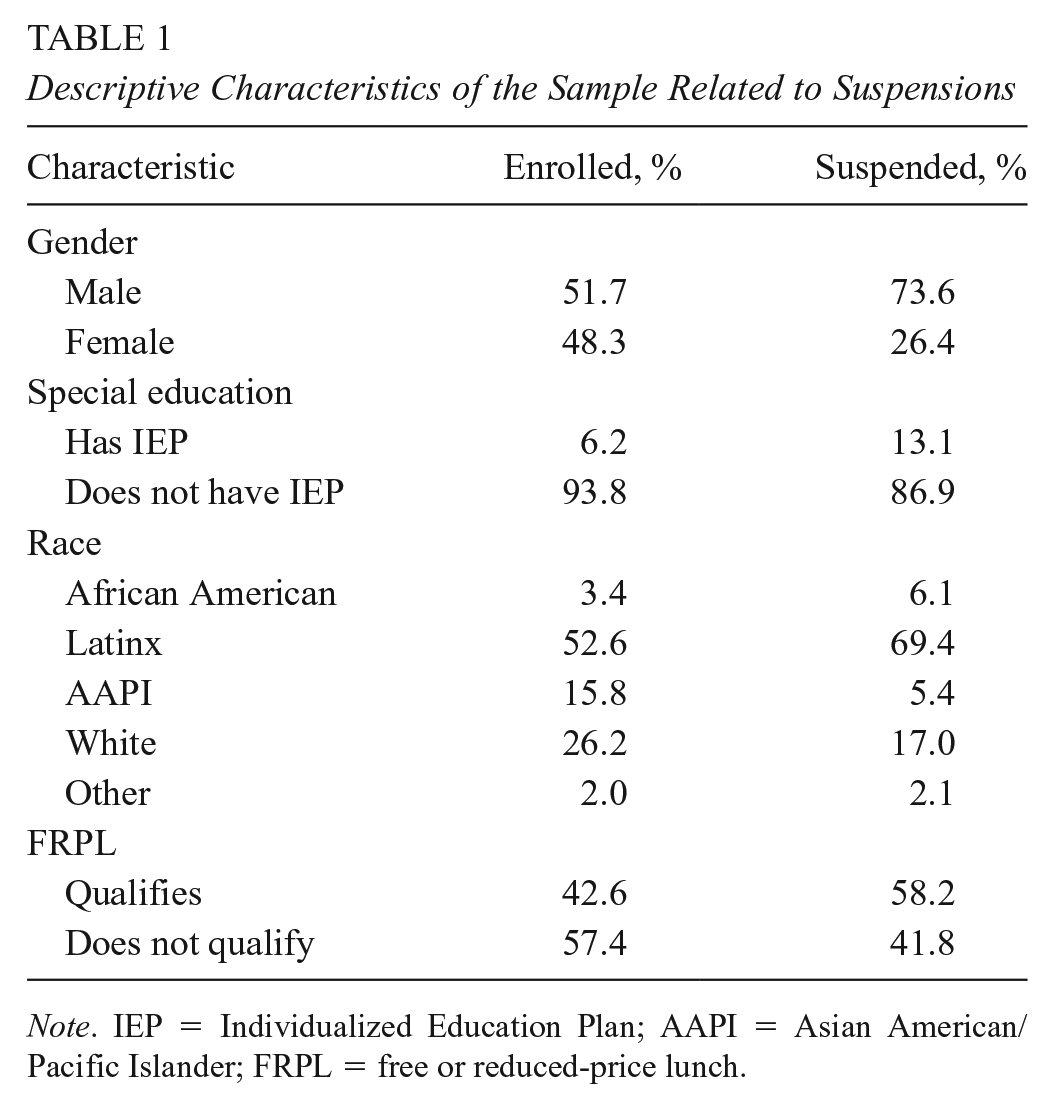
Note. IEP = Individualized Education Plan; AAPI = Asian American/Pacific Islander; FRPL = free or reduced-price lunch.
Variables
Student Characteristics
The primary characteristic of interest was special education designation by racial category, represented by a dummy-coded variable indicating whether a student had an Individualized Education Plan (IEP) multiplied by a dummy-coded variable indicating a student’s racial category (i.e., African American, Latinx, or AAPI 2 ). As aforementioned, we did not situate these categories in comparison with other racial groups; rather, the referent for each model was all other students combined, in comparison with that group. Other student-level predictors that served as control variables included student gender, eligibility for FRPL, and a series of dummy-coded variables for the highest parental education level (i.e., not high school graduate, high school graduate, some college, college, or master’s degree or higher). We considered time as a panel variable by school year; grade level and school of attendance were both dummy coded and used as fixed effects where specified in the analytic plan.
School Characteristics
The analysis included three continuous school-level predictors: percent of White students within the school, percent of students who qualified for FRPL, and average years of faculty teaching experience. The average percent of students eligible for FRPL was 6.69 (SD = 16.33), with a wide range of difference across schools (0.68%–63.69%). Average percent of White students within schools also encompassed a wide range, with an average of 25.94% (SD = 17.38%) and a range of 0.03% to 74.70%, indicating broad variation in diversity within and between schools. Variables for both school FRPL and percent of White students were transformed to z scores (µ = 0,
Analytic Plan
We predicted three related outcomes: (a) representation of students from each racial category (i.e., African American, Latinx, and AAPI) in special education (represented as a student having an IEP) and suspension, (b) temporal representation of multiply marginalized students (i.e., IEP * race category) in suspension by grade level, and (c) cross-nested school context variables associated with suspensions for multiply marginalized students. The data set features a three-level structure (i.e., time point nested within students and students nested within schools); thus, we used a series of mixed multilevel logistic regression models and discrete-time hazard models to hold constant control variables for each research question.
Representation of BIPOC in Suspension and Special Education
We first conducted a series of multilevel regression analyses to characterize disproportionate representation of BIPOC in special education and out-of-school suspensions within our data set. We specify our model as follows:

where
We then repeated this method using suspension as the outcome variable. Though suspension is a count variable, for consistency and ease of interpretation, we coded this variable as a dichotomous indicator, with 1 = being a student having one or more suspensions and 0 = being a student never having been suspended within that school year. We specified our model as a mixed logistic regression, again, including a random effect for school of attendance and a fixed effect for school year. These results are reported as odds ratios and indicate the level of disproportionality for BIPOC in both special education and in suspensions for this particular district. These analyses were performed using Stata 17’s mixed commands.
Intersectional Identities and Compounding Forms of Marginalization
To examine time points at which multiply marginalized students (i.e., BIPOC labeled with disabilities) were more likely to experience exclusionary discipline, we first analyzed descriptive data for grade level and mean suspension. We then used discrete-time hazard analysis, with the characteristic of interest as race * IEP. We constructed a person-by-period data set with observations for each student i, in each grade j, situated in school s, until either the event occurred or the student no longer appeared in the data, either because additional years of data were not available or because the student left the district or graduated (Singer & Willett, 2003). The following logistic regression equation represents the full model:

where
School Contexts and Exclusionary Discipline
Finally, we examined the extent to which school characteristics (i.e., percent of White students within the school and SWPBIS) were associated with disparities between multiply marginalized students and other students. We included cross-level effects to the model described in our first analysis. These additions comprised interactions between individual-level multiply marginalized identity markers (e.g., African American * IEP) and school-level variables (transformed to z scores) to indicate how suspensions for multiply marginalized students varied by school context. We repeated this method for Latinx students with IEPs, and then for AAPI students with IEPs, although because AAPI students in our data rarely experienced both special education placement and suspension, small sample sizes prevented us from interpreting these coefficients.
Results
Baseline Representation
Analysis related to our first research question established the presence of disproportionate representation of BIPOC in both special education and out-of-school suspensions. Prior to covariate adjustment, African American students were overrepresented in special education (OR = 1.33, SE = 0.05, p < .001), as were Latinx students (OR = 1.45, SE = 0.02, p < .001), and AAPI students were underrepresented (OR = 0.42, SE = 0.01, p < .001). We ran three separate models for each outcome and found that holding gender, FRPL, parent education, and school characteristic variables constant, African American students were still associated with roughly a 22% higher likelihood of having an IEP. Latinx students were associated with roughly a 25% higher likelihood, and Asian students were less than half as likely to have an IEP. These findings are consistent with previous research on disproportionality, which has indicated that BIPOC face disproportionate representation in special education programs (Waitoller et al., 2010). Table 2 reports the full results of each model.
Disproportionality in Special Education

Note. Year fixed effects included in all models, but not reported; cluster-robust SEs in parentheses next to estimates, clustered by school. AAPI = Asian American/Pacific Islander; FRPL = free or reduced-price lunch; SWPBIS = School-Wide Positive Behavior Interventions and Supports.
p < .05. **p < .01. ***p < .001.
We found similar patterns related to out-of-school suspensions. Prior to covariate adjustment, African American students were almost twice as likely (OR = 1.85, SE = 0.08, p < .001), Latinx students were more than twice as likely (OR = 2.06, SE = 0.05, p < .001), and AAPI students were less than half as likely (OR = 0.31, SE = 0.01, p < .001) to be suspended compared with the overall student body. All else held constant, African American (OR = 1.74, SE = 0.08, p < .001) and Latinx (OR = 1.40, SE = 0.04, p < .001) students were overrepresented in suspension data, whereas AAPI (OR = 0.40, SE = 0.02, p < .001) students were underrepresented. Again, this is consistent with prior research (Welsh & Little, 2018).
We found that as the percentage of White students in schools increased, odds of suspension decreased, and all else held constant, being in a school that offered SWPBIS was associated with a slightly higher odds of suspension for all students. This is likely due to SWPBIS not being applied at random (i.e., schools likely offered this program because they were actively aiming to reduce high suspension numbers, compared with schools with lower suspension numbers). Average years of teacher experience within a school was nonsignificant in association with special education identification, but as average years of teacher experience increased, odds of suspension decreased, indicating that teachers with more experience were clustered within some schools. School context effects were larger and more significant in analyses of suspension than for analyses of special education, indicating that school structure likely matters more for the ways in which stakeholders discipline students than place them into special education. See Table 3 for the full results of these models.
Disproportionality in Suspension

Note. Year fixed effects included in all models, but not reported; cluster-robust SEs in parentheses next to estimates, clustered by school. AAPI = Asian American/Pacific Islander; FRPL = free or reduced-price lunch; SWPBIS = School-Wide Positive Behavior Interventions and Supports.
p < .05. **p < .01. ***p < .001.
Representation Trajectories
Our first set of analyses provide a baseline association between special education, suspension, and race category. We next examined grade level and suspension to understand the interrelated nature of race, disability, and suspension, and overall student trajectory, across these areas. Figure 1 depicts mean suspension count for each race category for students with and without an IEP across the years of available data. Similar to past research (e.g., Gopalan & Nelson, 2019), we found that for African American students, particularly those with IEPs, discipline disparities were robust to our covariate adjustments.
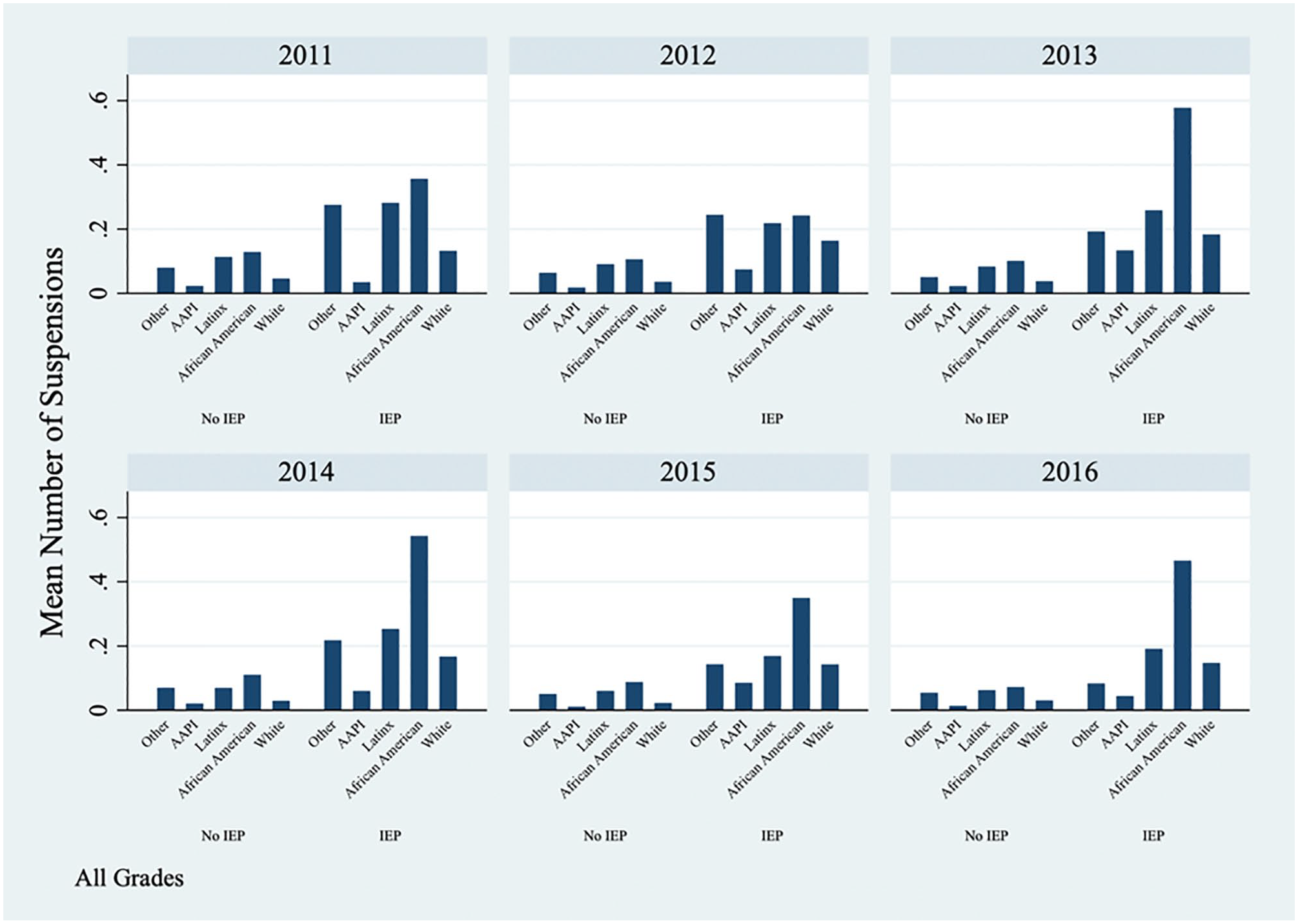
Mean number of suspensions by race category, over IEP status.
Given the wide variation of suspension by grade level, we used discrete-time survival analysis (Singer & Willett, 2003). In these analyses, hazard referred to the likelihood that a suspension would occur for a student in a particular grade, given that the event had not already occurred in previous years for that student. This allowed us to understand the suspension trajectory for multiply marginalized groups. Discrepancies for African American students with IEPs emerged early (grades pre-K–3), and widened with grade progression. Latinx-by-IEP disciplinary gaps were statistically insignificant in the early years but emerged in the later years and were more likely to be accounted for through student-level covariate adjustments (i.e., FRPL and parent education). AAPI students with IEPs were suspended infrequently and less often than peers across grade levels.
For the African American * IEP category, hazard estimates indicated that the likelihood and timing of suspension was triple that of students without these characteristics (hazard ratio [HR] = 3.15, SE = 0.26, p < .001). For the Latinx * IEP category, the estimate indicated almost double that of students without these characteristics (HR = 1.95, SE = 0.06, p < .001). For the AAPI * IEP category, the hazard estimate was nonsignificant (HR = 1.07, SE = 0.13, p = .578), indicating timing and suspension risk similar to the rest of the student population in the sample. These functions identify particular time points during which suspension was likely to occur and determine the likelihood that a multiply marginalized student could remain in the district through the 6 years of data without being suspended. As such, these results indicate differences between early, entrenched inequities for some multiply marginalized groups. These hazard ratio results are presented in Table 4 and graphically depicted in Figure 2.
Hazard Logistic Regression Models Predicting Suspension

Note. Cluster-robust SEs in parentheses next to estimates, clustered by school. IEP = Individualized Education Plan; AAPI = Asian American/Pacific Islander; FRPL = free or reduced-price lunch; SWPBIS = School-Wide Positive Behavior Interventions and Supports
p < .05. **p < .01. ***p < .001.
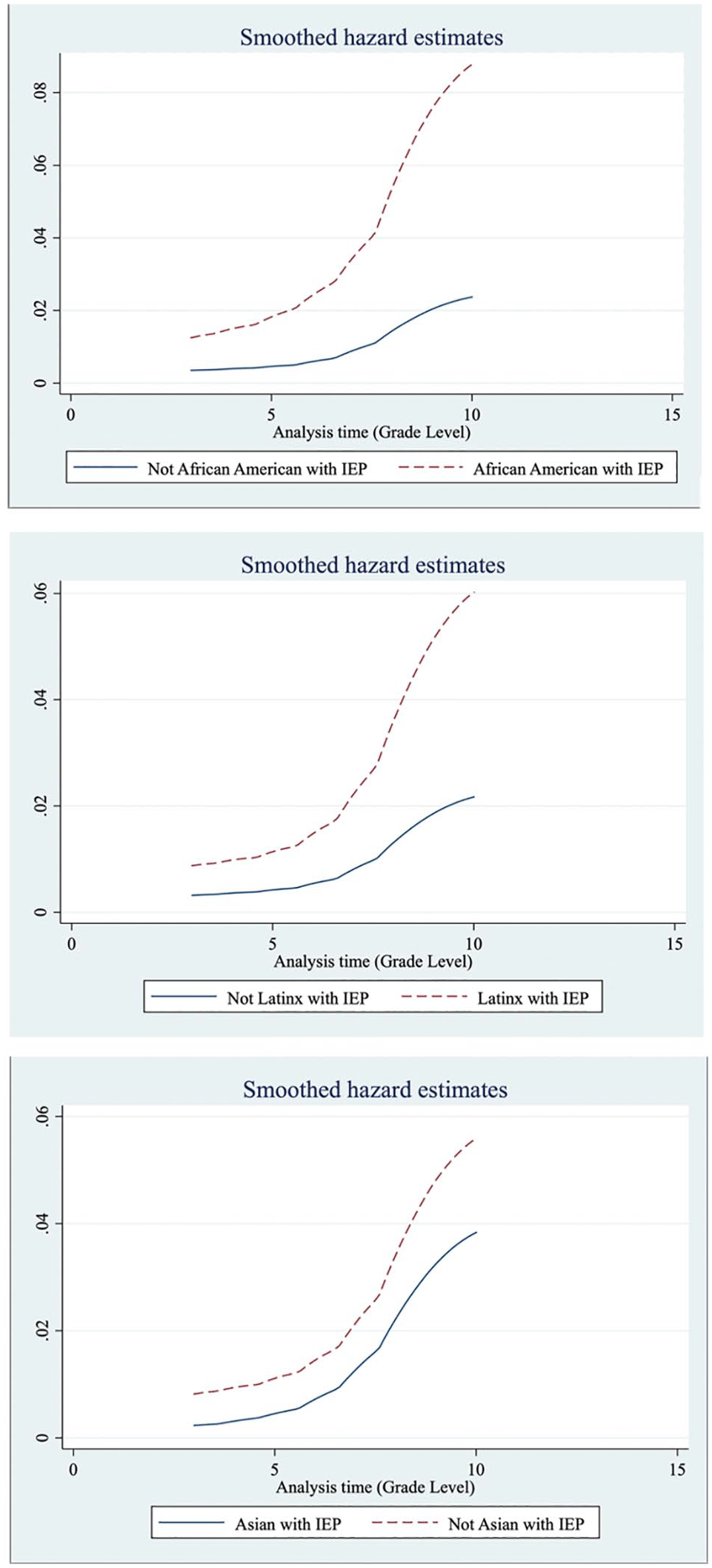
Smoothed hazard estimates
Representation and School Context
Our analyses suggest systematic differences across schools in average suspension rates, given student identity. Gopalan and Nelson (2019) indicated that some structural features of schools might “systematically contribute to higher suspensions/expulsions on average” (p. 12). We examined the racial composition of schools and the provision of SWPBIS, as past research has implicated racial composition as related to disproportionality in special education (Elder et al., 2019; Fish, 2019) and in suspensions (Eitle & Eitle, 2004). The inclusion of SWPBIS as a school-level variable represents an active effort by schools to rewrite the scripts that teachers and principals draw on as they enact discipline, though it should be noted that this district did not implement SWPBIS with a specific culturally responsive lens.
When considering the percentage of White students in schools, we found that African American students with IEPs were almost four times as likely to be suspended compared with the rest of the student population. With each standard deviation increase in percentage of whiteness, odds of suspension for all students reduced by almost half (OR = 0.67, SE = 0.06, p < .001). The interaction between school percent White and African American with IEP was nonsignificant, indicating that students with this characteristic face the same odds of suspension regardless of school diversity, all controls held constant. However, for Latinx students with IEPs, we found that this group was associated with double the odds of those without these characteristics, and that with each standard deviation increase in percent of White students within the school, students faced elevated levels of suspension (OR = 1.15, SE = 0.04, p = .001). Because few students who were AAPI experienced both suspension and special education placement, sample sizes prevented us from including this group in our final analysis.
Examining SWPBIS interaction terms, we found that being an African American student with an IEP in a SWPBIS school was associated with a slightly higher but statistically insignificant odds of suspension (OR = 1.15, SE = 0.24, p = .49). Being a Latinx student with an IEP in a SWPBIS school was associated with a significantly lower odds of suspension (OR = 0.87, SE = 0.05, p = .04). Results for AAPI students with IEPs were, again, difficult to determine, due to low sample sizes.
Discussion
Using DisCrit as a theoretical lens and QuantCrit as a methodological strategy, we interpret these findings through a sociohistorical perspective, considering the legal and historical mechanisms through which dis/ability and race are constructed. Sleeter (1986, 2010) described societal shifts in the purpose of schooling as influencing the evolution of special education and disproportionality, highlighting the relationship special education programs have with social competition for power, wealth, and prestige. The ways in which BIPOC are pathologized, labeled, and suspended all serve as sources of discrimination that maintain White, ableist power hierarchies. Past research has suggested that although stakeholders have agency in these educational systems, teachers’ perceptions of students also depend on structural factors (Cruz & Firestone, 2021; Fish, 2019; Hibel et al., 2010). Though these factors may be enacted differently in exclusionary discipline than in special education placement, our results provide evidence that students are affected by how practitioners view them within their school contexts.
For example, we found that AAPI students were underrepresented in both special education and exclusionary discipline, and few students in the AAPI category experienced both special education placement and suspension. Past research and policy have considered this category to have “honorary whiteness” (Young, 2009, p. 179) and have stereotyped Asians as the model minority (Lee, 1994). We see this model minority myth as a hegemonic device used to desensitize the public about the fraught history of race relations in the United States, and it contributes to the erasure of AAPI histories in schools (see Hsu, 2016). Theories around high achievement for this group often include cultural explanations centered on a higher value of education and career attainment and a higher likelihood of a two-parent family (Jo, 2004; Lee, 2006). These theories come at the expense of both African American and Latinx communities who are then seen from a deficit perspective (Ng et al., 2007), and at the expense of AAPI students who are in need of support, but are overlooked (Cooc, 2019). In fact, Kim (1999) states that “Asian Americans have not been racialized in a vacuum, isolated from other groups; to the contrary, Asian Americans have been racialized to and through interaction with Whites and Blacks” (p. 106). Recent education literature shows the ways in which AAPI students have been examined in a position relative to White, African American, and Latinx counterparts that have, over time, shaped the category of “Asian” and has reproduced a social hierarchy (Omi & Winant, 1994) that upholds the primacy of whiteness. Our results also suggested an upholding of smartness and goodness.
A core tenet of DisCrit highlights the interdependent relationship between racism and ableism. Our results indicated that disproportionality is complex, and highlight the fact that students were disciplined differentially, depending on intersecting identity characteristics. Special education, as a service in PK–12 schools and as an intellectual community, has a history of actively pathologizing African American students (Adjei, 2018; Annamma, 2017; Erevelles, 2014), yet some studies have assumed either neutral or positive associations with students being placed in special education (e.g., Morgan & Farkas, 2016). We reject the assumption that special education—a system that often excludes students from grade-level learning alongside peers—is beneficial (Collins et al., 2016); that disproportionality is, for multiply marginalized youth, tied to poverty (Artiles et al., 2010); and that proportionality is equated with identification rather than representation (Collins et al., 2016).
Understanding race and disability as social constructions means that we interpret disability identification not as an internal process but “always in relation to other people” (Anyon, 2009, p. 46). Qualitative research indicates that teachers are less likely to see students labeled with disabilities as constructors of knowledge (Lambert, 2019; Shifrer, 2016) but rather as in need of stripped-down explicit instruction and control-focused behaviorist approaches (as opposed to sociocultural and constructivist approaches found within other disciplinary fields; Bannister, 2016). Explicit direct instruction has been described as “ideologically opposed to goals for equitable classrooms” (Bannister, 2016, p. 335) given that overreliance on this form of instruction can limit students’ meaningful participation in creative educational experiences that develop problem solving and complex reasoning (Noguera et al., 2015). Furthermore, research on suspension-disparity reduction has indicated that teachers’ enactment of instruction with higher order thinking strategies can significantly reduce office referrals for African American students. In fact, Gregory et al. (2016) hypothesized that “given the opportunity to engage in cognitively demanding problem-solving tasks, Black students may detect their teachers’ high expectations and confidence in them as scholars” (p. 186).
Results of our second analysis indicate that African American students with IEPs are suspended early and often, and few studies have examined connections between this outcome and reduced opportunities for engaging in complex learning tasks. Studies that have examined the efficacy of special education in reducing suspensions (e.g., Hurwitz et al., 2021) provide valuable first steps toward keeping students in their learning environments, but they warrant further study, as pathologizing—and often excluding—students to reduce suspensions may further indicate that special education is used as a mechanism for behavior conformity rather than sustainment of individual differences as valuable assets for learning. Furthermore, there is a need to learn directly from multiply marginalized youth who have experienced the trauma of exclusionary discipline practices and their families (Kulkarni et al., 2021). Qualitative perspectives provide important insights into lived experiences that complement existing quantitative disciplinary data (e.g., Harry et al., 2005; Lambert, 2019; Lewis-McCoy, 2016).
Moreover, studies that limit examination of disproportionality based on inclusion of normative behavior and academic metrics as covariates (e.g., Morgan & Farkas, 2016) provide valuable insight into the mechanisms behind special education and discriminatory practices. However, when we consider whiteness and smartness as ideological property (Annamma et al., 2013), these studies fail to contend with critical issues related to the racism and ableism embedded in special education and exclusionary discipline—that they are interactional forms of oppression. Studies that rely on teacher-reported behavior ratings to “evaluate whether schools are discriminating against [students labeled with disabilities] when using suspension” (Morgan et al., 2019, p. 3) fail to understand the interlocking narratives of race, dis/ability, and stereotypes that lead to suspension and notions of “at risk” that can be better interrogated through qualitative works. These studies have relied on problematic assumptions, including that students identified in first grade “should have had more severe impairments due to their earlier identification and so displayed greater academic or behavioral difficulties than students identified as having disabilities in the later grades” (Morgan, p. 5).
Banks (2017), for example, conducted a study in which she asked African American men about their experiences of having been placed into special education in their PK–12 school careers and found that participants described nuanced ways in which some teachers misperceived them based on stereotyped beliefs about race, gender, disability, and behavior. Respondents described teachers who perceived acts of self-advocacy as classroom disturbances and who issued harsh consequences for minor infractions. Our results suggest that these lived experiences can also be seen and understood in larger, quantitative data sets and, again, that there is a critical need for including the voices of multiply marginalized students in research.
Interpreting our analysis from an agency–structure paradigm, we found that school context variables were associated with suspension of multiply marginalized students. Latinx students in schools with larger proportions of White students were associated with higher suspension rates. This harkens back to Bell’s (1980) description of the interest convergence dilemma of Brown v. Board of Education, noting that, despite integration, schools remain segregated spaces for BIPOC. Our results showing that Latinx students experienced higher suspension rates among majority White peers continues this legacy of separation and segregation.
African American students with IEPs in schools using SWPBIS were associated with slightly higher suspension rates, whereas Latinx students with IEPs in SWPBIS schools were associated with slightly lower suspension rates. It is likely that SWPBIS was offered in schools with higher need and lower performance, furthering the structural conditions that exacerbate teachers’ and principals’ perspectives of students. Failure to implement SWPBIS through centering equity can exacerbate already inequitable school systems. The cultural work of labeling occurs in tandem with the cultural work of determining acceptable behaviors. As McDermott et al. (2006) noted, “It takes constant interpretive work for people to create the ground where certain behaviors stand out in ways that are consistently and institutionally consequential” (p. 13). We contend that SWPBIS and racial composition are both factors that affect the agency–structure divide, and our results indicate variability in these impacts, given multiply marginalized student identity. Harry et al.’s (2005) ethnographic research specifically challenged deficit perspectives of African American families living in poverty as the root cause of their children’s learning and behavior difficulties. Connor’s (2008) in-depth urban narratives similarly challenged deficit perspectives of multiply marginalized youth. Both of these studies exemplify the importance of qualitative, first-person narratives that reduce deficit conceptualizations of multiply marginalized youth and their families, which may produce improved equity outcomes for schools implementing school-wide programming.
Lewis-McCoy (2016) described how special education has been used to segregate African American students, particularly males, from their peers through limited access to general education. Similarly, suspension has been conceptualized as a criminalization and marginalization process for BIPOC. Rather than considering these as intractable issues within our education system, we argue that decentering whiteness, smartness, and goodness as objects of ideological property (see Broderick & Leonardo, 2016) within schools and centering the need for culturally sustaining pedagogies and practices (Paris, 2012; Waitoller & King Thorius, 2016) might allow future quantitative analyses to reject deficit discourses and sustain the learning assets of multiply marginalized students.
Limitations and Areas for Future Research
Though prior research indicates academic achievement as being related to special education placement, we did not include academic achievement measures because achievement is not a fixed characteristic; it is influenced by students’ experiences in schools. As we emphasized in our introduction, achievement-gap narratives have dominated educational equity conversations (Reardon et al., 2019) and have been critiqued for failure to mention the influencing systemic factors, such as the opportunity gap (Ladson-Billings, 2006). This variable did not fit within our theoretical framework but could be critically explored in future work. We also did not specifically analyze the impacts of gender or language as marginalized identities, although we included gender in our model specification. Research indicates nuanced ways in which gender and language are implicated in the pathologizing of students (Blake et al., 2017; Cruz & Rodl, 2018b; Hibel & Jasper, 2012), and this remains an important area for future research.
This study was also limited in that there were small numbers of observations in AAPI and American Indian/Alaska Native categories, which made obtaining valid estimates difficult. Furthermore, small numbers of students within individual disability categories prevented us from examining pathologizing of specific disability categories. Future research should critically examine subjective disability categories related to suspension. As with all quantitative research, this study was also limited in that we were restricted to the operationalized variables made available to us from the district’s data collection systems. For example, we did not have information on fidelity of implementation for SWPBIS, as the district did not collect fidelity data, and as aforementioned, categorical data on student identity are socially constructed and can mask variation.
Finally, this study used data from one school district, which limits the external validity of findings. Though our purpose was to examine a local context, we are uncertain whether we would find similar outcomes across school districts. We do, however, assert that the findings be used for comparative purposes, with future studies examining other local configurations to better understand the nature of variability within disproportionality research. Future research should also continue to examine contextual factors that contribute to and maintain disparities. As evidenced by our findings, the demographic makeup of schools can vary widely from one school to the next, even within the same district, and the program offerings may also vary. We argue for future studies to continue examining disproportionality within local contexts; studies of this type assist educational leaders in better understanding the nuances of potential inequities within their special education processes and discipline systems, the allocation of resources among and within schools, and programs that may ameliorate systemic inequity.
Footnotes
Notes

Authors
REBECCA A. CRUZ is an assistant professor of special education at Johns Hopkins University. Her research interests include redefining the concept of inclusion, and her work uses hierarchical linear and logistic models to understand contextual and structural mechanisms that contribute to inequities across time.
SAILI S. KULKARNI (she/her/hers) is an associate professor of special education at San José State University. Her research examines discipline disparities for young children of color with disabilities and is also heavily informed by DisCrit (Disability Studies Critical Race Theory) in teacher education.
ALLISON R. FIRESTONE is a doctoral candidate in the University of California, Berkeley, and San Francisco State University’s joint doctoral program in special education. Her research focuses on teacher preparation, with a specific emphasis on equity-centered pedagogy.