




Abstract
The unprecedented arrival of COVID-19 upended the lives of American children with rapid shifts to remote and hybrid schooling and reduced access to school-based support. Growing concerns about threats to students’ mental health and decreased numbers of students transitioning to postsecondary education suggest access to school counselors is needed more than ever. Although previous research on school counselors finds they promote positive postsecondary, social emotional, and academic outcomes for students, further studies highlight the organizational constraints, such as an overemphasis on administrative duties and unclear role expectations, that hinder their work. Drawing on survey and focus group data, our mixed methods study documents school counselors’ experiences during the COVID-19 crisis, including the opportunities and constraints facing their practice. Findings suggest there should be a concerted effort to reduce the role ambiguity and conflict in counselors’ roles so they are better able to meet students’ increased needs.
The arrival of COVID-19 upended the lives of American children in ways never seen before. Reports have begun to document the pandemic’s influence on students, specifically raising alarms about increased mental health difficulties (Sheasley, 2021) and a decrease in postsecondary enrollment, especially among first-generation and low-income students (Rath & Beland, 2020). One prominent theme that has emerged is students’ separation from school counselors, who provide essential supports across multiple domains (Meyers, 2020). This trend is concerning given research continually affirming the positive influence of counselors on students’ development (Carey & Martin, 2017; Whiston et al., 2011), especially minoritized students (e.g., Grey, 2019; Malott et al., 2010; Martinez et al., 2020). However, there is evidence that high caseloads, poorly defined roles, and inadequate professional learning opportunities undermine counselors’ efforts (Savitz-Romer, 2019; Warren et al., 2020).
Emergent research has captured teachers’ experiences during the pandemic (Kraft & Simon, 2020); however, there is limited research that has systematically examined how COVID-19 affected school counselors and their ability to support students (e.g., American School Counselor Association [ASCA], 2021; Strear et al., 2021). Thus, our study expands on emerging COVID-19 related scholarship to offer insight into how schools can ensure students have access to high-quality counseling support as schools recover from this global pandemic.
Understanding the possibilities and constraints of school counselor practice during COVID-19 requires a dual focus on counselor experiences and the organizational contexts that shape their work. Therefore, we draw on role theory (Biddle, 1986), situated within the organizational theory literature, to examine how school counselors enacted their roles amidst a pandemic. Drawing on data collected in summer 2020 from the COVID-19 National Survey of School Counselors (n = 1,060) and eleven follow-up focus groups with survey respondents (n = 47), we find that school counselors faced a myriad of organizational constraints in fulfilling their professional responsibilities, including an onslaught of administrative duties and a lack of guidance on how to enact their roles remotely. School counselors largely adapted to these new challenges by shifting the focus of their work, bypassing obstacles, and embracing their autonomy. These findings suggest that efforts to address the consequences of this pandemic on students must take into careful consideration organizational support for school counselors.
Background
The spread of COVID-19 to the United States initiated a wave of school closures that displaced millions of students from their traditional learning environments. By the end of March 2020, 48 states and the District of Columbia announced that students would not return to in-person instruction in the 2019–2020 academic year, leaving 50.8 million students relying on virtual learning (Education Week, 2020). With the pandemic surging, students and educators quickly adapted to remote schooling and remained in virtual learning environments into the beginning of the 2020–2021 academic year. It is estimated that nearly 50% of K–12 public school students started the school year remotely (Burbio, 2020), although many districts then shifted to hybrid and in-person learning (Gross et al., 2021).
As a result of these shifts, students faced new challenges accessing school-based resources and support (Meyers, 2020). Notably, this coincided with increased student demands for support. The emotional, psychological, and financial stress of the pandemic has taken a negative toll on students’ mental health and well-being (Sheasley, 2021; Singh et al., 2020). In a survey of K–12 students in fall 2020, 46% of students reported that feeling depressed, stressed, or anxious was an obstacle to their learning in virtual environments (YouthTruth, 2021). Navigating changes to the college admission process, including standardized testing policies, has caused additional stress (Rath & Beland, 2020) and exacerbated existing inequalities in college access for first-generation, low-income, and minoritized students. Immediate college enrollment was down 6.8% in fall 2020, with the rate of enrollment decline steeper at high poverty schools (11.4%) and schools with high proportions of students from racially minoritized backgrounds (9.4%; Causey et al., 2021). Our project is motivated by these trends brought on by the COVID-19 crisis.
The pre-COVID literature on school counseling provides evidence that school counseling practices promote students’ social emotional development (Lambie et al., 2019; Masia Warner et al., 2016; Webb et al., 2019), academic achievement (Carey & Dimmit, 2012; Carrell & Carrell, 2006; Shi & Brown, 2020), and postsecondary outcomes (Hurwitz & Howell, 2014; McMahon et al., 2017; Mulhern, 2020). Scholarship simultaneously portrays counselors’ pre-COVID work conditions as constraining their efficacy due to limited oversight at the federal- and state-levels, high caseloads, poorly defined roles, insufficient accountability systems, and inadequate professional learning opportunities (Savitz-Romer, 2019; Warren et al., 2020). Moreover, organizational constraints such as role ambiguity (Blake, 2020) and an overemphasis on administrative responsibilities (Chandler et al., 2018) obstruct students from connecting with counseling support. Scholars find that school leaders’ expectations about what constitutes the school counselor role are often out of sync with counselors’ expectations (Amatea & Clark, 2005; Benigno, 2017), and typically reflect confusion about what counselors can and should do (Fye et al., 2017; Ruiz et al., 2018). For example, Blake’s (2020) study of high school counselors found that school leaders direct counselors to devote time to administrative tasks, such as scheduling and test coordination, that fall outside the counselors’ role as defined by the American School Counselor Association’s (2019) national model. In the face of resource constraints and staffing shortages, principals often assign these duties to counselors (Lowery et al., 2018); but in doing so, they reduce counselors’ time for implementing comprehensive school counseling programs (Fye et al., 2017; Hilts et al., 2019) and contribute to occupational burnout and reduced job satisfaction (Holman et al., 2019).
A small but growing body of research suggests that the experiences of counselors in rural and urban settings differ from counselors in suburban schools. Although rural and urban counselors face many of the same barriers as their suburban peers, they nevertheless contend with unique organizational and structural obstacles that affect their work (e.g., Bardhoshi & Duncan, 2009; Monteiro-Leitner et al., 2006). For example, studies have found that rural counselors are particularly susceptible to professional isolation given limited supervision and the fact that they are often the only mental health providers in a school (Grimes, 2020; Hann-Morrison, 2011), while urban counselors reportedly experience high levels of professional burnout (Kim & Lambie, 2018).
The combination of scholarship finding that school counselors have a positive influence on student outcomes, coupled with studies describing organizational and structural barriers that undermine counselors’ practices, suggests that when the conditions are right, counselors can be effective. This trend mirrors teacher-focused research emphasizing that working conditions either enable or constrain their efficacy (Johnson et al., 2011). However, the literature on school counselors’ working conditions is limited and does not account for novel shifts in remote and hybrid learning and its consequential impact on counselors’ roles and their adaptations.
Theoretical Framework
To answer questions about the professional roles school counselors inhabited during COVID-19, we utilized role theory, which is situated within the organizational theory literature. Role theory provides a framework for examining roles and expectations within the context of organizations (Kahn et al., 1964). Scholars have widely used this framework to describe how individual actors within an organization are expected to behave in each context (Bidwell, 2001; Richards et al., 2018). Roles are social positions that are tied to an individual’s identity—including their profession—and are associated with normative expectations and behaviors (Biddle, 1986). However, roles are not stable and vary based on the organization in which they are situated (Turner, 2001). Roles “are embedded within social systems” and vary in complexity depending on breadth of the role, difficulty (e.g., degree to which skill is required to perform the role), and coherence (e.g., how the components of the role fit together) (Biddle, 1979, p. 6). Role concepts can be used to better understand the behaviors of both the individual and the organization (Biddle, 1986). Since we are examining a highly specialized role within the school, which in many schools may constitute a singular role or one held by only a few individuals, this is a valuable framework to inform our study.
According to role theory, one of the major factors affecting an actor’s efficacy is role stress, which occurs when workers and managers hold opposing expectations about a particular role and there is a lack of alignment between work demands and time available (Coll & Freeman, 1997). The literature has identified three constructs that contribute to role stress: role conflict, role ambiguity, and role overload (Biddle, 1986; Turner, 2001). Role conflict occurs when an individual faces multiple, opposing expectations for their role, typically from managers and workers (Biddle, 1986). Workers experience role ambiguity when they receive unclear or inconsistent expectations regarding their role responsibilities, and role overload occurs when a person has limited time and resources to complete their work demands (Biddle, 1986; Coll & Freeman, 1997; Wilkerson & Bellini, 2006). Role stress is linked with an individuals’ job satisfaction and supervisor-rated performance (Fried et al., 2013).
Role Theory and School Counselors
School counselors’ roles are generally defined as a certified or licensed educator who works across all grade levels and implements a comprehensive school counseling program to support students’ development in three domains: academic, social emotional, and postsecondary (ASCA, 2019). Their professional responsibilities range from individual counseling, group counseling, and classroom lessons to family outreach and college and career readiness counseling (ASCA, n.d.). However, despite national standards, a professional model, and guidance on appropriate roles, these professionals face varying expectations of their role and responsibilities from students, parents, school principals, teachers, and even counselors themselves (Baker et al., 2021; Lewis et al., 2020; Zyromski et al., 2018). This is partially due to the fact that roles are context bound, meaning an individual’s understanding of the expectations for their role is influenced by organizational features in their environment.
To a limited degree, scholars have used role theory to examine professional school counseling roles (Astramovich, 2013; Cervoni & DeLucia-Waack, 2011). Such research has indicated the presence of role conflict, ambiguity, and overload in school counselors’ roles, especially due to the assignment of administrative duties, like scheduling, conducting standardized tests, and lunchroom duty (Culbreth et al., 2005). Role stress among counselors is linked to a host of negative outcomes, including, but not limited to, poor job performance, frustration, feelings of incompetence, low levels of job satisfaction, and burnout (Fye et al., 2020; Holman et al., 2019; Kim & Lambie, 2018). This study builds on this scholarship in two distinct ways. First, our study uses role theory as a lens through which to understand counselors’ experiences during a global pandemic in which remote and hybrid schooling further complicated their jobs. Second, our study extends findings about counselors’ role stress to understand how, despite these constraints, counselors adapted during a highly stressful time.
Method
The purpose of this study was to broadly explore school counselors’ professional experiences during the COVID-19 pandemic. Specifically, our research questions were as follows:
We embraced a pragmatic epistemological approach for this study, which evaluates the influence of the internal human experience (Johnson & Onwuegbuzie, 2004), exploring what is or is not working to solve problems in the field. We utilized the sequential explanatory mixed methods design outlined in Figure 1. We collected quantitative and qualitative data, combined them, and then used the strength of the data from both phases of data collection to better understand the research questions (Creswell, 2015; Teddlie & Tashakkori, 2010). We first conducted a national survey of school counselors to gain a broad picture of the counselor experience during the early months of COVID-19 school closures. The survey was followed by focus groups composed of survey participants to capture greater detail about these experiences during the first year of the pandemic. This approach best supported our study because two key elements of mixed methods research are methodological eclecticism, which is the ability to choose the most suitable techniques to investigate the chosen research problem (Teddlie & Tashakkori, 2010), and abductive reasoning, which includes the evaluation of prior inductive inferences to inform future lines of inquiry (Morgan, 2007). We used the qualitative results from focus groups to assist in explaining and interpreting the findings of our survey data collection and to address biases inherent in quantitative research (Creswell & Plano Clark, 2011). Survey data alone fails to provide the in-depth, nuanced information offered by focus groups, which is the benefit of this mixed methods approach. For this project, we obtained institutional review board approval at two institutions, and followed the ethical guidelines set forth in the American Educational Research Association’s (2011) Code of Ethics.

Explanatory sequential design: Mixed methods study of school counseling during COVID-19.
Phase 1: National Survey of School Counselors
Using survey design principles (Fowler, 2009), we created an 80-question online survey. The survey collected individual-level counselor data related to how counselors adapted to remote schooling during the first 3 months of the pandemic (e.g., primary responsibilities, virtual strategies), as well as the systems-level factors influencing their work (e.g., role expectations, communication, professional training). Finally, the survey consisted of six open-ended questions, asking participants to describe any challenges they faced and the types of support they received. See online Supplemental Appendix A for the survey instrument.
To validate the instrument, we piloted the survey and used cognitive interviewing techniques with six current school counselors to improve our instrument prior to data collection (Fowler, 2009). We sought to increase our understanding of how participants understood the questions and formulated their responses to validate the instrument.
Sampling
We utilized a two-pronged sampling approach to draw a nation-wide sample that allowed for intentional recruitment of urban and rural counselors. We distributed the survey in May and June of 2020 via national and state professional organizations’ listservs and social media outlets. To ensure we obtained adequate numbers of counselors from rural and urban schools, we purchased contact details for those counselors through MDR Education (n = 3,000) and sent those individuals a survey link directly. We oversampled rural and urban counselors given their low response rate in previous national surveys (e.g., Fan et al., 2019; Harris, 2013) and because there are fewer counselors working in rural districts than in suburban and urban areas (Gagnon & Mattingly, 2016).
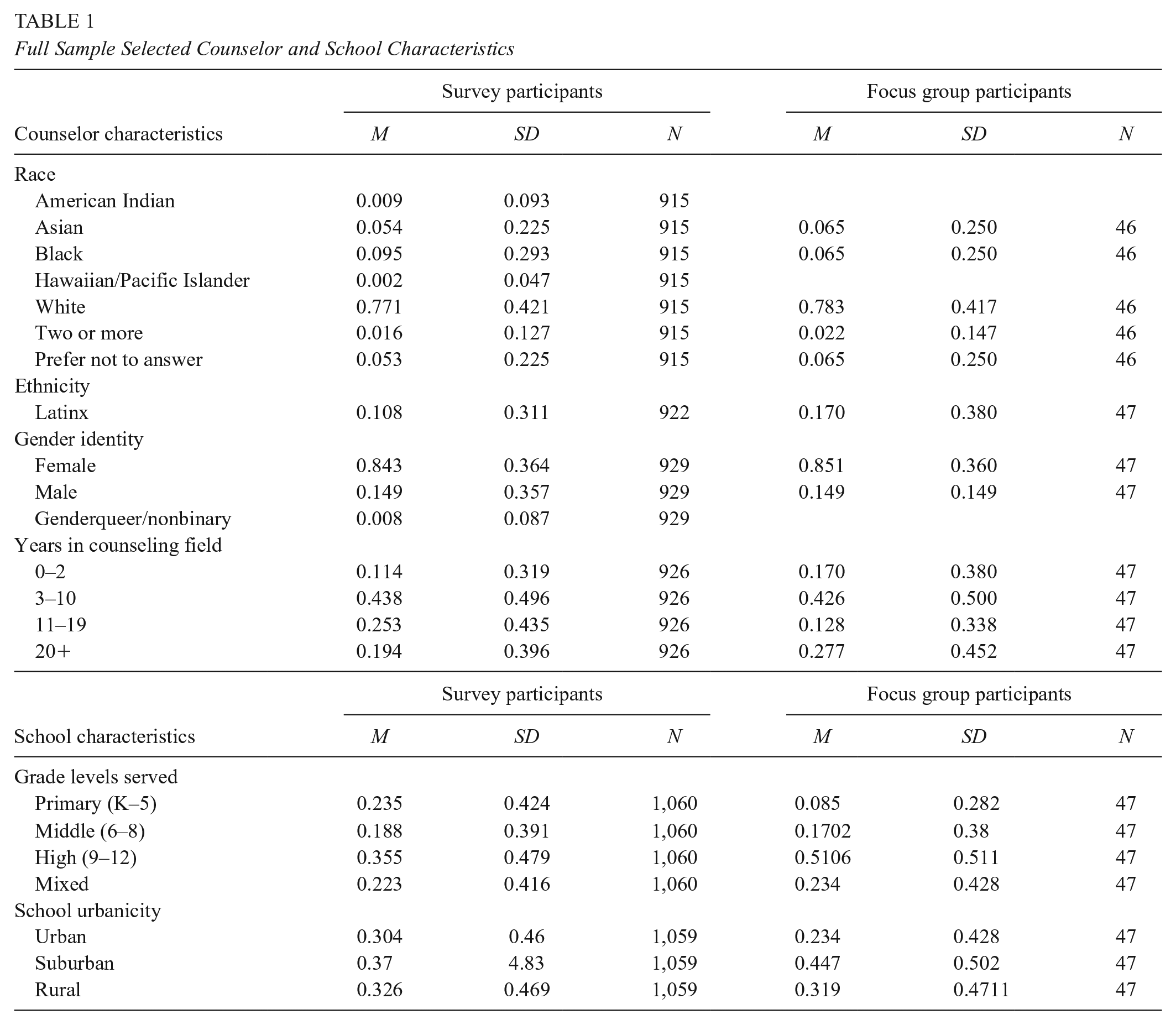
In total, 1,060 school counselors and educators in adjacent roles (e.g., college counselors, adjustment counselors, counseling directors) in 48 states and Puerto Rico completed the survey, Demographic characteristics of survey participants are shown in Table 1, and largely align with prior work that has examined the school counseling profession (e.g., ASCA, 2021; Bruce & Bridgeland, 2012). Our sample was overwhelmingly White (77%) and female (84%) with a master’s degree, and averaged 11.3 years of experience. The sample was evenly split in terms of school setting (30% urban, 33% rural, 37% suburban).
Full Sample Selected Counselor and School Characteristics
Variables
Our quantitative analysis focused on addressing Research Questions 1a and 2a and thus examined two sets of variables, support levels and time shifts, about counselors’ time during the COVID-19 pandemic and the support they received from education leaders. Listwise deletion was used to remove missing data, leaving 922 usable cases. Table 2 offers an overview of these variables.
Means and Standard Deviations for Analytic Sample
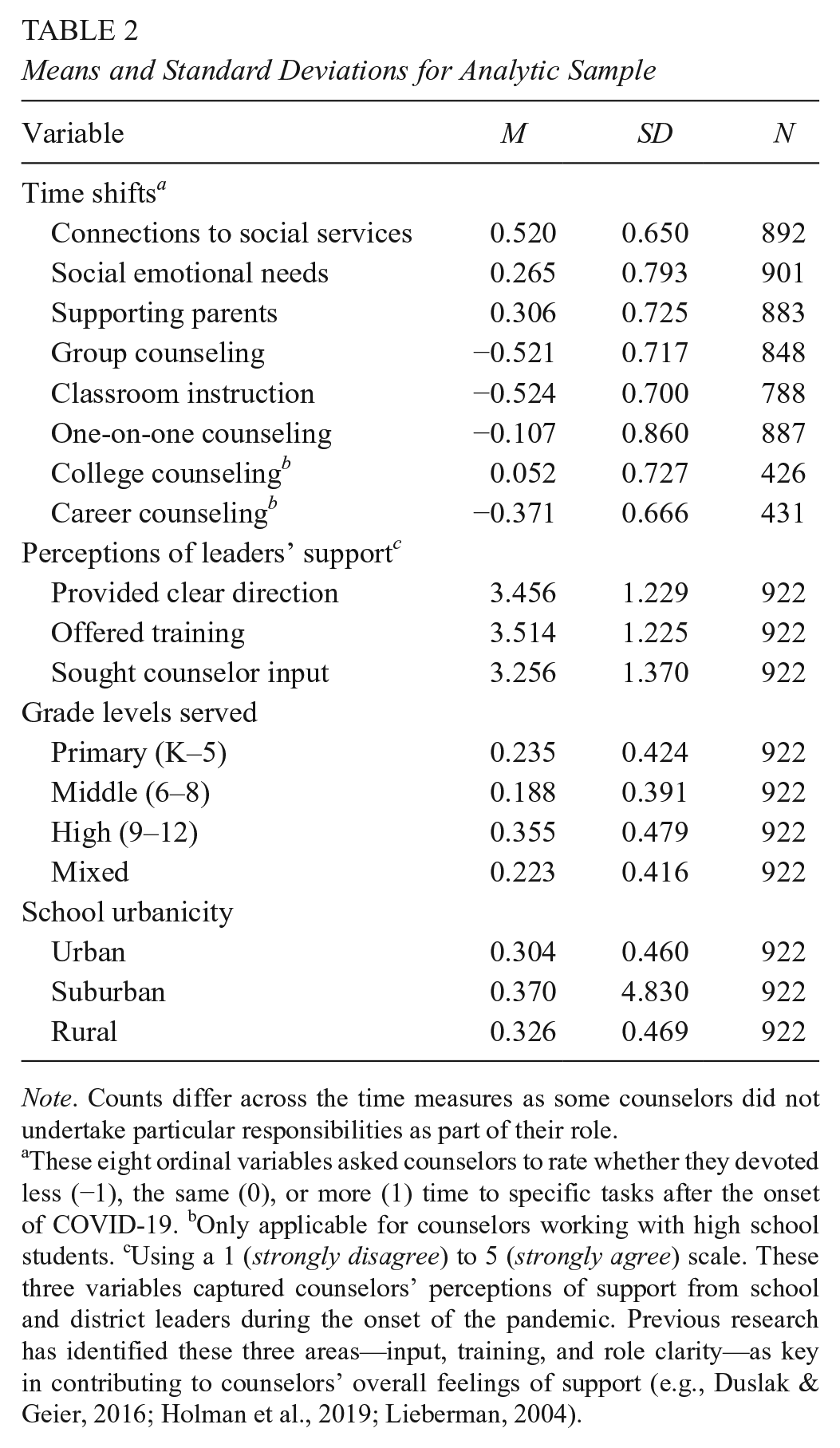
Note. Counts differ across the time measures as some counselors did not undertake particular responsibilities as part of their role.
These eight ordinal variables asked counselors to rate whether they devoted less (−1), the same (0), or more (1) time to specific tasks after the onset of COVID-19. bOnly applicable for counselors working with high school students. cUsing a 1 (strongly disagree) to 5 (strongly agree) scale. These three variables captured counselors’ perceptions of support from school and district leaders during the onset of the pandemic. Previous research has identified these three areas—input, training, and role clarity—as key in contributing to counselors’ overall feelings of support (e.g., Duslak & Geier, 2016; Holman et al., 2019; Lieberman, 2004).
Quantitative Analysis
We utilized analyses of variance (ANOVAs) to examine mean differences in perception of support and time shifts by urbanicity and grade level. Before undertaking the analyses, we first examined the assumptions of the parametric one-way ANOVA including normality and homogeneity of variance. Skew and kurtosis values for the variables of interest were within an acceptable range of ±2 (Field, 2017). We utilized Levene’s test to determine whether the homoskedasticity assumption was upheld. For those analyses where it was met, we conducted one-way ANOVAs with Tukey post hoc tests. When heteroscedasticity was present, we used Welch’s ANOVA, which is not as sensitive to unequal variances and handles unequal group sizes well (Field, 2017); when relevant, this was followed by Games–Howell post hoc tests.
Qualitative Analysis
Counselors provided over 2,471 text responses to our open-ended survey questions regarding support and challenges during the first 3 months of the pandemic. Using Dedoose, our research team implemented thematic coding of the text responses to develop a code list, which was then used by two team members to code all of the responses. The code list was generated using line-by-line coding of 100 responses to the open-response questions and then grouped according to emerging themes to develop a codebook. Simultaneous coding and subcoding were both utilized in this process (Miles & Huberman, 1994; Saldaña, 2013). As new themes emerged throughout the coding process, additional codes were added. The research team met regularly to compare codes for shared understanding and consistency and to search for emerging themes. Once the initial quantitative and qualitative survey data analyses were completed, the research team looked holistically at the data and identified areas where we had questions and needed additional information to better understand counselors’ experiences. These questions formed the basis for the focus group protocols.
Part 2: Focus Groups
The research team developed semistructured focus group protocols based on the findings from the survey data analysis (Creswell, 2015). This 90-minute protocol included topics where we wanted to deepen our understanding of survey data—such as counselors’ shifts in job responsibilities; the extent to which counselors received direction from their educational leaders; adaptations to their roles; and experiences with professional development opportunities. Some different question sets were developed—one for high school counselors and another for elementary and middle school counselors—due to the varying responsibilities of each group (see online Supplemental Appendix B). The research team conducted a pilot focus group with seven school counselors and made minor adjustments to the protocol related to question order based on participant feedback.
Sampling and Data Collection
During Phase 1 of data collection, we asked survey participants if they would volunteer to join a future follow-up focus group conversation. In all, 232 individuals agreed to be contacted about this opportunity and were subsequently invited in early February 2021 to join a 90-minute focus group. A total of 47 counselors from around the United States participated in the focus groups. See Table 1 for more information about the sample.
In total, we conducted 11 focus groups: four elementary/middle school focus groups, six high school focus groups, and one group that included all grade levels. The size of the focus groups ranged from two to eight participants. A team of five researchers, all of whom identify as White women with a range of experiences as school counselors, teachers, and researchers in K–12 schools, facilitated the focus groups. All focus groups were recorded via Zoom and then transcribed. During the focus groups, we encouraged participants to use the chat function in Zoom as another avenue for data collection (Gray et al., 2020).
Analysis
After the focus groups were transcribed, we completed thematic coding of the focus group transcripts with Dedoose. We utilized the same coding process as outlined in Phase One. Once the initial analyses were completed, the research team looked holistically at the data from both phases of data collection and identified key findings for the study.
Limitations
It is important to note a few limitations to our study. Responses to questions about the focus of counselors’ work may be influenced by the timing of our survey, which was distributed in May and June—a time when counselors’ focus was on wrapping up the school year and scheduling students for the following year. Thus, responses about their work may represent the seasonality of their roles. Furthermore, the survey was conducted following the first round of school closures and, as such, the longer term impact on counselors’ work was only explored in the focus groups. In addition, our survey sample may not be representative of all school counselors nationwide. Although our sample, which was overwhelmingly White (77%) and female (84%), mirrors the demographic makeup of the school counseling profession (ASCA, 2021), we do not infer that our findings accurately represent the experiences of counselors of color or male counselors. Notably, previous research found that the models that guide the work of counselors of color can differ from their White counterparts (Jackson et al., 2005). Finally, because anonymizing survey participants was essential given that some schools may only have one counselor, we were unable to consider any nesting within the data; this may have potentially affected the independence assumption underlying the statistical hypothesis testing.
Findings
Based on our analysis of qualitative and quantitative data, school counselors’ reports reflected obstacles they faced in carrying out their responsibilities, changes in how they spent their time, and adaptations to new work challenges. We organize our findings by first discussing school counselors’ perceptions of support from education leaders and constraints prohibiting their work. Then, we describe how they adapted to the situation. In both sections, we begin with a description of the quantitative data, followed by supporting qualitative data.
School Counselors Struggled to Enact Their Roles During the Pandemic
The school counselors in our study struggled to fully realize their professional roles during the pandemic. The barriers they faced derived in part from feeling an overall lack of support from education leaders and confronting policies that undermined their work.
Lack of Perceived Support
The survey data painted a rather bleak portrait of how counselors felt they were supported by education leaders during the COVID-19 pandemic. Although there was variation in counselor responses, most participants strongly disagreed or disagreed that their school and district leaders provided clear direction about the scope of the role (55%), offered counselor-specific training (57%), and actively sought input from counselors when planning to transition to remote and hybrid learning models in the early months of the crisis (50%) (see Figure 2). Notably, only 13% of respondents strongly agreed that their leaders solicited their input, while 8% and 6% strongly agreed that they provided clear direction and training, respectively.

Counselors’ perceptions of support.
One-way ANOVAs indicated statistically significant differences in whether counselors were asked for input from leaders by urbanicity, F(2, 919) = 3.42, p < .05, as well as differences by grade level in whether they received counselor-specific training, F(3, 918) = 3.95, p < .01. Although there were no significant pairwise comparisons across school urbanicity in terms of whether counselors had their input considered, high school counselors were significantly more likely than their middle school colleagues to report receiving training. See Table 3 for additional information.
Significant Mean Differences in Perceptions of Support and Time Shifts, by Grade Level

Note. N = 922. Standard deviations are in parentheses. Within rows, matching superscripts indicate statistically significant differences. For example, in Panel A, there is a statistically significant difference in responses between counselors from middle and high schools. Mean differences are significant at least at the .05 level.
Tukey post hoc test used rather than Games–Howell.
Consistent with the quantitative data, the qualitative data revealed that counselors perceived a lack of support for their roles when direction and professional learning were largely focused on teachers—leaving counselors to fend for themselves. Many of the counselors described their experience as being “forgotten” during the shift to remote and hybrid schooling. Counselors also reported limited access to professional learning that was sorely needed.
Communication from school leaders, which happened regularly for most counselors, did not include direction for counseling, and instead focused on school operations and instructional plans. Some participants described the communication from their district as “sparse,” which created “confusion and a lack of transparency about what the plans were.” This lack of clarity was challenging for counselors who were left to wonder how they were expected to fulfill their duties in this new format. As one counselor pointed out, There is no consistent leadership for counselors, so when we closed in March, the counselors were given literally ZERO recommenda-tions as to how we should be spending our time. No best practices, no suggestions . . .
In one case, the school counselors were not included in the district's updated memorandum of agreement negotiated by the district and teachers’ union. One survey respondent shared, “our district level administrators made all decisions without even consulting school administrators. Counselors were expected to continue working and just figure it out.” As a result, counselors reported spending a lot of time worrying about students whom they knew were struggling, while confused about how to engage in their work. One counselor described the lack of direction as symbolic of a lack of support, So, they say that they support us, but actually like getting the nitty gritty details of how that’s going to work and where we’re going to do our lessons and all of that . . . we don’t have that . . . almost feels like lip service.
Survey and focus group data reinforced counselor’s experiences of not being asked to provide input as schools made contingency plans. In some cases, counselors requested to be added to leadership team meetings not only to ensure they “were at the table” to be included in planning conversations, but also to relay what they were hearing from students. Counselors struggled to explain policy decisions to students and families and resolved issues stemming from poorly implemented plans that they felt could have been avoided if they had been consulted. Counselors believed school and district leaders’ lack of inclusion reflected a poor understanding of counselors’ value and relevance.
Another example of counselors’ perceptions of limited support included the absence of role-specific professional development. Counselors expressed that although they experienced an increased need for professional development during this uncertain time, they had limited access to school-based, counselor-focused professional development. School- and district-sponsored professional learning opportunities were focused on using new forms of technology and adapting to online teaching and learning. As one counselor put it, I feel a lot of it was for teachers and the counselors were just kind of like . . . it didn’t feel like we were a priority, even though a lot of different organizations are saying, “Oh, mental health really matters right now.”
Ultimately, not considering counselors’ professional learning needs left counselors frustrated and feeling unsupported. A high school counselor summed it up: “School counselors are usually the last professionals thought of when there is planning of any kind or professional development.” Counselors understood the focus on teaching given the number of teachers in their schools; however, the absence of role-specific professional development left counselors feeling like an “afterthought” and responsible for finding their own meaningful learning opportunities.
Policies Prohibiting Their Work
Whereas some counselors felt forgotten, others felt overly regulated and constrained by school and district policies that created obstacles to fulfilling their roles. Many schools and districts placed restrictions on the ways that counselors could connect with students, which greatly hampered their ability to provide counseling services. A high school counselor shared, My district didn’t want me to engage directly with students for fear of not being able to physically watch and keep them safe if they disclosed thoughts of suicide or self-harm. [My] district did not want to put a protocol into place.
Some counselors reported that their schools and districts eliminated all one-on-one and/or group counseling sessions outright, while others reported that they were prohibited from using video platforms to provide counseling. Counselors who were allowed to use video conferencing described other challenges that made doing so difficult, such as district requirements that parents give consent to online counseling or be present on the calls, which made counseling sessions less effective and more difficult to schedule. Elementary and middle school counselors in particular felt the limitations of working through parents to connect with their students. If parents were hard to reach or did not want their children to receive counseling, counselors were left with few options.
Beyond restrictive policies and lack of privacy that limited student contact, counselors reported that finding the time and space to connect with students was especially challenging in a virtual learning environment, even in schools and districts without specific policy constraints on student meetings. Many counselors found it nearly impossible to connect with students during regular school hours because there was no structured time for counseling sessions and they were often not allowed to pull students from class. Teachers were reluctant to relinquish any in-person time with students and in other cases, counselors were prohibited from accessing classes “because it impeded too much upon instructional time.” One counselor shared, I was answering emails, phone calls, and texts all hours. It was very difficult to set boundaries. Hours were not carved out for non-instructional time for students outside of their regular schedule. This caused most school counselors to work during the school day on data entry, scheduling, and non-interactive tasks while the students were working on their online classes. The bulk of my interaction with students occurred after school hours.
School Counselors Adapted to Organizational Constraints to Fulfill Their Roles
As a consequence of the organizational constraints, school counselors described changes to how they enacted their roles. Specifically, they adapted to newfound challenges by shifting their time between and among various responsibilities and embraced their autonomy to enact their roles and deliver support to students as best as they could.
Shifts in Focus of Counselors’ Time
Counselors reported shifts in their time as schools moved to remote learning formats in the spring of 2020. As shown in Figure 3, counselors who completed our survey overwhelmingly reported spending more time on tasks such as connecting students to social services, supporting the social emotional well-being of students, and directly engaging with families. They spent less time on classroom instruction and group counseling. About 43% of counselors reported spending less time on one-on-one counseling—a key component of the school counselor role (ASCA, 2019). Among high school counselors, there was also a drastic decline in the time spent on career counseling, with nearly half of counselors (48%) noting that they spent less time on this in the months after the onset of COVID-19.

Shifts in time spent on specific counseling tasks pre-/post-COVID-19 onset.
One-way ANOVAs and Welch ANOVAs showed differences by grade level in terms of time spent on connecting students to social services, F(3, 430.4) = 8.1, p < .001; engaging with parents, F(3, 879) = 6.6, p < .001; and conducting classroom lessons, F(3, 389.6) = 6.3, p < .001. As highlighted in Table 3, post hoc tests showed that high school counselors were significantly more likely than elementary and middle school counselors to report spending additional time connecting students with social services and less time on classroom instruction. Elementary and middle school counselors were more likely than their high school counterparts to report spending more time connecting with parents in the months after the onset of COVID-19.
In terms of school urbanicity, one-way ANOVAs and Welch ANOVAs showed statistically significant differences in how counselors spent time on a number of responsibilities, including working with parents, F(2, 880) = 10.0, p < .001; conducting one-on-one counseling, F(2, 884) = 7.1, p < .001 and group counseling sessions, F(2, 540.5) = 8.7, p < .001; holding classroom lessons, F(2, 497.4) = 3.7, p < .05; addressing students’ social emotional needs, F(2, 586.6) = 6.7, p < .01; and engaging in career-related counseling, F(2, 241.6) = 4.5, p < .05. Table 4 shows that counselors in urban schools reported spending more time on meeting students’ social–emotional needs and connecting with parents than their rural and suburban counterparts. In contrast, suburban and rural counselors were significantly more likely than urban counselors to report spending less time on group counseling and one-on-one counseling. In addition, counselors at suburban high schools were more likely than urban and rural counselors to spend less time on career development.
Significant Mean Differences in Time Shifts, by Urbanicity

Note. N = 922. Standard deviations are in parentheses. Within rows, matching superscripts indicate statistically significant differences. For example, in the first row there are statistically significant differences between urban and suburban counselors and urban and rural counselors in terms of time spent supporting parents. Mean differences are significant at least at the 0.05 level.
Tukey post hoc test used rather than Games–Howell.
The qualitative data echoed these quantitative findings. Counselors made clear that their time at the beginning of the pandemic was largely spent on everything but counseling. As one counselor shared on the survey, “We are not able to spend virtually any time on providing counseling services,” noting how she was responsible for many new administrative duties that fell outside of her role. These duties included facilitating students’ access to technology, generating schedules for online classes, and implementing new grading policies. One high school counselor shared on the survey: I was assigned a caseload of approximately 40 students to call home on a weekly basis to serve as a point person/check in person. This took up a lot of my time because various issues would come up where some students needed more time and attention than others. . . . I lost a lot of valuable time where I could have been preparing my juniors for the college process and/or working with my seniors who needed extra help with financial aid and matriculation to college.
Many counselors reported that they were also responsible for connecting families at their school with social services, especially those who were experiencing food and housing insecurities. One elementary school counselor from an urban district shared, “I am really dealing with that family constellation. But the other thing I’m doing a lot more of, which I don’t have as much experience with, is the social work piece. Finding resources for families and helping them. . . .” While responsibilities like checking in on students and engaging with parents are important, these tasks often left counselors with little time to deliver counseling.
As some students transitioned back into the physical classroom during the 2020–2021 academic year, counselor duties expanded to include tasks like conducting morning temperature checks, checking out Chromebooks, and filling in as classroom substitutes due to teacher absences. Counselors were not only frustrated by these requests at times but also felt the pull to help as part of a school team and for the benefit of students. One elementary counselor in a rural district shared she did not want to say no for serving as a classroom substitute: For those of us in rural districts, like who else does it, right? Like if I say no to that, it's not going to get done . . . Well, if I don’t sub what happens to those kiddos today? Are they learning? And similarly, like for any of those extra tasks we’re asked to do, it's hard to say no when you’re a helper because you want to help.
By far, counselors believed they spent the most time on attendance. Counselors were instructed to track down students who were not present for remote or in-person learning. One elementary school counselor who participated in a focus group noted, My role has changed from being a counselor to being just the secretary. Attendance takes the vast majority of my time, whether it be calling parents, sending text messages to parents, emailing parents . . . 65% to 75% of phone calls made to parents went unanswered.
Counselors described “strong pressure from administration and teachers to be academic police versus counselor and advocate.” They were asked to locate students, help them access remote learning platforms, and connect with parents. Counselors reported that this took longer than if they were in person, since students and parents took a long time to respond to email and phone messages. One counselor shared in their survey, “I was easily working about 10 hours a day, sometimes making calls on weekends or late at night in hopes to find students.”
Embracing Autonomy
Counselors acclimated to not receiving direction from their school or district leaders by embracing this autonomy and taking the initiative to carry out their roles the best way they knew how. Participants described this as “fending for ourselves” or “coming up with a system that works for us." A counselor responsible for middle and high school students shared, “I think my school depended on me to figure my job out for myself.” In this way, counselors leveraged the lack of attention from administration to attempt their own approach to support students.
Counselor initiative was also evident in counselors’ reports about the school districts in which they worked. Counselors shared examples of reaching out to other counselors in their district to establish consistent standards of practice. One survey participant commented, I love that some of the stronger counselors in my district began to do things like office hours and using Google classroom to access all students. Once we did that, our district followed suit and made that part of the guidelines that they put out for the less innovative counselors in the district.
This collective approach enabled counselors to learn from one another and share best practices—something that they wished was structured for them by their school and district leaders.
Whereas some of the counselors experienced autonomy as a consequence of limited guidance, there were a few cases in which counselors described independence resulting from the trust their school leaders had in them. According to one counselor, “Our school maintained their strategy of allowing the counseling team some autonomy in making decisions about how best to support students and families. They looked to us as the leading experts.” In these cases, the counselors felt trusted and appreciated not being “micromanaged.” More than one counselor described this as “freedom,” and leveraged this autonomy to institute substantive changes. In one case, the counselors “revamp[ed] our counseling program to better fit the needs of the whole school.” Although this was not the prevailing sentiment among counselors, the outcome was the same as those who experienced it differently—counselors taking the initiative to carry out their roles.
Counselors reported that this autonomy brought opportunities for them to collectively articulate their roles and adopt innovative practices. One counselor described collaboration among their district counseling department to clarify their roles—for themselves and students’ families—in providing domain-specific support at the onset of the pandemic. For another high school counselor, being autonomous allowed her to be “innovative,” prompting her to implement college admission case study nights that showed families how admission officers evaluate applications.
Counselors also described how they leveraged this autonomy to enact their roles by creatively working around school-based policies and constraints. For example, one counselor delivered journals to students’ homes to navigate a no-home-visits policy, while others collaborated with teachers in an ad-hoc manner. For many of the participants, this meant calling on personal relationships with teachers whom they felt would give them access to classrooms. One high school counselor described, “I really have had to force the programming that I know is necessary and helpful. Like collude with a teacher who I know will back me up and let me come into their virtual class and do some lessons.” However, with no system or expectation for school counselors to use class time to carry out their work and distinct policies prohibiting them from doing so, counselors felt their classroom-based work was inconsistent and insufficient. To remedy this, participants described a quick-fire approach to setting up Bitmoji classrooms, creating wellness rooms online, and establishing new ways to deliver counseling support.
Although participants spoke of autonomy as a positive consequence of the lack of direction, many also noted that such autonomy came at a price. In some cases, counselors reported that it can “be a good and a bad thing” as it creates inconsistency across schools and districts.” Others said it made them question the impact of their work: I have a lot of autonomy to, you know, meet with students in the way that I feel is most appropriate. In a lot of ways, it's been really helpful. We could meet on Zoom or by phone, email, text, whatever it is that you know is most comfortable for students, but it also sometimes feels a little bit . . . isolating as in, I don't know if what I'm doing is okay or I don’t know if I'm reaching all the students.
Several participants described that with little direction, working independently resulted in “reinventing the wheel” and not sharing ideas. Given the rapidly changing policies, both in their districts and in the college admission landscape, counselors expressed concern that this was a time for more coordination rather than less.
Another example of counselors exercising their autonomy was evident in their efforts to compensate for the absence of role-specific professional development. In this regard, counselors turned to professional organizations, their state affiliates, and colleagues within and outside their district for support. As one counselor put it, “We took it upon ourselves to reach out to our national organization (ASCA) and state organization to navigate the challenges and seek out best practice.” The professional learning that counselors found most helpful typically came from outside their schools and districts. Counselors reported that they signed up for virtual workshops, trainings, or just about anything they could get their hands on. As one counselor shared, As a counselor, I had to seek out those resources on my own. Anything that was done or provided by my school was much more teaching faculty focused. So again, kind of connecting with my network of other counselors, using professional organizations and kind of maximizing those virtual events as well as any kind of partner colleges and universities, and kind of what they offered specifically to counselors is what I utilized.
Counselors also expressed a desire for training on issues germane to the pandemic such as counseling students experiencing trauma, family job loss, and grief. Only in one case did a participant speak to valuable professional learning provided by their district that addressed how to navigate confidentiality electronically and classroom lessons about the pandemic and racial justice issues. Most of the counselors in this study managed the absence of profession-specific offerings by networking with their colleagues, looking to their professional organizations for support, and using social media to learn about training opportunities.
Discussion
Our mixed methods study of school counselors’ professional experience during the pandemic found that they faced unique barriers to enacting their roles, which largely originated from education leaders’ focused attention on instructional issues and teachers. Counselors received limited direction and guidance, were rarely asked for input into school planning, and their professional development needs went unmet. Together, these challenges left counselors feeling unsupported and challenged to fulfill their counseling roles. These findings align with previous research finding that school and district leaders do not understand counselors’ unique role (Warren et al., 2020). Counselors experienced this as an “all or nothing approach” in which direction was either absent or overly prohibitive, and in both cases restricted them from connecting with students. Counselors’ experience being asked to take on noncounseling roles, such as tracking attendance or filling in for absent classroom teachers, also matches prior literature finding that leaders tend to lean on counselors to carry out administrative responsibilities (Blake, 2020; Chandler et al., 2018) that take away valuable time for counseling and contribute to occupational burnout and reduced job satisfaction (Holman et al., 2019). Although we questioned whether these experiences would differ by grade level or school context, we found only a few differences in counselors’ experiences. This feeling of burnout, or emotional exhaustion, is consistent with COVID-related research on teachers who faced school leaders undermining their autonomy (Collie, 2021).
Applying role theory to our results, we find evidence of school counselors’ experience with role stress. Reports from counselors about their working conditions reveal an intensified form of role ambiguity—a likely result of a lack of familiarity with how to enact their roles remotely and new policies that hamstrung them professionally. Likewise, counselors’ descriptions of their experiences revealed role conflict. They often faced opposing role expectations, and a lack of alignment between work demands and adequate time and resources to fulfill obligations. In addition, school counselors experienced role ambiguity due to unclear expectations of their role from leadership, which aligns with previous research (Coll & Freeman, 1997). Counselors were often forgotten in communication about how their roles would shift, thereby leaving counselors on their own to articulate their role. Policies were created that were not informed by counselors themselves, thus restricting them in carrying out their roles. Finally, school counselors experienced role overload from being assigned administrative or noncounseling duties outside the realm of what they perceived to be the responsibility of their jobs, consistent with previous scholarship (Benigno, 2017; Blake, 2020). However, the specific noncounseling duties (i.e., tracking virtual attendance, temperature checks, coordination of technological device drop-offs) were novel given the unique situation brought on by the pandemic. With instructional time carefully protected and prioritized, counselors were not given the needed time and space to fulfill their role carrying out classroom lessons.
In light of this role ambiguity and overload, counselors adapted by embracing their professional independence to implement strategies and programming in spite of the system they work in. While this finding reveals a resilient profession, it also raises questions about whether this act added to their role stress. That is, coming up with new strategies and seeking out their own professional development required more time and energy. While independence was described as a positive quality, it also left counselors feeling lonely, confused, and not supported, and raised questions about consistency across schools and districts.
Our findings reveal practical implications for educators and policy makers as they prepare for a postpandemic world (Pincus et al., 2020). School counselors will be essential in creating a holistic approach to student support and learning as school systems return to a “new normal.” To ensure students have unrestricted access to school counseling support, school counselors will need to adopt new ways to employ technology and advocate for greater role clarity and expectations. Furthermore, we urge school administrators to clarify job expectations, protect counselors’ time spent directly with students delivering counseling, and ensure counselors have access to high quality professional learning. Clear plans for counselors’ roles are needed to help students and the school community heal and recover from the disruption in schooling.
This study offers a valuable portal into school counselors’ unique experiences; however, future research will be needed to fully understand counselors’ experiences as they embark on their roles postpandemic, with specific attention to college counseling and mental health supports. Furthermore, given the overwhelming representation of White, female counselors in our study, as well as in previous research on school counselors’ experience (ASCA, 2021), further work is needed that examines the lived experiences of male counselors and school counselors of color during COVID-19, as well as their experiences more broadly. Additional scholarship should explore avenues to educate school and district leaders on school counselors’ roles, to ensure they appropriately structure and support counselors’ essential work.
In conclusion, the COVID-19 global pandemic unquestionably brought difficult professional and personal challenges to all educators. As our nation attempts to rebound from a pandemic that severely interrupted education and the social support it provides, our data indicate that school counselors were excessively constrained in their efforts to carry out their jobs at a time when they were most needed. Much like other aspects of our society, the pandemic put a spotlight on preexisting pressure points in our educational system that have persisted for far too long—organizational constraints that undermine students’ access to meaningful school counseling. Making good on our schools’ commitment to support the whole student will need to begin by ensuring counselors are better positioned to respond to students’ postpandemic needs.
Supplemental Material
sj-docx-1-ero-10.1177_23328584211033600 – Supplemental material for When the Kids Are Not Alright: School Counseling in the Time of COVID-19
Supplemental material, sj-docx-1-ero-10.1177_23328584211033600 for When the Kids Are Not Alright: School Counseling in the Time of COVID-19 by Mandy Savitz-Romer, Heather T. Rowan-Kenyon, Tara P. Nicola, Emily Alexander and Stephanie Carroll in AERA Open
Footnotes

Authors
MANDY SAVITZ-ROMER, PhD, is the Nancy Pforzheimer Aronson Senior Lecturer in Human Development and Education at the Harvard Graduate School of Education (HGSE).
HEATHER T. ROWAN-KENYON, PhD, is an associate professor of higher education in the Department of Educational Administration and Higher Education in the Lynch School of Education and Human Development at Boston College.
TARA P. NICOLA is a doctoral candidate at the Harvard Graduate School of Education.
EMILY ALEXANDER is a master’s candidate at the Harvard Graduate School of Education.
STEPHANIE CARROLL is a doctoral student in the Lynch School of Education and Human Development at Boston College.
References
Supplementary Material
Please find the following supplemental material available below.
For Open Access articles published under a Creative Commons License, all supplemental material carries the same license as the article it is associated with.
For non-Open Access articles published, all supplemental material carries a non-exclusive license, and permission requests for re-use of supplemental material or any part of supplemental material shall be sent directly to the copyright owner as specified in the copyright notice associated with the article.
