



Abstract
This article estimates the relationship between students’ psychosocial and academic outcomes during their first 3 years enrolled at public, 4-year institutions. Our sample comprises students from low-income backgrounds who applied for a competitive scholarship and enrolled at a 4-year public institution. We follow two cohorts of entering students throughout their first 3 years on campus. We observe their cumulative grade point average and persistence decisions each semester, and have annual measures of four psychosocial outcomes: mattering to campus, sense of belonging to campus, academic self-efficacy, and social self-efficacy. We find that psychosocial outcomes are moderately predictive of academic outcomes, with sense of belonging and academic self-efficacy emerging as most predictive of both cumulative grade point avaerage and persistence.
Keywords
The goal of education has long been contested in the United States (Brighouse et al., 2018; Gutmann, 1987/1999; hooks, 1994/2017; McGuinn, 2017; Tyack, 1974). As conceptualizations about the purpose of education have shifted, so too have the policies shaping the practices of schools and educators. In the 1990s and early 2000s, the federal government offered a series of increasingly forceful policies aimed at increasing the testing of and accountability for student achievement outcomes (McGuinn, 2017). By the mid-2010s, however, concern about the emphasis on standardized testing led to a renewed focus on nontest-based measures of performance, such as school climate, student attendance, and student psychosocial outcomes (Barone, 2017; Krachman et al., 2016). The policy pendulum swinging back and forth between an emphasis on academics and psychosocial development makes it difficult for educational leaders to know which domain should be prioritized or what practices and policies to embrace. Increasingly, researchers are questioning whether psychosocial development and academic success are competing demands and examining the relationship between students’ psychosocial and academic outcomes in the K–12 system (e.g., Jackson, 2018; Kraft, 2017; Wanzer et al., 2019).
Although these tensions are often most visible within the K–12 system, postsecondary education is not immune from debates regarding the skills, knowledge, and experiences colleges should provide. Increasingly, states are tying postsecondary funding to easily quantifiable outcomes, such as retention and graduation rates (Holly & Fulton, 2017), even as employers emphasize the importance of psychosocial skills (The Aspen Institute, 2019; Hart Research Associates, 2013). Given this policy backdrop, postsecondary organizations need to know whether psychosocial and academic outcomes move together (e.g., Yeager & Walton’s (2011) finding that an intervention focused on belonging increases persistence) or whether growth across the two domains is unrelated. Furthermore, universities are often organizationally and functionally split into academic and student affairs, with academic affairs primarily concerned with academic outcomes and student affairs more concerned with student development (American College Personnel Association, 2008; Kezar, 2003). This bifurcation of responsibilities may prevent students from truly reaching their potential in either domain (Nesheim et al., 2007).
In this article, we explore whether there are relationships between four psychosocial and two academic outcomes in students’ first 3 years of college. Specifically, we focus on students’ sense of belonging to campus, feelings of mattering to campus, academic self-efficacy, and social self-efficacy as key psychosocial outcomes, and on cumulative grade point average (GPA) and persistence as academic outcomes. Data come from a rich, longitudinal survey administered as part of the Promoting At-Promise Student Success (PASS) Project, which evaluated the Thompson Scholars Learning Community (TSLC), a comprehensive college transition program implemented in the University of Nebraska system. 1 TSLC operates at three distinct 4-year campus environments: a metropolitan university, a rural university, and an R1 institution. All students included in the PASS project are low-income, defined in the study as having an expected family contribution of $10,000 or less. Roughly two thirds of students are first-generation college students, and around 40% are students of color. All students in the PASS project are eligible for a competitive, merit-based scholarship offered by the Susan Thompson Buffett Foundation (STBF), a private philanthropy that funds TSLC.
This descriptive work can inform postsecondary institutions working to promote student success in both psychosocial and academic domains. It also informs the debate about the extent to which positions on campus should be defined in relation to one set of outcomes or the other, or whether all university personnel should view success in both domains as within the scope of their work. We focus on four key psychosocial outcomes emerging from theoretical models of student persistence: sense of belonging (Tinto, 1993), mattering (Schlossberg, 1989), and academic and social self-efficacy (Bandura, 1977). While a number of other psychosocial constructs have also been explored as correlates of students’ postsecondary success, we focus on these four because they are (a) theoretically linked to students’ academic outcomes, (b) malleable through programmatic interventions and institutional investments, and (c) conceptually linked to broader notions of human thriving and quality of life (Schreiner, 2010). Throughout the article, we refer to these four psychosocial outcomes collectively as belonging, mattering, academic self-efficacy, and social self-efficacy (BMSE).
We first correlate students’ BMSE with traditional academic outcomes in each year. Then, we predict students’ traditional academic outcomes as a function of their reported levels of BMSE and a rich set of background characteristics. When examining the relationship between these four psychosocial outcomes and persistence, we estimate Probit models predicting student persistence as a function of students’ psychosocial outcomes and background characteristics. We look at the relationship between students’ reported levels of BMSE and persistence, as well as the relative predictive power of changes in students’ BMSE and changes in cumulative GPA for persistence. In the main text, we focus on relationships between the BMSE constructs and academic outcomes within our full sample; however, informed by prior literature documenting disparities in BMSE across groups (e.g., Huang, 2013; Hurtado & Carter, 1997; Gopalan & Brady, 2019; Jack, 2019), we also explore whether these relationships vary across subgroups.
Prior Literature Linking Psychosocial and Academic Outcomes
Psychosocial skills, also known as socioemotional or noncognitive skills, refer to a range of student capabilities beyond traditional measures of academic knowledge (Duckworth & Yeager, 2015). Farrington et al. (2012) describe five categories of psychosocial skills: academic behaviors, such as going to class and doing homework; academic perseverance, such as grit and self-control; academic mindsets, such as sense of belonging and self-efficacy; learning strategies such as metacognition and goal-setting; and social skills, such as empathy and cooperation. In this study we focus on four constructs that Farrington et al. (2012) classified as academic mindsets: students’ sense of belonging, mattering, academic self-efficacy, and social self-efficacy (BMSE). These four psychosocial constructs emphasize the reciprocal actions that must be taken by both institutional actors and students in order to foster student success—for example, a student cannot simply have the mindset that they matter; others on campus need to demonstrate to the student that they care about them as an individual. In this literature review, we summarize the literature discussing the link between psychosocial skills, particularly BMSE, and academic outcomes in both the K–12 and postsecondary settings, distinguishing between studies establishing descriptive and causal relationships.
Psychosocial Skills and K–12 Outcomes
In K–12 settings, researchers have descriptively found positive associations between all five categories of psychosocial skills identified by Farrington et al. (2012) and academic achievement (e.g., Farrington et al., 2012; Wanzer et al., 2019). The bulk of the research in the K–12 space has focused on academic behaviors (such as diligence) and academic perseverance (such as grit). Researchers have found positive relationships between both academic behaviors and academic perseverance and achievement (Borghans & Schils, 2012; Duckworth & Gross, 2014; Duckworth & Quinn, 2009; Zamarro et al., 2016); causal evidence also suggests a positive impact of these psychosocial skills on academic achievement (Durlak et al., 2011; Oyserman et al., 2006; West et al., 2016), as well as educational attainment and wages (Heckman et al., 2006).
Psychosocial Skills and Postsecondary Outcomes
In the postsecondary space, research has focused on academic mindsets (such as self-efficacy), learning strategies (such as goal setting), social skills (such as communication skills), and academic perseverance (such as determination). Generally, prior work has been descriptive and has produced mixed findings about the relationship between psychosocial skills and students’ academic success, as measured by GPA and persistence.
The first set of studies in the postsecondary space finds positive descriptive and causal relationships between psychosocial constructs and academic outcomes. For example, prior descriptive studies have documented positive associations between academic mindsets (such as self-efficacy and sense of belonging), social skills (such as social connection), and learning strategies (such as utility value) and academic achievement (Brown et al., 2008; B. Friedman & Mandel, 2011; Hartley, 2011; Kuh et al., 2008; Le et al., 2005; Robbins et al., 2004; Robbins et al., 2006; Shook & Clay, 2012; Sparkman et al., 2012; Tepper & Yourstone, 2017). In general, academic self-efficacy is most strongly related to academic achievement (Chemers et al., 2001; Krumrei-Mancuso et al., 2013; Zajacova et al., 2005). While the bulk of the literature is descriptive, there are experimental studies showing a positive impact of academic mindsets, such as sense of belonging, and learning strategies, such as utility value, on academic achievement (Harackiewicz et al., 2015; Durik & Harackiewicz, 2007; Durik et al., 2015; Walton & Cohen, 2011; Yeager & Walton, 2011).
A smaller strand of the literature has found no consistent relationships between different types of psychosocial constructs and academic achievement. This literature is generally descriptive in nature. For example, a series of articles has found no association of either certain social skills, such as assertiveness and empathy, or academic mindsets, such as emotional control and social self-efficacy, with GPA (DeBerard et al., 2004; B. Friedman & Mandel, 2011; Hartley, 2011; Robbins et al., 2006; Vuong et al., 2010; Sparkman et al., 2012).
Postsecondary researchers have also investigated the link between psychosocial skills and persistence, again with mixed findings. One set of descriptive studies documents positive associations of persistence with academic mindsets like self-efficacy, social skills including social connection, and academic perseverance, such as determination (Le et al., 2005; Porchea et al., 2010; Robbins et al., 2004; Robbins et al., 2006; S. Wright et al., 2012; Vuong et al., 2010; Yeager et al., 2016). Similarly, evidence from a limited number of studies suggests a positive relationship of academic behaviors (such as engagement), academic mindsets (such as self-concept), and social skills (such as empathy) with degree attainment (Le et al., 2005; S. Lee et al., 2008; Pascarella et al., 2004; Sparkman et al., 2012).
However, there is not yet consensus in the field about the relationship between these longer term academic outcomes and students’ psychosocial outcomes. Another body of largely descriptive work finds no or negative relationships of persistence with both academic mindsets (including self-efficacy) and social skills (including social activity; Elias & Loomis, 2000; B. Friedman & Mandel, 2011; McGaha & Fitzpatrick, 2005; Robbins et al., 2006; Vuong et al., 2010). The conflicting results across studies suggests the need for additional research, particularly studies that can address methodological limitations of prior work.
Limitations of Prior Research
Research examining the relationship between academic outcomes and psychosocial skills among postsecondary students often utilizes cross-sectional, self-reported survey data. Studies that use longitudinal survey or administrative data typically include a limited set of covariates, such as ACT/SAT score and high school GPA. While the bulk of the literature focuses on academic mindsets, many of the constructs examined relate to students’ internal traits, such as personality or intrinsic motivation, rather than constructs that reflect students’ interactions with their collegiate environments, such as sense of belonging or mattering. While these more environmental psychosocial skills feature prominently in theories of college persistence (e.g., Tinto, 1993), there is limited quantitative work estimating the relationships among these constructs and students’ academic outcomes. Finally, most studies employ observational methods, although Durik and Harackiewicz (2007), Durik et al. (2015), Harackiewicz et al. (2015), Walton and Cohen (2011), and Yeager et al. (2016) are exceptions in that they experimentally evaluate the impact of interventions targeting psychosocial constructs on academic outcomes.
Current Contribution
This study builds on the prior literature by examining the relationships between four psychosocial outcomes and two academic outcomes over students’ first 3 years in college. Specifically, we relate BMSE to students’ cumulative GPA and persistence in the University of Nebraska system. The data used in this study were collected as part of an evaluation of a comprehensive college transition program, the Thompson Scholars Learning Community (TSLC), which provides financial, academic, social, and personal support to students from low-income backgrounds attending 4-year public institutions in Nebraska. The program is intentional in its efforts to facilitate the development of relationships between students and university faculty and staff, as well as peers. Participants take small classes reserved for TSLC students, meet regularly with program staff, complete a first-year seminar course, are mentored by more senior students who previously went through TSLC, participate in various academic and social events, and have access to academic tutors. Through these structured interactions, TSLC encourages faculty and staff to be proactive in reaching out to students, potentially engendering BMSE for students from all backgrounds (Melguizo et al., 2021).
Sense of Belonging to Campus
Sense of belonging to campus captures the extent to which students identify with the institution and participate in campus life. Sense of belonging highlights the extent to which students feel comfortable reaching out to and interacting with others on campus (Inkelas et al., 2018). While theories of persistence emphasize the importance of integrating into the campus community (e.g., Tinto, 1993), researchers have also documented how such processes can be incredibly painful for students who feel such integration requires a renunciation of their prior experiences and identity (e.g., E. Lee & Kramer, 2013; Lehmann, 2013; Yosso et al., 2009). In response, researchers have transitioned from conceptualizing “belonging” as a form of integrating into the dominant campus community and toward understanding “belonging” as finding or creating a supportive network that acknowledges and respects students’ identities. This understanding was used when designing the survey instrument used for this study and for understanding the construct in our analysis. Given prior literature documenting how an emphasis on integration into the dominant campus culture can be damaging for minoritized students, we examine whether sense of belonging, defined in a way that is respectful of students’ identities, has similar associations with student achievement and persistence across various student populations.
Mattering to Campus
Mattering to campus captures the extent to which students feel that they have developed supportive, reliable relationships with individuals on campus (Rosenberg & McCullough, 1981; Schlossberg, 1989). Kirp (2019) stresses the potentially powerful impact mattering can have on postsecondary outcomes, arguing that interventions that improve student success “enable students to recognize that they are full-fledged members of a community that takes them seriously, as individuals” (p. 8). Mattering stresses the importance of the interpersonal, and, in particular, the extent to which students have relationships with institutional agents, including faculty, staff, and advisers, in addition to peers. Traditionally, the onus is on students to reach out to such institutional agents and establish relationships, which may lead to inequities along lines of race/ethnicity and socioeconomic status (e.g., Jack, 2016). Our analysis is set in a context in which certain institutional agents are encouraged to reach out to students, potentially lessening inequities across groups. Again, we look at these associations on average and by subgroup to highlight any nuances in the predictive power of these relationships
Academic and Social Self-Efficacy
Self-efficacy captures the extent to which students feel they can be successful (Bandura, 1977); we look specifically at students’ feelings of self-efficacy pertaining to their academic tasks (Pajares et al., 1999; Schunk, 1991) and social situations (H. Friedman, 1979). Self-efficacy focuses on the students’ internal perceptions of themselves; this stands in contrast to both the sense of belonging and mattering constructs discussed above, which aim to assess students’ perceptions of their relationships with or value to others. Prior literature has established a connection between students’ motivation and academic outcomes (e.g., Eccles & Wigfield, 2002; Eccles et al., 1983; Jacobs et al., 2002). As discussed above, academic self-efficacy has been consistently linked to students’ academic outcomes (Chemers et al., 2001; Krumrei-Mancuso et al., 2013; Zajacova et al., 2005). Social self-efficacy acknowledges the importance of peer relationships (Inkelas et al., 2018; Kirp, 2019), broadening the focus from the students’ relationships with institutional agents, such as faculty and staff, that are highlighted in the sense of belonging and mattering constructs. Our sample comprises high-achieving students from low-income backgrounds, allowing us to broaden the research base on how self-efficacy in these two domains predict postsecondary achievement and persistence for this population. We also explore whether these associations vary across student subgroups.
Scope of Inquiry
We hypothesize that each construct will be positively related to students’ academic outcomes. Belonging could relate to students’ persistence decisions directly, by shaping the extent to which students feel comfortable on campus and want to remain at the university. Belonging could also relate to students’ academic achievement by empowering students to reach out to their peers, instructors, or other support services on campus if they are struggling with a course. Mattering could be associated with students’ persistence decisions directly, as students who feel that they are valued by individuals on campus and that their success is valued by others on campus may be more likely to remain enrolled. Mattering could also relate to students’ academic performance, in that students who feel they matter to their instructors may be more confident in reaching out for assistance with coursework. Students’ academic self-efficacy may relate directly to their academic performance, while students’ social self-efficacy may relate to their persistence decisions by facilitating students’ development of a sense of belonging and mattering on campus. Given evidence on differences in both academic outcomes and reported levels of BMSE across subgroups, we estimate these relationships in our full sample as well as across subgroups defined by a rich set of demographic characteristics included in our survey. Specifically, in this article, we address two research questions:
What is the relationship between students’ reported BMSE and cumulative GPA at the end of their first, second, and third years on campus? Do these relationships vary by student race/ethnicity, sex, prior academic achievement, first-generation status, or socioeconomic status?
What is the relationship between students’ reported BMSE and likelihood of continued enrollment throughout their first six semesters (3 years) on campus? Does this relationship vary by student race/ethnicity, sex, prior academic achievement, first-generation status, or socioeconomic status?
Data and Methods
We have survey and administrative data for students who applied for the TSLC program and entered college in 2015 or 2016. Students who apply for a scholarship from the STBF are scored based on a variety of factors, including high school GPA, recommendations, and an essay. During the evaluation, students with the highest scores were awarded a scholarship and entrance into TSLC. Students whose scores were beyond a threshold for eligibility but were not among the top scores were placed in an experimental sample. These students were randomized into one of three treatment arms: scholarship and learning community support; scholarship only; or a control group (Angrist et al., 2016; Melguizo et al., 2021). For this analysis, which is descriptive and exploratory, we pool together all three groups in the experimental sample as well as the students who were awarded comprehensive support directly by the STBF based on their high application score. We include indicators for treatment status to control for unobserved differences across the four groups.
We describe the student survey in greater detail next, followed by a description of our analytic approach.
Survey Data
The survey was administered to students enrolled in one of three campuses in the University of Nebraska system. The campuses varied in size, location, and composition. The first campus is an R1 institution that enrolls over 20,000 students, roughly three quarters of whom are White. The second campus is a metropolitan campus enrolling over 12,000 students, about one third of whom are racially minoritized. The third campus is in a more rural location, enrolls just over 4,000 students, and is a member of the Hispanic Association of College and Universities, with more than 10% of its student body identifying as Latina/o/x. The sample frame included students who applied for and were eligible for a scholarship from the STBF and enrolled at a University of Nebraska system campus in the fall semester of 2015 or the fall semester of 2016, as well as students who were randomized to the TSLC group and transferred into a University of Nebraska system campus after initially enrolling elsewhere as first-year students in Fall 2015 or 2016. Students are not surveyed after exiting the University of Nebraska system. Students were first surveyed in the fall of their first year (T0), then in the spring of each academic year for up to four academic years.
Sample Characteristics
Our survey data allow us to capture a rich, nuanced perspective on students’ psychosocial development throughout their first three years on campus. We combine this information with administrative records from the STBF, University of Nebraska system, and FAFSA filings to conduct our analyses, detailed below. In all analyses, we combine observations from the 2015 and 2016 cohorts of students who applied for a scholarship from the STBF. We do not restrict our sample to students who responded consistently to each survey wave; thus, sample sizes vary over time. We limit our sample to students with complete background information. Table 1 describes our sample for each survey wave.
Selected Sample Characteristics
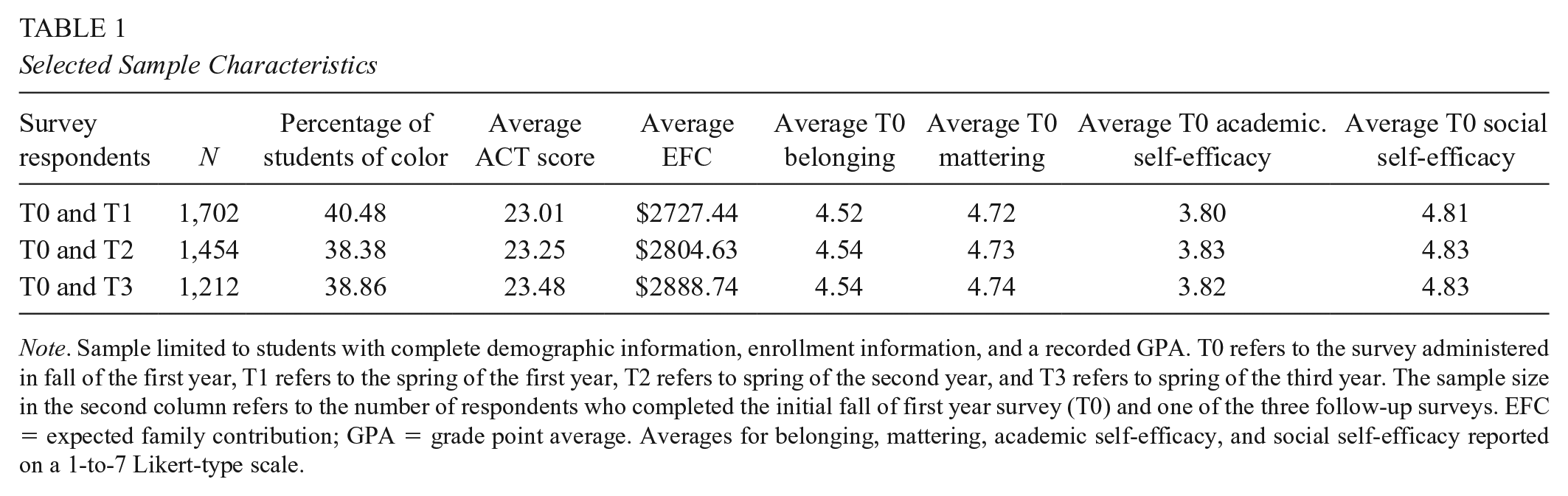
Note. Sample limited to students with complete demographic information, enrollment information, and a recorded GPA. T0 refers to the survey administered in fall of the first year, T1 refers to the spring of the first year, T2 refers to spring of the second year, and T3 refers to spring of the third year. The sample size in the second column refers to the number of respondents who completed the initial fall of first year survey (T0) and one of the three follow-up surveys. EFC = expected family contribution; GPA = grade point average. Averages for belonging, mattering, academic self-efficacy, and social self-efficacy reported on a 1-to-7 Likert-type scale.
The characteristics of our analytic sample are relatively consistent over time, although the share of students of color decreases from the end of Year 1 to the end of the Years 2 and 3, while average ACT scores, expected family contribution, and initial mattering and academic self-efficacy increase slightly as students attrit from the survey (and potentially from the university system). Our initial measures of mattering and academic self-efficacy (T0) are taken from a survey administered a few months into students’ first semester.
Measures
In this article, we focus on students’ first three years on campus (which we denote as T1, T2, and T3), for which we have data for both cohorts of students. The original survey included scales validated in prior literature in line with TSLC’s hypothesized theory of change; for example, the program was hypothesized to increase students’ sense of belonging at the campus, so items from the 2015 Programme for International Student Assessment (PISA; OECD, 2017) measuring belonging were included in the original survey. After each survey administration, the psychometric properties of each scale were examined, qualitative data were reviewed, and adjustments were made to items to ensure the relevance, validity, and reliability of the scales (Cole et al., 2018). In this article, we focus on four key psychosocial constructs: sense of belonging to campus, mattering to campus, academic self-efficacy, and social self-efficacy (BMSE).
The BMSE constructs were measured using a Rasch scoring method; we standardize the logit scores and use the resulting z scores in our analyses. Rasch is a type of item response theory that combines student responses across multiple items into a single score based on item difficulty and centrality to the construct. Table 2 summarizes the goodness-of-fit of each psychosocial outcome; each construct performs as expected as in our sample. Below, we discuss how each outcome is measured on our survey.
Goodness-of-fit of BMSE Constructs
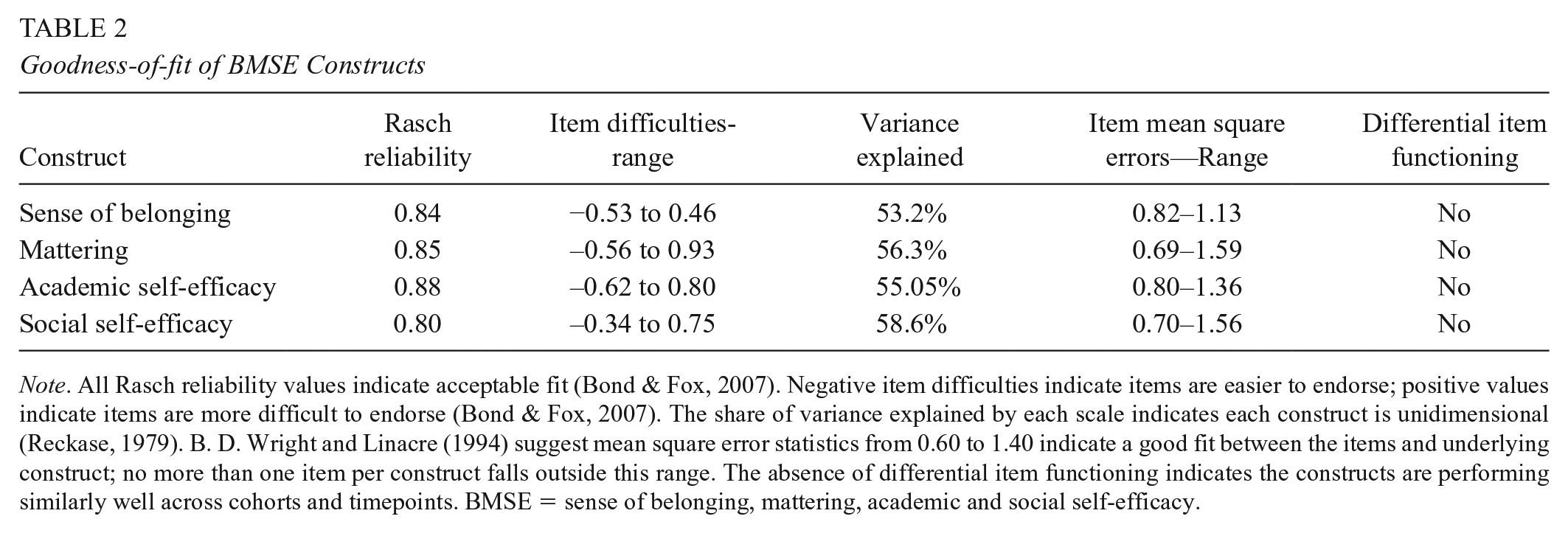
Note. All Rasch reliability values indicate acceptable fit (Bond & Fox, 2007). Negative item difficulties indicate items are easier to endorse; positive values indicate items are more difficult to endorse (Bond & Fox, 2007). The share of variance explained by each scale indicates each construct is unidimensional (Reckase, 1979). B. D. Wright and Linacre (1994) suggest mean square error statistics from 0.60 to 1.40 indicate a good fit between the items and underlying construct; no more than one item per construct falls outside this range. The absence of differential item functioning indicates the constructs are performing similarly well across cohorts and timepoints. BMSE = sense of belonging, mattering, academic and social self-efficacy.
Belonging to Campus
Our survey measures students’ sense of belonging to campus through eight Likert-type items. Students were asked to report, on a scale of 1 (strongly disagree) to 7 (strongly agree), the extent to which they “feel like an outsider” and “feel I am a member of the [INSTITUTION] community.” The belonging to campus scale initially included only six items, and students responded on a 4-point scale. After the survey was administered in fall 2015, two items were added and the response scale was expanded to include seven response options. Due to these changes in the construct over time, we calculated construct scores using a Rasch scale model.
Mattering to Campus
Our survey measures students’ feelings of mattering to campus through eight Likert-type items. Students indicated the extent to which they felt “There are people at [MY INSTITUTION] who are generally supportive of my individual needs” and that “Other students at [MY INSTITUTION] are happy for me when I do well on exams or projects.” There were some changes to the scale over time. In the fall of 2015, students responded to six Likert-type items, each of which had a 4-point response scale. Following formative and qualitative analysis of that scale, two items were added and the response scale was expanded from a 4-point scale to a 7-point Likert-type scale (where 1 indicates the lowest level of mattering and 7 indicates the highest level of mattering). The scale remained constant thereafter. Because of the changes to the scale over time, construct scores were calculated using a Rasch scoring method.
Academic Self-Efficacy
Each survey wave included a scale meant to capture students’ perceptions of their academic capabilities. On the first survey administered, in fall 2015, students responded to 11 items on a 7-point Likert-type scale. In subsequent administrations, students responded to 14 items on a 7-point Likert-type scale, where 1 represents the lowest feeling of efficacy and 7 represents the highest feeling of efficacy. Example items include the extent to which students feel they can “meet the academic demands of college” and “organize my schoolwork.” Because of the changes to the construct over time, scores are calculated using a Rasch scoring model.
Social Self-Efficacy
Social self-efficacy was originally measured through six Likert-type items; the construct was expanded in fall 2016 to include eight Likert-type items. Students consistently responded to these items on a 7-point scale, where one indicates the student feels they “cannot do this at all” and seven indicates the student feels they “absolutely can do this.” Students were prompted to report the extent to which they felt they could “get involved in interesting activities” and “make friends you can talk about your very personal problems with.” We again estimate students’ social self-efficacy using a Rasch scoring method.
Analytic Strategy
We pursue two distinct analytic strategies for our examination of the relationship between, first, students’ BMSE and cumulative GPA, and, second, BMSE and persistence. We explore the relationship between BMSE and GPA using correlations and descriptive linear models estimated using ordinary least squares. We use an event history approach to examine the relationship between BMSE and persistence (Stokes Berry & Berry, 1990).
Psychosocial Outcomes and Academic Achievement
We start by examining the relationship between BMSE and cumulative GPA at the end of students’ first, second, and third years on campus. We first calculate pairwise correlations between each psychosocial outcome of interest (mattering to campus, belonging to campus, academic self-efficacy, and social self-efficacy) and students’ Year 1, Year 2, and Year 3 cumulative GPA. When testing the significance of these correlations we apply a Bonferroni adjustment for multiple comparisons that holds the familywise error rate constant at
We next estimate regression-adjusted correlations between our four psychosocial outcomes of interest and students’ cumulative GPA at the end of their first, second, and third years on campus, respectively. Coefficients on the BMSE variables can be interpreted in standard deviation (SD) units. Our preferred model is given by Equation 1:

In Equation 1,
Psychosocial Outcomes and Persistence
We use an event history analysis (Stokes Berry & Berry, 1990) to examine the relationship between students’ self-reported BMSE and persistence by estimating a series of Probit models as shown in Equation 2:

In Equation 2, we focus on whether or not student i remains enrolled at the start of their second and third years on campus (full results for each semester are available on request). We include a measure of students’ BMSE from the semester prior to whether the student is perceived as persisting or not (
Results
Cumulative GPA
Table 3 presents the pairwise correlations between students’ BMSE and cumulative GPA over their first 3 years on campus. All correlations are significant at the .01 level after applying the Bonferroni adjustment for multiple comparisons (e.g., all observed p values are less than .0005).
Year-by-Year Correlation Matrices of BMSE and Cumulative GPA

Note. All correlations significant at the .001 level after implementing the Bonferroni adjustment for multiple comparisons (within each year). Sample restricted to students with a recorded GPA in each year of interest. Year 1 observations = 1,944; Year 2 observations = 1,678; Year 3 observations = 1,405. BMSE = sense of belonging, mattering, academic and social self-efficacy; GPA = grade point average.
p < .05. **p < .01. ***p < .001.
We find positive correlations between students’ sense of belonging to campus, mattering to campus, academic self-efficacy, social self-efficacy, and cumulative GPA at each time point. While the correlations between each psychosocial construct and cumulative GPA are significant, they are small to moderately sized, around .14 to .31 at each time point.
We are also interested in the predictive power of students’ BMSE on academic outcomes holding constant student background characteristics. Table 4 presents the results from Equation 1. As shown at the bottom of the table, each BMSE construct explains additional variance in cumulative GPA beyond the control variables. R2 values increase by 8% when belonging is included, 6% when mattering is included, by 19% when academic self-efficacy is included, and by 8% when social self-efficacy is included, relative to models only including the control variables. This suggests the importance of students’ BMSE for predicting academic performance beyond their background characteristics, prior academic performance, campus of enrollment, and unobserved characteristics associated with their treatment status. Overall, our regression results give additional support to the relationships suggested by the raw correlations: students’ BMSE levels are significantly related to their academic achievement, with academic self-efficacy and sense of belonging emerging as the strongest predictors of students’ academic performance.
Relationship Between BMSE Constructs and Cumulative GPA

Note. Entries are estimates from a multivariate regression of GPA (cumulative GPA) on a particular psychosocial construct and the following covariates: race/ethnicity, sex, high school GPA, ACT score, expected family contribution, first-generation status, treatment status, initial level of the psychosocial outcome of interest, initial campus of enrollment, and cohort). BMSE = sense of belonging, mattering, academic and social self-efficacy; MAT = mattering to campus; SOB = sense of belonging to campus; ASE = academic self-efficacy; SSE = social self-efficacy; GPA = grade point average.
p < .05. **p < .01. ***p < .001.
There are positive and significant associations between each psychosocial construct of interest and students’ cumulative GPA at each of the 3 time points we examine. The strongest relationship is between academic self-efficacy and cumulative GPA. At end the end of each year, a 1 SD increase in academic self-efficacy is associated with an increase in GPA of 0.18, 0.12, and 0.08 points, respectively; these relationships are all significant at the .001 level. Higher levels of belonging to campus are also positively associated with academic achievement at the end of students’ first, second, and third years on campus. Specifically, an increase in belonging to campus predicts a 0.12, 0.08, and 0.08 point increase in GPA, respectively; all relationships are significant at the .001 level. Higher reported levels of social self-efficacy are associated with 0.11, 0.06, and 0.07 point increases in GPA in Years 1 through 3, respectively (p < .001). Finally, 1 SD increases in mattering are associated with increases in cumulative GPA of 0.09, 0.03, and 0.05 points, respectively, during students’ first 3 years on campus (p < .001, p < .01, p < .001, respectively).
In models including all four BMSE constructs simultaneously, academic self-efficacy and sense of belonging to campus are consistently significant predictors of cumulative GPA in Years 1 through 3, as shown in Table 5. The estimated coefficient on sense of belonging is .055 in Year 1, .066 in Year 2, and .054 in Year 3 (p < .01, p < .001, p < .001, respectively); coefficients on academic self-efficacy are slightly larger in each year: .159, .133, and .126, respectively (p < .001). Mattering to campus is not significantly related to cumulative GPA in either Year 1 or Year 3, and is negatively associated with cumulative GPA in Year 2. Social self-efficacy is not significantly related to first-year or third-year cumulative GPA, and is negatively associated with second-year cumulative GPA.
Regression-Adjusted Correlations Between BMSE and Cumulative GPA

Note. Models control for race/ethnicity, sex, high school GPA, ACT score, expected family contribution, first-generation status, treatment status, initial levels of psychosocial outcomes, campus fixed effects, and cohort fixed effects. Standard errors in parentheses. BMSE = sense of belonging, mattering, academic and social self-efficacy; GPA = grade point average.
p < .05. **p < .01. ***p < .001.
The high correlations between the BMSE constructs may raise concerns of multicollinearity. For example, mattering and belonging are correlated at about .6 each year, social self-efficacy and belonging are correlated at about .7 each year, and mattering and social self-efficacy are correlated at about .6 each year. However, variance inflation factors (VIFs), which estimate the extent to which multicollinearity is present in a regression models, are less than 2 for each model including all four psychosocial constructs, and no variable has a VIF greater than 3 across all three models. This suggests that multicollinearity is not an issue when including multiple psychosocial constructs in the model to predict cumulative GPA, and reinforces our finding that belonging and academic self-efficacy are the strongest predictors of academic performance.
Persistence
We first present the results of our event history analysis looking at the extent to which students’ reported feelings of BMSE predict their likelihood of persisting into their second and third years, respectively. The marginal effects from our Probit models are shown in Table 6.
Relationship Between BMSE and Persistence in College

Note. Entries are estimated marginal effects from a multivariate probit regression of persistence to the start of the indicated year on a particular psychosocial construct and the following covariates: race/ethnicity, sex, high school GPA, ACT score, expected family contribution, first-generation status, treatment status, initial level of the psychosocial outcome of interest, initial campus of enrollment, and cohort. MAT = mattering to campus; SOB = sense of belonging to campus; ASE = academic self-efficacy; SSE = social self-efficacy; BMSE = sense of belonging, mattering, academic and social self-efficacy; GPA = grade point average.
p < .05. **p < .01. ***p < .001.
The four psychosocial constructs are generally positively and significantly predictive of persistence into students’ second and third years. Higher reported levels of academic self-efficacy, sense of belonging to campus, and social self-efficacy are all associated with about a 3 percentage point increase in the likelihood a student will be enrolled in the first semester of their second year on campus; these estimates are all significant at the .001 level. A 1 SD increase in mattering to campus in students’ first year is associated with a 1.6 percentage point increase in the likelihood of returning for a second year (p < .05).
A 1 SD increase in academic self-efficacy at the end of students’ second year is associated with a 1.8 percentage point increase in the likelihood of returning for a fifth semester (p < .01). Belonging and social self-efficacy are also positively associated with the likelihood of returning for a third year; point estimates are 1.6 and 1.2 percentage points, respectively (p < .05). Second year mattering to campus is not significantly related to the likelihood of returning for a third year.
In models including all four BMSE constructs simultaneously (shown in Table 7), both academic self-efficacy and sense of belonging to campus are significant predictors of second- and third-year persistence. A 1 SD increase in academic self-efficacy and sense of belonging in students’ first year is associated with a 1.8 and 2.0 percentage point increase in the likelihood of returning in semester three, respectively (p < .05). Similarly, 1 SD increases in academic self-efficacy and belonging in Year 2 are associated with 1.6 and 1.7 percentage point increases in the likelihood of persistence into Year 3, respectively (p < .05). After controlling for sense of belonging and academic self-efficacy, neither mattering to campus nor social self-efficacy is a significant predictor of persistence to Year 2 or 3.
Marginal Effects, Relationship of BMSE and Persistence

Note. Models control for race/ethnicity, sex, high school GPA, ACT score, expected family contribution, first-generation status, treatment status, initial levels of psychosocial outcomes, campus fixed effects, and cohort fixed effects. Sample restricted to students with complete demographic information, enrollment information, and a recorded GPA for the semester prior to the persistence outcome (e.g., second semester GPA for persistence into Year 2). Standard errors in parentheses. BMSE = sense of belonging, mattering, academic and social self-efficacy; GPA = grade point average.
p < .05. **p < .01. ***p < .001.
We were also interested in exploring the relative predictive power of changes in BMSE and cumulative GPA. Such an analysis may help institutions refine early warning systems that typically only focus on academic indicators. Table 8 presents the marginal effects from Probit models expressing the likelihood of persistence as a function of changes in both a single psychosocial construct of interest (mattering to campus, belonging to campus, academic self-efficacy, and social self-efficacy, respectively) and a change in cumulative GPA.
Relationship Between Changes in BMSE and GPA on Persistence

Note. Estimates are from models where persistence to Year 2 (Columns 1–4) or Year 3 (columns 5–8) is regressed on the change in a particular psychosocial outcome between the fall and spring of the first year and the change in cumulative GPA between the first and second semester (columns 1–4) or third and fourth semester (columns 5–8). Models control for treatment status, sex, race/ethnicity, expected family contribution, ACT score, high school GPA, first-generation status, initial campus of enrollment, cohort, levels of psychosocial outcomes, and cumulative GPA. Standard errors in parentheses. Probits, marginal effects shown. MAT = mattering to campus; BEL = belonging to campus; ASE = academic self-efficacy; SSE = social self-efficacy; CGPA = cumulative GPA; T0 = beginning of Semester 1; T1 = end of Semester 2; T3 = end of Semester 4; T4 = end of Semester 6; S1 = Semester1; S2 = Semester 2; S3: Semester3; S4 = Semester 4; BMSE = sense of belonging, mattering, academic and social self-efficacy; GPA = grade point average.
p < .05. **p < .01. ***p < .001.
As shown in Table 8, changes in cumulative GPA are consistently predictive of persistence decisions, and the relationship between changes in academic performance and persistence is stronger than the relationship between changes in BMSE and persistence. Generally, changes in students’ BMSE are not significantly related to persistence outcomes after accounting for levels of BMSE, cumulative GPA, changes in GPA, and background characteristics.
Discussion
We find positive associations between BMSE and student achievement, measured by GPA. While the literature is limited in providing a direct comparison to the size of these correlations, they seem in line with extant literature. For example, in a meta-analysis of studies examining the relationship between psychosocial outcomes and GPA, Robbins et al. (2004) found correlations of .01 to .50, depending on the psychosocial construct. Correlations among the BMSE constructs are also significant, and generally stronger than the correlations between the four psychosocial constructs and GPA, around .4 to .8, depending on the year and constructs. These correlations are somewhat stronger than some of the associations between psychosocial constructs documented in prior literature; for example, Fagioli et al. (2020) find that academic self-efficacy and conscientiousness are correlated at about .59 and that academic self-efficacy and growth mindset are correlated at .33 among community college students. The correlations we find suggest not only that these four psychosocial outcomes are indeed related to students’ postsecondary academic achievement but also that academic outcomes and BMSE represent distinct domains of student success. They also suggest that the BMSE measures capture a larger construct related to students’ psychosocial well-being.
Similarly, the positive associations we find between BMSE and achievement in our regression framework are in line with prior literature. For example, in a review of the literature, Farrington et al. (2012) found that effect sizes of interventions focused on academic mindsets such as sense of belonging typically result in GPA increases of 0.2 to 0.3 points, with smaller impacts in postsecondary than in K–12 classrooms.
Our documentation of positive associations between BMSE and persistence complements the small body of existing literature exploring this relationship. For example, Gopalan and Brady (2019) find that higher levels of belonging increases students’ likelihood of persisting into a second year by 1.9 percentage points and a third year by 2.1 percentage points.
The magnitude of the relationships we find are practically meaningful. Persistence rates in our sample are relatively high to begin with; about 93% of students returned for a second year, compared with a national retention rate of just under 80% for students starting full-time at a 4-year institution in 2015 or 2016 (National Student Clearinghouse Research Center, 2019). While the impact of increasing persistence by 2 percentage points in our sample may seem small from a practical standpoint (roughly 34 students), increasing persistence by 2 percentage points nationally would have meant about 21,000 more students returning to the same institution for a second year in each of the 2015 and 2016 cohorts. 2
Limitations
In this article, we have demonstrated the connection between students’ BMSE and academic outcomes over students’ first 3 years on campus. While an important contribution to the literature, this study has several limitations that offer suggestions for future inquiry.
First, our data set is potentially limited in its generalizability to postsecondary students. We use data from relatively high-achieving, low-income students enrolled in the University of Nebraska system. All students in our sample qualified for a competitive, merit-based scholarship from the STBF, and had an expected family contribution of less than $10,000. Furthermore, over two thirds of students in our sample were first-generation college students, and about 40% were racially minoritized. The relationships we find between students’ BMSE and academic outcomes may vary if we included a broader group of college students across a wider geographic area or who were enrolled at different institutional types. However, there currently is no nationally representative data set that contains as detailed information as ours on student’s BMSE and academic outcomes. In what limited data does exists, results align with ours. For example, Gopalan and Brady (2019) use a single-item measure of students’ belonging available in the national Beginning Postsecondary Students Longitudinal Study and find it predicts students’ persistence through their second and third years. Second, while all students in our study are enrolled in the University of Nebraska system, the three institutions offer three distinct university experiences: an R1 institution, a metropolitan campus, and a rural campus. The vast majority of undergraduate students attend public institutions; in 2018, 13 million students enrolled in public institutions compared with less than 4 million in any type of private institution (for-profit or not-for-profit; National Center for Education Statistics, 2019).
Second, our analyses are descriptive, not causal. We document that, on average, students who report higher levels of BMSE also earn higher cumulative GPAs and are more likely to persist through their third year. However, we do not show that increases in belonging, mattering, academic self-efficacy, or social self-efficacy lead to those improved academic outcomes. While there is some experimental evidence linking students’ psychosocial outcomes to their academic performance, such experiments are difficult to implement at scale and to control in a field (rather than a laboratory) setting. More work is needed to understand how programmatic efforts to improve students’ BMSE indirectly affects students’ academic outcomes.
Finally, we focus on four psychosocial constructs that are theoretically linked to students’ academic outcomes: belonging, mattering, academic self-efficacy, and social self-efficacy. There are many psychosocial constructs that have been explored in the higher education literature that we do not examine, including growth mindset, resilience, grit, and conscientiousness. There is little consistency in terminology across measures that seemingly capture similar constructs—for example, “social connection” versus “social self-efficacy,” “self-confidence” versus “self-efficacy,” or “determination” versus “grit.” As researchers continue to expand their focus beyond traditional definitions of student success beyond narrow academic markers and focus on students’ psychosocial well-being, it will be important for the field to build a consensus around which constructs are most salient for our understanding of students’ well-being and what terms should be used to describe these constructs. Without this consensus, researchers, university leaders, policy makers, and student affairs practitioners may find it difficult to sift through the existing literature to determine what is relevant and actionable. We think it is important for researchers to focus on constructs that emphasize institutional responsibility for fostering student success and that take a nondeficit approach to recognizing what students bring to the university setting.
Conclusion
This article makes several contributions to the literature. First, rather than relying on cross-sectional data, we use longitudinal survey data as well as administrative records to examine the relationships between students’ BMSE and cumulative GPA and persistence, two traditional indicators of academic success in college. This longitudinal data allows us to examine not only cross-sectional relationships but also how these relationships change over the course of a student’s first 3 years on campus and how changes in BMSE relate to changes in academic outcomes. Second, we use detailed scales of BMSE constructs that have been validated in other samples and that exhibit strong reliability within our sample. Finally, we include a rich set of covariates that we use to control for factors that might generate spurious correlations between students’ BMSE and academic outcomes.
Our work provides institutions of higher education additional evidence on the relationship between BMSE, psychosocial skills that are valued by employers and that are related to richer on-campus experiences, and traditional academic outcomes, which are increasingly prioritized by states subsidizing the cost of college. Our results suggest that psychosocial outcomes, particularly academic self-efficacy and sense of belonging, are positively correlated with students’ cumulative GPA and persistence, even after controlling for students’ background characteristics. While belonging and academic self-efficacy are most strongly predictive of students’ academic outcomes, we caution against the conclusion that mattering and social self-efficacy are unimportant. Both mattering and social self-efficacy are independently predictive of academic outcomes (when not controlling for other psychosocial outcomes) and capture important dimensions of the collegiate experience. Continued exploration of these outcomes is needed.
While our results are descriptive, they suggest that efforts to improve students’ subjective experiences and BMSE during their initial years on campus may also help universities move toward goals of increased achievement and retention. We find no consistent differences across subgroups, suggesting that measures of BMSE are important predictors of academic success for all students, and that universities should promote BMSE across groups. While psychosocial well-being is important for all groups, the programs and policies that support the development of BMSE may vary across groups, and should be responsive to students’ unique needs and backgrounds. Future work should continue examining BMSE and other psychosocial outcomes and work to identify the causal relationship between psychosocial and long-term academic outcomes, such as persistence and graduation. Researchers should also continue to explore how to support students’ psychosocial well-being, particularly with respect to underrepresented student groups. Prior work using a nationally representative data set suggests Black, Latina/o/x, and Native American students report lower levels of belonging, on average, than their White, Asian, and multiracial peers, and that first-generation college students report lower levels of belonging, on average, than their continuing generation peers (Gopalan & Brady, 2019). Understanding how to foster a sense of belonging among underrepresented student groups is a critical charge for researchers and practitioners.
While this study demonstrated that reported levels of BMSE are correlated with academic achievement and postsecondary persistence, our results also suggest that these psychosocial and academic domains are not fully overlapping. Universities cannot focus exclusively on promoting either BMSE or academic outcomes and expect that both goals will be reached. Instead, in order to fully support students, all institutional units need to balance their support for both academic success and BMSE development. This may be promoted by encouraging greater collaboration between academic and student affairs (American College Personnel Association, 2008; Kezar, 2003; Nesheim et al., 2007), focusing on instructional practices and curricular design (Baldwin, 2020; Kirp, 2019; Tough, 2019; Yeager et al., 2016), reshaping campus culture (Brown McNair et al., 2016; Jayakumar & Museus, 2012), or by developing new approaches and interventions. Future research should continue to examine how universities can promote both academic and psychosocial outcomes.
We find that, even after accounting for students’ level of achievement and semester-to-semester change in achievement, changes in belonging independently predict the likelihood that students will persist into their second and third years on campus. We focus on students’ first 3 years in college, an important time in which to understand correlates of student persistence. The share of students in our sample persisting into their third semester is 8 percentage points lower among students whose first-year reported sense of belonging was in the bottom quartile of feelings of belonging compared with students whose first-year reported sense of belonging was in the top quartile (87% vs. 95%). Our work is descriptive, and can only suggest areas for future research and institutional efforts. Nonetheless, they suggest that by focusing on improving students’ early experiences in college, institutions may be able to ultimately increase students’ long-term academic success.
Our work suggests that universities may want to assess students’ feelings of BMSE each year or semester to identify students who may need additional support. Surveys administered nationally, such as the National Survey of Student Engagement from Indiana University or the Your First College Year survey from the University of California Los Angeles, could also add items to measure and differentiate between these four constructs; individual institutions could also develop surveys to measure BMSE. Such data would allow institutional research offices to provide key data to both academic and student affairs offices to help make decisions regarding the allocation of scarce staff time. Universities are increasingly analyzing student transcript data to look for early warning signs related to passing gatekeeper courses or low grades in order to provide additional support and promote student success. Similarly, universities could examine trends in students’ reported BMSE to identify students who do not feel like they are part of a community and reach out to identify ways in which the university can become more inclusive and welcoming. For example, advisors could ask students about their relationships with faculty and other students during academic advising sessions, and universities could use semesterly surveys to identify students in the bottom quartile of belonging or academic self-efficacy. Improving students’ feelings of BMSE is possible, particularly when students receive comprehensive support from an intensive, asset-based, and individualized intervention (e.g., Melguizo et al., 2021). More work is needed to understand how campus-wide interventions and assessment of BMSE levels are related to student outcomes and BMSE growth.
Our work focuses on the relationship between students’ academic outcomes and BMSE while they are enrolled in a postsecondary institution. However, students’ feelings of BMSE could also be related to their longer term economic and personal outcomes, such as employment, wages, civic engagement, and quality of life. Future work should examine these relationships to better understand the importance of these and other psychosocial outcomes for individuals and communities.
Footnotes
Appendix
Acknowledgements
We would like to thank Darnell Cole, Ronald Hallett, Matt Soldner, Mark Masterton, Evan Nielsen, Cameron McPhee, Samantha Nieman, Gwendelyn Rivera, and all the other members of the broader mixed-methods evaluation team for designing and implementing the Longitudinal Survey of Thompson Scholars, for helping us get a better understanding of the program and providing relevant feedback on previous versions of this article.
Funding
The author(s) disclosed receipt of the following financial support for the research, authorship, and/or publication of this article: This study received financial support from the Susan Thompson Buffett Foundation.

1.
For more information about the PASS Project, please visit: http://pullias.usc.edu/tslc/. “At-promise” is an asset-based term that refers to students who are less likely to attend a 4-year college or university and who are more likely to be marginalized at predominantly White, middle class institutions, including students of color, first-generation students, students from low-income families, and students with low prior achievement (Swadener & Lubeck, 1995).
2.
The operationalization of “persistence” we use for this study most closely matches the National Student Clearinghouse (NSC’’s definition of “retention,” as we only observe students as persisting if they remain in the University of Nebraska system—NSC defines “retention” as students remaining enrolled in the same institution and “persistence” as students remaining enrolled in any institution (National Student Clearinghouse Research Center, 2019). In 2015, the NSC reported 1,096,607 students whose first enrollment was as full-time students in a public 4-year institution with a 79.3% retention rate; in the 2016 cohort this figure was 1,052,750, with a 79.6% (National Student Clearinghouse Research Center, 2019). A 2 percentage point increase in retention would translate to 21,932 additional students retained from the 2015 cohort and 21,055 additional students retained from the 2016 cohort.
Authors
ELISE SWANSON is a senior postdoctoral research associate at the Pullias Center for Higher Education at the University of Southern California. Her research examines students’ transitions into postsecondary education as well as the impact of policies and programs designed to support students’ postsecondary success.
TATIANA MELGUIZO is a professor in the Rossier School of Education at the University of Southern California. She studies the economics of higher education; in particular, her research uses quantitative methods to assess programs and policies affecting the persistence and educational outcomes of minoritized and low-income students.
PACO MARTORELL is an associate professor in the School of Education at the University of California, Davis. He is an economist who studies a variety of K–12 and higher education policies, with a current focus on developmental education, for-profit colleges, grade retention, school facility investments, and community college tuition subsidies.