




Abstract
The COVID-19 pandemic, an unprecedented public health emergency, challenged higher education and threatened students’ well-being in several ways. With the abrupt shift to online learning, were instructors able to maintain a focus on educating whole students, in addition to teaching subject matter? We answer this question by investigating “formative education,” an approach to teaching and learning that emphasizes holistic development, exploring formative education online during the pandemic. This qualitative study investigates the strategies of 37 college faculty who provided successful formative education online. A cross-subject analysis of data from faculty interviews and supplemental materials (course artifacts, course evaluations, student interviews) uncovered three teaching approaches that faculty used to achieve formative education online: empathic (centering students’ emotions), reflective (facilitating deep inquiry), and adaptive (having flexibility in meeting students’ needs). These approaches could help instructors design online education that engages the whole person.
The COVID-19 global pandemic, an unprecedented public health emergency, abruptly transformed educational practice. Since March 2020, above 60% of the world’s K–12 learners have been affected by closures or shifts to remote learning environments (UNESCO, 2020). At the postsecondary level, the figure is 65% (Strada, 2020a). These disruptions have disproportionately affected students from minoritized groups (Centers for Disease Control and Prevention, 2021; Gold et al., 2020; Jee-Lyn García & Sharif, 2015). In the midst of this upheaval, college students understandably report increased stress, with both mental and physical manifestations (Healthy Minds Network & American College Health Association, 2020). Accustomed to easily available social interactions in-person on campus, learning online can be an isolating experience that challenges students’ well-being and sense of social connection (McInnerney & Roberts, 2004). Students’ lives have been upended across many dimensions—emotional, physical, spiritual, ethical, and social. In addition to the usual stresses faced by university students, they must adjust to online learning, to the anxieties and uncertainties produced by the pandemic, and to the stresses that come with America’s racial reckoning.
Given these multifaceted challenges, educators’ response should address the development of “whole students” during this crisis. It is not sufficient simply to focus on students’ reduced access to subject matter learning, important as that is. Our university practices “formative education,” following the Jesuit method of teaching and learning that centers on cura personalis or “care of the whole person” (Casalini, 2019). This is of course only one “formative” approach to educating whole human beings. Wortham et al. (2020) review and provide a taxonomy of various approaches, most of them secular. In this article, we explore how formative education can mitigate the negative consequences of COVID-19 on college student development. Using insights about how formative education allows university educators to facilitate the development of whole human beings, we explore how exemplary university teachers have been able to care for all students through the challenges of the pandemic.
Research focused on faculty’s experience with whole-person or formative education online is nearly absent from the literature. Jerb et al. (2015) do provide a whole-person learning framework applied to distance education and independent learning, which addresses whole-person learning outcomes. The model includes four dimensions: cognitive, emotional, behavioral, and spiritual. Recent COVID-era research by Quezada et al. (2020) found that faculty increased their social–emotional engagement with students when teaching online during the pandemic. Jerb and colleagues indicate that journaling, reflective learning exercises, and creative writing exercises focused on personal insights can support students’ social, emotional, and spiritual needs. These studies show that faculty can use the flexibility afforded by online learning to customize their course to facilitate multidimensional student development (Dhawan, 2020).
This article explores how exemplary faculty members accomplished formative education online during the COVID pandemic. We address the following research questions:
What does formative education look like in the online environment during a time of global crisis?
What successful teaching practices did educators use to foster student formation in an online environment during the crisis?
Relevant Literature
Formation and Formative Education
In recent years, policymakers, educators, and researchers have increasingly emphasized comprehensive human development beyond skills and knowledge. A growing number of educational approaches focus on various noncognitive ends, including well-being, character, virtues, and civic purpose. Wortham et al. (2020) use a conceptual heuristic to map out eleven approaches to whole-person education, including indigenous education, social and emotional learning, virtue-based character education, and 21st-century skills. They argue that four central distinctions provide a taxonomy of these heterogeneous, proliferating movements: (a) approaches emphasize either discrete dimensions of human functioning, or they foster integration across dimensions; (b) approaches tend to focus on either individual or collective change; (c) approaches aim for either intrinsic or extrinsic ends; and (d) some approaches help students develop a sense of purpose, while others do not.
Amid these many, heterogeneous approaches to whole-person education, “formative education” is a distinctive tradition rooted in the Jesuit understanding of human nature and human flourishing (O’Malley, 2015). Jesuit education is influenced heavily by the teachings of Saint Ignatius Loyola, who believed that students should not merely be instructed, but “formed in all aspects of their persons” (Casalini, 2019, p. 130). It is only through cura personalis, or care of the whole being, that students can develop into full agents who are able to enact justice and contribute to the common good of humanity (Geger, 2014; O’Malley, 2015). Other educational approaches, many of them secular, also emphasize care for the whole person. For instance, as J. P. Miller (2010) notes, many indigenous traditions have cultivated wholeness, viewing themselves as part of an interconnected human and natural whole. Dewey (2001) also emphasizes educating the whole child: “The child’s life is an integral, a total one. [ . . . ] The things that occupy him are held together by the unity of the personal and social interests which his life carries along” (pp. 126–127). Emphasis on formation characterizes a diverse set of educational traditions, and thus our findings apply to a range of educational settings.
We summarize formative education as including three interrelated components. First, rather than placing priority on the development of skills and knowledge, formative education fosters holistic student development along multiple dimensions of human flourishing, attending to intellectual, social, ethical, and spiritual aspects. Sometimes these multiple dimensions are described as developing students’ minds, hearts, and spirits (Boston College, 2007). Second, formative education encourages students to reflect on the larger purpose of their lives, as a way of guiding them toward better decisions and greater fulfillment. Jesuit education often refers to this as “discernment,” the process of discovering the intersection between students’ talents and the world’s needs (O’Malley, 2015). Third, formative education takes place in community with others, who help students articulate their pathways and participate in collective projects. Formation requires “the help of a companion on the way,” even if the formation itself is deeply personal (Kolvenbach, 2007, p. 10). Thus, formative education is inherently communal.
In this time of global crisis, when many policymakers, educators, and the general public have become more aware of the fact that young people need developmental guidance beyond subject matter learning, we need greater insight into how educators can more effectively facilitate the development of the whole student. We argue that formative education is a generative approach to comprehensive student well-being that can help. Our version of formative education is certainly not the only worthwhile approach to fostering holistic student development but its distinctive emphases offer productive insights about how educators can facilitate student well-being online during disruptions like the pandemic.
Existing literature on formative or whole-person education focuses on in-person education (e.g., R. Miller, 1990; Pearl, 2018; Plater, 2017), with the exception of few studies that emphasize the importance of cognitive, emotional, behavioral, and spiritual aspects of online whole-person learning and teaching (Ascough, 2002; Baker & Edwards, 2011; Jerb et al., 2015; Lowe, 2010). Little is known about how formative education occurs in an online environment, however. The present study addresses this gap by exploring effective strategies of faculty who engaged in successful formative education online during the pandemic in 2020.
Online Teaching
The proportion of students enrolled in online courses has grown substantially over the past two decades. In 2000, 8% of undergraduates in the United States were enrolled in at least one online course, while 20% were enrolled in 2008 (Radford, 2011). More recently, in fall 2018, 5.7 million undergraduates—34% of all undergraduates enrolled in degree-seeking postsecondary education institutions in the United States—were enrolled in at least one online course (U.S. Department of Education, 2019). Additionally, 1.2 million postbaccalaureate students, or 40% of all postbaccalaureate students, were enrolled in at least one online course in fall 2018 (U.S. Department of Education, 2019).
Considerable research has been conducted over the past decade to understand faculty and student experiences teaching and learning online. Martin et al. (2020) conducted a systematic review of 619 research papers on online teaching and learning published between 2009 and 2018. The majority of these studies focused on the experience of students (56%), with some studies focused on course design and instructors (30%) and others on broader institutional support for online education (14%). Most of this research focuses on teaching and learning.
Several studies have explored factors contributing to successful online teaching. Martin et al. (2019) consulted eight award-winning online instructors to understand their teaching strategies. The research found that these exemplary faculty adopted multiple roles when teaching online: content expert, course designer, course manager, mentor, and facilitator. As content experts, course designers, and course managers, faculty members are responsible for maintaining expertise in their area of study, determining learning objectives, aligning content with course delivery, and grading assignments, among other activities. Moreover, faculty mentor students by meeting with students individually to provide advice concerning their academic development and career goals.
Despite our substantial knowledge about online teaching and learning, we know little about how it occurred during the current pandemic. While we may be able to extrapolate from existing knowledge about online teaching and learning in general, we know very little about how education proceeded after the abrupt transition to widespread online learning in 2020. We know even less about how educators can foster whole-person development online under circumstances like the pandemic.
Method
This qualitative research study utilized faculty interviews, course artifacts, course evaluations, and student interviews to understand how faculty facilitated formative education online (Merriam, 2009; Merriam & Tisdell, 2016). Participants were recruited in summer 2020 via purposive sampling from Boston College in the northeast United States. We used two criteria for purposive sampling. First, deans of each school within the university were asked to nominate exemplary faculty members who successfully transitioned to providing formative or whole-person education in the online environment during the pandemic. In most cases, deans relied on a combination of course evaluations, anecdotal information, and consultations with department chairs. Nominated faculty were invited by the dean of the School of Education and Human Development to participate in the study. The second criterion for inclusion in the study was willingness to participate. All but one nominated faculty member agreed to participate.
Participants
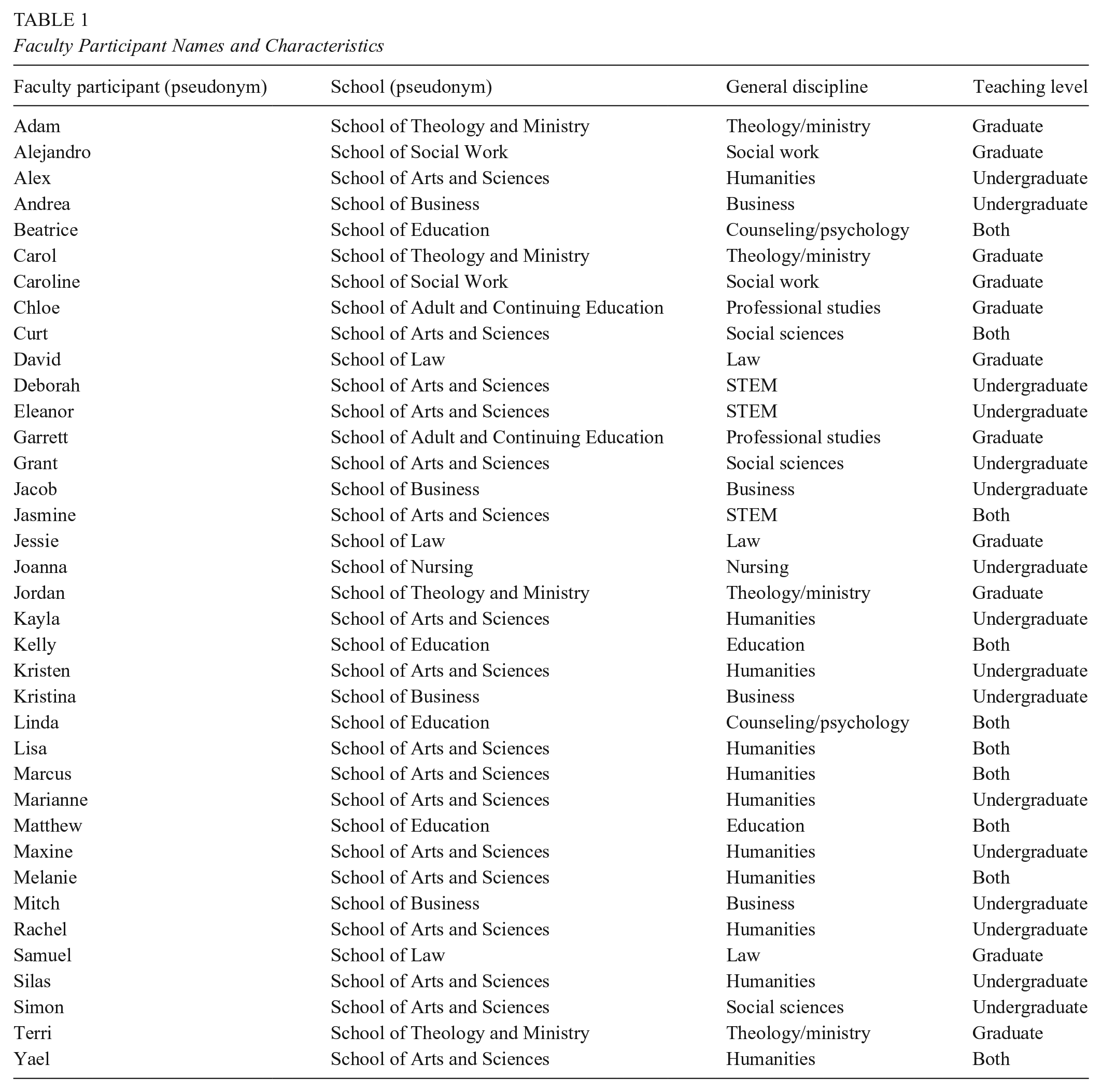
A total of 37 faculty members participated in the research, including tenured, tenure-track, and non–tenure track faculty of varying ranks and years of teaching experience. These faculty represented all eight schools across the university, including adult/continuing education (n = 2), arts and sciences (n = 17), business (n = 4), education (n = 4), law (n = 3); nursing (n = 1), social work (n = 2), and theology and ministry (n = 4). Within the School of Arts and Sciences, there were faculty in the humanities (n = 11), social sciences (n = 3), and STEM (n = 3). There were individuals teaching undergraduates only (n = 16), graduate students only (n = 11), or both undergraduate and graduate students (n = 10). Additional information about each participant is represented in Table 1.
Faculty Participant Names and Characteristics
Researchers’ Positionality
We recognize that our unique experiences and backgrounds affect our research. We are an eight-person research team, six doctoral-level graduate students, one associate professor, and one senior administrator. Three additional faculty members offered feedback throughout the project. The team included experts in developmental psychology, educational psychology, curriculum and instruction, educational measurement, and higher education. Five of the eight, including the first author, are scholars of color.
Data Collection
The primary data were hour-long interviews with each faculty member. We also collected course materials, course evaluations, and interviews with selected students. These materials were used to triangulate the findings from the interviews, in order to better ensure the trustworthiness of the findings (Merriam & Tisdell, 2016).
Semistructured Interviews With Faculty Members
We interviewed each faculty member in one individual semistructured Zoom interview lasting between 45 to 75 minutes. Faculty members were asked approximately 20 questions—most of which contained at least one follow-up question. The interview questions covered four main areas:
General teaching background, including experiences teaching online (e.g., “Had you taught an online or remote course prior to this spring semester?”)
Understanding of formative education (e.g., “When you hear ‘formative education’ or ‘whole-person education,’ what is your interpretation of the concept?”)
Online formative education teaching practices (e.g., “When you were teaching online this spring, were there teaching practices or strategies you used to foster students’ development beyond the subject matter, like their emotional, social, ethical, or spiritual development?”)
General reflective conclusions about formative education online (e.g., “How, if at all, did the online environment influence your teaching and ability to engage students in formative education?”)
Interviews were recorded and transcribed for further analysis using Dedoose software. Participants were asked to review their transcripts for accuracy.
Semistructured Interviews With Students
We interviewed 14 undergraduate and graduate students who enrolled in a spring 2020 class with 1 of the 37 faculty participants. Students in 12 of the 37 faculty members’ classes were interviewed. Each interview lasted between 45 and 60 minutes. The interviews addressed their experiences learning online in spring 2020, especially with respect to formative education. The student interviews mirrored the faculty interviews, including most of the same questions. The interview had five sections:
General education background (e.g., “What school/college are you in and what is your major?”) and online learning experience (e.g., “Prior to this past spring 2020, have you ever taken a course online?)
Understanding of formative education (e.g., “When you hear that a professor wants to support student learning beyond the content of the course, what does that mean to you?”)
Experience with formative education online (e.g., “How, if at all, did Professor [INSERT NAME] help support your growth and development above and beyond learning subject matter, inside and/or outside the classroom—for instance, thinking about your emotional, social, ethical, and spiritual life?”)
Sense of community (e.g., “How would you compare the sense of community in your online courses with your in-person courses?”)
Concluding reflections (e.g., “How would you compare your online courses to your in-person courses with respect to your development and growth beyond the subject matter?”)
Course Materials
Faculty were invited to share copies of course artifacts that reflected their formative teaching. These artifacts included assignments, class activities, asynchronous lecture videos, and synchronous class recordings. A total of 16 faculty provided at least one course artifact.
Course Evaluations
To gain further insight into student perspectives, faculty were asked to share copies of their Spring 2020 university course evaluations, which included questions about students’ online learning experiences. A total of 13 faculty shared course evaluations for one or more courses.
Data Analysis
The data were coded and analyzed using an inductive, ethnographic approach involving multiple rounds of coding (Erickson, 2012; Kelle, 2000). The initial analysis began with analytic memo writing after each interview (Merriam & Tisdell, 2016). These memos captured our observations, reflections, and ideas for possible codes. For the next stage of analysis, the transcripts were coded using Dedoose.
We analyzed all data inductively (Lincoln & Guba, 1985). The initial codes were derived from our analytic memos, further review of the transcripts, and conversations among the research team. For data analysis, we adopted procedures from Miles et al. (2014): (a) reviewing the first set of data and developing initial codes (e.g., checking in, creating assignments, collaborative learning); (b) deciding on the criteria for each code; (c) coding all the data; (d) revising the codes; (e) developing categories and subcategories based on thematic patterns; (f) revising categories and subcategories; (g) repeating steps (d)–(f) iteratively; (h) renaming or relocating the categories and subcategories; and (i) conducting within- and cross-subject analysis of the categories. Key themes (e.g., empathetic, reflective, and adaptive approaches) that were identified are presented below. By collecting data from multiple sources such as interviews, course materials, and course evaluations, we were able to triangulate results and increase the trustworthiness of our findings.
Results
Faculty members unanimously acknowledged the unprecedented impact of the global pandemic on student learning and well-being. During the transition to a mostly unfamiliar, fully online learning environment, students also experienced a combination of challenges including anxiety about sick family members, concern for their own health, diminished productivity and motivation, adjusting to alternative living conditions, depression and anxiety, and financial instability.
Faculty members tried to address this challenging situation at the same time as most abruptly transitioned to fully online teaching for the first time in their careers. After COVID-19 forced colleges to suspend in-person operations, our exemplary faculty participants nonetheless continued to focus on formative education in their online classrooms, supporting students’ development as whole people, providing opportunities to reflect on meaning and purpose, and fostering a sense of community.
Almost all of our participants increased their contact with individual students, regularly checking in with them, holding virtual office hours, providing students timely and substantive feedback, being responsive to a broad range of student needs, and providing opportunities for interactive engagement among students (cf. Baker & Edwards, 2011; Jensen et al., 2020). These proactive efforts to engage with students provided opportunities for supporting individual students based on their emerging needs, and they also helped build a sense of community in the classroom (Shea et al., 2006). Faculty members emphasized opportunities for interactive engagement among students as an important means to foster community online. Some faculty reported feeling a stronger connection to their students online than they had in person, although other faculty felt that the online format is impersonal (Jensen et al., 2020). They attributed this closeness to the higher amount of individual one-on-one communication that they engaged in online during the pandemic.
Overall, we uncovered three successful strategies for formative education online during the pandemic: empathic, reflective, and adaptive approaches. Each of the three strategies was discussed by nearly all participants. The empathic approach focuses on students’ complex emotions and nonacademic challenges during the crisis. The reflective approach emphasizes deep inquiry and drawing connections between the course content and the world. The adaptive approach calls for flexibility to best meet the broad range of student needs that emerged during the pandemic. We describe each of these approaches in one of the following sections. They are not mutually exclusive, and many faculty employed more than one approach. These approaches allowed our exemplary faculty to facilitate wholeness, purpose, and community despite the challenges of the pandemic.
Empathic Approach
Participants emphasized that students are multidimensional people with intellectual, social, ethical, and spiritual needs—not just disembodied minds, nor just anonymous members of the class. As Deborah described, “[students] come into your classroom not just as cognitive learners, but they have psychological transitions and social transitions and biological transitions, all happening simultaneously, and these transitions largely influence their presence and their ability to learn.” During the COVID-19 crisis, faculty also understood that these multidimensional students were facing anomalous, complex personal situations. As Beatrice explained, “[students] are experiencing depression and anxiety and hopelessness and all sorts of really difficult psychological kinds of responses to the current crisis.” Kelly shared an example of a student grieving the loss of a family member during the semester, making “the intellectual less important than the emotional and social [dimensions].”
Other faculty, like Garrett, added that, although everyone was experiencing difficulties due to the pandemic, “not everybody’s situation is the same.” Indeed, with students no longer having access to shared classroom spaces, “not everybody’s sitting in a nice library with a nice slate of books behind them as they Zoom.” Some students from low-income backgrounds, in particular, had to choose between spending time on their coursework and supporting their family members. In response, 100% of faculty employed one or more empathic practices like increased check-ins with students, modeling vulnerability, and fostering a classroom community that embodies empathy.
Reaching Out/Checking In
Faculty began reaching out to students as soon as the pandemic started. Approximately two thirds of faculty reported engaging in this practice at some point during the spring semester. For example, following the institution’s announcement that classes would move online, Grant emailed his students to ask them about their well-being “during this challenging time” and he acknowledged the disappointment that students must be experiencing. He also invited students to reach out “if you are struggling with anything.” Grant went beyond his typical responsibilities as a professor by providing more intensive emotional support to students.
Faculty regularly made time for “checking in” with their students throughout the semester. As Marcus explained, “I think just because of COVID, there was a lot more checking in with the students and giving people a chance to talk about what’s going on in their lives.” Some faculty members made time for check-ins during class by starting each synchronous class session with questions such as, “Can you give me a word about how you’re feeling today and why?” After class, Carol invited half of her students to remain on Zoom for extended discussions and “check-ins” each week. Deborah contacted her students to offer support, whenever she saw a drop in their academic performance. As she explained, sometimes it is just a matter of letting students know that you “acknowledge” that what they are experiencing is “really hard.” She advised other faculty to “keep reaching out to your students; they do want to hear from you.” Alex contacted students when they missed class or had their camera off during class: “Not in a punitive way, but just to [say], ‘I do know you’re there. You’re not invisible.’” These check-ins invited students to have regular opportunities where they could share challenges if they wished. It also let students know that their professors acknowledged the increased complexity of their lives.
Modeling Vulnerability
About one quarter of faculty members also demonstrated empathy by modeling their own vulnerability and sharing their emotions. Chloe let her students know that “this is not easy for anybody, professors included.” Many faculty members echoed this, describing how they were honest with students when they encountered difficulties navigating online teaching and how they sometimes shared challenges in their own lives. As Lisa explained, “If you want your students to bring their whole selves, you can also bring more of your whole self into what you’re doing.” Lisa shared an example of a time when she was experiencing considerable stress over her “really sick” son, who she worried had COVID. After sharing this information with her students, they followed up with her to see how she was doing. This also showed students that personal topics were appropriate and welcomed in her classroom. In these ways, faculty acknowledged that empathy is a two-way process.
Classroom Community
Faculty members believed that an empathic approach requires students to establish trust not only with their professors but also with their peers. Nearly all faculty engaged in one or more practices to support classroom community. For example, to increase comfort levels within the classroom, Silas sparked conversations at the beginning of classes, asking casual questions like “What’s the best thing to eat in one of the dining halls on campus?” He added that this type of small talk paved the way for students to have “riskier” conversations with one another. Apart from whole class discussions, many professors also used Zoom breakout rooms to encourage students to share ideas or personal experiences with one another that they might not share with the whole class. Kelly strategically used breakout rooms to elicit discussions on potentially sensitive topics.
Moreover, in recognition of the emotional isolation caused by the pandemic, Joanna found it important to help students “get to know each other” on a more personal level and “acknowledge our appreciation for each other.” In a similar way, Carol used her after-class sessions to help facilitate community among students, offering one another support and practical suggestions for dealing with challenges. Beatrice helped her students make sense of “their own sense of loss” by extending empathy toward others through online mentoring of younger students.
Reflective Approach
In this second strategy, 100% of faculty members in our study created opportunities for students to reflect more deeply and to think about how their personal life experiences—often made more difficult by the COVID-19 pandemic—intersected with the curriculum. Kelly and Lisa started off their classes with meditation and breathing exercises, sometimes playing a piece of music or reading poetry. These activities shifted students into a mindful and reflective state as they transitioned into the classroom from their busy lives. In this way, or more tacitly, many faculty members designed their classroom spaces to encourage reflection. As Adam described, the goal was to provide opportunities for “students who were ready to unpack [their emotions]” and to reflect on their experiences during the crisis, while not imposing discomfort or pain. The opportunity to discern their own feelings, the larger purpose that they felt called to, and their ethical commitments moving forward, made these opportunities for reflection particularly important for many students. Reflective practices were fostered through creative assignments and opportunities for students to connect subject matter with current events.
Creative Assignments
Creative assignments such as journaling and poetry provided students with creative platforms to reflect on experiences, express vulnerability, and untangle complex emotions. More than half of faculty incorporated creative assignments into their instruction. For instance, Lisa asked her students to write a poem about what they saw when looking out their window. One of Lisa’s students living in Manhattan described “seeing ambulances constantly racing by, and some of the refrigerator trucks going by [holding bodies].” One of Alex’s students used a poetry assignment to express his anxiety that something could happen to his elementary-school-aged younger sister. He modeled his poem on the Five Stages of Grief, and it helped him “grapple with his own emotional processes around the experience and to think about what it means to live through a pandemic and not be able to protect your loved ones.” These assignments gave students opportunities to unpack their feelings and the trauma that some experienced. A student in Beatrice’s course described one of the benefits of these creative assignments in the course evaluation: “On our experience with COVID-19, [it] provided a good place for analysis and reflection . . . that we can keep, to look back on this time.” These creative assignments allowed students to reflect on their experiences beyond the current semester.
Connecting Course Content to the Real World
Nearly all faculty members offered students opportunities to connect their course experiences to the real world. Many faculty members used the pandemic itself to invite student reflection on course content. In his theology course, Adam found the connection natural: “A lot of the prophetic literature of the Bible was written during a time of crisis and upheaval, and so [the pandemic experience] became . . . a lens engaging the course material in a new way.” Other professors asked students to reflect on the nature of inequality, because social injustice has been exacerbated by the pandemic. Curt connected the course content “to what’s happening in the economy now. How is COVID affecting everything?” Similarly, on one of Lisa’s final exams she included a question that was intended to apply the abstract intellectual concepts from class to real-world challenges and to explore how students might share this knowledge with their communities. A student said that this question allowed them to write about the course content in relation to their own areas of interest, such as criminal justice and children in foster care. As the student described their experience in the course, the reflection was “a really important time for me in my understanding of myself, and it really helped me to figure out what I wanted to do next [with my life].” Connecting course content to real-life experiences gave students opportunities to reflect on their larger sense of purpose outside the classroom.
In some cases, faculty made space for students to reflect on the relationship between the “dual pandemics,” of COVID-19 and systemic racism, and their chosen careers. For example, Joanna worked with a class of first year “non-Black [nursing] students of color.” As she explained: The nursing profession is definitely in the frontlines of the COVID response. [ . . . ] I think this was like probably the first time that they were kind of confronted with the realities of the challenges that come with the profession. And the risk to their lives that they’re putting themselves into. That doesn’t come with all professions.
Joanna recognized that her students were grappling with the real-life consequences of their chosen career path. It was important for them to unpack what it means to voluntarily put your life at risk to care for others, given their commitments to social justice and the high rates of COVID-19 among minoritized groups. After the class ended, Joanna met with students several times to discuss George Floyd’s murder and Black Lives Matter: “We wanted to hold a space to really dissect their identities within this movement, especially challenging since there are all non-Black students of color in the group. And what does that mean and what is our responsibility?” Since her students were future nurses, Joanna thought it was crucial to provide space for her students to discuss the ongoing racial trauma experienced by the Black community and to explore how to offer support.
Adaptive Approach
Faculty members’ third strategy involved an adaptive mind-set, restructuring the content and format of their courses to accommodate the abrupt transition to online learning and to incorporate rapidly developing current events. Nearly 100% of faculty adopted an adaptive approach. Adam mentioned that the pandemic was at the forefront of students’ minds, so it was necessary for him to “bring [the] material, and bend it to that flow rather than fight against the current.” For many professors, adaptation meant changing the topic and format of final assessments or restructuring the course to include more group work or asynchronous activities. Others used external tools and online resources to translate activities into the online context. Samuel explained how he “decided when I was teaching that I was going to teach a class basically the same way online as I did in person.” Although faculty members took varied approaches as they transitioned online, everyone was intentional in their decisions. Some faculty members stressed the importance of acknowledging the unprecedented nature of the situation and the reality that classes could not carry on as usual, while others intended to change as little as possible in an effort to maintain as much normalcy as possible. Beatrice’s student described how she balanced between the two perspectives: “She perfectly balanced acknowledging the difficult time students were going through without making the class all about that.” Adaptive practices that faculty adopted included modifying syllabus content, consulting students, and modifying instructional practices.
Syllabus Content
Over one third of faculty members’ initial response to the transition online was to revisit and revise their syllabi. Kelly removed or shortened some assignments, while Chloe changed the main assignment to give students an option to write about the course material from the perspective of navigating a crisis, to “keep the purpose real.” Curt said: Instead of being so focused on my agenda and what I wanted to cover in terms of my academic content, I was willing and open and acting on my sense that what was needed was to really follow the process of where students were at in their own personal lives.
Apart from flexibility with content matter, to follow the unpredictable flow of the real world, many faculty members also decided to loosen deadlines. Maxine said, “I’m normally kind of a stickler when it comes to deadlines. [ . . . ] But all that went out the window.” For course assignments, many faculty members incorporated more options so that students could individualize learning to fit their personal needs, interests, and goals.
Consulting Students
Several professors echoed Deborah’s decision to “put your ego aside” and let the class know that “I can’t recognize myself what I’m doing best and when I’m not doing so well, but my students sure can.” Over three quarters of faculty regularly consulted students, by asking students such questions as: “What can I do to make things easier for you?” “Is there a way we could redesign the course to make it more useful for you? Is the online learning environment working for you?” Curt had a small group of committed students who were attending optional sessions, but he was interested in finding ways to engage a larger percentage of the students in his lecture course. He nicknamed the small group his “advisory council” and asked them how he could reach more students. Following students’ advice, he hosted an Instagram live session, which involved about 80% of his 250 students. Using innovative approaches like this, faculty sought out opportunities to make changes as challenges arose.
Many faculty members also had international students who became geographically dispersed. After collecting information on different preferences, faculty members varied the time of day when office hours were offered, and they also developed alternative options for class participation. For example, Alex had one international student who decided to stay up late to attend class, while another international student preferred to not attend any late-night synchronous sessions. Alex gave the latter student the option to write a reflection piece and meet one-on-one on a weekly basis.
Instruction
The pandemic offered faculty an opportunity to become more agile educators who regularly reevaluated their students’ needs. About half of the participants reevaluated their course content and structure in one or more ways. Melanie described this as follows: So I think as educators, we have to be really prepared to shift things. [ . . . ] If something happens, like whether it’s with the Black Lives Matter march or a lot of people losing a favorite, God forbid, professor or something on campus, we can’t just carry on as though none of this is happening. We have to somehow integrate our classes into the lives of our students.
Given the crisis, Melanie recognized that proceeding with class as usual would disregard students’ needs. Faculty need to adjust their instruction to align with students’ lived experiences. Samuel emphasized the importance of reevaluating learning goals for his course to limit the amount of time students spend in front of their computers, given students’ reduced attention spans on Zoom compared with the physical classroom. “You have to get to the point a lot quicker teaching online. You just can’t get through as much material. [ . . . ] It forces you to ask yourself even more, what is the point of this class? What are the key things I want to ask?” Several professors also emphasized the importance of scripting or editing recorded lectures, to maintain students’ engagement at maximal levels.
Discussion
Many aspects of these three strategies adopted by our exemplary online teachers would make sense in a range of environments. But they were often driven by and particularly useful during the pandemic. Faculty members used technology to adapt their courses, like creative use of breakout rooms and class recordings. They made themselves more available to students, to discuss topics related to their general well-being, through one-on-one meetings (Martin et al., 2019). They used more holistic approaches to evaluate students’ work and were flexible with assessments. They solicited student feedback about the course and often made adjustments. And they provided enhanced social–emotional engagement by asking students how they were coping with the pandemic, by checking in with students struggling with internet connectivity and other issues, and by meeting with students in small groups to provide differentiated instruction and increased emotional support (Quezada et al., 2020).
Based on the innovations of these faculty who were particularly successful at continuing formative education online, we propose an Empathic, Reflective, and Adaptive approach to fostering whole-person development during disruptions and in a virtual medium. Formative education contains three central dimensions, which we have articulated in terms of wholeness, purpose, and community. Here, we summarize how the Empathic, Reflective, and Adaptive approach we have induced from our study accomplishes each of these key components.
First, formative education seeks to develop students as whole people—to encourage emotional, social, ethical, and spiritual development in addition to subject matter learning (Boston College, 2007). With respect to the Empathic approach, when faculty take students’ emotions into account, they can facilitate whole-person development by moving beyond skills and subject matter. They acknowledge their own and their students’ dignity as individuals, as well as their inevitable emotional reactions and ethical struggles. By employing the Reflective approach, educators give students opportunities to reflect on their diverse experiences during the crisis, intentionally building a bridge between the intellectual, the personal, the emotional, and the spiritual (Jerb et al., 2015). Adopting the Adaptive approach, educators recognize that contexts matter. Students are not simply isolated beings that can be separated from their sociopolitical, geographical, and historical contexts. Teaching in the midst of a global pandemic, faculty understood that students were affected in various ways by the unprecedented environment. They made adjustments in their courses to better accommodate students’ lived realities. They took students’ emotions, various living arrangements, technological needs, and other concerns into account.
A second dimension of formative education encourages students to reflect on the larger purpose of their lives, as a way of guiding them toward better decisions and greater fulfillment (O’Malley, 2015). A fulfilling sense of purpose connects the individual to a larger moral order, whether that involves an orientation toward a social ideal like justice, toward a more ideal kind of relationship with others, toward an ecological ideal, or toward the transcendent. Using an Empathic approach, faculty met with students individually to better understand them and give them guidance on how to discern what they are called to do in the world. Faculty incorporated Reflective practices by using thinking prompts during class discussions and as assignment topics, to focus students on their roles in a larger moral order. In many instances, this was oriented toward social justice, linked to events that occur outside of the classroom—such as Melanie, who sequenced her teaching to encourage her students to reflect on racism and systemic oppression—but in other classes it included reflection on ecological systems or the divine. Adopting an Adaptive approach, educators made some assignments more open-ended or flexible, to cater to individual students’ divergent passions and perspectives.
The third and final dimension of formative education recognizes the role of others in students’ formative journeys (Kolvenbach, 2007). Formative education takes place in community with others, who help us articulate our pathways and participate with us in collective projects. Fostering a sense of community and belonging in the classroom is critical to student learning (Strayhorn, 2019). Educators recognized how the crisis-induced remote context made cultivating a sense of community more challenging, since students no longer shared a classroom space (McInnerney & Roberts, 2004). Sometimes students also had shorter attention spans online and more limited time due to increased responsibilities. Adopting an Empathic approach, faculty worked hard to develop a class community that cared about one another by routinely checking in with the whole class to see how they were doing and what was making them anxious or frustrated, and by allowing time for students to share coping strategies with each other (Shea et al., 2006). Faculty incorporated Reflective activities to help students discern their roles as members of the classroom community, campus community, professional community, their families, and the broader society. Faculty used an Adaptive approach by making deliberate choices to sustain this sense of community. Students experience a deeper sense of community and belonging in online courses when they believe that their instructors are engaging in deliberate efforts to support their learning (Shea et al., 2006). Consistent with Martin et al. (2019), the exemplary faculty in our study fully enacted their roles as course designers and facilitators when teaching online. They made use of online resources to maintain a sense of community virtually, opening Zoom rooms before class officially started, for example, and having an “audio only” Zoom session open during exams.
Although the Empathic, Reflective, and Adaptive approach to formative education online was developed during the COVID-19 pandemic, we argue that these strategies are worth adopting more generally. The pandemic has amplified many challenges that students experience, such as economic insecurity, mental health challenges, racial injustices, and difficult family dynamics. But these challenges will not disappear once the pandemic is under control. It is useful for faculty to adopt an empathic, reflective, and adaptive teaching approach, in whatever era, in a way that supports students’ whole-person development (Casalini, 2019; O’Malley, 2015). By engaging in these empathic, reflective, and adaptive practices, faculty can help students develop as whole human beings living lives of meaning and purpose.
Conclusion
The COVID-19 pandemic has brought unprecedented disruption to higher education and will likely have a prolonged impact. While this change has affected everyone, its affect has disproportionately affected the poor and communities of color, who tend to have less access to reliable technology (Gonzales et al., 2020) and are also at greater risk of COVID-19 mortality and labor displacement due to the pandemic (Fain, 2020; Strada, 2020b). In order to deal with these challenges, we propose a three-pronged framework, characterized by Empathic, Reflective, and Adaptive pedagogical strategies, to facilitate formative education in online learning environments affected by the COVID-19 pandemic or other disruptions. This approach represents three focus areas that faculty research participants found essential to accomplishing formative education during the pandemic. The empathic approach involves educators’ heightened awareness of students’ affective state as well as strategies to affirm students’ complex emotions and model their own vulnerability. The reflective approach emphasizes educators’ commitment to incorporating contemporary events and personal experience into class as a foundation for inquiry and enhanced discernment. The adaptive approach involves flexibility in adjusting teaching to respond to the demands of the social context and the heterogeneous needs of their students. Our study not only illustrates that educators can foster formative education in crisis-induced online environments but it also provides concrete practices that they can use to achieve whole-person development during the pandemic and beyond.
The current study focused on the experiences of faculty identified as exemplary in providing formative education online. This purposive sampling approach provides many advantages in allowing us to understand what excellent formative education looks like online. Since our faculty spanned diverse disciplines and teaching levels, we plan additional analyses about (a) whether and how formative education varies across disciplines and (b) whether and how faculty change their approach to formative education when working with undergraduate or graduate students. Future studies might also examine formative education practices among faculty of varying levels of expertise, and in different sociohistorical contexts. Preliminary findings from a survey of over 300 instructors suggest that engagement in online whole-person education varies across academic disciplines. In general, business school faculty tended to engage in these activities less often than their colleagues in other academic departments, whereas nursing, education, and social work instructors tended to do more. With respect to gender, women instructors reported engaging more in whole-person education online. We found no differences based on teaching experience. Further qualitative and quantitative research conducted at more institutions would provide further insight into formative education online.
We have argued that faculty members should adopt teaching practices that support students’ comprehensive well-being and holistic development in an online environment. There is little empirical research to guide faculty members on how to engage students in formative education online. Our findings suggest that Empathic, Reflective, and Adaptive teaching strategies provide a useful framework for faculty. Participants in this study demonstrated how to sustain deep connections with their students, use the classroom space as an opportunity to make connections between the course material and the world, and adapt their courses purposefully to the circumstances. One of the long-term educational influences of COVID-19 appears to be an accelerating shift toward online learning. As remote learning becomes even more common, we argue that formative education should become a central concern and we hope that the strategies we have described are useful.
Footnotes

Authors
DEOKSOON KIM is an associate professor in the Department of Teaching, Curriculum, and Society at the Boston College Lynch School of Education and Human Development. She does research with immigrant students and English language learners, specializing in literacy and educational technology.
STANTON WORTHAM is the Charles F. Donovan, S.J., Dean at the Boston College Lynch School of Education and Human Development. He is a linguistic anthropologist of education who has done research on classroom discourse, Mexican immigrant communities in the United States, and formative education.
KATRINA BOROWIEC is a doctoral student in the Measurement, Evaluation, Statistics, and Assessment Department at the Boston College Lynch School of Education and Human Development. She uses mixed methods approaches to study the development of community in educational institutions and whole-person education.
DRINA KEI YATSU is a doctoral student in the Department of Teaching, Curriculum, and Society at the Boston College Lynch School of Education and Human Development. She is interested in second language learning, digital literacy, and the education of immigrant students.
SAMANTHA HA is a doctoral student in the Department of Teaching, Curriculum, and Society at the Boston College Lynch School of Education and Human Development. Her work focuses on the philosophy of education.
STEPHANIE CARROLL is a doctoral student in the Department of Educational Leadership and Higher Education at the Boston College Lynch School of Education and Human Development. She is interested in whole-person approaches to higher education.
LIZHOU WANG is a doctoral student in the Department of Educational Leadership and Higher Education at the Boston College Lynch School of Education and Human Development. She is interested in international higher education and person–system relationships in higher education.
JULIE KIM is a doctoral student in the Department of Counseling, Developmental, and Educational Psychology at the Boston College Lynch School of Education and Human Development. She is interested in cultural and parental influences on children’s learning in mathematics.