




Abstract
In recent years, rural school district adoption of 4-day school weeks has grown markedly. Despite this rapid growth, scant empirical evidence has documented the factors associated with district adoption and subsequent effects on student, labor, and economic outcomes. We examine the spread of the 4-day school week in rural Missouri, where over 10% of the state’s districts have adopted the policy in the past decade, the majority over the past 2 years. To help policymakers understand why districts forgo a day of instruction and to contextualize postpolicy effects, we conduct a survival analysis to assess student, district, and staff characteristics associated with policy adoption. We find that the presence of nearby 4-day school week districts most strongly predicts policy adoption. Adopting districts typically offer lower teacher salaries than nearby districts and have declining student enrollments. Our findings may inform policy focused on teacher recruitment and retention in rural locales.
The growth of the 4-day school week (4DSW) in rural America represents a significant structural shift in public education. Its implications may span from those critical to public school operations including student learning, teacher recruitment and retention, and district finances, to those in local communities including economic productivity and family labor outcomes. Today, more than 1,600 schools in 600 school districts across 26 states operate on a 4DSW, more than a sixfold increase over the past two decades (Heyward, 2018; Thompson et al., 2020). Nine in 10 of these districts are located in rural areas. Despite its rapid growth, evidence regarding the determinants and subsequent effects of the 4DSW has begun to emerge only recently.
Districts operating a 4DSW have grown both in number and in their respective state contexts. Whereas two decades ago the 4DSW was prevalent primarily in Colorado, Oregon, Arizona, and New Mexico, today that context has grown considerably to include representation in every state west of the Mississippi River. Among the 26 states in which 4DSW districts operate today, Colorado, Idaho, New Mexico, Oregon, and South Dakota contain the greatest proportions, each over 20% of their respective districts (Heyward, 2018). Furthermore, legislation in at least eight additional states permits the 4DSW where no district yet operates one (Heyward, 2018). Much of the recent 4DSW literature has emerged from Colorado, for example, where 60% of its districts operate a 4DSW, a figure that has doubled over the past 15 years (Brown, 2019). As the number of 4DSW districts continues to expand in both local and state contexts, policymakers may be informed through contemporary evidence describing both the characteristics of districts that choose to adopt the policy and the in- and out-of-school effects their constituents may experience after policy adoption. With such evidence in hand, state and local leaders may consider developing metrics by which to monitor districts operating a 4DSW or more closely evaluate strategies to address factors that may predict its adoption.
This article examines the expansion of the 4DSW in rural Missouri, one of the fastest growing 4DSW policy contexts in the nation. First sanctioned by state law in the 2010–2011 school year, 61 of Missouri’s 516 traditional public school districts adopted the 4DSW by the 2019–2020 school year. The most rapid expansion has been witnessed over the past 2 school years. Amid this growth, we address the following research question:
Do school district attributes including financial, human capital, student, and spatial characteristics predict the adoption of the 4DSW?
We employ a survival analysis to examine the factors hypothesized to motivate district adoption in Missouri. We find that the strongest predictor of district adoption is spatial proximity to other rural districts that had already adopted a 4DSW. This finding is robust to the consideration of a range of alternative hypotheses and supports speculation in Missouri that district leaders may be wary of the competitive disadvantage of failing to adopt a policy attractive to its current and prospective teachers in difficult rural labor markets. While drawn from evidence specific to Missouri, these findings may motivate similar analyses in other predominantly rural state contexts.
Although 4DSW district circumstances and motivations are not uniform across the country, the identification of commonly shared characteristics in rural Missouri districts may help focus state and local policy interventions pertaining to teacher recruitment and retention and district finances. Missouri offers a compelling setting, particularly in consideration of the financial and labor contexts in which the state’s rural school districts operate, one that may inform policy considerations in rural districts in other states. On the whole, an improved understanding of the factors precipitating such a significant policy change may guide policymakers in the development of policies to support 4DSW districts and additional districts that may consider policy adoption.
Related Literature
Much of the literature on the 4DSW is fairly nascent and specific to particular states. Thompson et al. (2020) helped contextualize state-specific research by compiling national cross-sectional data of 4DSW districts including survey responses pertaining to district rationale for policy adoption. Districts most commonly reported (65%) financial pressures as the primary rationale for adopting the 4DSW. In the wake of the Great Recession, average state funding declined $850 per pupil, cuts that reverberated well into the mid- to late 2010s (Leachman et al., 2017), a period during which many states witnessed accelerated 4DSW policy adoption. These districts may have considered the 4DSW a viable policy alternative in lieu of downsizing their labor forces, closing schools, or increasing student activity fees (Thompson et al., 2020). Districts’ second-most often-cited rationales (31%) were common issues in rural school districts including teacher retention. Over 90% of 4DSW districts are in rural regions, areas with long-standing challenges related to teacher recruitment, mobility, and retention (i.e., Arnold et al., 2005; Cowen et al., 2012). Additional concerns include commuting time to extracurricular events (29%) and additional time for teacher professional development (11%; Thompson et al., 2020).
When a district switches to a 4DSW, several elements of its schedule change (Thompson et al., 2020). Eighty-four percent of districts choose to forgo instruction on Friday, while the remainder, including most Missouri districts, forgo instruction on Monday. While there exists great heterogeneity among states, 4DSW districts average 85 fewer school hours per school year than their 5-day counterparts despite lengthening the average school day by 52 minutes. Almost half of 4DSW districts reported completely closing their school buildings on the fifth day, declining any supplemental on-site extracurricular programming that day. In fact, fewer than a third of 4DSW districts offer consistent extracurricular opportunities on the fifth day, with some suggestion that those districts tend to be disproportionately wealthy. Even fewer districts, less than a quarter of 4DSW districts, consistently provide teacher professional development opportunities on the fifth day.
Amid these schedule changes, the limited available evidence on the effects of the 4DSW on student achievement outcomes is mixed. Anderson and Walker (2015) found positive effects in student math and reading assessment results among fourth- and fifth-grade students in Colorado. Conversely, Thompson (2019a) found negative effects in math and reading scores among third to eighth graders in Oregon. Findings from Oregon further indicate that 4DSWs negatively affect math and reading achievement for boys and reading achievement for students who receive free or reduced-price lunch (FRPL). There is some speculation that the loss of school days is associated with learning loss and that additional days of schooling before annual testing dates are positively correlated with student achievement (Thompson, 2019a). Morton (2020) found null effects on third- through eighth-grade math and English language arts achievement among students in Oklahoma. Null findings persisted across a range of specifications.
Amid these conflicting findings pertaining to student achievement, a subset of states has established parameters to regulate the operation of the 4DSW. For example, California, Minnesota, Oklahoma, New Mexico, Washington, and Utah implemented stricter accountability standards to monitor student achievement results in 4DSW districts (Heyward, 2018). A subset of districts in Kentucky, Michigan, Minnesota, Montana, and South Dakota reverted to a 5-day school week in response to negative achievement results either voluntarily or through state mandate (Heyward, 2018). Despite a mixed achievement landscape, the adoption of the 4DSW has grown considerably.
In addition to effects witnessed on student learning, the 4DSW may affect nonacademic outcomes due to significant changes to long-held school and professional schedules. In light of commonly held motivations to reduce costs, 4DSW districts have demonstrated modest expenditure reductions. Recent national evidence suggests that 4DSW districts reduced costs by 1.2% to 1.8% driven by cuts to student services, food services, operations and maintenance, and transportation expenditures (Thompson, 2019b). Findings from Oklahoma (Morton, 2020) suggest total expenditure reductions of approximately 2.7%, though with wide variation across districts. Reductions in noninstructional expenditures including operations, food services, and transportation were more consistently and precisely estimated. The magnitude of these support early findings of typical district cost savings (Griffith, 2011). In addition, these findings fit in the context of a typical school district’s budget; human capital costs including teacher salaries constitute the vast majority of district expenditures and may be difficult to reduce through 4DSW interventions.
Additional studies have examined crime and labor outcomes beyond schools. In Colorado, Fischer and Argyle (2018) found an increase in youth property crime in 4DSW district areas, particularly petty theft. Examining Colorado, Idaho, Oklahoma, and Oregon, Ward (2019) found negative employment effects for mothers in two-parent households but no negative effects for single mothers or fathers. Although these effects may have been unintended in the settings in which they occurred, the identification of these outcomes may inform future policy adoption in new state contexts. Furthermore, an improved understanding of the district characteristics that may motivate policy adoption may aid state and local efforts to support current and prospective 4DSW districts.
Missouri Context
Missouri presents a salient setting to examine rural education policy including the adoption of the 4DSW. Since the 2010–2011 school year when the Missouri legislature first permitted policy adoption, 61 districts, or over 10% of districts statewide, have adopted the 4DSW (see Figure 1). Notably, 28 districts began a 4DSW during the 2019–2020 school year alone, and additional districts continue to indicate interest in policy adoption. 1 Other than their predominant location in rural areas, there is a lack of evidence documenting the characteristics of districts adopting the 4DSW. Therefore, an improved empirical understanding of district circumstances that may precipitate such a significant policy change may inform district practices and contextualize findings of postpolicy effects.

Four-day school week policy adoption in Missouri, by year.
Turner et al. (2018, 2019) conducted local survey and qualitative research of district staff and local parents in a subset of the state’s 4DSW districts. Within their sample, 91% of teachers preferred working on a 4DSW schedule; many teachers cited increased availability of planning time as a positive attribute of 4DSW scheduling (Turner et al., 2018). Among surveyed parents, 69% supported continuation of the 4DSW policy in their respective districts (Turner et al., 2019). Although these survey responses indicate a high level of support among crucial stakeholders, the data may reflect preexisting local 4DSW policy support rather than satisfaction with subsequent implementation. Amid this staff and parental support, the authors did not find evidence that Missouri district leaders anticipated significant financial savings. Instead, they adopted the 4DSW to address teacher labor priorities including retention and working conditions (Turner & Finch, 2018).
A January 2020 Missouri State Board of Education report substantiated the motivation of staff recruitment rather than cost savings. The report stated, “Attending a four-day week was initially thought to be a means to reduce spending, however, in more recent years many districts are using this as a means to attract and retain quality teachers when unable to offer competitive salaries.”
2
Supporting these claims, district superintendents consistently have cited teacher recruitment and retention as the primary rationale for adopting a 4DSW in recent media reports. For example, after voting to adopt the 4DSW, Superintendent Young of the Lutie R-VI School District commented, Our biggest motivating factor is teacher retention and recruitment. How can we improve our staff and have highly qualified teachers? As a small school in rural America, we sometimes have trouble finding teachers in certain subject areas . . . This will certainly help. (Dreckman, 2019)
While debating his district’s future plans, Superintendent Goddard of the Sarcoxie School District explained, At some point, you can’t be the only person standing because then you have all of your competitors for the same pool of teachers are offering something that you’re not. Again, I think that’s the main reason that the board is looking at it. (Barker, 2019)
After choosing to adopt the 4DSW beginning in the 2020–2021 school year, Goddard’s successor, Interim Superintendent Lewis, commented, We were kind of forced to because several other area schools . . . the people we probably compete against for teachers—were four-day (weeks), so it kind of leveled the playing field when we’re trying to recruit these potential teachers. (Barker, 2020)
While the Missouri State Board of Education report does not expound on its claims of salary competition, available media reports regularly identify a connection between salary and teacher recruitment and retention. For example, Superintendent Bell-Freeman of the Spokane R-VII School District explained, You are competing with folks who are going to pay a higher wage . . . You’ve got to come up with a way to get folks to look at your district, first of all, and then to want to stay. (Riley, 2019)
Following their January 2020 vote to adopt a 4DSW, Superintendent Bares of the Crystal City 47 School District explained, “It’s hard for us to compete. We can’t compete salary-wise” (Martinez, 2020). Superintendent Zoph of the Grandview R-II School District described, “We see our teachers moving to other districts that pay better. The goal was to give an incentive to keep these teachers” (Carbery, 2019). In addition to these media reports, there is descriptive evidence that Missouri 4DSW districts have lower average teacher salaries than proximal districts. As displayed in Figure 2, by the 2019–2020 school year, 4DSW district teacher salaries were $2,000 to $3,000 lower than those of proximal districts.

Difference in average teacher salaries between 4DSW districts and proximal districts.
These explanations represent only a sample of the media reports documenting the rationales Missouri district superintendents have offered in support of 4DSW policy adoption. If a teacher’s district has yet to implement a 4DSW, they may reap any perceived benefits of the 4DSW through job transfer to a 4DSW district in lieu of waiting for policy adoption in their own district. Such decisions may exert pressure for district policy adoption, particularly amid an evolving local 4DSW policy context. As policy adoption spreads across Missouri’s rural areas, teachers increasingly are availed with the opportunity to pursue positions at nearby 4DSW districts. 3 Figure 3 displays the spatial clustering of districts that have adopted the 4DSW. Nearly every 4DSW district either borders another 4DSW district or is closely located to one. The apparent spatial spread of the 4DSW in Missouri as a facet of district motivation has not been assessed quantitatively, particularly in a manner that balances potential confounding district characteristics.
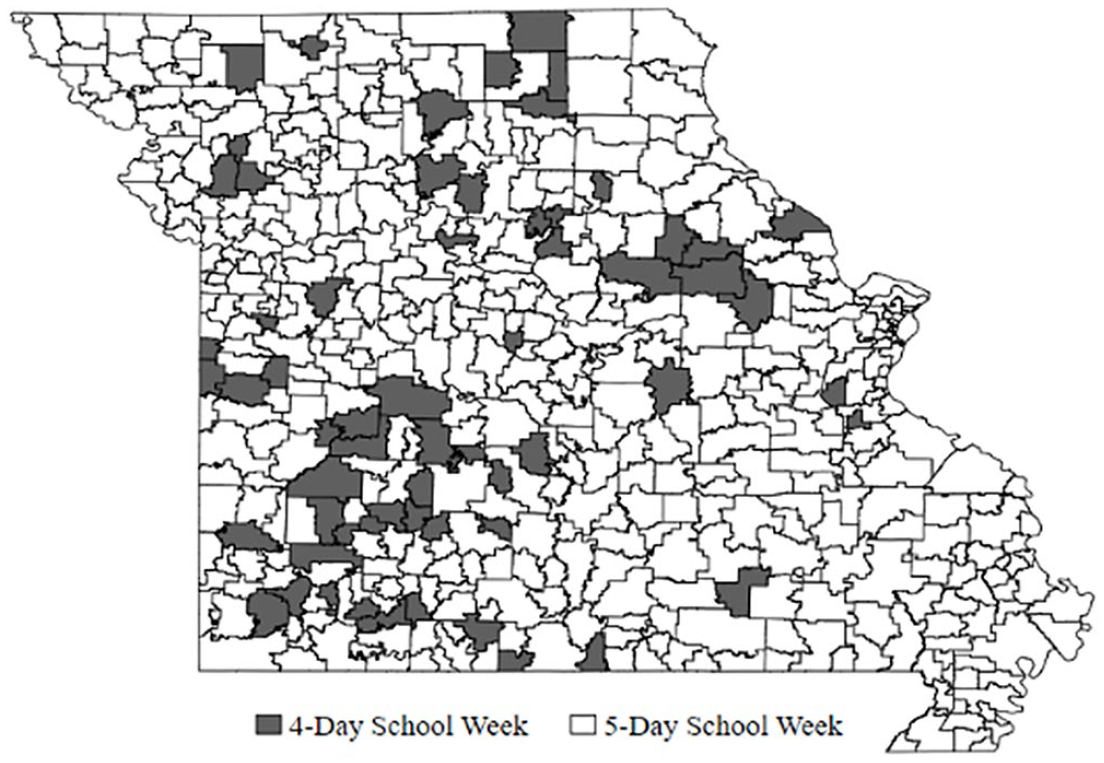
Missouri 4-day school week districts, 2019–2020.
Conceptual Framework
Within the education policy research literature, researchers have adopted policy diffusion frameworks prevalent in the political science literature to explain the spread of various local, state, and national policies. For example, quantitative studies have examined the spread of charter schools in local geographies (Rincke, 2007), broader school choice ideas (Mintrom & Vergari, 1998), and higher education funding models (Li, 2017). Qualitative analyses have focused on unpacking how policies diffuse and what parties influence the diffusion process (i.e., Cohen-Vogel & Ingle, 2007; Gandara et al., 2017). Shipan and Volden (2008) outlined four mechanisms through which policy diffusion may operate: learning, competition, imitation, and coercion. Learning occurs when governments acquire information from other governments that have already implemented a policy. Competition occurs when governments compete for scarce resources through the implementation of a given policy. Imitation occurs when a government attempts to mimic the policies of another government so as to appear similar. Finally, coercion occurs when governments apply direct pressure to other governments to initiate a policy change. Applied to the 4DSW, the learning, competitive, and imitative mechanisms may be most applicable. Given the scarcity of rigorous research on the effects of the 4DSW on a range of outcomes, specifically on teacher mobility and Missouri-specific findings, we focus on the intersection of competitive and imitative policy diffusion.
In addition to the policy diffusion hypothesis, the theory of yardstick competition from the economics literature offers an analogous framework to consider district competition (i.e., Shleifer, 1985). Exploring how firms maximize profits through cost reduction strategies in the face of government price regulation, Shleifer (1985) theorized that comparisons may be made between “identical firms.” He posited, “If a firm reduces costs when its twin firms do not, it profits; if it fails to reduce costs when other firms do, it incurs a loss” (p. 320). In the context of school district competition for labor, similar rural districts may compete with one another through the adoption of nonpecuniary interventions like the 4DSW; conversely, those with nearby 4DSW districts may find themselves at a competitive disadvantage in labor recruitment and retention.
To test these theories around district competition, we examine district proximity to nearby 4DSW districts in Missouri. Teachers may be attracted to the compelling characteristics of nearby districts including opportunity wages, student characteristics, and peer characteristics (i.e., Feng, 2009; Feng & Sass, 2017). School conditions also drive teacher mobility and job satisfaction (i.e., Kukla-Acevedo, 2009; Ma & MacMillan, 1999). If the 4DSW is viewed as attractive to local labor, its adoption in a nearby district could influence local teacher mobility or attract teachers new to the profession. Experienced teachers could avoid a residential move and retain their vested pension years by transferring to a nearby 4DSW district. To address this potentiality, districts may consider adopting the 4DSW to retain their existing teachers and attract new teachers.
Recent evidence indicates that prospective commute times influence teacher labor preferences and decisions (Gershenson, 2012, 2013; Horng, 2009). In general, the effect of commute time on labor supply may be difficult to estimate in a causal manner due to the oft-endogenous nature of residential location with respect to employment location (Gershenson, 2013). To estimate the causal impact of commuting times on teacher willingness to accept a position, Gershenson (2012) examined the substitute teacher labor market in Michigan and found that a 15-minute increase in commute time decreases teacher job acceptance by 1.4 percentage points. In addition, substitute teachers expressed less willingness to accept assignments on Fridays. Nearly five in six school districts that operate a 4DSW choose Fridays as their off day; Missouri districts, on the other hand, typically choose Mondays as their day off.
Although examining a different labor context, Gershenson’s (2012) findings indicated the importance of geographic and scheduling conditions on school district human capital decisions. These findings are relevant in rural settings where district leaders may try to improve teacher retention and recruitment by enacting policy decisions aimed to accommodate teacher preferences, policies that may include the adoption of the 4DSW. In the Missouri context, driving time from a given district to its nearest 4DSW district has declined precipitously as additional districts have adopted the policy. Figure 4 plots yearly kernel densities of these commute times demonstrating that as additional districts have adopted the 4DSW, prospective commuting impacts on teachers have declined sharply. These trends in the Missouri context may address Gershenson’s findings regarding the discouraging aspect of higher commute times and avail new employment opportunities at nearby 4DSW districts.

Driving time to nearest 4DSW district.
In light of the existing national literature on school district motivation to pursue the 4DSW (Thompson et al., 2020) and recent survey evidence in Missouri (Turner et al., 2017), we hypothesize that Missouri districts may pursue the policy due to competitive labor pressures of nearby district adopters and/or due to their financial circumstances. An improved understanding of these characteristics may aid state and local policymakers craft additional supports for rural districts. In the next section, we review our detailed panel data concerning these elements. In particular, we focus on our measures of district spatial proximity.
Data and Sample
We construct a district-level panel data set for the 2009–2010 through 2018–2019 school years composed of a rich set of financial, human capital, demographic, and geographic data. All data elements are obtained from the Missouri Department of Elementary and Secondary Education (DESE), the Common Core of Data (CCD) through the U.S. Department of Education’s National Center for Education Statistics, and the Here Application Programing Interfaces (Here API); all data are obtained through DESE unless noted otherwise. Our sample consists of traditional public school districts in the state of Missouri. In our descriptive statistics, we include all 516 school districts in operation across our entire analytic time period. 4 In the majority of our subsequent regression analyses, we restrict our sample to rural districts that operate elementary and high schools (and middle schools, if applicable). The rationale for this restriction is described subsequently. Two hundred ninety-two districts meet these conditions. Additional regressions including the full population of Missouri’s traditional public school districts convey consistent findings; they are included as appendix tables and referenced where appropriate.
We include district revenue data including shares derived from state, local, and federal disbursements and detailed expenditure data. Additional financial data include per-pupil measures of local assessed value of property and local property tax rates. Data pertaining to district staff include average teacher salary, per-pupil administrative staff salary, average years of teacher experience (in Missouri public schools), the share of teachers who hold a master’s degree, the number of students per teacher and per administrative staff member, and the share of teachers who are new to their respective districts. All financial data are inflation-adjusted and reported in real 2019$ (Shores & Candelaria, 2020).
District demographic data include district P–12 enrollments, the share of students who receive FRPL, the share of students identified as English language learners (ELL), the share of students who receive an individualized education program (IEP), and the share of minority students (students identified as Black or Hispanic). We observe district-level student measures including achievement (the share of students who score proficient or advanced on the Missouri Assessment Program in reading and math), student mobility (the share of students who are new to a district in a given school year), and student attendance (the share of students who demonstrated at least 90% attendance).
We obtain district geographic variables (urban, suburban, rural, and town, and subcategories of rural, which consist of fringe, distant, and remote) and district longitude and latitude through CCD. We leverage Here API, a private provider of mapping and location services through Stata’s georoute user-written module (Weber & Péclat, 2017). Georoute allows us to construct a series of measures of travel time from district to district, including from districts to other districts that operate a 4DSW in years t and t − 1. 5 First, we measure district proximity as the average reported travel times between the longitude and latitude of districts’ central offices obtained through CCD. We measure the following: (1) the travel time between each pair of districts statewide, (2) whether a district is within the average daily commuting time to a 4DSW district(s) (23.6 minutes), and (3) whether a district is within twice the average daily commuting time to a 4DSW district(s) (47.2 minutes). 6 These calculations enable us to construct four measures of spatial proximity as follows (summary statistics on these measures provided in a later table):
An indicator as to whether district i is within the average commuting time from any 4DSW district in year t
The proportion of districts within the average commuting time from district i that operate a 4DSW in year t
An indicator as to whether district i is within twice the average commuting time from any 4DSW district in year t
The proportion of districts within twice the average commuting time from district i that operate a 4DSW in year t
Four additional variables are constructed as the 1-year lagged values of each of the four spatial proximity variables. Using multiple calculations of proximity, we believe that we provide substantive evidence regarding the association of spatial proximity to nearby 4DSW districts and 4DSW policy adoption.
Individually, each of the aforementioned measures of district proximity may be an imperfect proxy to investigate the policy diffusion hypothesis. First, georoute may not perfectly reflect commute times experienced on a daily basis due to variation in driving conditions. A single snapshot of commuting time, however, is commonly used rather than a time-varying measure (i.e., Cowen et al., 2018; Lincove & Valant, 2018). Second, travel times are measured from central school district locations, rather than from an employee’s place of residence, to place of employment or prospective place of employment (i.e., school or district office). In addition, district central offices may be located in more developed locations relative to a district’s schools. We do not have access to data pertaining to employee residential location, however, and teachers’ school locations may not be assessed in our district-level data set. Third, average Missouri commute times (and twice the average commute times) may not perfectly capture employee preferences for commuting time. Fourth, we opt to measure nearby districts rather than adjacent districts. This measure includes proximal districts, some of which would be omitted by a more restrictive accounting of shared district borders, districts that may be as close or closer in travel time as adjacent districts. Despite these limitations, we believe the four constructed variables (and four lagged variables) are useful in probing the spatial element of the competitive and imitative policy diffusion hypotheses. While we present estimates associated with each of these eight spatial indicators, we consider estimates generated using twice the average commute time and proximal district decisions on a 1-year lag the best estimate of the policy diffusion hypothesis.
Empirical Approach
To assess the factors that predict 4DSW policy adoption in Missouri, we use survival analysis to measure the “hazard” of adopting the policy in a given school year. A form of event history analysis, survival analysis models the elapsed time to a given final event using included covariates hypothesized to affect the likelihood of the occurrence of a specified event. Historically employed in fields including biomedicine and engineering in addition to the social sciences, survival analysis often models the hazard of events such as the death of a medical patient, failure of a piece of equipment, or other such ultimate occurrence (i.e., Miller, 2011). Survival analysis is used frequently in education research, where scholars have examined topics including teacher turnover (e.g., Clotfelter et al., 2008), high school dropout (e.g., Plank et al., 2008), ELL student reclassification (e.g., Slama, 2014), student classroom removal due to disciplinary incidents (Petras et al., 2011), and grade retention (Davoudzadeh et al., 2015).
In our analyses, we employ Cox proportional hazards models. Cox models (Cox, 1972) allow the likelihood of the event, 4DSW policy adoption in our circumstances, to vary over time (Box-Steffensmeier & Jones 2004). Each unit, district i, is at risk of policy adoption in each year t until that district adopts the 4DSW. Our panel data span from 1 year prior to Missouri’s policy change to 2018–2019; thus, districts could be “at risk” of policy adoption for a total of 10 school years. All (516) traditional public school districts in Missouri are at risk of policy adoption, though the bulk of our analyses (as explained below) focus on the state’s 292 rural districts that operate a high school (see Appendix Figure A1 for the hazard function estimates discussed below). Any district i that adopts the 4DSW exits the sample after that point in time.
Cox models are “semiparametric” in that they combine linear modeling of covariates with an unspecified baseline hazard (Fox, 2002). The model permits the baseline hazard of 4DSW policy adoption to remain unspecified (Box-Steffensmeier & Jones, 2004; Cox, 1972). Lacking a definitive theoretical underpinning relating district characteristics to policy adoption, this model makes no assumptions about the likelihood of adoption over time. This approach is also consistent with recently tested policy diffusion hypotheses in education settings (e.g., Li, 2017). While our models do not assess the causal relationship between district proximity and 4DSW policy adoption, we offer rich descriptive evidence through a series of analyses that consider district proximity within a range of alternative hypotheses. While we prefer the Cox approach in our scenario, unobserved heterogeneity correlated with observed variables may lead to biased estimates that may attenuate our results. However, we lack a strong notion of the distribution of the shape parameter of district policy adoption used in Weibull hazard models, which are better equipped to accommodate unobserved heterogeneity (e.g., Allison, 2016). In addition, Cox models, particularly relative to the Kaplan–Meier estimator, are better suited to incorporate time-varying covariates (e.g., Fisher & Lin, 1999).
We specify the Cox model as follows:

where hi(t + 1) represents the hazard of adopting a 4DSW in the year t + 1 (essentially the act of making a decision to adopt a 4DSW, which will be implemented in the following school year), h0(t) is the unspecified baseline hazard, xi1 represents time-invariant covariates for district i, and xi2(t) represents time-varying covariates for district i in year t. βkxik, the parameter of interest, represents a k × 1 vector of explanatory variables for district i at time t. We cluster standard errors at the district level to account for the interdependence of the error term within districts across school years. The β0 intercept term in Cox models is incorporated into the baseline unspecified hazard function (Box-Steffensmeier & Jones, 2004; Cox, 1972). Similar to policy reforms examined by Li (2017), 4DSW policy adoptions occurred in much greater quantity at the end of our analytic period, including multiple policy adoptions in the same (discretely measured) school year, a phenomenon commonly referred to as a “tie” (see Figure 1). We conduct robustness checks on our model specifications to explore different methods of handling ties in policy adoption, given that we do not observe which school district adopted the 4DSW first (or, further, the temporal order of adoption) within each discrete school year. 7
We conduct tests for multicollinearity and violations of the proportional hazards assumption of Cox models and adjust our model specifications where appropriate. 8 A violation of the proportional hazards assumption indicates that the estimate associated with a particular variable varies over the panel timeframe. There are two common methods to adjust model specifications in order to correct for this violation (i.e., Allison, 2016; Fox, 2002). First, one may interact the variable with a measure of time (i.e., year) to create a time-dependent measure. Second, one may introduce a stratified analysis along the levels of some categorical variable hypothesized to introduce a time dependence on the hazard estimate. We elect to interact problematic covariates with our variable for time and ensure that the interaction terms are statistically significant in our final specifications. These corrections are identified in the notes of regression tables, where applicable. Corrections employing stratification more typically are made when a researcher has strong reason to believe that a specific element of a study’s setting or participants (e.g., treatment arms in a medical trial, patient age) may interact with the effect of treatment.
We determine our k explanatory variables by running univariate analyses on each of the variables included in Tables 1 and 2. These variables include measures of common 4DSW policy adoption cited by Thompson et al. (2020) in national surveys and other commonly cited student and district covariates. These model specifications are analogous to those employed by Li (2017), wherein the author tests a similar policy diffusion hypothesis in education using Cox proportional hazards models, albeit in a state higher education context. Researchers across fields regularly employ similar univariate approaches to reach final model specifications (i.e., Adams, 1996; Adams & Dial, 1993; Emura et al., 2019; Hammermeister et al., 1979). So as to include all variables that may influence the hazard of adoption, our final specifications include variables that had a p value of .25 or less 9 ; after these analyses, we included the following variables: per-pupil local revenues, per-pupil assessed values of property, district proportion of minority and ELL students, math proficiency proportions, district dropout rates, average years of teacher experience, average teacher salary, district proportion of new teachers, district student-administrator ratios, and per-pupil administrative salaries. Variables excluded from our final specifications are the remainder of those summarized in Tables 1 and 2. 10
District Demographic and Student Characteristics, by School Week Length and Urbanicity 2018–2019

Note. District characteristics are for the 2018–2019 school year for those districts operating a 4-day school week in the 2019–2020 school year. Mean (standard deviation) of district characteristics are reported; for geographic characteristics (urban, suburban, rural, and town), the proportion of the sample is indicated; fringe, distant, and remote are subcategories of rural that increase in their distance from populous areas. Enrollment includes all enrolled students in prekindergarten through 12th grade. FRPL is the proportion of students who receive free or reduced-price lunch. IEP is the proportion of students who receive an individualized education program. Minority is the proportion of a district’s students who are Black or Hispanic. Reading (Math) achievement is the proportion of students who scored proficient or advanced on the Missouri Assessment Program examination. Mobility rate is the proportion of new students in a given district. Attendance is the proportion of students who demonstrate at least 90% attendance. ELL = English language learner.
p < .1. **p < .05. ***p < .01.
District Finances and Staff Characteristics, by School Week Length and Urbanicity, 2018–2019

Note. District characteristics are for the 2018–2019 school year for those districts operating a 4-day school week in the 2019–2020 school year. Mean (standard deviation) of district characteristics is reported. Expenditures, state revenues, local revenues, assessed value of property, and administrative salary are reported on a per-pupil basis. Teacher salary is reported on a per-teacher basis. All finance variables are inflation adjusted (2019$). Teacher experience measures the average district years of experience in Missouri public schools. New teachers represents the proportion of teachers new to a given district.
p < .1. **p < .05. ***p < .01.
In each model specification, we include a different measure of spatial proximity. To evaluate the inclusion of our spatial metrics, we calculate Moran’s I, a measure of spatial autocorrelation. This calculation creates a matrix of distances between all district locations and their nearest 4DSW district using their reported longitudes and latitudes. We then test for the presence of autocorrelation of 4DSW districts based on their respective travel times to one another. We reject, at the p < .01 level, that there is no spatial autocorrelation, therefore supporting the inclusion of the spatial variables in final model specifications. While Cox models may be employed to assess causal relationships in certain settings (e.g., in the context of a randomized controlled trial or natural experiment), we consider our analyses predictive of district decisions rather than directly causal. The identification of correlational relationships (or the lack thereof) may help district and state leaders both better understand potential precursors to 4DSW policy adoption and craft policies to support district progress—whether or not the 4DSW ultimately is adopted.
Results
We begin by comparing 4DSW districts and 5-day school week districts along their demographic, student, staff, and financial characteristics (21 variables) and district geography (five variables). Districts operating a 4DSW are located principally in rural areas (95.1%) and tend to be much smaller by enrollment than their 5-day school week counterparts. They serve smaller shares of minority students and modestly smaller shares of ELL, perform worse on Missouri’s state assessments in math and reading, and have modestly higher dropout rates. Remaining student characteristics, including shares of students who receive FRPL, students with IEPs, student mobility, and attendance rates, are substantively similar. A similar story emerges concerning district finance and staff characteristics. The largest differences between 4- and 5-day school week districts are in teacher salary, teacher experience, students per teacher, and assessed value of property.
Because Missouri 4DSW districts are located almost exclusively in rural areas, we repeat these comparisons in a sample restricted to rural districts. In these comparisons, among each of the aforementioned characteristics, we find a statistically significant difference only in student math achievement, a finding that one may expect to reach by random chance (α = .05; one out of 22 comparisons was found to be statistically significant). Therefore, we cannot conclude that 4- and 5-day rural Missouri districts differ along the examined characteristics.
In Table 3, we present summary statistics describing the growth of the 4DSW and mean proximity to other 4DSW districts. By 2019, 29% of rural districts had a 4DSW district within mean commuting distance and 72% had one within twice the mean commuting time. Nearly 12% of districts proximal to rural districts (either within average commuting time or twice the average commuting time) operate a 4DSW. These figures have grown significantly over time, particularly over the final years of the panel.
4DSW District Proximity, by Year and Urbanicity

Note. ≥One 4DSW district indicates the proportion of districts that are proximal to at least one 4DSW district. The District count columns indicate the mean (standard deviation) of the number of proximal 4DSW districts. The Proportion of total columns indicate the proportion of proximal districts that operate a 4DSW. Proximal is measured as within Missouri’s mean commute time (Panel A: 23.6 minutes) or 2 times Missouri’s mean commute time (Panel B: 47.2 minutes) from district i in year t. 4DSW = 4-day school week.
Table 4 displays our hazard ratio estimates including the four nonlagged measures of spatial proximity, one in each specification. Hazard ratios greater than 1 denote a larger risk of 4DSW policy adoption, and those less than 1 denote a lower risk, conditioning on included covariates. For instance, in Column 1, a hazard ratio of 1.733 on the measure 4DSW within mean commute indicates a 73.3% increase of the hazard of adopting a 4DSW if a district is within 23.6 minutes of a district operating a 4DSW (though this estimate is large in magnitude, it is not statistically significant). In Column 2, a hazard ratio of 1.010 on the measure Proportion of 4DSW districts within mean commute indicates a 1% increase of the hazard of adopting a 4DSW for a 1–percentage point increase in the proportion of districts operating a 4DSW within 23.6 minutes (as in the prior specification, this estimate is not statistically significant). The spatial measures of these variables within twice Missouri’s mean commute (Columns 3 and 4) are statistically significant (at the p < .05 and p < .01 levels, respectively); they indicate a 36.8% increase in the hazard of adopting a 4DSW if a district has a 4DSW district within 47.2 minutes and a 3.2% increase in the hazard of policy adoption for every percentage point increase in the proportion of districts that operate a 4DSW within 47.2 minutes. District dropout rates and teacher salaries emerge as statistically significant predictors of 4DSW policy adoption in each of these specifications; higher dropout rates and lower teacher salaries are associated with increased hazard rates.
Hazard Ratios of 4-Day School Week Policy Adoption
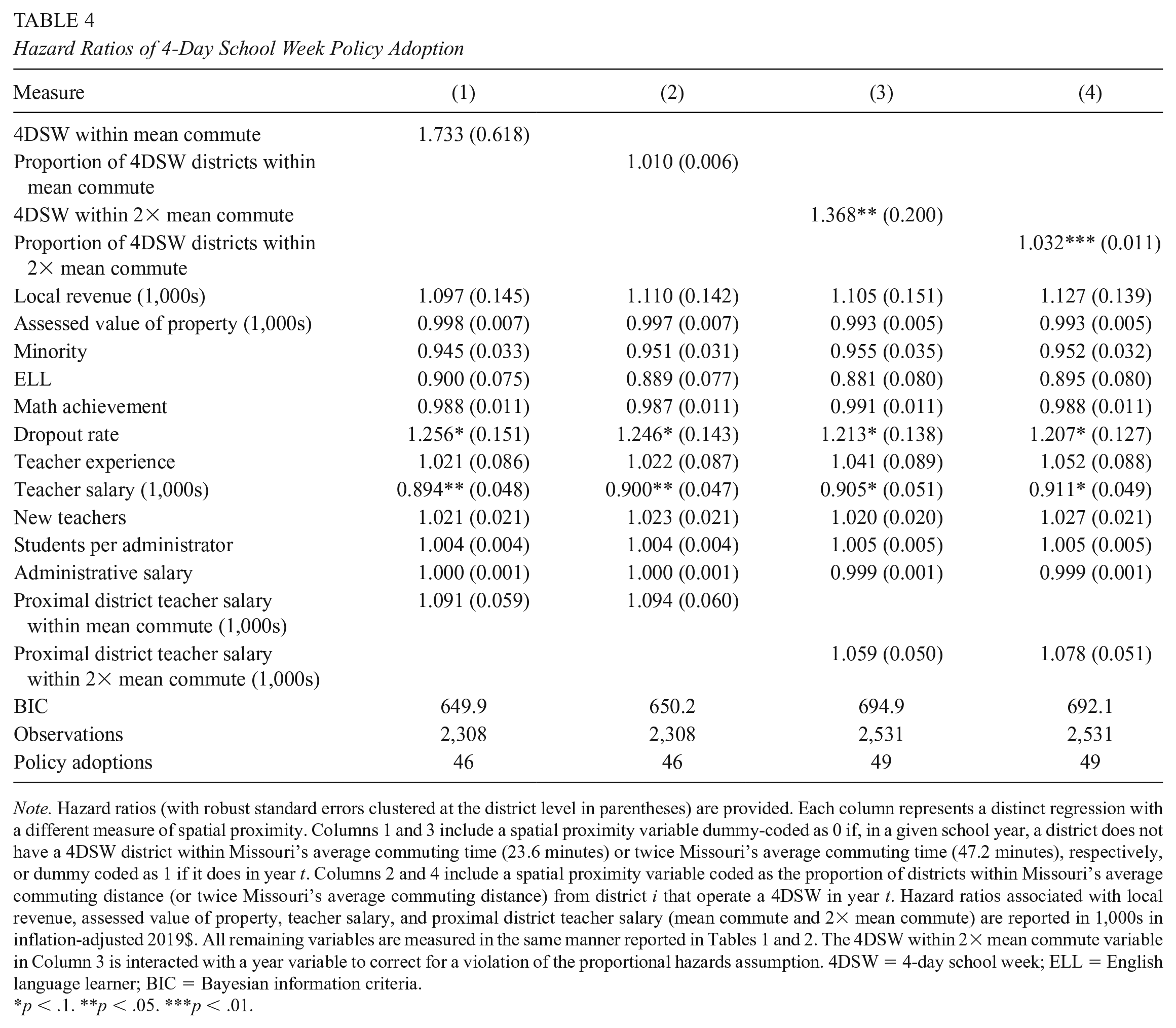
Note. Hazard ratios (with robust standard errors clustered at the district level in parentheses) are provided. Each column represents a distinct regression with a different measure of spatial proximity. Columns 1 and 3 include a spatial proximity variable dummy-coded as 0 if, in a given school year, a district does not have a 4DSW district within Missouri’s average commuting time (23.6 minutes) or twice Missouri’s average commuting time (47.2 minutes), respectively, or dummy coded as 1 if it does in year t. Columns 2 and 4 include a spatial proximity variable coded as the proportion of districts within Missouri’s average commuting distance (or twice Missouri’s average commuting distance) from district i that operate a 4DSW in year t. Hazard ratios associated with local revenue, assessed value of property, teacher salary, and proximal district teacher salary (mean commute and 2× mean commute) are reported in 1,000s in inflation-adjusted 2019$. All remaining variables are measured in the same manner reported in Tables 1 and 2. The 4DSW within 2× mean commute variable in Column 3 is interacted with a year variable to correct for a violation of the proportional hazards assumption. 4DSW = 4-day school week; ELL = English language learner; BIC = Bayesian information criteria.
p < .1. **p < .05. ***p < .01.
Next, we estimate hazard ratios using lagged measures of spatial proximity in Table 5. As indicated previously, the lagged spatial measures estimate the association of the presence of a 4DSW district in year t − 1 on a district’s decision to implement a 4DSW in year t + 1. Given these estimates grant district leaders an additional year to consider policy adoption, we would expect the hazard ratios to be larger or at least similar to those in Table 4. As we expect, these estimates yield results larger than those presented in Table 4, with the exception of Column 3. The magnitudes of the estimates within Missouri’s mean commuting time are quite large and statistically significant, and the magnitudes of the estimates within twice Missouri’s mean commuting time are very close to those without the 1-year lag. For example, for every percentage point increase in the proportion of districts that operate a 4DSW within 47.2 minutes, we observe a 5.4% increase in the hazard of policy adoption (Column 4). Once again, district dropout rates and teacher salaries often are statistically significant predictors of policy adoption in certain specifications and of similar magnitudes to estimates without the 1-year lag.
Hazard Ratios of 4DSW Policy Adoption: 1-Year Lagged Proximity Measures
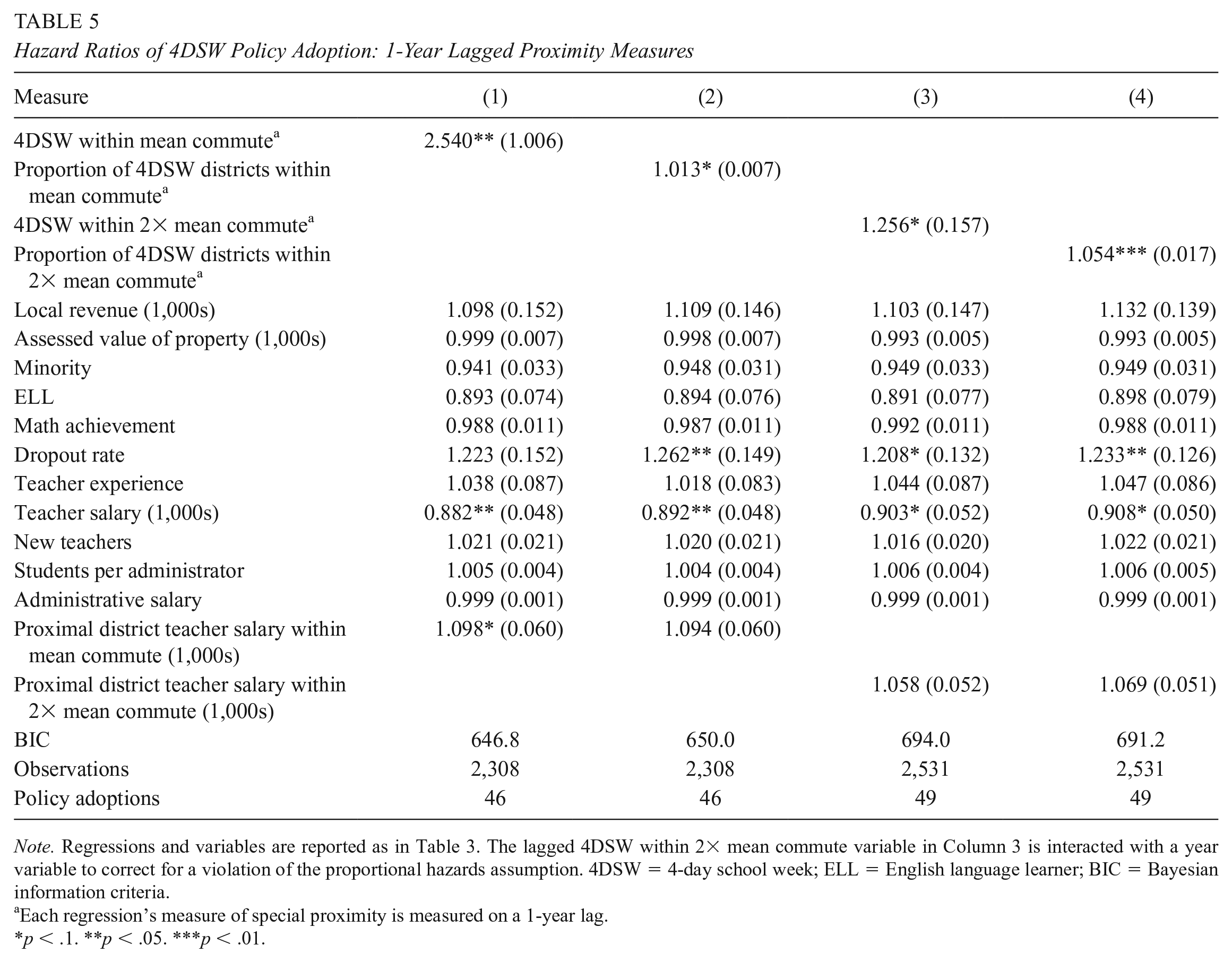
Note. Regressions and variables are reported as in Table 3. The lagged 4DSW within 2× mean commute variable in Column 3 is interacted with a year variable to correct for a violation of the proportional hazards assumption. 4DSW = 4-day school week; ELL = English language learner; BIC = Bayesian information criteria.
Each regression’s measure of special proximity is measured on a 1-year lag.
p < .1. **p < .05. ***p < .01.
Next, we further explore teacher salaries as a predictor of 4DSW policy adoption. Specifically, we examine the difference between average district salaries and the mean salary of proximal districts. If teacher salary competition is a driving force of 4DSW policy adoption, we might expect to see greater hazard of policy adoption among those districts at a competitive salary disadvantage relative to neighboring districts. To test this hypothesis, we generate a variable Differenceit equal to the difference of average teacher salaries between district i and the mean of those districts within a 47.2-minute commute. We focus on 2 times Missouri’s average commuting time due to the small count of proximal districts within 23.6 minutes for many rural districts. We then categorize districts into Difference quintiles, where Quintiles 1 through 4 (Q1–Q4) indicate relative average salary deficits of $14,352, $4,905, $2,926, and $1,586, respectively; average teacher salaries in Q5 exceed those of neighboring districts. In these models, we add interaction terms between the measures of spatial proximity and an indicator variable for each respective quintile; Q5 is excluded as the reference category. In Table 6, we estimate that districts in Q1 through Q4 each have larger hazards of 4DSW policy adoption relative to Q5. We find the most consistent results in Q2, Q3, and Q4 districts where the average salary deficit is less than $5,000. Districts in Q1 and Q5, conversely, may not be as susceptible to competition driven by nonpecuniary benefits. Q1 districts have very large salary deficits, particularly relative to the average rural Missouri teacher salary, which is less than $40,000 per year. Q5 districts do not have an average salary deficit.
Hazard Ratios of 4DSW Policy Adoption: Proximal District Teacher Salaries

Note. The first five rows (Quintiles 1–5) indicate interactions with a dummy variable for Quintile status of the variable Differenceit with the measure of spatial proximity indicated in the column heading. Estimates in Columns 3 and 4 indicate interactions with 1-year lagged measures of spatial proximity. 4DSW = 4-day school week; ELL = English language learner; BIC = Bayesian information criteria.
p < .1. **p < .05. ***p < .01.
Taken together, we believe that the findings outlined in Tables 4, 5, and 6 present a strong narrative as to the association between 4DSW policy adoption and district proximity to nearby adopters. We consider estimates using twice Missouri’s mean commute time and lagged measures of nearby district adoption (Table 5, Columns 3 and 4; Table 6) the strongest estimates of the policy diffusion hypothesis. Estimates using twice the average state commute time more fully encompass the regional dimension of local labor markets, particularly among small rural school districts with relatively few teaching positions, while lagged measures of nearby policy adoption decisions allow district leaders to deliberate over a longer time frame in consideration of nearby district policy decisions.
Heterogeneity Analyses and Robustness Checks
Next, we explore heterogeneity by three additional district characteristics: property wealth, dropout rates, and enrollment decline. In these models, we add an interaction term between the measures of spatial proximity and an indicator variable. In Appendix Table A1, we include an interaction with an indicator of below-median assessed value of property, a measure of district wealth. In Appendix Table A2, we include an interaction with an indicator for whether a district had a nonzero dropout rate (as the median reported dropout rate among Missouri districts is zero). In Appendix Table A3, we include an interaction with an indicator for below-median change in enrollment relative to the 2009–2010 school year. In each of these tables, we do not find the interaction terms to be statistically significant. Furthermore, our estimates for the association of spatial proximity and the hazard of policy adoption in these specifications remain consistent with prior estimates. These results suggest that the association of district proximity and the hazard of 4DSW policy adoption does not vary significantly by the assessed levels of district property wealth, dropout rates, and enrollment change.
We perform three checks for robustness to consider our sample restriction, additional school district financial characteristics, and district financial and enrollment change since the Great Recession. First, recall that each of the estimates presented in Tables 4 and 5 includes a sample of 292 rural Missouri traditional public school districts that operate an elementary school and a high school (and a middle school, if applicable). Our Cox proportional hazards model estimates are robust to the inclusion of nonrural districts and rural districts that do not operate a high school. These specifications include 516 school districts and exclude district dropout rates as the vast majority of dropouts occur in high school. Inclusion of these districts in the sample yields nearly identical estimates of the association of district proximity to 4DSW districts and the hazard of policy adoption (see Appendix Tables A4 and A5). In these models, district enrollments and students per administrator also emerge as significant predictors of 4DSW policy adoption. Proximal district salaries rather than district salaries are statistically significant, though the magnitudes of these estimates are very similar to the previous specifications.
Next, in Appendix Table A6, we consider additional measures of district finance including local tax burden, proportion of revenues derived from state sources, expenditures on retirement and nonretirement benefits, student transportation miles, and number of students transported. Each of these variables measuring “fiscal stress” may indicate alternative motivation for 4DSW policy adoption and may attenuate the estimates associated with district proximity. 11 Of these measures, the proportion of revenues derived from state sources is a statistically significant predictor of the hazard of 4DSW policy adoption. For example, in Column 1, a 1–percentage point increase in the proportion of revenue derived from state sources is associated with a 2.6% increase in the hazard of adopting a 4DSW. The inclusion of these fiscal and transportation measures, however, does not substantively change the spatial proximity estimates.
Finally, in Appendix Table A7, we consider changes to district financial and enrollment characteristics since the 2009–2010 school year following the Great Recession. Only changes to total enrollment emerge as statistically significant. For example, in Column 1, the estimate of 0.949 indicates that a 1% increase in year t relative to the 2009–2010 school year is associated with a 5.1% lower hazard of policy adoption. Alternatively, this also means that declining enrollment is associated with a larger hazard of 4DSW policy adoption. As in the prior model, the inclusion of measures of fiscal and enrollment change does not substantively alter the estimates of the association between spatial proximity and the hazard of 4DSW policy adoption.
Discussion and Policy Implications
The literature on school district adoption of the 4DSW suggests a range of motivating factors largely centered on financial and human capital considerations. Of the half of the nation’s school districts located in rural areas, approximately 7% have adopted the 4DSW (Thompson et al., 2020). Many of these districts, including all 61 Missouri 4DSW districts, adopted the policy over the past decade. Missouri’s state government and its local school districts face a challenging landscape to adequately and equitably fund its schools and attract and retain teachers, particularly high-performing teachers. These challenges are acutely applicable in the state’s rural settings where student achievement levels and local revenue-generating capacities are low and human capital recruitment is tenuous. Missouri outpaces national averages both in its proportion of rural districts, over two thirds, and in its proportion of rural districts that have adopted the 4DSW, 16%. First availed through Missouri state policy in 2010, the state’s proportion of 4DSW districts increased fourfold over the past 4 years and continues to grow sharply today. Similar contexts are shared by many other states, making Missouri an excellent subject in which to study the growth of the 4DSW in rural areas and to assess district motivations for policy adoption.
In this article, we describe the characteristics of Missouri’s 4DSW districts and conduct a survival analysis to assess those district and student characteristics that predict district 4DSW policy adoption. Our findings support the hypothesis of policy diffusion through districts’ geographic proximity to other 4DSW districts. Using several different measures of spatial proximity both with lagged and nonlagged measures, we find that rural districts located closer to districts that have already adopted the 4DSW are substantially more likely to do so themselves. Teacher salaries (lower in prospective 4DSW districts and higher in proximal districts), higher dropout rates, greater reliance on state aid, and district enrollment decline are also associated with 4DSW policy adoption in certain model specifications. Across different means of testing proximal districts, fiscal stress, district heterogeneity, and sample restrictions, district proximity to 4DSW districts consistently predicts a greater hazard of 4DSW policy adoption.
Rural districts encounter particularly difficult human capital landscapes across the nation (Rhinesmith et al., 2020). Missouri shares in these challenges. In numerous media reports (and far more than we cite in this article), district superintendents cite teacher recruitment and retention, often related to teacher salary, as the primary motivation for the consideration and adoption of 4DSW policies. Our findings may support the notion that rural districts fear the competitive disadvantage of failing to adopt a policy favored by local human capital, the competitive policy diffusion hypothesis. We argue that this is due, at least in part, to the challenges cited by rural superintendents. For example, we find that districts with average salary deficits of $1,500 to $5,000 relative to proximal districts most consistently exhibited greater hazard of 4DSW policy adoption.
Why would a policymaker be interested in gaining an improved understanding of the factors that predict district 4DSW policy adoption? Across the nation, policymakers have implemented many interventions to recruit and retain effective teachers, including various salary interventions (e.g., Pham et al., 2020). In Missouri, there are significant concerns regarding the prediction of teacher shortages (e.g., Reichardt et al., 2020) and the development of interventions to combat that possibility, such as grow-your-own teacher pipeline programs (DESE, 2016). Balancing preexisting policy challenges, such as low prevailing teacher salaries, with those governing nonpecuniary benefits may prove crucial to improve teacher turnover, especially amid and following the COVID-19 (coronavirus disease–19) recession. Our analyses indicate that district leaders may fear that failing to provide nonpecuniary benefits attractive to their current and potential labor supply, such as the 4DSW, may harm teacher recruitment and retention efforts. Furthermore, the 4DSW represents an important new nonpecuniary benefit in Missouri, one that other states may encounter soon if recent growth continues.
If Missouri districts pursue the 4DSW predominantly due to local labor market pressures, the state might leverage these predictions by focusing its policy efforts on ameliorating these conditions directly in the geographic areas where they may be most applicable. Both Missouri Governor Michael Parson and DESE proposed increases to teacher salaries, though neither proposed a budget to fund such increases in fiscal year 2021 (Huguelet, 2020). COVID-19–induced budget cuts, however, have delayed the consideration of any such funding increases at the state level (Suntrup, 2020).
If, conversely, district 4DSW policy adoption was shown to be unrelated to teacher labor markets, only related to teacher salary, or associated with additional idiosyncratic district characteristics, effective policy interventions to improve teacher retention may look very different. For example, Clotfelter et al. (2008) employed a similar methodological approach to assess factors associated with teacher turnover in North Carolina. Hazard ratio estimates related to teacher salary motivated their subsequent analysis examining the efficacy of a teacher salary intervention. In a similar manner, findings presented herein may motivate analyses of teacher turnover behaviors in future work using detailed teacher-level longitudinal data incorporating both salary and 4DSW proximity considerations. Such future analyses will be strengthened by the inclusion of panel data from the school years to come, when a substantially greater number of districts will have experienced at least a few postpolicy years after which turnover behaviors may be observed (see district adoption trends in Figure 1).
Furthermore, as the 4DSW grows in many settings, there will emerge new opportunities for states to support such districts to ensure the maintenance or improvement of a range of student outcomes. Our findings bear considerable weight on the prospect for state support of new and prospective 4DSW districts, particularly regarding teacher recruitment and retention. While achievement evidence remains mixed, district leaders nonetheless may encounter pressure to adopt the 4DSW due to its prevalence within local labor environments rather than due to its effects on student learning.
Importantly, our findings do not suggest that Missouri districts lack challenging fiscal constraints beyond teacher salaries. Missouri’s per-pupil state funding ranks 46th in the nation (National Center for Education Statistics, 2018), forcing districts to rely more heavily on local funding sources. We find that higher reliance on state aid is positively associated with the hazard of 4DSW policy adoption. Among Missouri districts, those operating a 4DSW have substantially lower per-pupil assessed value of property from which to generate local revenues, reflecting a stark geographic divide among rural and nonrural districts. State minimum teacher salaries, for example, currently are set at $25,000, levels that disproportionately affect novice teachers. Rural districts may not have the capacity to substantially increase teacher salaries through local revenue sources and may turn to alternative policies such as the 4DSW in efforts to improve working conditions that may help recruit and retain teachers.
Additional research evaluating teacher mobility and recruitment in Missouri’s rural districts may shed light on whether 4DSW policy adoption may improve rates of teacher turnover among experienced teachers and/or attract high-performing novice teachers. Furthermore, important questions remain as to whether these potential changes may improve levels of human capital in Missouri schools on the whole or shift them from district to district resulting in no net improvement to educator quality. By adopting a 4DSW, district leaders may perceive a competitive advantage over peer institutions. To keep pace with those local districts that have transitioned to the 4DSW, districts may adopt the policy themselves to alleviate a perceived competitive disadvantage in retaining and recruiting human capital. This cycle, however, cannot last indefinitely.
Finally, in the coming years, 4DSW policy adoption in Missouri may reach an equilibrium whereby districts will have exhausted a substantial nonpecuniary bargaining chip in negotiations with their teachers. This may be contrasted with salary interventions that may persist or expand with additional revenues or through budget reallocations. If additional proximal districts pursue 4DSW policy adoption, districts will lose the ability to boast the rarity of this nonpecuniary benefit to current and prospective teachers. In this light, the 4DSW may no longer serve as an effective long-term strategy to address teacher turnover behaviors. In consideration of the heretofore mixed evidence on the effect of 4DSW policies on critical student outcomes in other state settings, the efficacy of Missouri policy decisions may hinge on state oversight informed through better understanding of the district determinants of policy adoption. In future policy proposals, state leaders should focus on improving the factors that drive the substantial gap of highly qualified teachers between rural and nonrural districts, including direct pecuniary interventions such as widespread or targeted salary interventions. Policymakers may derive lessons from Missouri’s rapid 4DSW policy expansion, guidance particularly applicable in state settings where high-performing teachers are difficult to recruit and retain in rural settings.
Footnotes
Appendix A
Hazard Ratios of 4-Day School Week Policy Adoption: Change Since 2010

| Measure | (1) | (2) | (3) | (4) |
|---|---|---|---|---|
| 4DSW within mean commute | 1.466 (0.580) | |||
| Proportion of 4DSW districts within mean commute | 1.008 (0.007) | |||
| 4DSW within 2× mean commute | 1.373** (0.200) | |||
| Proportion of 4DSW districts within 2× mean commute | 1.034*** (0.013) | |||
| Change in local revenue (1,000s) | 0.735 (0.254) | 0.735 (0.254) | 0.786 (0.275) | 0.765 (0.276) |
| Change in state revenue (1,000s) | 0.598 (0.221) | 0.578 (0.208) | 0.612 (0.210) | 0.580 (0.205) |
| Change in total revenue (1,000s) | 1.300 (0.339) | 1.321 (0.341 | 1.226 (0.304) | 1.261 (0.328) |
| % Enrollment change | 0.949*** (0.015) | 0.950*** (0.015) | 0.944*** (0.015) | 0.945*** (0.014) |
| % FRPL enrollment change | 0.998 (0.006) | 0.998 (0.006) | 0.997 (0.007) | 0.997 (0.007) |
| % ELL enrollment change | 0.664 (0.173) | 0.646 (0.162) | 0.643 (0.177) | 0.658 (0.185) |
| % IEP enrollment change | 1.005 (0.044) | 1.003 (0.043) | 1.035 (0.045) | 1.014 (0.046) |
| BIC | 687.7 | 687.5 | 729.6 | 726.6 |
| Observations | 2,308 | 2,308 | 2,531 | 2,531 |
| Policy adoptions | 46 | 46 | 49 | 49 |
Note. All regressions include covariates included in Table 4. All change variables are measured relative to the 2009–2010 school year. The 4DSW within 2× mean commute variable in Column 3 is interacted with a year variable to correct for a violation of the proportional hazards assumption. 4DSW = 4-day school week; FRPL = free or reduced-price lunch; ELL = English language learner; BIC = Bayesian information criteria; IEP = individualized education program.
p < .1. **p < .05. ***p < .01.
Acknowledgements
Anglum acknowledges funding from the Saint Louis University Beaumont Scholarship Research Award for critical support of this research. The authors thank participants at the Association for Public Policy Analysis and Management 2019 Fall Research Conference, the Association for Budgeting and Financial Management 2019 Annual Conference, and the Association for Education Finance and Policy 2020 Annual Conference for constructive feedback on earlier versions of this paper.
1.
2.
3.
Pension dynamics are key determinants of teacher turnover decisions (i.e., Costrell & Podgursky, 2009; Koedel et al., 2013). Importantly, the Missouri Public Service Retirement System covers all teachers in the state outside Saint Louis City and Kansas City permitting their movement within its covered districts without pension ramifications (i.e., Koedel et al., 2014; McShane & Shuls, 2017).
4.
The Stet R-XV School District merged with adjacent districts in the 2012–2013 school year and is excluded from analysis.
5.
Drive times in georoute are measured: “Under normal traffic conditions” (Weber & Péclat, 2017, p. 965). As a comparison, recent research examining student commute times in public choice systems (Cowen et al., 2018; Lincove & Valant, 2018) uses Google API to measure travel times on specific days and times. These studies are situated in the Detroit metropolitan area and New Orleans, respectively, urban locations with notable rush hour traffic concerns. Our study focuses predominantly on rural locales, where such considerations are minimal.
6.
The most recent 5-year American Community Survey estimates that the average travel time to work for workers aged 16 years or greater in Missouri is 23.6 minutes (U.S. Census, 2019: https://www.census.gov/search-results.html?q=Average+Commute+Time+Census&page=1&stateGeo=none&searchtype=web&cssp=SERP” https://www.census.gov/search-results.html?q=Average+Commute+Time+Census&page=)
7.
Following Box-Steffensmeier and Jones (2004), there are several ways to handle ties. First, one may consider the exact partial likelihood over every possible ordering of policy adoptions in a given school year. Breslow approximates the partial likelihood as if each failure occurs first without changing the risk set, which works well with a small number of tied failures. In Efron’s method (e.g., Hertz-Picciotto & Rockhill, 1997), the risk set changes depending on which event is modeled to have occurred first. We begin by using Efron’s method, which, following  , “is virtually always better than the Breslow approximation and should be used routinely.” Nonetheless, we also use Breslow’s method; hazard ratios (in direction and magnitude) are quite similar across both sets of specifications. Results following Breslow’s method are available on request.
8.
To evaluate the possibility of collinearity, we calculate the variance inflation factor (VIF) associated with the covariates listed in Tables 1 and 2. VIF values above 10 suggest multicollinearity (Eckles & Stradley, 2012). Calculated VIF values average 2.05 and range from 1.28 to 3.83. When including a measure of proximal district teacher salary, calculated VIF values average 2.39 and range from 1.28 to 5.50. Furthermore, multicollinearity typically is not considered a central concern in survival analysis (Allison, 2010). Model fit was assessed using the Bayesian information criteria, though these values do not offer substantive feedback for any individual specification (Allison, 2016).
9.
We conservatively include covariates with univariate p values of up to 0.25 so as to minimize model misestimation (i.e., Bretagnolle & Huber-Carol, 1988).
10.
Variables excluded from our specifications in Tables 4, 5, and 6 include enrollment, FRPL, IEP, reading achievement, student mobility, student attendance, district geographic size, subcategories of rurality, expenditures, state revenues, tax rates, and student–teacher ratios. Several of these variables are included in robustness checks in the tables.
11.
Variables measuring district fiscal stress may indicate a cost savings motivation for 4DSW policy adoption. The transportation-related variables are included with fiscal indicators; recent reports indicate that Missouri districts struggle with insufficient transportation funding (i.e., Anglum, 2020).
Authors
J. CAMERON ANGLUM is an assistant professor in the Education Policy and Equity program at Saint Louis University. Anglum’s research and teaching are focused on the economics of education policy and education finance, work that is centered on the study of policy and program effects witnessed by disadvantaged students and the school districts and governments that serve them.
AARON PARK is a doctoral student in the Education Policy and Equity program at Saint Louis University. Park’s research focuses on program evaluation, racial segregation in schools, and school finance.