




Abstract
On this 50th-year anniversary of Alexander v. Holmes Board of Education (1969) nationally enforcing school desegregation in fall 1970, Mississippi is being sued for racial disparities in public education between Black students and White students in Williams et al. v. Bryant et al. (2017). Using quantitative and qualitative primary sources, I investigate the extent to which Mississippi administered racial disparities in public education between Black students and White students from its statehood in 1817 through school desegregation. The data show many racial disparities such as a $242 million difference in expenditures for 14 years and the school attrition of more than 1 million Black students, over a 17-year period, of which over 730,000 of those students left school after first grade. In the conclusion, I offer three recommendations for how Mississippi can take present-day responsibility for these racial disparities in public education.
Keywords
Free institutions cannot be separate from free schools. . . . It was well said by the late President Garfield, in his inaugural address, that “the dangers which arise from ignorance in the voter, cannot be denied. It is a danger that lurks and hides in the sources and fountains of power in every State.” All the Constitutional power of the nation, and of the State, and all the volunteer forces of the people should be summoned to meet this danger, by saving influence of education. In this beneficent work, sections and races should be forgotten, and partisanship should be unknown. We owe it to ourselves and to those who come after us to maintain, increase, and improve our educational facilities to the best of our abilities . . .
This quote from the 19th century called for Mississippi to improve its educational facilities and put racial differences aside. Yet, in the 21st century, Mississippi is being sued for not providing Black students the same educational experience and facilities as White students. In the lawsuit, Williams et al. v. Bryant et al. (2017), two Black mothers of students in Jackson Public Schools and two Black mothers of students in Yazoo County School District claim their elementary-aged children are educated in schools with predominantly Black enrollments that have conditions incomparable to schools in neighboring Madison County Schools with predominantly White enrollments and higher socioeconomic statuses. For example, the parents indicate their children’s schools perform worse academically, display paint-chipped walls and water-stained ceilings, lack supplies (e.g., textbooks, toilet paper, iPads), and offer fewer extracurricular activities compared to the other school district. Based on these educational differences, the lawsuit argues that Mississippi has violated a post–Civil War Readmission Act (1868) requirement to uphold its constitutional provision for a “uniform system of free public schools” (Williams et al. v. Bryant et al., 2017, p. 3). Additionally, the Readmission Act mandated that Mississippi not change its constitution to “deprive any citizen or class of citizens of the United States of the school rights and privileges” (Williams et al. v. Bryant et al., 2017, p. 3). In fact, Mississippi modified its laws several times and eventually removed the word uniform from its education clause in 1960 (Williams et al. v. Bryant et al., 2017).
In 2018, Williams et al. v. Bryant et al. was dismissed in the U.S. District Court for the Southern District of Mississippi on the grounds that the case violates the Eleventh Amendment, which indicates a state has sovereign immunity that protects it from being sued in federal court by citizens (Southern Poverty Law Center, n.d.). By 2019, the case was appealed to the U.S. Court of Appeals, Fifth Circuit. On April 2, 2020, the Court of Appeals remanded the case, in part, back to the District Court (Southern Poverty Law Center, n.d.). To the extent that research suggests school desegregation “failed to narrow educational gaps or alter the educational status of most Blacks” (R. S. Baker, 2001, p. 321), and parental education can influence a student’s education outcomes (e.g., school readiness, precollege academic preparation, college enrollment; Cataldi et al., 2018; Halle et al., 2012; Riegle-Crumb et al., 2019; Wells & Lynch, 2012), Black parents in Williams et al. v. Bryant et al. fighting for racial equality in education for their children in segregated schools two generations after Black parents in Alexander v. Holmes County Board of Education (1969) fought for school desegregation to produce racial equality in education suggests the history of racial disparities in the public education of Mississippi is contemporarily salient.
As this legal battle over state liability for centuries of racial disparities in education ensues in the judicial system, educational researchers are uniquely positioned as “citizen scholars” (Harper, 2020, p. 1) to examine the historical context of this present “struggle for public education” (Ball, 2017, p. 1). I take up this objective in the current archival study by investigating one central research question: To what extent has Mississippi administered racial disparities in public education between Black students and White students? The answer to this question would be shortsighted if Alexander v. Holmes was not discussed as part of this present struggle for public education on the 50th-year anniversary of the case enforcing school desegregation.
Alexander v. Holmes and School Desegregation
Ten years after Brown v. Board of Education of Topeka (1954, 1955) ruled racially separate and unequal schools unconstitutional and mandated schools desegregate at all deliberate speed, no Black students in Mississippi attended a school with a White student (Doherty, 1970). The main problem with this school segregation was school districts had not been equally supporting the education of Black students (Bolton, 2005). For example, a city report shows, in 1949, there were 18 public schools in Jackson Public Schools to serve 5,734 White students and 4,184 Black students (Board of Trustees, 1963). By 1963, that number grew to 50 public schools to accommodate 21,353 White students and 15,195 Black students. However, this 1963 school distribution was composed of only 16 Black schools compared to 34 White schools (Board of Trustees, 1963). The school district, then known as Jackson Municipal Separate School District, also gave Black schools fewer local funds than White schools (Bolton, 2005). As these actions produced overcrowded Black schools with inadequate resources, in August 1962, Medgar Evers and a group of Black parents petitioned the school district to assign schools on a nonracial basis. When the petition was denied, Medgar Evers and the other parents filed one of the first school desegregation lawsuits against a Mississippi school district on March 4, 1963 (Bolton, 2005). Evers was assassinated 3 months later (Davis, 2003).
The National Association for the Advancement of Colored People brought the case forward with intervenor plaintiffs as Evers et al. v. Jackson Municipal Separate School District (1964). When Judge S. C. Mize of the U.S. District Court for the Southern District of Mississippi ruled that the plaintiffs had not exhausted administrative remedies with the school district, the case was appealed to the U.S. Court of Appeals, Fifth Circuit in consolidation with lawsuits from two other school districts (Bolton, 2005; Dalehite, 1974). The Court of Appeals issued an injunction for the school districts to submit desegregation plans by July 1964 and ordered the District Court to reverse its decision. On July 6, 1964, 4 days after the Civil Rights Act became law, the U.S. District Court for the Southern District of Mississippi reluctantly mandated school districts submit desegregation plans for integrating the schools beginning fall 1964 (Evers et al. v. Jackson Municipal Separate School District, 1964). However, the court only approved school desegregation plans that employed freedom of choice—a process where parents of first and second graders would choose which school their children attended, and one additional grade would be integrated each year (Bolton, 2005).
These freedom of choice plans proved to be mere stall tactics that kept most Black students in underfunded schools and gave White Mississippians more time to figure out other ways to resist school desegregation. For example, in 1960, less than 5% of Mississippi students attended a private school, and only 12 private schools existed in the state in 1963 (Palmer, 1971b). Yet, in the summer of 1964, Governor Paul B. Johnson called a special session for the Mississippi legislature to pass “a law to provide a $185 tuition grant to any student attending a nonsectarian private school” (Bolton, 2005, p. 105). By 1966, Mississippi liberally gave out private school charters to education foundations and churches that yielded 236 private schools enrolling 23,586 students (Palmer, 1971b). Then, in 1969, Mississippi cut $12 million in funding to public schools and provided a $6 million tax cut to benefit middle- and low-income White families desiring to flee public schools to attend private schools (“Mississippi advances bills . . .,” 1970). Moreover, freedom of choice school desegregation plans were not fully implemented by 1969 and yielded no more than 0.5% to 16% of Black students enrolled in White schools (Doherty, 1970).
Because Green v. County School Board of New Kent County (1968) in Virginia deemed freedom of choice to be an ineffective strategy for school desegregation, Black parents in Mississippi found a legal way forward in the struggle for the public education of their children. More specifically, Beatrice Alexander, a Black mother of a student at Holmes County School District, and a group of parents from 13 other Mississippi school districts—including Jackson Public Schools and Yazoo County School District—submitted motions for immediate desegregation of their children’s schools (Doherty, 1970). When district courts refused to hear the motions, the cases were appealed to the U.S. Court of Appeals, Fifth Circuit. The Court of Appeals ordered the district courts to hear the cases by November 4, 1968 (Doherty, 1970).
The U.S. District Court for the Southern District of Mississippi combined nine private cases including Beatrice Alexander’s case, Alexander v. Holmes County Board of Education, and 14 U.S. Department of Justice cases into one case, United States v. Hinds County School Board (Doherty, 1970). Because the District Court permitted freedom of choice school desegregation plans to continue, United States v. Hinds County School Board was appealed to the U.S. Court of Appeals, Fifth Circuit. In a July 3, 1969, ruling the Court of Appeals deemed freedom of choice school desegregation plans as no longer permissible, but the Court of Appeals delayed the implementation of school desegregation until September 1, 1969, with a deadline to submit desegregation plans by August 11, 1969. Thirty school districts affected by the decision were mandated to desegregate by the beginning of the 1969–1970 school year, and three school districts—Holmes County, Hinds County, and Meridian—were approved to wait until the 1970–1971 school year to desegregate.
After the Department of Health, Education, and Welfare accepted this delay as satisfactory, the Court of Appeals abandoned its implementation deadline to permit a December 1, 1969, deadline for the submission of desegregation plans. Beatrice Alexander and other parents requested a stay of the extension. More specifically, the parents consolidated their private cases into Alexander v. Holmes County Board of Education (1969), and it ascended to the U.S. Supreme Court on a petition for a writ of certiorari (Doherty, 1970).
On October 29, 1969, the Supreme Court decided the Court of Appeals should not have permitted an extension on school desegregation and decreed “continued operation of segregated schools under the standard of ‘all deliberate speed’ for desegregation is no longer constitutionally permissible” (p. 1). Schools districts were ordered to desegregate immediately. By fall 1970, school desegregation was enforced not only in Mississippi but also in other states after years of resistance to Brown v. Board of Education of Topeka.
Alexander v. Holmes and School Resegregation
According to James Palmer (1971b), a social scientist at Mississippi State University, when Alexander v. Holmes was implemented, White Mississippians continued to resist school desegregation in many ways. First, many White students and White teachers exited public schools for private schools. As evidence, in 1970, enrollment in Mississippi public schools decreased by 41,163 students compared to a decrease of only 6,450 students in the prior year. By 1971, Mississippi was home to 163 private schools enrolling 54,037 students in 66 counties despite many of the new private schools not having better education quality than the public schools (Palmer, 1971b).
The White flight to private schools not only socially isolated Black students from White students but also economically abandoned desegregated public schools. For example, many White families moved to neighboring public school zones with fewer Black residents (Palmer, 1971b), and White community members voted down bond issues intended to maintain public schools (Palmer, 1971a). In a collective memoir of school desegregation, John Griffin Jones, a 1973 White graduate of Murrah High School in Jackson Public Schools, not only confirms White flight to neighboring school districts but also explains its effect on desegregated schools. Jones (2016) writes, The outward-migration transformed small towns, villages really—Madison and Ridgeland in Madison County—into some of the fastest growing communities in Mississippi. . . . The exodus to escape desegregation had, and continues to have, a devastating adverse impact on Jackson’s commercial, tax, and residential bases from which the city has never recovered. Yet, over time, those same forces managed to yield great public schools in the outlying counties: massive things that are fully integrated and hugely successful in every way that can be measured, especially against the JPS. (p. 48)
Jones’s observation of racial and socioeconomic inequality is consistent with what parents presently claim in Williams et al. v. Bryant et al.
However, not only were White parents financially devastating public schools, the state also reduced funding to desegregated schools. For example, in 1971, Governor John Bell Williams issued an executive order denying school districts state funds if children were bused to desegregate schools. Jackson Public Schools lost 40% of its budget that year due to the policy (Singleton v. Jackson Municipal Separate School District, 1981). Taken together, this history means just as quickly as schools desegregated in Mississippi, schools were resegregating.
Contemporarily, Orfield et al. (2014) confirms school resegregation in Mississippi. The researchers report that, between 1980 and 2011, the percentage of Black students attending schools with a 90% to 100% non-White enrollment increased to 45%. The implication of this school segregation is decades after Black Mississippians sued for access to a better education, many Black students attend schools with an overconcentration of poverty. As evidence, 43% of Black children in Mississippi live in poverty compared to 14% of White children in Mississippi living in poverty, and Black children represent 43% of children in the state and 49% of students enrolled in Mississippi public schools (Annie E. Casey Foundation, 2019a, 2019b; Mississippi Lifetracks, n.d.). Yet Mississippi allots neither extra funding to high-poverty school districts (B. D. Baker et al., 2018) nor extra funding by the percentage of Black students enrolled in a school district.
There has been little action that Black families could take against the effects of school resegregation for two reasons. First, the current segregation in schools is de facto segregation due to factors such as residential zip codes and district boundaries set in place by school boards and local ordinances not the de jure segregation legally enforced by the state in the 20th century. Second, during the 1980s, “there was strong attack on desegregation orders led by the Reagan and Bush administrations’ Justice Departments” (Orfield et al., 2014, p. 10). Without an active desegregation order, a resegregated school district cannot be accused of violating school desegregation laws. Moreover, in many cases, Black parents would be suing all Black school districts if they sued a resegregated district now. Notwithstanding this reality, Williams et al. v. Bryant et al. (2017) suggests Mississippi is responsible for administering racial disparities in the public education of Black students long before schools resegregated.
Historical Literature on the Public Education of Black Mississippians
In fact, historical research suggests Mississippi administered racial disparities in the public education of Black Mississippians as far back as slavery. For example, Anderson (1988) and Span (2009) cover a period from 1860 to 1935 in their seminal work that describes how it was illegal for Black people to learn to read or write prior to the Civil War. These two scholars also report that Northern philanthropies, Christian missionaries, and the personal agency of Black slaves were responsible for the start of the education of Black Mississippians. Furthermore, they find, at the turn of the 20th century when high school education was burgeoning in the nation and Mississippi, most Black Mississippians lacked access to secondary education. Other literature about education in Mississippi after 1935 explicates how the federal Head Start program (Hale, 2012) and the grassroots efforts of Freedom Schools (Clemons, 2014; Hale, 2011; Sturkey & Hale, 2015) were instrumental in the improvement of public education for Black Mississippians during the Civil Rights Movement. Another body of literature depicts state actions in educational funding disparities during the Civil Rights Movement (Bolton, 2005; Sanders, 2016). Racial disparities in Mississippi also have been included in a larger narrative of how the Black–White high school graduation gap decreased nationally between 1940 and 1980, and Mississippi policy makers’ fear of federal intervention in school desegregation was the state’s motivation for finally expanding high school education for Black Mississippians (Rury & Hill, 2015). In sum, these studies show structural and financial disparities have existed between the education of Black and White students in Mississippi. However, no study has presented, from slavery through desegregation or through resegregation, the quantitative trends in racial disparities in public education in Mississippi.
Current Study
The current study addresses this gap in the literature by using quantitative and qualitative primary sources to present some historical trends in racial disparities in public education in Mississippi from the start of its statehood in 1817 through school desegregation in 1969. More specifically, I find the state amended its laws and reformed its educational practices to (a) deny Black slaves access to education, (b) delay the consolidation of Black schools, (c) require Black Mississippians to pay a large percentage of the cost for the construction of their schools, (d) distribute school funding unequally, (e) permit elementary school attrition, (f) repeal its compulsory attendance law. These barriers were enacted to resist school desegregation and to prevent high school education in an overall effort to maintain a pre–Civil War racial hierarchy.
I present these findings in the next section and the online Supplemental appendices. In online Supplemental Appendix A, I show that Mississippi spent more money on transportation and instruction for White students than Black students between 1946–1947 and 1959–1960 despite Black students comprising roughly 49% of public school enrollment during that period (Mississippi State Department of Education [MDE], 1946/1947–1964/1965). Within online Supplemental Appendix B, I triangulate the lived educational experience of a Black Mississippian, John M. Perkins, from his autobiography, Let Justice Roll Down, with findings of racial inequity in education from the main analysis. Online Supplemental Appendix C provides the methodology and sources used for the study. In the next section, I present the findings from the study.
Findings
1817 to 1869: Constructing Public Education in Mississippi
According to a volume of the Publications of the Mississippi Historical Society, when Mississippi became a state of the Union, in 1817, incorporating Jefferson College was deemed the state’s first act of incorporation (Butts, 1919). Throughout the 1820s, more colleges and private schools began opening with tuition-based admission (Dalehite, 1974). In 1821, the state began making an attempt toward a public education system as Governor Poindexter asked the state legislature to create a “literary fund for the free education of poor children, and authorized the lending of it to individuals or the investments of it in bank stocks within the State” (Shafer, 1971, p. 173). To ensure Black slaves or freemen would not benefit from the intellectual emancipation extended to White Mississippians, Mississippi policy makers passed a statute in 1823 that rendered it illegal for Black slaves or freemen to be taught to read or write (Span, 2009).
Education for White Mississippians
In 1835, the first school in Mississippi’s capital city of Jackson was opened as a private school for women. In the years that followed, more private schools were founded in Jackson (Dalehite, 1974). In a book on the history of the public schools in Jackson, William Dalehite (1974) indicated the capital city played a central role in state education reform efforts. For example, he writes that, between 1840 and 1860, “Jackson had more private schools than any other city in Mississippi” (Dalehite, 1974, p. 8), and Jackson Mayor John P. Oldham prioritized educating poor children in his 1844 inaugural address. By January 29, 1844, the City Council of Jackson passed an ordinance to open a common school. Then, in September 1845, 29 Jackson residents organized into the Jackson School Association, and the group drafted a request to the state legislature for funding for a school building. By 1846, the legislature granted the selected property, donated other lots the city of Jackson could sell to raise additional funding for the school, and passed the first school law to start common schools for White children of all backgrounds. By 1860, Mississippi offered a mere 1,116 common schools limited to 30,970 White students (Timberlake, 1912) despite being home to 353,899 White citizens, 436,631 Black slaves, and an undisclosed number of Native Americans (Hearon, 1912; Mills, 2001). Although these common schools operated in an “unorganized, clumsy, and unintelligent fashion” (Butts, 1919, p. 34), the schools systemically provided White Mississippians an educational head start above Black Mississippians.
Education for Black Mississippians
The education of Black Mississippians began in 1862, when the Union Army camp set up in the Mississippi town of Corinth, and Northern philanthropies and missionary associations—from outside the South—arrived to teach slaves in preparation for their emancipation (Rowland, 1907). At the end of the war through Reconstruction, the U.S. Freedmen Bureau also supported the teaching of Black Mississippians and the construction of their schools (Rowland, 1907).
As Mississippi no longer had slaves but a burgeoning group of Black citizens pursuing an education for true liberty, one of the first postwar activities for Mississippi policy makers was to hold a legislative meeting, on October 16, 1865, in which 23 education acts were passed (Butts, 1919). The quantity of education acts passed immediately after the war suggests Mississippi policy makers saw education as a systemic mechanism for societal progress. For instance, Governor Benjamin Humphreys, in his inaugural address before the legislature on that day, said the following about educating Black Mississippians: The State of Mississippi has already, under the pressure of the result of the war, by her own solemn act, abolished slavery. It would be hypocritical and unprofitable to attempt to persuade the world that she has done so willingly. . . . Several hundred thousand of the negro
2
race, unfitted for political equality with the white race, have been turned loose upon society. . . . The highest degree of elevation in the scale of civilization to which they are capable, morally and intellectually, must be secured to them by their education and religious training, but they cannot be admitted to political or social equality with the white race. The purity and progress of both races require that the caste must be maintained. (McArthur & Wilson, 1981, p. 99)
In this quote, Humphreys definitively offered an example of the beliefs and actions Mississippi policy makers were asked to hold toward the education of Black Mississippians to sustain a prewar racial hierarchy.
For a moment during Reconstruction, Humphreys instructions were not implemented when the Constitutional Convention of 1868—composed of Black and White delegates—protected the progress and future of education for Black Mississippians (Mississippi Constitutional Convention, 1871). For example, state representative Henry P. Jacobs, a Black Baptist minister from Natchez (Baldwin, n.d.), requested, “that none of the public money of this State shall ever be used in supporting any sectional school whatever” (Mississippi Constitutional Convention, 1871, p. 47). By the end of the Constitutional Convention of 1868, legislators had passed a constitution with an education clause to establish “a uniform system of free public schools, by taxation or otherwise, for all children between the ages of five and twenty-one years, and as soon as practicable, establish schools of higher grade” (Mississippi Constitution of 1868, art. 8, § 1). The new constitution also provided that school funds be distributed to “counties and cities in proportion to their respective populations between the ages of five and twenty-one years” (Mississippi Constitutional Convention, 1871, p. 150) and for an elected state superintendent of education (Butts, 1919). This law was ratified in 1870 as part of the Mississippi constitution submitted for readmission into the United States.
1870 to 1969: Deconstructing the Public Education of Black Mississippians
In a volume of the Publications of the Mississippi Historical Society, Elise Timberlake (1912) recounts White Mississippians’ response to tax-supported education for Black Mississippians. She reported that some White Mississippians wanted Black people to access education but only to maintain safety and social order. Timberlake noted that some White superintendents even claimed they advocated for Black children attending school more than Black parents, but Timberlake (1912) remarked, The question then arises, if the white people were in favor of educating the negro, why were the schoolhouses burned in some localities and the teachers of negro schools whipped or driven away? This state of affairs seems to have risen not from opposition to the negro schools but to the demoralizing effect on labor. . . . The farmers, still dependent as they were upon negro labor, became desperate and resorted to the only means they knew to put the negroes back into the field. (p. 88)
In other words, White Mississippians could not afford to have Black Mississippians attending school because White Mississippians would have to work their own fields. Domestic terrorism was the best solution some White Mississippians had to solve this concern. Other White Mississippians recruited Chinese people to the United States to work the fields (Loewen, 1988). However, Mississippi generally found changing its education laws to be a more impactful strategy for maintaining the prewar racial hierarchy.
Modifying Laws
Between 1870 and 1871, amendments were made to the educational statutes in the state constitution to create supervision, organization, and funding barriers by which Black education could be stifled. More specifically, one amendment required every county to have a school district, and any incorporated city or township with less than 3,000 residences was deemed a separate school district (Butts, 1919). The revised constitution also allowed the state superintendent of education to appoint county superintendents and a board of school directors who were responsible for creating regulations, structuring districts, acquiring contracts for school buildings, choosing textbooks, estimating and managing school funding, and employing and certifying teachers (Butts, 1919). These changes directly placed the administration of Black schools into the hands of local people who once enslaved them.
Notwithstanding this school administration, Black Mississippians were becoming the numerical majority of the public education system by the time Reconstruction ended. White Mississippians viewed this educational progress of Black Mississippians as “very troublesome and burdensome because schoolhouses, teachers, and every expense, [had to] be duplicated” (Rowland, 1907, as cited in Butts, 1919, p. 61). As such, state policy makers amended Mississippi school laws to try to indefinitely evade its responsibility to provide Black students the same education as White students.
Namely, in 1890, Mississippi created a new constitution to deconstruct the public education of Black Mississippians by disenfranchisement because disenfranchisement would cyclically eliminate Black political influence in educational policy and Black social mobility. As evidence, one of the disenfranchisement provisions of the Mississippi Constitution of 1890 required a literacy test before casting a vote in an election (Mississippi Constitution of 1890, art. 12, § 241–243). Because Black Mississippians were only about 30 years removed from chattel slavery denying them access to an education, disenfranchisement occurred. In the years following the disenfranchisement of Black Mississippians, Mississippi directed many of its efforts toward improving the public education system and keeping it racially segregated and inequitable.
Reforming Educational Practices. Between 1890 and 1935, high schools became public in the United States to expand social mobility to White children from diverse economic backgrounds (Anderson, 2004). Mississippi solidified its commitment to the high school movement by adding 12th grade to its public education system around 1900 (MDE, 1915) and by passing laws, in 1910, to authorize consolidated schools, to fund school transportation, and to create county agriculture high schools (“Mississippi wars on high illiteracy . . .,” 1920). Then, by 1925, with authorization from the “Senate Bill 100 of the Legislature of 1924” (MDE, 1925–1927, p. 19), Governor Henry Whitfield sought education reform in the state.
Whitfield requested that a University of Wisconsin–Madison professor of education, Michael Vincent O’Shea, conduct an official state report of how the Mississippi public education system should be reformed. The biennial report from the state superintendent of education indicates O’Shea “secured the cooperation of a number of experts who made a hurried study of certain schools by means of brief visits” (MDE, 1925–1927, p. 19) and gave a report. The report names the study committee as the Mississippi state superintendent of education, the dean of the University of Mississippi School of Education, the dean of the State College for Women, professors from the University of Chicago and Teachers College at Columbia University, and a few other education stakeholders (O’Shea, 1925).
In the report, O’Shea (1925) posited that a new fourfold concept of education existed “for physical well-being, for citizenship, for vocation, and for leisure” (p. 39), and he said “the customs and laws of Mississippi provide for a dual system of schools and colleges” (p. 325). In fact, the following quote shows O’Shea considered the education of Black people as a problem caused by the Civil War: The colored people of the state are more numerous than the whites and this constitutes a complex and serious problem which the educational leaders of the state must take account of. . . . The ante-bellum social and economic structure was destroyed by the War. . . . It was inevitable that the white race should become disheartened. (pp. 8–10)
With this statement placed at the beginning of the report, O’Shea (1925)—an educational researcher from outside the South—not only affirmed the commodification of Black people as property but centered a prewar racial hierarchy into the 20th century framework of public education in Mississippi. Within other remarks in the state report, O’Shea offered educational strategies for subjugating Black Mississippians to a second class while advancing the college preparation of White Mississippians.
More specifically, O’Shea (1925) said, over time, more free schools had become available in Mississippi and secondary schools were becoming more focused on the “academic requirements of college admission” (p. 142). He suggested Mississippi consolidate smaller schools to achieve large enough class sizes to offer college preparatory curriculum that included history, foreign language, algebra, physics, and chemistry. For the 60% to 70% of White students, he predicted could drop out of school, O’Shea (1925) recommended those students complete no less than general science, physical education, agriculture, home economics, English literature, public speaking, bookkeeping, and other general subject areas to produce “good civism” (p. 139). His professional benevolence was not as great for Black students.
O’Shea (1925) thought only 10% of Black students “should have opportunities to complete secondary, collegiate, and professional training” as “selected by intelligence and achievement tests” (pp. 335–336). He also asserted that college-going Black students did not need “foreign language, algebra, English grammar, and general history” (p. 328) despite that prescription being a less rigorous and less expansive curriculum than the curriculum he deemed necessary for White students dropping out of high school. For the remaining 90% of Black children enrolled in school, O’Shea proposed they only be prepared for manual labor jobs and their highest education level should be fifth grade with a curriculum not to exceed hygiene and the three R’s commonly known as grammar, arithmetic, and handwriting. O’Shea (1925) claimed the study’s committee members, who were local to Mississippi, received this recommendation from Black leaders in Mississippi. He purported that the local Black leaders perceived only a few Black people needed to be educated to become attorneys, doctors, and ministers of Black people.
Given the discriminatory tenor of the report and hurried nature of the study, O’Shea and the study committee likely did not build this recommendation around a conversation with Black Mississippians but rather an ongoing national debate of “whether black people would be educated to challenge or accommodate the oppressive southern political economy” (Anderson, 1988, p. 77). Nationally, Booker T. Washington, a former slave and founder of Tuskegee University in Alabama, had advocated for agricultural education and domestic service training for Black people (Wish, 1964). In comparison, W. E. B. Du Bois, a Black scholar born after slavery, called for the education of all Black youth with only 10% of them continuing to higher education to become leaders of Black people (Wish, 1964). On the other hand, White Northern philanthropists of industrialization and White Southern moderates aligned to advocate for manual labor and industrial vocational training for Black people’s education to advance the Southern economy for the nation (Watkins, 2001).
By 1927, intelligence testing was implemented in Mississippi, and O’Shea presented a follow-up report about the state assessment (MDE, 1925–1927). In that report, O’Shea (1925) reemphasized a belief that Black students and White students “should not be put through the same educational regimen” (p. 5). He also said, “The negro race produces some men and women of naturally high intelligence whom it is sound public policy to assist by higher education to positions of serviceable and responsible leadership among their own people” (O’Shea, 1925, p. 326). Nearly two decades later, racial disparities in public education were systemic.
Delaying Consolidation and Inequitably Funding Construction
Reports from MDE offer quantitative evidence of school consolidation as a practice of racial disparity in public education. For instance, in 1925, Mississippi provided 862 consolidated schools of which 330 were high schools and expected the school consolidation program to be complete by 1929 (MDE, 1923–1925). By 1930, Mississippi had constructed 676 high schools that served a total of 45,229 White students and the state boasted the following in an MDE report: Consolidation has done away with practically all of the one and two-teacher schools. In fact, this year there are less than ten per cent of the white children of the rural districts attending these old type schools. The other ninety per cent [of white students] have the advantage of modern high schools . . . plans are being made for increasing the efficiency of the school and, at the same time, keeping down the cost by a system of super-consolidation. (MDE, 1929–1931, p. 11)
This quote makes it apparent that consolidating schools was Mississippi’s primary method for expanding high school education. However, Mississippi did little to improve the education of Black Mississippians despite simultaneously acknowledging Black elementary schools were overcrowded with one teacher responsible for 75 to 150 students (MDE, 1929–1931, p. 11).
Perhaps the worst part of the inequity in access to high school education is Black Mississippians had to pay a large percentage of the cost for the construction of their schools. For instance, the Julius Rosenwald Fund, created by a cofounder of Sears, Roebuck and Company, donated financial aid for Southern states to construct modern schools to educate Black students between 1914 and 1932 (Anderson, 1988; McCormick, 1934; MDE, 1931–1933). By 1932, there were 633 Rosenwald school buildings in Mississippi that cost $2,851,421. Black Mississippians covered $859,688 of the cost. The Julius Rosenwald Fund paid $539,917, and White Mississippians contributed $323,143 (MDE, 1931–1933, p. 53). Public school administrators paid the remaining cost.
When the Rosenwald Fund ended, Mississippi increased the financial burden on Black Mississippians. In 1934, state leaders suggested Black Mississippians spend more of their savings or plant extra crops to pay for the construction of Black schools similar to how “one [Black] community in Neshoba County raised twenty bales of cotton in one year by each farmer planting one acre for his school” (MDE, 1933–1935, p. 41). This request was unreasonable and discriminatory since many Black schools already convened in churches, cabins, stores, and tenant houses (MDE, 1935–1937, p. 12) without basic supplies such as “comfortable seating facilities, stoves, blackboards, erasers, crayon, supplementary reading materials, maps, flash cards, [and] charts” (MDE, 1933–1935, p. 41). Furthermore, under such conditions, many Black high schools were not accredited. For example, by 1937, only 18 of 93 existing Black high schools were state accredited, and 15 counties offered no Black high school (MDE, 1935–1937). Yet Mississippi continued underfunding Black schools.
In 1939, Mississippi spent a mere $1.5 million on Black schools compared to over $12 million on White schools (Thompson, 1973). By the 1946–1947 school year, Mississippi spent over $45 million on White school property for 1,189 White schools of which a little over 50% were elementary schools (MDE, 1946–1947). In comparison, the state expended only $7 million on Black school property although there were 3,345 Black schools of which 90% were elementary schools (MDE, 1946–1947). Moreover, Figure 1 shows Black students comprised the majority of the school census, the highest elementary school enrollment, and the lowest high school enrollment that year.

School census, elementary school enrollment, and high school enrollment, 1946–1947 to 1964–1965
According to Figures 2 and 3, the racial disparities between the public education of Black students and White students also existed in the type and number of school districts. For example, in the 1946–1947 school year, there were 3,208 Black school districts governing 3,345 Black schools, and 2,015 of those schools were one-teacher schools (MDE, 1946–1947). Undoubtedly, Black students having school districts composed of a single one-teacher school prevented curriculum for higher grades. However, Mississippi did not consolidate these schools and districts until the threat of federal intervention.
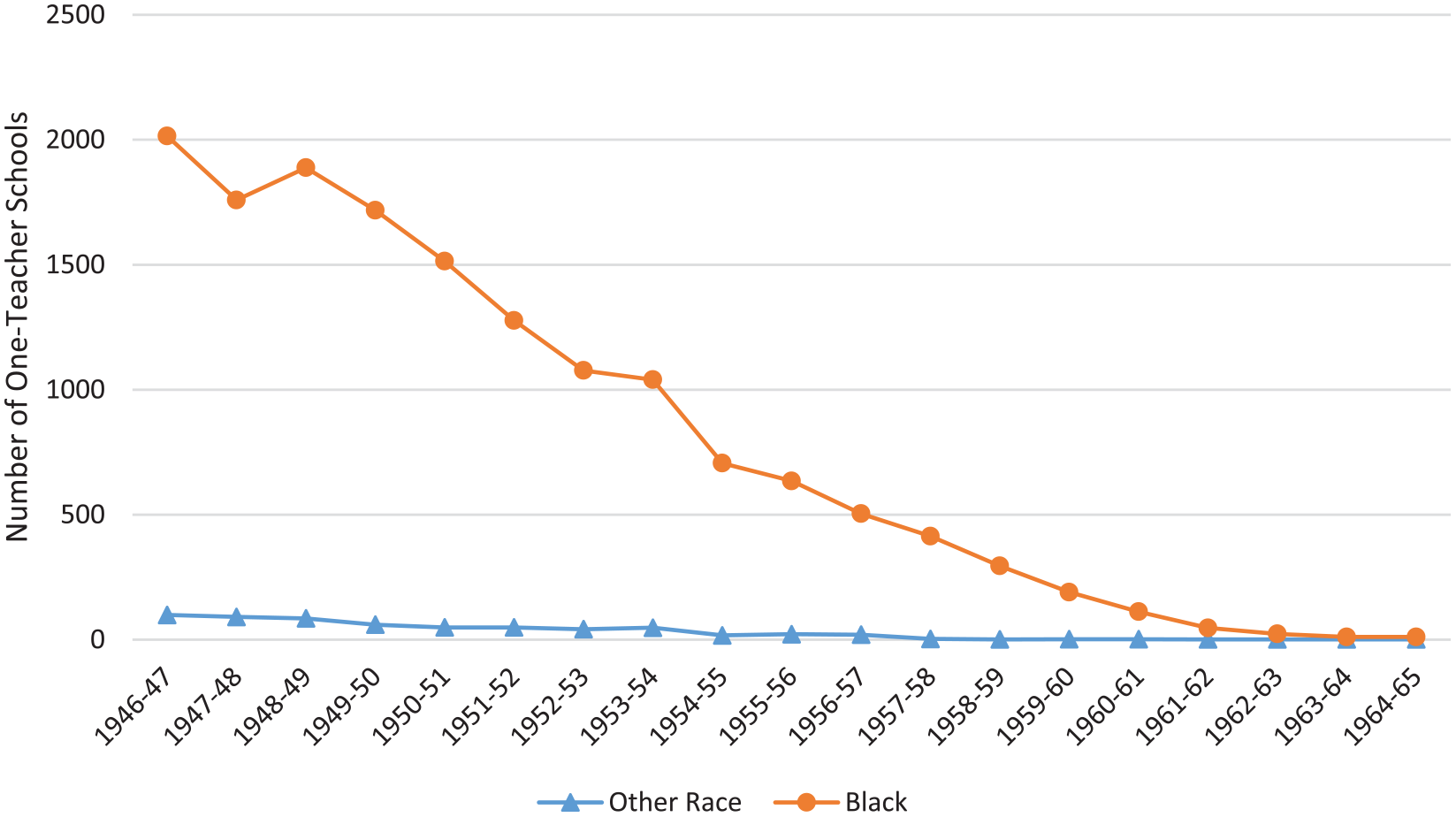
Number of one-teacher schools by race, 1946–1947 to 1964–1965

Number of school districts by race, 1946–1947 to 1964–1965
Specifically, between 1947 and 1951, the number of Black school districts steadily declined from 3,208 to 2,701. Then, during the year Brown v. Board of Education of Topeka (1952) was first argued before the U.S. Supreme Court, the number of Black school districts sharply dropped to 608; this quantity was nearly 200 districts less than the number of White school districts that year. By the 1953–1954 school year, when the 1954 Brown v. Board of Education of Topeka ruling was handed down, only 167 Black school districts remained while 570 White school districts continued. This consolidation yielded a 93.8% decrease in Black school districts between 1950–1951 and 1953–1954 compared with a mere 6.6% decrease in White school districts during the same period. Then, by the 1957–1958 school year, Mississippi offered no Black school districts, 99 combined race school districts, and 52 White school districts.
According to leaders in Mississippi, an equalization program explains the sudden reduction in the number of Black school districts. Namely, Cleopatra D. Thompson (1973), a former president of the Mississippi Teachers Association–National Education Association and a dean at Jackson State College, noted that a 1952 legislative Recess Education Committee determined “there were too many school districts for effective administrative and financial operations,” and the number of districts had caused “poor classroom instruction and the high percentage of failures and dropouts in the elementary schools” (p. 19). Some actions proposed from the findings were to restructure school districts and establish a Minimum Foundation of Education in 1953 that would equalize schools (Thompson, 1973).
Administering Equalization Funds Unequally
Mississippi should have been expected not to equalize schools for two reasons. First, Black schools already were underfunded despite the state having a school equalizing fund, under the Kyle-Cooke law, that required schools with the greatest need to receive the greatest financial aid (MDE, 1946–1969; see 1948–1949 report). Second, Mississippi could not afford to operate separate schools. With clear admission of the state’s administration of separate and unequal schools, the speaker of the house for the 1953 legislature said, “The cost to equalize will be high because in the past we actually have not maintained a dual system of schools, financially. We have maintained a white system and left the Negro schools to go with meager attention” (Palmer, 1971a, p. 35). In fact, data in online Supplemental Appendix A show equalization did not occur.
In the Mississippi Law Journal, William Winter (1957), the state tax collector, clarified that the equalization fund was nothing more than a strategy to resist Brown v. Board of Education of Topeka. As evidence, Winter said that among all the state segregation legislation, “none will prove more valuable toward the maintenance of public school segregation than that setting up the monumental school equalization program in 1953-54” (pp. 148–149). Winter perceived that the Brown v. Board of Education of Topeka rulings meant separate schools could exist if the schools were equal, and he posited that the type of school facilities could determine how the court perceived separate schools. This logic explains the drastic reduction in Black one-teacher schools between 1953–1954 and 1954–1955 (see Figure 2).
Repealing Compulsory School Attendance and Permitting School Attrition
Winter also noted that a compulsory attendance law had existed for years without enforcement, but the law was repealed in 1956 because it would interfere with a law passed to give legislators power to “abolish public schools” (p. 151) if desegregation orders were enforced. From a review of several volumes of Mississippi school law, I identified only one compulsory attendance law before the 1956 repeal—a 1920 code for compulsory attendance (Mississippi, 1920). The 1920 compulsory school attendance law required children aged 7 to 14 years to attend school for at least 80 days per year unless there were “no schools of suitable grade within two and one-half miles, by the nearest traveled road” or “unless transportation is furnished as provided for in the case of consolidated schools” (Mississippi, 1920, p. 13). The 1920 compulsory attendance law also explained actions the county superintendent of education should take to keep students in school. For example, if a student’s parents could not afford a student’s books, the superintendent was to petition the board to use county funds to pay for the books. Additionally, if a child was excessively absent, the superintendent would need to reach out to the parents about the absences and explain the compulsory attendance law (Mississippi, 1920). The racially discriminatory context of education in Mississippi made it unlikely that a White county superintendent would take such generous actions with Black students or secure them transportation.
Instead, the 1920 compulsory attendance requirements and exemptions likely allowed Mississippi to administer racial disparity in education in a few ways. First, in 1925, O’Shea recommended that the common course of study for 90% of Black children be no more than a fifth-grade education level while the compulsory school attendance law required attendance until age 14 years. Second, communications about the minimum school age and compulsory school age varied. Specifically, the compulsory attendance age in the 1920 law was age 7 years (Mississippi, 1920), and that age differed from the minimum school age of 5 years in the education clause of the Mississippi Constitution of 1890. Moreover, the compulsory attendance age differed from the minimum school age of 6 years specified by 1934 and 1960 amendments to the education clause (Williams et al. v. Bryant et al., 2017). Additionally, a 1950 federal report on compulsory education suggests Mississippi’s compulsory attendance law required students aged 7 to 16 years to attend school for at least 9 years with a required “completion of the elementary school course (usually eight grades)” (Keesecker & Allen, 1950, p. 5). Last, based on MDE data shown in Figure 1, between 1946–1947 and 1960–1961, the “school census” was age 6 through 21 years, and Black students comprised the majority of the census. If the minimum age for compulsory attendance was so unclear in official communication and changed multiple times between 1920 and 1960, some rural Black parents, in a time without technology for sharing news quickly, may not have known what the compulsory age for attendance was from year to year.
Irrespective of parents’ knowledge of the compulsory attendance age, the lack of enforcement of compulsory attendance and the eventual repeal of the compulsory attendance law suggests the elementary school attrition displayed in Table 1 was a racial disparity in public education permitted by the state. More specifically, Table 1 shows only 10.4% of the 1,286,272 Black students who began first grade between the 1941–1942 and 1957–1958 school years persisted to 12th grade. This means 1,152,409 or nearly 90% of Black students did not finish high school as O’Shea recommended for public education in Mississippi. In comparison, 41.6% of the 626,448 White students who began first grade, during that same period, finished high school, as O’Shea predicted. While student attrition occurred after each grade level, the bulk of the attrition took place after first grade for Black students. In all, 730,616 Black first-grade students beginning school between 1941–1942 and 1957–1958 left school between first and second grade (see Table 2).
Number of Beginning First-Grade Students in 1941–1957 Completing 2nd and 12th Grades in 1952–1968
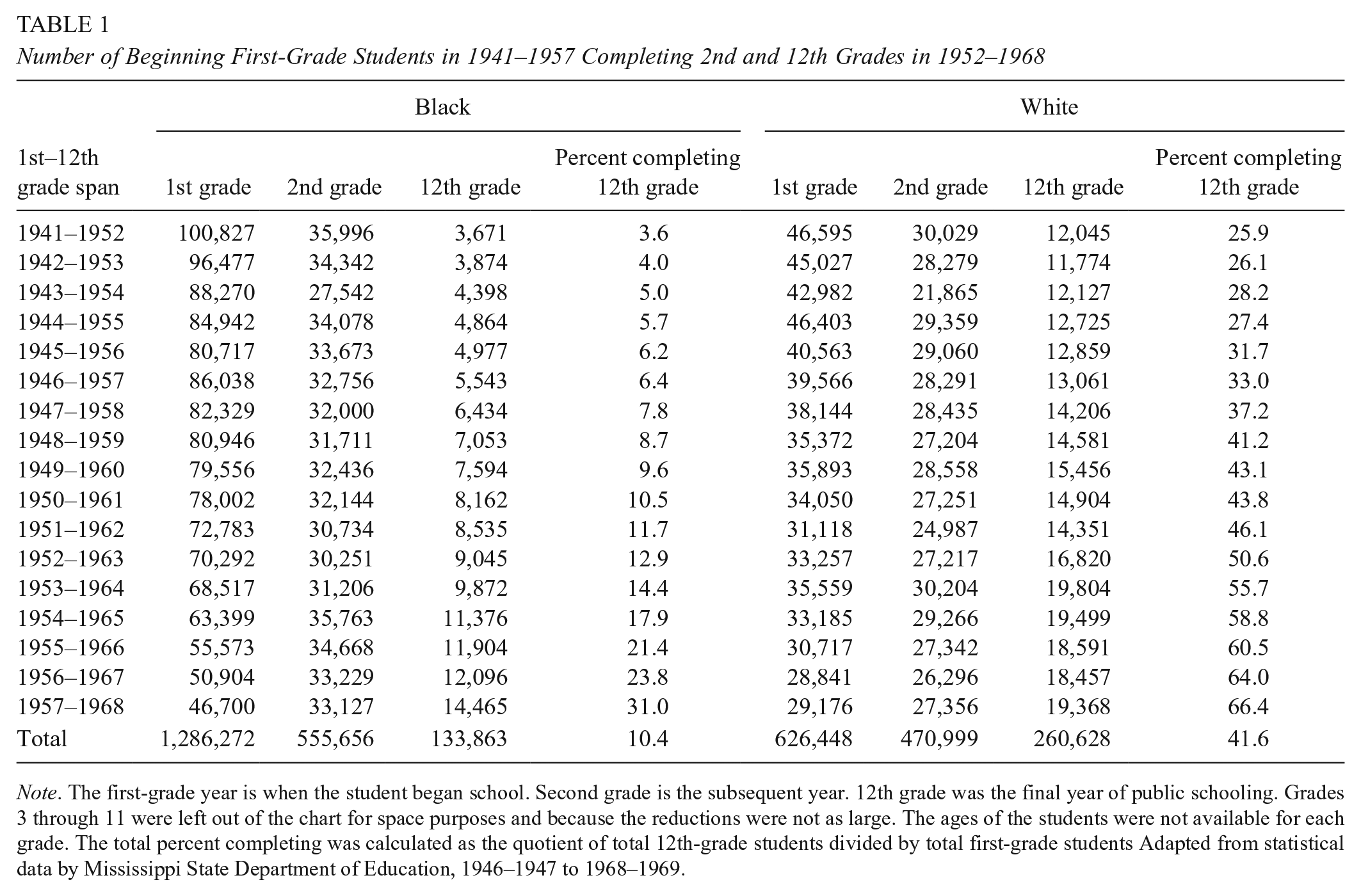
Note. The first-grade year is when the student began school. Second grade is the subsequent year. 12th grade was the final year of public schooling. Grades 3 through 11 were left out of the chart for space purposes and because the reductions were not as large. The ages of the students were not available for each grade. The total percent completing was calculated as the quotient of total 12th-grade students divided by total first-grade students Adapted from statistical data by Mississippi State Department of Education, 1946–1947 to 1968–1969.
Number of Beginning First-Grade Students Leaving Before 2nd and 12th Grades

Note. The attrition rate was calculated by dividing the total number of leavers in the respective grade span by the total number of first-grade students in Table 1 and multiplying that quotient by 100. Adapted from statistical data by Mississippi State Department of Education, 1946–1947 to 1968–1969.
The delayed consolidation of Black schools and additional findings in the online Supplemental Appendices suggest Black parents may have found it hard to allow their young children to attend overcrowded, underfunded schools while White students were given access to consolidated schools, transportation, and better facilities. For instance, online Supplemental Appendix A shows, between 1946–1947 and 1959–1960, Mississippi annually spent $2,061,029 to $3,780,392 more on transportation for White students. In online Supplemental Appendix B, the lived experience of John M. Perkins (1976) suggests some Black elementary students had to walk to school, in winter months, as school buses of White students drove past them. Taken together, elementary school attrition was one of Mississippi’s greatest methods for maintaining a prewar racial hierarchy that delayed and stifled Black Mississippians’ social mobility, for generations, before school desegregation and resegregation.
Conclusion
The current study shows that regarding the public education of Black Mississippians from 1817 to 1969, Mississippi did not “take a responsible position based upon moral convictions or upon respect for law and order” (Valien, 1956, p. 359) administered by a civil war, state legislation, federal legislation, or the Supreme Court. Instead, Mississippi increasingly administered many racial disparities in public education to maintain a prewar racial hierarchy. On the 50th-year anniversary of Alexander v. Holmes enforcing school desegregation, Mississippi has evaded responsibility for these racial disparities in Williams et al. v. Bryant et al.
Mississippi policy makers can learn how to take responsibility for racial disparities from William Winter (1957), the state tax collector, who praised the equalization fund’s disguised intent to maintain segregated schools. When Winter became governor of Mississippi, he worked to pass the Education Reform Act of 1982 that reestablished compulsory attendance (Meacham, 2018). Then, with a changed heart and mind, Winter went on to become one of Mississippi’s greatest advocates for racial unity and racial justice in education (Sansing, 2018). He also participated in the One America Initiative on race in 1997 (Sansing, 2018) and became a close friend of John M. Perkins. In 2010, I heard Winter speak at an event for Perkins’s nonprofit. Winter apologetically stated that he wished he had spoken up and taken more action sooner (W. F. Winter, personal communication, June 12, 2010).
I conclude this article with policy recommendations on how Mississippi leaders can take immediate responsibility for the racial disparities in education administered to Black Mississippians. More specifically, I suggest Mississippi leaders administer at least three remedies. First, every Black child, 5 years old and younger, could receive a voucher to access a free early childhood education at a childcare center of the parent’s choice because racial disparities in education begin before elementary school. Second, to overcome racial disparities in school facilities and resources (i.e., extracurricular activities, technology) underpinned by neighborhood socioeconomics, schools could receive an extra allotment of state funds for the percentage of Black students attending the school. This allotment, in many cases, also would be addressing the state’s lack of extra funding to high-poverty school districts (B. D. Baker et al., 2018). Third, Mississippi could permit Black students to attain up to a bachelor’s degree education tuition-free without any minimum ACT score requirement (Mississippi Office of Student Financial Aid, 2019). The ACT requirement should be excluded because 95% of Black ACT-tested high school graduates, in Mississippi, meet less than three of four college readiness benchmarks (ACT, 2014, 2019). Through these remedies, Mississippi could eliminate racial disparities in education and its prewar racial hierarchy irrespective of the outcome of Williams et al. v. Bryant et al.
These remedies are a small price to pay for the racial disparities administered by state policymakers and the ancestors of White Mississippians. Indeed, Mississippi is responsible for more racial disparities than this study revealed. As a single researcher with limited resources and data collected from only one archive library, I could not enumerate more trends in the racial disparities. However, a team of researchers could collect and analyze data from multiple libraries to more comprehensively determine the extent to which Mississippi has administered racial disparities in public education. Finally, because “nobody is free until everybody’s free” (Hamer, 1971, as cited in Brooks & Houck, 2011, p. 139), archival research, such as this study of Mississippi, should be conducted in other states where there has been a struggle for the public education of Black students.
Supplemental Material
sj-docx-1-ero-10.1177_2332858420975396 – Supplemental material for From Statehood to School Desegregation: Racial Disparities in the Public Education of Mississippi, 1817–1969
Supplemental material, sj-docx-1-ero-10.1177_2332858420975396 for From Statehood to School Desegregation: Racial Disparities in the Public Education of Mississippi, 1817–1969 by LaTanya L. Dixon in AERA Open
Footnotes
Funding
The author disclosed receipt of the following financial support for the research, authorship, and/or publication of this article: The research reported here was partially supported by the Institute of Education Sciences, U.S. Department of Education, through Grant No. R305B170009 to Peabody College at Vanderbilt University.

Notes
Author
LATANYA L. DIXON is an Institute of Education Sciences Postdoctoral Fellow at Peabody College at Vanderbilt University. Her research focuses on how the sociohistorical context of education and opportunity structures (e.g., educational leadership, academic pathways) influence racial equity in college readiness and STEM (science, technology, engineering, and mathematics) pathways.
References
Supplementary Material
Please find the following supplemental material available below.
For Open Access articles published under a Creative Commons License, all supplemental material carries the same license as the article it is associated with.
For non-Open Access articles published, all supplemental material carries a non-exclusive license, and permission requests for re-use of supplemental material or any part of supplemental material shall be sent directly to the copyright owner as specified in the copyright notice associated with the article.
