




Abstract
As the student population in U.S. public schools becomes increasingly ethnoracially diverse, many school districts and hiring personnel have taken proactive approaches to recruiting teachers of color. The drive to diversify the teaching force is supported by a range of academic and nonacademic outcomes for students of color. Yet, many districts struggle with the recruitment and retention of teachers of color. One explanation for the slow pace of change, especially in districts with increasing diversity in its study body, is the presence of durable and parochial social networks in schools and districts that privilege the hiring of largely White alumni. Drawing on semistructured interviews with 65 participants in a small urban district and applying the analytic lens of bonding social capital, we examined these entrenched patterns of parochialism, and the extent to which parochial attitudes and behaviors intersect with race, to explain the incremental pace of change diversifying the teacher workforce.
Introduction
Millbridge 1 is a small city in the northeastern part of the United States with a proud industrial history. Like many similar communities, the city’s 19th-century manufacturing base included a sizable immigrant population—primarily Irish, Italian, and French-Canadian laborers. Frank Russo, principal of the only high school in Millbridge, was the son of Italian immigrants. In an interview conducted as part of this study, Russo reflected on what he called the city’s “blue-collar roots” and how these historical roots were evident in contemporary community values: “The mills were done in the right way,” he said. “I think there was a lot of caring about people so that’s part of culture here too . . . a sense of taking care of your own, which is important.”
The value of “taking care of your own,” as it related to hiring in the school district, was corroborated by other school administrators, district leaders, teachers, and students. For example, one high school teacher—like Russo, a Millbridge graduate, said, I’ve always acknowledged that, that we hire a lot of our own . . . I like to see it as not nepotism in any way, though you want to caution on that, but we’re pulling our best and our brightest.
An elementary school administrator and former Millbridge teacher seemed to embody this idea along with a sense of reciprocal care: “I have a deep sense of pride in the city,” she said.
And I knew I was given privileges that other students and kids my age hadn’t been. And I felt like, “You know what, I went and I got this great degree and I know I’m pretty good at this. Why would I take my skills elsewhere? Shouldn’t I give them back to Millbridge?
One high school administrator estimated that, of 160 staff at Millbridge High School, “at least a third” were alumni.
Empirical research offers support for the trend of teachers working close to home, with Reininger (2012) estimating that 60% of novice teachers work within 20 miles of where they went to high school (see also Boyd et al., 2005, 2013). However, the pride of place voiced by Millbridge educators “coming home” to work is compounded by broader patterns of parochialism, which combine to inhibit efforts to diversify the workforce. In this article, we consider how, within organizations, parochialism and pride of place, enacted as a form of bonding social capital (Putnam, 2000), operate as a uniquely powerful influence on teacher hiring. Specifically, we argue that parochialism (at the organization and/or society level) and pride of place (at the individual level) work together to bolster exclusionary instincts and resist efforts toward systemic reform.
Putnam (2007) defines bonding social capital as social “ties to people who are like you in some important way” (p. 143), and other scholars have observed that bonding social capital is “often parochial and only benefits those with internal access” (Leonard, 2004, p. 929). Indeed, Bowles and Gintis (2004) viewed parochialism as a set of shared beliefs and practices within decentralized groups, including groups defined by their ethnicity or place of residence, that were designed to facilitate cooperation and maintain exclusivity. Where parochialism defines a general social process aimed at maintaining productive (though exclusive) bonds, we view pride of place as an individual perspective privileging one’s affection for and connection to place without necessarily a conscious acknowledgment of the role it may play in undermining attempts to break down insularity and encourage inclusivity. Each perspective would be instructive toward understanding exclusive hiring practices; together, they demonstrate how society-level processes intersect with individual affinities to produce a persistent resistance to diversity.
Understanding the influence of these interconnected social forces takes on special urgency in rapidly diversifying communities like Millbridge, where there is a growing demographic gap between the largely White teaching force and its increasingly ethnoracially heterogeneous student population. In the 2017–2018 school year, only 7% of Millbridge Public Schools teachers identified as persons of color, compared with 57% of the students. In these communities, parochialism and pride of place work in concert with ethnoracial identity to maintain a socioracial hierarchy, which has implications for the maintenance of a racially homogeneous teacher workforce as well as the academic success and socioemotional well-being of students of color.
The Benefits of Teacher Diversity
Importantly, the demographic shifts in Millbridge mirror national trends. In 2003, 41% of U.S. public school students were students of color; by 2014, students of color accounted for 50.3% of all students (Warner-Griffin et al., 2016). In contrast to the increasing ethnoracial diversity in the U.S. student population, the public school teaching workforce has remained predominantly White (Jupp & Lensmire, 2016; Warren, 2020). In 1987, only 13% of all U.S. public school educators were teachers of color (TOCs). Twenty-five years later, in 2012, that number had increased to only 18% (U.S. Department of Education, 2016).
In response to these changing demographic trends, efforts to recruit and retain TOCs have yielded some promising results (McKinney de Royston et al., 2020; Warner-Griffin et al., 2016). Such efforts are critical given the potential for improving educational outcomes among students who have TOCs (Bristol & Martin-Fernandez, 2019; Carey, 2020). For example, having a Black teacher is associated with improved outcomes for Black students, including better performance on standardized tests (Dee, 2004; Eddy & Easton-Brooks, 2011), decreases in exclusionary discipline (Lindsay & Hart, 2017), and an increased probability of attending a 4-year college (Gershenson et al., 2018). Similarly, for Latinx students, having a Latinx teacher meant increased opportunities to learn in classrooms that attended to cultural and linguistic diversity (Lara & Fránquiz, 2015; Monzó & Rueda, 2001), which in turn were associated with improved learning outcomes (López, 2016). Moreover, a recent study found that all students—including White students—reported a preference for being taught by a teacher of color (Cherng & Halpin, 2016).
Despite these findings, research on the barriers for hiring TOCs remains limited. Researchers have documented some barriers for entry into the profession, including program-based challenges during preparation (Brown, 2014; Kohli, 2009) and lower passing rates and retests on teacher certification exams (Petchauer, 2012). However, we know less about how the hiring process itself—including the influence of entrenched social networks in schools’ professional culture and among hiring personnel in particular—may act as an additional barrier for increasing the number of TOCs. This study helps fill this gap by answering the following questions:
What are school administrators’ and teacher leaders’ beliefs about why teacher hiring networks remain racially homogeneous?
How, if at all, do these beliefs vary based on stakeholders’ resident status (i.e., whether they were born and raised in the district)?
How are these beliefs enacted or resisted in district and school-based hiring practices?
Conceptual Framework
To answer these questions, we applied the analytic lens of social capital theory—specifically, the distinction between bridging and bonding social capital (Putnam, 2000). Social capital theory may help explain the parochialism and insular social networks that have sustained a teaching force in Millbridge with strong ties to the community’s historically White working class (i.e., bonding social capital). However, it also suggests opportunities for the district to tap into its growing immigrant and non-White communities to establish a more diverse teacher pipeline (i.e., bridging social capital). The concept of bonding social capital may further help illuminate the social dynamics of place and the emergence of insular and broad-based social networks (Bristol & Shirrell, 2019). This article takes a unique approach in explicitly combining social capital—which is well-suited to analyzing macrolevel patterns within and across communities, with parochialism and pride of place—which are well-suited to analyzing microlevel patterns of society- and individual-level beliefs and assumptions.
Parochialism, Pride of Place, and Bonding Social Capital
According to Bourdieu (1986), social capital is the accumulation of resources (real or potential) linked to one’s membership in a particular group. Especially pertinent to this study, social capital may also be geographically bound, with Portney and Berry (1997) describing close-knit and physically bounded communities as “wellsprings of social capital” (p. 633). In studying social capital and social networks within U.S. communities, Putnam (2000) distinguished between bridging social capital, which was “outward looking [and sought] to build ties across social identities (p. 22), and bonding social capital, which cemented existing exclusive groups. Empirical work has suggested that bonding social capital has both positive and negative effects on individuals and groups. On one hand, it may bolster in-group ties and fortify trust (e.g., Collins et al., 2014; Reynolds, 2013). On the other hand, it may foster insularity and intolerance toward out-groups (e.g., Rhodes, 2012; Veugelers et al., 2015). Indeed, as noted in Putnam (2007), the very features of bonding social capital that were viewed positively in some lights—in-group solidarity, for example—also had deleterious side effects, especially within diverse contexts, such as the tendency to “hunker down” and withdraw from civic life.
Both parochialism and pride of place, as they relate to social capital, further interpret these self-isolating instincts and behaviors. Specifically, we posit that these two concepts operate as nested phenomena that act together to fortify and reinforce place-based bonding social capital. Parochialism operates at the organization or society level, describing the beliefs, assumptions, and patterns of behavior within the dominant social network. Pride of place governs decision making and behavior at the individual level, including decisions about where to live, where to work, and who to work with. Originally defined by one’s affinity for a church community, the term parochialism has over time broadened to mean practices undertaken by any narrowly defined group with a shared identity aimed at preserving the benefits of exclusivity (Bowles & Gintis, 2004). The characteristics defining parochial groups may include religion, ethnoracial identity, or an attachment to one’s hometown or neighborhood. Community psychologists refer to individuals’ experience of place-based parochialism as “place attachment”—what we call “pride of place”—and define it as “the experience of a long-term affective bond to a particular geographic area and the meaning attributed to that bond” (Morgan, 2010, pp. 11–12; see also Perkins & Long, 2002). Hay (1998) observed that individuals’ sense of place may be heightened among those who have ancestral ties or insider status. Like social capital more broadly, pride of place is most often studied for its perceived benefits and positive association with community development and civic participation (e.g., Manzo & Perkins, 2006). However, we observe that pride of place, when linked to parochialism, may also reinforce insularity and exclusivity.
An analysis of the rationale underpinning parochial practices within groups reveals why parochialism may persist, especially within ethnoracially homogeneous groups. For example, contrary to the theory that parochialism is motivated by a sense of altruism (i.e., helping those who are similar), Bowles and Gintis (2004) noted that parochial practices appeared to be motivated by the expectation of reciprocity and the receipt of social benefit among group members. That is, members of a particular group might confer a benefit on a fellow group member—for example, a job offer or a promotion to someone from the same community or ethnoracial group—in part because they expect the favor to be returned in some way. Viewed as individual acts, these behaviors may seem motivated by a benign attachment to place or to one’s group. However, viewed as part of a larger pattern of parochialism, these behaviors may be fed and perpetuated by individual self-interest and instincts toward self-preservation that accumulate at the society level and drive more pernicious outcomes.
More notably, these two related concepts have thus far not been used together to understand how bonding social capital works to preserve homogeneity within rapidly diversifying contexts. Parochialism has been used as a frame toward understanding organized resistance to rural education reform (Mette et al., 2019); place attachment has been used to interpret children’s responses to education in a postdisaster context (Scannell et al., 2016). To our knowledge, neither parochialism nor pride of place have been used to analyze patterns related to teacher diversity and hiring, particularly in the context of a small urban district.
Because it is important to account for the social context in which bonding social capital is generated and spent, we focus in this article on the nature of bonding social capital within Millbridge as a community. In particular, we focus on the subgroup of currently practicing teachers born and raised in Millbridge—the majority of whom identified as White, and for whom parochialism and pride of place play a meaningful role in how they interpret the demographic and policy changes taking place around them.
Methodology
As Yin (2014) noted, single-case designs—such as this one—are appropriate in several instances. Among the rationales for single-case studies is the critical case study, which is closely tied to well-articulated theories and seeks to confirm, challenge, or extend them in some way. As such, in this article, we apply social capital theory to the place-based (but also ethnoracially coded) patterns of belief and behavior that underlie teacher hiring in Millbridge. In addition to shedding light on interpersonal barriers to teacher diversity in this one district, such an analysis may also highlight how bonding social capital, enacted as a cycle of individuals’ pride of place reinforced by entrenched parochial networks, works to maintain social distance within increasingly heterogeneous communities.
Research Site
As noted above, Millbridge is a small city with an ethnoracially and economically diverse population. Formerly an industrial manufacturing hub in the 19th and early 20th centuries, Millbridge in the early 21st century emerged as a hub of biotechnology start-ups. In addition, the city, like many small northeastern cities, has undergone a recent demographic shift. According to census data, in 2010 residents of color accounted for 17% of Millbridge’s population; by 2019, that percentage had doubled to 35% residents of color. Millbridge elected its first Latinx city councilor in 2015 and its first Black city councilor in 2018. The current mayor, who is White, describes herself as a lifelong resident of Millbridge and a graduate of the Millbridge Public Schools (MPS). The mayor is in her 16th year in office.
MPS serves approximately 6,000 students and employs 500 teachers. The district has one high school, two middle schools, six elementary schools, and one new preK–12 dual-language program. While the student population has rapidly become ethnoracially diverse, the teaching force in MPS has remained steadfastly White. District-wide, during the 2017–2018 school year, 58.3% of students were students of color and 90.7% of staff were White.
With funding from a grant to examine issues of equity, MPS’s superintendent hired the research team to undertake a study to help the district develop policies and practices to recruit and retain TOCs, a priority named in the district’s strategic plan and identified as a key lever for closing achievement and opportunity gaps. The focus on parochialism as a potential barrier and opportunity emerged during data collection because participants regularly (and often unprompted) identified themselves by whether they grew up in Millbridge.
Data Collection and Sample
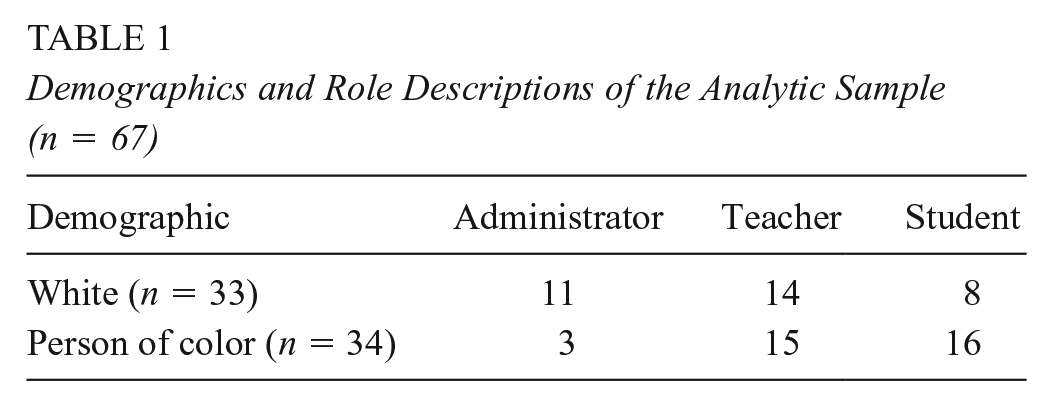
Over 3 months during the 2017–2018 school year, we conducted semistructured interviews with stakeholders in the district office and across four schools—the high school, one of two middle schools, and two of six elementary schools. To ensure a diversity of perspectives across roles and ethnoracial identity, we built a purposive sample that included 34 participants who identified as people of color (three district or school administrators, 15 teachers or staff, and 16 students) and 33 participants self-identifying as White (11 district or school administrators, 14 teachers or staff, and 8 students; see Table 1). Ethnoracial identity of participants was initially determined from an employee roster provided by the district; participants were also given the opportunity to self-identify their race and ethnicity as part of their interview. Having an ethnoracially diverse research team was seen as critical for recruiting this sample. Specifically, working from a theory that White participants might be reluctant to talk with people of color about hiring TOCs, a White researcher was enlisted to recruit and interview White participants while two researchers of color interviewed participants of color (Gallagher, 2000; Hendrix, 2002). In recruiting the sample, the research team further noted what appeared to be an especially strong motivation to participate among TOCs.
Demographics and Role Descriptions of the Analytic Sample(n = 67)
Members of the research team met with district leadership to identify school sites and key district administrators involved in hiring for interviews. Researchers then sent individual emails to district and school leaders involved in hiring, teachers and school staff identified on employee rosters as people of color, and a random sample of teachers and staff identified on employee rosters as White. Interviews lasted 30 to 90 minutes. In addition, researchers asked school leaders at the high school to convene student focus groups and conducted three—two with students of color (n = 16) and one with White students (n = 8), each lasting approximately 45 minutes.
Participants were not purposely screened or selected based on their residency-status—that is, whether they were born in or currently lived in Millbridge, However, a significant number of participants volunteered this information in the course of interviews, and researchers probed for this information in later interviews once its potential significance became clear.
Analytic Approach
In conducting multiple rounds of descriptive coding and calibrating codes across readers (Saldaña, 2013), we identified several key themes and patterns within and across individual cases. These themes included not only a shared belief about the benefits of diversity but also a durable history of hiring from within that tended to elevate alumni or people with close social ties to the community. Further research memos explored this theme in depth, and we returned to the data to confirm or disconfirm emerging hypotheses. Data were triangulated by our purposive sampling strategy, by which we intentionally recruited perspectives across multiple levels: school, role, and racial category.
Findings
Converging and Conflicting Beliefs
Among the participants, there was broad agreement that great teacher ethnoracial diversity would benefit students. This perspective was shared among teachers and administrators, White participants and people of color, those native to and new to Millbridge. For example, drawing on what she perceived as the intersection between racial and geographic bias evident in the demographics of the teaching force, Eliza Dempsey, a person of color working at the high school in a student support role, explained, “We owe it to our students to model that we think [diversity] is important and right now we send a very different message.” Benjamin Becker, a White elementary school administrator originally not from Millbridge, agreed with this sentiment: kids. . . need to see . . . somebody who either looks like them, sounds like them, has a shared experience to them or something. Because it’s very strange if you are a poor student of color who may not know English and everybody in your school is White, Catholic, and upper-middle class. I mean, I don’t know how that would be a good thing.
At the same time, among some interviewees, there was a resistance to the idea that schools should make hiring decisions solely or primarily on the basis of diversity. Recognizing that TOCs are liable to face questions about their qualifications, Wayne Chen, a Chinese-American science teacher who immigrated to the United States as a teenager, referred to so-called quota policies that set goals for hiring based on particular characteristics, including demographic characteristics: “I don’t agree on that,” he said, “it really is like . . . when you hire people, it’s really, you need to make a judgment on that person’s personality skills by their experience, not on what he looks like, what race or which place he comes from.” Similarly, Lisa Meehan, a White elementary school administrator who grew up in Millbridge, agreed with the benefits of teacher diversity, but she tempered her support for the district’s initiative to hire more diverse teacher candidates with language about merit-based hiring and colorblindness: “When we make a hire of diversity,” she explained, “that candidate has to stand up against all the other candidates on their merit . . . We want the best teacher, period. I don’t care if they’re purple.” Chen and Meehan believed that teacher hiring practices in Millbridge were—and should be—meritocratic, based simply on whether a teacher candidate had the best skills to be selected for a position. However, as we discuss below, hiring decisions were less often made on a candidate’s merits. Instead, we found that parochialism, or a prospective teacher’s attachment to Millbridge, more favorably influenced hiring decisions.
In-Groups and Out-Groups
In Millbridge, individuals’ beliefs about the role race should play in hiring decisions must be viewed and understood not only through the lens of ethnoracial identity but also based on individuals’ connections to Millbridge itself. Parochialism and pride of place in Millbridge were evident in part by the widespread use of a term, known to nearly all interviewees and seemingly unique to Millbridge, to describe people not from the community and to mark them as members of an out-group: “Breezers” (people “who breeze in and out,” according to Meehan, the White elementary school administrator and a Millbridge native). Henry Graves, an affable man working as a part-time district administrator, was a Breezer. Born in a town bordering Millbridge, he married a “Millbridge girl” and his children graduated from Millbridge High School, but despite these ties to the community, he was acutely aware of his status as an outsider. “Millbridge is a very parochial city,” he explained.
When I first started to work here, I went out for coffee with a guy who had just retired after 35 years . . . And I actually know him, he was one of my wife’s cousins . . . In the course of the coffee conversation, I remember looking across at him and I said, “You know what, Walter, keep in mind that you’re a Breezer, as I am, and always will be.” . . . Walter Miller, who moved and married a Millbridge girl as I did, lived here—Walter lived here for 40-plus years, I lived here for 30 years—but with all of those Millbridge roots, we’re really not Millbridge guys. And never will be. And that’s kind of a constraining parameter in a city like Millbridge.
Understanding Breezers as an out-group defined not (at least not outwardly) by ethnicity or race but rather by birthplace was critical to understanding the culture of Millbridge and the historical patterns of teacher hiring that tended to privilege those who had grown up in the city and attended its schools. Rich Green, a White school administrator, explained, “I’m what you call a Townie.” Green remembered being a new college graduate when he visited his alma mater, Millbridge High School (MHS): I came back and met with my old history teacher who then had become a [content-area] director [with responsibility for hiring] . . . We had just an informal conversation in his office. I brought my résumé and cover letter, you know, fresh out of college, right, and all that kind of stuff and presented it to him and he said, “Okay, this is great. There’s no job that’s here, no one’s retiring. So go enjoy grad school and come back and see me in the spring when we have some retirees popping up.”
A few months later, attending graduate classes at night, Green took a short-term substitute job at MHS. In the spring, as promised, the history director alerted him to some retirements in one of the middle schools, which turned into a permanent position. Green described his hiring as “non-traditional,” but in many ways, it was the tradition for Millbridge graduates.
Ray Jackson, a Black man who grew up in one of Millbridge’s public housing projects and—like Green—graduated from Millbridge High School, ran a peer mediation and conflict resolution program in MPS. At the time he was hired, he was working in the criminal justice system as a probation officer but looking to move into “prevention.” While recovering from surgery, he was contacted by his old MHS soccer coach, who had become the principal and who thought he had the “perfect job” for Jackson. Jackson viewed the job offer as an opportunity to give back: He [the then-principal] knew me since I was 10 years old. So he knew, you know, the kind of person that I was . . . And he was a mentor to me, so I was like, “Anything I can do to help, you know, give back to the city, I will,” because I grew up here.
In much the same way that Townies, like Green and Jackson, were aware of the parochial networks that benefited them, Breezers were equally aware of how these same social networks placed them and people like them at a disadvantage. District and school leaders spoke about perceived and real pressure from “real Millbridge people” to hire Townies. Evan Forrester, the superintendent of Millbridge and a Breezer himself, acknowledged there were ramifications to disrupting the entrenched patterns of bonding social capital at work in Millbridge’s hiring practices. He recounted a hiring decision in which a person of color was selected over a Townie for a school administrator position: “The candidate who wasn’t selected is someone who is married to a leader on the police force, and that [leader] is connected to city council. And it became this huge firestorm in the community.” Similarly, Lilly Rubin was a Breezer and a district administrator, as well as a former principal who had worked in Millbridge for 16 years. In that time, she had been involved with and observed the hiring of many teachers and staff, and she worried that social networks were partly responsible for the shortage of TOCs. “Some of the hiring practices,” she explained, “I don’t think are—I think they’re more about, in this town, someone’s brother’s sister’s cousin’s uncle, and that to me is one of the reasons why we don’t have a diverse population in staff.”
The Intersection of Place and Race
While the pride of place and parochialism that seemed to draw Townies to work in Millbridge was strong, there were notable differences in how this attachment was perceived and experienced based on whether the participant was White or a person of color. For many Townies, coming back to Millbridge to work in the schools was gratifying. But some alumni, like Rob Preston, a White high school administrator, seemed to confirm Lily Rubin’s suspicions: that a parochial affinity for hiring Millbridge graduates may have contributed to a lack of diversity in hiring. He said, “There may have been . . . an unintentional barrier of . . . hiring people that grew up here, wanted to come back here, wanted to stay in the city.” But, he insisted, such a barrier was born out of pride of place—in his mind, a noble motivation: “I think it was more of a pride of having people that went to school here who want to come back and to continue to be a part of this community.” Indeed, Rob Preston benefited from his status as a Townie. Born in Millbridge and a graduate of MHS, he got his first teaching job in Millbridge but went on to work as an administrator in a nearby district. While working in this other district, Preston was told by two high school friends—one of whom was teaching at MHS—of an impending administrator opening. “I wasn’t job searching,” he admitted, but he applied and took the job (and a pay cut) when it was offered. He wanted to come “home.”
Preston’s pride of place was typical in many ways, but his perspective on the Millbridge culture was also distinct in that he grew up in one of the city’s low-income, largely non-White public housing projects. He remembered his neighborhood being very insular (“If you grow up in the projects, you pretty much stayed in the projects,” he said). Viewed one way, this experience was consonant with bonding social capital and the parochial networks that reinforce it: Preston felt a strong affinity for his roots, both the housing project where he grew up and Millbridge generally. At the same time, as a White person in a neighborhood where the majority of residents were from Puerto Rico, Preston also accumulated considerable bridging social capital enabling him to experience solidarity with people who were not like him. One of his neighbors growing up was Grace Pérez—“I could throw a rock and break [her] window from my house,” he said. Like Preston, Pérez worked at MHS for many years—as a teacher and then an adjustment counselor—before leaving for another district. When there was an opening for an administrator position at MHS, Preston did for Pérez what his friends did for him more than a decade earlier: He called her and told her to apply. Recently hired as one of the district’s first Latina administrators, she was held up by other interviewees as evidence that the district was making progress hiring more leaders of color. However, viewed through Preston’s lens, Pérez was hired the same way he and many people in the district were hired: through the tight and parochial network of Townies.
As a Townie and a person of color, Pérez was both an insider and an outsider. Reflecting her “insider” status was the fact that, in addition to being notified by Preston about the opening, Pérez was also recruited to apply for her position by Frank Russo, MHS’s long-time (and Townie) principal. Moreover, she remembered feeling a sense of ease and comfort during the hiring process: “I grew up in the city, so Millbridge is home to me. I’ve always felt comfortable being part of this school and this academic family. So for me it was—it was just coming back to my roots.” Pérez also recognized the ways in which she was an outsider—for example, as a Latina in a district with increasingly large numbers of Spanish-speaking students but relatively few Spanish-speaking staff. She knew she was a pioneer in a position that had “always been dominated by White administrators.” Many in the district, including the superintendent and Russo, viewed both her connections to Millbridge and her Latina identity as assets. However, a vocal group of Townies in the district believed (falsely, according to Russo, who made the decision to offer her the job) that her Latina identity played too prominent a role in her hiring. Reflecting on the resistance he received from fellow Millbridge educators for hiring Pérez, Russo explained, “Some people are thinking, well, we’re hiring minority people who are unqualified and uncertified.” Acknowledging he had also heard this feedback, Superintendent Forrester noted, “It’s such a, a parochial system . . . Grace is from Millbridge, she graduated from Millbridge High School, but somehow isn’t seen as from Millbridge.”
The perceived lack of insider status challenged other Townies of color in the hiring process as well. For example, Arlette Hernández, a first-year teacher who self-identified as Latinx, was born and raised in Millbridge and graduated from MPS. After graduating from one of the state’s universities with her teaching license, Hernández spent 2 years applying for a position in the district. “Every year I just kept applying to positions in [Millbridge],” she explained, “because I do really want to work in [Millbridge] and with the students here . . . [but] I wasn’t getting any interviews.” Unlike Pérez, who was personally connected to alumni in hiring positions, Hernández only sought employment through formal channels. She said, I remember two years ago when I was applying, it was through SchoolSpring. You just send all your info and then you really just have to wait to get an email or phone call that they want to interview you . . . But I never did get a call.
Hernández ultimately settled for an assistant teacher position in Millbridge, a job she held for 2 years. Despite being overqualified for the assistant teacher position, Hernández, like many Millbridge residents, was determined to return to the district and the city in which he had a great sense of pride. Ultimately, after two unsuccessful hiring cycles, Hernández was hired as a Millbridge teacher of record.
The views of Dennis Stevenson, a long-time teacher at MHS and a Townie who identified as White, seemed to embody the tension that both embraced and excluded people like Grace Pérez and, possibly, Arlette Hernández. The tradition of hiring Millbridge graduates, explained Stevenson, was “a gem of Millbridge and a part of me doesn’t want to lose that, though I realize the idea of bringing in new ideas and people.” At the same time, he cautioned that these new ideas and people should be “compatible with the thinking of our town and not be bringing in such foreign concepts to us that it’s not a good fit.” Asked for an example of ideas that were not a good fit, Stevenson paused for a long time before explaining that Millbridge was an “apolitical” place, and that a threat to the community was people from the outside coming in and making us political, having us see things through a political lens or a racial lens, where it’s like, “Racial issues, what racial issues?” and then there’s a “Oh, you must have some here.” And it’s like “No, not really.”
Responsibility to Place Versus Responsibility to People
Another layer of difference among Townies, based on ethnoracial identity, was how they understood their responsibility to Millbridge. White Townies tended to see themselves as giving back to the community as a whole, while people of color adopted a more nuanced perspective, seeing themselves as giving back to the communities of color within Millbridge.
Rob Preston held the tension between parochialism and the imperative for teacher diversity in a way that few of his colleagues did. He reflected, Our district is very, very White in terms of staff. And it makes me wonder like, you know, when I got my job was, did somebody of color get passed over? Were there applicants for my job 12 years ago that were of color? Because I grew up in Millbridge, because I’m a Townie, I wonder that.
And yet, despite his belief in the value of teacher diversity, Preston worried that the pendulum was swinging too swiftly away from hiring Townies like Pérez and himself. A TOC, and Breezer, seemed to corroborate this hunch: Over the years, different administrations, like depending on the superintendent, have sort of tried to steer clear of . . . hiring Millbridge graduates, because I think a lot of the Millbridge High graduates coming back to teach here were primarily White.
Reflecting on the possibility that hiring personnel were deliberately not hiring Millbridge graduates, Preston felt a twinge of resentment mixed with Millbridge pride: I think . . . a staff member not feeling like they have a good chance because they’re from here . . . has a very big blowback in culture . . . Reject me because someone is more qualified. But don’t reject me just because I’m from here. I take pride being from here.
But that pride was often experienced differently by the small number of TOCs who were also Townies, manifested in a sense of responsibility toward the city but just as much (if not more) toward and in solidarity with the growing number of students of color within the city. Pérez explained, I graduated from Millbridge High School and, you know, for me, I knew that the Latino community was growing, so it was, you know, for me it was an interest to be able to . . . support the ELL [English language learning] population here as well as be able to support all my other students.
Ray Jackson, who identified as Costa Rican American and Black, recognized the MHS he attended and the MHS where he now worked as two distinct places: When I was here [as a student], there was like sprinkles of people of color—sprinkles, you see what I mean? And you know when I came in [as staff], I hadn’t been in the building for 22 years . . . and when I came back, I was like, “Oh my gosh.” I was like my jaw went clang, I said, “Is this really the same?” . . . I felt like Rip van Winkle, fell asleep, 20 years later woke up and everything was changed . . . I hated high school, you know, and so when I came back in . . . it was amazing, the diversity . . . And it actually made me say I made the right choice because I said I can work with these kids.
Yet, while the demographics of the student population may have changed dramatically, the lived experiences of students of color had changed relatively little.
In 2017, even though they now constituted a majority of the student body, students of color at MHS reported persistent racist microaggressions (or what scholar Ibram X. Kendi, 2019, called “racist abuse,” p. 47), similar to Jackson’s own experience as a student 30 years earlier. In a focus group with students of color, one student recalled, “I was actually in front of a teacher who saw—we both saw—a couple of White students yell in front of Mexican students, ‘Oh, we’re building a wall’ . . . and the teacher said nothing, nothing.” 2 Students also pointed to the existence of a new social media account—advertised throughout the high school hallways—where students could anonymously submit accounts of racist abuse. Stories included multiple incidents of racial name-calling in the hallways or on the bus; a White student yelling at a group of Latina girls in the hallway to “Get the [bleep] out of my way and my country!”; teachers punishing students of color for behavior while ignoring White students engaged in similar or worse behavior; and teachers pointedly talking slowly to students they assumed to be Latinx
Reconciling the Values of Parochialism and Diversity
Participants sought to reconcile their beliefs about diversity and their connections to Millbridge through their ideas about and attitudes toward hiring policies. Pride of place and parochialism permeated Millbridge. Yet, among Townies and Breezers alike, there was a creeping sense of optimism that the same bonding social capital that created barriers for diverse teachers could—over time—work to the district’s advantage. Lily Rubin, the White district administrator and Breezer who worried about an entrenched pattern of hiring Townies, speculated that “now, with the growing diverse population of kids growing up and graduating . . . they’ll come back and we can hire them.” Indeed, on the current staff of Millbridge High School, there are at least two examples: Arlette Hernández, the first-year teacher noted above, and Luz Hill-Rodríguez, a seventh-year Latina English teacher at MHS. When asked how she came to her current position, Hill-Rodríguez leaned into a familiar impulse: So, I always tell the story that when I was a sophomore here at Millbridge High School, I made my plan that I was going to go to school to become an English teacher and come back and teach at Millbridge High. So that is pretty much what brought me back . . . I wanted to be home, in a place that was comfortable. I had had a great experience here and I knew that I wanted to come back.
However, the pride of place that characterized Hernández’s and Hill-Rodríguez’s paths to teaching in Millbridge may be more the exception than the norm. Generating in other students the same kinds of affectionate feelings for the city, the schools, and teaching that brought Hernández and Hill-Rodríguez “home” means attending carefully to the school culture and the incidents of racist abuse that students of color experience and working with teachers and staff members to build their cultural competence.
Efforts were underway across the district to shed light on issues of race and equity. For example, during the year of data collection for this study, schools across Millbridge were engaged in a series of professional development sessions focused on equity and diversity. Reactions were mixed, with one White Townie teacher who referred to himself as “reasonably colorblind” scoffing that the trainings were “re-separating us” by racial groups when the district needed to “melting pot us together.” At the same time, some teachers and administrators were cautiously optimistic that the diversity initiatives were bringing to light topics that had been unspoken for a long time. At the high school, a woman of color and a Breezer noted, This is the first year that we’ve really even been discussing this [equity and diversity]. I mean, a bunch of us have been discussing it for years, but it’s gone nowhere. Just now we’re starting to really kind of make good traction.
Across town, at one of the elementary schools, a White administrator and a Townie reflected on the professional development: This year, cultural proficiency has been a big piece of what we’ve been doing as an admin team when we have our meetings and that has been widely beneficial. I’m learning things I didn’t know and I’m understanding those unconscious biases.
Implications
As this study makes clear, teacher ethnoracial diversity, especially in small urban districts undergoing demographic changes, is a persistent challenge made even more challenging by entrenched patterns of parochialism. However, this study also suggests some implications for theory, research, policy, and practice that could inform efforts to overcome these obstacles.
Theory
In finding that diverse contexts were related to “hunkering” behaviors that reinforced and strengthened social isolation, Putnam (2007) noted that it was still unclear whether “diversity in the workplace . . . [had] the same effects as . . . neighborhood diversity” (p. 163). This study suggests that indeed attempts to diversify the workplace may be associated with similar instincts and patterns toward exclusivity. Moreover, a theory of bonding social capital that draws on parochialism and pride of place to examine patterns of belief and behavior within social networks and organizations may serve as an important framework for exploring ethnoracial diversity hiring decisions, particularly in small urban centers. As people of color become increasingly unable to afford gentrifying urban cores and move into smaller cities, they are often met by an unwelcome White hegemonic presence unwilling to share power (Durán, 2020). One way to examine how White hegemony maintains power in small urban contexts is through the frame of parochialism, which in turn results in teacher-hiring networks that remain racially homogeneous.
Research
Additional research aimed at understanding the influence of parochialism and bonding social capital in teacher hiring can inform the small but growing body of research that explores the processes school districts use to recruit prospective TOCs. Indeed, demographic trends nationally suggest that many communities—both postindustrial working-class cities like Millbridge and traditionally White middle-class suburbs—are rapidly becoming more diverse (Frey, 2011). Empirical work on these communities thus far have tended to focus on macrolevel policy ecosystems (Holme et al., 2013) and leadership-level policy responses (Diem et al., 2016; Holme et al., 2014). Relatively little research has examined the intersection of policy with the role of social networks in recruitment efforts for TOCs. The replication of studies like this one—multiple case studies combined with larger surveys of teachers’ career pathways—will generate larger analytic power.
Policy
Given our finding that previous hiring decisions gave preferential treatment to Millbridge natives—most of whom were predominately White—it would be important for this district, as well as other districts seeking to enact teacher diversity hiring policies, to design systems and processes that mitigate the hunkering instincts associated with bonding social capital. For example, a community agreed-upon rubric for hiring all educators could ensure a transparent and fair hiring process by balancing a candidate’s personal connection to the community with other qualifications seen as necessary for serving current students well (Brannon & Leuzinger, 2014). A community agreed-upon rubric would allow multiple stakeholders to name what they believe are the dispositions and skills needed to support students’ learning and social and emotional development (Nelson, 2016; Wallace, 2018). Equally important, a common rubric developed with multiple stakeholders has the potential to reduce bias in the hiring process.
Practice
In order to preserve the benefits of the traditionally lucrative parochial pipeline of teacher hiring while also increasing the diversity of the teacher workforce, contemporary educators and school leaders—like those in Millbridge—must acknowledge the persistence of unconscious bias and confront incidents of racist abuse experienced by students and TOCs (Starck et al., 2020). To do so will require an ongoing investment of time and resources to support school and district staff, since even well-intentioned educational leaders often struggle with how to lead antiracist learning in schools (Solomon, 2002; Swanson & Welton, 2019). Reflective learning spaces where leaders can candidly share and interrogate their struggles are critical for systemic improvement (Noonan, 2014). There is some cause for cautious optimism, however, since well-facilitated and ongoing professional learning experiences focused on race and equity—such as those offered in Millbridge—have been useful for helping teachers “unlearn” racist ideas and enact antiracist practices (e.g., Duncan-Andrade, 2004; Tatum, 2001).
Outside formal professional learning and support aimed at increasing the racial competencies of White teachers, informal learning and support opportunities for teachers of color—such as racial affinity groups (Bristol, 2020)—may help sustain their commitment to the Millbridge community, especially among Breezers of color, who may not have bonding social capital ties to the city. The challenging school-based experiences that the TOCs describe have influenced districts’ creation of affinity groups for TOCs (Kohli, 2019), and the growing body of research on TOCs participating in affinity groups suggests a number of benefits: affinity groups can create spaces for healing and reflection, share recommendations for navigating their organizations, and address issues of maintaining cultural and self-identities. For example, affinity groups for TOCs can build a collective body of knowledge for responding to institutional oppression and strengthen a sense of belongingness and cultural pride threatened by poor equity practices in their organizations. In addition, an affinity group can provide TOCs with a psychologically safe space where they can make sense of the microaggressions they experience.
Conclusion
Frank Russo, the principal of MHS, was set to retire at the end of the 2017–2018 school year. A soft-spoken man with deep roots in Millbridge, he had gradually undergone a transformation in the way he understood the demographic challenges facing the district. In contrast to many Townies who remained inclined toward insularity, Russo at the end of his long career was looking outward—cultivating greater bridging social capital ties, both to non-White and non-Townie educators—and he was adamant that the district needed to be better prepared to serve its diverse student body. In addition to taking steps at MHS to increase teacher diversity during his last 2 years as principal, including the creation of a schoolwide “Equity Team” and requiring that at least one member be part of all hiring committees, Russo believed that it was imperative among district and school leaders to “educate teachers about diversity, about culture.” Noticeably raising his voice and leaning forward in his seat, he punctuated this point, as if speaking to a room full of skeptics. “We’re not going back as a school,” he said.
We’re going to be a diverse school. And if that’s not what you signed up for . . . it just might be time for you to go, because that’s who we are . . . We’re not going back to the 1980s, we’re not that anymore.”
Russo was right that the school was qualitatively different than the school he attended and where he spent his career as an educator. Less certain, however, was whether the leaders who would follow him would be willing or able to take up the mantle of teacher diversity and antiracist teaching while preserving the bonding social capital ties that had been so formative for him and for legions of Millbridge educators.
Footnotes

Notes
Authors
JAMES NOONAN is an assistant professor at Salem State University in Salem, Massachusetts. His research interests include educational equity, broadly defined, and the intersection of teacher identity and teacher learning.
TRAVIS J. BRISTOL is an assistant professor at the University of California at Berkeley. His research interests is situated at the intersection of teacher policy and practice. Specifically he explores three interrelated foci: (1) national, state, and local policies that enable and constrain teacher workplace experiences and retention; (2) district and school-based educator professional learning communities; and (3) race and gender in schools.