




Abstract
One method for reducing gender and racial segregation in career fields is addressing sorting by major in college. However, previous research has not examined the full process of major sorting; few studies have explicitly explored the majors of which students are aware or the majors that students consider choosing. In this study, we use survey data from community college students to examine differences in the size and composition of awareness and consideration sets of groups of students. We find significant differences in the size of awareness sets and the composition of consideration sets in our sample. Applying the methodological advances from this study could help college administrators identify key opportunities, in timing or methodology, for supporting and guiding students’ decisions.
Introduction
Career fields in the United States are highly segregated by race, ethnicity, and gender (Blau et al., 2013; Gradin et al., 2015; Hegewisch & Hartmann, 2014; Mann & DiPrete, 2013; Queneau, 2009; Tomaskovic-Devey et al., 2006). While gender segregation has decreased somewhat over the past five decades, the pace of integration has slowed significantly since 1990 (Blau et al., 2013; Buchmann & DiPrete, 2006), and segregation by race, which was improving through 1980, has stalled (Tomaskovic-Devey et al., 2006). Additionally, segregation by ethnicity has grown significantly (Queneau, 2009); Latinx–White segregation is particularly severe (Alonso-Villar et al., 2012). And while segregation does not necessarily imply a particular hierarchy, White men have historically had, and have continued to maintain, dominance in the occupational pecking order (Mintz & Krymkowski, 2010).
The implications of this segregation are serious. Career segregation is linked with inequalities in wages and occupational mobility, it can cement status expectations, and it can affect economic efficiency (England, 1992; Tomaskovic-Devey, 1993). Greater parity across career fields could have large implications for many important social and economic outcomes.
A key contributor to segregation is differences in education between groups; quantitative differences (e.g., number of years completed, degrees earned) and qualitative differences (e.g., types of schools attended, programmatic concentrations within these schools) between groups account for much of the extant occupational segregation (Borghans & Groot, 1999; Sloane et al., 2019; Sookram & Strobl, 2009). Given this, many current education policy reforms aim to equalize rates of postsecondary attendance between majority and marginalized groups or equalize the selectivity of colleges attended between these groups. These programs and policies could reduce occupational segregation.
Another potential policy lever that could affect occupational segregation has received less attention: reducing differences in students’ curricular paths and major choices (Shaw & Baruti, 2010). While far from a deterministic process (e.g., Robst, 2007), college major is predictive of occupational field. One’s major has a significant relationship with earnings and social mobility, even after accounting for the fact that different types of students select into different majors (Brown & Corcoran, 1997; Hamermesh & Donald, 2008; Lemieux, 2014; Roksa & Levey, 2010; Sloane et al., 2019; Thomas & Zhang, 2005; Wolniak et al., 2008). Major choice affects students’ initial career options, which ultimately affects occupational growth and career advancement over the length of a student’s career (Roksa & Levey, 2010).
Within the same school, men and women, students of different socioeconomic backgrounds, and students of different ethnicities sort into different majors (England & Li, 2006; Gradin, 2011; Sloane et al., 2019). Women are less likely than men to earn degrees in STEM (science, technology, engineering, and math) fields (Morgan et al., 2013) and more likely to major in education and English (England & Li, 2006). Black students are more likely than any other racial/ethnic group to earn business degrees and are the least likely to choose engineering degrees (Aud et al., 2010). Asian students are the least likely to earn degrees in either education or communication (Aud et al., 2010). There are also significant differences by race/ethnicity and by gender within STEM fields. For example, in 2015–2016, women earned 84% of bachelor’s degrees in health professions, while male students earn 81% of bachelor’s degrees in computer and information sciences and 79% of bachelor’s degrees in engineering. 1 Of all racial groups, Asian students are the most likely to receive degrees in biology and biomedical sciences and Black students are the least likely to choose engineering degrees (Aud et al., 2010).
Given these sizable differences in major choices by race/ethnicity and by gender, there has been much focus on how the major choice process can be shaped to support more equal representation. Many colleges have established seminars, orientation programs, and informational campaigns to help students choose majors, and many of these initiatives have the explicit goal of reducing gender and racial/ethnic segregation between majors (e.g., Butterfield & Crews, 2012; Machina & Gokhale, 2010).
However, the variation in both timing and methodology of these programs reflects a lack of a unified theory regarding how students choose majors. For example, the fact that the majority of kinesiology majors are female has a number of potential implications for practice. If very few entering male students are aware that kinesiology is an available major, a targeted information session during orientation might be an appropriate response. If male students are equally likely to be aware that kinesiology is an available major but do not consider choosing it, the school could share information about required courses or labor market outcomes. If, however, male students consider choosing kinesiology at rates similar to women, but ultimately decide on a different major, the school might want to more closely examine students’ experiences in kinesiology classes or the demographic composition of kinesiology faculty.
Structural changes and more focused guidance with major selection could affect career segregation, but current research and policy lacks an understanding of when differences between groups of students arise. Traditional models of decision making often assume a one-stage process, in which decision makers are aware of all possible choices and use complex decision rules to make a final choice. These models assume away any preceding stages of decision making.
These gaps in previous research are not only the result of a simplified theoretical model of how people make decisions. We also lack the necessary data to examine if segregation in major choice is a function of awareness, consideration, and/or choice. Much of what we know about major stratification focuses only on the majors that students eventually choose. We rarely have data on the decision process that a student went through when choosing a major or the other choices he or she considered. Such data are often not explicitly collected by schools and it is hard to infer them through transcript data.
In this study, we argue that applying a more intuitively reasonable model of decision making could yield more actionable information. Research from marketing and psychology indicates that when faced with consequential decisions with many options, people tend to make a final choice in a series of steps: first using crude rules to move from the set of options of which they are aware to the set of options they would consider, and then using more complex rules to move to their final choice. Few researchers have applied a multistage model to major choice; we know little about the majors of which students are aware and the majors that they would consider choosing. In this article, we articulate and test a framework for examining the major choice process.
We use a unique data set in which community college students were asked to identify the majors of which they were aware and the majors they would consider choosing. These cross-sectional data allow us to examine the size and composition of awareness and consideration sets and to explore if there are meaningful differences between groups of students. This is the first study to examine the majors of which college students are aware and the first to examine racial and gender stratification in the various stages of major choice. It adds to our understanding of the educational decisions that lead to occupational segregation.
Background and Conceptual Framework
How Students Choose Majors
College students choose a major or degree program in a complicated choice environment. Students have many options from which to pick, and each option varies along a number of dimensions (e.g., perceived difficulty of required courses, assessments, expected labor market outcomes). This is particularly true in community colleges, where students are presented with an especially large number of options from which to choose (Scott-Clayton, 2015).
There is a long, multidisciplinary literature that examines how college students choose majors. Studies have examined questions such as how social structures and external forces shape sorting into majors; how personality traits are related to major choice; and what are the specific factors that students consider when choosing a major. Below, we briefly summarize perspectives on major choice from three disciplines: sociology, psychology, and economics. We note that boundaries between these disciplines are artificial; we classify a small sample of previous work for ease of exposition.
Research in sociology has focused on the ways in which sorting into college majors reflects socialization and social structures. Political, societal, and cultural factors systematically reproduce educational gaps, both quantitative and qualitative, between more and less advantaged groups (e.g., Armstrong & Hamilton, 2013; Arum et al., 2018; Duncan & Murnane, 2011). Such factors affect outcomes such as high school graduation, college attendance, and college selectivity (John, 1991; Koyama, 2007; O’Connor et al., 2010; Rumberger, 1983, 1995). Likewise, a student’s eventual major is a reflection of the contexts and experiences to which they have had access (e.g., Cabrera & La Nasa, 2000; Ferry, 2006; X. Wang, 2013). For example, explanations for why women and racial and ethnic minorities are unlikely to choose a field in which they will be underrepresented (Kanter, 1993; Lackland, 2001; Solnick, 1995) include social norms about gender and race (e.g., Chusmir, 1990; Farmer, 1985), the “chilly climate” of some fields (Hall & Sandler, 1982), and stereotype threat (Deemer et al., 2014).
One important mechanism through which these cultural and political structures and societal and historical factors can operate is by affecting the information students have about certain majors (e.g., Byars-Winston, 2014; Cabrera & La Nasa, 2000; Ferry, 2006; Fouad, 1995; Tsui, 2007; Turner & Lapan, 2005). For instance, a student’s social network affects knowledge of major options (Chen & Carroll, 2005), and experiences in elementary and high school affect students’ knowledge of and information about postsecondary majors (Eggleton, 2017; Stoet & Geary, 2018). Early college experiences, including signals about skills, fit, and career options, can affect students’ willingness to consider certain majors (Kugler et al., 2017).
Research from psychology has focused on the role that personality–environment fit plays in major choice. Astin (1993) argued that students with certain personality traits are more likely to choose certain majors. Other researchers (e.g., Smart et al., 2000) have used Holland’s (1985) theory of careers to examine how students choose academic environments that are compatible with their personality. Eccles (1987) and others have argued that educational and vocational choices reflect both expectations for success and personal values. This work highlights that factors differentially affect various groups of students. For example, female students are much more likely than male students to want jobs that “provide direct benefits to society” (Eccles, 2007, p. 209). Again, these individual preferences and values are shaped by larger cultural and structural processes.
Work in economics has focused on how various groups of students weigh information to select a major. Three general factors have been found to be particularly important: interest in the field (Baker, Bettinger, et al., 2018; Beffy et al., 2012; Wiswall & Zafar, 2011; Zafar, 2009), perceived ability (Arcidiacono et al., 2012; Eccles, 1987; Stinebrickner & Stinebrickner, 2014), and expected labor market outcomes (Arcidiacono et al., 2012; Montmarquette et al., 2002). However, there are some important differences between groups. For example, earnings differences across majors is a more important factor for men than for women (Attanasio & Kaufmann, 2017; Wiswall & Zafar, 2011; Zafar, 2009).
Together, this work represents the broad framework underlying this study: A student’s choice of major is the result of the interaction between person, environment, and behavior (Lent et al., 1994). The process by which students are sorted into majors reflects how social, cultural, and structural factors affect students’ experiences, which in turn shape their perceptions of their own strengths and preferences. In this study, we add a temporal dimension to that framework by explicitly examining the majors of which different groups of students are aware and would consider choosing.
Policies to Inform Major Choice
Policies and programs that aim to support students’ major choice reflect a variety of beliefs about the optimal timing and content of information and experiences. For example, some schools focus on information sharing, such as by distributing marketing materials to new students that highlight all available majors or by offering orientation programs that introduce students to majors across campus (Bailey et al., 2015; Jenkins & Cho, 2012). Such policies assume that social and informational forces limit knowledge about majors, which might affect eventual choices.
Other existing approaches include giving students opportunities to learn about a major’s relationship to careers through coursework (Butterfield & Crews, 2012; Keup et al., 2010; J. Wang & Staver, 2001). Another popular strategy is exposing students to the core concepts and experiences within the major field by including authentic research experiences or context-based content in lower division coursework. Such practices can help students see themselves in the field, understand more about potential careers, or gain a better understanding of their own interest or ability (Machina & Gokhale, 2010; Russell et al., 2007; Sweeder & Strong, 2012). These methods are built on the assumption that learning more about specific majors might influence the set of majors that students would consider choosing and assume that it is not awareness of specific choices that drives eventual choices.
Other programs and policies, such as meta majors, part of many guided pathways reforms, aim to affect both awareness and consideration by providing students with introductory course work in a set of related majors. Such interventions expose students to all majors in a given field (increase awareness) while also providing students with a deeper understanding of, and experience with, these majors (affecting consideration).
The variation in these programs illustrates two key points relevant to this study. First, these interventions rest on different theoretical foundations regarding how and when students select programs of study. No research has examined if such programs and policies are differentially effective at shaping major choice or at reducing segregation between majors. Second, the structure of some of these programs will differentially shape awareness and consideration across groups of students. For example, if career exploration programs are embedded within lower division major coursework, students who are placed into developmental classes will not have access to this information until they pass into college-level work, if they ever do. As non-White students are more likely than White students to be referred to developmental coursework and less likely to persist into college-level classes (Bailey et al., 2010), such programs can differentially affect awareness and consideration.
Multistage Decision Making
Classic models of decision making (e.g., Payne, 1976) assert that people make decisions roughly as follows: Each alternative in a choice set is evaluated separately, a utility is assigned to each dimension of each option, the dimensions are combined to calculate an overall utility for each alternative, and the option that gives the most utility is chosen. Figure 1 depicts this model of decision making.

Linear model of decision making (adapted from Bruch & Swait, 2014).
This foundational theory assumes that people are aware of all available choices and have the ability to determine a utility for each option. It is easy to see how such a model could become computationally taxing very quickly. Indeed, evidence suggests that these simple models are not accurate; decision makers are generally only aware of a subset of available choices and then use crude heuristics to winnow the awareness set down to a manageable number. It is within this smaller set that people use more complicated decision rules to make a final choice (Billings & Marcus, 1983; Hauser & Wernerfelt, 1990; Roberts & Lattin, 1991; Swait & Erdem, 2007). Figure 2 illustrates the more plausible decision-making process (a modified Brisoux & Laroche, 1980 model).

Multistage model of decision making (adapted from Bruch & Swait, 2014; Brisoux & Laroche, 1980).
The process by which majors are included in the awareness and consideration sets affects students’ eventual choices. First, if certain types of majors are not in the awareness set (e.g., strictly vocational majors), they will not be chosen, no matter how the student would eventually rate them. Similarly, if a student will not consider any majors that do not meet some crudely set criteria (e.g., they require at least one math class), large groups of majors will be ruled out before they are fully examined. While the foundational ideas from a multistage model of decision making have not been broadly applied in the context of major choice, some important findings from past research provide both a framework for and specific insight into this particular context.
The Awareness Set
When there are a large number of options, decision makers are generally not aware of all of them (Loudon & Della Bitta, 1993; Roberts & Lattin, 1991). The formation of the awareness set is affected by past experience; familiarity with a subset of options can affect how much information is gathered about unknown options. In the case of major choice, the significant asymmetry of information about majors (some, e.g., English and history, are quite familiar) could affect students’ willingness to learn about less familiar majors (Hoyer & Brown, 1990; Sinn et al., 2007).
The Consideration Set
Not all items in the awareness set are actively considered; people typically consider between one quarter and two thirds of the options of which they are aware (Crowley & Williams, 1991). Decision makers use simple decision rules to winnow down the awareness set to the consideration set (Hauser & Wernerfelt, 1990; Payne, 1976; Roberts & Lattin, 1991; Shocker et al., 1991). That is, people are more likely to use crude rules (“I will only consider apartments in the Mission neighborhood of San Francisco”) when deciding which choices to consider than when making a final choice (when desirable factors can compensate for less desirable ones: “The apartment is large and airy, so it’s okay that it doesn’t have a parking spot”). These simplifying heuristics are more likely to be used when there are more options and when the options have many dimensions on which to be evaluated (Hauser et al., 2009). Moving from awareness to consideration is the most likely time for decision makers to use extrinsic factors, such as recommendations from trusted sources (Abougomaah et al., 1987).
Multistage Models of Major Choice
There are a handful studies that explicitly address the idea of awareness and consideration in the context of major choice. Galotti (1999), in asking first-year students at a selective liberal arts college to list the set of majors “currently under consideration,” formalized the concept of considered-but-not-chosen majors. She found that students were actively considering about 30% of the available majors and that the students used crude criteria when deciding which majors to consider. Arcidiacono et al. (2012) furthered this line of inquiry by gathering information about students’ perceptions of majors they considered but did not choose, including expected earnings and their perceived ability. They found that students have more accurate information about the major they plan on choosing than they do about other majors. Alon and DiPrete (2015) explore gender segregation in considered majors by examining the majors that Israeli students apply to (a stringent operationalization of the consideration set). They find that the consideration sets of male and female students are more similar than the final choices of these two groups. They hypothesize that gender norms and expectations might differentially affect decision making at the consideration and final choice stages.
This exploratory study is meant to provide an example of how research on decision making can expose promising avenues for policy and practice. We use cross-sectional data from a sample of community college students to examine the size and composition of the set of majors of which students say they are aware and that they say they would consider choosing. Specifically, we ask, Does the size or composition of awareness and consideration sets for college majors vary significantly between groups of students?
This investigation extends prior work in two important ways. First, this is the first study to provide a method for examining the content and size of awareness sets of college majors. This methodological advance means we are the first to present descriptions of students’ college major awareness sets and the first to examine racial and gender stratification in the context of a multistage model of major choice.
Second, the students we sampled for this study attend a community college; most previous studies of major choice have focused on students in selective, 4-year schools. This context is important for at least three reasons. First, students in community colleges are more likely than students in 4-year schools to have little information about available majors (Scott-Clayton, 2015). As previous research has noted that awareness is a larger determinant of eventual choice for inexperienced decision makers than it is for experienced ones (Hoyer & Brown, 1990; Macdonald & Sharp, 2000), differences in the composition of awareness sets could be especially predictive of differences in final choices in this context. Second, the major choice structure in community colleges is more complex than it is in 4-year schools (Scott-Clayton, 2015). When a decision appears complex, people are both more likely to use crude rules to move from awareness to consideration and to have small consideration sets (Abougomaah et al., 1987; Hauser et al., 2009). Finally, community college students are more ethnically and racially diverse than students in 4-year schools (Baker, Klasik, et al., 2018), so these schools can play an especially important role in diversifying particular labor markets (e.g., the teaching force).
Attention to the full process of major choice could lead to particularly ripe opportunities, in timing or methodology, to affect segregation. While we shouldn’t assume that the results of this exploratory study would generalize across all groups of students, this article provides a generative framework for theoretical and practical work to reduce career segregation.
Data and Method
Data
The data for this study come from a survey given to 261 students in 11 classes at one northern California community college. The classes were all introductory level and fulfilled general education requirements. The survey was administered on paper in classes, and very few students elected not to take the survey (<3%). It took students 15 to 20 minutes to complete the full survey.
Left side of Table 1 describes the students in the sample (collected from demographic questions on the survey). They are generally of traditional college age, well balanced on gender, and are primarily Asian (38%), Latinx (23%), and White (14%). Almost half of the students in the sample have at least one parent who attended college, and more than 80% of the students in the sample state that they want to transfer to a 4-year college.
Summary Statistics

Note. Data come from survey of 261 students in one northern Californian community college. All data are self-reported. Prop. = proportion; STEM = science, technology, engineering, and math; CTE = career technical education; GPA = grade point average.
The goal of the survey was to elicit the set of majors that the student knows exist at the school (the awareness set) and the set of majors that the student says he or she would consider choosing (the consideration set). This survey procedure is modified from previous work that has looked at similarly complex decision making in education (e.g., Dawes & Brown, 2004; Laroche et al., 1984).
The main portion of the survey consisted of a list of 35 majors. Students were asked to indicate if they were aware that the major existed on their campus and if they would consider choosing it. There are three key components of this design. First, the survey employed aided recall; rather than asking students to list as many majors as they could from memory, we provided them with a list. Straight recall could conflate ability to recall with awareness and has little contextual validity. Second, to allow for variety and good coverage of available options without tiring students out, we provided a stratified random sample of the available majors at the college rather than the complete list. 2 Third, we included three or four nonexistent majors on each survey form; students were told that some of the majors on the form were not offered at the school. We included these fake majors to force students’ attention and to increase the probability that they read each option. All but one of the fake majors was realistic (they were offered at other California community colleges). The final fake major was silly and obviously fake (“Professional Puppy Petting”). 3
Reflecting the range of majors offered at the college, the 35 majors on the list included a mix of STEM and non-STEM majors and a mix of career technical education (CTE) and non-CTE majors. The STEM categorizations were based loosely on the National Science Foundation’s definition of STEM fields. 4 To categorize CTE versus non-CTE programs, we examined the ratio of professional certificates to associates degrees offered in the department. 5
To measure students’ awareness sets, we asked them, “Is this major offered at [school redacted]?” This basic measure of awareness, which implies simply thinking a major exists on campus and not that the student has any specific knowledge of the content, matches past work from marketing (e.g., Brisoux & Laroche, 1980; Roberts & Lattin, 1991) and from work in education that has measured awareness (e.g., Dawes & Brown, 2002; Laroche et al., 1984).
To measure students’ consideration sets, we asked them, “Would you consider choosing this major?” for each major on the same list. While in some contexts it is possible to measure consideration behaviorally (e.g., by examining the courses students take or observing which courses they consider taking), that is not possible in this case. Attempting to infer consideration from transcript data is noisy and error prone because there is significant overlap in course requirements across majors and because most colleges have robust general education requirements (Jenkins & Cho, 2012). This is especially true in community colleges, where majors do not have upper division requirements.
In the appendix, we present a check of the validity of our awareness and consideration measures. For six of the ~30 actual majors on each survey, students were asked two additional questions: “Do you feel like you have enough information to decide if you would like to choose this major?” and “Indicate the strength of your desire to choose the major.” Students’ answers to these two questions provide a check on if students’ awareness and consideration sets measure meaningful groups of majors. The results from these supplemental analyses, presented in the appendix, indicate that the majors included in students’ awareness and consideration sets are different in the expected ways.
Right side of Table 1 presents descriptive statistics on the size and composition of students’ awareness and consideration sets. On average, students in the sample were aware of about 20 majors (of the ~30 actual majors shown) and said that they would consider choosing about eight. About 50% of the majors in students’ awareness sets were STEM majors and 25% were CTE majors. These proportions are similar for considerations sets—53% STEM majors and 26% CTE majors.
Table 2 presents summary statistics for the 43 majors included in the survey. In addition to providing information on the demographic composition of students who earned degrees in those majors between 2008 and 2013, the final two columns of the table present the percentage of surveyed students who were aware of and said they would consider choosing each major. The proportion of surveyed students who were aware of a major ranged from 0.105 (Project Management) to 0.899 (English) with a mean of 0.611. The proportion of surveyed students who would consider a major ranged from 0.104 (Mandarin) to 0.492 (sociology) with a mean of 0.316.
Summary Statistics for Available Majors

Note. grad. = graduates; prop. = proportion; CS = computer science; CTE = career technical education; STEM = science, technology, engineering, and math. Majors available to students in 2013–2014 school year; majors introduced in the school year of data collection (indicated by superscript letter a) do not have any graduates in 2008–2013 and are thus missing the school administrative data describing graduates. Eighty-nine majors have been collapsed to 43 categories by combining majors with same general category (e.g., combining all auto tech majors). STEM categorizations based on the National Science Foundation’s definition of STEM fields (available at https://fas.org/sgp/crs/misc/R42642.pdf). Academic versus CTE distinction based on ratio of certificates to associates degrees offered in the department. Ratio >1.5 is categorized as CTE, ≤1.5 is categorized as academic. Measures of awareness and consideration come from a survey of 261. Students were asked if they “knew about this major” (with the explanatory text: knowing that the major is offered at this college “means you know it’s an option at [college name] and you know roughly what it is about”) and “Would you consider choosing this major?”
Majors introduced in the school year of data collection.
Method
We use the data from this survey to examine our research question. First, we describe the differences in the size of awareness and consideration sets across groups of students. Second, we describe differences in the composition of the awareness and consideration sets of groups of students.
For each of these analyses, we examine differences between three pairs of comparison groups: White and Asian students, White and Latinx students, and male and female students. The focus on these comparisons was driven by the sample of students; less than 5% of students in our sample identified as Black, and 13% identified as a race other than White, Asian, Latinx, or Black. Since the heterogeneity of this “other race” group makes it difficult to draw conclusions, we do not include this group in our analyses.
Measuring the Size of Awareness and Consideration Sets
To examine if different groups of students have awareness and consideration sets that are of significantly different sizes, we predicted the size of the sets using regression models that controlled for student-level demographic controls, which of the four survey forms the students was given, and the class in which the student took the survey. We estimate regression models of the following general form:

That is, we predict the size of the awareness and consideration sets for student i in class c who filled out survey form f. We examine if these outcomes are different for male and female students and between our three largest race groups by including indicators for if a student identifies as female, Latinx, and Asian (male and White are our omitted categories); the coefficients of interest are
Examining the size of the consideration sets requires a slightly more sophisticated regression model than the exploration of the awareness sets. Because students need to be aware of a major in order to consider it, the size of a student’s consideration set could be affected by the size of the student’s awareness set. 6 To account for this dependency, we include the size of the awareness set in our model predicting the size of the consideration sets. This allows us to determine if there are differences in the size of consideration sets between various groups of students for students who had the same size awareness sets.
Measuring the Composition of Awareness and Consideration Sets
As a summary measure of differences in composition of the majors included in groups of students’ awareness and consideration sets, we computed the Index of Dissimilarity. The Index of Dissimilarity is a measure of how evenly two groups are distributed across a set of potential alternatives (e.g., census tracts, schools, or in this case, majors) that ranges from 0 to 1. It can be interpreted as the proportion of major choices of one group that would have to change to have equal representation between two groups.
Because the Index of Dissimilarity was formulated to measure segregation in cases when each individual can only belong to one group (e.g., a person can only live in one neighborhood), we modified it to account for the fact that students can be aware of or consider multiple majors. We used choices, rather than individuals, as the unit of observation. Thus, the Index of Dissimilarity between White and Latino students at stage k (

where
The Index of Dissimilarity provides a summary statistic describing how similar or different the awareness and consideration sets are for two groups of students. It does not provide information on if these differences are due to differences in awareness or consideration of certain types of majors. To examine this, we use a regression model similar to Model (1) that allows us to examine the composition. Specifically, we examine if the sets of various groups of students contained significantly different proportions of STEM or CTE majors.

All terms are defined in the same way as they are in Model (1), and the outcomes in this model are proportion of majors in the awareness or consideration set that are STEM or CTE majors. Again, examining the composition of the consideration sets requires a slightly more sophisticated model. Because students need to be aware of a major in order to consider it, the composition of a student’s consideration set will be affected by the composition of the awareness set. To account for this, in the models predicting the composition of the consideration sets, we include both the proportion of the majors in the student’s awareness set that are in his or her consideration set and the proportion of majors in his or her awareness set that are STEM or CTE majors. This allows us to determine if there are differences in the composition of consideration sets between various groups of students controlling for size and composition of awareness sets.
For all analyses in this study, we only included students who had complete data on all predictor and outcome variables. While 297 students completed portions of the survey, dropping students without complete data resulted in an analytic sample of 261 students. Due to the nature of missing data (most students were dropped because they were missing important predictor data such as high school GPA, gender, or outcome data on awareness and consideration), we did not feel it was appropriate to use imputation techniques.
Results
Size of Awareness and Consideration Sets
The first panel of Figure 3 presents a visual description of the size of the awareness sets of White, Latinx, and Asian students. Asian students have larger awareness sets than their White and Latinx peers. The first panel of Figure 4 presents the size of awareness sets for male and female students. Male students have slightly larger awareness sets than their female peers.
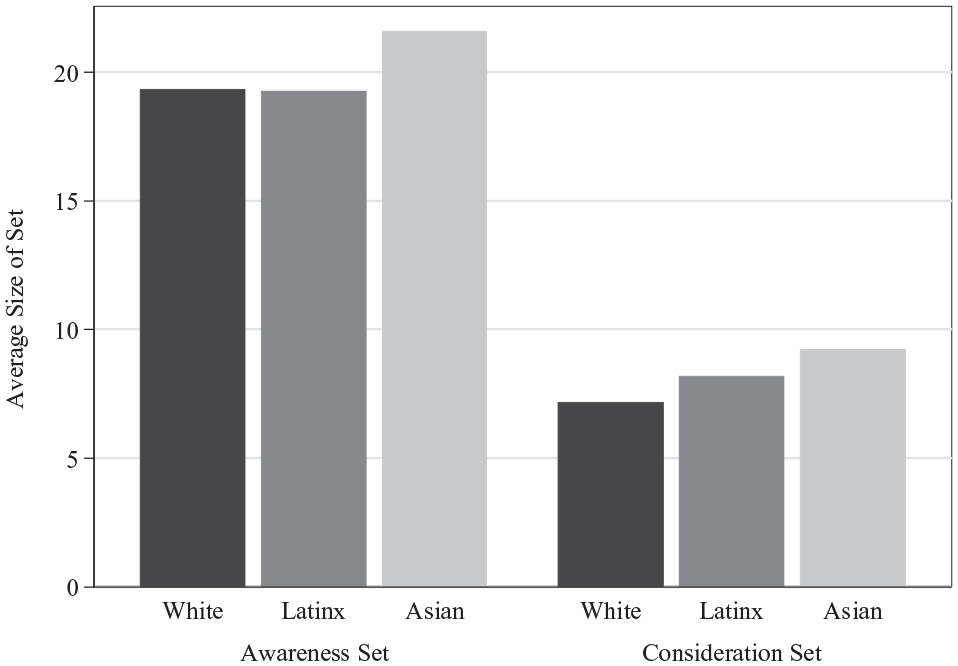
Average number of majors in awareness and consideration sets, by race/ethnicity.

Average number of majors in awareness and consideration sets, by gender.
Table 3 formalizes these findings using regression models. Controlling for previous achievement, educational goals, student status, and parental education, Asian students are aware of about 2.4 more majors than their White peers, and this difference is statistically significant. The difference in the size of the awareness sets of male and female students is not statistically significant.
Predicting Size of Awareness and Consideration Sets Using Student Characteristics

Note. Data come from a survey of 261 students at one northern California community college. Demographic/academic controls include if the student is in their first year of college, self-reported high school GPA (grade point average), if either parents has a college education, and if the student has a transfer goal. Class fixed effects control for the class the student was in when he or she took the survey. Students were randomly given one of four survey forms (each of which had a different set of majors). Fixed effects indicating which survey form they saw are included in the regressions.
p < .10. *p < .05. **p < .01. ***p < .001.
The second panel of Figure 3 presents a visual description of the average number of majors that White, Latinx, and Asian students say that they would consider choosing. Asian students have larger consideration sets than Latinx and White students, and Latinx students have larger consideration sets than White students. The second panel of Figure 4 presents a visual description of the average number of majors that male and female say that they would consider choosing. Male students have slightly larger consideration sets than their female peers. Table 3 formalizes these descriptive findings using regression models. There are no significant differences in the size of consideration sets across our three comparisons.
Composition of Awareness and Consideration Sets
Figure 5 presents the Index of Dissimilarity at awareness and consideration for each of three pairs of groups of students from our sample. For all three comparisons, the set of majors considered was more different from the set of majors of which students were aware (D was smaller for awareness than for consideration for all groups). The composition of awareness sets did not vary hugely between groups; on average, about 6% of the majors of which one group is aware would have had to change for each of the pairs of groups to have equal composition of awareness sets.

Dissimilarity indices for awareness and consideration sets, Asian–White, Latinx–White, and male–female.
In terms of consideration, male and female students said they were considering the least similar majors (19% of considered majors for male or female students would have to change majors for equal representation), but we note that the Dissimilarity Indices at each stage are not statistically significantly different from each other (e.g., the male–female consideration Dissimilarity Index is not statistically different from the Asian–White consideration Dissimilarity Index). 7
Table 4 presents results from the regression analyses that examine if certain groups of students are more or less likely to be aware of or consider certain types of majors. There are no significant differences between White and Asian, White and Latinx, and male and female students in the proportion of majors in the awareness set that are STEM or CTE majors. However, conditional on having the same proportion of majors from the awareness set in the consideration set and having the same proportion of majors in the awareness set that are STEM majors, female students, on average, consider choosing fewer STEM majors than male students. There is also a marginally significant difference between Asian and Latinx in the proportion of STEM majors in the consideration set (significance determined in post hoc F test).
Predicting Composition of Awareness and Consideration Sets Using Student Characteristics

Note. Data come from a survey of 261 students at one northern California community college. Prop. = proportion; AS = awareness set; CS = consideration set. Demographic/academic controls include if the student is in their first year of college, self-reported high school GPA (grade point average), if either parent has a college education, and if the student has a transfer goal. Class fixed effects control for the class the student was in when he or she took the survey. Students were randomly given one of four survey forms (each of which had a different set of majors). Fixed effects indicating which survey form they saw are included in the regressions.
p < .10. *p < .05. **p < .01. ***p < .001.
Discussion and Conclusion
There is significant segregation, by gender and by race/ethnicity, in career fields, and this segregation is reflected in students’ choices of college major. However, previous research has not examined if this segregation is also present in the group of majors of which students are aware or would consider choosing. By ignoring these preceding steps of the major choice process, research ignores potentially powerful opportunities for affecting major choice and reducing eventual segregation.
In this study, we examined the sets of majors of which a sample of community college students said they were aware and the set they indicated they would consider choosing. Students were not aware of all of the majors available to them; on average, students were aware of about two thirds of the majors presented to them. This roughly comports with previous literature on the size of awareness sets for complex academic and career decisions (Dawes & Brown, 2002; Laroche et al., 1984). Of those majors of which they were aware, students would consider choosing about eight majors (about 40%). This ratio of consideration to awareness fits with previous literature about decision making (Crowley & Williams, 1991, find an average ratio of 3.9/10 for consideration to awareness across a number of studies) and provides evidence that students might be making this decision using strategies similar to how we make other consequential decisions.
The wide variation in the proportion of students who were aware of majors (ranging from 11% to 90%, with a mean of 61%) is an important result for school administrators. First, awareness is a prerequisite for choice; schools could be missing opportunities for simple interventions that could affect eventual choices. Second, past work has shown that when decision makers have high familiarity with some choices and very low familiarity with other choices, they are unlikely to work to gain information about the less familiar options (Hoyer & Brown, 1990; Sinn et al., 2007). In this complicated, high-stakes context in which some choices are exceedingly familiar, this phenomenon could have important consequences.
We find suggestive evidence that levels of awareness differ across student groups. In our sample, Asian students were aware of about two and a half more majors than their White peers. The composition of awareness sets did not differ across White and Asian students, and conditional on being aware of the same kinds of majors, their consideration sets did not differ. While this indicates that information sharing could potentially reduce segregation between certain groups, schools must be careful regarding where information is shared. If there are differences, by race and ethnicity or gender, in the spaces in which the information is shared, such policies could inadvertently increase segregation by major.
Differences in patterns of consideration between some groups of students indicates that informational interventions might not reduce all forms of segregation. Conditional on being aware of the same number of STEM majors, female students consider fewer STEM majors than their male peers. Gender differences in STEM major choice do not appear to be due to informational differences; simply making female students aware of STEM majors might not reduce segregation. In this case, programs such as introductory classes or seminars that give students experience with the methods and related careers of specific fields, or that highlight the ways in which careers in certain fields can “provide direct benefits to society” (Eccles, 2007, p. 209), might reduce gaps in consideration between male and female students.
The Index of Dissimilarity analyses show that the levels of segregation in consideration in our sample are lower than levels of segregation for final choice for graduates from this school. 8 This finding mirrors the findings of Alon and DiPrete (2015)—the decisions of groups of students become increasingly dissimilar moving closer to final choice. This indicates that enacting policies to encourage groups of students to consider similar majors will not necessarily result in equality among eventual choices. If students have different experiences in classes, experience different climates within departments, or get different signals from instructors, merely equalizing consideration sets will not fully reduce segregation.
Thus, this study indicates that intervening at only one stage of the major choice process might not reduce overall segregation. Intervening at the point of awareness might reduce the extent of differences in awareness sets, but might not affect differences in consideration sets; intervening to increase similarity among consideration sets does not necessarily mean that students will eventually choose the same major. These results might reflect the ways in which students’ environments and experiences have shaped their decision-making processes. While this study does not explicitly examine many important characteristics of majors (e.g., probability of employment or perceived difficulty), it does point to the fact that such factors might matter differently at different stages for groups of students.
Similarly, even if schools are successful in equalizing major choices, this will not necessarily lead to full occupational integration. Conditional on major choice, groups of students end up in different jobs. Such differences are particularly pronounced for male and female students (Bobbitt-Zeher, 2007; Joy, 2000; Morgan, 2008) and are shaped by societal norms and expectations (e.g., Cha, 2013; Gherardi & Poggio, 2001) as well as personal preferences (e.g., Wiswall & Zafar, 2017). Reducing segregation in college majors may reduce occupational segregation, but it is unlikely to eliminate it.
However, we note that the expected alignment between field of major and field of career is major specific, and majors that provide more general knowledge and skills exhibit higher career mismatch than those providing specific knowledge and skills (e.g., kinesiology, business; Robst, 2007). Because community colleges offer more professionally oriented and skill-based degree programs than 4-year schools, alignment between majors and careers is stronger in community colleges than in 4-year schools (Stevens et al., 2019).
This study also highlights that some policies and programs could serve to exacerbate levels of segregation. For example, as recent research shows a positive relationship between early major declaration and student success, many institutions are focusing on helping students enter programs very early in their college career (Jenkins & Cho, 2012). However, incentivizing early choice of major could create more segregation if there are large differences in the composition of awareness sets between students. Similarly, depending on how meta majors are structured and implemented, such policies could increase segregation if there are differences in awareness between student groups (Baker, 2018). By more explicitly and formally acknowledging and examining these multiple stages, schools might decide to organize their curricular programs in different ways.
Limitations
This study has a number of limitations. First, this pilot study is based on data from a small, unique sample. All of the students in this study attended the same community college in Northern California. Like all schools, the unique context of this school and the community in which it is situated affect students’ knowledge, experiences, and preferences. While the general methods employed in this study could be applied in other contexts, researchers and administrators should be careful not to assume that the findings of this study would hold in other contexts.
The design of this study could also affect the findings. We do not have information about students’ awareness and consideration before entering college, and we do not track students over time. This study cannot speak to how various experiences and factors—such as interactions with peers and faculty, classroom experiences, signals about fit, and information about ability—affect students’ consideration. With a cross-sectional design, this study examines differences between groups of students but not how the process unfolds for particular groups of students. A longitudinal design that more explicitly examines this dynamic process would be an important extension to this study.
Also, awareness, as measured in this study, might be picking up consideration. Students who know they are interested in STEM fields, for example, might be more likely to visit STEM department websites or to talk to students who have taken classes in these fields. This highlights the complexity of measuring an unfolding, dynamic process. Despite this limitation, measuring awareness and consideration early in college is important, as colleges provide unique opportunities for intervention and is the first point at which most students in the United States experience curricular differentiation.
In this study, we describe majors using very crude categorizations (STEM and CTE). There are a number of other characteristics (e.g., local labor market descriptors, probability of finishing the degree) that are important. We do not measure if the awareness and consideration sets differ along such dimensions. Larger data sets with detailed labor market data could allow us to examine if the composition of awareness and consideration sets differs in ways that have implications for students.
As we noted earlier, as the correlation between major and career is not perfect, this study can only uncover part of the full story regarding how and why career fields have become segregated by race/ethnicity and gender. A natural extension to this study would be to examine students’ awareness and consideration of the careers associated with their degree.
Finally, the comparisons we are able to make with these data set are limited. The small sample size restricts the groups that we can examine, and the race categories we employ are crude and not mutually exclusive. More fine-grained descriptions of race, and the intersections of these categories with gender and socioeconomic experience, could allow for a more nuanced understanding of lived experiences and societal expectations.
Conclusion
Academic fields and career fields are segregated by gender, ethnicity, and race. This segregation has implications for wage gaps and growing economic inequality. Classic models of choice, which assume awareness and consideration of all options, run the risk of obscuring important features of the decision process that could explain continued segregation. Many policies and programs in community colleges aim to structure the major choice process by intervening at the point of awareness or consideration. These interventions are predicated on varied theoretical foundations and will only have the intended effects if they align with how students actually make decisions.
This study expanded on previous work by exploring a multistage decision-making model of student major choice. We identified differences in the size of awareness sets and the composition of consideration sets across some student groups. Such differences could exist between other marginalized groups not included in this study, such as low-income and first-generation college students. The results of this study have implications for how and when to share information with incoming community college students with a view toward increasing parity across programs of study. Schools should explicitly examine the majors of which their students are aware and those they would consider choosing and explore how such analyses could be translated into programmatic innovations that could affect career segregation.
Footnotes
Appendix
Notes
Authors
RACHEL BAKER is an assistant professor of education at the University of California, Irvine. She studies how institutional and state policies affect students’ decision making in higher education.
GABE AVAKIAN ORONA is a PhD student in education at the University of California, Irvine. His research focuses on measurement and assessment in higher education.