




Abstract
Learning to teach is rife with challenges. Preservice teachers’ self-efficacy can potentially mitigate the stress of these challenges, and teacher education programs are fundamental in helping them build this important resource. As such, understanding the foundations of self-efficacy is important for researchers and teacher educators alike. Grounding our study in social network theory, we explored the relationship between sense of belonging to a teacher education program, network centrality, and self-efficacy. Our sample included 245 preservice teachers in three university teacher education programs. We found that sense of belonging to the program and network centrality (in-degree and out-degree) were significantly and positively related to preservice teachers’ self-efficacy beliefs. This study builds on a growing literature that explores the relationships between preservice teachers’ social networks and their beliefs and practices.
Keywords
Learning to teach is fraught with insecurity and self-doubt, which impel many early-career teachers (ECTs) to leave the profession (Ingersoll et al., 2018; Nichols et al., 2017; Richmond et al., 2011). Teaching is an inherently vulnerable and stressful job, especially for preservice teachers (PSTs) and ECTs, who often face unique stressors and dilemmas (Kelchtermans, 2009; Kyriacou, 2001; Pillen et al., 2013). For example, when aspiring teachers enter university teacher education programs (TEPs), they are often shocked by the chasm between their visions of good teaching and those of teacher educators (Richmond et al., 2011). Later, as they become PSTs, some find that the type of teacher they thought they would be does not match the type of teacher they become, both in their student teaching placements and as they transition into the first years of teaching (Nichols et al., 2017; Sydnor, 2017). This dissonance can bring feelings of self-doubt and make PSTs’ commitment to the profession falter or disappear completely (Hong, 2010).
Fostering teacher self-efficacy in PSTs has the potential to mitigate these problems (Hong, 2010; Yost, 2006). For decades, researchers have found relationships between teacher self-efficacy and increased confidence, motivation, and resilience, as well as improved classroom practice (Bandura, 1997; Kleinsasser, 2014; Pajares, 1996; Tschannen-Moran et al., 1998; Tschannen-Moran & Woolfolk Hoy, 2001; Zee & Koomen, 2016). While these outcomes and benefits for teachers are well established, there has been scant research on the antecedents of teachers’ self-efficacy (Tschannen-Moran & Woolfolk Hoy, 2007) and even less inquiry into the social antecedents of PSTs’ self-efficacy.
Increasingly, the education literature has shown the importance of social networks for the well-being of ECTs (Baker-Doyle, 2012; Barnatt et al., 2017; Fox & Wilson, 2009; Thomas et al., 2019). But despite a “logical connection” (Siciliano, 2016, p. 228), few studies have explored the relationship between PSTs’ social networks and their feelings of self-efficacy and other positive outcomes. Furthermore, the studies that have explored PSTs’ networks show positive relationships between network structures and beneficial outcomes, demonstrating the promise of this line of inquiry (e.g., Liou & Daly, 2018; Liou et al., 2016; López Solé et al., 2018). Similarly, scant research has explored PSTs’ sense of belonging to a TEP and its outcomes, despite literature that shows sense of belonging to be central to motivation and well-being (Lambert et al., 2013; Ryan & Deci, 2000, 2017).
This study builds on the literature that has begun to explore the social side of PSTs’ self-efficacy development—specifically, social networks and sense of belonging (Borgatti & Lopez-Kidwell, 2011; Wasserman & Faust, 1994). In particular, we asked the following questions:
What is the relationship between PSTs’ social network position and their self-efficacy beliefs?
What is the relationship between PSTs’ sense of belonging to the TEP and their self-efficacy beliefs?
Literature Review and Theoretical Framework
Teacher Self-Efficacy
The literature on teacher self-efficacy
1
shows that it is related to a host of beneficial outcomes for both teachers and students (Zee & Koomen, 2016). Self-efficacy is a future-oriented judgment of abilities that has little to do with actual competence and instead is an expression of perceptions of what people believe they can do (Bandura, 1997). Skaalvik and Skaalvik (2010) defined teacher efficacy as “individual teachers’ beliefs in their own ability to plan, organize, and carry out activities that are required to attain given educational goals” (p. 1059). Pajares (1996) contended that efficacy beliefs help determine how much effort people will expend on an activity, how long they will persevere when confronting obstacles, and how resilient they will prove in the face of adverse situations—the higher the sense of efficacy, the greater the effort, persistence, and resilience. (p. 544)
Bandura (1997) identified four primary sources of self-efficacy: mastery experiences, vicarious experiences, verbal persuasion, and psychological and affective states. Mastery experiences for teachers come from success in the classroom, and they tend to be the strongest source of self-efficacy (Bandura, 1997; Mulholland & Wallace, 2001). Vicarious experiences are those where the activity of interest is successfully modeled by others. This can be especially powerful when one identifies with the person who is modeling. Verbal persuasion comes in the form of praise or feedback that supports teachers’ actions, including support from peers (Tschannen-Moran & Woolfolk Hoy, 2007). Novice teachers who feel supported by colleagues and administration likewise often have higher levels of self-efficacy (Flores, 2006; Tschannen-Moran & Woolfolk Hoy, 2007). PSTs who perceive higher levels of support also tend to increase self-efficacy during their time in the TEP (Woolfolk Hoy & Burke Spero, 2005). Importantly, verbal persuasion is generally understood in terms of the recipient’s view of the person giving it—for example, an uncle’s general praise about a PST’s ability to teach may not affect self-efficacy as much as praise from a respected peer in the TEP. The fourth source of self-efficacy is physiological and affective states. People often read their physiological states (e.g., increased heart rate) or moods during various situations to give them cues about each situation and how to act (Bandura, 1997).
“Teachers’ efficacy beliefs have a profound effect on the educational process” (Knoblauch & Woolfolk Hoy, 2008, p. 166), as well as on teachers’ motivation, commitment, and general resilience (Day, 2008; Flores, 2006; Gu & Day, 2007). Teachers with high self-efficacy for instructional strategies, for example, tend to believe that all students are teachable; they devote more class time to academic activities, put more effort into struggling students, and praise academic achievements—all of which are related to student achievement (Dunn & Rakes, 2011; Tschannen-Moran & Woolfolk Hoy, 2007; Zee & Koomen, 2016). Teachers with higher self-efficacy experience lower levels of emotional exhaustion and burnout (Hultell et al., 2013; Skaalvik & Skaalvik, 2010, 2014), lower levels of stress (Skaalvik & Skaalvik, 2016), and higher levels of job satisfaction and engagement (Day & Gu, 2009; Skaalvik & Skaalvik, 2014).
Self-efficacy can have profound impacts on ECTs and their future. Those who begin their teaching careers with high levels of self-efficacy tend to show increased motivation and persistence, which leads to increased efficacy in their careers (Bandura, 1997; Tschannen-Moran & Johnson, 2011). Additionally, ECTs who have and maintain high levels of self-efficacy when they enter the workforce are better able to deal with feelings of isolation and reality shock (Flores, 2006). Just as it helps ECTs cope with doubts and struggles in learning to teach (Yost, 2006), maintain a more positive attitude (Gu & Day, 2007), and palliate feelings of burnout (Hong, 2010), we believe that self-efficacy can have similar effects on PSTs.
Bates et al. (2011), for example, found that PSTs with a high sense of self-efficacy for teaching math had a stronger belief that they could have a positive effect on their students than those with lower math self-efficacy. Moreover, self-efficacy has been found to increase over time in a TEP and to decrease in the first year of teaching (Bokhove & Downey, 2018; Woolfolk Hoy & Burke Spero, 2005). As such, TEPs play an important role in the development of self-efficacy and resilience in PSTs (Putman, 2012; Yost, 2006). It is therefore imperative that these programs provide opportunities for PSTs to develop and bolster their self-efficacy, to act as a bulwark against the difficulties they may face as new teachers (Flores, 2006; Putman, 2012; Tait, 2008).
Sense of Belonging
A sense of belonging is integral to people’s identity formation and maintenance of that identity (Brewer, 1991; Gee, 2000; Wenger, 1998). Moreover, it is an innate and fundamental human need (Baumeister & Leary, 1995). It means having relationships with people or groups of people who bring about a sense that one fits in (Lambert et al., 2013). Relationships that promote a sense of belonging give people a sense of purpose and meaning in life (Lambert et al., 2013). As one becomes a more central member of a community, one forms a sense of belonging and identity with that community (Lave & Wenger, 1991; Wenger, 1998).
A large body of scholarship on sense of belonging in education has focused on students in K–12 and undergraduate settings. For instance, in K–12 contexts, researchers have found that positive interactions and authentic relationships between peers and with teachers can increase students’ sense of belonging (Bjorklund, 2019; Furrer & Skinner, 2003; Juvonen, 2006). Increased sense of belonging has been shown to increase engagement as well as academic motivation and performance (Furrer & Skinner, 2003; Goodenow, 1993; Urdan & Schoenfelder, 2006). With respect to undergraduates, the scholarship has shown that those who feel like they belong are more likely to seek out support when they need it, be more motivated to learn, and have an easier time communicating with faculty (Levett-Jones & Lathlean, 2008; Strayhorn, 2012). Additionally, Freeman et al. (2007) found a positive relationship between undergraduate students’ sense of belonging in a class and academic self-efficacy.
Despite the importance of sense of belonging for students, few scholars have explored its impact on teachers or PSTs (Skaalvik & Skaalvik, 2011). In one study, Freedman and Appleman (2008) followed PSTs for the first few years after leaving a TEP and found that one PST struggled to fit in with her program and with her peers. She reported not feeling supported by the program and subsequently left the profession within the first 5 years. Conversely, some studies have found that belonging to a supportive group of peers in a TEP fosters resilience and support for new teachers (Flores, 2006; Tait, 2008). Being part of a strong learning community in a TEP where peers feel supported can facilitate resilience and empower PSTs as they become new teachers (Le Cornu, 2008, 2009).
Skaalvik and Skaalvik (2011) found that belonging was positively related to teachers’ job satisfaction and negatively related to their emotional exhaustion. Other scholars found a positive relationship between teachers’ identification with a school—which is related to belonging—and their self-efficacy (Chan et al., 2008). Similarly, some have argued that having a strong affiliation with a community of teachers can lead to increased self-efficacy (Kruse & Lillie, 2000). We contend that if PSTs feel a sense of belonging to a community where they have received and will continue to receive praise, feedback, and ideas, this will enhance feelings of self-efficacy. Extending the work of Freeman et al. (2007), we posit that a strong sense of belonging to a TEP sets the conditions to promote self-efficacy in the work of that community. As such, we hypothesize that PSTs who feel a greater sense of belonging to their TEPs will report higher levels of self-efficacy (Hypothesis 1).
Social Network Theory
Mutual engagement with peers in a community means seeking them out and being sought by them—it requires interaction (Wenger, 1998). To examine these interactions and their impacts, we used social network theory because it provides a formal and conceptual way to think about the social world. It is based on the notion that relationships among interacting units are important in the actions of individuals (Borgatti et al., 2013; Wasserman & Faust, 1994). In a social network perspective, relationships (ties) between people (actors) are the central focus, rather than personal attributes, as is the case in most social science research (Borgatti & Ofem, 2010; Wasserman & Faust, 1994). A network approach privileges the “web of relationships in which actors are embedded that both constrain and provide opportunities” (Borgatti & Ofem, 2010, p. 18).
Network scholars contend that various network structures catalyze or constrain social resources and actions of actors across a given network (Burt, 1987, 2004; Granovetter, 1973; Moolenaar & Daly, 2012). For example, people who are more central to a network have more access to social capital (Lin, 2001). Engagement in a social network involves being sought by and seeking others. We can measure these activities using social network theory via in-degree (the number of people who seek an actor out) and out-degree (the number of people an actor seeks out). People with higher in-degree and out-degree are considered more central to the network (Wasserman & Faust, 1994).
Siciliano’s (2016) work supports the notion that network structures are related to teacher self-efficacy. He found that the self-efficacy of other teachers in a teacher’s advice network had a positive relationship with self-efficacy—the higher the efficacy of the teachers in one’s network, the higher their self-efficacy. Additionally, increased network density has been found to be related to increased collective efficacy in teachers (Berebitsky & Salloum, 2017; Moolenaar & Daly, 2012). The limited research that exists on PSTs’ social networks shows a connection between networks and self-efficacy. Liou et al. (2016) found, for example, that PSTs’ network positions were positively related to better instructional practices and improved teachers’ performance during their TEP.
The type of network also relates to the network’s usefulness. Liou and Daly (2018) found, for example, that PSTs who were central in an instrumental network increased self-efficacy for instructional strategies over time. Relationships in instrumental networks tend to be geared toward reaching organizational or professional goals; they may transfer resources like work-related information (Moolenaar & Daly, 2012). In contrast, expressive networks are more social, intimate, or friendship based. They tend to have an affective component, like support or advice about personal problems (Moolenaar & Daly, 2012). In the current study, we explored the support networks (a type of expressive network) of PSTs among their peers in their TEP.
When scholars explore support networks, they generally conceive of them as the personal networks actors use when they need support from others (e.g., Bokhove & Downey, 2018; Rosenfeld et al., 2000; Thomas et al., 2019; Walker et al., 1993). The size of an ECT’s support network has been found to be positively related to ECT job satisfaction and motivation to teach (Thomas et al., 2019). Bokhove and Downey (2018) explored the relationship between the growth of PSTs’ support networks and the development of self-efficacy over time. They found that as self-efficacy increased, the size of a PST’s support network decreased. They posited that this could be because when a PST’s feelings of efficacy increase, their need for support from peers decreases, resulting in smaller networks.
Our study builds on Bokhove and Downey’s (2018) exploration of the total size of PSTs’ support networks. We differentiate between incoming (in-degree) and outgoing (out-degree) ties in PSTs’ support networks and teacher self-efficacy. We also add to the work of Liou and Daly (2018) by exploring the relationship between actor centrality in an expressive network and self-efficacy by asking PSTs whom they seek out when they need support. We focus on expressive networks because they can be vehicles for positive verbal persuasion, which can be related to increased self-efficacy (Bandura, 1997; Tschannen-Moran & Woolfolk Hoy, 2007). We propose that connectedness to peers within a TEP—the ability to seek the support of others and to be sought out by others for support—creates opportunities for PSTs to receive support, praise, and feedback—that is, social persuasion (Bandura, 1997)—which will improve self-efficacy. We therefore hypothesize that PSTs who are more central to the support network, as measured by in-degree and out-degree, will report higher levels of self-efficacy (Hypothesis 2).
Methods
Study Participants and Data Collection
We conducted surveys at three university TEPs in the western United States during the winter and spring quarters of 2018. Each TEP created cohorts of PSTs based on credential type—multiple or single subject—for a total of seven cohorts in our sample. A cohort model groups the same PSTs together for several classes during the course of their program to foster community, relationships, and supportive social ties (Dinsmore & Wenger, 2006). Two of the TEPs in our study (TEPs 1 and 2) solely catered to graduate students who were pursuing a master’s degree in education (MEd) while also pursuing a teaching credential; the third (TEP 3) offered a similar MEd program as well as a program for undergraduates to complete a credential by the time they graduated. These sites were selected because they were representative of other TEPs in the region in terms of mission and population.
We sent personalized survey links to 339 PSTs, and they were given time in class to complete the survey; a total of 265 (78%) participated. In TEP 1, we had response rates of 94% and 100% for the single- and multiple-subject cohorts, respectively; in TEP 2, we had response rates of 93% and 86% for the single- and multiple-subject cohorts, respectively; in TEP 3, we had response rates of 61%, 51%, and 90% for the single-subject, multiple-subject, and undergraduate cohorts, respectively. We conducted a listwise deletion of anyone who had missing data for any of the variables in the models. This resulted in dropping 20 participants (7.5%) from our original sample, for a final sample of 245.
We conducted our network surveys at the cohort level. To collect social network data, we gave the participants rosters of their cohort (Scott, 2000) and asked them to select their frequency of interaction with members of the cohort whom they seek out when they need support. Their options for frequency of interaction (tie strength) ranged from 1 = once a quarter to 4 = daily or almost daily.
At the time of the survey, all the participants had some teaching experience as student teachers or interns and were teaching in classrooms in one of those capacities. Over three quarters (76%) of the PSTs in our sample were female, and 24% were male (see Table 1). Half (50%) were multiple-subject candidates, and the remaining half were single-subject candidates. The average undergraduate GPA of the participants was 3.42 (SD = 0.32), ranging from 2.41 to 4.00. The average time since completing their bachelor’s degree was 2.2 years (SD = 3.95), with a range of 0 to 33 years. Those who indicated 0 years since completion either went straight from their undergraduate program into the TEP or were one of a group of 10 students in the sample enrolled in an undergraduate program leading to a credential.
Descriptive Statistics (N = 245)
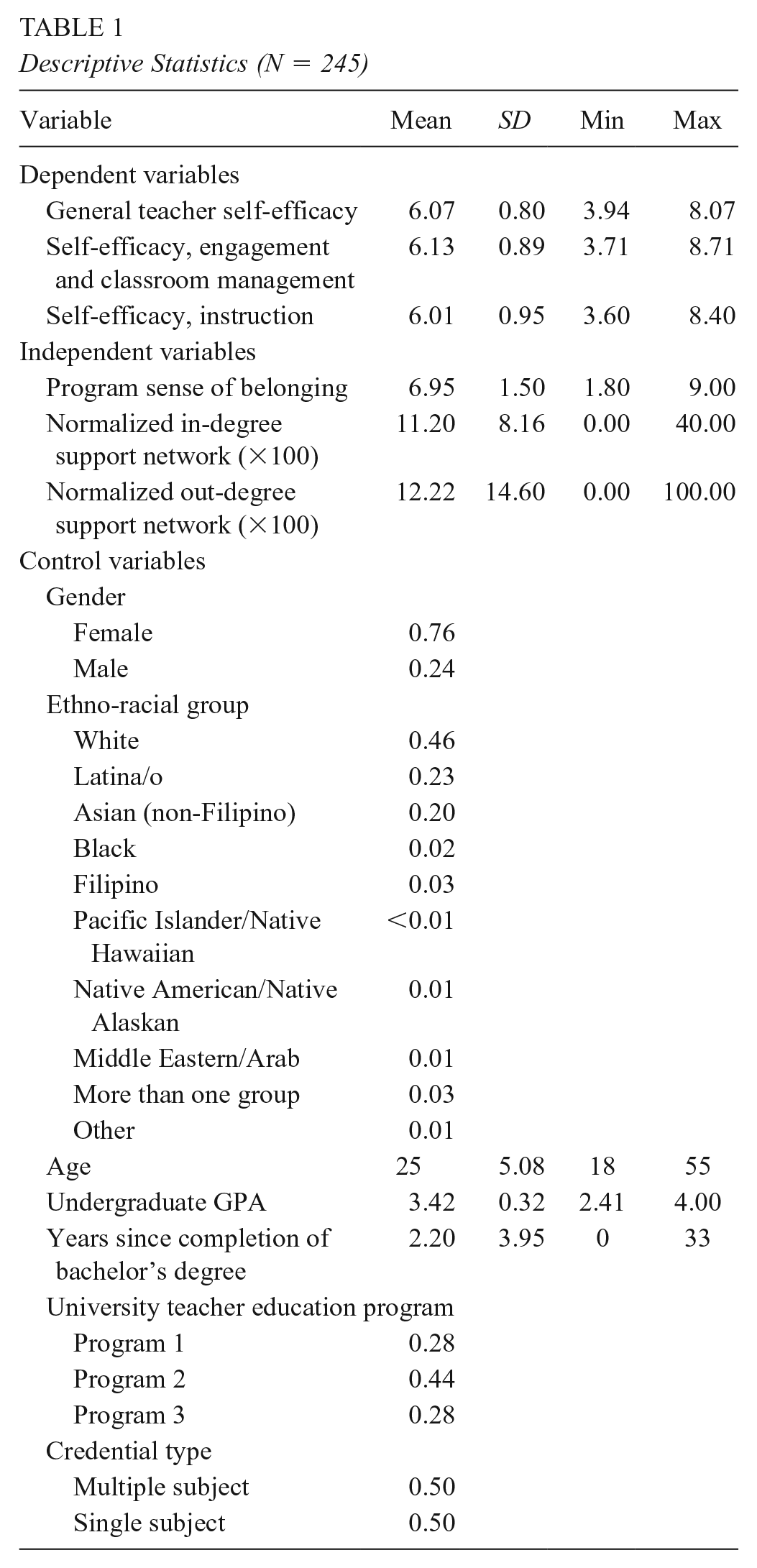
The average age of the participants was 25 years (SD = 5.08), with ages ranging from 18 to 55 years. Most of our participants identified as White (46%), with slightly over one fifth (23%) identifying as Latina/o and one fifth (20%) identifying as Asian (non-Filipino). The remaining 11% of our sample identified as Filipino (3%), more than one ethno-racial group (3%), Black (2%), Native American/Native Alaskan (1%), Arab/Middle Eastern (1%), other (1%), or Native Hawaiian/Pacific Islander (<1%).
Variables
Dependent Variable: Self-Efficacy
We drew on a teacher self-efficacy scale that has been used and validated in prior work (Tschannen-Moran & Woolfolk Hoy, 2001) and that explored the PSTs’ sentiments about self-efficacy in their teaching practice. This scale has a well-established, three-factor solution—self-efficacy for classroom management, self-efficacy for student engagement, and self-efficacy for instructional strategies. The scale included items like “How much can you motivate students who show low interest in school?” (self-efficacy for student engagement), “To what extent can you use a variety of assessment strategies?” (self-efficacy for instructional strategies), and “How much can you do to control disruptive behavior in the classroom?” (self-efficacy for classroom management). However, Tschannen-Moran and Woolfolk Hoy (2001) have noted that this factor solution is “less distinct” (p. 799) for PSTs. Given this, Fives and Buehl (2010) contended that a factor analysis should be done when using this scale on PSTs to see if the three-factor solution holds.
We initiated a principal component analysis (PCA) to verify the factors of the scale (Fives & Buehl, 2010; Tschannen-Moran & Woolfolk Hoy, 2001). Each item used a 9-point Likert-type scale that ranged from 1 = nothing/not at all to 9 = a great deal. Our PCA and varimax rotation yielded two factors. The first factor—self-efficacy for classroom management and engagement—was an amalgamation of Tschannen-Moran and Woolfolk Hoy’s (2001) two subscales. It included seven items with factor loadings ranging from .54 to .80 (α = .85), had an eigenvalue of 4.82, and accounted for 29% of the variance. A higher score indicated stronger feelings of self-efficacy in the ability to manage the classroom and increase student engagement.
The second factor—self-efficacy for instructional strategies—included five items with loadings ranging from .58 to .75 (α = .86). It had an eigenvalue of 1.58 and accounted for 23% of the variance. A higher score indicated stronger feelings of self-efficacy regarding pedagogy and the ability to work with students. Tschannen-Moran and Woolfolk Hoy (2001) and Fives and Buehl (2010) argued that because the three-factor solution may be inadequate for PSTs, a single-factor self-efficacy scale may be more appropriate. As such, we also included an omnibus or general teaching efficacy scale (α = .86) with all 12 items discussed above (Bokhove & Downey, 2018; Putman, 2012; Tschannen-Moran & Woolfolk Hoy, 2001).
Independent Variable: Program Sense of Belonging
We understand program sense of belonging as PSTs’ feelings that they are a part of and valued by the TEP in general, which encompasses faculty; cooperative teachers; positive learning environments; and ideological fit. We modeled our program sense of belonging scale on a previously validated scale (Anderson-Butcher & Conroy, 2002) to fit the context of the TEPs in the study. Each item in the scale used a 9-point Likert-type scale ranging from 1 = strongly disagree to 9 = strongly agree. We conducted a PCA that yielded one factor consisting of five items; factor loadings ranged from .68 to .79 (α = .88) and accounted for 21% of the variance in the PCA. One example of an item from the scale is “I feel supported in the program.” A higher score indicated a greater sense of belonging to the program in general.
Independent Variable: Support Network, Out-Degree and In-Degree
Out-degree represents the number of people a PST sought out for support. It can be thought of as a PST’s activity in terms of seeking support from peers (Borgatti, 2005; Liou & Daly, 2018). In-degree corresponds to the number of peers who reached out to a particular PST for support. It can be understood as a representation of that individual’s “popularity” in supporting his or her peers (Liou & Daly, 2018; Wasserman & Faust, 1994). Each of these can be viewed as a measure of centrality in the network. A higher in-degree and/or out-degree indicates that an actor is more central to the network and more resources flow through that actor (Borgatti, 2005). We used a normalized in-degree and out-degree, which is a ratio of the number of in-degrees or out-degrees divided by the total number possible. To make them easier to interpret in our models, we multiplied both measures by 100.
Control Variables: Demographics
We included a host of demographic variables that are not shown in our models as they were not the focus of our study. In all our regression models (described below) we controlled for gender, ethno-racial group, age, undergraduate GPA, years since completion of bachelor’s degree, TEP, and credential type (multiple- or single-subject). Past literature has shown these variables to be relevant to self-efficacy and to the experiences of PSTs in TEPs (Brown, 2014; Bullough & Knowles, 1990; Skaalvik & Skaalvik, 2007; Tschannen-Moran & Woolfolk Hoy, 2007). PSTs of color (Brown, 2014) and older PSTs for whom teaching may be a second career (Bullough & Knowles, 1990) often have distinctly different experiences in TEPs from their White or first-career peers, which may affect self-efficacy. Moreover, Tschannen-Moran and Woolfolk Hoy (2007) contended that self-efficacy can vary between high school and elementary school teachers.
Data Analysis
Social network data violate the independence assumption of ordinary least squares regression because actors and ties in the same network are, by definition, not independent (Hanneman & Riddle, 2005). Additionally, the intraclass correlation showed that 14.3% of the variance in general teaching self-efficacy, 13.4% of the variance in self-efficacy in classroom management and engagement, and 10.6% of the variance in self-efficacy for instructional strategies were accounted for by between-cohort differences. To address the violation of independence and the between-cohort differences, we used robust standard errors by clustering by cohorts (where the networks were located), using the cluster option in Stata 15 (Mehmetoglu & Jakobsen, 2017). We used UCINET (Borgatti et al., 2002) to explore the standardized in-degree and out-degree centrality of the strong ties—seeking support weekly or daily/almost daily—in order to measure network centrality. We focused on strong ties as scholars have noted that these are the most robust and enduring and because they represent trust (Granovetter, 1973; Ruef, 2002).
Results
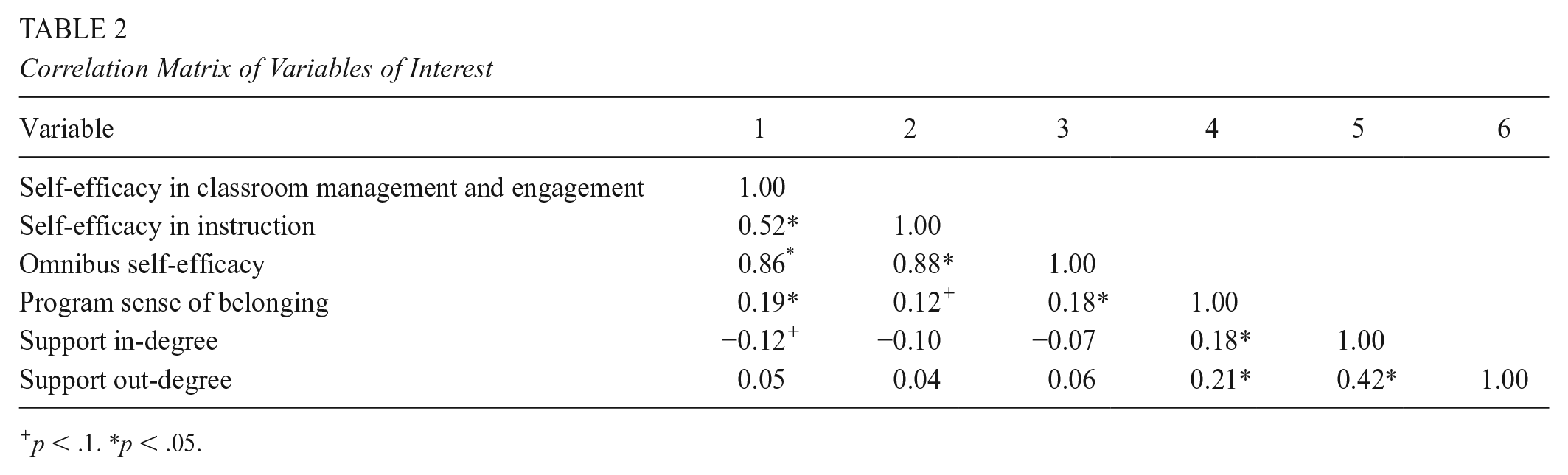
Table 2 shows the correlation between our variables of interest. Our four ordinary least squares models for each scale (Tables 3 through 5) include the demographic controls to show a baseline R2. We then include sense of belonging with the controls, our network variables with the controls, and all variables together in the final model to highlight the amount of variance explained by our variables of interest.
Correlation Matrix of Variables of Interest
p < .1. *p < .05.
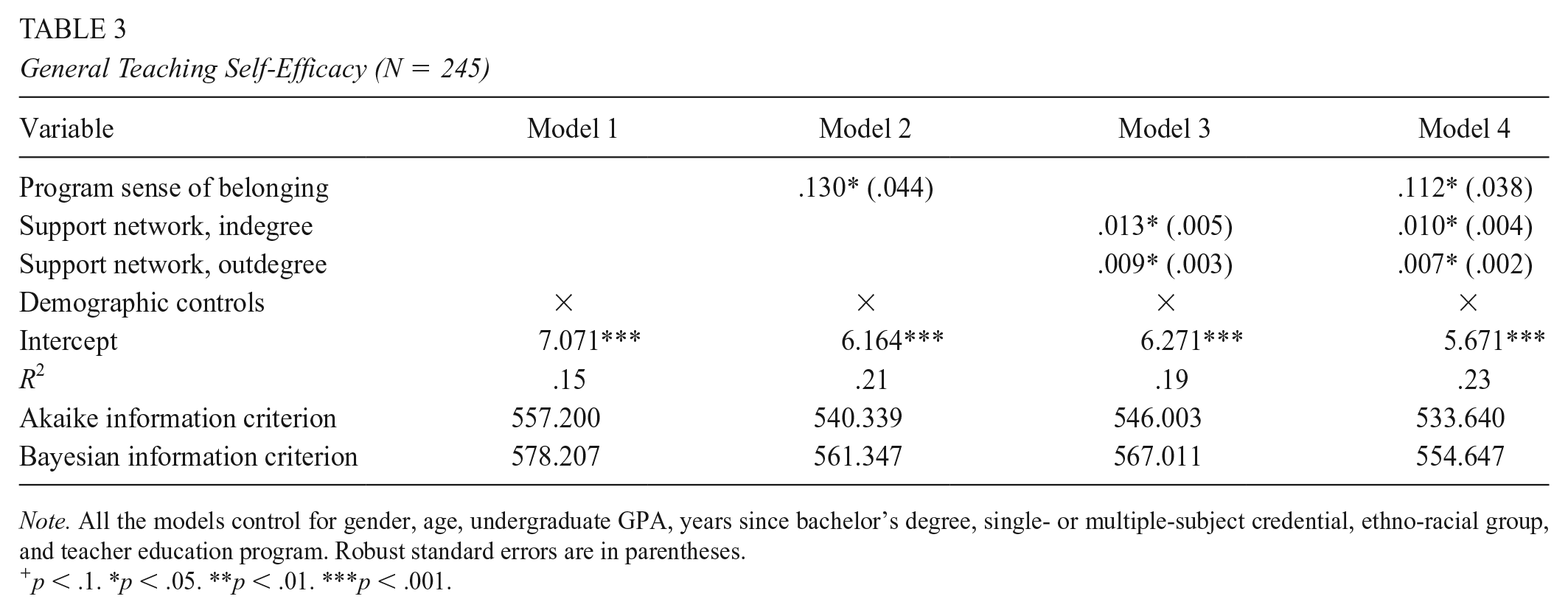
Model 1 shows that our demographic controls accounted for 15% of the variance in general teacher self-efficacy (Table 3). In Model 2, sense of belonging was significant (b = .130, p < .05) and positively related to teaching self-efficacy. This means that for every one-unit increase in sense of belonging, general self-efficacy increased by 0.130. In Model 3, both in-degree (b = .013, p < .05) and out-degree (b = .009, p < 0.05) were positive and significant. In other words, for every one-unit (1%) increase in normalized in-degree, general self-efficacy increased 0.013; for every 1% increase in normalized out-degree, it increased 0.009. In our final model, all of our variables of interest remained significant and positively related to self-efficacy. The final model accounted for 23% of the variance in general self-efficacy, meaning the inclusion of sense of belonging and the network variables increased R2 by 8 percentage points.
General Teaching Self-Efficacy (N = 245)
Note. All the models control for gender, age, undergraduate GPA, years since bachelor’s degree, single- or multiple-subject credential, ethno-racial group, and teacher education program. Robust standard errors are in parentheses.
p < .1. *p < .05. **p < .01. ***p < .001.
Table 4 shows the self-efficacy for the classroom management and engagement models. Demographic controls alone accounted for 17% of the variance in self-efficacy for classroom management. Model 2 introduced sense of belonging, which was significant (b = .152, p < .05) and positively related to self-efficacy. When we included the network variables in the model (Model 3), only out-degree was significant (b = .011, p < .05). In the final model, sense of belonging (b = .137, p < .05) and out-degree (b = .008, p < .05) remained positive and significant. The final model accounted for 25% of the variance in self-efficacy for classroom management—an increase of 8 percentage points from the model that included only demographic controls.
Self-Efficacy for Classroom Management and Engagement (N = 245)

Note. All the models control for gender, age, undergraduate GPA, years since bachelor’s degree, single- or multiple-subject credential, ethno-racial group, and teacher education program. Robust standard errors are in parentheses.
p < .1. *p < .05. **p < .01. ***p < .001.
In our self-efficacy for instructional strategies models (Table 5), demographic controls (Model 1) accounted for 8% of the variance in self-efficacy for instructional strategies. Sense of belonging was positive but only marginally significant in Model 2. Only in-degree was significant (b = .020, p < .01) when we included the network variables. In our final model, sense of belonging remained positive and marginally significant (b = .087, p < .1), and in-degree was positive and significant (b = .018, p < .01). Model 4 accounted for 13% of the variance in self-efficacy for instructional strategies, an increase of 5 percentage points from Model 1.
Self-Efficacy for Instructional Strategies (N = 245)

Note. All the models control for gender, age, undergraduate GPA, years since bachelor’s degree, single- or multiple-subject credential, ethno-racial group, and teacher education program. Robust standard errors are in parentheses.
p < .1. *p < .05. **p < .01. ***p < .001.
Discussion
The early stages of learning to teach are stressful, doubt filled, and often characterized by the notion of survival (Huberman, 1989). PSTs and ECTs often face challenges, dilemmas, and dissonance that can force them to question themselves as teachers and question their place in the classroom (Nichols et al., 2017; Richmond et al., 2011; Sydnor, 2017). Self-efficacy can help palliate the negative feelings PSTs and ECTs encounter and bolster their resilience (Tait, 2008; Yost, 2006).
Building on prior work (Bokhove & Downey, 2018; Liou & Daly, 2018; Liou et al., 2016), we adopted a social network approach to understanding self-efficacy development in PSTs. We surveyed PSTs in seven cohorts across three TEPs in the western United States to explore their social networks, self-efficacy, and sense of belonging. We found that their sense of belonging to their TEP was positively related to self-efficacy. Moreover, network centrality was also positively related to self-efficacy. We discuss these results below and their implications for TEPs and for future research.
Hypothesis 1: PSTs Who Feel a Greater Sense of Belonging to Their TEPs Will Report Higher Levels of Self-Efficacy
We found support for our hypothesis that sense of belonging is positively related to self-efficacy in PSTs. Program sense of belonging was positively related to all three of our self-efficacy scales. This finding supports and builds on past literature that suggests that feelings of connection and belonging to a class or community of educators increase self-efficacy (Chan et al., 2008; Kruse & Lillie, 2000; Takahashi, 2011). Freeman et al. (2007) found that undergraduates who felt a sense of class belonging to one of their courses felt increased academic self-efficacy. Our work builds on this research by showing a similar relationship between sense of program belonging and teaching self-efficacy of PSTs. We believe that a sense of belonging to the program was related to PSTs’ self-efficacy because it increased feelings of competence and helped them foster teacher identity.
Sense of belonging to or identification with a group or community can increase feelings of competence, engagement, and motivation in activities related to that group (Freeman et al., 2007; Juvonen, 2006; Portes, 1998). We believe that a sense of belonging to the program—and what it stands for—facilitates a greater sense of self-efficacy through creating increased engagement and feelings of competence, which in turn can further increase sense of belonging (Furrer & Skinner, 2003; Juvonen, 2006). A greater sense of belonging to a TEP suggests that PSTs feel like they are meaningfully engaged in the group or community, and this membership may increase their teacher identity and self-efficacy in their practice. Additionally, through engagement in the program, PSTs develop a sense of meaning about their practice and a greater sense of belonging to the TEP, and thus they may feel a greater sense of competence and teacher efficacy.
PSTs with a sense of belonging to the program may align their beliefs and views to the program, but they also shape the program through their beliefs, views, and actions (Wenger, 1998). PSTs who do not feel that their beliefs align with the program or that the program allows them the space to create meaning within the program may feel alienated. As such, it follows that PSTs who both align with the program and add to the program may feel a stronger sense of belonging, which drives their teacher identity and feelings of competence. They may feel competent because they align with the views of the program that they engage in and their contributions to the program help create a common understanding of what it means to be a teacher. We believe that through these processes of aligning beliefs, contributing to the group, and meaning making, PSTs form teacher identities and build self-efficacy.
In short, we conjecture that a sense of belonging to the program fosters self-efficacy by creating an identity with the community that the program represents and increasing engagement and feelings of competence. Belonging implies group membership (Brewer, as cited in Lambert et al., 2013), so a stronger sense of belonging to the program potentially means a stronger teacher identity. Overall, these findings support the importance of TEPs in facilitating PSTs’ sense of belonging to the program to foster self-efficacy as they become teachers.
Hypothesis 2: PSTs Who Are More Central to the Support Network, as Measured by In-Degree and Out-Degree, Will Report Higher Levels of Self-Efficacy
Our results also support the notion that PSTs’ network position is related to their self-efficacy. In-degree in the support network was positively related to general self-efficacy and self-efficacy for instructional strategies. In other words, being sought for support by peers in the program was related to self-efficacy for PSTs. This confirms findings from Liou and Daly (2018) that network position was significantly related to PSTs’ self-efficacy for instructional strategies. It also builds on that study by showing that ties in expressive networks can bolster self-efficacy in PSTs.
As noted above, Bandura (1997) highlighted four main sources of self-efficacy: mastery experiences, vicarious experiences, verbal persuasion, and psychological and affective states. Being a source of support for peers could serve as verbal persuasion for PSTs; if people often turn to them, it may show them that people value their opinions or insights, which could increase self-efficacy. Moreover, central actors with high in-degree are often understood to be influencers in the network (Cole & Weinbaum, 2010). Feeling that one has influence over peers or their practice could potentially increase self-efficacy. In-degree in this instance may serve as a form of identity verification (Burke & Stets, 1999), in which people’s identities as teachers are verified by others coming to them for support, thereby enhancing their self-efficacy and well-being (Gecas & Schwalbe, 1983; Moretti & Higgins, 1990).
Out-degree was significant and positively related to general self-efficacy and self-efficacy for engagement and classroom management. This supports prior research that shows that having the support of one’s peers in a TEP is a factor in resilience and self-efficacy growth for PSTs and new teachers (Flores, 2006; Freedman & Appleman, 2008; Tait, 2008). Knowing that one has peers they can reach out to for support during student teaching and into the classroom bolsters self-efficacy and confidence (Gu & Day, 2007; Le Cornu, 2009).
These results support Liou and Daly’s (2018) findings that out-degree is positively related to self-efficacy. They can be understood through Judith Jordan’s theory of relational resilience (Jordan, 2005; Le Cornu, 2009). Grounded in relational-cultural theory—which is based in the belief that all psychological growth occurs via relationships—relational resilience posits that the ability to seek out help and feel supported in relationships is a sign of strength and something that bolsters confidence. Feeling supported by peers builds PSTs’ confidence, efficacy, and resilience (Le Cornu, 2009; Tait, 2008). If PSTs feel that they have the ability to reach out to people when they are in need of support, they may feel more confident in their abilities (Tait, 2008).
We found no significant relationship between in-degree and self-efficacy for classroom management and engagement. Likewise, there was no significant relationship between out-degree and self-efficacy for instructional strategies. This may be due to concerns expressed by Tschannen-Moran and Woolfolk Hoy (2001) and Fives and Buehl (2010) that a single factor is more adequate for PSTs. It could also be that feelings of self-efficacy for instructional strategies are more closely tied to mastery experiences (Bandura, 1997; Mulholland & Wallace, 2001; Putman, 2012), whereas self-efficacy for classroom management and engagement is more connected to concrete support from peers. For example, it may be that PSTs who have high self-efficacy for instructional strategies have developed it through mastery experiences in their classrooms. As such, their peers seek them out for support, which could further validate their feelings of efficacy. Conversely, PSTs may increase self-efficacy for classroom management and engagement by reaching out to peers who can offer concrete strategies for classroom management or engagement.
Additionally, it could be that classroom management has a strong emotional component that instruction may not. When students are disrespectful, it can affect a teacher on an emotional level (Nias, 1996, Nichols et al., 2017). Jennings and Greenberg (2009) discuss the toll of emotionally provocative situations, many of which are associated with classroom management. PSTs who can seek out help and solace from a range of individuals will be more likely to develop a mind-set that enables them to externalize the source of their class management frustrations and, in so doing, maintain a sense of self-efficacy. Those without social support may be more inclined to internalize the negative emotions related to class management difficulties, become discouraged, and experience self-doubt. Whatever the explanation for the finding that instructional self-efficacy was related to in-degree ties while class management self-efficacy was related to out-degree ties, our findings suggest that fostering supportive relationships in TEPs can buoy PSTs’ sense of self-efficacy.
It is also noteworthy that the correlation between the self-efficacy scales and network variables (see Table 2) was only moderately significant or not significant until we included demographic controls. Moreover, in-degree was negatively correlated with self-efficacy prior to conditioning on demographic controls. It seems that controlling for appropriate demographic variables gave us a clearer and more nuanced picture of the relationship between the network variables and self-efficacy than we found with zero-order correlation alone (Appleton et al., 1996; Kennedy, 2005).
Limitations
There are several limitations to this study that must be noted. First, the response rates from two of our cohorts in TEP 3 were relatively low (61% and 51%), and this may be problematic for social network analysis (Borgatti et al., 2013; Kossinets, 2006). This is a clear limitation of this study, and the network results should be interpreted with caution. Second, despite the fact that we include seven networks in our analysis, the results may not be generalizable because the environments in these networks are unique and may not be the same in other networks. The cross-sectional nature of our data is also a limitation, as multiple time points would be more informative. Similarly, when asking candidates about who supported them, we did not specify what type of support they received from their peers, so we do not have a clear picture of exactly the type of support that is related to self-efficacy (Tschannen-Moran & Woolfolk Hoy, 2007).
Additionally, as this is a correlational study, it is clear that there are relationships between the variables, but it is not clear exactly what is driving these relationships. Qualitative research that explores the meaning behind the network ties would strengthen the findings. Similarly, it should be noted that the presence of a support network does not guarantee positive outcomes for PSTs or ECTs (Yost, 2006). More work should be done to explore what network structures are related to self-efficacy. Lastly, there may be other factors that we did not explore—for example, mastery experiences—that may have a stronger relationship to self-efficacy than the variables that we presented.
Implications and Conclusion
No matter the quality of preparation PSTs receive, no TEP can fully prepare them for work in the classroom (Feiman-Nemser, 2001; Nias, 1989). As such, it is important that TEPs help PSTs foster a sense of belonging and build support networks with their peers. These peer networks can help them address the “reality shock” inherent in becoming new teachers (Nias, 1989; Veenman, 1984, p. 143).
Hagerty et al. (1992) noted that sense of belonging has two defining attributes: (1) feeling “valued, needed, or important” by people, groups, organizations, or environments and (2) feeling “fit or congruence” with other people, groups, organizations, or environments (p. 174). As such, TEPs should consider creating environments where PSTs feel valued by the program. Moreover, they should work to create congruence with PSTs in terms of beliefs and ideas. By creating spaces where PSTs feel like they belong, TEPs can enhance graduates’ self-efficacy and resilience as well as their ability to create similar learning environments when they enter the field (Gillies, 2017). TEPs should take steps to actively evaluate and explore PSTs’ sense of belonging and to develop this sentiment in PSTs who lack it. It may be beneficial to explicitly discuss and reflect on belonging and how PSTs can create learning environments that foster a sense of belonging in their students (Gillies, 2017).
Additionally, our results support the idea that TEPs should consider making network-building for PSTs more central to their programs. To promote network ties (relationships) between PSTs, the literature on tie formation in social networks (e.g., McPherson et al., 2001; Reagans, 2011; Small & Adler, 2019) is instructive. This literature shows that both homophily (perceived social similarities between people) and propinquity (physical proximity) are important factors in tie formation (McPherson et al., 2001; Small & Adler, 2019). Finding ways to increase feelings of homophily and meaningful opportunities for interaction could increase tie formation in TEPs. Small (2009) underscored the fact that organizations, like TEPs, have the ability to foster tie formation between individuals: Independent of their own intentions, people are more likely to form ties when they have opportunities to interact, when they do so frequently, when they are focused on some activity, when they are not competitive, and when they have reason to cooperate. (p. 15)
TEPs can take concrete steps to create opportunities for PSTs to form ties and support networks by actively creating these conditions. For example, Bjorklund and Daly (2019) found that one of the strongest predictors of tie formation for PSTs was being placed in the same school for student teaching. Understanding the reasons why ties form and the role that TEPs have in forming ties can help teacher educators actively facilitate tie formation in their programs. More research needs to be done to increase understanding of tie formation within TEPs.
Similarly, by fostering fluency in network literacy—a basic understanding of networks, why they matter, why they form, and how to leverage them—TEPs may help PSTs understand the power of social networks to achieve their goals. Specifically, it would be worthwhile to ensure that PSTs understand that more robust networks can improve their self-efficacy and resilience as they navigate student teaching and move into their own classrooms (Baker-Doyle, 2012; Thomas et al., 2019). It may be good practice for TEPs to teach PSTs foundational ideas about networks, the impact they can have on teacher development, and how to cultivate and grow support networks as they start their careers.
The current study is unique in that it is one of the first to explore the impact of social networks and sense of belonging in TEPs on teacher self-efficacy. It builds on the work of Bokhove and Downey (2018), who found that increased self-efficacy is related to a decrease in support network size over time. A few distinctions between our studies may account for the ostensibly different results. First, Bokhove and Downey measured changes in PSTs’ network size over time (from the beginning of the academic year to the end), whereas we measured in-degree and out-degree at one time point at the end of the academic year. Furthermore, it is plausible that if we had used network size as a variable, instead of breaking it apart into in-degree and out-degree, we would have found a different effect. Second, we asked the participants about the frequency with which they go to peers for support; Bokhove and Downey asked (at four time points) whom the PSTs had turned to for support in the previous month, and as such, theirs was just an on/off assessment—that is, either a tie existed or it did not. This is an important distinction as their measure did not necessarily account for tie strength. It could be that sending or receiving more strong support ties is related to self-efficacy, as opposed to support ties in general (strong and weak).
We contend that the current study complements and adds to the work of Bokhove and Downey (2018), because we took a slightly different approach to measuring a similar relationship. Both studies are ultimately about theory building in the space, and more work and replications should be done to parse the relationship between support networks and self-efficacy. Moreover, future research should explore PSTs’ social networks to better understand how relationships are formed and what benefits these relationships provide for this population. Social network analysis can offer a unique lens to examine the effectiveness of different program designs on PSTs’ relationships and networks.
Furthermore, despite the large body of literature that extols the benefits of sense of belonging for students in K–12 and undergraduate settings, there is a dearth of research that explores sense of belonging among PSTs and teachers (Skaalvik & Skaalvik, 2011). Future research needs to explore how sense of belonging affects PSTs and their understanding of themselves as teachers. This study presents a starting point to understand the larger trends in sense of belonging and social networks in TEPs.
Footnotes
Notes
Authors
PETER BJORKLUND JR. is a PhD candidate in the Department of Education Studies at the University of California, San Diego. His research interests are centered on social network analysis, teacher well-being, trust, sense of belonging, preservice and early-career teachers, and teacher identity.
ALAN J. DALY is a professor of education studies at the University of California, San Diego. His research and teaching focus on leadership, educational policy, district reform, and social network theory.
REBECCA AMBROSE is a professor in the School of Education at the University of California, Davis. Her research explores how children solve mathematics problems and involves working with teachers to apply what she has learned about these informal strategies that children employ to differentiate and improve instruction in math.
ELIZABETH A. VAN ES is an associate professor in the School of Education at the University of California, Irvine. Her research focuses on teacher thinking and learning and the design of preservice teacher education and professional development.