




Abstract
In this study, we examine the unique and shared contributions of Spanish and English core academic language skills (CALS) to English reading comprehension in a population of Spanish-English dual language learners in Grades 4 and 5 (n = 165). We focus on cross-disciplinary CALS, operationalized as sets of high-utility lexical, syntactic and discourse resources prevalent in school texts. This study finds that Spanish and English CALS are positively and significantly related, and, further, that both sets of skills exert a unique positive influence on English reading comprehension. Aligned with an interpretation of linguistic interdependence between Spanish and English academic language skills, results document their cross-linguistic contribution to reading comprehension for students enrolled in educational programs that foster literacy and content learning regularly in two languages.
Keywords
Introduction
In the United States, where approximately one-fifth of all children speak a language other than English (Ryan, 2013), Dual Language Immersion (DLI) is increasingly regarded as a promising bilingual education model. While less common than English-only instruction in the United States, recent studies document that DLI students, on average, evidence English reading skills that are commensurate with those of students enrolled in English-only instruction by the upper elementary grades (Genesee, Lindholm-Leary, Christian, & Saunders, 2006; Steele et al., 2017; Umansky & Reardon, 2014). Moreover, in their recent study, Kieffer and Thompson (2018) hypothesize that access to high-quality DLI may be partially responsible for their finding that bi-/multilingual students in U.S. schools tended to outpace their monolingual peers in their rates of reading growth.
Among the factors that may contribute to reading development in DLI settings—where students use two languages for reading, writing, and learning—are increased opportunities to learn academic language resources (Aguilar, Uccelli, & Phillips Galloway, 2019). Academic languages (ALs) encompass lexical, syntactic, and discursive resources used recurrently for explaining concepts in the disciplines, exploring and negotiating understandings in academic communities, and for flexibly enacting social roles and stances prevalent in these communities (e.g., epistemically cautious expert, skeptical colleague, or respectful critic). ALs are learned through authentic and meaningful participation in language-mediated learning tasks in classrooms, where this language learning makes possible more expansive participation in these and other academic communities of practice. Germane to this study, ALs are one resource for precisely expressing abstract concepts in print and, so proficiency in this language facilitates understanding of academic texts. In fact, studies consistently find that bi/multilingual and monolingual students educated in English-only settings with higher levels of English ALs proficiency demonstrate an advantage in English text comprehension (Barr, Uccelli, & Phillips Galloway, 2019; Phillips Galloway & Uccelli, 2019; Uccelli, Barr, et al., 2015; Uccelli, Phillips Galloway, et al., 2015). Similarly, Spanish ALs proficiency significantly contributes to Spanish reading comprehension for students educated in Spanish (Meneses et al., 2018).
Nevertheless, cross-linguistic relations between Spanish and English ALs proficiencies and their contributions to English reading comprehension remain underexamined in students educated bilingually. This gap limits our understanding of DLI students’ school-relevant language learning, and thus of the potential of Spanish-English DLI models for promoting literacy development. Though some bilingual students have strong support for Spanish language and literacy development in home and community settings, for the majority of these students in the United States—where English monolingualism is the norm—opportunities to develop Spanish for literacy outside of school are often limited. English-only programs further reduce opportunities to expand the Spanish resources that support reading comprehension in Spanish and, presumably, also in English. In contrast, in the case of Spanish-English bilinguals enrolled in DLI (like those studied here), stronger cross-linguistic relations would be expected because these classrooms promote the concurrent learning of Spanish and English language resources relevant for school literacy and learning. Furthermore, this context may stimulate metalinguistic development as learners are afforded greater opportunity to note lexical, syntactic, and discursive similarities between Spanish and English academic registers, which share both overlaps in typology (e.g., cognates, sentence structures) and communicative functions (e.g., cautiously expressing interpretations, communicating concepts precisely; Singleton & Aronin, 2007).
Inspired by these hypotheses, we focus on the relations between Spanish and English ALs proficiencies and English reading comprehension in a sample of fourth and fifth graders attending DLI schools. We use a unique pair of Spanish and English instruments that capture ALs proficiencies as operationalized in the Core Academic Language Skills (CALS) construct (Meneses et al., 2018; Uccelli, Barr, et al., 2015). This pair of theoretically-grounded and psychometrically-valid assessments capture students’ knowledge of the language used to achieve precision, concision, and stepwise text organization in English and Spanish academic written communication across disciplines, which in turn facilitates their comprehension and production of texts in middle-grade settings. While Spanish and English oral language skills are commonly assessed using global measures of vocabulary (e.g., Woodcock, Peabody Picture Vocabulary Test) that tap language skills learned indistinctively in academic and other contexts, the CALS–Instrument (CALS-I) assesses only cross-disciplinary language skills necessary for comprehending/producing academic texts. We examine the following questions: What is the relation between Spanish and English CALS, as measured by the Spanish CALS-I and the English CALS-I, for upper elementary students receiving DLI instruction? And, what is the contribution of Spanish CALS to English reading comprehension after accounting for English CALS among fourth- and fifth-grade Spanish-English DLI learners?
Links Between Spanish and English Skills and Reading Comprehension
This study advances two related theoretical hypotheses proposed by Cummins: (1) the hypothesis that bilingual learners’ ALs proficiencies constitute a relevant subset of language proficiencies that support their literacy achievement and (2) the Linguistic Interdependence Hypothesis (LIH), which posits that bilinguals’ well-developed skills in one language (Lx) positively influence their language and literacy achievement in a second language (Ly; Cummins, 1981, 1991, 2016). Specifically, Cummins reasoned that transfer of Lx proficiency to Ly occurs when learners experience adequate exposure to Ly (in school or in the environment) and are adequately motivated to learn Ly (Cummins, 1981, and also mentioned in Cummins, 2016).Whereas amply discussed together in theoretical terms, these hypotheses have been empirically studied mostly independently (e.g., Geva & Siegel, 2000; Proctor, August, Snow, & Barr, 2010). The LIH posits that although languages differ in surface features (pronunciation, lexical differences), bilingual readers’ skills in Lx predict language and literacy skills in their Ly due to a common underlying proficiency that makes conceptual knowledge, cognitive, language, and literacy skills interdependent across languages (Cummins, 1981, 1991, 2016). In particular, recent conceptions of common underlying proficiency underscore the role of implicit metalinguistic skills (phonological, morphological, semantic, and discourse awareness), which are heightened through instruction (Durgunoğlu, 2017). Others have elaborated on the LIH, arguing that bilinguals’ language skills are reciprocally related (rather than only Lx → Ly; MacSwan, 2017; Prevoo, Malda, Emmen, Yeniad, & Mesman, 2016). Drawing on these theoretical understandings, in this study, we envision bidirectional relations between students’ Spanish and English ALs knowledge. In fact, because determining which language is the first and which the second in our sample of DLI learners is impossible, we refer to Spanish and English skills without specifying one as the first language.
We also link the LIH to the Simple View of Reading (Gough & Tunmer, 1986) to argue that a learner’s conceptual knowledge and vocabulary in Spanish, their knowledge of decontextualized AL skills to discuss ideas in Spanish, and their metalinguistic and metacognitive awareness about ALs’ lexical, syntactic, and discursive features will support not only their Spanish text comprehension but also their understanding of English texts (Cummins, 2016; Proctor et al., 2010). Drawing on prior work (Chung, Chen, & Geva, 2018; Dressler & Kamil, 2006; Genesee & Geva, 2006; Geva & Siegel, 2000; Koda, 2008; Prevoo et al., 2016; Proctor et al., 2010), we envision two pathways through which linguistic and metalinguistic knowledge, whether acquired in Spanish or English, affects English text comprehension: (1) through students’ word recognition skills, which underlie accurate and fluent decoding and (2) and through their language proficiencies, specifically their CALS.
In the following sections, we summarize literature examining cross-linguistic links between Spanish and English word reading and language proficiency skills, as well as those that connect these skills to English reading comprehension.
Spanish-English Cross-Linguistic Links
Focusing on skills that support word reading, Geva and Siegel’s (2000) script-dependent hypothesis extends Cummins’s LIH to argue that Spanish and English word recognition skills would be strongly related because these languages share a common orthography and have alphabetic overlap (Cárdenas-Hagan, Carlson, & Pollard-Durodola, 2007; Cárdenas-Hagan, 2018; Genesee & Geva, 2006; Geva & Siegel, 2000). This hypothesis has found support in empirical studies. For example, Bialystok, Luk, and Kwan (2005) report high correlations between Spanish and English alphabetic knowledge (r = .73, p < .01) for first-grade bilinguals (Bialystok et al., 2005; see also Cárdenas-Hagan et al., 2007). A recent meta-analysis conducted by Melby-Lervåg and Lervåg (2011), though not restricted to Spanish-English relations or to middle graders, finds associations of similar magnitude (r = .60 for common measures of Lx and Ly phonological awareness in 16 samples; r = .54 for Lx and Ly decoding measures in 22 bilingual samples).
Whereas findings on the cross-linguistic relations of word recognition skills in Spanish and English are consistent and extensive, findings related to the language proficiency skills that underpin text understanding are more varied. For vocabulary knowledge (often measured as breadth), for example, some studies report nonsignificant correlations (Cobo-Lewis, Eilers, Pearson, & Umbel, 2002; Goodrich, Lonigan, & Farver, 2013; Gottardo & Mueller, 2009; Lesaux, Crosson, Kieffer, & Pierce, 2010; Proctor, Harring, & Silverman, 2017; Proctor, Silverman, Harring, & Montecillo, 2012), while others find negative correlations between the Spanish and English vocabularies of U.S.-educated multilinguals (Carlisle, Beeman, Davis, & Spharim, 1999; Goodrich, Lonigan, Kleuver, & Farver, 2016; Hammer et al., 2012; Ordóñez, Carlo, Snow, & McLaughlin, 2002). Adding complexity, a few studies find weak-to-moderate positive, cross-linguistic associations between U.S. multilinguals’ Spanish and English vocabularies (Atwill, Blanchard, Gorin, & Burstein, 2007; Branum-Martin et al., 2009; Jiménez, García, & Pearson, 1996; Nagy, García, Durgunoğlu, & Hancin-Bhatt, 1993; Proctor & Mo, 2009; Ramírez, Chen, & Pasquarella, 2013).
These inconsistencies likely reflect the diversity of learning opportunities provided to U.S. Spanish-English bilinguals. For bilingual students educated in English-only settings, nonsignificant (or negative) associations might be attributed to lack of overlap in the contexts where their Spanish and English vocabulary learning typically occur—home and school, respectively— and to differences in the communicative functions for which each language is used (de Groot, 2011; Durgunoğlu, 2017; Marchman, Martínez-Sussmann, & Dale, 2004; Oller & Eilers, 2002; Prevoo et al., 2016). As noted above, we might anticipate that this overlap would be greater for students participating in DLI, where Spanish and English words are learned to refer to meanings used similarly across both academic registers and related to a common underlying school-relevant conceptual knowledge. Relatedly, studies more consistently find positive correlations between knowledge of Spanish and English cognates (e.g., cognates like estrucura/structure; Nagy et al., 1993). Interestingly, academic words in English and Spanish tend to share Latinate origins (Berman & Nir-Sagiv, 2007). In the English Academic Word List, 75% of the total corpus is composed of Spanish cognates (Lubliner & Hiebert, 2011).
Like studies at the lexical level, studies that explore cross-linguistic associations between Spanish-English syntax skills document varied results. Some report nonsignificant correlations (Proctor et al., 2017; Swanson, Rosston, Gerber, & Solari, 2008), while others find positive associations between these skills for school-aged bilinguals (Proctor et al., 2012). Despite these conflicting findings, additional insight can be gleaned from studies focused on the cross-linguistic influence of Spanish on the development of English syntactic structures in bilingual children. For example, Hsin finds accelerated mastery of the wh-question structure in Spanish-English bilinguals when compared with monolingual English-speaking peers during early childhood, a result she attributes to bilinguals’ earlier acquisition of these syntactic structures in Spanish, which overlap with those of English wh-questions (“structure sharing”; Hsin, 2014; for findings on morphosyntax, see Liceras, Fernández Fuertes, & Alba de la Fuente, 2012).
Finally, at the discourse level, skills in organizing discourse (as when producing a well-formed narrative or word definition) in Spanish and English appear related (Durgunoğlu, 2017; Ferré, Sánchez-Casas, Comesaña, & Demestre, 2017; Nagy et al., 1993; Petersen, Thompsen, Guiberson, & Spencer, 2016; Uccelli & Páez, 2007; van Hell & de Groot, 1998). Commonalities across Spanish and English discourse structures promote cross-linguistic associations, at least in part, because they facilitate metalinguistic insights about how texts are typically organized in order to convey meaning (Durgunoğlu, 2017; Spies et al., 2018).
Spanish Cross-Linguistic Links to English Reading Comprehension
Spanish and English word reading and language proficiency skills are both expected to contribute to English reading comprehension (Proctor, August, Carlo, & Snow, 2006, 2019). Indeed, given that Spanish and English share an alphabetic system and Roman script, it is not surprising that strong interdependence has been documented between Spanish word recognition skills and English reading comprehension (Proctor et al., 2010). Firmly established word recognition skills can also be interpreted as enablers of cross-linguistic transfer of meaning-making abilities (Cárdenas-Hagan et al., 2007). After all, it is only with fluent decoding that bilingual readers will be able to allocate a greater proportion of their cognitive energy toward using Spanish and English proficiencies and metalinguistic resources to make meaning from an English text (Durgunoğlu, 2017). In their study of fourth-grade Spanish speakers, for example, Proctor and colleagues found that while the majority of English reading comprehension was predicted by English decoding, vocabulary, and listening comprehension, Spanish vocabulary added a small amount of variance—but only for those students who were fluent English word readers (Proctor et al., 2006). Nakamoto, Lindsey, and Manis (2008) find that for Spanish-speaking students receiving some formal Spanish instruction in transitional bilingual programs, sixth-grade English reading comprehension levels were predicted by third-grade English decoding skills (explaining 30% of the variance) and English oral language skills (a factor comprised of vocabulary/listening comprehension), which explained 36% of the variance. Generally speaking, English skills entirely mediated (and rendered insignificant) the contribution of Spanish decoding and oral language (for similar findings, see Manis, Lindsey, & Bailey, 2004; Nakamoto et al., 2008). However, replicating Proctor et al.’s (2006) results, the English reading comprehension of more skilled English decoders did marginally benefit from higher Spanish oral language skills (Nakamoto et al., 2008). Regardless of students’ fluency and decoding levels, results appear to differ when language skills are captured using measures of syntax knowledge. For example, Proctor, Harring, and Silverman (2017) find that for fifth-grade Spanish-English bilinguals educated in English, Spanish syntax knowledge predicted English language skills (i.e., vocabulary breadth, semantics, syntax, and morphology) and English reading comprehension (Proctor et al., 2017).
Operationalizing Spanish and English ALs
Informed by this prior research focused on Spanish and English language skills learned across home and school contexts, this study focuses narrowly on language skills learned mostly in school settings (Ravid & Tolchinsky, 2002). We draw on our prior research that delineated an operational construct of cross-disciplinary ALs skills, or “Core Academic Language Skills” or CALS (Uccelli, Barr, et al., 2015; Uccelli & Meneses, 2015; Uccelli, Phillips Galloway, et al., 2015). CALS refer to knowledge of the lexical, syntactic, and discourse resources used for completing common communicative functions in classroom learning communities. CALS encompass knowledge of abstract vocabulary, intricate sentence structures, connective words, and phrases (e.g., therefore, as a result), and stance markers (e.g., probably, it might be true . . .) that are of high utility for their prevalent use in written academic discourse to precisely and concisely express information, to logically organize thinking, and to express perspectives reflectively (Uccelli, Barr, et al., 2015; Uccelli, Phillips Galloway, et al., 2015).
Despite obvious differences (e.g., lexicon, word order), similar linguistic forms complete the same communicative functions in Spanish and English academic texts (e.g., cognates and embedded syntactic structures pack information concisely, connecting words link ideas logically). Thus, in designing two independent CALS instruments (CALS-I)—one in Spanish and one English—to assess cross-disciplinary ALs knowledge, we found that parallel skillsets were relevant across languages. The English CALS-I was designed for English-speaking students in Grades 4 to 8. The Spanish CALS-I (or Evaluación de lenguaje académico, ELA) was subsequently modeled after the English CALS-I, but developed for Spanish-speaking students (Meneses et al., 2018). To select CALS to be assessed in each language, we engaged in independent language-specific literature syntheses, examination of English and Spanish academic corpora, and analysis of textbooks designed for U.S. English-speaking and for Chilean Spanish-speaking middle graders (for more details, see Meneses et al., 2018; Uccelli, Barr, et al., 2015; Uccelli, Phillips Galloway, et al., 2015).
Below, we briefly describe the domains of linguistic/metalinguistic skills measured by these two instruments as well as prior research linking these to reading comprehension (see the Methods section for additional information on the operationalization of each CALS-I domain).
Domain 1: Packing/Unpacking Complex Words and Sentences
At the word-level, the CALS-I measures assess knowledge of nominalizations (e.g., evaporar → evaporación/evaporate → evaporation) and other morphologically derived words common in academic texts, but that present challenges to novice readers in both Spanish (Chamorro, Barletta, & Mizuno, 2013; Cinto, 2009; Cuñarro, 2010; García Negroni, Hall, & Marín, 2005; Mizuno & Moss, 2009) and English (Nagy, Berninger, & Abbott, 2006; Schleppegrell, 2001). In addition, studies of Spanish-English bilingual adolescents find links between derivational morphology skills and English reading comprehension outcomes (Kieffer & Lesaux, 2012; Ramírez, Chen, Geva, & Luo, 2011). At the sentence level, readers of Spanish and English texts are faced with unpacking intricate sentences, especially those containing embedded clauses and expanded noun phrases (Battaner, Atienza, López-Ferrero, & Pujol, 2009; Colombi, 2000; Fang & Schleppegrell, 2008; Fang, Schleppegrell, & Cox, 2006; Schleppegrell, 2001; Venegas, 2010). Spanish and English share the subject-verb-object structure, but not all syntactic structures are overlapping: knowledge of passive se is an important element of Spanish syntax that has no English analog (e.g., “Se encontró un tesoro que estaba enterrado en el jardín” [“A treasure that was buried in the garden was found”]; Cárdenas-Hagan, 2018). Language-specific differences are accounted for in the Spanish CALS-I syntax task.
Domain 2: Connecting Ideas Logically
Logical connectives are used in both Spanish and English informational texts to foster cohesion, explicitly signaling for readers how ideas and propositions are related (e.g., therefore, as a result, for instance; Halliday & Hasan, 1976). The CALS-I assesses these skills because individual variability in connective understanding among middle graders partially explains differences in levels of text comprehension in both languages (Crosson, Lesaux, & Martiniello, 2008; J. R. García, Bustos, & Sánchez, 2015; Sánchez & García, 2009).
Domain 3: Tracking Participants and Themes
Texts use varied language to refer to the same person, event, process, or concept. Forming a cohesive mental model hinges on tracking these referents through a text. This is especially challenging in academic texts because of the presence of conceptual anaphora, or noun phrases that encapsulate complex meanings expressed in a previous discourse fragment (e.g., Machine learning technologies stand to alter the very ways we work each day. These innovations . . .). Studies suggest that conceptual anaphora are very common in both Spanish and English academic texts (Carreiras & Gernsbacher, 1992). Both the Spanish and English CALS-I measures assess anaphora resolution skills, which are positively related to text comprehension in both languages (J. R. García et al., 2015; Sánchez & García, 2009).
Domain 4: Interpreting Writers’ Viewpoints
Relevant to Spanish and English academic discourse comprehension is understanding the authors’ degree of certainty about a claim made in the text, often by comprehending epistemic markers (e.g., It is unlikely that/No es probable que; De Saeger, 2007; Hyland, 2014). The interpretation of these markers is central to communicating, critiquing, and constructing knowledge in a discipline. While the research base examining links between knowledge of epistemic markers and text comprehension is scant, both versions of the CALS-I assess this knowledge given its relevance for learning in the upper grades.
Domain 5: Understanding Metalinguistic Terms
Inspired by the extensive literature linking vocabulary to reading outcomes, the Spanish and English CALS-I assess metalinguistic terms that refer to the discourse and cognitive processes that underlie text-focused discussion, argumentation, and learning in classrooms (e.g., cite/citar; hypothesize/hipotetizar). For example, when asking students “to hypothesize” (vs. “to guess”), educators cue students to engage in the cognitive process of formulating a plausible explanation. Ideally, metalinguistic vocabulary supports students’ learning from text, but their affect is greatly reduced if students do not grasp nuances in meanings across related terms (e.g., to synthesize vs. to list). Of note, metalinguistic vocabulary includes many Spanish-English cognates, which are likely to support our DLI sample in comprehending English texts (e.g., Nagy et al., 1993; Proctor & Mo, 2009).
Domain 6: Organizing Analytic Texts
Knowledge of the conventional structures of academic texts, including argumentative ones, likely aids text comprehension by providing a roadmap (e.g., thesis, argument, counterargument, rebuttal, conclusion; Rex, Thomas, & Engel, 2010). These structures are similar across Spanish and English. For middle graders reading in Spanish knowledge of text macrostructure is positively implicated in their text understanding (J. R. García et al., 2015; J. R. García, Sánchez, Cain, & Montoya, 2019). While cross-linguistic relations have not been extensively examined, knowledge of narrative story structures exhibits interlinguistic associations (Petersen et al., 2016; Spies et al., 2018; Uccelli & Páez, 2007).
Domain 7: Identifying Academic Register
A final domain assessed on the Spanish and English CALS-I encompasses the capacity to differentiate between more academic and less AL when presented with definitions of familiar words that follow or depart from typical academic conventions. We argue that awareness of language variation across contexts supports students to actively recruit ALs resources for school literacy when necessary (Uccelli, Barr, et al., 2015). As a metalinguistic skill, proficiency in defining words using a canonical structure has been shown to be related in Spanish and English (Carlisle et al., 1999; Ordóñez et al., 2002).
In privileging these skillsets for assessment, we do not imply that CALS is categorically distinct from language resources learned in other contexts. CALS comprise knowledge of Spanish and English language resources more likely to co-occur with school learning tasks (Snow & Uccelli, 2009), but which may also be used for communication in homes and communities (just as the language used in home settings is also used for learning at school). In addition, in focusing on ALs, we are not suggesting that this language development is more consequential than that which results from adolescents’ participation in other discourse communities (sports teams, religious groups, with peers online). It is through movement across discourse communities, in fact, that preadolescents and adolescents sharpen their acumen at selecting from available language resources to achieve their own communicative, academic, and sociopolitical goals (Ravid & Tolchinsky, 2002; Sfard, 2016).
We focus on CALS within the larger construct of language proficiency because these skills exhibit considerable individual variability during middle childhood and are highly relevant for literacy. To date, CALS-I scores have been examined as predictors of reading comprehension in monolingual Spanish and English populations, as well as students designated as English Learners participating in English-only schooling. For all, CALS skills—as general cross-disciplinary language skills—positively and significantly predict reading comprehension (Meneses et al., 2018; Phillips Galloway & Uccelli, 2019; Uccelli, Barr, et al., 2015; Uccelli, Phillips Galloway, et al., 2015). One study so far examines the dual contribution of Spanish and English CALS to reading comprehension outcomes for dual language learners in fourth to sixth grades (n = 101), finding that both Spanish and English CALs make significant independent contributions to English reading comprehension (Aguilar et al., 2019). This consequential study offers the first evidence that bilingual readers educated in DLI might draw on both Spanish and English CALS in the course of comprehending text and supports the broader exploration of this topic.
The Present Study
Studies increasingly examine the role of contexts of language learning in linguistic interdependence (Prevoo et al., 2016; Sierens, Slembrouck, Van Gorp, Agirdag, & Van Avermaet, 2019). As noted above, this study was partially motivated by the hypothesis that for Spanish-English bilinguals in DLI, stronger linguistic interdependence may emerge between cross-disciplinary ALs because students have been simultaneously socialization into Spanish-speaking and English-speaking academic discourse communities (Chung et al., 2018; Halliday, 1993). By focusing on DLI learners, we can be certain that the participants we study have been exposed regularly and extensively to both English and Spanish ALs. Thus, in this sample, the language skills we assess are not subjected to the subtractive impacts of English-only instruction in which U.S. bilingual learners learn distinct sets of language skills at home and at school. In this study, we move away from using global language assessments of Spanish and English vocabulary, syntax, or discourse that do not take the context of language use into consideration. Instead, to address a gap in the literature, we focus on assessments intentionally designed to test school-relevant language skills. This study design allows us to ask more specific questions than prior studies: Are the English and Spanish CALS of DLI learners positively related to each other? And, what is the contribution of Spanish CALS to English reading comprehension after accounting for English CALS among fourth- and fifth-grade Spanish-English DLI learners?
Method
Setting
All participants were enrolled in public K–8 urban schools located in the Northeast region of the United States. These schools were part of a single district that had adopted a legal framework that aimed to rapidly integrate students who had been classified as English Learners into mainstream, English-only instruction. As a result, the programs from which participants were recruited represent the only two long-standing K–8 DLI programs focused on Spanish-English in the focal district. At both sites, students participated in dual language instruction, with content areas devoting approximately equal resources and teaching time to teach in Spanish and in English. In both K–8 schools, a 50/50 Spanish-English model was in place, such that students learned in Spanish and English in equal proportions. Subjects (social studies, science, language arts, and math) were taught in both languages, alternating between Spanish and English with each unit of study. While one school served mostly heritage-language speakers (students from homes where Spanish was spoken), both schools also admitted students who spoke English at home and applied through the public school lottery system.
Participants
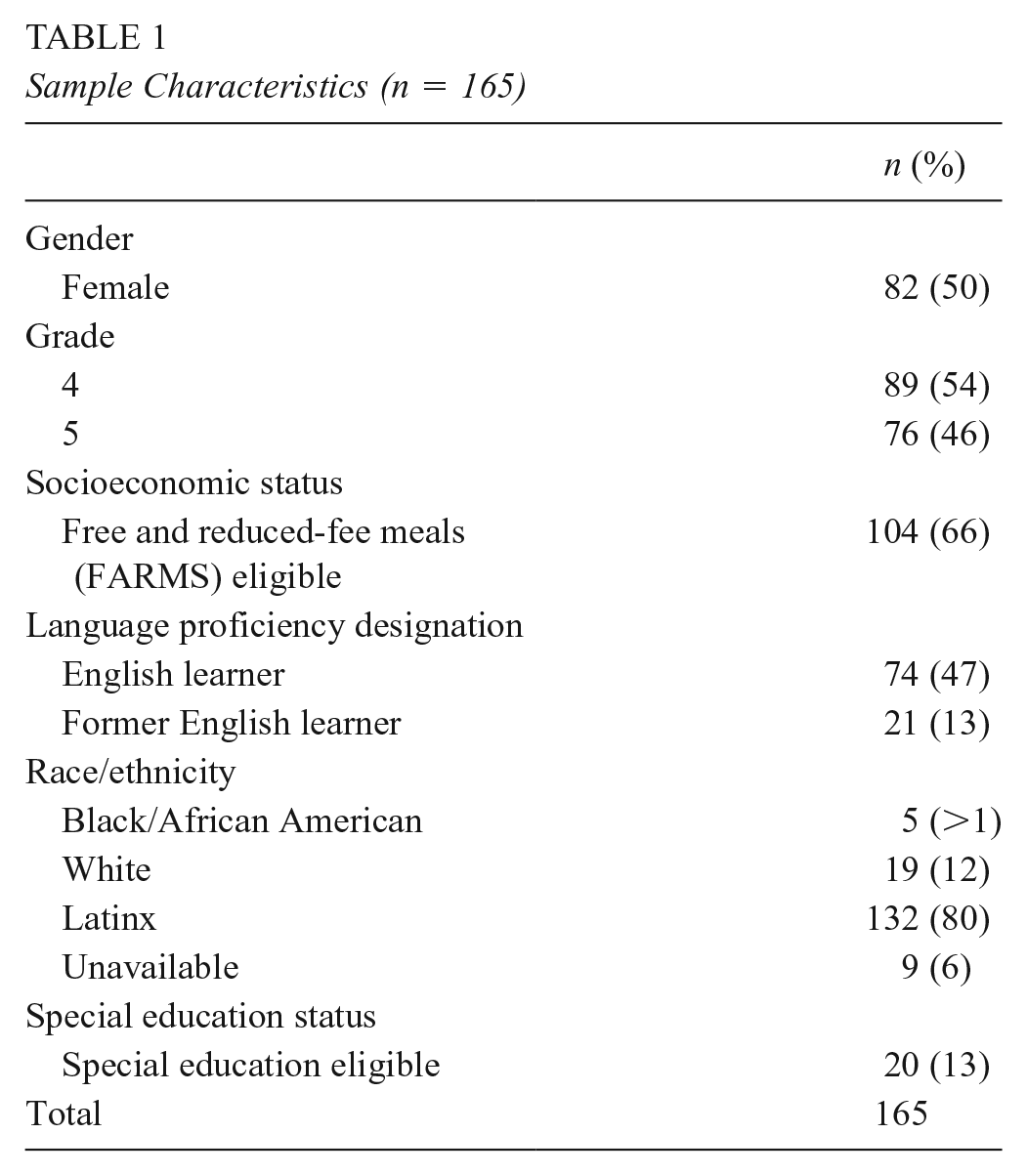
As part of a larger study, the fourth- and fifth-grade students included in this analysis were recruited through their schools. In the sample, of those that had home language data provided by the district (90 students), the majority spoke Spanish at home (96.7%). Based on data from a district-mandated assessment of English language development, 47% of students were classified as English Learners (henceforth ELs: 44% in Grade 4 and 30% in Grade 5), while 13% were Former English Learners (FELs: 9% in Grade 4 and 17% in Grade 5), that is, reclassified as English proficient (EP) in the past 2 years (Table 1). Most students (63%) qualified for free- and reduced-fee meals (66% in Grade 4 and 60% in Grade 5). According to records provided by the district, 80% were Latinx, 12% were White, and less than 1% of the sample were African American/Black (proportions by grade were similar). Fewer students were eligible for special education supports in Grade 5 (8%) than in the Grade 4 cohort (17%).
Sample Characteristics (n = 165)
Measures
All permissioned participants were assessed using the group-administered measures described below. Participants were tested by trained administrators with previous experience as classroom educators and working in partnership with classroom teachers, who led administration in some classrooms.
English CALS-I
Core Academic Language Skills Instrument (CALS-I), Form 1, (α = 0.93): 50-minute paper-and-pencil assessment that measures cross-disciplinary core ALs skills in English in Grades 4 to 6. The 49 items on the measure are grouped into eight tasks (see Figure A1 in the appendix for a description of items tested in each domain). Raw scores range from 0 to 36. Mean percent correct scores were used in this analysis. The CALS-I has undergone extensive psychometric analysis (for information, see Barr et al., 2019).
Spanish CALS-I
Evaluación de lenguaje académico (ELA) (α = 0.88) modeled after the English CALS-I, this 50-minute group-administered paper-and-pencil test was designed and validated independently in Chile with monolingual Spanish speakers (see Meneses et al., 2018). All items drew inspiration from the construct delineated above, and the format, tasks, and item types are similar to those in the English CALS-I. The syntax task (unpacking/packing complex sentences) differs from the parallel English task and was modeled after prior research in Spanish, that is, ordering sentences (Navarro & Rodríguez, 2014). A total of 53 items comprise the eight tasks. Raw scores range from 0 to 53. Mean percent correct scores were used in our analysis (see Figure A1 in the appendix for a description of items tested in each domain).
English Word Reading Fluency
Test of Silent Word Reading Fluency
It is a group-administered test of English word reading fluency skills (Mather, Hammill, Allen, & Roberts, 2004). Students are given three minutes to identify as many words as possible by drawing slashes in order to identify the words, which are ordered from easiest to most challenging to decode (e.g., roll/bottle/jolly/sky). Test of Silent Word Reading Fluency scores were calculated as raw scores.
Spanish Word Reading Fluency Test
It is a group-administered test of Spanish word reading fluency. Students are asked to identify words in strings of letters and to draw a line between the words they identify. For example, robleautosalón (oakcarhall) should be parsed as roble/auto/salón (oak/car/hall). The total score represents the number of correct words identified in 90 seconds (raw score). This silent word reading fluency test was inspired by Bråten, Lie, Andreassen, and Olaussen’s (1999) original test, validated for Spanish readers in Spain (Elosúa et al., 2012), and later validated for Latin American students (Meneses et al., 2018).
English Reading Comprehension
The Massachusetts Comprehensive Assessment System–English Language Arts (MCAS-ELA; Massachusetts Depart-ment of Elementary and Secondary Education, 2018) was used as a proxy to measure reading comprehension. The MCAS-ELA is a statewide standards-based assessment of English language arts and reading achievement. Responses are mainly multiple-choice but also include some open-ended items. Scaled scores fall into four performance levels (Exceeding Expectations: 560–533; Meeting Expectations: 529–500; Partially Meeting Expectations: 499–470; Not Meeting Expectations: less than 469). Because this test is not vertically equated across grades, we conducted all analyses within grade.
Analytic Plan
First, we conducted descriptive analyses and post hoc tests to examine differences in performance by grade level and English proficiency designation (EP, EL, FEL) on all measures. Pairwise correlation analyses, including English CALS-I scores, Spanish CALS-I scores, word reading fluency scores, and sociodemographic factors, informed our understanding of how constructs were related. Research Question 1, which focuses on the relation between Spanish and English CALS-I performances, was explored through examination of the correlations between measures administered. To examine Research Question 2, path models consisting of all observed variables were fit by grade using MLMV in Stata 14. Model fit was assessed using a range of goodness-of-fit measures as proposed by Hu and Bentler (1999), including chi-square, root mean square error of approximation, Tucker-Lewis index, and comparative fit index. Students missing MCAS data were excluded from analysis, but no significant differences were found on sociodemographic variables for included and excluded students.
Results
Descriptive Statistics
Table 2 displays means and standard deviations by grade for all measures. To examine whether these differences were statistically significant, analysis of variance using general linear models were conducted with CALS-I scores in each language as the dependent variables and two between-subject factors: grade (two levels: Grade 4 vs. 5) and English proficiency designation (three levels: EP, FELs, ELs). Following trends identified in prior studies, CALS-I scores were higher in Grade 5 in both Spanish (Grade 4, M = 35.06, SD = 14.29; Grade 5, M = 46.71, SD = 17.02) and English (Grade 4, M = 60.66, SD = 19.51; Grade 5, M = 71.59, SD = 19.21). CALS-I scores differed significantly by grade in Spanish, F(2, 138) = 19.21, p < .001, and English, F(2, 142) = 11.01, p < .001. Students in Grade 5 demonstrated greater mastery of CALS likely as a function of having had more time to be exposed to these skills. We also found statistically significant differences by English proficiency designation in Spanish CALS-I scores, F(2, 134) = 14.24, p < .001, and English CALS-I scores, F(2, 138) = 47.84, p < .001. On the English CALS-I, FELs (M = 80.78) and EP students (M = 73.78) evidenced CALS-I scores that were significantly higher than their peers designated as ELs (M = 53.30). Interestingly, Spanish CALS-I scores showed a similar pattern: FEL (M = 45.13) and EP students’ (M = 40.47) scores were significantly higher than those of current ELs (M = 31.94). No significant differences, though, were found between FEL and EP students in Spanish or English CALS-I. While variability in English reading comprehension scores spanned all four performance levels on the MCAS, these scores revealed that, on average, students reached the “Meeting Expectations” range (M = 495.95; SD = 19.24). English word reading fluency scores represented as raw scores were lower in Grade 4 (M = 88.29, SD = 24.56, range: 9–148) than in Grade 5 (M = 108.97, SD = 24.52, range: 70–181). Raw scores are similar to those obtained for students in English-only instructional settings in prior studies: Grade 4 (M = 98.08, SD = 30.82) and Grade 5 (M = 93.36, SD = 26.68; Uccelli, Phillips Galloway, et al., 2015). In contrast, Spanish word reading skills did not significantly differ between fourth (M = 57.49, SD = 26.01, range: 5–134) and fifth graders (M = 52.89, SD = 14.59, range: 8–78). Raw scores for students can be interpreted in relation to those obtained for Spanish monolingual students (fourth grade: M = 52.04, SD = 28.74; fifth grade: 61.60, SD = 31.11; Meneses et al., 2018). Notably, the English and Spanish fluency tasks differed in administration times (3 minutes vs. 90 seconds) and format.
Means and Standard Deviations for all Measures Included in Analysis (n = 165)

Prior to modeling cross-language relations, we examined pairwise correlations between all modeled variables in order to better understand how factors related within and across languages. To control for familywise error rates, we performed a Bonferroni correction with alpha per comparison set at .05/5 or p = .01. Based on prior studies, patterns of within-language correlations demonstrated expected levels of strength and association (Table 3): English CALS-I scores were positively and significantly correlated with English word reading fluency (Grade 4, r = 0.37, p < .001; Grade 5, r = 0.50, p < .001) and with English reading comprehension (Grade 4, r = 0.62, p < .001; Grade 5, r = 0.72, p < .001). Spanish CALS-I scores were positively and significantly correlated with Spanish word reading fluency (Grade 4, r = 0.41, p < .001; Grade 5, r = 0.37, p < .01).
Pairwise Correlations Between Modeled Variables for the Grades 4 (n = 89) and 5 (n = 76) Students

Note. Correlations for Grade 4 students are located below the diagonal, correlations for Grade 5 students are located above.
p < .05. **p < .01. ***p < .001.
We next examined cross-language correlations. Confirming our initial hypothesis, Spanish CALS-I and English CALS-I performances were strongly and positively correlated, as would be expected for learners exposed and instructed in academic Spanish and English at school (Grade 4, r = 0.71, p < .001; Grade 5, r = 0.67, p < .001). Additionally, in preparation to answer our Research Question 2, we observed that the relation between Spanish CALS-I scores and English reading comprehension was also positive and strong (Grade 4, r = 0.51, p < .001; Grade 5, r = 0.63, p < .001); and that word reading fluency in Spanish and English were moderately and positively correlated (Grade 4, r = 0.38, p < .001; Grade 5, r = 0.53, p < .001). Curiously, and for reasons we cannot explain, the correlation between Spanish WRF and English reading comprehension skills was very weak and insignificant for fourth graders, but moderate and significant for fifth graders (Grade 4, r = 0.02; Grade 5, r = 0.32, p < .05; Table 3).
Ordinary least squares was used to estimate a multigroup path model in order to explore our second Research Question (Figure 1). Because our measure of English reading comprehension, the MCAS-ELA, is a state standardized achievement measure that was not vertically equated across grades in the testing year, it was necessary to fit a multigroup model that allowed for different patterns of association for fourth and fifth graders. Figure 1 displays the hypothesized model. The relation between English and Spanish CALS was modeled as a covariance because these relations were assumed to be bidirectional, rather than unidirectional, due to DLI learners’ simultaneous bilingual acquisition (Path A). English CALS (Path B) and Spanish CALS (Path C) were regressed onto English reading comprehension, our outcome of interest. A covariance was modeled between Spanish and English word reading fluency (Path D) based on prior studies that find that decoding in both languages is related. Word reading fluency in both Spanish and English were regressed onto English and Spanish CALS as well as English reading comprehension to account for the role of fluent word recognition in accessing print on all three assessments. Sociodemographics (i.e., FARMS eligibility, special education designation, EL designation) were included as control variables and regressed on primary parameters. Students were drawn from two schools, and thus to account for these differences, school membership was included as a fixed effect.
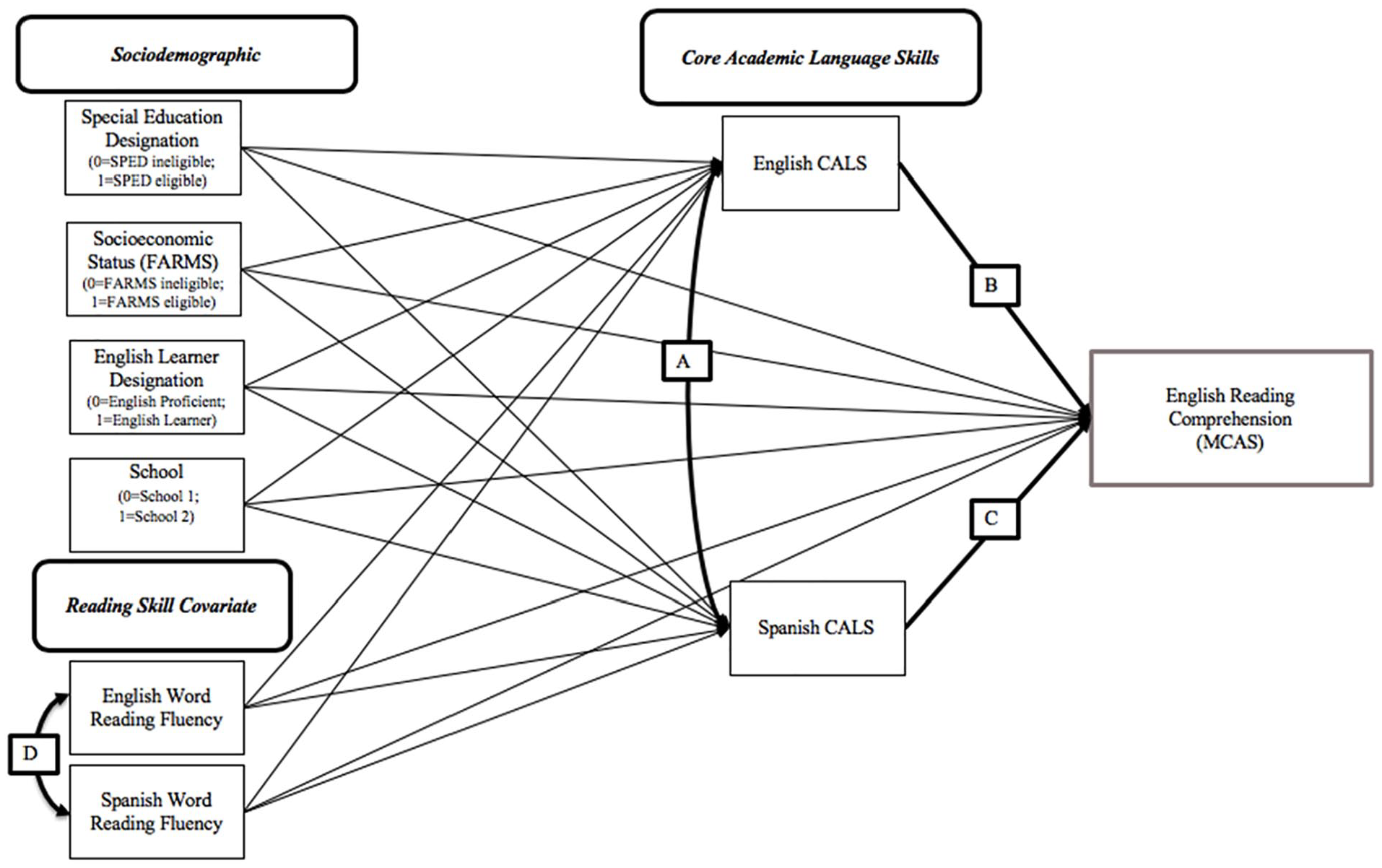
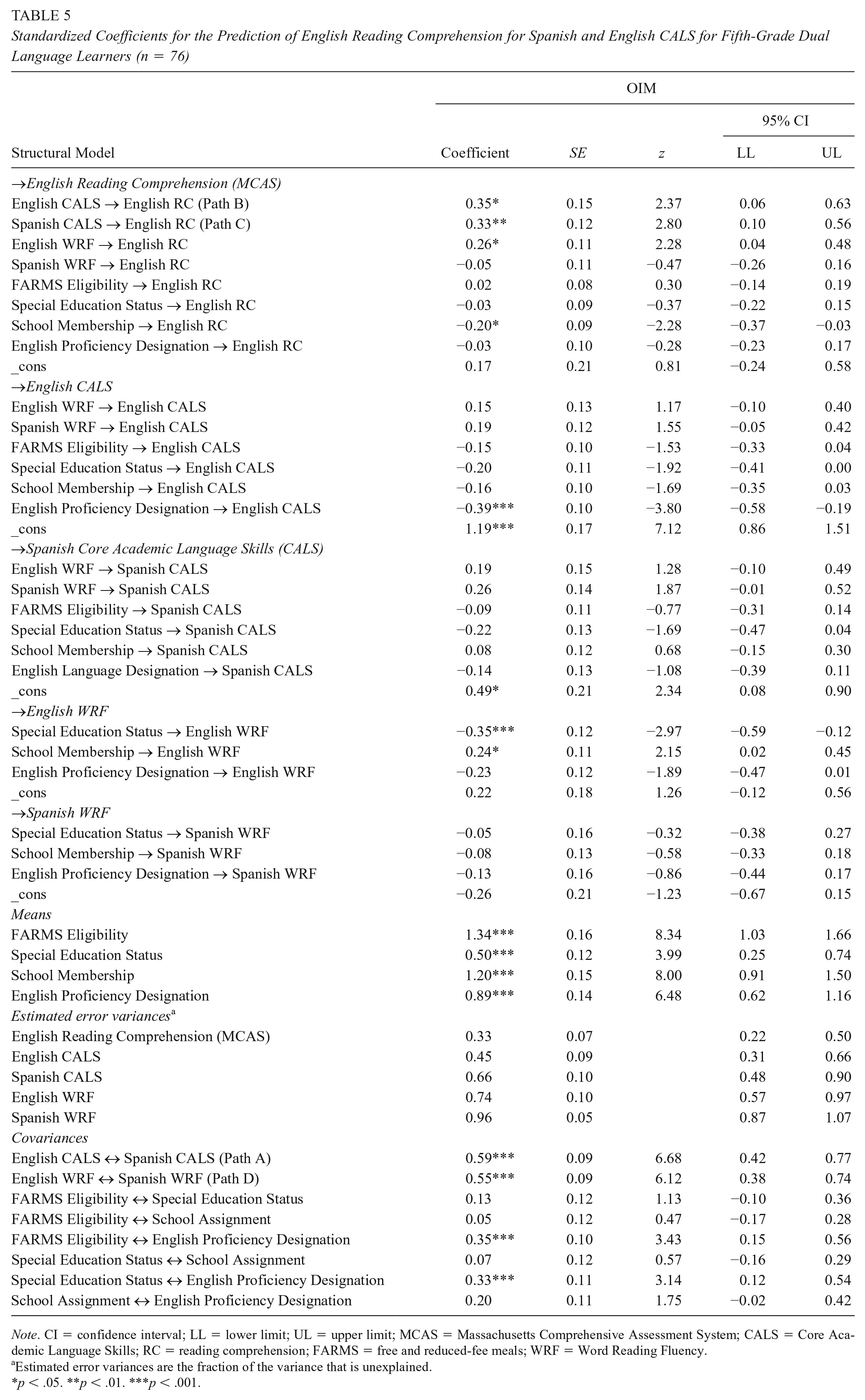
The model showed acceptable fit to the data (χ2[4, N = 165] = 2.45, p = .654, root mean square error of approximation = .000, Tucker–Lewis index = 1.000, comparative fit index = 1.056). To view standardized coefficients for modeled paths, please see Tables 4 and 5. In keeping with the links revealed between Spanish and English CALS evident in the correlation analysis, the two remained positively correlated (Grade 4, standardized coefficient = 0.66; Grade 5 = 0.59) in the model (see Figures 2 and 3, Path A). Word reading fluency in Spanish and English were also positively correlated for both grades (Grade 4, standardized coefficient = 0.53; Grade 5 = 0.55; Path D). As hypothesized, after accounting for the covariance, Spanish and English CALS both uniquely predicted English reading comprehension (see Figures 2 and 3, Paths B and C). Interestingly, the standardized coefficients for Spanish and English CALS predicting reading comprehension were similar in magnitude to one another for both fourth graders (Spanish CALS → English RC, standardized coefficient = 0.29; English CALS → English RC, standardized coefficient = 0.31) and fifth graders (Spanish CALS → English RC, standardized coefficient = 0.33; English CALS → English RC, standardized coefficient = 0.35).
Standardized Coefficients for the Prediction of English Reading Comprehension for Spanish and English CALS for Fourth-Grade Dual Language Learners (n = 89)

Note. MCAS = Massachusetts Comprehensive Assessment System; CALS = Core Academic Language Skills; RC = reading comprehension; FARMS = free and reduced-fee meals; WRF = Word Reading Fluency; CI = confidence interval; LL = lower limit; UL = upper limit.
Estimated error variances are the fraction of the variance that is unexplained.
p < .05. **p < .01. ***p < .001.
Standardized Coefficients for the Prediction of English Reading Comprehension for Spanish and English CALS for Fifth-Grade Dual Language Learners (n = 76)
Note. CI = confidence interval; LL = lower limit; UL = upper limit; MCAS = Massachusetts Comprehensive Assessment System; CALS = Core Academic Language Skills; RC = reading comprehension; FARMS = free and reduced-fee meals; WRF = Word Reading Fluency.
Estimated error variances are the fraction of the variance that is unexplained.
p < .05. **p < .01. ***p < .001.

Model of Spanish core academic language skills (CALS), English CALS, and reading comprehension for fourth-grade students (some covariances and predictor relationships omitted for parsimony, see Table 4).

Model of Spanish core academic language skills (CALS), English CALS, and reading comprehension for fifth-grade students (some covariances and predictor relationships omitted for parsimony, see Table 5).
For fourth graders, after taking into account the shared variance between Spanish and English word reading fluency (Path D, Figures 2 and 3), English word reading fluency was a significant predictor of English CALS for students in Grades 4 (standardized coefficient = 0.40), but not of Spanish CALS or English reading comprehension. Similarly, Spanish word reading was a significant predictor of Spanish CALS (standardized coefficient = 0.28), but not of English CALS or English reading comprehension. In contrast, for students in Grade 5, English word reading fluency was a significant predictor of English reading comprehension (standardized coefficient = 0.26) but was not a significant predictor of Spanish or English CALS. Spanish word reading skills did not contribute significant variance to Spanish CALS, English CALS, or English reading comprehension for fifth graders. An interesting finding is that the standardized coefficients for Spanish and English word reading (Path D) were smaller in magnitude than the covariance between Spanish and English CALS (Path A). 1
Discussion
In a climate of increasing interest in DLI programs, we aimed to better understand the links between DLI learners’ Spanish and English ALs skills, and their contribution to English reading comprehension (as measured by a statewide ELA assessment) for upper elementary students (Grades 4 and 5). Rather than focus on the relations between language skills broadly acquired across contexts, we focused on a circumscribed set of co-occurring school-relevant language skills, or CALS, shown in prior research to support reading comprehension within languages (in English and Spanish), but only minimally investigated cross-linguistically in DLI students (Aguilar et al., 2019). We drew on Cummins’s LIH, but with an understanding of cross-linguistic connections as reciprocal because we studied learners developing two languages simultaneously in school contexts where Spanish-English biliteracy is fostered.
Path models that specified correlations between the similar skillsets assessed in both Spanish and English were used to examine cross-linguistic relations. A noteworthy finding, which differs from prior research (Proctor et al., 2010) and demands additional study, is that Spanish and English CALS-I scores demonstrated a covariance that was greater in magnitude for both fourth and fifth graders than the magnitude of the covariance between word reading skills in both languages. This finding may be linked with the sample (we assessed students educated in Spanish and English rather than just in English) or an artifact of the measures of word reading used. Another not mutually exclusive possibility is that this study may offer some evidence that linguistic interdependence is affected by the context-specific subset of language skills measured (Prevoo, Malda, Mesman, & Van Ijzendoorn, 2015). Prior studies mostly capture language skills using vocabulary breadth measures in Spanish and English (e.g., Woodcock Picture Vocabulary/Vocabulario Sobre Dibujos) by asking students to name objects that are pictured, some of which are likely to occur in everyday speech across home and school contexts (e.g., car, baby, dog). Some objects are less familiar (e.g., transom, chevron), and potentially are only encountered in print sources read at school (if encountered at all given that they are not high-utility words in academic settings).
In contrast, in this study, we assessed students’ knowledge of school-relevant high-utility Spanish and English resources developed and used in academic discourse in bilingual school contexts (e.g., derivational morphology skills that apply to cognates, knowledge of embedded syntax structures, and academic text/discourse structures found both in Spanish and English). That is, we interpret the positive correlation observed between Spanish and English CALS to be supported by the co-occurrence of Spanish and English used for academic learning and literacy in students’ day-to-day schooling, a situation that can be referred to as register overlap. In other words, participation in DLI involves learning both Spanish and English to accomplish the same communicative macrofunctions. For example, in DLI classrooms, students use Spanish and English language for similar purposes and with the same expectations (e.g., to communicate abstract ideas and intricate relationships precisely and concisely). In addition, both languages are also used for assuming particular identities (e.g., epistemically-cautious expert, inquisitive learner) and for interacting with individuals within the academic discourse community.
We also employed path models to examine the joint contribution of Spanish and English CALS to fourth and fifth graders’ English reading comprehension, controlling for the shared variance between Spanish and English CALS-I scores, word reading fluency in both languages, and a host of student sociodemographic characteristics. Results revealed that Spanish and English CALS-I performances both uniquely predicted English reading comprehension, even after partialing out the shared variance in these skills, for fourth and fifth graders. Our results mirror those of prior studies that have examined CALS in students attending Spanish-only and English-only schools, where CALS-I scores significantly predicted reading comprehension outcomes within each language (Barr et al., 2019; Phillips Galloway & Uccelli, 2019; Uccelli, Barr, et al., 2015). Drawing from the Simple View of Reading, students, on average, demonstrated firmly established English word recognition skills, which may have supported the cross-linguistic transfer of Spanish CALS (and limited the impact of Spanish decoding skills).
This finding is noteworthy because positive statistically significant links between Spanish language skills (vocabulary, syntax) and English reading comprehension have been infrequently observed after accounting for English language skills in prior studies (e.g., Proctor et al., 2006). Of course, our data do not offer explanatory factors that can account for these results. However, extending Stahl and Nagy’s (2006) hypotheses regarding how vocabulary knowledge predicts reading comprehension to CALS, we might reason that both instrumental knowledge (e.g., knowing more words and syntactic structures prevalent in school texts in Spanish or English) and metalinguistic awareness (e.g., awareness of overlapping Spanish and English morphological, syntactic, and discourse structures and communicative function that characterize academic texts across languages) facilitate text comprehension cross-linguistically. Proctor and colleagues argue that comprehending the meaning of vocabulary in a text may depend more heavily on language-specific resources (except for cognate forms; Proctor et al., 2010, 2017). They propose an interdependence continuum that characterizes some Spanish-English language proficiencies (vocabulary knowledge, in particular) as less prone to cross-linguistic transfer than Spanish word-recognition skills (decoding, alphabetic knowledge) or Spanish syntax skills, which share greater overlap with English both in how sounds are mapped to print and in how words are ordered in simple sentences (subject-verb-object), respectively (Proctor et al., 2010, 2017).
Embedded in the continuum hypothesis is the notion that cross-linguistic influence partially results from form or structure sharing across languages, which for the bilingual learner amounts to greater opportunity for developing metalinguistic insights into how languages “work” and for transfer of linguistic knowledge from one language to another (see also the distributed feature model, van Hell & de Groot, 1998). Academic registers in Spanish and in English, in particular, share an abundance of cognates and isomorphic structures, which likely played a role in our findings. In this study, we add nuance to this continuum model by suggesting that bilingual learners might also leverage knowledge of shared communicative functions across languages. For example, Spanish and English connectives communicate how ideas should be processed within a text. Plausibly, readers draw on metalinguistic knowledge of a connective’s function (whether learned in English or Spanish) even when there is little overlap in the form (e.g., “in sum” and “en resumen” both signal that the end of a list of propositions has been reached and a summation is being provided). Indeed, as Durgunoğlu (2017, p. 176) notes, studies exploring the effects of overlap in the communicative purposes of function words and connectives across languages on cross-linguistic transfer remain rare, making this study particularly noteworthy. Of course, these relations are likely further strengthened when words are cognates or when syntactic structures are shared, therefore also overlapping in form. For students in DLI, learning academic registers in two languages at once (register overlap) may, indeed, provide richer input for leveraging their knowledge of ALs’ communicative functions, as a facet of metalinguistic awareness.
Though we caution against drawing pedagogical conclusions given the relatively small sample, these findings add to a growing body of literature that speaks to the importance of ALs skills to reading in the transition from elementary to middle school for bilingual students (Geva & Farnia, 2012; Geva & Massey-Garrison, 2013). Cross-disciplinary AL proficiency, as operationalized in the CALS construct, highlights for educators a specific set of language skills that can be taught through meaningful participation in academic discourse communities to support DLI learners across content areas, across grades, and across languages. Translingual pedagogical approaches (O. García & Leiva, 2014), which encourage flexible and holistic use of all of learners’ and teachers’ linguistic resources, have rarely been linked to ALs learning. However, the results of this study offer support for such an approach. With reference to translingual pedagogies, it may be beneficial to engage students not only in pedagogical noticing around shared Spanish and English ALs forms and structures but also around shared communicative functions (Uccelli, Phillips Galloway, Aguilar, & Allen, 2019).
Limitations and Future Directions
This study faced limitations that future studies might address, including small sample size. Future studies should seek to replicate these findings with different and larger samples, broadening the sample to include Spanish-English bilingual students educated in a range of bilingual instructional settings and geographic contexts. Indeed, results might differ in school settings with different bilingual education models, altering the exposure students receive to Spanish and English. Furthermore, additional data, such as students’ age of English acquisition and out-of-school language practices, might add nuance to this analysis (Uccelli & Aguilar, 2018).
Because testing bilingual populations requires assessment in both languages, doubling the assessment time, this study did not include all of the same measures used in prior studies or all of the measures we would have liked to explore. For example, it is possible that a third variable, such as executive functioning, may play a role in links observed between Spanish and English CALS. Future studies might add measures that capture these skills. Relatedly, Spanish and English CALS were captured via measures that contained overlapping item types. A portion (though certainly not all) of the shared variability between the CALS-I in Spanish and English is due to their sharing a common method of measurement, as will be the case with any measures that share item formats (such as multiple-choice tests). 2 To address this limitation, future studies might seek to quantify this method variance. We are confident, though, that the relations identified here would remain relatively unchanged given that this study follows in a line of prior studies that have found relations of similar magnitude between CALS-I scores and reading comprehension (as measured by the Gates, GISA, MCAS, PAARC assessments) and in models that included other measures of reading subskills (fluency and general vocabulary; Barr et al., 2019). In addition, a single score, rather than domain-level scores, are provided for the CALS-I in Spanish and English, both of which load to a single factor in psychometric studies (Barr et al., 2019; Meneses et al., 2018). This limited our exploration of within language associations that might differ at the domain level. In conclusion, despite these limitations, this study offers important insights that help the field better understand the role of register overlap in Spanish-English linguistic interdependence, and in so doing adds to a growing body of evidence that affirms the value of DLI instruction for the growing numbers of Latinx students in U.S. schools, whose multilingualism is an instructional asset.
Footnotes
Appendix
Acknowledgements
We especially thank the students and teachers who participated in this study. We are also grateful to our research assistants for their support in data collection and entry. We also thank the Observatorio de la lengua española y las culturas hispánicas en los Estados Unidos, Instituto Cervantes, Harvard University (US) for their support of this project through a grant to Dr. Paola Uccelli.
1.
We conducted a sensitivity analysis of the CALS-I parameter estimate by adding measures of students’ English narrative writing ability to the model. We found that the Spanish and English CALS-I remained significant, and its parameter estimate was virtually unchanged.
2.
We know of no rule of thumb for estimating a pure method correlation, and empirical examples of multitrait multimethod matrices show widely varying method correlations with some at or less than .1 to others as high as .35.
Authors
EMILY PHILLIPS GALLOWAY is an assistant professor at Vanderbilt University. Phillips Galloway’s quantitative and qualitative research explores the relationships between school-relevant language development and language comprehension and expression during middle childhood with a particular focus on linguistically and culturally minoritized learners.
PAOLA UCCELLI is a professor at the Harvard Graduate School of Education. Her research focuses on how different language skills (at the lexical, grammatical, and discourse levels) interact with each other to either promote or hinder advances in language expression and comprehension in monolingual and bilingual students.
GLADYS AGUILAR is a doctoral candidate at the Harvard Graduate School of Education. Aguilar’s research examines impact of bilingualism on minority children’s cognitive, socioemotional, and language development and the role of parents and teachers in this development.
CHRISTOPHER D. BARR is director of Assessment and Evaluation of STEM Programs at Rice University’s Office of Research. Barr’s research employs innovative statistical and modeling techniques to capture learning and development.