



Abstract
Children develop their language when they explore and talk about literary texts. In this study, we explore the design of shared digital reading as a basis for critical reflection on the reading situation in an institutional context with its given opportunities and limitations. We examine six videotaped readings of one specific picture book app, with a focus on the strategies used by teachers in early childhood education and care institutions to control children’s access to the medium and the types of verbal engagement (about the story and about the medium) that are generated by these different strategies. We use qualitative and quantitative analysis of video data. A qualitative categorization of the readings reveals the strategies Show, Show & Share, and Share. In analyzing the participants’ verbal and multisensory engagement, we find that the Show strategy generates more utterances, especially about the story, as well as more time spent on dialogue.
Keywords
Introduction
Shared reading with young children in early childhood education requires the teacher to design a reading situation that allows the children to be active participants, while the teacher is still in control. This reading situation must be understood in relation to the medium one reads from, and within the context in which it takes place (Tønnessen, 2016). In digital reading from a tablet, the touch screen technology invites individual reading practices, since the screen normally responds only to one touch at the time. However, in the institutional setting of Norwegian kindergartens (early years’ education and care institutions for children of age 1–5 years), reading is generally carried out as shared reading in groups, organized by one adult reader. This article focuses on six teachers’ strategies for designing digital readings of the same picture book app, and reflects on how the situation may affect the children’s verbal and bodily engagement with the app.
The reading situations were framed to encourage dialogue as part of early childhood education’s obligation to facilitate language learning. The idea in such dialogue-based reading is to provide challenging content that requires the use of language to be explored and shared (Grøver, 2018). Picture book texts were chosen as a suitable basis for conversations in which children can use their own experiences and skills and construct new knowledge (Solstad, 2016). Stories are known to evoke the interests and engagement of the child reader. In particular, the fictional story world of “there-and-then” can be expected to encourage the use of language for creating story worlds outside the “here-and-now” of the reading situation. This calls for the children’s use of decontextualized language when they verbalize their experience of situation, characters, and events.
In traditional book reading, young children who cannot yet read by themselves encounter books closely accompanied by the adult communicating the written text to them (Mangen & Hoel, 2017, p. 3). With digitization, new opportunities for the mediation of multimodal texts have emerged such as picture book apps that are downloadable on tablets. These invite reading practices that may differ from book reading, due to the affordances of the digital touch screen and the social settings in which it is used. While we acknowledge that the literary text as well as the medium is of importance for how the dialogue turns out (Tønnessen & Hoel, 2019), our emphasis in this article is on the reading situation.
Most studies of children’s reading experiences involve readings by child-adult dyads, resulting in a contrasting understanding of book and screen as media of reading—for example, “curling up with paper [and] shoulder-surfing with screen” (Yuill & Martin, 2016, p. 8). In an institutional context like the one we have studied, where a teacher reads a picture book app with a group of up to six children, questions arise on how to ensure access and participation for the whole group. Institutional reading in Norwegian kindergartens is essentially dialogic in nature—within a polyadic interaction context (Bae, 2004; Schaffer & Lidell, 1984)—with both teacher and children actively contributing in talking about the story and exploring the pictures (Hoel, 2013). Compared with reading in dyads, shared reading in groups affect the child-adult relations as well as the children’s access to the medium. In addition, it may add a social dimension to the reading experience.
Teachers’ design of shared dialogue–based reading in groups includes facilitating the participants’ access to text and medium. It also entails creating reading groups, taking into account each child’s interests and language skills as well as group interaction, and facilitating the physical conditions for optimizing the children’s participation. In this study, our aim is to gain better understanding of the reading situation, with the opportunities and limitations an institutional context entails, by exploring the teachers’ design of shared readings. Our focus is on the teacher’s spatial organization of the reading situation and how this relates to the children’s verbal and bodily responses. Our research questions are as follows:
These questions are based on the understanding that the kindergarten teacher uses her pedagogical insights to design the reading situation in ways that cater for the children’s active participation. The children may be active in listening to the words and looking at the pictures but not necessarily interacting directly with the medium, as we often see in traditional book reading for larger groups where the children are expected to sit still. This element of disciplining children may be understood from the point of view of the kindergarten being an educational institution, which is likely to be different from reading in a private setting. In shared dialogue–based reading for smaller groups of children, a key point is how the children may be encouraged to apply verbal language along with other forms of expression to take an active part. When the medium is a tablet with an interactive touch screen and not a book, another key question is how and when the children should be given access to interact with the screen and how this embodied interaction may also generate utterances and dialogue. Children may respond in verbal language, commenting on the story or on the medium and the reading situation. They may also provide a physical response by pointing at the pictures (Mitchell, 2018). In the shared readings that we have studied with groups of children, the teacher may have to control these activities as part of her or his strategy to include the whole group.
Previous Research
As mentioned, the shared reading of words and images is often studied in the context of the adult-child dyad (e.g., Mjør, 2009). An exception is Marilyn Cochran-Smith (1984), who studied picture book reading in a Canadian preschool, focusing on how the teacher modeled a reading practice with the children. Cochran-Smith underscored the dialogical nature of this process, whereby the children took part in negotiating interpretations and meaning making. Negotiation was also one aspect that led to interesting conversations where children asked questions and offered interpretations in Trine Solstad’s study of teachers reading picture books with two or three children in Norwegian kindergartens. The other characteristic aspect found in this deliberately free and child-initiated reading situation was that the children played games with the story, entering into a fantasy world that took its outset in the picture book but developed quite freely from there (Solstad, 2015).
A study comparing app reading in kindergarten with Solstad’s findings concluded that children’s verbal response in terms of negotiation and play could also be found in app reading, both in relation to the meaning of the story and in relation to the medium, such as negotiations on turn taking and playing with the medium (Solstad & Tønnessen, 2014). This comparison also made it clear that a reading situation in kindergarten modeled on book reading practices was quite different from app reading at home, especially in terms of the children’s access to the medium (Tønnessen, 2016). Access to the touch screen is a prerequisite for activating the interactive elements that distinguish app reading from book reading.
Several empirical studies have identified the impacts technology can have on reading. In a meta-analysis of multimedia stories, Takacs, Swart, and Bus (2014) compared technology-enhanced independent reading with shared book reading, concluding that multimedia features can provide similar scaffolding to reading with an adult. These scholars focus on story comprehension and word learning from a cognitive perspective. In another meta-analysis, they find that multimodal and interactive affordances can support and even strengthen children’s understanding of the story, depending on a close congruency between verbal and nonverbal information. However, irrelevant animations, sound effects, games, and other interactive elements may distract or interfere with children’s understanding (Bus, Takacs, & Kegel, 2015; Takacs, Swart, & Bus, 2015). Interaction with adult readers or shared group readings was not systematically included in these meta-studies.
For a while, research on picture book apps focused mainly on how this new mediation of picture book texts could be theorized (e.g., Al-Yaqout & Nikolajeva, 2014; Schwebs, 2014) or on theorizing new features of the medium, such as hotspots (Zhao & Unsworth, 2016). In her article “Children’s Interactions With iPad Books: Research Chapters Still to Be Written” (2013), Natalia Kucirková identifies a lack of research on “the content of the stories, the overall context of interaction and the background of the interactants.” Our hope is to fill gaps on the context of interaction through analysis of the reading situation related to a specific picture book app.
Theoretical Framework
Mangen and Hoel (2017) call for an interdisciplinary approach to account for the diverse dimensions of texts, media, readers, and social settings. Our work is theoretically framed in a social and cognitive understanding of reading and in perspectives on literacy, including digital media and multimodal texts. In the present study, we explore the reading situation and how it facilitates the children’s engagement with text and medium.
Shared Dialogue–Based Reading in Groups
Shared reading in Norwegian kindergartens is commonly characterized by being dialogic and is usually conducted within group settings. The teacher is mediator of the written text during shared reading and responsible for promoting the children’s participation in dialogue. Drawing on various responsive teaching approaches, the teacher may ask exploratory questions related to the narrative or encourage the children to explore illustrations or other semiotic resources offered in the text, such as sound or animations. This way, the children will be engaged and take part in extended discourses in combination with a rich vocabulary (Dickinson & Tabors, 2001). Thus, an aim of the dialogic approach to shared reading related to a picture book app is to engage children in sustained stretches of talk. This is what we mean with shared dialogue–based reading in this study. Participating in such dialogues enables both speakers and listeners to explore and build on their own and others’ observations, thoughts, and reflections. Accordingly, during reading, the teacher will remain responsive to the children’s own input and questions. This approach to shared reading is inspired by theory that looks at children’s development within the context of interactions that form his or her environment (e.g., Bronfenbrenner, 1994). It is worth noting that Anezka Kuzmičová et al. (2018) claim that the social setting, the “physical presence, and concurrent activity, of other people in the environment” (p. 70) is an underexplored factor in reading experiences.
For all children to see the picture book app, the spatial design of shared reading is characterized by physical closeness, which allows for direct bodily interaction between children and between teacher and children. Thus, shared reading is a multisensory and embodied experience (Mangen, Hoel, & Moser, 2019). In app reading, the choices involve how to ensure visual contact between teacher and children, as well as who should have visual and physical access to the touch screen. In this context, it is worth noting that Norwegian kindergartens cannot be compared with traditional classroom settings in school; for example, there are no desks. Most often, shared readings are carried out in a sheltered place in the kindergarten—sometimes on mattresses on the floor.
The stories presented in picture book apps are multimodal texts that come to life as words are read and heard, images seen, and hotspots activated. The reading session itself can be regarded as multimodal meaning making, where the dialogue is embedded in the performing of the app story. Shared dialogue–based reading entails interaction with both text/medium and among the participants in the group. Starting points for dialogue may be found in a theme that the children find interesting, details in the illustrations or wording, or in activating hotspots that extend or elaborate (van Leeuwen, 2005, p. 230) the “iconotext” (Hallberg, 1982), possibly creating surprising dramaturgic moments. It is this communicative situation that we intend to capture with our categorization of the reading situation.
Affordances in Multimodal Performance of Picture Book Apps
We regard meaning making and interaction to be interrelated and at the heart of the reading situation, and basic to generating dialogues in the group. Multimodal social semiotics is a fruitful context-sensitive approach not only to texts but also “to analyse texts in action and interaction, often in combination with ethnographic methods” (Jewitt & Leder Mackley, 2018, p. 94). This entails the understanding that texts as well as media carry potentials for meaning making and that observed meaning-making processes are shaped by the context of situation, which, in the next instance, can be seen as a realization of the context of culture (Halliday, 1999, p. 8). In multimodal social semiotics, the term affordance has been adopted from J. J. Gibson (1979) to stand for the potentials and limitations of meaning-making resources depending on their “material features” and social use (Kress, 2010, p. 80). Theo van Leeuwen (2005) emphasizes this to be an open concept, including “how that resource has been, is, and can be used for purposes of communication” (p. 5). In digital media, the affordances of text and medium (Engebretsen, 2007, p. 17; Rustad, 2008) may be hard to distinguish, except for analytical purposes, as can be seen from the concept “semiotic technologies” looking into how semiotic choices may be built into software and digital templates (Djonov & van Leeuwen, 2018; Poulsen & Kvåle, 2018).
In traditional picture books, the main resources for meaning making are words and images interacting in the “iconotext” (Hallberg 1982, p. 165). Nikolajeva and Scott (2006, p. 1) underscore that words are structured in time, which affords communicating narratives and processes, while images are spatially composed and hence afford showing the whole and the parts as well as the relationship between them. The interplay between words and images may engage the complementary affordances of the two modes, the one elaborating or extending the meaning of the other. In analyzing the reading situation, a vital question is whether the children can hear the words (read by an adult or by a prerecorded voice in a picture book app) and see the images simultaneously. This fusion of verbal and visual meaning-making resources is characteristic of what Agnes Bjorvand (2012) calls a “genuine reading” of the iconotext (p. 71). In our video observations of six reading situations, we pay attention to both the children’s verbal responses and how their attention to the images is expressed by pointing (Mitchell, 2018). Gestures like pointing is known from infancy on to have a meaningful communicative function. Flewitt, Kucirková, and Messer (2014) note pointing to be central to social development within “cooperative and emotionally rich relationships with parents and carers” (p. 109).
Our understanding of medium is inspired by Henry Jenkins (2006) who notes that both the technology and the connected practices must be taken into account. The most salient technological characteristic of the tablet is the touch screen, which enables direct contact with the visual modes of the picture book, and it also allows the reader to contribute to the multimodal performance of the text by touching hotspots. Hence, reading from a digital touch screen entails active contact with the medium through bodily contact and performance. The medium affords a tangible experience of interacting with the narrative, a form of “liveliness” (Schwebs, 2014) as the reader plays a part in performing the text (Al-Yaqout & Nikolajeva, 2014).
The tactile experience of the touch screen is more direct and the motoric action more user-friendly than handling a mouse or a keyboard (Merchant, 2015). Limitations, however, are that the size and mobility of the tablet restricts the reach of the app experience to activities that may be carried out within the reach of the body. Interaction through touch presupposes an understanding of what different versions of touch, such as tapping or swiping (Crescenzi, Jewitt, & Price, 2014), may mean when activating preprogrammed interactions. In their social semiotic approach to touch design, Sumin Zhao and Len Unsworth (2016) underscore that interactivity in apps is a resource for meaning making. They propose a distinction between hotspots that perform acts of meaning making in the context of the narrative (intratextual) and those that function as part of the menu system (extratextual). Our interest in touch in this analysis is mainly oriented to whether the design of the reading situation allows the children access to touching the screen.
In our analysis of the six reading situations, we focus on verbal responses in terms of extended stretches of dialogue and utterances and we distinguish between utterances about the story and utterances about the medium. We also include pointing based on insights from Flewitt et al. (2014) that “touch and gesture are not merely supplementary to speech but are finely integrated with it” (p. 109). In our video observations, pointing is seen as a gesture by which the children direct attention to what appears visually on the screen. From our observations, we realize that pointing could also be interpreted as a preparation for touching the screen. This is a question of interpretation, which our quantitative coding cannot answer.
Material and Methods
In this article, we examine six shared readings chosen because they are readings of the same picture book app, making the text a constant in our analyses. Six kindergarten teachers conducted and videotaped these readings with groups of up to six children. The study includes qualitative video data and quantitative coding of data from analysis of the videos. It also includes the teachers’ pedagogical reflections after each reading.
The Picture Book App Yesper and Noper
The picture book app that is read is Yesper and Noper (Jakop og Neikop; Stai, 2011), which is based on a picture book. The story is about two friends and the problems they experience when Yesper always says “Yes!” and Noper always says “No!” This contrast is underscored in the musical theme that begins as soon as the app is opened, at which point children’s voices sing Yesper’s name in a high pitch and Noper’s in low pitch. The images are stylized geometric shapes in clear colors, and this simplicity is verbally mirrored in short poetic sentences. Illustrations shown in the app are the same as those of the paper book, but they are sometimes customized for digital formats through the use of close-ups and camera movements. The multimodal text affords clear-cut oppositions between the protagonists, interesting side characters, and creative use of verbal language, all of which was expected to encourage dialogue in the reading situation. In the six videotaped readings, all teachers chose to expose the written text (optional), activate sound effects (optional), and have the text read aloud (optional). In using the app, the reader taps to turn the page. The extratextual hotspots are in a menu at the bottom of the screen. The menu also offers the opportunity to make one’s own recording of verbal text and sound effects.
The picture book app contains additional affordances to the print book. Tapping intratextual hotspots initiates sounds (drums, car driving), simple animations (lights on and off, buns that are eaten), and dialogue/sounds from the characters (i.e., making a seller say “Do you want to buy a drum?”). With the exception of the opening page, where an inscription on Yesper’s hat says, “Press me!” and one on Noper’s hat says, “Not me!” (Figure 1), there are no markers of the many intratextual hotspots included in the picture book app.

Opening page of the app Yesper and Noper.
For some of the children, this is an invitation to engage in hands-on exploration. One of the affordances of the touch screen medium is that hotspots may emphasize the narrative, and in this way provide the readers with an opportunity to “perform the text” (Al-Yaqout & Nikolajeva, 2014). It is our impression that the interactions afforded in the Yesper and Noper app are mostly well integrated in the story. However, it is an open question to what extent the large number of unmarked hotspots contribute to the children’s participation in dialogues. In the videotaped readings, the teachers were free to choose how they wanted to facilitate the children’s interaction with the medium.
Preparations and Videotaping Reading Situations in Kindergarten
The participating kindergarten teachers had experience with shared reading with picture books, which is part of the Norwegian kindergarten curriculum; still, only a few had experiences with shared dialogue–based reading or with reading picture book apps. As part of the preparations for the study, the teachers’ attended a workshop on these topics; subsequently, they used the following months to practice shared dialogue–based reading with groups of children, both in print and on screen.
In the overarching study, each teacher read two titles in print and app versions, during a period of 3 weeks. The order was reversed when reading the second title to secure balance in the overall design. The teachers were in charge of assembling the children who would attend their reading in groups of six children. Children who were not present on the day of the filmed reading, were not replaced. Primarily, the reading groups were supposed to include the older children (5-year-olds), both boys and girls, with sufficient language skills to enjoy participating in shared dialogue–based reading with age-appropriate literary texts. For this article, we examine six readings (Table 1).
Overview of the Reading Groups

The teachers decided when in the day and where in the kindergarten they wanted to read, and how the children should sit. They also videotaped the readings themselves; thus, there were no outsiders present during the reading. There are both women and men among the six teachers. To protect the participant’s privacy in this study, we refer to all teachers as “her.”
The teachers were free to choose how they wanted to facilitate the children’s interaction with the medium. Thus, the teacher’s design also includes taking into account the children’s access to the medium. Three of the readings are first-time readings (where the equivalent print book was read later). Three readings were second-time readings of this specific book title. Each reading session was assigned an ID, identifying the kindergarten, the teacher, and the order of reading within the group (numbered from 1 to 4).
From Qualitative to Quantitative Analysis
The analysis was conducted in two phases: In the first phase, we observed the filmed event as a whole, which results in a qualitative categorization of the six readings. The second phase is an exploration of the participants’ responses as they can be seen from the coding of quantitative patterns in the videos. Here, we compare and discuss how the children respond verbally in dialogue and utterances and by pointing within the different strategies.
In the qualitative analysis of the videotaped reading sessions, we considered the following: (a) position of the teacher, (b) position of the children, (c) placement of the medium, and (d) the teacher’s preparations according to their reflection logs.
In their design of the reading situation, the teachers had some choices (e.g., when, where, how the children should sit; whether to expose the written text, activate sound effects, and have the text read aloud; and how to facilitate the children’s interaction with the medium). The relationship between the teacher’s educational and practical design and the conducted readings are expressed in the reflection logs, which the teachers wrote after reading the picture book app. These reflections are open answer questions related to the teacher’s preparations for the readings (e.g., “Did you read/explore the book yourself?”), the execution (e.g., “How did you choose to convey the book, and why?”), and their assessments of the reading (e.g., “When you read this book later, what would you like to do differently?”).
Coding the Videos
A coding scheme was developed, adapting categories from previous studies of children’s engagement with picture book apps, and adjusting them to cater for the focus on shared reading. Four coders took part in the coding. Intercoder agreement was checked when four films were independently coded by two coders each, and intercoder reliability was found acceptable (Mangen, Hoel, Jernes, & Moser, 2019). There are two main categories of codes: durations codes that record how long a phenomenon lasts and none durations (frequency) codes that record the number of instances (frequency) occurring. All frequency codes are linked to either child or teacher to provide an opportunity to identify whether the children or the teacher is the active party.
For the quantitative analysis of children’s responses in this article, relevant codes on verbal engagement and some aspects of multisensory engagement were selected.
Verbal response was measured by the duration of dialogues and the frequency of utterances related to multimodal text and medium, respectively. The children’s bodily engagement was measured by the frequency of pointing. In the video data coding scheme (Mangen, Hoel, Jernes, et al., 2019), dialogue is characterized by the exchange of opinions, impressions, and thoughts in which the expressions are interrelated, including responses over several turns, as can be seen in this excerpt from 101-4:
Do you remember, what happened here?
He says “No”.
Why did they make a wall?
Because, because they made a room so they couldn’t argue.
Yes, why?
Because Yesper got all the things he wanted.
He just said yes when someone would sell lamps to him. Then they made a wall.
The verbal engagement expressed through utterances (either as part of a dialogue or standalone comments including single words) may be related to the narrative (the verbal content, illustrations, animations, and audio expressions) as can be seen in this extract from 101-4:
He was a clever guy.
He said: “Hello, I don’t want to be with you.”
Or they may be codes as related to the medium (comments on lack of view, getting a better view, questions about where/when/who to tap, negotiations on taking turns) as in this extract from 101-4:
You can tap first.
No, it was my turn to tap. I also want to try.
Multisensory engagement is revealed when a child or the teacher points, with the whole hand or with a finger, to the tablet.
Ethical Considerations
The study has been reviewed and approved by The Norwegian Social Science Data Service, a third-party ethics oversight agency in Norway. The participating kindergarten teachers were all informed about the voluntary participation and the possibility of withdrawing during the study. The parents provided their written informed consent for their child to participate. In addition, the children provided their oral informed consent to participate, and they were all informed of the possibility of withdrawing at any time. Neither teachers nor children can be identified in our work. When we have chosen to present visualizations of the observed findings, the illustrations are not portraits of real situations, but representations of prominent features.
Analysis
Qualitative Analysis of the Six Readings
In our qualitative assessment of the six reading sessions, we find four different ways to design the reading situation: No strategy (reading 305-1), Show strategy (readings 407-1, 510-1, and 612-4), Show & Share strategy (reading 101-4), and Share strategy (reading 204-4).
In the No strategy reading (Figure 2), the children are placed in front of the screen, and the kindergarten teacher is on the left side. The teacher initiates the activity, pointing occasionally at the screen, but otherwise saying nothing. The children actively tap the screen, especially the two children on the sides. There is little dialogue and much physical exertion (between the children). We see few indications that the children are involved with the story. In her reflections, the teacher comments that she had prepared exploratory questions related to the story; however, she had not prepared for how to handle the medium. She felt that she lost control when the children were so occupied by the interactive elements. Her summary of the reading was that there was little interest in the story and that she became speechless. It appears in the video that there are relatively few utterances and no dialogue sequences during the reading, and, according to the teacher’s own assessment, this is not shared dialogue–based reading. Although this example clarifies how important it is for the teacher to actually have a strategy before shared reading in groups, we have chosen not to include No strategy in the further analysis. No strategy is also untypical for the video observations as a whole.
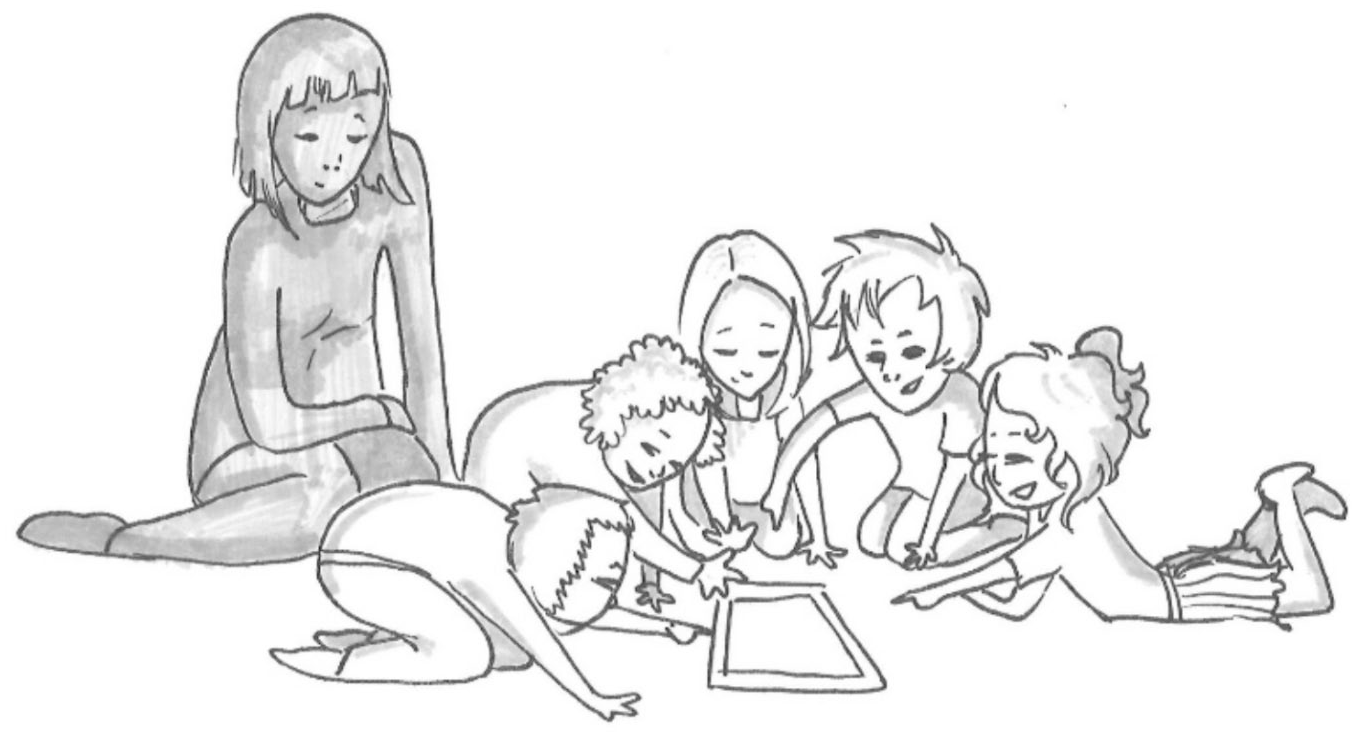
No strategy.
With the Show strategy (Figure 3), the kindergarten teacher faces the children and holds the tablet up in front of herself so the children can see the screen. The children are seated in a row, for instance, on the floor or in a windowsill. The teacher emphasizes and substantiates the story with words and mimicry, and she controls what the children should touch and who is allowed to touch. The children are engaged and well organized, and they are ready to tap the screen when they are allowed. In their reflections, the three teachers explain that they planned to remain close to the narrative, and their readings are scheduled with exploratory questions related to words and illustrations. They take a clear intermediary role, with prepared control of effects; still, in their reflections, the teachers underscore that they wish to facilitate more dialogue.
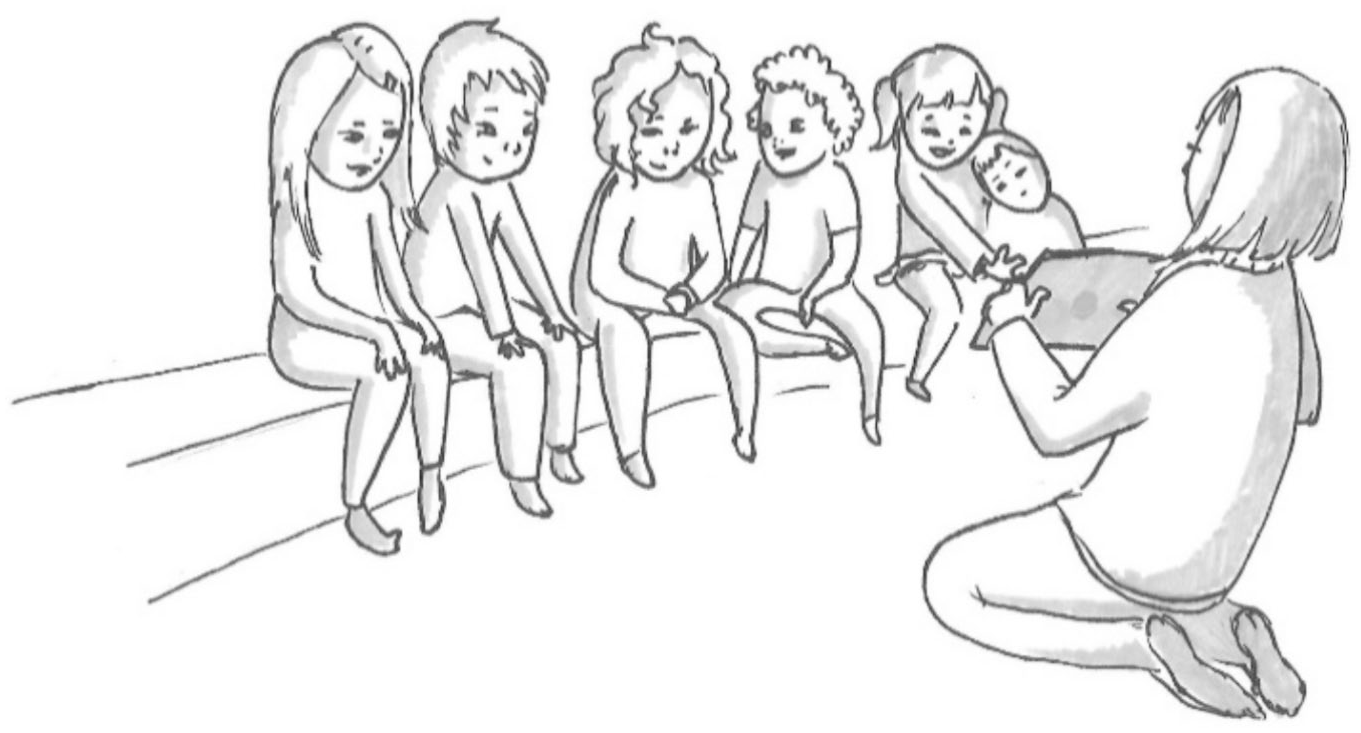
Show strategy.
Our assumption is that this Show strategy may provide more focus on the story since other aspects of the reading and the handling of the medium are so strictly controlled by the teacher.
With the Show & Share strategy (Figure 4), the teacher faces the children, while she holds the tablet, which is accessible and also faces the children. The teacher shows her reactions to the story with words and mimicry, and the children are allowed to tap the screen when they want to. This appears to be an in-between position, with slightly less control than in the Show readings, while the children are closer to the medium. In her reflections, the teacher expresses that this is a well-prepared reading considering both story and medium and that she decided in advance to let the children have access to the screen. Nevertheless, she reports that children taking turns tapping hot spots constantly interrupted the reading, and the reading lacked coherence.
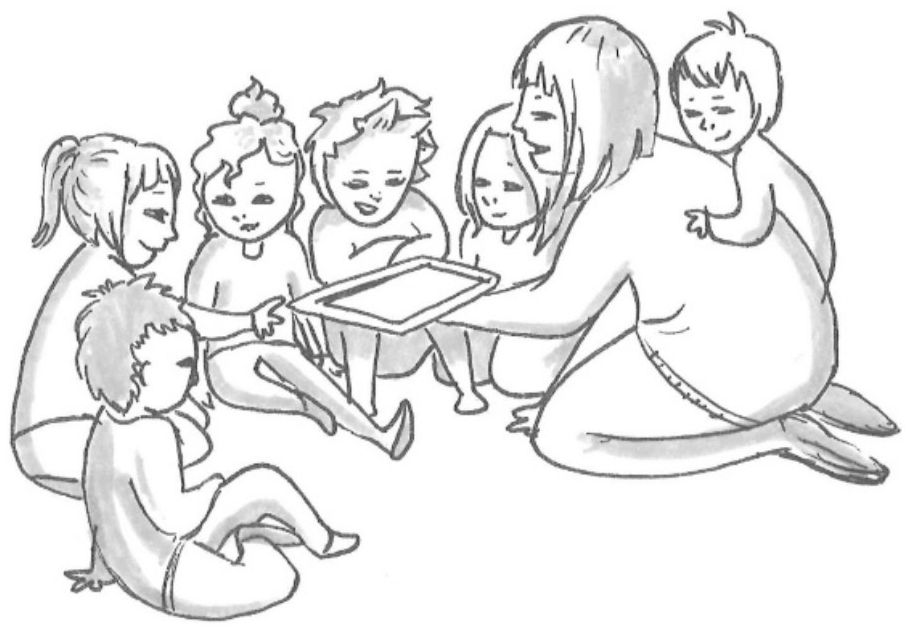
Show & Share strategy.
In the Share strategy reading (Figure 5), the children are on their stomach on the floor, with the kindergarten teacher in the middle, all facing and sharing access to the medium. The teacher asks questions, often related to the activities performed by the children. The children touch the screen in ways that are quite disciplined; they have agreed in advance that only one child will tap on each screen page. In her reflections, the teacher explains that the reading was well prepared, and she is satisfied with how the agreement about tapping worked out.

Share strategy.
We expect that there may be more of a focus on the medium in this reading situation since the placement of the readers makes access to the medium open to negotiation.
Exploration of Quantitative Patterns Within the Different Strategies
What responses do these strategies generate? The selected codes give us certain quantitative indicators, on which our discussions and interpretations are based. The total time of the verbal narration in the app is 6 minutes, and the time left for dialogue/utterances varies from 3 to 43 minutes between the readings.
Utterances on Text and Medium
Taking the coded utterances as a starting point, the main impression is that the Show strategy generates the most utterances in all (Figure 6). This is particularly clear for utterances relating to the story. The Show & Share strategy stands out by generating many utterances on the medium, and the teacher utters most of these. This may be explained by the in-between position of this strategy, which seems to require many comments on how to handle access to the medium.

Frequency of utterances on text and medium, differentiated between children and teacher.
In all the readings, utterances related to the text are most frequent. With the Show strategy, both children and teachers’ utterances are predominantly about the story. In two of these groups (407-1 and 510-1), it is the teachers who utter most of the comments related to the story, for instance, when saying, “Let’s see what happens next”—which contributes to building expectations related to the story—or “What would you do to make friends again?” In the third Show reading (612-4), the children present most utterances on the story. This may be because this group has heard the story from a previous book reading; hence, building expectations to the text is less important. With the Show & Share strategy, text-related comments are quite evenly distributed between teacher and children—still, there are noticeably fewer of them than in the two other strategies—while with the Share strategy, the children’s utterances relate to the narrative more often than the teacher does.
Within the Show strategy, the children utter more than the teacher about the medium, and many of these utterances relate to gaining access to the tablet (“Can I tap now?”). In contrast, in the Share strategy, the teacher utters more about the medium than the children do. These utterances include both negotiations for control of the medium (“Now it is xx’s turn to tap”) and exploration of the medium (“What happens if we tap them?”/“Try tapping something else.”).
In the hybrid Show & Share strategy, the teacher also utters more often than the children about the medium. These utterances include control of the tablet (“Enough tapping”), negotiations on access (“You will be allowed to tap, but if you tap all the time, we do not hear what they say”), and utterances that contribute to building expectations related to the medium such as “What happens when we tap on the lamps?”
Overall, it appears to be the organization of the reading situation that most clearly affects the frequency of utterances about the medium, while utterances about the text are more evenly distributed across the strategies and may be more dependent on the kindergarten teacher’s responsive teaching approaches.
Engaging With the Visuals
In our video observations, the activity of pointing to the screen was coded to account for multisensory engagement with the text (Figure 7). This entails a body posture that shows how a child or the teacher directs attention to something on the screen. For the children, we observed that the pointing could also be understood as readiness to interact with the screen as soon as the teacher gave permission.
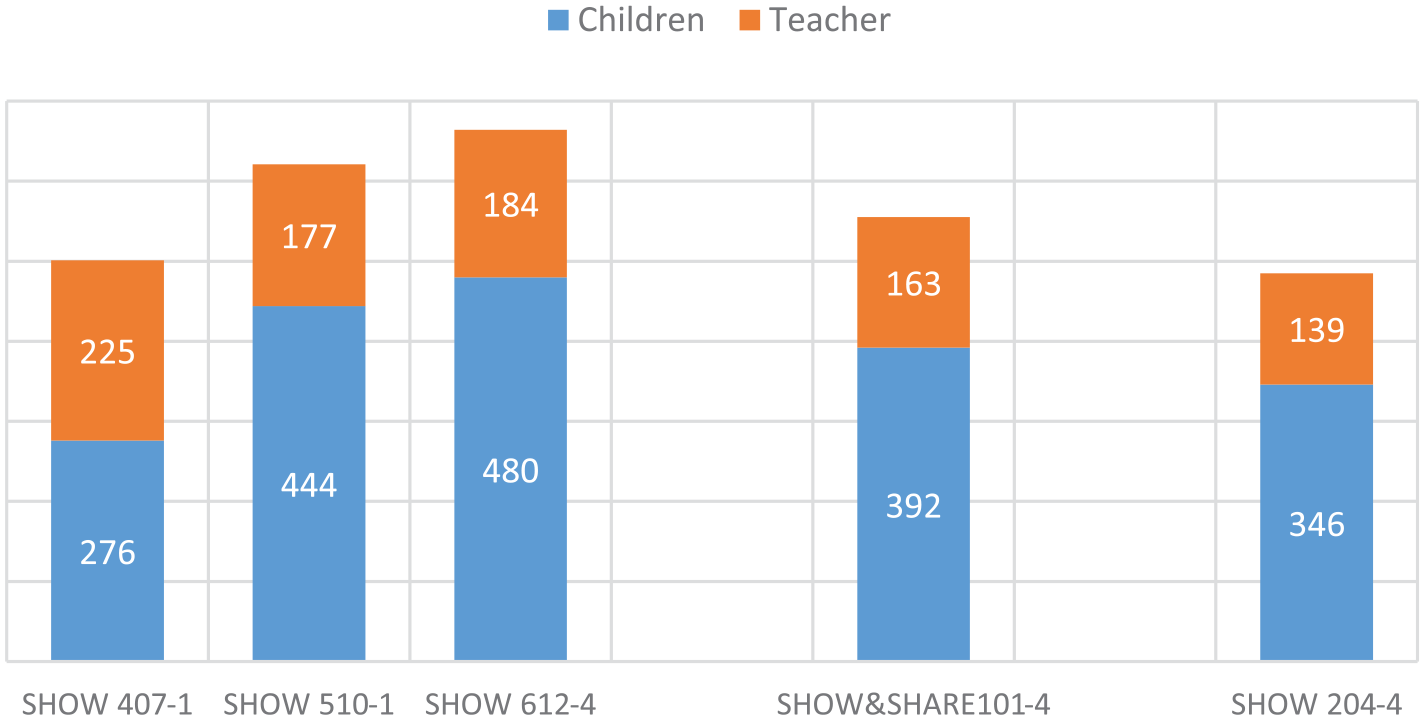
Frequency of pointing to the screen by children and teachers.
Across all the groups, we notice that the children are most eager in pointing at the screen. This may be a consequence of the group reading situation, where the teacher is in control of the medium and has the authority to give the children access. However, it also shows that the children actively relate to the visuals of the text, which is in line with the established reading practice they know from picture book reading in kindergarten. It may also indicate that the children are aware of the affordances of the touch screen as a medium. Comparing the verbal and the bodily response, the children who experience the reading in situations that involve sharing access to the medium (Share strategy and Show & Share strategy) are relatively more eager to respond bodily by pointing than by verbal utterances.
Polyadic Dialogue Sequences
Finally, we turn our attention to the dialogical sequences observed, since the educational aim of the reading sessions was to encourage dialogue. Dialogue sequences were coded both in terms of how many sequences there are in each reading and for how long (in minutes) they last. A dialogue sequence can involve from two to several participants who exchange opinions, impressions, thoughts and responses, which are interrelated. As seen from Figure 8, we find that the Show strategy generates the most dialogue, while we see considerably less dialogue time with the in-between Show & Share strategy and with the Share strategy.

Duration of dialogue sequences and total time of reading.
The total length of reading was between 20 and 24 minutes for four of the five groups, which leaves considerable time for dialogue, interaction, and utterances in addition to the 6 minutes it takes to play the prerecorded verbal performance. Reading 612-4 stands out by spending a total of 49 minutes on their reading. This group was reading the story for the second time, which may have inspired more activity. For the two other Show readings, this was their first reading of Yesper and Noper. However, the Show & Share and the Share readings encountered the story for the second time but still spent approximately the same amount of time as the first-time readers in the Show strategy.
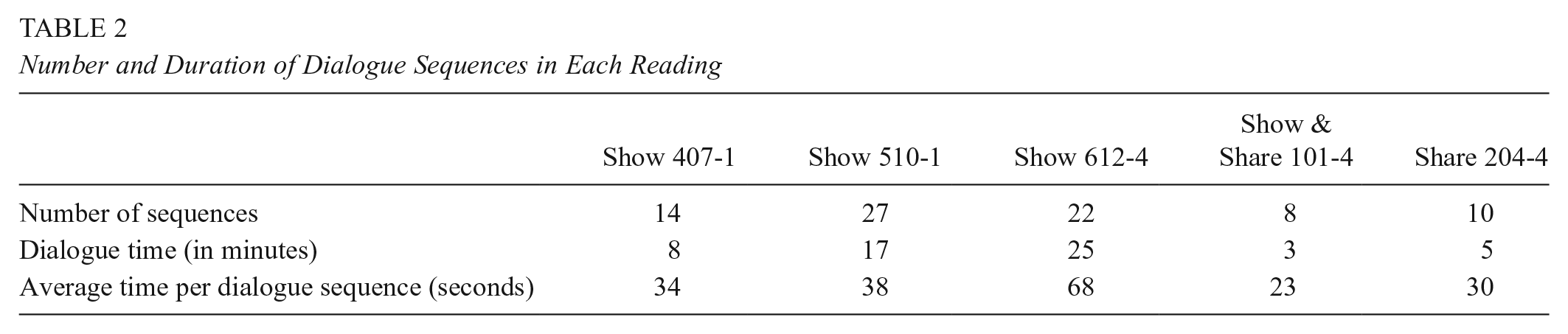
The dialogues may vary in length, as seen from comparing the number of dialogue sequences with the time spent (Table 2). Reading 510-1 has the most dialogue sequences, but this does not lead to most time spent in dialogue. Reading 612-4 has the longest duration of dialogue distributed on fewer sequences. This means that each sequence lasts more than a minute on average in contrast to all the other readings where dialogue sequences last 23 to 38 seconds on average. In strategies that involve sharing, we find not only fewer dialogue sequences but also shorter dialogue time. These findings indicate that we need to explore other factors, such as how the teacher initiates and extends dialogue sequences.
Number and Duration of Dialogue Sequences in Each Reading
Summary
Summing up these quantitative indicators, we see that the readings are fairly equal in length (except for one reading). We also see that the Show strategies generate more utterances in total and more dialogue. In all the readings, there are most utterances about the text. We find most utterances about the medium in the in-between Show & Share reading, where the teachers’ intention of giving the children access to the medium results in frequent interruptions when the children want to take their turn tapping the screen.
When comparing utterances from the group of children and teacher, the clearest pattern appears in utterances about the medium. The Show strategy readings have relatively more child comments and fewer from the teacher. The Show & Share and the Share strategy reading situations have a greater proportion of teacher comments on the medium; especially for the Show & Share strategy, where the children’s access to the medium is more unclear and hence open to negotiations. The reading strategies we observed in our qualitative analysis are most clearly correlated with utterances connected to the medium. Children dominate in the Show strategy readings, while teachers are the most active in the readings that involve sharing. Utterances about the text are more evenly distributed between the teacher and the children, with no noticeable differences in the patterns between the categories.
Discussion
In this study, our focus on different reading situations designed by the teacher has been limited to comparable quantitative measures of effect on verbal and multisensory engagement. The analysis has shown a need for further explorations of dialogue qualities such as how the teacher invites dialogue and responds to the children’s utterances. Our contribution is mainly relevant in an institutional setting where teachers design digital reading with groups of children, whereas we see a need to extend this interest in the reading situation to other settings.
Designing the Reading Situation
Reading from a touch screen in a kindergarten setting is a reading practice that must be designed in new ways since it is different from book reading and screen reading practices established in the private sphere. We observed how six kindergarten teachers designed reading approaches—the strategies they have chosen—and how they seem to draw on, or transfer, practical experiences to this new situation. The intermediary strategy of Show & Share seems to be an attempt to combine the teacher’s position of control by placing her body frontally in relation to the group of children and, at the same time, being attentive to the affordances of the medium and providing access for the children. According to the teacher’s reflections, this strategy seems to be the one where the teacher had most considerations on “medium matters,” with a clear intention that she wanted to both convey the story and give the children access to the screen. However, the teacher did not assess this combination as successful, and chances are that she will not follow up this strategy in the future.
The majority of the observed groups seem to customize the way they read picture book apps in groups into what we have called a Show strategy. This ensures the teachers’ control of the medium and of the children’s access to the screen. It also gives the teacher a good overview of the group of children prioritizing eye contact with the children, while not looking directly at the screen herself. To work, this strategy requires the teacher to be well prepared and to know the app well (the story as well as potentials for interactivity). The strategy emphasizes the institutional setting, providing clear roles and a division of authority between teacher and children.
The other clear alternative we have labeled a Share strategy, since it entails that the teacher and the children have equal access to the medium. The strategy prioritizes that everyone looks at the screen instead of the teacher having eye contact with the children, although the teacher may still be in control from her central position. The roles in this case invite the teacher and children to explore the picture book app together. This reading strategy also draws on experiences of reading print picture books with a group of children; nevertheless, this may be more similar to the experience of the tablet as a personal medium that most children know from home, where they may recognize the “shoulder-surfing” (Yuill & Martin, 2016) mentioned above.
The Children’s Responses
The strategies for organizing the reading session seem to matter the most for utterances on the medium. This is in line with theories on reading as an embodied practice (Mangen, Hoel, & Moser, 2019), indicating that how readers are positioned physically in relation to the medium makes a difference. This supports the idea that we must pay attention to the sensorial dimensions of reading practices in relation to different media (Mills, Unsworth, & Exley, 2018). In addition, there may be a social and cultural dimension (Halliday, 1999; Kress, 2010; van Leeuwen, 2005) to the choice of strategies, where the teachers and perhaps also the children may feel more confident within a reading practice that they can recognize from previous experience with clear roles and expectations.
Our finding that the Show strategy generates more utterances, especially about the story, as well as more time spent on dialogue, seems to emphasize this strategy as the most educationally successful. Nevertheless, this calls for a discussion of what kind of dialogue we find fruitful and the type of reading experience that we hope to give to the children. In our introduction, we gave as a reason for the choice of fictional stories that these—in the fictional story world of “there-and-then”—may generate dialogues that enhance children’s mastery of verbal language outside of the “here-and-now” of the reading situation. From this point of view, what we want to encourage is a focus on the story, especially as it appears that the utterances on the medium are largely tied to the “here-and-now” situation, concerning access to the screen and being allowed to tap. However, we do find examples of more playful and explorative utterances about the medium, especially in the strategies that involve sharing—for example, “What happens if we tap them?” (204-4). Being able to discuss the medium may be an important part of mastering digital reading practices. Relevant questions to investigate more qualitatively is whether the utterances about the medium overshadow the dialogic exchanges about the text and whether comments on the medium may also lead to semiotic acts of meaning making rather than utterances controlling the children’s behavior.
We find that there is more dialogue time in readings that are more focused on the text, while many of the utterances about the medium seem to remain stand-alone comments and not generate dialogue. There may be an unused potential in the children’s active engagement in pointing (Figure 7), which by far exceeds the number of utterances (Figure 6) for all the groups. We notice that whether the groups read the story for the first or second time may have affected the engagement in some of the readings. Knowing the story from before may lead to a concentration of interest in the app medium and the interactivity it offers, or it may deepen the dialogues, as seems to be the case in reading 612-4. Another explanation may be that the teachers have been trained to inspire dialogue about the text, whereas they have not been prepared to the same extent to focus on the affordances of the medium as a topic of dialogue.
Our focus on dialogue and utterance comes from the framing of the overarching project, which situates the reading practice in a frame of language and literacy enhancement. However, there are other dimensions of reading that are vital to the experience and hence to the children’s motivation for continued engagement with literature. The inclusion of pointing as an indicator of attention to the screen, both the visual expression and the interactive performance, provides a broader perspective on the reading practice. In this regard, we found no clear distinction among the strategies. One might have expected more of this type of bodily engagement in the strategies that shared access to the screen on a more equal basis between the children and the teacher.
Conclusion
In this article, we explore what characterizes kindergarten teachers’ strategies in managing children’s access to medium and text in shared app readings and what type of responses to the medium and the story these strategies generate. We focus on the children’s verbal and bodily responses to the text and how this relates to the teacher’s spatial organization of shared dialogue–based reading. Given a free choice to organize the reading situation, we find contrasting strategies between the teachers who treat the tablet like a traditional book, keeping control over the group and of access to the medium, and those who share access to the screen on a more equal basis. In both cases, there appear to be challenges with how to handle the medium-specific interactive affordances, either the children lack access to the hotspots or the teacher lacks in control. Sharing strategies seem to entail more talk about the medium from the teacher.
In terms of utterances about the text, we find relatively balanced relationships between the children’s and teachers’ utterances, regardless of how the reading situation was organized, whereas the Show strategy generates more dialogue and utterances in total. In some cases, we find differences not accounted for by the reading strategies. This calls for further exploration of how the actual dialogue was initiated and led by the teacher.
As a continuation of this analysis, we will expand our material to the other three apps in the overarching project to find out whether the teachers’ strategies vary with different apps and in different orders of reading. If we find steady patterns beyond Yesper and Noper, the design of the reading situation will be an important contribution to understand and facilitate the dynamics of group reading apps in an institutional setting.
Supplemental Material
Captions_AERA2019 – Supplemental material for Organizing Shared Digital Reading in Groups: Optimizing the Affordances of Text and Medium
Supplemental material, Captions_AERA2019 for Organizing Shared Digital Reading in Groups: Optimizing the Affordances of Text and Medium by Trude Hoel and Elise Seip Tønnessen in AERA Open
Footnotes
Acknowledgements
This research was supported by a grant from the Research Council of Norway. We would like to thank our colleagues in the VEBB research group at University of Stavanger who contributed in the coding process and statistical analysis: Professor Anne Mangen, Associate Professor Margrethe Jernes, PhD candidate Marianne Undheim Larsen, and Associate Professor Elisabeth Brekke Stangeland.
Notes
Authors
TRUDE HOEL is associate professor at the National Centre for Reading Education and Research at the University of Stavanger, Norway. Her research concerns early literacy, language learning and children’s book reading in print and on screen.
ELISE SEIP TØNNESSEN is professor in Department of Nordic and Media Studies, University of Agder, Norway. Her research interests are connected to multimodal literacy and children’s uses and understandings of literature and media texts.
References
Supplementary Material
Please find the following supplemental material available below.
For Open Access articles published under a Creative Commons License, all supplemental material carries the same license as the article it is associated with.
For non-Open Access articles published, all supplemental material carries a non-exclusive license, and permission requests for re-use of supplemental material or any part of supplemental material shall be sent directly to the copyright owner as specified in the copyright notice associated with the article.
