




Abstract
Increasingly, children are engaging in early literacy experiences through digital devices. This raises questions about how electronic reading compares to print reading. To assess this, we randomly assigned 200 children (3–5 years) to be read the same book (1) with auto-narration on a tablet or 2) by a researcher from a print book. Reading was recorded and coded for behavioral and emotional engagement and vocalizations. Children were also tested on their story comprehension and vocabulary. Children had slightly higher posttest scores in the print condition. Older children and females also scored higher. There was an interaction between weekly tablet use and book platform. Children were equally engaged with the e-book and print book, but vocalized more about the device in the e-book condition. Findings suggest that e-books offer many of the same, but not all, of the educational affordance as print books. Additionally, novelty might be important in supporting comprehension.
today’s young children are digital natives, meaning that electronic technology is a normative part of their daily lives (Prensky, 2001). In a recent survey of parents of children 0 to 8 years old, the majority reported they had a smartphone and tablet at home (95% and 78%, respectively) and nearly half reported that their child had their own tablet (42%; Rideout, 2017). Electronic media are also becoming increasingly prevalent in schools; a 2015 report found that over half of the preschool teachers surveyed used tablets as part of their educational practices (Blackwell, Wartella, Lauricella, & Robb, 2015). With technology permeating young children’s surroundings, many activities in preschoolers’ lives are digital, including early literacy experiences. For instance, a 2012 poll found that 50% of children are read e-books (electronic books) at bedtime (Fottrell, 2012) and a recent study found electronic reading to account for 2% of young children’s daily screen time (Rideout, 2017).
As young children engage with more electronic books (referred to here as e-books), which have the capacity to narrate stories without a reader present, questions arise about whether these digital stories are as beneficial for young children as print books read by a person. To address some of the questions about the educational affordances of e-books, this study compares whether the comprehension, engagement, and language use of preschool-aged children differs depending on whether the story is narrated by an iPad or read by an adult.
The Benefits of Reading to Young Children
A robust body of literature documents the benefits of reading to young children (Bus, van IJzendoorn, & Pellegrini, 1995). Studies of parent-child book sharing consistently find positive impacts on preschool-aged children’s vocabulary, reading comprehension, and emergent literacy skills (Boyce et al., 2004; Dodici, Draper, & Peterson, 2003; Neuman & Dickinson, 2011) such as print awareness (Justice & Ezell, 2004), decoding (Dooley, 2010), and procedural knowledge (Sénéchal, LeFevre, Smith-Chant, & Colton, 2001).
Reading with young children exposes them to decontextualized language (Beck & McKeown, 2001), which introduces novel vocabulary (Boyce et al., 2004; Marulis & Neuman, 2010) that is often more complex than college-educated adults’ conversational language (Cunningham & Zibulsky, 2013). Reading also provides opportunities for adults to personalize story content by connecting the text to children’s background knowledge, increasing story comprehension as well as language exposure (McKeown, Beck, Sinatra, & Loxterman, 1992). As Korat and colleagues state, “Shared book reading in early childhood is considered a promising context for promoting children’s language, especially vocabulary enrichment” (Korat, Kozlov-Peretz, & Segal-Drori, 2017, p. 60).
Self-Reading Books
With the proliferation of tablets, books that can be read to children without an adult present are highly prevalent. This Read-to-Me feature enables narration of the story completely automatically or with the child swiping to “turn” pages and advance narration. As such, children can be read to without an adult present and can bypass parts of the story by jumping ahead or moving backward. Furthermore, children can tap to have text reread or engage hotspots for supplemental information that may or may not be relevant to the story (Piotrowski & Krcmar, 2017).
Although numerous studies have documented the benefits of book sharing with, and being read to by, an adult, less is known about the potential benefits in the absence of an adult reader. This might be important since research has robustly documented the educational advantages of dialogic reading practices, such as questioning, recasting, and personalizing the story (Bus et al., 1995; Mol, Bus, de Jong, & Smeets, 2008; Whitehurst, Arnold, Epstein, & Angell, 1994), as well as interactive and emotional behaviors such as being warm and responsive during the reading episode (Bus, 2001; Farran, Aydogan, Kang, & Lipsey, 2007). Young children using e-books with auto-narration may not have a warm and interactive adult reading along with them or engaging in dialogic reading practices.
e-Book Research
Earlier research on e-books on computers has largely focused on children who have already begun formal schooling and are typically literate (Zucker, Moody, & McKenna, 2009). The bulk of these studies have found inconsistent results with some showing an advantage for traditional print books (e.g., de Jong & Bus, 2002; Korat & Shamir, 2007), others for e-books (e.g., Korat & Shamir, 2007; Moody, Justice, & Cabell, 2010), and others observing no differences (e.g., de Jong & Bus, 2004; Grimshaw, Dungworth, McKnight, & Morris, 2007; O’Toole & Kannass, 2018). A recent meta-analysis of e-books, regardless of platform (e.g., computers, tablets, DVDs, CD-ROMs, and TV), found heterogeneous effects with a small benefit for e-books on story comprehension (Takacs, Swart, & Bus, 2015). Although reviews of electronic reading have been done for books in several languages (e.g., Bus, Takacs, & Kegel, 2015; Korat & Falk, 2019; Takacs et al., 2015), they document a diversity of findings. This is likely due to the variance in methods and ages included in the studies synthesized. For instance, some of these studies involved a parent or teacher sharing the print book and/or e-book with the child, others had children read the e-book more than once, and others used different types of e-books that are static or interactive with hotspots and/or dictionaries.
With the high prevalence of smartphones and tablets (Rideout, 2017), young children are frequently engaging with e-books on mobile devices, rather than computers. Studies comparing self-reading books on tablets to print books are fewer in number but still find ambivalent results on comprehension, recall, and vocabulary (O’Toole & Kannass, 2018; Reich, Yau, & Warschauer, 2016). However, some studies have observed longer reading times for e-books (Richter & Courage, 2017), more talk about the device than the story with tablets (Chiong, Ree, Takeuchi, & Erickson, 2012; O’Toole & Kannass, 2018; Parish-Morris, Mahajan, Hirsh-Pasek, Golinkoff, & Collins, 2013; Revelle & Bowman, 2017; Richter & Courage, 2017), and both greater distraction (Chiong et al., 2012; Piotrowski & Krcmar, 2017) and learning (Korat et al., 2017) from e-book enhancements/hotspots.
The extant literature on e-books has disproportionately focused on school-aged children and digital stories on computers. The smaller number of studies that has included preschool-aged children and their reading on tablets has found varying benefits of electronic reading over print reading (e.g., Dore et al., 2018; O’Toole & Kannass, 2018; Zhou & Yadav, 2017). Thus, questions still remain as to whether self-reading e-books are equivalent, better, or worse than person-read print books on 3- to 5-year-olds’ comprehension, vocabulary acquisition, story and character recall, attention, engagement, and verbal participation. Given that tablets and e-books are a part of most preschoolers’ daily activities (Rideout, 2017), understanding their utility in early learning is important.
Method
In order to compare learning and engagement between e-books and print books, we used a posttest only experimental design. For this, we recruited 200 children, aged 3 to 5 years, and randomly assigned them to be read the same story by an adult with a print book or by an iPad with the Read-to-Me feature of an e-book, while an adult was present.
Participants
Participants (n = 194) were recruited from 10 preschools in Southern California and through snowball sampling (n = 6). The preschools were selected based on proximity to the researchers and the schools’ willingness for researchers to recruit and test children at the center. No compensation was provided to the centers. Six children were recruited through snowball sampling, rather than recruiting another center. These children did not differ on any measured variables from children recruited from preschools. Children were 3 (n = 60, Mage = 3.53 years, SD = 0.29), 4 (n = 80, Mage = 4.45 years, SD = 0.69), and 5 (n = 60, Mage = 5.55 years, SD = 0.3) years old. The sample of 4-year-olds was larger since this age has greater receptive and expressive vocabularies and letter and phonological awareness than 3-year-olds but are less likely to be able to read the text than 5-year-olds. Thus, their emergent literacy skills are rapidly developing, but their performance on posttest assessments would likely not be due to active reading of the text on their own. Across all age groups and conditions, half of the participants were female and ethnically diverse (49% non-White). However, due to the recruitment area, families were affluent, with 48% having a family income of $125,000 or higher. See Table 1 for details.
Demographics Characteristics for Full Sample and by Condition

Notes. Percentages may not add to 100 due to rounding.
p < .05.
Procedures
Recruitment procedures were equivalent across preschool centers. For each center, a researcher was present during morning drop-off and afternoon or evening pick up (depending on the centers’ hours), to discuss the study with caregivers. Parents/caregivers completed consent and background forms during these beginning and end-of-day times, or packets with the parental consent forms and background questionnaires were sent home with children and returned to the center later. Caregivers also contacted parents/caregivers known to them on our behalf to recruit the remaining six children.
After getting caregiver written consent, we randomly assigned children to be read the same story either by a researcher with a print book or through the Read-to-Me feature on an iPad while a researcher sat next to the child. This ensured comparable adult familiarity and contact between groups. The story that we read was, Chris P. Bacon: My Life so Far. This true story of a pig born with disfigured hind legs was selected because (1) it was available in both print and e-book form and (2) was uncommon and therefore, unlikely that participants would have read it before (see Figure 1). The images and text were equivalent between the print and e-book versions. Each page of the print book was exactly the same in the e-book version. However, the e-book had an average of 6 hotspots per page, that when tapped repeated the word or provided some animation, such as confetti falling at the party scene.
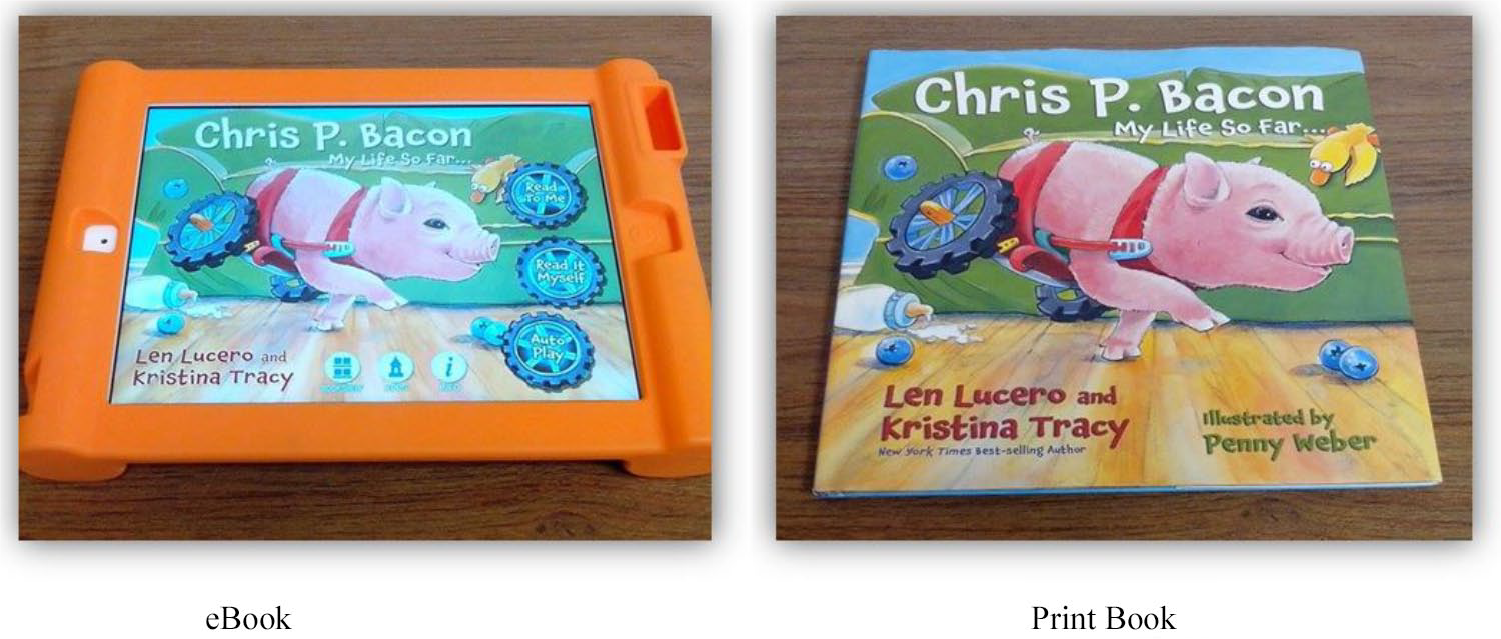
The target book in digital and print form.
For both groups, we collected data in a quiet area of the preschool classroom, yard, or office where the child could be seen by his or her teachers, but not be disrupted by classmates. Children who were recruited via snowball sampling participated in a quiet area in or outside their home. Parents were asked to leave the room. Prior to beginning the study, we asked all children for their verbal assent to participate and to be recorded and if they had ever read the book, Chris P. Bacon: My Life so Far. The researcher and child then sat side-by-side on the floor or on chairs and the print book or iPad was placed on a cushioned lap pillow on the child’s lap. For the print condition, the researcher pointed to the text as she read, using a similar tone and intonation as the e-book. For the e-book condition, the Read-to-Me feature highlighted the text as the story was read. In both conditions, children were expected to turn the page physically or by swiping. If the child did not turn the page after 10 seconds, the researcher told the child, “Turn the page.” If the child turned the page prior to at least half of the page being read, the researcher turned the page back and said, “I think Chris has more to say.” If the child attempted to turn pages backward (return to completed pages), the researcher said, “I think we should let Chris finish his story” and turned back to the current page. To make the conditions as comparable as possible, the researchers tried not to engage in conversation with the child. Children’s comments (e.g., “I have a tablet at home”) were answered with an “uh-huh” or “ok.” Questions were given terse responses as well (e.g., Child: What’s that? Researcher: Let’s keep reading and see). Following the story, we asked children a series of questions about the story, characters, and key vocabulary. We video recorded all the reading episodes and posttest assessments unless caregivers requested that their child not be recorded, which occurred for 39 children (21 print condition, 18 e-book condition). Children received a book for participating. A university institutional review board approved all study procedures and materials.
Measures
A variety of measures were used. First, we asked parents/caregivers to complete a background measure that included demographic information as well as details about children’s tablet and e-book use. Second, we verbally assessed children after each reading episode. Finally, we coded all videos for attention, engagement, and language used.
Background
In addition to providing written consent for their child to participate, caregivers completed a background questionnaire, created for the study, on the child’s age, home English use, birth order, and race and ethnicity, parental education and income, how often in a 7-day period that the child is read to, and the frequency of tablet use and e-reading. Parents also noted if the child had read Chris P. Bacon: My Life so Far before.
Posttest Assessment
At the completion of the book, the child was asked 14 questions about the book that were drafted specifically for this study (see Appendix A). The first was a global recall question, “What was the book about?” followed by specific questions about the characters. For eight of the questions, children were asked to freely recall the answers. If they could not recall the answers correctly, the researcher read a list of multiple-choice options to select from. For instance, children were shown pictures from the book and asked to name the characters (e.g., “I’m going to show you a picture from the story. Tell me the name of the man in the picture.” If they could not recall the name, the child was asked “Is his name: Dr. Len, Dr. Bob, or Dr. John?”). Children were also asked to place images from the book in the order they occurred in the story. Additionally, children were asked to define vocabulary from the book and to recognize a word that was spelled phonetically in the book (e.g., “yooooo-neek”). From these questions, we calculated the following scores.
Total Score
All questions were first scored as correct of not, providing a potential total score ranging from 0 to 14. For many of these questions, children were asked to freely recall the answer and if they were not able to answer the open-ended question, we offered three multiple-choice options. Considering free recall as a higher level of memory, we calculated a total score with recall based on accuracy and whether the child freely recalled events or needed prompting. For this, correct answers that were freely recalled were given a 2, correct answers derived from the multiple-choice options were given a 1 and incorrect answers received a 0. This provided a greater possible range of scores from 0 (none correct) to 22 (all 8 free recall/recognition and 6 other questions, e.g., sequencing, vocabulary, recognition) correct.
Story sequence
Sequencing of story events involved two items. For the first item, children recalled the first thing Chris did when he got home (weighted for free recall or multiple choice). For the second item, children placed four images from the story in the order that they occurred. This picture sequencing was scored as the percentage of pictures in the correct order (i.e., was the first picture placed first). Scores ranged from 0 to 3.
Story events and characters
There were eight questions on characters or events in the story. Questions were presented verbally (e.g., “What kind of animal was the main character?”) or with a picture (e.g., “In this picture, Chris is on wheels. Why did Chris need the toy with the wheels?”). These were summed for a story events and characters subscore ranging from 0 to 8.
Vocabulary
There were three questions about words presented in the book. Two asked meaning (e.g., He was a veterinarian. But what is a veterinarian?) with recognition and free recall and one asked for visual recognition of a word that is large and phonetically spelled in the book (i.e., “yooooo-neek). Scores ranged from 0 to 3.
Video Coding
Videos were divided into 10-second segments and each segment was coded by two trained researchers for engagement items (Willoughby, Evans, & Nowak, 2015; Zhou & Yadav, 2017). Our engagement coding framework was based on the dimensions of general reading engagement (Unrau & Quirk, 2014) and studies of digital reading engagement (Willoughby et al., 2015; Zhou & Yadav, 2017). We coded six items in three dimensions of engagement: behavioral (one item), emotional (two items), and vocalizations (three items). For each 10-second segment, we coded whether each item was present or not (score of 1 if present and 0 if not present). To calculate the proportion of time segments each item was present, we divided the total number of time segments an item was present by the total number of time segments in the reading session.
Behavioral Engagement
Behavioral engagement was coded as children’s complete visual attention to the book/device or the researcher during the 10-second segment. If children maintained orientation to the book/device or the experimenter during the entire time segment, their visual attention was coded as present (score of 1). If children shifted their orientation away from the book/device or the experimenter at any point, their visual attention was coded as absent (score of 0).
Emotional Engagement
Emotional engagement was indicated by the presence or absence of children’s positive or negative emotions during the 10-second segment. Positive expression was scored as present (score of 1) if the child showed at least one of the following 16 expressive displays during the segment: smiling, cheering, clapping, dancing, jumping in excitement, laughing audibly, singing, showing eagerness, giggling, raising cheeks, pulling up lip corners, crinkling eyes, showing affection, smirking, speaking in a warm emotional tone, and using terms of endearment (Bai, Repetti, & Sperling, 2016). Negative emotions were scored as present (score of 1) if children showed at least one of the following 6 expressions: frowning, yawning, lip pouting, sighing, speaking in a cold emotional tone, using terms to expression boredom, dislike, or disinterests (Kring & Sloan, 2007). A score of 0 was given for the segment if the child did not engage in any of these displays.
Child Vocalization
Children’s vocalizations during each 10-second time segment of the reading episode were transcribed and coded as (1) relevant to the story content, which we call narrative-relevant (e.g., “They’re having a welcome home party! I saw a cake on the picture”), (2) relevant to the device being used, which we refer to as device-relevant (e.g., “The iPad can talk!”) and included questions about how to operate the e-book (e.g., “How to swipe?”), and last, (3) irrelevant to the story or device (e.g., “It’s snack time!”). For each type of comment, segments received a score of 1 if the comment type was present and a score of 0 if it was absent. Every time segment was coded for all three types of vocalizations (e.g., the child made a narrative-relevant, device-relevant, and irrelevant vocalization in the segment), but the frequency of each type of vocalization in the segment was not coded (e.g., a score of 1 was given if the child made one device-relevant comment during the segment or if they made three). (See Appendix B for the coding scheme manual.)
Analytic Plan
Linear regressions were run with the main dependent variables being the total score on the posttest assessment (globally and considering free recall). Then, we explored children’s performance on specific components of the posttest, specifically story sequence, story events and characters, and vocabulary. We then compared children’s engagement from the videos with specific analyses comparing behavioral engagement, emotional engagement, and child vocalizations. Predictors of interest were condition (print, e-book), age (3, 4, 5 years), gender (0 = male, 1 = female), and tablet use of at least once a week (0 = no, 1 = yes) as well as interactions between weekly tablet use and condition, while controlling for parental age, income, use of English as a main language at home and race (White, Asian, Other).
Results
Two hundred children participated in the study and of these, 161 reading episodes were recorded. Since researchers were sitting with the child, no coding of behaviors could be done in real time. Therefore, the engagement analysis sample consisted of 161 children (Mage = 47.9 months, SD = 1.4 months; 50% boys, 50% girls) with consent to be recorded. All caregiver reported that their child had never read Chris P. Bacon: My Life so Far.
Comparisons between demographic characteristics of those with caregiver consent to be recorded or not found no difference from the overall sample in age, gender, ethnicity, parental education, and income. The only difference was that more parents who consented to recording declined to state their annual income as compared with those who did not consent to recording (17% vs. 6%). Similarly, comparisons of the children randomly assigned to the print or e-book condition yielded only two differences. More parents of children in the e-book condition had an annual income less than $25,000 (10% vs. 3%) and a 2-year college degree (7% vs. 1%) than parents of children in the print condition. Although 18% of caregivers reported using another language more than English in the home, these children’s group assignment did not significantly differ. See Tables 1 and 2 for details.
Demographics Characteristics for Sample With and Without Video Recording

Note. Percentages may not add to 100 due to rounding.
p < .05.
Posttest Assessments
All children answered at least one posttest question correctly, but none answered all questions correctly (M = 7.45, SD = 2.8), observed range 1 to 13. In considering the level of recall (free recall vs. prompting with multiple choice questions), participants scored from 1 to 17 (M = 8.44, SD = 3.6). Thus, most children answered with recognition, rather than free recall. The print book condition had slightly higher total score means (M = 8.745, SD = 0.34) for all three ages than the e-book group (M = 8.36, SD = 0.34) which were significantly different after controlling for other child and family characteristics. Additionally, older children performed significantly better than young children (Β = 2.49, p < .001) and females had more correct answers than males (Β = −1.41, p = .002). Interestingly, there was an interaction between condition and using a tablet at least once a week (Β = −2.69, p = .004), in which weekly tablet users scored higher in the print condition and less frequent tablet users (never or less than once a week) scored higher in the e-book condition. Scores for story events and characters had the same pattern, with the print condition scoring slightly higher than the e-book condition (Β = −0.46, p = .03), older children scoring higher than younger ones (Β = 0.48, p < .0001) females higher than males (Β = −0.6, p = .001), and an interaction between condition and tablet use (Β = −2.18, p = .002). For story sequencing and vocabulary, there was a main effect of age but not gender. There was also an interaction effect of condition and weekly tablet use for story sequence but not for vocabulary, with infrequent users scoring better in the e-book condition and weekly users scoring higher in the print condition. See Tables 3 and 4 for details.
Dependent Variables by Condition and Age Group

Ordinary Least Squares Regressions Predicting Posttest Scores, Attention, Engagement, and Vocalizations

p < .05. **p < .01. ***p < .001.
Video Codes
Videos were segmented into an average of 53 ten-second segments, with the shortest reading episode containing 40 segments and the longest containing 90 segments. Twenty percent of the videos were double-coded, with an interrater reliability of greater than 0.85 across codes and segments (see Xu, Yau, & Reich, 2019, for details). In comparing video-coded behavioral engagement, emotional engagement, and vocalizations during the reading episode, we found no differences in behavioral engagement or emotional engagement by condition. The proportion of segments with behavioral engagement was high for both conditions and not significantly different. While children did not make many vocalizations overall, there was a main effect of condition on device-relevant comments. Children in the e-book condition made significantly more device-relevant comments (Β = 0.03, p = .01) than children in the print book condition. However, the number of narrative-relevant comments or irrelevant comments did not differ between conditions (Β = −0.01, p = .87, for narrative-relevant comments; Β = 0.01, p = .31, for irrelevant comments). There were no significant interactions effects with weekly device use for any of the engagement items. See Tables 3 and 4 for details.
Discussion
Increasingly, young children are engaging with tablets and as such, early reading experiences are oftentimes digital (Korat & Falk, 2019; Rideout, 2017). This experimental study tested preschoolers’ story recall, comprehension, vocabulary, engagement, and vocalizations when being read the same book by either a researcher or from the Read-to-Me feature of an iPad. We found that children 3 to 5 years old who were read a print book performed slightly better on posttest assessments, largely due to recalling more details about the sequence of the story events. Children who were read to by the automatic narration of the e-book tended to talk more about the device than children who were read the story by a person. However, children showed equivalent emotional and behavioral engagement during the story when being read to by an iPad or a person. These findings are important in several ways.
Attention and Enjoyment
Attention has been shown to be principal for learning, especially learning to read (Franceschini, Gori, Ruffino, Perdrolli, & Facoetti, 2012; Hidi, 2001; LaBerge & Samuels, 1974). For instance, a study with preschoolers found that the amount of time a child focused on an alphabet book predicted their posttest letter-name knowledge and phonological awareness (Willoughby et al., 2015). Some studies (e.g., Richter & Courage, 2017) have found children to be more visually sustained with e-books. We did not see a difference in behavioral engagement, although children were less likely to recall the story sequence when they heard the book on the tablet. Furthermore, like other studies of digital reading (e.g., Lauricella, Barr, & Calvert, 2014; Richter & Courage, 2017), we found young participants to be equally behaviorally engaged with the books in both platforms.
Enjoyment is a component of engagement (Reeve, 1989) that might also be facilitative of learning. Our findings suggest that children might enjoy being read to both by a person and a digital device. O’Toole and Kannass’s (2018) four-group comparison of a person-read print, person-read e-book, digital narration of a print book, and digital narration of an e-book suggests some benefits to adult reading through scaffolding children’s understanding as well as potential attention cost to children attending to the reader rather than the story. Though a small difference, children remembered significantly more about the story when it was read by a person than a tablet. However, they were equally emotionally and behaviorally engaged.
Traditional (print) studies of emergent literacy have identified numerous ways in which young children benefit from adult readers, who often mediate children’s engagement with text (Haden, Reese, & Fivush, 1996; Whitehurst, Falco, Lonigan, & Fischel, 1988; Whitehurst & Lonigan, 1998). In our study in which neither the person nor the tablet engaged children in conversation around the text, children were equally likely to vocalize about the story in both conditions. These findings deviate from earlier studies comparing e-books and print books, which found more parent-child discussion about the digital platform than story when comparing reading on e-books and print books (e.g., Chiong et al., 2012; Lauricella et al., 2014; Parish-Morris et al., 2013; Revelle & Bowman, 2017). Importantly, our study and others do not find device novelty alone to explain these patterns (e.g., Dore et al., 2018; O’Toole & Kannass, 2018). In considering the educational affordances of e-books, it is possible that these verbal outputs during reading, even about the device, could benefit language development. Future research should assess language skills.
Novelty and Comprehension
An interesting and unexpected finding from this study was the interaction between tablet use and book platform. Children who had little to no tablet use (i.e., never or less than once a week), scored higher on the posttest when they read the e-book, rather than print book. Conversely, common tablet users (at least once a week) scored higher when the book was in print, rather than digital. This suggests a potential benefit of novelty (Schomaker & Meeter, 2015). Research on older media (e.g., computers) when they were new (Clark, 1983) as well as studies of more contemporary forms of media (e.g., tablets; Rossing, Miller, Cecil, & Stamper, 2011) have found educational benefits from the novelty of these platforms. In considering print and electronic reading, children with little tablet experience may be more focused on the story when it is presented on a novel, digital, platform. On the same note, children with weekly tablet use might find print versions of books novel as well. This is an interesting pattern given that the two groups did not differ in their observed behavioral engagement during the reading episode. It is also important to note that answers to the dichotomized question, “Does your child ever read books electronically (like on an iPad, Kindle, Nook)?” were not related to posttest scores directly or in conjunction with condition. This suggests that the novelty is not based on previous book platform (digital), but rather on the device (tablet).
Narration Matters
Other studies (e.g., Dore et al., 2018; O’Toole & Kannass, 2018) have found story comprehension to be equivalent when narrated by a person or device. A recent study comparing 4- and 5-year-olds’ comprehension of an e-book story when read by (1) a parent, (2) alone with the Read-to-Me feature, or (3) alone without narration (just looking at the e-book) found that children recalled more details when hearing narration from the device than when simply looking at the e-book without narration. However, being read the story by a parent resulted in greater comprehension and recall. The authors attributed the parental benefit to observable engagement behaviors such as affection and dialogic reading practices (Dore et al., 2018). Our study also found higher posttest scores when read to by a person, even without embellishments by an adult or differences in observable engagement behaviors by children. However, questions remain as to how children might benefit from joint-book sharing of an e-book with a parent using the Read-to-Me feature (auto-narration), especially if the parent is affectionate and engaged in dialogic questioning during the story.
Limitations
This study has several important limitations to consider. First, not all of our enrolled participants’ caregivers consented to the recording of their child. Thus, we were unable to code visual engagement, emotional engagement, and vocalizations for all participants. This limited our statistical power to detect small effects and resulted in uneven cells by condition and age. Although we assessed potential differences in demographic characteristics between those with video consent and those without, there are potentially unmeasured systematic differences between groups. Another limitation is that our study included only three vocabulary questions and one of these words, “veterinarian,” was likely known by older children. A recent study by O’Toole and Kannass (2018) found comparable story comprehension between e-book and print book reading, but a benefit of e-books for acquisition of novel vocabulary. Unfortunately, we were limited in which words in the book were likely novel for 3- to 5-year-olds and our narrow measurement likely limited our ability to identify potential vocabulary benefits of specific platforms. It is important to note that we did not measure baseline reading or language skills and, instead, relied on a randomized posttest only design. It is possible that random assignment did not equally distribute children on key reading or linguistic characteristics. In trying to keep the conditions as comparable as possible, we did not engage children in discussion about the book and provided minimal responses to questions. As such, we are unable to assess the additional benefit of reading with embellishments that are (currently) unique to a human reader. Last, the characteristics of our sample limit the generalizability of our results. For instance, our largely affluent sample of children (higher mean income and education than national average) limits the generalizability of these finding to children from less educated and resourced families. Additionally, 18% of parents reported that English was not the main language in their home. Although the prevalence of children from these homes did not differ between the print and e-book conditions, there was a main effect of language on total score and memory of story characters and events. Future research should consider the role of home language in learning from digital books.
Conclusion
By keeping the story, adult contact, and lack of discussion equivalent across conditions, we were able to compare the comprehension, sequencing, vocabulary, engagement, and child vocalizations when listening to a story read by a person or a tablet. We found children to be equally attentive, vocal, and emotionally engaged with both platforms and to remember more about the story, particularly the story sequence, when read a print book. However, children tended to talk about the device when reading on a tablet, regardless of previous tablet or electronic reading experiences. These patterns may influence young children’s focus on reading and subsequent literacy. Future studies should explore the impact of e-reading on reading motivation as well as e-book design features that could promote story-relevant vocalizations. Print books seem to have a slight advantage over e-books on overall recall of what was read, but not on memory of story events or novel vocabulary. Given the high prevalence of e-books in the lives of young children, understanding the different benefits of digital and print early literacy experience is important.
Footnotes
Appendix A
Appendix B
Acknowledgements
We would like to thank Beatrice Kug and Jasmine Chang for assistance in coding the videos and the UCI Undergraduate Research Opportunities Program for helping fund this study. We are especially grateful to the preschools and children that participated in our study.

Authors
STEPHANIE M. REICH is an associate professor of education at the University of California, Irvine, with appointments in informatics and psychological science. Her research focuses on direct and indirect influences on children’s development especially through the family, schools, and digital environments.
JOANNA C. YAU earned her doctorate in education at the University of California, Irvine and is now a post-doctoral fellow at the University of Southern California. Her research examines how technology affects wellbeing, interpersonal relationships, and learning.
YING XU is a PhD student at the University of California, Irvine. Her research interest is focused on digital media and child development.
TALLIN MUSKAT is a technical recruiter in the IT & telecommunications industry. She is interested in human behavior, leadership, learning, and the intersection of technology and education.
JESSICA UVALLE is a 10th grade English teacher. Her research interests are in project-based learning within her classroom.
DANIELA CANNATA is a registered behavior technician, specializing in work with children affected with autism. She received her bachelor’s degrees in psychology and social behavior and education sciences at University of California, Irvine and a master’s degree in curriculum and instruction with a concentration in applied behavior analysis (ABA) from Arizona State University.