




Abstract
As state governments seek to improve the performance of institutions of K–12 and higher education, they often adopt educational policies that have similar names but different characteristics across states and with variations over time within states. Yet quantitative analyses generally examine the absence or presence of an educational policy instead of diving into details such as the dosage or percentage of funding tied to a policy or the specific groups being targeted by the implementation of the policy. The aim of this article is to provide guidance for education policy researchers in constructing and analyzing detailed data that can inform the design of state-level policies, using state performance-based funding policies in public higher education as an example. We also show how to conduct difference-in-differences analyses with continuous treatment variables in order to take advantage of more-nuanced data and better understand the context in which policies are effective (or ineffective).
The role of state governments in shaping educational policies is arguably stronger today than at any point in the past two decades. The passage of the Every Student Succeeds Act in 2015 to replace No Child Left Behind curtailed the power of the U.S. Department of Education over states’ K–12 educational practices after years of critiques from both sides of the political aisle (Dillon, 2011; Klein, 2016; Krane, 2007). In higher education, the Trump administration is moving to reverse a number of federal accountability provisions in higher education while many states are taking a more active role in attempting to improve colleges’ performance (Kelchen, 2018a).
A large body of research has shown that innovations in K–12 and higher education adopted in one state often spread to other states through the policy diffusion process (e.g., Hearn, McLendon, & Linthicum, 2017; Lacy & Tandberg, 2014; McDermott, 2003; Mintrom, 1997; Mokher & McLendon, 2009), but distinctions in local needs and political preferences often lead states to function as policy laboratories, approaching similar policy issues in a range of different ways (Elazar, 1972; Karch, 2007). As a result, qualitative and quantitative research in education has shown a great deal of heterogeneity in how states adopt and interpret educational policies (Dougherty, Natow, Pheatt, & Reddy, 2016; Wong, Wing, Martin, & Krishnamachari, 2018).
Yet many quantitative analyses in both K–12 and higher education classify complex state policies into a small number of basic classifications. Numerous empirical studies examining policies that vary considerably across states, such as charter school policies and higher education funding strategies, treat such policies as being binary in nature (e.g., Finger, 2018; Wong & Shen, 2002). Researchers often make these decisions for the purpose of methodological convenience: Quasi-experimental methods frequently used to generate causal estimates of policy impacts are easier to estimate using a binary treatment variable, and existing data sets often do not contain the detailed information required to construct a continuous treatment measure. Yet policy makers need to know how the details of state education policies affect student outcomes, as examining the simple absence or presence of a policy can obscure important details about which conditions make a particular policy effective (or ineffective).
Some studies provide a slightly more nuanced look at the data by placing states into a small number of groups based on similar policy characteristics (e.g., Kelchen, 2018b; Sjoquist & Winters, 2015). Collapsing heterogeneous policies into broad categories, however, leaves policy makers with little nuanced information about how to design state-level policies to meet their intended outcomes (and to mitigate potential unintended consequences). To fully understand the implications of different types of educational policies across states, researchers typically need to compile their own data sets capturing how policies have changed in each state over time. As Table 1 shows, a number of recent studies have begun to use this method to answer a range of questions. However, only some of these studies publish summary data at the state level, and few get into issues of variations in treatments within or across states. This slowly growing literature base represents a promising direction for informing policy, but researchers lack clear guidance on how to construct and analyze detailed state-level education policy data.
Examples of National Studies on State-Level Educational Policies

Note. STEM = science, technology, engineering, and mathematics; FTE = full-time equivalent.
In this article, we outline how to collect and analyze detailed data on state education policies in order to account for heterogeneity in how states adopt and implement policies, using state performance-based funding (PBF) policies in higher education as a case study of a complex educational policy that differs substantially across adopting states. We begin by offering a brief summary of PBF policies that tie state funding to student outcome metrics and considering how existing research has examined the effects of these policies. We then provide a step-by-step guide on how to construct detailed policy data sets that allow for more nuanced analyses of complex education policies, including a discussion of how to collect data using state education commission websites, budget documents, media coverage, and discussions with stakeholders in a way that can be replicated and expanded on by future researchers. We also provide examples of the data dictionary and data collection protocol as a practical guide for this work. Finally, we describe how researchers can leverage detailed data to extend common quasi-experimental methods, particularly difference-in-differences (DD) designs that are frequently employed to examine the impacts of state-level education policies, to provide more nuanced analyses and policy recommendations.
Case Study: Performance-Based Funding in Higher Education
The case study used throughout this article, PBF, is an increasingly popular higher education policy that ties a portion of state funding for public institutions to various student outcome metrics, with the goal of incentivizing colleges to operate more efficiently and improve student outcomes (Dougherty & Natow, 2015). As of 2017, 35 states connect at least a portion of their higher education appropriations to PBF (Hillman, Fryar, & Crespín-Trujillo, 2018), with additional states, such as California, either considering or transitioning to a PBF policy (Fain, 2018).
The structure and dosage of PBF policies vary considerably across participating states. For example, Michigan ties only 1% to 2% of higher education appropriations to performance-based outcomes, while Tennessee allocates 85% of higher education appropriations to performance (Snyder & Boelscher, 2018). Other states, including North Carolina, Michigan, and Ohio, tie different shares of funding to outcomes or use different funding formulas for 2- and 4-year colleges. A growing number of PBF-participating states have also introduced bonuses or premiums for graduating low-income, racial minority, or other at-risk students in order to achieve greater equity (Gándara & Rutherford, 2018; Kelchen, 2018a), but the amount of PBF allocated for equity considerations and the specific equity metrics being incentivized (e.g., low-income, minority, adult, at-risk students) also differ substantially across participating states (Jones et al., 2017).
Despite the growing presence of PBF policies, the majority of peer-reviewed academic research on the effectiveness of PBF policies has shown that adoption leads to null or negative effects on student outcomes (e.g., Hillman et al., 2018; Hillman, Tandberg, & Fryar, 2015; Umbricht, Fernandez, & Ortagus, 2017). However, most multistate analyses rely solely on binary indicators of PBF and are unable to account for distinctions between PBF policies (or changes to PBF policies once in place). The growing popularity of PBF combined with the lack of detailed policy data over time suggests the need for detailed descriptive and quasi-experimental analyses that move beyond binary indicators of complex educational policies. In the following section, we describe how to construct a detailed data set of state educational policies to be able to support such analyses.
Constructing a State Policy Data Set
One of the reasons why few researchers have constructed detailed data sets of state educational policies (and conducted analyses using detailed data sets) is the time-consuming nature of creating such a data set. Yet this sort of work is needed in order to accurately examine the effectiveness of different components of state educational policies and ultimately influence public policy discussions with nuanced, evidence-based recommendations for how to design effective educational policies.
In this section, we offer a step-by-step guide to constructing a detailed longitudinal state policy data set. The goal of this guide is to help advance the field of education research by offering exposure to the nuances and processes associated with collecting and using administrative data across policy-adopting states. Even though we present this guide as a linear process, researchers should expect to go back and make changes to their variables list and data collection process after they begin to collect data. However, our hope is that this guide helps researchers reduce the amount of time needed to produce a useful data set.
The first step is to determine the intended time period of the data set. In some cases, the time period to be examined will be clearly defined based on the first state to adopt a certain educational policy. In other cases, researchers may consider a natural break point related to when states changed their level of commitment to a policy, particularly for programs that have existed in some states for decades. Another option that is not ideal, but often necessary for researchers working with a limited budget, is to choose the years included in the data set based on issues of statistical power or the researcher’s available resources. Bringing older years of data into a data set may allow for more policy adoptions or changes in policy, but each older year of state policy data may come at a high cost to researchers due to the difficulty in gathering older records. In addition, researchers may consider focusing on relatively recent policy adoptions if the goal of the corresponding research is to influence ongoing policy discussions, as legislators and state educational agencies may not be as interested in an analysis that includes data on long-abandoned or since-revised aspects of educational policies.
In our PBF example outlined above, we chose to begin in 1997 because it allowed for a two-decade panel data set that balanced available resources with the ability to capture nearly all policy adoptions. While eight states adopted PBF between 1993 and 1996, all but one of these states abandoned PBF by 2002 (Dougherty & Natow, 2015). Finding details of these short-lived programs is exceedingly difficult, as little information on these programs are available on the Internet and many state education agencies lack the institutional memory to help fill in missing data. For the purposes of quasi-experimental analyses, we recommend that researchers collect available data on the absence or presence of a policy for several years prior to the beginning of the main policy data set and also collect information on available state-level and institution-level characteristics from sources such as the Common Core of Data or the Integrated Postsecondary Education Data System. This allows for comparisons of pretreatment trends and allows for the first years of detailed policy data to be used in analyses.
This decision should be immediately followed by creating a draft list of the variables of interest, or a data dictionary, that includes a clear description of each variable. Because the list of variables to collect should be based on theory and prior research, it may be necessary to collect data on policies to include not only the main variable(s) of interest but also covariates that could serve as confounding factors. For example, researchers interested in examining state charter school enrollment caps may wish to collect additional information on the landscape of school finance equity lawsuits, as that could potentially influence whether charter schools choose to operate within a state. The same data collection protocol identified above would still hold in such a situation, but the number of variables collected (and the time needed to collect those variables) would increase due to the need to account for additional contextual complexities that could otherwise threaten the internal validity of later analyses.
The focus in state educational policy data collection efforts should be to go beyond a simple binary indicator of a policy’s presence in a given year and attempt to measure the intensity or dosage of a policy. This dosage measure captures variations in policy adoption across states as well as within states over time, such as differences in levels of state funding tied to student outcomes or the types of metrics being considered. The typical variable of interest in the PBF literature has been the absence or presence of PBF at a given college or in a given state at a particular point in time, but a small body of recent literature has expanded the focus to examine the presence of bonus provisions for STEM (science, technology, engineering, and mathematics) or historically underrepresented student success (Gándara & Rutherford, 2018; Kelchen, 2018a; Li, 2018). A consulting firm, HCM Strategists, released a four-category typology of PBF formulas in fiscal years 2015, 2016, 2018, and 2019 that represented a slightly more nuanced classification of states’ PBF policies (e.g., Snyder & Boelscher, 2018; Snyder & Fox, 2016), categorizing participating states based on the percentage of funds at stake in a given sector and a few other details related to each state’s PBF formula. While such categorizations move the research community closer to understanding how key components of a particular policy affect outcomes, they may offer little specific guidance to policy makers seeking to better understand which aspects of an educational policy are effective in achieving the goals of the policy or legislative body.
Table 2 contains an example data dictionary, which shows researchers how to begin data collection efforts with the goal of measuring variations in dosage of PBF policies by including as much detail as practically possible. We first included both the dollar amount and percentage of state appropriations tied to institutional performance each year, as different analysts may find one of the two numbers more suitable for their analyses. We then collected details on the individual success metrics included in PBF systems, such as credit completions, retention, and the number of credentials awarded. To capture the presence of bonus provisions, such as bonuses for graduating underrepresented or STEM students, we also collected data on the amount and percentage of state appropriations tied to performance metrics associated with individual student subpopulations of interest.
Data Dictionary for Performance-Based Funding (PBF) Policies With an Example State (Tennessee in Fiscal Year 2008)

Note. PASSHE = Pennsylvania State System of Higher Education; N/A = not available; IPEDS = Integrated Postsecondary Education Data System; STEM = science, technology, engineering, and mathematics.
In Table 3, we include a sample of the data we collected for Tennessee in Fiscal Year 2008 as an example of what a data entry looks like for a state with a complicated PBF system. Even though Tennessee’s PBF policy was in place throughout the duration of the time period for which we collected data, the state made several substantive changes over time in both the amount and percentage of state funding tied to institutional performance metrics and therefore offers a useful example of variations over time in the characteristics and dosage of a PBF policy.
Performance-Based Funding (PBF) State-Level Policy Data Set Construction Protocol

The second step to take before beginning data collection is to determine the appropriate level(s) at which data should be collected. Researchers should consider whether a policy treats all districts, schools, or colleges within a state in the same way or whether they face different incentives or pressures under a broader policy. While many states subject all public colleges to a PBF policy, for example, some states (e.g., Maine, Texas, and Washington) only include one of the two main sectors of colleges (2-year and 4-year), while a few states (e.g., Wisconsin and Pennsylvania) include systems of higher education that do not align cleanly with institutional sectors (Snyder & Boelscher, 2018). Other states, such as Arkansas, Florida, and Missouri, allow colleges or governing boards to select some of their own performance metrics, resulting in variations in focal metrics within each state (National Conference of State Legislatures, 2015).
For cases in which state policies operate differently across districts, schools, or colleges, researchers should consider creating an additional data set to capture details at the institutional level. For data collection purposes, researchers can begin with one line of data for each state/year combination (e.g., Wisconsin in 1997), with all the details about the differences across institutions contained in an open-ended section at the end of each entry. Regardless of variations across districts, schools, or colleges within a participating state, a state-level data set may be of more value for policy makers or the public, as a data set with 50 state entries for each year can be easier for a lay audience to understand and quickly use than a data set with hundreds or even thousands of lines representing each individual district, school, or college in a given year. However, researchers seeking to examine the efficacy of a given educational policy will eventually need to break the data set down to the institution level if there are any differences in how the policy is applied to institutions within a participating state.
The third step to take before beginning any data collection is to carefully consider what counts as policy adoption given that states do not always implement their policies as they were initially enacted. Some researchers may choose to focus on what legislators or state education agencies initially passed through legislation given that this is the set of policies that schools or colleges were considering while setting their course of action for the upcoming year. Other researchers may choose to examine what conditions an institution actually faced in that given year, as a school or college may have changed their response if they realized that the educational policy would not be implemented (and funded) as initially planned. As researchers begin to collect data and learn more about how policies are legislated and actually implemented, the definition of adoption may need to be revisited and potentially revised.
Researchers often assume that a policy is implemented in the year following its approval and use a 1-year lag in their analytic models to account for this delay (e.g., Umbricht et al., 2017). Unless there is clear evidence that the policy is always implemented as initially designed across all participating states, researchers can create separate categories for initial policies and what was actually implemented (or at the very least collecting those details in a separate notes section). In the example PBF data set, we distinguished between policy adoption and policy implementation by noting years of policy adoption and policy implementation in separate columns and documenting funding amounts announced during initial adoption and funding amounts that actually flowed to institutions (see the data dictionary in Table 2 for more details).
We make the preceding recommendation because not every state with a PBF policy on the books actually tied funding to outcomes in a given year. The logic of the preceding point extends beyond the PBF example and can apply to any state funding policy. For example, the Mississippi legislature passed a law in 2009 blocking the state’s board of trustees from enacting its approved PBF policy until 2014 (Mississippi Institutions of Higher Education, 2013), and as many as seven states with listed PBF policies did not actually provide funding for their systems in Fiscal Year 2018 (Snyder & Boelscher, 2018). In addition, states often adjust their budgets in the middle of a fiscal year due to unexpected revenue shortfalls or expenditure increases. At least eight states have made midyear budget cuts in each year since 2008, with a peak of 41 states pulling back promised funds to at least some state agencies in Fiscal Year 2009. Although not every state pulled back higher education funds, five states reduced higher education funding by more than $10 million in Fiscal Year 2018 (National Association of State Budget Officers, 2018).
For the fourth step, researchers must develop a comprehensive strategy on how they will gather data on an individual policy in a given year. This strategy should be the same for each state and year in the data set for two reasons. First, this clear set of policies provides a framework for revising initial drafts of the data set if the protocol changes after beginning to collect data. Second, a comprehensive strategy also allows the data set to be updated in the future, including by other researchers. These decisions should be carefully documented in a data collection protocol. For many state policies, the optimal way to compile data is through a carefully designed set of Internet searches. Given the potential for significant variations and inefficiencies when searching for policy details, we offer the following six recommendations for researchers when conducting a thorough search of state-level policies (see our data search protocol in Table 4 for additional details).
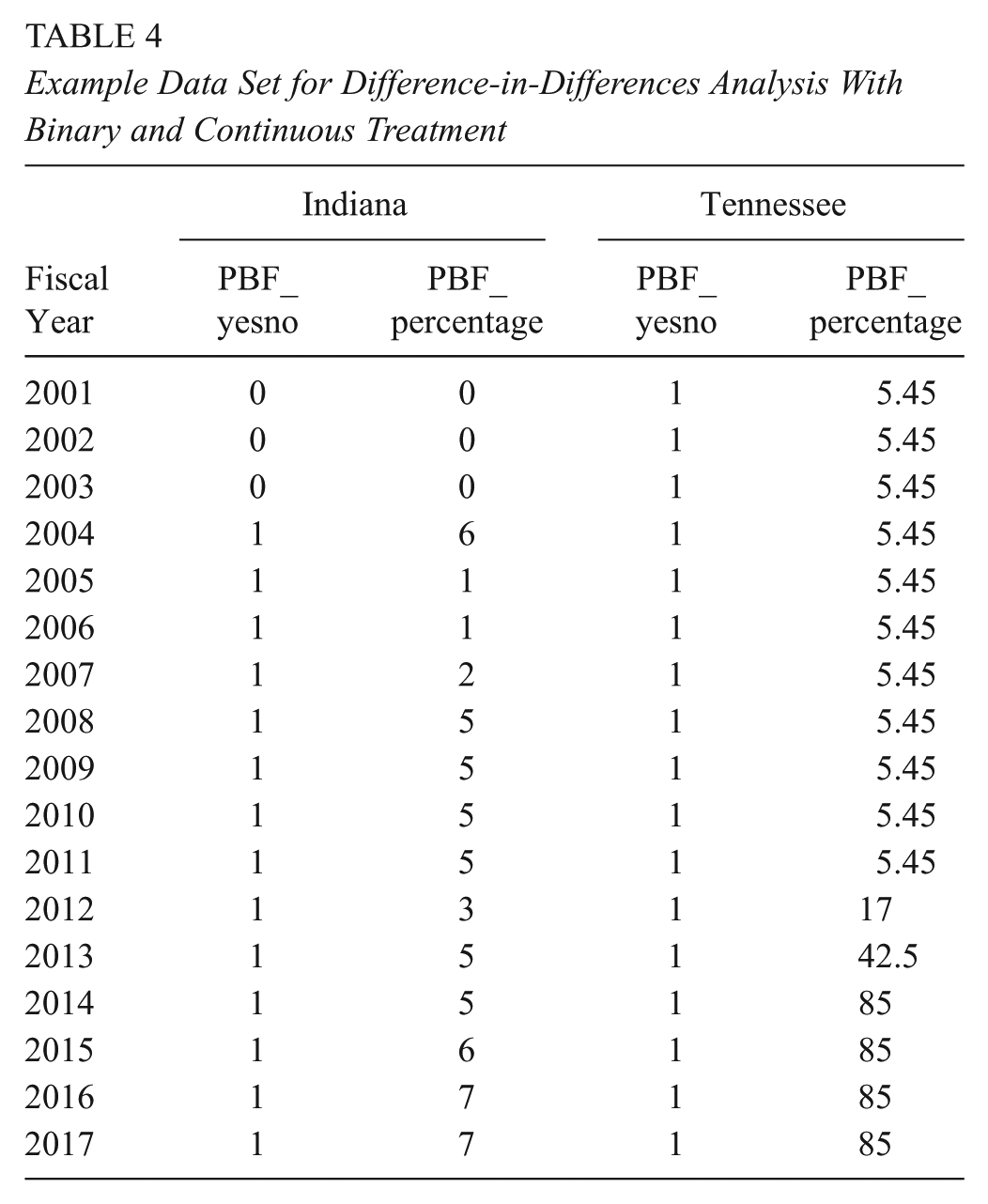
Example Data Set for Difference-in-Differences Analysis With Binary and Continuous Treatment
After going through the above steps, a researcher can now begin collecting data. Rather than collecting data for one year or one state at a time, we strongly recommend that researchers collect data from a random sample of states for a random sample of years (with an oversample of earlier years of the data set) to make sure that the desired data elements can be collected. For large-scale data collection processes that involve a team of researchers (as well as graduate students), concerns regarding interrater reliability should be addressed. Multiple coders should independently code several state/year combinations to see if they all arrive at the same values. If coders disagree on more than a small percentage of observations, researchers should consider changing the data collection guidelines and/or providing additional training in order to increase the likelihood of coders agreeing. Once data collection for a state has been completed by one researcher, another researcher can independently collect and record information on the same data elements to ensure interrater reliability. Any discrepancies can be discussed as a research team and, in some cases, individual researchers can contact state education agencies for further clarification. As researchers learn more about the particular aspects of policies during the data collection process, additional elements that may need to be collected can be identified and the data dictionary and protocol can be updated appropriately.
Accounting for Policy Details in Difference-in-Differences Analyses
With educational policies being adopted and implemented in different ways across states, districts, schools, and colleges, more nuanced evaluations are increasingly important to understand the context in which policies are effective. While quasi-experimental designs can support continuous treatment variables, it is still relatively uncommon to do this in practice (Imbens & Wooldridge, 2009; St. Clair & Cook, 2015) due, at least in part, to the time-intensive nature of collecting and documenting detailed policy data and a small number of exemplars in education research on how to use continuous treatment variables. This leaves researchers with limited practical suggestions for incorporating continuous treatments into multistate policy evaluations, and the alternative of doing a series of individual analyses with each adopting state as a separate treatment group is often inefficient and insufficient as a way to influence discussions surrounding the efficacy of complex educational policies.
In this section, we demonstrate how researchers can use continuous treatment variables in quasi-experimental designs to support more detailed analyses of educational policies. We focus on DD designs since this method is frequently used to examine the impact of state educational policies, including PBF policies (e.g., Hillman et al., 2018; Hillman, Tandberg, & Gross, 2014; Tandberg, Hillman, & Barakat, 2014; Umbricht et al., 2017). Additionally, this section focuses on analyses at the state level to reflect on how policies may vary across states and within states over time. Analysts interested in sector-level or substate-level analyses (e.g., school, district, college, or student level) can use the same general DD framework by disaggregating data to an appropriate level, with the correct level to use varying across research questions and depending on whether different schools or colleges in a state were treated differently by a policy.
We provide a practical guide for how to conduct and interpret results from a DD analysis using a continuous rather than binary treatment variable and then discuss strategies to test assumptions underlying the DD model, drawing throughout on the PBF example described in the previous section. Table 5 provides examples of DD studies in education that use continuous treatment variables in policy evaluations, and we recommend Wing, Simon, and Bello-Gomez (2018) for a comprehensive—yet accessible—review of the DD method.
Examples of Education Studies Using Difference-in-Differences Designs With Continuous Treatments

Conceptualizing DD Models With a Continuous Treatment Variable
The simplified DD model with two time periods (one before and one after policy adoption) and two groups (one that adopts a policy and one that does not) can be expressed:

where
However, the simple DD model is often insufficient for analyses across states (or other units of analysis) due to policy adoption occurring in different years in different states, which requires an extension or generalization of the simple DD model in Equation 1. The generalized model includes a treatment variable that is the interaction of the (usually) binary policy variable and postadoption time period (

where
In many state education policy evaluations, the policy variable in both simple and generalized DD designs are treated as binary, indicating either the presence or absence of a policy, such as PBF in higher education. In such analyses, any state that directs any funding to colleges based on performance metrics meets the PBF policy threshold and would be coded as 1. Similarly, in a substate analysis, any college (or college student) in a state that directs funds based on performance would be coded as 1. To examine differences in dosage in a DD framework, the binary policy treatment variable (labeled
Table 4 provides an example from our PBF data set that includes both a binary and continuous treatment variable for two states. The first state, Indiana, adopted a PBF policy in 2003. If treated as a binary variable, values in the “PBF_yesno” column take on 0 in prepolicy years (prior to 2003) and 1 in postpolicy years (2003 and later). If treated as a continuous variable, prepolicy years in which PBF was not yet in place would be coded as 0 in the same as in the binary case, as seen in the “PBF_percentage” column in years prior to 2003. Treatment in postpolicy years varied from year to year after PBF policy implementation, with the percentage of funds tied to outcomes ranging from 1% in 2004 and 2005 to 7% in 2014 and 2015. Tennessee’s PBF system, on the other hand, has been around since 1979, and the “PBF_yesno” variable is equal to 1 in all years. However, the percentage of funds tied to student outcomes increased sharply from just over 5% prior to 2010 to 85% in recent years.
Interpreting Results From DD Analyses With a Continuous Treatment Variable
In the case of a binary treatment variable, the DD coefficient can be interpreted as an intercept change or shift in the outcome of interest (e.g., degree production) after the introduction of a particular policy (e.g., PBF) in adopting states. However, with a continuous treatment variable, such as the share or amount of state higher education funding allocated based on student outcomes, the interpretation of the DD coefficient changes. The coefficient for the continuous treatment variable estimates whether colleges in states with a higher dosage policy (for instance, a larger share of funds tied to performance) experience larger impacts on outcomes. Specifically, the DD coefficient can be interpreted as a beta change in the outcome that is associated with a one-unit change in policy intensity conditional on the covariates.
One of the primary challenges associated with continuous treatment variables in education research is interpreting what the change in dosage level means from a practical perspective. In a binary treatment case, the change in treatment status is clear: schools, districts, or colleges are either subject to a policy or not, and the estimated effect is the impact of policy adoption on the specified outcomes. But in a continuous treatment case, changes in the dosage of a policy may not immediately provide practical advice for policy makers seeking to draft effective legislation, as policy makers are unlikely to focus debates on differences of 1 percentage point when drafting legislation.
Additionally, because a 1 percentage point change is small, the impact of this change on the outcome of interest is also likely to be small and difficult to interpret in a practical sense. Researchers could translate findings into a more meaningful change, such as a 5 or 10 percentage point change in the percent of funds tied to student outcomes in order to provide practical guidance for policy makers. Researchers could also interpret findings at various points in the distribution of existing policy designs—for instance, the impact on outcomes when dosage is set at the 25th and 75th percentiles—which can make findings more relevant for policy makers seeking to adopt policies with higher or lower levels of dosage.
Another way for researchers to examine the dosage or intensity of a policy is to create multiple discrete categories of state policies, such as “low,” “medium,” or “high” intensity adopting states based on the policy’s dosage. This may be particularly helpful if there are clear distinctions between policies in which there is a group of states that tie very small shares of funds to student outcomes (low intensity), a group that ties around half of funds to student outcomes (medium intensity), and another group that ties nearly all funding to student outcomes (high intensity). This specification allows researchers to examine whether the relationship between policy dosage and outcomes is nonlinear (i.e., the impact on outcomes varies depending on the level of policy intensity). 1
Researchers would need to examine the distribution of states within each grouping to determine whether the cut points for categories are appropriate. For instance, if there is a clustering of low-intensity states (e.g., less than 10% of funds tied to performance) while relatively few states attach the majority of funding to performance, the unbalanced distribution of states could create complications for the researcher. In such cases, estimating separate models using both continuous and discrete categorical treatment variables would be a good robustness check to determine whether results hold across both specifications. Examples of this particular strategy can be found in an economics study examining minimum wage changes (Card, 1992) and an education study examining the effect of community traumatic events on student achievement (Gershenson & Tekin, 2018). Additional technical considerations can be found in Imbens and Wooldridge (2009).
Finally, it is possible in a DD design to estimate the effects of multiple design elements of a policy at one time. In the case of PBF, for instance, researchers might be interested in how design elements of PBF policies relating to both institutional performance (e.g., percent of funds tied to degree completion) and specific equity metrics (e.g., percent of funds tied to enrollment and/or graduation of at-risk students) affect outcomes. Researchers can include separate terms for each of these elements in the model to better understand how various aspects of particular policies shape outcomes to inform many aspects of policy design.
Analyses that include continuous measures of a given educational policy are likely to be most useful when substantial variation in policy design exists. In some cases, the difference between the presence or absence of a policy might absorb any variation due to marginal shifts in a continuous aspect of the policy, especially if there is not substantial variation in the continuous measure. Researchers can include both the dichotomous policy adoption variable and the continuous dosage term for some particular aspect of a policy in the model at the same time to examine whether specific design aspects of a policy affect outcomes above and beyond the presence of the policy itself.
Testing Assumptions of the DD Model With a Continuous Treatment Variable
The primary identifying assumption underlying the DD model is that outcomes in adopting and nonadopting states would have followed parallel paths over time in the absence of policy adoption (Angrist & Pischke, 2008). Under this assumption, the differences in outcomes between treated and nontreated groups are constant in the pretreatment time period. For instance, states might adopt a policy based on trends in the outcomes of interest: for instance, if graduate rates at public institutions have fallen in recent years, legislators in that state may implement PBF in an effort to incentivize colleges to improve completion outcomes. If trends in outcomes, such as graduation rates, followed different trends over time in adopting and nonadopting states, any estimates from a DD model will reflect not only changes due to the policy but also different trends across states, resulting in biased estimates. This assumption is critical for identification in a DD design regardless of whether the policy being evaluated is treated as binary or continuous. The same identifying assumption also holds in the case of a continuous variable because dosage may not be exogenous: for instance, states with steeper declines in graduation rates may implement PBF policies tying larger shares of funds to outcomes in order to provide stronger incentives for institutions to improve performance.
In a relatively simple DD model when policy adoption occurs at one time period but multiple prepolicy years are observed, researchers can visually examine outcomes for prepolicy trends, plotting means for adopting and nonadopting states in years leading up to policy adoption. This method becomes more complicated to apply when adoption occurs at different time periods or when the policy is measured as a continuous variable rather than binary. Visual examinations of prepolicy trends become even more difficult to do if states change the dosage or intensity of a policy over time, as described in the Tennessee example above. In such cases, there is not a clear “treatment” and “comparison” group to use to examine parallel trends in years leading up to policy adoption but rather different levels of treatment each year after policy adoption (and for each treated state). One option is for researchers to provide graphical depictions of trends in outcomes over time when (1) treatment is considered binary (PBF-adopting vs. PBF nonadopting states) or (2) treatment is considered as multiple discrete categories (e.g., high, medium, and low PBF intensity states). Although visualizations of prepolicy trends do not offer a formal statistical test of the parallel trend assumption, we still recommend researchers provide this visualization in some form when treatment is measured continuously.
One strategy to test for parallel trends for both continuous and binary policies is to conduct a modified Granger causality test, assigning leads for policy adoption (often in each year up to 3–5 years prior to actual adoption) and estimating Equation (2). The coefficients for leads in this falsification test—that is, when policy adoption is set to occur prior to years when it was actually in place—should not be significant. In other words, there should not be any effect of the policy on outcomes of interest in years prior to actual policy adoption. If coefficients on the lead variables are significant, the parallel trends assumption may be violated. Researchers can also include lagged treatment variables in the model to examine whether there is a delayed response to a policy (or to a change in the dosage of a policy). For instance, a lagged response would surface if colleges were slow to respond to PBF incentives and the impact of the policy increased (or decreased) over time. Statistical software programs, such as Stata, allow leads and lags for continuous variables in the same way they do for binary variables.
A second strategy that can be used with both binary and continuous treatment variables (but that becomes even more important given the difficulty visualizing pretreatment trends in the latter case) is to relax the parallel trend assumption and allow each state, school, district, or college to have a unique time trend. To do this, researchers interact a continuous time variable with a dummy variable for each unit of analysis (state, school, district, or college) and estimate a model with the inclusion of this unit-specific time trend. Researchers then examine the robustness of the findings to this specification to determine whether results are consistent when the parallel trend assumption is relaxed and each unit is allowed to follow a unique trend over time. If results are consistent across the two specifications, there would appear to be more support for parallel trends. 2
Conclusion
As states lead the way in adopting (and repeatedly changing) a range of educational policies in an effort to improve student outcomes, the traditional analytic strategy of policy evaluation based on the simple absence or presence of a policy is being viewed with increased skepticism from different stakeholders. As top-tier academic journals increasingly demand more nuanced evaluation strategies while policy makers and advocacy groups push back against analyses that do not account for a given state’s peculiar characteristics researchers are being pushed toward conducting more detailed analyses of state policies. This development allows for inferences to be drawn regarding the extent to which dosage and particular design characteristics matter among states that have adopted different variations of the same policy (such as the PBF example used throughout this article).
In this article, we provided strategies for researchers who seek to compile detailed state-level and institutional-level data sets to better understand the impacts that educational policies can have on both students and institutions. However, we also recognize that these types of data collection efforts can be incredibly time consuming for researchers. Our PBF data set will take 2 years to be fully constructed and checked by a team of three faculty members and two graduate students. Although it would have been far faster to construct a binary data set indicating whether states had any PBF system in a given year, we strongly believe that the upfront investment of building a comprehensive data set will pay off in the long run via greater research and policy relevance. We also provide guidance for how to conduct DD analyses when treatment is measured as a continuous variable, in particular discussing how to interpret results and draw meaningful conclusions for policy makers as well as offer suggestions for testing the assumptions of the model in the case of a continuous treatment variable.
Both nonacademic and academic audiences have a role to play in encouraging more researchers to invest large amounts of time and resources in building better data sets and conducting detailed analyses using these data. Foundations and policy organizations alike can help by making resources available to support data collection and cleaning efforts. These organizations often prefer to support low-cost analyses of existing data sets or randomized trials, but we argue that digging into the nuanced details of educational policies allows for researchers to study policies as they were actually implemented instead of simply whether they were enacted.
Academic institutions should also provide incentives for researchers to compile state-level policy data sets; otherwise, graduate students and pretenure faculty members may see the time costs of these projects as exceeding the benefits of the resulting papers. In order for academics to be incentivized to construct the types of comprehensives data sets described in this article, peer-reviewed journals must recognize the act of building a data set as a significant contribution to the body of knowledge, while hiring and tenure/promotion committees would need to be aware of the difficulty of creating a data set from scratch instead of relying on publicly available data sources. The academic community at large would also need to reward the outcomes of the data collection process, giving credit to researchers when their data set helps influence educational policies and state legislation.
Finally, we strongly encourage researchers to make their data publicly available after conducting initial analyses (in order to make sure that those who collected the data have the first opportunity to publish findings using those data). Efforts by Sean Reardon to compile data on racial/ethnic segregation and test score gaps in K–12 education, the Opportunity Insights Project to examine social mobility rates in higher education, and PennAHEAD’s detailed database of college Promise program features are three excellent examples for future researchers to follow (Chetty, Friedman, Saez, Turner, & Yagan, 2017; Perna & Leigh, 2018; Reardon, 2016). Both of these data releases came with substantial media attention that further highlighted their published research and allowed their findings to reach more state education policy makers, and we will be making our initial data set available to the public in 2020. Future researchers who decide to make their data set publicly available would also allow other researchers to cite and replicate the data set as well as expand on previous analyses and data collection, increasing its value in the academic labor market.
Footnotes
Acknowledgements
We are grateful to the William T. Grant Foundation for supporting our data collection efforts. We would also like to thank Lynneah Brown, Karly Caples, and Nicholas Voorhees for their efforts in compiling our data set on state performance-based funding policies.

Notes
Authors
ROBERT KELCHEN is an associate professor in the Department of Education Leadership, Management and Policy at Seton Hall University. His research interests include higher education finance, accountability policies and practices, and student financial aid.
KELLY OCHS ROSINGER is an assistant professor in the Department of Education Policy Studies and a research associate with the Center for the Study of Higher Education at Pennsylvania State University. Her research focuses on the barriers students face going to and through college and the impact of policies and interventions designed to improve college access and success.
JUSTIN C. ORTAGUS is an assistant professor of higher education and the director of the Institute of Higher Education at the University of Florida. His research examines how online education, community colleges, and various state policies affect the opportunities and outcomes of underserved students.