




Abstract
Social–Emotional Learning (SEL) programs are school-based preventive interventions that aim to improve children’s social–emotional skills and behavioral development. Although meta-analytic research has shown that SEL programs can improve academic and behavioral outcomes in the short term, few studies have examined program effects on receipt of special education services and grade retention in the longer term. Using an experimental design, the current study leveraged administrative data available through students’ school records (N = 1,634) to examine the impacts of one SEL program implemented in kindergarten and first grade on receipt of special education and grade retention in fifth grade. The study further considered whether impacts varied for low- versus high-income students. Findings revealed no difference between treatment and control group students in grade retention. However, treatment group students were less likely to ever receive special education services by the end of fifth grade, with low-income students appearing to drive this effect. Implications are discussed.
Social–Emotional Learning (SEL) programs are school-based preventive interventions that aim to improve children’s social–emotional skills and behavioral development (Jones & Doolittle, 2017). Meta-analytic research has shown that SEL programs tend to achieve these aims in the short term (Durlak, Weissberg, Dymnicki, Taylor, & Schellinger, 2011). Further work (e.g., Bierman et al., 2010; Brackett, Rivers, Reyes, & Salovey, 2012; Diamond & Lee, 2011) demonstrates that SEL programs can improve children’s academic skills, although that evidence base is more mixed (Durlak et al., 2011; Social and Character Development Research Consortium, 2010). Few studies, however, have been able to track intervention study participants across time in order to understand the long-term impacts of SEL programming. Indeed, a recent meta-analysis by Taylor, Oberle, Durlak, and Weissberg (2017) found that of 82 SEL program impact studies with at least 6 months of follow-up data, only 6 studies considered effects 4 or more years postintervention.
To date, evaluators have generally tested how SEL programs affect children’s developmental outcomes, perhaps in line with theory hypothesizing that improvements in skills resulting from intervention will beget gains in later skills (Heckman, 2006; Magnuson & Duncan, 2016). A subset of rigorous evaluations has examined effects of SEL programs on receipt of special education (SPED) services and grade retention (Taylor et al., 2017), two outcomes that policy makers are increasingly interested in due to their cost implications for districts. In addition, recent work has further theorized that receipt of SPED services and grade retention may be particularly important outcomes for determining children’s future educational trajectories. For example, as theorized by Bailey, Duncan, Odgers, and Yu (2017), some interventions can have long-term outcomes because they may “equip a child with the right skills or capacities at the right time to avoid imminent risks (. . .) or seize emerging opportunities” (p. 7). In general, SEL programs aim to change student behaviors by supporting children in recognizing/managing emotions, setting and achieving goals, appreciating the perspectives of others, establishing and maintaining positive relationships, making good decisions, and handling interpersonal situations constructively (Elias et al., 1997). In changing these behaviors, it is also possible that SEL programs may qualitatively shift the likelihood that children would be referred to receive SPED services or be retained in grade because behavioral issues would be less likely confounded with need for SPED services or grade repetition. Yet, few studies have examined effects of SEL programs on receipt of SPED services and grade retention partly because longitudinal follow-up on a larger sample is needed to detect impacts on these outcomes.
It is also critical to consider variation in impacts for the children most likely to benefit from SEL programs in the longer term. Work rooted in prevention science asserts that children at heightened risk for social–emotional and/or academic difficulties may exhibit the largest improvements in outcomes after participating in an SEL program (Cicchetti & Aber, 1998; Jones, Brown, & Lawrence Aber, 2011; Rimm-Kaufman et al., 2014). At the same time, theories of differential susceptibility assert that some children are more likely to be affected by environmental contexts and supports than others (Belsky, Bakermans-Kranenburg, & Van Ijzendoorn, 2007). Early behavioral issues are associated with heightened risk for SPED services and/or grade repetition (Blair, 2001; Xia & Kirby, 2009). Given that a much higher proportion of children from low-income backgrounds are reported to have behavioral problems (Qi & Kaiser, 2003), and that children with behavioral and academic problems may demonstrate the greatest gains from SEL programming (Rimm-Kaufman et al., 2014), it is plausible that low-income children who participate in SEL interventions will be less likely to receive SPED services and be retained in grade, in particular. Yet, few longitudinal studies have had diverse enough samples to examine how impacts of SEL programs vary based on individual characteristics and experiences.
Leveraging longitudinal data from a randomized control trial of one SEL program implemented at the transition to elementary school—INSIGHTS into Children’s Temperament—we add to the literature by examining intervention impacts on grade retention and receipt of SPED services at the end of fifth grade. We then test for variation in program impacts for low- versus high-income children.
Effects of SEL Programs on Grade Retention and Receipt of Special Education
The transition to formal schooling—defined in this article as the start of kindergarten—presents multiple social demands, such as exhibiting nonaggressive and well-regulated behavior (Thompson & Raikes, 2007), paying attention and mastering core academic skills (Eisenberg, Valiente, & Eggum, 2010), and partaking in social interactions (Kellam et al., 2008). Participation in SEL programs can support young children to develop core skills of self-management, self-awareness, social awareness, responsible decision making, and relationship skills (Collaborative for Academic, Social, and Emotional Learning, 2012), which in turn should bolster children’s ability to successfully engage in these behaviors and navigate the transition to formal schooling. This is an important foundation because when students do not develop critical social and behavioral readiness skills at the transition to elementary school, the implications for schools can be even more costly with regard to greater likelihood of grade retention, receipt of academic support services, and suspensions/expulsions (Bettencourt, Gross, & Ho, 2016).
Evidence-based SEL programs differ in their approaches, but tend to use teacher professional development (e.g., training sometimes paired with coaching) and a classroom-based curriculum (which may vary in the extent to which they are scripted) to support teachers in using strategies that help students develop social–emotional skills (Low, Smolkowski, & Cook, 2016). Teachers are generally the primary delivery mechanism, often integrating SEL content throughout instructional time in addition to program components that are more manualized. Teachers may support students to recognize and respond to different emotions (Preschool PATHS; Bierman et al., 2010), use evidence-based strategies to respond to challenging behaviors (Incredible Years; Webster-Stratton, Jamila Reid, & Stoolmiller, 2008), or use information on children’s unique temperaments to apply differentiated sets of strategies for responding to individual child behaviors (i.e., INSIGHTS; McClowry, 2014).
There is robust evidence demonstrating that children who participate in SEL programs exhibit fewer disruptive behavior problems and better behavioral regulation postintervention than children in a comparison or control group (e.g., Durlak et al., 2011; Taylor et al., 2017). Developmental cascades theory would suggest that interventions like SEL programs implemented at a sensitive time like the transition to kindergarten (Heckman, 2006; Masten, Long, Kuo, McCormick, & Desjardins, 2009; Reynolds & Temple, 2006) can lead to positive cascading effects by targeting competence in domains that are linked to functioning across other domains over time (Masten & Cicchetti, 2010). For instance, SEL interventions can trigger such a cascade by targeting social–emotional competencies (e.g., self-regulation) which are linked to improved functioning across multiple domains (e.g., behavior, academic skills; Durlak et al., 2011). Given the increased likelihood for teachers to recommend children with behavioral and emotion regulation problems for retention or SPED services (Bettencourt et al., 2016; Davoudzadeh, McTernan, & Grimm, 2015), by supporting student’ social–emotional competencies, SEL interventions may lead to a lower likelihood of referral to SPED or grade retention due to the positive cascading effects triggered by the intervention.
Receipt of Special Education Services
Schools generally begin providing SPED services to students in kindergarten (Levine, 2016). There are a variety of reasons why children might be referred to services and given an Individualized Education Plan, but disruptive behavior problems are one key reason for SPED referral at the transition to formal schooling (Carlson et al., 2009; McIntyre, Eckert, Fiese, Reed, & Wildenger, 2010). Low-income students are also more likely than wealthier students to receive SPED services (either via pull out from the classroom, referral to a SPED contained classroom, or enrollment at a school specifically for SPED students) due to behavioral issues (Coutinho & Oswald, 2000; C. O’Connor & Fernandez, 2006). Although SPED services are critical to supporting the positive development of children who need them (Morgan & Sideridis, 2006), some children are referred to SPED simply due to difficulties in supporting their early behavioral regulation (Morgan et al., 2015). SPED services might be less relevant for these students because they mostly require behavioral supports in the classroom during early schooling, rather than a more comprehensive set of services across the full elementary school experience.
Although children who receive SPED services do for the most part require intervention supports, it is also true that these children are more likely to exhibit poor academic and social–emotional outcomes in middle childhood and early adolescence, and are more likely to stay in SPED throughout schooling rather than be integrated in general education classrooms (Harry & Klingner, 2014). SPED services are also costly: The Individuals with Disabilities Education Act allocated approximately $4,700 per student receiving SPED services for the 2013–2014 academic year (Snyder, de Brey, & Dillow, 2016), over and above the typical cost of general education.
There is some empirical evidence to suggest that SEL programs implemented in early elementary school can reduce receipt of SPED services. In their long-term follow-up of the Good Behavior Game paired with an academically enhanced curriculum implemented in first grade, Bradshaw, Zmuda, Kellam, and Ialongo (2009) found that low-income African American children assigned to the intervention were 6 percentage points less likely to receive SPED services 11 years postintervention, relative to the control group. Even a small reduction in the percentage of students receiving SPED services can represent a likely cost savings for districts.
Grade Retention
In a similar way, participation in SEL programming could change whether children are retained in grade. Although some studies have found positive short-term impacts of grade retention on behavioral and psychosocial outcomes (e.g., Wu, West, & Hughes, 2010), the majority of work considering longer term follow-up periods has generally found grade retention to have negative effects on students (Hong & Yu, 2007; Hwang & Cappella, 2018). For instance, using a regression discontinuity design based on a test score cutoff, Mariano, Martorell, and Tsai (2018) found that grade retention reduced high school credit accumulation and the likelihood of taking math and English Regents exams. In addition, Hughes, West, Kim, and Bauer (2018) used a propensity score analysis and found that retention in Grades 1 to 5 increased the likelihood of high school dropout. Similar to SPED services, grade retention in itself is expensive. According to a conservative estimate of a 1% annual retention rate, nearly five hundred thousand children are retained in the United States each year (Eide & Goldhaber, 2005; Warren & Saliba, 2012). Given that in 2013–2014, the average per pupil cost of an additional year in public school amounted to $12,509 ($24,116 in New York; U.S. Department of Education, National Center for Education Statistics, 2017), the estimated annual cost of retention is approximately $6.6 billion per year.
When children display enhanced social–emotional skills in the classroom as a result of SEL intervention, it is possible that these enhanced competencies will reduce the likelihood that they will be retained in grade due to behavioral issues. Indeed, recent work by Mattison et al. (2018) has found that kindergarten students whose teachers rate them to be high on externalizing behavior problems are more likely to be retained between first and fifth grades. Some quasi-experimental work has found that participation in SEL programs can reduce the probability that students will be retained in grade. For example, Hawkins, Catalano, Kosterman, Abbott, and Hill (1999) found that children who received the Seattle Social Development program (a combination of teacher training, parenting classes, and social competence training for children in Grades 1–6) were 8 percentage points less likely to repeat a grade by age 18 years, relative to a matched (but not randomly assigned) control group.
However, the number of evaluation studies that have considered receipt of SPED services and grade retention as outcomes are limited. In addition, the extant work in this domain examines interventions implemented in the early 1980s and 1990s, prior to the zeitgeist movements in the early 2000s to not only expand the availability and quality of SEL programs but also to test their efficacy using rigorous randomized trials. Questions thus remain about whether the field is likely to see long-term effects of contemporary SEL programs on receipt of SPED services and grade retention.
Variation in Impacts on Receipt of SPED for Low-Income Children
SEL programs may have larger impacts on the SPED receipt and grade retention of lower income students. Indeed, lower income children are more likely than affluent students to receive SPED for behavioral issues in the early grades (Harry & Klingner, 2014), a core targeted outcome of SEL programming. This overrepresentation may be a function of lower income children exhibiting more behavior problems, or else may indicate teachers’ heightened frustration with behavior problems in classrooms and schools serving primarily lower income children (Bettencourt et al., 2016). Similarly, whereas grade retention can actually be beneficial for higher income children perhaps due to redshirting practices and/or because teachers in schools with more resources are better attuned to the needs of these students and observe benefits in retention (Fortner & Jenkins, 2017), additional research finds that lower income and racial/ethnic minority students are at heightened risk for grade retention due to early behavior problems (Davoudzadeh et al., 2015). If an SEL program does succeed in achieving its target of improving students’ behavioral regulation, this may be more effective in reducing receipt of SPED and grade retention for lower income students who are at heightened risk for these outcomes specifically because of early behavior issues at the transition to elementary school. Few studies to date, however, have had diverse enough samples to explicitly test this hypothesis.
INSIGHTS Into Children’s Temperament
INSIGHTS is a comprehensive SEL program that supports children’s ability to self-regulate by enhancing their attention and behavior management. Details about the intervention components are included in Appendix A. A prior study found that the program reduced children’s disruptive behavior problems and improved sustained attention by the end of first grade (E. E. O’Connor, Cappella, McCormick, & McClowry, 2014). This study did not consider program effects on SPED receipt and grade retention because the follow-up was not long enough to observe sufficient change in these outcomes to detect statistically significant program impacts. Indeed, in experimental studies of SEL programs it is rare to have longitudinal data to examine outcomes many years after the end of the intervention. Longitudinal data are likely necessary when estimating impacts on receipt of SPED services and grade retention because the changes in these outcomes take time to manifest themselves. However, administrative data on these outcomes were available as children who participated in study schools moved from kindergarten through fifth grade, making it possible to estimate impacts on receipt of SPED and grade retention in a longer term follow-up study.
Although there are other examples of prior studies that considered long-term effects of SEL programs on receipt of SPED services (Bradshaw et al., 2009) and grade retention (Hawkins et al., 1999), the current effort adds to the extant literature in four key ways. First, the prior experimental and quasi-experimental studies that examined long-term effects on receipt of SPED (Bradshaw et al., 2009) and grade retention (Hawkins et al., 1999) considered interventions that were implemented in the early 1990s. Given the proliferation of SEL programs and practices in schools across the past 15 years, the studies from the 1990s likely generated a much larger service contrast in provision of SEL activities than would be expected today. More up to date analyses may provide more realistic impact estimates for current programs operating today.
Second, both the Bradshaw et al. (2009) and Hawkins et al. (1999) studies were conducted in within-group, high-need samples. Accordingly, the generalizability of these findings may be limited to the populations and contexts under which they were examined. In contrast, the current study adds to the literature because it includes information on a sample from a different city and contains sufficient diversity in the student population to consider variation in impacts by students’ family income. Third, the interventions studied in prior work were fairly intensive and required multiple days of time from teachers to be trained on the interventions, and a larger amount of resources to support implementation. The INSIGHTS intervention, in contrast, is comparatively easier to implement and requires less intensive commitment from teachers, students, and schools. Accordingly, the current study adds to the literature by estimating impacts of a less intensive SEL program (perhaps more scalable in future work) for potentially reducing SPED receipt and grade retention.
Finally, more generally, given the documented difficulty in replicating effects across intervention studies noted by Stroebe and Strack (2014) and described by many others in the social sciences as the “replicability crisis,” it is critical to consider replicating impacts across different interventions and across time. Examining similar sets of outcomes across different intervention studies is important for building the evidence base on the range of curricula and SEL programs that can have lasting impacts on SPED receipt and grade retention. The current study is well-poised to add to the literature by determining whether different types of models—including less intensive SEL programs—have impacts on receipt of SPED and grade retention, testing effects in more contemporary data, and examining variation in impacts using longitudinal data.
The Current Study
To this end, the current article will first estimate the impacts of one SEL program for kindergarten and first-grade students—INSIGHTS into Children’s Temperament—on receipt of SPED services and grade retention at the end of fifth grade. Second, the article will consider how impacts of INSIGHTS vary for children from lower income families. This study will build evidence about how one particular SEL program does or does not affect the extent to which children access different educational experiences that they otherwise would not have been exposed to in the absence of the intervention.
Method
Between 2008 and 2012, a total of 22 elementary schools from three New York City school districts were randomly assigned to participate in the INSIGHTS intervention or to an attention-control condition. The current study uses administrative data for the students enrolled in study schools in the fall of kindergarten, which was the point at which schools were randomly assigned to study conditions. The study uses administrative data on children’s demographic characteristics, subsequent school locations, receipt of SPED, and grade retention between kindergarten and fifth grade.
Participants and Setting
Participants in this study included all students (N = 1,634) who were enrolled in kindergarten—the time of random assignment—in an intervention or control school during the years when the randomized controlled trial took place. 1 See demographic characteristics of the study schools and students in Table 1. Children included in the current study sample were representative of the broader total school population. 2
Baseline Descriptive Statistic for INSIGHTS and Attention-Control Groups

Note. We used independent-samples t tests to examine whether the treatment and control groups were significantly different from one another. None of the group-based differences in the final column were statistically significant.
Recruitment and Randomization
Schools were initially recruited for participation in the intervention study between 2008 and 2010. The recruitment strategies were approved by university and school system research boards. Principals serving primarily low-income students in three urban school districts were the first to be contacted. 3 Team members explained the purpose of the study and its related logistics including randomization to one of two intervention conditions: INSIGHTS or the attention-control condition which was an after-school reading program (see further details below). Twenty-three schools were invited and initially agreed to participate. Prior to randomization, one school withdrew from the study due to a principal transition. Teachers were initially recruited in small group or individual meetings. Ninety-six percent of the kindergarten and first-grade teachers at participating schools consented to participate. All teachers agreed to participate for the duration of the study.
In the original study, a subsample of students within the participating schools (N = 435) received parental consent for data collection (see E. E. O’Connor et al., 2014, for more details). In contrast, the current study leverages de-identified data on all students who were enrolled in participating schools and thus represents a larger sample than the group of students who consented for research activities. This is possible because all children in participating schools received the intervention delivered by teachers and facilitators, regardless of whether they had consented to participate in data collection. The only difference for the consented subsample is that parents in INSIGHTS schools received the opportunity to participate in the parent program. In the current study, students were identified as members of the treatment group based on their enrollment in kindergarten—the point or random assignment—in one of the schools assigned to INSIGHTS.
After baseline data were collected in kindergarten, a random numbers table was used to randomize schools to INSIGHTS or the attention-control group. Schools were used as the unit of random assignment to limit possible contamination effects that could threaten the internal validity of the study. Eleven schools were randomized to INSIGHTS, and 11 schools were assigned to the attention-control group. There were the same number of treatment and control group schools within each participating district. Chi-square tests were used to examine baseline equivalence between the INSIGHTS (N = 800 students, 11 schools) and attention-control groups (N = 843 students, 11 schools) on observed characteristics available on study schools and students enrolled in participating schools. We used independent samples t tests to compare baseline characteristics between students and schools assigned to INSIGHTS versus the attention-control group. Similar to findings in E. E. O’Connor et al. (2014), preliminary analyses revealed no statistically significant differences between schools assigned to the INSIGHTS program versus schools assigned to the attention-control group. Similarly, there were no differences between the group of students assigned to the INSIGHTS group versus the attention-control group. See Table 1 for more detailed information establishing baseline equivalence.
Data Collection
The data for this study were obtained from the New York City Department of Education through the Research Alliance for New York City Schools. The New York City Department of Education collects and records administrative data on all students at the beginning (October) and end (June) of each school year. The research team received administrative data through fifth grade for all students who were enrolled in kindergarten in one of the schools participating in the study.
Measures
Receipt of Special Education Services
In the administrative data, receipt of SPED services (excluding services related to physical disabilities, vision, and/or hearing problems) was indicated for each grade level for each study participant. Receipt of SPED also included enrollment in a stand-alone SPED school. One limitation of these data is that they did not provide details on the reason for receipt of SPED. Accordingly, receipt of SPED services could be related to a host of issues (e.g., behavioral, academic, speech supports, etc.). We do know, however, that receipt of any language support services for English language learners is not included in this variable. In addition, receipt of SPED was highly correlated across years, such that students who received SPED services in first, second, third, or fourth grades tended to continue to receive SPED services in each year thereafter.
We first created grade-specific dummy variables to describe whether the student received SPED services within that grade. Once a variable was created for each grade, another dummy variable was coded to identify students who received SPED services during any grade from first grade (the year that intervention ended) to fifth grade, for example, ever referred for SPED services (1 = received SPED services between first and fifth grade; 0 = never received SPED services between first and fifth grade).
Grade Retention
A dummy variable was created to indicate whether a student was ever retained between kindergarten and fifth grade (1 = retained anytime between kindergarten and fifth grade; 0 = never retained). If the student’s actual grade level was behind the expected grade level in any grade between kindergarten and fifth grade, then the student was coded as retained. For the small number of cases where values appeared problematic (e.g., if the expected grade level was behind in one year but then ahead of expected grade in a future year), we cross-referenced values with the school discharge variable to determine grade retention categorization.
Demographic Characteristics
At public school enrollment, parents and guardians reported on their children’s demographic characteristics—race, ethnicity, gender, eligibility for free or reduced price lunch (used in the current study to describe a student as low-income), immigration status, birthdate, and whether their child spoke a language other than English. These variables were used as covariates in the analysis. Child age on September 1 of the kindergarten year was also calculated using the birthdate and included as a covariate in analytic models.
School-Level Characteristics
We included a set of covariates at the school level as well in our predictive models that match the set of school-level covariates we used in our short-term follow-up study. We used publicly available administrative data to capture the school size (number of students enrolled in the year prior to the intervention implementation), school attendance rate, the percentage of students in the school who were proficient on the state ELA test in the prior year, and the percentage of students in the school proficient on the state math test in the prior year. We further adjusted for study cohort at the school level including dummy variables for Cohort 2 and Cohort 3, with Cohort 1 as the reference group. We used some additional school-level demographic characteristics to examine baseline equivalence at the school level. These were school-level versions of the student-level demographic characteristics (percent female, percent Black, percent Hispanic, percent eligible for free/reduced price lunch, percent immigrant, percent dual language learner, and percent who attended a district PreK program).
INSIGHTS Intervention Procedures and Attention-Control
Participating schools were divided into three cohorts (Cohort 1: Fall 2008–Spring 2010; Cohort 2: Fall 2009–Spring 2011; Cohort 3: Fall 2010–Spring 2012) and agreed to implement the INSIGHTS or attention-control program in kindergarten and first grade. More specific information about the intervention and attention-control conditions is located in Appendix A.
Analytic Approach
Missing Data Analysis
As noted above, the total analytic sample size for this study is N = 1,634 students. Of the total number of students, 1,263 (77%) remained in the sample through the end of the fifth grade, while 371 (23%) are missing outcome data because they attrited from the school district before the end of the fifth grade. Follow-up analyses revealed that students in the treatment and attention-control group attrited at similar rates (24% of the baseline attention-control group attrited and 22% of the treatment group attrited). In Table 1, we further illustrate how the baseline characteristics are similar across the nonattrited students in the treatment and attention-control groups and further detail on attrition is included in Appendix B. According to the standards from the What Works Clearinghouse (2017), this study constitutes a low-attrition RCT, meaning that overall attrition and differential attrition indicate a tolerable level of bias for the estimated intervention effect. Using the assumption that data were Missing at Random, the team used a multiple data imputation method in STATA MICE and imputed 100 data sets in order to generate complete data on all covariates, which had minimal levels of missingness (Graham, Olchowski, & Gilreath, 2007).
Impact Analysis
Because school was the original unit of random assignment and most students stayed in the same elementary school that they enrolled in during kindergarten, we expected that student outcomes would not be independent at follow-up. In order to determine the most appropriate fit to the data, we considered a number of different models and compared their log likelihoods and fit statistics (Akaike information criterion [AIC] and Bayesian information criterion [BIC]). This approach for model selection has been recommended by Scott, Simonoff, and Marx (2013). For both sets of outcomes—receipt of SPED services and grade retention through fifth grade—we first ran unconditional logit models with clustered standard errors for schools. Then, we compared that model fit to a mixed-effects logistic regression (Fitzmaurice, Laird, & Ware, 2004) which included random effects for the school that participated in the original trial. After comparing the log likelihoods of the models and the AIC/BIC statistics across these specifications (these statistics are illustrated in Model 1 in Tables 3 and 4 for the mixed-effects logistic regressions and in Appendix D Tables D1 and D2 for the logistic regressions with clustered standard errors for study school), we found that the mixed-effects logistic regression was a better fit to the data for both outcomes. We then considered a number of covariance structures, including the unstructured, independent, exchangeable, and identity structures. Results were almost identical regardless across approaches, so we retained the unstructured covariance structure for our main set of analyses. The baseline random intercepts model for examining treatment impact is illustrated in Equation 1.

where yij refers to the outcome for student i in school j; ζ j is a random intercept for school, and β2 is the treatment impact for students who participated in the study in school j. It is important to note here that assignment to INSIGHTS is operationalized as a school-level variable. The full set of nested models including all Level-1 and Level-2 covariates is included in Appendix C. After estimating the main effects of INSIGHTS on the study outcomes, we then considered how impacts varied for low-income students by creating cross-level interactions between assigned to INSIGHTS and the dummy variable for low income.
All findings are reported as odds ratios. For statistically significant main effects and moderated impacts, we then calculated probabilities for treatment and control group members. Differences in the probabilities can be interpreted as percentage differences and facilitate interpretation and comparisons with prior research. Given the relatively small number of schools in the study and potential for imbalance in findings, we also conducted a series of robustness checks and tested models using logistic regression with clustered standard errors for study school. We further considered how robust the impacts were when we group-mean centered the Level-1 covariates.
Results
Descriptive Statistics for Outcome Variables
Frequencies for the overall sample, and for both low-income and higher income groups by intervention status are reported in Table 2. Independent-samples t tests revealed that students in the INSIGHTS group were significantly less likely to receive SPED services through fifth grade: mean difference = −3.39; t(1,261) = 14.56, p < .05. In addition, low-income children enrolled in the INSIGHTS group were also less likely to receive SPED services through the end of fifth grade relative to low-income children enrolled in the attention-control condition: mean difference = −4.59; t(1,261) = 24.86, p < .05.
Descriptive Statistics for Grade Retention and Special Education (SPED) Referral Through Fifth Grade Unadjusted

Note. N = 1,263 students with available outcome data, N = 973 students in the low-income group, N = 290 in the high-income group.
p < .05. **p < .01.
Impacts of INSIGHTS on Grade Retention and Receipt of SPED Services
Impact results examining main effects are presented in Table 3 (grade retention) and Table 4 (receipt of SPED services). As shown here, there were no main effects of INSIGHTS on grade retention through fifth grade (odds ratio [OR] = 0.79, p = .33). However, there was a statistically significant impact on receipt of SPED services such that students enrolled in INSIGHTS schools were less likely to receive SPED services through fifth grade than students in the attention-control condition (OR = 0.85, p = .04). We used the conditional odds ratio to calculate the probability of receiving SPED services by fifth grade for a student in the INSIGHTS group versus the control group, who was a member of the reference group on all covariates. Reference group students in the INSIGHTS group had a 7% probability of receiving SPED services by fifth grade, relative to a 12% probability for students in the attention-control condition.
Impacts of INSIGHTS on Grade Retention
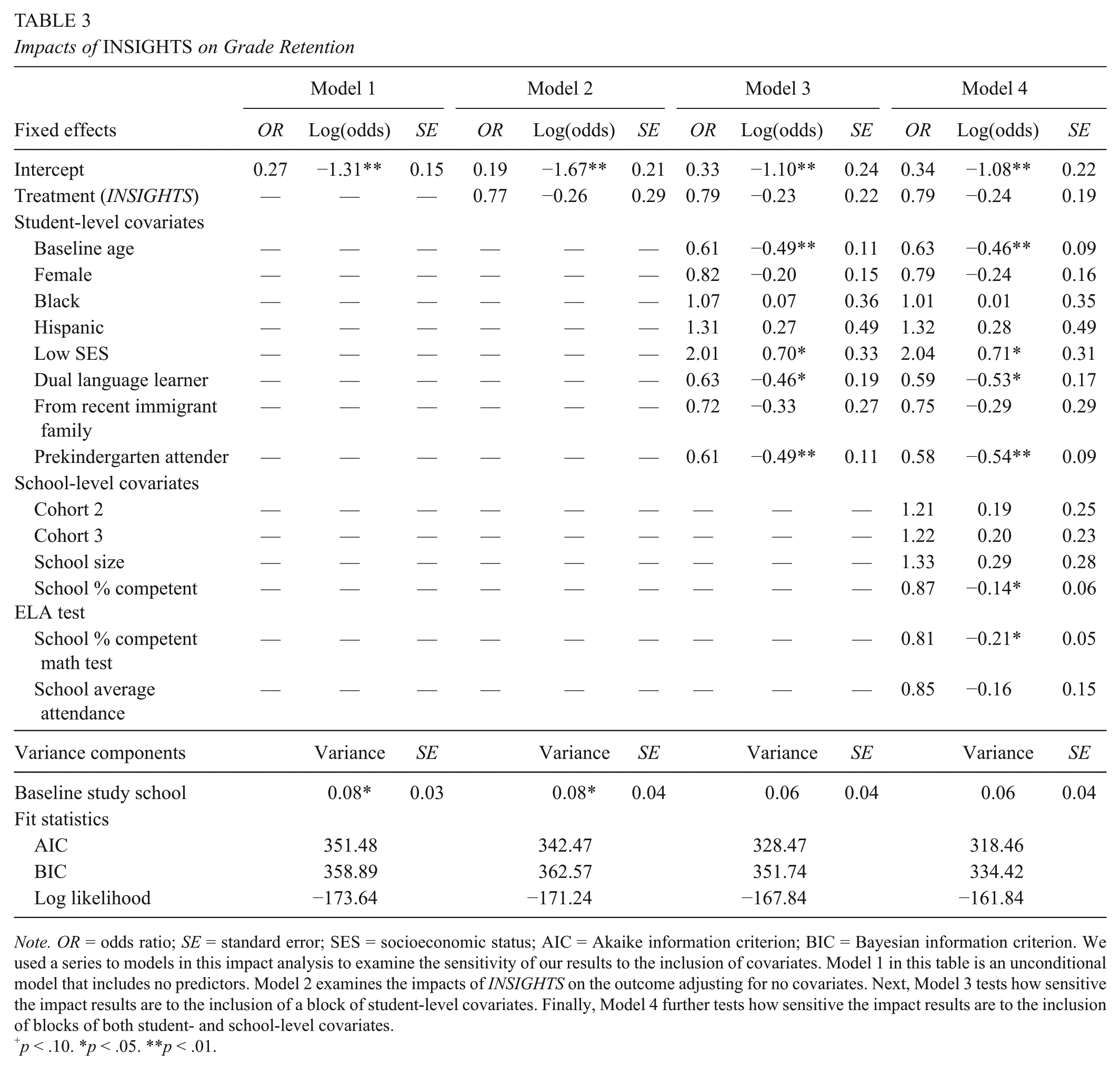
Note. OR = odds ratio; SE = standard error; SES = socioeconomic status; AIC = Akaike information criterion; BIC = Bayesian information criterion. We used a series to models in this impact analysis to examine the sensitivity of our results to the inclusion of covariates. Model 1 in this table is an unconditional model that includes no predictors. Model 2 examines the impacts of INSIGHTS on the outcome adjusting for no covariates. Next, Model 3 tests how sensitive the impact results are to the inclusion of a block of student-level covariates. Finally, Model 4 further tests how sensitive the impact results are to the inclusion of blocks of both student- and school-level covariates.
p < .10. *p < .05. **p < .01.
Impacts of INSIGHTS on Receipt of Special Education Services

Note. OR = odds ratio; SE = standard error; SES = socioeconomic status; AIC = Akaike information criterion; BIC = Bayesian information criterion. We used a series of models in this impact analysis to examine the sensitivity of our results to the inclusion of covariates. Model 1 in this table is an unconditional model that includes no predictors. Model 2 examines the impacts of INSIGHTS on the outcome adjusting for no covariates. Next, Model 3 tests how sensitive the impact results are to the inclusion of a block of student-level covariates. Finally, Model 4 further tests how sensitive the impact results are to the inclusion of blocks of both student- and school-level covariates.
p < .10. *p < .05. **p < .01.
We found that null effects of INSIGHTS on grade retention through fifth grade did not vary by student income. However, we did find a statistically significant interaction between assignment to INSIGHTS and low-income in predicting receipt of SPED services through fifth grade (OR = 0.39, p = .04; see Figure 1). The finding demonstrates that children who were low-income and in INSIGHTS schools were less likely than low-income students attending schools in the attention-control group to receive SPED services between kindergarten and fifth grade. Using the odds ratio estimate, we calculated the probabilities for the two groups in the adjusted models, finding that low-income students in the INSIGHTS group (in the reference group for all covariates) had a 9% probability of receiving SPED services by fifth grade, relative to the low-income students in the control group who had a 15% probability of receiving SPED services by fifth grade. Further probing demonstrated that there was no difference in receipt of SPED for higher income students assigned to INSIGHTS versus the attention-control.
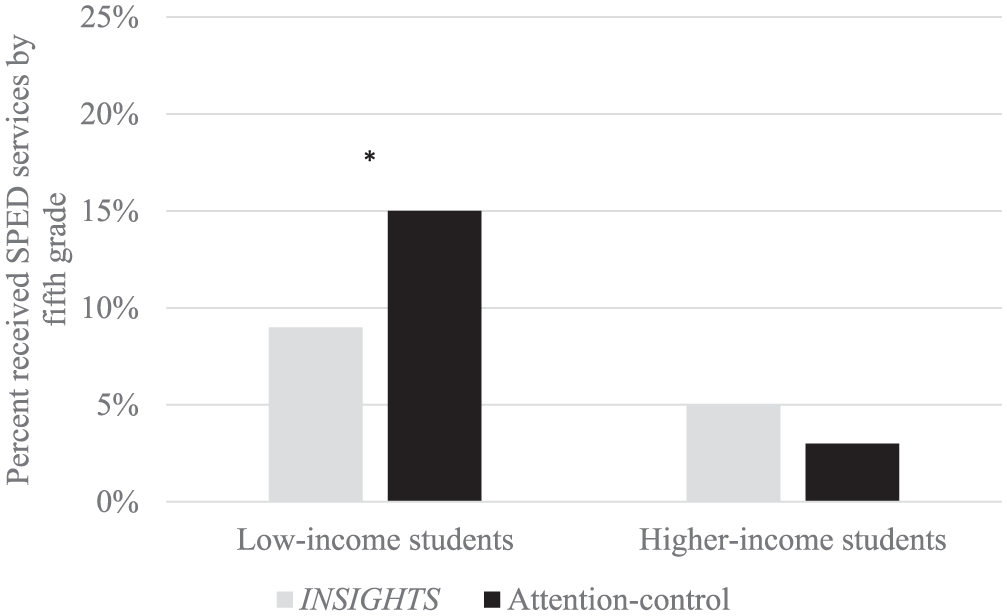
Impacts of INSIGHTS on receipt of SPED services by fifth grade.
Robustness Checks
We used a series of robustness checks to examine how sensitive the impact analysis results were to our model specification. In general, we found that the bulk of our results were robust across different modeling assumptions. All robustness checks are described thoroughly in Appendix D.
Discussion
This study aimed to leverage existing administrative data on all students enrolled in schools that participated in a randomized control trial of the INSIGHTS program to determine whether there were long-term effects of the intervention on receipt of SPED services and grade retention from kindergarten through fifth grade—and whether outcomes varied for lower income versus higher income students. Findings revealed that students in the INSIGHTS group were 5 percentage points less likely than comparison group members to receive SPED services by fifth grade. However, this effect was sensitive to model selection and did not fully replicate in a model using clustered standard errors for study school. Even so, we further found that INSIGHTS reduced the likelihood of receiving SPED services for low-income students by 6 percentage points. This impact was not sensitive to model selection and we are thus more confident that the intervention reduced receipt of SPED services within the sample of low-income students. There were no main or moderated effects of INSIGHTS in reducing grade retention by fifth grade.
Impacts of INSIGHTS on receipt of SPED services are somewhat aligned with prior research. For example, Bradshaw et al. (2009) found that assignment to the Good Behavior Game reduced the likelihood of placement in a SPED classroom by 6 percentage points with is a similar effect size to the one found in this study, although the follow-up period was about twice as long in that prior study, so the research designs are not directly comparable. Work by Rimm-Kaufman, Pianta, and Cox (2000) has found that kindergarten teachers working in schools serving primarily low-income families are more likely to report significant behavioral problems for children at kindergarten entry. Lower income students who exhibit behavior problems in early educational settings are more likely than higher income students with equivalent behaviors to be referred to SPED (C. O’Connor & Fernandez, 2006; Shavelson & Towne, 2002). An earlier study demonstrated that INSIGHTS did reduce children’s disruptive behaviors in the short term and improved their literacy and math skills (O’Connor et al., 2014). Importantly, children identified to be at behavioral risk at baseline benefited the most from the intervention in terms of their reduced disruptive behaviors and improved behavioral engagement (McCormick, O’Connor, Cappella, & McClowry, 2015). Positive impacts on students’ behaviors in the short term may have later manifested in broader reductions in receipt of SPED services. This result may have been particularly true for the lower income students in the sample with a higher likelihood of receiving SPED services due to challenging behaviors (Qi & Kaiser, 2003; Xia & Kirby, 2009).
In contrast, the grade retention finding for this study is not fully aligned with prior work evaluating impacts of SEL programs (e.g., Hawkins et al., 1999; Hawkins et al., 2009). For example, in their 6-year follow-up of the Seattle Social Development Program, Hawkins and colleagues (1999) found that the program reduced grade retention by 12.5 percentage points. The null impact found in the current study may reflect the fact that although the strategies taught by the INSIGHTS program were intended to be integrated into typical instruction during the school day, the activities were not directly tied to academic content. The intervention itself may not have been sufficiently intense to improve children’s academic skills to the point where it would change their likelihood of being retained in grade. SEL programs explicitly target social–emotional skills, which are theorized to then support gains in academic skills (Durlak et al., 2011). However, for children who are risk of being retained in grade based on poor early academic skills, more intensive supports directly focused on academic instruction may be necessary over and above involvement in SEL programming.
In addition, it is important to note that the comparison group in this study did receive a reading intervention. As such, we are comparing INSIGHTS—an SEL program—to a more active control group participating in an academically oriented set of services rather than a business as usual control group. We originally decided to use this approach in order to ensure that any treatment effects we observed were related to the INSIGHTS SEL program and not the fact that treatment schools were simply receiving additional attention and professional development supports. The current study thus represents a relatively conservative test of the INSIGHTS program and more stringently examines the effect of a program to support social–emotional development relative to a more academically oriented intervention. With respect to the null effect on grade retention, it might have been that the supports from the Read Aloud program were similarly effective in supporting children’s grade promotion. Further work examining the effects of INSIGHTS—and other SEL studies—on grade retention may consider a less active control group in order to increase the treatment contrast and see how that change does or does not affect impacts on grade retention.
Prior studies that have looked at the longer term effects of SEL programs on student outcomes, albeit from implementation efforts several years ago, have found longer run effects through high school and beyond (Taylor et al., 2017). For example, earlier studies have found effects on outcomes such as high school dropout or graduation (Bradshaw et al., 2009; Felner et al., 1993; Hawkins, Kosterman, Catalano, Hill, & Abbot, 2008), college attendance or completing a college degree (Bradshaw et al., 2009; Hawkins et al., 2008), safe sexual behaviors and STD diagnosis (Hill et al., 2014), criminal involvement or arrests (Eddy, Reid, Stoolmiller, & Fetrow, 2003; Hawkins et al., 2008), and adult mental health outcomes (Hawkins et al., 2008; Ialongo, Poduska, Werthamer, & Kellam, 2001; Riggs & Pentz, 2009). More contemporary evidence (e.g., longer term impacts of the Positive Action program; Duncan et al., 2017) has demonstrated benefits of universal SEL program in reducing behavior problems through eighth grade. Yet, no studies to date have explicitly tested whether impacts of SEL programming on receipt of SPED services did in fact lead to longer term outcomes in high school and beyond. This study represents an initial step in identifying an impact of one SEL program on receipt of SPED services through fifth grade. Even so, additional research in the future would be needed to explicitly test whether reductions in receipt of SPED services in the short term would then link to long-term effects in high school and beyond.
Limitations
Although this study uses an experimental design and multiple years of follow-up data for a large sample, there are a number of limitations. First, the study sample is made up of the total population of students who were enrolled in kindergarten in schools participating in the study during their first year of study implementation. Although we know that students who consented to the study participated at high rates, we cannot determine the exact level of dosage for the students included in this study. In order to use an intent-to-treat design in this study, we included students in the treatment group if they were enrolled in a school assigned to INSIGHTS during the kindergarten year when the intervention was initially implemented. If the child was enrolled in a control group school in kindergarten and then switched to INSIGHTS, they remained in the control group in order to maintain the internal validity of the intent to treat design, and vice versa. Review of students’ school locations, however, suggests that crossovers from treatment to control group school were minimal. It was more likely that a student would leave an INSIGHTS school for a nonstudy school or vice versa. Even so, we are unable to describe the extent to which we observed noncompliance in this study for the full student sample.
Although the administrative data are a core strength of the study, it is still true that understanding these data is complicated, particularly with respect to grade retention. It is possible that there is some measurement error in operationalizing the outcome constructs of interest in this study. In order to limit the possibility of Type I error posed by running too many impact analyses, we restricted this article to consider four total impact models and two total outcomes. It is possible that if we used different operationalizations of the outcomes (e.g., comparing impacts on grade retention at different follow-up time points) we could have found differential effects of the treatment across time. Further work with greater statistical power to conduct multiple comparisons adjustments may consider probing these outcomes further.
We also found that the results of the analysis did not completely replicate across a model using random intercepts for study schools and a logistic regression using clustered standard errors for study school (see Appendix D). However, the findings from the logistic regression were similar in direction and magnitude and there is a fierce debate in the literature about the conceptual difference between findings at the p < .05 and p < .10 levels (Cristea & Ioannidis, 2018). Moreover, work by Roodman, Nielsen, MacKinnon, and Webb (2019) has shown that clustered standard errors may be too conservative of an approach when there are few clusters of interest. We do interpret the main effects of INSIGHTS on receipt of SPED services with caution given lack of exact replication. However, we have more confident that INSIGHTS did reduce receipt of SPED services for low-income students within the sample—an effect that replicated across all models.
Finally, we lack detailed and nuanced data on the potential moderators and mechanisms explaining impacts of INSIGHTS on receipt of SPED and why those impacts were larger for lower income children. Furthermore, we were unable to demonstrate that the impacts on receipt of SPED were not accompanied by negative impacts in other domains within the current study sample. Doing so would have allowed us to be more confident in our assertion that reducing receipt of SPED services is a positive outcome, and not actually indicative of a situation where children who need SPED services are unable to access them. Our past work examining the short-term impacts of the program (E. E. O’Connor et al., 2014) demonstrated that INSIGHTS reduced disruptive behaviors and improved behavioral engagement and that those effects were driven by students who had challenging temperaments at baseline (McCormick et al., 2015). In addition, our team has completed a complementary set of analyses (McCormick, O’Connor, Cappella, & McClowry, 2019) that examine the impacts of INSIGHTS on academic skills outcomes in third, fourth, and fifth grades for students who were in the original trial (N = 331 with complete data at follow-up). Although these results are still under review, we have found positive treatment impacts on language skills in third and fourth grade and no group-based differences on children’s math skills. This is only a subsample of the group of students examined in the current study, but findings do provide further evidence that a reduction in receipt of SPED services is not associated with negative outcomes for students in other domains.
Conclusions and Implications
Results from this study demonstrate that a time-limited and fairly intensive SEL intervention that supports teachers in effectively responding to and managing the behaviors of children implemented at the critical transition to elementary school can reduce receipt of SPED services through fifth grade for low-income students. The fields of intervention and education research are currently interested in identifying the mechanisms through which early intervention can affect longer term outcomes. Rather than following a linear process, the current study provides some early evidence for Bailey et al.’s (2017) contention that early programming can provide access to qualitatively different experiences for students—for example, by reducing the likelihood of that they will be referred to SPED services due to a behavioral issue—which may lead to longer term adaptive outcomes. Low-income children who need SPED services should continue to receive them. But SEL programs may be able to support children’s behavioral development early on in a way that can prevent them from perhaps unnecessarily receiving SPED programming and better promoting their academic development at the transition to elementary school.
Policy makers can benefit from this work when considering cost implications of early programming, and integrating evidence-based SEL intervention into the early grades. Although some whole-school reforms to support students’ social emotional skills can be quite costly, shorter embedded interventions—like INSIGHTS—can be less expensive. Moreover, if SEL programs can have even small effects on outcomes like receipt of SPED services, they can still have significant cost savings for school districts serving low-income students. Although this study did not include an in-depth cost effectiveness component, one could potentially balance the cost of INSIGHTS implementation—estimated at about $5,500/school for 2 years of programming (or about $50/child)—against the expected cost of a lower income student receiving SPED services over and above regular education (average of $4,700/year; Snyder et al., 2016). However, this is likely an overestimate in comparing costs as many of the expenses associated with the receipt of SPED are likely driven by a few very high-need children and the students who may benefit from intervention are likely lower need. Future work including a more in-depth cost study focused explicitly on the subsample of students who do not receive SPED services as a result of an SEL program is needed. Finally, the study provides initial evidence that practitioners can be trained to support a diverse set of students’ social–emotional development in such a way that can link to adaptive outcomes even after those students transition out of trained teachers’ classrooms. Integrating evidence-based SEL programming into teacher training and professional development on a broader scale may thus be warranted.
Footnotes
Appendix A
Appendix B
Appendix C
Appendix D
Acknowledgements
The research reported here was conducted as a part of a study funded by Grant R305A160177 from the Institute of Education Sciences to New York University with a subcontract to MDRC. The opinions expressed are those of the authors and do not represent views of the Institute or the U.S. Department of Education.

Notes
Authors
MEGHAN P. M
ROBIN NEUHAUS is a doctoral candidate in teaching and learning at New York University.
E. PARHAM HORN is a doctoral candidate in counseling psychology at New York University.
ERIN E. O’CONNOR is a professor of teaching and learning at New York University. She received an EdD in human development from the Harvard Graduate School of Education.
HOPE I. WHITE is a doctoral candidate in clinical psychology at SUNY Buffalo.
SAMANTHA HARDING is a master’s candidate at New York University.
ELISE CAPPELLA is an associate professor at New York University. She received a PhD in community and clinical psychology from the University of California, Berkeley.
SANDEE MCCLOWRY is a professor emeritus at New York University. She received a PhD in nursing from the University of California, San Francisco.