




Abstract
This analysis examines the process of one research-practice partnership (RPP) engaged in the activity of decomposing elementary principal practice in the context of an instructional improvement initiative in mathematics. Decomposing, or breaking apart, complex practice has been used primarily by researchers to inform the design of pre-service teacher education. We argue that decomposition is a rich activity for researchers and practitioners to collaboratively engage in to support improvement efforts where practitioners are expected to transform their day-to-day practice. We examine what can be learned from the process by which one RPP engaged in decomposing practice that might be useful for other RPPs. Our retrospective, qualitative analysis supports understanding of how RPPs might engage in decomposition and the role decomposition might play in supporting RPPs to foster educational transformation in local contexts.
Keywords
Instructional improvement initiatives often include expectations that practitioners enact their roles in fundamentally new ways. Supporting this transformation of practice is challenging. Researchers attribute the challenge to factors such as vague goals for learning, lack of opportunity to develop new forms of practice in school contexts, and broader systems that are not aligned with new expectations (e.g., Boston, Henrick, Gibbons, Berebitsky, & Colby, 2016; Honig, 2012; Hubbard, Mehan, & Stein, 2006). Increasingly, there is recognition that supporting substantial change in educational systems involves deep learning on the part of practitioners in a way that is adapted to particular contexts in order to be sustainable (e.g., Coburn, 2003). Research-practice partnerships (RPPs) offer the potential for collaborative, context-specific approaches to supporting practitioner learning. However, how RPPs might effectively engage in designing and implementing learning supports aimed at developing fundamentally different forms of practice is not yet well understood. In what activities might RPPs engage? What tools might RPPs develop and use?
We examine one RPP’s support of practitioner learning—in this case, elementary principals learning fundamentally different ways of leading teacher development of new mathematics instructional practices. Early in the process, RPP members realized they did not yet share an understanding of goals for principal practice around which to design supports for learning. Existing research on principal leadership provided limited guidance for the RPP about what effective principal participation might look like in the specific context of the RPP, including the professional development structures, goals for student and teacher learning, district expectations, and other leadership roles. The RPP engaged in identifying expectations for principal practice and more intentionally organizing learning around those expectations, an activity we refer to as decomposition of practice. Other analyses indicated that over the course of a year, the principals developed significantly new ways of participating as leaders, and that one important support for this learning was the RPP’s engagement in the activity of decomposition of practice (Fox, 2018).
Decomposition of practice entails identifying essential elements of practitioner practice for the purposes of teaching and learning in professional education (Grossman, Compton, Igra, & Williamson, 2009). Engaging in the act of decomposition offers a potentially rich activity for RPPs working on transforming practitioner practice in educational settings. Such activity has the potential to support partnerships to make sense of, articulate, and support learning of expected forms of practitioner practice in relation to a specific context. We retrospectively analyze one RPP’s process to understand (a) how it might look for an RPP to engage in decomposition of practice and (b) what the benefits of engaging in the activity might be for an RPP. In doing so, we aim to contribute to a deeper understanding of how RPPs can effectively engage in particular activities that support educational improvement (e.g., Johnson, Severance, Penuel, & Leary, 2016; Penuel, Coburn, & Gallagher, 2013).
Supporting Practitioner Learning
In examining how RPPs might support practitioner learning, it is important to clarify our assumptions about learning. Drawing on sociocultural perspectives, we view learning as not simply the accumulation of new knowledge or skills but the development of new forms of participation in social practice (Rogoff, 1994; Wenger, 1998). Practice involves “orchestration of understanding, skill, relationship, and identity to accomplish particular activities with others in specific environments” (Grossman et al., 2009, p. 2059). We take this view to mean that practitioners engaged in instructional improvement efforts must be supported to learn fundamentally new ways of participating—of knowing, doing, and being—in social practice in interaction with specific school contexts, relationships, and approaches to instructional improvement (Herrenkohl & Mertl, 2010). To do so, learners must be supported to see, understand, and enact new expectations for their practice. Supporting this learning is especially complex given that educational practice is relational, or deeply situated in social contexts in which there are no scripts to follow; practice occurs in improvised responses to unpredictable interactions with others (Forzani, 2014; Grossman et al., 2009).
Decomposition of Practice
Grossman and colleagues (2009) studied professional education for roles that require such relational practice (clinical psychologists, clergy, and teachers) and found that one key element was how programs made use of decomposition of practice. Decomposition of practice entails organizing practitioner learning around essential elements of practitioner practice, with the goal of fostering learners’ ability to see, understand, and enact new forms of practice (Grossman et al., 2009; see also Goodwin, 1994). Efforts to decompose practice assume that practice is complex, contextual, and responsive while also involving some more predictable, learnable aspects (Lampert & Graziani, 2009). The aim is not to “script” practice but rather to foster understanding of the structure and vision of practice to support effective improvisation in response to context-specific interactions. While tools such as frameworks of components of practice are often part of engaging in decomposition, the power of decomposition lies in organizing learning experiences around components of practice in a way that makes them conceptually accessible to learners. Decompositions of practice can inform decisions about how to articulate expectations for practice, unpack examples of practice so that learners “see” what matters, provide feedback as learners engage in practice, and assess effectiveness of learning experiences (e.g., Grossman, 2018; McDonald, Kazemi & Kavanagh, 2013; Reisman et al., 2018; Windschitl, Thompson, Braaten, & Stroupe, 2012).
For an example of decomposition of practice, we turn to Alston, Danielson, Dutro, and Cartun’s (2018) work in the design of English language arts methods courses. The study examines a group of teacher educators who engaged in decomposition of the teaching practice of facilitation of English language arts classroom discussions. The example illustrates (a) grounding decomposition in a vision for practice, (b) the creation of frameworks that identify and name components of practice, and (c) how such frameworks can guide the design of the teaching of practice.
First, to support learning of practice in a way that allows for effective improvisation, decompositions of practice need to be grounded in a broader vision for practice (e.g., Kloser, 2014). In Alston et al. (2018), discussion facilitation was decomposed in relation to a particular view about teaching and learning that included a commitment to “shifting the power dynamics during classroom discussions in ways that privilege student thinking” (p. 230). For the teacher educators in the study, supporting learners to see the structure of practice was inextricably tied to developing understanding of this vision. Learners needed not only to develop ways of enacting particular components of practice (e.g., “supporting student contributions through feedback or redirection”) but also to think about how, when, and why they might do so in ways that disrupt typical power dynamics in the classroom. Given the unpredictability of student and classroom dynamics, it would be impossible to give teachers a script of what to say and when—instead, teachers need to develop a lens for making sense of when, how, and why to make particular moves with the ultimate goal of disrupting power dynamics in the classroom. Thus, grounding decomposition in a deeper vision of practice has the potential to support learners to develop responsive, improvisational practice.
Second, within this vision of instruction, the teacher educators in Alston and colleagues’ (2018) study collaboratively developed a framework of components of the practice of facilitating discussion, including launching the discussion, creating opportunities for student talk, coordinating student participation, taking up student ideas, and making contributions. Within each component, the group identified subpractices. For instance, within “taking up student ideas” they identified the subpractice of “supporting student contributions through feedback or redirection” (p. 229). It’s important to note that in creating the framework, the teacher educators did not aim to identify and name all components of teaching practice in a final product but rather sought to create a flexible tool that supported their design of learning for their particular learners (in this case, novice teachers).
Alston and colleagues (2018) then examined how this collaborative effort to decompose facilitation of discussions influenced how three teacher educators planned, designed, and supported novice learning. Notably, analysis revealed significant variation in how teacher educators used the framework; adaptations reflected context, including local language, teacher education program structure, and teachers’ grade levels. While in one case, the teacher educator found it useful to give the framework itself to teachers, the primary significance of the tool was how it guided the design of the teacher education courses, including structure of learning activities, design of other tools, and how examples of discussion were “marked” to highlight the structure of the practice. Thus, the framework itself did not support teacher learning. Rather, the entire process of discussing, generating, and using the decomposition served as a heuristic to guide the teaching of practice.
Decomposition of Practice as an RPP Activity
While decomposition of practice has not been studied in the context of RPPs, there is good reason to think that it may be a useful joint activity for researchers and practitioners. As an RPP activity, decomposition of practice entails efforts both to identify key aspects for practice and to use them in the teaching of practice. Given that RPPs often aim to support transformation of practitioner practice in specific educational settings, we argue that the act of jointly decomposing practice has the potential to empower RPPs to more effectively design, implement, and research learning supports for local practitioners.
Existing literature suggests possible tasks and tensions that might arise when engaging in decomposition of practice in the context of an RPP. Potential tasks offered in existing studies include observing novice or experienced practice to identify what’s important, developing frameworks, and using frameworks in the design of additional tools and professional learning experiences (e.g., Alston et al., 2018; Jacobs & Empson, 2016; Sleep, 2012). Creating and using decompositions will raise tensions for RPPs to navigate (e.g., Grossman et al., 2009; Janssen, Grossman, & Westbroek, 2015). First, decisions must be made about how to decompose practice in order to communicate important components of practice and not lose a sense of how the components necessarily interact in actual enactment of practice as a “whole.” Learners must develop a sense of how to integrate, or “recompose” practice. A second tension relates to naming aspects of practice while also attending to the fact that practice is necessarily different as it plays out in different social contexts that have particular histories of social interaction, relationships, and so forth. Both of these tensions implicate a third tension that relational practice necessarily involves conditions of uncertainty that require practitioner improvisation. Therefore, any decomposition must balance describing components without simplifying practice and must be grounded within particular visions of accomplished practice as complex, dynamic, situated, and improvisational.
However, the existing research on decomposition of practice does not examine how the activity might look in the context of an RPP. While teacher educators have engaged in decomposition efforts of both teacher practice (e.g., Reisman et al., 2018) and teacher educator practice (e.g., van Es, Tunney, Goldsmith, & Seago, 2014) in most cases, decomposing practice is a researcher-initiated activity. While practitioner learning and practice is examined to inform decompositions, practitioners themselves are not considered active participants in articulating elements of practice, developing tools, or designing learning experiences. A few studies begin to explore how pre-service teachers might also be involved in decomposition of practice (Peercy, Destefano, & Kidwell, 2016; Windschitl et al., 2012). For example, Windschitl and colleagues (2012) found that rather than being a top-down learning process, pre-service teacher learning was most influenced by a set of tools created by the pre-service teachers in response to the initial teacher educator decomposition of practice. The authors write that decomposition of practice that “belongs to a community can serve as a basis for principled experimentation by a collective of professionals who are informed by shared and explicit goals for instruction and committed to the advancement of learning for all students” (p. 898). In this analysis, we examine one RPP’s attempt to decompose practice as a community of researchers and practitioners in response to very particular shared goals and contextual factors.
Analyzing Collaborative Design Processes
The growth of RPPs in education has been accompanied by research on these collaborative partnerships that disrupts traditional divisions between research and practice. Analyses have investigated complex partnership dynamics (e.g., Akkerman & Bruining, 2016; Coburn, Bae, & Turner, 2008; D’Amico, 2010) as well as the potential of these collaborations to support important change in educational systems (e.g., Donovan, Snow, & Daro, 2013; Rosenquist, Henrick, & Smith, 2015). Emerging specification of key activities and tasks for RPPs also has aided understanding of how RPPs might effectively engage in particular lines of work to facilitate collaboration and promote shared understanding (e.g., Cobb, Jackson, & Dunlap, 2017). As new RPPs form, they will need guidance on how to engage in particular activities that have the potential to support educational improvement goals.
However, conducting research on one RPP in a way that might be useful for other partnerships is complicated by the contextually specific nature of RPP work. Education RPPs have the potential to support educational improvement because they are deeply rooted in particular contexts and thus able to respond to local needs, dynamics, and conditions. While RPP activities are unlikely to unfold in exactly the same way across contexts, there may be activities that RPPs can engage in across contexts that support broader common goals (e.g., instructional improvement). We report on analysis of a specific activity—decomposition of practice—that we conjecture may be useful for other RPPs to engage in.
To inform our analysis, we draw on Edelson’s (2002) argument that studying design processes can develop theory about the process itself: a design methodology. A design methodology lays out the people and processes involved in the development of a particular design by describing “(a) a process for achieving a class of designs, (b) the forms of expertise required, and (c) the roles to be played by individuals representing those forms of expertise” (p.115). In this case, we apply Edelson’s lens to the activity of decomposition of practice to understand how decomposition unfolded and how different roles and forms of expertise were involved.
Existing literature also suggests the utility of analyzing design processes through the lens of design tensions. While the specific activities and challenges involved in decomposition of a relational form of practice may vary from context to context, RPPs are likely to experience similar tensions or competing goals (Tatar, 2007) that are common in the activity of decomposition. Examination of the design process in relation to these tensions may support other teams of practitioners and researchers to anticipate and respond to those tensions. In this case, we examined one team’s process through the lens of both the tensions that commonly arise in decomposition of practice (summarized above) and additional tensions that were evident in the design team’s work.
Study Context
The study examines the activity of decomposition of practice as undertaken by one RPP involving leaders from the Roosevelt School District (pseudonym) and researchers and teacher educators from a nearby university. The partnership meets the definition of an RPP (Coburn & Penuel, 2016) because of its longevity, focus on problems of practice, use of intentional strategies to foster the partnership, and ongoing commitment to mutual benefit for both researchers and practitioners. The collaborative work also resulted in multiple original analyses.
The partnership began in 2011. While the focus of the work evolved over time, the overarching problem of practice was how to design for schoolwide professional learning, that in turn supported the development of a collaborative adult learning community and student-centered, discourse-based mathematics instruction (Kazemi & Resnick, in press). This analysis examines the partnership’s work in the 2016–2017 school year, during which the RPP sought to support a newly formed network of five elementary schools in implementing schoolwide professional learning. The team engaged in design-based implementation research (Penuel, Fishman, Cheng, & Sabelli, 2011) to design and investigate the district- and school-level supports necessary for effective, adaptive implementation of the instructional improvement approach initially developed at one school.
Design Team
In the 2016–2017 school year, the core design team of the RPP consisted of four members: one district leader and three university-based teacher educators and researchers (including the authors). The district leader, Julie, was a principal supervisor leading the implementation of the district initiative across the five schools. During the time of this analysis, the design team was an established partnership. Through 7 years of collaboration and common experiences, members had already developed a shared vision of goals for student, teacher, and school leader learning. The team also had developed mutual trust and strategies for collaboratively working together. All four team members also brought unique perspective and knowledge to the table. Julie was previously the principal at the initial elementary school where the RPP started. She had significant experience effectively enacting the principal role in the context of the same approach to instructional improvement. The researchers also played different roles in the initial school, including facilitator of professional development, instructional coach, and classroom teacher. All three researchers had experience as teacher educators in pre-service contexts in which learning experiences were organized around decompositions of practice.
Approach to School Improvement
The approach to school improvement was initially developed by the partnership beginning in 2011 at one elementary school. The partnership iteratively designed a coherent, job-embedded professional development system for teachers supported by principal and mathematics coach instructional leadership (Kazemi & Resnick, in press). Analysis of the instructional leadership showed that principal (Julie) and mathematics coach enactment of their roles served to model participation in collective learning spaces and foster teacher risk taking and trust (Gibbons, Kazemi, & Fox, 2017; Gibbons, Kazemi, & Lewis, 2017). Analyses demonstrated that a schoolwide professional community developed and staff established a shared vision of new forms of mathematics instructional practice across the school (Gibbons, Kazemi, & Fox, 2017; Gibbons, Kazemi, & Lewis, 2017; Lewis, 2016). Previously identified as a “failing” school, by 2014 the school’s mathematics test scores outperformed both state and district averages, and students demonstrated more sophisticated mathematical thinking and strategies on assessments designed by the partnership (Lewis, 2016). Given this success, in 2016 the district decided to support a network of five schools (including the initial school) to implement the instructional improvement approach.
While the approach involved a coordinated system of job-embedded teacher and leader learning supports, in this analysis we focus on one structure within that system, a professional development structure called Math Labs (Kazemi et al., 2018). Here, we provide a brief description of Math Labs because the design team decomposed principal practice in relation to the specific context. In a Math Lab, a small team of teachers (typically four to six), usually from the same grade level, are released from their classrooms for 3 to 6 hours to learn together during the school day. In the Roosevelt context, teachers engaged in Math Labs four to six times a year, facilitated by a school-based mathematics coach. The coach guides the group of teachers through an inquiry cycle of four phases: (a) unpacking new ideas about instruction, student thinking, and content; (b) coplanning a short lesson; (c) collaboratively experimenting with enactment of the lesson with students (Gibbons, Kazemi, Hintz, & Hartmann, 2017); and (d) debriefing the instructional experience. Math Labs are one way of structuring professional learning to reflect research that suggests that effective professional learning be job embedded, be tied closely to practice, and involve ongoing experimentation and inquiry into student learning (Desimone, 2009; Garet, Porter, Desimone, Birman, & Yoon, 2001; Putnam & Borko, 2000).
Supporting Principal Learning
A focus for the RPP during the 2016–2017 school year was the design and implementation of principal learning supports, including five full-day professional development sessions, monthly principal meetings with Julie (principal supervisor), and weekly support from Julie in schools. The design team developed goals for principal learning based on past experience at the initial elementary school and existing research (e.g., Coburn 2005; Nelson & Sassi, 2005; Robinson, Lloyd, & Rowe, 2008). Before the school year began, the team identified that one key role that principals needed to play was that of “lead learner” or “teacher of teachers.” These terms were used by the design team to characterize the vision of principal participation in teacher learning structures like Math Labs. This vision entailed principals’ viewing teachers as learners and sense makers who were engaging in making significant shifts in their mathematics instructional practice. To support this learning, principals needed to participate as learners alongside teachers while also encouraging teachers to advance their ideas, fostering collaboration, encouraging risk taking, and holding teachers accountable for experimenting with new ways of teaching.
In the Roosevelt case, the need for decomposition of principal practice—designing principal learning around a described set of practices associated with being a lead learner—emerged through design team conversations and was not initially a design activity that the team intended to engage in. Once the school year started, Julie attended Math Labs alongside principals in her role as their supervisor, with the goal of modeling leadership practice and supporting principals’ learning. While Julie felt that she was modeling the forms of practice clearly, she shared during a September design team meeting that principals found it challenging to understand what she was doing and why. The researchers on the team, who had experience with supporting teacher learning of relational practice, suggested that it might be helpful to further unpack what participating as a lead learner meant. These conversations launched a yearlong process of decomposition of principal practice in Math Labs, which included development of tools and design of principal learning supports. In a separate analysis, we examine how the design team’s decomposition of practice supported principals to develop new visions for their participation and take on new identities as principals (Fox, 2018). Here, our analysis focuses in on the design team’s engagement in decomposition of principal practice in Math Labs specifically as a case of RPP engaging in the activity of decomposition of practice in relation to a particular context.
Partnership Process and Analytic Approach
To engage in an effective design-based process, Cobb et al. (2017) outline the following phases: (a) preparing for a design study, (b) experimenting to support learning, and (c) conducting retrospective analysis. This study is a retrospective analysis of one partnership’s experimentation to design a system of supports for principal learning. The design team engaged in five cycles of systematic design, data collection, and analysis. These cycles aligned with five professional development sessions for the principals and instructional coaches from the five schools that occurred six times throughout the school year. Each cycle, shown in Figure 1, involved (a) implementation of a professional development session, (b) observation of principal practice in school settings by both Julie (principal supervisor) and a researcher, (c) analysis of data collected, and (d) design of upcoming professional development sessions and other learning supports based on analysis. Systematic data collection occurred throughout this process, including documentation of all design team conversations (35 hours), leader professional development (32 hours), and school-based observations (48 hours). Data collection at all events involved detailed field notes, document collection, and audio recording. In addition, end-of-year interviews were conducted with teachers, mathematics instructional coaches, and principals from each school (33 hours). While no formal interviews were conducted with Julie or other design team members, design team meetings always included a reflective conversation in which members prompted each other to express their thinking as the work unfolded.

Sources of data during the design process.
For this analysis, we focused on data that supported understanding the design team’s decomposition of principal practice specific to Math Labs, including principals’ engagement in, and sense making of, practice in Math Labs and teacher and coach perceptions of principal practice in Math Labs. As the decomposition process occurred across the year, the full data set was examined, but only pieces of each event or interview that pertained to principal practice in Math Labs were analyzed.
The first goal of analysis was to develop understanding of engagement in the activity of decomposition of practice in the context of an RPP. To do so, we developed a time-order matrix (Miles & Huberman, 1994) to track developments and patterns over time (see Figure 2). We created a column for each event in the design team process (e.g., design team meeting, principal professional development session) and then created analytic prompts in rows to guide analysis of each event. Drawing on Edelson’s (2002) framework, we attended to (a) key steps and activities in the design team process, (b) the expertise or sources of information that informed those steps, and (c) the roles played by individuals on the design team. To support our analysis of decomposition of practice, we also attended to what was identified about principal practice in Math Labs, how it was identified, and how it influenced design of learning supports.

Illustration of matrix used to analyze the design process over time.
We then examined the time-order matrices with two analytic questions aimed at further understanding decomposition of practice in the context of an RPP: (a) In what ways did engaging in decomposition of practice benefit the RPP’s efforts to design and investigate supports for principal learning? and (b) What design tensions emerged in the design team’s work, and how did the design team respond? In analyzing for the second question, we attended to both the tensions of decomposition evident in the existing literature (described previously) and additional tensions that arose in the process in the context of an RPP.
Findings
We examine the design team’s process for engaging in decomposition of practice and how the design team responded to some of the design tensions that surfaced in the process. Throughout, we consider the benefits of engaging in decomposition of practice as an RPP, with attention to both the team’s creation of a framework tool and its related design and implementation of learning supports.
Design Team Process
We examine the design team’s process of engaging in the activity of jointly decomposing practice by looking at not just the process for identifying components of principal practice but also how that process interacted with (a) collaborative development of tools; (b) design and implementation of learning supports; and (c) evaluation of, and research on, the improvement initiative.
Collaborative tool development
In an effort to support school leader learning, the design team designed a number of tools. Here, we focus on a framework that the design team developed as one articulation of its decomposition of principal practice in Math Labs (see Figure 3). The tool captures the team’s decomposition of principal practice by identifying goals of practice and the working definitions. It’s important to note that the framework was designed to be locally meaningful; language and formatting choices reflect the collective sense-making process of those involved, given the perceived learning needs in the moment. While other RPPs might design different tools to represent decompositions of practice, they might engage in similar processes.
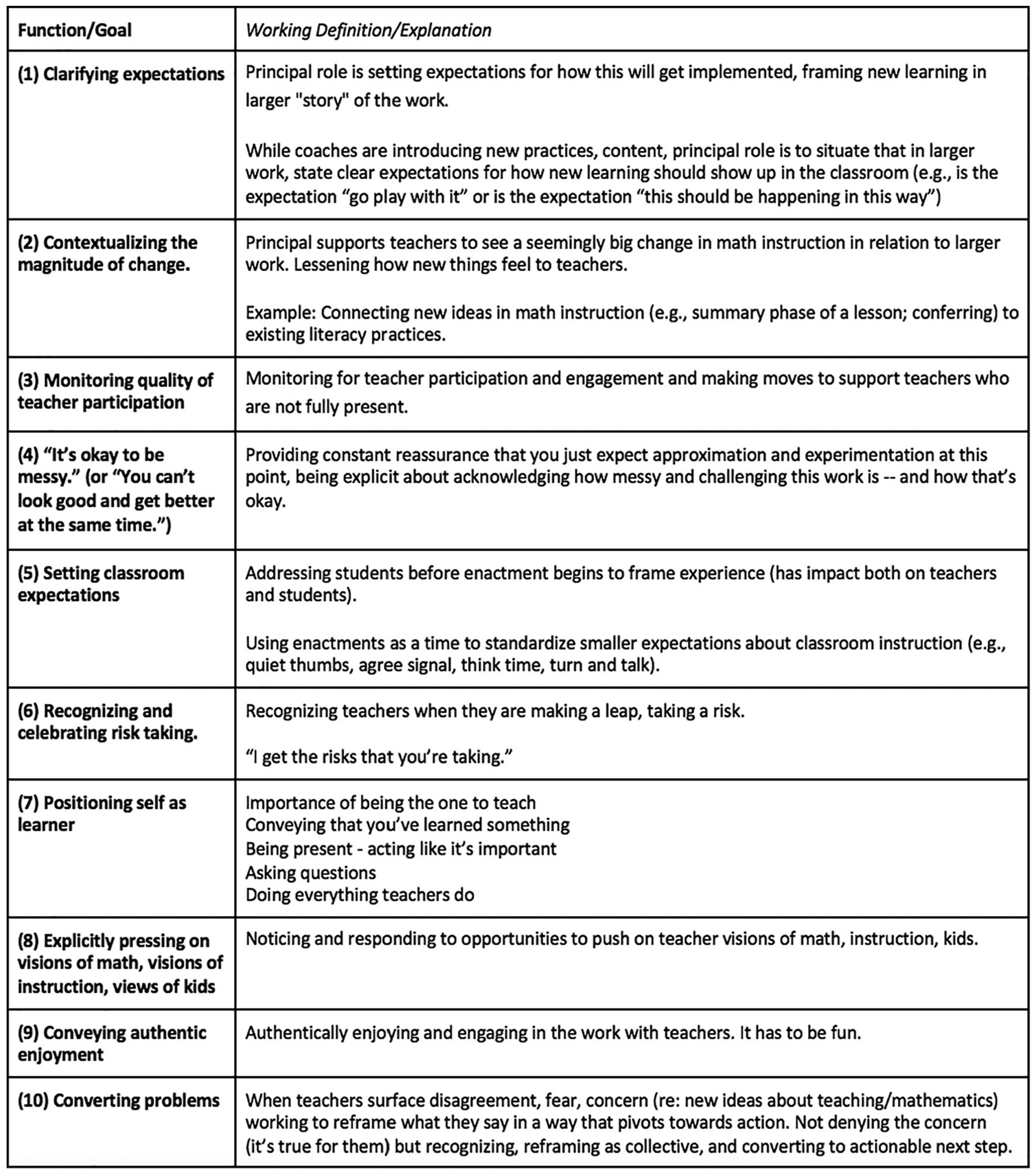
The design team’s working framework representing one articulation of its decomposition of principal practice in Math Labs. Identified components are described as functions or goals of practice, accompanied by a working definition of each.
Development of the framework began with data collection during Math Labs. One researcher attended a Math Lab at each of the five schools and took detailed field notes with a focus on how both the principal and Julie participated. Because the researchers were unable to attend all of the Math Labs alongside Julie, the team also developed a routine that became known as “brain-dumps.” After each Math Lab, Julie briefly reflected on her own participation and the principals’ in a 20- to 30-min recorded phone call with a researcher. The researchers asked Julie questions such as, “What did you notice yourself thinking about or trying to do?” or “Were there moments you noticed that the principal maybe should have said or done something?” These brain-dumps allowed Julie and the researchers to begin to articulate her tacit understandings about the principal role as lead learner.
Based on these data, the design team collectively identified emergent themes and began to develop a framework of goals for principal participation as lead learner. The initial framework, which represents a decomposition of practice, had five goals, which the team added to over the course of the year (see Figure 3). The team found that articulating the components of practice as goals or functions that a principal might be trying to achieve (e.g., “recognizing and celebrating risk taking”) allowed them to capture the range of moves that a principal might make in response to different moments, teacher interactions, or relationships in a given Math Lab. For each identified goal, the framework included multiple examples of principal moves that had surfaced so far across the Math Labs in the five schools. The version shown here was a condensed version that included brief descriptions of each function.
Retrospective analysis suggests that initial goals in the framework emerged in two ways: (a) Researchers asked Julie to name “buckets” of moves she found herself making in Math Labs, and (b) researchers contributed ideas based on either what they heard in Julie’s reflections or what they observed in Math Labs. In this way, the identification of initial goals—and thus engagement in decomposition of practice—was a deeply collaborative process. Julie started by suggesting two goals she had (“clarifying expectations” and “contextualizing the magnitude of change”), then one of the researchers pointed out a third goal she heard Julie talk about in reflecting on Math Labs (“monitoring quality of teacher participation”). Julie then explained that she also tried to offer “frequent re-assurance [to teachers] that we’re asking you to approximate this. We’re not expecting you to go in and teach a model lesson the first time you try. . . . It’s got to be messy” (October 3, 2017). A second researcher then added that in observing Math Labs, she noticed Julie making moves during the classroom enactment portion that seemed intended to send messages about classroom expectations (e.g., around how mathematics discussions should be structured). In this way, the framework that the design team developed reflected insight from different perspectives and was grounded directly in the work of principals in their schools.
Analysis indicates that the initial work to develop the framework supported design team members in bringing a different lens to their observation and interpretation of practice. Members began to think about articulating underlying goals of principal practice. Following initial development of the framework, Julie felt that she could effectively communicate her observations about practice in note form, and brain-dump phone conversations decreased. The notes that Julie and the researcher who attended labs took both began to identify specific moments for principal moves and attempted to name what the underlying goal was. For instance, during one lab, Julie jotted down details about an interaction and then wrote, “I am finding myself . . . attempting to address the idea of the difference between teaching as getting kids to do things versus supporting kids in constructing their own strategy or meaning” (October 14, 2017). This observation, combined with notes from both the researcher and Julie over three more labs led the design team to add a function to the framework: “explicitly pressing on visions of math, visions of instruction, views of kids.” By the end of the school year, the design team’s framework included 10 functions of principal practice in Math Labs. It’s important to emphasize that the framework was not designed to be a complete or polished document and does not represent all of the ideas that the design team identified over the course of the school year. Rather, the tool was one way that the design team represented its decomposition of practice in that moment.
Engaging in decomposition of practice through this collaborative development of a framework supported previously tacit knowledge about practice to be made explicit. Julie described how conversations with the researchers created time and opportunity for her to process what she was making sense of in schools: “Knowing I have a venue to brain dump with someone who [understands what] I’m saying . . . I don’t know when else I would have the capacity” (April 10, 2017). She also referred to feeling frustrated previously because, given the success at the initial school, researchers and district leaders often asked her what she had done as a principal in Math Labs, to which she could only respond, “I don’t know. . . . It developed over five years, I never thought about it” (June 17, 2016). Julie reflected on multiple occasions that the decomposition process helped her develop language for what she was looking for in principal practice. “We knew [principals] had a role to play, we just weren’t sure what to say the role was. . . . We can talk about [practice] now because we have the words to talk about it” (June 17, 2016), she explained at the end of the school year. In this way, the process of engaging in decomposition in partnership with researchers helped Julie name what mattered and what she was looking for as she supported principal learning. Making this tacit knowledge explicit affected the design of learning supports.
Design and implementation of learning supports
As emphasized in the Introduction, the activity of decomposition of practice is more than just the creation of a framework; practice is decomposed for learning through the design and implementation of learning supports. The framework itself was not shared directly with principals until the end of the school year; however, this initial decomposition of practice influenced how design team members engaged in design of learning supports. For the purposes of this article, we highlight four examples below.
First, engagement in the activity of decomposition of practice influenced Julie’s interactions with principals as she supported their learning in their schools. She reflected that while initially she expected principals to just “pick it up” if she modeled practice, she now realized that principals needed support in coconstructing a deeper understanding of the structure and functions of their practice in Math Labs: “What should we be doing, what’s the ultimate purpose of having the leader there in the learning. . . . What’s your job, your role, your contribution” (October 3, 2016)? Her realization affected her support of principal learning in principals’ schools in two ways. First, she added one-on-one debrief meetings after each Math Lab. These meetings allowed her and the principal to discuss examples of principal practice in a specific Math Lab and make sense of some of the functions that Julie had tried to model for them. Second, Julie began giving feedback to principals in the form of function-focused questions such as, “How can you use the classroom visits to model/set expectations for how kids and teachers should interact?” (September 29, 2016). In this way, Julie’s engagement in the development of the framework supported her use of interactions with principals to decompose practice for their learning.
Second, engaging in decomposition of practice influenced the team’s design of professional development sessions for principals and mathematics coaches. While the team initially thought it would focus on developing collective vision of mathematics instruction, engaging in decomposition of practice sparked the idea of creating opportunities for principals and mathematics coaches to develop a collective understanding of their roles in Math Labs. For example, in a November session, the team designed an activity in which principals and mathematics coaches collaboratively filled out a document that aimed to break down (a) the purpose of each phase of a Math Lab and (b) the leader roles in each phase. Figure 4 shows an excerpt from the document for the phase of a Math Lab in which teachers are supported in debriefing their collaborative classroom enactment of instruction. The activity surfaced ideas that both mirrored and departed from the initial framework that the design team developed. It also served as an opportunity for the design team to gauge how principals and coaches were making sense of the communication of expectations for practice thus far. Again, the document was created to be locally meaningful to those involved in creating it.

Excerpt of document developed during a principal and coach professional development session detailing their developing collective decomposition of practice of both principal and coach roles during each part of a Math Lab. This excerpt shows the decomposition for one phase.
Third, engaging in decomposition of practice influenced how the design team leveraged data collected from interviews with teachers and coaches to further support principal learning. In a June meeting, the design team shared a PowerPoint with themes from teacher interviews at all five schools about which forms of principal practice supported learning in Math Labs. Themes were shared using representative direct quotations from teachers. Some of the themes mirrored ideas that the design team had already identified as functions of principal practice (e.g., “[the principal] was really transparent about what [she/he] didn’t know”). However, in teacher perspectives other functions surfaced as well. For example, teachers expressed that Math Labs principals could foster the sense that the learning was schoolwide. Teachers conveyed that it was motivating to know that colleagues also were engaging in the challenge of changing instructional practice. This function for principal participation was not yet articulated by the design team but was shared with principals as an additional function of practice that seemed to matter for teacher learning. Principals were provided reports for each school that summarized themes from teacher and coach interviews about each principal’s practice both specific to, and outside of, Math Labs. Thus, the PowerPoint and reports served to further communicate to principals what mattered about their practice from teachers’ perspectives.
Fourth, although beyond the scope of this article to provide detailed analysis, there is evidence that the design team’s decomposition of practice specific to Math Labs also affected thinking about principal learning and practice in subsequent efforts to support practitioner learning. In the spring of 2017 and in subsequent school years, the design team brought the lens of decomposition of practice to its thinking about supporting principal and coach learning about practice in other structures including grade team meetings, whole staff meetings, and leadership team meetings. For instance, in spring 2017, the design team engaged principals and coaches in an activity aimed at developing understanding of their roles in grade team meetings. Unlike the context of Math Labs, the design team realized that grade team meetings might have a range of purposes and structures based on time of school year, where teachers were in a given unit of instruction, or particular teacher learning needs. How principals and coaches might need to participate in a grade team meeting would depend on the purpose of the meeting. Thus, the activity for principals and coaches involved identifying the range of kinds of grade team meetings, the purpose and timing for each, and the principal and coach roles in relation to the purpose.
Evaluating and researching learning and learning supports
The influence of engaging in the activity of decomposition of practice is evident in the evaluative and research approaches the design team undertook throughout the year. The relationship between research and practice was two way and recursive (Coburn & Stein, 2010). Here, we briefly highlight three examples. First, Julie found that having the language for articulating what mattered about principal practice in Math Labs helped her to think about what she might look for as evidence that principals were making progress in their learning. Second, when the team collaboratively designed end-of-year interview protocols, they included a series of questions for teachers, coaches, and principals aimed at understanding how they made sense of principal practice in Math Labs. Third, engagement in decomposition influenced the research questions and analytic approaches that researchers took up for forthcoming publications. For example, analyses examined how principal learning unfolded with specific attention to how principals developed the forms of practice that emerged through engagement in decomposition of practice (Fox, 2018).
Tensions in the Activity of Decomposition of Practice
Analysis suggests that engaging in the activity of decomposition of practice as an RPP supported the design team to navigate some of the tensions that are common to the work of decomposition. As described previously, the work of decomposition involves complex decisions about how to break apart practice while not losing sight of the complexity of the “whole” of practice, including the improvisational, relational, and context-specific nature of practice. Engaging in decomposition in an RPP meant that the activity involved collaboration between researchers and practitioners to decompose practice in response to immediate, context-specific learning needs. Here, we describe two examples.
First, involving both practitioner (Julie) and researcher perspective supported the design team in balancing the tension of breaking apart practice while attending to context. For instance, during brain-dump conversations, as the researcher was not always present at the Math Lab, she asked clarifying questions to capture the context around practice, including information about the specific interaction surrounding the example of principal practice as well as broader information such as teacher-principal dynamics and challenges the particular school was facing. In this way, both practitioner and researcher developed a deeper understanding of the complexity of supporting transformation of practice in the particular context.
Second, the iterative process of engaging in decomposition of practice as design team members interacted with leaders and teachers from all five schools supported the team in balancing the tension of breaking apart practice while also allowing space for adaptation and improvisation across school settings. The range of schools provided the design team points of comparison that supported them in noticing differences in principal relationships with teachers and resulting differences in practice. During sessions, design team members tried to intentionally provide opportunities for principals to share various examples from across their schools of both successes and challenges in supporting teacher learning. This provided the group as a whole with a wide variety of examples of how principals might engage in practice in response to particular contexts and teachers. Julie also realized she needed to emphasize the relational nature of practice to principals so that they didn’t interpret expectations for practice as scripts to follow regardless of context. For example, in a June meeting with principals she said, “You’re all different leaders—you are going to play roles differently. And you should. You’re the one who knows your teachers; you’re the one who knows what bad thing happened . . . yesterday. So today you are going to take on cheerleader a lot more” (June 17, 2017). In this way, the iterative process of engaging in decomposition supported design team members to clarify the ways in which principal practice needed to be responsive to particular contexts.
Additional tensions of decomposition in the context of an RPP
The team wrestled with additional tensions that arose because the decomposition of practice was part of an instructional improvement effort. In this context, in contrast to pre-service teacher education, principals were being asked to fundamentally transform their existing practice, and there was a deep sense of urgency for change to occur quickly. Decomposition of practice supported the design team in developing an understanding of how principals needed to participate in Math Labs. This reification of practice then created clarity about what they might hold principals accountable for. However, holding principals accountable for change in practice was in tension with supporting deep learning. For example, to support principals to fundamentally change their day-to-day practice, Julie needed to hold them accountable for trying out new forms of practice. Simultaneously, the design team discussed that if the level of accountability was too strict, principals might resist because they might not feel like the forms of practice were valuable or impactful yet. The design team frequently raised the question of how to support principals to make practice their own and not just send the message that they had to do exactly what Julie did. Second, Julie’s own learning as principal occurred over 5 years, so principals could not be expected to demonstrate the same kinds of participation in just 1 year. The design team grappled with how to think about expectations for principals as learners. Julie found it challenging when principals did not yet engage in Math Labs in ways that had become obvious to her. Often in these conversations, the researchers played a role of supporting Julie to step back and remember that principals were on a learning trajectory. Through conversations with the design team members, Julie made decisions about when to leave space for principals, as learners, to not be ready yet to engage in a particular way.
Conclusion and Implications
Decomposition of practice is a potentially powerful activity for RPPs in that it supports partnerships to make sense of, articulate, and support learning of expectations for practitioner practice in relation to a specific context. In this case, articulating that principals needed to engage as lead learners was not specific enough for the design team to effectively design learning supports, nor for the principals to envision new ways of participating. It was necessary to identify what “lead learner” meant in the Roosevelt context, including the particular goals, challenges, and supports for teacher and student learning. The impact of engaging in decomposition was evident in the design team’s development of tools, design of learning supports, evaluation of implementation, data collection, and research questions. Engaging in decomposition of practice supported the design team in collectively clarifying goals and developing common, local language about their work, both important tasks for RPP teams (Coburn, Penuel, & Geil, 2013).
Given our goal of contributing to understanding of how RPPs might engage in potentially powerful activities, we conclude with five proposed design principles for engaging in the activity of decomposition of practice. Design principles aim to describe key characteristics of design tasks or processes that seem to matter for supporting desired outcomes (van den Akker, 1999). In this case, we identify procedural design principles in that they characterize how teams might engage in the activity of decomposition. While proposed principles are implicit in existing literature on decomposition of practice, they are not yet explicitly named—an important step if others (RPP teams or otherwise) are to engage in the activity.
These design principles are not meant to guarantee success but aim to articulate developing knowledge about what may support effective engagement in decomposition of practice across contexts. Other efforts to decompose practice will likely have different steps and products based on the experiences, knowledge, visions of practitioner roles, and relationships of those involved. Ultimately, what mattered for the effectiveness of the decomposition in the Roosevelt case was how meaningful it was for local actors—including design team members, school leaders, and teachers. The power of decomposition in the context of RPPs lies in the potential to draw out local wisdom, to make explicit the tacit local knowledge that practitioners or researchers might not otherwise have the time, systems, or experience to articulate.
Footnotes

Authors
ALISON FOX RESNICK is a research associate at the University of Washington. Her research draws on her collaborative work with local districts and examines how partnerships can design powerful systems for teacher and instructional leader learning to support transformation of instruction.
ELHAM KAZEMI is a professor in curriculum & instruction at the University of Washington College of Education. Her research focuses on the challenge of designing professional learning experiences for elementary mathematics teachers and teacher educators so that teachers’ classroom practices improve in ways that are productive for student learning, especially in high-poverty settings.