




Abstract
This study was designed to assess parental beliefs, motivations, and facilitative co-use of print and digital media with preschoolers and identify differences between parents’ and children’s perceptions of these media. We surveyed 43 parents and interviewed their 3- to 5-year-old children. Parents reported their child enjoyed print more than digital books and predicted their child would choose a print over a digital book. Parents indicated they believed print was more educational and entertaining than digital media and were motivated to use print for children’s learning, relaxation, entertainment, and parent-child bonding. Parents also reported they use fewer facilitative behaviors when co-using digital than print media. Children more often chose to read the digital over the print book and more often selected digital devices across most motives. This study highlights a contrast between how parents and children view media and suggests that parents might better facilitate children’s digital media use by creating more interactive digital media co-use opportunities.
Parents and teachers are faced with the choice of if, when, and what type of digital content they should provide for the preschool children in their care. Due to the increased availability of touchscreen technologies over the past decade, children have more access to a wide variety of digital devices and content (Pew Research Center, 2018). For example, mobile devices, such as smartphones and tablets, are now almost ubiquitous in U.S. households (e.g., 91% of adults 18–49 own smartphones; Hitlin, 2018; Kabali et al., 2015). As a result, parents are inevitably faced with making choices about their children’s access to digital devices and content. The purpose of this study is to better understand the ways in which parents perceive and co-use print and digital media with their preschoolers and investigate the alignment between parents’ and children’s perceptions of both media types.
Theoretical Framework
Hoover-Dempsey and colleagues (Green, Walker, Hoover-Dempsey, & Sanderl, 2007; Hoover-Dempsey & Sandler, 1995, 1997; Hoover-Dempsey, Walker, & Sandler, 2005) created a model of parent beliefs and involvement that refined Bandura’s (1986, 1997) social cognitive theory to better explain links between parental beliefs, motivations, and experiences; parent involvement in educational activities; and children’s beliefs, motivations, and academic outcomes. This model has been tested with parents and their children (early childhood through late adolescence) from a variety of socioeconomic backgrounds and cultures and has been used to predict child outcomes across a variety of domains (e.g., academic achievement, literacy skills, social-emotional skills; see e.g., Chen, Newland, Liang, & Giger, 2016; Freeman, Newland, & Coyl, 2008; Newland, Chen, & Coyl-Shepherd, 2013; Newland et al., 2011). To date, it has not been used to examine similarities or differences in parental perceptions of and interactions with children using print and digital media, nor has it been used to examine the alignment between parents’ and children’s perceptions. This study provides an important extension of Hoover-Dempsey’s work to investigate constructs from that model in relation to both print and digital media use in the homelives of preschoolers.
Parent and Preschooler Perceptions
U.S. parents hold mixed views about the benefits and pitfalls of their children’s screen media use. For example, parents with children ages 6 months to 6 years expressed quite moderate views when asked to rate statements about digital media being beneficial to their children’s cognitive, social, and physical development (M = 3.77 out of 7; 7 = strongly agree) and gave similarly moderate ratings of digital media’s harmful effects (M = 4.14 out of 7; Cingel & Krcmar, 2013). In focus groups, parents expressed that they believed children learned from digital devices such as computers and TVs and would acquire important technology-related skills for future success but also expressed concerns, such as worry about exposure to advertisements and violence (Rideout & Hamel, 2006). Pediatricians caution parents to limit screen media, advising that children ages 2 to 5 years should spend less than 1 hour per day with screen media (Council on Communications and Media, 2016). Parents who choose to allow their children access to screen media are encouraged to select “high-quality programming” and co-use media alongside their children.
Preschoolers, on the other hand, do not appear to mirror adults’ cautious embrace of screen media, generally showing high engagement. Specific features available in digital media have been shown to promote children’s interest and engagement, including the ability to control what happens on screen (Calvert, Strong, & Gallagher, 2005), customize and personalize the experience (Cordova & Lepper, 1996; Kucirkova & Flewitt, 2018), and interact contingently with on-screen actors (e.g., through video chat; Strouse, Troseth, O’Doherty, & Saylor, 2018). In other studies, preschoolers have provided high ratings of engagement with digital storybooks (Prasetya & Hirashima, 2018) and explicitly stated a preference for (Richter & Courage, 2017) and consistently engaged more with (Chiong, Ree, Takeuchi, & Erickson, 2012; Moody, Justice, & Cabell, 2010; Willoughby, Evans, & Nowak, 2015) digital as opposed to print books.
In contrast to the mixed views parents hold about screen media, parental agreement that shared reading benefits preschoolers tends to be quite high. Although maternal education has been shown to predict parents’ literacy beliefs, all parents generally report positive views about reading with preschoolers (e.g., Cottone, 2012; Curenton & Justice, 2008; Weigel, Martin, & Bennett, 2006). Parents believe that shared reading not only improves children’s language skills but also encourages interest in reading (DeBaryshe, 1995). They report that they begin to engage in shared reading activities when their children are on average 7 months of age (DeBaryshe, 1993), and most report reading daily with children ages 1 to 4 years (Strouse & Ganea, 2017).
Parents searching for high-quality digital content to share with their preschoolers may opt for e-books. E-books may be seen by parents as potentially beneficial to their children because of their positive association with books. Although adults report they prefer and more often choose print than digital books for children (Rainie, Zickuhr, Purcell, Madden, & Brenner, 2012; Strouse & Ganea, 2017), they also recognize that portability, wide selection, and quick access are advantages of selecting digital over print books (Rainie et al., 2012). Children’s e-book usage is on the rise, including sales in the children’s category through traditional publishers (up 2% in January–October 2018; American Association of Publishers, 2018) and increases in children’s e-books accessed through libraries (up 9% in 2017; Rakuten OverDrive, 2018a) and K–12 schools (up 45% in 2017, Rakuten OverDrive, 2018b).
Benefits and Pitfalls of Digital and Print Stories
Stories presented digitally can support learning. Learning occurs best when children are cognitively engaged with learning materials, undistracted, have personally meaningful experiences, and have opportunities for social interactions related to the learning goal (Hirsh-Pasek et al., 2015). A recent meta-analysis showed that across 43 studies with children ages 3 to 10 years, those who heard technologically enhanced stories had higher levels of story comprehension and expressive vocabulary than those who heard oral stories or print stories read aloud (Takacs, Swart, & Bus, 2015). Learning from digital stories may be enhanced by supportive adult co-viewers (Segal-Drori, Korat, Shamir, & Klein, 2010; Strouse, O’Doherty, & Troseth, 2013). However, digital enhancements themselves also appear to provide support for children beyond what is available in print materials. Even in the absence of support from co-readers, multimedia stories were still advantageous for children’s learning over stories without technological enhancements (Takacs et al., 2014). Closer investigation of the features that supported learning indicated a particular type of technological enhancement was important: Multimedia features such as animation, music, and sound effects were positively related to learning (Takacs et al., 2015). According to Paivio (1986) and Mayer (2005), a strong match between the verbal and nonverbal features provided in media will support learning. Animations, music, and sound effects may provide this alignment by incorporating visual depictions and audio cues that align with the narrative arc of the story as children listen (Bus, Takacs, & Kegel, 2015; Takacs et al., 2015).
However, digital children’s books are not without their critics. Some researchers have shown that differences in content can lead to larger differences in learning than format (Neuman, Wong, & Kaefer, 2017). In addition, concerns that digital enhancements may distract from learning have been voiced by a variety of researchers (e.g., Hirsh-Pasek et al., 2015; Labbo & Kuhn, 2000; Reich, Yau, & Warschauer, 2016; Troseth, Russo, & Strouse, 2016). Interactive features like hotspots, games, and dictionaries may attract attention away from the verbal story arc, requiring task switching, increasing cognitive load, and subsequently decreasing learning (Bus et al., 2015; Takacs et al., 2015). In addition to distracting children, digital features may distract parents from engaging in learning-oriented parent-child interactions during shared reading. Observations of parents reading to preschoolers indicate that parents are less likely to provide supportive content-related talk when using digital books or print books with technological enhancements compared to traditional print books (Chiong et al., 2012; Krcmar & Cingel, 2014; Parish-Morris, Mahajan, Hirsh-Pasek, Golinkoff, & Collins, 2013). These studies also suggested that children’s comprehension of digital content was reduced relative to print content as a result of decreased content-related talk. Canadian caregivers of children ages 1 to 4 years reported that digital-print differences in parent-child interaction occurred regularly at home too; parents reported participating in more interactive behaviors (e.g., stopping to discuss, pointing, and labeling) when engaging with their child around print (Strouse & Ganea, 2017).
Gaps in Prior Research
As a result of the nuance involved in children’s learning from digital media, it is important to better understand how parents and children think about and use digital media to better identify opportunities for promoting learning from these materials. In prior studies, parents have reported that digital media is somewhat fun (M = 4.64 out of 7, SD = 1.38) and educational (M = 3.90 out of 7, SD = 1.28) for their children (ages 6 months–6 years; Nabi & Krcmar, 2016) and that they primarily let their children use digital media because their children enjoy it, for educational purposes, and to allow parents time to themselves (Cingel & Krcmar, 2013; Nabi & Krcmar, 2016). In these studies, parent beliefs that digital media was educational and fun predicted reports of greater motivation for children to use digital media (Nabi & Krcmar, 2016) and greater amounts of actual usage (Cingel & Krcmar, 2013). However, these studies did not include a comparison of parents’ beliefs about and motivations for allowing their children to use digital versus print media.
Researchers also have not addressed whether parents accurately report their children’s preferences. Parents of children age 1 to 4 years reported their children paid attention to and enjoyed print books more than digital books (Strouse & Ganea, 2017), but the study did not include children’s perspectives, and data collected directly from children suggest they may prefer digital formats (Chiong et al., 2012; Moody et al., 2010; Richter & Courage, 2017; Willoughby et al., 2015). A direct comparison of parents’ predictions with their own child’s stated preference is needed to determine whether this apparent mismatch is due to procedural and sampling differences between studies or reflects a potential parental misperception of child preference. Understanding children’s preferences may help identify missed opportunities for engaging with children around print and digital materials.
Children’s motivations for using media also may highlight opportunities for promoting positive learning experiences. In prior studies, preschoolers were asked to identify how they or other people might use print and digital media sources in hypothetical learning situations but not their motivations for their own behaviors. In one study, preschoolers ages 3 to 5 years were equally likely to choose print and digital media when asked which tool a doll should use if the doll wanted to learn about a range of different topics, including trees, cooking, and the state of Virginia (Eisen & Lillard, 2016). In another study, 4- to 6-year-olds’ responses to “Is this something people use for ___?” were compared to undergraduate students’ responses across a variety of devices and purposes (Eisen & Lillard, 2017). Children and undergraduates agreed that books were for learning and reading but not talking to others, taking pictures, playing games, or watching shows. However, undergraduates were more likely than children to attribute a wide variety of functionality, including learning, to digital devices (iPads, TVs, and iPhones). In both studies, children’s responses were not related to the frequency with which they used each device (Eisen & Lillard, 2016, 2017), suggesting that children’s own motivations for use may differ from how they believe other people use media. Thus, to understand children’s own usage, it is important to ask them why they choose to use the devices themselves.
The Current Study
We collected information about parents’ beliefs regarding the role of print and digital media in their own children’s lives, their motivations for using each, and the behaviors they typically engage in when co-using media with their 3- to 5-year-old children. Our goal was to build on the prior literature by providing a more detailed picture of the different ways that parents conceptualize and co-use print and digital media with their children. We also interviewed children about their preferences and motivations for use to add children’s perspectives to the literature and compare their perspectives with those of their parents. Motivations in this study included both intrinsic and extrinsic reasons for action (as in Nabi & Krcmar, 2016) or specifically, reasons for children’s media usage. This study was guided by three main research questions:
Research Question 1: Are there differences between print and digital media with regards to what parents believe about them, their motivations for allowing their preschoolers to use them, and their interactive co-use?
Research Question 2: Do parents’ reports of their children’s media preferences differ from their children’s reports?
Research Question 3: Do parents’ motivations for allowing their children to use media differ from their children’s motivations?
Based on prior literature, we expected parents to more consistently rate print than digital media as educational, report more interactive co-use of print than digital media, and predict that their children would prefer to read a print book. Conversely, we expected that preschoolers may more often choose the digital over the print book and be more likely than their parents to express a wide variety of motivations for choosing digital media.
Method
Participants
Data were collected from 48 families in a small university community (population 10,000) in a rural area of the midwestern United States. Parents and their 3- to 5-year-old children were recruited systematically for the study by sending home invitations to participate through all four community child care centers and the private preschool and word of mouth. Parents from 43 of the families completed the online survey, and children from 45 of the families participated in a session with a researcher. Children were on average 50.54 months old (SD = 8.23) at the time of testing. Eighty-one percent of parents (n = 35) reported their child was White. Other racial and ethnic identities were reported by fewer than 3 parents each (Black-White, n = 3; American Indian-White, n = 2; Asian-White, n = 1; Hispanic, n = 1; Hispanic-White, n = 1). Parents were mostly female (86%) and were on average 34.91 years old (SD = 5.42). Many of the parents who completed the survey reported they had a graduate or professional degree (44%) or 4-year college degree (33%). The remaining parents had all completed high school. Approximately 16% of participating parents reported that their children were eligible for the federal Child and Adult Food Program.
Materials
Parent survey
Parents completed an online Qualtrics survey comprised of questions on family demographics and their beliefs about print and digital media, motives for allowing their child to use print and digital media, children’s current print and digital media exposure, and child’s digital media skills. Digital media was defined as “modern electronic media on devices such as televisions, computers, game consoles, phones, tablets, or other handheld devices.” Print media was defined as “information conveyed through books, magazines, newspapers, art, photographs, maps, and other printed, non-electronic tools for communication.” The survey took approximately 30 minutes to complete. Items analyzed in this article are described below.
Book enjoyment and preference
Parents were asked to rate their child’s enjoyment of “reading/listening to” books and e-books on a scale of 1 (doesn’t enjoy) to 5 (really enjoys; items from Strouse & Ganea, 2017). Parents were also shown photographs of the cover of The Monster at the End of This Book in print and digital (displayed on an iPad) formats and asked, “Given the opportunity to choose, which book do you think your child would prefer to read?” (see Figure 1).
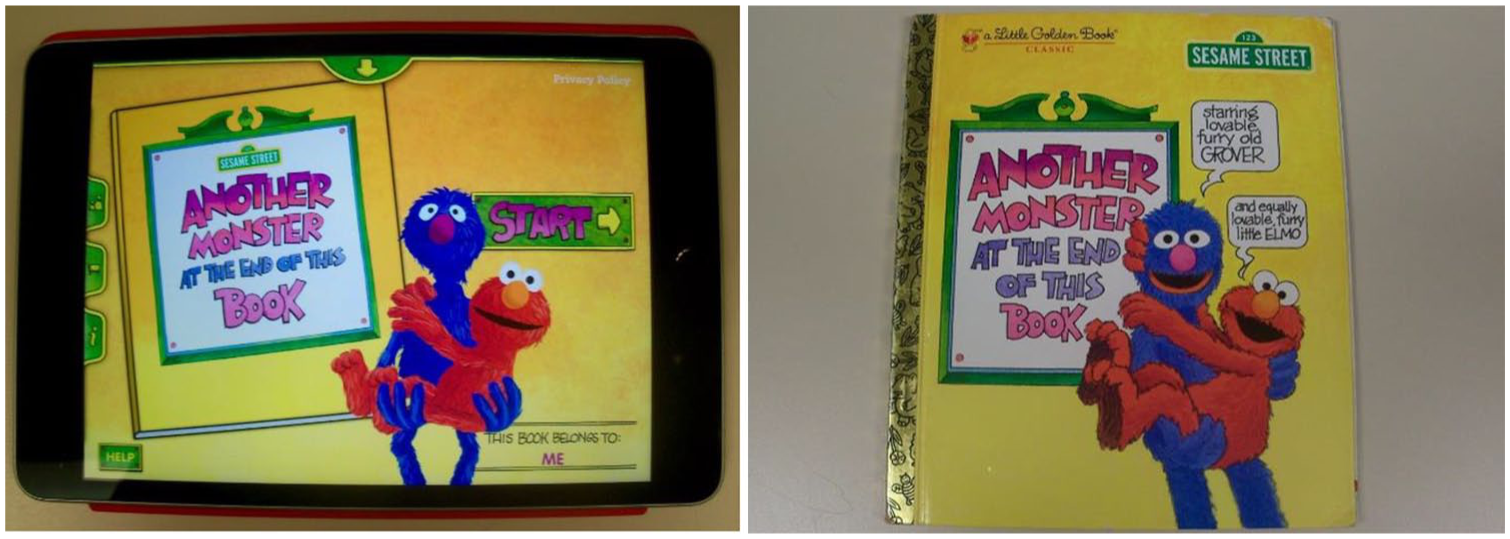
Photographs used for parent and child measures of child preference, displayed as (left) an e-book and (right) in print.
Parent beliefs
Parent belief items were adapted from Nabi and Krcmar’s (2016) nine-item scale of 7-point Likert items. The adaptation involved adjusting the questions to refer to “print media” or “digital media” rather than “educational/entertainment electronic media,” resulting in two nine-item scales, one for print and one for digital media. Cingel and Krcmar (2013) use these same nine items as a single indicator of parents’ perceptions of positive effects of media. However, Nabi and Krcmar broke this scale into two dimensions, identified using factor analysis. We report scores separately for these two dimensions: educational (e.g., “Digital media can improve my child’s language and communication skills”) and fun (e.g., “Using digital media is a fun activity for my child.”) Print and digital media items were blocked; educational and fun items were intermixed within these blocks. Subscale scores were computed by averaging responses across items. Internal consistencies are reported in Table 1.
Internal Consistencies for Multiple-Item Scales

Parent motivations
Parents’ motivations for incorporating print and digital media into their child’s life were created from two existing scales. First, we adapted Nabi and Krcmar’s (2016) 15-item motivations scale by replacing the word media in the question stem, “I let my child use media . . . ” with either “books, magazines, and other print media” or “digital technology and media (TV, videos, games),” resulting in two sets of 15 items. We chose this instrument because it was recently developed (and thus relevant to the current digital media landscape) and based on motivations that parents had reported in prior literature. It also offers predictive validity in that parents’ scores on this scale predicted the amount and type of digital content their children consumed (Cingel & Krcmar, 2013).
Because we were interested in creating an instrument that could be used to address digital as well as print media, we also included five items previously used by Newland and colleagues (2011) to measure parents’ motivations for reading (print) with their preschool-aged children. These five items were adjusted to use the same format as Nabi and Krcmar’s (2016) questions, specifically, the same question stem and 7-point Likert response options (strongly disagree to strongly agree). The resulting scales (one for print, one for digital) included 20 items each. These items also offered predictive validity as they predicted the frequency and quality of children’s home literacy interactions with print (Newland et al., 2011).
Each motivation scale was broken into six dimensions identified by Nabi and Krcmar (2016): child learning (e.g., “because it is educational”), parent time to themselves (e.g., “to allow myself some free time”), child relaxation (e.g., “to give them some down time”), child reward (e.g., “as a reward for my child’s good behavior”), child enjoyment (e.g., “because they like it”), and parent-child bonding (e.g., “so I can spend time with my child”). Newland and colleagues’ (2011) items originally fell into two subscales; the constructs measured by these two subscales aligned with and were added to Nabi and Krcmar’s child learning and parent-child bonding dimensions. Print and digital media items were blocked; items from the six dimensions were intermixed within these blocks. Subscale scores were computed by averaging responses across items. Internal consistencies are listed in Table 1.
Interactive parent and child behaviors
Parent and child behavior items were adapted from interactive book reading items that previously have been associated with preschoolers’ literacy skills (Newland et al., 2011). Wording of the 5-point Likert items was adapted to be appropriate to both print and digital media formats, and parents completed the set of 12 items for each format. The adult facilitative behaviors scale was comprised of 5 items relevant to literacy-promoting behaviors carried out by adults (e.g., asking the child questions, relating content to the child’s life). The child active behaviors scale was comprised of 7 items relevant to child participation in shared media usage (e.g., asking questions, pointing to words/images, helping navigate, paying attention). Print and digital items were interleaved. Subscale scores were computed by summing responses across items. Internal consistencies are listed in Table 1.
Child outcome materials
Child preference
The same two photographs of the cover of The Monster at the End of This Book (one print, one digital) that parents viewed in the online survey were printed in color (15.9 × 11.4 cm) and laminated (Figure 1).
Child motivations
A grid featuring color images of eight different media formats was created using Adobe Photoshop and printed on letter-sized sheet of paper (21.6 × 27.9 cm). Each square on the grid featured several depictions of a print or digital media format. For example, the first square featured a collection of smartphone models including recent models from Samsung, Sony, HTC, Nokia, and Apple. The other squares featured: children’s print magazines and books, video gaming systems (console and handheld), computers (desktop and laptop models), tablets (adult and child models), photographs of people and pets in a variety of frames, pictures and drawings (both famous art and child art), and televisions. To aid in comparison between parent and child responses, our questions were inspired by the motivations listed in Nabi and Krcmar’s (2016) parent measure but represented only those aspects we believed would be appropriate from a child’s perspective. Individual items are listed in Table 5.
Procedure
After consenting to participate, parents were emailed a link to complete the online parent survey. Children who assented to participate were tested in a quiet room at their preschool or child care facility or in a child-friendly laboratory room on campus. Children completed the child preference measure first. They were presented with the two color photographs of The Monster at the End of This Book, one in print format and one in digital format, side by side in random order and asked, “If you could read only one of these books, which book would you choose to read?”
Next, we measured children’s motivations for using different media. Our procedure is based on the procedure used by Eisen and Lillard (2016), in which preschoolers were asked to respond to a question about function by pointing to a picture of the device that “people” use for that function. We first confirmed the child recognized our media pictures and agreed with the researcher on their label. The researcher presented the child with a media grid, pointed to each square in order, and asked the child “What do you see in this picture?” The researcher recorded the child’s label for each square, accepting a variety of correct labels for each group of photos (e.g., tablets could be called “tablets,” “iPads,” “LeapPads,” “Kindles,” etc.). If the child used a categorically incorrect label, they were corrected by the researcher before continuing. The researcher then pointed to each square and asked, “Have you used [label] before?” If the child said yes, the researcher asked, “Why do you use [label]s?”
Finally, the child was asked to point to pictures to indicate their response to a series of nine questions about using the different media formats. Children were asked to point to all the pictures that went with the question (listed in Table 5) or say “none of them.” If children responded by pointing to one or more squares, they were asked to confirm, “All done?,” or asked “Any more?” to ensure they had a chance to point to as many pictures as they wished before continuing to the next item. Children’s responses ranged from pointing to 0 squares to pointing to all 8; on average, they pointed to 1.90 squares per question (SD = 1.17).
Coding
Child preference
Children’s selections on the book preference question were recorded by the researcher at the time of testing. A second coder who was blind to the study hypotheses reviewed video recordings of the sessions and recorded children’s responses. Reliability for 67% of the sample was kappa = .93 (one discrepancy, resolved by a third party). Data for preference were not collected for two children, yielding a final sample of 43 responses.
Child motivations
Children’s responses to the nine motivation questions were recorded by the researcher at the time of testing using a dichotomous indicator of whether the child pointed to each picture. This resulted in eight dichotomous scores (one for each picture) for each of the nine questions. A second coder who was blind to the study hypotheses reviewed video recordings of the sessions and recorded children’s responses. Reliability for 46% of the sample was kappa = .92. A third coder, also blind to hypotheses, resolved all discrepancies. Data are reported for 41 children; the first 4 child participants were excluded because significant procedural changes to shorten the task were made after they participated.
Results
Media Usage
Parents reported that their children were regular users of both print and digital media. One hundred percent of parents reported that their child read or looked at print books and watched television at least once per week. Ninety-three percent indicated that their child used digital devices such as tablets, computers, and smartphones at least once per week. However, only 53% reported that their children used digital devices to read or listen to stories with this frequency.
Parent Conceptualizations and Co-Use
Enjoyment and preference
Parents’ ratings of their child’s enjoyment of print versus digital books were compared using a Wilcoxon signed rank test because response distributions were negatively skewed (most parents indicated high enjoyment). Consistent with our hypothesis, parents reported that their child enjoyed print more than digital books (on a 5-point scale; print: median and maximum = 5, minimum = 3; digital: median = 3, minimum = 1, maximum = 5), Z = −4.96, p < .001. This pattern held true both for parents whose children were exposed to digital stories at least once per week (Z = −3.08, p = .002) and parents whose children were exposed less frequently than once per week (Z = −3.89, p < .001). Most parents (62%) also predicted that their child would choose to read the print copy of The Monster at the End of This Book over the digital copy.
Beliefs and motivations
Parents’ beliefs about and motivations for their child’s media use are summarized in Table 2. Parents indicated they believed print media was more fun for their child than digital media, t(42) = −8.71, p < .001, 95% CI [–1.67, –1.04], and that print was more educational, t(42) = −3.82, p < .001, 95% CI [–1.16, –0.36]. Parents were more often motivated to allow their child to use print than digital media for child learning, t(42) = 8.72, p < .001, 95% CI [1.34, 2.15]; child relaxation, t(42) = 4.57, p < .001, 95% CI [0.73, 1.88]; child enjoyment, t(42) = 3.51, p = .001, 95% CI [0.25, 0.91]; and parent-child bonding, t(42) = 8.17, p < .001, 95% CI = [1.20, 1.99]. Alternatively, parents were more often motivated to use digital than print media for providing parents with solo time, t(42) = −2.09, p = .043, 95% CI [–1.10, –0.02], and as a reward, t(42) = −3.15, p = .003, 95% CI [–1.02, –0.22].
Parent Beliefs About and Motivations for Their Child’s Media Use

Note. Asterisks indicate differences between mean responses to print and digital scales as indicated by a repeated-samples t test.
p < .05. **p < .01. ***p < .001.
Co-use behaviors
Parents reported that when they co-used digital media with their child, they were less likely to engage in facilitative behaviors than when they co-used print, t(42) = 3.50, p = .001, 95% CI [0.82, 3.04] (Table 3). Parents also reported that children engaged in fewer active behaviors with digital media, t(42) = 2.95, p = .005, 95% CI [0.43, 2.31].
Parent and Child Interactive Behaviors

Note. Asterisks indicate differences between mean responses to print and digital scales as indicated by a repeated-samples t test.
p < .01.
Child Preferences and Motivations
Preliminary analyses of child data indicated no age-related differences, so all children’s responses were considered together. Only 37% of children chose the print version of The Monster at the End of This Book over the digital version. A binomial test indicated that this was not significantly different from chance, p = .13 (two-tailed). Table 4 displays the alignment of parents’ predictions with their child’s choice. Differences between parents’ predictions and their own child’s choice was assessed using McNemar’s test. Parents were much more likely to err in predicting their child would choose print than to err in predicting their child would choose digital, p = .007 (exact significance). Eighty-seven percent of parent errors involved parents who predicted their child would choose print but whose child chose the digital book.
Parent Predictions Versus Child Choices of the Print or Digital Copy of The Monster at the End of This Book

Note. McNemar’s test indicated that parents and children selected print and digital books with significantly different probability, p = .007.
Children, in contrast to their parents, more often pointed to pictures of digital than print media when asked what they would use for learning, relaxation, enjoyment, and bonding (Table 5). McNemar’s tests were used to compare the proportion of children choosing any print square or any digital square in response to each question (children could choose both). Children were more likely to select digital but not print squares than vice versa for questions related to enjoyment (p = .021, p < .001), bonding with people not present (p = .007), and using solo (p = .003). The only motivation for which children were more likely to select print than digital was for reading a story (p < .001).
Children’s Responses to Motivation Questions

Note. McNemar’s tests were computed using SPSS Version 25. For questions with fewer than 25 children pointing to a print but not digital picture or vice versa, the binomial distribution was used to compute probabilities for McNemar’s test. These cases are indicated with a, and exact significance is reported. For the remaining cases, chi-square with Yates continuity correction was computed, and asymptotic significance is reported. Asterisks indicate significantly different probabilities of selection across print and digital squares.
p < .05. **p < .01. ***p < .001.
Comparing results from Table 2 and Table 5, parents showed a general motivation for using print for most purposes, whereas children showed a general motivation for using digital media. Parents were more motivated to allow their child to use print than digital media for learning, child relaxation, child enjoyment, and bonding. However, children did not express the same motivation to use print over digital media in these ways—choosing digital for enjoyment and bonding with people not present and embracing both types of media for learning and co-using with family and friends. When parents more strongly agreed with motivations for digital media than print, their motivations were somewhat aligned with children’s. Parents’ agreement was higher for digital media than print for rewarding their child and providing themselves with free time, and children agreed that digital media was entertaining and were motivated to use it independently.
Discussion
We found notable differences in (a) the way that parents think about and use print versus digital media with their preschool-age children, (b) parents’ estimates of versus children’s actual preferences for print and digital books, and (c) parents’ versus children’s motivations for using print and digital devices. Parents appear to prefer print over digital media for a variety of purposes and predict their child will also hold this preference, whereas children more typically choose digital media or select digital and print media with equal frequency.
Parents’ Perceptions and Usage
Parents reported more positive views about print than digital media and were motivated to choose print over digital media for most purposes. Like a sample of Canadian parents of children ages 1 to 4 (Strouse & Ganea, 2017), parents in this study rated their children’s enjoyment of print books as higher than digital books. In addition, a majority of parents predicted that their child would choose to read a print over a digital version of the same book. When asked about their own perspectives, parents more strongly agreed with beliefs that print rather than digital media was educational for their child. This is consistent with the high ratings parents generally give to the educational value of books (Cottone, 2012; Curenton & Justice, 2008; Weigel et al., 2006) and more moderate agreement with of the educational value of digital media (Cingel & Krcmar, 2013; Rideout & Hamel, 2006). Parents in this study also more strongly agreed with beliefs that print rather than digital media was entertaining or fun for their child. This is consistent with parents’ own reports that their children enjoy print more than digital books.
This study extends prior research by providing a direct print-versus-digital comparison of parent beliefs and motivations. Parents in this study reported being more motivated to use print than digital media for children’s learning, relaxation, and enjoyment and to bond with their child. Parents only reported being more motivated to use digital than print media in two contexts: as a child reward and to provide themselves with free time. Parent motivations in this study were consistent with their beliefs—they reported believing that print media was more educational and fun for their child than digital media and also being more motivated to use print than digital media for these purposes. However, parents’ relatively higher motivation to use digital than print media as a reward for children appears somewhat contradictory to their belief that print has higher entertainment value.
Consistent with prior parent report (Strouse & Ganea, 2017) and observations of parents reading with preschoolers (Chiong et al., 2012; Krcmar & Cingel, 2014; Parish-Morris et al., 2013), parents in this study reported that when they did co-use print and digital media with their children, they did not do so in the same ways. Parents reported more frequently providing interactive facilitative behaviors when they co-used print rather than digital media with their child, such as asking the child questions and relating content to the child’s life. In addition, parents reported that children engaged in more active behaviors, such as asking questions, pointing to words/images, helping navigate, and paying attention, when they co-used print. This appears to be consistent with parents’ report that children enjoy print more than digital books and is also consistent with observations of child language production during reading (Krcmar & Cingel, 2014; Moody et al., 2010; Parish-Morris et al., 2013).
Children’s Preferences
Children more frequently indicated a preference for reading a digital rather than a print version of a book (63% digital, 37% print). This is consistent with the preference children of the same age expressed in Richter and Courage’s (2017) study (56% digital, 28% print, 17% no preference). It is also consistent with other researchers’ observations of children’s engagement with these media formats (Chiong et al., 2012; Moody et al., 2010; Richter & Courage, 2017; Willoughby et al., 2015). Our study adds a direct contrast between children’s stated preference and the prediction of their own parents. In our study, 41% of parents made an incorrect prediction regarding their child’s preference, and 87% of those incorrect predictions were that their child would opt to read the print book.
Children’s Motivations
Children in our study selected digital media more frequently than print for all motivations except one, suggesting that overall, children were very motivated to use digital media. Children’s selection of digital media was significantly greater than their selection of print media for enjoyment, bonding with people not present, and using solo. Our study extends prior literature by showing that children’s beliefs about how others might use digital and print media are consistent with their motivations for their own usage. Similar to Eisen and Lillard’s (2016) report that children equally selected digital and print formats for a doll to use for learning, children in our study showed no significant difference in their selection of digital and print formats for their own learning. Also consistent with children’s selection of books more frequently than digital devices as platforms that people use for reading (Eisen & Lillard, 2017), children in our study more frequently selected print for the purpose of their own reading.
Our study also adds a direct comparison between parents’ motivations and those of their own children. Parents and children in our study expressed quite different motivations for using print and digital media. Across motivational purposes, parents reported higher motivations for allowing their child to use print media, whereas children more frequently selected digital devices. Parents were more motivated to allow their child to use print than digital media for learning, child relaxation, child enjoyment, and bonding, but children chose digital media or both media types for these purposes. This is somewhat inconsistent with Eisen and Lillard’s (2017) findings that children were less likely to ascribe multiple functions to digital devices than undergraduate students. However, individuals in their study were asked only about the range of functions these devices served for other people, not specifically about motivations for preschoolers’ usage. It is possible that adults recognize a wide variety of functions for these devices but do not agree that the full variety of functions are significant motivations for allowing their child to use digital media.
In addition to several differences between parents’ and children’s motivations, there were also similarities in their responses. For the two motivations that parents more strongly agreed with for digital media than print, children generally agreed. Parents reported being motivated to use digital media as a reward for their child, which is consistent with children’s motivation to use digital media for enjoyment. In addition, parents reported being motivated to use digital media more frequently than print for providing themselves with free time, and children reported that they were motivated to use digital media when they are by themselves and to talk to people who are not with them.
Implications
In the current study, parents were motivated to use print and digital media for different roles in their preschoolers’ lives and reported co-using them in different ways. According to Hoover-Dempsey et al.’s (2005) framework, parent perceptions lead to differences in the type and quality of interactions they provide for their children. Therefore, differences in parents’ and children’s perspectives may point to a missed opportunity for positive parent-child interactions. That is, parents viewed print as medium for learning and bonding, and they tended to support print with more interactive behaviors. Kids, however, saw digital devices as avenues for these same purposes. Because cognitive engagement with and social interactions related to learning goals help support learning (Hirsh-Pasek et al., 2015), children may benefit from increased co-use and interaction with digital devices. Prior research has consistently shown that preschoolers learn more from digital media when parents co-use and scaffold their learning (Dore et al., 2018; Lauricella, Barr, & Calvert, 2014; Strouse et al., 2013). Thus, parents who dismiss digital media as lacking in educational value or frequently encourage their children to use it independently may be missing out on using digital media as an avenue for positive shared experiences. Parents may be able to capitalize on digital media as a tool for bonding with their child and promote learning by using digital media more like they use print, for example by co-using it and providing interactive, facilitative scaffolds.
Despite differences in parental beliefs and motivations regarding print and digital media, parents held positive beliefs and agreed with all the motivations for both types of media (averaging more than 4 out of 7 on all but using print as a reward). In prior studies, parents reported primarily letting their children use digital media because they enjoy it, for educational purposes, and to allow parents time to themselves (Cingel & Krcmar, 2013; Nabi & Krcmar, 2016). These were also three of the top four motivations in our study (child reward was third). Thus, parents, like children, do view digital media as useful in a variety of contexts and see value in both types of media. It is important for future research to address the most developmentally appropriate balance of print and digital media such that children can interact with both in positive ways.
Limitations and Future Directions
Our choice to measure parents’ beliefs, motivations, and co-use with a self-report survey resulted in several limitations for our study. First, parents may have been affected by the perceived social desirability of their responses, especially given pediatric guidelines promoting shared reading but advocating that parents limit children’s screen time (Council on Communications and Media, 2016; High et al., 2014). Second, the adaptation of instruments designed for digital media to measure parents’ beliefs and motivations for print contexts led to the use of some items that were less relevant or more awkwardly applied to print (e.g., “so they can spend time with their favorite characters”) and may be responsible for low internal consistency on several of the print motivation dimensions. Similarly, the adaptation of a print-based measure of interactive behaviors and lack of open-ended items may have led to the omission of some types of interactions that occur with digital media. Third, parents responded to written statements about media, whereas children responded by pointing to pictures. The specific word or images used to describe each category may have led parents and children to recall different instances of usage when responding. Finally, parents’ report of their children’s preferences was likely based on different contexts than those in which children’s preferences were assessed; namely, parents likely based their predictions on which books children chose at home, whereas research studies, including ours, are based on how children behave in front of researchers in home, school, or child care contexts. Thus, the apparent contrast between parents’ and children’s responses may reflect a misconception on the part of the parent or real differences in the media that children choose in differing contexts. In the future, data collected in more naturalistic settings and across multiple observations may help establish the stability of children’s responses. Repeated measurement with different photographs also may help address any biases due to children’s familiarity or lack of familiarity with the particular book or devices pictured.
Our data cannot address whether parents’ or children’s preferences are aligned with best practices for usage of these children’s media, which are rapidly changing in features and availability. Bonding and learning are well-established motivations for parents participating in shared print reading with their children (Anderson, Anderson, Lynch, & Shapiro, 2004; Audet, Evans, Williamson, & Reynolds, 2008, Harris, Loyo, Holahan, Suzuki, & Gottlieb, 2007). However, digital media may be evolving to also fulfill these goals, for example, as video chat apps become available to facilitate shared reading between children and remote family members. Future research should address how well different media formats and features fulfill parents’ and children’s goals and promote positive child development.
Our data also cannot address demographic or cultural differences in parents’ views regarding print and digital media. Parents’ lived experiences shape their parenting practices and beliefs (Taylor, Clayton, & Rowley, 2004), so their own histories with print and digital media may shape why and how they use these media with their children. Parents’ self-efficacy with reading and their technological skills may significantly influence their beliefs, motivations, and co-use. For example, parents with lower literacy levels have been found to place lower importance on exposing young children to literacy-related materials (e.g., books) and providing literacy-supporting interactions (e.g., visiting the library; Fitzgerald, Spiegel, & Cunningham, 1991). Nabi and Krcmar (2016) reported demographic differences in motivation even within a highly educated sample: Higher parent education levels were associated with less motivation to use digital media for child relaxation, reward, and bonding. Strouse and Ganea (2017) also reported demographic differences in media usage: Their higher education sample reported more frequent usage of both print and digital books than their lower education sample but reported children spent less time watching videos and playing digital apps and games. Future research should address the ways in which cultural and personal experiences shape parent beliefs and motivations and how these lead to differences in the content, frequency, and type of digital media children use.
In addition, there is a need to better understand the types of activities, co-use, and facilitative behaviors that best support children’s learning from digital media. Facilitative behaviors have a long history of being studied in shared reading contexts (e.g., Mol, Bus, de Jong, & Smeets, 2008; Sénéchal, 1997; Whitehurst et al., 1988), but research on co-use in digital contexts is new and will need to evolve along with digital features and formats. Although the same types of behaviors that support language growth and comprehension of print stories have been shown to also support video stories (Strouse et al., 2013), it is not necessarily the case that these facilitative behaviors will be optimal in new and varied digital media contexts. For example, drawing apps, coding games, and video chat may elicit many different types of parent-child interactions than sharing narrative stories.
Finally, this study has adequate power for paired-samples testing (with N = 43, an effect size of .42 can be detected with power = .8) but is underpowered for investigating the relation between beliefs, motivations, and interactive behaviors (N = 98 would be required for a regression with six predictors, f2 = .15, power = .8). However, prior studies have indicated that parents’ beliefs and motivations and their child’s media usage are related. For example, parents who more strongly agreed with the educational benefits of reading more frequently read with their children (DeBaryshe, 1995). Parents who more strongly agreed that digital media was educational were more likely to report educational motivations, and those who more strongly agreed that it was fun were more likely to report entertainment motivations (Nabi & Krcmar, 2016). In addition, parents who had higher levels of motivation for allowing their children to use digital media had children who used more digital media across all motives, and parents who were motivated to use digital media for learning had children who used more educationally oriented content (Cingel & Krcmar, 2013). In the current study, we reported differences in the manner in which parents facilitated their children’s usage of print and digital media. We do not yet know if parents’ lower agreement with digital media motivations for learning, bonding, or other purposes is related to the way they facilitate children’s learning from these devices. Future research also should explore whether making parents aware of the educational potential of digital media encourages them to provide children with more supportive, collaborative digital media experiences.
Conclusion
The results of this study provide an insight into how parents and children make sense of both print and digital media in their lives. While parents were more often motivated and preferred to use print media with their children, children more often showed a preference for digital media. The findings from this study highlight the need for continued exploration into how parents can maximize the benefits of both print and digital media use with their children. With digital media present in nearly all aspects of our lives, and likely only to grow in impact as technological advances are made, it is safe to assume that digital media will continue to have an important role in both parents’ and young children’s lives. Children are motivated to use digital media for a variety of purposes, which parents may be able to harness in productive and developmentally appropriate ways. Therefore, it is important that we work to better understand how digital media can be used to support children’s development and help parents develop optimal facilitative strategies.
Footnotes
Acknowledgements
Thank you to the families who participated in the research, the child care centers and elementary school that facilitated recruitment and data collection, and the members of the Science of Learning Research Group who helped with data collection and coding. In addition, thank you to the University of South Dakota School of Education Dean’s Office and the School of Education Research Center for providing support and resources.

Authors
GABRIELLE A. STROUSE, Division of Counseling and Psychology in Education, University of South Dakota, and Center for Brain and Behavior Research, University of South Dakota, focuses her research on determining when and why young children struggle to learn from different types of media and identifying methods for supporting children’s learning.
LISA A. NEWLAND, Division of Counseling and Psychology in Education, University of South Dakota, and Center for Brain and Behavior Research, University of South Dakota, focuses her research on the intersection between family mental health and well-being, parenting, and child well-being in culturally and socioeconomically diverse families.
DANIEL J. MOURLAM, Division of Teacher Residency and Education, University of South Dakota, focuses his research on the intersection of digital technologies and media with the beliefs and knowledge of PK–12 learners and their parents, teacher candidates, in-service teachers, and university faculty.