




Abstract
In research-practice partnerships (RPPs), the line between researcher and practitioner can be blurred, and the roles for everyone involved may be unclear. Yet little is known about how these roles are negotiated and with what consequences for collaborative efforts. Guided by organizational theory, we share findings from a multiyear case study of one RPP, drawing on observations of partnership leadership meetings and interviews with school district leaders and partners. Role negotiation occurred in more than one third of leadership meetings, as evidenced by identity-referencing discourse. When roles were unclear, collaborative efforts stalled; once partners renegotiated their roles, it changed how they engaged in the work together. Several forces contributed to these dynamics, including the partner’s ambitious yet ambiguous identity and the introduction of new members to the group. This study offers implications for those engaged in partnership work and provides a foundation for future research regarding role negotiation in RPPs.
Keywords
Hoping to encourage greater use of evidence in schools and districts, policy makers, funders, and researchers have created new mechanisms to expand the role of research in educational improvement efforts. Research-practice partnerships (RPPs) are one strategy that has gained prominence in recent years. RPPs are long-term collaborations organized to investigate problems of practice and solutions for improving schools and districts (Coburn, Penuel, & Geil, 2013). Supporters argue that RPPs can encourage greater use of research in decision making, address persistent problems of practice, and improve educational outcomes (Donovan, Snow, & Daro, 2013; Fishman, Penuel, Allen, Cheng, & Sabelli, 2013; Tseng, 2012).
The modest empirical literature on RPPs suggests that practitioners and researchers face myriad challenges as they work together. One primary challenge involves navigating uncertain social dynamics that arise when researchers and practitioners or policy makers interact (Coburn & Penuel, 2016). For instance, many point to the need to establish and maintain trust as part of the relationships that animate RPP work (Farrell et al., 2017; Henrick, Jackson, Cobb, Penuel, & Clark, 2017; López-Turley & Stevens, 2015; Penuel & Gallagher, 2017). Yet one dimension of RPP interactions has heretofore been unexplored: the negotiation of roles. We know from research outside of education that when organizational roles are clear, it can clarify the division of labor and authority relationships (March & Olson, 2006); when roles are unclear, it can lead to confusion, uncertainty, and even conflict (March & Olson, 1989). It follows that role issues are likely to play out in interorganizational relationships like RPPs, where participants collaborate across different organizational norms, routines, or ways of doing business.
To better understand how partners define and negotiate roles within the RPP context, we drew on data from a longitudinal study of an RPP focused on improving mathematics teaching and learning. We asked:
What did role negotiation look like within the RPP?
What were the consequences of role negotiation for subsequent work together?
What factors contributed to the need for role negotiation?
Drawing on role negotiation and organizational identity theory, we found that role negotiation can be a frequent and critical challenge for partnerships. The process was interactive, social, and mediated by language. When roles were unclear—for example, when new members entered the group—collaborative work efforts stalled. Once participants sorted out new roles, how they engaged in work together shifted. Following a review of the literature, we describe these findings and conclude with implications for partnership efforts and future studies of RPPs.
The Need to Focus on Role Negotiation in RPPs
In RPPs, researchers and practitioners engage in co-investigation where they identify a pressing problem, engage in collaborative cycles of inquiry, generate findings, and communicate the work to key stakeholders (Arce-Trigatti, Chukhray, & López Turley, 2018; Bevan & Penuel, 2018; Coburn & Penuel, 2016). Advocates for this approach argue that research findings or solutions rooted in practitioners’ identified needs are more actionable, thus increasing the likelihood that educators will actually use them to improve policy making and, ultimately, student outcomes (Tseng, 2012). Advocates also claim that the approach helps close the research-practice gap by creating infrastructures for sustained collaboration and challenging traditional divisions of labor between producers and consumers of research (Bryk, Gomez, Grunow, & LeMahieu, 2015). Policy makers and funders alike hold substantial hope that this will strengthen the bridge between research and practice in more equitable ways (Tseng, Fleischman, & Quintero, 2017).
In spite of this optimism, productive partnerships can be quite challenging to develop and maintain (Farrell et al., 2018). Some difficulties are technical, such as the intricacies of establishing a data-sharing agreement (e.g., Roderick, Easton, & Sebring, 2009) or identifying funding for long-term sustainability (e.g., Conaway, Keesler, & Schwartz, 2015). Others relate to social dynamics, which are central to productive partnering (Penuel, Allen, Coburn, & Farrell, 2015). Trust, for example, can be a key ingredient, while breaches in trust can cause conflict and bring partnership work to a halt (López-Turley & Stevens, 2015). Existing research suggests the presence of communication challenges because researchers and practitioners lack a common language with which to talk about issues facing practitioners (e.g., Goodlad & Sirotnik, 1988). Status and authority dynamics can also play a role, as members of RPPs can have uneven influence over decisions regarding collaborative work (Coburn, Bae, & Turner, 2008).
Yet these are not the only social dynamics that animate partnership efforts. People’s expectations of roles—for themselves and others—are critical for understanding collaborative work. In RPPs, partners are often asked to undertake roles that require them to engage in ways that are unfamiliar or go against established organizational and institutional norms (Coburn et al., 2008; Cohen-Vogel et al., 2015; Davidson & Penuel, 2019; Nelson, London, & Strobel, 2015). In most traditional research projects, for example, researchers are expected to remain at arm’s length from implementation of interventions, for fear of disrupting the results. In RPPs, however, researchers can be active participants in implementation and adaptation decisions (Henrick, Munoz, & Cobb, 2016). Similarly, in traditional research projects, educators are often treated as research participants or consumers. In some RPPs, practitioners are asked to contribute expertise at all stages of the work (Donovan et al., 2013), including as coinvestigators and researchers (Severance, Penuel, Sumner, & Leary, 2016). Sometimes, the lines defining “researcher” and “practitioner” are blurred, as partners adopt counternormative roles in unfamiliar tasks, like in continuous improvement efforts (Cannata, Cohen-Vogel, & Sorum, 2017; Cohen-Vogel et al., 2015; Tichnor-Wagner, Wachen, Cannata, & Cohen-Vogel, 2017).
Most research on role negotiation comes from reflective pieces written by participants within RPPs. These pieces tend to highlight tensions that can arise when researchers and practitioners step into new, different, or counternormative roles (Cannata et al., 2017; Rosenquist, Henrick, & Smith, 2015; Tichnor-Wagner et al., 2017). For example, as researchers become involved in development and implementation, they may struggle with how their involvement conflicts with ideas of researchers as “objective” and “independent” (Penuel, Allen, & Ryoo, 2018). Similarly, as practitioners take on coequal roles in research, they may have to adopt ways of thinking about inquiry, measurement, and data use that are very different from what they are accustomed to (Cohen-Vogel et al., 2018). Although first-person pieces point to the importance of roles, they do not investigate role negotiation systematically or unpack what it actually looks like in collaborative spaces.
Further, misconceptions regarding roles and responsibilities within RPPs may have consequences for the ability of partnerships to maintain momentum on their ongoing work, an intermediate outcome necessary for the more ambitious goals of influencing policy, practice, and ultimately student outcomes (Firestone & Fisler, 2002; Henrick et al., 2017; Supovitz, 2008). For instance, Coburn et al. (2008) studied how status and authority relationships influence long-term partnerships, finding that uncertain authority relationships can delay substantive work. However, it is not clear whether or how this lesson applies to role negotiation. We need a better understanding of how role negotiation supports or detracts from ongoing work efforts in a partnership.
Finally, when role negotiation comes up in RPP literature, it is often raised as part of the early steps of launching a partnership (e.g., Witteman et al., 2018). However, we know RPPs can face a great deal of turbulence throughout the joint work. Turnover is widespread, particularly in upper levels of school systems but also within research teams or organizations. When key staff leave, new relationships must be formed and trust rebuilt (Rosenquist et al., 2015). It follows, then, that changes in leadership, organizational turnover, or other factors might trigger the need for RPPs to reestablish understandings of the roles central to the work together. These relationships must be more fully explored.
Conceptual Framework
We draw on two related organizational theories 1 —concerning the importance of roles and organizational identity—to understand the social dynamics animating RPP work. First, James March and John Olsen suggested that actors have a repertoire of assumed roles and identities, each with its own set of rules for appropriate behavior for different situations. In any given situation, individuals or groups are guided by key questions: “What kind of situation is this? What kind of person am I (are we)? What does a person such as I (we) do in a situation such as this?” (March & Olsen, 1989, p. 23). When the situation or appropriate roles are unclear, people do not always know how to interact with one another or what meaning to draw from an interaction (Diehl & McFarland, 2010; Goffman, 1974; March & Olsen, 1989). This can lead to “breaches,” wherein a person or group acts in a way seen as inappropriate by the other group, causing confusion and potential breakdown of trust (Golden-Biddle & Rao, 1997).
Actors’ expectations regarding appropriate roles or behavior in a given situation are, in part, grounded in their understanding of the shared identity held by the organization they represent (Albert & Whetten, 1985; Ravasi & Schultz, 2006; Scott & Lane, 2000; Whetten, 2006). Organizational identity is an organization’s collective response to the question, “Who are we as an organization?” An organizational identity comprises aspects of an organization perceived as central, enduring, and distinctive (Gioia, Schultz, & Corley, 2000, p. 63).
Organizational identities can evolve over time, and at certain points they are particularly salient or open for revision, such as at the formation of an organization, with new leadership, or with rapid growth (Albert & Whetten, 1985). Further, an organization can have multiple salient identities at once—for instance, a hospital is at once a utilitarian business and a humanitarian organization (Albert & Whetten, 1985). Some scholars go further, suggesting that organizational identity is inherently dynamic, a reflexive back and forth between the organization’s view of self in conversation with outsiders’ perceptions (Gioia et al., 2000; Scott & Lane, 2000). Together, the literature suggests an interesting duality—and potential source of tension—regarding organizational identity. It is stable and enduring enough to provide a common touchstone for actors as they make decisions and represent the organization, yet it evolves and changes through interaction with other individuals or organizations in the environment.
Organizational identity theory provides critical insights for understanding social dynamics in RPPs’ interorganizational collaborations. Specifically, organizational identity informs the broader social context for individuals in each organization, affecting how members think and act and how they relate to outsiders (Ashforth & Mael, 1989, 1996; Dutton, Dukerich, & Harquail, 1994). These identities bound what is “in character” for an organization and its members, guiding collective responses to new or challenging situations and signaling to potential partners what capacities the organization may bring to collaborative work. When organizational identities lack cohesiveness, members’ decisions may become muddled or incoherent, and potential partners may have difficulty framing expectations for how organizations will act. Moreover, if members’ own understandings of their collective identity clash with others’ expectations, this may challenge the organization’s ability to maintain broad support (Albert & Whetten, 1985; Whetten, 2006).
Organizational identity is created, reinforced, and revised through social interactions as organizations and their members engage with actors from other organizations (Albert & Whetten, 1985; Ashforth & Mael, 1989; Dutton & Dukerich, 1991). In these interactions, members locate their organization within a set of legitimate social categories, make comparisons to like or unlike organizations, or refer to collective histories to help others make sense of what the organization stands for (Ravasi & Schultz, 2006). Whetten (2006) called this “identity-referencing discourse” (p. 223), explaining that it can involve language connoting what organizational activity is characteristic or uncharacteristic. It is part of the social milieu that individuals draw upon when deciding what behavior is appropriate (Dutton et al., 1994).
While role negotiation and organizational identity have been studied in many contexts, there is much to learn about whether and how these phenomena shape the work of RPPs. We add to the scholarship on RPPs and role negotiation in three ways. First, we uncover the dynamics by which RPP participants make sense of their own and their partners’ roles in these new social contexts, paying close attention to when and how they draw on identity-referencing discourse. Second, we discuss how the need for role negotiation at times supersedes the substantive work at hand, thus making it a critical feature of RPP work. Finally, we identify the factors that contribute to the need for role negotiation, finding that it occurs over the course of the work, not only at the beginning, as suggested by existing accounts.
Research Methods
This study emerged from a larger project, conducted in 2012–2015, focused on decision making in three districts working with external partners.
Description of the Case
We focus on the partnership between Cypress School District and the Partner for District Improvement (PDI), both pseudonyms. Cypress is a large urban district in California, educating approximately 55,000 students every year (see Table 1).
Characteristics of Students in Cypress School District

Enrollment is rounded to nearest 5,000 to preserve anonymity of district.
Sources: National Center for Education Statistics Common Core of Data, Federal Education Budget Project.
PDI is an organization focused on developing long-term relationships with districts nationally and facilitating a process of collaborative research, design, and development. PDI’s approach to partnering typically focuses on coconstructing research-based tools, which are then tested in the district, studied, and collaboratively redesigned—that is, a design-based partnership (Coburn et al., 2013). PDI had been involved with Cypress for 6 years when we began our study (see Table 2). The PDI-Cypress partnership focused on supporting district efforts in middle school mathematics.
Timeline

Note: RPP = research-practice partnership.
Given limited extant research, a case study design is an appropriate strategy for an exploratory study to answer our research questions (Yin, 2003). We focused on this specific case for several reasons. First, we used theoretical sampling to select sites, and PDI-Cypress served as a paradigmatic case of a design-based RPP (Creswell, 2007). Second, it was a mature collaboration, enabling us to focus on real-time negotiations that occur in an established partnership and not only during its launch, when we might expect to see negotiation of roles.
Data Collection
Ethnographic observations of partnership work were at the center of our investigation. Central to this analysis are 17 leadership meetings across 2 years, approximately 34 hours total. These meetings were key spaces where central district leaders and PDI staff worked together to discuss the direction of the partnership. We recorded all observations with detailed field notes. Early on in data collection, we were granted permission to videotape leadership meetings. For each meeting we developed a video index; where role negotiation was a central focus, we had the meeting transcribed. We gathered all relevant documents from the meetings we observed, including agendas or copies of presentations. We also collected documentation related to the partnership’s history, including annual reports and grant applications, and artifacts related to district mathematics policies more broadly (N = 1,826 artifacts). We conducted semistructured interviews with central office leaders involved in decision making related to mathematics broadly and the partnership specifically. This group ranged across departments and varied by role, including teachers on special assignment, directors, supervisors, and cabinet-level leadership. Here, we drew on 67 interviews with 40 central office officials and 20 interviews with four PDI staff centrally involved in Cypress. 2 We audiotaped, transcribed, and entered all data into a software program for qualitative data analysis.
Analysis
Consistent with a longitudinal case study design (Yin, 2003), we employed strategies to identify and analyze the social, interactive, and situated process of role negotiation in an RPP context. We started by creating a historical account of the 6 years of RPP work. We read through all the documents we gathered about the work of the partnership before 2012 and drew on retrospective accounts of the partnership’s history from interviews with district leaders and partner staff. This timeline provided broad insights into the evolution of the partnership: who had been involved, in what ways, and around what lines of work.
Next, we focused on meetings of the RPP leadership that occurred during our study, creating a similar but more in-depth chronological trajectory. We drew on transcripts of video recordings, detailed video indexes, and ethnographic field notes. Where appropriate, we referenced relevant artifacts, like meeting agendas or handouts. For each meeting in the chronological data set, we identified episodes—segments of the meeting with sustained discussion around a given topic (for more, see Huguet et al., 2017). We considered discussion “sustained” if it included five contributions to the conversation, by any number of participants, related to the same topic. An episode boundary was created when a participant entered or left the conversation. There were multiple episodes within each meeting, as people tended to shift topics in planned (i.e., per the agenda) or unplanned ways, or as people came in and out. This led to 126 episodes during 17 meetings.
We then coded each episode within each meeting (for a similar approach, see Horn & Little, 2010). We first identified general mentions of self or other (e.g., talk of “who we are”) and of the appropriate roles for self or other. For instance, in one episode a PDI staff member explained, “[PDI] designs stuff and makes stuff, but we do not implement without the district; we’re not another provider of PD [professional development].” In a second pass we did more refined coding for identity-referencing discourse for both PDI and the district (Strauss & Corbin, 1990). Drawing on the theoretical literature on role negotiation and organizational identity, we coded for linguistic markers signaling identity-framing discourse and role negotiation: metaphors or similes that attempted to describe the relationship between district and partner, storytelling about the history of the partnership, comparisons to other kinds of partners (e.g., “we are not another provider of PD”), and broader talk about the right or wrong ways of partnering. For each episode, we determined whether discussion of appropriate roles vis-à-vis organizational identity was a central focus. Discussion was deemed central if it reflected the main topic of conversation; one-off comments or brief mentions were identified as peripheral. We also broadly tracked the content of talk when roles were not being negotiated, including when there was central discussion of ongoing work efforts.
While observational data provided insight into in-the-moment negotiation of roles, the interviews provided important insight into individuals’ perceptions about the roles of PDI and district leaders. For our analysis of interviews, we created inductive categories related to conceptions of PDI (e.g., intermediary, collaborator/colaborer, developer of tools/strategies for other districts, PD provider). In both district and PDI interviews, we identified any talk about tensions that emerged related to roles or organizational identity as well as reports of how roles had shifted. We mapped these perceptions along the trajectory of the partnership meetings. We assessed shifts in perceived roles over time and as part of within- and between-group comparisons. Based on our in-depth knowledge of the site, we added other major events, such as when new leaders joined the district, which allowed us to understand the conditions that influenced role negotiation talk.
Several features of the study make us confident about our findings: intensive immersion at the research site, systematic coding of data, member checks with PDI staff and district leaders, and use of data matrices and memoranda to investigate patterns and refine our thinking (Eisenhart & Howe, 1992; Strauss & Corbin, 1990). Further, the combination of observational and artifact data alongside interview reports helps to mitigate the limitations of any one data source and supports the triangulation of our findings across sources (Patton, 2002).
Findings
Negotiation of roles was an important feature of the work of the PDI-Cypress partnership. Both practitioners and external partners drew on identity-referencing discourse to define what was within or out of bounds for the RPP. During their interactions, they drew on their perceptions regarding other kinds of partners, like vendors or consultants, and experiences with partnering more generally as they made sense of the partnership. When roles were not clear, substantive work efforts stalled as partners engaged in greater role-negotiation talk. Once roles were clarified, partnership work moved forward again, with external partners serving new roles. PDI’s ambiguous organizational identity and turnover of district leaders both contributed to the need for negotiation and renegotiation of roles and identity. We explore each of these claims in turn.
What Did Role Negotiation Look Like Within an RPP?
Part of PDI’s philosophy was that incorporation of research into district policy does not happen because a researcher has provided clear guidance around “what works.” Instead, any efforts needed to be responsive to the district’s needs, people, and existing structures from the start. To support this responsiveness, the partners held monthly leadership team meetings from the beginning of the RPP in 2006. Key PDI staff members attended, as did district leaders with responsibilities for middle school mathematics. 3 The group was designed to play a guiding role for the partnership, ensuring that any lines of work they explored together were closely tied to district decision making. The meetings had two broad goals, as outlined in the RPP’s early grant proposals: (a) to share ideas, problem solve, and make decisions concerning major research and development activities at the district level and (b) to provide feedback and recommendations based on the needs of the district and the requirements of high-quality collaborative research.
During the course of our study, however, a different kind of work emerged as a focus of these meetings. Through iterative interactions, district leaders and PDI staff contested, negotiated, and created a new shared understanding about the appropriate role(s) for PDI, with discourse related to the organizational identity of PDI playing a central role. To illustrate what this deliberation looked like, we focus on one meeting (Meeting 9) where participants spent five of seven episodes (71%) making sense of who PDI was and what role they would serve. This meeting took place in fall of 2013 and involved four PDI staff (Tania, Quentin, Itoco, and Quincy) and two district leaders (Karl and Miguel). In the first episode of the meeting, Karl, a leader who had joined the group 6 months earlier, initiated a discussion about the roles that PDI had served in the past and his understanding of PDI’s identity (Excerpt 1).
Excerpt 1
As I understand, what you guys have described to me about [PDI] is that [PDI] comes in and—it’s not something that you want to research, but it’s that the district tells you, “I have some—I have a problem. I have a question, and you guys can answer it.”
That’s right. Or get to work on it.
Prior to my involvement, I don’t know what those questions were that were asked. I don’t know what was asked of you guys beforehand.
Karl began by saying what, in his view, PDI was not: a traditional research group with an advanced idea of a research topic; instead, he saw PDI as an organization that could provide answers to the district’s questions. After getting confirmation for this distinction from Quentin, Karl requested information about the partnership’s past work. The group spent the next 15 min describing the history of its previous work, which potentially provided Karl with examples of PDI’s past roles. Karl then explicitly asked PDI staff to help him understand the parameters of PDI’s work in the district (Excerpt 2).
Excerpt 2
We talked about the foundation of how the different pieces came. Are there parameters as well about what we can ask of you folks?
Yes.
Yeah. I mean, obviously, there are parameters. What are they?
I mean, Tania is responsible for our identity as the founder and the president. The boundaries are living boundaries. They’re not like fences. They’re engagements, so we’re not primarily an implementation partner. The idea of [PDI] is not just to work with [Cypress] but to work with [Cypress] on behalf of all districts eventually. When you have to go to scale, then you have to make it so that it implements. You need to provide enough stuff to help it implement. You look at [example of specific PDI project]. We’ve gone a long way down the road of helping people implement stuff, professional development, and everything else. But we’re not a vendor as an implementation partner. We weren’t offering what [different consultant involved in district] was offering. We weren’t offering a staff of coaches, a complete implementation scheme, or any of those things. So there is this boundary around implementation that has to be worked out with [PDI], with each thing.
Quentin’s description of PDI’s identity—and its implications for PDI and Cypress’s work together—was layered and complex. He began with an analogy: The “boundaries” of PDI’s work with Cypress were “living,” not “like fences.” That is, its role was flexible and evolving. Next, he offered a direct assertion of PDI’s organizational identity: “We’re not primarily an implementation partner,” but PDI aims to “to work with Cypress on behalf of all districts.” Then, pointing to a past project, he clarified that PDI had helped with implementation, but only under certain circumstances where scaling a project required it. He elaborated on this “boundary around implementation” through a contrast with a broad category of partner (“vendors”) and with another district partner who provided more implementation infrastructure. Through these analogies, contrasts, and direct assertions of organizational identity, Quentin named what PDI stood for and the kinds of roles it had served in the past. Tania then elaborated on this explanation (Excerpt 3).
Excerpt 3
Tania: The way I think about it is, ours is shared work. As a district, you’re often in a position where you have your work, and you bring somebody from outside to do a part of it that you pay them to do. You can contract with ’em. You know what it is you want. It’s your work, and they come and do it. Our work is really shared work. It begins with a problem, and we figure out together how we’re gonna tackle that problem.
Tania noted that the partnership is focused on “shared work.” She then pivoted to contrast this idea with the image of a traditional district-vendor relationship, one where the district’s role is to contract out work that the partner executes. She returned to what the PDI partnership did represent, if not this vendor relationship: “We figure out together how we’re going to tackle the problem.” In so doing, she named another kind of partnership model with which district leaders were likely familiar—a vendor-district arrangement—to distinguish PDI.
Together, these excerpts represent how the partners worked to negotiate a role for PDI in the district through a process of joint sensemaking with district leaders. In this interactive process, district leaders and PDI staff constructed new shared understandings through identity-referent discourse that sought to clarify who PDI was and what role it could serve going forward.
Looking across leadership team meetings, role negotiation through organizational identity discourse was a salient feature of the RPP’s work. Discussions like this one, where roles and organizational identities were central, occurred in 15 of 17 meetings (see Figure 1). Overall, 25% of episodes across the 2 years involved this kind of talk. As this was the partnership’s 6th year, this suggests role negotiation through identity-referencing discourse can emerge at various points during the life of a partnership, not only at launch.
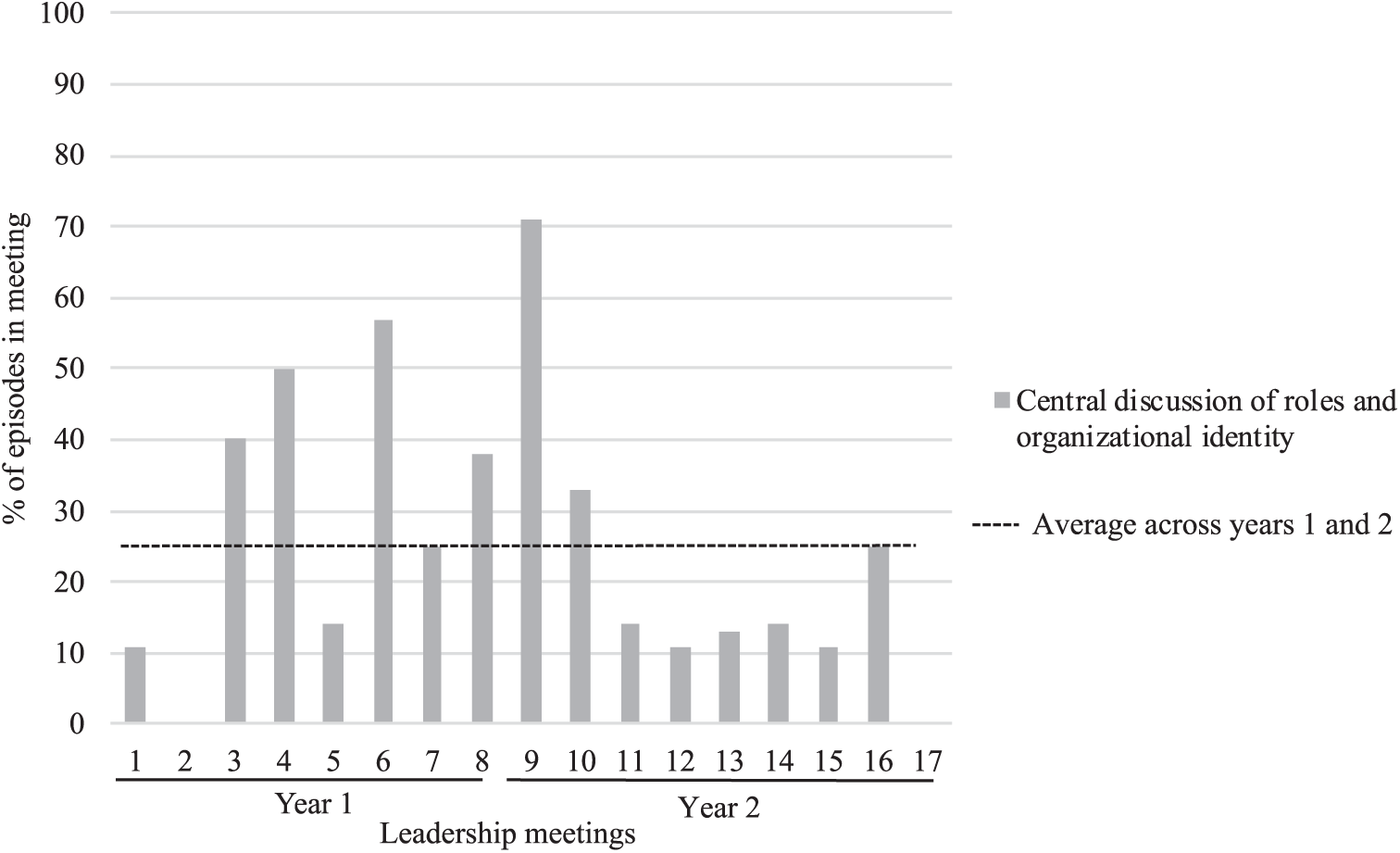
Percentage of meeting episodes with central discussion of roles and organizational identity. Each meeting included five to nine episodes.
What Were the Consequences of Role Negotiation for Subsequent Work Together?
Our analysis suggests that role negotiation had two central consequences for this RPP. It contributed to the time available for discussion of substantive projects during leadership meetings and a reorganization of roles during the course of the work.
Topics for discussion
First, time spent negotiating and renegotiating roles shaped—and sometimes constrained—the agendas for leadership meetings (see Figure 1). The more time the leadership team spent negotiating roles, the less time they spent discussing substantive work efforts. For example, early in Year 1, the team spent the majority of its time in discussions centrally focused on joint work projects. They discussed co-design efforts for science assessments and a project where members of the task force would interview teachers to understand their perspectives. In Meeting 1, only one in nine episodes (11%) involved central talk about roles or organizational identity; it did not come up in any Meeting 2 episodes. Then, there was a noticeable uptick in identity-referent discourse during Meetings 3 through 9. As PDI and district leaders spent more of their time making sense of each other vis-à-vis organizational identity discourse, talk time about substantive instructional improvement efforts decreased. Indeed, in five of these seven meetings, discussions of organizational identity and roles occurred in close to 40% of all episodes. In later meetings, this type of discourse decreased, and substantive discussion about work efforts again became more central. The group had established a new joint work effort together where they focused on district implementation of new curricular materials in Year 2.
Reorganization of roles
Role negotiation resulted in reorganization of roles for PDI staff and educators, which, in turn, contributed to new ways of working together in subsequent projects. During the first year of our study, we observed PDI engaging with the district as organizers of smaller research collaborations and as a provider of professional development (PD). We saw confirming evidence for these roles in Year 1 interviews as well. When we asked district leaders to describe PDI, 12 described it as a group of researchers who came to do research on or with the school district; 7 also focused on PDI’s role as a provider of PD to teachers and school leaders (see Table 3).
Conceptions of PDI by Cypress District Leaders, by Study Year

Note: Each district leader could name more than one conception of PDI. PDI = Partner for District Improvement; PD = professional development.
Then, through discourse around roles and organizational identity in leadership meetings, leaders in the partnership negotiated a new role for PDI. The team coconstructed an understanding that framed PDI as an advisor, integrating its efforts into the district’s work surrounding mathematics instruction. To illustrate, we return to Meeting 9, where we saw the leadership team begin to name and coalesce around a new role for PDI. In Excerpt 4, Karl transitioned from descriptions of PDI’s past role to offer a different set of relationships for the future.
Excerpt 4
One of the things that I was thinking about were the past projects for [PDI]. In relationship to what I’ve asked when I give you guys a call and say, “Hey, can you help me out with this?”—it’s a different grain size. What we could do is now permeate the work through the [district curriculum] because that will be our vehicle for rolling out Common Core. When I ask you guys to do things now, it’s a bigger grain size. And it’s been more loosely defined. Can we start to define our work in that larger grain size, and make it be less loose than it is now?
Yeah, that would be good.
Yeah, I totally agree with you on both of those things. That it makes sense to begin to define our work in the way we’re actually working.
Reflecting on past working arrangements, Karl requested that PDI begin to work at “a bigger grain size” and “less loose than it is now.” Further, he requested that the partnership “permeate” into the district’s new curriculum aligned with California Common Core State Standards for Mathematics (CCSS-M), “defin[ing] the work” in a new way. Tania agreed, noting it made sense to “define our work in the way we’re actually working” (Line 13). In a subsequent interview, Miguel, another district leader, summarized that the new role would be more “narrow … where [PDI] could reflect, give their opinion about it, give advice on it, bring expertise to the table.”
This new advisory role was manifest in the ways that PDI staff and district staff interacted in Year 2. Instead of engaging in multiple disparate projects, PDI leaders concentrated on the district’s ongoing efforts to respond to CCSS-M. They did so by embedding themselves in district meetings and providing advice on the district’s own initiatives. One PDI staff member said that in Year 2 he “played more of a critical friend role, an expert advisor. A lot of the work that I did, I contextualized in what [the main district initiative in mathematics] was.”
This new role gained prominence in the conceptions of PDI held by district leaders. Reflecting on experiences with PDI at the end of Year 2, one district leader described the change in PDI’s relationship with the district: What I saw was partnership in action with the school district. They [PDI] weren’t there with their agenda. They weren’t there to sell or convince or promote anything. They were there to be present to the needs that the [educators] had—that within a year to actually have a better sense of the role that partners play in the work, it was very much demonstrated there. Because they were not leading the work, they were supporting the work. What that required was that … their tasks and roles were defined.
Here, the leader explicitly named the new role for PDI (“not leading the work … supporting the work”) and acknowledged the importance of (re)defining PDI’s “tasks and roles.” Further, this new role for PDI was held not only by this leader and others involved in leadership meetings but also by leaders broadly dispersed in the central office (see Table 3). In Year 2 interviews, seven district leaders described PDI as a thought partner/advisor that provided guidance, and seven talked about PDI staff as “members of the team,” working alongside staff on district initiatives. While some district leaders still described PDI in ways that suggested other roles (i.e., PDI as PD provider), there seemed to be a growing understanding of the new ways of working together established in Year 2.
Which Factors Contributed to the Need for Role Negotiation?
Two factors likely contributed to the need for role negotiations within the partnership over time: PDI’s multifaceted and ambiguous identity and shifts in personnel and leadership.
PDI’s multifaceted identity
Like many partners engaged in RPPs, PDI had an ambitious vision for itself. Across interviews with central PDI staff, a relatively consistent portrait of their identity emerged (see Table 4). PDI leaders saw PDI as sitting at the intersection of practice, research, and design, proving a “bridge” across these communities. They saw themselves as collaborating with district leaders to explore a key issue that the district faced. Further, PDI staff saw their role as “following the contours” of a given problem, meaning that, as an organization, PDI was dynamic and flexible in how it engaged, depending on the phase and goals of the work together. PDI also had a mission focused on developing solutions that could spread to other districts—a key aim for many RPPs (Coburn & Penuel, 2016).
Conceptions of PDI by PDI Staff, by Study Year
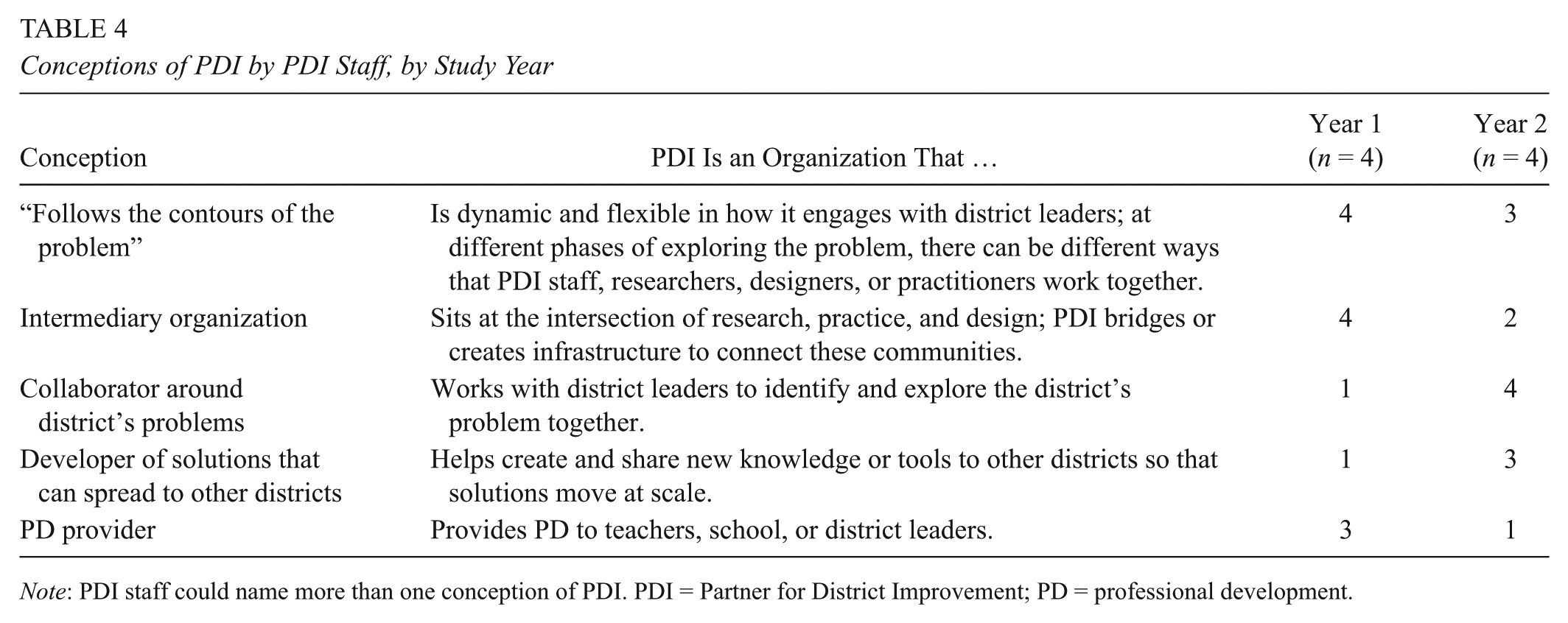
Note: PDI staff could name more than one conception of PDI. PDI = Partner for District Improvement; PD = professional development.
While ambitious, PDI was also an “ambiguous, amorphous world,” noted one PDI leader. There was a form-follows-function element to PDI’s work, whereby its role at a given stage of the work should not be predetermined but rather based on the current problem at hand. One PDI leader, when asked about appropriate roles for district personnel and PDI staff, answered, “There are a lot of things about PDI partnership that we, by design, don’t have answers to, and that’s one of them.” Or as another PDI staff person explained, “there are so many layers at PDI that it’s hard for people to know the identity. ‘What is PDI?’ [Pause] ‘Well, what do you want it to be?’”
In addition, there were times where one aspect of PDI’s identity seemed to run counter to another, creating some confusion. This is not uncommon with organizational identities, which can be multidimensional or even inconsistent (e.g., a hospital with an identity as a for-profit organization and an organization dedicated to improving health care outcomes; Albert & Whetten, 1985). In work with Cypress, for example, PDI framed itself as fundamentally different than other research partners, focused on solving problems of practice faced by the district. At the same time, though, it aimed to develop shareable knowledge for the field more broadly. One example of the tension between these goals was evident in PDI staff’s thinking about whether they should offer professional development (PD) requested by the district. In interviews with PDI staff, no one saw the organization as a provider of district PD. One PDI staff person explained, “The mission of PDI is not to do PD for principals.” Yet PDI staff did provide PD to teachers and principals in response to a request from the district. There were different justifications for playing this role, even if it lay outside of its core mission. Some PDI staff thought of PD for teachers and principals as a “side project,” one that could generate greater interest in mathematics on the ground, which could fuel bigger, subsequent projects. Others saw PD as a short-term project that could be “very immediate and gratifying” and encourage the district to “play along with us for this long[-term] thing.” Regardless, there was acknowledgment by staff that PDI’s role in PD sessions took it away from the main aspects of its mission. One PDI staff member explained his involvement this way: The original idea was … that we’re examining a problem with them that really benefits them, but that on the other hand, we’re taking what we learned, and we’re sharing that with the field. [Pause] I don’t see so much of that, as much as, I am helping them solve their problems.
Finally, certain dimensions of PDI’s role in the RPP were not always visible to district staff. For instance, some projects that were related to its role as intermediary between researchers and practitioners involved building infrastructure to improve these relationships—PDI would play “matchmaker,” connecting relevant research experts to district leaders. One PDI staff person explained that “a lot of that work is hidden.” More visible projects—like PD sessions—became the public face of PDI work instead. As such, the ambiguous nature of PDI’s identity, and the flexible role-taking it required, may have made it difficult for district leaders to have a full picture of their work. That uncertainty, in turn, may have necessitated additional negotiation as partners clarified and defined the roles that PDI could play in the collaboration’s next phase.
Shift in personnel
Cypress, like many urban districts, experienced leadership turnover during the study. Two new leaders in the curriculum and instruction (C&I) department joined with responsibilities for mathematics teaching and learning, and both became centrally involved in the partnership’s leadership meetings. Looking across the meetings, this shift in personnel contributed to the need for role negotiation in the partnership.
Before our study began, PDI worked largely with the department that oversaw secondary schools. The hiring of new C&I leadership represented a new phase for the department, as it was charged with supporting implementation of CCSS-M in the district. Consequently, PDI shifted focus from the secondary school team toward mathematics department leaders.
These new leaders brought to bear their own conceptions about appropriate roles for external partners. For instance, one new C&I leader brought a very broad understanding, thinking of partners as commercial vendors (minus traditional researchers who “did studies” on the district). For instance, in a Year 1 meeting, he explained that he had just gone to a conference where “there were a range of different vendors and products … with about 50 vendors, like PDI.” He believed there were overall too many external partners in the district in mathematics, and some were only loosely connected to the district’s agenda. In response, this leader had a very clear vision for appropriate partner roles: “It’s really about [the partner’s] alignment—their relationship to the district’s work and how they align to it, as opposed to being the work.” This understanding of PDI stood in contrast to how PDI saw itself in Year 1. PDI saw itself as quite different from vendors or service providers, and as a group that was, in one PDI leader’s words, “doing work that is the district’s work.” These divergent conceptions likely contributed to the concomitant increase in role negotiation in meetings.
Reorienting the partnership toward the mathematics department may have allowed PDI to stay relevant to the core of mathematics work in the district. However, it increased participation from new leaders with conflicting ideas about external partners generally and the role that PDI played in the district’s work specifically. This shift in leadership likely contributed to the salience of role negotiation in the years of our study.
Discussion and Conclusions
RPPs are touted as a promising strategy for improving research use in education. However, there are significant challenges to building and maintaining the relationships at the core of any partnership. Indeed, we know little about how RPPs achieve productive working relationships (Coburn & Penuel, 2016; Peurach, 2016). In this study, challenges arose for the PDI-Cypress partnership when district leaders’ expectations about the appropriate role for PDI were, at times, incongruous with the expectations PDI derived from its own organizational identity. As one C&I leader noted in his reflection on the partnership’s work, “We were like, ‘What the hell is this?’ And they [PDI] were in the middle of, ‘What the hell is this, and who the hell are you?’”
Here, we extend the modest literature base on RPPs in three ways. First, while many write about the importance of trust, we shed light on a heretofore unexplored dimension of RPP dynamics: role negotiation. We observed participants defining and redefining their roles in their partnership work through identity-referencing discourse—locating themselves within a set of legitimate social categories, making comparisons to other organizations, and referring to collective histories to make sense of what role(s) they might play. By bringing role negotiation to the fore, we have a more complete picture of the complex social and discursive processes at the heart of partnering.
Second, we explore how misconceptions regarding roles and responsibilities within RPPs may have consequences for the partnership’s ongoing work. When there was confusion, partners had to dedicate time to negotiating role boundaries and defining what the partner could or could not be expected to do. At times, these discussions superseded discussions of ongoing projects. They also resulted in reorganization of educator and PDI staff roles, which contributed to new ways of working together. By the end of Year 2, PDI staff were serving as advisors and contributing guidance and expertise to the district’s main efforts in mathematics, a new role that was jointly negotiated within leadership meetings. Thus, role negotiation was not only highly salient but also impactful, at least in the short term.
Finally, existing literature often names factors that can enable or constrain RPPs’ work (including our own work; see Farrell et al., 2018); few, however, unpack how different conditions influence RPP efforts. We argue that two factors contributed to the need for role negotiation. First, PDI’s own organizational identity influenced these dynamics, as it was sometimes difficult for partners to make sense of who PDI was as an organization when traditional referents for external partners—such as traditional research project, vendor, or PD provider—did not easily fit. This need to revisit PDI’s role was further compounded by changes in district staff centrally involved in the partnership. New leaders who stepped into the partnership did not have a clear understanding of what PDI was or the appropriate roles for PDI staff, necessitating sensemaking and negotiation to achieve clarity. Further, we saw that these factors contributed to the RPP’s social dynamics during the life of the partnership, not only at the beginning, as suggested by current accounts.
These findings offer important practical implications for practitioners and researchers involved in collaborative partnerships. When a partnership is having difficulty moving work forward, confusion around roles or ambiguity regarding who the partners are and what contributions they bring to the table may be part of the problem. Thus, partnerships may want to explicitly attend to the development of shared understandings around these issues. Explicit attention to appropriate roles may be particularly important when there are shocks to the partnership, like leadership turnover. If a shift involves new district leaders who will become key actors in the RPP, then the partnership could dedicate time to describing shared history, answering questions, and addressing explicitly what is acceptable in terms of roles. Finally, role negotiation likely extends beyond the initial establishment of a partnership. Therefore, participants in RPPs should not assume that because a conversation around roles took place at the outset, the issue has been addressed. Even long-standing partnerships may need to revisit or reestablish shared understandings about roles.
This study points to several directions for future research. First, our analysis focused on role negotiation within formal leadership meetings, yet PDI and district leaders interacted in other ways. Some settings were formal, such as when a PDI staff person attended a district department meeting; others were informal, such as when PDI staff and district leaders exchanged text messages. It would be beneficial to see whether role negotiation emerges within these and other interactive contexts. This will help us better understand how different social contexts affect when and how role negotiation unfolds.
Second, we surfaced the phenomenon of role negotiation through identity-referent discourse in partnership settings. Yet this is not the only important micro-process of RPP work. Future studies should consider how role negotiation interacts with status, authority, and power dynamics, as these all can shape how partnership work unfolds (Coburn et al., 2008; Vakil, de Royston, Nasir, & Kirshner, 2016). For instance, one could explore whether role negotiation is more likely to surface when raised by an individual with high status or authority versus someone who is not as well positioned. A separate study might consider the relationship between trust in an RPP and divergent conceptions of appropriate roles. Prior research suggests that when a person or group acts in a way seen as inappropriate by the other group, it can contribute to a potential breakdown of trust (Golden-Biddle & Rao, 1997). Future work can investigate when and under what conditions these two dynamics interact, and to what end.
Further, the phenomenon of role negotiation could be examined in comparative studies of RPPs of different designs. This study was a single case study of one particular type of RPP, a design-based partnership 4 (Coburn et al., 2013). In this type of partnership, role negotiation might be more salient since partners can be expected to assume less familiar roles more regularly than in partnerships where researchers and practitioners take on more traditional roles. Or, it may be the case that networked improvement communities require educators to take on significantly different roles in improvement science work (e.g., Tichnor-Wagner et al., 2017) in ways that research alliances do not (e.g., Roderick et al., 2009). Future research can explore how role negotiation might unfold differently in partnerships with different designs or expectations around roles.
Finally, our analysis considered the consequences of role negotiation for the focus of discussion during leadership meetings and the role for the external partners in their subsequent work. A natural next step is to consider how these partner interactions influenced PDI’s involvement in the district’s plans for CCSS-M plans and their implementation in schools. Understanding this pathway will help tease apart the complex, interrelated chain of events, actors, and conditions that are involved in achieving longer-term outcomes of RPPs.
This case sheds light on role negotiation as an important dynamic of RPP work. Here, both district leaders and PDI staff were actively involved in negotiating roles and coconstructing a new role for PDI. In so doing, they entered a new social context of collaboration. Constructing a shared vision for appropriate roles while taking into account broader understandings of organizational identity may be a necessary step toward supporting these new ways of working together.
Footnotes
Acknowledgements
We wish to thank colleagues at Northwestern University and University of Colorado Boulder for their very helpful feedback. We greatly value the insights from district leaders and partners in the study. Support for this article was provided by the William T. Grant Foundation, Grant #180922 and Grant #184067.
Notes
Authors
CAITLIN C. FARRELL is the director of the National Center for Research in Policy and Practice at the University of Colorado Boulder. Drawing on organizational theory, her current work focuses on educators’ decision making, research-practice partnerships, and the role of evidence in policy and practice.
CHRISTOPHER HARRISON is a professor at Montana State University Billings. His research interests include the politics of education, practitioners’ use of student performance data, and district processes for implementing and scaling programs and practices.
CYNTHIA E. COBURN is a professor at the School of Education and Social Policy at Northwestern University. She studies the relationship between instructional policy and teachers’ classroom practice, the scale-up of innovative instruction, and the relationship between research, practice, and policy.