




Abstract
Children’s working memory (WM) skills, which support both academic and social success, continue to improve significantly through the school years. This study leverages the first nationally representative data set with direct assessments of elementary school students’ WM skills to examine whether WM grows more during the school year or summer months and whether WM growth rates differ by household income. Results demonstrate that WM skills grow more during the school-year months compared to the summer months, suggesting that school environments provide children with unique opportunities to improve and practice their WM skills. Further, lower-income children have significantly faster WM growth rates in the first 2 years of school and the intervening summer, compared to their peers from higher-income families, leading to an overall narrowing in WM disparities by household income during the early school years. However, there was no evidence that schools equalize or exacerbate differences in WM skills between children from lower-income and higher-income households.
Parental sensitivity, scaffolding, and cognitive stimulation have been linked to higher executive functions, including WM skills (Fay-Stammbach, Hawes, & Meredith, 2014). In preschool classrooms, responsive teaching and classroom organization have been associated with increases in children’s WM skills over the school year, after controlling for demographic characteristics and the structural quality of classrooms (Hamre, Hatfield, Pianta, & Jamil, 2014). Children’s experiences with teachers may be particularly important for children who have less supportive home environments (Vandenbroucke, Spilt, Verschueren, & Baeyens, 2017). There is evidence that school experiences help close socioeconomic gaps in reading and math skills (Downey, von Hippel, & Broh, 2004; Verachtert, Van Damme, Onghena, & Ghesquière, 2009) and a handful of studies suggesting that children who experience more years of formal schooling have higher executive functions (Burrage et al., 2008; McCrea, Mueller, & Parrila, 1999).
The current study explores how children’s WM growth differs between school-year and summer months using a nationally representative sample of American kindergarteners: the Early Childhood Longitudinal Study, Kindergarten Class of 2010–2011 (ECLS-K:2010). These seasonal analyses provide nuanced information on the developmental trajectories of WM and which environmental contexts may shape WM growth. Further, this study tests whether children’s growth rates are differentially associated with growth in their WM skills depending on their household income, to disentangle the role of schooling in exacerbating or reducing disparities in children’s WM development by household income.
WM Development During Elementary School
WM encompasses children’s abilities to hold, update, and manipulate information in the mind over short periods of time (Diamond, 2013). WM is under the broader umbrella of executive function skills, which enable children to cognitively regulate their attention and behaviors (Obradović, Portilla, & Boyce, 2012) and support both academic and social success in the school context (de Wilde, Koot, & van Lier, 2016; McQuade, Murray-Close, Shoulberg, & Hoza, 2013; Swanson, 2011; Vandenbroucke, Verschueren, & Baeyens, 2017). WM is measured using tasks that require children to remember information and mentally work with that information once it is no longer perceptually present (Diamond, 2013). For example, in a WM span task, children would be asked to repeat back a set of words or numbers in reverse order from which they were presented (Alloway, 2007). It is important to note that most tasks that are designed to capture WM partially rely on children’s inhibitory control skills to inhibit dominant responses in favor of nondominant responses. WM and inhibitory control support one another, and to successfully complete a WM span task, children must also resist the urge to repeat back the numbers or words in the original order to correctly state the sequence in backward order (Diamond, 2013).
Early indicators of WM appear in children’s first year (Diamond, 2013), with improvements through elementary school (Gathercole, Pickering, Ambridge, & Wearing, 2004). Studies in England and Singapore demonstrated that WM skills steadily increased between ages 4 and 15 (Gathercole et al., 2004; Lee et al., 2013). One study focused on the early elementary years showed that WM improved over the first 3 years of formal school in a Swiss sample (Röthlisberger, Neuenschwander, Cimeli, Michel, & Roebers, 2012). They found nonlinear patterns, with the largest gains in kindergarten and smaller gains in first and second grade. A study in Belgium found similar increases in WM from kindergarten to first grade (Vandenbroucke, Verschueren et al., 2017). Aside from Lee and colleagues’ (2013) study in Singapore, longitudinal studies have been relatively small in scale and followed children over 1 to 2 academic school years. To better target interventions and supports for children’s WM skills, more information is needed on the developmental trajectories of children’s WM during the elementary school years.
The School Context and WM
The transition to formal schooling is a significant milestone that sets the stage for children’s long-term developmental trajectories (Nelson et al., 2017; Pianta, Rimm-Kauffman, & Cox, 1999; Portilla, Ballard, Adler, Boyce, & Obradović, 2014). In kindergarten, teachers begin to have an explicit focus on formal academic instruction with specific goals for children’s literacy and numeracy development (Rimm-Kaufman & Pianta, 2000). In recent years, kindergarten has become increasingly academic, such that teachers have reported large increases in literacy and math instruction, time spent on challenging academic topics, and the use of standardized tests from 1998 to 2010 (Bassok, Latham, & Rorem, 2016). Class sizes and student-to-teacher ratios are also much larger in elementary school classrooms compared to students’ preschool classrooms, and children are expected to more independently manage their time and behaviors. The new demands of formal schooling—both academic and social—require children to engage their WM skills to keep track of directions and progress on academic work (Alloway, Gathercole, Kirkwood, & Elliott, 2009b), learn more challenging academic material (Peng, Namkung, Barnes, & Sun, 2016), and manage social interactions with peers (McQuade et al., 2013). These experiences in early elementary school should theoretically provide children with opportunities to practice and improve their executive function skills in ways that they could not in the home environment.
Research exploring “schooling effects” has largely focused on the growth rates of children’s academic achievement scores in elementary school. These studies compare gains on reading and math test scores during the school-year months to gains during the summer months, under the assumption that school-year learning is influenced by both school and nonschool factors, whereas summer learning is influenced solely by nonschool factors, such as the home environment (Heyns, 1987). Leveraging the exact dates of academic assessments, researchers have been able to more accurately separate school-year from summer learning (Alexander, Entwisle, & Olson, 2001; Downey et al., 2004; Quinn, Cooc, McIntyre, & Gomez, 2016). Using the earlier ECLS-K:1998, Downey and colleagues (2004) demonstrated that both reading and math scores grew faster during the school years compared to the summers. A similar study conducted in Finland also found that children’s math skills grew the most during the kindergarten and first-grade school years, compared to the intervening summer vacation (Verachtert et al., 2009). These results are not surprising, as schools are explicitly set up to increase children’s academic content knowledge, whereas parents are not directly tasked with teaching their children academic skills during the summer months.
In contrast, the role of schools for children’s nonacademic development is not as well defined (Downey, Workman, & von Hippel, 2017). Although both kindergarten teachers and researchers cite executive function skills as a crucial predictor of school adjustment and success (Blair, 2002; Blair & Raver, 2015; Lewit & Baker, 1995), there are not clear supports built into elementary school curricula for the development of these skills. A small number of studies have explored schooling effects on executive function skills by comparing children who are close in age but differ in the number of years of formal schooling experienced. One study showed that kindergarteners had higher WM scores compared to their prekindergarten peers of a similar age (Burrage et al., 2008). They hypothesized that these differences may be due to kindergarteners’ prior preschool experiences. Both the prekindergartners and kindergarteners showed equal growth in WM skills during the school year, suggesting that these two grades have equivalent schooling effects. Another study found small schooling effects on executive functions, including WM, for 7- to 9-year-olds, demonstrating that students who had an extra year of elementary school showed higher executive function scores than their age-matched peers in the grade below at a single time point (McCrea et al., 1999). A recent study demonstrated that schooling effects on children’s executive function scores are mirrored by schooling effects on their neural development. In a small sample of German children from higher-income families, first graders demonstrated more activation of the right superior prefrontal cortex when engaging in executive function tasks than kindergarteners of the same age (Brod, Bunge, & Shing, 2017). These changes in activation of the brain during the school year were correlated with improvements in executive function task performance during the school year.
Although these studies provide some initial evidence that school experiences may benefit executive function development more generally, they compare two separate groups of students who may differ on a wide range of factors that are implicated in executive function development (e.g., social-emotional skills, preschool experience). Cutoff designs are also unable to disentangle schooling influences on executive function skills from nonschooling influences on executive function skills. It is possible that differences in children’s home learning experiences may be driving these findings. For example, parents may anticipate children’s kindergarten entry by engaging in increased learning activities during the summer before they start school (Son & Morrison, 2010; Weiland, McCoy, Grace, & Park, 2017). If these enhanced home learning environments also supported executive function development, then studies using cutoff designs would overestimate the benefits of school for executive functions. Further, these studies used relatively small samples that may not be generalizable to children’s schooling experiences more generally. It is important to extend this work to larger, more representative, longitudinal samples that allow for estimation and comparison of school-year and summer growth rates.
Do Schools Equalize or Exacerbate WM Disparities by Household Income?
There are large socioeconomic disparities in children’s WM skills (Hackman et al., 2015; Little, 2017; Sarsour et al., 2011). A prior study using the ECLS-K:2010 showed large socioeconomic gaps in children’s WM skills at school entry that got smaller from kindergarten to second grade (Little, 2017). Specifically, children whose families were in the top socioeconomic-status quintile had WM scores that were 1.01 standard deviation units higher than their peers from the lowest socioeconomic quintile, on average, at kindergarten entry. This gap was reduced to 0.66 standard deviation units in the spring of second grade. However, Hackman and colleagues (2015) did not find differences in children’s executive function growth trajectories from kindergarten to fifth grade by household income, using a large sample of American children drawn from predominantly white and middle-class families around the country (National Institute of Child Health and Development Study of Early Child Care). These contrasting findings may be explained by sample differences, differences in the WM tasks used, or nonlinearities in the effects of socioeconomic status on the development of children’s WM skills. It is plausible that there are differences in WM growth rates by socioeconomic status during early elementary school, when children are first adjusting to school, but not in the later grades. Therefore, socioeconomic differences in executive function growth rates might differ over time. Further, neither study examined whether growth differed between school-year and summer months, confounding schooling effects with the natural maturation of WM skills and the effects of nonschool experiences.
Theoretically, public schooling experiences in the United States are supposed to act as “equalizers” where all children have equal access to learning opportunities. Most evidence supports the role of schools as equalizers for academic achievement, with reductions in socioeconomic status gaps in children’s reading and math skills during the school-year months (Alexander et al., 2001; Burkam, Ready, Lee, & LoGerfo, 2004; Downey et al., 2004; von Hippel, Workman, & Downey, 2017). When rates of academic skill growth have been compared between school-year and summer months, data from the earlier ECLS-K:1998 data set demonstrated that schools reduced the rate of reading and math inequality between low- and high-socioeconomic-status students compared to the months when school was out of session (Downey et al., 2004). Recent analyses from the ECLS-K:2010 found equalizing effects of schooling on math and reading scores only during the kindergarten year (Quinn et al., 2016; von Hippel et al., 2017). These changes over time may be due to shifts in math and reading curricula over the past two decades (Hiebert, 2015; Porter, McMaken, Hwang, & Yang, 2011) as well as increases in the quality of low-income children’s home learning experiences during this time period (Bassok, Finch, Lee, Reardon, & Waldfogel, 2016).
Because WM skills are not directly targeted by classroom curricula, it is unclear whether schools would similarly play an equalizing role in reducing WM disparities between children from low- and high-income families. Related work on teacher-rated socioemotional skills, such as children’s approaches to learning, self-control, and interpersonal skills, did not find evidence that schools exacerbated or reduced socioeconomic inequality (Downey et al., 2017). They found large gaps in teachers’ ratings of socioemotional skills at school entry that persisted through second grade. However, these analyses are likely biased by teachers’ perceptions of students (Garcia, Sulik, & Obradović, 2018) and skewness in teacher ratings of children’s behavior (Miner & Clarke-Stewart, 2008; Sulik, Blair, Greenberg, & Family Life Project Investigators, 2017). The present study improves upon this work by using direct assessments of children’s skills.
Current Study
Leveraging the only nationally representative data set including direct assessments of children’s WM skills, this study examines how growth rates in children’s WM skills differ between school-year and summer months. These analyses extend previous work demonstrating seasonal differences in children’s academic skill growth rates (Downey et al., 2004; von Hippel et al., 2017) to understand if schooling is similarly associated with benefits in WM development. Although WM is not directly targeted by schooling instruction, children’s academic and social experiences at school afford them with many opportunities to further develop and practice their WM skills. Testing whether growth rates differ between school-year and summer months provides insight about which contexts may be most promotive of WM development.
Second, this study explores whether WM growth rates differ by children’s household income. Given the importance of executive function skills for long-term outcomes, it is critical to understand whether schools are reducing or exacerbating income disparities in children’s WM skills. These analyses provide information about when school- or home-based interventions might be best targeted to reduce WM gaps between children from lower- and higher-income families.
In addition to these conceptual contributions, the current study applies a methodologically rigorous approach to describing seasonal differences in WM development. Prior seasonal research on executive functions has used cutoff designs, which compare students who are close in age but in different grades due to school birthday cutoffs (Brod et al., 2017; Burrage et al., 2008; McCrea et al., 1999). Cutoff designs may confound unobserved differences in children’s skills or home environments with schooling effects and are not able to evaluate whether growth during school-year months differs from growth during summer months. The current study utilizes longitudinal data and exact information about when WM test scores were assessed to provide more accurate comparisons of how growth during school-year months differs from that during summer months.
Method
Data and Sample
The data used in this study are drawn from the ECLS-K:2010. The ECLS-K:2010 collects data from a nationally representative sample of about 18,170 children who were in kindergarten in fall 2010 (representing a cohort born in 2004–2005; Tourangeau et al., 2017). The current study uses data from the fall and spring of children’s kindergarten, first-grade, and second-grade years. The primary measure of interest, children’s WM skills, was measured using direct assessments in the fall and spring of each year. In the fall of children’s first- and second-grade years, a random subsample (approximately one third of the total sample) of children took the direct WM assessment. The analytic sample is restricted to first-time kindergarteners; the 840 children who were repeating kindergarten, as reported by parents, were dropped from the sample. Children without a valid sample weight or WM data were also excluded, leaving a final analytic sample of 11,150 children in the kindergarten year.
Measures
WM
Children’s WM skills were measured using the Numbers Reversed subtest of the Woodcock-Johnson III (Blackwell, 2001). In this task, the assessor read a sequence of numbers, and the child was asked to orally repeat the sequence in reverse order. For example, if the assessor read the sequence 5, 8, 2, the child was expected to say 2, 8, 5. All children began with five sequences of two digits (e.g., 7, 3); then, based on performance, the number of digits in the sequence increased to a maximum of eight digits (e.g., 8, 3, 6, 1, 7, 9, 2, 4). There were 30 possible trials in total (five sets of two- and three-digit trials and four sets of four-, five-, six-, seven-, and eight-digit trials). The task ended when the child got three consecutive trials incorrect within a level. As advised by the National Center for Education Sciences (Tourangeau et al., 2017), a standardized score based on a transformation of the Rasch Ability Scale is used in all regression analyses (W score). This score represents a child’s ability as well as the difficulty of the item. Two other measures of performance on the Numbers Reversed test are presented descriptively to help anchor the W scores: the percentage of items children correctly answered and the longest span of digits children were able to correctly reverse. If children did not answer any trials correctly, their longest span was set to 1.
Household income
Household income, the total income of all persons in the household over the past year, including salaries, other earnings, interest, and retirement, was self-reported by parents during the spring kindergarten interview. Income was measured in 18 categories, ranging from $5,000 or less to $200,001 or more. The midpoint of each income category was used to create a continuous income variable. For children whose parents reported making over $200,001 per year, their household income was set to $350,000. Income was log-transformed and grand-mean centered for all regression analyses.
Analytic Plan
Children’s WM skills were assessed at six different time points: the fall and spring of kindergarten, first grade, and second grade. These six assessments allowed for estimation of growth in WM skills during the kindergarten school year, the summer after kindergarten, the first-grade school year, the summer after first grade, and the second-grade school year. WM assessments were generally scheduled a month after the start of school (fall) and a month before the end of school (spring). Therefore, simple subtraction of children’s skills between the time points would confound growth during the school-year months and summer months, as shown in Figure 1. By using the exact dates that children’s WM scores were assessed, the model estimates growth rates using children’s exposure to school in months and extrapolates scores on the assessments to what would have been obtained if children were assessed on the first and last day of the school year. This allows school-year growth in WM to be separately estimated from summer growth in WM. These analyses are similar to those previously used to assess seasonal differences in the growth rates of children’s achievement and social-emotional skills using the ECLS-K data sets (Downey et al., 2004, 2017; Quinn et al., 2016).
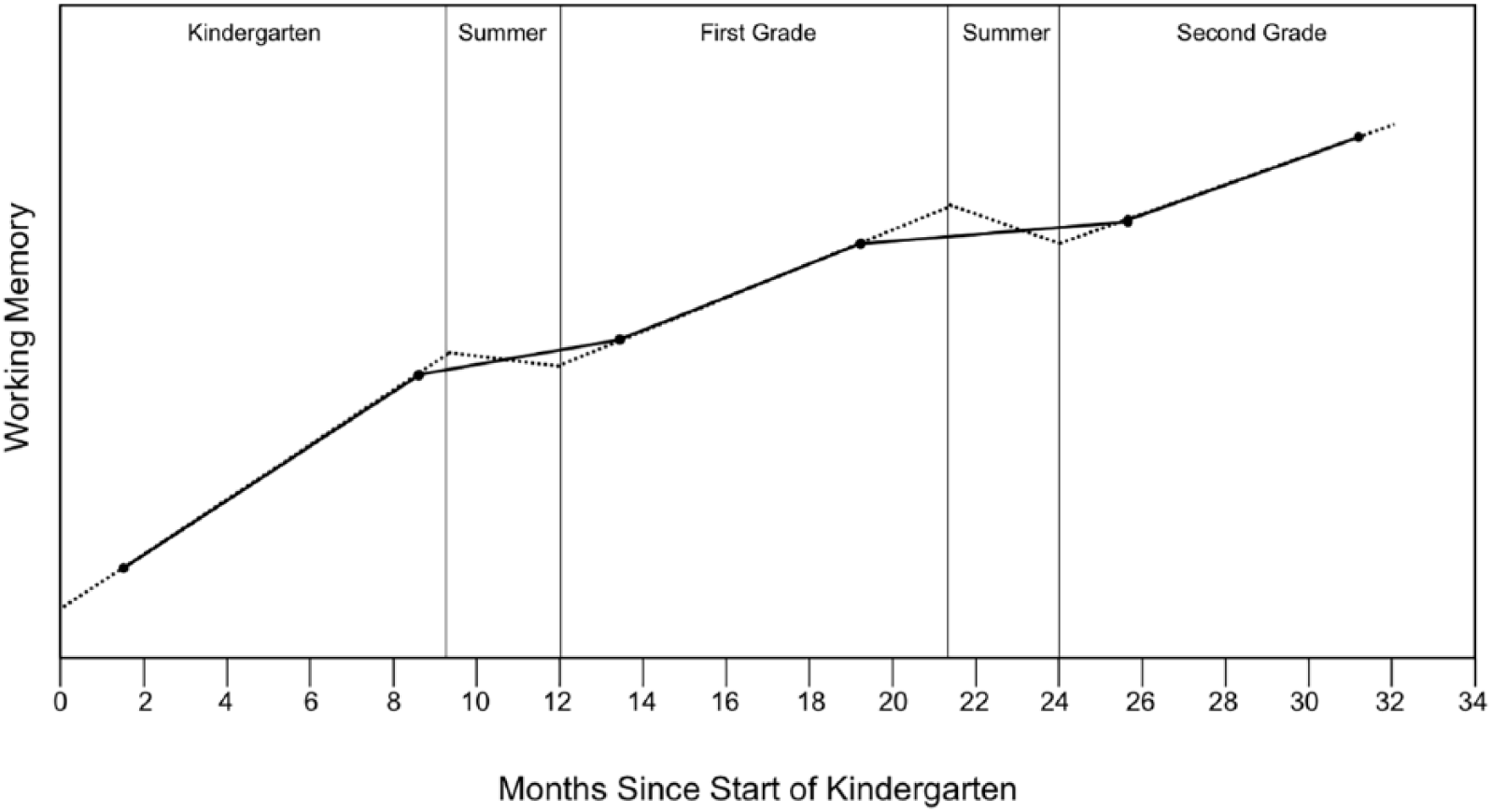
School-year and summer working memory (WM) growth rates using assessments given in the fall and spring of each school year. Hypothetical WM test scores are shown using dots. The solid lines show naive estimates, where growth rates are estimated simply using the differences between each test. Extrapolated WM test scores are shown using the dashed line. The difference between the extrapolated scores at the beginning and end of the school years provides a more accurate estimate of summer learning.
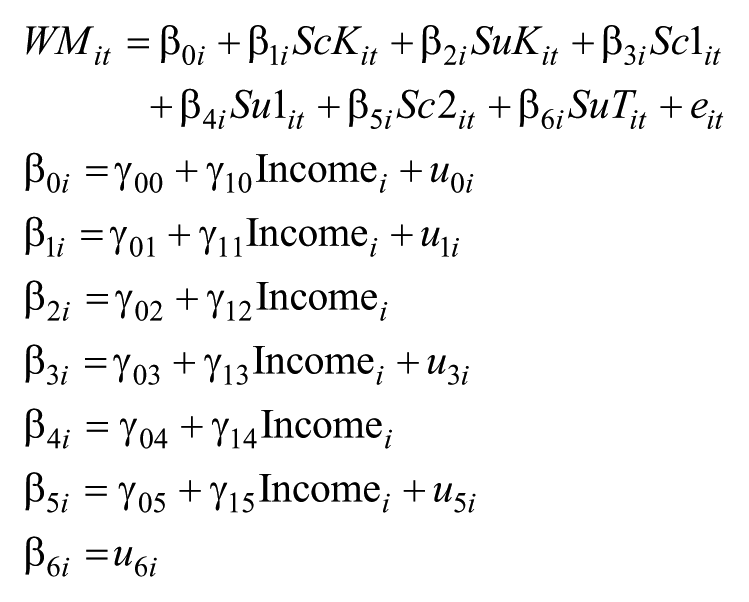
Multilevel growth curve models (Raudenbush & Bryk, 2002) are used to analyze growth in children’s WM skills during each school year and summer. For child

In this model, β0i can be interpreted as the score the child would have received on the first day of kindergarten; β1i, β3i, and β5i show growth in WM skills per each month of kindergarten, first grade, and second grade, respectively; and β2i and β4i represent growth in WM skills per each month of summer after kindergarten and first grade, respectively. The random-effects error term is constrained to be the same across the two summers, but the average growth rates are still allowed to differ across the two summers. This means that the average growth rate in WM may differ across the two summers, but individual students’ growth rates are constrained to differ from the average summer rates by the same amount in both summers.
In a second set of analyses, the growth parameters for the three school years and two summers were allowed to vary by a continuous measure of children’s household income. Therefore, for example, γ11 would show how the growth rate of WM skills during the kindergarten school year differed by household income.
Results
Descriptive Statistics
As shown in Table 1, average levels of children’s WM skills increased at each time point. Children showed the largest gains, on average, during the kindergarten school year (17.059 points on the W ability score), followed by the first-grade school year (12.353 points). The standard deviation of children’s WM skills on the W ability score steadily decreased from fall of kindergarten (30.240 points) to the spring of second grade (22.881 points), demonstrating that variability in children’s WM skills decreases over the early school years. These patterns in the W ability scores were mirrored by patterns in the percentage of correct trials (out of 30) and the longest digit span children achieved. In the fall of kindergarten, 40% of children did not get any trials correct, 60% correctly responded to a two-digit trial, 32% correctly responded to a three-digit trial, and 5% correctly responded to a four-digit trial. By the spring of kindergarten, only 19% of children did not get any trials correct, 81% of children correctly responded to a two-digit trial, 54% correctly responded to a three-digit trial, and 11% correctly responded to four-digit trial. By the end of second grade, very few students (2.03%) were not able to correctly respond to any trials, 98% correctly responded to a two-digit trial, 89% of children correctly responded to a three-digit trial, and 48% of children correctly responded to a four-digit trial.
Descriptive Statistics for Working Memory Measures at Each Wave

WM Growth Rates in School-Year and Summer Months
Table 2 shows average growth rates in WM (using the W ability scores) during the first three school years and the summers between them. These results demonstrate that children’s WM skills improve more during school-year months than in summer months (see Figure 2), as shown by the steeper slopes in the kindergarten, first-grade, and second-grade school-year months compared to the summer months. Children gain an average of 2.775 points per month of kindergarten, 1.567 points per month of first grade, and 0.985 points per month of second grade. In contrast, they gain 0.841 points per month in the summer after kindergarten and 0.395 points per month in the summer after first grade. WM growth rates were significantly larger during the kindergarten and first-grade school-year months compared to the summer between them, χ2(1) = 114.50, p < .001; χ2(1) = 12.12, p < .001, respectively. Similarly, WM growth rates were significantly larger during the first-grade and second-grade school-year months compared to the summer between them, χ2(1) = 36.58, p < .001; χ2(1) = 7.41, p = .007, respectively.
Multilevel Models Demonstrating Associations Between Months in School Years and Summers and Children’s Working Memory (WM) Skills

Note. All estimates are weighted (W1C0) to adjust for the complex survey design of the Early Childhood Longitudinal Study, Kindergarten Class of 2010–2011. The maximum sample size is 11,150 (rounded to the nearest 10 per National Center for Education Statistics guidelines), but sample size varies at each time point. Income has been log-transformed.

Fitted working memory growth trajectory for all students.
In both school-year and summer months, children’s WM growth rate monotonically decreased, such that the largest improvements in WM skills were found during the kindergarten school year. Children had significantly larger gains during the kindergarten months compared to the first-grade months, χ2(1) = 276.28, p < .001, and during the first-grade months compared to the second-grade months, χ2(1) = 52.41, p < .001. Similarly, children showed larger gains during the summer after kindergarten compared to the summer after first grade, χ2(1) = 4.36, p = .037.
Moderation of WM Growth Rates by Household Income
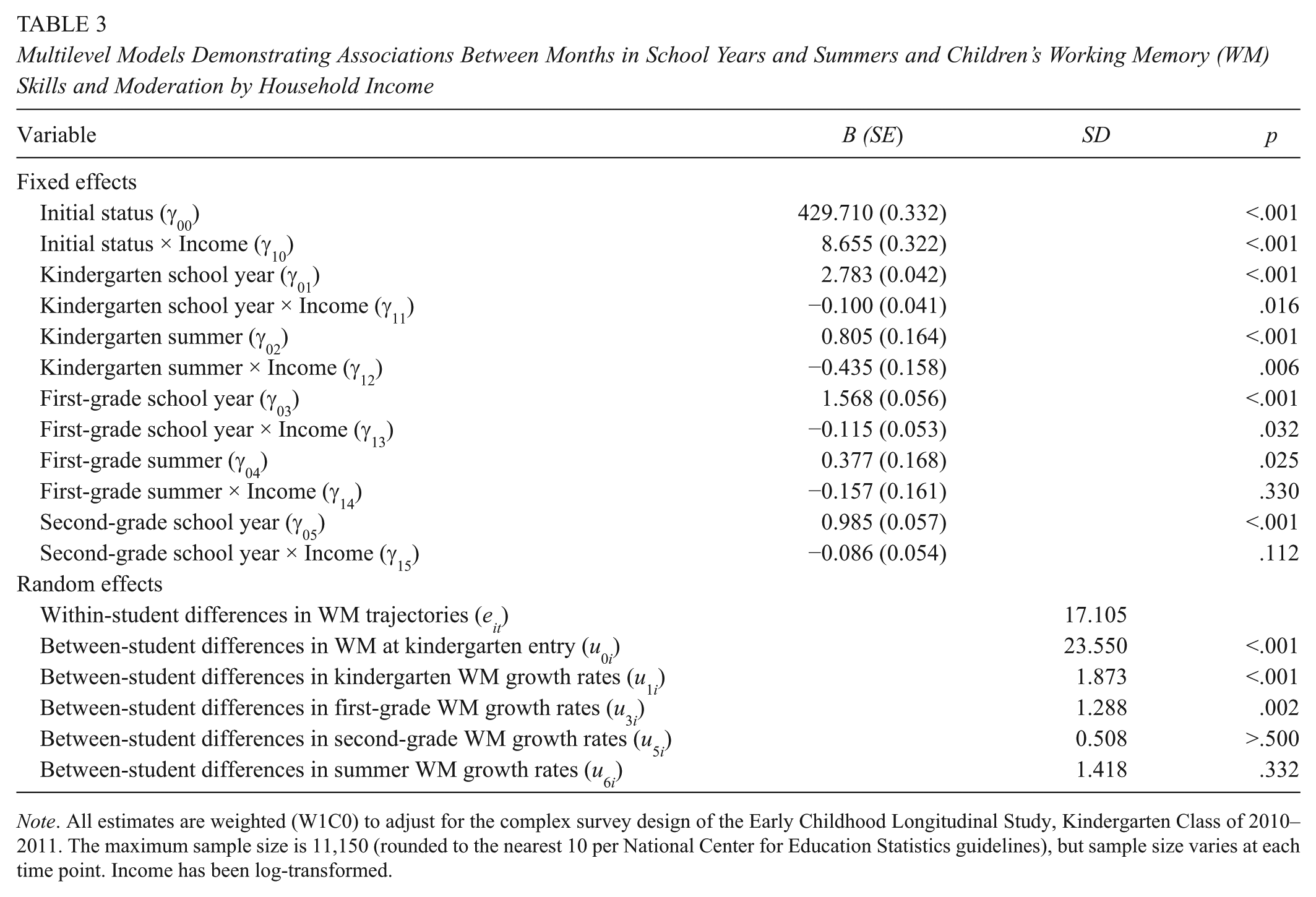
Table 3 includes interactions between log-transformed household income and children’s growth rates in each school year and summer. There were large disparities in children’s WM skills by household income at kindergarten entry (B = 8.655, p < .001). Further, household income moderated children’s growth trajectories in the kindergarten school year, the first-grade school year, and the summer between. Specifically, children from lower-income households had significantly faster growth rates during the kindergarten school year (B = −0.100, p = .016), the summer after kindergarten (B = −0.435, p = .006), and the first-grade school year (B = −0.115, p = .032), compared to children from higher-income households. Results were unchanged with the addition of age at kindergarten entry and gender as covariates. Effect sizes, as measured by pseudo-R2 statistics, are reported in Table 4. Figure 3 illustrates the decreasing gaps between lower- and higher-income children by showing growth trajectories for children from households at the 10th, 50th, and 90th income percentiles. Households at the 10th income percentile have a total household income of $12,500, households at the 50th income percentile have a total household income of $52,500, and households at the 90th income percentile have a total household income of $150,000.
Multilevel Models Demonstrating Associations Between Months in School Years and Summers and Children’s Working Memory (WM) Skills and Moderation by Household Income
Note. All estimates are weighted (W1C0) to adjust for the complex survey design of the Early Childhood Longitudinal Study, Kindergarten Class of 2010–2011. The maximum sample size is 11,150 (rounded to the nearest 10 per National Center for Education Statistics guidelines), but sample size varies at each time point. Income has been log-transformed.
Pseudo-R2 Effect Size Statistics for Multilevel Models Demonstrating Associations Between Months in School Years and Summers and Children’s Working Memory Skills and Moderation by Household Income


Fitted working memory growth trajectories for students at the 10th, 50th, and 90th income percentiles. Households at the 10th income percentile have a total household income of $12,500, households at the 50th income percentile have a total household income of $52,500, and households at the 90th income percentile have a total household income of $150,000. This figure demonstrates that there were significant differences in working memory growth rates by household income during the kindergarten school year, the summer after kindergarten, and the first-grade school year. There was also significantly more equalizing of scores between lower- and higher-income children during the summer after kindergarten compared to the kindergarten school year.
Wald tests were used to compare the coefficients on the interaction terms between income and WM growth for each time period. The null hypothesis was that the coefficients on the interaction terms were the same across different time periods, such that income similarly moderated WM growth rates over time. The difference in WM growth rates between lower- and higher-income children was marginally larger in the summer after kindergarten compared to the kindergarten school year, χ2(1) = 3.73, p = .054, but not compared to the first-grade school year, χ2(1) = 2.57, p = .109. This shows that there was slightly more equalizing in WM scores during the summer after kindergarten compared to the kindergarten school year. There were not significant differences in WM growth rates between lower- and higher-income children in the kindergarten and first-grade school-year months, χ2(1) = 0.05, p = .822, demonstrating that there are similar equalizing effects of exposure to school during the kindergarten and first-grade school years.
Discussion
Although WM skills continue to improve after kindergarten entry (Lee et al., 2013; Vandenbroucke, Verschueren, et al., 2017), there is little information about whether these improvements are due to experiences children have in school. This is the first study to demonstrate that WM skills grow more during the school-year months compared to the summer months, suggesting that school environments provide children with unique opportunities to improve and practice their WM skills. Further, lower-income children showed significantly faster WM growth rates in the first 2 years of school and the intervening summer, compared to their peers from higher-income families. This led to an overall narrowing in WM disparities between children from lower- and higher-income families during the early school years. However, there was no evidence that schools specifically were equalizing or exacerbating inequality in WM skills between lower- and higher-income children, as narrowing occurred both during the school years and during the summer.
WM Growth Rates in School-Year and Summer Months
This study provides nuanced information about the developmental trajectories of WM in early elementary school using a nationally representative sample. First, results demonstrated that children’s WM skills show the largest improvements in kindergarten and that growth in WM monotonically decreases over time. In particular, this study focuses on the central executive component of WM, which not only stores information in the mind but actively processes and manipulates that information (Baddeley, 2012). The central executive component of WM is the most complex (Baddeley, 2012) and tends to develop later than the two systems it controls (Davidson, Amso, Anderson, & Diamond, 2006; Garon, Bryson, & Smith, 2008). The findings in this study are similar to several studies highlighting significant improvements in the central executive component of WM during the early elementary years (Gathercole et al., 2004; Lee et al., 2013; Van der Ven, Kroesbergen, Boom, & Leseman, 2012; Vandenbroucke, Verschueren, et al., 2017) and a longitudinal study of young Swiss children who showed the largest gains in WM during the prekindergarten and kindergarten years and smaller gains during the first- and second-grade years (Röthlisberger et al., 2012). None of these previous studies examining WM development differentiated between school-year and summer growth in WM.
Second, these findings highlight that WM skills grow significantly more during the school-year months compared to the summer months. These findings corroborate prior research comparing WM scores for children of similar ages who had different amounts of exposure to formal schooling (Burrage et al., 2008; McCrea et al., 1999). The current study builds on prior schooling-effects research that used birthdate cutoff designs by comparing children to themselves at different points in the academic year, allowing for more precise estimation of what months in the year WM growth occurs. Results are similar to those found in seasonal research on academic skills (Downey et al., 2004), suggesting that the kinds of activities children engage in at school similarly benefit their WM and academic skills, despite the fact that the promotion of WM is not part of typical school curricula.
There are several mechanisms through which school experiences may foster WM development. Broad measures of classroom quality, including emotional support, instructional quality, and classroom organization have been associated with executive function development for preschoolers (Fuhs, Nesbitt, Farran, & Dong, 2014; Hamre et al., 2014; Weiland, Ulvestad, Sachs, & Yoshikawa, 2013). This suggests that classroom dynamics cocreated by both teachers and students, such as positive communication or a productive classroom environment, are important for executive function development in the early childhood period. Building on prior research demonstrating bidirectional links between social development and executive functions (Holmes, Kim-Spoon, & Deater-Deckard, 2015), children’s interactions with peers in the classroom and on the playground may also benefit children’s WM development.
Improvements in WM skills during the school year may also be directly related to growth in academic skills. Studies highlight bidirectional associations between academic and executive skills in prekindergarten and early elementary school (Fuhs et al., 2014; Nesbitt, Fuhs, & Farran, 2018; Schmitt, Geldhof, Purpura, Duncan, & McClelland, 2017; Van der Ven et al., 2012). Although there is slightly more evidence for bidirectional associations between math and executive function skills (including WM), there is little information about what specific academic activities and curricula are most promotive of WM development. There is evidence that classroom programs that support children’s social-emotional development and pretend play have led to improvements in children’s executive function skills (Diamond & Lee, 2011).
Some studies suggest that WM training programs, where children repeatedly practice WM tasks, are linked to short-term gains in short-term memory and WM tasks (Diamond & Lee, 2011; Melby-Lervåg & Hulme, 2013; Redick, Shipstead, Wiemers, Melby-Lervåg, & Hulme, 2015). However, these effects do not transfer well to the academic and behavioral skills that matter for school success (Diamond, 2012; Hitchcock & Westwell, 2017; Melby-Lervåg & Hulme, 2013; Redick et al., 2015; Sala & Gobet, 2017). Learning activities that require children to monitor their progress and keep track of complex rules and steps are likely a better way to provide children with opportunities to practice and improve their WM skills (Diamond, 2012). For children in elementary school, games that require strategy, planning, and logical reasoning require children to engage their WM skills. Further, movement and song games where children copy a leader, repeat verses, and have complicated clapping rhythms help children practice their WM skills (Center on the Developing Child, 2014).
Differences in WM Growth Rates by Household Income
Similar to results by Little (2017), there were significant disparities in children’s WM skills by household income at kindergarten entry. This corroborates a large body of research demonstrating that household income during the early childhood period is associated with children’s executive function skills (Finch & Obradović, 2018; Lawson, Hook, & Farah, 2018; Raver, Blair, & Willoughby, 2013) and emphasizes the importance of children’s experiences prior to kindergarten entry for their cognitive development. Socioeconomic differences in children’s WM skills are likely mirrored by disparities in related cognitive skills, such as children’s attention, inhibitory control, and cognitive flexibility, which are all supported by the prefrontal cortex (Hackman et al., 2015; Noble, Houston, Kan, & Sowell, 2012; Noble, McCandliss, & Farah, 2007).
Findings by Burrage and colleagues (2008) showed that prekindergarten and kindergarten experiences have similar effects on WM development. Ensuring that children from lower-income families have access to high-quality preschool settings could help reduce income-based WM disparities by providing children with the benefits of schooling experiences earlier in life. Evidence from Boston demonstrated that access to a prekindergarten program with empirically validated curricula and a coaching system increased children’s executive function skills, with larger impacts for low-income children receiving free or reduced-price lunch (Weiland & Yoshikawa, 2013). Increasing access to high-quality preschool programs at a national scale could significantly reduce income gaps in WM skills at kindergarten entry (Duncan, Ludwig, & Magnuson, 2007; Yoshikawa et al., 2013).
There was no evidence that schools play a clear role in exacerbating or reducing WM disparities by household income. Gaps between lower- and higher-income children closed during both the kindergarten and first-grade school years as well as the intervening summer. Downey and colleagues (2017) similarly found a neutral role of schools for socioeconomic gaps in teachers’ ratings of children’s social-emotional skills in the ECLS-K:2010. Together, these results highlight differences in the role of schools for nonacademic and academic skills. Recent findings from the ECLS-K:2010 demonstrated that children from lower-socioeconomic-status families fell more behind on reading and math skills during the summer after kindergarten (Quinn et al., 2016; von Hippel et al., 2017), and a larger body of literature highlights summer learning disparities for children’s academic skills (Alexander et al., 2001; Burkam et al., 2004; Downey et al., 2004; Heyns, 1987). For math and reading skills, schools seem to play an equalizing role (particularly in the kindergarten year) by reducing socioeconomic gaps in achievement scores during the school year (Downey et al., 2004; Quinn et al., 2016; von Hippel et al., 2017), whereas schools do not play a clear role in reducing socioeconomic gaps in nonacademic skills.
However, findings showed that lower-income children’s WM skills grow at a faster rate during the first 2 years of school and the intervening summer, compared to their higher-income peers. It is possible that children’s school experiences spark a cascade of experiences that allow low-income children to practice and improve their WM skills, including at home during the summer months. Beginning in kindergarten, children gain increased exposure to literacy and math concepts that affect the kinds of activities they are able to engage in. For example, numeracy skills learned in the kindergarten classroom may support children in playing more complex board games, which would then allow them to practice their WM skills with siblings and parents. Further, children make many more social connections at school entry. These new friendships likely foster the development of WM during the early school years (Holmes et al., 2015). Kindergarten experiences may be particularly novel, and thus impactful, for lower-income children, who tend to have lower-quality learning experiences before school entry (Bradley, Corwyn, McAdoo, & Coll, 2001; Espinosa, Laffey, Whittaker, & Sheng, 2006; Kaushal, Magnuson, & Waldfogel, 2011). The present study builds on literature from the early childhood period, demonstrating compensatory effects of preschool attendance for low-income children (McCartney, Dearing, Taylor, & Bub, 2007; Votruba-Drzal, Coley, Koury, & Miller, 2013), such that attending preschool had significantly larger effects on school readiness skills for lower-income children compared to their more advantaged peers.
Strengths, Limitations, and Future Directions
This study leveraged nationally representative, longitudinal data to provide a more detailed picture of children’s WM development in the early elementary years; however, several limitations should be noted. Although this study improved on cross-sectional research previously used to estimate WM schooling effects, this study is limited to young children in the first 3 years of elementary school. Children’s early school years represent an important transition period (Pianta et al., 1999; Rimm-Kaufman & Pianta, 2000), coupled with significant increases in WM skills (Gathercole et al., 2004; Röthlisberger et al., 2012; Van der Ven et al., 2012). Therefore, schooling effects may differ for older children, who are more acclimated to the school context and whose WM skills are not improving as quickly.
Second, this study used only one direct assessment to measure children’s WM development. The ECLS-K:2010 data set was specifically chosen because it is the first nationally representative data containing direct assessments of children’s executive function skills. Previously, researchers have used teacher ratings of students’ executive function skills, which are subject to biases (Garcia et al., 2018). However, the use of a single task does not provide information on other executive function components (inhibitory control and cognitive flexibility) or the other aspects of WM (e.g., verbal and visuospatial WM), which have been shown to have slightly different developmental trajectories (Davidson et al., 2006; Garon et al., 2008; Lee et al., 2013). The ECLS-K:2010 does include a direct assessment of children’s cognitive flexibility using the Dimensional Change Card Sort task, but the task was changed from a tabletop version to a computerized version in second grade (Tourangeau et al., 2017), not allowing for comparison across those years. These findings warrant replication with a larger battery of executive function tasks and specifically WM tasks that tap verbal and visuospatial WM. Improvements in WM skills could be partially due to practice effects because children were given the same WM task at each assessment. This is unlikely, given that there were approximately 6 months between assessments, but utilization of a larger battery of WM tasks that changed across assessments would help elucidate if improvements in WM scores were due to practice effects.
This study is descriptive and does not provide causal information about why children’s growth rates may differ across school-year and summer months or why there are differences in children’s WM development by family income. In future research, researchers should explore which aspects of the school environment are predictive of executive function development. Further, it will be important to disentangle whether household income is predictive of children’s executive function trajectories or whether these patterns are driven by other aspects of children’s home environments. I encourage researchers to include race-ethnicity information as well as other covariates that may confound the link between household income and executive function outcomes.
Finally, the findings in this study can be generalized to the overall U.S. school population and utilized a large sample size that provides the power to detect small differences in growth rates and moderation by income. Future research should leverage these data to understand how developmental trajectories of WM skills differ by other child-level factors, such as gender, receipt of special needs services, and English language learner status.
Conclusion
In summary, this study highlights children’s schools as a key developmental context for the development of WM skills. The first 2 years of school may provide a unique window of opportunity to boost the WM skills of children from low-income families. Whereas prior work has focused largely on the role of parents in the development of executive function skills, this study emphasizes the need to identify specific aspects of children’s school experiences that are the most promotive of executive function development. Future research needs to move beyond general measures of classroom quality to better disentangle which teacher behaviors, curricula, learning activities, and interactions with peers can support children’s WM development.
Supplemental Material
DS_10.1177_2332858419848443 – Supplemental material for Do Schools Promote Executive Functions? Differential Working Memory Growth Across School-Year and Summer Months
Supplemental material, DS_10.1177_2332858419848443 for Do Schools Promote Executive Functions? Differential Working Memory Growth Across School-Year and Summer Months by Jenna E. Finch in AERA Open
Footnotes
Acknowledgements
This research was supported by a William R. and Sara Hart Kimball Stanford Graduate Fellowship.

Author
JENNA E. FINCH is an assistant professor of psychology at the University of Nebraska–Lincoln. Her research interests include early childhood education, executive functions, and contextual influences on children’s cognitive and social-emotional development.
References
Supplementary Material
Please find the following supplemental material available below.
For Open Access articles published under a Creative Commons License, all supplemental material carries the same license as the article it is associated with.
For non-Open Access articles published, all supplemental material carries a non-exclusive license, and permission requests for re-use of supplemental material or any part of supplemental material shall be sent directly to the copyright owner as specified in the copyright notice associated with the article.
