




Abstract
Learning to read two scripts at a young age is a demanding task. This study aims to develop games for building fundamental code-related emergent literacy skills among biscriptal preschoolers. We developed five games and tested them on a sample of 102 Chinese kindergarteners. The participants were aged 4 to 5 years and were learning English as a second language. The children’s reading skills were measured with a battery of literacy tests as well as estimated by their teachers using a literacy-related behavior checklist. Correlational analysis revealed that the performances of the children in the tangram games were significantly correlated with teachers’ ratings and children’s Raven’s IQ. Further regression analysis confirmed that the tangram hand-copying game predicted unique variances for visual-orthographic skills and word identification abilities in Chinese and English. This study provides valuable evidence regarding the application of tangram games for assessing code-related emergent literacy skills in the visual domain.
Emergent Literacy Development in Bilingual Children
A growing trend was observed in learning to read in one’s nonnative language (e.g., Goodrich & Lonigan, 2017; see also Hammer et al., 2014, for a review); this trend is attributed to many reasons, such as immigration and mandatory bilingual education. In the United States, 24% of children in the Head Start program are dual language learners (Klein, Nikki, & Knas, 2017). In many Asian countries, English language education is mandatory (Nunan, 2003). As reading is a complex skill that requires effortful learning and practice, children who are learning more than one script are under enormous pressure and are more prone to difficulties, especially when mastering two distinctive orthographies, such as Chinese and English (Buckwalter & Lo, 2002). Large populations of children have no choice but to learn two scripts. Thus, they need to understand the biscriptal development process and receive optimal instructional solutions. The present study aims to examine if games created with Chinese tangrams can estimate visual processing skills in young Chinese children learning English as a second language. If supporting evidence is found, then the tangram games can be used to assess multiple visual processing skills in emergent readers and screen out children who have early visual processing difficulties.
Reading acquisition is a continuous process that starts from a very early stage of life. Children can discover and recognize the properties of print in early childhood through their own attempts at reading storybooks (Justice & Ezell, 2002) and a range of environmental prints, such as billboards, food labels, road signs, and toy packaging (Horner, 2005; Vera, 2011). For instance, children can distinguish letters from their nonprint context and make predictions of their meanings (Baker, Fernandez-Fein, Scher, & Williams, 1998). As empirically proven, the potential strengths and weaknesses of preschoolers in relation to reading can be observed at a very young age. Emergent literacy consists of the skills, knowledge, and attitudes that are developmental precursors to reading and writing (Sulzby & Teale, 1991; Whitehurst & Lonigan, 1998). The two-domain emergent literacy model (Whitehurst & Lonigan, 1998) suggests that a range of emergent literacy skills can be categorized as code-related or oral language precursors to reading in monolingual English readers. The continuity of the two precursors of reading remains stable across time (Storch & Whitehurst, 2002). The model predicts learning to read in a reader’s first language (L1), but the contribution of emergent literacy skills to subsequent reading development in a second language (L2) is less understood. An L2 emergent literacy model was proposed to study emergent literacy in second-language readers (L. L. S. Chan & Sylva, 2015). One unique feature of this L2 emergent literacy model is the consideration of transfer from L1 to L2. L1 emergent literacy skills can be utilized in learning L2 depending on the typological distance between L1 and L2. Chinese children who learn English as a second language experience difficulty in applying their L1 knowledge to learn English due to a large typological distance between Chinese and English. For example, Chinese learners who first learn Chinese characters mapped on syllables have problems identifying subsyllabic units (e.g., phonemes) in English words. Indeed, Chinese is a complex orthography, which consists of many distinctive visual patterns. The morphosyllabic nature of the Chinese language demands sophisticated visual skills for language learning. Learning to read English as a L2 demands additional visual skills. As shown in previous studies, visual skills are code-related skills that help emergent readers make sense of print. These skills require explicit training through various home-learning activities (e.g., Foy & Mann, 2003; Sylva, Melhuish, Sammons, Siraj-Blatchford, & Taggart, 2011). Given the minimal cross-linguistic transfer between Chinese and English, activities that can promote code-related emergent literacy skills in both languages are needed to minimize learning effort. A tool with dual functions is ideal for promoting code-related literacy skills among bilingual learners. Having such a feature is particularly important in a society wherein environmental prints or books in foreign language are scarce. The insufficient print input hinders children’s emergent literacy development. Inspired by the common underlying proficiency model (Cummins, 1979), we aimed to identify language-independent knowledge that transcends the distinct surface features of each language. Once the young readers acquire knowledge about literacy in general, they can identify the specific nature of L1 and L2 writing systems. The multiple visual-related properties of Chinese tangrams inspired us to create a set of tangram games that may be related to reading and related skills in Chinese and English. This study seeks to test this idea.
Common Practice Promoting Emergent Literacy Skills
As noted in the home literacy model (Sénéchal, 2006; Sénéchal & LeFevre, 2002), informal (e.g., storybook reading) and formal literacy (e.g., parents tutoring their children) activities carried out by parents are significantly correlated with the development of children’s early language and literacy skills. A large-scale research project indicated that parenting practices appear to be the strongest predictors of early literacy skills (NICHD Early Child Care Research Network, 2003). Children who experience predictable and enjoyable interactions with their mother exhibit solid language skills during preschool years (Landry, Smith, Swank, & Miller-Loncar, 2000). Books and toys (e.g., puzzles) are recommended for promoting children’s curiosity and independent exploration provided that the learning materials within homes are cognitively stimulating (Gottfried, 1990; Wachs & Gruen, 1982).
In Levin and Aram’s (2012) intervention study, mothers of kindergarteners were provided with educational games relevant to fine motor skills, such as mazes and coloring shapes; they were also taught to guide children in painting, including following lines, cutting, and gluing. These visuomotor skills were correlated, to some extent, with school readiness as indicated by the children’s ability to name colors and their personal information, such as their first name (Johnson, Gallagher, Cook, & Wong, 1995). The father’s role in promoting the literacy development of children is also observed in various empirical studies (Ortiz, 2000; Stile & Ortiz, 1999; see Saracho, 2007, for a review). Most fathers read with their children for recreational purposes. For example, a father reads brochures on airplane with his son who likes airplanes. Fathers are likely to read words printed on board games, video boxes, comic strips, restaurant menus, or other environmental prints with their children. Given that fathers’ motivation to read with their children is recreationally oriented, games that are related to code-related emergent literacy skills are a useful tool for fathers to engage their children in reading. Built on the assumption that stimulating toys can promote cognitive development, we further examined whether tangram games can promote reading and related skills.
Development of Visual and Visuo-Orthographic Skills in English and Chinese Reading Development
A key early milestone in reading development is the attainment of the ability to distinguish print from picture and the identification of one orthography from another (Adi-Japha & Freeman, 2001). Later reading development requires more complex visual skills. As suggested in Ehri’s (1991) theory of reading development, visual coding strategies are commonly employed by young readers. For example, in a study with English-speaking children, Hitch, Halliday, Schaafstal, and Schraagen (1988) showed that compared with older children (aged 10 years), younger children (aged 5 years) were more susceptible to distractions from visually confusing stimuli. In the next phase of word acquisition, young learners further advance their knowledge of the function of visual codes to different representational levels: from letter, to letter combinations, to whole words (Berninger, Yates, & Lester, 1991; Geva & Siegel, 2000; Pammer, Lavis, Hansen, & Cornelissen, 2004). In addition, more advanced skills, such as the detection of legal and illegal letter string combinations, have a positive effect on reading development (Cassar & Treiman, 1997). This orthographic knowledge enables sublexical units to be chunked and perceived as a whole unit (Anderson, Li, Ku, Shu, & Wu, 2003). Several studies have shown that orthographic knowledge contributes a unique variance to reading ability over and above the contribution of phonological skill (e.g., Barker, Torgesen, & Wagner, 1992; Cunningham & Stanovich, 1993; Stanovich & West, 1989). Given the strong predicting power of visual-orthographic skills in word reading, we plan to test if tangram games will be closely linked to visual-orthographic skills in both Chinese and English in young Chinese learners of English.
Contributions of Writing to Chinese and English Reading Acquisition
The underlying mechanism in learning Chinese is conceptualized as a type of visual processing of character configuration and discovery of orthographic structure (Luo, Chen, Deacon, Zhang, & Yin, 2013). Age differences with regard to visual skills are also indicated within Chinese studies (Ho & Bryant, 1997; Li, Shu, McBride-Chang, Liu, & Peng, 2012). Orthographic awareness has been shown to be a more powerful predictor than phonological awareness in the prediction of Chinese reading achievement (Chung, Ho, Chan, Tsang, & Lee, 2010; Siok & Fletcher, 2001).
Across Chinese societies, repetitive copying of Chinese characters is considered the most dominant approach that fosters the literacy development of children (e.g., Wu, Li & Anderson, 1999). Children learn by copying characters multiple times until they can recite them. The memories of each character’s stroke sequences are formed and consolidated through repeated copying. Recently, empirical studies have shown that writing acquisition has a strong link with Chinese reading development (D. W. Chan, Ho, Tsang, Lee, & Chung, 2006; Tan, Spinks, Eden, Perfetti, & Siok, 2005; Wu et al., 1999). One explanation for the close connection between reading and writing is that writing facilitates the coupling of visual and motor systems. When a child writes, the temporal sequences of motor movements are stored as motor memories. These motor memories help establish the spatial configuration of visual codes and later become wired with visual perceptual representations (Cao et al., 2013). The association between copying and reading remains robust even when phonological processing skills are statistically controlled (Tan et al., 2005). As shown in McBride-Chang, Chung and Tong’s (2011) study on third and fourth graders, copying tasks (copying unfamiliar print in Vietnamese, Korean, and Hebrew) uniquely explained a 6% variance in word reading when age, Raven’s IQ, rapid automatized naming, morphological awareness, and orthographic skill were statistically controlled. Similar findings are noted in the recall of pseudo-characters in Japanese (Naka, 1998) and semantic processing in Chinese (Guan, Liu, Chan, Ye, & Perfetti, 2011). A functional magnetic resonance imaging (fMRI) study demonstrated that Chinese character-writing training promoted higher brain activation in the bilateral middle temporal gyri, the brain region for semantic processing (Cao et al., 2013). Despite substantial cross-linguistic differences between Chinese and English, Chinese learners show evidence of applying the skills used in Chinese language learning when acquiring English words (e.g., Cheung et al., 2010).
For emergent readers, drawing and painting is the foundation for further writing development. Levin and Bus’s (2003) study showed that when children start drawing objects referentially, they write by drawing “print.” They also reported that progress in object drawing involves progress in drawing print, and thus children’s writing becomes more “writing-like.” In Longcamp, Zerbato-Poudou, and Velay’s (2005) research, preschool children who received handwriting training outperformed controls who received typing practice in a letter recognition task. Given that learning words by hands is a common practice in Chinese learners, we suggest that tangram games, which have a motor component, are strongly related to code-related emergent literacy skills in Chinese learners. One of the main objectives of this study is to test that link.
The number of people learning to read more than one orthography at a young age is growing, and the orthographies being learned commonly belong to different writing systems (e.g., alphabetic English and logographic Chinese). Given these circumstances, an educational tool that can facilitate the development of code-related emergent literacy skills in both languages is in demand. A tool that can be flexibly applied to elicit a wide range of visual processing skills in response to the specific orthographic feature is needed. One possible tool is the tangram, which is composed of six different geometric shapes. In this study, tangram is validated, and its link with word identification and visual-orthographic skills in Chinese and English is tested.
The Present Study
According to the results of past studies and several useful properties of Chinese tangrams, we created five tangram games, each with a set of formal rules, to examine a range of visual skills in the participants. The overarching aim of this study is to examine the connection between children’s performances in the five proposed tangram games and children’s code-related emergent literacy skills. Three research questions were proposed.
Research Question 1: Are there significant associations among the scores of the tangram games, visual-orthographic skills, word identification skills, and the teacher-completed behavior checklist?
If empirical evidence shows that children’s tangram game performances are positively associated with their coded-related emergent literacy skills, then this outcome provides potential support for the implementation of tangram games in language and literacy classrooms.
Research Question 2: Are there significant unique contributions by the five tangram games in predicting visual orthographic skills and word reading abilities?
We further compared the size of effects among the five tangram games following the correlational analyses conducted for answering the first question. These results will further indicate which tangram game(s) has a stronger link with the hypothesized visual-related literacy skills.
Research Question 3: Are the tangram games related to more than one script?
To address this question, we tested Chinese children who are concurrently learning to read English as a second language. These additional results will indicate whether the visual skills employed in the tangram games are related to both Chinese and English learning. These outcomes will indicate what skills, if any, are shared between Chinese and English word learning.
Method
Participants
One hundred two second-year kindergarten students (equivalent to pre-K in the United States; male = 55; female = 47) were recruited from three kindergartens located in three major areas of Hong Kong. The mean age of participants was 5 years and 4 months (SD = 4 months). Children of this age were chosen because they received formal literacy instruction for more than 1 year and their cognitive development level is well suited to the tangram games. All participants are native Chinese speakers and are learning English as a second language. Similar to other Chinese children in Hong Kong, the participants learn and use English mainly in schools from the age of 2 or 3, depending on whether they attend prenursery classes. Most Chinese children communicate with their family members and peers in Chinese, and they primarily use English during English language lessons. Given that English is an official language in Hong Kong and is printed alongside Chinese on most environmental prints such as road signs and restaurant menus, Hong Kong children experience additional print exposure to English. Spoken English is also delivered through movies, TV programs, and YouTube videos commonly encountered by young Hong Kong children. As noted in Bacon-Shone, Bolton, and Luke (2015, p. 20), a considerable number of Hong Kong people speak English with friends or as a home language as a result of the following: “returnee families coming back to Hong Kong after sojourns in English-speaking countries abroad,” “the growth of a middle class with an orientation towards bilingual and bicultural identity,” and “the widespread employment of English-speaking domestic helpers in the community.”
The Education Bureau in Hong Kong has not enforced compulsory English language in kindergartens. However, over 97% of kindergartens provide English instruction in response to market demand (Education and Manpower Bureau, 2003). Nowadays, many 2-year-old children attend prenursery classes. Thus, they receive earlier exposure to English.
The child participants had no reported learning difficulties. Their nonverbal IQ was normal, as indicated by their performances on Raven’s Coloured Progressive Matrices Raven (RCPM; Raven, Court, & Raven, 1995), which were compared to a group of similarly aged typically developing children tested in a previous study (Cheung et al., 2010). The socioeconomic status of the children’s families as represented by family monthly income and parents’ education were also presented. Our data indicate that 91.2% of fathers and 95.1% of mothers received secondary education or above. Around 70% of the families belong to middle-income households with a monthly family income of HK$15,000 or above (Economic Analysis Division, 2007). The remaining 30% earned less than HK$15,000 per month.
Materials and Procedure
Parental consent was obtained before testing. During the testing session, children were administered the literacy and nonverbal IQ tests and instructed to complete all the tangram games on a one-to-one basis following the same order. Testing was conducted on a one-to-one basis by trained research assistants, who had substantial experience in child testing. The test was conducted in a quiet room in the kindergartens attended by the participants. The testing was framed as a play session, and the participants were told that their performances did not count as their school performances. A testing session normally lasted for 1 hr.
In choosing the tests, we made references to previous studies conducted by our team and in Hong Kong. Psychometrically sound and age-appropriate tests (in terms of the test instruction and item difficulty) were included in our test battery.
Nonverbal reasoning
The 36-item RCPM (Raven et al., 1995) was employed to assess nonverbal reasoning. Raw scores were used because this task has not yet been normed on the Chinese population. A visual matrix with one missing part was presented in each trial. Children were provided with multiple options and instructed to choose the option that best fits the matrix. After excluding two practice items, the maximum score of this test was 34, and the Cronbach’s alpha was .93.
Chinese word reading
This test consisted of 48 items of single-character and two-character Chinese words. The test was validated and used in territory-wide research studies conducted in Hong Kong (Chow, Ho, Wong, Waye, & Bishop, 2011). Each child was required to read each word aloud. Testing stopped when the child failed to read 15 consecutive items. The maximum score was 48, and the Cronbach’s alpha was .99.
Chinese visual-orthographic skills
These skills were assessed using a self-administered lexical decision task, which was created on the basis of previous studies on older children (Chung, Tong, & McBride-Chang, 2012). We presented children with a mixture of real Chinese characters, noncharacters, and Arabic numbers on a piece of paper and asked them to cross out the items that were not real Chinese characters. Noncharacters were constructed in two ways. First, we created the mirror image of real single-bodied Chinese characters with either left-right reversal, up-down reversal, or both. Second, we placed the phonetic and semantic radicals of ideo-semantic Chinese characters in illegal positions. Out of a total of 85 items, 37 were real Chinese characters, and 48 were noncharacters. One point was given for each correctly rejected item. The Cronbach’s alpha of this test was .93.
English word reading
This test assessed children’s knowledge of English words. The words were selected carefully from reading materials published in Hong Kong. These materials included textbooks and readers designed for Hong Kong children learning English as a second language. Teachers were invited to arrange the words according to their perceived difficulty. Pilot testing was conducted using this preliminary word list. The test we used was validated and employed in territory-wide research studies conducted in Hong Kong (Chow et al., 2011). We asked the children to read the words aloud. Each correct response earned 1 point. The maximum score was 39, and the Cronbach’s alpha was .97.
English visual-orthographic skills
This skill was assessed by a combined letter reversal and lexical decision task developed with reference to similar studies on older children (Wong, Chow, Ho, Waye, & Bishop, 2014). The letter reversal task consisted of 26 English letters comprising 17 uppercase and 9 lowercase letters. Fourteen of them were left-right reversed. The lexical decision task included 25 items. These items were either four- or five-letter English monosyllabic real words, pseudowords, or nonwords. Pseudowords were pronounceable and had similar structures to real English words. Children with good English visual-orthographic skills were expected to consider pseudowords as real words. Nonwords violated the conventions of the English writing system, and thus children were expected to treat nonwords as unreal. Children were instructed to identify and cross out words and letters that were not real within the English language. One point was given for each correctly identified item. Lexical decision and letter reversal tasks were combined. Thus, the maximum score for this task was 51, and the Cronbach’s alpha was .66.
Child Behavior Checklist
We measured children’s overall literacy-related learning abilities using the Hong Kong Learning Behavior Checklist for Preschool Children (Wong et al., 2006), which was designed for the identification of preschoolers who are at risk of specific learning difficulties. This checklist was normed with a sample of Hong Kong children aged 5.5 to 6.9 years (M = 6.1, SD = 0.3). High internal reliability was obtained (Cronbach’s alpha = .96). The predictive validity of the checklist was indicated by the significant correlations between the checklist scores and the results of the Hong Kong Test of Specific Learning Difficulties (Ho, Chan, Tsang, & Lee, 2000). By using this checklist, we asked teachers to rate the children’s daily performance on 46 items with a 5-point Likert-scale. These 46 items measured eight domains of skills: (a) language ability, (b) learning ability, (c) written performance, (d) attention, (e) memory, (f) sequential ability, (g) spatial ability, and (h) developmental coordination. A composite score was calculated. The higher the score, the more reading-related learning difficulties were experienced.
Chinese Tangram Properties and Their Link With Chinese and English Orthography
Several features of the Chinese tangram motivated us to choose it for developing games that promote literacy skills. According to Slocum (2003), Chinese tangrams first existed during the Sung dynasty in the form of a banquet table that could be used for playing geometry games. Since then, the educational value of tangrams was realized, and people employed it to teach geometry (Russell & Bologna, 1982) and assess creativity (Domino, 1980). However, to the best of our knowledge, Chinese tangrams have not been used in the domain of emergent literacy skills development. Almost all Chinese tangram puzzles available in the market suggest only making patterns of objects and actions. Traditional Chinese tangrams have some distinguishing facets that inspired us to use it to promote home literacy skills. First, the seven-piece Chinese tangram consists of basic geometric figures (triangle, square, and parallelogram) in different sizes (Figure 1). Each Chinese character, which is visually complex, can be decomposed into word components known as “geometrical ions/geon” (Huang & Wang, 1992). We speculate that experience with many different combinations of tangram puzzles would promote skills in identifying the subcharacter components within a Chinese character. Chinese characters involve multiple types of spatial structures (e.g., left-right and upper-lower structures), which require visual-spatial skills for analyzing the characters during learning.
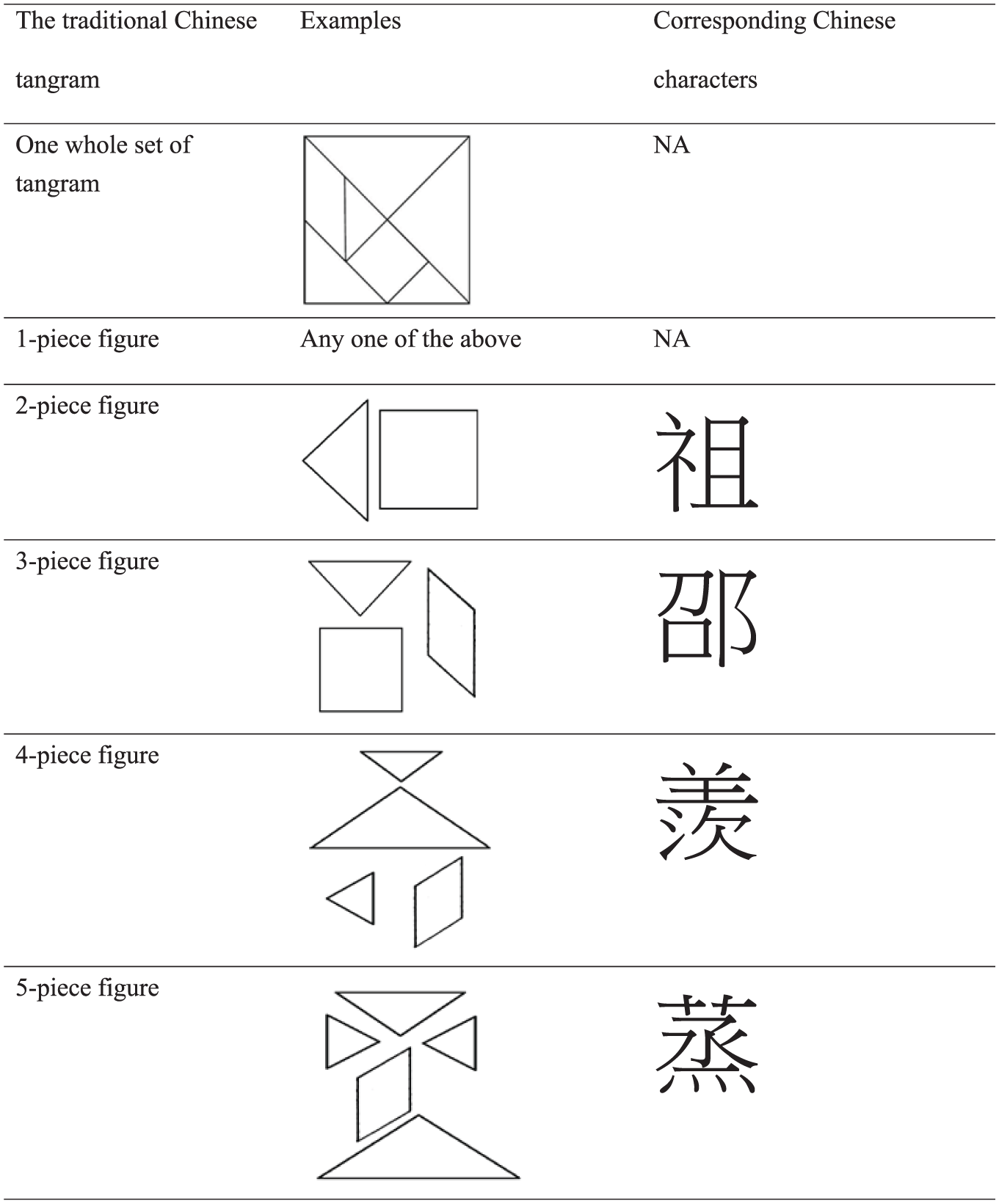
An illustration of Chinese tangram and exemplar tangram figures that imitate the Chinese orthographic structure. The actual size and ratio of the figures are distorted to fit into the table.
Also, the geometric figures of Chinese tangrams can form the basic 26 English letters in many ways. This feature of Chinese tangrams allows children to be prompted to form English letters and letter patterns with Chinese tangram puzzles in different ways, providing them experience of visual processing at the sublexical level (the tangram puzzles that form an English letter), which enhances their word decoding skills in turn, as postulated by the lexical quality hypothesis (Perfetti & Hart, 2002). Second, tangrams are readily available and inexpensive. Aside from being commercially available, tangrams are also easily constructed from simple materials, such as paper or wooden boards. Third, tangrams support countless possible combinations, over 20,000 of which have been documented (Slocum, 2003). These tangram combinations include objects, landscapes, animals, and human figures in various positions. By exhibiting such a high degree of versatility, Chinese tangrams provide multiple options for creating joint literacy activities. In this study, we focused on the potential of tangram games for training visual-related literacy skills. Data obtained for this study were complete because all participants completed the games. The difficulty level of the developed tangram games is thus suitable for these children, and they generally like and are engaged with the games.
Immediate replication of tangram game
This game was designed to prompt children’s visual-spatial skills. The game included one practice item and 30 trials, presented in increasing levels of difficulty. On each trial, the experimenter displayed one figure composed of one to three tangram puzzle pieces. Each child was then provided with a set of tangram puzzle pieces scattered on the table and asked to construct the same figure (Figure 1). Partial scoring was adopted. A full mark of 2 points was given if the child selected the correct tangram pieces and placed them in the correct position and orientation. One point was awarded if the child selected the correct tangram pieces but placed them in incorrect positions and/or orientations.
Tangram delayed replication game
This game aimed to elicit children’s short-term visual memory. One practice item was used, and 17 trials were conducted. On each trial, children were presented with a picture depicting a tangram figure consisting of one to four pieces (Figure 1).
Children were instructed to memorize the picture for later recall. Exposure to each tangram figure lasted for 4 s. The experimenter then showed four different tangram figures to the child and asked him or her to select the one that resembled the figure he or she had just seen 4 s earlier. Each correct answer earned 1 point.
Timed tangram moving game
This game estimated the speed of hand-eye coordination. The child was shown an array of tangram puzzles equally spaced on a paperboard. Then, the children were asked to pick up these tangram pieces one at a time from left to right and relocate them to the designated box(es) as accurately and quickly as they could (Figure 2).

An illustration of the trio-shape condition of the timed tangram moving game.
Three conditions were implemented. In each condition, children were instructed to complete the task twice using their preferred hand. The time taken to complete the task was recorded with a stopwatch, and the average reaction time was computed for each condition. Before the game started, the experimenters showed the children the correct way of moving the puzzle pieces. Children were asked to indicate their preferred hand and to move one piece into the box to ensure full understanding of the game. In the single-shape condition, children were given 24 triangular puzzle pieces arranged in four rows. The goal for this condition was to move all the triangular pieces into a single box. In the dual-shape condition, 12 triangular and 12 square puzzle pieces were arranged in a random order in four rows. Children were provided with two boxes that were designed to contain either the triangular or square pieces. In the trio-shape condition, 8 triangular, 8 square, and 8 parallelogram puzzle pieces were presented in four rows in random order. Three boxes were made available to the children for storing the triangular, square, and parallelogram pieces separately. A composite score was generated by averaging the latency scores obtained in the three conditions.
Tangram hand-copying game
This game involved the application of fine-motor skills. The game had one practice item and 17 trials. In each trial, the experimenter presented a tangram figure containing one to five tangram puzzle pieces and asked the child to draw the figure on a blank sheet of paper. The children were instructed to make the line drawing as similar to the real object as possible in terms of both shape and size. To rate the drawings, we created a scoring rubric that contained three criteria: orientation, ratio, and inter-figural relationship. We rewarded 1 point for each criteria attained. Therefore, the full mark for each drawing was 3 points. Two trained research assistants were instructed to score the drawings. If the two raters did not agree on the scores, the authors discussed and confirmed an agreeable final score.
Tangram pattern recognition game
This game estimated the children’s ability to identify the objects, animals, or actions depicted by tangram-made figures. Unlike photos or drawings, tangram-made figures have higher levels of abstraction and demand more advanced visual pattern recognition skills. We constructed a set of tangram figures and asked 10 university graduates to name them. The purpose of this pilot test is to test whether the name attached to the visual pattern is valid (e.g., whether most people agree that a tangram pattern of bird should be designated as “bird”). According to their responses, tangram figures that elicited diverse responses were excluded. Only the final 35 figures that generated consistent responses from the adult respondents were retained. To rule out the possibility that some children are unable to name the tangram-made figures due to an absence of oral vocabulary knowledge, we administered a picture-naming test to measure the children’s vocabulary knowledge rather than using the failure to recognize the tangram-made figure. A set of clipart pictures depicting the same objects/animals/actions as the tangram-made figures were shown to the children. After one practice item, the children were asked to verbalize the Chinese name of the tangram-made figures one by one. Each correct response was rewarded with 1 point. To control for spoken vocabulary knowledge, a composite score was calculated as a percentage (the number of correctly named tangram-made patterns / the number of correctly named clipart pictures × 100).
Results
The current study examined the relations among the performances for five tangram-based games, visual-orthographic skills, and Chinese and English word identification skills in Hong Kong kindergarteners.
First, the overall performances of the participants in the literacy-related and tangram-based games were examined. Table 1 presents the descriptive statistics and internal reliabilities. Moderate to high internal reliabilities were achieved, and no ceiling and floor effects were observed.
Descriptive Statistics and Cronbach’s Alphas of Literacy Measures and Tangram Games

The number of items and the maximum score are not identical for some tasks because partial scoring method was adopted.
Test-retest reliability indicated by Pearson correlation coefficient.
To avoid the confounding of vocabulary knowledge, the score for this task was calculated with the score of naming the picture of corresponding tangram pattern controlled.
To evaluate predictive validity, we first computed the correlations among the tangram subtests, teacher-completed behavior checklist scores, and Raven’s IQ. All tangram measures were significantly and positively correlated with the composite scores of the teacher-completed behavior checklist, thereby providing some degree of predictive validity of the tangram games. Similarly, Raven’s IQ was significantly correlated with all tangram games’ scores, aside from the timed tangram moving game. This overlap between Raven’s IQ and tangram games’ scores could be attributed to the children’s understanding of the task demand or the similarity between the visual processing skills required in performing the tasks.
Correlations between literacy test scores and tangram games were then calculated. As shown in Table 2, both Chinese and English word reading tests were significantly correlated with the tangram delayed replication and tangram copying games. Only the Chinese reading test significantly correlated with the tangram pattern recognition game.
Partial Correlation Controlling for Age Among the Tangram Games and Literacy Skills

The italic numerical figures represent correlations for English skills.
p < .05. **p < .01.
For the link between tangram-based games and visual-orthographic skills, Chinese visual-orthographic skill significantly correlated with all the tangram games, except for the tangram pattern recognition game. Conversely, English visual-orthographic skill significantly correlated with the tangram immediate replication and tangram hand-copying games only.
To further clarify the tangram game(s) that best predicted word reading and visual-orthographic skills in Chinese and English, we conducted four sets of hierarchical regression analysis (Tables 3 and 4). The five tangram games explained 16% and 18% of the variance in Chinese word reading and visual-orthographic knowledge, respectively. The set of tangram games explained 14% and 11% of the variance in English word reading and visual-orthographic knowledge, respectively. Among the five tangram games, the tangram hand-copying game was the only one that significantly explained the unique variance of word reading and orthographic skills in both Chinese and English.
Multiple Regressions Predicting Chinese Skills With Age Controlled

p < .05. **p < .01.
Multiple Regressions Predicting English Skills With Age Controlled

p < .05. **p < .01.
We also examined the overlap between the tangram hand-copying game and nonverbal IQ (Raven’s IQ) in predicting word reading and visual-orthographic skills in Chinese and English. Four additional sets of hierarchical regression analysis were computed (Table 5). Results indicated that Raven’s IQ did not predict Chinese and English visual-orthographic skills. However, Raven’s IQ significantly predicted Chinese and English word reading, and its effect outweighed that of the tangram hand-copying game. This result showed an overlap between the tangram hand-copying game, nonverbal IQ, and word reading skills.
Hierarchical Linear Regressions Predicting Chinese and English Skills From Tangram Measures and Raven’s IQ (With Age Controlled)

p < .05. **p < .01. ***p < .001.
Discussion
The feature analyses of tangrams suggest their potential for promoting literacy skills, and this belief is tested in this study. We explored the potential of playing tangram games to facilitate reading development, and our results were promising. First, the internal reliabilities of all the tangram games were high, indicating their good psychometric properties. Second, all tangram games were moderately correlated with either word identification or visual-orthographic skills or both in Chinese or English. Third, subsequent multiple regression analyses further demonstrated that the tangram fine-motor copying game was a unique predictor of Chinese and English word identification and visual-orthographic skills when children’s age was controlled for. Finally, the predictive power of the tangram fine-motor copying game on Chinese visual-orthographic skill was preserved even after controlling for the Raven’s IQ and age of children.
The finding of a significant correlation between the tangram hand-copying game and word identification corroborated previous findings regarding copying or writing skills in Chinese reading acquisition (Cao et al., 2013; D. W. Chan et al., 2006; Tan et al., 2005; Wu et al., 1999). Given the strong link between writing and reading in Chinese reading development, good copying skills observed with the tangram hand-copying game serve as a strong prerequisite skill for the development of Chinese characters and orthographic knowledge. The development of hand-copying skills by young readers may help them acquire literacy skills through several means. Accurate hand copying reflects good motor memories, which are necessary to establish the spatial configuration of words and form accurate visual perceptual representations (Cao et al., 2013). Given that the tangram hand-copying game predicted both Chinese and English visual orthographic and word recognition skills, it can be deduced that similar mechanisms are applied by Hong Kong Chinese children learning to read Chinese and English. This assertion is verified despite the substantial cross-linguistic differences between Chinese and English. Our findings extended past research that showed that writing facilitates the coupling of visual and motor systems in Chinese learners (Cao et al., 2013) to Chinese–English biscriptal learners. Chinese and English orthographies have little overlap, but motor memories in one language could facilitate the development of spatial configuration of visual codes in another language. One possible explanation is that motor memories are formed in a similar brain region, such as the bilateral middle temporal gyri (Cao et al., 2013). Further investigations are warranted to verify this hypothesis.
The correlates of visual-spatial skills and processing speed skills, as measured by the tangram immediate replication and timed tangram moving games, correlated with visual-orthographic skills but not with word reading skills in both Chinese and English. One possible explanation is that the two tangram games demand skills that are more closely related to the identification of the outer form rather than the inner structure of the writing system. As shown in previous research, outer form reading skills, defined as the ability to recognize the surface appearance of a writing system (e.g., telling the differences between Chinese and English), emerge earlier than the inner structure counterparts, which are denoted as the ability to map orthographic units to sound units (Bialystok & Martin, 2003; Zhang, Yin, & Treiman, 2017). These two tangram games likely omitted other reading-related visual skills (e.g., print-sound correspondence; Venezky, 1970). Visual-spatial skills alone are insufficient for learning new words because word knowledge acquisition requires two main processes: the establishment of the spatial configuration of visual codes and the consolidation of visual perceptual representations (Cao et al., 2013). Visual-spatial skill mainly serves the former but not the latter. Other tangram games involving visual memorization may link to reading in a more robust way. Children’s performance in tangram games accounts for only at most 18% of the variance in visual-orthographic and word reading skills. Other important emergent literacy skills, such as oral language skills, emergent literacy environment, and motivation, should be considered in developing additional joint literacy activities between adults and children.
Modest to moderate correlations (rs = .27–.46) were found between all the tangram tasks and the teacher’s assessment of the children’s behavior. Some tangram tasks did not have a significant correlation with either visuo-orthographic or word identification skills, but all tangram tasks correlated with the scores from the behavior checklist. The additional correlation may be attributed to other skills estimated by the behavior checklist, namely, attention, memory, sequential ability, spatial ability, and developmental coordination. Further studies are needed to verify this suggestion.
Results indicated that Raven’s IQ did not predict Chinese and English visual-orthographic skills. However, Raven’s IQ significantly predicted Chinese and English word readings, and its effect outweighed that of the tangram hand-copying game. This outcome showed an overlap among the tangram hand-copying game, nonverbal IQ, and word reading skills. The causal links among the three skills cannot be feasibly tested given the concurrent nature of the data in this study. Again, future research is warranted.
Further to several reasons such as the tangrams’ low cost, versatility for endless possibilities, and shared geometrical figures with Chinese and English orthographies, we empirically demonstrated the exact connection between children’s ability to play with tangrams and their word identification. Over five games can be created because of the flexibility of tangrams. Parents or teachers can utilize their creativity to generate more games, depending on the skills they want to develop in children. Users can also employ multiple sets of tangram puzzles when developing games. As tangram puzzles are portable, tangram games can be played easily outside the school or home. This practice allows for joint literacy activities in more associated contexts, which are found to be important for emergent literacy development (Martini & Sénéchal, 2012).
Pedagogical Implications
In response to the increasing expectations placed on the literacy achievement of young children, developmentally appropriate activities to facilitate emergent literacy skills are in crucial demand. Play-based literacy activities are effective for engaging young children and promoting emergent literacy skills (Morrow, 1990; Neuman & Roskos, 1990). The tangram games presented and validated in this study provide children a fun way to discover print conventions such as spaces among components in words, relative size of components within words, and directionality. If self-discovery fails, then teachers and parents can utilize the tangram games to introduce the visual properties of prints. Furthermore, the tangram games offer teachers and parents a context for assessment. As suggested by Klenk (2001), play-based literacy activities are advantageous for eliciting children’s behaviors, and the observations can become useful entries in children’s school portfolios. We suggest that co-mediations (Krikorian, Wartella, &Anderson, 2008) provided by parents or teachers should operate following a three-step principle. First, parents/teachers must initiate the tangram games by acting as test administrators and providing feedback on children’s performances. Second, parents/teachers can explicitly draw children’s attention to the different visual properties of the tangrams. Third, parents/teachers can extend the tangram games to games that draw on the other properties of words. Moreover, we recommend parents and teachers to play the tangram games with the children on a regular basis so that they can keep track of children’s performances. As the tangram games can be played before young children learn to read and write, they are instrumental for fostering children’s readiness to understand the visual properties of Chinese characters and English words.
Limitations and future research direction
The data of this study are correlational in nature. We provided empirical support for the use of tangram games to estimate literacy skills. Whether training on tangram games can enhance the literacy skills of young readers would be an interesting research direction. This research idea must be studied using a randomized control trial study. Thus, future research is warranted. Moreover, future studies could examine the game performances in children of different ages to understand the longitudinal development of emergent literacy.
A link between performances in tangram games and literacy tasks was confirmed in this study. This association lays the foundation for the use of a traditional Chinese puzzles to develop code-related emergent literacy skills in children.
Footnotes
Acknowledgements
We thank all the participating schools and participants. We extend our sincere thanks to Hoyee Miao, Vina Leung, Jenny Tsui, and Heidi Chan for their research assistantship. We are also grateful to Ms Nek Mak for drawing the figures.
Conflict of Interest
The authors declare that they have no conflict of interest.
Funding
The work described in this paper was supported by two grants from the Research Grants Council of the Hong Kong Special Administrative Region, China (Project No. CityU 11619816; 845213).

Authors
SIMPSON W. L. WONG is an associate professor in the Department of Education Studies, Hong Kong Baptist University. His research interest lies in the area of developmental and educational psychology.
REBECCA WING-YI CHENG is a principal lecturer in the Department of Psychology, The Education University of Hong Kong. Her research interest is educational psychology, specifically student achievement motivation.
BONNIE WING-YIN CHOW is an associate professor in the Department of Social and Behavioural Sciences, City University of Hong Kong. Her main research interest lies in the field of developmental psychology, with an emphasis on language and literacy acquisition and psychological well-being in students.
SANDRINE MAN-CHI CHUNG is a PhD student in the Department of Psychology, The Education University of Hong Kong. Her research interest is child development and play.