



Abstract
Increasing research on teacher professional development (TPD) has found teachers’ self-reflection to be key for improving teaching effectiveness. Although video methodology, as often used in TPD, provides crucial insight concerning situated learning, teachers are often reticent to participate in TPD protocols due to discomfort over being videotaped. This longitudinal study explored emotion-related behaviors by assessing the nonverbal expressions exhibited by teachers during a 1-year video-based TPD program highlighting salient contributors to productive classroom dialogue. Six teachers were observed regarding bodily motion, facial expression, and eye contact, with results obtained across four workshops coded according to five types of emotions. The emotions of shame, defensiveness, and distraction appeared more often than did laughter and surprise, with the negative emotions found to decrease over time. This study highlights the importance of longitudinally evaluating teachers’ emotional expressions during video-based TPD activities and continued efforts to encourage teacher participation in these pedagogical training opportunities.
Educational research consistently underscores the importance of teaching effectiveness and the necessity of teacher professional development (TPD) for supporting student learning and outcomes (Borko, 2004; Scheerens, 2010; Stoll, Bolam, McMahon, Wallace, & Thomas, 2006). This research interest is further bolstered by government efforts over the past few decades to identify and implement professional development programs leading to dependable and long-term outcomes (National Research Council, 2007). Innovative and successful training programs for teachers also represent a critical component of institutional and government teacher training initiatives. However, despite the variety of professional development courses available, teachers’ willingness to participate and their reticence for completing supplemental training activities (e.g., classroom technology adoption, online training protocols) are important factors for administrators and researchers to consider (Buabeng-Andoh, 2012; Wiley, 2007). Accordingly, teachers’ perceptions and emotions with respect to attending teacher training activities represent a critical area for future research in TPD.
The emotional aspect of teacher learning to date remains underexplored (Pekrun, 2006; Sutton & Wheatley, 2003), with limited research directly examining teachers’ experiences in TPD contexts (e.g., Yoo & Carter, 2017). Emotions have consistently been proposed as a critical mediator of the effects of teachers’ cognitions and motivational beliefs, based on findings showing learners’ appraisals for learning outcomes and regulation of negative emotions found to impact cognition, attention, motivation, and engagement (see Pekrun, 2006; Pekrun, Frenzel, Goetz, & Perry, 2007). However, although the opportunities for learning and improvement associated with teacher development may be appealing to some teachers (e.g., those with mastery goals or high self-efficacy), there exist unexpected emotional challenges during deep learning that can dissuade participation in professional development exercises (e.g., teacher discourse, critical colleagueship; Lord, 1994; Westheimer, 2008). Accordingly, it is important for researchers to understand teachers’ emotional experiences during TPD activities to secure continued participation in, and the effectiveness of, these critical pedagogical efforts.
As one way of examining teachers’ responsiveness to professional development exercises, nonverbal communication may prove valuable for interpreting how training activities are perceived (e.g., in combination with various artifacts such as subsequent classroom records, teaching plans, assignments, and portfolios). Given the degree of interpersonal communication required for instructional training, teachers’ nonverbal cues should not only provide naturalistic information about their emotional responses during the training process but could also, when combined with verbal expression, help more accurately convey the likelihood that teachers will adopt and benefit from the principles presented (Burgoon, Humpherys, & Moffitt, 2008; Scherer, 1980). As such, the present study represents one of the first investigations into teachers’ nonverbal emotional responses to cutting-edge teacher training involving video-based protocols as an initial attempt to explore whether such indicators serve as important cues for the efficacy of TPD programs.
Video-Based TPD
Several studies showed video-based teacher training methods to have a persistent positive influence on instructional development (e.g., Borko, 2012; Borko, Jacobs, Eiteljorg, & Pittman, 2008; Gaudin & Chaliès, 2015; Gröschner, Seidel, Kiemer, & Pehmer, 2015; Marsh & Mitchell, 2014). By watching their own instructional behaviors and discussing the results in a learning community, teachers are better able to detect potential problems and derive solutions with the help of colleagues. Due to the situated aspect of video-based training, it is largely considered an effective means of fostering teachers’ professional competencies through the enhancement of collaborative reflection, noticing (attention to tacit knowledge), and community of practice. As many video-based TPD programs are based on a situated learning perspective (Lave & Wenger, 1991), the learning activities employed with experienced teachers are typically linked to professional situations specifically referring to one’s teaching in a classroom setting (Borko, 2004). Accordingly, the types of learning experiences encountered in video-based TPD programs are not only cognitive but also emotional and motivational.
For example, in a recent experimental study by Gröschner et al. (2015), teachers in an iterative video-based intervention were found to be significantly more satisfied with the TPD program that addressed purposeful classroom discourse practice than were the teachers in the nonvideo control group. Teachers who participated in the TPD intervention further experienced greater increases in autonomy support for their learning motivation relative to controls and further described the video-based program as providing immediacy and substantial transfer opportunities for teaching improvement. Although findings from earlier studies similarly showed superior learning gains for video-based TPD participants, existing findings also indicate participants’ reported concerns regarding self-exposure as a primary drawback of video-based training activities (e.g., Brophy, 2004; van Es, 2012; see also Rosenholtz, 1989; Sherin & Han, 2004). Although this finding may be due in part to video-based methods typically requiring greater teacher commitment due to their being more intensive, teachers’ self-consciousness is likely responsible for low participation rates in previous video-based TPD studies (e.g., 5–10 participants; Borko et al., 2008; Brantlinger, Sherin, & Linsenmeier, 2011; Gröschner et al., 2015; van Es, 2009, 2012). Given the clear potential benefits of video-based TPD, this emotional impediment to teacher participation in these protocols suggests the need for further research on identifying and mitigating these confounding emotional experiences.
As outlined in the situative TPD perspective proposed by Borko (2004), “records of practices are powerful contexts for teacher learning” (p. 7), with subsequent thoughtful facilitation being key to a successful professional development experience. Video-based training thus capitalizes on participant engagement by allowing teachers to not only demonstrate instructional practices to their peers for feedback and constructive criticism but improve their teaching by reviewing and redefining their own teaching behaviors. However, facilitators also play an essential role in ensuring a positive conversation culture in minimizing the negative effects of personal judgment by encouraging shared understanding of discourse rules. According to Alles, Seidel, and Gröschner (2018), “teachers first describe what they have observed, then give an explanation, and, lastly, integrate their knowledge by drawing conclusions about the impact of teaching on student learning” (p. 3). Although “critical colleagueship” is an important TPD feature in fostering teacher growth through collective critique and intellectual challenges (Lord, 1994), mutual respect among participants and safe inquiry environments as afforded by facilitators are required (Alles et al., 2018; van Es, 2012; Zeichner, 2003).
As such, a balance between participant comfort and stimulation is desired in teacher participant discourse to create ongoing “productive disequilibrium” in which constructive critique can occur (Lord, 1994). Concerning implications for teachers’ emotions during self-reflective TPD protocols, it is therefore expected that teachers would tend to exhibit negative emotions at the beginning of the program due to worries about judgment by unfamiliar TPD peers. However, following the establishment of rapport and the internalization of discussion norms, it is also anticipated that teachers would experience lower levels of negative affect over time—enough to result in “productive disequilibrium” but not enough to prompt withdrawal and attrition. According to Gröschner, Seidel, Pehmer, and Kiemer (2014), optimal video-based PD programs should provide “a trustful atmosphere of learning and exchange, in which critical aspects, as well as critical situations of classroom practice, can be addressed, existing teaching routines can be realized, and alternatives can be suggested without judgments” (p. 276).
According to Gröschner and colleagues’ (2015) video-based TPD model, referred to as the dialogic video cycle (DVC), teachers are expected to react nonverbally while viewing their teaching practices, with this visible behavior yielding valuable explorative data about their perceptions and emotions concerning this experience (see also Alles et al., 2018). As nonverbal communication affords data that are cross-culturally comparable and reliable (e.g., Burgoon et al., 2008; Knapp, 2006; Lakin, 2006), it further serves as a profitable complement to verbal transcripts and follow-up questionnaires (Fridlund & Russell, 2006). From a comparative perspective, previous studies suggest that although watching one’s own teaching may result in defensive responses, it nonetheless allows teachers to experience greater immersion and motivation as compared with observing others’ teaching behaviors (Seidel, Stürmer, Blomberg, Kobarg, & Schwindt, 2011). Given the importance of providing effective external support for TPD programs beyond individual teacher learning (Kleinknecht & Schneider, 2013; Putnam & Borko, 1997; Wilson & Berne, 1999), nonverbal data exhibited by teachers during video-based training may thus help to identify how such methods can be improved.
In sum, video-based methods and reflection practices have garnered considerable research interest in affording an in-depth examination of “the complexity and subtlety of classroom teaching as it occurs in real time” (Brophy, 2004, p. 287) and productive teacher collaboration (Gröschner et al., 2014). However, despite the increasing research importance of “noticing” classroom challenges (e.g., Seidel et al., 2011; Star & Strickland, 2008; Stürmer, Seidel, & Schäfer, 2013) to better identify, interpret, and decide on next steps (Jacobs, Lamb, & Philipp, 2010; van Es & Sherin, 2008), participation in video-based programs remains thwarted by teacher reluctance (Borko et al., 2008; van Es, 2012).
Whether due to teacher sensitivity to self-evaluation or critiques from others (e.g., Brophy, 2004; Rosenholtz, 1989) or a lack of peer critique due to superficial engagement or social niceties (Grossman, Wineburg, & Woolworth, 2001), teachers are often uncomfortable with learning from video-based methods. Existing research (e.g., van Es, Tunney, Goldsmith, & Seago, 2014; Zhang, Lundeberg, & Eberhardt, 2011) further shows a lack of support during TPD programs to impair learning outcomes, highlighting the importance of appropriate guidance and professional facilitation for ensuring educational fidelity and positive teacher experiences (Arya, Christ, & Chiu, 2014). In an effort to better capitalize on the empirically observed benefits of video-based professional development for teachers (e.g., Borko et al., 2008; LeFevre, 2004), the present study explored how nonverbal emotion-related information provided by teacher participants in such programs could inform useful directions for increasing teacher comfort and involvement in video-based TPD protocols.
Nonverbal Communication and Emotional Expressions of Teachers
Burgoon and Hoobler (2002) defined nonverbal communication as “the behaviors other than words themselves that form a socially shared coding system” (p. 244), thus allowing individuals to convey commonly interpretable information in the absence of interaction (see Wiener, Devoe, Rubinow, & Geller, 1972). Moreover, according to Burgoon et al. (2008), nonverbal behavior cues may be organized for analysis according to seven discrete categories of codes. Within this coding framework, the most notable category of nonverbal behavior is referred to as “kinesics,” which encompasses facial expressions and body movements. This category of nonverbal behavior further highlights the multidimensional and multivariate nature of nonverbal communication as “a system comprising interdependent components” (Patterson & Manusov, 2006, p. 525) with such cues needing to be interpreted in consideration of one’s physical and social environment (e.g., norms).
Various studies identified multiple salient functions of nonverbal cues, with two basic functions suggested by Burgoon and colleagues (2008) being directly relevant to the context of teacher training. First, message production involves behavioral cues that indicate some degree of engagement and willingness to communicate in the social setting (Bavelas, 1990). For example, a head nod may indicate approval; a gaze can indicate direction of attention; and folded arms may suggest resistance to participation. The second relevant function involves emotional expression, such as a frown indicating discomfort or a smile reflecting enjoyment of the available stimuli. Cross-cultural research has consistently identified six basic facial displays of emotion (anger, disgust, fear, happiness, sadness, and surprise; e.g., Ekman, 1972, 1973; Rosenberg & Ekman, 1994; Ruch, 1995) with Tracy and Robins (2007a) further proposing that “self-conscious” emotion displays (i.e., pride and shame) may serve important social-communicative functions. It is nonetheless important to note that the intensity of the correlation between nonverbal expressions and emotions was found to rely largely on the context and motives of signalers and recipients (e.g., behavioral ecology; Fridlund, 2014).
From a social cognitive perspective, teachers’ emotional experiences and expressions are assumed to mediate the effects of cognitive and motivational variables on teaching and learning behaviors (Pekrun, 2006; Pekrun et al., 2007). According to Pekrun’s (2006) control-value theory of achievement motivation, emotions experienced in educational contexts can be differentiated according to their focus (activity vs. outcome) and antecedent cognitive appraisals (control vs. value). Activity-focused emotions are proposed to occur during learning tasks (e.g., enjoyment, relaxing, frustration, boredom), whereas outcome-focused emotions are more directly tied to performance feedback (e.g., hope, pride, guilt, shame). Concerning the role of cognitive appraisals, Pekrun et al. (2007) asserted that if “the activity is seen as being controllable and valued positively, enjoyment is instigated” and “if the activity is valued neither positively nor negatively, boredom is induced” (p. 21). Furthermore, whereas positively valenced emotions (e.g., enjoyment, hope) were found to positively correlate with learning and motivation, negative emotions were found to have mixed effects on motivation (e.g., short-term efforts to avoid failure, lower long-term persistence) and impair cognitive resources (e.g., attention, retrieval; Pekrun, 2006; Sutton & Wheatley, 2003).
In line with achievement emotion theory, research on nonverbal communication and emotion expression among teachers suggests that teachers experience a variety of positive and negative emotions while teaching that in turn correspond to their teaching quality and student outcomes. A review by Sutton and Wheatley (2003) showed that teaching-related emotions highlight the prevalence of specific positive emotions, such as joy, satisfaction, and pleasure, as well as discrete negative emotions, such as anger and frustration. More recent research further underscores the roles of enjoyment, anxiety, and anger as prominent discrete emotions that influence students’ classroom behavior as well as instructional effectiveness (Frenzel, 2014), with findings showing teachers to intentionally express emotions to students to facilitate classroom management and teaching objectives (Hochschild, 1983; Sutton, 2004; Taxer & Frenzel, 2015).
With respect to limited existing research on teachers’ emotions during their own learning (see Gartmeier & Hascher, 2016), a qualitative case study by Yoo and Carter (2017) showed teachers to experience various positive and negative emotions during teacher training pertaining to creative writing, including excitement, hope, and gratitude as well as frustration, discouragement, and vulnerability. As such, whereas teachers’ emotions during instruction have been empirically explored, research on teachers’ emotions while learning in various professional development settings is scarce. However, given that teachers are expected to react automatically or intentionally by way of nonverbal communication of emotions during video-based training activities, these emotion displays should nonetheless serve as analyzable data with which to evaluate their emotional reactions to such training protocols.
Research Questions
The present exploratory study evaluated to what extent teachers nonverbally expressed specific emotional experiences while viewing videotaped teaching behaviors in the context of their participation in video-based teacher training activities. A particular focus was given to negative emotions as an indicator of critical learning incidents, or “productive disequilibrium,” by examining nonverbal emotion expressions longitudinally across multiple TPD sessions (for similar protocols, see Kleinknecht & Schneider, 2013; Praetorius, Pauli, Reusser, Rakoczy, & Klieme, 2014) as well as within a given session (e.g., Sherin & van Es, 2009; van Es & Sherin, 2008). Finally, differences were explored between teachers when viewing their own videos and the videotaped teaching of others, in terms of their nonverbal behaviors (see Kleinknecht & Schneider, 2013; Seidel et al., 2011). Accordingly, the specific research questions examined in this study were as follows:
Research Question 1: What specific nonverbal behaviors are exhibited by teachers when viewing videos of their own or others’ teaching?
Research Question 2: To what extent do teachers’ nonverbal behaviors change throughout four video-based training workshops over a 1-year period while viewing their own or others’ instructional videos?
Research Question 3: To what extent do teachers’ nonverbal behaviors change during the instructional video segments within a given workshop?
Research Question 4: To what extent are there differences between other-viewing (OV; observing others’ teaching videos) and self-viewing (SV; observing one’s own teaching video) assessments of teachers’ nonverbal communication for the same display behavior during the video-viewing period across the four training workshops?
Methods
Participants
This study was conducted within the Dialogue project and included 6 teachers (4 women) who participated in the DVC voluntarily. The participants (see Table 1) reported an average age of 39.5 years (SD = 5.43) and a range of teaching experience from 2 to 10 years (M = 4.67, SD = 2.94). They taught ninth-grade students in science or mathematics in the top or middle tier of secondary schools (Gymnasium or Realschule) in a German metropolitan area.
Teacher Sample

M = 39.5 (SD = 5.43). bM = 4.67 (SD = 2.94). cTeachers usually study and teach two subjects in top or middle tiers of secondary schools in Germany. dGermany has a three-tiered secondary education system consisting of Gymnasium, Realschule, and Hauptschule curricula.
Design
The DVC represented the TPD model within which teacher participants’ nonverbal responses were assessed. The DVC has as its focus training teachers how to best facilitate productive classroom dialogue (Gröschner et al., 2014) to improve the quality of teacher-student interactions and achieve gains in student learning (e.g., Howe & Abedin, 2013; Michaels, O’Connor, & Resnick, 2008; Seidel, Rimmele, & Prenzel, 2003).
The DVC project was longitudinal and took place during the 2011–2012 school year. Six teachers attended one DVC in each of the two semesters (see Figure 1), with each cycle consisting of three workshops and incorporating video coverage of participant instruction specific to efforts to facilitate classroom dialogue (e.g., making learning goals explicit, providing constructive feedback; Gröschner et al., 2015). The DVC was based on TPD aspects that were shown to be effective in research, such as supporting active teacher learning and collective participation in a group of teachers (Borko et al., 2008; Desimone, 2009). Specifically, DVC 1 took place in the first semester and consisted of classroom videotaping and three workshops, with video clips being used to facilitate teacher training in the latter two reflection workshops. The same design was applied in DVC 2 in the second semester, resulting in a total of six TPD workshops, each lasting approximately 2 hr.

Dialogic video cycle (DVC) implementation design (Gröschner et al., 2015).
In the first planning workshop at each time point, a facilitator introduced theories of productive classroom dialogue and guided discussion of the lesson plans revised by participating teachers. The small group discussions focused on improving lesson plans by incorporating two main components of productive classroom dialogue: promoting student activation and clarifying discourse rights (Activity 1) as well as scaffolding students’ thinking with guidance and feedback (Activity 2; Walshaw & Anthony, 2008). Following the preparation of revised lesson plans, DVC researchers videotaped teachers’ instructional behaviors in their regular classroom settings, with the video frame capturing teacher talk and movement. For the following two workshops, the DVC facilitator selected relevant video excerpts with regard to Activities 1 and 2. Several video clips, each roughly 2 to 5 min in length, were presented in each of the following two workshops, with teachers’ immediate reactions to their own video clips videotaped and used as data. The final two workshops also had the facilitator guide in-depth discussions to help the teachers reflect, recall, and apply the concepts from Activities 1 and 2 to their teaching practice. Discourse rules and guiding questions were explained to participants before watching the clips to focus their attention on the discussion objectives, with the collective discourse rules prominently displayed during all sessions in written format to be referenced by the facilitator if needed (Alles et al., 2018). In general, according to DVC protocols, teachers choose a lesson they wish to improve, and they work on a revised plan that implements specific principles of productive classroom dialogue in terms of creating a pleasant atmosphere, guiding conversation, and promoting cooperation (Gröschner et al., 2014).
Instruments and Data Analysis
Video clips
Video recordings of teachers during each of the reflection workshops, four in total, were evaluated in the current study, with the camera capturing the view from the front of the training room. Specifically, only teachers’ nonverbal expressions while watching the video clips of their own classroom behavior were coded for analysis, resulting in 107 min of footage across four workshops. Consistent with prior research (e.g., Wubbels, Brekelmans, den Brok, & van Tartwijk, 2006), the coding scheme was applied to 10-s intervals, resulting in 644 segments of 10 s being coded for analysis. The coding categories for nonverbal expression were derived from the collected data in relation to previous research in nonverbal communication and achievement emotions (see next section).
Observational ratings
Given the reviewed emotion literature and feedback of session facilitators (e.g., Elfenbein & Ambady, 2002), five common nonverbal behaviors were identified and synthesized into the coding categories listed in Table 2: laughter, surprise, shame, defensiveness, and distraction. Facilitator observation represents an important resource, as participant behaviors are optimally understood in reference to the specific educational context under consideration (Fridlund, 2014). Following Pekrun and colleagues’ (2007) achievement emotion theory, participants’ activity-related emotions of enjoyment and boredom were assessed in terms of laughter and distraction, with the former reflecting general positive affect (Keltner & Bonanno, 1997) and the latter a lack of interest in and attention to TPD activities (Eastwood, Frischen, Fenske, & Smilek, 2012). These emotions were also selected according to research showing these critical temporary emotional experiences to be easily recognizable (Poyatos, 2002). Concerning outcome-focused emotions, anger was approximated by assessing participants’ defensiveness (Tracy & Robins, 2003; coding scheme by Talley & Temple, 2015), with surprise also evaluated given its prominence as a prototypic emotion expression (Ekman & Friesen, 1975). Shame was additionally examined as an outcome-related emotion per Tracy and Matsumoto’s (2008) coding scheme.
Categories of Nonverbal Expression for Video-Based Teacher Training

Observations were further differentiated between the nonverbal behaviors exhibited by the teacher who watched his or her own teaching video in a group setting (SV) and the nonverbal behaviors exhibited by teachers as a group when they were watching excerpts that did not feature themselves (OV; see Figure 2). Accordingly, whereas the SV data consisted of observations of individual participants while they observed themselves teaching alongside other teacher participants in the same room (coding for one teacher participant at a time), the OV data consisted of observations of group behavior exhibited by the remaining teachers in the room while observing the videotaped teaching behavior of another participant (coding across five teachers at one time).
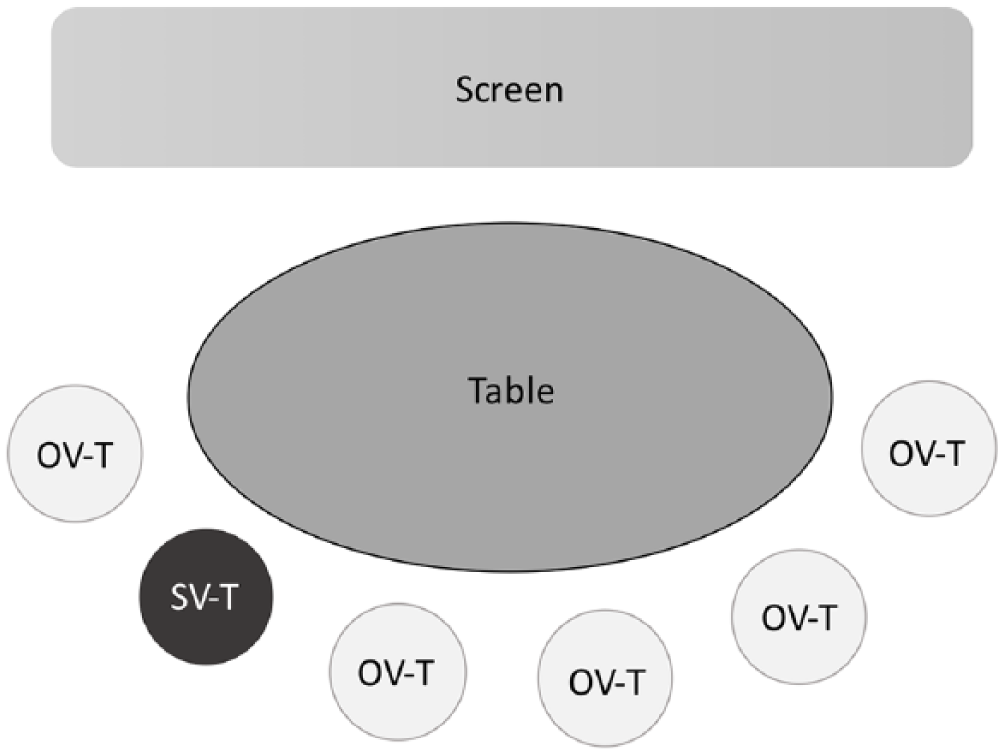
SV and OV coding without the presence of facilitators, as observed across four workshops. SV coding was applied to an individual teacher’s behavior while watching one’s own video in the presence of other participants. OV coding was applied to the behavior exhibited by the remaining teachers while they watched the videos, excluding the one teacher who was watching his or her own video. U-shaped table may also be employed to accommodate a greater numbers of participants. OV = other-viewing; SV = self-viewing; T = teacher.
Two video observers then rated the frequency according to the five resulting categories of nonverbal behavior: laugh, surprise, shame, defensiveness, and distraction. For the OV behaviors, when one or two teachers presented a specific behavior, the raters coded the frequency level as 1; when three or more teachers presented the same behavior, the frequency level was coded as 2. With respect to the coding for the SV behaviors, only ratings of 0 (none) or 1 (behavior appeared) were provided. All nonverbal behaviors were coded by two independent raters, including the article’s first author and a second project researcher. The raters first reported the behavior frequency for each of the five categories. After the first session was coded, the intraclass correlation coefficient (ICC) for the preliminary results was calculated, and problematic segments were discussed. Mutual agreement was achieved through discussion with the raters, who then coded the first session again, followed by the remaining workshops.
Interrater reliability
Before behavior frequency was evaluated, the reliability of ratings across observers was determined by way of an ICC. The universal criteria of ICCs are as follows: >.75, good; .74-.40, adequate; and <.40, poor (Fleiss, 1981). ICCs calculated for the five patterns of OV behaviors were as follows: laugh = .91, surprise = .89, shame = .88, defensiveness = .70, and distraction = .84. For the SV behaviors, the ICCs were as follows: laugh = .95, surprise = .91, shame = .95, defensiveness = .96, and distraction = .88. Given that 9 of 10 ICCs met the standard of “good,” with only the defensive category for the OV behaviors being <.75, consistency across raters was deemed adequate in the present study.
Descriptive analysis
To answer our first research question, the frequencies of specific nonverbal behaviors within a given 10-s segment were calculated for the SV and OV behaviors according to the five aforementioned behavioral categories. To address our second research question, chi-square tests were applied across the four workshops to identify behavior patterns over time. To answer our third research question, our chi-square analysis was restricted to behaviors exhibited during the four video-based workshops, with these assessments occurring at the beginning, middle, and end of each professional development session while participants were watching video footage of participants’ in-class teaching behaviors. To examine the fourth research question, behavior frequencies were calculated across all observations for the SV and OV behaviors within each behavior category to directly compare the prevalence of the different nonverbal behaviors between the SV and OV behaviors.
Results
Coding results based on data obtained from the four video-based training sessions are presented according to the research questions in the following sections. In total, 644 segments (107 minutes) were extracted from four 2-hr long videos, with teachers’ patterns of nonverbal behavior coded according to five categories: laugh, surprise, shame, defensiveness, and distraction.
Overall Nonverbal Behavior
To address our first research question, specific nonverbal behaviors exhibited by teachers were assessed regardless of whether teachers were watching videos of themselves or others teaching. Upon summing across data for the SV and OV behaviors, frequencies and percentages for each behavior pattern were calculated for each 10-s segment (644 segments in total). In addition, observed nonverbal behaviors exhibited by three people or more were assessed in a given segment for the OV behaviors. As outlined in Table 3, the nonverbal behavior of defensiveness was most frequently observed (610 instances observed across 94.7% of video segments), followed by shame (574 across 89.1%) and distraction (431 across 66.9%). Laugh appeared infrequently (196 instances across 30.4% of segments), with surprise showing the lowest frequency (40 across 6.2%). In terms of OV behaviors exhibited by three or more participants (this cutoff point of 50% was adopted to reflect a simple majority across the five OV teacher participants), significant proportions of teachers demonstrated shame (15.2%), distraction (15.5%), or defensiveness (13.4%) while observing other teacher participants on video, with the more positive behaviors of laughing or surprise occurring much less frequently.
Total Number and Percentages of the Nonverbal Behaviors

Note. Total segments: n, the total number of 10-s units of analysis coded across four workshops; %, the proportional frequencies of 10-s units of analysis coded across four workshops.
The individual observations were analyzed via dummy coding (1 = behavior observed, 0 = behavior missing) of other-viewing behaviors (observation of five teachers in a given segment) and self-viewing behaviors (observation of one teacher in a given segment).
Observations ≥3 were analyzed via dummy coding (2 = three or more behaviors observed, 1 = two or fewer behaviors observed) of only other-viewing behaviors.
Nonverbal Behavior Across Workshops
To examine our second research question, teachers’ nonverbal emotional expressions were further examined in terms of how they changed throughout four video-based training workshops. The results are reported in Table 4 for the 10-s segments obtained across the four workshops (164, 200, 130, and 150 segments in Sessions 1–4, respectively). For the category of laughter, the frequency did not fluctuate substantially across sessions, as indicated by a nonsignificant chi-square: χ2(3) = 1.36, p = .715. However, the other four behaviors were found to be significantly more frequent in the first semester (i.e., DVC 1-1, DVC 1-2): surprise, χ2(3) = 20.12, p < .001; shame, χ2(3) = 17.85, p < .001; defensiveness, χ2(3) = 20.19, p < .001; and distraction, χ2(3) = 86.66, p < .001. In terms of the percentage (see Table 4 and Figure 3), surprise showed a consistent decline from Sessions 1 through 3, with percentages for shame dropping sharply from the first to the second session and then stabilizing across Sessions 3 and 4. The percentages for defensiveness and distraction were also variable over time, with an initial increase in levels from Session 1 to 2, followed by relatively lower levels in Sessions 3 and 4.
Chi-Square Analyses of Nonverbal Behaviors Within the Four Workshops

Note. DVC 1-1 and 1-2 sessions were held in the first semester; DVC 2-1 and 2-2, the second semester. Percentage indicates the proportional frequencies of 10-s units of analysis coded in each workshop. DVC = dialogic video cycle.
Effect size: contingency coefficient (Reinard, 2008).
p < .001.

Percentages of the nonverbal behaviors in the four workshops. DVC 1-1, 1-2 = dialogic video cycle, Semester 1, Workshops 1 and 2; DVC 2-1, 2-2 = dialogic video cycle, Semester 2, Workshops 1 and 2.
Nonverbal Behavior During a Given Workshop
We further investigated our third research question by examining the behaviors exhibited by teachers within each of the four video-based workshops. These within-session assessments occurred at the beginning, middle, and end of each workshop while participants watched video excerpts. To evaluate the frequency of nonverbal behaviors during a given session, three 3-min clips from each session were assessed, with each clip including behavior from the beginning, middle, or end of each workshop specifically when the participants were viewing video clips of themselves or others. For example, in the first workshop (DVC 1-1), we coded participants’ responses while watching footage of Marc teaching at the beginning of the session (00:10:06–00:12:55), during the middle of the workshop session while watching footage of Laura teaching (00:47:21–00:48:50 and 00:57:45–00:59:14; two 1.5-min segments totaling ~3 min), and near the end of the session while watching footage of Lucy teaching (01:51:56–01:54:55). Given 18 video segments (3 min each) excerpted from each of the four workshops, 72 segments were assessed in total. Chi-square tests were conducted on each nonverbal behavior to evaluate the differences among the three periods across all sessions. As outlined in Table 5, the frequency of the observed behaviors of laughter, defensiveness, and distraction were found to differ significantly over time: laugh, χ2(2) = 26.11, p < .001; defensiveness, χ2(2) = 27.67, p < .001; and distraction, χ2(2) = 12.69, p = .002. Laughter and distraction showed an increase that subsided by the end of the session, whereas the instances of defensiveness first increased and then stabilized. As indicated by nonsignificant results for surprise and shame, these observed behaviors were consistent in frequency throughout a given session.
Chi-Square Analyses of Average Nonverbal Behaviors Frequencies Across the Four Workshops
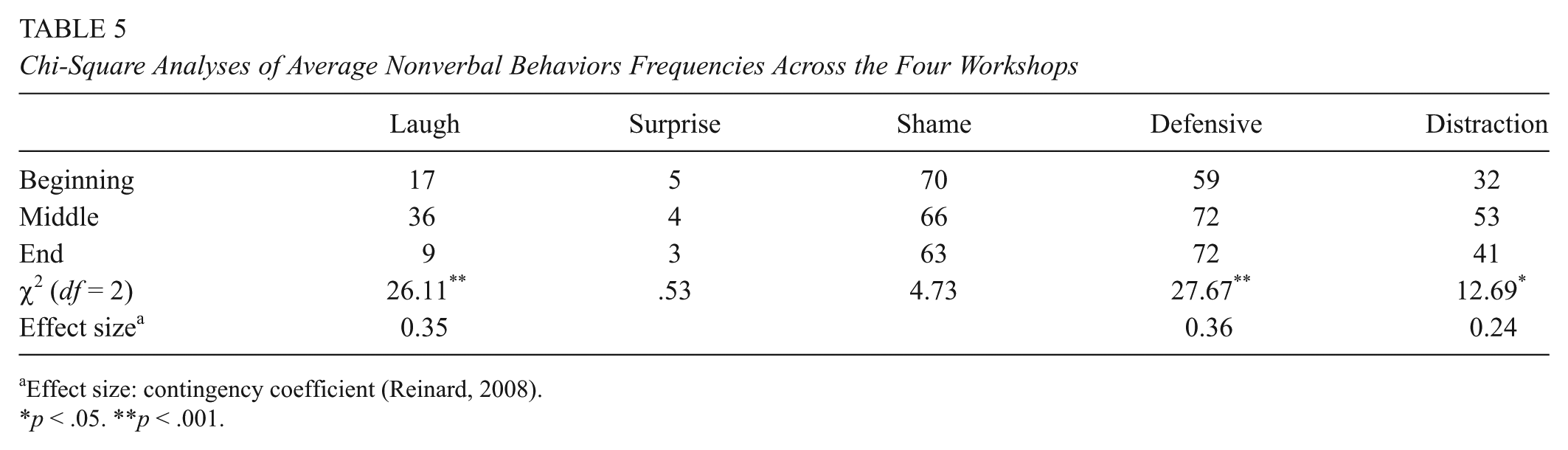
Effect size: contingency coefficient (Reinard, 2008).
p < .05. **p < .001.
Nonverbal Behavior While Viewing One’s Own Versus Others’ Videotaped Teaching
Finally, we addressed our fourth research question by examining the proportions of SV behaviors as compared with OV behaviors exhibited by teachers while watching the teaching video clips across TPD sessions. Specifically, all instances of a specific behavioral code were divided according to the context in which the behavior was exhibited (watching one’s own vs. others’ videotaped teaching), with the resulting proportions for SV and OV behaviors (totaling 100%) presented in figures across sessions (Figure 4) and for each training session semester (DVC 1, Figure 5; DVC 2, Figure 6).

Total percentages of nonverbal behaviors within each category for other-viewing versus self-viewing behaviors. Other-viewing behaviors were assessed per the coding of any amount of behavior shown by five participants; self-viewing behaviors were assessed per the coding of the behavior exhibited by the one self-viewing participant.

Percentages of dialogic video cycle nonverbal behaviors within each category for other-viewing versus self-viewing behaviors: Semester 1.

Percentages of dialogic video cycle nonverbal behaviors within each category for other-viewing versus self-viewing behaviors: Semester 2.
Concerning differences between the SV and OV behaviors across sessions, although the percentages for the OV behaviors (any given amount of collective observation) accounted for a larger proportion in every category of nonverbal behavior, this disparity was most noticeable for distraction. With respect to nonverbal behaviors exhibited during the first semester of video-based training (DVC 1), the pattern of differences observed was similar to the overall results and showed an even larger proportion to be accounted for by the OV behaviors. In contrast, results for the second semester of video-based training showed greater proportions for the SV behaviors (single observation on one person) relative to the first semester. Although the OV behaviors again showed greater proportions across categories than the SV behaviors (e.g., particularly concerning distraction), this disparity was lower for the laugh category, for which comparable proportions were observed (SV, 42%; OV, 58%).
Discussion
In the present study, five types of nonverbal behaviors were observed as teachers attended a series of video-based TPD workshops throughout an academic year. Given the lack of existing research on nonverbal behavior exhibited during teacher training activities and the notably self-conscious nature of watching oneself on video for learning purposes, these exploratory findings are important for improving our understanding of what teachers think and how they feel during long-term video-based training exercises.
With respect to overall nonverbal behavior demonstrated by teacher participants across sessions, negative emotions such as shame and defensiveness appeared often, with the latter suggesting some degree of participant anger and self-protection (e.g., among those who were viewing their own videotaped teaching or felt protective on behalf of the SV teacher; Tracy & Robins, 2007b). Whereas this finding is in line with assertions that some teachers may be self-conscious or feel embarrassed while evaluating their own teaching (Brophy, 2004; Rosenholtz, 1989; Sherin & Han, 2004), it could also serve as a prosocial signal showing commitment to interpersonal feedback on their teaching behavior. According to findings from Feinberg, Willer, and Keltner (2012), individuals who observe embarrassment tend to affiliate more strongly with the target and so direct their resources toward ameliorating this experience. As such, teachers may have exhibited such negative emotions as a signal that they trusted the expertise of the training coordinators and were receptive to being provided specific feedback about their teaching (see Clark, Fitness, & Brissette, 2004; Matsumoto & Willingham, 2009). Moreover, if we assume that the participants were not influenced by the professional development environment, this result aligns with previous findings on negative emotions expressed by teachers in the group comparison studies focusing on teachers’ video reflection regarding their own or others’ teaching, in which a positive relationship between negative emotions and deep reflection was observed (Kleinknecht & Schneider, 2013; Seidel et al., 2011). In general, although negative emotions were clearly observed, such emotions would reasonably be expected when self-evaluation and “productive disequilibrium” are encouraged (Lord, 1994; Tracy & Robins, 2007b).
With respect to observed change over time in teachers’ nonverbal emotion expressions during the video-based training protocols, the emotions of surprise, defensiveness, and distraction were found to decrease in frequency from the first semester (DVC 1-1 and DVC 1-2) to the second (DVC 2-1 and DVC 2-2). This finding suggests that participants accommodated to the training over time with respect to the positive learning atmosphere and conversational culture afforded by the facilitator’s mindfulness-oriented protocols (e.g., discourse rules; Alles et al., 2018; Gröschner et al., 2014). Despite this overall decline, defensiveness and distraction were found to be most frequent in the second workshop. Whereas defensiveness may result from emotion regulation in response to shame to avoid sensitive incidents (Tracy & Robins, 2007b), distraction may reflect boredom due to the longer duration of the video-viewing portion of the training session (cf. Kleinknecht & Schneider, 2013).
As for declines in feelings of shame, it is possible that the supportive and control-enhancing nature of the learning environment or the increased familiarity with study protocols may have contributed to participants feeling more receptive to colleagues’ feedback over time (Borko et al., 2008; Gröschner et al., 2014). Concerning more positive expressions, laughter was consistently observed across sessions, suggesting sustained enjoyment of the teacher training protocols by study participants and providing a potential explanation for the lack of attrition observed in this longitudinal study. Taken together, these findings suggest that the present TPD protocols were effective overall in promoting positive and constructive dialogue among teachers, thereby reducing participants’ negative perceptions concerning the video-based exercises as well as the potential negative effects of critical colleagueship.
As for changes over time in teachers’ nonverbal behaviors during a given workshop, results showed laughter to increase initially and then decline throughout a session, with defensiveness and distraction instead tending to increase over time. One possible explanation for this pattern of results may be teacher fatigue due to the 2-hr length of the seminar or being required to view participants’ teaching videos for too long a period (see Kleinknecht & Schneider, 2013; Lauer, Christopher, Firpo-Triplett, & Buchting, 2014). Although this increase in negative affect was not dramatic and may be an expected by-product of training seminars of typical length, these findings tend to suggest that shortening the duration of the training sessions and providing more breaks or reducing the proportion of time spent viewing participants’ in-class teaching behaviors may improve participant enjoyment and responsiveness while decreasing participant boredom. Alternatively, these findings suggest that greater facilitator efforts to introduce more stimulating content or reinforce value appraisals by reminding participants about the utility of the video-based activities midway through TPD sessions may be required to maintain participant engagement (e.g., “noticing”; Jacobs et al., 2010; van Es & Sherin, 2008).
Finally, regarding observed differences between the nonverbal behavior observed while teachers were viewing their own in-class instruction (SV behavior, single observation) and that while viewing video footage of other teachers’ in-class instruction (OV behavior, collective observation), the present findings suggest that teachers are indeed more sensitive to observation and apprehensive while watching their own teaching practices (Brophy, 2004; Sherin & Han, 2004). This finding is consistent with prior research showing self-defense mechanisms to be triggered by the activation of self-related knowledge (Seidel et al., 2011) as well as findings showing that teachers who watch their own versus others’ teaching videos exhibit different patterns of positive and negative emotions, as well as cognitive processing (Kleinknecht & Schneider, 2013; Seidel et al., 2011). However, as roughly equivalent proportions of positive emotions were expressed by teacher training participants (e.g., laughter) regardless of whether they were watching their own or others’ teaching, the present findings expand on prior studies in suggesting that our TPD activities, which incorporated facilitator guidance with respect to optimal group dynamics, created a more positive learning experience for SV teachers than comparable TPD protocols.
Nevertheless, the study findings overall showed that teachers’ nonverbal behaviors conveyed noticeably fewer emotions during SV than OV, in every coding category. One reason for this finding may be the nature of present analyses in which the OV codes were based on group observation, whereas the SV codes were assessed in reference to a single SV teacher. It is also possible that teachers may not have trusted the training coordinators or other participants to attend to their emotional states and may have consequently constrained their expressions of emotion (Clark et al., 2004). However, given a lack of corresponding self-report or physiologic data indicating disparate internal experiences (e.g., high heart rate or perceived distrust combined with lacking external emotion displays), this interpretation is speculative. Regardless, these results underscore the important role of the facilitator in attempting to determine participants’ internal emotional experiences despite lacking external displays, while supporting teacher reflection and reducing confounding group dynamics by establishing norms of mutual respect, fostering a motivation to learn, and ensuring a productive teacher training experience (Alles et al., 2018; Gröschner et al., 2014; van Es et al., 2014; Zhang et al, 2011).
Limitations and Future Directions
Concerning directions for future research, efforts to further refine the behavioral coding scheme to incorporate more specific positive and negative emotional experiences (e.g., relaxation, openness, apprehension, embarrassment) and better operationalize defensive behaviors could help to improve interrater reliability. Furthermore, the incorporation of self-report, discourse analysis, or physiologic methods (e.g., galvanic skin response, facial recognition) to more directly evaluate teachers’ perceptions of trust, defensiveness, coping (e.g., suppression, emotional labor), and emotional states (e.g., anxiety, boredom) is warranted to substantiate the aforementioned assertions concerning the lack of emotional expression for teachers who viewed their own teaching (Riggio & Riggio, 2005). Future research is also recommended to examine how the social nature of the TPD context might moderate the negative emotional experiences of teachers while viewing their own teaching behaviors, given that observing one’s teaching publicly versus privately is likely to produce different emotional experiences. Additionally, whereas the present TPD protocols addressed the topic of classroom dialogue, it is possible that video-based teacher development activities in which a different pedagogical issue is addressed (e.g., behavior management, performance feedback) may elicit different patterns of emotions among teacher participants.
Given the small sample size of the present study, future research with larger samples is needed to provide greater power with which to examine the types and frequency of emotions expressed by different groups of teachers (e.g., male vs. female, novice vs. experienced teachers, student vs. practicing teachers) during video-based workshop experiences. Additionally, as the nonverbal behaviors were contrasted between individual SV teacher participants and the remaining group of teachers while they viewed the instructional video of another participant, further investigation to expand the coding scheme to record the behavior patterns given by each participant while viewing others’ videos is encouraged. As such, we believe the coding scheme developed for this project to be of substantial use to future research in informing more complex coding protocols to better assess additional topics, such as the co-occurrence of emotions in a given action (e.g., staring downward as both distraction and shame) or the development of one emotion into another in a given session (e.g., surprise turning into laughter). Relatedly, our coding scheme should assist future studies on the long-term effects of teachers’ emotions during TPD activities on relevant retention and performance outcomes (e.g., follow-up observations of in-class teaching effectiveness and student learning outcomes). Cross-cultural and comparative studies are also encouraged for gaining a broader perspective on how to best address teachers’ discomfort with self-conscious development protocols on an international scale.
In sum, the present findings contribute new insights into the nonverbal expressions of emotions by teachers in video-based TPD contexts. The study results suggest that varied emotions could be observed among teachers throughout a given session or entire program, ranging from laughter and surprise to shame, defensiveness, and distraction cues, which may serve as useful information for training coordinators concerning teachers’ receptiveness to the training content and protocols. As the teachers in this study generally exhibited more negative nonverbal expressions throughout the training activities, future research is needed to validate these displays as being indicative of engagement and trust or, alternatively, resistance or disengagement concerning the training activities. Finally, the study findings reiterate the critical role played by TPD facilitators in understanding participants’ emotional expressions as well as creating a positive conversation culture with shared discussion rules to optimize teacher learning and participation in TPD activities.
Footnotes
Acknowledgements
This research was supported by a grant from the German Research Foundation (SE 1397/5-1). We thank the teachers who participated in the project.

Authors
CHIUNG-FANG CHANG is a PhD student in the Department of Education and Counselling Psychology at McGill University. Her research focuses on practicing and preservice teachers’ motivation, emotions, as well as coping strategies and how to facilitate optimal perceptions as for situated and social learning in teacher training.
ALEXANDER GRÖSCHNER holds the Chair of Teaching and Learning Research at the Friedrich-Schiller University of Jena, Germany. His research focuses on (video-based) teacher professional development, communication in teacher-student interactions, mentoring and peer-coaching in preservice teacher education, and evidence-based practice.
NATHAN C. HALL is an associate professor in the Department of Education and Counselling Psychology at McGill University. His research examines the role of motivation, emotions, and self-regulation in achievement, persistence, and well-being in educational settings.
MARTINA ALLES is a PhD student and research assistant at the Friedl Schöller Chair of Teaching and Learning Research at the School of Education, Technical University of Munich (TUM), Germany. Her research focuses on (video-based) teacher professional development, teacher learning communities, as well as coherence in teacher education.
TINA SEIDEL holds the Friedl Schöller Chair of Teaching and Learning Research at the School of Education, Technical University of Munich (TUM), Germany. Her research interest is in teaching and teacher education research, especially in investigating individual characteristics of students and their impact on teacher-student interactions in classrooms, the development of (multi-media based) tools for teacher education, as well as research syntheses and meta-analyses.