




Abstract
This study analyzes the acquisition of the Texas Wesleyan University School of Law by Texas A&M University. In particular, institution-level effects are examined by measuring selectivity, tuition prices, job outcomes, and bar passage rate before and after the law school changed names from a hyperregional institution to one of statewide eminence and national recognition. Difference-in-differences estimations and synthetic control analysis are used to measure effects of the acquisition on various institutional metrics. Results show an increase on school selectivity and null effects on tuition price and job outcomes, suggesting heterogeneity in response to the acquisition. Implications for higher education and legal education, specifically, are discussed.
When the Texas A&M University (A&M) system announced that it was paying $25 million to overtake the law school at Fort Worth’s Texas Wesleyan University (TW) in 2012, chancellor John Sharp told The Dallas Morning-News, “This law school won’t be regional. It will draw students from all 254 Texas counties” (Hacker, 2012). Although the newspaper characterized it as an “unusual” move, the leader of the state’s flagship land grant university was candid about the system’s intention to cultivate a “top tier” professional school with statewide demand out of the middling north Texas law program—a higher education coup that would fulfill a decades-long dream of once-and-future Aggie lawyers (Hacker, 2012). Even though the term mergers and acquisitions conjures the work of Wall Street financial and legal institutions, the practice is increasingly relevant in higher education. Be it Purdue University’s acquisition of the for-profit Kaplan University, Middle Tennessee State’s failed takeover of the law school at Valparaiso University, or a swath of institutional mergers in the University System of Georgia, economic exigencies within and among higher education institutions and systems are at the root of financialized behaviors that mirror those of profit-maximizing firms (Gumport, 2000; Jaquette & Curs, 2015). But what are the effects of such acquisitions on schools themselves?
Prevailing economics of higher education research provides a key analytic insight, where prestige is substituted for profit to fit the microeconomic theory used to explain various aspects of college and university administration (e.g., Cyrenne & Grant, 2009; Hoxby, 1997; Melguizo & Strobe, 2007). It follows in those contexts that students are seen as both inputs and outputs in the production function, causing firms (colleges) to strive for optimal quality in their customers (students). Winston (1999) concedes that standard economic theory and methodology, however, obfuscate the “awkward” dynamics of how the customer as input-output function affects different stakeholders in academia. Scholars drawing on sociological and organizational frameworks have made such dynamics primary research questions in studies of rankings systems (Bastedo & Bowman, 2009; Pusser & Marginson, 2013), administrative costs (Morphew & Baker, 2004), and student labor market outcomes (Rivera, 2011). Though bounded by substantive focus and methodological approaches, explicating institutional effects of acquisitions in higher education inherently wrestles with stakeholder decision making in some form—be it students, administrators, or employers. To that end, the A&M law school purchase presents a unique lens into the effects of organizational change in higher education that warrants explanation beyond newspaper reports.
The following case study outlines results from a difference-in-differences (DD) estimation and a synthetic control analysis that together show the institutional effects of the acquisition of the former TW law school by A&M. Prior research on the organization of law schools and the legal profession informs a detailed analytic procedure.
Background
TW Becomes A&M
On August 12, 2013, a law school was the only professional program not in the massive A&M system portfolio, which stretches from West Texas A&M in the Panhandle to A&M International in the Rio Grande Valley. The following day, Chancellor Sharp declared, “It’s our law school. We own it” (Hamilton, 2013), in reference to the Fort Worth campus of the former TW School of Law. In total, A&M would pay $73 million for the law school over a 5-year period, with revenues from tuition used to shoulder some of the costs (Hamilton, 2013). The inflated price tag, up from $25 million just a year earlier when the deal was first announced, allowed for the eventual purchase of the Fort Worth real estate on which the campus stood, as well as the ability to shed the cumbersome “Texas A&M School of Law at Texas Wesleyan University” name (Hamilton, 2013). The institution officially became Texas A&M University School of Law on August 13, 2013.
Enrollment in the A&M system swelled to nearly 60,000 students on the heels of the law school takeover, with >53,000 of those students enrolled at the flagship campus in College Station (National Center for Education Statistics, 2018). In December 2013, the law school graduated its first class, which consisted of mostly part-time law students who had spent the bulk of their legal education under the auspices of TW law school. Replete with the pomp of any other official A&M commencement, the transformation occurred swiftly and portended immediate effects on law school students, faculty, and alumni.
Organizational Mechanisms in Higher Education and the Legal Industry
Intertwined with causal effects of institutional change in higher education are the very social processes that sustain quality maximization as a form of organizational identity and/or strategic management. Bastedo and Bowman (2009) provided a series of theoretical justifications for such effects in higher education, melding information-driven explanations such as decision theory with understandings of subjective norms and organizational reputation. In the present case, identification of causal mechanisms undergirding observable effects of the A&M acquisition relies on a similarly wide array of theory and prior empirical analysis. As such, it is helpful to clarify the parameters under investigation.
First, the effects of the A&M acquisition are analyzed at the level of the school itself rather than that of individual students, administrators, or employers. To that end, a large literature on organizational behavior in higher education, law schools, and the legal industry is particularly useful in contextualizing immediate effects. Second, temporal constraints impose limits on how effects are captured analytically such that some theory and prior empirical findings can be thought of as providing background for potential effects of the acquisition that are unobservable at the present time. Together, this section provides background on short- and long-term implications of the acquisition at the organization level.
Sociological research explicating institutional processes embedded in law school environments provides an initial framing of visible short-term effects of the A&M acquisition. Espeland and Sauder’s (2007) study of reactivity—behavioral change in response to evaluation—in law schools exhibited the powerful effect that public measures have on stakeholder perceptions and behaviors and on internal organizational functions and external pressures within schools. The authors outline commensuration—the conversion of “qualities into quantities” (p. 16)—and self-fulfilling prophecies—the recognition of embedded aspects of measurement in social actions—that are associated with institutional responses to U.S. News & World Report rankings as sophisticated analytical explanations for the self-evident idea that public measures of an institution’s quality are representative of and influence law school environments to some degree. Indeed, powerful players in industries dependent on formal legal training, such as federal court judges and big law firms, simply attribute a “practical definition” (Posner, 2016, p. 10) of law school quality to institutions that rank highest in the rankings. As it is, change to a public evaluation signal (i.e., a school name) would likely spur visible responses among some law school stakeholders in the short term. Elite law firms and judges that hire top law school graduates, however, openly avow cultural fit (Rivera, 2012) as a practical indicator of employability, law school status notwithstanding. Heinz and Laumann (1982) found similar sociocultural antecedents for stratification in the legal sector in their seminal Chicago lawyers study, which indicated the existence of structural barriers that are potentially more resistant to behaviors of individual agents and organizations. In the case of reactivity at the level of the school or culture in the entire legal industry, methodological considerations for identification of effects of institutional change in law schools thus become imperative.
A recent empirical analysis of employment outcomes of undergraduates at Harvard and Stanford revealed how effects of the A&M acquisition might be manifested at the level of the school itself. Binder, Davis, and Bloom (2016) noted the methodological individualism inherent in research of student entry and exit in higher education, documenting that how institutions foster collective occupational definitions and actively sustain student career paths offers a more pointed construct with which to approach questions of social reproduction and institutional effects on student and employer conceptions of quality. Granfield’s (1992) case study emphasizes similar mechanisms of status definition at Harvard Law School, one where aversions to the status quo (i.e., seeking/desiring employment at a corporate law firm) constitute something of a cultural mutiny despite a plurality of entering students exhibiting diverse academic and professional interests. Socialization to this unique organizational environment (DiMaggio & Powell, 1983; Van Maanen, 1983) can provide the procedural glue for understanding links between educational and professional markets that undergird research on law schools, whereby students (and prospective students and applicants), schools, and employers are active participants in the formation and maintenance of collective attitudes toward quality in an occupational field. That social capital, be it of students or employees, forms the basis of rigid interorganizational embeddedness characteristic of highly professionalized industries such as law and private equity in the United States (Rider, 2012). On that point, a large literature drawing on ecological explanations of firm behavior exists at the organization level, which introduces the notion of potential heterogeneity in responses to organizational change.
Phillips (2002), for example, documented parent-progeny relationships in Silicon Valley law firms, finding that organizational offspring of large firms sometimes experience exceeding failure rates despite parent firm quality. Individual characteristics such as employee educational pedigree, however, were shown to moderate organization-level impacts in the legal industry (Rider & Negro, 2015). Betancourt and Wezel (2016) noted that prismatic effects—in which characteristics of linked organizations and their agents are assessed by market participants in light of those links—can be heterogeneous; that is, wholly positive impressions do not always accrue from a high-status firm to a low-status firm and vice versa. On that point, Dorobantu, Henisz, and Nartey (2017) provided insight into how different stakeholders react to critical events at a firm. Stakeholders’ prior beliefs and the pace with which reactions occur after a “spark” are documented as affecting future assessments of a firm and, indeed, whether a critical event even causes any sort of market disruption. The role of market participants in the analysis of short- and long-term organization-level effects of a higher education acquisition thus comes into clearer view.
Research on organizations’ reliance on individual employee networks has documented how the strength of social forces such as homophily (Beckman & Phillips, 2005; Sorenson & Rogan, 2014) makes separation of educational and labor market determinants of organizational behavior tenuous (Rider, 2012). Here, social judgment theory provides a useful model for understanding possible heterogeneity in effects of a law school acquisition. Bitektine (2011) outlined a model in which evaluators arrive at discursive or nondiscursive actions related to organization status, reputation, and legitimacy through a series of cognitive and social processes, primarily those based on access to information and interpersonal pressures. Taken with evidence specific to the legal industry discussed here, differences in evaluators in the aggregate likely precede differences in observable effects of organizational change and reactivity in the field. Important for analysis in the present case, then, are measures that capture those variations.
In a social judgment theory lens, students and prospective students, with comparatively less access to information, would be predicted to rely most on social pressures and heuristics as related to commensuration in law school environments (Bitektine, 2011). That notion was documented in experimental evidence of prospective students’ psychosocial responses to framing of law school debt (Field, 2009). Price is also a significant commensuration lever for administrators, analyzed at the undergraduate level where tuition and fees were found to rise at particularly status-conscious institutions in the wake of status loss (Askin & Bothner, 2016) and after entire institutions merge (Russell, 2018). Outside schools, employers’ evaluations of institutional and student quality—though made in possession of relatively more industry-specific knowledge than the students themselves—experience constraints not only from existing employee networks (Rider, 2012) but from behavioral expectations that can accentuate quality ambiguity (McDonnell & King, 2018). Bitektine’s (2011) model specifically outlined a proposition in which an organization with unknown status, such as a “new university,” will be deemed a “low-status actor” by other organizations and individual actors in the field. The primary question in the present case is as follows: Are diverse judgments about the A&M law school visible as institution-level effects, and if so, how might those mechanisms reveal themselves?
Method
Data
American Bar Association–accredited law schools are required each year to submit employment and Standard 509 (various institutional and enrollment characteristics) disclosures, which are made publicly available in print and online data sets. Academic year and calendar year enrollment, admissions, tuition, and student outcomes statistics from these data were first compiled from those sources into a comprehensive data set. Academic year and calendar year identifiers are shown with descriptive statistics in Table 1. Data for primary analysis are for years 2010 to 2015 to assess the effects from the A&M acquisition of TW in 2013. Year 2009 data are also used for placebo interventions discussed later but are not available for two outcome variables. Raw data contained a number of quirks with respect to outcome variables (e.g., two Rutgers University campuses and two Penn State University campuses reporting identical or no information), resulting in a number of dropped observations and a final data set composed of 1,062 observations over 6 years for Models 1 to 5 (177 institutions per year). For measure, the average number of law schools included in American Bar Association employment data sets for years 2010 to 2015 is 204.5.
Summary Statistics (2010–2015)
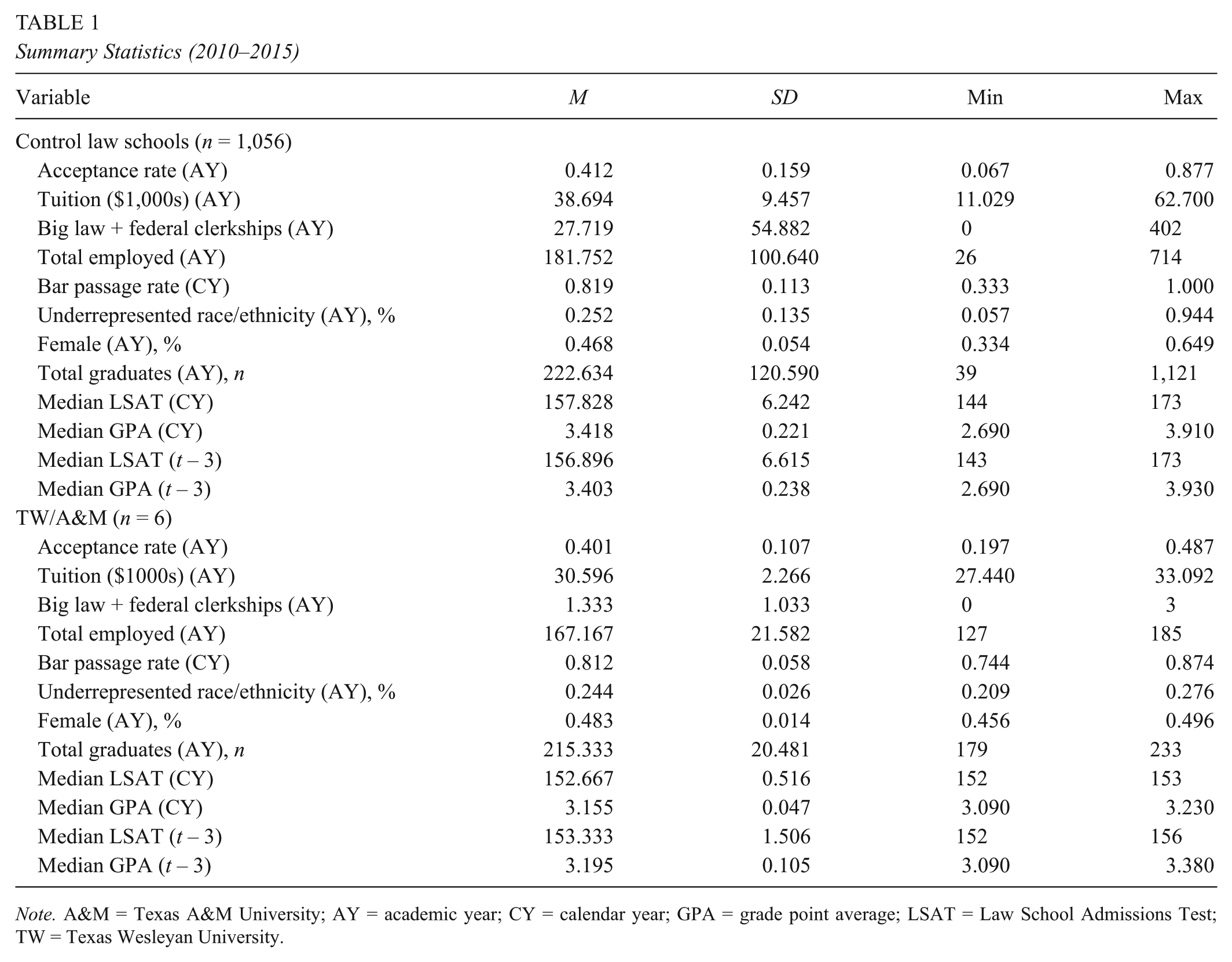
Note. A&M = Texas A&M University; AY = academic year; CY = calendar year; GPA = grade point average; LSAT = Law School Admissions Test; TW = Texas Wesleyan University.
Variables
The primary measures of interest in this study are student, administrator, and employer effects postacquisition, as captured in measures of admissions selectivity (a school’s total number of admits divided by the total number of applicants), tuition price, student job outcomes, and bar passage rates. Tuition is full-time nonresident tuition, given that the subsidies provided by law schools at public institutions are in many cases not distinct from merit scholarships (Stake, 2006) and that some law schools at public universities in the United States are in fact self-sufficient, quasi-private institutions (Lenz, 2013). Job outcomes measured are high-status jobs—those at large law firms and federal clerkship placements—as well as a measure of total employment. Large law firms are firms with >500 attorneys, of which there exist multiple offices in metropolitan Dallas–Fort Worth. With federal clerkships, those jobs represent the most prestigious outcomes for American law school graduates (Yoon, 2017). Both variables are log transformed to fit normal distributions. Job variables and bar passage rate reflect those of the graduating class of the following year such that 2013 variables are those of the class 2014 (students enrolled September 2013–August 2014).
Covariates included in regressions are a school’s proportion of students from underrepresented racial/ethnic backgrounds (all self-reported and unknown race/ethnicities except students identifying as White), proportion of students that are female, number of graduates, median entering student LSAT score (Law School Admissions Test), and median entering student undergraduate grade point average. The latter two variables are each lagged 3 years in Models 3, 4, and 5 to align with job placement and bar passage dependent variables (the modal law student finishes a degree in 3 years). Selected covariates were analyzed in prior higher education research contexts on organizational behavior and change (e.g., Belasco, Rosinger, & Hearn 2015). For the present case, they capture observable school characteristics empirically or otherwise associated with each dependent measure (Sander, 2004) and are not necessarily parameters of interest.
Analysis
Exploiting the pre- and postperiods of the A&M case allows for an assessment of the effect of the acquisition as it relates to measures of selectivity, tuition price, job outcomes, and bar passage rate at the new institution as compared with that of the former TW School of Law. To measure magnitude of those effects, I use a DD estimation:

where

where
Robustness Checks
To ensure confidence in DD estimates, additional steps must be taken independent of specific findings. Notably, researchers have expressed caution in using a DD estimator to analyze effects of single-event studies with relatively small numbers of observations and clusters, as it is inherently inconsistent in such cases (Cameron, Gelbach, & Miller, 2008; Conley & Taber, 2011). Cameron et al. (2008) proposed a wild cluster bootstrap procedure as a means to refine standard asymptotic tests in the case of standard errors obtained with a small number of clusters, and as such, I report p values from 1,000 replications of that method. With respect to specific institutional effects postacquisition, additional analysis can provide further confidence in DD estimates.
First, I estimate placebo interventions using the same basic model with acquisition induced in 2011 and in 2010 on panel data for years prior to the actual change (2009–2012). Inference for those tests is based on standard t distributions rather than the bootstrap method, as clusters are <5 in those models (Cameron et al., 2008). Another placebo test involves creation of a synthetic control to check validity of DD estimates under hypothetical conditions in which A&M had not purchased the TW law school. I create the synthetic control from a weighted average of covariates from other law schools in the state of Texas and neighboring states of Arkansas, Louisiana, New Mexico, and Oklahoma, a geographic-based “donor pool” (Abadie, Diamond, & Hainmueller, 2010) defined ex ante that stems from empirical and intuitive (e.g., state-based nature of legal licensure) similarities among schools included. Here,

where

As with DD estimation, placebo interventions inform interpretation of synthetic control analyses, where synthetic controls of the donor pool controls are created and exposed to a hypothetical acquisition event and comparisons are made to deviations between the observed estimates of TW/A&M and its synthetic control.
Results
Selectivity
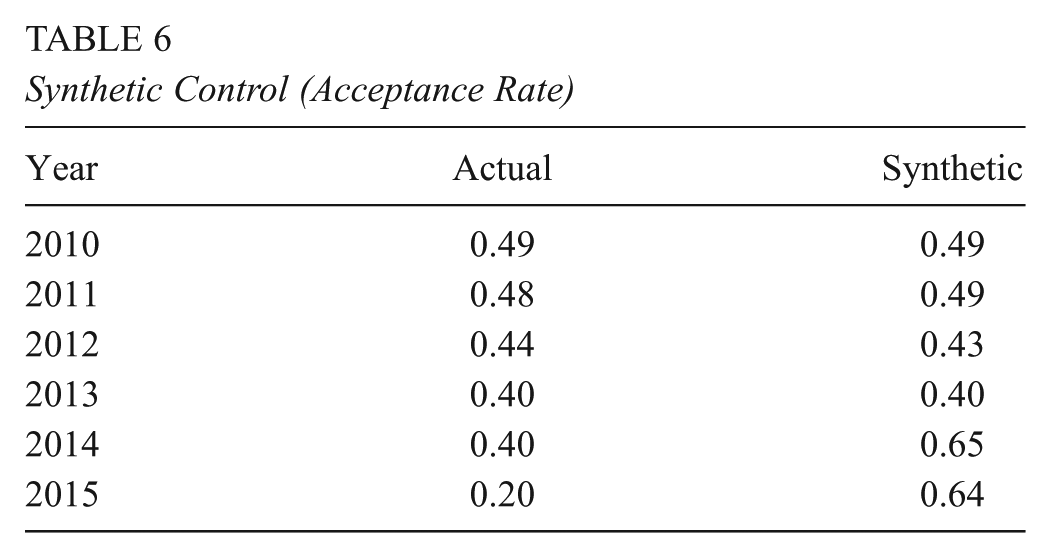
Results in Table 2 show significant effects of the acquisition on selectivity, as measured by a decrease (p < .05) in the acceptance rate at A&M law school postacquisition. Results in Model 1 are also robust to two placebo tests, as displayed in Table 3, and the synthetic control analysis, as shown in Figure 1. Figure 1 also displays placebo tests for all control institutions, with A&M visible as a clear outlier. Means for A&M, its synthetic control, and the donor pool are shown in Table 4; weights used to create the synthetic control are displayed in Table 5; and predicted values for each are displayed in Table 6. Together, the results suggest that the decrease in the acceptance rate after the acquisition was a direct consequence of the A&M acquisition.
Difference-in-Differences Model Results

Note. Cluster-robust standard errors in parentheses. A&M = Texas A&M University.
Log transformed.
p < .05 determined by wild cluster bootstrap procedure.
Placebo Intervention (Acceptance Rate), 2009–2012

Note. Cluster-robust standard errors in parentheses. A&M = Texas A&M University.

Synthetic control plots: Acceptance rate.
Synthetic Control Summary Statistics (Acceptance Rate)

Note. GPA = grade point average; LSAT = Law School Admissions Test; UR/E, underrepresented racial/ethnic.
Institutional Weights: Synthetic Creation (Acceptance Rate)

Synthetic Control (Acceptance Rate)
Other Dependent Variables
Effects for acceptance rate did not translate to other institutional indicators analyzed. Neither tuition nor job and bar passage rate DD estimates were statistically significant. Synthetic control analyses for each show similar null effects, which are displayed in Figure 2. A full regression table with covariate estimates can be found in Table A1.

Synthetic control plots: Other outcome variables.
Limitations
A number of limitations are worth noting, both substantive and methodological. Primarily, the study focuses on one case, and the data set is limited to observational data aggregated at the school level such that direct hypothesis testing of social psychological theories used to frame the analysis is untenable. Relatedly, there still exist challenges in using DD or other regression-based methods of inference to measure a postintervention effect with a relatively small number of observations and periods (MacKinnon & Webb, 2018). Experimental and/or student-level data and qualitative analysis would surely provide more detailed assessment of peculiarities of higher education acquisitions, particularly as related to the role of social judgment theory and network effects likely at play with respect to job outcomes.
Quality in higher education is similarly difficult to quantify, and bar passage rate as a proxy for law school quality can be a problematic metric (Ho, 2005; Stake, 2006). That being said, disaggregation of dependent variables by gender, race/ethnicity, and inclusion of a student debt or socioeconomic status variable would provide additional clues about heterogeneous effects of a law school acquisition and its relationship to the legal industry in the United States. Such analyses would require data not currently available from the American Bar Association, a limitation for research on law schools overall. Moreover, a deeper qualitative analysis of the A&M acquisition could shed further light on organizational mechanisms specific to that case. Examining continued effects of higher education acquisitions across systems over future periods is worth revisiting in research to address these limitations.
Discussion
Given that selectivity increased after the A&M acquisition independent of any other institutional effects measured in this study, behaviors of applicants and school enrollment managers are perhaps the most significant points of consideration for future analyses of mergers and acquisitions in higher education. In undergraduate settings, for example, public institutions are found to respond to decreases in state appropriations by behaving like private institutions with respect to recruitment of out-of-state students (Jaquette & Curs, 2015). Findings here suggest that leveraging existing resources (i.e., brand names) through other avenues (i.e., new programs) may present public institutions with alternate, perhaps more palatable, pathways to privatization. For the present case, the $73 million purchase of a law school immediately bolstered short-run competition among the school’s inputs, which may boost institutional quality in the long run. As it is, the A&M School of Law entered the top 100 of the U.S. News & World Report rankings for the first time in 2018 (Watkins, 2017). Though such effects are intuitive, the fact that they are not uniform across law school stakeholders is noteworthy, as the acquisition failed to significantly affect tuition prices or job outcomes for students. Together, the results discussed here mimic those in other organizational fields, where mergers and acquisitions among associated organizations can have heterogeneous effects (Betancourt & Wetzel, 2016). As such, a number of implications can be considered for researchers, administrators, and practitioners in higher education, legal education, and the legal industry.
First, the apparent heterogeneity in the effects of the acquisition complicates the notion of ironclad linkages between educational and labor market determinants, at least in a narrow professional context. Big law firms and federal courts in Texas, for example, appear relatively resistant to a law school name change in the short term. With noted strong effects of gender and ethnicity on organizational behavior in the professions (Ruef, Aldrich, & Carter 2003), high-status jobs rely on cultural homophily as a primary source of cohesion within and among organizations (Mark, 2003; Rivera, 2012). It follows that the A&M acquisition without concomitant changes affecting quality and/or cultural norms may fail to penetrate status-conscious networks that dominate the American legal industry. That finding may also be a function of a more rigid horizontal stratification (Rivera, 2011) in the legal profession, where graduates from schools outside the so-called T-14 (Rubino, 2017) face hurdles breaking into elite legal employment circles regardless of relative law school prestige (Galanter & Henderson, 2008). The role of media rankings, specifically, may also affect the pace with which future assessments from stakeholders with prior negative or neutral beliefs turn positive (Dorobantu et al., 2017). To tackle those uncertainties, future research could examine similar phenomena in undergraduate settings, other professional schools, or other environments in the legal industry, as well as the influence of more esoteric aspects of cultural change, such as college and university sagas (Lyke, 2017), on organizational mechanisms including reactivity and cascades. Does, for example, naming a management school after a well-known wealthy donor influence hiring in jobs associated with said donor? Or, broadly, how are other nominal changes in law school quality or prestige interpreted in hiring for various positions or by heterogeneous student populations?
Interpretation of results from this study also concerns the balance between pre- and postacquisition status (relative position in a hierarchy) and reputation (collective understanding of particular aspects of a firm’s quality; McDonnell & King, 2018) and institutional control over those aspects. Research on firm mergers in other industries that situates status/reputation differentials as being critical to postmerger effects on aspects of organizational identity and performance (Graebner, Heimeriks, Huy, & Vaara, 2017; Lipponen, Wisse, & Jetten, 2017) can provide insight into how higher education mergers and acquisitions affect different groups, as can research on effects of status/reputation differentials in organizations broadly speaking (e.g., Delmestri & Greenwood, 2016). In the present case, A&M is one of the largest higher education institutions in the United States and has the largest single campus in the state of Texas, and the former TW law school was a hyperregional professional school such that most students, faculty, and administrators likely felt little agency in the acquisition process and were thus limited in their ability to respond discursively. That point differs from mechanisms related to status loss observed at the undergraduate level, which is characterized by more active and agentic responses (Askin & Bothner, 2016), and from tuition increases observed as a result of higher education mergers (Russell, 2018). Direction of change and differentials among organizations in any case appear pivotal in predicting passive or active responses in acquired higher education institutions.
In addition to continued analysis of the long-term effects in the A&M case, future empirical studies could seek to further untangle dynamics of higher education mergers and acquisitions with varying degrees of status/reputation change and before and after differentials, such as those at Penn State University’s two law school campuses or at status-neutral mergers in the University System of Georgia. How might institutional effects manifest in higher education mergers and acquisitions unencumbered by profit or prestige maximization? Alternatively, how might stakeholders respond if a merger resulted in status loss for the institution?
Last, more precise analysis of the role of information, interpersonal relationships, and isomorphic pressures as detailed in Bitektine’s (2011) social judgment theory model presents researchers with a theoretical basis with which to carry out empirical analysis of higher education mergers and acquisitions. Regarding the creeping forces of privatization in public institutions and technocratic regimentation across sectors, response to wholesale changes in name, identity, form, and function within and among institutions can illuminate otherwise undetectable heterogeneity among seemingly cohesive campus groups. Experimental research designs, either in the laboratory or in schools and professional organizations, provide one foray into a more in-depth analysis of psychosocial mechanisms underlying organizational change in higher education, as could qualitative or mixed methods designs.
This study has extended empirical analysis of organizational change in higher education by exploiting an acquisition as a rare window into mechanisms driving effects often reduced in higher education research to a static rankings variable. Future research should continue to investigate organizational behavior in the legal industry and in higher education as a dynamic force with diverse effects and varied causal mechanisms.
Conclusion
What happened when the TW School of Law became the A&M School of Law, and how can it inform future mergers and acquisitions in higher education and beyond? Findings here indicate that selectivity increases in the case of a positive nominal change at a law school, although such effects are not uniform and more research is certainly required to fully understand the process in any generalizable sense (i.e., in other sectors of education). Social processes underpinning the effects of education in the American legal industry and in professional labor markets hinge on multiple layers of interaction that shape cognitive assessments of organizations and actions based on those evaluations, which are seen in this particular case study but demand continued analytical attention. With the aforementioned implications for researchers of the legal industry and higher education, leaders in universities and law schools ought to take into account differences in the effects of mergers and acquisitions among various school stakeholders as they make decisions about student access, success, and outcomes.
Footnotes
Appendix
Difference-in-Differences Model Covariate Estimates

| Dependent variable | |||||
|---|---|---|---|---|---|
| (1) Acceptance rate | (2) Tuition ($1,000s) | (3) High-status jobs a | (4) Total jobs a | (5) Bar pass | |
| UR/E, % | 0.034 (0.062) | −5.170 (3.868) | −0.892 (0.404) | −0.497 * (0.126) | −0.235 (0.052) |
| Female, % | 0.172 (0.067) | −0.460 (3.809) | −0.687 (0.484) | −0.060 (0.149) | −0.132 (0.064) |
| Graduates, n | 0.0002 (0.0001) | 0.011 (0.006) | 0.001 (0.001) | 0.001 (0.0002) | −0.0001 (0.0001) |
| LSAT | −0.018 (0.002) | −0.044 (0.125) | 0.011 (0.015) | −0.005 (0.005) | 0.013 * (0.002) |
| GPA | −0.155 (0.040) | −2.146 (2.302) | 0.217 (0.208) | 0.061 (0.063) | 0.126 * (0.027) |
| Post-2012 × A&M | −0.161 * (0.076) | 2.023 (1.724) | 0.084 (0.294) | 0.303 (0.092) | −0.0002 (0.039) |
| Observations, n | 1,062 | 1,062 | 1,062 | 1,062 | 1,062 |
| Time fixed effects |
× |
× |
× |
× |
× |
| School fixed effects |
× |
× |
× |
× |
× |
Note. Cluster-robust standard errors in parentheses. A&M = Texas A&M University; GPA = grade point average; LSAT = Law School Admissions Test; UR/E, underrepresented racial/ethnic.
Log transformed.
p < .05 determined by wild cluster bootstrap procedure.
Author
AUSTIN LYKE is a PhD student in the Department of Education at the University of California-Los Angeles. His research focuses on interactions between higher education institutions and their environments.