




Abstract
Integrative learning is a cognitive outcome that reveals students making intellectual connections, bringing sources together, and integrating them into one. What are the kinds of sources integrated by students in writing, and what are the categories or forms that characterize those integrations? How are the sources integrated by students in writing, and what are the strategies, habits of mind, or processes that characterize those integrations? I analyzed 32 student essays using grounded theory. Three categories of what students integrate emerged: two sources, multiple sources, and metacognitive sources. Such sources ranged from published texts to personal experiences. How students integrate also fell into three categories: connection, application, and synthesis. Students integrate through connections via equivalencies, contrasts, bridges, and intellectual problems. Applications may apply an idea to the “real world” or one source to another. Synthesis often takes the form of idea, judgment, gathering, and/or implications. A revised empirical definition of integrative learning emerged from the typologies of what and how students integrate.
Keywords
Introduction
But college can foster the ability in students themselves to create connections across experiences and knowledge. One highly valued cognitive outcome is integrative learning, “the ability to connect, apply, and/or synthesize information coherently from disparate contexts and perspectives, and make use of these new insights in multiple contexts” (Barber, 2012, p. 593). Even beyond college, the Association of American Colleges & Universities (AAC&U, 2004) sees integrative learning, the skill of bringing pieces of evidence together into one synthesized understanding, as the necessary tool for the 21st-century knowledge economy. Though disagreement persists in the literature, most definitions and theories seek to explain two distinct aspects of integrative learning: what students are integrating and how they are integrating it (AAC&U, 2010; Barber, 2009; Lardner & Malnarich, 2010).
First-year composition (FYC) courses encourage the bridging of multiple contexts (what students integrate) and teach various methods for that bridging (how students integrate). Although Yancey (1998) does not explicitly refer to integrative learning, she argues that reflection in composition classes helps students examine the intersection of three sources of information: prior knowledge (which students bring to class), the “delivered curriculum” (p. 18), and the student experience of that curriculum. In stark contrast, a national study of writing assignments from courses other than FYC reveals that college students most frequently are asked to report/reproduce learning, not integrate understanding (Melzer, 2009). Because FYC is not a discipline and is often positioned as preparing students for true disciplines (Lockhart & Soliday, 2016; Regaignon, 2009), such courses are designed to help students transfer learning (Barnhisel, Stoddard, & Gorman, 2012; Mahoney & Schamber, 2011). Thus, composition courses can both establish an intellectual setting where connecting, applying, and/or synthesizing is encouraged and teach students how to enact those integrative learning skills.
Oddly, the literature has a glaring gap: Most research on integrative learning emerges from student self-reporting. Even leaving aside survey-driven research that often measures integrative learning experiences (Mayhew, Seifert, Pascarella, Nelson Larid, & Blaich, 2012; O’Neill, 2012), Barber’s (2012) definition—the only empirical, generalized definition of integrative learning—is derived from student interviews. Although the semi-structured interview protocol that produced Barber’s data was designed in part to encourage students to remember and report previous demonstrations of integration (Baxter-Magolda & King, 2007), students are not trained to recognize this complex skill. Furthermore, multiple composition studies have shown college writing as a kind of intervention that leads to learning (see e.g., Sommers, 2008; Sommers & Saltz, 2004); students may demonstrate cognitive outcomes differently in writing than speech (Yancey, 1998). As such, both a practical and theoretical need persists to examine direct evidence of integrative learning in student writing.
Thus, this study of integrative learning was guided by two research questions:
Research Question 1: What are the kinds of sources integrated by students in writing, and what are the categories or forms that characterize those integrations?
Research Question 2: How are the sources integrated by students in writing, and what are the strategies, habits of mind, or processes that characterize those integrations?
My goal was to establish a taxonomy of both the different kinds of sources students integrate in their writing and the different ways in which students demonstrate integration of learning in this writing, with the expectation that these taxonomies could inform an empirically derived definition of integrative learning itself. Examining student writing allowed for direct observations of integrative learning instead of relying on student self-reports. Many of the aspects of integrative learning are thought to be cognitively advanced (AAC&U, 2010), and integrative learning in the literature has “a degree of intentionality and of success” (Nowacek, 2011, p. 2); I defined demonstrations of integrative learning as, in essence, successful or complete demonstrations. And to ensure this advanced skill was successfully enacted in the writing I analyzed, I examined award-winning student writing; I chose to focus on exemplary essays in the hopes that these writings would be particularly data rich. This decision was aligned with my research goals as a study with aims to create typologies, and empirical definitions benefit more from a limited, purposive data selection process than a representative sampling method (Creswell, 2014).
Composition has a strong post-positivist tradition (Belanoff, 1991; Belanoff & Elbow, 1986), and I designed this study with a post-positivist stance. I acknowledge the ways in which the student writers could be theorized as co-constructors of their essays with their professors and the environment of each particular class, and yet I believe that the essays can still be read as free-standing demonstrations of student ability; indeed, they were published to be read without additional context.
I also align myself with a movement within the field of composition that seeks to honor and treat seriously the thinking of students by working with published student texts in the classroom. The circulation of published student writing can act as an empowering counternarrative (Harris, Miles, & Paine, 2010; Robillard, 2006) to the notion of “inexpert texts” (Downs, Estrem, & Thomas, 2010, p. 119) and creates a pedagogy that values and listens to the student voice. Many FYC teachers assign essays written by (former) FYC students—texts current students read not just for content but as a model of the kind of writing the students are being asked to do themselves (Adler-Kassner & Estrem, 2007; Bunn, 2013). Counterintuitively, by establishing a zone of proximal development (Vygotsky, 1978), using award-winning student writing as model texts particularly benefits students who are not the most advanced writers (Bartholomae & Matway, 2009); these “expert” texts were, after all, written by (former) first-year students. The use of model texts also sends a strong signal to students, across the spectrum of achievement, that their own thinking, like that of the student model text writer, is to be taken seriously. In this way, while the use or study of award-winning model texts could be interpreted as elitist, my stance is informed by work in the field of composition that suggests just the opposite.
Literature Review
Historical
Integration of learning has been a value of undergraduate education for decades, even if it has often gone by other names. Alexander Meiklejohn created the (residential) Experimental College at Wisconsin in the 1920s with the explicit goal of fostering “intelligence,” which “implie[d] unity of understanding” as opposed to “the unrelatedness of scattered bits of knowledge” (Meiklejohn, 1932, pp. xvi–xvii). Indeed, ever since Johns Hopkins was founded in the Germanic ideal, the structure of higher education in the United States has often encouraged a discipline-centric system of unrelatedness both for the faculty and students (Lattuca, 2001; Thelin, 2004). So the larger history of general education in the United States can be seen as a response, “the unification of knowledge” (Stevens, 2001, p. 177) as a counterweight to the fractured student experience (Chaddock & Cooke, 2014). While Yale, Harvard, Smith, and Wellsley (S. Gordon, 1975; Hindmarsh, 1932; Horowitz, 1984; Pierson, 1955) sought to create such unification through residential experiences, general education curricula sought to create “coherence” (Boning, 2007, p. 1) through linked courses, explicit value systems (e.g., civic engagement), and/or core reading lists (Brint, Proctor, Murphy, Turk-Bicakci, & Hanneman, 2009). Even though none of these programs used the term integrative learning, many of them were focused on an analogous outcome.
AAC&U and Relevant Theories
Current thinking that explicitly addresses integrative learning can perhaps best be understood through the AAC&U’s (2010) VALUE initiative. The VALUE rubrics, including one for integrative learning, have been adopted on over 3,000 campuses (Rhodes & Finley, 2013); simply put, they are influential. As such, the integrative learning VALUE rubric will be used as an organizing principle in the literature review. The AAC&U operationalizes integrative learning in five ways: (1) “Connections to Experience (Connects relevant experience and academic knowledge)”; (2) “Connections to Discipline (Sees (makes) connections across disciplines, perspectives)”; (3) “Transfer (Adapts and applies skills, abilities, theories, or methodologies gained in one situation to new situations)”; (4) “Integrated Communication”; and (5) “Reflection and Self-Assessment (Demonstrates a developing sense of self as a learner, building on prior experiences to respond to new and challenging contexts)” (AAC&U, 2010, p. 2). While these operationalized skills articulate what students are integrating, how students integrate is often captured across each skill’s four levels of proficiency (AAC&U, 2010, p. 2). The following pages explore the theories that inform understandings of each of these operationalized aspects of integrative learning. Although this section is schematically structured (to highlight theories with particular value for understanding integrative learning), these theories should not be seen as separate, nor should these skills be read as operating independently. Rather, each of these theories can inform multiple skills, multiple understandings of integration of learning.
Theories of transfer of learning clearly inform the Transfer aspect of integrative learning. Haskell (2001) explains that “transfer refers to how previous learning influences current and future learning, and how past or current learning is applied or adapted to similar or novel situations” (p. 23). The literature proposes several typologies of transfer. The simplest is the distinction between “near” and “far” transfer (Perkins & Salomon, 1992), suggesting, in effect, a variance in how much adaptation is required to bring the old skill to the new setting. A similar distinction exists between “low road” and “high road”: Low road transfers involve a new situation for an old skill, whereas high road transfers require the abstract thinking necessary to see the potential to adapt and apply the old skill (Haskell, 2001; Perkins & Salomon, 1992). Finally, another kind of transfer is dubbed “relational” because it involves the ability of “seeing the same structure between two things” (Haskell, 2001, p. 32) that are not obviously in relation. The field of composition has produced a related typology of the ways students use prior knowledge for new tasks—through superficial assembling, more holistic remixing, or complete rethinking of the knowledge (Robertson, Taczak, & Yancey, 2012). A recent curriculum, named Teaching for Transfer (Yancey, Robertson, & Taczak, 2014), crystalizes composition’s focus on transfer into a complete pedagogy designed to help students transfer what they learn about writing in FYC into other disciplinary courses (Fishman & Reiff, 2008).
Interdisciplinarity (operationalized by the AAC&U as Connections to Discipline) is a narrow aspect of integrative learning: It involves bringing together multiple disciplines (Rhoten, Boix-Mansilla, Chun, & Klein, 2006). Importantly, the literature is clear on the distinction between multidisciplinary and interdisciplinary: It is not enough for more than one discipline to be involved; thinking, learning, or research can only be truly interdisciplinary if two or more disciplines are “integrated” and something new is created (Klein, 1990; Lattuca, 2001; National Academy of Sciences, 2004). As such, the theories of interdisciplinarity contribute importantly to the understanding that integrative learning can involve not just connection making but a kind of creative synthesis.
Beyond students’ academic work, theories of self-authorship can help shed light on the aspect of integrative learning that the AAC&U (2010) operationalizes as Connections to Experience, and Barber (2012) calls those “vitally important” “out-of-the-classroom experiences” (p. 608). In Baxter-Magolda’s (2009) study, one student described self-authorship “as living the facts and absorbing that information into her entire being . . . [a] merger of knowledge and sense of self” (p. 281). To achieve self-authorship, a student has to be able to integrate, or “merge,” (academic) knowledge with experiences the student has taken ownership of.
Reflection and Self-Assessment can be understood through theories of metacognition (Kolb, 1981). Kolb’s (1976) learning style theory suggests that regardless of what kind of learner a student is, the cycle of conceptualizing, testing, and experiencing is only complete once the student has reflected on their learning process. An ideal integrative learner would be in a positive feedback loop: He or she would make a connection (between, say, two disciplines) and would then reflect on that process; the product of this kind of reflection is, according to Yancey (1998), “a cumulative, multi-selved, multi-voiced identity, which takes place between and among composing events” (pp. 13–14). That reflection could itself then fuel, in Kolb and the AAC&U’s theorizing, yet more integrative learning. Sommers (2006) refers to this process as students remaining aware of themselves as learners across their academic careers and thus “across the drafts” (p. 250); she found that students who assess themselves as novices can be more open to developing as writers (Sommers, 2008). Yancey also describes reflection as a continuing process, integral both to revising texts and naming what a student has learned.
Finally, Integrated Communication can be understood within the intellectual tradition of form and content, a tradition debated since at least Aristotle (~330 B.C.E./1963). Today, the field of composition frequently focuses on form; for instance, Teaching for Transfer highlights genre awareness as vital to students’ ability to decide what form/genre will best communicate their content to their intended audience (Yancey et al., 2014). More broadly, references to concepts such as the “interdependence of language and meaning” could be found in almost any first-year writing textbook (see Hoy & DiYanni, 1999; Vilardi & Chang, 2009).
Insights From Measures
Attempts to measure integrative learning or constructs seemingly related to it reveal several more aspects of this outcome. University of Michigan’s MPortfolio program (McGuinness, 2015; Peet et al., 2011; Taylor, 2011) operationalizes multiple pertinent dimensions of reflexivity and self-authorship, as does the National Survey of Student Engagement (NSSE, 2015). Both measures also reveal ways in which aspects of integrative learning can be demonstrated in/as a response to societal issues or problems. But all these instruments also underscore the difficulty that self-reported data introduce into the understanding and measuring of integrative learning (see Peet et al., 2011).
In addition, these measures have contributed to a body of research about the relationships between integrative learning experiences and other outcomes. Integrative learning experiences are positively correlated with similarly holistic outcomes such as need for cognition, positive attitudes toward literacy, and lifelong learning as well as civic outcomes such as openness to diversity, socially responsible leadership, and moral development (Laird, Seifert, Pascarella, Mayhew, & Blaich, 2014; Mayhew et al., 2012; O’Neill, 2012; Seifert et al., 2008). Quantitative studies also reveal that not all kinds of students experience the same amounts of integrative learning: Students in liberal arts colleges report higher levels of integrative learning experiences than students in regional institutions or research institutions (Pascaraella, Wang, Trolian, & Blaich, 2013); on the other hand, first-generation college students report less frequent integration than their peers (Pike & Kuh, 2005).
Insights From Composition
For multiple reasons, the writing that emerges from composition courses provides a fruitful site of research for higher education—and more specifically, integrative learning. Composition courses often foster metacognition by asking students to think about thinking and the structures/acts of general education (Guy, 2009). Transfer is embedded in composition courses, which are frequently designed to “serve” the rest of the university (Fosen, 2006). Being outside the structures of disciplines, these courses require an integrative mindset, both from the faculty and students (Fleming, 2011). Finally, Yancey et al. (2014) found that students integrate their “academic and non-academic literate lives” (p. 12) in composition courses; by contrast, students writing outside such courses “are not often called upon to relate course content to personal experiences . . . or reflect on their own learning” (Melzer, 2014, p. 33) In short, it is intuitive to look for integrative learning in first-year writing courses because “writing makes learning visible” (Merrill & Miller, 2005, p. 205).
Methods
Site Selection
To create an empirically derived definition, I searched for student writing from authentic classroom contexts. Writing that was written or collected to demonstrate integrative learning was avoided; so too were publications that had articulated narrow goals. In both cases, the concern was inadvertently excluding certain kinds of integration by focusing on other kinds. (For example, Michigan’s MPortfolio program idiosyncratically conceptualizes integrative learning as connected to societal change; Peet et al., 2011; and Queens City Writers, ostensibly a national journal of undergraduate writing, recently put out a call looking specifically for “undergraduate work addressing [political] R/resistance”; QCWriters, 2017.) National studies (Melzer 2009, 2014) also suggest that FYC courses encourage self-reflection and connection-making more than other undergraduate courses. Lastly, the AAC&U (2010) rubric describes increasingly complex aspects of integrative learning, suggesting that writing that demonstrates the most complex processes would also be able to demonstrate the simpler processes but that the reverse would not be true. As such, award-winning FYC writing was expected to be a more data-rich set of writing than a randomized or representative selection of non–award winning and/or non-FYC student essays.
With these goals and limitations in mind, I selected Mercer Street, the journal of “the best work done in [NYU’s Expository Writing Program (EWP)] courses” (Publications, n.d.). No rubrics for the Mercer Street evaluation process exist as of the writing of this study, nor is integrative learning an explicit goal of the program (EWP, 2015); each essay simply receives a double-blind reading by two EWP faculty members, who rank the writing on a scale of 1 to 5 (R. Larson, personal communication, February 25, 2015). Only essays written for an FYC course are eligible (the award comes with a small honorarium and publication). And because Mercer Street essays are used as achievable model texts for the next year’s students, they are only copyedited to ensure correct citation formatting.
Although Mercer Street has been published annually for at least 20 years, I coded essays only from the most current edition (Donatelli & Novak, 2015). The 2015–2016 edition of Mercer Street has 34 essays: The mean length is ~2,600 words, with over half the essays falling between 2,000 and 3,000; the shortest essay is ~1,200, words, and the longest essay is over 4,100. In the edition analyzed, writers were first-year students in one of six schools: the arts, engineering, business, social work, or education schools, or the college of arts and science. Each year’s Mercer Street is a required text in the next year for all ~4,000 first-year students in those six schools as well as the small undergraduate school of nursing (EWP, n.d.).
Sampling, Coding, and Saturation
Corbin and Strauss (2008) articulate the vital components of grounded theory as “the ‘constant comparative’ method of analysis, the use of concepts and their development, theoretical sampling, and saturation” (p. 303). Guided by this text and the original work of Glaser and Strauss (1967), I coded individual essays, identifying demonstrations of integrative learning and constantly comparing them to previously identified demonstrations. This was a detailed, word-by-word, sentence-by-sentence, paragraph-by-paragraph kind of work to identify what students are integrating, how students are integrating, where in the context of an essay (e.g., beginning, middle, end) students are integrating, and why they are integrating (e.g., what appears to be the rhetorical impetus for integration).
Theoretical saturation “has occurred when the major categories show depth and variation in terms of their development” (Corbin & Strauss, 2008, p. 149). There can be no predetermined endpoint; the data must sufficiently produce rich and clear categories (Glaser & Strauss, 1967), underscoring the importance of award-winning writing as a data source. Ultimately, the endpoint emerges from the data and analysis itself. Nonetheless, Creswell (2014) notes that grounded theory research typically examines between 20 and 30 participants. I examined 32 student essays.
Validity Procedures
Grounded theory offers multiple processes for demonstrating validity. I recruited a peer debriefer, who has different training in composition than I have; she is also interested in qualitative education research. Barber and Walczak (2009) suggest that a debriefer read and code 20% to 25% of the data; my peer debriefer read 28%. We met regularly during my coding, so our conversations also became part of my iterative process. We traded coding and memos, discussed our decisions and areas of concern, and attempted to understand the ways in which we differed without succumbing to easy agreement.
To further triangulate the data, I also examined institutional documents, including: writing program documents (public and internal), general education requirements, a course catalogue, and undergraduate mission statements.
Finally, although individual demonstrations of integrative learning are in effect the units of analysis in this study, the end of each student essay provided a useful occasion for my iterative memo-writing practice, as I thought back to “previous” essays I had coded. This metacognitive, integrative memoing is vital to grounded theory; memos help the researcher begin to transform analysis into theory (Corbin & Strauss, 2008). Writing begets integration; at least, it did for me.
Methodological Caveats
Although grounded theory is most often associated with interviewing, a rich tradition exists of analyzing published documents and other texts with grounded theory. Corbin and Strauss (2008) note that “non-technical literature can be used as primary data” (p. 39). The bulk of one chapter in Glaser and Strauss’s (1967) seminal work on grounded theory outlines how to use the method on library materials. Corbin (Corbin & Strauss, 2008) even did a major grounded theory research project using memoirs as her primary data.
A qualitative study such as this one is never intended to be universally generalizable. Nonetheless, it could be argued that the typologies that follow are in fact merely typologies of what and how NYU students integrate. However, EWP’s curriculum and pedagogy were crafted in conversation with the field of composition, and a brief look at multiple FYC textbooks reveals many similarities. For instance, urging students to pair a text and an art object may be a common EWP assignment, but many composition textbooks suggest it as well (see Ackley, 2015; Austin, 2015; Connelly, 2015; Hesford & Brueggemann, 2007). Thus, while this study does not attempt to claim that NYU is representative of FYC nationally, recent textbooks published by multiple major publishers suggest that NYU is not unrepresentative or misrepresentative.
Results
What
What students integrate can be organized into three broad categories: two sources, multiple sources, and metacognitive sources. When students demonstrate integrative learning by integrating two sources, they often integrate: a text and another text, a text and an art object, or a text and a personal experience. When students integrate multiple sources, it can take the form of: a multifaceted debate, a context, or a set of outside knowledge. Finally, students also demonstrate integrative learning by integrating metacognitive sources either by integrating form and content or integrating evidence of reflective metacognition. A typology of what students integrate in the NYU sample is found in Table 1.
Typology of What Students Integrate.
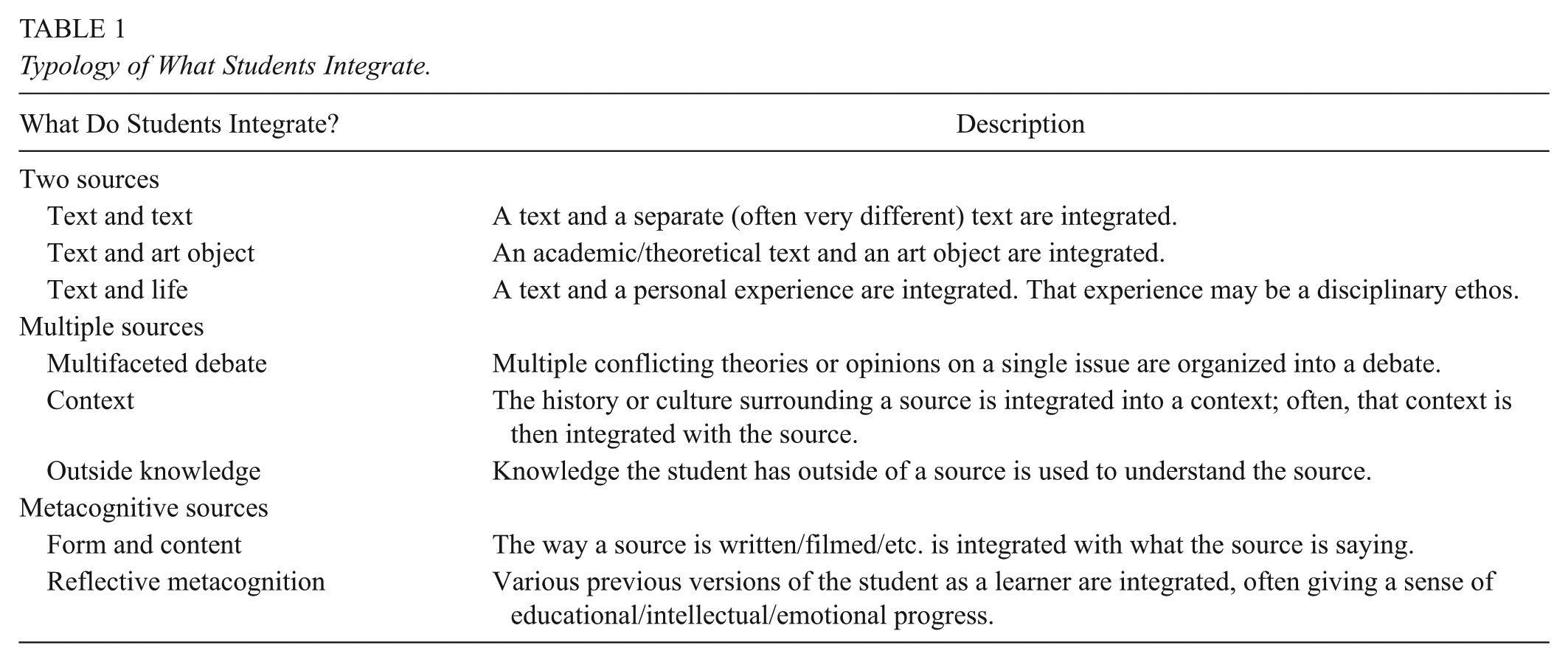
Students in the NYU sample integrate learning between two sources in practically every essay. One such integration, text and text, is often apparent even in the title, such as “Justice 101: Social Reproduction or Revolution” (Donatelli & Novak, 2015, p. 237), which hints at the two integrated texts (on reproduction and revolution, respectively). (All student authors are referred to by their published first name.) Students in the NYU sample also often integrate a text and an art object. A representative example comes from “Fifty Shades of Abusive Romance,” in which Yutong constructs her essay around a feminist reading of Fifty Shades of Grey (Donatelli & Novak, 2015, p. 76).
A third category of two sources occurs when student writers in the NYU sample integrate text and life, using a text to give theoretical language to an experience. This kind of integration may involve a student naming/claiming an identity as part of the essay’s intellectual exploration, as when Gabrielle, in writing about FDA regulations and food anxieties, reveals that “as a recovering anorexic, I am acutely aware of the calories in everything” (Donatelli & Novak, 2015, p. 101).
Students also can integrate an aspect of their lives that is not a discrete personal experience so much as a disciplinary ethos. For instance, Sophie, in her essay “Uses of Insecurity,” integrates the ethos of her chosen field with a memoir by Donald Miller: In every position I’ve held or course I’ve taken [as an undergraduate social work student], I have been reminded to . . . help the client feel safe and empowered. So when I read Miller’s story, I reflexively think to myself (and would express to him, in a client-social worker relationship) that he is brave for being so honest. (Donatelli & Novak, 2015, p. 229)
More than merely a personal event to integrate with the Miller text, Sophie’s disciplinary ethos, which she has learned and practiced, is an entire field/discipline’s way of approaching people and problems.
Multiple sources can be more complex to integrate than two sources. A multifaceted debate integration takes the form of bringing together opposing viewpoints and creating out of that cacophony the clarity of a clear, organized dispute. Jeremy attempts to make sense of capital punishment debates: Indeed, “contemporary American law is unique among advanced industrial countries in its focus on blame and retribution,” says James Q. Whitman, a professor of comparative law at Yale (Whitman). Despite Gopnik and Gilligan’s condemnation of America’s punitive criminal justice system, according to Gallup polling, in 2014, more than 60 percent of Americans supported the death penalty for people who are convicted of murder (Jones). As Radley Balko of the Huffington Post puts it, “most Americans support the death penalty out of a desire for vengeance or retribution.” (Donatelli & Novak, 2015, p. 48)
In this passage, the student writer integrates: a law professor’s writing (Whitman), a general interest long-form essay (Gopnik), a psychologist’s writing (Gilligan), the statistical analysis of a Gallup poll, and a general interest news article (Balko). Thus, this kind of synthesis can require integrating multiple different kinds of texts.
When students create a context, they usually demonstrate integration twice. For instance, Rachel (Donatelli & Novak, 2015, p. 207) examines the film Good Will Hunting by placing it in the larger context of class and 1990s Boston, a context she constructs through synthesizing a series of texts and facts. So the student integrates a film with a context, but the context itself is an integration of multiple different historical/social/cultural sources.
Outside knowledge, unlike context, is characterized by being “outside” of traditional academic sourcing—there is no explicit citation; the student may have simply accumulated historical/cultural knowledge. In this sense, integrating outside knowledge is akin to the theorized process of learning whereby students integrate every new piece of knowledge with their prior understandings (Neumann, 2014; Yancey, 1998). For instance, Rebecca questions a documentary with multiple pieces of outside knowledge: Paris is Burning took place in a darker time, a harder time, in the midst of the AIDS epidemic. In 2014, there is no longer such a severe social stigma against people who are HIV positive. While not completely accepted and completely “normal,” it’s alright to be queer and a minority—at least in New York City. However, this is not true everywhere. . . . Amidst the chants of “black lives matter,” it’s worth noting that this kind of attention is still not given to [everyone]. (Donatelli & Novak, 2015, p. 148)
Thus, the student integrates the film with multiple pieces of outside knowledge, from the cultural climate surrounding the queer population inside and outside New York to the black lives matter movement and the ways it has not fully supported the queer community.
The final two categories of this section examine metacognitive sources that students integrate. One such integration is form and content since to use form as a source involves an awareness of it, a fashioning of it. Investigating the ways in which the film Atonement blurs the line between real and imagined, Carliann titles her essay, “To: Briony Tallis” (the fictional character and unreliable narrator at the heart of the film). Carliann’s form—a letter to an imaginary character—integrates with her idea that in this film, “the lines between representation and reality become tainted” (Donatelli & Novak, 2015, p. 126).
Reflective metacognition refers to instances where what the student integrates is understandings of past selves with a present or future one. In “Let’s Talk About It (Out Loud),” when Zoe hears the N-word, she is outraged and tells a friend about it, only to learn she had not understood the word’s meaning in that context: [Naz] chuckled at me like I was a total buffoon. . . . In that moment, I felt like an outsider, but only when I stepped back and looked at myself. Before, I’d felt in tandem with Naz—I legitimately empathized with him, especially when he vented his frustrations about misappropriations of African-American culture. . . . Suddenly, faced with the real world usage of “nigga” down in Alphabet City, I was at a loss. There, in Naz’s room on the sixteenth floor of our 5th Avenue dorm, I was having a revelation. (Donatelli & Novak, 2015, pp. 161–162)
Here, Zoe “step[s] back and look[s] at [her]self” and, in so doing, integrates multiple versions of herself: herself telling the story in the dorm room with Naz “on the sixteenth floor”; herself in the moment when she overheard the conversation; herself previously, when she “felt in tandem with Naz”; herself during moments of exhaustion with hypocritical racists; and of course, the version of herself writing the essay. Reflective metacognition integrates an instance of learning with previous instances of learning. Integration begets integration begets integration.
How
How students in the NYU sample integrate can also be organized into three broad categories: connection, application, and synthesis. How students integrate learning can be through connection, in which sources are: positioned as equivalent, contrasted, connected via a bridge or intermediary, or connected in service of the formation of a problem. When students integrate learning by application, it can take the form of: one author’s language being brought to another author; or the realm of ideas or art objects being tested in or exported to the everyday world. Finally, integrations of learning may be demonstrated by synthesis, through the process of: generating an idea, forming a judgment, following an implication, or gathering sources. A typology of how students integrate in the NYU sample is found in Table 2.
Typology of How Students Integrate.
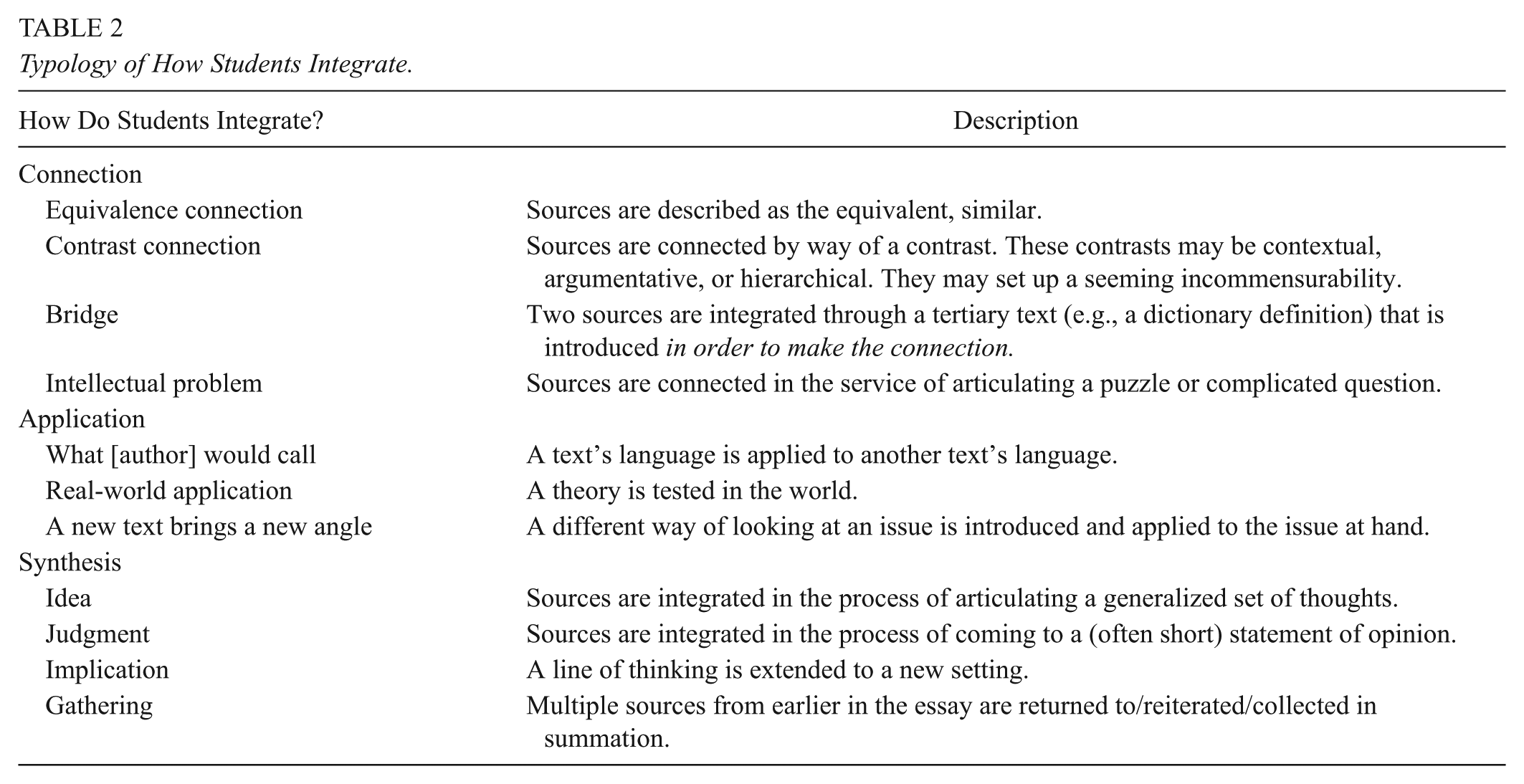
Across the NYU sample, students integrate learning by making connections. The most straightforward of these is equivalence connection. In his essay, Benjamin notes that “[Harvey] Blume sees this myopic use of storytelling as especially dangerous and problematic” before beginning the next paragraph: “Another essayist interested in the power of absolutist storytelling, John Berger, ponders another act of ‘justified’ atrocity” (Donatelli & Novak, 2015, p. 128). In this instance, the student explores two very different essays (one about film, the other about philosophy and war) and finds a connecting concept.
Contrast connection can be seen as a negative connection. Frances crafts a string of oppositions as she tries to make sense of SlutWalks. After noting that “the SlutWalk movement . . . [works to] positively adopt the derogative slur ‘slut’” (Donatelli & Novak, 2015, p. 224), she examines an essay on racist jokes, concluding that appropriating derogatory words “may counter-productively embolden” their use by others (Donatelli & Novak, 2015, p. 225). Her idea emerges from this tension, suggesting that contrast connections can be used by students to push themselves beyond opposition into integrative learning.
When a student is unable or unwilling to simply connect two sources directly, he or she can demonstrate integration by creating a kind of conceptual bridge between them. Dictionary definitions form readily available bridges, as in Jordana’s essay, “Recovering Our Knowledge”: Polanyi divides knowledge into two different categories: tacit and explicit knowledge. The Cambridge Dictionary defines tacit knowledge as “knowledge that you do not get from being taught, or from books, etc.” . . . According to Polanyi, in his book The Tacit Dimension, . . . explicit knowledge “can be articulated in formal language” (8). . . . In his essay, Percy makes use of explicit knowledge. (Donatelli & Novak, 2015, p. 70)
Thus, to integrate her thinking about Polanyi and Percy, Jordana’s strategy is to bring in the dictionary, which acts as a bridge. In bridge integrations, a student understands that two sources are not directly or coherently connected and so introduces another source to bridge, to instigate the integration.
Compelling connections often result in an intellectual problem. NYU’s Expository Writing Program defines problem as a “genuine puzzle” that “arises from the writer’s encounter with evidence, from the identification or apprehension of something that is curious” (EWP, 2015, p. 1). A good example of this curiosity-generating habit of mind comes in Meghan’s “Men’s Table, Women’s Table” (Donatelli & Novak, 2015, p. 175). As she tackles conflicting texts—Aristotle, second-wave feminism, and an art object—she realizes the noble goal of creating separate spaces for the sexes as a way of creating “accommodation” could (paradoxically) perpetuate dominance. Articulating this problem, which might be characterized as one of unintended consequences, is a demonstration of integration of learning because such a problem can only come into existence when related but oppositional theories are brought together.
Across the NYU sample, students integrate learning not only through connection but also through application. I coded one such tactic as what [author] would call. The name is self-explanatory but comes from in vivo coding: In Jiazhou’s essay, the student examines a fictional character who is “living in what [philosopher John] Berger would call ‘a solitude confirmed daily by networks of bodiless and false images’” (Donatelli & Novak, 2015, p. 25). Here, Jiazhou enacts integration of learning by describing or understanding one source through the literal words of another.
Students also apply a text or theory in a real-world application, often in response to an intellectual problem. Clara examines the real case of a murderer in her essay. She cannot establish guilt because the murderer does not have typical neurological control over himself. So Clara applies the work of David Eagleman to propose “changes to the existing legal code” (Donatelli & Novak, 2015, p. 36). In this essay, the student takes a real-world case and applies two different “solutions” to it—first a neuroscience approach to free will, then a legal system policy change. It can, of course, be the case that student applications yield no fruitful solutions. But students demonstrate integrative learning by testing, by seeing how well a theory fits when applied to the real world.
Students also integrate when a new text brings a new angle in an essay. This integration strategy is as though the student applies the source to the essay being written, purposefully changing the direction of the argument by integrating a new theory. For instance, Carnie, a former Israeli soldier, writes about the ethical issues involved with conscientious objection. But after examining a famous actor’s refusal to serve, Carnie turns to a sociological article (Donatelli & Novak, 2015, p. 112) examining conscientious objection throughout Israeli society. This integrative interdisciplinarity alters the essay’s focus from individual ethics to society-wide implications, shifting the essay’s course and demonstrating integrative learning.
Across the NYU sample, unlike connection or application, synthesis—when multiple sources are fused together to create something new—often results in the “old” sources being no longer visible. Many students synthesize through articulating an idea—and here I use idea to mean (partially) generalized thinking—as in this short idea statement in Natalie S.’s “To Shed Three Tears”: Popular iconography shifts as the trends do—and thus true kitsch is always changing as technologies grow obsolete, celebrities become irrelevant, and innovation takes place. To document the moment in between change . . . is to bring kitsch in conversation with the avant-garde. The present and the future are linked, and in bringing them together for the sake of art, the result, [Jeff] Koons finds, is the suspension of time. (Donatelli & Novak, 2015, p. 156)
Here, the student synthesizes Koons, American consumer culture, theories on kitsch, and the avant-garde. But the thoughts about “bring[ing] kitsch in conversation with the avant-garde” and “suspension of time” are not obvious results of the “what” that is integrated. One cannot read the parts and imagine this particular sum. This synthesis is integrative—not merely assembled—learning.
Alongside idea, the process of integrative synthesis can also reveal judgment. Rebecca renders multiple integrative judgments in her essay about Paris Is Burning. Rebecca notes that “Octavia, a black woman, is framed and lit by [the director, Jennie] Livingston far differently from how Venus, an Italian-American, is lit” (Donatelli & Novak, 2015, p. 146). After collecting evidence on lighting, costume, sound, tone, composition, and color, Rebecca “doubt[s] that Livingston intended to make Venus softer, prettier, and more sympathetic than Octavia, . . . [but] this is racism: inherent and engrained in her, engrained in society” (Donatelli & Novak, 2015, p. 147). This clear and disturbing judgment on a much admired documentary allows the student to synthesize many pieces of evidence and gesture outward, from the film to the world.
Thus, implication often appears alongside judgment. Implication demonstrates integration because it necessarily involves applying knowledge to a new setting. Lisa, in her essay “The Myth of Meritocracy,” examines affirmative action. From there, a (judgment-tinged) implication emerges: “Trying to assign index values to innate privilege or lack thereof may seem ludicrous, but it is ultimately necessary if we are to sustain any hope of providing equal opportunity” (Donatelli & Novak, 2015, p. 219). Thus, the knowledge of how privilege works and how affirmative action could work is integrated and demands an intellectual response. Implication—the act of imagining what comes next—can only happen if the student has synthesized the sources and applied them.
Near the end of many essays, students begin gathering the sources and concepts that have appeared throughout the piece. This work is often part of a final synthesizing of evidence, a last demonstration of integrative learning. In the final two paragraphs of Benjamin’s “Stories With Pictures,” all the previously examined sources are gathered together (italics added): In the end, Berger’s most compelling argument is his call to abandon relativism, while Blume’s most compelling argument is his call to abandon absolutes. After this thorough analysis, it is now clear that these arguments are not in conflict, but rather combine to form a conclusion harmonious with Berlin’s. . . . If we are ever to improve our understanding of the infinitely complicated past and present, then we must accept the truth that Blume, Berger, and Berlin are all hinting at in different ways: that no single story is the whole story, no icon the universal truth. . . . The views from the top of the cross at Golgotha and the bottom of the World Tree must both be accepted as pieces of the same picture. (Donatelli & Novak, 2015, pp. 132–133)
The mathematical precision with which Berger and Blume are positioned as seeming opposites only to be reconciled in Berlin is characteristic of gathering-fueled synthesis. This process is different from a simple summary or reiteration; the student gathers five sources at once and, in so doing, notices new relationships and demonstrates new integrations.
Discussion
For this study, I performed a grounded theory analysis of 32 award-winning student essays from the most recent (2015–2016) edition of NYU’s Mercer Street and created two typologies of what and how students integrate learning. What follows is my own integration, a gathering of various stakeholders implied by this study and the implications for them.
Implications for Research
Direct observation of student writers demonstrating integrative learning added substantially to the existing literature on this vital outcome. Barber’s (2012) empirical definition remains convincing in light of this study’s evidence and should continue to be central to any higher education researcher exploring integration. Crucially, Barber’s definition emerges from self-reported, spoken interviews with college students. And so with gratitude and respect, I would revise Barber’s definition of integrative learning to respond to the evidence from this study: “Integration of learning is the demonstrated ability to connect, apply, and/or synthesize information” (Barber, 2012, p. 593). In award-winning student writing, this includes the ability to integrate two sources such as: a text and another text, a text and an art object, or a source and a personal experience; the ability to integrate multiple sources, such as: a multifaceted debate, a source and a constructed context, or a source and outside knowledge; and the ability to integrate metacognitive sources, such as: a source and the form of the student writing, or past versions of the self. These integrations may happen by connection, in which sources are: positioned as equivalent, contrasted, connected via a bridge, or connected in service of the formation of a problem. These integrations may happen by application, in which one author’s language is brought to another source, or in which the realm of ideas are tested in or exported to the everyday world. These integrations may happen as a result of synthesis, through the process of: generating an idea, forming a judgment, following an implication, or gathering.
This study’s typologies are useful supplements to the AAC&U’s integrative learning rubric. For instance, in Connections to Experience, the highest level is described as “Meaningfully synthesizes connections among experiences outside of the formal classroom” (AAC&U, 2010, p. 2). But faculty might have an easier time spotting such synthesis if they knew the particular ways that such synthesis is demonstrated. More importantly, the rubric’s lack of specificity could be read to suggest that such integrations simply happen. For the best students, this may be true. But for most students, explicitly practicing the act of, say, gathering or judgment could significantly increase their integrative capabilities. More broadly, this study could provide a bridge between the fields of composition and higher education.
Implications for Practice
The typology of what students integrate could be used to revise syllabi and particularly the writing assignments that may precede drafting. Recall Gabrielle, who wrote about nutrition, integrating her experience of anorexia: She fruitfully selected a topic she cared passionately about. Sommers and Saltz (2004) found that students were engaged with writing when they wrote about “what mattered to them personally,” but only students who “connect their interests with those of a discipline [and] look beyond the personal to the public” (p. 148) are truly able to grow as writers. An intervention could be designed to highlight integrating personal experience with a discipline as a means of selecting a writing project. Additionally, the typology of how students integrate could be a roadmap for fostering more complex work with sources; this is especially vital given research from the field of composition revealing that students cite sources without truly engaging with them (Howard, Serviss, & Rodrigue, 2010) and usually only cite from the first two pages of a source (Jamieson & Howard, 2013).
These typologies could have practical applications not only for classrooms but also for academic support spaces, such as writing centers. For instance, articulating a clear and short judgment might be a good integrative learning prompt for a writing center consultation (designing short, in-the-moment writing tasks is useful if a writing tutor/consultant wants the student to do productive work while the consultant reads over the student draft).
Faculty could intentionally create writing assignments across the curriculum to foster these aspects of integrative learning, avoiding the short-answer writing that dominates the undergraduate experience (Melzer, 2009). Melzer (2014) offers poetic/expressive writing as one alternative but frames it as largely personal; Yancey’s (1998) reflection prompts (e.g., “What have you learned? How does this connect with what you already knew/know?,” p. 61) would also elevate short-answer writing but often call for separate, additional assignments. These typologies give faculty—even those in disciplines that don’t value personal evidence or explicit, free-standing reflection—multiple integrated avenues for creating assignments that foster learning and self-assessment, not merely regurgitation.
Student affairs practitioners, especially those who work in various academic affairs/student affairs partnerships (e.g., living learning programs, residential colleges, etc.), could use this study to create co- and extracurricular programming. Residence hall events could, for example, foster connections by supplying a short theoretical reading before a film screening. With these findings, interdisciplinary settings could create principles to actively foster integrative learning.
Limitations
This study examined 32 award-winning student essays from courses within NYU’s Expository Writing Program. The limitations suggested within that sentence are multiple. The essays are not representative of the full range of undergraduate NYU student academic achievement; no attempts were made to publish a representative sample in terms of gender, ethnicity, religion/worldview, sexuality, nationality, socioeconomic status, or major. Nor are the essays selected for Mercer Street necessarily the “best” essays at integrating learning; faculty readers are not trained (or asked) to look for integrative learning as such. So the Mercer Street essays, as a sample, may very well be missing certain kinds of integrative learning that are either not often in “the best” essays, recognized by student writers themselves as submission worthy, and/or recognized by faculty readers. This study also defined the construct of integrative learning in student writing by looking at individual essays from a single academic year; it could not examine how students developed that skill over the course of their academic careers.
Furthermore, these essays were written to satisfy specific assignments from specific faculty members, and I have neither examined those assignments nor interviewed those faculty members. The setting may also skew the results because of institution type. How and what students in urban R1 universities integrate may differ from students in other types of institutions.
The previous research on integrative learning and my awareness of it also constitutes a limitation for a grounded theory methodology. Glaser and Strauss (1967) recommend “literally to ignore the literature of theory and fact on the area under study” to avoid bias (p. 37). While I surfaced my awareness of various integrative learning research during my reading, coding, and writing processes, I had preconceptions. My how typology mirrors the three broad categories of Barber’s (2012) research (connect, apply, and synthesize) even though I had no preexisting coding scheme. It seems fair to wonder if his work had not only an explicit but also a subliminal influence on my research. That said, Corbin and Strauss (2008) understand that grounded theory can be used to “complement, extend, and verify” (p. 39) a preexisting theory.
Further Study
Several of these limitations could be addressed by further study that examined different bodies of student writing. Several first-year writing programs (e.g., Columbia University, G. Gordon, 2016; University of Michigan, Nichols & Xiz, 2015) publish best student essays. An examination of those student writings could begin to clarify which elements of this research are common across multiple institutions. A similar study could be conducted using award-winning academic writing from upper-class students to examine if a developmental aspect to written demonstrations of integrative learning exists, especially since studies like Sommers and Saltz (2004) argue so convincingly that writing development is not limited to the first year and benefits from integration of personal and disciplinary knowledge. Such a study might examine writing from students who had been previously published in Mercer Street or students in a variety of majors and fields. Examining student writing that is not award-winning could help identify which aspects of the typologies appear across the spectrum of student writers and which aspects are indeed particular to high-achieving/award-winning student writers.
This study also suggests a combination of Barber’s and my own methods. I imagine a study in which the composition artifacts of interviewees are examined and, conversely, the writers of award-winning essays are interviewed. In this way, a relationship could be explored between direct observations and self-reports, perhaps even shedding light on the mechanisms that lead to the what and how of integrative learning.
Finally, this study could be used as a construct definition study. Integrative learning has not been adequately measured. Using the results of this study and Barber’s previous studies, a measure of integrative learning could be designed. A reliable and valid quantitative measure of integrative learning could open up any number of research avenues; most importantly, it could begin to examine which student experiences and characteristics influence integrative learning as an outcome.
Conclusion
The student essays I examined were neither written nor published with the intent to demonstrate integrative learning, yet they provided rich evidence for typologies and an empirical definition. Perhaps this is in fact because college is not necessarily a connected set of experiences. Perhaps students are drawn to make connections, apply learning, and synthesize the vast amounts of experiences and sources and facts they encounter in the first year of college. Faculty and staff could, in effect, play to this desire. The various methods discovered in this study could be explicitly taught to students, offered to them as means for accomplishing that most exciting of intellectual experiences: when disparate things come together in the mind.
Footnotes
Author
ETHAN YOUNGERMAN, EdD, MFA, is a senior language lecturer and faculty mentor in NYU’s Expository Writing Program and an affiliated faculty member of NYU’s Higher Education and Student Affairs program. His research focuses on integrative learning, writing, co-curricular initiatives like residential colleges, and theater.