




Abstract
News media play a significant role in the education policy arena, informing the public about pressing issues and influencing how such issues are prioritized and understood. For this reason, researchers are increasingly raising concerns about how much attention news media give to education, which topics are covered, and how topics are addressed. In this article, the authors advance this growing body of research through a quantitative content analysis of the topics in national television news coverage of pre-K–12 (early childhood through high school) education in the United States over the past 35 years. The authors present their typology of education topics, providing a foundation for future research in this area, and analyze major trends. This article also serves as an introduction to a new data set: 2,322 abstracts, representing all substantial education news coverage from the three major evening news networks, included as an online appendix.
News media play an important, if not fully understood, role in the formation of education policy (Gerstl-Pepin, 2007; Wallace, 1993). Although members of the public may learn about their local schools through firsthand contact and discussions with family and friends, they rely on media outlets to inform their thinking about schooling more broadly (Howell, 2008; West, Whitehurst, & Dionne, 2011). News coverage of education can influence how the public and policymakers think about important educational issues and which issues are deemed “important” in the first place (Moses, 2007; Rhoades & Rhoades, 1987). For this reason, media have become a major site of struggle in the debates over school reform, with advocates investing significant resources into strategies aimed at framing educational “problems” and “solutions” in their preferred terms (Kumashiro, 2008; Malin & Lubienski, 2015).
Despite a long tradition of studying the influence of media on people and politics, it is only in the past decade that a critical mass of research has begun to coalesce around the question of the media’s role in shaping education policy in particular. As Gerstl-Pepin (2007) noted 11 years ago:
There is a pressing need for educational researchers to systematically examine the media’s role in educational politics . . . particularly in terms of how educational problems are defined, how they are portrayed, and whether they are grounded in a nuanced understanding of research and educational issues. (pp. 2–3)
This growing body of research has raised significant concerns about how the news media cover education as well as the potential negative impacts of such coverage on policy and practice, which we review in the following section. With some exceptions (e.g., Campanella, 2015; Goldstein & Beutel, 2009; Haas & Fischman, 2010; Sternod, 2011), empirical work in this area has focused on particular news events or relatively short timeframes. There is thus a need to build on this research with longitudinal studies—based in diverse methods and frameworks—that track trends in media discourse over longer periods of time.
In the present study, the authors—one a scholar of communication and the other a scholar of education—undertake a quantitative content analysis of the topics in national television news coverage of formal pre-K–12 (early childhood through high school) education in the United States over the past 35 years. In doing so, we forward the emerging body of research on media portrayals of education in three primary ways. First, by analyzing 35 years of news topics, we offer what is to our knowledge the chronologically broadest quantitative analysis of education coverage to date. Our timeline encompasses the entire modern era of school reform—from just before the publication of the influential A Nation at Risk report to the run-up to passage of the Every Student Succeeds Act under President Obama. Similar past studies have either focused on only a few years (e.g., West et al., 2009) or have been conducted outside of peer review and thus failed to follow standard methodological practices expected in academic content analyses, such as formal checks of reliability and/or validity (e.g., Campanella, 2015). Second, we offer an extensive typology of education topics. In the few available studies that analyze education topics in the news (e.g., Campanella, 2015; West et al., 2009), there is no common typology nor any methodological explanation of how topic codes were developed. The typology we propose should thus provide a needed foundation for future research on education coverage. Finally, we present with our analysis an online appendix that provides descriptive information about each of the 2,322 news articles in our census as well as the direct URL for each abstract. Using this appendix, scholars will be able to easily identify articles on a topic of interest and perform more detailed analyses.
Why News Coverage of Education Matters
The U.S. public cares a lot about schools. In a recent national poll from the Pew Research Center (2017a), “education” was rated the third most important issue that the president and congress should be addressing, after only terrorism and the economy. Given this widespread interest, there is surprisingly little coverage of education in the U.S. news media. According to one study of national print, television, web, and radio news sources in 2009, just 1.4% of news coverage addressed topics related to education (West et al., 2009). Most of this coverage was about topics such as school finances, education’s intersection with politics, and the H1N1 flu outbreak. Very little attention was given to what the authors viewed as more pressing education topics, including teaching, curriculum, and school reform. Their analysis led them to conclude that education coverage at “the national level . . . is virtually invisible” (West et al., 2009, p. 5).
Campanella (2015), authoring a study for his Campanella Media and Public Affairs consulting company, offered a more optimistic view of the media landscape beyond national news. Using computer searches of key terms to categorize education stories in 5,000 local, regional, and state news sources over a 25-year period, Campanella found that education coverage made up 6.82% of total coverage in 2014, an increase over the previous average. However, Campanella still found far less coverage of education in national news (2.3%). Moreover, his findings aligned with those of West et al. (2009) in that coverage was not focused on pedagogical questions of teaching and learning; rather, sports, events, and school funding dominated.
Why does it matter whether and how news media outlets cover education? One answer is that democratic governance relies on the informed engagement of the public, and the press has an important role to play in keeping the public informed about policy issues such as education (Moses, 2007). There is evidence that current education coverage is not adequate to this task. For example, some have observed that coverage tends to be “thin” or superficial, lacking historical, moral, and practical context (Gerstl-Pepin, 2002; Moses & Saenz, 2008). Others have found that coverage is not well informed by education research (Haas, 2007; Hess, 2008) and that it offers a biased take on issues by highlighting some voices and perspectives (e.g., government officials) over others (e.g., teachers) (Tamir & Davidson, 2011). Further, as explained previously, there is often simply not enough coverage of education to begin with.
The influence of the news media, however, goes deeper than simply informing the public about issues of import. News outlets also have the potential to influence which issues the public sees as important in the first place, a well-documented process that scholars call “agenda setting” (for a review, see McCombs, 2004). Traditional agenda setting research holds that news coverage cannot simply tell us what to think—individuals are active participants in the interpretation of media messages (Hall, 1980)—but, as B. C. Cohen (1963) famously observed, “it is stunningly successful in telling its readers what to think about [italics added]” (p. 13). Rhoades and Rhoades (1987) apply this thinking directly to the field of education, saying: “The power to ‘set the agenda’ for the public carries a great responsibility for the media, and must over time influence how teacher education issues are perceived” (p. 40).
News media can also influence how we think about topics through the many conscious and unconscious choices made in the production of news coverage: what is included and what is excluded, what is made salient and what is left in the background, and what narratives, frames, prototypes, and discourses are used to make sense of news topics (Fairclough, 1995; Haas & Fischman, 2010; Kumashiro, 2008). For example, education scholars in a number of countries have established that the news often portrays schools as being in a constant state of crisis and failure (e.g., J. L. Cohen, 2010; Gerstl-Pepin, 2002; O’Neil, 2012)—a trend that can trace its U.S. roots at least as far back as the 1983 publication of the A Nation at Risk report, which stoked fears that a failed education system was endangering U.S. competitiveness (Tyack & Cuban, 1995). Much news coverage is dominated by a “discourse of derision” (Parker, 2011; Wallace, 1993) that portrays schools in a negative light and blames them for the effects of broader social and structural inequities (Stack, 2006; Ulmer, 2016). Teachers and their unions are a particular target of derision (Keogh & Garrick, 2011; Tamir & Davidson, 2011; Thomas, 2011; Ulmer, 2016), with teachers framed as caring but ineffective (J. L. Cohen, 2010) and unions as obstructing needed reforms (Goldstein, 2011). Together, these and other discourses and frames advance an approach to school reform that emphasizes privatization, choice, and individual teacher accountability (Feuerstein, 2014; Hlavacik, 2016; Ungerleider, 2006; Wubbena, Ford, & Porfilio, 2016) while ignoring larger economic and social forces undermining school success (Goldstein & Beutel, 2009) as well as systemic challenges faced by teachers, such as heavy workloads (Thomas, 2006). Many researchers conclude that the overall effect of these dynamics on U.S. education is negative, though this view has not gone unchallenged (Opfer, 2007).
Media, of course, do not work in a vacuum. They are shaped by the structure, funding, and standard practices of the journalism profession; the biases and agendas of the people and institutions involved; and the ideologies, discourses, and narratives embedded in the broader culture (Fairclough, 1995; Van Dijk, 1988). Media have become a major site of political and ideological struggle as groups compete to frame reality in a way that emphasizes their definition of the “problem” and that makes their solution seem the best and most “commonsense” answer (Kumashiro, 2008; Malin & Lubienski, 2015). Those who have access to institutional power have a huge advantage in this struggle, though strong media strategies and well-crafted framing of unpredictable news events can bring other voices into the mainstream (Lawrence, 2000).
The analysis that we present in this paper, focused as it is on the topics presented in news coverage, best aligns conceptually with the aforementioned research positioning the news media as a central force in setting the public agenda (e.g., B. C. Cohen, 1963; McCombs, 2004; Rhoades & Rhoades, 1987). Our choice to focus on major network news outlets and identify only the most prominent topic in each story means that our analysis reflects the dominant media agenda over this period (rather than, say, marginalized or newly emerging topics). At the same time, we hope that our data set will facilitate future scholarship drawing on a range of conceptual frameworks and methodological approaches.
Education Topics in News Coverage: A Typology
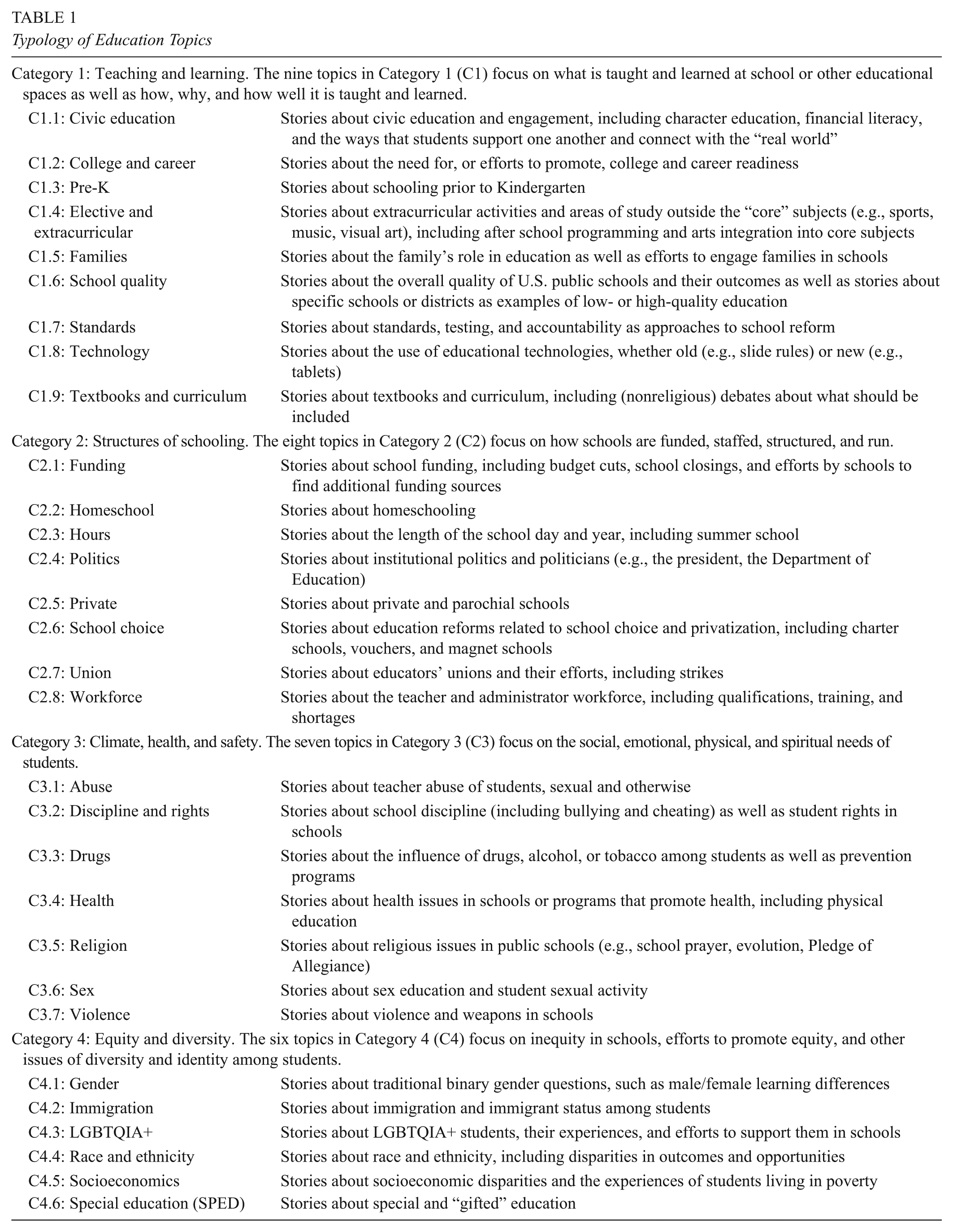
We sought to develop a typology that would allow our research to offer a general view of the broadcast media agenda over the past 35 years while also carving that agenda up into useful topic areas that could speak to prominent education discourses, policy debates, and the findings of past research on news coverage of education. This led us to a two-tier coding system. The first tier includes four umbrella categories that represent major areas of media focus and scholarly and/or public interest. We describe each of these categories in turn before discussing the second tier.
Teaching and learning captures topics related to what is taught and learned in schools and other educational spaces, how it is taught and learned, why it is taught, and efforts to measure or set standards for this learning. This category is most directly related to what Elmore (2010) calls the “instructional core”—the interaction between educators and students in the presence of content—and arguably to the core purpose(s) of schooling.
Structures of schooling includes topics related to how schools are funded and governed; how educators are recruited, hired, supported, and organized; and the politics surrounding public schooling. Although less directly connected to student learning than topics in the first category, these topics have often been heated areas of policy debate, with reform advocates arguing that structural changes (e.g., small schools, school choice, teacher pay) can create a better foundation for student learning (Auguste, Kihn, & Miller, 2010; Ayers, Klonsky, & Lyon, 2000; Ravitch, 2011).
Climate, health, and safety covers a range of topics related to the social, emotional, physical, and spiritual needs of students and how these needs are either supported or endangered in the school context. These stories reflect the public’s hopes that schools can affect negative social dynamics such as drug use, obesity, and unsafe sexual behaviors (Labaree, 2011) as well as its fears for students’ safety, rights, health, and well-being while at school (Auter, 2016). Whether these topics are understood as central or ancillary to the purpose of schools, addressing them is often a prerequisite for creating school climates that foster learning and growth (O’Brennan & Bradshaw, 2013).
Equity and diversity includes stories about inequities in schools, efforts to promote equity, and other questions of diversity and identity. If the teaching and learning category is about what is taught and how, then this category is about who is taught and how. This umbrella category has the most conceptual overlap with other categories. Stories about the racial “achievement gap,” for example, could reasonably fit in this umbrella category or in teaching and learning. However, given the centrality of equity concerns to U.S. education policy and reform as well as the long history of struggles for equity in and through education (Growe & Montgomery, 2003; Noltemeyer, Mujic, & McLoughlin, 2012), we decided it was important to pull these topics into a separate analytic category.
The second tier isolates subtopics in each of the four general categories. We began with a small set of topics developed from the research outlined previously, which evolved and grew through an iterative process of coding a selection of stories, discussing our decisions, revising the coding system, coding a new selection, and repeating this process. We strove to ensure that codes were as conceptually distinct as possible and that they were responsive to both the specifics of the stories and the relevant topic areas in education research and policy. We also worked to avoid codes that captured a particular slant without also including other perspectives. For instance, we wanted to capture the discourse of crisis and school failure that has been documented in the literature, but rather than create a code for failure, we developed a school quality code that could also capture stories of educational successes.
Table 1 presents the full typology, with definitions for each category and topic. Although not indicated on the table, for each of the four major categories we also included an “other” topic so that the typology was exhaustive. These four generic topics were used infrequently in our analysis, which we take to be a good indicator that our typology covers the individual topics likely to arise in most news coverage.
Typology of Education Topics
Method
This study tracked broadcast evening news coverage of pre-K–12 U.S. education from January 1, 1980, to January 1, 2015, a span of 35 years. Broadcast evening news was selected because of its large audience (which has held steady for the past decade at roughly 22.5 million people combined; see Pew Research Center, 2017b) and its unique stability of format. This stability is useful as we draw content comparisons across 35 years, helping to ensure that observed changes are not caused solely by a rapidly changing media environment.
To collect news content, we relied on the Vanderbilt Television News Archive (http://tvnews.vanderbilt.edu), a publicly accessible unit of the Vanderbilt University library system. The most complete of its kind, the Vanderbilt archive has searchable abstracts for every broadcast evening news program since 1968. These abstracts are free to search and analyze (unlike the videos themselves, which the archive loans out for a fee) and thus have been widely used in research. Indeed, the archive’s website hosts a bibliography of the many studies that have relied on it (see http://tvnews.vanderbilt.edu/tvn-citations.pl?SID=20160914290588378&code=). The abstracts do not fully represent every aspect of the stories they summarize but have nonetheless been shown to be an effective means of identifying primary topics in news coverage (Althaus, Edy, & Phalen, 2002; Edy, Althaus, & Phalen, 2005). The abstracts are thus well suited to the goals of the present study.
Seeking the widest range of relevant content possible, we searched the weekday and weekend evening news abstracts for education OR teacher*—the asterisk ensuring that our returns included references to teachers as well as the singular form. This search string—which returned 5,131 abstracts—was selected after running several other possible strings and comparing results. Through this process, we found that including additional terms (e.g., school) largely duplicated the relevant stories returned in our search while also returning many stories that fell outside of our specific focus. To enhance the “precision” of our retrieval process (see Stryker, Wray, Hornik, & Yanovitzky, 2006) and focus on only substantive news coverage of pre-K–12 U.S. education, we manually culled the 5,131 abstracts and deleted any that (a) did not pertain to formal pre-K–12 education (e.g., a human interest story about a martial arts teacher), (b) focused solely on international issues or college education (e.g., a story about tuition increases at universities), (c) was almost entirely about another topic and mentioned education only in passing (e.g., a political campaign story that noted a candidate gave a speech discussing social security, health care, and education but reported no details about these topics), or (d) was 20 seconds or less in duration (which was uncommon). This process left 2,322 abstracts, which were distributed among the three national broadcast television networks as follows: American Broadcasting Company (ABC) = 781, CBS (formerly Columbia Broadcasting System) = 711, National Broadcasting Company (NBC) = 830. These 2,322 abstracts form the basis of our analysis.
Our method of studying these abstracts was quantitative content analysis (see Coe & Scacco, 2017). Specifically, we assigned each abstract a primary topic according to the previously discussed typology. To ensure adequate intercoder reliability (see Krippendorff, 2013), roughly 10% of the abstracts were cross-coded. Chance-corrected reliability (using Krippendorff’s alpha) was .89, indicating a high degree of consistency in the coding. Disagreements were resolved by discussion between the authors.
The online appendix for this article includes a spreadsheet of the 2,322 abstracts, including for each the date, time, and network on which it aired; its duration, topic, and title; and a URL that links directly to the full abstract on the Vanderbilt Archive website.
Results
We begin mapping the terrain of education discourse by looking at the extent of news coverage across our 35-year period of analysis. Throughout this section, we present averages and percentages with no accompanying statistical tests. Working with the census of relevant news coverage renders inferential statistics unnecessary.
In the average year between 1980 and 2014, the three networks combined to average 66 stories, which amounted to 194 minutes of broadcast time. The shortest story was 30 seconds and the longest was nearly 14 minutes, with an average story lasting a little less than 3 minutes. Notably, news attention to education varied considerably over time. Figure 1 illustrates these changes using two measures: stories per year and minutes per year. In both cases, 3-year prior moving averages are used to smooth the trends. Whether looking at stories or minutes, the pattern is much the same. News coverage of education rose slightly in the mid-1980s before declining again and then increased noticeably in the 1990s. It especially swelled near the beginning and end of that decade, then declined in the early 2000s. Attention once again grew from 2004 to 2012, before beginning to decline.

Total news coverage of education.
It is tempting to look at these trends and assume that certain presidential election years (1992, 2000, 2012) generate more news coverage of education. This is true to an extent but is not the whole story. Topics were still quite wide-ranging in peak years and often were driven by events external to the presidential campaigns. In 2012, for instance, the massacre at a school in Newtown, Connecticut, drove much of the coverage. As one illustration of how coverage can vary year to year, Figure 2 charts yearly coverage for the 1980s (with no smoothing of the trends via moving averages). Here again, it would be easy to point to a single event—in this case the publication of the A Nation at Risk report in 1983—as the key force driving an obvious spike in coverage, but the reality is more complex. That report received a handful of stories immediately upon its release (including a lengthy story of more than 6 minutes on ABC) and likely contributed to numerous stories running later in the year highlighting general concerns with educational quality. Indeed, quality (18.1% of stories) and standards (11.7%) were the second and third most covered topics that year. But union stories (19.1%) were actually the most covered topic in 1983, driven in part by a strike in Chicago. Politics (8.5%), including some early presidential campaign coverage, was the other dominant topic that year.

News coverage of education in the 1980s.
Looking more closely at the specific topics of coverage brings the nature of this education news into sharper focus. We begin at the broadest level, with the four overarching typology categories outlined previously. Teaching and learning turned out to be the most covered topic. Across 818 stories it garnered 2,316 minutes of coverage (34% of the total coverage). Stories covering structures of schooling were the next most prominent, with 1,967 minutes of coverage (29%) across 705 stories. Climate, health, and safety received somewhat less coverage: 1,591 minutes (23%) across 499 stories. Equity and diversity was the least covered category, with 911 minutes (13%) in 300 stories.
Figure 3 shows the change over time in these four categories of coverage, again using 3-year prior moving averages to facilitate interpretation. Several points can be gleaned from the figure. First, the patterns occasionally move in sync but often do not. This suggests that coverage of education is not strictly habitual or ritualized in newsrooms but rather is also driven by specific events and changing interests. Second, the extended elevation of news attention to education in the 1990s (noted in the discussion of Figure 1) appears to be driven in large part by a heightened focus on teaching and learning—which, as mentioned, was the most covered category. Indeed, this era saw increased attention to the overall quality of the U.S. school system as well as more focused coverage of civic education and the use of technology in schools. Third, two categories—climate, health, and safety and structures of schooling—have particularly severe peaks in coverage. This indicates that these categories are especially responsive to specific circumstances; the former to acts of violence, the latter to political dynamics (e.g., policy proposals) and workforce issues (e.g., strikes). Finally, the figure indicates just how substantial the changes in various forms of education coverage have been over time. Consider the case of equity and diversity, the least covered category among the four and the one that exhibited the greatest stability across the decades examined here. Even amid this relative stability, equity and diversity received more than five times as much coverage at its peak in the early 1990s as it did during the 2010s. Clearly, news coverage of education has changed meaningfully with the passage of time.

News coverage of education by category.
To better understand the trends underlying the aggregate movement observed thus far, we turn our attention to the 34 specific topics that fall within the four general categories in our typology. Table 2 presents each of these topics from the most covered (in terms of total minutes) to the least. Violence was the single most covered topic, garnering in the average year roughly 22 minutes of coverage (11% of the total coverage) across six stories. Quality was a close second, receiving 19 minutes of coverage (10%) in seven stories. Funding, race and ethnicity, and workforce rounded out the five most covered topics, all receiving at least 12 minutes of coverage (7% each) in the average year. These five topics dominated much of the coverage, accounting for 42% of the total minutes. Just two additional topics, standards and workforce, received at least 5% of the total coverage. The remaining coverage was spread widely across a range of topics, with some topics receiving virtually none. In an especially striking instance of news inattention, coverage of LGBTQIA+ (Lesbian, Gay, Bisexual, Transgender, Queer, Intersex, Asexual, etc.) issues in education received just 26 minutes of coverage over three and a half decades—not even a full minute per year.
Topics in Television News Coverage of Education

Looking at how attention to specific topics rose and fell over time can provide additional insight. Given that our purpose here is not a comprehensive accounting of news coverage of education but rather to introduce this data set and facilitate further examination of this important body of discourse, we provide here just two brief case studies of key topics. In both cases, we conducted initial analysis of the relevant stories, in the spirit of highlighting the rich potential of this data set.
From quality to standards
Both school quality and standards were among the 10 most covered topics, with school quality garnering 10% and standards 5% of the total coverage. And of course, they are related. Stories coded under school quality make assessments about the successes and failures of the education system. Those under standards focus on proposed solutions to issues of quality through standards-based reform (SBR), including common learning expectations, standardized testing, and test-based accountability (see Hamilton, Stetcher, & Yuan, 2008). Figure 4 plots 3-year prior moving averages of these topics to illustrate their movement over time. Two key patterns stand out. The first is that the trends parallel each other quite closely, underscoring the connection between these two topics. Each time debates about school quality became more prominent on the media agenda, SBR also garnered more attention, suggesting that advocates for SBR may have been trying to take advantage of policy windows (Kingdon, 1984) created by increased concerns about school quality.

News coverage of standards in relation to quality.
The second noteworthy trend evident in Figure 4 is that whereas discussion of school quality used to dominate, since the early 2000s, the topic of standards has garnered roughly equal attention. This is no accident. Beginning in the 2000 campaign, presidential nominee George W. Bush made SBR a “centerpiece” of his planned legislation to address education reform (Hamilton et al., 2008). That legislation, No Child Left Behind, was signed into law in early 2002, marking a significant win for advocates of SBR. Since that time, news coverage of standards has become as much a part of the national discourse as has school quality while other reform movements have seen declines in media attention (e.g., multicultural and bilingual education, which is further discussed in the “Race and Ethnicity” section that follows).
Notably, an initial qualitative review of the stories in these categories reveals a clear tendency toward negativity. That is, discussions of standards and school quality more often stressed the failures than the successes of education in the United States. What is more, those stories that were positive often focused on specific cases—for instance, a single school or teacher implementing an innovative program. In contrast, the negative stories often presented general trends, such as a set of disappointing test scores across a district, state, or even nationwide. Together, these trends might suggest to an evening news viewer that the school system is generally disappointing, with only minor moments of achievement. In this respect, part of the “discourse of derision—a stream of disdainful talk and action about public schooling” (Parker, 2011, p. 413; see also Wallace, 1993) that often circulates in American public discourse might be partially explained by journalists’ selection and presentation of specific news topics.
Race and ethnicity
Stories that focused on race and ethnicity made up 6.4% of the total number of stories, with 148. This made race and ethnicity the fifth most common topic by number of stories and the fourth by total minutes of coverage. Coverage varied widely across the years, however, as changing demographics and debates shaped schooling (see Figure 5). In several years, the broadcast evening news devoted no stories at all to race and ethnicity. The most coverage in a single year occurred in 1991, with 13 stories that produced 50 total minutes of coverage. Looking across the decades reveals the ebb and flow of this coverage. There were 33 race and ethnicity stories in the 1980s (95 minutes). The 1990s saw the highest level of coverage (70 stories; 233 minutes), with peaks at the beginning, middle, and end of the decade. The 2000s were not as active in this area, returning to a level only slightly higher than the 1980s (35 stories; 118 minutes).

News coverage of race and ethnicity.
Perhaps most surprising is the dearth of race and ethnicity coverage since 2008. From 2008 to 2014 (the run-up to Obama’s historic election through the end of our data), there were just 11 race and ethnicity stories across all three networks. This accounted for only 31 minutes of coverage. It may be the case that news networks, in covering various racial issues surrounding the election and presidency of America’s first chief executive of color, felt they had devoted sufficient attention to race and thus did not seek out such stories in the context of education. Or perhaps education coverage was swept up in a growing discourse of colorblindness that posited Obama’s rise was a sign of a “post-racial” United States (Bonilla-Silva, 2015). Whatever the cause of this steep decline, it is clear that race and ethnicity has not recently had the presence in education news that it once did.
A closer look at the stories within the topic of race and ethnicity offers a glimpse into the changing face of the debates about racial equity in schools. Questions of segregation, desegregation, and integration were the most consistent race and ethnicity storylines throughout the three and a half decades considered here. In the early 1980s, the focus was on busing programs that transported students of color to primarily White schools as well as on the attendant pushback. Later, with the busing movement in decline, an increasing number of stories focused on the ongoing lack of desegregation in public schools, with coverage driven by anniversaries of Brown v. Board of Education (the landmark Supreme Court ruling that overturned state laws requiring racial segregation in public schools) as well as current court challenges.
The bilingual (English/Spanish) education movement was the next most prominent storyline, consisting mainly of coverage of policy losses for the movement. There was a small peak in the early 1980s around the Reagan administration’s efforts to roll back bilingual education policy and a large peak in 1998 surrounding California’s Proposition 227, which ultimately banned bilingual education in the state. Since 2001, network news has been nearly silent on English/Spanish bilingual education—just one story in 14 years. Interestingly, this later period saw seven stories about the trend of English-speaking students learning Chinese. Unlike stories about English/Spanish bilingual education, in which a “conflict” frame was often dominant (Fleming-Rife & Proffitt, 2004), these stories (with the exception of a controversial mandatory effort in Georgia) situated language learning within a narrative about the need to prepare students for the modern world. The differential treatment of these two types of dual-language learning points to the racial undercurrents of bilingual education debates (see Spener, 1988).
Finally, multicultural and culturally relevant approaches to education garnered attention in the 1990s, with 14 stories. Afrocentric education was prominent in the beginning of the decade, with attention turning in 1996 to the decision of Oakland, California, to recognize ebonics (i.e., African American Vernacular English) as a language in the classroom. Since 2000, however, these topics have all but disappeared (2 stories), giving way to coverage of the racial “achievement gap,” which has been the focus of almost half of the race and ethnicity stories since 2008.
Discussion
This study sought to expand past research on media portrayals of education while providing a foundation for future research. Our analysis of 35 years of education topics in television news coverage reveals several important trends. Overall attention to education has been strikingly limited. We found that between a low in the early 1980s and a high in the early 1990s, the average year has seen 194 minutes of pre-K–12 education news. Using 21,000 minutes as a conservative estimate of the total annual news hole for such programs (20 minutes of actual news content per broadcast, times 350 days of news when accounting for holidays and other preemptions, times 3 networks), pre-K–12 education coverage accounts for well under 1% of the content people see on the network evening news. Consistent with past research that has considered a shorter time period, education news over the past 35 years has indeed been largely “invisible” (West et al., 2009).
Why is education coverage so limited in the evening news? Some insight into this question can be gained by looking at the topics that do get covered. Central among these topics, our data reveal, was violence. News coverage periodically focused extended attention on school shootings and other similar attacks. Quality was also a regular concern of news, as were funding (usually cuts) and workforce (usually strikes). Race and ethnicity also garnered a relatively large amount of coverage, often in response to court cases, legislation, or anniversaries of Brown v. Board of Education. In these patterns, we see just how “event-driven” (see Livingston & Bennett, 2003) education news coverage has been over the past several decades. A violent act, a new set of test scores, a shortage of funds, a strike, a ballot proposition—all would draw the attention of the evening news for a period before coverage returned to its regular pattern. In this respect, education does not have the same advantages that some other topics do. It lacks, for instance, the event-heavy year-round presence of a topic such as politics. And day-to-day, it lacks the drama that television news seeks out (see Bennett, 2016). Put simply, the tendency of news coverage to seek dramatic events ensures that education coverage will not receive a large proportion of coverage. Further, the coverage it does receive will focus quite narrowly on just a few topics that better fit traditional journalistic notions of newsworthiness.
The nature of network television news in particular might also help explain the dearth of coverage we observed. In theory, network television news focuses primarily on issues that affect the entire nation. In practice, as a commercial media entity, it pays close attention to its audience’s likely desires—and its audience is not reflective of the nation. Most notably, it skews older: 53% of Americans 65+ years of age “often” watch network news, whereas only 10% of those 18 to 29 years old do. Moving between these extreme ends of the spectrum, increased age is a steady predictor of higher network television viewing (Pew Research Center, 2016). Given this, a large proportion of the average network television news audience would no longer have school-age children. This is not to say that they would have no interest in pre-K–12 education, but we can probably assume that if networks are choosing between an education story and, say, a health care story, they might decide that their audience would prefer the latter. Such decisions, made casually many times, likely play some role in education receiving scant coverage.
This limited overall attention to education makes those stories that do get covered all the more important for potentially setting the public agenda. Even considering topics alone helps to underscore why researchers have often expressed concern about the tenor of media portrayals of education (e.g., Gerstl-Pepin, 2002; Keogh & Garrick, 2011; Reyes & Rios, 2003; Thomas, 2006; Ulmer, 2016). One can imagine the fragmented and potentially negative image of the U.S. school system these patterns of coverage might cast in the mind of a viewer who does not have other regular means of contact with the school system: an institution known mainly for episodes of violence, labor struggles, budget cuts, and generally poor quality amid pockets of excellence.
There are many more aspects of education that merit national media attention. And yet, it is perhaps too simple to just state that network television news should have more coverage of education. Those who produce the news work within serious time constraints and have to choose among a wide range of topics that might warrant attention. In some respects, a simple charge to “cover education more” is akin to well-intentioned legislators demanding that classroom teachers devote more time to a certain subject. Although perhaps useful in the abstract, the realities of implementation might be impossible for a teacher whose class time is already stretched thin among existing requirements. With this in mind, a more plausible normative shift might be for network news to present a fuller picture of education. For example, some of the disproportionate amount of time currently devoted to violence might be better spent on topics that are more mundane but no less important. Additionally, given the constraints of network news as a vehicle for substantive coverage of education, it will be important for other venues—websites that support longform news content, for instance—to play a role in providing needed information about the U.S. education system.
Naturally, this study was not without limitations. Our focus on a single news source increases the validity of our over-time comparisons but necessarily limits our ability to speak about news coverage in general. Additionally, although the utility of abstracts in representing major news topics has been demonstrated in prior research (Althaus et al., 2002; Edy et al., 2005), there is still the possibility that some topics in the stories may not have been fully captured in the abstracts and thus not present in our analysis. Moreover, our choice to focus on pre-K–12 education in the United States leaves out stories on postsecondary and international education. Finally, we have focused herein solely on content as opposed to effects. We assume, based on past research, that exposure to media portrayals of education can have important effects on some individuals. But it bears noting that the present study provides no evidence of such effects.
These limitations notwithstanding, we hope that the preliminary analysis of education topics that we have offered can provide a useful foundation for future scholarship. The typology we have proposed should be applicable to any news format and thus allow for more consistency in future research that seeks to track the content of education news. Just as important, for those scholars interested in specific education topics, our online appendix can provide immediate access to a collection of broadcast television news story abstracts on that topic. This should facilitate both quantitative and qualitative analyses of specific education topics that a researcher wants to analyze in detail over a specific time span (e.g., Feuerstein, 2014).
By way of example, we briefly discuss two future directions that seem valuable. First, it would behoove scholars to more fully explicate the “discourse of derision” that appears to characterize much of the public discussion about education (see Parker, 2011; Wallace, 1993). Does this discourse become manifest primarily in a negative news tone, for example? Or are there subtler indicators, such as marginalization of teacher voices? Second, there is much to explore in the umbrella category of equity and diversity. In addition to considering what is and is not covered, it would be valuable to look at who is and is not asked to speak for marginalized groups and the reforms meant to benefit them. Another line of inquiry could consider how news coverage handles the intersectionality of identity (Crenshaw, 1991). There is some coverage, for example, of the education of youth who are both raced and gendered (e.g., Black boys). Such intersections deserve more detailed analysis. Scholars interested in these and other questions could draw an excellent sample of stories from our online appendix, retrieve full-text transcripts (when available), and perform quantitative or qualitative analysis to provide a fuller picture than presently exists. These and other avenues for future research should help usefully broaden our understanding of media portrayals of education.
Footnotes
Acknowledgements
We thank Alley Agee, Kevin John, Zachary Jones, Meaghan McKasy, Dakota Park-Ozee, and Manusheela Pokharel for their assistance with data collection.
Authors’ Note
The authors are listed alphabetically.

Authors
References
Supplementary Material
Please find the following supplemental material available below.
For Open Access articles published under a Creative Commons License, all supplemental material carries the same license as the article it is associated with.
For non-Open Access articles published, all supplemental material carries a non-exclusive license, and permission requests for re-use of supplemental material or any part of supplemental material shall be sent directly to the copyright owner as specified in the copyright notice associated with the article.
