




Abstract
Collective efficacy, a group’s belief in its capabilities to reach a goal, is an important organizational property repeatedly linked with student achievement. However, little scholarship specifies the antecedents of collective efficacy. To fill this gap, this study examines a potential predictor of collective efficacy: teachers’ social networks. The authors employ social network and regression analysis to explore the relationship between network density, network centralization, and collective efficacy in 20 middle school mathematics departments in two large, urban districts across 3 years. Collective efficacy had a significant relationship with density, but not centralization, when controlling for school demographics. The findings underscore the importance of network density to school improvement reforms. Policymakers need to consider policies that support the building of a dense network, which could increase collective efficacy and, ultimately, student achievement.
This article makes a significant contribution to the literature on collective efficacy beliefs in several ways. First, this study is situated in two urban districts undergoing mathematics reform. Since the inception of the Elementary and Secondary Education Act in 1965, American educational policy has focused on mitigating the achievement gap between underserved students and their peers. In particular, the past two decades of standards-based accountability reforms (Supovitz, 2009) have disproportionally impacted urban schools. To this end, learning about factors relating to high levels of collective efficacy is essential for improvement of student achievement to advance goals of educational equity in large, urban districts.
Second, limited research brings social network analysis into conversation with collective efficacy. We located a single study examining the relationship between teachers’ social networks and collective efficacy (Moolenaar et al., 2012). Our article builds upon Moolenaar et al.’s (2012) work, which was set in the Netherlands, considering an American urban middle school context, as compared to a European elementary school context, across multiple years. Finally, we study middle school mathematics departments as the unit of analysis, which is an important aspect of the American middle school context. Elementary and middle schools have different organizational structures, the former organized in self-contained grade-level classrooms and the latter organized by content area. Such differences in organization likely have implications for teachers’ social networks. For example, teachers may have substantively different conversations with content peers as compared to those who teach the same grade level. These interactions are of particular importance to consider in education reform as social networks tend to be important to reform initiatives at scale (Cobb & Jackson, 2011). This fine-grained analysis helps illuminate the social factors that lead to department-level collective efficacy in a subject matter that is traditionally elusive for American students; both the International Mathematics and Science Studies and the Programme for International Student Assessment demonstrate that American children are below average in mathematics as compared to other industrialized nations in both eighth- and 12th-grade mathematics (National Center for Education Statistics, 2010, 2011).
Bandura’s (1993, 1997) social cognitive theory asserts that teachers’ perceptions of both self and organization influence their actions. The beliefs that emerge from the interactive process in schools influence both participants’ well-being and their perception of colleagues’ capability. Organizational beliefs are an important aspect of school culture. Collective efficacy is a way of distinguishing the normative environment, an attribute of school culture (Hoy & Miskel, 2013); such norms influence teachers’ behavior. Teachers’ beliefs about their faculty’s capability to educate students constitute a norm that influences the actions and achievement of schools. The resulting culture can be invigorating or dispiriting to the school’s social system. Collective efficacy espouses reciprocal causation between the self, environment, and behavior. In his seminal work, Bandura (1993)defined collective efficacy as a group’s belief that it has the will and skill to achieve a particular goal. In other words, collective efficacy is a group’s sense that it is able to produce student learning irrespective of barriers. This aspect of school culture is a dynamic property, as teachers both contribute to and are influenced by the collective efficacy of their colleagues. Collective efficacy is beyond an aggregate of self-efficacy; it measures how individuals feel about a group’s shared capability (R. Goddard & LoGerfo, 2007).
Collective efficacy beliefs are influenced by the same four sources of information associated with self-efficacy: (a) mastery experience, (b) vicarious experience, (c) verbal persuasion, and (d) physiological and affective states (Bandura, 1986, 1997). These four sources are also related to social networks. Mastery experiences at the school level include both success and failure; success tends to build collective efficacy, while failure tends to undermine it. Social networks can be critical to the formation of collective efficacy via mastery experience at a school level. Individual teachers can have success in their own classrooms, but if a connected social network does not exist in the school, then it will be difficult to transmit that success to others. When teachers are directly aware of the success of their colleagues, then their belief in the collective capabilities of the faculty will increase.
Whereas direct experience is an example of a mastery experience, other sources, such as the accomplishments of other schools, provide vicarious experience. This is a particularly relevant intersection with social networks, as school leaders in different schools might offer opportunities to their staff to participate in vicarious experience. For example, if a faculty is implementing a new curriculum, the school leader might facilitate a visit and meetings with a school that has already had some success implementing said curriculum. Another means of strengthening a school’s collective efficacy is verbal persuasion, which might be delivered by a principal, coach, or teacher in the form of workshops, professional development, or other group meetings where the faculty as a whole attends. Verbal persuasion is communication through information flow within or between buildings, again relying on social networks. Finally, organizations, like individuals, have affective states; they react to stress, pressure, successes, and challenges. The interactions between individuals and organizations are through social networks and hence can inform collective efficacy beliefs.
Collective efficacy demonstrates a consistently positive relationship with student achievement. In Bandura’s (1993) seminal study, collective efficacy was positively and significantly related to school-level student achievement in both mathematics and reading, even when considering SES. Multiple studies expanded on Bandura’s initial scholarship and linked collective efficacy to student achievement in multiple subject areas and school contexts (e.g., R. Goddard et al., 2000; Hoy, Sweetland, & Smith 2002; Tschannen-Moran & Barr, 2004). Given the link between collective efficacy and student achievement, understanding collective efficacy in and of itself is a worthy endeavor. Although the exact mechanism through which collective efficacy affects student achievement is unknown, research has explored potential pathways. Scholars have postulated that high collective efficacy results in schools setting more ambitious goals and persistence leading to improved student achievement (R. Goddard et al., 2000). A recent study has also shown a positive and significant link between the level of collective efficacy in a school and teachers’ instructional practices (Berebitsky & Salloum, 2017). In addition, Moolenaar and colleagues (2012) found that collective efficacy is the mediating factor between social networks and student achievement. In other words, in schools with more dense social networks, collective efficacy is likely to be improved, leading to increased student achievement. We extend this research by focusing on potential antecedents of collective efficacy.
We hypothesize that characteristics of the school social network are factors that can predict collective efficacy. In prior research, aspects of the school social network were linked to teachers’ self-efficacy; Siciliano (2016) found that knowledge access and peer influence have a significant and positive relationship with teacher self-efficacy. The act of turning to another colleague for advice is evidence of having faith in an individual’s capability. If schools are characterized by such social interaction around instruction, likely collective efficacy is strengthened. To this end, we focus in this study upon an aspect of school structure that is likely related to collective efficacy: teachers’ social networks.
Schools are social institutions by design; the organization of a school facilitates or impedes instructional interactions between students and teachers and collegial activities among teachers (Wenger, 1998). Logically, then, such organization may contribute to collective efficacy just as collective efficacy may inform school organizational structure. To explicitly examine school structure, we utilize social network theory. Recently, researchers have used social network analysis (Scott, 2000) to study teacher and school capacity (e.g., Coburn & Russell, 2008; Daly & Finnigan, 2010, 2011). Existing research suggests that network ties can either support or hinder organizational change (Krackhardt, 2001; Mohrman, Tenkasi, & Mohrman, 2003; Tenkasi & Chesmore, 2003).
Those who study social networks draw upon social capital theory (e.g., Bourdieu, 1986; Coleman, 1988, 1990; Lin, 2000). Social capital is an economic analogy, suggesting that people may invest in and profit from their social connections; in other words, social capital refers to the resources embedded in relationships. Specifically in a school context, social networks may connect teachers to both knowledge and resources. Social network theory allows for a detailed exploration of the nature of teacher relationships (Moolenaar, 2012). Often, a school’s social network departs from traditional formal hierarchical structure (Coburn, 2005; Penuel, Riel, Krause, & Frank, 2009).
Social networks are particularly important in school settings, as many reforms, such as professional learning communities, are attempting to make teaching a more collaborative field (Y. Goddard, Goddard, & Tschannen-Moran, 2007). Recent scholarship illustrates variability in the extent to which teachers interact with one another (Moolenaar, 2010), and this research has shown that when teachers interact around instruction, their social networks play an important role in the diffusion and implementation of educational reforms (Frank, Zhao, & Borman, 2004). Such communal activity allows teachers a space to collaborate, understand their colleagues’ knowledge and skills, and exchange resources, and provides an opportunity to see their colleagues as capable of bringing about change to students and instruction, thereby enhancing collective efficacy.
Understanding teachers’ advice-seeking patterns offers insight into how teacher collaboration influences instructional practice and reform implementation (Moolenaar, 2012). Teachers requesting advice on instruction are more likely to evolve their practice (Parise & Spillane, 2010), as social networks play a critical role in the dispersion and implementation of educational reforms (Frank et al., 2004; Penuel, Sun, Frank, & Gallagher, 2012). For example, in a study of teachers’ social networks in the first 2 years of a mathematics reform at scale, in networks with strong ties characterized by frequent interaction, teachers were more likely to maintain their pedagogy amid a changing environment (Coburn, Russell, Kaufman, & Stein, 2012). Teachers who have implemented reform are more likely to maintain and deepen implementation if they are situated in networks with expertise (Coburn et al., 2012; Frank, Zhao, Penuel, Ellefson, & Porter, 2011). Furthermore, across 53 Dutch elementary schools, well-connected networks were associated with stronger levels of collective efficacy, which in turn supported student achievement (Moolenaar et al., 2012). In sum, these studies suggest that access to expertise, facilitated by social networks, is important for the implementation of instructional innovation and social norms. The implication of these findings is that schools can be structured to facilitate teacher interactions. There are structural considerations, such as ensuring that teachers of similar grade level and/or content have time and space during the school day to collaborate. Perhaps more important is the creation and maintenance of norms of collaboration, which is vital to creation of a strong school network.
Social networks are as varied as the schools in which they are situated, and a common type of social network studied is an advice-and-information network (e.g., Spillane & Kim, 2012), which is the type of network we explore in this paper. Social network theory builds on strong methodology to visually depict relationships among individuals (Borgatti, Everett, & Freeman, 2002; Borgatti, Everett, & Johnson, 2013). Given the endless ways in which to configure the social structure and patterns of communication, we consider two measures of social network structure: density and centralization. Social network theory has highlighted the importance of group cohesion among actors, as it can strongly influence communication, decision making, and support processes (Blau, 1977; Friedkin & Slater, 1994; Moolenaar, 2012). More cohesive, or dense, networks can facilitate quick and efficient movement of resources and knowledge as compared to sparsely connected networks (Finnigan & Daly, 2012; Scott, 2000). “A cohesive communication network among the teachers in a school indicates that the school is a workplace in which a variety of interpersonal transactions and collective achievement occur frequently” (Friedkin & Slater, 1994, p. 142). In this study, we employ an indicator of cohesion: network density. The density of a network is measured by dividing the number of connections between actors in a closed system by the total possible connections.
Another aspect of the structure of a social network illuminates how centralized the network is. Is the network centered on a single person? Or do a number of actors take central roles in distinct subgroups? At an individual level, network researchers often study centrality, which measures how central an actor is in the network. The higher an actor’s centrality, the more likely the actor is to develop, maintain, and exercise interpersonal influence (Friedkin & Slater, 1994). At the simplest level, researchers calculate centrality by taking the number of times an actor is nominated and dividing by the number of possible nominations. However, centrality is an individual-level measure, and we are interested in the structure of the network at a school level.
The centralization of a network refers to how central the most central person in the school is compared to everyone else in the school. Specifically, centralization measures the variability in centrality of all actors in a network (Moolenaar, 2012). Like density, centralization influences the flow of knowledge and resources throughout a system, with research indicating that highly centralized networks can sometimes become overreliant on one individual, who often gains an inordinate amount of influence on the dissemination of knowledge and resources (Finnigan & Daly, 2012; Finnigan, Daly, & Che, 2013). In this study, we employ Freeman’s indegree graph centralization (Freeman, 1977, 1979; Hanneman & Riddle, 2005). Although not mutually exclusive, density and centralization are not simply two sides of the same coin. A centralized network does not necessarily have a low density and vice versa.
Recent research postulates that structural aspects of the school network, specifically density and centralization, have indirect effects on student achievement (Moolenaar et al., 2012; Pil & Leana, 2009) by influencing other teacher- and school-level factors, including collective efficacy (Moolenaar, 2012). We seek to understand differences in collective efficacy across schools in urban contexts focused on reform. Is collective efficacy different when the network has a few knowledgeable teachers to whom most people turn (centralization), more teachers in communication with each other (density), or some combination of density and centralization?
The Current Study
Given the commitment to school improvement under recent federal policy, this study was situated in two urban districts engaged in reforming middle school mathematics with emphases on ambitious (Lampert, Beasley, Ghousseini, Kazemi, & Franke, 2010) and equitable (Cobb & Jackson, 2011) teaching. Moreover, these districts were attempting to improve instruction in all classrooms across the whole district and had implemented a number of reforms, including professional development and instructional coaching, aimed at supporting the improvement process. However, research has repeatedly shown that large-scale reform efforts aimed at improving instruction rarely produce lasting changes in the classroom (e.g., Elmore, 2007; Gamoran, 2003) as these reforms often focus either exclusively on what happens inside the classroom or the organization of schools and not both (Cobb & Jackson, 2011; Coburn, 2003).
Our review of the literature illustrates the potential of collective efficacy as an antecedent of student achievement and as a vital construct to consider within school reform initiatives. However, there is limited work on predictors of collective efficacy (Tschannen-Moran & Barr, 2004) and, in particular, how teacher network structure might contribute to a school’s levels of collective efficacy. Researchers have shown that aspects of the school network have the potential to impact collective efficacy (Moolenaar, 2012) and thus indirectly affect student achievement (Moolenaar et al., 2012; Pil & Leana, 2009). Considering the sources of collective efficacy identified by Bandura (1986, 1997), structural aspects of a school’s social network could influence the level of efficacy in the building by enabling the dissemination of knowledge and resources necessary for success and, thus, mastery learning. Further, a dense or highly centralized network could facilitate vicarious learning via sharing of classroom successes. Finally, school leaders wanting to verbally persuade teachers of the necessity for instructional reforms may have an easier time achieving buy-in if many close ties characterize the school network or if the network has a few very central figures (i.e., a more centralized network).
In this study, we aim to learn how teachers’ social networks may associate with collective efficacy, particularly in urban school contexts engaged in large-scale mathematics reform efforts. This is not a causal study, and we do not seek to establish the direction(s) of the relationship between the organization’s social structure and collective efficacy. We seek to understand the relationship between specific aspects of the school social network, specifically density and centralization, and the level of collective efficacy. This leads us to the following research questions. In two urban districts engaged in large-scale middle school mathematics reform over 3 years,
Does network density have a significant relationship with collective efficacy?
Does network centralization have a significant relationship with collective efficacy?
Method
Sample
The data for this study come from three school years (2011–2012, 2012–2013, 2013–2014) of a longitudinal project investigating how large, urban districts improve middle school mathematics instruction at scale (i.e., across a whole district). Data were collected from two American, urban districts, Districts B and D, that both envision high-quality mathematics instruction aligned with the National Council of Teachers of Mathematics’ (2000) recommendations. District B is located in a southern state, serving over 80,000 students. The majority of the student body is ethnically Hispanic (nearly 60%), with 25% of students identifying as Black and 14% of students identifying as White. Over 75% of the students are economically disadvantaged, and 28% of the students are English learners. Located in a midwestern state, District D serves over 94,000 students. In contrast to District B, the majority of the student body, nearly 52%, identifies as White. Over 36% of students are Black, and only 7% are Hispanic. In addition, roughly 63% of the students are eligible for free/reduced-price lunch (FRL), and fewer than 4% are English learners.
As the goals of the larger project focus on the ways that districts and schools support systemwide improvement of middle school mathematics instruction, data collection focused heavily on mathematics teachers and administrators. Although 25 schools (12 from District B and 13 from District D) participated in the 1st year, four schools dropped out in the 3rd year. In addition, another school had only two teachers provide network data in the 3rd year, which was insufficient to calculate density and centralization. Although these schools were replaced in the sample, our final sample includes only schools that had 3 years of complete data, resulting in a sample of 20 schools. Among other collected data, all mathematics teachers, mathematics coaches, principals, and assistant principals who oversaw mathematics in each school were asked to complete social network surveys that surfaced whom teachers and administrators talk to about aspects of mathematics instruction. In addition, teachers were asked to assess the level of collective efficacy for mathematics in each school. Therefore, our analysis focuses only on the bounded social network of mathematics teachers and administrators as opposed to the entire staff. Studying a subset of the school’s social network was appropriate given that the districts and the larger study were focusing on the improvement of middle school mathematics instruction, and our goal in this study is to understand how the collective efficacy (in this case, the mathematics department of a middle school) relates to the social network of that organization.
In total, surveys were sent to every mathematics teacher, coach, and administrator who oversaw mathematics. Social network analysis is particularly susceptible to missing data, and therefore, we endeavored to obtain responses from all potential participants. Surveys were sent electronically to each respondent’s school e-mail, and after 6 weeks, those who had not completed the electronic survey were sent a paper copy to complete. Nearly all respondents replied to the survey, with response rates above 90% in each of the 3 years. The full math department size in each school (regardless of response rate) was used in the calculation of density, centralization, and number of nodes.
Variables
The main variables of interest in this study are collective efficacy and two measures of the mathematics department social network: density and centralization. As explained below, we also include controls for the district, mathematics department size, percentage students of color, percentage students eligible for FRL, and average experience of teachers in each mathematics department.
Collective efficacy for mathematics
All mathematics teachers were asked to assess the level of collective efficacy among teachers using a slightly modified version of the standard 12-item collective efficacy scale (R. Goddard, 2002). Five items were modified to specify mathematics teachers instead of teachers in items such as “Mathematics teachers in this school are able to get through to difficult students.” A tension in the measurement of efficacy beliefs is the specificity of the questions as efficacy beliefs are both “task-and situation-specific” (Pajares, 1996, p. 1). This slight modification was important given our investigation of mathematics department social networks instead of the full school social network. The other items were not adjusted, as they focused more heavily on students as opposed to the content. To construct the measure of collective efficacy, each of the 12 items was aggregated to the school level to calculate the average of all teachers’ responses. Then, we conducted an exploratory factor analysis using principal axis factoring per standard procedure (e.g., R. Goddard, 2002). The exploratory factor analysis also allowed us to ensure that the modified items behaved in a similar manner to the established scale, and the resulting factor structure demonstrated the items worked similarly (see Table 1). The strong reliability of our measure (Cronbach’s alpha = .86) was consistent with R. Goddard’s (2002) 12-item measure.
Collective Efficacy Factor Loadings (N = 60)

Items were reverse coded.
Network density and centralization
The network survey asked respondents, “Is there anyone, in your school(s) or in the district, who you talk to about teaching mathematics outside of scheduled meetings?” Teachers, coaches, and administrators identified the name of the person, the person’s role in the school (e.g., teacher, principal), and how often they interacted with that individual. Respondents could nominate up to 10 people. Although we limited the number of potential nominees, no respondent reached that limit; the largest number of nominations by a single respondent was eight. These data allowed us to identify the informal advice-seeking and/or collaborative networks of mathematics teachers and administrators in each school (we will refer to the advice-seeking and/or collaborative network as a social network throughout the paper). Respondents could name somebody from outside of the school, which they did only in a few cases; however, we focused only on the bounded school networks and thus excluded those few out-of-network cases. Two measures of the structure of the mathematics department’s social network were tested in the analyses: density and centralization.
Density
The density of a network is calculated by taking the ratio of the number of ties between school members and the number of possible ties. A tie occurs when one actor nominates another, so between a pair of actors, there can be two possible ties. For example, in a system including four actors, there are 12 possible ties. The number of possible ties included all potential respondents in a mathematics department regardless of participation in this study. A denser network means that more teachers report being directly connected to each other. Density is reported as a percentage bounded between 0 and 100.
Centralization
As discussed in the literature review, the centralization of a school network refers to how central the most central person in the school is when compared to the entire staff. For example, in a school where teachers report consulting with the coach exclusively for instructional advice, only the coach will be central to the network (with a high measure of centralization). The specific measure of centralization used in this paper is calculated using the Freeman indegree value (Freeman, 1977, 1979; Hanneman & Riddle, 2005) calculated by the UCINET software package (Borgatti et al., 2002). This calculation is based upon what is referred to as a star network. A star network is one in which all members of the network point to one and only one person. Centralization is calculated by taking the degree of variance in the network divided by the variance of a perfect star network of the same size and is bounded between 0 and 100 (Hanneman & Riddle, 2005). Higher centralizations thus indicate networks where there is a highly nominated central figure.
Controls
In our analysis, we included five control variables that had the potential to influence the mathematics department network and/or collective efficacy. We accounted for the size of the mathematics department network, as past research has shown that school size can influence both the structure of a social network (Spillane & Kim, 2012) and the level of collective efficacy in a school (R. Goddard & Goddard, 2001). In calculating the number of nodes, we included all potential respondents in a mathematics department regardless of participation in this study. Specifically, we used the number of nodes in the mathematics department’s social network, which includes the number of mathematics teachers, instructional coaches, principals, and assistant principals. Although this control includes more than just mathematics teachers, the addition of the administrators and support staff did not radically alter the numbers. In year 1, the average school had 14.80 nodes (SD = 3.52; see Table 2), and the mean number of mathematics teachers was 12.48 (SD = 3.75); the small difference between these numbers indicated to us that most schools were adding one or two administrators and one coach per school. We used the number of nodes in the calculation of both density and centralization, as this was the best option to help us understand the relationship of mathematics department size and collective efficacy.
Means and Standard Deviations of All Variables by Year (N = 60)

Note. FRL = free/reduced-price lunch.
We controlled for the mean years of teaching experience across all teachers in each mathematics department, as the level of experience may influence either the network or the efficacy of the teachers. For example, novice teachers might reach out to colleagues more often to get advice on mathematics teaching. Finally, we included two controls for the sociodemographics of the school, percentage students of color and percentage of students eligible for FRL, as school context could be associated with collective efficacy. Both of these measures were calculated on a scale of 0 to 100 of the percentage of students identifying their race-ethnicity as non-White or eligible to receive FRL. We controlled for context as it may have a relationship with how teachers interact. For example, department size may influence how often teachers communicate and the quality of those interactions. We also took into consideration student demographics, such as SES and race. It is plausible that teacher relationships and interactions vary in relation to student demographics. It could be that teachers lean on each other more or less often when working with high-poverty students. In addition, previous research illustrates a negative correlation between collective efficacy and schoolwide measures of disadvantage in urban schools (e.g., R. Goddard & Goddard, 2001). These demographic measures were obtained from the National Center for Education Statistics’ Common Core of Data. In order to account for any potential differences between District B and District D, we included a district dummy fixed effect (District B), and to account for any potential differences across years, we included two year fixed effects (Year 2 and Year 3, which leaves Year 1 as the comparison group).
Analysis
To respond to our research questions, we employed ordinary least squares (OLS) regression with collective efficacy as the dependent variable and density and centralization as the independent variables of interest. We also included the controls described above: percentage students of color, percentage FRL students, mathematics department size, and average years teaching experience. Fixed effects for district and year were included as well. In addition to this model, we checked the stability of our findings using a multilevel model nesting years in schools. Our limited sample size (20 schools over 3 years) restricts the power of this model, but we felt that controlling for the variability between schools in this manner would serve as an additional check on the findings.
Results
Basic descriptive information about the 20 schools over the 3 years can be found in Table 2. Overall, the mean school density was 8.04% (SD = 4.24%) and ranged from 6.56 to 10.65 across years. In addition, centralization ranged from 17.88 to 23.24 and had a mean of 20.30 (SD = 11.26). As a proxy for size, the average school had 12.47 nodes (SD = 3.69), and the mean years experience for teachers in a mathematics department was just under 9 years (SD = 2.62). As described in the Method section, both districts were in large, urban contexts with typically underserved populations of students. When we examined the sociodemographics of the schools in our sample from each district, we observed differences. The average school served student bodies where 74.30% were eligible for FRL and 71.93% identified as a student of color; however, both of these measures had large standard deviations (14.32% and 21.75%, respectively), indicating variation across the sample.
Prior to conducting the regression analysis, we constructed a correlation matrix to understand the relationships among the variables (see Table 3). The correlation matrix reveals that, in these schools, collective efficacy had positive relationships with density (r = .24), but the relationship with centralization was close to zero (r = .03). Further, collective efficacy did not seem to be related to the number of nodes in a school (r = .02). However, the percentage of FRL students (r = –.10) and the percentage of students of color (r = –.15) had small, negative relationships with collective efficacy. In addition, collective efficacy seemed to have a small, positive correlation with the average experience of teachers in the school (r = .11).
Correlation Matrix of All Variables Across All Years (N = 60)

Note. FRL = free/reduced-price lunch.
Results of the regression analysis (see Table 4) reveal important relationships between collective efficacy and the variables in our model. None of the five school descriptive measures had a significant association with collective efficacy. In addition, the district and time fixed effects did not indicate that collective efficacy varied between districts or across time when controlling for these other measures.
Regression Analysis on Collective Efficacy (N = 60)

Note: R2 is .15. FRL = free/reduced-price lunch.
p < .05. **p < .01. ***p < .001.
Our research questions focus on how density and centralization associated with the level of collective efficacy in a school. The results of the regression indicate that density, but not centralization, was significantly related to collective efficacy. Schools with dense networks also tended to have high levels of collective efficacy. Specifically, for each percentage increase in a school’s density, collective efficacy increased by a tenth of a standard deviation when accounting for the controls in our model. Overall, our model accounted for just over 15% of the variance in the collective efficacy of these schools.
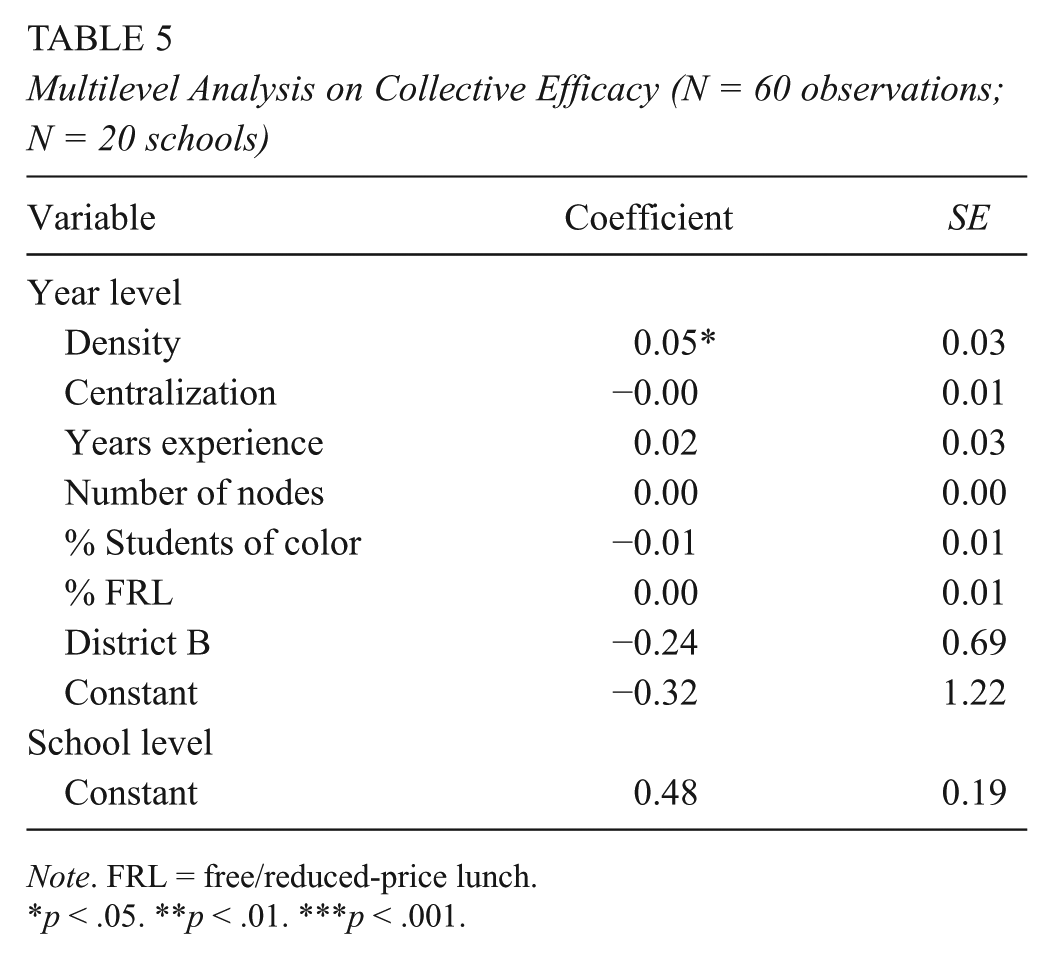
One limitation of this model is that it assumes independence among the schools even though the same 20 schools are measured at each time point. To account for this, we also ran a multilevel model with years nested in schools. The model, which can be seen in Table 5, supports our findings in the OLS model. Density remains the only independent variable that has a statistically significant relationship with collective efficacy; however, the size of the coefficient does shrink in this model. Overall, both models seem to indicate that the density of a school’s network has a positive relationship with collective efficacy.
Multilevel Analysis on Collective Efficacy (N = 60 observations; N = 20 schools)
Note. FRL = free/reduced-price lunch.
p < .05. **p < .01. ***p < .001.
Discussion and Conclusions
The difficulty in improving instruction at scale has led researchers to study the important elements necessary in a district to facilitate the process. As part of their theory of action, Cobb and Jackson (2011) suggest that one critical component to reforming instruction at scale is the existence of a network of professional relationships among teachers to facilitate dissemination of knowledge and innovations. In addition, multiple scholars have discussed the importance of culture and teacher beliefs in reforming classroom instruction (e.g., Sarason, 1996). This paper provides insight into the relationship between teacher networks and an important aspect of a school’s culture, collective efficacy. The work of Bandura (1986, 1997) illustrates that the level of collective efficacy in an organization is influenced by four sources: mastery experience, vicarious experience, verbal persuasion, and physiological and affective states. In schools, collective efficacy can thus be built not just by the success of the individual or group (mastery experience) but by the accomplishments (vicarious experience) and the encouragement (verbal persuasion) of others. Teachers’ social networks facilitate these sources.
In this study, regression results indicate the density of teacher networks in mathematics departments was positively and significantly related to levels of collective efficacy across 3 years of data. In other words, when more teachers turn to more colleagues for advice regarding instruction, collective efficacy tended to be higher. Although we cannot conclude a causal relationship between the measures, network characteristics may directly influence the formation of collective efficacy. For example, a dense network has the potential to facilitate quicker and more efficient dissemination of resources and knowledge (Finnigan & Daly, 2012; Scott, 2000), which can increase both mastery and vicarious experience in the department, thus raising collective efficacy. In addition, prior research has shown that teacher self-efficacy, via the mechanisms of verbal persuasion and vicarious experience, can be built through teachers’ social networks (Siciliano, 2016). Researchers have hypothesized that aspects of the school social network can influence student achievement indirectly (Moolenaar et al., 2012; Pil & Leana, 2009) via mechanisms such as collective efficacy (Moolenaar, 2012), and the findings of our analysis support this hypothesis. Although we were not able to take the next step and link collective efficacy to student achievement, a strong literature base has made the connection (e.g., Bandura, 1993; R. Goddard et al., 2000; Hoy et al., 2002; Moolenaar et al., 2012; Tschannen-Moran & Barr, 2004).
The results of this analysis also showed that centralization did not significantly relate to the level of collective efficacy in our sample of schools. Centralization is important to consider, as it indicates that there is a central figure in the school who can develop, maintain, and exercise interpersonal influence (Friedkin & Slater, 1994), and that influence can act as a form of verbal persuasion or vicarious experience that increases collective efficacy (Bandura, 1986, 1997). However, verbal persuasion and vicarious experience tend to be weaker sources of information that influences efficacy, which may explain the lack of significant relationship between centralization and collective efficacy. It is also possible that centralization influences collective efficacy only when the central figure has the expertise to share knowledge and experience across the teacher network. Future researchers should consider who is the central figure in teacher social networks and how he or she disseminates knowledge within a school or department.
Perhaps the most salient contribution of this study is to add contextual understanding to the relationship between collective efficacy and teachers’ social networks in urban middle school math departments. We build on the work of Moolenaar et al. (2012) by focusing on how characteristics of teacher networks relate to collective efficacy in American urban middle schools. The authors explored these relationships in Dutch elementary schools, and we wanted to see if the findings held when in different contexts, in both level and nationality. Our findings do align with Moolenaar et al.’s work, and together the findings demonstrate that the relationship between aspects of school culture, specifically collective efficacy, and teacher social networks persists across grade levels and countries.
Limitations
Like all research, there are limitations in our study. Given that these data were collected from two urban districts, the findings have limited generalizability. Focusing on schools with complete data across all 3 years of the study also limited our sample size. Although our sample was enough to find a significant association between network density and collective efficacy, a larger and more diverse sample would allow us to better explore this relationship and others. A larger sample would also allow for the inclusion of more covariates, such as the number of years in the school, willingness to adopt innovations/reforms, and openness to collaboration. These covariates are a sample of the potential confounders that could influence our model and thus warrant further study.
In addition, this was a study of mathematics teams as opposed to entire faculties. It is possible that network density and centralization operate differently across the entire middle school staff as opposed to one content-area team. Future researchers may consider school-level analyses across content areas to understand communication patterns within and between academic units. It is also important to remember that the existence of an advice-seeking relationship between teachers does not guarantee that the relationship is productive from an instructional improvement standpoint. Although network density was significantly and positively associated with the level of collective efficacy, density on its own is not necessarily productive if the members of the network are lacking in knowledge and skills. Expertise can be disseminated only if it exists in the network. Research that considers the quality of the interactions among teachers could also shed more light on the relationship between social networks and collective efficacy.
Implications for Practice, Research, and Policy
There are implications for school leaders as they consider the school organization around educational reform and, specifically, professional development for their teachers. Many researchers suggest principals who are actively involved with instruction lead successful schools (e.g., Edmonds, 1979; Hallinger, 2005). However, principals are not the only instructional leaders in schools, and scholars, practitioners, and policymakers need to take a distributed perspective of instructional leadership (Neumerski, 2013; Spillane & Healy, 2010). The findings for density and centralization seem to indicate that instead of simply having one knowledgeable central figure, it is critical to facilitate discussion among and between teachers to foster a belief in the collective capabilities of a faculty. For instance, school and district leaders may want to consider the use of instructional coaches to facilitate the formation of dense teacher networks, as prior research has shown that coaches can influence the nature of teachers’ interactions (Coburn & Russell, 2008; Sun, Wilhelm, Larson, & Frank, 2014).
Although our analyses illustrate that density significantly relates to collective efficacy, it is possible that collective efficacy also impacts the way schools organize. In other words, because we cannot disentangle causality, mutual causation or a feedback loop may exist between culture and structure. It might be that a denser network allows teachers to feel more efficacious; it also might be that when teachers feel more efficacious, they communicate with colleagues about instruction more frequently. Although we had 3 years of data in our sample, the design of the study and the limits of the sample did not allow us to explore the directionality of the relationship. Future research might consider this feedback loop or reciprocal causation.
In addition, the results of this study are important for policymakers and district leaders seeking to reform instruction at scale. In revealing the importance of a dense network, the findings bolster the argument of other scholars that have highlighted the importance of network density to reform implementation and school improvement (e.g., Coburn et al., 2012; Finnigan et al., 2013). Moreover, collective efficacy has repeatedly been associated with student achievement (e.g., R. Goddard et al., 2000; Moolenaar et al., 2012), which is the goal of most policies implemented today. Therefore, policymakers need to consider policies that support the building of a dense network, which bolsters collective efficacy and ultimately may facilitate improved student achievement.
Footnotes
Acknowledgements
The data used in this study were collected as part of the National Science Foundation–funded project, Investigating and Supporting the Development of Ambitious and Equitable Mathematics Instruction at Scale (DRL-1119122). The authors would like to thank the study PIs: Paul Cobb, Tom Smith, Erin Henrick, Ken Frank, Lani Horn, and Kara Jackson, as well as the whole MIST team, for their tireless work in the collection and preparation of the data used in this paper. In addition, the authors appreciate the numerous people who provided constructive feedback during the development of the manuscript, including Annie Wilhelm, Paul Cobb, Megan Tschannen-Moran, Lori Boyland, and Meredith Richards.
Authors
DAN BEREBITSKY is an assistant professor in the Educational Policy and Leadership department in the Simmons School of Education and Human Development at Southern Methodist University. He studies the connections among culture, social networks, and leadership in schools.
SERENA J. SALLOUM is an assistant professor in Teachers College at Ball State University. Her research interests focus on how school climate and organizational structures promote equity in high-poverty schools.